
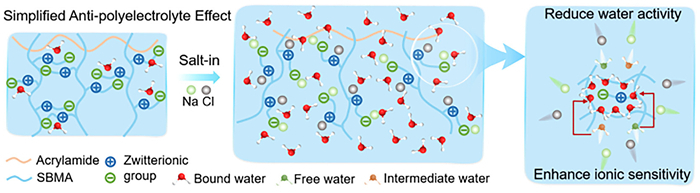
Figure 1.
Schematic illustration of the simplified APE.


Zwitterionic hydrogels are a kind of three-dimensional network structure material formed by chemical or physical crosslinking of zwitterionic polymer. Their polymer chains contain an equal amount of positive and negative charge groups, which is electrically neutral as a whole. Zwitterionic hydrogels are widely used in the fields of biomedical [1–5], environmental protection [6–9], energy and flexible electronics [10–13] due to their outstanding hydrophilicity, ionic conductivity, remarkable biocompatibility and antifouling performance, multi-functional integration characteristics. However, the zwitterionic hydrogels usually contain a large amount of active water and are inevitably frozen at low temperatures, resulting in a sharp decline in their mechanical properties and electrical conductivity, which greatly limits their application, especially in the fields of energy and flexible electronics. It is necessary that the energy storage or electronic devices based on zwitterionic hydrogels have low temperature resistance, because such devices usually need to work normally in cold weather. Therefore, it is urgent to improve the freezing resistance of zwitterionic hydrogels.
The common strategy is to introduce some organic compounds, such as ethylene glycol [14,15], glycerin [16], dimethyl sulfoxide [17] and acetonitrile [18], into the hydrogels to replace some water to form a zwitterionic hydrogels of organic system. However, most organic hydrogels have the issues of toxicity, flammability, high cost, and require complex preparation processes. In addition, adding high concentrations of inorganic salts as anti-freezing agents is also a general strategy [19,20]. However, this strategy has some limitations and negative impacts. The main issues include strong corrosiveness and environmental pollution. Therefore, it is ideal to explore other green and feasible strategies to reasonably construct anti-freezing zwitterionic hydrogels without organic solvents, but it is still challenging. The unique properties of zwitterions, such as the anti-polyelectrolyte effect (APE), may be a breakthrough. APE refers to the phenomenon that ions from the solution, particularly counterions with opposite charges to those zwitterionic groups of the polymer chains, infiltrate the polymer network when zwitterionic hydrogels are soaked in a salt solution, leading to the volume expansion of hydrogel [21,22]. The permeation of these ions weakens or even disrupts the electrostatic interactions between the cationic and anionic groups within the polymer chains through a charge-shielding effect [23,24]. During the expansion process of polymer chains, more charged zwitterionic groups are exposed, which increases hydration by allowing these groups to establish strong hydrogen bonding with water molecules [25]. Thus, the stronger the APE of zwitterionic polymers, the higher the hydration capacity [26]. Therefore, theoretically, the APE can be used to reduce the freezing point of zwitterionic hydrogels. This strategy of utilizing the structural properties of zwitterionic materials without adding extra anti-freezing agents has never been reported before.
In this work, the unique APE of zwitterions is applied to regulate the freezing point of zwitterionic hydrogels for the first time. Sulfonic-based 2-(methacryloyloxy)ethyl dimethyl(3-sulfopropyl)-ammonium hydroxide (SBMA) and carboxylic-based 2-carboxy-N,N-dimethyl-N-(2′-methacryloyloxyethyl)ethanaminium inner salt (CBMA) zwitterionic monomers are selected as a proof of concept. Molecular dynamics simulations (MDS) show that the molecular chains of polymerized SBMA (PSBMA) self-associate in water but the PSBMA exhibits a strong APE in NaCl salt, causing polymer molecular chains to transition from a self-associated state to a dispersed state. The electrostatic attracted zwitterionic groups are exposed, thus increasing hydration by allowing these groups to establish strong hydrogen bonding with water molecules during the volume expansion process of zwitterionic polymer in salt. The activity of the water molecules is decreased in the hydrogel, so the freezing point of the hydrogel is reduced. This is the mechanism of the APE to regulate the freezing point of zwitterionic hydrogels. By contrast, as a control, the molecular chains of polymerized CBMA (PCBMA) are relatively dispersed in water and NaCl salt, with almost no APE, resulting in a higher water activity than PSBMA. The Raman fine spectra also confirm that the free water content in the PSBMA (18.1%) with strong APE is lower than that in the PCBMA (25.6%), and the bound water content in the PSBMA (35.1%) is higher than that in the PCBMA (29.6%) when PSBMA and PCBMA in NaCl salt. Benefitting from the strong APE, the freezing point of PSBMA hydrogel containing NaCl (−20.9 ℃) is significantly lower than that of PCBMA hydrogel (−12.4 ℃) containing NaCl.
Fig. 1 illustrates the simplified schematic of the APE and the spatial composition of hydrogel. First, the acrylamide and zwitterionic monomers (SBMA or CBMA) are chemically crosslinked respectively via the free radical polymerization, and these two crosslinked chains penetrate each other to form a polymer network of hydrogels. The polyacrylamide networks provide mechanical toughness and maintain the elasticity of hydrogels. Zwitterionic monomers (SBMA or CBMA) with the zwitterionic groups as the main component provide migration channels for the separated positive ion and negative ions under the application of an external electric field. The zwitterionic chains tend to self-associate forming aggregates in water due to the electrostatic attraction within or between the zwitterionic chains, resulting in structural collapse. When the zwitterionic chains are in NaCl salt solution, the salt ions shield the electrostatic attraction between anions and cations on the zwitterionic chains, leading to chain expansion. In this way, more zwitterionic groups transform from a self-association state to an exposed state, thereby hydrating unbound water molecules, causing greater water uptake. As typical zwitterionic monomers, SBMA and CBMA have similar structures but also differences. Both the SBMA and the CBMA possess trimethyl ammonium cations, but the SBMA has a sulfonic anion and the CBMA has a carboxylic anion (Figs. 2a and b). Besides, the number of methylene groups between the trimethyl ammonium and sulfonic groups in SBMA is 3, while the number of methylene groups between trimethylammonium and carboxyl groups in CBMA is 2. The differences in structure lead to differences in properties.
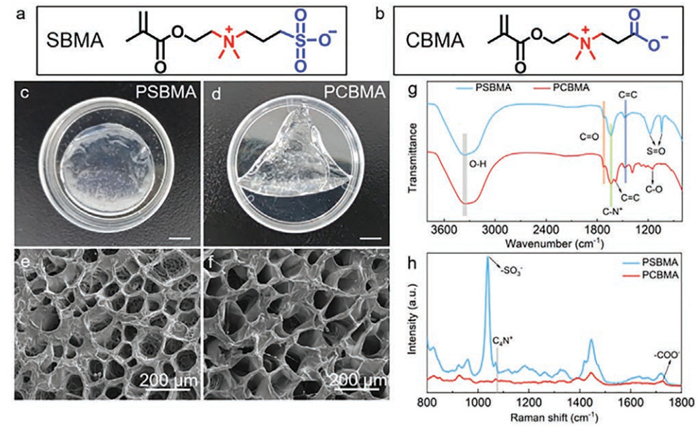
To study the APE, we first prepare PSBMA and PCBMA zwitterionic hydrogels without salt. The zwitterionic hydrogels are prepared by ultraviolet (UV) irradiation and the transparent hydrogels of arbitrary shape can be obtained (Figs. 2c and d). The morphology of the hydrogels after freeze-dried exhibits a hierarchically porous structure in the polymer matrix, confirming the formation of crosslinked networks. Scanning electron microscope (SEM) images show that the pore structure of the network skeleton of hydrogels is rich, and the pore size of PSBMA is slightly smaller than that of PCBMA (Figs. 2e and f), which may be due to the longer chain length of SBMA and the denser crosslinked network of the PSBMA. This helps PSBMA to gain greater water uptake. Fourier transform infrared (FTIR) is first applied to identify the composition of the hydrogels (Fig. 2g). For the collected spectral signals of PSBMA and PCBMA, the strong peaks at 3340–3377 cm−1 are linked to free O—H tensile vibration absorption [27]. The peaks at 1355–1438, 1639 and 1707 cm−1 belong to the stretching vibration of the C—N+ [28], the C=C and C=O groups [29], respectively. The characteristic peaks at 1044 and 1178 cm−1 are attributed to the S=O group of PSBMA and the peak located at 1723 cm−1 corresponds to the O—C=O group of PCBMA [27]. Furthermore, these characteristic peaks of PSBMA and PCBMA are also confirmed by Raman spectra (Fig. 2h). The strong and sharp peak at 1038 cm−1 corresponds to the symmetric stretching vibration of the sulfonic group (SO3−) in PSBMA [30]. The peak at 1725 cm−1 assigns to the symmetric stretching vibration of the carboxyl group (COO−) in PCBMA [31]. The peak at 1069 cm−1 indexes to the antisymmetric stretching of a cationic quaternary amine (C4N+), shared by PSBMA and PCBMA [30,32].
The salt-responsive properties of hydrogels are first investigated by testing the swelling behavior in water and salt solutions. Generally, zwitterionic hydrogels show ionic specificity, as revealed by the different water contents in 0.5 mol/L salt solutions with different cations and anions. The PSBMA and PCBMA hydrogels have their own ionic specificity for cations (Fig. 3a). The hydrogels are soaked in NaCl, KCl, MgCl2 and CaCl2 solutions with the same concentration, respectively. K+ contributes to higher water content as compared to Na+, Ca2+ and Mg2+ for the PCBMA. Nevertheless, Na+ contributes to highest water content among these cations for the PSBMA. Subsequently, the hydrogels are soaked in Na2SO4, NaBr, NaNO3 and NaCl solutions with the same concentration, respectively. For anions, the trend of ionic specificity of the two hydrogels is consistent, and Cl− endows the two hydrogels with the higher water content as compared to Br−, NO3− and SO42− (Fig. 3b). Thus, the salt-responsive behavior of zwitterionic hydrogels is closely related to the type of salt (i.e., different cations and anions). NaCl, as the most common salt for studying the salt-responsive behavior of zwitterionic polymers, is selected for the subsequent research. The salt concentration dependence of the water content is investigated first (Fig. 3c). Notably, the components of the hydrogel after adsorption equilibrium include polymer network, intrinsic water, adsorbed water and salt. The PCBMA has relatively high water content before immersion, but the water content gradually decreases as increasing NaCl concentration, which stems from that the proportion of adsorbed salt is higher than that of adsorbed water. Obviously, the water absorption of PCBMA in salt solution is not significant, indicating that salt-responsive behavior of PCBMA is not obvious. However, the water content of PSBMA increases after immersed in salt solution (0.2 and 0.5 mol/L) compared with that before immersion. The higher water content in NaCl solution indicated that the PSBMA possesses salt-responsive property and the proportion of water increase is more than that of salt. When the NaCl concentration is higher than 0.5 mol/L, the water content in the PSBMA gradually decreases as increasing NaCl concentration, which indicates that the proportion of water increase of PSBMA in these concentrations is not as large as that in 0.5 mol/L NaCl. This implies that NaCl effectively shields the electrostatic attraction between zwitterionic groups of PSBMA at a salt concentration of 0.5 mol/L, allowing the zwitterionic groups to be fully exposed and bound to water molecules, thus resulting in the highest water absorption. In other words, the APE of PSBMA is most significant at this concentration.
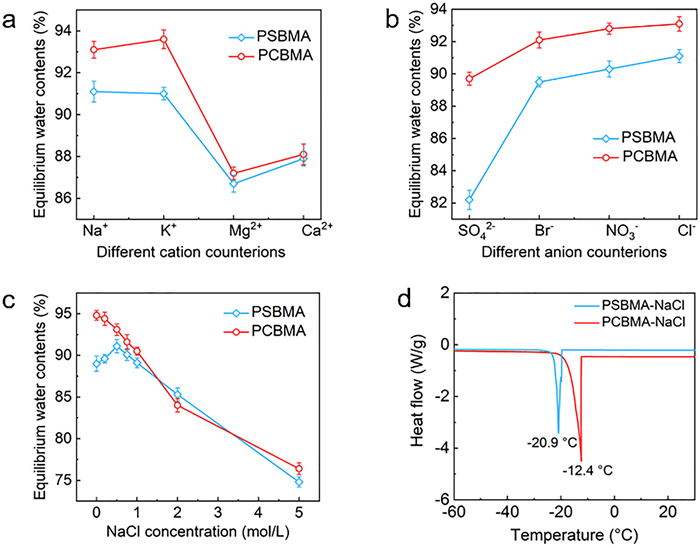
To verify the influence of the APE on the water activity of zwitterionic hydrogels, the zwitterionic hydrogels containing 0.5 mol/L NaCl (i.e., PSBMA-NaCl and PCBMA-NaCl) are subsequently prepared, with the same amount of water. Generally, the water in the hydrogels can be classified in the following three states: Free water, intermediate water and bound water [33]. The activity of water in the hydrogels can be assessed by differential scanning calorimetry (DSC) tests. A significantly lower freezing point is obtained for the PSBMA-NaCl (−20.9 ℃) compared to the PCBMA-NaCl (−12.4 ℃), confirming that the activity of water in the PSBMA-NaCl is lower than in the PCBMA-NaCl (Fig. 3d). This is due to the strong APE of PSBMA in the NaCl salt. The zwitterionic groups of polymer chains combine free/intermediate water and transform into bound water when exposed, increasing the proportion of bound water, thus reducing the overall water activity of the hydrogel. Besides, the PSBMA-NaCl hydrogel has an ionic conductivity of 75.9–11.4 mS/cm over a wide range of temperatures from 25 ℃ to −20 ℃ (Fig. S1 in Supporting information), higher than the PCBMA-NaCl (69.2–0.9 mS/cm) hydrogel, via the lower freezing point of PSBMA-NaCl hydrogel than the PCBMA-NaCl hydrogel.
Raman spectroscopy is used to further analyze the distribution of water in hydrogels. The Raman peak at 3236 cm−1 corresponds to the bound water, which is directly related to the hydration induced by ions (Na+ and Cl−) and the zwitterionic groups [25]. Besides, the peak of 3397 cm−1 is linked to the intermediate water that interacts weakly with the ions or polyacrylamide molecules [34]. Furthermore, the peak at 3498 cm−1 is associated with free water that is not bound by hydrogen bonding networks or hydration [35]. The relative content of free water in the PSBMA-NaCl (18.1%) is lower than that of the PCBMA-NaCl (25.6%), but the relative content of bound water (35.1%) in the PSBMA-NaCl is higher than that of the PCBMA-NaCl (29.6%) (Figs. 4a-c), which implies partial free water and intermediate water are transformed into bound water in the PSBMA-NaCl. This result demonstrates the activity of water in the PSBMA-NaCl is significantly lower than that in the PCBMA-NaCl. Besides, FTIR spectra also verifies this (Fig. 4d). These results demonstrate that the APE of hydrogel is stronger, the activity of water in the hydrogel is lower, which renders the freezing point of hydrogel lower and is consistent with the results of DSC test.

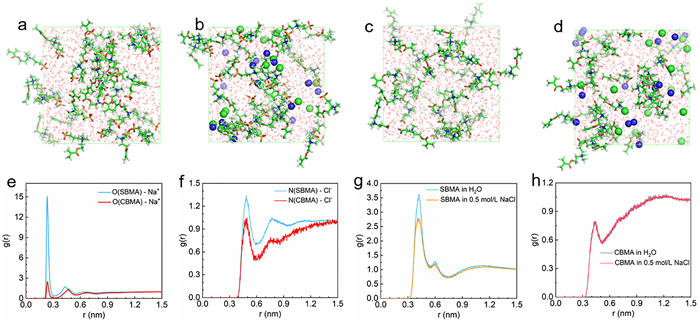
The calculation of the charge density of the cationic and anionic groups in SBMA and CBMA can prove their self-association state in water (Table S1 in Supporting information). Compared to CBMA, SBMA has a more symmetrical charge distribution and closer charge density of its cationic and anionic groups, which is more conducive to the formation of stable intramolecular ion pairs or intermolecular associated structures, thereby reducing system energy and promoting self-association [36]. The effect of NaCl on the spatial distribution of zwitterionic chains in water or salt is confirmed through MDS. 3D snapshot for the system of SBMA in water obtained from MDS shows a self-association state (Fig. 5a), while the proportion of self-association of SBMA decreases and the dispersibility of SBMA improves after the introduction of NaCl (Fig. 5b), proving the salt-responsive behavior of SBMA. On the contrary, the 3D snapshot for the system of CBMA in water presents a relatively dispersed state (compared to SBMA) (Fig. 5c), and almost no significant changes in dispersibility are observed after the introduction of NaCl (Fig. 5d), which also implies that the response of CBMA to NaCl is not obvious. The obtained radial distribution functions (RDFs) once again validate the salt-responsive behavior of SBMA and CBMA. The higher peak values in Figs. 5e and f indicate that SBMA has a stronger interaction with Na+ and Cl‒ ions compared to CBMA, laying the foundation for its strong APE. Additionally, the RDFs stemmed from SBMA indicate the self-association of SBMA in NaCl is significantly weakened compared to in water (Fig. 5g), which confirms that SBMA transforms from its original self-associating state to a dispersed state. This means that more zwitterionic groups are exposed, more unbound water molecules are hydrated, and the activity of water is reduced, which also reveals the mechanism of APE regulating the freezing point of PSBMA. In contrast, the RDFs originated from CBMA in NaCl or water show almost no change (Fig. 5h), demonstrating the CBMA hardly responses to NaCl. These results provide a theoretical basis for how APE regulates the freezing point of zwitterionic hydrogels, not limited to the PSBMA.
In summary, the APE of zwitterions was used to regulate the freezing point of zwitterionic hydrogel in this work for the first time. Sulfonic-based SBMA and carboxylic-based CBMA zwitterionic hydrogels were prepared, and their ion specificity and salt-responsive properties were studied. PSBMA exhibited strong APE in NaCl, while PCBMA showed almost no response to NaCl. Benefiting from the strong APE of SBMA, the proportion of free water in PSBMA is lower, while the proportion of bound water is higher compared to PCBMA. Therefore, the overall water activity is lower than PCBMA, which endues PSBMA with a lower freezing point. MDS revealed the mechanism of APE regulating the freezing point of zwitterionic hydrogel, that is, in NaCl salt, the zwitterionic groups exposed from the original self-association state, thus increasing hydration by allowing these groups to establish strong hydrogen bonding with water molecules during the volume expansion process of zwitterionic polymer in salt. The overall water activity is decreased in the hydrogels. This work provides profound and meaningful guidance for the development of the anti-freezing zwitterionic hydrogels.
Juan Zeng: Writing – review & editing, Writing – original draft, Methodology, Investigation, Funding acquisition, Formal analysis, Data curation, Conceptualization.
The authors declare that they have no known competing financial interests or personal relationships that could have appeared to influence the work reported in this paper.
This work was supported by the National Natural Science Foundation of China (No. 22409156) and the Natural Science Foundation of Hubei Province (No. 2024AFB250).
Supplementary material associated with this article can be found, in the online version, at doi:
L. Gao, A. Varley, H. Gao, et al., Langmuir 41 (2025) 3007–3026. doi: 10.1021/acs.langmuir.4c04788
Z. Wang, X. Liu, M. Zhu, et al., J. Mater. Chem. A 13 (2025) 13693–13705. doi: 10.1039/d5ta01111f
S. Moayedi, W. Xia, L. Lundergan, et al., Langmuir 40 (2024) 23125–23145. doi: 10.1021/acs.langmuir.4c02664
Y. Sun, Y. Zhu, J. Si, et al., Chin. Chem. Lett. 36 (2025) 110012. doi: 10.1016/j.cclet.2024.110012
S. Chen, R. Zhao, L. Dong, et al., Chin. Chem. Lett. 36 (2025) 111647. doi: 10.1016/j.cclet.2025.111647
D. Gokhale, A.F. Hamelberg, P.S. Doyle, Nat. Water 2 (2024) 62–71. doi: 10.1038/s44221-023-00180-8
K. Wu, X. Guo, J. Feng, et al., Gels 11 (2025) 587. doi: 10.3390/gels11080587
B. Song, E. Zhang, Y. Shi, et al., ACS Appl. Mater. Interfaces 16 (2024) 27908–27916. doi: 10.1021/acsami.4c02574
Y. Fu, X. Wang, S. Li, et al., Chin. Chem. Lett. 37 (2026) 111991. doi: 10.1016/j.cclet.2025.111991
X. Zhou, B. Nie, R. Hu, et al., Chin. Chem. Lett. (2026), doi: 10.1016/j.cclet.2026.112547.
J. Zheng, J. Liang, J. Xu, et al., Chem. Eng. J. 508 (2025) 161021. doi: 10.1016/j.cej.2025.161021
X. Zou, L. Mei, Q. Liu, et al., ACS Appl. Polym. Mater. 7 (2025) 8065–8080. doi: 10.1021/acsapm.5c01145
G. Wang, H. Ni, Y. Li, et al., Adv. Funct. Mater. 35 (2025) 2505048. doi: 10.1002/adfm.202505048
J. Wang, Y. Huang, B. Liu, et al., Energy Storage Mater. 41 (2021) 599–605. doi: 10.1016/j.ensm.2021.06.034
Q.J. Fu, S.W. Hao, X.R. Zhang, et al., Energy Environ. Sci. 16 (2023) 1291–1311. doi: 10.1039/d2ee03793a
D. Han, Y. Cai, X. Wang, et al., Adv. Funct. Mater. 35 (2025) 2501362. doi: 10.1002/adfm.202501362
Z.J. Chen, T.Y. Shen, M.H. Zhang, et al., Adv. Funct. Mater. 34 (2024) 2314864. doi: 10.1002/adfm.202314864
X.P. Morelle, W.R. Illeperuma, K. Tian, et al., Adv. Mater. 30 (2018) 1801541. doi: 10.1002/adma.201801541
R. Gao, J. Wang, Y. Song, et al., Adv. Funct. Mater. 36 (2025) e14585.
L.X. Hou, H. Ju, X.P. Hao, et al., Adv. Mater. 35 (2023) 2300244. doi: 10.1002/adma.202300244
S. Xiao, Y. Zhang, M. Shen, et al., Langmuir 34 (2018) 97–105. doi: 10.1021/acs.langmuir.7b03667
M.G. Petroff, E.A. Garcia, M. Herrera-Alonso, et al., Langmuir 35 (2019) 4976–4985. doi: 10.1021/acs.langmuir.9b00218
S. Hou, Y. Liu, J. Yan, et al., Macromol. Chem. Phys. 226 (2025) e00106. doi: 10.1002/macp.202500106
K.T. Huang, K. Ishihara, C.J. Huang, Biomacromolecules 20 (2019) 3524–3534. doi: 10.1021/acs.biomac.9b00796
J. Zeng, H. Chen, L. Dong, et al., Adv. Funct. Mater. 34 (2024) 2314651. doi: 10.1002/adfm.202314651
W. Choi, S. Park, J.S. Kwon, et al., ACS Nano 15 (2021) 6811–6828. doi: 10.1021/acsnano.0c10431
J. Zeng, H. Chen, L. Dong, et al., J. Colloid Interface Sci. 652 (2023) 856–865. doi: 10.1016/j.jcis.2023.08.037
Y.N. Chou, M.Z. Ou, ACS Appl. Polym. Mater. 5 (2023) 5411–5428. doi: 10.1021/acsapm.3c00762
R. Lalani, L. Liu, Polymer 52 (2011) 5344–5354. doi: 10.1016/j.polymer.2011.09.015
K. Sivashanmugan, P.C. Liu, K.W. Tsai, et al., Nanoscale 9 (2017) 2865–2874. doi: 10.1039/C6NR08077D
C. Li, W. Zhu, Y. Ma, et al., Anal. Bioanal. Chem. 416 (2024) 4849–4860. doi: 10.1007/s00216-024-05429-z
S. Mai, X. Yao, C. Li, et al., Biomacromolecules 24 (2023) 2392–2405. doi: 10.1021/acs.biomac.3c00247
X. Zhou, Y. Guo, F. Zhao, et al., Adv. Mater. 32 (2020) 2007012. doi: 10.1002/adma.202007012
D. Li, Z. Zhu, D.W. Sun, Analyst 145 (2020) 897–907. doi: 10.1039/c9an01743g
W. Hu, Y. Luo, E. Zhu, et al., Adv. Sustain. Syst. 8 (2024) 2400387. doi: 10.1002/adsu.202400387
Q. Shao, S. Jiang, Adv. Mater. 27 (2015) 15–26. doi: 10.1002/adma.201404059

Figure 2 The structural formulas of (a) SBMA and (b) CBMA. Optical picture of prepared hydrogels with arbitrary shape: (c) PSBMA and (d) PCBMA. Scale bar: 1 cm. SEM image of the freeze-dried (e) PSBMA and (f) PCBMA hydrogels. (g) FTIR and (h) Raman spectra of PSBMA and PCBMA.

Figure 3 Equilibrium water content of the PSBMA and PCBMA hydrogels in (a) 0.5 mol/L salt solutions with various cations, (b) 0.5 mol/L salt solutions with various anions, (c) NaCl solutions with different concentrations. (d) DSC curves of PSBMA-NaCl and PCBMA-NaCl hydrogels.

Figure 4 The Raman fine spectra of (a) PSBMA and (b) PCBMA hydrogels. (c) The area ratio summaries of the bound, intermediate, and free water in the PSBMA and the PCBMA hydrogels. (d) FTIR spectra of the PSBMA and the PCBMA hydrogel.

Figure 5 Snapshots of MDS systems for the SBMA molecules: (a) Water and (b) 0.5 mol/L NaCl solution. Snapshots of MDS systems for the CBMA molecules: (c) Water and (d) 0.5 mol/L NaCl solution. (e) RDFs between the oxygen atoms of sulfonic and carboxylic groups with Na+. (f) RDFs between nitrogen atoms of trimethyl ammonium groups with Cl‒. RDFs between nitrogen atoms and oxygen atoms of the (g) SBMA and (h) CBMA in water and 0.5 mol/L NaCl solution.

 扫一扫看文章


扫一扫关注我们
 DownLoad:

 下载:
下载:
 下载:
下载: