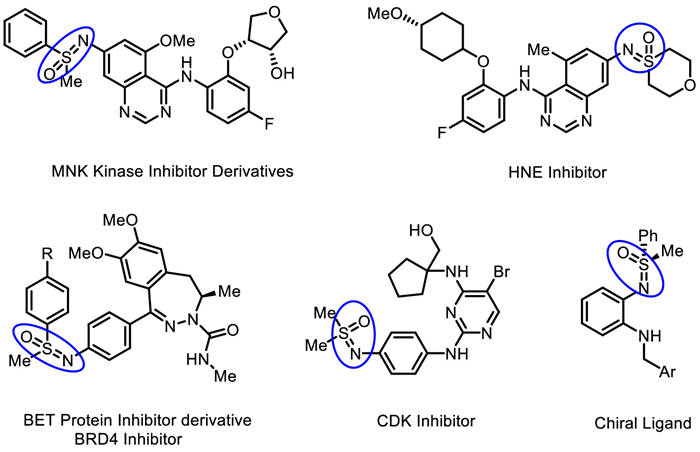
Figure 1.
Selected examples of bioactive sulfoximines.

N-Arylation of NH-sulfoximines with thianthrenium salts via visible-light/copper catalysis
Yuqing Zhao , Xianjin Zhu , Fengkai Yu , Lingyu Shi , Zihan Xu , Jian Lv , Yongjia Shi , Xufeng Li , Daoshan Yang


Sulfoximines, the aza-analogues of sulfones, have gained significant attention in synthetic and medicinal chemistry due to their unique properties and broad applications (Fig. 1) [1-8]. Their chiral sulfur center makes them useful as building blocks, chiral auxiliaries, and ligands in asymmetric catalysis [9-19]. Additionally, their structural similarity to sulfones, combined with their nitrogen functionality, enhances their stability and reactivity, making them valuable in drug development and agrochemicals [20-24]. Recently, sulfoximines have emerged as key scaffolds in drug discovery, and several derivatives based on this structure are in the clinical trial stage [25-27]. A key structural advantage lies in the ease of modifying their properties, especially through N-arylation [28-31]. Consequently, the development of efficient and broadly applicable methods for the synthesis of N-aryl sulfoximines remains an important objective in modern synthetic chemistry.
Since the seminal work by Bolm and Hildebrand on the palladium-catalyzed N-arylation of sulfoximines with aryl bromides [32], a variety of transition-metal-catalyzed methods for N-arylation have been developed (Scheme 1A) [7,8,27,33-39]. These approaches primarily rely on preactivated aryl coupling partners, including aryl nucleophiles and related aryl electrophiles, and typically require elevated temperatures, special ligands, or high catalyst loadings. Despite considerable progress, most of these methods remain sensitive to the electronic properties of the aryl moiety, making them difficult to be used for the synthesis of a wide variety of N-aryl sulfoximines. While alternative coupling strategies employing boronic acids provide milder reaction conditions and broad substrate scope [40,41], there still remains a challenge need to develop direct and general methods that can circumvent these electronic constraints, particularly for the late-stage diversification of drug-like scaffolds.
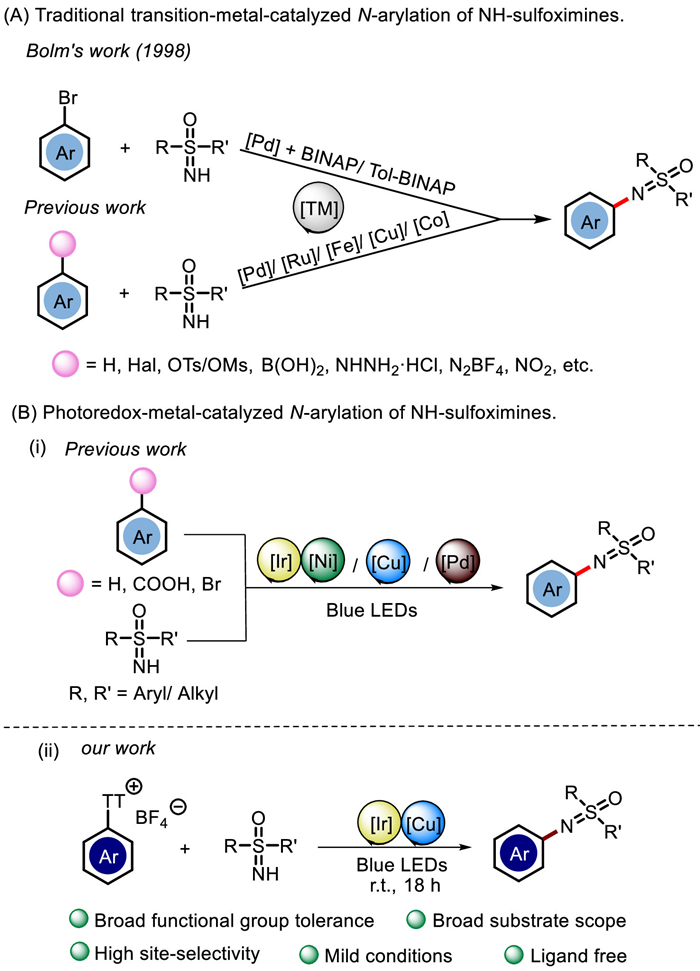
As a highly renewable energy source, visible light, has been widely regarded as an ideal promoter in organic synthetic chemistry [42-55]. Recent developments in photoredox catalysis have opened new avenues for C—N bond formation (Scheme 1B(ⅰ)) [56-59]. In 2019, König et al. reported a dual Ni/Ir catalytic system that enabled the coupling of sulfoximines with aryl halides under mild conditions [60]. Prior to this work, the groups of König and Meier independently demonstrated the direct C—H/N—H dehydrogenative cross-coupling of sulfoximines with electron-rich arenes [61,62]. In 2023, Ritter and co-workers developed a copper-mediated ligand-to-metal charge transfer (LMCT) strategy that, for the first time, enables the use of arenes and benzoic acids with diverse electronic properties as aryl donors [63,64], albeit at the expense of requiring stoichiometric amounts of copper salts and ligands. In 2025, Kuniyil and Roy reported a visible-light-induced palladium-catalyzed N-arylation reaction between aryl bromides and sulfoximines [65]. Despite these advances, most of these methods suffer from some limitations such as inaccessible starting materials, toxic metal salt catalysts, and relatively harsh reaction conditions.
Aryl thianthrenium salts display excellent thermal and air stability and can be synthesized under mild conditions with high regioselectivity [66-73], which are widely recognized as versatile aryl radical precursors in organic synthesis [74-95]. As a result, aryl thianthrenium salts provide a unified platform for engaging both electron-rich and electron-deficient aromatic systems under photoredox conditions. Note that when this article was being prepared, Wang et al. reported a nickel/photoredox-catalyzed N-arylation of sulfoximines using aryl thianthrenium salts, providing an efficient strategy for C—N bond formation on sulfoximines [96]. However, in this nickel-catalyzed system, aliphatic sulfoximines remain challenging coupling partners, and the strategy still requires the use of stoichiometric amounts of organic bases and toxic amide solvents. Therefore, developing a complementary strategy that can efficiently couple aliphatic sulfoximines under milder and more economical conditions holds significant research value. In addition, photoredox-enabled N-arylation of sulfoximines employing aryl thianthrenium salts remains relatively underexplored, and the substrate scope, particularly with respect to long-chain aliphatic sulfoximines, is still limited. Inspired by the previous work and with our continuing studies on photochemical reactions [97-105], we herein report a photoredox/copper dual catalytic system that enables the N-arylation of both aliphatic and aromatic sulfoximines using aryl thianthrenium salts as aryl radical precursors, thereby providing a valuable complement to existing N-arylation strategies (Scheme 1B(ⅱ)). Compared with the LMCT strategy that requires stoichiometric amounts of copper salts, this method only uses catalytic amounts of copper salts, thereby reducing costs and environmental impacts, while enhancing the economic efficiency and sustainability of the reaction [64].
Initially, biphenyl-derived thianthrenium salt 1a and S-methyl-S-phenylsulfoximine 2a were chosen as the model substrates to optimize the reaction conditions, including the photocatalysts, copper salts, bases and solvents. As shown in Table 1, after a series of systematic screenings of reaction parameters, an N-arylation reaction was achieved to deliver the expected N-aryl sulfoximines 3a in 67% yield using fac-Ir(ppy)3/Cu(CH3CN)4PF6 as photoredox/copper dual catalytic system (Table 1, entry 1, see Supporting information for more details). Subsequently, results of experiments revealed that other photocatalysts such as Na2-EosinY, Pyrene, 4CzIPN led to the decreased yield of 3a (Table 1, entry 2, see Supporting information for more details). In comparison to other copper salts, such as CuBr and Cu(OTf)2, Cu(MeCN)4PF6 was the best choice for this transformation (Table 1, entry 3, see Supporting information for more details). Next, other commonly used bases were investigated and K3PO4 was found to be the best (Table 1, entry 4, see Supporting information for more details). Replacing dimethyl carbonate (DMC) with other solvents led to inferior yields (Table 1, entry 5, see Supporting information for more details). Control experiments indicated that photocatalysts, copper salts and light irradiation are essential factors for the reaction (Table 1, entries 6, 7 and 8). In the absence of a base, the yield of the product was significantly decreased (Table 1, entry 9). It was noteworthy that the reaction performance is relatively poor when only [(rac-BINAP)Cu(MeCN)]PF6 was used as the photocatalyst (Table 1, entry 10).
 DownLoad:
CSV
 |
||
| Entry | Variations from standard conditions | Yield (%) b |
| 1 | None | 67 |
| 2 | Photocatalysts other than A | N.R.c to 13 |
| 3 | Copper other than Cu(CH3CN)4PF6 | N.R. to 56 |
| 4 | Bases other than K3PO4 | N.R. to 62 |
| 5 | Solvents other than DMC | N.R. to 56 |
| 6 | No blue LED irradiation | N.R. |
| 7 | No photocatalyst | Trace |
| 8 | No Copper | Trace |
| 9 | No base | 50 |
| 10 | Only [(rac-BINAP)Cu(MeCN)]PF6 as photocatalyst (20.0 moL%) | 20 |
| a Reaction conditions: 1a (0.2 mmol), 2a (0.3 mmol), photocatalyst (2.0 mol%), copper (50.0 mol%), base (2.0 equiv.) and solvent (2.0 mL) at room temperature under irradiation with a 25 W blue LED (455 nm) for 18 h. b Isolated yield. c N.R. = no reaction. |
||
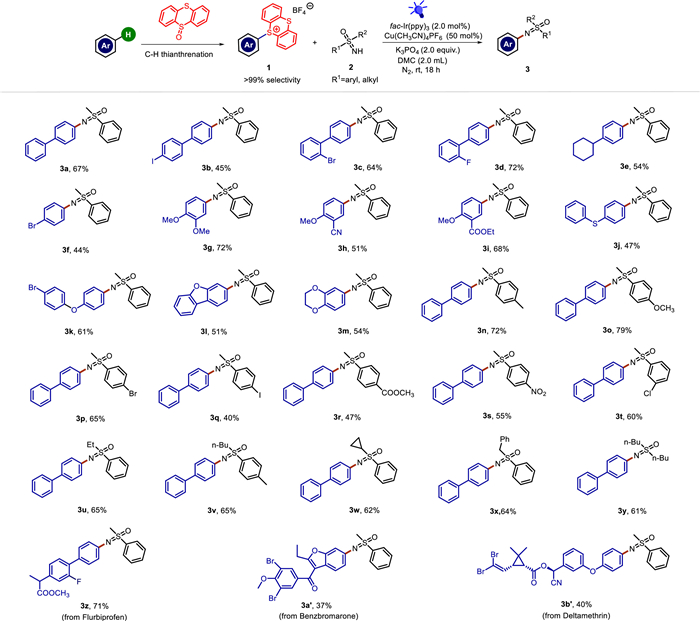
With the optimum reaction conditions in hand (Table 1, entry 1), we explored the synthetic potential of this photoredox/copper-catalyzed strategy for the synthesis of N-aryl sulfoximines. As shown in Scheme 2, we were pleased to find that diverse substituted aryl thianthrenium salts 1, which were directly synthesized from a broad range of arenes, reacted efficiently with sulfoximines 2, delivering the N-aryl sulfoximines 3 in good to excellent yields. Both electron-donating and electron-withdrawing groups on the aromatic ring were well tolerated, affording the desired products in moderate to good yields (3a−3i). Steric effects had little influence on this transformation, as aryl thianthrenium salts bearing substituents at various positions reacted efficiently with sulfoximines (3g-3i). Halogen atoms (I, Br, F) (3b-3d) and sensitive functional groups, including cyano (3h) and ester (3i), were well tolerated, providing opportunities for further functionalization. Moreover, heteroatom-containing aryl thianthrenium salts were smoothly converted into the corresponding products in 47%−61% yields (3j-3m). On the other hand, a broad range of sulfoximines were suitable for this transformation, delivering the desired products in moderate to good yields (3n-3y). Both strong electron-withdrawing groups (NO2) (3s) and Halogen atoms (Br, I, Cl) (3p, 3q, 3t), as well as strong electron-donating groups (OCH3) (3o), were well tolerated under the reaction conditions. In addition, substrates bearing diverse alkyl or cyclic substituents on the sulfoximines, including ethyl, n–butyl, and cyclopropyl groups, also furnished the corresponding products in comparable efficiencies (3u-3w). Even bulky substituents such as n–butyl (3v), cyclopropyl (3w) and benzyl (3x) showed good reactivity, highlighting the excellent steric tolerance of this protocol. To our delight, aliphatic sulfoximines were also compatible, demonstrating the excellent compatibility of this method with structural diversity (3y). It was noteworthy that this protocol enabled late-stage functionalization of complex bioactive molecules, including flurbiprofen, benzbromarone, and deltamethrin (3z-3b'), underscoring its potential for the modification of pharmaceutically relevant scaffolds.
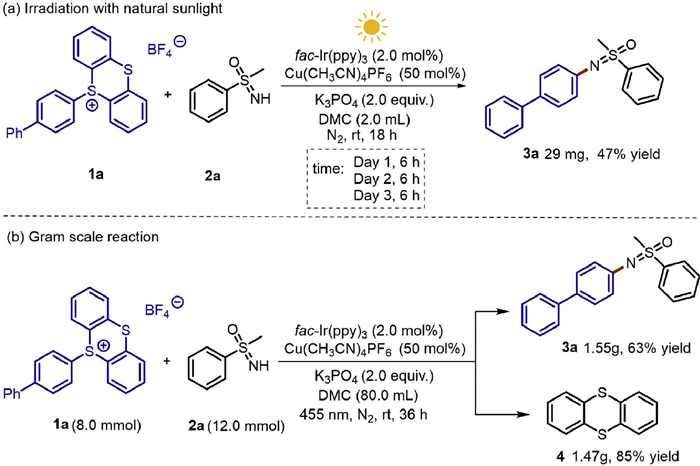
The synthetic applicability of this photoredox/copper-catalyzed strategy was further demonstrated. Natural sunlight could effectively promote the present transformation, delivering the desired product in 47% yield after 18 h of exposure (Scheme 3a). In addition, we conducted a scale-up experiment by using thianthrenium salt 1a and sulfoximine 2a under irradiation of two 25 W blue LED lamps, and the product 3a was obtained in 63% yield (Scheme 3b). Notably, thianthrene 4 was recovered in high yield, which could be used for further synthesis of thianthrenium salts. The experimental result highlights the practical potential of the present reaction protocol.
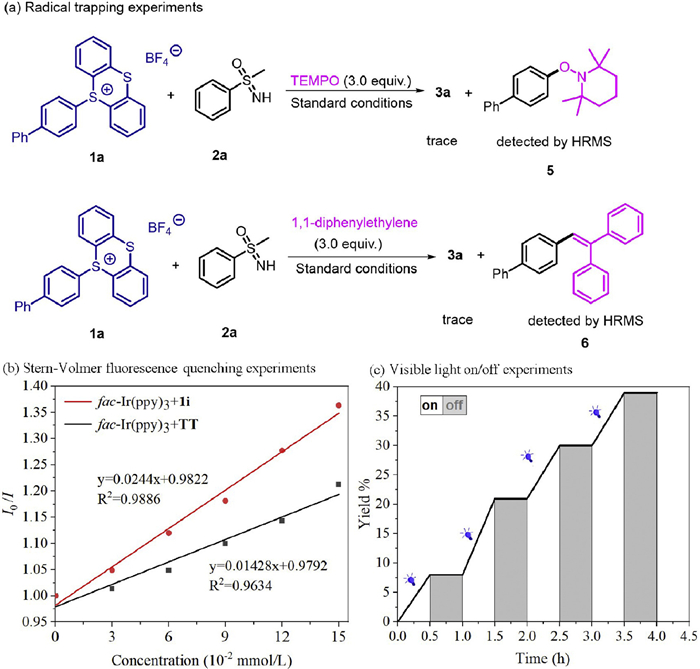
To gain mechanistic insights into this N-arylation reaction, a series of mechanistic studies were performed (Scheme 4). Two radical trapping experiments were conducted to investigate the mechanism (Scheme 4a). Upon the addition of (2,2,6,6-tetramethylpiperidin-1-yl)oxidanyl (TEMPO) or 1,1-diphenylethylene under the standard conditions, these transformations were significantly suppressed, and the corresponding radical trapping intermediates 5 and 6 were detected by HRMS, respectively, which implied that the present reaction might proceed via a radical pathway (see Supporting information for details). Stern-Volmer fluorescence quenching experiments revealed that the excited state of fac-Ir(ppy)3 is efficiently quenched by aryl thianthrenium salts 1i, whereas thianthrene (TT) exhibits a much weaker quenching effect. These results indicate a strong interaction between the excited fac-Ir(ppy)3 and the aryl thianthrenium salt (Scheme 4b, see Supporting information for details). Finally, an on/off experiment (Scheme 4c) and the calculation of the apparent quantum yield (455 nm) value (AQY) for the model reaction (see Supporting information for more details) suggested that the present transformation was not a radical-chain process.
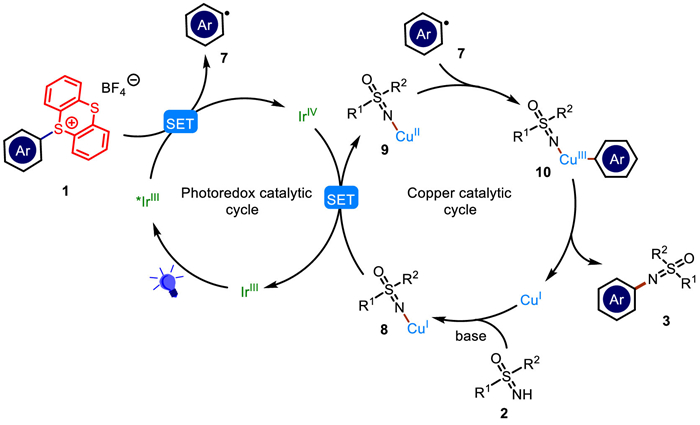
On the basis of the above mechanistic studies and previous reports [106-114], a plausible mechanism is proposed in Scheme 5. Initially, photoactivation of Ir(Ⅲ) with blue LEDs (455 nm) forms the excited Ir(Ⅲ)*, which reduces aryl thianthrenium salts 1 via single-electron transfer (SET) process to yield an aryl radical 7 and an Ir(Ⅳ) species. Concurrently, in the presence of a base, a Cu(Ⅰ) salt reacts with a sulfoximine to generate a Cu(Ⅰ) complex 8. This complex is subsequently oxidized by the Ir(Ⅳ) species through another SET process to afford a Cu(Ⅱ) complex 9 and regenerate the Ir(Ⅲ) catalyst. Intermediate 9 then associates with aryl radical 7 to form a Cu(Ⅲ) complex 10, which undergoes reductive elimination to deliver the final N-arylated product 3.
In summary, we have developed a photoredox/copper cooperatively catalyzed system that enables the direct N-arylation of aliphatic or aromatic sulfoximines with aryl thianthrenium salts, providing a modular strategy for the construction of multifunctional N-aryl sulfoximines. This transformation proceeds under mild conditions and exhibits broad substrate scope, excellent functional group tolerance, and high levels of chemoselectivity. Moreover, the protocol is applicable to the late-stage N-arylation of structurally complex bioactive molecules. Mechanistic studies suggest that the reaction likely proceeds through a radical pathway, with aryl thianthrenium salts serving as aryl radical precursors. This strategy is expected to serve as a valuable complement to established N-arylation methods with broad potential in organic synthesis and medicinal chemistry.
Yuqing Zhao: Methodology, Investigation, Formal analysis. Xianjin Zhu: Methodology, Investigation. Fengkai Yu: Methodology, Data curation. Lingyu Shi: Data curation. Zihan Xu: Software, Resources. Jian Lv: Resources, Methodology. Yongjia Shi: Validation. Xufeng Li: Writing – original draft, Supervision. Daoshan Yang: Writing – review & editing, Investigation, Conceptualization.
The authors declare that they have no known competing financial interests or personal relationships that could have appeared to influence the work reported in this paper.
We acknowledge the financial support from the National Natural Science Foundation of China (No. 22271170), the Taishan Scholars Program from Shandong Province (No. tsqn202408197), the Natural Science Foundation of Shandong Province (No. ZR2024QB154) and the Scientific Research Foundation of Qingdao University of Science and Technology.
Supplementary material associated with this article can be found, in the online version, at doi:
M. Reggelin, C. Zur, Synthesis 2000 (2000) 1–64.
M.L.G. Borst, C.M.J. Ouairy, S.C. Fokkema, et al., ACS Comb. Sci. 20 (2018) 335–343. doi: 10.1021/acscombsci.7b00150
Y. Zhu, M.R. Loso, G.B. Watson, et al., J. Agric. Food Chem. 59 (2011) 2950–2957. doi: 10.1021/jf102765x
S.J. Park, H. Baars, S. Mersmann, et al., ChemMedChem 8 (2013) 217–220. doi: 10.1002/cmdc.201200403
O. García Mancheño, C. Bolm, Org. Lett. 9 (2007) 2951–2954. doi: 10.1021/ol071302+
D. Liu, Z.R. Liu, C. Ma, et al., Angew. Chem. Int. Ed. 60 (2021) 9444–9449. doi: 10.1002/anie.202016310
L. Yang, W. Chen, Org. Lett. 27 (2025) 9721–9726. doi: 10.1021/acs.orglett.5c02971
S. Baranwal, J. Kandasamy, Tetrahedron Lett. 61 (2020) 152079. doi: 10.1016/j.tetlet.2020.152079
S. Otocka, M. Kwiatkowska, L. Madalińska, et al., Chem. Rev. 117 (2017) 4147–4181. doi: 10.1021/acs.chemrev.6b00517
X. Shen, W. Miao, C. Ni, et al., Angew. Chem. Int. Ed. 53 (2014) 775–779. doi: 10.1002/anie.201308484
M. Langner, P. Rémy, C. Bolm, Chem. Eur. J. 11 (2005) 6254–6265. doi: 10.1002/chem.200500497
M.T. Reetz, O.G. Bondarev, H.J. Gais, et al., Tetrahedron Lett. 46 (2005) 5643–5646. doi: 10.1016/j.tetlet.2005.06.107
M. Frings, I. Thomé, I. Schiffers, et al., Chem. Eur. J. 20 (2014) 1691–1700. doi: 10.1002/chem.201304331
C.R. Johnson, Acc. Chem. Res. 6 (1973) 341–347. doi: 10.1021/ar50070a003
S. Koep, H.J. Gais, G. Raabe, J. Am. Chem. Soc. 125 (2003) 13243–13251. doi: 10.1021/ja030324y
M. Harmata, X. Hong, J. Am. Chem. Soc. 125 (2003) 5754–5756. doi: 10.1021/ja034744z
C. Bolm, O. Simić, J. Am. Chem. Soc. 123 (2001) 3830–3831. doi: 10.1021/ja004261k
M. Langner, C. Bolm, Angew. Chem. Int. Ed. 43 (2004) 5984–5987. doi: 10.1002/anie.200460953
C. Moessner, C. Bolm, Angew. Chem. Int. Ed. 44 (2005) 7564–7567. doi: 10.1002/anie.200502482
V. Pandya, M. Jain, G. Chakrabarti, et al., Eur. J. Med. Chem. 58 (2012) 136–152. doi: 10.1016/j.ejmech.2012.10.005
G.C. Nandi, P.I. Arvidsson, Adv. Synth. Catal. 360 (2018) 2976–3001. doi: 10.1002/adsc.201800273
V.R. Padma Priya, K. Natarajan, G.C. Nandi, Tetrahedron 111 (2022) 132711. doi: 10.1016/j.tet.2022.132711
U. Lücking, Angew. Chem. Int. Ed. 52 (2013) 9399–9408. doi: 10.1002/anie.201302209
P. Mäder, L. Kattner, J. Med. Chem. 63 (2020) 14243–14275. doi: 10.1021/acs.jmedchem.0c00960
Y. Han, K. Xing, J. Zhang, et al., Eur. J. Med. Chem. 209 (2021) 112885. doi: 10.1016/j.ejmech.2020.112885
J.A. Sirvent, U. Lücking, ChemMedChem 12 (2017) 487–501. doi: 10.1002/cmdc.201700044
N.B. Rathod, R.N. Patel, S.D. Patel, et al., J. Org. Chem. 89 (2024) 18436–18444. doi: 10.1021/acs.joc.4c02318
M. Frings, C. Bolm, A. Blum, et al., Eur. J. Med. Chem. 126 (2017) 225–245. doi: 10.1016/j.ejmech.2016.09.091
H.J. Lim, W.H. Lee, S.J. Park, Molecules 24 (2019) 3451. doi: 10.3390/molecules24193451
U. Lücking, Chem. Eur. J. 28 (2022) e202201993. doi: 10.1002/chem.202201993
M. Malik, D. Kumar, H. Lotana, et al., Bioorg. Med. Chem. 93 (2023) 117459. doi: 10.1016/j.bmc.2023.117459
C. Bolm, J.P. Hildebrand, Tetrahedron Lett. 39 (1998) 5731–5734. doi: 10.1016/S0040-4039(98)01199-X
L. Wang, D.L. Priebbenow, W. Dong, et al., Org. Lett. 16 (2014) 2661–2663. doi: 10.1021/ol500963p
N. Yongpruksa, N.L. Calkins, M. Harmata, Chem. Commun. 47 (2011) 7665. doi: 10.1039/c1cc12444g
C. Bolm, J.P. Hildebrand, J. Org. Chem. 65 (2000) 169–175. doi: 10.1021/jo991342u
G.Y. Cho, P. Rémy, J. Jansson, et al., Org. Lett. 6 (2004) 3293–3296. doi: 10.1021/ol048806h
J. Sedelmeier, C. Bolm, J. Org. Chem. 70 (2005) 6904–6906. doi: 10.1021/jo051066l
Q. Yang, P.Y. Choy, Q. Zhao, et al., J. Org. Chem. 83 (2018) 11369–11376. doi: 10.1021/acs.joc.8b01599
W. Dong, C. Liu, X. Ma, et al., Tetrahedron 75 (2019) 3886–3893. doi: 10.1016/j.tet.2019.05.039
C. Moessner, C. Bolm, Org. Lett. 7 (2005) 2667–2669. doi: 10.1021/ol050816a
S. Gupta, S. Baranwal, N. Muniyappan, et al., Synthesis 51 (2019) 2171–2182. doi: 10.1055/s-0037-1612216
C.K. Prier, D.A. Rankic, D.W.C. MacMillan, Chem. Rev. 113 (2013) 5322–5363. doi: 10.1021/cr300503r
J.R. Chen, X.Q. Hu, L.Q. Lu, et al., Acc. Chem. Res. 49 (2016) 1911–1923. doi: 10.1021/acs.accounts.6b00254
H.C. Li, M. Zhang, Q. Lv, et al., Chin. Chem. Lett. 36 (2025) 110579. doi: 10.1016/j.cclet.2024.110579
C. Xin, J. Jiang, Z.W. Deng, et al., Acta Chim. Sin. 82 (2024) 1109. doi: 10.6023/A24100329
H.Y. Song, J. Jiang, C. Wu, et al., Green Chem. 25 (2023) 3292–3296. doi: 10.1039/D2GC04843D
J.C. Hou, J. Jiang, H. Dai, et al., Sci. China Chem. 68 (2025) 1945–1951. doi: 10.1007/s11426-024-2496-5
Y.Y. Zeng, J. Jiang, Y.C. Wen, et al., Chin. Chem. Lett. 37 (2026) 111776. doi: 10.1016/j.cclet.2025.111776
Q. Wu, D. Yang, Chin. J. Org. Chem. 44 (2024) 3571. doi: 10.6023/cjoc202400058
X.M. Chen, L. Song, J. Pan, et al., Chin. Chem. Lett. 35 (2024) 110112. doi: 10.1016/j.cclet.2024.110112
X.Y. Yuan, C.C. Wang, B. Yu, Chin. Chem. Lett. 35 (2024) 109517. doi: 10.1016/j.cclet.2024.109517
S.H. Yang, J.C. Song, H. Yang, et al., Chin. Chem. Lett. 34 (2023) 108131. doi: 10.1016/j.cclet.2023.108131
Q. Peng, J. Peng, Y. Cai, et al., Acta Chim. Sin. 83 (2025) 1013. doi: 10.6023/A25060202
Q. Zhang, Q. Zhao, X. Wu, et al., Chin. Chem. Lett. 36 (2025) 110167. doi: 10.1016/j.cclet.2024.110167
F. Lin, Y. Zhang, M. Wu, et al., Chin. J. Org. Chem. 45 (2025) 1729. doi: 10.6023/cjoc202407040
G. Pandey, R. Laha, D. Singh, J. Org. Chem. 81 (2016) 7161–7171. doi: 10.1021/acs.joc.6b00970
A. Sagadevan, A. Ghosh, P. Maity, et al., J. Am. Chem. Soc. 144 (2022) 12052–12061. doi: 10.1021/jacs.2c02218
K. Manna, T. Ganguly, S. Baitalik, et al., Org. Lett. 23 (2021) 8634–8639. doi: 10.1021/acs.orglett.1c03343
K.S. Sharma, N. Thadem, G. Pandey, J. Org. Chem. 90 (2025) 3384–3390. doi: 10.1021/acs.joc.4c03052
A. Wimmer, B. König, Org. Lett. 21 (2019) 2740–2744. doi: 10.1021/acs.orglett.9b00698
A. Wimmer, B. König, Adv. Synth. Catal. 360 (2018) 3277–3285. doi: 10.1002/adsc.201800607
H. Lämmermann, A. Sudau, D. Rackl, et al., Synlett 29 (2018) 2679–2684. doi: 10.1055/s-0037-1609656
W. Su, P. Xu, R. Petzold, et al., Org. Lett. 25 (2023) 1025–1029. doi: 10.1021/acs.orglett.3c00256
P. Xu, W. Su, T. Ritter, Chem. Sci. 13 (2022) 13611–13616. doi: 10.1039/D2SC05442F
G. Chakrabortty, K. S, S. Singh, et al., Org. Lett. 27 (2025) 10785–10791. doi: 10.1021/acs.orglett.5c03397
J. Chen, J. Li, M.B. Plutschack, et al., Angew. Chem. Int. Ed. 59 (2020) 5616–5620. doi: 10.1002/anie.201914215
X.X. Nie, Y.H. Huang, P. Wang, Org. Lett. 22 (2020) 7716–7720. doi: 10.1021/acs.orglett.0c02913
Z.Y. Tian, Y. Ma, C.P. Zhang, Synthesis 54 (2022) 1478–1502. doi: 10.1055/a-1677-5971
H. Xu, J. Zhang, J. Zuo, et al., Chin. J. Org. Chem. 42 (2022) 4037. doi: 10.6023/cjoc202209004
H. Meng, M.S. Liu, W. Shu, Chem. Sci. 13 (2022) 13690–13707. doi: 10.1039/D2SC04507A
Q.Q. Fu, S.B. Zhang, S.F. Song, et al., Org. Lett. 27 (2025) 11953–11958. doi: 10.1021/acs.orglett.5c04036
S. Yang, X. Tan, D. Liu, et al., Chin. J. Chem. 43 (2025) 1379–1384. doi: 10.1002/cjoc.70000
Q.Q. Fu, Y. Liang, X.X. Sun, et al., Org. Lett. 26 (2024) 8577–8582. doi: 10.1021/acs.orglett.4c03208
Q. Wu, X. Li, J. Ma, et al., Org. Lett. 26 (2024) 7949–7955. doi: 10.1021/acs.orglett.4c02992
F. Berger, M.B. Plutschack, J. Riegger, et al., Nature 567 (2019) 223–228. doi: 10.1038/s41586-019-0982-0
J. Li, J. Chen, R. Sang, et al., Nat. Chem. 12 (2020) 56–62. doi: 10.1038/s41557-019-0353-3
M.H. Aukland, M. Šiaučiulis, A. West, et al., Nat. Catal. 3 (2020) 163–169. doi: 10.1038/s41929-019-0415-3
C. Chen, Z.J. Wang, H. Lu, et al., Nat. Commun. 12 (2021) 4526. doi: 10.1038/s41467-021-24716-2
Y. Lu, Q. Liu, Z.X. Wang, et al., Angew. Chem. Int. Ed. 61 (2022) e202116071. doi: 10.1002/anie.202116071
K. Sun, A. Shi, Y. Liu, et al., Chem. Sci. 13 (2022) 5659–5666. doi: 10.1039/D2SC01241C
M.S. Liu, H.W. Du, W. Shu, Chem. Sci. 13 (2022) 1003–1008. doi: 10.1039/D1SC06577G
X.Y. Chen, Y. Wu, P. Wang, Synthesis 54 (2022) 3928–3940. doi: 10.1055/s-0041-1737493
M. Zhang, L. Liu, B. Wang, et al., ACS Catal. 13 (2023) 11580–11588. doi: 10.1021/acscatal.3c03096
X.Y. Chen, X. Kuang, Y. Wu, et al., Chin. J. Chem. 41 (2023) 1979–1986. doi: 10.1002/cjoc.202300188
Z.H. Lin, Y.F. Yao, C.P. Zhang, Org. Lett. 24 (2022) 8417–8422. doi: 10.1021/acs.orglett.2c03541
L. Guo, J. An, H. Liu, et al., ACS Sustain. Chem. Eng. 13 (2025) 14939–14948. doi: 10.1021/acssuschemeng.5c05040
G.Y. Fu, H. Sheng, X. Li, et al., Org. Lett. 28 (2026) 567–572. doi: 10.1021/acs.orglett.5c05058
L. Chen, X. Wang, G. Liu, et al., Adv. Synth. Catal. 367 (2025) e70115. doi: 10.1002/adsc.70115
S. Tang, S. Tao, K. Yang, et al., Org. Lett. 27 (2025) 7194–7199. doi: 10.1021/acs.orglett.5c02130
Z. Wang, Q. Yang, L. Bao, et al., Eur. J. Org. Chem. 28 (2025) e202500303. doi: 10.1002/ejoc.202500303
Z. Wang, J. Wang, Z. Yang, et al., Adv. Synth. Catal. 367 (2025) e202401378. doi: 10.1002/adsc.202401378
C. Guo, X. Wang, Q. Ding, et al., J. Org. Chem. 89 (2024) 9672–9680. doi: 10.1021/acs.joc.4c00827
Z. Bai, T. Ritter, Acc. Chem. Res. 59 (2026) 915–931. doi: 10.1021/acs.accounts.5c00863
R.N. Yi, W.M. He, Chin. Chem. Lett. 35 (2024) 110194. doi: 10.1016/j.cclet.2024.110194
Y. Guan, X. Peng, R. Fan, et al., Chin. Chem. Lett. 37 (2026) 111132. doi: 10.1016/j.cclet.2025.111132
Z. Feng, X. Sun, X. Zhuang, et al., ACS Catal. 15 (2025) 17015–17023. doi: 10.1021/acscatal.5c05814
Q. Wu, X. Li, J. Lv, et al., Org. Lett. 27 (2025) 7703–7708. doi: 10.1021/acs.orglett.5c02449
J. Zuo, X. Li, Y. Shi, et al., Org. Lett. 26 (2024) 3541–3546. doi: 10.1021/acs.orglett.4c00932
K. Feng, X. Li, J. Lv, et al., Chin. J. Chem. 43 (2025) 3003–3008. doi: 10.1002/cjoc.70218
G. Guo, Q. Wu, Y. Dong, et al., Chin. J. Org. Chem. 45 (2025) 3719. doi: 10.6023/cjoc202410018
G. Guo, X. Li, J. Ma, et al., Chin. Chem. Lett. 35 (2024) 110024. doi: 10.1016/j.cclet.2024.110024
H. Xu, X. Li, J. Ma, et al., Chin. Chem. Lett. 34 (2023) 108403. doi: 10.1016/j.cclet.2023.108403
X. Li, W. Cui, Q. Deng, et al., Green Chem. 24 (2022) 1302–1307. doi: 10.1039/D1GC04184C
Y. Zhang, L. Shi, P. Turgun, et al., Org. Lett. 28 (2026) 3535–3540. doi: 10.1021/acs.orglett.6c00500
Y. Shi, D. Yang, Chem. Soc. Rev. 55 (2026) 2441–2464. doi: 10.1039/D5CS01154J
F.S. He, P. Bao, Z. Tang, et al., Org. Lett. 24 (2022) 2955–2960. doi: 10.1021/acs.orglett.2c01132
H. Zhang, H. Dong, Y. Wu, et al., Org. Lett. 27 (2025) 5502–5508. doi: 10.1021/acs.orglett.5c01511
D. Liu, J. Hu, W. Li, et al., Org. Lett. 27 (2025) 10180–10185. doi: 10.1021/acs.orglett.5c03252
H. Ma, D. Zhang, B. Cheng, et al., Org. Lett. 27 (2025) 3446–3451. doi: 10.1021/acs.orglett.5c00882
F. Xia, C.P. Zhang, Org. Lett. 27 (2025) 1198–1203. doi: 10.1021/acs.orglett.4c04755
E.M. Alvarez, T. Karl, F. Berger, et al., Angew. Chem. Int. Ed. 60 (2021) 13609–13613. doi: 10.1002/anie.202103085
T.Y. Shang, L.H. Lu, Z. Cao, et al., Chem. Commun. 55 (2019) 5408–5419. doi: 10.1039/C9CC01047E
S.I. Kozhushkov, M. Alcarazo, Eur. J. Inorg. Chem. 2020 (2020) 2486–2500. doi: 10.1002/ejic.202000249
M.N. Lavagnino, T. Liang, D.W.C. MacMillan, Proc. Natl. Acad. Sci. U. S. A. 117 (2020) 21058–21064. doi: 10.1073/pnas.2011831117

Scheme 2 The substrate scope. Reaction conditions: 1 (0.2 mmol), 2 (0.3 mmol), fac-Ir(ppy)3 (2.0 mol%), Cu(CH3CN)4PF6 (50.0 mol%), K3PO4 (2.0 equiv.) and DMC (2.0 mL) at room temperature under irradiation with a 25 W blue LED (455 nm) for 18 h. Isolated yield. Thianthrenium salt 1 was isolated prior to the subsequent step and was not used directly without isolation.
Table 1. Investigation of the reaction conditions.a
|
||
| Entry | Variations from standard conditions | Yield (%) b |
| 1 | None | 67 |
| 2 | Photocatalysts other than A | N.R.c to 13 |
| 3 | Copper other than Cu(CH3CN)4PF6 | N.R. to 56 |
| 4 | Bases other than K3PO4 | N.R. to 62 |
| 5 | Solvents other than DMC | N.R. to 56 |
| 6 | No blue LED irradiation | N.R. |
| 7 | No photocatalyst | Trace |
| 8 | No Copper | Trace |
| 9 | No base | 50 |
| 10 | Only [(rac-BINAP)Cu(MeCN)]PF6 as photocatalyst (20.0 moL%) | 20 |
| a Reaction conditions: 1a (0.2 mmol), 2a (0.3 mmol), photocatalyst (2.0 mol%), copper (50.0 mol%), base (2.0 equiv.) and solvent (2.0 mL) at room temperature under irradiation with a 25 W blue LED (455 nm) for 18 h. b Isolated yield. c N.R. = no reaction. |
||
 下载: 导出CSV

 扫一扫看文章


扫一扫关注我们


 下载: