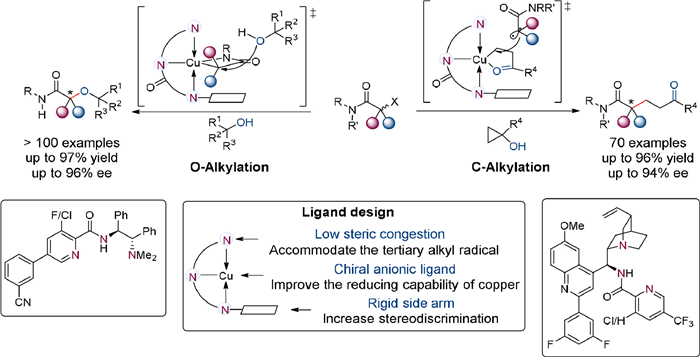
Scheme 1.
Copper-catalyzed enantioselective coupling of tertiary halides with alcohols.

N,N,N-Tridentate anionic ligands enable copper-catalyzed enantioconvergent O- and C-alkylation of alcohols with tertiary halides
Tao Jia , Liyuan Chen , Caiyun Fang , Zhibing Dong , Tao Tu


Alcohols are abundant and cost-effective raw materials, and their use as coupling partners with various electrophiles has garnered widespread attention. In recent years, photoredox/nickel dual-catalyzed cross-coupling of alcohols with halides has attracted broad attention. However, current studies have largely been confined to racemic transformations [1-6]. Asymmetric variants of alcohol–halide coupling remain underexplored, particularly those involving tertiary halides.
The engagement of tertiary halides presents pronounced challenges. The substantial steric demand of the resultant tertiary alkyl radicals impedes their interaction with chiral transition metal–alkyl species, leading to kinetic hurdles. Moreover, the in situ generated transition metal–alkyl intermediates are often inherently unstable and prone to deleterious side pathways, including β-hydride elimination, homocoupling of alkyl nucleophiles, and protodemetalation. Concurrently, the highly reactive tertiary alkyl radicals are susceptible to hydrogen atom transfer or disproportionation. Alcohols themselves pose additional difficulties owing to their modest nucleophilicity and the high bond dissociation energy of the O–H bond, rendering them suitable for use as nucleophiles or radical precursors generated via O–H bond homolysis in cross-coupling reactions with tertiary halides (Scheme 1).
To overcome these obstacles, Professor Xinyuan Liu's research group at Southern University of Science and Technology has developed a catalytic platform based on multidentate anionic chiral ligands and various copper salts. After judicious design of distinct anionic N,N,N-tridentate chiral ligands, they have achieved both the O-alkylation of alcohols with tertiary halides to access sterically congested chiral dialkyl ethers [7] and the C-alkylation of cyclopropanols with tertiary halides to forge chiral all-carbon quaternary centers [8]. The architecture of these N,N,N-tridentate anionic chiral ligands is pivotal for achieving high yields and enantioselectivities. Incorporation of an amide anionic moiety enhances the reducing capacity of the copper catalyst. One flank of the ligand imposes relatively low steric hindrance, thereby creating a cavity sufficiently spacious to accommodate bulky tertiary alkyl radicals, whereas the opposite flank integrates a rigid framework and substituents positioned remote from the metal center. This tailored design modulates the steric environment surrounding the metal center, thereby enabling exquisite control over both chemoselectivity and enantioselectivity.
The synergistic combination of these anionic ligands with copper effectively mitigates the instability inherent to tertiary alkyl radicals and the stereochemical challenges traditionally associated with cross-coupling reactions, furnishing a practical strategy for the construction of chiral molecules embodying quaternary carbon centers. Furthermore, this methodology enables the employment of alcohols—substrates conventionally recalcitrant to activation—as viable coupling partners, thereby expanding the horizon of alcohol functionalization. Given the intrinsic photoredox properties of copper, future investigations could harness ligand-to-metal charge transfer (LMCT) to activate alcohols for downstream transformations [9]. Additionally, structural modification of these N,N,N-anionic ligands may enhance their light absorption characteristics, thereby unlocking photochemical reactivity and laying the groundwork for photo/copper dual catalysis.
Tao Jia: Writing – original draft, Investigation. Liyuan Chen: Writing – original draft. Caiyun Fang: Writing – review & editing. Zhibing Dong: Writing – review & editing, Methodology. Tao Tu: Writing – review & editing, Supervision, Conceptualization.
The authors declare that they have no known competing financial interests or personal relationships that could have appeared to influence the work reported in this paper.
Financial support from the National Natural Science Foundation of China (Nos. 22271060, 22401223), the Natural Science Foundation of Hubei Province (No. 2024AFB315), the Science and Technology Research Project of Hubei Provincial Department of Education (No. Q20231501), the Innovative Research Group Project of National Natural Science Foundation of Hubei Province (No. 2025AFA049), and the Innovative Development Joint Fund of Natural Science Foundation of Hubei Province (No. 2025AFD316). The School of Chemistry and Environmental Engineering at Wuhan Institute of Technology and Department of Chemistry at Fudan University is gratefully acknowledged.
G. Zhu, Z. Duan, H. Zhu, D. Ye, D. Wang, Chin. Chem. Lett. 33 (2022) 266–270. doi: 10.1016/j.cclet.2021.06.060
D. Weng, W. Fang, Y. Liu, T. Tu, Chin. Chem. Lett. 35 (2024) 109394. doi: 10.1016/j.cclet.2023.109394
Z. Dong, D.W.C. MacMillan, Nature 598 (2021) 451–456. doi: 10.1038/s41586-021-03920-6
Y. Chen, X. Wang, X. He, Q. An, Z. Zuo, J. Am. Chem. Soc. 143 (2021) 4896–4902. doi: 10.1021/jacs.1c00618
Q. Pan, R. Yu, Z. Cai, Y. Chen, Angew. Chem. Int. Ed. 64 (2025) e20148. doi: 10.1002/anie.202520148
L. Huang, T. Ji, M. Rueping, J. Am. Chem. Soc. 142 (2020) 3532–3539. doi: 10.1021/jacs.9b12490
J. Zhang, J. Chen, B. Shen, et al., Nat. Catal. 8 (2025) 919–930. doi: 10.1038/s41929-025-01402-w
D. Gao, L. Qin, Z. Li, Q. Gu, X. Liu, Nat. Synth. 5 (2026) 750–760. doi: 10.1038/s44160-025-00987-1
C.A. MacAllister, C.R. Lacker, M.F. Maciejewski, et al., Nat. Synth. 5 (2026) 349–356.

 扫一扫看文章


扫一扫关注我们
 DownLoad:

 下载:
下载:
 下载:
下载: