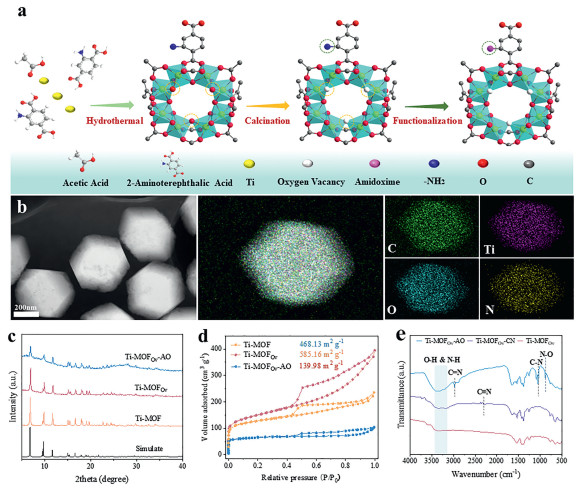
Figure 1.
(a) Schematic for synthesis process of Ti-MOFOv-AO. (b) TEM image and elemental mapping for Ti-MOF. (c) XRD pattern, (d) N2 adsorption/desorption isothermals and (e) FT-IR spectra for MOFs.

Defect-rich MOFs with multiple adsorption and catalytic sites for efficient electrochemical uranium extraction from seawater
Yaowen Liu , Xu Zhu , Zijian Chen , Beichen Xue , Haitao Yi , Xin Huang , Yilin Ji , Jing Li , Xingqi Han , Xinlong Tian


Nuclear energy is a highly efficient and clean energy source, considered one of the most promising alternatives to fossil fuels and the strong enabler for humanity’s carbon neutrality aspirations. With the global expansion of nuclear power generation, uranium is experiencing a rapid rise in demand. Nevertheless, the limited uranium content in terrestrial ores is projected to be exhausted within a century. In this context, the extraction of uranium from seawater has garnered significant attention, as the total reserve of uranium in seawater is estimated at approximately 4.5 billion tons, which can potentially sustain nuclear energy production for at least 1000 years [1-4]. Uranium extraction from seawater represents a more environmentally sustainable approach compared with the traditional uranium mining. Unfortunately, although the extraction of uranium from seawater has been investigated by countries around the world for more than seven decades, the extremely low uranium concentration in seawater (~3.3 ppb) presents substantial challenges to the efficient extraction [5-8].
At present, several strategies including adsorption, membrane separation and photocatalysis have been developed for uranium extraction. Compared with the conventional methods, electrochemical uranium extraction (EUE) confers a significant kinetic advantage due to the ability to accelerate the migration of uranyl ions under the applied electric field [9-11]. Cui’s group developed an EUE strategy using half-wave rectified alternating current electrochemical (HW-ACE) method, demonstrating a nine-time higher uranium extraction capacity without saturation and four-time faster kinetics than conventional physical/chemical adsorption in uranium-spiked seawater [12]. The electrode material is a key factor influencing the efficiency of EUE. Given the extremely low concentration of uranyl ions in seawater, designing porous electrode materials to facilitate the ion transport is particularly important. The intrinsic porous architecture of framework materials makes them ideal candidates for the enrichment of uranyl ions into electrode [13-15]. In addition, the construction of electrocatalytic sites on the electrode material can enhance the extraction capacity by facilitating the transformation of electro-adsorbed uranyl ions into electrically neutral uranium deposits. This transformation can effectively mitigate the Coulombic repulsion between initially adsorbed ions and subsequently arriving ions, thereby promoting continuous ion accumulation and improving overall electrochemical performance. Therefore, porous framework materials integrating adsorption and catalytic sites have attracted significant interests in electrode design. For example, Zhu’s group developed an amidoxime modified porous aromatic framework (PAF-144-AO), in which amidoxime functional groups selectively adsorbed uranyl ions in coordination with the pore structure, and carbazole moieties acted as catalytic sites to promote the transfer of electrons to uranyl ions. Such rational design enabled an impressive uranium extraction capacity of 12.6 mg/g from natural seawater over a period of 24 days [16]. Hua’s group constructed a supramolecular organic framework (MPSOF) based on a phenanthroline scaffold, which was formed via hydrogen bond-driven self-assembly of melamine and 1,10-phenanthroline-2,9-dicarboxylic acid (PDA). The PDA moieties selectively coordinated with uranyl ions, while the hydrogen-bonded framework served as an efficient electron transfer channel to facilitate the redox reactions of uranyl ions. Benefitting from this structural design, MPSOF exhibited a high uranium extraction capacity of 7311 mg/g tested in a solution with uranium concentration of 1000 ppm [17]. As a representative framework material, metal organic frameworks (MOFs) inherently possess favorable characteristics including a highly tunable pore structure and catalytically active metal centers, making them promising candidates for high-performance EUE electrode materials. Moreover, MOFs can be readily functionalized with amidoxime groups for selective coordination with uranyl ions. Among various metals, titanium (Ti)-based materials are extensively utilized in uranium extraction [18-20], however, the application of Ti-MOF in electrode materials for EUE represents a novel and emerging research direction. Utilizing Ti as the metal center in MOFs can offer advantages in enhancing EUE efficiency. Firstly, Ti center is capable of facile redox conversion between Ti3+ and Ti4+, which can form redox ion pairs with uranium, promoting the electrocatalytic transformation of uranyl ions into electrically neutral uranium deposits [18]. Secondly, uranium existing as oxygen-containing species in seawater, Ti has strong affinity with oxygen atoms, thereby contributing to its efficient adsorption capability and facilitating the electron transfer to uranium [21]. Besides that, the oxygen vacancies can be introduced into Ti-MOF by defect engineering, which is conducive to selectively trapping the oxygen-containing uranyl ions [22-24]. The structural defects in MOFs can also modulate charge distribution and increase the density of active sites, thus enhancing their electrocatalytic performance.
In this study, a novel Ti-MOFOv-AO integrating metallic Ti3+ site, oxygen vacancies and amidoxime groups within a single porous framework was synthesized for EUE. The amidoxime groups exhibit excellent adsorption capability towards uranyl ions. The Ti sites and oxygen vacancies demonstrate a strong affinity for the oxygen atoms of uranyl ions. All of these structural characteristics contribute to the selective extraction of uranium. Moreover, the porous mass transfer channels and catalytic centers promote the electro-deposition of uranyl ions. As a result, Ti-MOFOv-AO exhibits a high uranium extraction capacity of 14.80 mg/g per day testing in natural seawater with excellent selectivity toward uranium over common competing ions. Theoretical analysis and physicochemical characterization are employed to verify the synergistic effect of the multiple sites. The probable EUE mechanism is proposed by investigating the speciation evolution of uranium. These findings are expected to develop advanced EUE electrode and promote the clean extraction of uranium resources.
Fig. 1a depicts the preparation process of MOF-derived electrode material. The pristine Ti-MOF was synthesized through a solvothermal strategy adapted from a previously reported method with a slight modification [25]. Firstly, 2-aminoterephthalic acid and tetra–butyl ortho-titanate were mixed in a beaker, followed by the addition of acetic acid (AA) to ensure homogeneity prior to the reaction. The resulting framework was composed of Ti8O8(OH)4 secondary building units and 1,4-benzenedicarboxylate linkers, giving rise to a highly robust and crystalline architecture. Then, Ti-MOF was calcined under an Ar/H2 atmosphere to create oxygen vacancy defects for the synthesis of Ti-MOFOv. Finally, amidoxime groups were covalently grafted onto the amino side chains of the Ti-MOFOv to fabricate an advanced functional material, Ti-MOFOv-AO. This material featured multiple active sites for uranium extraction, including amidoxime functional groups for specifically capturing uranyl ions, oxygen vacancies that enhance adsorption, and Ti metal sites capable of catalyzing the reduction of uranyl ions.
Fig. 1b and Fig. S1 (Supporting information) show dodecahedral morphologies of Ti-MOF and its derivatives. The initial Ti-MOF had an average particle size of approximately 300 nm, and elemental mapping images revealed homogeneous distribution of C, N, O, and Ti elements across the sample surface. Ti-MOFOv and Ti-MOFOv-AO retained a dodecahedral shape similar to that of initial Ti-MOF, while exhibiting a rougher surface morphology. The X-ray diffraction (XRD) peaks (Fig. 1c) of Ti-MOFOv and Ti-MOFOv-AO were consistent with those of initial Ti-MOF, meanwhile slight intensity variations were observed in certain diffraction angles. The decrease in crystallinity always signifies an increase in defect sites [26]. This phenomenon suggests that the rational calcination and functionalization increase the number of defect sites for uranium capture. N2 adsorption-desorption measurements were performed to determine the Brunauer-Emmett-Teller (BET) specific surface area (Fig. 1d). According to the IUPAC classification, Ti-MOF showed type IV adsorption isotherm curves with H4 type of hysteresis loops, indicating the presence of a hierarchically porous structure combining with micropores, mesopores and macropores. The BET surface areas of Ti-MOF, Ti-MOFOv, and Ti-MOFOv-AO were 468.13, 585.16 and 139.98 m2/g, respectively. The developed pore structure and high surface area are favorable for the enrichment of uranyl ions from seawater. The BET surface area of Ti-MOFOv-AO significantly decreased after the amidoximation process, indicating the incorporation of the amidoxime groups may partially obscure the pore structure. Nevertheless, the amidoxime groups enable the efficient capture of uranyl ions through the strong coordination interaction.
The surface groups of MOF-derived materials were confirmed by Fourier transform infrared spectroscopy (FT-IR) as shown in Fig. 1e. The amidoxime modification was accomplished via a two-step reaction. The initial step was cyanation, which yielded an intermediate product, Ti-MOFOv-CN. Comparing to the spectra of Ti-MOFOv, a new absorption band appeared at ~2300 cm-1 in the spectra of Ti-MOFOv-CN, which is attributed to C≡N stretching vibration of the cyano groups. The second step was the conversion of cyano groups to amidoxime groups. The C≡N stretching vibration disappeared in Ti-MOFOv-AO, and the bands at 879 cm-1 (N—O), 2974 cm-1 (C═N) and 1045 cm-1 (C—N) emerged, indicating the graft of amidoxime groups [27,28]. The high-resolution N 1s X-ray photoelectron spectroscopy (XPS) spectra (Fig. S2 in Supporting information) showed the disappearance of C≡N peak and the emergence of the C═N—O peak for Ti-MOFOv-AO. This result is consistent with the findings by FT-IR. Furthermore, the variation in the binding energy of the -NH2 peak can be attributed to the distinct electronic environments where the -NH2 groups are located. In the case of Ti-MOFOv-CN, the -NH2 group is grafted onto the aromatic framework of the MOFs. In contrast, for Ti-MOFOv-AO, the -NH2 groups are part of the amidoxime structure. The above findings further validate the successful graft of amidoxime groups. The nitrogen and oxygen atoms within the amidoxime functional group serve as electron-donating sites and coordinate with uranyl ions in accordance with Lewis acid-base theory. Moreover, amidoxime groups exhibit faster reaction kinetics and stronger binding affinity for uranyl ions than for other ions, enabling exceptional ion selectivity.
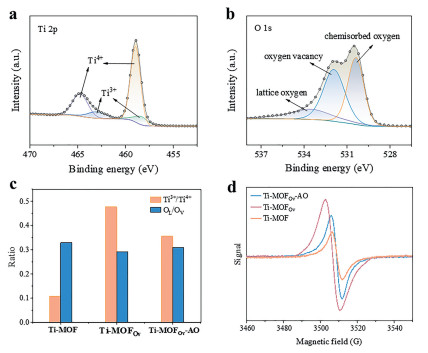
To reveal the local electronic structure and oxidation state of the metal catalytic sites, XPS fine spectrum of Ti analysis was conducted. Fig. 2a displays the characteristic Ti 2p1/2 and 2p3/2 peaks of tetravalent Ti4+ and shoulder peaks corresponding to trivalent Ti3+. The Ti3+/Ti4+ ratio was 0.11 for Ti-MOF evaluated by the ratio of peak area. After thermal calcination, the ratio increased to 0.48 for Ti-MOFOv and 0.35 for Ti-MOFOv-AO (Table S1 and Fig. S3a in Supporting information). The results indicate the thermal calcination at Ar/H2 atmosphere facilitates the transition of Ti4+ to Ti3+. Therefore, the more Ti3+ species for Ti-MOFOv and Ti-MOFOv-AO can improve the electrocatalytic activity for uranium extraction. Additionally, the thermal calcination broke the hydroxyl or oxygen bridges between metal-oxygen-metal units (Ti-OH-Ti/Ti-O-Ti) [29,30], leading to a decrease in O content of MOFs (Table S2 in Supporting information). The O 1s spectra of the MOFs (Fig. 2b and Fig. S3b in Supporting information) showed peaks assigned to chemisorbed oxygen, oxygen vacancies, and lattice oxygen, respectively. In comparison with the pristine Ti-MOF, the peak area ratio of lattice oxygen (OL) to oxygen vacancies (OV) decreased from 0.33 to 0.31 for Ti-MOFOv-AO and to 0.29 for Ti-MOFOv, which indicates an increased presence of oxygen vacancies (Fig. 2c and Table S3 in Supporting information). The presence of oxygen vacancies can be further evidenced by electron paramagnetic resonance (EPR) characterization. Fig. 2d depicts the signal peak at 3510 G, which corresponds to the oxygen vacancies present in the MOFs. Ti-MOFOv possessed the highest oxygen vacancy proportion, resulting from the breakage of Ti-OH-Ti/Ti-O-Ti. After amidoximation, Ti-MOFOv-AO showed a slight decrease in the intensity of oxygen vacancy, however, the level remained higher than that of the pristine Ti-MOF. The presence of oxygen vacancies can improve the electrical conductivity and selective adsorption of oxygen-containing species from aqueous solutions, which in turn facilitates the migration and specific capture of UO22+. The above evidence indicates the co-exist of oxygen vacancies, amidoxime groups, and Ti3+ active sites in Ti-MOFOv-AO.
Thermogravimetric analysis (TGA) was employed to evaluate the thermal stability of the MOFs (Fig. S4 in Supporting information). For all the prepared MOFs, a weight loss was observed below 100 ℃, which is attributed to the removal of adsorbed water molecules. Besides that, a gradual weight loss above 300 ℃ indicates the decomposition of the organic ligands. The hydrophilicities were evaluated through water contact angle measurements (Fig. S5 in Supporting information). The pristine Ti-MOF showed a contact angle of 33.4°, indicating good hydrophilicity. After calcination, the water contact angle of Ti-MOFOv increased markedly to 96.3°, indicating enhanced surface hydrophobicity. Upon surface modification with amidoxime groups, the contact angle of Ti-MOFOv-AO decreased to 29.0°, indicating the amidoxime moieties contribute to the hydrophilicity. The enhanced hydrophilicity of Ti-MOFOv-AO is advantageous for uranium extraction from seawater.
Electrochemical extraction performance was performed under the half-wave potential method with a frequency of 400 Hz, which can enhance the selectivity for uranium extraction and suppress water splitting [12]. The extraction performance of Ti-MOFOv-AO was first carried out in a uranium solution with an initial concentration of 100 ppm and a pH level of 6 to examine the impact of voltage on extraction capacity (Fig. 3a). Under the open-circuit condition (−0.5 V), Ti-MOFOv-AO demonstrated a relatively low uranium adsorption efficiency of 38.30%. As the applied voltage became more negative, the extraction efficiency rose to 98.01% at −3.5 V, suggesting that the enhanced electric field results in a remarkable improvement in uranium extraction efficiency. Further increasing the voltage to −5.5 V led to a similar extraction efficiency of 99.04%. Considering energy efficiency, all subsequent experiments were conducted at an applied voltage of −3.5 V.
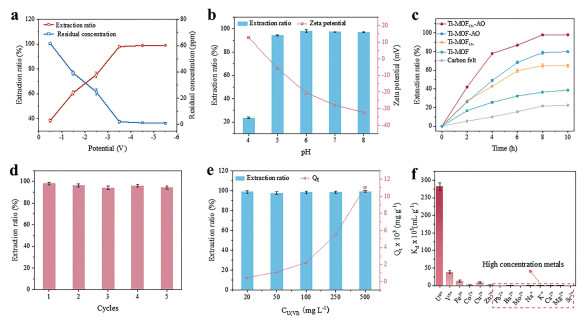
Fig. 3b shows the EUE performance under different pH conditions. The uranium extraction capacity is strongly dependent on the pH, owing to its influence on both uranyl ion speciation and the surface charge of the adsorbent [31,32]. Ti-MOFOv-AO achieved uranium extraction efficiencies of 33.52%, 94.33%, 98.01%, 97.31%, and 97.11% at pH values of 4, 5, 6, 7 and 8, respectively. The zeta potentials of Ti-MOFOv-AO were 12.8, −5.8, −20.4, −27.8, and −32.3 mV, respectively, indicating a gradual increase in surface negativity with increasing pH, which favors the electrostatic attraction of positively charged uranyl ions. The marked improvement in uranium extraction efficiency observed upon increasing the solution pH from 4 to 6 is primarily attributable to the reversal of the electrode surface zeta potential from positive to negative. Although the zeta potential became increasingly negative with increasing pH up to 8, uranium extraction efficiency exhibited a slight decline. This reduction is attributable to the predominance of the anionic uranium species (UO2)2CO3(OH)3- under these conditions, which induces electrostatic repulsion with negatively charged electrode surfaces. However, the enhanced activity of oxygen vacancies under mildly alkaline conditions can help to offset the adverse effect of this electrostatic repulsion on the extraction efficiency. Under acidic conditions (pH 4), oxygen vacancies are prone to passivation due to their occupation by abundant protons, which is unfavorable for catalytic reactions. In contrast, under near-neutral conditions (pH 7–8), the proton concentration is significantly lower, and the (UO2)2CO3(OH)3- can be electrostatically attracted to the oxygen vacancies. Owing to this feature, Ti-MOFOv-AO kept a high uranium extraction capacity at pH 7–8, demonstrating its application potential in seawater.
Fig. 3c shows the performance comparison among the prepared MOFs. The initial uranium concentration was 100 ppm with a pH value of 6. As a reference, bare graphite felt exhibited an extraction capacity of 500.29 mg/g, and a low extraction efficiency of 22.50%. The uranium extraction capacities of the MOF-derived electrode materials increased rapidly during the initial 4 h, following which the extraction rates slowed down. Ultimately, the uranium extraction capacities tended to reach a stable state after 8 h. Ti-MOFOv-AO achieved a highest extraction capacity of 2177.92 mg/g, with a high extraction efficiency of 98.01% (Fig. S6 in Supporting information). This finding demonstrates that the synergistic presence of oxygen vacancies and amidoxime groups exerts a more pronounced enhancement on the material’s performance compared to either functional moiety acting independently. Moreover, the relatively high Ti3+/Ti4+ ratio of Ti-MOFOv-AO confirmed by XPS analysis is also conducive to the EUE. The Ti3+ sites facilitate the electrocatalytic reduction of uranyl ions to a lower valence state, subsequently promoting the formation of electrically neutral deposits. Fig. S7 (Supporting information) shows that within just 40 min, a large amount of uranium deposited on the electrode surface and continued to increase. The Ti3+ catalytic sites can be regenerated via electron transfer from the cathode, thereby enabling its continuous participation in the uranium extraction without saturation. After uranium extraction, the electrode can be recycled by acid-leaching using 0.1 mol/L HCl as the eluent. The cyclic stability of Ti-MOFOv-AO was also evaluated in electrochemical extraction process. As shown in Fig. 3d, Ti-MOFOv-AO retained a high extraction efficiency of 94.33% after the fifth cycle. To verify the performance of Ti-MOFOv-AO across a wide range of uranium concentrations, the uranium extraction capacities of Ti-MOFOv-AO in uranium solutions with different initial concentrations were tested (Fig. 3e). Even when the initial uranium concentration increased to 500 ppm, the extraction efficiency of Ti-MOFOv-AO reached 99.01%, with a corresponding uranium extraction capacity of 11,044.44 mg/g. Its uranium extraction capacity is superior to that of most state-of-the-art materials reported in the literature (Table S4 in Supporting information). Besides that, a comparison of extraction efficiency between physicochemical adsorption and EUE was carried out based on the Ti-MOFOv-AO in 100 ppm uranium aqueous solution (Fig. S8 in Supporting information). The capacity of physicochemical adsorption was only 570.44 mg/g, significantly lower than that of electrochemical extraction, thereby demonstrating the superior efficiency of EUE strategy.
As for the application in seawater, the extremely low uranium concentration coupled with the presence of various competing ions is a challenge for extraction efficiency and ion selectivity. Ion-selectivity experiments were conducted in simulated seawater. The relative concentrations of the simulated seawater solution were provided in Table S5 (Supporting information). As shown in Fig. 3f, Ti-MOFOv-AO exhibited a high distribution coefficient (Kd) for uranium and relatively low Kd values for most metal ions. Vanadium and iron are the main competing ions. The Kd value of Ti-MOFOv-AO for uranium was 7.26 times that of vanadium and 23.42 times that of iron, indicating the excellent ion selectivity. For the Ti-MOF-AO without oxygen vacancies, its Kd value for uranium was 4.03 times higher than that for vanadium and 8.88 times higher than that for iron, respectively (Fig. S9a in Supporting information). The superior ion selectivity of Ti-MOFOv-AO over Ti-MOF-AO suggests that oxygen vacancies in Ti-MOFOv-AO serves as the active sites for the preferential trap of uranyl ions. For the original Ti-MOF, its Kd value for uranium was only 4.14 times higher than that for vanadium and 4.25 times higher than that for iron (Fig. S9b in Supporting information). The results indicate that oxygen vacancies and amidoxime functional groups within Ti-MOFOv-AO, acting as dual recognition sites, can collaboratively enhance the selectivity for uranium. To evaluate the extraction capacity of Ti-MOFOv-AO in practical applications, EUE was performed in 30 L of natural seawater. Ti-MOFOv-AO achieved a uranium extraction capacity of 14.80 mg/g within the first day, resulting in a rapid decrease in uranium concentration of seawater from ~3.3 ppb to ~1.0 ppb. Ti-MOFOv-AO achieved a uranium extraction capacity of 14.80 mg/g within the first day, resulting in a rapid decrease in uranium concentration of seawater from ~3.3 ppb to ~1.0 ppb. The corresponding energy consumption is 1113 kWh kg-1 U. After 7 days, the uranium content in this 30 L of seawater had been nearly exhausted, and the extraction capacity of the Ti-MOFOv-AO reached 17.95 mg/g (Fig. S10 in Supporting information). These results demonstrate that the Ti-MOFOv-AO exhibited high uranium extraction efficiency, achieving nearly complete extraction within a short period. The SEM images (Fig. S11 in Supporting information) show the surface morphology of Ti-MOFOv-AO after electrochemical extraction. The presence of small protrusions on Ti-MOFOv-AO after electrochemical extraction confirms the formation of uranium deposits. EDS element mapping (Fig. S12 in Supporting information) revealed that the elements C, O, N, Ti, and U were uniformly distributed across the Ti-MOFOv-AO surface. With the continuous uranium extraction, the deposits grow into nano-flake aggregates as observed by the SEM image in Fig. 4a and settled to the bottom of the electrolytic cell. The XRD pattern (Fig. 4a) of the yellow deposits was in agreement with that of PDF #12–0011, indicating that Na2O(UO3H2O)x was the dominant species. The U 4f7/2 XPS spectra (Fig. S13 in Supporting information) showed a main peak at 381.9 eV assigned to UO3, further supporting the uranium deposits existed in the form of Na2O(UO3H2O)x.
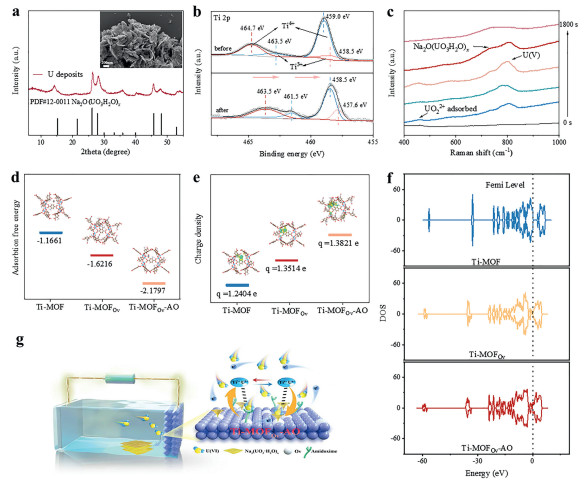
The Ti3+ catalytic center and oxygen vacancies serve as the crucial active sites in the electrochemical extraction of uranium, and their valence state evolution before and after the reaction is essential for elucidating the fundamental reaction mechanism. As shown in Fig. 4b, before EUE, the Ti4+ 2p1/2 and 2p3/2 peaks were located at 464.7 and 458.9 eV, respectively. Small shoulders assigned to Ti3+ appeared at 463.5 and 457.8 eV. After EUE, the Ti4+ 2p1/2 and 2p3/2 peaks shifted to 463.5 and 458.5 eV, respectively. Meanwhile, the Ti3+ peaks shifted to 461.5 and 457.6 eV, showing binding energy reductions of 2.0 and 0.9 eV, respectively. EUE led to an overall reduction in the binding energy of Ti species as a result of electron uptake, accompanied by an enhanced signal intensity of the active Ti3+ species. In addition, according to the O 1s spectra (Fig. S14 in Supporting information), the OL/OV ratio decreased from 0.31 to 0.26 after EUE, indicating the increased concentration of oxygen vacancies. This phenomenon indicates that oxygen vacancies can be regenerated through electron acquisition from the cathode, and new vacancies are simultaneously generated, thereby facilitating the extraction of uranium.
Operando Raman spectroscopy (Fig. 4c) was employed to monitor the dynamic transformation of uranium species throughout the (EUE) process. Prior to the initiation of the reaction, a distinct Raman peak was observed at 464.51 cm-1, corresponding to the vibrational mode of the adsorbed UO22+. With the EUE processing, new vibrational peaks emerged at approximately 801.32 and 725.34 cm-1, corresponding to U(Ⅴ) and Na2O(UO3H2O)x, respectively. With increasing reaction time, the intensity of the U(Ⅴ) peak initially increased and subsequently decreased, whereas the intensity of Na2O(UO3H2O)x peak exhibited a continuous increase. This trend suggests that UO22+ was first reduced to U(Ⅴ) species, which were then further transformed into Na2O(UO3H2O)x product and subsequently deposited onto the electrode.
Density functional theory (DFT) calculations were employed to further elucidate the intrinsic mechanism underlying the superior EUE performance of the Ti-MOFOv-AO electrode. Fig. 4d shows the calculated adsorption energy of UO22+ on Ti-MOFOv-AO was markedly lower than that on Ti-MOFOv and Ti-MOF, indicating that Ti-MOFOv-AO possessed a stronger binding affinity toward free uranium species. Moreover, Ti-MOFOv-AO exhibited distinct electron transfer characteristics and interfacial redox capability compared with Ti-MOFOv and Ti-MOF. As illustrated in Fig. 4e, electrons were more easily accumulated at the solid-liquid interface, and differential charge density calculations revealed a higher degree of electron accumulation around U(Ⅵ) on Ti-MOFOv-AO than on Ti-MOFOv and Ti-MOF. Consistently, Bader charge analysis indicated that U(Ⅵ) gained more valence electrons on the Ti-MOFOv-AO surface. These results suggest a stronger interaction between Ti-MOFOv-AO and UO22+ at the solid-liquid interface, which is more favorable for electron transfer from Ti-MOFOv-AO to uranium species, thereby reinforcing the interfacial electron transfer process. Furthermore, density of states (DOS) calculations indicated that the introduction of oxygen vacancies induced a positive shift of the Fermi level toward the bottom of the valence band (Fig. 4f), significantly enhancing the electron-accepting capability of Ti-MOFOv-AO.
Based on the analysis of the above results, the possible EUE mechanism of Ti-MOFOv-AO electrode is concluded as follows (Fig. 4g): Firstly, UO22+ is selectively adsorbed onto the surface of Ti-MOFOv-AO through the synergistic effect of amidoxime groups and oxygen vacancies. Secondly, the adsorbed UO22+ interacts with Ti3+ species on the electrode. The presence of oxygen vacancies facilitates interfacial reaction and electron transfer from Ti3+ to U(Ⅵ)O22+, resulting in the formation of an unstable U(Ⅴ) intermediate. Subsequently, in the presence of Na+, U(Ⅴ) is oxidized back to U(Ⅵ) in the term of Na2O(UO3H2O)x deposits [10]. Meanwhile, the unstable U(Ⅴ) species transfers one electron back to the Ti4+ species, thereby regenerating Ti3+ catalytic center and restoring the oxygen vacancies. Finally, U(Ⅵ)O22+ are continuously adsorbed to the regenerated oxygen vacancies and then interact with the regenerated Ti3+, enabling interfacial redox reactions that drove the deposition of U(Ⅵ)O22+. Through repeated cycles, this process leads to highly efficient uranium extraction. Drawing on the above findings, we inferred a series of redox reactions that are likely involved in the EUE process:
|
|
(1) |
|
|
(2) |
In summary, a multifunctional titanium-based metal-organic framework (Ti-MOFOv-AO) was developed as an innovative cathode material for uranium extraction. The Ti-MOFOv-AO exhibited a remarkably high adsorption capacity of 11,044.44 mg/g in a simulated system at −3.5 V and a practical extraction yield of 14.80 mg/g per day in natural seawater. Both the experiment results and DFT calculations indicate the excellent extraction capacity and ion selectivity performance of Ti-MOFOv-AO are attributed to its abundant amidoxime adsorption sites, porous structure, the in-situ regenerated Ti3+ catalytic sites and oxygen vacancies under electrochemical conditions. These oxygen vacancies not only act as active sites for capturing U(Ⅵ)O22+ from the solution but also serve as electron shuttles, promoting electron transfer from the active Ti3+ center to U(Ⅵ)O22+. This process facilitates the conversion of uranyl ions into electrically neutral Na2O(UO3H2O)x deposits, thereby enabling the continuous and efficient extraction of uranium. This work provides a promising strategy for designing high-performance electrode materials applied in uranium extraction from seawater.
Yaowen Liu: Writing – original draft, Methodology, Formal analysis, Data curation. Xu Zhu: Software, Methodology, Formal analysis. Zijian Chen: Methodology, Formal analysis. Beichen Xue: Writing – review & editing, Supervision, Project administration, Funding acquisition, Conceptualization. Haitao Yi: Methodology, Formal analysis. Xin Huang: Methodology, Formal analysis. Yilin Ji: Methodology, Formal analysis. Jing Li: Resources. Xingqi Han: Writing – review & editing, Software, Funding acquisition. Xinlong Tian: Writing – review & editing, Supervision, Project administration.
The authors declare that they have no known competing financial interests or personal relationships that could have appeared to influence the work reported in this paper.
This work was supported by National Natural Science Foundation of China (No. 22568022), Key Research and Development Project of Hainan Province (Nos. ZDYF2026XDNY165, ZDYF2025GXJS004), Innovational Fund for Scientific and Technological Personnel of Hainan Province (No. KJRC2025B21), Hainan Provincial Natural Science Foundation of China (No. 225RC633) and Start-up Research Foundation of Hainan University (No. 2400005266). Additionally, the authors acknowledge the support for comprehensive characterizations by Pico Election Microscopy Center of Hainan University. Numerical computations were performed on Hefei advanced computing center.
Supplementary material associated with this article can be found, in the online version, at doi:
Y. Wang, G. Wen, Z. Liu, et al., Nat. Sustain. 8 (2025) 682–691. doi: 10.1038/s41893-025-01567-z
H. Guo, E. Hu, Y. Wang, et al., Nat. Commun. 16 (2025) 2012. doi: 10.1038/s41467-025-57113-0
Y. Xie, Z. Liu, Y. Geng, et al., Chem. Soc. Rev. 52 (2023) 97–162. doi: 10.1039/d2cs00595f
J. Yu, Y. Huang, P. Zhang, et al., Chin. Chem. Lett. 37 (2026) 111378. doi: 10.1016/j.cclet.2025.111378
Y. Yuan, D. Cao, F. Cui, et al., Nat. Water 3 (2025) 89–98. doi: 10.1038/s44221-024-00346-y
B. Xue, Y. Ji, H. Yi, et al., Adv. Funct. Mater. (2026) e29094. doi: 10.1002/adfm.202529094
Z. Sun, Y. Liao, Y. Zhang, et al., Sustain. Carbon Mater. 1 (2025) e007.
L. Yang, Y. Qian, Z. Zhang, et al., Chem. Sci. 15 (2024) 4538–4546. doi: 10.1039/d4sc00011k
Y. Wang, Y. Wang, M. Song, et al., Angew. Chem. Int. Ed. 62 (2023) e202217601. doi: 10.1002/anie.202217601
H. Yang, X. Liu, M. Hao, et al., Adv. Mater. 33 (2021) 2106621. doi: 10.1002/adma.202106621
Y. Ye, J. Jin, W. Han, et al., Nat. Water 1 (2023) 887–898. doi: 10.1038/s44221-023-00134-0
C. Liu, P.-C. Hsu, J. Xie, et al., Nat. Energy 2 (2017) 17007. doi: 10.1038/nenergy.2017.7
D. Cao, F. Cui, C. Zhang, et al., Adv. Funct. Mater. 35 (2025) 2413729. doi: 10.1002/adfm.202413729
Y. Wu, Y. Xie, X. Liu, et al., Coord. Chem. Rev. 483 (2023) 215097. doi: 10.1016/j.ccr.2023.215097
W. Li, N. Wu, C. Li, et al., Chin. Chem. Lett. 37 (2026) 110733. doi: 10.1016/j.cclet.2024.110733
D. Chen, Y. Li, X. Zhao, et al., ACS Cent. Sci. 9 (2023) 2326–2332. doi: 10.1021/acscentsci.3c01291
C. Wang, M. Xu, W. Wang, et al., Adv. Funct. Mater. 34 (2024) 2402130. doi: 10.1002/adfm.202402130
Y. Wang, C. Xie, G. Wang, et al., Water Res. 258 (2024) 121817. doi: 10.1016/j.watres.2024.121817
T. Lin, T. Chen, C. Jiao, et al., Nat. Commun., 15 (2024) 4149. doi: 10.1038/s41467-024-48564-y
L. Lin, T. Liu, Y. Qie, et al., Environ. Sci. Technol. 56 (2022) 13327–13337. doi: 10.1021/acs.est.2c02632
G.Y. Han, M.S. Sun, R.X. Zhao, et al., Chem. Soc. Rev. 54 (2025) 5081–5107. doi: 10.1039/d4cs01007h
P. He, L. Zhang, L.Z. Wu, et al., Appl. Catal. B: Environ. Energy 322 (2023) 122087. doi: 10.1016/j.apcatb.2022.122087
R.R. Jia, Y.T. Wang, C.H. Wang, et al., ACS Catal. 10 (2020) 3533–3540. doi: 10.1021/acscatal.9b05260
Q.Y. Zhang, C. Xie, J.C. Wang, et al., Chem. Eng. J. 514 (2025) 163253. doi: 10.1016/j.cej.2025.163253
S. Liang, X. Xiao, L.X. Bai, et al., Adv. Mater. 33 (2021) 2100333. doi: 10.1002/adma.202100333
J.W. Ren, M. Ledwaba, N.M. Musyoka, et al., Coord. Chem. Rev. 349 (2017) 169–197. doi: 10.1016/j.ccr.2017.08.017
X. Liu, Y. Xie, M. Hao, et al., Adv. Sci. 9 (2022) 2201735. doi: 10.1002/advs.202201735
G. Zhou, F. Gao, T. Liu, et al., Adv. Funct. Mater. 34 (2024) 2406329. doi: 10.1002/adfm.202406329
J. Jin, S.P. Wan, S. Lee, et al., Small 19 (2023) 2302776. doi: 10.1002/smll.202302776
Y.Y. Sun, H.Q. Ji, Y.J. Sun, et al., Angew. Chem. Int. Ed. 63 (2024) e202316973. doi: 10.1002/anie.202316973
Y. Xie, C. Chen, X. Ren, et al., Prog. Mater Sci. 103 (2019) 180–234. doi: 10.1016/j.pmatsci.2019.01.005
T. Chen, K. Yu, C. Dong, et al., Coord. Chem. Rev. 467 (2022) 214615. doi: 10.1016/j.ccr.2022.214615

Figure 1 (a) Schematic for synthesis process of Ti-MOFOv-AO. (b) TEM image and elemental mapping for Ti-MOF. (c) XRD pattern, (d) N2 adsorption/desorption isothermals and (e) FT-IR spectra for MOFs.

Figure 2 (a) XPS Ti 2p spectra, (b) XPS O 1s spectra, (c) The Ti3+/Ti4+ and OL/OV ratio demonstrated by XPS, and (d) EPR for MOFs.

Figure 3 (a) The extraction ratio of Ti-MOFOv-AO within various voltages in 100 ppm uranium aqueous solution. (b) The influence of pH values on the extraction ratio and zeta potential of Ti-MOFOv-AO in 100 ppm uranium aqueous solution. (c) The extraction capacity of MOFs and pure graphite felt in 100 ppm uranium aqueous solution. (d) Recycling performance of the Ti-MOFOv-AO in 100 ppm uranium. (e) The extraction ratio and extraction capacity of Ti-MOFOv-AO in uranium aqueous solution with different concentration. (f) The distribution coefficient (Kd) of Ti-MOFOv-AO in simulated seawater.

Figure 4 (a) XRD pattern and SEM image (inset picture) of the final uranium deposits collected from the bottom of the electrolytic cell. (b) XPS Ti 2p spectra of Ti-MOFOv-AO before and after EUE. (c) Operando Raman spectra of Ti-MOFOv-AO electrode at different extraction time. (d) Calculated adsorption free energies of UO22+ on MOFs and (e) The transfer electron number between them. The yellow and cyan irregular bubbles denote electron accumulation and electron depletion, respectively. (f) The DOS of MOF electrodes. (g) Schematic diagram of the rational reaction mechanism for EUE by Ti-MOFOv-AO.

 扫一扫看文章


扫一扫关注我们
 DownLoad:
 下载:
 下载: