Covalent organic frameworks (COFs) represent a promising class of crystalline porous materials composed of covalently bonded organic building blocks into extended crystalline frameworks. COFs enable potential applications in gas storage and separation, electronic conduction, drug delivery, energy storage, and catalysis owing to distinct advantages in terms of structural versatility, intrinsic porosity, and well-defined structures [1,2]. Since the topological architectures of COFs can be predesigned by reticular chemistry, the topological diagrams define how covalent bonds should form in space; consequently, organic building blocks with specific geometries are arranged and linked to form desirable periodic structures. As is well-known, the pursuit of atomic precision structure of COFs is particularly crucial for in-depth understanding the intrinsic structure–property relationships. While COFs are typically prepared by simultaneous free polymerization and crystallization of monomers following the principle of dynamic covalent chemistry involving “error-checking” and “proofreading” procedure under thermodynamic control, the formation of high-quality single-crystal COFs poses a significant challenge [3,4]. Despite the considerable efforts have been devoted to regulate the crystallization kinetics towards the formation of a kinetically favored single-crystalline COF, there only a few one-dimensional (1D) single-crystals COFs have been successfully achieved due to the relatively weak molecular attractions compared with two-dimensional (2D) or three-dimensional (3D) COFs [5,6]. Therefore, growing 1D single-crystals COFs and precisely determining their structures at the atom level remain formidable challenges.
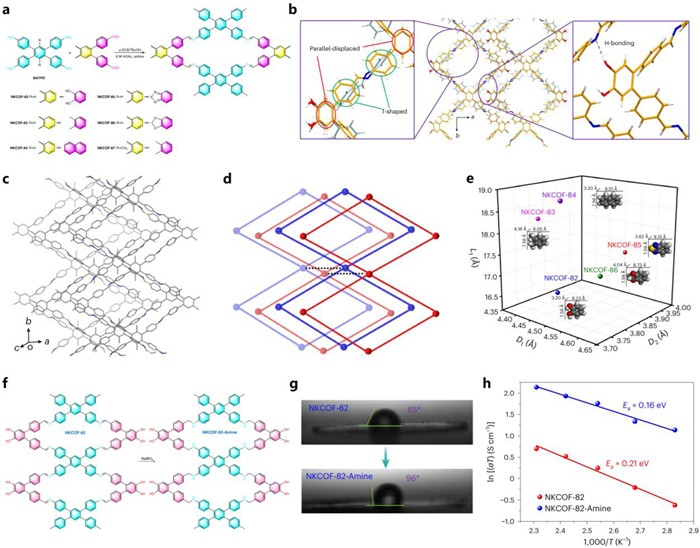
In a recent study published in Nature Synthesis, Prof. Zhenjie Zhang and co-workers present a significant advancement in atomic-precision determination of 1D COFs [7]. Fig. 1a illustrates the design and synthetic route of the NKCOFs (NKCOF: Nankai Covalent Organic Framework) through Schiff base condensation reactions between V-shaped ditopic linker and X-shaped tetratopic knot. They established a general protocol for the growth of high-quality 1D COFs single-crystals via rationally modulating the crystallization process. This advanced strategy has been extended and demonstrated by exhibiting atomic resolution visualization of six 1D COFs single-crystals (denoted as NKCOF-82, NKCOF-83, NKCOF-84, NKCOF-85, NKCOF-86 and NKCOF-87) with a high resolution of up to 0.90 Å determined by continuous rotation electron diffraction (cRED) technique. Obviously, all the non-hydrogen atoms in the framework could be directly located (Fig. 1b). Beyond structure determination at the crystallographic level, the work provides deep insights into understanding the structural evolution of NKCOFs by modifying the functional groups of monomers, including interchain interactions, stacking mode, interlayer distance, interlayer slip and interchain spacing. As a result, NKCOF-87 displays a unique AB stacking structure compared to AA stacked NKCOF-82 to NKCOF-86 by introducing steric methyl groups on the organic linkers (Figs. 1c and d). Crucially, the stacking configurations of NKCOFs can be synthetically controlled through strong electron-withdrawing groups, steric hindrance effect, and hydrogen bonds in skeleton, which in turn led to the disruption of the interlayer interactions (Fig. 1e). Moreover, the work further underscored the significance of the formation of amine linkages in NKCOF-82-Amine by reducing the imine-linked NKCOF-82 toward higher chemical stability under harsh acidic conditions (Fig. 1f). Notably, NKCOF-82-Amine maintained high-quality crystals after the reduction modification, which was further confirmed by the cRED single-crystal analysis. The direct reductive amination strategy has a central role in achieving an enhanced hydrophobicity and proton conductivity (Figs. 1g and h).
Figure 1
Figure 1.
(a) Schematic diagram of the route to synthesize NKCOFs. (b) The crystal structure of NKCOF-82. (c, d) The AB stacking structure of NKCOF-87. (e) The interlayer distance (D1), the interlayer slips (D2) and the interchain spacing (L1) of NKCOFs. (f) Illustration of the structure transformation of NKCOF-82 to NKCOF-82-Amine by reducing imine linkages. (g) The contact angle of NKCOF-82 and NKCOF-82-Amine. (h) Arrhenius plots for H3PO4@NKCOF-82 and H3PO4@NKCOF-82-Amine. T, temperature; σ, conductivity. Reproduced with permission [7]. Copyright 2026, Springer Nature.
In summary, these findings achieved by Prof. Zhenjie Zhang and co-workers represent a significant breakthrough in construction and atomic-precision determination of 1D single-crystals COFs. The crystal structures of six 1D NKCOFs are determined by the cRED single-crystal analysis with a high resolution. Advances in crystal structure determination of these 1D NKCOFs reveal the molecular mechanisms of the steric hindrance effect on the stacking configurations of NKCOFs. Moreover, the reductive amination strategy with a crystal-to-crystal transformation of imine-linked to amine-linked COFs reported by this work provides a fundamental way for designing advanced porous 1D COFs with enhanced chemical stability, hydrophobicity and proton conductivity, also highlights great potential to achieve tailored properties in a yet uncharted territory of reticular materials.
The authors declare that they have no known competing financial interests or personal relationships that could have appeared to influence the work reported in this paper.
Acknowledgments
This work was supported by the Natural Science Research of Jiangsu Higher Education Institutions of China (No. 25KJB150017), the Scientific Research Start-up Project Foundation of Nanjing Forestry University (No. 163101240). J. W. acknowledge the funding provided by the Alexander von Humboldt Foundation. The authors thank the funding from Key Laboratory of Engineering Dielectrics and Its Application (Harbin University of Science and Technology) (No. KFM202507, Ministry of Education), Opening funding from engineering research center of Li-S battery storage (Inner Mongolia Minzu University) (No. MDK2025071).
[1]
K.T. Tan, S. Ghosh, Z. Wang, et al., Nat. Rev. Method. Prime. 3 (2023) 1.
Figure 1
(a) Schematic diagram of the route to synthesize NKCOFs. (b) The crystal structure of NKCOF-82. (c, d) The AB stacking structure of NKCOF-87. (e) The interlayer distance (D1), the interlayer slips (D2) and the interchain spacing (L1) of NKCOFs. (f) Illustration of the structure transformation of NKCOF-82 to NKCOF-82-Amine by reducing imine linkages. (g) The contact angle of NKCOF-82 and NKCOF-82-Amine. (h) Arrhenius plots for H3PO4@NKCOF-82 and H3PO4@NKCOF-82-Amine. T, temperature; σ, conductivity. Reproduced with permission [7]. Copyright 2026, Springer Nature.


 DownLoad:

 下载:
下载:


 下载:
下载:

