Citation:
Rongrong Mao, Gaolei Liu, Xiu Fan, Kifayat Ullah, Fengxiang Li. Piezoelectric effect promotes the degradation of antibiotics in the environment: Current progress, improvement strategies, and future prospects[J]. Chinese Chemical Letters,
2027, 38(1): 112885.
doi:
10.1016/j.cclet.2026.112885
Piezoelectric effect promotes the degradation of antibiotics in the environment: Current progress, improvement strategies, and future prospects
College of Environmental Science and Engineering, Nankai University, Key Laboratory of Pollution Process and Environmental Criteria, Ministry of Education, Tianjin Engineering Center of Environmental Diagnosis and Contamination Remediation, Tianjin 300350, China
Received Date:
25 September 2025 Accepted Date:
03 May 2026 Revised Date:
14 March 2026 Available Online:
12 January 2027
Abstract:
The overuse of antibiotics and their resistance to natural degradation have contributed to a continuous increase in the accumulation of this substance in the environment. How to make it degrade efficiently is the goal that many researchers are striving for. This review focuses on piezocatalysis, a technology that uses the piezoelectric effect to degrade antibiotics. It compares the differences between this technology and common methods, and discusses how combining the piezoelectric effect with advanced oxidation processes and modifying piezoelectric materials can effectively improve the degradation efficiency of antibiotics, respectively. In addition, the review also introduces the degradation pathways of several common types of antibiotics and analyzes the impact of changes in environmental conditions on degradation efficiency. Finally, through the piezoelectric effect, antibiotics gradually convert into intermediate products until they are degraded into small molecules, with their toxicity continuously decreasing, ensuring a safe transformation. This demonstrates that the piezoelectric effect has broad application prospects in antibiotic degradation and serves as a valuable reference for other scientists to further study how to efficiently degrade antibiotics in the environment using the piezoelectric effect.
Antibiotics are substances, either produced by microorganisms or synthesized chemically, that possess the ability to inhibit or kill other microorganisms, including bacteria, fungi, and viruses [1]. Following the advent of penicillin in 1972, a plethora of antibiotics (Fig. S1 in Supporting information) have been employed in both the medical and veterinary domains for the treatment and prevention of infections. Moreover, in recent years, due to factors such as infectious diseases, the global consumption of antibiotics has continued to rise gradually [2]. However, due to the stubborn nature of its antibiotic structure, neither humans nor animals can completely break down and metabolize it, resulting in some unmetabolized compounds and their metabolites entering the surrounding environment [3]. The environmental impact of antibiotics extends beyond inducing antibiotic resistance genes (ARGs); it also involves the adsorption of antibiotics onto surfaces of substances in aquatic environments, forming complex pollutants that complicate degradation processes. Furthermore, the phenomenon of antibiotics being adsorbed in the soil can affect microorganisms and also affect the absorption by plants and invertebrates [4-6]. The escalating environmental concentrations of antibiotics have raised concerns regarding their potential ecological and genetic toxicity [7]. For these reasons, many researchers are looking for effective ways to degrade stubborn antibiotics in the environment [8].
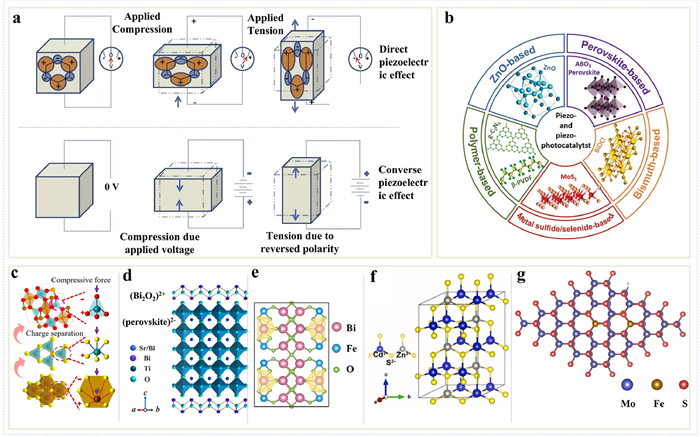
Piezocatalysis is a technology that utilizes the piezoelectric effect of materials capable of generating piezoelectric responses to achieve catalytic reactions [9,10]. Due to its significant catalytic potential, many studies consider it a feasible technology that can be used to degrade various organic compounds, including antibiotics [11,12]. The piezoelectricity of piezoelectric materials is mainly due to their asymmetric structure, which causes charge separation when subjected to mechanical stress, thus achieving the conversion between mechanical and electrical energy [13-15]. The two common mechanisms for generating electrons in piezocatalysis are the energy band theory and the shielding charge effect (Fig. 1a) [16,17]. The former states that under mechanical force, the excited charges or the inherent charges of the material form carriers, and electrons can be excited from the valence band to the conduction band, with the generated energy used to oxidize free radicals; the latter suggests that under the piezoelectric polarization field, external ions are attracted to the material surface and subsequently dissociate to produce electrons. The commonly used piezoelectric catalysts can be classified into several categories based on their main structures (Fig. 1b), including ZnO-based materials, perovskite-based materials, bismuth-based materials, metal sulfides/selenide-based materials, and polymer-based materials [18,19]. Owing to their exceptional electronic, mechanical, and chemical properties, these materials are widely used in piezocatalysis (Figs. 1c-g) [20-24]. Text S1 (Supporting information) briefly introduces several commonly used piezoelectric catalysts.
Figure 1
Figure 1.
Piezoelectric effect and materials: (a) The mechanism diagram of the piezoelectric effect. Reproduced with permission [17]. Copyright 2018, Elsevier. (b) Common types of piezoelectric catalysts. Reproduced with permission [18]. Copyright 2024, Wiley. (c) Schematic structure model of Mo5Fe5. Reproduced with permission [20]. Copyright 2025, Elsevier. (d) Crystal structure of Sr2Bi4Ti5O18 (SBTO). Reproduced with permission [21]. Copyright 2025, Elsevier. (e) The structural formula of BTO. Reproduced with permission [22]. Copyright 2025, Wiley. (f) Structure of Cd0.7Zn0.3S. Reproduced with permission [23]. Copyright 2024, Elsevier. (g) Optimized structure for the 2-Fe/MoS2. Reproduced with permission [24]. Copyright 2024, Elsevier.
Piezoelectric catalytic technology has been successfully applied to the efficient degradation of various antibiotics (such as tetracycline, ciprofloxacin). For instance, through materials such as Ce-doped ZnO, Fe3O4@MoS2/PVDF composite membranes, a degradation rate of over 80% or even 90% can be achieved, demonstrating the significant potential of this technology in wastewater treatment [25-27]. However, there are still relatively few comprehensive review papers summarizing the application of piezoelectric effects in antibiotic degradation. Therefore, this review compares the advantages of piezocatalysis with common antibiotic degradation methods, explores the coupling effect of combining the piezoelectric effect with advanced oxidation technology for antibiotic degradation, and summarizes several strategies for improving catalytic activity through modification of piezoelectric materials. It also discusses the internal mechanism of piezoelectric catalytic degradation of antibiotics. This helps to better remove antibiotics from the environment, provides a background for future related experiments, and offers a feasible reference method for degrading other pollutants in the environment.
2.
The advantages of piezoecatalysis
2.1
Compared with physical methods: Degradation or transfer
Common methods for antibiotic degradation include physical, chemical, biological approaches, and other technologies (Fig. S2 in Supporting information) [28]. Adsorption, as one of the representative physical methods, is characterized by simplicity and economy [29]. However, during the degradation process, the issue of adsorbent recovery needs to be considered, and it may also cause secondary pollution [30]. The physical adsorption method (such as using activated carbon or resins) is for transferring pollutants, while piezocatalysis is for degrading pollutants. Table S1 (Supporting information) lists some examples of physical adsorption for removing antibiotics. Compared with the efficiency of antibiotic degradation by piezocatalysis, it is obvious that adsorption requires a longer time and the removal rate is lower than that of piezoelectric catalysis [31,32]. Furthermore, the antibiotics adsorbed onto the adsorbent do not undergo any further degradation process. Once saturation occurs, they are prone to form new "pollution sources". Another problem brought about by adsorption saturation is the need to regularly replace or regenerate the adsorbent [33]. In contrast, piezoelectric catalysis can completely decompose antibiotics into carbon dioxide and water, thereby avoiding the risk of secondary pollution. Moreover, it can produce catalysts with good stability in one go, and these materials can be reused, thus reducing the burden of operation and maintenance.
Therefore, for high-concentration and difficult-to-degrade antibiotic wastewater, although physical adsorption shows quick initial effectiveness, the secondary pollution problem after saturation is severe, and the overall benefits are low. Piezocatalysis has an irreplaceable value in completely eliminating pollution, although the initial investment may be high, but it has more advantages in long-term operation and environmental safety, and has the competitiveness for medium- and short-term promotion.
2.2
Compared with chemical methods: Costand safety
Chemical methods, including electrochemical oxidation, have problems like high energy consumption, limitations of electrode materials, and short lifespan [34]. Chemical methods (such as Fenton and ozonation) are also aimed at degrading pollutants, but they are quite different from piezocatalysis in terms of mechanism and cost. The traditional Fenton process requires the continuous addition of chemical substances, and during the process, iron sludge and unknown toxic intermediate by-products may be produced [35]. Therefore, this method needs to be studied to be improved [36]. Moreover, ozone oxidation method requires more equipment (such as ozone generators), which will increase the degradation cost (Fig. S3 in Supporting information) [37]. The main cost of piezocatalysis lies in the energy consumption of mechanical force (ultrasonic waves or water flow), while the consumption of chemical agents mainly occurs during the synthesis of the catalyst and does not result in a large amount of sludge. Through the synergistic effect of various ROS such as •OH and •O2-, a higher mineralization rate can be achieved, with fewer intermediate products and further oxidation, significantly reducing the risk of secondary pollution.
In scenarios where high mineralization rate and low secondary pollution are required, piezocatalysis offers greater advantages in product safety compared to traditional chemical methods. Its economic feasibility depends on the comparison of local electricity costs and the cost of chemical reagents, but it stands out in terms of avoiding chemical sludge and toxic by-products. Currently, there are a large number of studies coupling piezoelectric catalysis with advanced oxidation technologies (AOPs) for the degradation of antibiotics, which will be mentioned later.
2.3
Compared with biological methods: Biologicaltoxicity and complexity
During the microbial degradation process, microorganisms utilize pollutants as carbon sources to carry out selective biocatalytic reactions [38]. Biological methods are the core of traditional municipal wastewater treatment, but they have obvious limitations when it comes to toxic pollutants like antibiotics. The degradation rate of antibiotics by microorganisms is relatively slow, and there is a need for the provision of sufficient nutrients for the microorganisms [39]. Microbial fuel cells are one of the common methods for removing antibiotics. However, the process of culturing microorganisms and the degradation itself take time, and they cannot completely eliminate antibiotics (Fig. S4 in Supporting information) [40]. Furthermore, this type of removal method using constructed wetlands is also limited by space and climate requirements. When designing, the nitrogen and phosphorus content in the effluent also need to be taken into account [41]. In complex pollution systems (such as those containing antibiotics, heavy metals, and organic substances), microorganisms are prone to inactivation. In contrast, piezocatalysis is driven by mechanical energy and is free from the uncertainties caused by microorganisms. Furthermore, piezocatalysis not only can decompose organic substances, but also its surface charges can adsorb or reduce heavy metal ions, demonstrating the advantage of synergistically treating multiple pollutants.
In conclusion, developing advanced antibiotic degradation technologies is imperative to mitigate ecological risks and prevent public health crises associated with antimicrobial resistance [42]. Piezoelectric catalytic technology does not aim to completely replace all traditional methods. Instead, it is a complementary technology with great potential in specific scenarios: When rapid emergency treatment is required, physical adsorption still has its place; in ordinary municipal wastewater treatment plants that are extremely sensitive to operating costs, the biological method remains the mainstream; however, in the field of antibiotic wastewater treatment with high concentration, difficult degradation, and complex composition, piezocatalysis, with its comprehensive advantages of thorough degradation, low secondary pollution, strong environmental adaptability, and low operating and maintenance burden, shows clear application prospects and short-term promotion competitiveness.
3.
Coupling AOPs for antibiotic degradation
3.1
Piezo-photocatalytic
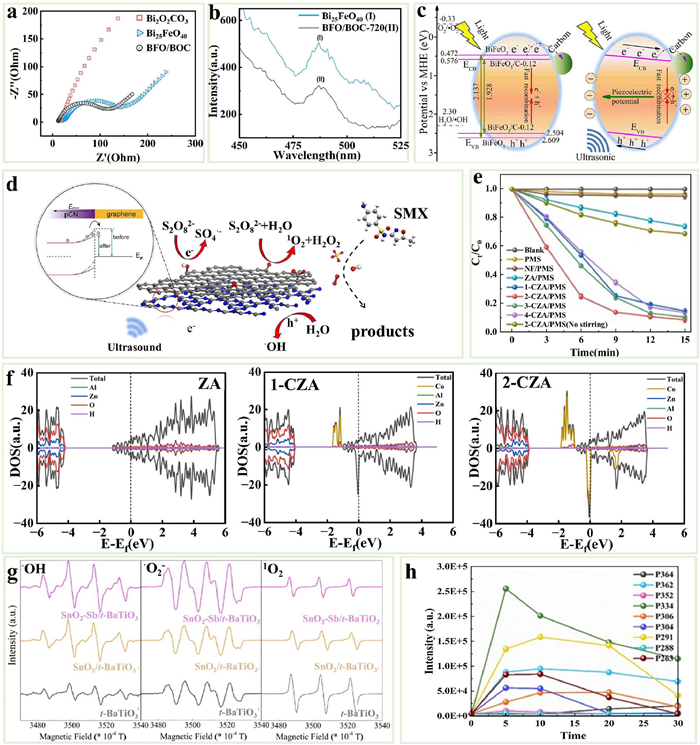
Photocatalysis processes provide an effective and sustainable method for degrading pollutants [43,44]. However, the rapid recombination of photogenerated charge carriers severely restricts charge separation efficiency and ultimately diminishes photocatalytic activity [45,46]. Therefore, many techniques to improve photocatalysis are based on enhancing charge separation [47,48]. The discovery of the piezoelectric effect provides a new direction for improving the shortcomings of photocatalysis [49]. Through coupling, the polarized piezoelectric material generates an effective electric field that selectively attracts and repels photogenerated carriers based on charge polarity, specifically, this is manifested as a lower electrochemical impedance and a lower peak density of the PL spectrum of the material (Figs. 2a and b), indicating an improvement in the carrier separation ability and an enhanced separation effect of electron-hole pairs, thereby significantly enhancing the catalytic efficiency [50]. Li et al. experimentally confirmed that piezo-photocatalysis achieves superior degradation efficiency compared to standalone piezoelectric or photocatalytic processes [51]. Under light irradiation, photocatalysts generate electron-hole pairs that react with adsorbed H2O and O2 to produce reactive oxygen species (ROS), including •OH and superoxide anions •O2-, which drive oxidative pollutant degradation [52,53]. According to theoretical calculations and experimental characterization, although the conduction band electrons of the BiFeO3/C composite material cannot directly reduce oxygen to generate •O2-, the oxygen-containing functional groups on the surface of its carbon component can act as electron mediators, promoting the reduction of oxygen to generate •O2-, while the valence band holes still have the ability to directly oxidize water to form •OH (Fig. 2c) [54]. It has been established that electrons and holes, when their separation rate is restricted, are more capable of interacting with oxygen or water molecules to form free radicals, which significantly improve the removal of antibiotics and provide an efficient and sustainable method for environmental purification.
Figure 2
Figure 2.
Piezoelectric effect and AOPs are coupled to degrade antibiotics. (a) Electrochemical impedance of Bi2O2CO3, Bi25FeO40, and BFO/BOC-720. (b) PL spectrum for Bi25FeO40 and BFO/BOC-720 in 370 nm excitation wavelength, respectively. Reproduced with permission [50]. Copyright 2024, Elsevier. (c) Band structures of the BiFeO3/carbon-dots catalysts and possible degradation mechanism. Reproduced with permission [54]. Copyright 2024, Elsevier. (d) The sulfamethoxazole degradation mechanism in the rGO/CN-PDS-US system. Reproduced with permission [58]. Copyright 2023, Elsevier. (e) Degradation performance of activated PMS on norfloxacin by different samples. The co-doped ZnAl-LDHs were named according to the order of increase of Co(NO3)2·6H2O. And 2-CZA has the best degradation performance. (f) DOS of ZA, 1-CZA, and 2-CZA. Reproduced with permission [59]. Copyright 2023, Elsevier. (g) ESR spectra of ROS in the various systems. Reproduced with permission [62]. Copyright 2019, Elsevier. (h) Temporal patterns of intermediate byproduct abundances (by TOF-MS) during ciprofloxacin degradation. The intensity of most by-products tends to increase first and then decrease. Reproduced with permission [63]. Copyright 2022, Elsevier.
By converting mechanical vibrations into electric polarization, the piezoelectric effect drives the activation of persulfate and the production of ROS, leading to enhanced catalytic performance [55]. Particularly in the field of antibiotic degradation, this effect can bring significant enhancement effects [56,57]. For instance, some researchers have established a piezoelectric-peroxydisulfate (PDS) co-catalytic system. The electrons generated by piezoelectricity can efficiently activate PDS, generating highly oxidizing sulfate radicals. This system can achieve a degradation rate of 95.7% for sulfamethoxazole within 30 min (Fig. 2d) [58]. The cobalt-doped ZnAl LDH piezoelectric catalyst developed by Lu et al. exhibited excellent catalytic activity and stability during the PMS activation and degradation of norfloxacin. The experiment showed that the degradation rate reached as high as 91.5% within 15 min (Fig. 2e). Density functional theory simulation further revealed that the cobalt doping introduced more defect levels, promoting charge transfer and thereby enhancing the activation ability of PMS (Fig. 2f) [59]. In the study of piezoelectric activation of PMS, •OH, SO4•− and •O2− are usually the main active radicals that act [60]. These active free radicals significantly play a pivotal role in the oxidative degradation of organic pollutants, including antibiotics, by initiating radical chain reactions that mineralize complex molecular structures. The existence of the piezoelectric effect will induce the generation of electron-hole pairs. The e- directly reduces persulfate to form •OH and SO4•−; the piezoelectric field polarization of PMS molecules lowers the activation energy barrier; it may promote the generation of 1O2. Therefore, the coupling of the piezoelectric effect and PMS improves not only the activation efficiency of PMS but also the degradation efficiency of antibiotics, indicating its potential application in the treatment of environmental pollution.
3.3
Electrochemical oxidation and piezocatalysis
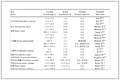
There are relatively few examples of the coupling degradation of antibiotics by the piezoelectric effect and electrochemical oxidation. In their 2012 foundational work, Starr et al. characterized piezocatalysis as an interfacial electrochemical phenomenon occurring at piezoelectric material-solution interfaces, establishing that hydrogen evolution rates at material surfaces are governed by coupled piezoelectric-electrochemical mechanisms [61]. Subsequent studies revealed that integrating high-performance electrocatalysts (e.g., SnO2) with piezoelectric materials (t-BaTiO3) enhances piezocatalytic activity by synergistically mobilizing both intrinsic free charges and interfacial transfer electrons (Fig. 2g) [62]. In the study by Wang et al. [63], the synthesis of Ti/TiO2-NTA/PbO2-La was conducted for piezoelectric electrocatalytic degradation of ciprofloxacin. Remarkably, the hybrid piezoelectric-electrocatalytic system achieved a ciprofloxacin degradation efficiency of 91.4%, which is a substantial improvement over the conventional electrochemical oxidation process (24.1%) and the standalone piezocatalysis process (12.8%) (Fig. 2h). This enhancement is due to multiple factors. Firstly, the material exhibits excellent piezocatalytic performance, and the doping of La provides more reaction sites by reducing the crystal size of PbO2. Secondly, the increase in mechanical vibration energy enhances the piezocatalytic performance, and the current density can influence the catalytic efficiency by affecting the generation of •OH. In summary, the coupled interaction between the piezoelectric effect and electrochemical oxidation significantly increases the degradation efficiency of ciprofloxacin, suggesting that this coupling strategy also has the potential to be applied to antibiotic degradation. Table 1 [54,59,62-74] lists some studies on the degradation of antibiotics by piezoelectric effect-coupled AOPs.
Table 1
Table 1.
Some examples of antibiotic degradation couple the piezoelectric effect and AOPs.
4.
Modification of piezoelectric materials enhances catalytic performance
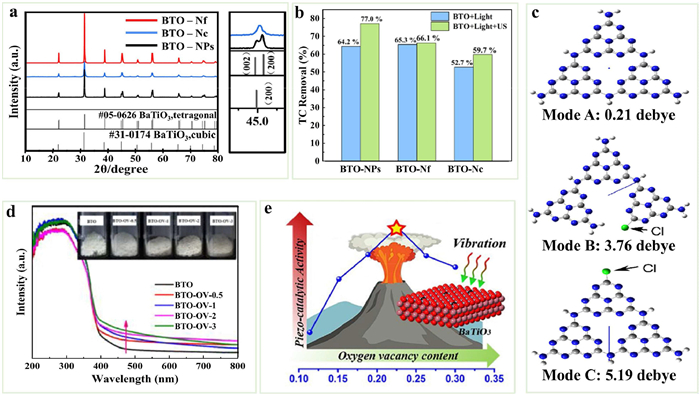
The crystal structure and morphological characteristics of the material have a crucial impact on its piezoelectric catalytic efficiency in antibiotic degradation. Taking BaTiO3 (BTO) as an example, the granular BTO with a tetragonal crystal phase exhibits significant spontaneous polarization due to the deviation of Ti4+ ions from the central position in the crystal (Fig. 3a) [75]. Its piezoelectric performance is superior to that of the coral-shaped and flower-shaped BTO with a cubic structure, and thus it shows higher catalytic activity in tetracycline degradation (Fig. 3b). Moreover, the small size and large specific surface area of nanoparticles facilitate the promotion of charge transfer with pollutant molecules [76]. Therefore, to further improve performance, researchers often modify the material by introducing defects, constructing heterojunctions, or loading noble metals (Table 2) [27,59,62,77-85]. These improvement methods usually can alter the piezoelectric coefficient of the catalyst, effectively enhancing the piezoelectric response and catalytic efficiency. The piezoelectric coefficient is a fundamental physical constant that measures the material's ability to convert mechanical force into electrical charge (or vice versa), and directly determines the intrinsic driving force intensity for the separation of charges and chemical reactions in piezoelectric catalysis [86]. When the piezoelectric coefficient (d33) of the material is increased, a stronger built-in electric field is generated under external force, which can more effectively drive the separation and directional migration of charge carriers (electrons and holes), resulting in more abundant active charges participating in surface redox reactions, and ultimately leading to a significant improvement in catalytic efficiency [87].
Figure 3
Figure 3.
The influence of piezoelectric material structure on catalytic performance. (a) XRD patterns of three catalytic materials with different morphologies (BTO NPs, BTO Nf, and BTO Nc). The diffraction peak of BTO NPs splits into two peaks at 45°. (b) Performance Comparison Chart. In contrast, BTO NPs have the highest degradation rate. Reproduced with permission [75]. Copyright 2023, MDPI. (c) Calcination models and dipole moments of catalytic materials (Model A is the original structure of GCN, and models B and C are the structures doped with Cl). The doping of Cl will cause a change in the symmetry of the GCN skeleton. Reproduced with permission [77]. Copyright 2023, Elsevier. (d) Ultraviolet-visible diffuse reflection spectra of several modified catalysts. (e) Volcanic trend of oxygen vacancies-activity of BaTiO3. The catalytic performance exhibits a non-monotonic dependence on oxygen vacancy concentration, with an optimal defect density maximizing activity before excessive vacancies induce performance degradation. Reproduced with permission [93]. Copyright 2020, Elsevier.
Defect engineering is a key strategy for enhancing the performance of catalysts, mainly involving two methods: Doping and introducing oxygen vacancies. Doping, by introducing impurity atoms into the semiconductor lattice, can effectively regulate its electronic properties. For instance, doping silicon carbide with nitrogen can optimize its electronic structure and enhance its piezoelectric performance by inducing lattice polarization, thereby increasing the current density of the catalyst under photoacoustic synergy by 50.1% [88]. Another study introduced chlorine atoms into the graphite-like nitrogen-containing carbon (GCN) framework (Fig. 3c), which changed the crystal symmetry and increased the dipole moment, significantly enhancing the material's degradation activity towards antibiotics [77].The introduction of oxygen vacancies can form defect states in the band gap, constructing intermediate energy levels for electron transitions, thereby promoting charge separation and inhibiting electron-hole recombination. This structural optimization enhances light absorption and establishes an intrinsic electric field, thereby improving catalytic efficiency [89-91]. For example, the Bi2WO6 nanocatalysts rich in oxygen vacancies exhibits superior performance due to enhanced charge separation and visible light absorption. Theoretical calculations confirm that the electron vacancy band produced by oxygen vacancies is the reason for the improvement in light capture ability [92]. It is worth noting that the concentration of oxygen vacancies should be kept moderate: A moderate concentration of vacancies can improve performance, but excessive vacancies will disrupt lattice polarization and instead weaken the piezoelectric response and catalytic efficiency (Figs. 3d and e) [93]. In summary, doping and the introduction of oxygen vacancies jointly enhance the degradation ability of the catalyst towards antibiotics by (i) regulating the electronic band structure to optimize charge separation efficiency, and (ii) increasing surface active sites to improve reaction activity and selectivity.
4.2
Building heterojunctions
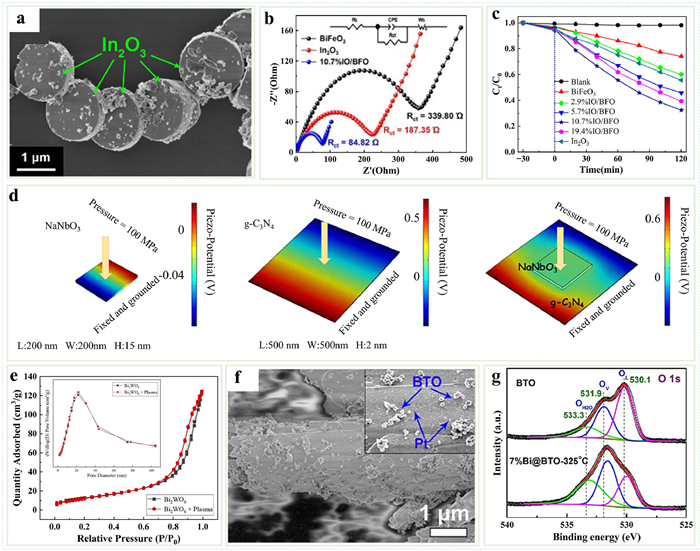
Heterojunction construction is an effective strategy for enhancing the piezoelectric catalytic performance. By establishing an internal electric field at the material interface and promoting electron transfer, it can significantly enhance the charge separation efficiency under mechanical stress [94-96]. Sun et al. constructed the In2O3/BiFeO3 heterojunction (Fig. 4a) and evaluated the carrier separation and transfer ability generated by light using photoluminescence (PL) spectroscopy [97,98]. The experimental results (Figs. 4b and c) show that the PL intensity of the most effective material (10.7% IO/BFO) is significantly lower than that of BiFeO3 and In2O3, and the degradation efficiency of this material is increased by 2.05 and 3.97 times compared to In2O3 and BiFeO3, respectively, confirming the effective suppression of photocarrier recombination by constructing heterojunctions. The use of this catalyst in piezo-photocatalysis also has significant advantages, indicating that the formation of heterojunctions can substantially enhance catalytic efficiency.
Figure 4
Figure 4.
The influence of piezoelectric material modification on performance. (a) SEM images of 10.7% IO/BFO. (b) EIS plots of BiFeO3, In2O3, and 10.7% IO/BFO. The EIS spectrum of composite materials is smaller in diameter than the semicircle of a single material. (c) Time-dependent photodegradation curves of tetracycline. Reproduced with permission [97]. Copyright 2023, Elsevier. (d) The piezoelectric properties of the catalytic materials [NaNbO3 (0.58 V), g-C3N4 (0.45 V), and NNCN-3 (0.67 V)] before and after the construction of the heterojunction were analyzed through finite element simulation (cavitation pressure of 100 MPa). Reproduced with permission [101]. Copyright 2023, Elsevier. (e) The adsorption performance of Bi2WO6 and its modified catalyst was measured by N2 (attached figure: Pore size distribution of the two catalysts). Reproduced with permission [105]. Copyright 2024, Elsevier. (f) SEM image of 2% Pt/9% BTO/BO (BaTiO3/Bi2O3). Reproduced with permission [66]. Copyright 2024, Elsevier. (g) O 1s XPS spectra of BTO and 7% Bi@BTO-325 ℃. Reproduced with permission [70]. Copyright 2024, Elsevier.
Furthermore, materials such as g-C3N4, due to their controllable band structure, are often utilized to construct heterojunctions in order to facilitate charge transfer at the interface [99,100]. Guo et al. coupled NaNbO3 and g-C3N4 to form a heterojunction system and found that at 100 MPa (Fig. 4d), the interfacial potential difference exceeded that of either individual component, confirming enhanced mechanical energy conversion through heterojunction formation [101]. In summary, the construction of heterojunctions enhances the piezoecatalytic performance of catalysts through multiple mechanisms, including: (i) Interfacial electron transfer optimization, (ii) spatial charge separation efficiency improvement, and (iii) mechanical energy conversion enhancement.
4.3
Loading precious metals
The deposition of precious metals (Ag, Au, Pd, Pt) is an effective modification strategy. The deposition of precious metals on semiconductors usually leads to their effective electron or hole trapping functions, thereby improving the charge separation efficiency. The piezoelectric catalytic activity can also be enhanced by taking advantage of its surface plasmon resonance (SPR) effect, which can amplify the local electric field and promote charge separation under mechanical excitation [102,103]. For example, Sun et al. synthesized NaNbO3 µm powders and their Ag quantum dot-modified counterparts. Silver quantum dots (Ag QDs) facilitate interfacial charge transfer through the formation of Schottky junctions, while simultaneously suppressing carrier recombination via plasmon-induced local field enhancement. The modified catalyst significantly enhances visible light absorption, which is conducive to catalytic reactions [104]. Zhou et al. treated Bi2WO6 with plasma surface modification in the experiment [105]. In comparison with the original catalyst, the modified catalyst exhibited no substantial alterations in the crystal structure; however, an augmentation in both the specific surface area and the average pore size was observed. This modification method has been shown to create additional adsorption centers, thereby improving the performance of the catalyst (Fig. 4e and Fig. S5a in Supporting information). However, the cost of depositing precious metals is a significant challenge. In an effort to overcome this limitation, some studies have explored the potential of transition metals as alternatives to precious metal, to enhance the catalytic performance of catalysts. Although research in this area is still limited, especially in the context of antibiotic degradation [106].
4.4
Coupling modification strategy
A single modification strategy has limitations in enhancing the piezoelectric catalytic performance. Therefore, by combining multiple strategies and fully leveraging their synergy, it is expected to achieve further breakthroughs in performance. Sun et al. constructed a ternary heterojunction of BaTiO3/Bi2O3/Pt, which is a model of the synergy of multiple strategies (Fig. 4f) [66]. The synergistic effect is manifested as follows: Bi2O3 acts as a photosensitive matrix to absorb light energy and generate electron-hole pairs; BaTiO3 serves as the piezoelectric component, generating an internal electric field under mechanical force, which cooperates with the built-in electric field within the heterojunction; ultimately, the electrons that migrate to BaTiO3 are efficiently captured by the Pt nanoparticles on its surface through a Schottky junction and used to drive the surface catalytic reaction. This system achieves full-chain optimization of energy harvesting, charge separation, and interface reactions through precise coupling of the piezoelectric effect, heterojunction, and co-catalyst, demonstrating efficient antibiotic degradation performance (Fig. S5b in Supporting information). Wang et al. [70] successfully combined the control of bulk phase defects of BaTiO3 (Vo) with the surface modification of Bi quantum dots (Bi QDs) through structural modification of BaTiO3, achieving synergistic enhancement. The oxygen vacancies and Bi quantum dots jointly form a fast "capture-transmission" channel (Fig. 4g). The electrons generated by the piezoelectric effect are first effectively captured and stabilized by the oxygen vacancies, and then quickly extracted and transferred to the surface to participate in the catalytic reaction by adjacent Bi quantum dots. This synergistic effect significantly improves the overall efficiency of charge separation and utilization, thereby achieving a substantial enhancement in the piezoelectric catalytic performance (Fig. S5c in Supporting information). These studies provide theoretical and experimental foundations for designing and optimizing the piezoelectric catalytic process.
5.
Degradation pathways and toxicity assessment of antibiotics
5.1
Degradation pathways
Antibiotics have garnered significant scientific concern owing to their recalcitrant nature and potential toxicity. In addition to the previously mentioned how to improve the degradation efficiency, it is also very important to study its possible degradation pathways. During the process of gradually decomposing complete molecules into small molecules such as CO2 and H2O, the toxicity of antibiotics and their intermediate products is also constantly changing [107]. Therefore, studying the degradation pathways of antibiotics is crucial for dealing with potentially more toxic intermediate products. For a range of prevalent antibiotic types, the potential degradation pathways are illustrated in Fig. S6 (Supporting information).
5.1.1
Tetracyclines
Tetracyclines represent a class of broad-spectrum antibiotics based on hydrogenated tetraphenyls, including, but not limited to, TC [50,108], chlortetracycline [80,109], and oxytetracycline [81]. The degradation pathways of these antibiotics can be summarized into two types. Pathway one involves reactions of demethylation, deamination, and amide groups. Specifically, the two methyl groups connected by the amino group first detach and convert into two hydrogen atoms, followed by the opening of the amino group and its ring, and then the decarbonylation reaction occurs. Due to the erosion of C-C bonds by active substances, continuous ring-opening reactions occur until all are mineralized into small molecules. Pathway two begins with the opening of the ring where the amino group is located, followed by the detachment of the amino group, and then a continuous process of ring opening and mineralization. Since tetracyclines primarily contain simple functional groups like -OH, their degradation starts from the basic skeleton, which can be opened at different sites. This process involves various reactions, including dehydrogenation, ring opening, demethylation, and decarboxylation (Fig. S6a).
5.1.2
Fluoroquinolones
Fluoroquinolone antibiotics are named because they contain quinolone structures, of which ciprofloxacin and norfloxacin are representative drugs. The commonality between these two antibiotics is that the R2 position is connected to a piperazine ring, but the difference is that the R1 position is connected to a different alkyl group (Fig. S6b). During the degradation process, the piperazine ring usually transforms first due to its relative fragility. The structural changes of products during the degradation process of ciprofloxacin [63,66,70] include the attack of the piperazine ring by the free radicals formed in the oxidation system, causing a series of changes in the piperazine ring until it opens. Therefore, in this process, the quinolone group opens step by step: (i) Initial oxidation and destruction of the piperazine ring, followed by conversion into an amino group for further degradation; (ii) Defluorination, where fluorine is replaced by hydroxyl groups or directly removed, followed by the conversion of the piperazine ring or the oxidation of the carboxyl group; (iii) Direct decarboxylation, and the decarboxylated product further removes other functional groups. Overall, the piperazine ring is the first to be converted during degradation due to its susceptibility to electrophilic and nucleophilic attacks. The pyridine moiety exhibits high susceptibility to oxidative cleavage, primarily due to the low bond dissociation energy of the C-C-C-O linkage, facilitating ring-opening reactions under catalytic conditions. As the cyclopropane in ciprofloxacin and the ethane in norfloxacin gradually detach, the antibiotics eventually mineralize into small molecule compounds (CO2, H2O, F, NO2).
5.1.3
Sulfonamides and nitroimidazoles
Sulfonamide antibiotics, exemplified by sulfadiazine [110] and sulfamethoxazole [58,111], manifest divergent degradation pathways when contrasted with tetracycline and fluoroquinolone antibiotics (Fig. S6c). This distinction is attributable to their distinct structural characteristics. The process of sulfonamide antibiotic degradation is initiated by the replacement of the hydrogen atom of the sulfonamide group, which is attached to the benzene ring, with various functional groups. The degradation process typically commences with ring opening, and the degradation pathways predicted in different reports generally begin in the attached functional groups. The possible degradation pathways include: (i) Degradation starting from the substituent side, for example, the benzene ring in sulfamethoxazole will undergo ring opening and conversion to an amino group under the action of active free radicals, or undergo direct hydroxylation, which involves the conversion of the benzene ring and is an important step in the degradation of sulfonamide antibiotics; (ii) degradation begins from the amino group directly connected to the benzene ring, where the amino group is converted into a nitro or hydroxyl group and subsequently shed. Then, the benzene ring is opened and finally mineralized into small molecules. This pathway illustrates the influence of changes in amino groups in sulfonamide antibiotics on their degradation pathway.
Nitroimidazole antibiotics, such as metronidazole [56,62] and tinidazole [112], typically have a relatively simple structure with only one ring, resulting in fewer intermediate products produced during degradation. The difference between these antibiotics lies in the substituent groups, which replace the hydrogen attached to the nitrogen on the nitroimidazole ring. During the degradation process, the reaction typically initiates from the substituent groups attached to the ring. Based on the experimental results of other researchers [113,114], the degradation pathways can be summarized as follows. The first approach is to attack the hydrogen on the nitroimidazole ring through -OH to undergo a hydroxylation reaction, or attack the nitro group to undergo a hydroxylation reaction. The second pathway is the homolytic cleavage of the N-O bond within the nitro group (Fig. S6d).
Through the above pathways, antibiotics can be effectively degraded, reducing environmental pollution and associated ecological and public health risks. Studies of antibiotic degradation pathways may help to identify more toxic intermediates on time and assess the feasibility of new technologies capable of degrading antibiotics, thus making a valuable contribution to environmental protection and human health. In Table S2 (Supporting information), based on the degradation pathways of antibiotics, the suitable catalyst types are listed, along with the inhibitory effects of coexisting ions in water on the degradation efficiency of different types of antibiotics.
5.2
Toxic changes
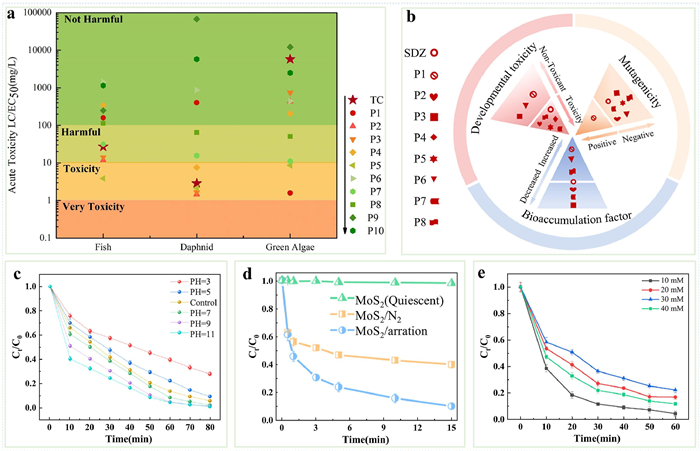
Extensive experimental studies have validated the effectiveness of piezocatalysis in detoxifying antibiotics and their degradation intermediates, thereby facilitating safe conversion processes. For example, Huo et al. investigated the acute and chronic toxicities of tetracycline and its intermediates after their degradation by piezocatalysis (Fig. 5a) [78]. Zhu et al. [110] combined the piezoelectric effect with persulfate activation to degrade sulfamethoxazole and evaluated the toxicity of the degradation intermediates (Fig. 5b). These experiments demonstrated that certain transformation products exhibited a high potential for bioaccumulation, and their ecological toxicity might be higher than that of the parent antibiotic during the reaction process. However, as the degradation process progressed, most of the intermediate products would be transformed into less toxic substances. This indicates that piezocatalysis can effectively reduce the ecological risk of antibiotics, while also mineralize the biologically active intermediates and prove the effectiveness of piezocatalysis technology in the degradation of antibiotics and the reduction of toxicity.
Figure 5
Figure 5.
Toxicity changes and influencing factors during the degradation process of antibiotics. (a) Change in toxicity during the degradation of tetracycline by MoS2/GDY-3 via ECOSAR. Reproduced with permission [78]. Copyright 2022, Elsevier. (b) Toxicity analysis of sulfadiazine and its intermediate products. The biological accumulation coefficient, developmental toxicity, and mutability were investigated. The closer to the midpoint, the greater the degree of harm. Reproduced with permission [110]. Copyright 2022, Elsevier. (c) Effects of pH. Reproduced with permission [120]. Copyright 2024, Elsevier. (d) Investigate the influence of dissolved oxygen on the degradation rate. Reproduced with permission [112]. Copyright 2023, Elsevier. (e) Comparison of degradation rates of piezoelectric degradation of tetracycline under different initial concentrations (Ni/MoS2/Wood). Reproduced with permission [108]. Copyright 2023, Elsevier.
6.
Influencing factors in the process of antibiotic degradation
The factors that influence piezoelectric catalytic efficiency mainly include the piezoelectric effect caused by piezoelectric materials and the surface redox triggered by piezoelectricity [115]. The piezocatalytic degradation efficiency is governed by multiple interdependent factors, including the material's crystallographic phase, morphological characteristics, catalyst loading, and mechanical activation parameters. In addition to the influence of the material itself, the type of mechanical force causing the piezoelectric effect, water quality parameters, and water background matrices also have an impact on the degradation effect of antibiotics.
6.1
Motivating force
The mechanical forces commonly used to generate piezoelectric effects include ultrasonic waves, water flow shear forces, among others (Text S2 in Supporting information). Different mechanical forces have different impacts on the process of piezocatalysis [108]. Ultrasound usually achieves the fastest initial degradation rate due to its ability to generate the highest concentration of instantaneous reactive species (such as •OH) [116]. However, their energy efficiency is relatively low, as the majority of the input energy is converted into heat rather than the effective cavitation effect. Therefore, they are more suitable for coupling with other modes or treating small-scale high-risk wastewater. The rate of the fluid shear system is usually slower and needs to be improved by optimizing the reactor or the structure of the catalyst, but its energy efficiency is higher, and it can directly utilize kinetic energy [82,117,118]. Furthermore, ball milling is also one of the forces that promote piezocatalysis. It has been demonstrated that collisions and shearing can generate significant forces, resulting in the deformation of the catalyst [81]. The dominant reactive species in different mechanical modes may vary, which may affect the degradation effect, but there are currently few clear data indicating this difference.
6.2
Water quality parameters
Having examined the intrinsic material properties governing catalytic performance, we now systematically analyze how environmental parameters influence antibiotic degradation efficiency, such as pH, dissolved oxygen, and substrate concentration. The pH of the solution has an impact on the degradation efficiency of the catalyst in multiple aspects, including the formation level of active free radicals, ionization level, and chemical properties of pollutants [60,119]. The change in pH can affect the formation of active free radicals, which in turn affects the degradation efficiency (Fig. 5c). Under highly acidic conditions, excessive H+ ions scavenge conduction band electrons, suppressing •O2- formation. Conversely, alkaline environments facilitate •OH generation through enhanced hydroxide ion oxidation, thereby improving radical-mediated degradation efficiency [120]. The influence of dissolved oxygen is illustrated through an example. Zhang et al. systematically investigated the effects of aeration and dissolved oxygen in antibiotics degradation by piezoelectric odd-layer MoS2 using water bubble rupture driven by an aerator as a piezoelectric driving force [112]. The results showed (Fig. 5d) that under conditions of aeration, dissolved molecular oxygen (O2) was reduced to superoxide radicals (•O2-) through electron transfer processes at the catalyst-water interface, and the presence of this free radical played an important role in TNT degradation, with a notable enhancement in the degradation rate. Furthermore, the removal rate of the catalyst for more than ten other antibiotics was above 80%, and these results demonstrate the broad applicability of MoS2 for antibiotic removal in aeration-driven piezocatalysis, where dissolved oxygen serves as a critical electron acceptor to sustain ROS generation.
6.3
Water background matrices
In the actual water environment, various ions are usually present, and the coexisting substances (K+, Ca2+, Mg2+, Cl-, NO3-, HCO3-, SO42-) also have an impact on the piezocatalytic system. Generally speaking, SO42- and NO3- have a relatively minor impact on the degradation performance. Cl- is prone to react with the active substances, and HCO3- has the effect of quenching active free radicals [59]. Therefore, when removing antibiotics from the actual water body, it is necessary to consider whether these ions exist or not. For example, among different water bodies (surface water, deionized water, seawater, rainwater, and tap water), the degradation rate in deionized water is the lowest. The underlying reason for this phenomenon may be attributed to the enhanced degradation efficiency induced by the presence of ions and organic substances in diverse water qualities [121]. Moreover, elevated substrate concentrations promote catalyst surface fouling through molecular adsorption, which physically obstructs active sites and diminishes catalytic efficiency (Fig. 5e) [108]. In summary, the efficiency of piezocatalysis is governed by multiple interdependent factors, and optimizing these conditions can enhance the degradation efficiency of antibiotics and minimize ecological impacts.
7.
Challenges and prospects
(1) There are still several key directions that need to be expanded in the research on the degradation of antibiotics through piezoelectric effects: Firstly, in terms of the degradation targets, current studies mainly focus on a limited number of categories such as tetracycline, ciprofloxacin, and metronidazole. However, the mechanisms and pathways of piezoelectric catalytic degradation for important antibiotics like aminoglycosides and penicillins have not been systematically explored. In the future, it is necessary to expand the research on the antibiotic spectrum and develop catalyst systems with strong adaptability and high stability by considering the complex factors such as ion competition and buffering effects in actual water bodies. Secondly, in terms of the action dimension, in addition to the antibiotic molecules themselves, attention should also be paid to the synchronous removal efficacy of antibiotic resistance genes and resistant bacteria by piezoelectric catalysis, thereby providing new technical ideas for controlling the spread of antibiotic resistance.
(2) Magnetic field coupling and peroxide activation are two promising but yet-to-be-in-depth-explored research directions in the field of piezoelectric catalytic antibiotic degradation. Currently, there have been preliminary explorations on combining magnetic fields with piezoelectric catalysis, but reports specifically using it for antibiotic degradation are still rare. This cross-disciplinary synergy mechanism merits systematic research. On the other hand, studies on advanced oxidation processes combining piezoelectric catalysis with peroxides such as PMS or H2O2 are also limited. The main challenges lie in: (ⅰ) The complexity of the mechanism, and the specific pathways of energy transfer and peroxide activation remain unclear; (ⅱ) The design of catalysts needs to take into account both piezoelectric properties and peroxide activation ability; (ⅲ) The addition of additional oxidants will increase the processing cost, and the integration process has higher requirements for system operation. Future efforts should focus on mechanism clarification, development of compatible materials, and process optimization.
(3) To advance the practical application of piezoelectric catalytic degradation of antibiotics in the future, it is necessary to focus on breaking through two key bottlenecks: the innovation of material systems and the optimization of system costs. At the material level, current research mainly focuses on the modification and optimization of traditional piezoelectric materials, but the complex modification processes often restrict their large-scale production. In the future, efforts should be made to discover new material systems with high intrinsic piezoelectric response and catalytic activity, and develop precise and controllable microstructure control strategies to enhance the synergy of piezoelectric properties and surface reaction activity while reducing the synthesis costs. At the system level, the costs of the entire process, including catalyst recycling, ultrasonic energy consumption, and process operation, should be comprehensively evaluated. By developing low-power driving modes and coupling resource recovery processes, the technology should be transformed from auxiliary degradation to energy-resource collaborative recycling. For example, combining pollutant degradation with high-value conversion processes such as hydrogen production through hydrolysis and activation of peroxides, efficient purification can be achieved while improving the economic and sustainability of the overall process, providing a feasible path for the practical engineering application of piezoelectric catalytic technology.
(4) At present, the research on piezoelectric catalysis still faces a series of core challenges at the mechanism level. Firstly, the dynamic regulation mechanism of piezoelectric potential on the surface reaction pathway is not yet clear. The microscopic process from the intrinsic piezoelectric response to catalytic activity remains unknown. Secondly, there is a lack of standardized energy conversion efficiency descriptors in the field, making it difficult to conduct essential comparisons and mechanism correlations of performance data from different research systems. Finally, in multi-field coupled systems, the synergistic effects of physical fields such as stress, light, and heat often present nonlinear superposition, and the microscopic mechanism of their mutual coupling is difficult to precisely decouple. The breakthrough of these bottleneck issues urgently requires continuous and in-depth research, so as to truly achieve the transformation from macroscopic performance correlation to microscopic mechanisms.
8.
Conclusions
Antibiotics have emerged as a concerning class of emerging contaminants, with their widespread usage posing significant ecological and public health risks. In parallel, piezocatalysis has established itself as an effective AOP for degrading various organic pollutants, demonstrating particular promise for antibiotic remediation. This review mainly explores the role of the piezoelectric effect in organic matter degradation from the perspective of antibiotic degradation. In practical applications, the piezoelectric effect can work together with AOPs. Experimental results show that this coupling can produce a synergistic effect in the process of antibiotic degradation. In addition, to improve catalytic activity, piezoelectric materials are often modified. By introducing defects, constructing heterojunctions, loading precious metals, and other methods, the performance of the catalyst can be enhanced to achieve the goal of improving the degradation efficiency. These modification strategies effectively suppress charge recombination by creating spatial separation pathways for electrons and holes, thereby enhancing carrier utilization efficiency in catalytic reactions. After applying the piezoelectric effect to degrade antibiotics, the toxicity of most antibiotics and their intermediates can be reduced to varying degrees. Therefore, applying the piezoelectric effect to the degradation of antibiotics not only has good application prospects, but also can effectively reduce the concentration of antibiotic residues, reduce environmental pollution. In future research, the piezoelectric effect can be considered for the removal of more pollutants. In addition, how to further improve its efficiency and save energy consumption can also be included in the research direction.
The authors declare that they have no known competing financial interests or personal relationships that could have appeared to influence the work reported in this paper.
Acknowledgments
This work was supported by the National Natural Science Foundation of China (No. 32171615) and the National Key Research and Development Program of China (No. 2019YFC1804102).
Supplementary materials
Supplementary material associated with this article can be found, in the online version, at doi:10.1016/j.cclet.2026.112885.
Figure 1
Piezoelectric effect and materials: (a) The mechanism diagram of the piezoelectric effect. Reproduced with permission [17]. Copyright 2018, Elsevier. (b) Common types of piezoelectric catalysts. Reproduced with permission [18]. Copyright 2024, Wiley. (c) Schematic structure model of Mo5Fe5. Reproduced with permission [20]. Copyright 2025, Elsevier. (d) Crystal structure of Sr2Bi4Ti5O18 (SBTO). Reproduced with permission [21]. Copyright 2025, Elsevier. (e) The structural formula of BTO. Reproduced with permission [22]. Copyright 2025, Wiley. (f) Structure of Cd0.7Zn0.3S. Reproduced with permission [23]. Copyright 2024, Elsevier. (g) Optimized structure for the 2-Fe/MoS2. Reproduced with permission [24]. Copyright 2024, Elsevier.
Figure 2
Piezoelectric effect and AOPs are coupled to degrade antibiotics. (a) Electrochemical impedance of Bi2O2CO3, Bi25FeO40, and BFO/BOC-720. (b) PL spectrum for Bi25FeO40 and BFO/BOC-720 in 370 nm excitation wavelength, respectively. Reproduced with permission [50]. Copyright 2024, Elsevier. (c) Band structures of the BiFeO3/carbon-dots catalysts and possible degradation mechanism. Reproduced with permission [54]. Copyright 2024, Elsevier. (d) The sulfamethoxazole degradation mechanism in the rGO/CN-PDS-US system. Reproduced with permission [58]. Copyright 2023, Elsevier. (e) Degradation performance of activated PMS on norfloxacin by different samples. The co-doped ZnAl-LDHs were named according to the order of increase of Co(NO3)2·6H2O. And 2-CZA has the best degradation performance. (f) DOS of ZA, 1-CZA, and 2-CZA. Reproduced with permission [59]. Copyright 2023, Elsevier. (g) ESR spectra of ROS in the various systems. Reproduced with permission [62]. Copyright 2019, Elsevier. (h) Temporal patterns of intermediate byproduct abundances (by TOF-MS) during ciprofloxacin degradation. The intensity of most by-products tends to increase first and then decrease. Reproduced with permission [63]. Copyright 2022, Elsevier.
Figure 3
The influence of piezoelectric material structure on catalytic performance. (a) XRD patterns of three catalytic materials with different morphologies (BTO NPs, BTO Nf, and BTO Nc). The diffraction peak of BTO NPs splits into two peaks at 45°. (b) Performance Comparison Chart. In contrast, BTO NPs have the highest degradation rate. Reproduced with permission [75]. Copyright 2023, MDPI. (c) Calcination models and dipole moments of catalytic materials (Model A is the original structure of GCN, and models B and C are the structures doped with Cl). The doping of Cl will cause a change in the symmetry of the GCN skeleton. Reproduced with permission [77]. Copyright 2023, Elsevier. (d) Ultraviolet-visible diffuse reflection spectra of several modified catalysts. (e) Volcanic trend of oxygen vacancies-activity of BaTiO3. The catalytic performance exhibits a non-monotonic dependence on oxygen vacancy concentration, with an optimal defect density maximizing activity before excessive vacancies induce performance degradation. Reproduced with permission [93]. Copyright 2020, Elsevier.
Figure 4
The influence of piezoelectric material modification on performance. (a) SEM images of 10.7% IO/BFO. (b) EIS plots of BiFeO3, In2O3, and 10.7% IO/BFO. The EIS spectrum of composite materials is smaller in diameter than the semicircle of a single material. (c) Time-dependent photodegradation curves of tetracycline. Reproduced with permission [97]. Copyright 2023, Elsevier. (d) The piezoelectric properties of the catalytic materials [NaNbO3 (0.58 V), g-C3N4 (0.45 V), and NNCN-3 (0.67 V)] before and after the construction of the heterojunction were analyzed through finite element simulation (cavitation pressure of 100 MPa). Reproduced with permission [101]. Copyright 2023, Elsevier. (e) The adsorption performance of Bi2WO6 and its modified catalyst was measured by N2 (attached figure: Pore size distribution of the two catalysts). Reproduced with permission [105]. Copyright 2024, Elsevier. (f) SEM image of 2% Pt/9% BTO/BO (BaTiO3/Bi2O3). Reproduced with permission [66]. Copyright 2024, Elsevier. (g) O 1s XPS spectra of BTO and 7% Bi@BTO-325 ℃. Reproduced with permission [70]. Copyright 2024, Elsevier.
Figure 5
Toxicity changes and influencing factors during the degradation process of antibiotics. (a) Change in toxicity during the degradation of tetracycline by MoS2/GDY-3 via ECOSAR. Reproduced with permission [78]. Copyright 2022, Elsevier. (b) Toxicity analysis of sulfadiazine and its intermediate products. The biological accumulation coefficient, developmental toxicity, and mutability were investigated. The closer to the midpoint, the greater the degree of harm. Reproduced with permission [110]. Copyright 2022, Elsevier. (c) Effects of pH. Reproduced with permission [120]. Copyright 2024, Elsevier. (d) Investigate the influence of dissolved oxygen on the degradation rate. Reproduced with permission [112]. Copyright 2023, Elsevier. (e) Comparison of degradation rates of piezoelectric degradation of tetracycline under different initial concentrations (Ni/MoS2/Wood). Reproduced with permission [108]. Copyright 2023, Elsevier.


 DownLoad:

 下载:


 下载:

