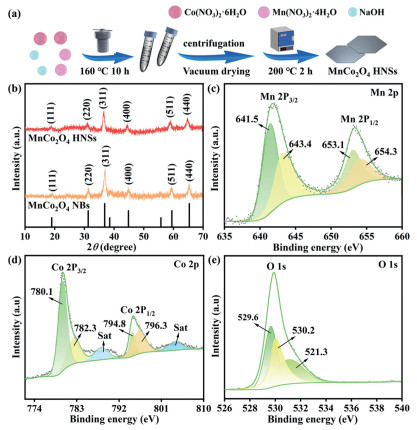
Figure 1.
(a) The preparation process of MnCo2O4 HNSs. (b) The XRD patterns, (c) Mn 2p, (d) Co 2p and (e) O 1s XPS spectrums of MnCo2O4 HNSs.

Bimetallic oxide spinel MnCo2O4 hexagonal nanosheets toward efficient peroxymonosulfate activation for tetracycline removal in wastewater
Xiaoqian Lu , Tong Gao , Zenghui Sun , Zhangqian Liang , Zhenzi Li , Wei Zhou


Tetracycline hydrochloride (TC), an antibiotic is widely used to treat multiple diseases caused by bacteria in recent decades [1,2]. Meanwhile, misuse of TC have resulted in serious risks to both public health and ecosystem [3]. Yet, traditional approaches, such as adsorption, biodegradation and membrane separation method are difficult to completely degrade TC due to its high stable aromatic ring molecular structure and biotoxicity [4-6]. Thus, there is a pressing need to explore an advanced remediation technology capable of both regulating and eliminating TC. Recently, advanced oxidation processes (AOPs) via activating peroxymonosulfate (PMS) are widely employed for eliminating persistent organic macromolecular pollutants from wastewater owing to their ability in generating abundant chemically reactive oxygen species (ROSs, including hydroxyl radicals (•OH), superoxide radicals (•O2−), singlet oxygen (1O2) and sulfate radicals (SO4−•) with high oxidative power [7]. More importantly, compared to other ROSs, AOPs based on SO4−• exhibit a higher redox potential (2.5–3.1 V) and a longer half-life (approximately 30–40 μs) [8]. Hence, SO4−•-based AOPs demonstrate exceptional potential for applications in soil remediation or antibiotics wastewater treatment.
So far, a variety of technologies can be used to activate PMS, encompassing heat, transition metals, UV, etc. [9,10]. It is proved that transition metal-based catalysts are the most efficient ones, as they do not require complex equipment or additional energy input. Besides, transition metal-based catalysts boast low energy consumption, excellent reusability, high activation efficiency, strong industrial applicability and stability [11]. Specifically, the valence change of transition metals will lead to the asymmetric cleavage of the O–O bond in the process of PMS activitation, thereby promoting the generation SO4−• (Eq. 1) [12].
|
|
(1) |
In addition, the catalysts based on bimetallic (BM) oxides exhibit excellent performance over conventional catalysts with a single active site owing to their structural flexible tunability, more multiple active sites and the synergistic electron transfer between different active sites [13]. It is reported that manganese (Mn) could readily form Mn oxides with high oxidizing properties, enabling it to effectively activate oxidants [14]. Also, Mn has the advantages of abundant natural reserves, variable chemical valence states, high environmental compatibility and low cost, making it a highly promising candidate for activating PMS [15]. Meanwhile, cobalt (Co) are a preferred choice for PMS activation due to their high efficiency and cost-effectiveness among transition metals [16]. Thus, the bimetallic oxide formed by the combination of Co and Mn endows it with superior activity over single metal oxide, such as a variety of valence states that facilitate redox reaction.
MnCo2O4, a spinel-structured material with the general formula AB2O4 (where A and B reside in tetrahedral and octahedral sites, respectively), is considered a promising catalyst for PMS activation to achieve organic pollutant removal owing to its inherent exceptional redox ability, diverse catalytic sites, adjustable coordination structures and structural stability [17]. It is widely recognized that the 2D nanosheet structure facilitates the process of PMS activation, whose lamellar structure serves both to create more transport channels for ROSs and provides abundant active sites [18]. However, studies targeting the enhancement of the catalytic performance by transition bimetallic metals for activating PMS via designing their morphology and structure remain scarce [19]. While current research has predominantly focused on harnessing the synergistic effects of transition bimetals, often overlooking the critical relevance among their nanostructural properties and catalytic performance [20]. To further improve the activity of bimetallic catalysts, it is need to explore novel and controlled 2D nanosheet structures of Co-Mn bimetallic oxides and to elucidate their multi-activation mechanism toward PMS.
Given the foregoing analysis, we successfully synthesized MnCo2O4 hexagonal nanosheets (HNSs) via hydrothermal followed by calcination method (Fig. 1a) to remove TC by PMS activation. Owing to the combination of Co-Mn synergy and their specific hexagonal nanosheets structure, the MnCo2O4 HNSs exhibited an excellent catalytic activity and outstanding stability for activating PMS. The influences of different reaction conditions including the initial solution pH, the catalyst dose, the PMS dose, the conditions of stirring and unstirring as well as the adding different trapping agents on the catalytic performance were comprehensively investigated in depth as well. Furthermore, the quenching experiments and EPR analysis were conducted to demonstrate the effect of synergistic interaction of Mn and Co and the catalytic mechanism. Ultimately, we therefore identified the possible degradation intermediates and further proposed the catalytic mechanism for activating PMS toward TC removal in the MnCo2O4 HNSs/PMS system. This study may offer a new insight to develop catalysts in the combination of Co-Mn synergy and morphology regulation for effectively treat antibiotics wastewater.
To elucidate the influence of microstructures on the crystal structure of MnCo2O4, X-ray diffraction (XRD) patterns of MnCo2O4 NBs and MnCo2O4 HNSs are performed. Both MnCo2O4 NBs and MnCo2O4 HNSs exhibit six characteristic diffraction peaks at 18.5°, 30.5°, 35.9°, 43.7°, 57.9° and 63.6° (Fig. 1b). And all of these peaks can be assigned to the (111), (220), (311), (400), (511) and (440) crystalline facets of cubic spinel phase of MnCo2O4 (JCPDS No. 32–0297), respectively. And both the MnCo2O4 NBs and MnCo2O4 HNSs display good crystallinity and high phase purity. Moreover, the diffraction peaks show little significant difference between the sheet-like and bulk MnCo2O4 structures. The surface chemistry of the MnCo2O4 HNSs was explored via the XPS tests. Fig. S1 (Supporting information) indicates the existence of O, Co and Mn signals in MnCo2O4 HNSs, exhibiting the successful preparation of MnCo2O4 HNSs. The Mn 2p spectrum (Fig. 1c) of MnCo2O4 HNSs is fitted with four different peaks, and the peaks at 653.1 and 641.5 eV are ascribed to Mn2+ while those at 654.3 and 643.4 eV correspond to Mn3+ [21]. Deconvolution of the Co 2p spectrum (Fig. 1d) reveals two pairs of characteristic peaks alongside prominent satellite peaks. And the peaks at 779.8 and 794.8 eV are attributed to Co3+, while those at 781.3 and 796.4 eV are assigned to Co2+ [22]. As for the deconvolution of the O 1s spectrum (Fig. 1e), the peaks at 529.6, 530.2 and 531.3 eV are ascribed to O in MnCo2O4 spinel structure, surface -OH and adsorbed H2O [23]. Thus, the XPS results exhibit that the existence of Co2+/Co3+ and Mn2+/Mn3+ redox pairs in MnCo2O4 HNSs are conducive to the electron cycling between Co and Mn, which can effectively activate PMS to generate active radicals and then enhance the activity of MnCo2O4 HNSs for degrading TC [24].
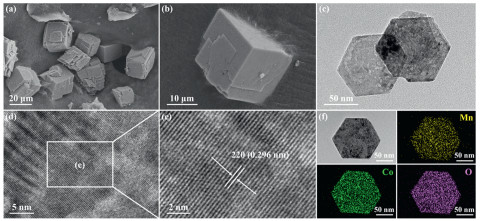
Scanning electron microscopy (SEM) and transmission electron microscopy (TEM) can analyze the morphologies of the MnCo2O4 NBs and HNSs. Fig. 2a shows that the MnCo2O4 NBs exhibit the classical irregular polygonal cubic nanoblock morphology. A closer inspection of a single cubic nanobulk (Fig. 2b) indicates that the MnCo2O4 NBs’s surface is relatively smooth. Fig. 2c shows the TEM image of MnCo2O4 HNSs, which presents an irregular hexagonal lamellar morphology. Thus, compared with MnCo2O4 NBs with lumpy morphology, the MnCo2O4 HNSs with ultra-thin sheet morphology can provide electron transfer channel and abundant active sites to boost the activity of TC removal with the assistance of PMS. The HRTEM images in Figs. 2d and e display that MnCo2O4 HNSs owns the regular lattice fringes, which further demonstrates the good crystallinity and purity of MnCo2O4 HNSs. Moreover, the lattice fringes visible in the higher-magnification image (Fig. 2e) of the region boxed in Fig. 2d have a spacing of 0.296 nm, which matches the interplanar distance of the (220) plane in MnCo2O4 HNSs [21]. This result corroborates the XRD data presented in Fig. 2a. Additionally, the homogeneous distribution of Mn, Co and O elements throughout the nanosheets revealed by EDX mapping (Fig. 2f), which provides direct evidence for the successful preparation of MnCo2O4 HNSs.
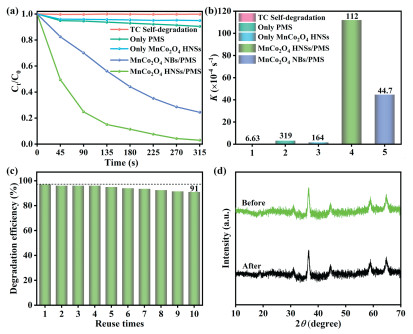
To study the influence of morphology on catalytic performance, the TC removal activity of MnCo2O4 NBs and HNSs was studied. Fig. 3a compares the TC removal efficiency in changed reaction systems. The concentrations of the PMS and catalysts were 0.8 and 0.4 g/L, respectively. The self-degradation of TC is negligible due to the stability of its aromatic rings; Likewise, the degradation of TC is extremely limited in the sole PMS system without catalyst [25]. Besides, adsorption by the MnCo2O4 HNSs was negligible (<5%). Yet, the TC removal efficiency was markedly accelerated in the MnCo2O4/PMS system. The MnCo2O4 HNSs achieved a TC degradation efficiency of approximately 97.0% within 315 s, which was much higher than that of MnCo2O4 NBs (75.6%). The corresponding reaction kinetics of MnCo2O4 HNSs was ~2.5-fold higher than that of MnCo2O4 NBs (Fig. 3b). These findings prove the efficient and rapid TC degradation of the MnCo2O4 HNSs. Moreover, the mineralization efficiency of TC by the MnCo2O4 HNSs/PMS system was quantified via total organic carbon (TOC) analysis. As illustrated in Fig. S2 (Supporting information), over 50% of the TOC was removed within 315 s of reaction, demonstrating that more than half of the TC was mineralized into CO2 and H2O, while the remaining fraction was converted into low-carbon by-products. It is widely recognized that the recyclability, stability, and adaptability of catalysts are critical for its practical deployment. Thus, the stability of MnCo2O4 HNSs materials was further tested to determine their practical applications. Fig. 3c shows the cycling experiments of MnCo2O4 HNSs, whose activity still remained above 91% after 10 cycles, indicating that the MnCo2O4 HNSs has high stability and recoverability. The catalyst’s stability is largely governed by the structural stability of the active materials. Negligible change in the crystalline phase of MnCo2O4 HNSs is detectable in the XRD patterns after cycling (Fig. 3d), confirming their excellent structural stability. Moreover, the activity of MnCo2O4 HNSs in degrading organic pollutants is benchmarked against other reported catalysts of similar type. Table S1 (Supporting information) lists representative recent studies on organic pollutant degradation by some manganese cobalt spinel-based catalysts [19,26-30]. These findings confirm the high efficiency of MnCo2O4 HNSs on TC degradation in this work.
To probe the charge transfer and interfacial reactivity, we employed electrochemical impedance spectroscopy (EIS) [31]. It is known that a larger arc radius represents a greater charge transfer resistance and a corresponding reduced catalytic activity [32]. As evidenced by the smaller semicircle of MnCo2O4 HNSs compared to MnCo2O4 NBs in the EIS plot (Fig. 4a), it exhibits lower charge transfer resistance. These results indicate that MnCo2O4 HNSs possess superior charge-transfer properties to the MnCo2O4 NBs, as manifested by their lower resistance and faster interfacial kinetics. The specific surface area of MnCo2O4 with distinct morphologies was subsequently tested as shown in Fig. S3 (Supporting information). The observed type IV hysteresis loop and pore size distribution confirm the mesoporous nature of both MnCo2O4 NBs and HNSs [33]. Notably, the nanosheet morphology of MnCo2O4 HNSs exhibits a smaller average pore size and significantly higher specific surface area relative to the bulk morphology of MnCo2O4 NBs. These structural advantages account for the superior electron transport efficiency observed in the sheet-like architecture relative to its bulk counterpart.
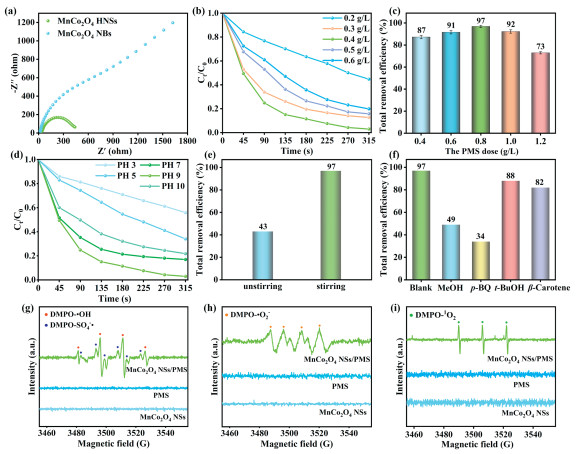
The influence factors (including the MnCo2O4 HNSs catalyst dose, PMS dose, solution pH, conditions of stirring and unstirring as well as adding different trapping agents) of MnCo2O4 HNSs in activating PMS for TC degradation (Figs. 4b-f) were further explored. Fig. 4b shows the influence of the MnCo2O4 HNSs dose on TC removal under fixed concentrations of TC (50 mg/L) and PMS (0.8 g/L). Initially, increasing the MnCo2O4 HNSs dose from 0.2 g/L to 0.4 g/L improved TC removal efficiency from 55% to 97%, presumably owing to the increase of active sites. Yet, a further increase to 0.6 g/L led to a decline in efficiency to 80%. This phenomenon occurred because the excess catalyst quenched the free radicals, thereby reducing its degradation activity [27]. Based on these results, a dosage of 0.4 g/L was chosen as the optimal catalyst dosage for all subsequent experiments. Subsequently, the experiments were performed to investigate the influence of PMS dosage over a range of concentrations (0.4, 0.6, 0.8, 1.0 and 1.2 g/L) on TC removal. A higher PMS dose led to improved TC removal (Fig. 4c), with efficiency increasing from 87% to 97% over the dosage range of 0.4–0.8 g/L. The enhancement is because of the increased adsorption of PMS molecules on the active sites of MnCo2O4 HNSs, which accelerates the production of ROSs and further promotes contact between TC and the ROSs, thereby enhancing the TC removal efficiency. Thus, appropriate PMS concentration can improve catalytic behavior of MnCo2O4 HNSs. Nevertheless, a further increase in PMS concentration to 1.2 g/L did not enhance but slightly reduced the TC removal efficiency to 73%. This decline was caused by the saturation of active sites and the quenching of ROS by excessive PMS (Eqs. 2 and 3) [22]. Hence, 0.8 g/L was acted as the optimal PMS concentration.
|
|
(2) |
|
|
(3) |
The solution pH is also important for the catalytic pollutant’s removal. Therefore, the influence of solution pH on TC removal in MnCo2O4/PMS system was explored. Fig. 4d presents the TC removal efficiency at different pH values: 44% (pH 3), 66% (pH 5), 83% (pH 7), 97% (pH 9), and 78% (pH 10). The maximum efficiency of TC removal was observed at pH 9, suggesting that the MnCo2O4 HNSs has the optimum degradation efficiency in a weakly alkaline environment. Because the MnCo2O4 HNSs becomes highly dispersed in a weakly alkaline environment, which provides more accessible active sites for contacting PMS and thus generates more free radicals to efficiently degrade TC [12]. Besides, we explored the influence of agitation on TC removal in MnCo2O4/PMS system. Fig. 4e shows that degradation rate of TC was 43% and 97% in conditions of unstirring and stirring, respectively. Thus, the degradation performance in conditions of stirring is significantly better than that of unstirring. The degradation of a small portion of TC under conditions of unstirring is attributed to the Fenton-like reaction occurring in the solution. In contrast, stirring can promote the polarity of the catalyst surface to significantly enhance degradation rate of TC. This promotes a better separation of electrons and holes, and further activates PMS to generate more reactive species and accelerates the overall degradation process [34].
The radical quenching tests for degrading TC was measured to recognize the radicals in the MnCo2O4/PMS system. Methanol (MeOH) was employed to scavenge both SO4−• and •OH due to its rapid reaction kinetics with these species during the experimental process [35]. p-Benzoquinone (p-BQ) can trap •O2− [36]. tert-Butanol (t-BuOH) was specifically selected for •OH quenching, as it exhibits a high reaction rate constant with •OH but significantly lower reactivity toward SO4−• [37]. Additionally, β-carotene was applied as a specific scavenger for 1O2 [38]. TC removal efficiency was reduced to 34% and 9% when adding 5 mmol/L p-BQ and 100 mmol/L MeOH into the MnCo2O4 HNSs/PMS reaction system (Fig. 4f) [39,40], suggesting that •O2−, •OH and SO4−• were produced and acted as the dominant reactive species. However, adding 100 mmol/L t-BuOH only caused a 9.0% inhibition in TC removal [41,42], demonstrating that •OH was not the dominant ROSs but still played a minor yet non-negligible role in MnCo2O4 HNSs/PMS system. This result suggests that •O2− and SO4−• play important roles in the reaction. Furthermore, 1O2 is a highly reactive but short-lived oxidant that can degrade TC via a non-radical oxidation pathway [43]. The addition of 5 mmol/L β-carotene resulted in 15% inhibition of TC degradation (Fig. 4f) [44], prove that 1O2 also participates in TC removal process within MnCo2O4 HNSs/PMS system. Therefore, it is concluded that •O2− and SO4−• are the primary species responsible for catalyzing the TC degradation, while •OH and 1O2 participate in the removal process. In summary, reactive species such as SO4−•, •O2−, •OH and 1O2 radicals collectively result in the removal of TC in MnCo2O4 HNSs/PMS system.
EPR test using 5,5′-dimethyl-1-pyrroline-N-oxide (DMPO) as the spin-trapping agent can identify the reactive species generated in MnCo2O4 HNSs/PMS system. Figs. 4g-i observed that no obvious characteristic peaks of SO4−•, •O2–, 1O2 and •OH were detected when either PMS or MnCo2O4 HNSs were present alone, indicating that neither PMS nor MnCo2O4 HNSs alone can effectively degrade TC. In contrast, strong characteristic peaks corresponding to DMPO-•O2–, SO4−•, •OH and 1O2 were observed in the MnCo2O4 HNSs/PMS system, indicating that the reaction between PMS and MnCo2O4 HNSs generates these reactive species, which collectively contribute to TC degradation. The high TC degradation efficiency is because of the formation of Mn-Co bonds within MnCo2O4 HNSs, which creates electron transfer channels and provides abundant active sites. Also, the synergistic interaction between the PMS and transition metal catalyst promoted the production of radicals and significantly improved the TC degradation performance.
Based on these findings, a plausible TC removal mechanism in the MnCo2O4 HNSs/PMS system under darkness is proposed (Scheme 1). Initially, Mn2+ in MnCo2O4 HNSs reacts with HSO5− to produce SO4−• accompanied by the creation of Mn3+ (Eq. 4) [16]. Meanwhile, the produced Mn3+ react with HSO5− and reconvert to Mn2+ (Eq. 5), realizing the cycle of Mn3+/Mn2+ [12]. Besides, Mn2+ also can react with HSO5− to get •OH (Eq. 6) [12]. Regarding Co3+, it reacts with HSO5− to yield Co2+ that further combine HSO5− to produce SO4−• (Eqs. 7 and 8) [45]. SO4−• can further react with H2O or OH− to produce •OH through Eqs. 9 and 10, thereby boosting the TC removal efficiency [12]. The primary •O2− generated in the MnCo2O4 HNSs/PMS system can be obtained from (11), (12), (13) [45]. Then, •O2− could further react with HSO5− to obtain 1O2 (Eq. 14), and •O2− could react with H2O to form 1O2 (Eq. 15) [22]. Finally, SO4−•, •O2−, •OH and 1O2 collectively participate in the removal process of TC (Eq. 16), indicating the synergistic effect of MnCo2O4 HNSs/PMS system.
|
|
(4) |
|
|
(5) |
|
|
(6) |
|
|
(7) |
|
|
(8) |
|
|
(9) |
|
|
(10) |
|
|
(11) |
|
|
(12) |
|
|
(13) |
|
|
(14) |
|
|
(15) |
|
|
(16) |
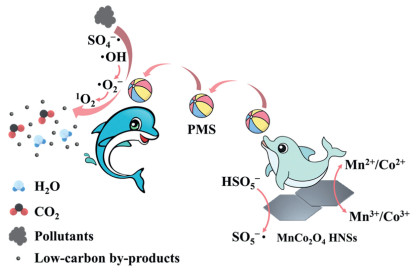
In brief, a 2D spinel-type MnCo2O4 HNSs was successfully synthesized via hydrothermal followed by calcination method to remove TC by PMS activation. The obtained MnCo2O4 HNSs achieved a high TC removal efficiency of approximately 97.0% within 315 s via PMS activation under stirring and pH 9. The removal efficiency was much higher than that of MnCo2O4 NBs (75.6%) and literatures. Meanwhile, the experimental data showed that the optimum adding reaction PMS and catalyst dose was 0.8 and 0.4 g/L, respectively. In addition, the MnCo2O4 HNSs maintained a high TC removal efficiency of over 96% even after cycles. This outstanding recyclability and stability are ascribed to the synergistic effect between Co-Mn synergy and the unique 2D hexagonal nanosheet architecture. Finally, the catalytic mechanisms of MnCo2O4 HNSs/PMS system were analyzed through quenching tests and EPR analysis, which confirmed that •O2–, SO4−•, •OH and 1O2 radicals collectively promote the TC removal, particularly SO4−• and •O2− play critical roles during the process of TC removal reaction. This study proposes a new insight to develop catalysts in the combination of Co-Mn synergy and morphology regulation for achieving high-efficient degradation of antibiotics wastewater treatment in PMS activation.
Xiaoqian Lu: Writing – original draft, Formal analysis, Data curation. Tong Gao: Investigation. Zenghui Sun: Investigation. Zhangqian Liang: Writing – review & editing, Writing – original draft, Funding acquisition, Data curation, Conceptualization. Zhenzi Li: Supervision. Wei Zhou: Writing – review & editing, Funding acquisition.
The authors declare that they have no known competing financial interests or personal relationships that could have appeared to influence the work reported in this paper.
The authors are thankful for funding from the Natural Science Foundation of Shandong Province (Nos. ZR2023QB063, ZR2024MB155), Key R&D Program of Shandong Province of Innovation Enhancement Project for Science and Technology-Based Small and Medium-sized Enterprises (No. 2024TSGC0121), Science, Education and Industry Integration Innovation Pilot Project from Qilu University of Technology (Shandong Academy of Sciences) (No. 2024ZDZX13).
Supplementary material associated with this article can be found, in the online version, at doi:
S. Li, C. You, K. Rong, et al., Adv. Powder Mater. 3 (2024) 100183. doi: 10.1016/j.apmate.2024.100183
M. Ao, J. Wei, C.S. He, et al., Chin. Chem. Lett. 36 (2025) 109882. doi: 10.1016/j.cclet.2024.109882
S. Miao, Y. Zhang, B. Li, et al., J. Hazard. Mater. 479 (2024) 135601. doi: 10.1016/j.jhazmat.2024.135601
Y. Zhao, Y. Zheng, S. Lei, et al., Sep. Purif. Technol. 378 (2025) 134534. doi: 10.1016/j.seppur.2025.134534
M. Yang, Y. Ma, X. Song, et al., J. Hazard. Mater. 470 (2024) 134123. doi: 10.1016/j.jhazmat.2024.134123
Y. Yang, L. Guo, X. Wang, et al., Adv. Powder Mater. 3 (2024) 100178. doi: 10.1016/j.apmate.2024.100178
Q. Zou, B. Wang, B. Gao, et al., Biochar 5 (2023) 86. doi: 10.1007/s42773-023-00285-z
H. Li, Z. Wang, J. Geng, et al., Chin. Chem. Lett. 36 (2025) 110138. doi: 10.1016/j.cclet.2024.110138
X. Shi, Z. Huang, J. Xu, et al., Sep. Purif. Technol. 353 (2025) 128528. doi: 10.1016/j.seppur.2024.128528
Y. Duan, J. Liu, Q. Liu, et al., Chin. Chem. Lett. 37 (2026) 111120. doi: 10.1016/j.cclet.2025.111120
F. Li, J. Wei, D. Wang, et al., Chem. Eng. J. 481 (2024) 148633. doi: 10.1016/j.cej.2024.148633
Y. Li, W. Zhu, Q. Guo, et al., Sep. Purif. Technol. 276 (2021) 119403. doi: 10.1016/j.seppur.2021.119403
S. Deng, L. Yang, X. Wang, et al., Chem. Eng. J. 524 (2025) 168959. doi: 10.1016/j.cej.2025.168959
S. Kong, A. Li, J. Long, et al., Nat. Catal. 7 (2024) 252–261. doi: 10.1038/s41929-023-01091-3
H. Li, W. Wang, J. Xu, et al., Adv. Mater. 36 (2024) 2312685. doi: 10.1002/adma.202312685
X. Zhang, T. Bai, R. Chen, et al., Sep. Purif. Technol. 353 (2025) 128646. doi: 10.1016/j.seppur.2024.128646
C. Guo, Y. Tang, Z. Yang, et al., ACS Nano 17 (2023) 23761–23771. doi: 10.1021/acsnano.3c07630
Y. Wang, Y. Liu, H. Zhang, et al., Chem. Soc. Rev. 54 (2025) 2436–2482. doi: 10.1039/D4CS00338A
H. Wang, Y. Meng, H. Xue, et al., Sep. Purif. Technol. 370 (2025) 133243. doi: 10.1016/j.seppur.2025.133243
X. Li, Q. Zhuang, X. Yuan, et al., Chem. Eng. J. 505 (2025) 159580. doi: 10.1016/j.cej.2025.159580
C.W. Zheng, H.Y. Niu, C. Liang, et al., Chem. Eng. J. 403 (2021) 126400. doi: 10.1016/j.cej.2020.126400
M. Wu, B. Zhang, H. Wang, et al., J. Colloid. Interf. Sci. 653 (2024) 867–878. doi: 10.1016/j.jcis.2023.09.106
J. Li, Z. Ni, Y. He, et al., Sep. Purif. Technol. 316 (2023) 123756. doi: 10.1016/j.seppur.2023.123756
Z.Y. Guo, C.X. Li, M. Gao, et al., Angew. Chem. 60 (2021) 274–280. doi: 10.1002/anie.202010828
X.H. Yi, T.Y. Wang, H.Y. Chu, et al., Chem. Eng. J. 449 (2022) 137784.
Y. Zhang, Q. Peng, W. Zhong, et al., Colloids Surf. A: Physicochem. Eng. Asp. 661 (2023) 130915. doi: 10.1016/j.colsurfa.2022.130915
Z. Li, C. Guo, J. Lyu, et al., J. Hazard. Mater. 373 (2019) 85–96. doi: 10.1016/j.jhazmat.2019.03.075
J. Ji, Q. Zhang, H. Mo, et al., Chem. Eng. J. 492 (2024) 152212. doi: 10.1016/j.cej.2024.152212
T. Xie, B. Chen, Y. Mei, et al., Sep. Purif. Technol. 315 (2023) 123694. doi: 10.1016/j.seppur.2023.123694
Y. Zhang, Y. Li, H. Bi, et al., J. Colloid. Interf. Sci. 630 (2023) 855–866.
Q. Wang, Z. Xu, Y. Jiang, et al., Appl. Surf. Sci. 585 (2022) 152705. doi: 10.1016/j.apsusc.2022.152705
S. Ren, X. Yang, L. Liao, et al., Small 21 (2025) 2409352. doi: 10.1002/smll.202409352
L. Guo, J. Gao, M. Li, et al., EcoEnergy 1 (2023) 437–447. doi: 10.1002/ece2.20
G. Park, S.C. Oh, S.H. Kang, et al., J. Mater. Chem. A 13 (2025) 5374–5385. doi: 10.1039/d4ta08365b
T. Zhang, P. Yang, Y. Ji, et al., Environ. Sci. Technol. 59 (2025) 3325–3335. doi: 10.1021/acs.est.4c12579
Y. Xu, X. Da, L. Wang, et al., Chin. Chem. Lett. 36 (2025) 110168. doi: 10.1016/j.cclet.2024.110168
X. Wang, G. Liu, Y. Cao, et al., Chem. Eng. J. 521 (2025) 166362. doi: 10.1016/j.cej.2025.166362
S. Zhang, X. Kong, X. Xu, et al., Nat. Commun. 16 (2025) 5822. doi: 10.1038/s41467-025-61041-4
L. He, J. Zou, J. Wu, et al., Environ. Sci. Technol. 58 (2024) 20313–20326. doi: 10.1021/acs.est.4c06878
S. Li, J. Zou, J. Wu, et al., Environ. Sci. Technol. 59 (2025) 7747–7759. doi: 10.1021/acs.est.4c13612
S. Li, J. Zou, J. Wu, et al., Water Res. 259 (2024) 121891. doi: 10.1016/j.watres.2024.121891
S. Li, J. Zou, J. Wu, et al., Environ. Sci. Technol. 59 (2025) 10608–10619. doi: 10.1021/acs.est.5c01622
H. Wang, C. Qiao, C. Chen, et al., Chin. Chem. Lett. 36 (2025) 110244. doi: 10.1016/j.cclet.2024.110244
J. Wu, J. Zou, J. Lin, et al., Environ. Sci. Technol. 58 (2024) 15741–15754. doi: 10.1021/acs.est.3c09753
G. Zhou, S. Wen, J. Wang, et al., Sep. Purif. Technol. 330 (2024) 125244. doi: 10.1016/j.seppur.2023.125244

Figure 1 (a) The preparation process of MnCo2O4 HNSs. (b) The XRD patterns, (c) Mn 2p, (d) Co 2p and (e) O 1s XPS spectrums of MnCo2O4 HNSs.

Figure 2 (a, b) SEM images of MnCo2O4 NBs. (c) TEM, (d, e) HRTEM and (f) EDX mapping images of MnCo2O4 HNSs.

Figure 3 (a) The TC degradation at the diverse systems, and (b) the corresponding reaction kinetics. (c) The recycles of MnCo2O4 HNSs, and (d) the XRD patterns of MnCo2O4 HNSs before and after recycles.

Figure 4 (a) EIS spectra of MnCo2O4 HNSs and MnCo2O4 NBs. The effect of MnCo2O4 HNSs/PMS system on TC degradation: (b) the MnCo2O4 HNSs catalyst dose, (c) the PMS dosage (Error bars stand for the standard deviation of three independent tests.), (d) the solution pH, (e) the conditions of stirring and unstirring and (f) different trapping agents. EPR spectra of DMPO for capturing (g) •OH and SO4−•, (h) •O2− and (i) 1O2 in different systems.

 扫一扫看文章


扫一扫关注我们
 DownLoad:
 下载:

 下载: