Citation:
Jin Wang, Li Xu, Jia Kang, Chen Wang. Precision engineering of sub-nanochannel designs in conjugated microporous polymer membranes for breakthrough osmotic energy conversion[J]. Chinese Chemical Letters,
2027, 38(1): 112876.
doi:
10.1016/j.cclet.2026.112876
Precision engineering of sub-nanochannel designs in conjugated microporous polymer membranes for breakthrough osmotic energy conversion
English
Precision engineering of sub-nanochannel designs in conjugated microporous polymer membranes for breakthrough osmotic energy conversion
Jiangsu Key Laboratory of Biofunctional Materials, Jiangsu Collaborative Innovation Center of Biomedical Functional Materials, Jiangsu Key Laboratory of New Power Batteries, College of Chemistry and Materials Science, Nanjing Normal University, Nanjing 210046, China
b.
State Key Laboratory of Neurology and Oncology Drug Development, Nanjing 210042, China
Received Date:
06 November 2025 Accepted Date:
30 April 2026 Revised Date:
24 March 2026 Available Online:
12 January 2027
Abstract:
Reverse electrodialysis (RED) membranes represent a highly promising platform for nanofluidic osmotic energy conversion. However, achieving high ion permselectivity without sacrificing permeability remains a major challenge in the development of practical RED membranes. In this study, we present a transformative strategy to overcome this trade-off by engineering ultrathin conjugated microporous polymer (CMP)-based RED membranes with precision-tailored sub-nanochannel architectures. Functionalized CMP monomers enable the membranes to achieve finely tuned charge densities and polarities, significantly boosting both ion selectivity and permeability. Additionally, the integration of CMP membranes with anodized aluminum oxide substrates creates an asymmetric architecture that introduces unique ionic current rectification while effectively mitigating ion concentration polarization. These advancements yield a power density of 105.5 W/m2 under a 500-fold salinity gradient, outperforming the performance of most previously reported membranes. Our findings underscore the critical role of sub-nanochannel engineering in advancing RED technologies and demonstrate its broader potential for nanofluidic applications involving ionic transport, desalination, and energy conversion.
Osmotic energy existing between salinity gradients is a prospective sustainable energy source, which can be extracted directly as electrical energy by reverse electrodialysis (RED) technology [1]. In a RED system, the ion-selective membrane undertaking preferential counter-ion diffusion plays a vital role in osmotic energy conversion [2,3]. Currently, the low ion transport efficiency for conventional ion exchange membranes generally restricts the performance of osmotic energy conversion [4]. To address this issue, researchers have developed a variety of nanofluidic membranes crafted from porous framework materials [5,6], transition metal carbides/nitrides (MXenes) [7,8], 2D polymers [9], and graphene oxide (GO) [10], etc. [11]. These innovative membranes usually feature plentiful nanoscale or sub-nanoscale channels and high ion-selective transport efficiency, alleviating the limitations of conventional membranes [12,13]. Nevertheless, precisely controlling the nanochannel chemical environment, thickness, and uniformity is still hard due to the complicated processing and post-modification procedures [14]. It leaves challenges in balancing ion selectivity and permeability, and thus hinders the further improvement of energy conversion efficiency [15].
Conjugated microporous polymers (CMP), a unique class of organic porous materials [16], have aroused increasing applications in varied fields such as nanofiltration [17], gas adsorption/separation [18], catalysis [19] and energy storage [20] due to their distinct advantages of extended π-conjugated structures and permanent nanopores [21,22]. Unfortunately, since the majority of the reported CMP feature neutral nanoporous structure (named as n-CMP), the surface charge-governed ion selective transport cannot occur, greatly limiting their applications in nanofluidic osmotic energy conversion [23,24]. Recently, Lai et al. developed an ionic CMP membrane by introducing functional ionic modules into monomers, enabling CMP to possess tailored nanochannel environments such as charge polarity and density. This strategy opens up the possibility of applying CMP for osmotic energy conversion which heavily depends on the ion selectivity and permeability [25]. However, up to now, the field of CMP-based osmotic energy conversion remains under-explored.
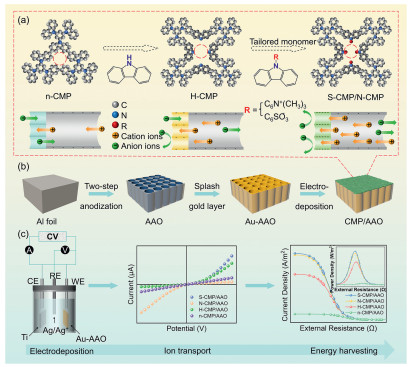
Herein, a series of ultrathin CMP membranes were electrodeposited on anodized aluminum oxide (AAO) for selective ion transport and efficient osmotic energy conversion (Scheme 1). First, monomers with varied charge densities and polarities were designed and synthesized. Then, three CMP membranes were prepared using monomers with varying charge properties: strongly negatively charged S-CMP, weakly negatively charged H-CMP, and positively charged N-CMP, via the electrodeposition technique [26]. The tailorable nanochannel charge environment could effectively promote ion selectivity and permeability simultaneously. Additionally, the asymmetric structure of CMP/AAO significantly contributes to the promotion of ionic current rectification (ICR) behavior of the membrane, which allows one-way ion transport and blocks the backflow of ionic current. It mitigates the ionic concentration polarization (ICP) during osmotic energy conversion process, and further improves the overall performance. Theoretical calculations further validate the critical role of the sub-nanochannel environment on the ion transport efficiency. When applied for osmotic energy conversion, the as-prepared CMP/AAO membrane could achieve a maximum output power density of up to 105.5 W/m2 under a 500-fold NaCl gradient, significantly outperforming the n-CMP/AAO membrane (4.4 W/m2) and most other nanofluidic membranes. This work demonstrates the great potential of functionalized CMP for ion transport-governed nanofluidic applications.
Scheme 1
Scheme 1.
(a) Schematic diagram of the design principles of CMP/AAO membranes. (b) Schematic diagram of the fabrication process for the CMP/AAO membranes. (c) Schematic of the synthesis installation for CMP/AAO membranes and their application in selective ion transport and osmotic energy conversion.
To tailor the sub-nanochannel environment of functionalized CMP membranes, we rationally designed several CMP monomers composed of electroactive carbazole moieties as building blocks (see details in Supporting information). As a proof of concept, a new building block, sodium 6-(9H-carbazol-9-yl)hexan-1-sulfonate (donated as CbzC6-S) was synthesized through the reaction between carbazole and hexanesulfonic acid lactone [27]. The obtained products were confirmed by the 1H nuclear magnetic resonance (NMR) (Fig. S1 in Supporting information), 13C NMR spectroscopy (Fig. S2 in Supporting information), and Fourier transform infrared spectroscopy (FT-IR) (Fig. S3 in Supporting information). Then, the synthesized CbzC6-S combined with another monomer 1,3,5-tris (n-carbazolyl)benzene (TCB) was used for the construction of customized CMP with the desired charge density and polarity via electrodeposition. The CMP membranes were fabricated by cyclic voltammetry (CV) on a conductive AAO substrate deposited with Au layer. The specific polymerization mechanism and preparation process are illustrated in Figs. S4 and S6 (Supporting information). During the polymerization process, CMP was deposited onto the surface of Au-AAO, forming the CMP/AAO membrane (Fig. 1a). With the same procedure, weakly electronegative H-CMP could be prepared by electrodepositing the TCB and carbazole. Similarly, the positively charged N-CMP was synthesized from TCB and 6-(9H-carbazol-9-yl)-N,N,N-trimethylhexan-1-aminium bromide (named as CbzC6-N) according to the literature [28].
Figure 1
Figure 1.
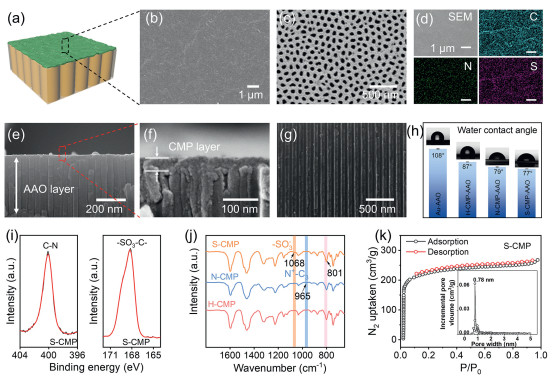
Fabrication and characterization of CMP/AAO membranes with tailored sub-nanochannel environment. (a) The schematic illustration of the prepared CMP/AAO membrane. (b-d) SEM images of the top (b), bottom view (c), and EDX elemental mappings (d) of S-CMP/AAO membrane. (e-g) SEM images of the cross-section of S-CMP/AAO membrane. (h) Contact angle of Au-AAO and different CMP/AAO membranes. (i) N 1s and S 2p high-resolution XPS spectra of S-CMP membrane. (j) FT-IR spectra of different CMP membranes. (k) Nitrogen sorption isotherms of S-CMP membrane (insert is pore-size distribution of S-CMP membrane).
Scanning electron microscopy (SEM) was used to characterize the morphology of AAO and CMP/AAO membranes. As shown in Figs. S7 and S8 (Supporting information), the fabricated AAO substrate exhibited regular nanochannels with a diameter of around 50 nm. The deposition of Au layer did not affect the surface structure of AAO, which is used to improve electrical conductivity [29]. Notably, the thickness of the prepared CMP layer can be facilely and precisely controlled via the duration of electrodeposition. During the first 0.5 h, the two monomers polymerized at the solid-liquid interface on the AAO surface. Numerous polymer fragments emerged, which did not fully cover the AAO substrate (Fig. S9 in Supporting information). After 1 h, an intact CMP membrane was observed, with no obvious defects found on the surface (Fig. S10 in Supporting information). As the electrodeposition time was further extended, the thickness of the membrane continued to increase (Figs. S11-S13 in Supporting information). Therefore, the CMP/AAO membrane prepared with an electrodeposition time of 1 h was selected for subsequent characterization and testing, since maximum permeability could be ensured at this point. As displayed in Figs. 1b and c, a homogeneous and crack-free CMP membrane existed on the top side of AAO, while the bottom side maintained ordered nanochannels. The energy dispersive X-ray spectroscopy (EDX) mappings also showed that C, N and S elements are uniformly distributed on the top side of S-CMP/AAO membrane (Fig. 1d). Additionally, the cross-section image of S-CMP/AAO demonstrated a 40 nm-thickness S-CMP layer, which was densely attached to the top of AAO layer (Figs. 1e-g). With the same procedure, H-CMP/AAO and N-CMP/AAO were readily synthesized, confirming the generalizability of the electrodeposition method for the preparation of different CMP membranes with modulated sub-nanochannel environments (Figs. S14-S17 in Supporting information).
The static contact angle measurements revealed that the hydrophilicity of the CMP/AAO membranes increased obviously compared with Au-AAO (Fig. 1h), which will accelerate the ion transport in the nanofluidic membrane [30]. The chemical structure of the prepared CMP membranes was characterized by X-ray photoelectron (XPS) and FT-IR spectra. The characteristic peaks of the C-N of carbazole units and the sulfonic group at 169.12 eV in XPS spectra indicated the formation of the S-CMP/AAO membrane (Fig. 1i) [28]. As shown in Fig. 1j, the characteristic C-H stretching frequencies in the trisubstituted carbazole rings of the polycarbazole chain were observed at 801 cm−1, and the peak of sulfonic groups at 1068 cm−1 was obvious as well. All these characterizations confirmed the ion groups were intact in S-CMP/AAO membranes. Similarly, the chemical properties of H-CMP/AAO and N-CMP/AAO membranes were verified, which were shown and discussed in Fig. 1j and Fig. S18 (Supporting information). To prove the sub-nanochannel structure of CMP, the N2 adsorption isotherm was performed to explore the Brunauer-Emmett-Teller (BET) surface area (Fig. 1k, Figs. S19 and S20 in Supporting information). S-CMP membranes exhibited a type I adsorption isotherm with no obvious hysteresis loop observed in the adsorption isotherms. The corresponding pore size distribution curve revealed that the pore size of S-CMP membrane was centered at ~0.78 nm. The other two CMP membranes also showed a sharp pore-size distribution peak at 0.7–0.8 nm, which were comparable, or even superior to the reported crystalline porous materials [31]. Detailed information on the specific surface area and the micropore area of the prepared CMP membrane were provided in Table S1 (Supporting information). Collectively, we successfully fabricated a series of CMP/AAO membranes with abundant and customizable sub-nanochannels.
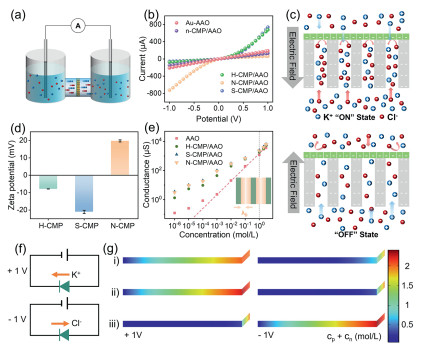
The transmembrane ionic transport properties of different CMP/AAO membranes were examined by mounted them between two homemade half-cells (Fig. 2a). Potassium chloride (KCl) was chosen as the standard electrolyte because of the close diffusion coefficients of K+ and Cl− ions [32]. As shown in Fig. 2b, the Au-AAO and traditional neutral CMP/AAO present linear Ohmic behavior as reported [23]. However, the I-V curves of our designed CMP/AAO membranes presented an obvious ICR behavior, which was different from those of nonselective membranes. The ICR ratio, defined as the ratio of the absolute current measured at +1 V (I+1V) to the one measured at −1 V (I-1V), was calculated to be 5.12 (H-CMP/AAO), 6.08 (S-CMP/AAO) and 6.34 (N-CMP/AAO) at 100 mmol/L KCl, respectively. Such a non-linear behavior can be ascribed to the surface charge effect of CMP membranes as well as the asymmetric structure of CMP/AAO membranes [33]. Take the negative-charged S-CMP/AAO membrane as an example, the ICR phenomenon can be explained by the change of ion concentration in nanochannels under varied potential bias (Figs. 2c and d). When the electric field is applied from the S-CMP layer (top side) to AAO (bottom side), cations (K+) are driven downward from the top, while anions (Cl-) move in the opposite direction. Owing to the electrostatic effect, Cl- is difficult to pass through the negatively charged S-CMP and accumulate in the AAO nanochannel. To maintain the electroneutrality of the nanofluidic membrane, most of the K+ that can freely pass through the S-CMP layer stays within the AAO. Accordingly, large amounts of ions accumulate within the nanochannels, leading to a relatively high ionic conductance, which is marked as the “ON” state. On the contrary, when the electric field is in the reverse direction, the top-down transport of Cl- driven by the electric field is repelled by the negatively charged S-CMP, meanwhile, K+ flows out of the nanochannel with the electric field. In this case, the ions within AAO nanochannels will be depleted, thus the S-CMP/AAO membrane shows the so-called “OFF” state.
Figure 2
Figure 2.
Selective ion transport properties of the tailored CMP/AAO membranes. (a) Schematic diagram of the device for measuring ion selectivity. (b) I-V curves of Au-AAO, n-CMP/AAO and tailored CMP/AAO membranes obtained in KCl solution (pH 7). (c) Scheme of the mechanism for “ON” and “OFF” states in ICR, originating from the varied ion concentration in nanochannels. (d) Zeta potential of different CMP membranes. (e) Transmembrane ionic conductance of different CMP/AAO as a function of the KCl concentration varying from 1 μmol/L to 3 mol/L. (f) Scheme of CMP/AAO membrane used for theoretical calculation. (g) The calculated ion concentration profiles of different CMP/AAO membranes: (ⅰ) H-CMP/AAO, (ⅱ) S-CMP/AAO and (ⅲ) N-CMP/AAO.
The weakly negatively charged H-CMP/AAO membranes demonstrate similar ion transport behavior, with lower ion selectivity and correspondingly weaker ion accumulation and depletion (Fig. 2d and Fig. S21 in Supporting information). In contrast, the positively charged N-CMP/AAO membrane displays “ON” and “OFF” states under opposite electric field directions (Fig. 2d and Fig. S22 in Supporting information) [34]. Notably, due to the low surface charge density of bare AAO nanochannels and large pore size (~50 nm), it is challenging for bare AAO to generate effective ICR [35]. Accordingly, the enlarged current response and the pronounced ICR behavior confirmed the enhanced permeability and selectivity of the as-prepared CMP/AAO membranes. The electrolyte concentration influences the transmembrane conductance. As depicted in Fig. 2e, the ionic conductance started to deviate from the bulk value (gray line) at a high concentration of 1 mol/L, revealing an obvious surface charge-controlled ion transport behavior [36]. Notably, S-CMP/AAO and N-CMP/AAO membranes with higher charge densities exhibited improved conductance compared to H-CMP/AAO. Evidently, the surface charge-controlled ion transport behavior can be more prominent by precisely tailoring sub-nanochannel chemical environment of the CMP layer.
To further unravel the origination of ICR behavior of the CMP/AAO asymmetric membranes, numerical simulations based on the Poisson-Nernst-Planck (PNP) equation were conducted [37]. An asymmetrical porous model featuring diode-like behavior was adopted (Fig. S23 in Supporting information). Upon placing the same concentration of electrolyte solution on both sides of the negatively charged S-CMP/AAO membrane, significant ion enrichment and depletion indicated the remarkable ion permselectivity, which did not occur in symmetric S-CMP membrane (Figs. S24 and S25 in Supporting information). It suggests that the asymmetric membrane structure is also responsible for the dipole-like ion transport. Notably, similar results were obtained when the charged properties were changed. To further investigate the ion selectivity of CMP/AAO membranes with different sub-nanochannel chemistries, electrolyte solutions of varied concentrations (1 mol/L and 1 mmol/L) were placed on the CMP and AAO sides, respectively. With the anode on the CMP membrane side, the current was mainly attributed to K+ flow under +1 V, while conversely, the current was ascribed to Cl- (Fig. 2f). As shown in Fig. 2g(ⅰ), K+ was enriched at +1 V and depleted at −1 V on the heterogeneous channel interface of the H-CMP/AAO membrane, implying the cation selectivity of the H-CMP/AAO membrane. Moreover, the accumulation and depletion were more pronounced as the surface charge density of the CMP layer increased (S-CMP/AAO, Fig. 2g(ⅱ)). Instead, this ion transport behavior was reversed at the same voltage in the presence of a positively charged N-CMP/AAO membrane (Fig. 2g(ⅲ)). Thus, both experimental and theoretical results demonstrate that the prepared CMP/AAO membranes, with tailored sub-nanochannel environments, achieve optimized anion/cation selectivity and significant counterion accumulation, resulting in remarkable ion-permselective.
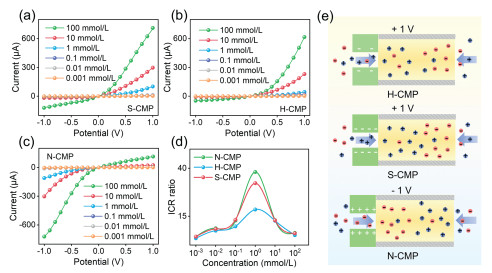
The influence of ion concentration and valence on ICR effect was further investigated to reveal the ion transport properties and the ion-selective behavior of the CMP/AAO membranes with different charge characteristics [38]. We first tested the current response of CMP/AAO membranes with varying surface charge properties under a concentration gradient of KCl solution from 0.001 mmol/L to 100 mmol/L. As illustrated in Fig. 3a, in the presence of S-CMP/AAO membranes, I+1V continuously increased with increasing concentration. Interestingly, the calculated ICR ratios presented a tendency to increase and then decrease. It was caused by the excess surface charge of CMP/AAO membranes through absorption of counterions to form electrical double layer (EDL) [39]. According to previous studies, the EDL thickness diminishes as the electrolyte concentration increases. Typically, the ICR ratio reaches its maximum value when the EDL thickness is equal to the nano-channel diameter of the CMP layer [40]. As the KCl concentration increased from 0.001 mmol/L to 1 mmol/L, the ionic strength correspondingly rose, leading to an increase in both the ionic current and the ICR ratio. When the KCl concentration was above 1 mmol/L, the rectification ability of S-CMP/AAO decreased due to the incomplete overlap of the EDL with the nanochannels. This result follows the performance of cation-selective membranes measured in our previous work [25]. To clarify the role of the sub-nanochannel chemical environment on ICR performance, we examined the performance of the synthesized H-CMP/AAO and N-CMP/AAO membranes under the same conditions (Figs. 3b-d). For the weaker negatively charged H-CMP/AAO membranes, their I-V responses in different concentrations of KCl solutions were consistent with those of S-CMP/AAO, though with smaller ICR ratios (Fig. 3b). The positively charged N-CMP/AAO membrane exhibited a more sensitive current response at −1 V, which is consistent with the characteristics of anion-selective membranes (Fig. 3c) [41]. Importantly, in this case, the trend and ratio of ICR were basically consistent with that of S-CMP/AAO. In addition, the responses of these membranes in NaCl electrolyte were also tested under the same experimental conditions, which yielded similar results (Figs. S26-S28 in Supporting information). This may be due to that both KCl and NaCl are monovalent salts with the same ionic charge. Fig. 3e details the differences in ion transport behavior between these CMP/AAO membranes. These results demonstrate the feasibility and universality of our proposed method in preparing nanofluidic membranes with remarkable anion/cation selectivity.
Figure 3
Figure 3.
ICR behavior of CMP/AAO membranes with different sub-nanochannel environments. I-V curves of the S-CMP/AAO (a), H-CMP/AAO (b), and N-CMP/AAO (c) membranes obtained in KCl solution (pH 7) with different concentrations varying from 0.001 mmol/L to 100 mmol/L. (d) Relationship between the ICR ratio and electrolyte concentrations of different CMP/AAO membranes. (e) Schematic of trans-membrane ion transport in different CMP/AAO membranes.
The ionic valence significantly affected the ICR properties of asymmetric nanochannels [42]. Hence, we examined the ICR performance of CMP/AAO membranes in the presence of divalent cations (Ca2+) and divalent anions (SO42-). In the presence of the anion-selective S-CMP/AAO membrane, the ionic current of “ON” state in CaCl2 solution is obviously larger than KCl of the same bulk concentration (Fig. S29 in Supporting information, the difference in “OFF” state is not very significant, thus not discussed here). Since Ca2+ carries twice the charge of K+ at the same concentration, the shielding effect will be stronger. Therefore, the ICR ratio reached its maximum at lower electrolyte concentration (0.1 mmol/L, ICR ratio = 39.37). Similarly, the divalent anion-containing K2SO4 also achieved a maximum ICR at 0.1 mmol/L, though Ca2+ had a slightly greater effect on the ICR at the same concentration due to the cation-selectivity nanofluidic membrane (Figs. S30 and S31 in Supporting information). Comparatively, the anion-selective N-CMP/AAO membrane was more sensitive to changes in the concentration of divalent anions (Fig. S32 in Supporting information). Owing to the smaller charge density, H-CMP/AAO had lower ICR ratios at the same concentration, though the response for different valence ions was consistent with that of S-CMP/AAO (Fig. S33 in Supporting information). Overall, ion valence and species are closely related to ion selectivity. These results provide deeper insights into the relationship between ion valence effects on ICR and the ion-selective capabilities of nanofluidic membranes.
Moreover, given the abundant functional groups in the sub-nanochannels of these tailored CMP membranes, the surface charge properties are susceptible to interference by the pH of the environment, which in turn affects the ion transport properties. The effect of pH on the ICR performance was thoroughly investigated by measuring the I-V curves of CMP/AAO membranes under different pH values. The calculated ICR ratios suggest an obvious pH-regulated ICR behavior. And the responses of CMP/AAO membranes with diverse sub-nanochannel chemical environments to pH are significantly different. This pH-dependent ICR property can be explained by the differing dissociation degrees of ionic groups within the nanochannels of CMP/AAO membranes at different pH [43]. Taking S-CMP/AAO as an example, when pH > 3, the electronegativity of sulfonate groups increases with increasing pH, resulting in an enlarged ICR ratio. While in a strongly acidic environment (pH ≤ 3), the sulfonate groups are protonated, leading to reversed electrical properties, which transform the asymmetric membrane into anion-selective (Fig. S34 in Supporting information). The results of zeta potential measurement at different pH further confirmed this presumption (Fig. S35 in Supporting information). Another cation-selective H-CMP/AAO membrane displayed the same trend with pH, except that the charge reversal occurred at a higher pH (pH > 4) due to the different dissociation constant (Figs. S36 and S37 in Supporting information). As for N-CMP/AAO membranes, the ionic groups undergo charge reversal at pH > 8, shifting from anion-selective to cation-selective (Figs. S38 and S39 in Supporting information). Apparently, pH strongly influences the ion selectivity of nanofluidic membranes by modulating the properties of ionic groups in CMP membranes, with each group exhibiting distinct response profiles.
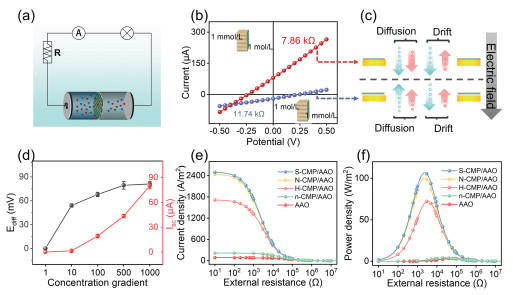
Inspired by the ion-selective transport property, the osmotic energy conversion performance of the CMP/AAO membranes was further evaluated. It is generally realized by selective transmembrane ion diffusion through charged membranes under a concentration gradient [44]. The experimental setup is illustrated in Fig. 4a and Fig. S40 (Supporting information). The selectivity of the ion diffusion process in this device was first tested by introducing a chemical potential gradient on both sides of the membrane. In this context, the ionic current is mainly influenced by the ion transport from higher to lower concentrations. For S-CMP/AAO membranes, the highly negatively charged channels selectively passed K+, resulting in a K+-dominated net current, as did H-CMP/AAO with a weaker negative charge (Figs. S41 and S42 in Supporting information). In contrast, when N-CMP/AAO membranes were used, the Cl- current became dominant, reflecting its anion selectivity (Fig. S43 in Supporting information). The open-circuit potential (Voc) and short-circuit current (Isc) in a nanofluidic membrane-based RED system can be obtained from the measured I-V curves. The Voc is composed of the diffusion potential (Ediff) from the membrane and the redox potential (Eredox) caused by the unequal polarization potential originating from the electrode-solution interface at different electrolyte concentrations (Fig. S44 in Supporting information). The Eredox values can be obtained from the non-ion-selectivity AAO membrane, since bare AAO cannot generate Ediff in solution under a salinity gradient. The contribution of Eredox is deducted via potential calibration (Ediff = Voc-Eredox) [45]. To achieve more efficient osmotic energy conversion, we first optimized the configuration conditions of the salinity gradient using S-CMP/AAO membranes as an example. Two KCl solutions with a 1000-fold difference in salinity (1 mol/L/1 mmol/L) were placed on the S-CMP side and the AAO side, respectively. When the high concentration was on the S-CMP side (Fig. 4b, red curve), the absolute values of Voc and Isc were 239.7 mV and 80 μA, while in reverse, both Voc and Isc decreased to 148 mV and 10.5 μA. It indicates that the first case has a smaller internal resistance (7.86 kΩ vs. 11.74 kΩ), which ensures higher permeability (Fig. 4c) [46]. Therefore, to achieve a higher output power density, all the following experiments were carried out by placing a high-concentration solution on the CMP side.
Figure 4
Figure 4.
The ion diffusion mechanism and osmotic energy conversion performance of CMP/AAO membranes. (a) Schematic of the experimental setup used to harvest osmotic energy from salinity gradient using a CMP/AAO membrane. (b) Measurement of ionic current under the gradient of two different salt concentrations. Red curve represents the I-V curve with the 1 mmol/L KCl solution on the AAO side and the 1 mol/L KCl solution on the CMP side. Blue curve represents the same condition under the reverse salt concentration. (c) Ion diffusion direction under different experimental conditions. (d) The recorded Isc and Ediff of S-CMP/AAO membrane under various salt concentration gradients. Current densities (e) and power densities (f) of AAO and different CMP/AAO membranes with increasing loaded resistance under 500-fold salinity gradient.
Further, the effect of concentration gradient on the energy conversion performance of CMP/AAO membrane was investigated. The KCl concentration on the AAO side was fixed at 1 mmol/L, and changed from 1 mmol/L to 1 mol/L on the CMP side. As the concentration gradient increased, the values of both Vdiff and Idiff gradually increased, with maximum values of 81.1 mV and 80.0 μA for S-CMP/AAO, respectively (Fig. 4d and Table S2 in Supporting information). The optimal cationic transfer number of S-CMP/AAO was 0.964 with an energy efficiency of 43.1%, noticeably higher than that of H-CMP/AAO with a lower charge density (0.888% and 30.0%, respectively). While N-CMP/AAO membrane, which had an anion-selective behavior with a similar charge density, showed a similar energy conversion efficiency to that of S-CMP/AAO. These results provide direct evidence that the improved charge density enhances ion selectivity and permeability, simultaneously [47]. Then, the CMP/AAO membranes were connected with a load resistor (RL) to assess the output performance of the salinity gradient energy conversion system (NaCl solutions were used to mimic seawater and river water). The output power of the membrane can be calculated as P = I2 × RL. As shown in Fig. 4e, the current densities of AAO and different CMP/AAO membranes decreased progressively with increasing external resistance. In contrast, the power densities first increased and then decreased (Fig. 4f). The maximum output power density appeared at RL = RM, in which RM was the internal resistance of the membrane. At a 500-fold salinity gradient, the maximum output power density of these CMP/AAO membranes could reach 105.5 W/m2 (S-CMP/AAO), 98.9 W/m2 (N-CMP/AAO), and 76.2 W/m2 (H-CMP/AAO), respectively, with a commonly used testing area of ~0.03 mm2. Noteworthy, for AAO and n-CMP/AAO membranes without ion-selectivity, the maximum power densities were only 2.29 and 4.4 W/m2. The above results revealed that the abundant and well-tailored sub-nanochannels of CMP membrane improve the ion permselectivity, thus enabling the prepared nanofluidic membranes with high power density in osmotic energy conversion.
Generally, successive ion transport leads to the enrichment of counter ions on the lower concentration side, resulting in ICP phenomenon [48]. The polarization phenomenon will reduce the effective concentration gradient across the ion-selective membrane and thus suppress energy conversion process [49]. Fortunately, the CMP/AAO membranes with good ICR properties promise to suppress the ICP phenomenon effectively. Accordingly, theoretical calculations were further employed to confirm the underlying mechanisms (Figs. S45 and S46 in Supporting information). Based on the PNP theory, the concentration at the exit of the nanochannel on the low-concentration side was calculated under a 50-fold concentration gradient (0.5 mol/L/0.01 mol/L). As depicted in Fig. S45, the cation concentrations of the three mentioned CMP channels on the lower concentration side were much larger than the bulk solution due to the severe ICP phenomenon. Conversely, the asymmetric CMP/AAO membrane can effectively suppress the ICP phenomenon, displaying a sharper heterogeneous concentration distribution (Fig. S46). Overall, the proposed nanofluidic membranes with high surface charge density and well-defined asymmetric structure are conducive to improving the unidirectional ion transport and prohibiting the generated current back to the membrane, thus effectively suppressing the ICP phenomenon, holding great potential for salinity gradient energy conversion applications.
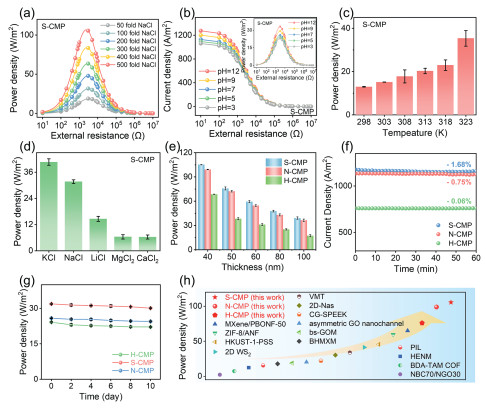
The performance of osmotic energy conversion can be influenced by many external factors, including salinity gradient, pH of electrolyte, temperature, electrolyte types, membrane thickness, and testing area [50]. For an optimal osmotic energy conversion performance, we first investigated the effect of salinity gradient. Specifically, the concentration on the CMP membrane side was changed from 0.1 mol/L to 5 mol/L, while keeping the concentration on the other side at 0.01 mol/L to ensure ideal ion selectivity. As shown in Fig. 5a and Figs. S47-S49 (Supporting information), both current density and power density increased with the increasing salinity gradient due to the high driving force. As mentioned earlier, pH affects the surface charge properties of CMP membranes and thus the ion transport process. We further explored the effect of pH on CMP membranes with different in-pore modifications. As illustrated in Fig. 5b and Figs. S50-S52 (Supporting information), the ion transport conductance and osmotic energy conversion behaviors of CMP/AAO membranes also varied regularly with pH. Differently, the negatively charged H-CMP/AAO and S-CMP/AAO showed an opposite tendency to that of the positively charged N-CMP/AAO. The former exhibited maximum power density at pH 3, while the latter at pH 12. The major reason is that the surface charge density of tailored CMP membranes varies with pH, as different ionic groups respond differently to changes in pH. Notably, when the external temperature was elevated from 298 K to 328 K, the ionic conductance increased with increasing temperature (Fig. S53 in Supporting information), showing an enhanced ion transport behavior. Thus, the osmotic energy conversion performance of CMP/AAO membranes also increased correspondingly (Fig. 5c and Fig. S54 in Supporting information). The power density of S-CMP/AAO membrane at 323 K reached 70.6 W/m2 under 100-fold salinity gradient.
Figure 5
Figure 5.
Osmotic energy conversion performance of different CMP/AAO membranes. (a) Power density of S-CMP/AAO membrane under different concentration gradients. (b) The current density of S-CMP/AAO membrane under different pH, the inset is the power density of S-CMP/AAO membrane under different pH. (c) Power density of S-CMP/AAO membrane under different temperatures. (d) Power density of the S-CMP/AAO membrane plotted as functions of external load resistance for various salts. (e) Maximum power density values of S-CMP/AAO, N-CMP/AAO and H-CMP/AAO membranes with different thicknesses. The salinity gradient is 500-fold (5 mol/L/10 mmol/L). (f) The current densities of the CMP/AAO membranes were continuously measured for 3600 s. (g) Power densities of the CMP/AAO membranes after immersion in water for 10 days. The NaCl concentration gradient (cCMP/cAAO) was set to 1 mol/L/ 0.01 mol/L. (h) Comparison of the output power density with previously reported RED membranes. The concentration gradient is 500-fold. Detailed data are provided in Table S4.
The type of electrolyte is a crucial factor affecting osmotic energy conversion, and the differences in ion diffusion rate and hydrated diameter make a significant difference in transmembrane efficiency. In this regard, we explored the variation pattern of osmotic energy conversion efficiency in different electrolyte environments by tailoring their sub-nanochannel environments. In the case of cation-selective S-CMP/AAO, for example, the output power for monovalent cations, Na+, Li+, and K+, is apparently dissimilar. Typically, higher ion diffusion coefficients result in more efficient ion transport [51]. Accordingly, Na+ with a higher diffusion coefficient exhibits greater charge density and power output (Table S3 in Supporting information). As for divalent cations (Ca2+, Mg2+), their hydrated diameters are larger (>8 Å) than the pore size of the S-CMP (7–8 Å), resulting in lower diffusion coefficients and hence significantly lower output power densities than monovalent cations (Fig. 5d). It is a feature often observed in cation-selective membranes with similar pore sizes (Fig. S55 in Supporting information) [52]. Similarly, the decrease in power density of anion-selective N-CMP/AAO membranes is attributed to different anion hydration radii and diffusion coefficients, as well as the interaction of ions with the inner wall of the nanochannels (Fig. S56 in Supporting information) [53]. Additionally, the thickness of the CMP layers has a substantial influence on the energy conversion behavior. As shown in Fig. 5e and Figs. S57-S59 (Supporting information), the output power of CMP/AAO membranes achieved a maximum value at the minimum thickness (40 nm) of CMP that could completely cover the AAO membrane. For a relatively thick CMP layer, the transmembrane ion resistance will increase drastically, leading to a decreasing power output.
The influence of the testing area on the energy conversion performance was also explored. We measured the output power density using devices with various testing areas. As seen from Fig. S60 (Supporting information), the output power density significantly decreased with the increase of testing area. This phenomenon is mainly caused by the coupling of interfacial ion concentration polarization regions of the nanochannels in the nanoporous membrane [54]. The coupling effect renders the domination of interfacial resistance in the total resistance. As a result, the output current increases nonlinearly with the testing area [55]. Therefore, the output current density and the power density decreased as the testing area increased. Importantly, these CMP/AAO membranes also exhibit excellent operational stability. As shown in Fig. 5f, the current density of the CMP/AAO-based energy generator could still be maintained above 98% after continuous operation for 3600 s without renewing the electrolyte solution. It implies that the proposed tailored CMP/AAO membrane can effectively stabilize the transmembrane concentration gradient and promote continuous osmotic energy conversion. Furthermore, we evaluated the long-term stability of the membranes in osmotic energy conversion at a 100-fold concentration gradient (Fig. 5g and Figs. S61-S63 in Supporting information). There was almost no decrease in power density measured after 10 days, indicating the chemical and physical structural stability of these well-defined CMP/AAO membranes. Noteworthy, to the best of our knowledge, the power density achieved in this work outperformed the performance of most previously reported membranes (Fig. 5h and Table S4 in Supporting information). The impressive performance under different external conditions and electrolytes highlights the potential of our CMP/AAO membranes for practical osmotic energy conversion applications.
In summary, we have developed a series of high-performance membranes for osmotic energy conversion by electrodepositing different CMPs on an AAO substrate. The charge polarity and density (strongly negative, weakly negative, and positive) of the sub-nanochannels within the CMP layer were precisely tailored through rational monomer design. Theoretical simulations confirmed that these charge-tailorable asymmetric membranes enhance selective ion transport and suppress ICP, resulting in improved ion permselectivity. A systematic investigation into the CMP membranes’ sub-nanochannel environments demonstrated the critical role of charge density and polarity in regulating ion transport. In osmotic energy conversion, the optimized CMP/AAO membranes achieved an output power density of up to 105.5 W/m2 under a 500-fold NaCl gradient, significantly outperforming the n-CMP/AAO (4.4 W/m2) and most reported works. Moreover, it exhibits excellent stability along with pH and temperature-sensitive ion transport behavior, offering further opportunities for optimization. This work highlights the strong potential of precisely tailored CMP membranes for advancing nanofluidic ion permselectivity and osmotic energy conversion applications. Looking forward, applying the charge-tailoring strategy to more robust substrates could further enhance the mechanical durability of these membranes, facilitating their practical implementation.
CRediT authorship contribution statement
Jin Wang: Writing – original draft, Methodology, Investigation, Funding acquisition, Formal analysis, Data curation, Conceptualization. Li Xu: Validation, Formal analysis, Data curation. Jia Kang: Methodology, Data curation. Chen Wang: Writing – review & editing, Project administration, Funding acquisition, Conceptualization.
Declaration of competing interest
The authors declare that they have no known competing financial interests or personal relationships that could have appeared to influence the work reported in this paper.
Acknowledgments
This work was supported by grants from the National Natural Science Foundation of China (No. 22304084), Natural Science Foundation of Jiangsu Province (No. BK20230377), Jiangsu Provincial Department of Education (No. 23KJB150021), and State Key Laboratory of Neurology and Oncology Drug Development (Nos. SKLSIM-F-2025351, SKLSIM-F-2024176).
Supplementary materials
Supplementary material associated with this article can be found, in the online version, at doi:10.1016/j.cclet.2026.112876.
[1]
H. Ling, W. Xin, Y. Qian, et al., Angew. Chem. Int. Ed. 62 (2022) e202212120.
Scheme 1
(a) Schematic diagram of the design principles of CMP/AAO membranes. (b) Schematic diagram of the fabrication process for the CMP/AAO membranes. (c) Schematic of the synthesis installation for CMP/AAO membranes and their application in selective ion transport and osmotic energy conversion.
Figure 1
Fabrication and characterization of CMP/AAO membranes with tailored sub-nanochannel environment. (a) The schematic illustration of the prepared CMP/AAO membrane. (b-d) SEM images of the top (b), bottom view (c), and EDX elemental mappings (d) of S-CMP/AAO membrane. (e-g) SEM images of the cross-section of S-CMP/AAO membrane. (h) Contact angle of Au-AAO and different CMP/AAO membranes. (i) N 1s and S 2p high-resolution XPS spectra of S-CMP membrane. (j) FT-IR spectra of different CMP membranes. (k) Nitrogen sorption isotherms of S-CMP membrane (insert is pore-size distribution of S-CMP membrane).
Figure 2
Selective ion transport properties of the tailored CMP/AAO membranes. (a) Schematic diagram of the device for measuring ion selectivity. (b) I-V curves of Au-AAO, n-CMP/AAO and tailored CMP/AAO membranes obtained in KCl solution (pH 7). (c) Scheme of the mechanism for “ON” and “OFF” states in ICR, originating from the varied ion concentration in nanochannels. (d) Zeta potential of different CMP membranes. (e) Transmembrane ionic conductance of different CMP/AAO as a function of the KCl concentration varying from 1 μmol/L to 3 mol/L. (f) Scheme of CMP/AAO membrane used for theoretical calculation. (g) The calculated ion concentration profiles of different CMP/AAO membranes: (ⅰ) H-CMP/AAO, (ⅱ) S-CMP/AAO and (ⅲ) N-CMP/AAO.
Figure 3
ICR behavior of CMP/AAO membranes with different sub-nanochannel environments. I-V curves of the S-CMP/AAO (a), H-CMP/AAO (b), and N-CMP/AAO (c) membranes obtained in KCl solution (pH 7) with different concentrations varying from 0.001 mmol/L to 100 mmol/L. (d) Relationship between the ICR ratio and electrolyte concentrations of different CMP/AAO membranes. (e) Schematic of trans-membrane ion transport in different CMP/AAO membranes.
Figure 4
The ion diffusion mechanism and osmotic energy conversion performance of CMP/AAO membranes. (a) Schematic of the experimental setup used to harvest osmotic energy from salinity gradient using a CMP/AAO membrane. (b) Measurement of ionic current under the gradient of two different salt concentrations. Red curve represents the I-V curve with the 1 mmol/L KCl solution on the AAO side and the 1 mol/L KCl solution on the CMP side. Blue curve represents the same condition under the reverse salt concentration. (c) Ion diffusion direction under different experimental conditions. (d) The recorded Isc and Ediff of S-CMP/AAO membrane under various salt concentration gradients. Current densities (e) and power densities (f) of AAO and different CMP/AAO membranes with increasing loaded resistance under 500-fold salinity gradient.
Figure 5
Osmotic energy conversion performance of different CMP/AAO membranes. (a) Power density of S-CMP/AAO membrane under different concentration gradients. (b) The current density of S-CMP/AAO membrane under different pH, the inset is the power density of S-CMP/AAO membrane under different pH. (c) Power density of S-CMP/AAO membrane under different temperatures. (d) Power density of the S-CMP/AAO membrane plotted as functions of external load resistance for various salts. (e) Maximum power density values of S-CMP/AAO, N-CMP/AAO and H-CMP/AAO membranes with different thicknesses. The salinity gradient is 500-fold (5 mol/L/10 mmol/L). (f) The current densities of the CMP/AAO membranes were continuously measured for 3600 s. (g) Power densities of the CMP/AAO membranes after immersion in water for 10 days. The NaCl concentration gradient (cCMP/cAAO) was set to 1 mol/L/ 0.01 mol/L. (h) Comparison of the output power density with previously reported RED membranes. The concentration gradient is 500-fold. Detailed data are provided in Table S4.


 DownLoad:

 下载:


 下载:

