
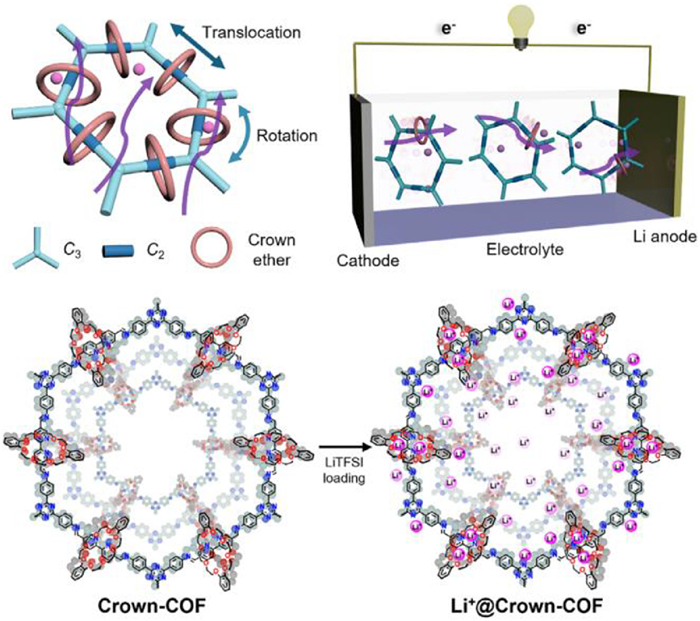
Figure 1.
Schematics showing the advantages of crown ether-threaded COFs as battery electrolytes and their chemical schemes. Reproduced with permission [8]. Copyright 2026, Wiley Publisher.


Mechanically interlocked molecules (MIMs), particularly rotaxanes, represent a cornerstone of modern supramolecular chemistry due to their unique ability to combine structural integrity with controlled molecular motion [1]. Their interlocked architectures enable dynamic processes such as shuttling and rotation, which are central to the design of molecular machines and adaptive functional systems. Notably, the integration of mechanical bonds into macromolecular scaffolds has emerged as an important direction. For example, Yang and co-workers demonstrated that rotaxane dendrimers can synergistically combine controlled molecular motion with well-defined branched architectures, enabling diverse applications ranging from light harvesting to soft actuators [2].
In parallel with the rapid development of MIMs, reticular materials such as metal organic frameworks (MOFs) and covalent organic frameworks (COFs) have attracted enormous attention owing to their ordered structures and tunable functionalities [3]. Compared with MOFs, COFs are constructed via dynamic covalent chemistry, typically involving reversible linkages such as imine (C=N) bonds that enable error correction during crystallization, ultimately affording chemically robust frameworks with long-range order and permanent porosity [4]. These features make COFs particularly appealing as platforms for integrating functional molecular units. Nevertheless, from a materials design perspective, incorporating bulky rotaxane motifs may introduce synthetic challenges, particularly in maintaining long-range crystallinity and ordered pore stacking under sterically demanding conditions. Despite this, the integration of rotaxane motifs into COFs offers a compelling opportunity to merge dynamic behavior with ordered nanochannels, enabling precise regulation of pore environments and transport processes. Such “rotaxane struts” introduce mobility into otherwise static frameworks and open avenues for stimuli-responsive functions as well as advanced separation and energy-related applications.
Early efforts have begun to validate this concept across diverse applications. In 2021, Zhu et al. incorporated crown ether-based rotaxane units into COFs to create adaptive catalytic systems, where the mechanically mobile macrocycles enabled flexible binuclear Zn active sites for highly efficient organophosphate degradation [5]. Chen et al. developed rotaxane-mediated COF membranes, in which pseudorotaxane linkers regulate interfacial polymerization and induce tighter stacking, yielding sub-nanometer channels with excellent desalination performance [6]. Jiang et al. introduced rotaxane structures into 2D COFs to disrupt interlayer stacking and construct 3D proton-conduction pathways, achieving exceptionally high anhydrous proton conductivity [7]. Building on these foundational studies, recent advances have further expanded the functional scope of rotaxane-based COFs, as exemplified by the two representative systems discussed below. Notably, these studies represent distinct application scenarios: The former focuses on solid-state electrolytes and ion conduction, whereas the latter targets ion-sieving membranes for selective separation.
In 2026, Kim et al. developed a mechanically interlocked COF electrolyte by integrating crown ether rotaxane motifs into a crystalline, nitrogen-rich 2D framework [8]. As shown in Fig. 1, crown ether macrocycles are first threaded onto bipyridinium-based linear precursors to form pseudorotaxane building blocks, which are subsequently polymerized into an extended COF network. This strategy installs rotaxane struts within the COF channels, where the macrocycles are mechanically confined yet retain their intrinsic mobility. Unlike conventional COFs with static binding sites, this design introduces dynamic elements into well-defined nanochannels, enabling the coexistence of structural order and molecular motion—features that are rarely combined in solid-state ion conductors.
From a mechanistic perspective, the incorporation of crown ether rotaxanes fundamentally alters Li+ transport behavior. Ether oxygen atoms and COF nitrogen sites cooperatively coordinate Li+, promoting salt dissociation and enhancing the Li+ transference number. More importantly, Li+ migration proceeds via a hybrid mechanism that combines conventional hopping between coordination sites with mechanically assisted shuttling driven by crown ether motion. This dynamic process lowers the effective energy barrier for ion diffusion and enables continuous Li+ migration along the COF channels. As a result, the Li+@Crown-COF electrolyte exhibits high ionic conductivity (~10–3 S/cm) at room temperature, outperforming non-interlocked analogues. These features also indicate strong potential for practical implementation in next-generation solid-state lithium metal batteries, where high ionic conductivity, interfacial stability, and dendrite suppression are critically required.
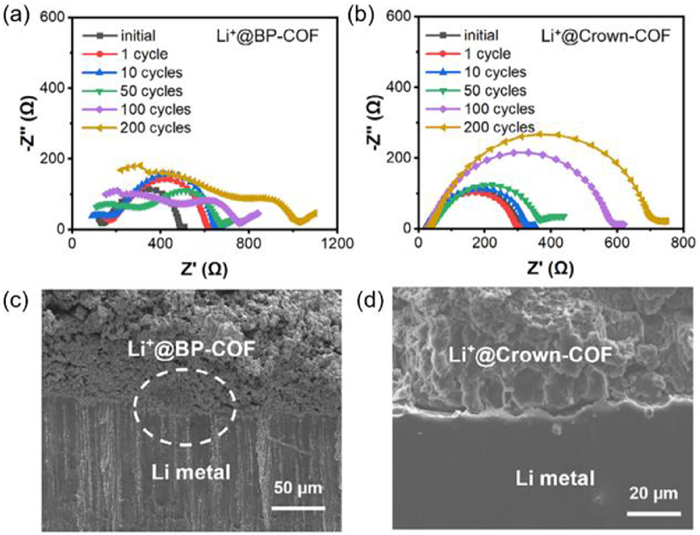
The advantages of this mechanically adaptive framework are further reflected in its electrochemical stability and cycling performance (Figs. 2a and b). Impedance analysis shows that the rotaxane-functionalized COF maintains a stable and low interfacial resistance during prolonged Li plating/stripping, whereas control systems suffer from rapid resistance buildup. Post-cycling morphological characterization further reveals a smooth and dendrite-free lithium surface in the presence of the Crown-COF electrolyte, in stark contrast to the rough and heterogeneous deposition observed otherwise (Figs. 2c and d). This improved stability is attributed to the uniform Li+ flux enabled by dynamic coordination and transport, as well as the enhanced mechanical robustness of the interlocked framework. Overall, this work demonstrates that incorporating rotaxane struts into COFs is a powerful strategy to couple molecular motion with ion transport, offering new design principles for high-performance solid-state electrolytes.
In contrast to ion conduction in bulk solid-state systems, the following work shifts the focus to ion-selective transport across confined membrane channels. Deng et al. reported a rotaxane-induced strategy to construct COF membranes featuring sub-nanometer ion-recognition channels [9]. As shown in Fig. 3, dibenzo-crown ether (DCE)-based rotaxane units were first introduced via host–guest threading with linear COF precursors to form pseudorotaxane monomers, which subsequently underwent polymerization into crystalline COF nanosheets. These rotaxane-decorated nanosheets were then assembled into membranes through pressure-assisted stacking. Crucially, bulky and π-rich rotaxane moieties simultaneously modulate interlayer interactions and stacking behavior: π–π interactions between aromatic components promote an ordered eclipsed stacking mode, while the steric shielding from the interlocked macrocycles effectively narrows the intrinsic COF pores. This cooperative effect leads to vertically aligned one-dimensional channels with angstrom-scale apertures, while embedding crown ether units along the pore walls as well-defined recognition sites.
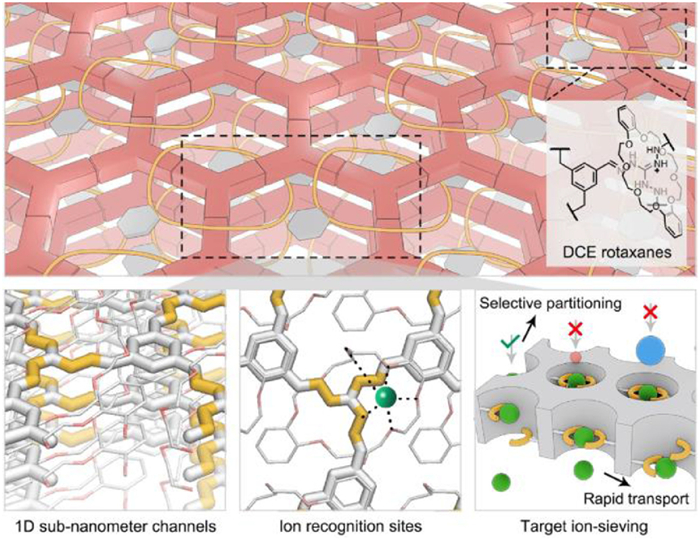
Functionally, this system exemplifies a synergistic integration of size exclusion and specific ion recognition within confined nanochannels. The crown ether cavities, together with adjacent guanidinium sites, form tailored coordination environments that preferentially stabilize Li+, thereby compensating for its high dehydration energy upon entering the sub-nanometer pores. Meanwhile, the hydrophobic and spatially confined channels enforce partial or complete dehydration of competing ions, amplifying selectivity. Notably, an optimal balance between binding strength and transport kinetics is achieved at intermediate rotaxane loadings, enabling efficient “hopping” transport of Li+ between adjacent recognition sites. As a result, the membrane exhibits a high Li+ permeation rate alongside remarkable selectivity (e.g., Li+/Mg2+ up to 315), outperforming many state-of-the-art systems. Such characteristics are highly relevant to industrial applications, including lithium extraction from salt-lake brines and seawater desalination, where high selectivity and throughput are essential.
In summary, this editorial highlights recent advances in COFs with rotaxane struts, an emerging class of materials that integrate mechanical bonds into crystalline porous architectures. By embedding interlocked macrocycles within ordered frameworks, these systems transcend the traditional static nature of COFs, enabling dynamic regulation of pore environments, ion transport, and catalytic function. The discussed examples demonstrate how rotaxane motifs can simultaneously modulate structure, microenvironment, and motion, leading to enhanced performance in areas ranging from solid-state electrolytes to ion-selective membranes. Importantly, these advances underscore the promising industrial potential of rotaxane-strutted COFs in lithium metal batteries, seawater desalination, and high-efficiency ion separation technologies.
Looking forward, the true potential of rotaxane-based COFs lies in their ability to bridge molecular machines with functional materials. Future developments may focus on programmable motion, stimuli-responsive behavior, and multiscale coupling between dynamics and transport. In addition, the long-term mechanical robustness and thermal stability of mechanically interlocked “soft” rotaxane struts within otherwise rigid COF backbones will be an important consideration for their practical deployment, particularly under sustained electrochemical operation and varying temperature conditions. Achieving precise control over mechanical motion within periodic frameworks could unlock opportunities in smart separation, adaptive catalysis, and energy systems, positioning rotaxane-strutted COFs as a versatile platform at the frontier of supramolecular materials science. With continued development, such systems may bridge the gap between fundamental supramolecular design and real-world deployment in energy storage and water treatment.
Tao Liang: Writing – original draft, Investigation. Tangxin Xiao: Writing – review & editing, Supervision, Project administration, Conceptualization. Kai Diao: Writing – original draft. Leyong Wang: Writing – review & editing, Supervision, Funding acquisition.
The authors declare that they have no known competing financial interests or personal relationships that could have appeared to influence the work reported in this paper.
F. Cui, Q. Zhang, T. Xiao, Z. Wang, L. Wang, Chin. Chem. Lett. 35 (2024) 110061. doi: 10.1016/j.cclet.2024.110061
X.Q. Wang, W.J. Li, W. Wang, H.B. Yang, Acc. Chem. Res. 54 (2021) 4091–4106. doi: 10.1021/acs.accounts.1c00507
O.M. Yaghi, M. O’Keeffe, N.W. Ockwig, et al., Nature 423 (2003) 705–714.
C.S. Diercks, O.M. Yaghi, Science 355 (2017) eaal1585. doi: 10.1126/science.aal1585
X. Ruan, Y. Yang, W. Liu, et al., ACS Cent. Sci. 7 (2021) 1698–1706. doi: 10.1021/acscentsci.1c00941
L. Ren, H. Wu, J. Han, J. Chen, Adv. Funct. Mater. 35 (2025) 2425244. doi: 10.1002/adfm.202425244
J. Yang, W. Fan, X. Wei, et al., Natl. Sci. Rev. 12 (2025) nwaf293. doi: 10.1093/nsr/nwaf293
M. Gu, J. Wu, C. Li, et al., Adv. Mater. 38 (2026) e11473. doi: 10.1002/adma.202511473
L. Ren, J. Song, N. Zhang, et al., Angew. Chem. Int. Ed. 65 (2026) e25413. doi: 10.1002/anie.202525413

Figure 1 Schematics showing the advantages of crown ether-threaded COFs as battery electrolytes and their chemical schemes. Reproduced with permission [8]. Copyright 2026, Wiley Publisher.

Figure 2 Impedance spectra of (a) Li|Li+@BP-COF|Li and (b) Li|Li+@Crown-COF|Li symmetric cells, respectively. Cross sessional SEM image of Li anode interface of (c) Li+@BP-COF and (d) Li+@Crown-COF after cycling, respectively. Reproduced with permission [8]. Copyright 2026, Wiley Publisher.

 扫一扫看文章


扫一扫关注我们
 DownLoad:
 下载:
下载:

 下载:
下载: