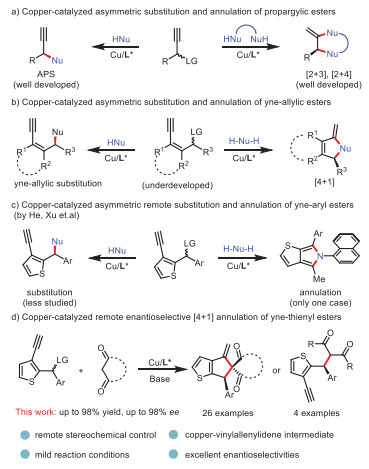
Scheme 1.
Remote Cu-catalyzed substitution and annulation reactions.

Remote copper-catalyzed asymmetric [4 + 1] annulation of yne-thienyl esters with 1,3-dicarbonyls
Xiao-Kang Dai , Jia-Xin Xiong , Zheng-Yan Wang , Hao-Dong Qian , Jing Zhao , Shaolin Zhou , Hao Xu


Copper-catalyzed asymmetric propargylic substitution reactions of propargylic esters constitute an important strategy for the synthesis of chiral propargylic derivatives [1–7]. In addition, propargylic esters have been well established as C2 synthons and have been widely applied in propargylic cyclization reactions, such as asymmetric [2 + 3] and [2 + 4] cycloadditions, providing efficient access to chiral five- and six-membered frameworks (Scheme 1a) [8–13]. In 2022, Fang and co-workers developed yne–allylic esters, which under copper catalysis undergo yne-allylic substitution as well as [4 + 1] cyclization reactions with a broad range of mono- and bis-nucleophiles [14]. Subsequently, Xu and co-workers reported asymmetric [4 + 1] cyclizations of these reagents with C-bis-nucleophiles via a remote yne-allylic/Conia-ene cyclization process [15–17], thereby establishing yne-allylic esters as a class of C4 synthons (Scheme 1b) [18–28]. Further studies demonstrated that these reagents could also participate in [4 + 1] cyclizations with arylamines, enabling the construction of axially chiral pyrrole derivatives [29,30].
In 2023, the groups of He and Xu almost simultaneously replaced the alkenyl moiety in yne-allylic esters with an aryl group and disclosed remote asymmetric benzylic substitution reactions of yne-thienyl esters with various mono-nucleophiles (Scheme 1c) [31,32]. He and co-workers further reported an asymmetric [4 + 1] annulation with naphthylamines to access axially chiral products, although only a single example was achieved [33]. Subsequently, the same group described a [4 + 2] cyclization of yne-thienyl esters with hydrazines [34]. However, catalytic asymmetric control was not realized. As a result, asymmetric annulation reactions of yne-thienyl esters as C4 synthons remain highly challenging. This challenge may be attributed to the planar aromatic nature of the thiophene moiety, which diminishes alkynyl reactivity and increases molecular rigidity, thereby disfavoring intramolecular cyclization.
Inspired by interest in copper-catalyzed propargylic substitution and annulation chemistry [35–73], we set out to address this challenge and herein report a copper-catalyzed asymmetric [4 + 1] annulation of yne-thienyl esters with cyclic active methylene compounds (Scheme 1d).
We commenced our investigation by examining the feasibility of the reaction between (3-ethynylthiophen-2-yl)(phenyl)methyl carbonate 1a and 1H-indene-1,3(2H)-dione 2a under copper catalysis, using N,N-diisopropylethylamine (DIPEA) as the base in MeOH (Table 1, see Supporting information for details). Initial screening of chiral ligands revealed that representative tridentate PyBox ligands were capable of promoting the formation of the proposed copper-vinylallenylidene intermediate. However, sterically demanding ligands such as iPr-PyBox L1 (entry 1) and tBu-PyBox L2 (entry 2) afforded the desired product with poor enantioselectivity. We therefore evaluated less hindered PyBox ligands and found that Me-PyBox L5 (entry 5) significantly improved the enantioselectivity to 74% ee, indicating that reduced steric congestion around the copper center is beneficial for asymmetric induction. Encouraged by this result, we next investigated the electronic effects of substituents on the pyridine moieties of the PyBox framework. The para-CF3-substituted PyBox L6 delivered product 3a in 23% yield with a diminished enantioselectivity (60% ee; entry 6) relative to L5. This observation prompted us to examine PyBox ligands L7 and L8 bearing electron-donating NMe2 and OMe substituents at the C4 position. However, no further improvement in enantioselectivity was observed (entries 7 and 8). Subsequently, switching to Ph-PyBox ligand L9 led to a marked enhancement in enantioselectivity, affording 3a in 40% yield with 84% ee (entry 9). Nevertheless, the moderate yield under these conditions was likely attributable to the intrinsically low reactivity of substrate 1a. To address this issue, we turned our attention to the effect of the leaving group on the yne-thiophene ester. Notably, replacement of the carbonate with an acetate leaving group resulted in a further increase in enantioselectivity to 91% ee (entries 10–12). Subsequently, systematic optimization of additional reaction parameters, including the copper salt and substrate stoichiometry, revealed that the desired product 3a could be obtained in 61% yield with 92% ee using 10 mol% CuCl2 and a 1.5:1 ratio of 1 to 2a (entries 13–16). Notably, the asymmetric annulation remained efficient even with a shortened reaction time (entry 17).

 DownLoad:
CSV
DownLoad:
CSV
 | |||||
| Entry | 1 | L | [Cu] | Yield (%)b | ee (%)c |
| 1 | 1a | L1 | CuI | 32 | 22 |
| 2 | 1a | L2 | CuI | 24 | −8 |
| 3 | 1a | L3 | CuI | 15 | 34 |
| 4d | 1a | L4 | CuI | 22 | 66 |
| 5d | 1a | L5 | CuI | 31 | 74 |
| 6d | 1a | L6 | CuI | 23 | 60 |
| 7 | 1a | L7 | CuI | 34 | 72 |
| 8 | 1a | L8 | CuI | 37 | 52 |
| 9 | 1a | L9 | CuI | 40 | 84 |
| 10 | 1b | L9 | CuI | 18 | 90 |
| 11d | 1c | L9 | CuI | 45 | 56 |
| 12 | 1d | L9 | CuI | 12 | 91 |
| 13e | 1d | L9 | CuI | 57 | 92 |
| 14e | 1d | L9 | CuCl | 64 | 91 |
| 15e | 1d | L9 | CuOTf | 59 | 92 |
| 16e | 1d | L9 | CuCl2 | 61 | 92 |
| 17e, f | 1d | L9 | CuCl2 | 70 | 93 |
| a Reaction conditions: 1 (0.20 mmol), 2a (0.40 mmol), copper salt (10 mol%), L (12 mol%) and DIPEA (1.5 equiv.) in MeOH (2.0 mL) at 25 ℃ under N 2 atmosphere for 24 h. b Isolated yield. c The ee values were determined by HPLC. d 1 (0.15 mmol), 2a (0.30 mmol). e 1 (0.30 mmol), 2a (0.20 mmol). f Reaction was performed for 12 h. | |||||
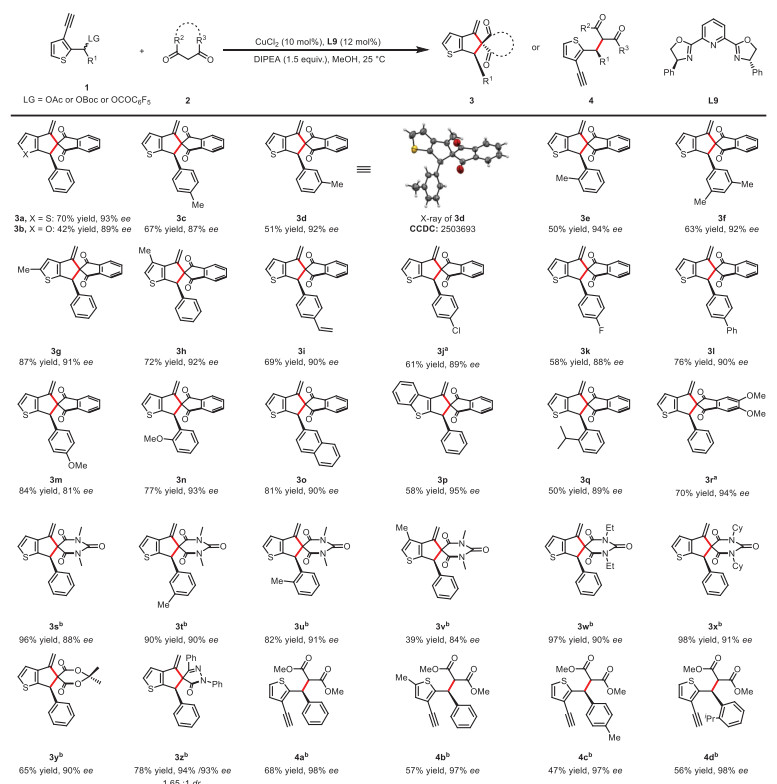
With the optimized reaction conditions in hand, we next investigated the substrate scope using a series of yne-thienyl esters bearing diverse electronic and steric substituents (Scheme 2). Substrates containing alkyl 3c–3h and alkenyl 3i substituents were well tolerated, delivering the corresponding spirocyclic products in good to moderate yields with uniformly excellent enantioselectivities, thereby enabling the efficient incorporation of a broad range of functional groups. Yne-thienyl esters featuring para-, meta-, and ortho-substituted phenyl rings all underwent the annulation smoothly to afford the desired products. Notably, electrophilic substituents such as chloro 3j and fluoro 3k groups were fully compatible with the reaction conditions. In addition, extended aromatic systems, including naphthyl-substituted yne-thienyl esters, also participated effectively, furnishing product 3o in good yield. The generality of the reaction was further examined with respect to the nucleophilic component by employing a range of commercially available 1,3-dicarbonyl compounds. Various pharmaceutically relevant heterocycles, including bioactive pyrrolidine derivatives 3z and barbituric acid derivatives 3s–3x, were efficiently converted to the corresponding spirocyclic products with high levels of enantioselectivity. Moreover, dimethyl malonate, an acyclic bis-nucleophile, afforded the desired product in moderate yield while maintaining excellent enantiocontrol. Interestingly, this acyclic nucleophile selectively delivered mono-alkylated products 4a–4d. The absolute configuration of representative product 3d was unambiguously established by single-crystal X-ray diffraction analysis (CCDC: 2503693), and the configurations of the remaining products were assigned by analogy.
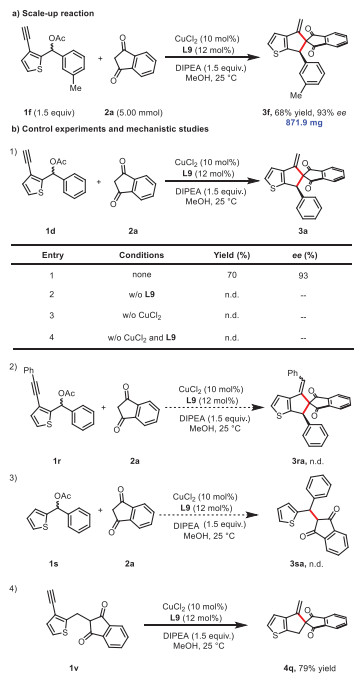
To further demonstrate the practicality of this methodology, the synthesis of spirocyclic compound 3f was carried out on a scale-up reaction, delivering the desired product without any erosion in yield or enantioselectivity (Scheme 3a). In addition, a series of control experiments were performed to gain mechanistic insight into the reaction (Scheme 3b). In the absence of either the chiral ligand or the copper salt, no formation of the target product was observed. Moreover, neither the phenyl-substituted substrate 1r nor substrate 1s, which lacks a terminal alkyne moiety, afforded the desired product under the standard conditions. These results clearly indicate that the copper catalyst, chiral ligand, and the presence of a terminal alkyne are all essential for this asymmetric transformation. Furthermore, the proposed intermediate 1v was independently synthesized and was found to undergo intramolecular cyclization under the reaction conditions. Collectively, these observations support a reaction pathway involving an initial nucleophilic substitution event followed by a Conia-ene cyclization sequence, likely proceeding through an enol or enolate intermediate. Additionally, to evaluate the biological activity of the target compounds, the herbicidal activities of all target compounds were assessed by Small-Beaker method (see Table S11 in Supporting information for details). The results indicated that several compounds exhibited moderate to good herbicidal activity, suggesting that these scaffolds possess promising herbicidal potential.
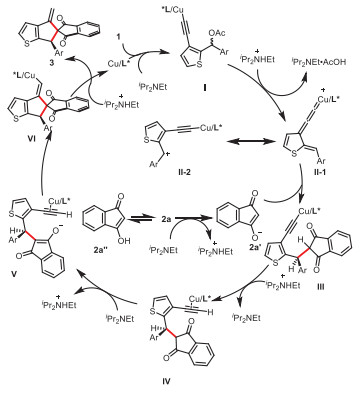
On the basis of these mechanistic studies, a plausible catalytic cycle for the copper-catalyzed asymmetric [4 + 1] cyclization is proposed (Scheme 4). The catalytic cycle is initiated by activation of the terminal alkyne of substrate 1 by the chiral copper catalyst, generating a copper acetylide species Ⅰ. Subsequent elimination of the acetate leaving group leads to the formation of a copper-vinylallenylidene intermediate Ⅱ, which is in resonance with a copper-acetylide species. The in situ generated enolate 2 then undergoes nucleophilic addition preferentially at the ε-position of the copper-vinylallenylidene intermediate. The resulting intermediate Ⅲ is subsequently protonated and demetalated to furnish intermediate Ⅳ [74]. Thereafter, coordination of the copper catalyst promotes an intramolecular Conia-ene cyclization via intermediate Ⅴ, delivering intermediate Ⅵ. Final protonation and demetalation afford the spirocyclic product 3, while simultaneously regenerating the chiral copper catalyst to complete the catalytic cycle.
In summary, we have developed a copper-catalyzed enantioselective [4 + 1] annulation of yne-thienyl esters with 1,3-dicarbonyl compounds via remote stereocontrol, enabling efficient access to highly enantioenriched spirocyclic architectures in good yields (up to 98%) and excellent enantioselectivities (up to 98% ee). This work overcomes a longstanding challenge associated with yne-thienyl esters as C4 synthons and expands the synthetic utility of copper-allenylidene chemistry. Further studies along these lines are currently underway in our laboratory.
Xiao-Kang Dai: Writing – original draft, Validation, Methodology, Investigation, Data curation. Jia-Xin Xiong: Data curation. Zheng-Yan Wang: Data curation. Hao-Dong Qian: Validation. Jing Zhao: Validation, Investigation. Shaolin Zhou: Supervision. Hao Xu: Writing – review & editing, Validation, Supervision, Project administration, Investigation, Funding acquisition.
The authors declare that they have no known competing financial interests or personal relationships that could have appeared to influence the work reported in this paper.
The authors acknowledge financial support from the National Key Research and Development Program of China (No. 2024YFD1701700), the National Natural Science Foundation of China (No. 22471088) and the Fundamental Research Funds for the Central Universities (No. CCNU24JCPT013).
Supplementary material associated with this article can be found, in the online version, at doi:
Y. Miyake, S. Uemura, Y. Nishibayashi, ChemCatChem 1 (2009) 342–356. doi: 10.1002/cctc.200900214
C.H. Ding, X.L. Hou, Chem. Rev. 111 (2011) 1914–1937. doi: 10.1021/cr100284m
Y. Nishibayashi, Synthesis 2012 (2012) 489–503. doi: 10.1055/s-0031-1290158
X.P. Hu, X.H. Hu, Z.T. Liu, et al., Synthesis 47 (2015) 913–923. doi: 10.1055/s-0034-1379968
X. Bi, L. Zhang, G. Fang, et al., Synthesis 47 (2015) 2317–2346. doi: 10.1055/s-0034-1378852
C. Cordier, A. Adeleke, A. Brown, et al., Synthesis 49 (2017) 790–801. doi: 10.1055/s-0036-1588405
S.W. Roh, K. Choi, C. Lee, Chem. Rev. 119 (2019) 4293–4356. doi: 10.1021/acs.chemrev.8b00568
D.Y. Zhang, L. Shao, J. Xu, et al., ACS Catal. 5 (2015) 5026–5030. doi: 10.1021/acscatal.5b01283
L. Shao, Y.H. Wang, D.Y. Zhang, et al., Angew. Chem. Int. Ed. 55 (2016) 5014–5018. doi: 10.1002/anie.201510793
Z.T. Liu, Y.H. Wang, F.L. Zhu, et al., Org. Lett. 18 (2016) 1190–1193. doi: 10.1021/acs.orglett.6b00322
H. Chen, X. Lu, X. Xia, et al., Org. Lett. 20 (2018) 1760–1763. doi: 10.1021/acs.orglett.8b00253
F.L. Zhu, Y.H. Wang, D.Y. Zhang, et al., Angew. Chem. Int. Ed. 53 (2014) 10223–10227. doi: 10.1002/anie.201405857
L. Li, X.S. Chen, X.P. Hu, Org. Lett. 24 (2022) 5433–5438. doi: 10.1021/acs.orglett.2c02155
S. Niu, Y. Luo, C. Xu, et al., ACS Catal. 12 (2022) 6840–6850. doi: 10.1021/acscatal.2c00911
H.H. Kong, C. Zhu, S. Deng, et al., J. Am. Chem. Soc. 144 (2022) 21347–21355. doi: 10.1021/jacs.2c09572
R. Zhao, S. Deng, R. Huang, et al., ACS Catal. 14 (2024) 9254–9264. doi: 10.1021/acscatal.4c01756
G. Xu, C. Zhu, X. Li, et al., Chin. Chem. Lett. 36 (2025) 110114. doi: 10.1016/j.cclet.2024.110114
X. Li, J.X. Guo, J. Zhang, et al., ACS Catal. 14 (2024) 9244–9253. doi: 10.1021/acscatal.4c01563
M.D. Li, Z.-H. Wang, H. Zhu, et al., Angew. Chem. Int. Ed. 62 (2023) e202313911. doi: 10.1002/anie.202313911
D. Luo, S. Niu, F. Gong, et al., ACS Catal. 14 (2024) 2746–2757. doi: 10.1021/acscatal.3c06146
Z.H. Li, H.D. Zeng, H.Y. Lu, et al., Sci. China Chem. (2026), doi: 10.1007/s11426-025-3163-5.
T.Y. Lin, M.D. Li, R. Wang, et al., Org. Lett. 26 (2024) 5758–5763. doi: 10.1021/acs.orglett.4c01916
X.R. Wang, M.D. Li, Z.H. Wang, et al., Org. Lett. 26 (2024) 6407–6412. doi: 10.1021/acs.orglett.4c02199
H. Zhu, M. Shen, Z.H. Wang, et al., ACS Catal. 15 (2025) 2415–2423. doi: 10.1021/acscatal.4c07043
Z.H. Wang, R.X. Liu, Y.X. Liu, et al., Org. Lett. 28 (2026) 1412–1417. doi: 10.1021/acs.orglett.5c05274
T. Yin, C. Zhao, C. Yao, et al., Org. Lett. 26 (2024) 5961–5965. doi: 10.1021/acs.orglett.4c02012
R. Huang, Y. Lu, F. Xu, et al., Sci. China Chem. 68 (2025) 3595–3601. doi: 10.1007/s11426-024-2475-3
C. Yao, K. Feng, Y. Lu, et al., Org. Lett. 27 (2025) 9078–9082. doi: 10.1021/acs.orglett.5c02805
C. Yao, D.R. Li, H.M. Xiang, et al., Nat. Commun. 15 (2024) 6848. doi: 10.1038/s41467-024-50896-8
Z. Ge, C. Zhu, G. Xu, et al., Org. Lett. 27 (2025) 5632–5636. doi: 10.1021/acs.orglett.5c01316
H.D. Qian, X. Li, T. Yin, et al., Sci. China Chem. 67 (2024) 1175–1180. doi: 10.1007/s11426-023-1922-5
X. Li, H.D. Qian, X. Qiao, et al., Org. Chem. Front. 11 (2024) 3962–3967. doi: 10.1039/d4qo00602j
Y.Z. Sun, Z.Y. Ren, Y.X. Yang, et al., Angew. Chem. Int. Ed. 62 (2023) e202314517. doi: 10.1002/anie.202314517
Z.T. He, Y.Z. Sun, G.Q. Lin, Synlett 36 (2025) 82–86. doi: 10.1055/a-2294-5395
M.Y. Teng, Y. Xu, X.Q. Zhu, et al., Chin. J. Chem. 42 (2024) 3469–3483. doi: 10.1002/cjoc.202400607
C.M. Chen, Y.Z. Kong, P.C. Qian, et al., Sci. Sin. Chem. 53 (2023) 1377–1388. doi: 10.1360/ssc-2023-0060
H.H. Li, Y.P. Zhang, T.Y. Zhai, et al., Org. Chem. Front. 9 (2022) 3709–3717. doi: 10.1039/d2qo00685e
C. Zhu, Y. Ding, L.W. Ye, Org. Biomol. Chem. 13 (2015) 2530–2536. doi: 10.1039/C4OB02556C
J.R. Chen, X.Q. Hu, L.Q. Lu, et al., Chem. Rev. 115 (2015) 5301–5365. doi: 10.1021/cr5006974
J.S. Ma, H.Y. Lu, Y.W. Chen, et al., Nat. Synth. 2 (2023) 37–48.
H.Y. Lu, Z.H. Li, G.Q. Lin, et al., Chem. Commun. 60 (2024) 4210–4213. doi: 10.1039/d4cc00371c
Z.H. Li, J.S. Ma, H.Y. Lu, et al., ACS Catal. 14 (2024) 11646–11656. doi: 10.1021/acscatal.4c02333
Y.X. Yang, Y.F. Wang, G.Q. Lin, et al., ACS Catal. 15 (2025) 10030–10038. doi: 10.1021/acscatal.5c01798
C. Xu, H. Zhang, S. Lan, et al., Angew. Chem. Int. Ed. 62 (2023) e202219064. doi: 10.1002/anie.202219064
S. Lan, Q. Cui, D. Luo, et al., J. Am. Chem. Soc. 147 (2025) 1172–1185. doi: 10.1021/jacs.4c14944
S. Li, Q.W. Gong, Y.T.C. Lam, et al., Angew. Chem. Int. Ed. 64 (2025) e202519335. doi: 10.1002/anie.202519335
Z. Li, D. Li, H. Xiang, et al., Chin. Chem. Lett. 33 (2022) 867–870.
J. Huang, H.H. Kong, S.J. Li, et al., Chem. Commun. 57 (2021) 4674–4677. doi: 10.1039/d1cc00663k
H.D. Qian, Z.H. Li, S. Deng, et al., J. Am. Chem. Soc. 144 (2022) 15779–15785. doi: 10.1021/jacs.2c06560
Z.Q. Geng, C. Zhao, H.D. Qian, et al., Org. Lett. 25 (2023) 4504–4509. doi: 10.1021/acs.orglett.3c01524
R. Zhao, Z. Wang, T. Fang, et al., Org. Chem. Front. 12 (2025) 5511–5518. doi: 10.1039/d5qo00595g
Z. Ge, S.N. Guan, H. Xu, Org. Lett. 27 (2025) 13974–13979. doi: 10.1021/acs.orglett.5c04559
F.L. Zhu, Y. Zou, D.Y. Zhang, et al., Angew. Chem. Int. Ed. 53 (2014) 1410–1414. doi: 10.1002/anie.201309182
Y. Senda, K. Nakajima, Y. Nishibayashi, Angew. Chem. Int. Ed. 54 (2015) 4060–4064. doi: 10.1002/anie.201411601
Z. Zhang, Y. Sun, Y. Gong, et al., Nat. Chem. 16 (2024) 521–532. doi: 10.1038/s41557-024-01479-z
J. Li, M. Liao, H. Zhu, et al., J. Org. Chem. 89 (2024) 12935–12945. doi: 10.1021/acs.joc.4c00853
H. Zhu, L. Xu, B. Zhu, et al., Org. Lett. 25 (2023) 9213–9218. doi: 10.1021/acs.orglett.3c03871
M. Liao, J. Li, H. Zhu, et al., Org. Lett. 27 (2025) 4836–4841. doi: 10.1021/acs.orglett.5c00700
Y. Lan, P. Liu, Z. Fang, et al., Org. Chem. Front. 11 (2024) 6319–6326. doi: 10.1039/d4qo01368a
W. Shao, H. Li, C. Liu, et al., Angew. Chem. Int. Ed. 54 (2015) 7684–7687. doi: 10.1002/anie.201503042
L. Shen, T. Qin, C. Jiao, et al., Angew. Chem. Int. Ed. 64 (2025) e202423405. doi: 10.1002/anie.202423405
Q. Wang, T.R. Li, L.Q. Lu, et al., J. Am. Chem. Soc. 138 (2016) 8360–8363. doi: 10.1021/jacs.6b04414
K. Zhang, L.Q. Lu, S. Yao, et al., J. Am. Chem. Soc. 139 (2017) 12847–12854. doi: 10.1021/jacs.7b08207
R.Q. Wang, C. Shen, X. Cheng, et al., Chem. Commun. 58 (2022) 8552–8555. doi: 10.1039/d2cc01695h
B.C. Wang, T. Fan, F.Y. Xiong, et al., J. Am. Chem. Soc. 144 (2022) 19932–19941. doi: 10.1021/jacs.2c08090
Z.J. Zhang, L. Zhang, R.L. Geng, et al., Angew. Chem. Int. Ed. 58 (2019) 12190–12194. doi: 10.1002/anie.201907188
W. Guo, L. Zuo, M. Cui, et al., J. Am. Chem. Soc. 143 (2021) 7629–7634. doi: 10.1021/jacs.1c03182
R.Z. Li, D.Q. Liu, D. Niu, Nat. Catal. 3 (2020) 672–680. doi: 10.1038/s41929-020-0462-9
Z. Li, K. Huang, Z. Cen, et al., Org. Lett. 27 (2025) 8650–8655. doi: 10.1021/acs.orglett.5c02590
Q. Liu, J. Zheng, X. Zhang, et al., Nat. Commun. 13 (2022) 3302. doi: 10.1038/s41467-022-30655-3
C. Sheng, Z. Ling, Y. Luo, et al., Nat. Commun. 13 (2022) 400.
T. Wang, Y. You, Z.H. Wang, et al., Org. Lett. 25 (2023) 1274–1279. doi: 10.1021/acs.orglett.3c00075
J. Zhang, T. Ni, W.L. Yang, et al., Org. Lett. 22 (2020) 4547–4552. doi: 10.1021/acs.orglett.0c01594
E.Z. Lin, Y. Xu, K. Ji, et al., Chin. Chem. Lett. 32 (2021) 954–962. doi: 10.1016/j.cclet.2020.08.012

Scheme 2 Scope of yne-thienyl esters and 1,3-dicarbonyls. Standard reaction conditions: 1 (1.5 equiv.), 2 (0.20 mmol), CuCl2 (10 mol%), L9 (12 mol%), DIPEA (1.5 equiv.), MeOH (2.0 mL), N2, 25 ℃ for 12 h. a CuCl2 (20 mol%), L9 (22 mol%). b 1 (0.2 mmol), 2 (1.5 equiv.).
Table 1. Optimization of reaction conditions.a
| |||||
| Entry | 1 | L | [Cu] | Yield (%)b | ee (%)c |
| 1 | 1a | L1 | CuI | 32 | 22 |
| 2 | 1a | L2 | CuI | 24 | −8 |
| 3 | 1a | L3 | CuI | 15 | 34 |
| 4d | 1a | L4 | CuI | 22 | 66 |
| 5d | 1a | L5 | CuI | 31 | 74 |
| 6d | 1a | L6 | CuI | 23 | 60 |
| 7 | 1a | L7 | CuI | 34 | 72 |
| 8 | 1a | L8 | CuI | 37 | 52 |
| 9 | 1a | L9 | CuI | 40 | 84 |
| 10 | 1b | L9 | CuI | 18 | 90 |
| 11d | 1c | L9 | CuI | 45 | 56 |
| 12 | 1d | L9 | CuI | 12 | 91 |
| 13e | 1d | L9 | CuI | 57 | 92 |
| 14e | 1d | L9 | CuCl | 64 | 91 |
| 15e | 1d | L9 | CuOTf | 59 | 92 |
| 16e | 1d | L9 | CuCl2 | 61 | 92 |
| 17e, f | 1d | L9 | CuCl2 | 70 | 93 |
| a Reaction conditions: 1 (0.20 mmol), 2a (0.40 mmol), copper salt (10 mol%), L (12 mol%) and DIPEA (1.5 equiv.) in MeOH (2.0 mL) at 25 ℃ under N 2 atmosphere for 24 h. b Isolated yield. c The ee values were determined by HPLC. d 1 (0.15 mmol), 2a (0.30 mmol). e 1 (0.30 mmol), 2a (0.20 mmol). f Reaction was performed for 12 h. | |||||
 下载: 导出CSV

 扫一扫看文章


扫一扫关注我们


 下载:
下载: