Key Laboratory of Functional Inorganic Material Chemistry (MOE), School of Chemistry and Materials Science, Heilongjiang University, Harbin 150080, China
b.
Key Laboratory of Opto-Electronic Technology and Intelligent Control (Ministry of Education), Lanzhou Jiaotong University, Lanzhou 730070, China
c.
Key Laboratory of Hexi Corridor Resources Utilization of Gansu, Hexi University, Zhangye 734000, China
chemagh@163.com (G. An). 1 These authors contributed equally to this work.
Received Date:
03 January 2026 Accepted Date:
30 April 2026 Revised Date:
23 April 2026 Available Online:
12 January 2027
Abstract:
The site-selective functionalization of C(sp2)−H bonds has emerged as powerful tools for molecular synthesis. The challenge in the field is to achieve different site selectivity reverse to electron-controlled electrophilic substitution under mild conditions. Herein, we report a mild Ru-catalyzed meta-selective C(sp2)−H alkylation of aniline derivatives. Mechanistic studies revealed a distinct Ru catalytic species ligated by two κ2-bound aminopyrimidine in an octahedral geometry. This ruthenium species is generated from dissociation of p-cymene to trigger the metallaphotoredox catalysis.
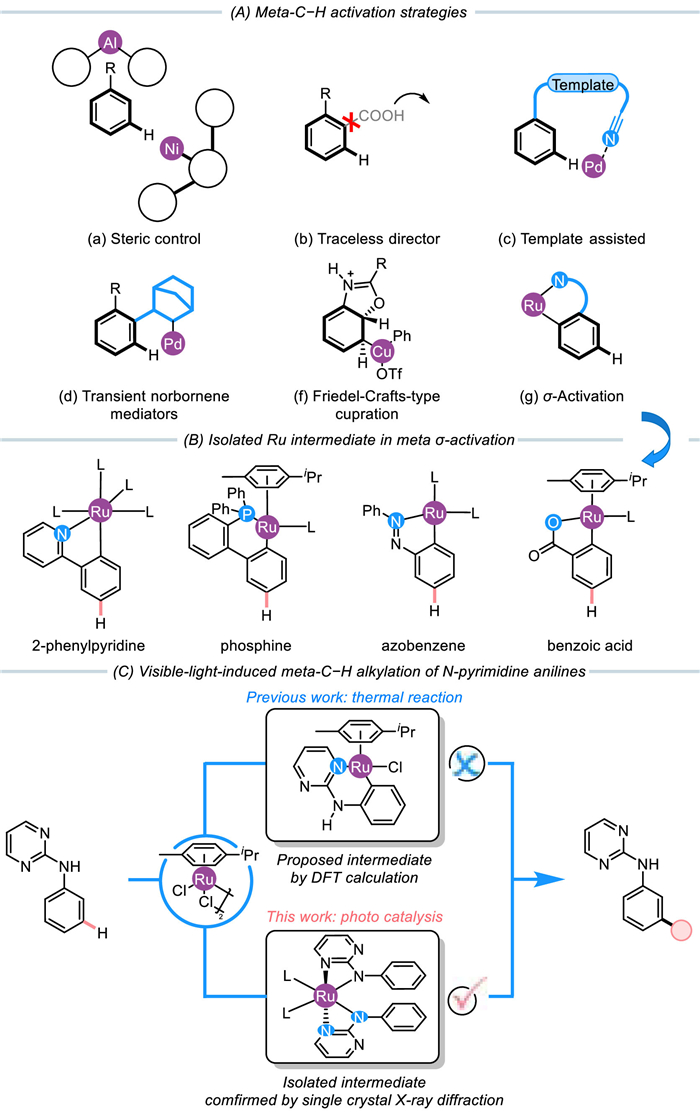
The development of C(sp2)−H bond functionalization in arenes has attracted intensive interest owing to the ubiquitous existence of aryl groups in natural products, pharmaceuticals, and materials [1-4]. One of the challenges in these aspects is to achieve different site selectivity reverse to electron-controlled electrophilic substitution [5-7]. Electron rich arenes, particularly anilines and N-protected anilines, are prevalent in organic synthesis, pharmaceuticals, and materials science [8-10]. However, their high electron density leads to fast ortho- and para-functionalization and the subtle differences of meta-C(sp2)−H bonds over their ortho-, and para-counterparts pose significant challenges to achieve meta-selectivity [11,12]. To address this issue, several elegant approaches were developed (Scheme 1A). Nakao and coworkers achieved meta-selectivity through the regulation of steric repulsion among substrates, bulky Lewis acid and metal catalyst with bulky ligands [13]. The groups of Larrosa and Su developed traceless director strategy via in situ decarboxylation mediated by silver salts [14-17]. Yu, Maiti and others disclosed template assisted meta-C—H functionalization of anilides, hydrocinnamic acids and biphenyls [18-21]. Yu and Fernández-Ibáñez reported meta-C—H functionalization using transient norbornene mediators [22-25]. Gaunt and coworkers devised an electrophilic meta-arylation of anilines and phenols via Friedel-Crafts-type cupration using the hypervalent iodine compounds (Ph2IOTf) [26-29]. Frost, Ackermann and others also established meta-C—H functionalization of aniline and phenol derivatives via Ru catalyzed σ-activation [30-35]. Despite the great advances, these protocols normally required elevated reaction temperatures together with stoichiometric metal salts or oxidants, which resulted in low functional group tolerance and hampered the application in late-stage functionalization of complex molecules. Conversely, mild and redox neutral meta-C—H functionalization of electron rich arenes remains elusive.
Scheme 1
Scheme 1.Meta-C—H activation strategies and isolated Ru intermediate in σ-activation. (A) Meta-C—H activation strategies. (B) Isolated Ru intermediate in meta σ-activation. (C) Visible-light-induced meta-C—H alkylation of N-pyrimidine anilines.
Visible-light-mediated photoredox catalysis has emerged as a powerful tool to achieve mild synthesis and redox neutral conditions [36-49]. The success in transitioning thermal regimes of Ru-catalyzed σ-activation to photo-induced conditions positions this strategy as a compelling solution to address the aforementioned challenges [50-54]. The thermal and photo-induced σ-activations normally proceed through similar Ru catalytic species. Thus, to develop σ-activation system for mild visible-light-mediated meta-C—H functionalization, the important Ru intermediates under thermal conditions are summarized and analyzed (Scheme 1B). These thermal reactions proceed predominantly through ortho-cyclometalated ruthenacycle intermediates featuring Ru−C σ-bonds [55-57]. The intermediates in Scheme 1B were confirmed by isolation of the complexes, followed by single crystal X-ray diffraction. In these examples, most substrates such as 2-phenylpyridines, azobenzenes, phosphines and benzoic acids, are electron-deficient arenes with rigid structures, which resulted in facile formation of ruthenacycle intermediates.
However, electron rich substrate, N-phenylpyrimidin-2-amine, is a flexible ligand, leading to the difficulty in isolation of Ru catalytic species. Therefore, the intermediates for meta- and para-selective C—H functionalization of 2-anilinopyrimidine were hypothetically proposed in pioneer thermal reactions [30,58,59]. Similar to the electron-deficient arenes, an ortho-cyclometalated ruthenacycle intermediate was proposed for its meta-C—H alkylation with support by DFT calculation. Notably, these Ru intermediates were not prepared or isolated, which prevents deeper mechanism investigation to develop the mild meta-C—H functionalization. Thus, preparation of these proposed and authentic Ru species and extensive investigation of their catalytic and photoredox properties would be highly demanding.
Herein, we disclosed the preparation of series of Ru-aminopyrimidine complexes (Scheme 1C). Their stoichiometric and catalytic experiments revealed that the photocatalytic process proceeds through a distinct Ru-substrate coordination mode in stark contrast to cycloruthenated intermediates of conventional thermal activation pathways [58]. Based on this catalytic mode, a photoredox catalytic system was developed, enabling the late-stage functionalization of natural products and drugs.
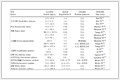
We initiated our investigation with the photocatalytic meta-alkylation of C(sp2)−H bonds using aniline derivative (1a) and alkyl halide (2a) as model substrates (Table 1 and Tables S1-S10 in Supporting information). A key challenge for this design is the requirement to control regioselectivity among the ortho-, meta- and para-positions of the benzene ring and the Minisci reaction-driven C-5 position of the pyrimidine ring. Gratifyingly, through the optimization campaign, we obtained the expected product 3a with a yield of 64% in the presence of [RuCl2(p-cymene)]2 as the photocatalyst, PivOH, KOAc and 4 Å MS as the additives (Table 1, entry 1). No product was detected in the absence of [RuCl2(p-cymene)]2, indicating its essential role (Table 1, entry 2). The reaction vanished in the absence of either light or Ar, indicating it might be a light enabled radical process (Table 1, entry 3). Replacing [RuCl2(p-cymene)]2 with other Ru catalysts led to decreased yields and regioselectivity (Table 1, entries 4 and 5) (see Table S1 in Supporting information for details). Notably, RuCl2(DMSO)4, in which ruthenium does not coordinate with arene, also afforded meta-alkylation product, suggesting ruthenium complexes without p-cymene would be catalytic species (Table 1, entry 5). Examination of the acids and bases resulted in decreased yields, which confirms their roles as pH regulators (Table 1, entries 6–9) (see Tables S2-S5 for details). Further screening of the solvents and temperature shows that 1,4-dioxane and 60 ℃ is the best choice (Table 1, entries 10 and 11) (see Tables S6 and S7 for details). Moreover, replacing blue LEDs with irradiation at 390, 420 or 450 nm resulted in decreased yields (Table 1, entries 12–14) (see Table S10 for details).
Table 1
Table 1.
Optimization of the reaction conditions.a
4Å MS = 4Å molecular sieves, PivOH = pivalic acid, 1-AdCOOH = 1-adamantanecarboxylic acid, N-Piv-Val-OH = N-pivaloyl-L-valine, MesCOOH = 2,4,6-trimethylbenzoic acid, TBME = tert–butyl methyl ether; Blue LEDs: 100 W Keloray® Aquarium Light AO100 Series. a Standard conditions: 1a (0.2 mmol, 1.0 equiv.), 2a (3.0 equiv.), [RuCl2(p-cymene)]2 (10 mol%), PivOH (0.5 equiv.), KOAc (2.0 equiv.), 4 Å MS (0.15 g), 1,4-dioxane (1.0 mL), blue LEDs, 60 ℃, 8 h, Ar. b Isolated yields.
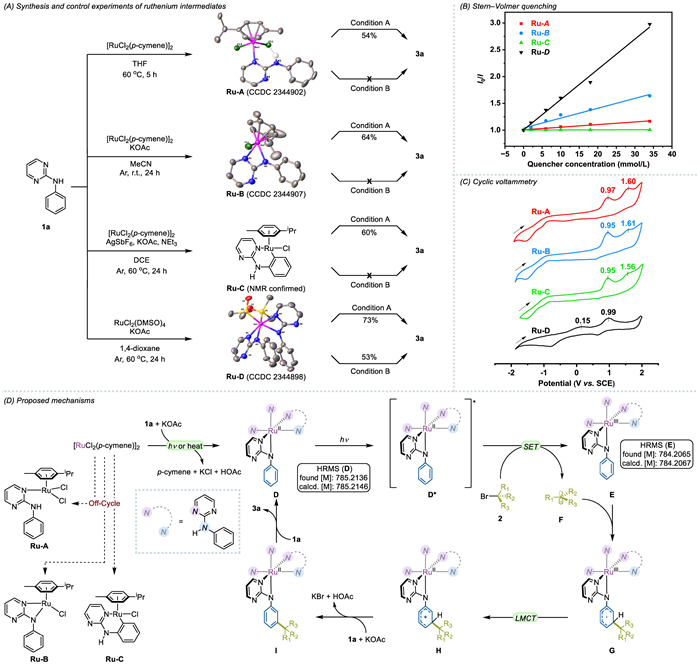
To gain the insight of the mechanism, a series of investigation was carried out. Radical inhibition experiments with the radical scavengers, including (2,2,6,6-tetramethylpiperidin-1-yl)oxyl (TEMPO) and 1,1-diphenylethylene, resulted in complete inhibition of alkylation with the formation of radical adduct 5, indicating the involvement of an alkyl radical (see Section 5.1 in Supporting information for details). To fulfill our goal in clarification of catalytic species in the protocol, four unreported ruthenium complexes, Ru-A, Ru-B, Ru-C and Ru-D, were prepared (Scheme 2A). The structural characterizations of Ru-A (CCDC No. 2344902), Ru-B (CCDC No. 2344907) and Ru-D (CCDC No. 2344898) were confirmed by single-crystal X-ray diffraction. Ru-C was fully characterized by NMR spectroscopy, owing to its recalcitrance to crystallization and pronounced thermal lability. Ru-A, Ru-B and Ru-D are Ru-substrate complex with Ru−N bonds. Ru-B and Ru-D are ligated by one and two κ2-bound aminopyrimidine ligands, respectively. In contrast, Ru-C was a ruthenacycle organometallic compound. Notably, Ru-B and Ru-C were proposed by Frost [58] and accepted widely [30,59-62] as the catalytic species in para-alkylation and meta-alkylation, respectively. Despite their comparable catalytic efficiency in catalytic experiments (Scheme 2A, condition A), the stoichiometric reactions vanished using Ru-A, Ru-B, or Ru-C as substrates (Scheme 2A, condition B). This result excludes previously proposed Ru-B and Ru-C together with Ru-A from being catalytic species in the photo-induced meta-alkylation. Intriguingly, Ru-D, a bis-substrate complex without p-cymene, enabled product formation under similar stoichiometric conditions, indicating its role as catalytic species in catalytic cycle.
Scheme 2
Scheme 2.
Mechanistic investigations. (A) Synthesis and control experiments of ruthenium intermediates. (B) Stern–Volmer quenching. (C) Cyclic voltammetry. (D) Proposed mechanisms. Condition A (Catalytic): 1a (0.2 mmol, 1.0 equiv.), 2a (3.0 equiv.), Ru-A−Ru-D (20 mol%), PivOH (0.5 equiv.), KOAc (2.0 equiv.), 4 Å MS (0.15 g), 1,4-dioxane (1.0 mL), blue LEDs, 60 ℃, 8 h, Ar; Condition B (Stoichiometric): Ru-A−Ru-D (0.2 mmol, 1.0 equiv.), 2a (3.0 equiv.), PivOH (0.5 equiv.), KOAc (2.0 equiv.), 4 Å MS (0.15 g), 1,4-dioxane (1.0 mL), blue LEDs, 60 ℃, 8 h, Ar.
In Stern-Volmer experiments, Ru-D also demonstrated higher efficiency than other complexes (Scheme 2B). Furthermore, cyclic voltammetry measurements revealed superior redox activity of Ru-D (Scheme 2C). Combined experimental evidence definitively establishes Ru-D as the photocatalytic species which is distinct from its proposed thermal version Ru-C [58]. Additionally, monitoring the reaction by GC–MS showed that a significant amount of free p-cymene was observed by dissociation from [RuCl2(p-cymene)]2 (see Section 5.9 in Supporting information for details), also confirming the formation of Ru-D type complex. As DMSO is not present in the reaction system, the ligand DMSO in Ru-D would be replaced by other ligands such as solvents or even aniline 1a in the real reaction system. Thus, HRMS of reaction mixture was taken and analyzed. D with two 1a to replace DMSO was detected together with its Ru(Ⅲ) species E, generated via oxidation of D (Scheme 2D). These results confirmed the real structure of intermediates D and E, and clarified the structure of subsequent intermediates such as G, H and I.
As Ru-D type complex was considered as catalytic species for photoredox catalysis, we also evaluated its possible role in thermal reactions. Ru-D complex was employed as a substrate to react under standard condition at 60, 90, or 120 ℃ with light irradiation (Table 2). The reaction vanished at 60 ℃ (entry 1), whereas a 22% yield of product was formed at 90 ℃ (entry 2). At 120 ℃, the yield of Ru-D reached 61% (entry 3), which is nearly identical to the yield obtained under the meta-thermal reaction conditions reported by Prof. Frost [58]. Thus, Ru-D is further employed as a substrate under Prof. Frost's reaction condition (entry 4) [58], affording the product with a yield of 56%. Based on these results, we speculate that Ru-D complex is the competing catalytic species in thermal reaction.
Table 2
Table 2.Ru-D as substrate under thermal conditions.a
Based on these mechanistic studies and previous reports [30,51,53,54,63-78], we have proposed a plausible catalytic cycle (Scheme 2D). Coupled with the dissociation of p-cymene, the catalytic process commences with a base-assisted N—H deprotonation leading to the formation of catalytic species D. Upon visible-light irradiation, complex D is excited to form an excited state of D*, which reacts with 2 to generate Ru(Ⅲ) complex E and alkyl radical F. Alkyl radical F attacks the benzene ring of E to form intermediate G, which then undergoes ligand-to-metal charge transfer (LMCT) to afford intermediate H. Intermediate H undergoes elimination to rearomatize to I. Finally, ligand exchange between I and 1a releases 3a and regenerates the catalytic species D.
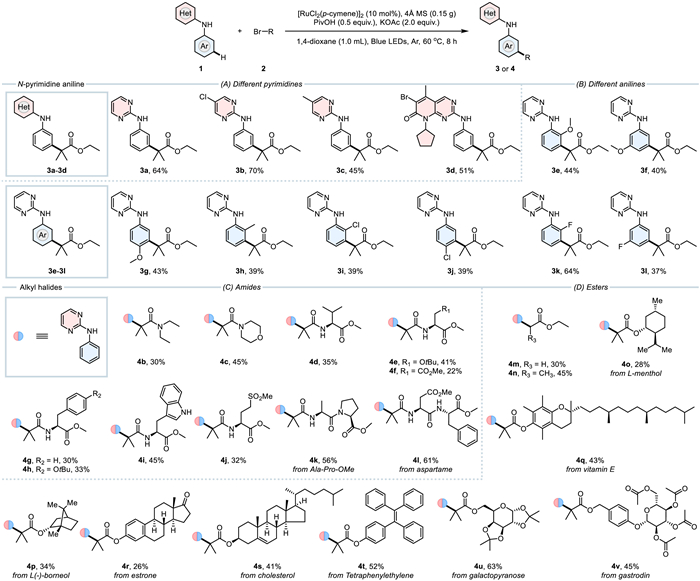
We next explored the reaction scope. Regarding the heteroaryl groups of aniline derivatives 1, pyrimidyl groups were initially tested for this meta-alkylation reaction (Scheme 3A). The presence of electron-neutral (H), electron-donating (Me) and electron-withdrawing (Cl) groups at the para-position of the pyrimidyl ring was all well tolerated, affording most of the products in good regioselectivity (3a-3c). Generally, para-electron-donating groups on the pyrimidine impaired reaction yields (3bvs.3c), probably because the enhanced acidity of N—H bond in electron-poor pyrimidine led to facile deprotonation and subsequent coordination with Ru catalyst. The alkylation was also compatible with fused heteroarene, and the derivative from the precursor of the anti-cancer drug palbociclib afforded 3d in 51% yield. Furthermore, we explored the effects of different substituents on aromatic ring of aniline (Scheme 3B). Various aniline derivatives decorated with both electron-donating (3e-3h) and electron-withdrawing (3i-3l) substituents were all suitable substrates. Alkylation of ortho-substituted substrates selectively occurred at adjacent positions of these substituents (3e, 3h, 3i and 3k). Notably, ortho-fluoro on the phenyl ring increased the yield (3k). Besides these aniline derivatives, switching pyrimidine moiety to pyridine group completely inhibited the reactivity (Scheme S1 in Supporting information). Tertiary aniline derivatives were also ineffective substrates, indicating that extra substituents on N can hinder the formation of the Ru-D complex (Scheme S1).
Scheme 3
Scheme 3.
Scope of Ru-catalyzed meta-C—H alkylation. (A) Different pyrimidines. (B) Different anilines. (C) Amides. (D) Esters.
We also evaluated the scope of α–bromo amides (Scheme 3C). Simple amides were suitable substrates for the meta-C—H alkylation process (4b, 4c). α-Bromo amides with N-terminal residues of Val (4d), Phe (4g), Ser (4e), Asp (4f) and Tyr (4h) were all amenable to afford corresponding meta-alkylated aniline derivatives. Halogenated amide with unprotected tryptophan residue was compatible without alkylation on indole moiety (4i). When the N-terminal residue was replaced by a methionine residue (Met), an alkylation reaction still occurred with oxidation of thioether (4j). Dipeptides were also compatible substrates proving the utility of this protocol (4k, 4l).
The range of α–bromo esters was also investigated (Scheme 3D). Both primary (4m) and secondary (4n) α–bromo esters were substrates. α-Bromo esters derived from terpenoid (4o, 4p), diterpene (4q), steroids (4r, 4s) and sugars (4u, 4v) were also compatible with the reaction conditions. 1,1,2,2-Tetraphenylethene as an AIE fluorophore could be introduced by this alkylation process as well to binding with N-pyrimidine anilines (4t). Notably, oxidative labile phenol ether (4q, 4r, 4t and 4v), alkenyl group (4s and 4t), α−H of carbonyl (4r) and benzyl−H (4v) and acid labile ketal moiety (4u and 4v) were maintained during the reaction, further confirming the mild nature of this protocol. These results prompted us to further conjugate drug analogue with drug active residue via this protocol. The precursor of palbociclib reacted with gastrodin derivatives to produce their conjugate 4w (Scheme 4A). Further extension of the scale of the synthesis of 3k to 10 mmol was also successful (Scheme 4B).
Scheme 4
Scheme 4.
Late-stage functionalizations. (A) The linkage of palbociclib analogue and gastrodin. (B) Large-scale meta-alkylation.
In summary, we have developed visible-light-mediated Ru-catalyzed meta-C(sp2)−H alkylation of aniline derivatives. The mild protocol tolerates diverse functional groups, enabling the late-stage functionalization. The exploration of catalytic species has been highlighted through preparation and control experiments of various previous-hypothesized complexes, including ruthenacycle complex (Ru-B and Ru-C) and Ru-substrate complexes (Ru-A and Ru-D). Importantly, we confirmed that the real catalytic Ru species is ligated by two κ2-bound aminopyrimidine in an octahedral geometry and generated from dissociation of p-cymene. This result provides the real chemical schemes for future computational investigation and further determination of the mechanism detail of this type ruthenium catalyst is undergoing.
The authors declare that they have no known competing financial interests or personal relationships that could have appeared to influence the work reported in this paper.
Acknowledgments
The authors gratefully acknowledge support from the National Natural Science Foundation of China (Nos. 22061017 and 21862006), the Science and Technology Project of Zhangye (No. ZY2024KY06), 2025 Gansu Provincial University Teachers' Innovation Fund Project (No. 2025A-184), and the University Nursing Program for Young Scholars with Creative Talents in Heilongjiang Province (No. UNPYSCT-2017124). The authors thank Dr. Wei-Qiu Liang and Yun-Long Bao for the kind support in recording the NMR spectra, Dr. Jia-Qi Wang and You-Ming Dong for the kind support in cyclic voltammetry, and Dr. Li-Ye Liang for the kind support in crystal analysis.
Supplementary materials
Supplementary material associated with this article can be found, in the online version, at doi:10.1016/j.cclet.2026.112869.
[1]
T. Rogge, N. Kaplaneris, L. Ackermann, et al., Nat. Rev. Methods Prim. 1 (2021) 43. doi: 10.1038/s43586-021-00041-2
[2]
J. Grover, A.C. Bissember, D. Maiti, et al., Chem. Soc. Rev. 54 (2024) 2006–2053.
[3]
L. Guillemard, N. Kaplaneris, L. Ackermann, M.J. Johansson, Nat. Rev. Chem. 5 (2021) 522–545. doi: 10.1038/s41570-021-00300-6
[4]
U. Dutta, S. Maiti, T. Bhattacharya, D. Maiti, Science 372 (2021) eabd5992. doi: 10.1126/science.abd5992


 DownLoad:




 下载:


 下载:

