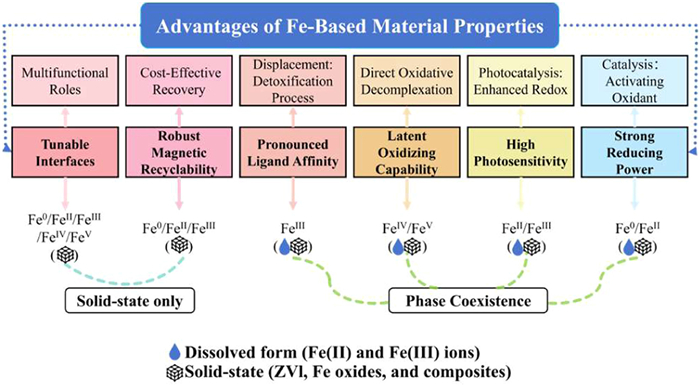
Figure 1.
Advantages of Fe-based material properties for HMCs removal.

From atomic to ecosystems: Multi-mechanism orchestration of iron-based materials for heavy metal complexes remediation and resource recovery
Mingjia Xu , Shuo Wang , Junjie Chen , Qizhan Zhang , Xuedong Du , Qingrui Zhang


Heavy metal contamination poses a severe and persistent threat to global water security, ecosystems, and human health, primarily due to the toxicity, carcinogenicity, and bioaccumulation potential of metal ions [1,2]. Sources of such pollution are extensive, with primary anthropogenic activities including mining, smelting, electroplating, chemical manufacturing, and electronic waste dismantling [3]. In authentic aquatic environments, heavy metal ions (HMIs) frequently react with coexisting ligands such as industrial chelating agents (e.g., ethylenediaminetetraacetic acid (EDTA), nitrilotriacetic acid (NTA), diethylenetriaminepentaacetic acid (DTPA)) and natural organic matter (NOM), forming heavy metal complexes (HMCs) [4,5]. Characterized by strong metal-ligand coordination (e.g., Cu(Ⅱ)-tartrate logK = 6.51 and Cu(Ⅱ)-EDTA logK = 18.70), large molecular size, high solubility across a broad pH range, and exceptional thermodynamic stability, HMCs exhibit remarkable resistance to conventional water treatment technologies such as precipitation, adsorption, and biological processes [6-8]. Unlike free HMIs, HMCs maintain mobility and bioavailability even under conditions typically conducive to metal precipitation. They pose persistent and severe multi-level risks to ecosystem structure and function and human health through bioaccumulation and potential transformation into more toxic species [9,10]. For instance, recent research has reported that EDTA significantly increases the lethality of Cu2+ toward human hepatocellular carcinoma cells, revealing a ligand-mediated mechanism for enhanced metal toxicity [11]. Consequently, HMCs are regarded as highly challenging environmental pollutants, demanding innovative technologies not only for removal but also for resource recovery. Addressing the specific challenges posed by HMCs, particularly their extreme stability and resistance to conventional methods, requires approaches capable of disrupting strong metal-ligand bonds and overcoming solubility barriers [12].
Iron (Fe)-based materials emerge as a highly promising platform for tackling these specific HMCs challenges, leveraging their intrinsic multi-valent nature (Fe0/Fe2+/Fe3+/Fe4+), tunable surface chemistry, and versatile redox activity [13-15]. This inherent multi-valent nature is key to their ability to orchestrate multiple complementary mechanisms specifically suited for destabilizing persistent HMCs and enabling resource recovery: (1) Potent reducing capacity enables activation of oxidants (such as hydrogen peroxide (H2O2), persulfate (PS), ozone (O3)) to generate reactive species (RS) for decomplexation in advanced oxidation processes (AOPs) [16,17]; (2) potential oxidation is achieved via high-valent Fe species (Fe(Ⅳ)/Fe(Ⅴ)) [18]; (3) pronounced ligand affinity allows Fe(Ⅲ) to displace less stable metals within complexes [19]; (4) excellent photosensitivity promotes ligand-to-metal charge transfer (LMCT) under ultraviolet (UV) light irradiation for self-decomplexation [20,21]; (5) tunable interfaces permit precise reactivity design through surface engineering [22,23]; and (6) robust magnetic recoverability facilitates sustainable operation [24]. This multi-mechanism orchestration empowers Fe-based materials to function efficiently as catalysts, adsorbents, complexing agents, and flocculants, bridging the gap from atomic-scale bond cleavage to macroscopic water purification and resource recovery by directly countering the core stability mechanisms of HMCs [25-27].
Although numerous reviews have discussed Fe-based materials for environmental remediation, most have focused either on the removal of free HMIs or the degradation of organic pollutants. For instance, Yan et al. reviewed the potential of nonmetal-modified zero-valent iron (ZVI) for treating water contaminated by HMIs or halogenated organics, with a focus on enhanced electron utilization and selectivity, but did not address coexisting HMIs and organic ligands [28]. Similarly, while many reports detail the catalytic performance of various Fe-based catalysts in different AOPs systems, their target pollutants are primarily organic contaminants such as pesticides, antibiotics, and endocrine-disrupting chemicals [29,30]. Although Zhang’s group reviewed the principles, advantages, and challenges of five typical AOPs for removing HMCs, their analysis lacked a thorough examination of the catalysts [31]. Consequently, a critical gap persists: the absence of a systematic and in-depth analysis dedicated specifically to Fe-based material-enabled HMCs removal and resource recovery. This is particularly evident in the absence of comprehensive integration of atomic-scale mechanistic insights, systematic summarization of performance-enhancing engineering strategies, and holistic assessment of practical application challenges. Given the unique challenges posed by HMCs compared to free HMIs or single organic pollutants, addressing this gap is essential for advancing sustainable remediation strategies.
Therefore, this review aims to consolidate recent advances and deepen mechanistic understanding in the use of Fe-based materials for HMCs remediation and HMIs resource recovery, adopting a cross-scale perspective “from atomic interactions to ecosystem applications”. We first elucidate the atomic-scale origins of HMCs persistence and the multifunctional roles of Fe-based materials. We then systematically dissect key removal mechanisms, including adsorption, oxidative cleavage, reductive dissociation, Fe-driven displacement, and integrated “one-stop” processes, highlighting how multi-mechanism orchestration enhances decomplexation efficiency. Advanced engineering strategies such as atomic-level surface modification, heterometallic synergy, confinement architectures, and field-assisted intensification are examined to overcome material limitations and boost performance. Furthermore, we evaluate the robustness and economic feasibility of these technologies using real industrial wastewater case studies, addressing practical challenges in scaling from laboratory to field applications. By tightly coupling atomic-scale insights with system-level performance and circular economy principles, this review provides a comprehensive scientific foundation and a forward-looking technological roadmap for advancing sustainable HMCs management and resource recovery.
The HMCs pose a significant challenge as persistent industrial pollutants due to their unique coordination structures, which confer exceptional thermodynamic stability, high solubility across pH ranges, and large molecular sizes, rendering them highly resistant to conventional water treatment methods. This stability originates from specific metal-ligand binding governed by coordination chemistry principles, including the Hard-Soft Acid-Base theory and the Irving-Williams series, with stability constants varying drastically. Removal mechanisms are dictated by binding strength: Weaker complexes may undergo direct ligand cleavage by radicals, while highly stable complexes like Cr(Ⅲ)-organics require strategies like metal displacement or redox conversion. Fe-based materials emerge as a potent solution due to their multiple variable valence states (0, +2, +3, +4), enabling multifunctional roles. Manifested in both dissolved (Fe(Ⅱ)/Fe(Ⅲ) ions) and solid-state forms (e.g., ZVI, oxides), their intrinsic properties establish Fe-based materials as versatile catalysts, complexing agents, and adsorbents, bridging fundamental atomic-scale interactions with practical HMCs decontamination across diverse scenarios. The essential mechanistic foundation linking HMCs recalcitrance to Fe-material versatility for sustainable water treatment is established.
The HMCs represent a class of industrial pollutants characterized by unique coordination structures, which confer large molecular sizes, high solubility, and exceptional stability in aquatic environments. The molecular sizes of Cu(Ⅱ)-NTA, Cr(Ⅲ)-EDTA, and Ni(Ⅱ)-citrate are 7.6 × 5.4 × 5.4 Å, 9.5 × 5.8 × 6.6 Å, and 10.8 × 8.6 × 7.2 Å, respectively (Figs. S1a-c in Supporting information). Unlike free HMIs, HMCs maintain high solubility even under high pH conditions (Figs. S1d-f in Supporting information), attributed to the ligand-shielded metal centers that inhibit hydroxide nucleation [32]. The stability of HMCs originates from their coordination chemistry, where ligands bind to metal centers through donor-acceptor interactions. From the perspective of coordination chemistry, the stability differences among HMCs adhere to the Hard-Soft Acid-Base (HSAB) theory [33]. Hard acid metal ions (e.g., Fe(Ⅲ), Cr(Ⅲ)) form the most stable complexes with hard base ligands (oxygen-containing groups), exemplified by Fe(Ⅲ)-EDTA with a logK of 24.23. In contrast, borderline (e.g., Cu(Ⅱ)) and soft acid metals (e.g., Cd(Ⅱ)) exhibit progressively lower stability with the same ligands. Based on the functional groups involved in metal coordination, HMCs can be classified into carboxyl, amino, aminocarboxyl, phenolic hydroxyl, phosphoric, and thiol types. Common functional groups include carboxyl (e.g., citrate, oxalate) and aminocarboxyl (e.g., EDTA, NTA) moieties. The choice of organic ligand influences stability, as demonstrated by the trend: Cu(Ⅱ)-EDTA (18.70) > Cu(Ⅱ)-citrate (11.20) > Cu(Ⅱ)-oxalate (10.27) > Cu(Ⅱ)-tartrate (6.51). Notably, EDTA, a polydentate ligand with amino-hydroxy functional groups, can form highly stable HMCs with most alkaline or transition metal ions (e.g., Ni, Cu, Fe) in a 1:1 stoichiometry, creating multiple five-membered chelate rings (Fig. S1b) [34]. Beyond ligand type, the metal ion’s identity and oxidation state also affect HMC stability. The thermodynamic stability of M-EDTA complexes follows the Irving-Williams series, with logK values decreasing in the order: Fe(Ⅲ)-EDTA (24.23) > Cu(Ⅱ)-EDTA (18.70) > Ni(Ⅱ)-EDTA (18.56) > Pb(Ⅱ)-EDTA (18.30) [35]. The presence of competing ligands or metal ions in solution may alter the stability of existing complexes through substitution reactions. Unlike other metal complexes, Cr(Ⅲ) complexes pose greater removal challenges due to their propensity to transform and accumulate as the more toxic Cr(Ⅵ). For instance, electrochemical oxidation of Cr(Ⅲ)-oxalate and Cr(Ⅲ)-malonate complexes could generate 13%-83% Cr(Ⅵ) [36]. Additionally, the hexaaquachromium(Ⅲ) ion [Cr(H2O)6]3+ exhibited kinetic inertness in water exchange (t1/2 = 81.6 h at 298.15 K), resulting in extremely slow dissociation rates for Cr(Ⅲ)-organic complexes [37]. Thus, removal mechanisms vary depending on the metal-ligand binding strength. For less stable HMCs, strong oxidative radicals can directly cleave metal-ligand bonds. In contrast, highly stable complexes may require metal displacement to release free HMIs or redox conversion to lower-stability HMCs of alternative oxidation states to achieve dissociation.
Compared to free HMIs, HMCs exhibit extreme stability due to saturated coordination sites and steric hindrance, along with significantly higher mobility. The combination of stability, large molecular size, and high solubility renders HMCs highly resistant to conventional treatment methods, making their removal challenging even under harsh conditions [6]. To overcome these limitations, decomplexation becomes essential. The appropriate removal mechanisms vary depending on the metal-ligand binding strength. For less stable complexes (e.g., citrates or weak organic ligands), strong oxidative radicals (e.g., ·OH or Fe(Ⅳ)) can directly cleave metal-ligand bonds. More stable complexes (e.g., EDTA or NTA chelates) may require alternative strategies, such as Fe-based material-mediated metal substitution (e.g., Fe(Ⅱ)/Fe(Ⅲ) displacement) or redox conversion to less stable oxidation states (e.g., Cr(Ⅲ)-EDTA to Cr(Ⅵ)) prior to decomplexation [31]. This fundamental understanding highlights the need for tailored Fe-based materials (e.g., ZVI, Fe (oxy)hydroxides) that balance oxidative capacity, structural specificity, and recyclability to address diverse HMCs across atomic to ecosystem scales, bridging the gap between mechanistic insights and practical applications.
Fe-based materials contain multiple variable valence states (0, +2, +3, +4). This variability enables them to remove various types of HMCs through multiple processes. The primary properties derived from multiple valence states include strong reducing power, latent oxidizing capability, pronounced ligand affinity, high photosensitivity, tunable interfaces, and robust magnetic recyclability. Furthermore, these properties are manifested mainly in dissolved and solid states during industrial wastewater treatment. In homogeneous systems, Fe exists as Fe(Ⅱ) and Fe(Ⅲ) ions; in contrast, solid Fe materials in heterogeneous systems include ZVI, Fe oxides, and composites. Therefore, Fe-based materials can function as catalysts, complexing agents, adsorbents, and flocculants, exhibiting different activities and catalytic mechanisms, suitable for the removal of HMCs in different scenarios.
The advantages of Fe-based material properties for HMCs removal and their relationship with valence states and forms are described below (Fig. 1): (1) Strong reducing power: It is known that dissolved Fe(Ⅱ) and Fe(Ⅲ) typically serve as the active components in Fenton or Fenton-like reactions. They can catalyze oxidants such as H2O2, PS, and O3 to generate reactive oxygen species (ROS), including hydroxyl radicals (·OH), superoxide radicals (·O2-), sulfate radicals (SO4·-), and singlet oxygen (1O2). These ROS can attack the coordination bonds within HMCs, leading to their decomplexation [38]. In addition to dissolved Fe, solid Fe-based catalysts also exhibit excellent reducibility and possess a broader applicable pH range than dissolved Fe ions. This is primarily because their interfaces serve as highly reactive zones, functioning beyond merely releasing Fe ions for homogeneous reactions. The reducibility of ZVI, the most typical example, manifested in two key aspects: (i) Activating dissolved oxygen (DO) to generate ·OH and ·O2-, and (ii) reducing liberated Cu(Ⅱ) ions upon Cu(Ⅱ)-EDTA decomplexation [39]. (2) Latent oxidizing capability: While applications of Fe(Ⅱ) and Fe(Ⅲ) are widespread, the potential of high-valent Fe species (Fe(Ⅳ) and Fe(Ⅴ)) as emerging oxidants cannot be overlooked. High-valent Fe species may be generated in Fenton reactions under alkaline conditions [40]. Furthermore, it has been confirmed that Fe(Ⅳ) can oxidize EDTA, enhancing the degradation of HMCs. (3) Pronounced ligand affinity: Stability analysis of metal-ligand complexes reveals that Fe(Ⅲ) forms significantly more stable complexes with carboxyl, hydroxyl, and amino groups than most common HMIs [41]. For instance, the stability constant of Fe(Ⅲ)-EDTA (logK = 24.23) is orders of magnitude higher than those of Cu(Ⅱ)-EDTA (logK = 18.70), Ni(Ⅱ)-EDTA (logK = 18.56), and Pb(Ⅱ)-EDTA (logK = 18.30) [35]. This property enables Fe(Ⅲ) to displace toxic metal ions from HMCs, offering a detoxification strategy. (4) High photosensitivity: When complexes formed between Fe(Ⅲ) and ligands are irradiated by UV light, intramolecular LMCT (which refers to the electron transfer from ligand to metal, leading to metal reduction and ligand oxidation) is induced, promoting the generation of Fe(Ⅱ). For instance, in the Fe(Ⅲ)-oxalate complex, the oxalate anion (C2O42-), acting as a strongly reductive ligand, undergoes an electronic transition from its highest occupied molecular orbital (HOMO) to the vacant d orbital of Fe(Ⅲ) under UV irradiation. This results in the formation of unstable [Fe2+(C2O4·-)], leading to the reduction of Fe(Ⅲ) to Fe(Ⅱ) [42,43]. Additionally, solid semiconductor materials such as Fe oxides and Fe-based metal organic frameworks can act as photocatalysts, where photogenerated holes (h+) oxidize HMCs while photogenerated electrons reduce HMIs [44]. (5) Tunable interfaces: The variable valence states and versatile coordination chemistry of Fe-based materials allow for strategic engineering of their surface properties and reactivity. This tunability encompasses electronic structure, surface charge, hydrophobicity, and specific binding sites. Manipulating the synthesis conditions or incorporating supports enables tailoring the Fe(Ⅲ)/Fe(Ⅱ) ratio on oxide surfaces, thereby optimizing active site density and redox behavior [45]. The spontaneous corrosion of ZVI generates tailored oxide/hydroxide shells whose composition and porosity directly govern electron transfer kinetics and contaminant adsorption pathways [46]. Furthermore, functionalization of ZVI with organic ligands or inorganic coatings significantly enhances their specificity towards target HMCs [47]. This precise interfacial control provides versatility across diverse treatment scenarios. (6) Robust magnetic recyclability: A key operational advantage of many solid Fe-based materials, particularly magnetite (Fe3O4), maghemite (γ-Fe2O3), and their composites, is their intrinsic ferrimagnetic or superparamagnetic nature. This inherent magnetism facilitates rapid and energy-efficient separation of spent materials from treated water streams using moderate magnetic fields. Consequently, these materials can be recovered and reused over multiple treatment cycles without significant compromise to their performance or structural integrity, dramatically reducing operational costs and secondary waste generation associated with sludge disposal [48].
Compared with other metal-based materials, Fe-based systems offer distinctive advantages in multi-mechanistic synergy and cost-effectiveness for remediating HMCs. While Co-based catalysts often exhibit high activity in AOPs, they risk leaching toxic metal ions, limiting their environmental applicability [49]. Similarly, photocatalysts such as TiO2 can degrade organic ligands and release HMIs, but suffer from rapid charge recombination and remain largely confined to laboratory studies [50]. The fundamental physicochemical properties of Fe-based materials (strong reducing power, latent oxidizing capability, pronounced ligand affinity, high photosensitivity, tunable interfaces, and robust magnetic recyclability) collectively derive from their multiple variable valence states (0, +2, +3, +4), establishing an intrinsic structure-property relationship. These properties, manifested through distinct dissolved (Fe(Ⅱ), Fe(Ⅲ) ions) and solid-state forms (ZVI, Fe oxides, composites), empower these materials to function effectively as catalysts, complexing agents, adsorbents, and flocculants for the removal of HMCs across diverse wastewater treatment scenarios. Moreover, Fe is abundant, low-cost, and environmentally benign, which reduces operational costs and minimizes secondary pollution risks. The presented evidence demonstrates the versatility of Fe-based materials in achieving efficient HMCs decontamination and highlights their potential for sustainable application. These multifaceted properties establish essential mechanistic bridges governing HMCs removal, setting the stage for detailed examination of the underlying atomic-level interactions, as will be examined in detail subsequently.
Building upon the fundamental challenges of HMCs, this section elucidates the atomic-scale mechanisms enabling their removal and subsequent HMIs recovery using Fe-based materials (Fig. 2). Direct HMCs removal primarily occurs through adsorption via surface complexation and electrostatic attraction, with efficiency governed by material surface properties and HMC stability; functionalized composites enhance this capture. Decomplexation-centric strategies involve three key pathways: (1) Oxidative cleavage utilizes Fe-activated RS (e.g., radicals like ·OH/SO4·- and non-radicals like 1O2/Fe(Ⅳ)) which attack specific sites (identified via Fukui function analysis) on HMCs, cleaving metal-ligand bonds through distinct pathways influenced by oxidative potential and complex stability. (2) Reductive dissociation employs electron transfer from Fe(Ⅱ) or ZVI corrosion to reduce complexed HMIs (e.g., Cu(Ⅱ) to Cu(Ⅰ)), weakening ligand binding, albeit requiring careful anaerobic conditions. (3) Fe-driven displacement leverages Fe(Ⅲ)’s superior ligand affinity and ligand field stabilization energy to spontaneously displace toxic HMIs from complexes, forming stable Fe-based products. Following decomplexation, released HMIs are recovered via sequential methods like precipitation, coagulation, or adsorption, or through integrated “one-stop” processes where Fe-materials (notably ZVI-based systems) synergistically achieve decomplexation and concurrent HMIs immobilization/reduction, overcoming pH-adjustment bottlenecks.
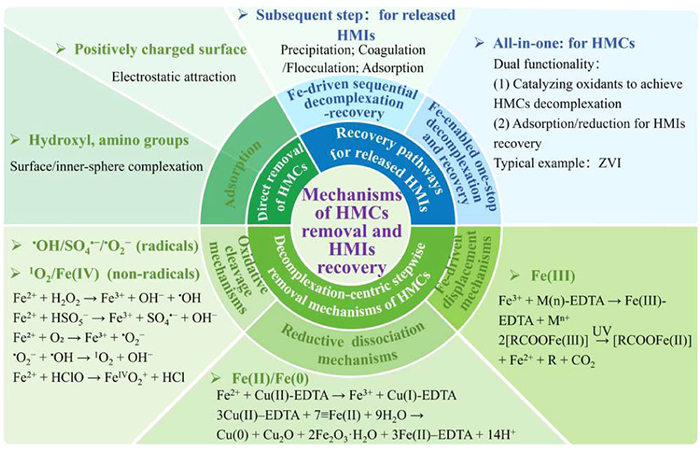
Adsorption is the key process for the direct removal of HMCs by Fe-based materials, achieving simultaneous immobilization of both the metal and the ligand (the entire molecule). The mechanism primarily involves surface/inner-sphere complexation and electrostatic attraction (Table S1 in Supporting information). Adsorption efficiency depends on the material’s surface characteristics (e.g., hydroxyl group density, specific surface area) and the stability of the HMCs. Zhang et al. demonstrated adsorption of various Cr(Ⅲ) complexes by ferrihydrite, achieving simultaneous immobilization of the Cr and ligand. The mechanism involved electrostatic adsorption of anionic Cr(Ⅲ)-EDTA onto the positively charged surface and surface complexation (Fig. S2a in Supporting information), evidenced by XPS-confirmed Fe-O bond formation with EDTA functional groups; the material was regenerable using Na2SO4 solution [51]. Building upon mineral-based adsorbents, functionalized composites offer enhanced design for HMCs capture. Wang and co-workers developed DTPA-chitosan-functionalized Fe3O4@SiO2 magnetic adsorbents, demonstrating efficient immobilization of both Cr(Ⅲ) and Cr(Ⅲ)-EDTA. This simultaneous removal leveraged complexation with DTPA groups and electrostatic interactions between the anionic complex and protonated amino groups, achieving rapid equilibrium and high capacities (39.27 mg/g for Cr(Ⅲ), 22.24 mg/g for Cr(Ⅲ)-EDTA) [52]. The influence of solution chemistry, particularly pH, critically governs the dominant adsorption mechanism. Wu et al. utilized poly-hydroxyl Fe/Zr-pillared montmorillonite for Cu(Ⅱ)-EDTA removal across a wide pH range (3.0–9.0). Immobilization occurred via distinct mechanisms depending on pH: Primarily electrostatic attraction and ion exchange under acidic conditions, shifting to inner-sphere complexation (via M-OH oxygen atoms, M = Fe/Zr) at neutral-alkaline pH, yielding a maximum capacity of 16.67 mg/g. The bimetallic Fe/Zr pillar maintained efficacy while reducing costs by 40% versus Zr-only materials [53].
Fe-based materials can catalytically activate various oxidants to generate multiple highly reactive species (RS). These RS react with HMCs selectively or non-selectively, leading to the cleavage of coordination bonds and degradation of functional groups, thereby inducing decomplexation (Table S1). Oxidants, including H2O2, PS (peroxymonosulfate, PMS; peroxydisulfate, PDS), O3, O2, generate strongly oxidizing RS encompassing both radicals (·OH, SO4·-, ·O2-) and non-radicals (1O2, high-valent Fe). Originating from distinct catalytic processes, these RS possess different oxidative capabilities and are applied to decompose various types of HMCs. As a potent oxidant, ·OH exhibits an oxidation potential as high as 2.7 V. Typically, under pH ∼3, Fe2+ reacts with H2O2 to generate highly reactive and non-selective ·OH. Fu et al. utilized the Fenton reaction to degrade Ni(Ⅱ)-EDTA and observed that under optimal conditions the removal efficiency reached 92.8% within 60 min [54]. Compared to homogeneous Fenton, heterogeneous Fenton-like processes exhibit a wider applicable pH range. Ye et al. applied a pyrite/H2O2 heterogeneous system to remove Cr(Ⅲ)-citrate/EDTA/oxalate/tartrate complexes, achieving significantly higher efficiency than Fe2+/H2O2 system homogeneous at neutral-alkaline conditions. Since pyrite reacted with H2O2, releasing large amounts of H+, it maintained the reaction pH at approximately 3.0, regardless of the initial pH, thereby generating abundant ·OH (Fig. S2b in Supporting information) [55]. As a research hotspot among ROS, the SO4·- possesses a higher oxidation potential than the ·OH (2.6–3.1 V vs. 1.8–2.7 V) and a longer half-life (30–40 μs vs. 1.0 μs) [56]. Zhang and co-workers utilized pyrite to catalyze PMS, generating both SO4·- and ·OH to co-oxidize Cr(Ⅲ)-citrate. In quenching experiments, the addition of tert-butanol reduced the total Cr removal efficiency by 28.2%, whereas methanol presence caused a 72.3% reduction, demonstrating the predominant oxidative role of SO4·- [57]. Another common radical in AOPs is the ·O2-. Due to its relatively weak oxidative capacity (1.3 V), its decomplexation effect is limited; however, as a reactive intermediate, it cannot be neglected. For example, O2 is reduced stepwise to ·OH via three single-electron transfers by Fe(Ⅱ), first being reduced to the ·O2-, then to H2O2, and finally to the strongly oxidizing ·OH. The inhibition rate of 1,4-benzoquinonesodium on Cd(Ⅱ)-EDTA removal was indeed significantly higher than that caused by methanol, demonstrating the importance of the ·O2- as the initial ROS [58].
Besides radicals, non-radicals represent an emerging class of RS with unique advantages for decomplexation. Among them, 1O2 is a typical ROS characterized by a low oxidation potential (0.81 V) while possessing strong selectivity and a long lifespan [59]. During catalytic processes, the generation of 1O2 primarily occurs via three pathways: (1) Oxidation of the ·O2- by the ·OH, (2) interaction between the ·O2- and H2O2 based on the Haber-Weiss reaction, and (3) its own disproportionation reaction [60]. He et al. observed a 1:1:1 triplet signal in the EPR spectrum when using TEMP as the trapping agent, confirming the generation of 1O2 during the photocatalytic process of MIL-53(Fe). Simultaneously, quenching experiments demonstrated that 1O2 plays an equally important role as the ·OH in the degradation of Cu(Ⅱ)-EDTA [44]. Additionally, high-valent metals are highly instrumental in the release of HMIs from HMCs, particularly Fe(Ⅳ), which is a distinctive RS specific to Fe-based catalysts. Xu and co-workers constructed a dual-anode mixed metal oxide (MMO)/Fe system for the removal of Ni(Ⅱ)-EDTA. Mechanistic studies revealed that the additional Fe anode, under acidic conditions, reacted with active Cl through in-situ generated Fe(Ⅱ) ions, promoting the formation of high-valent Fe (Fe(Ⅳ)). It not only accelerated EDTA degradation but also significantly suppressed the generation of chlorinated intermediates. Compared to a single MMO anode and a single Fe anode, the dual-anode system achieved a significantly higher Ni-EDTA degradation rate (0.141 min-1) and more effectively removed Ni from water after alkaline precipitation (reducing Ni concentration from 39.85 mg/L to 0.63 mg/L) [61]. Xie et al. immobilized Fe(Ⅲ)-tetra-amido macrocyclic ligands (TAML) complexes on the surface of carbon black particles. Using this “suspended anode” process, Fe(Ⅲ)-TAML was electrochemically activated to Fe(Ⅳ)-TAML via electron transfer in the system. Experimental results demonstrated that the overpotential required for Fe(Ⅳ) generation was 0.17 V lower than that in homogeneous electrochemical systems, and the stability of Fe(Ⅳ) in this system was significantly higher than in homogeneous Fe-TAML systems [62].
Elucidating the sites at which RS attack HMCs and the oxidative decomplexation pathways of these complexes is crucial for enhancing decomplexation efficiency. Taking Cu(Ⅱ)-EDTA as an example, ROS such as ·OH, SO4·-, and 1O2 readily undergo electrophilic attack on N and O functional groups. Because the Fukui function values for the atoms in Cu(Ⅱ)-EDTA reveal that N and O atoms exhibit relatively large f- values, identifying them as sites susceptible to electrophilic attack [63]. Therefore, the primary degradation pathways for Cu(Ⅱ)-EDTA are: (1) Successive decarboxylation, progressively forming Cu(Ⅱ)-EDDA, Cu(Ⅱ)-ED2A, and Cu(Ⅱ)-EDMA; and (2) Cu(Ⅱ)-NTA and Cu(Ⅱ)-IDA as the main products [64]. For certain HMCs, radicals can also directly attack their metal sites, with the ease of decomplexation depending on the stability of the complex. For instance, ·OH could oxidize Cr(Ⅲ) in Cr(Ⅲ)-citrate to Cr(Ⅵ), simultaneously releasing citrate for further mineralization [57]. However, when ·OH attacked the Cr site in Cr(Ⅲ)-EDTA, the Gibbs free energy change was positive, indicating that the oxidation process could not proceed spontaneously (from a thermodynamic perspective). Density functional theory (DFT) calculations revealed that the environment supplied at least 0.03 kcal/mol to provide the necessary heat for oxidizing Cr(Ⅲ) to Cr(Ⅵ) via a single-electron transfer pathway initiated by ·OH [65]. The 1O2, a less oxidizing non-radical species, exhibits specificity in attacking the Cr site in Cr(Ⅲ)-citrate. Unlike the ·OH, because the oxidation potential of 1O2 (0.81 V) was lower than that required for Cr(Ⅵ) formation (1.23 V), it achieved decomplexation without generating the more toxic Cr(Ⅵ). More interestingly, the ·OH shortened the Cr-O bond length in the complex from 1.82 Å to 1.77 Å, whereas 1O2 increased the Cr-O bond length to 1.83 Å, suggesting that 1O2 was more effective for the Cr(Ⅲ)-citrate decomplexation (Fig. S2c in Supporting information) [66]. Indeed, inferences from the f+ values of the Fukui indices indicate that the metal sites in HMCs are more prone to attack by electron-rich species (reductants), demonstrating that reductive RS also possess high-efficiency decomplexation capability [67]. In summary, different ROS target HMCs via distinct sites and mechanisms. Strong oxidizing radicals mainly attack organic ligands through electrophilic processes, degrading functional groups and releasing HMIs. Non-radical ROS such as 1O2 follow varied pathways, selectively oxidizing ligand groups and weakening metal-ligand bonds. Apart from ROS, high-valent metal species also contribute to decomplexation, oxidizing ligands via direct electron transfer with minimal by-product formation. These mechanistic insights provide a key foundation for designing tailored decomplexation strategies.
The reductive dissociation mechanisms involve the transfer of electrons to reduce high-valent metal ions (e.g., Cu(Ⅱ), Ni(Ⅱ)) to lower valence states, thereby weakening their binding affinity with ligands and achieving decomplexation. In Fe-based materials, this mechanism primarily operates through two pathways: Direct reduction by Fe(Ⅱ) and electron release via ZVI corrosion. To prevent the oxidation of Fe(Ⅱ) ions, reductive decomplexation is predominantly conducted under anaerobic conditions. Dissolved Fe(Ⅱ) ions could reduce over 90% of Cu(Ⅱ)-EDTA to Cu(Ⅰ)-EDTA within an initial pH range of 2–7, achieving partial decomplexation. Subsequently, Fe(Ⅱ) ions completely released Cu(Ⅰ) ions via a displacement reaction. For processes exposed to atmospheric conditions, achieving self-regulation to maintain anaerobic conditions was crucial for preserving established reductive decomplexation efficiency. He et al. found that surface Fe(Ⅱ) reduced Cu(Ⅱ) in Cu(Ⅱ)-EDTA to Cu(0) while oxidizing to Fe(Ⅲ), accompanied by EDTA degradation. This electron transfer efficiency was highly pH-dependent: Under acidic conditions (pH 3.0), the higher reduction potential of Fe(Ⅱ) enabled a 95% Cu(Ⅱ) reduction rate, whereas neutral conditions led to Fe(Ⅱ) oxidation into Fe(Ⅲ) (oxy)hydroxides, passivating active sites. The reducing capacity of surface-bound Fe(Ⅱ) in heterogeneous hydroxy-Fe(Ⅱ) complexes was stronger than that of homogeneous Fe(Ⅱ) ions [68]. As a strong reductant, ZVI supplies electrons through corrosion reactions, directly reducing complexed HMIs. However, research on direct reductive decomplexation by ZVI has not been reported. Instead, studies are primarily focused on ZVI activating DO to generate oxidizing RS for decomplexation and reducing the released HMIs. This is because, given the inevitable presence of DO in wastewater, ZVI preferentially reduces O2 (which possesses a higher oxidation potential) rather than HMCs. The Yang’s group demonstrated that under anaerobic conditions, zero-valent aluminum with an electron reservoir could efficiently reduce and decompose Cu(Ⅱ)-EDTA, enriching Cu(0) on its surface [69]. Therefore, under O2-free conditions, ZVI also possesses the potential for direct reductive decomplexation of HMCs.
Based on the strong ligand affinity, non-toxic Fe(Ⅲ) can displace highly toxic HMIs, thereby releasing them. For example, in the case of Cu(Ⅱ)-EDTA, at the atomic scale, the 3d5 high-spin configuration of Fe(Ⅲ) is more stable than the 3d9 configuration of Cu(Ⅱ). Additionally, the ligand field stabilization energy of Fe(Ⅲ) in an octahedral coordination field with EDTA is approximately 45 kJ/mol higher than that of Cu(Ⅱ). Driven by ligand field theory, Fe(Ⅲ) can preferentially displace the HMIs in the complex [70]. DFT calculations revealed that the transition state energy barrier (ΔE) for Fe(Ⅲ) displacing Cu(Ⅱ)-EDTA was 0.73 eV, indicating a low-energy pathway favorable for the reaction. The Fe (oxy)hydroxides could directly adsorb and coprecipitate Cu(Ⅱ)-EDTA, with Fe(Ⅱ) forming crystalline lepidocrocite (γ-FeOOH) and Fe(Ⅲ) generating amorphous ferrihydrite. The Fe(Ⅲ)-derived flocs exhibited better stability and settling performance compared to Fe(Ⅱ) products (Fig. S2d in Supporting information) [71]. On the macroscopic experimental level, isothermal titration calorimetry results showed that the enthalpy change (ΔH = -42.5 kJ/mol) for the reaction between Fe(Ⅲ) and Cu(Ⅱ)-EDTA was exothermic, suggesting that the displacement process was spontaneous [72]. The Fe-based displacement technology typically relies on ZVI corrosion, the addition of Fe(Ⅲ) salts, or the use of Fe(Ⅱ) minerals. Among these, ZVI corrosion is a passive process dependent on proton concentration in the solution. The displacement by Fe(Ⅲ) ions is pH-dependent, with Fe(Ⅲ) availability decreasing at pH > 4 [73]. Moreover, the displaced metal ions require subsequent separation and removal via alkaline precipitation.
The highly stable Fe-based complexes formed as products also require removal. Notably, differing from most HMCs, Fe-based complexes possess photosensitivity. Under UV light, intramolecular LMCT occurs, achieving self-decomplexation. Shan et al. proposed a combined Fe(Ⅲ) displacement/UV/alkaline precipitation process for Cu(Ⅱ)-EDTA removal, achieving efficient reduction of Cu concentration from an initial 19.2 mg/L to below 1 mg/L [74]. And Yuan et al. developed a low-Fe(Ⅲ)-driven UV/air process combined with chelating resin adsorption for Cu(Ⅱ)-EDTA treatment. The UV/air oxidation minimized secondary pollution, and the Fe(Ⅲ) cycle reduced reagent usage [75]. Furthermore, Ya and co-workers revealed that Fe(Ⅱ) exhibited superior displacement efficiency under alkaline conditions. While Fe(Ⅲ)-based systems plateau at ∼83% Cu(Ⅱ)-EDTA removal, Fe(Ⅱ) ions achieved complete Cu(Ⅱ)-EDTA removal at 5 mmol/L in alkaline pH, provided DO was controlled. This highlighted Fe(Ⅱ) as a more sustainable alternative, though its application requires careful management of redox conditions [76]. The core operational constraints of the Fe replacement process can be summarized into three aspects: pH environment, Fe species and dosage, and redox conditions. In the Fe(Ⅲ) replacement system, maintaining an acidic pH is critical for the replacement reaction to prevent precipitation as Fe(OH)3, which would lead to replacement failure. This system is time-dependent and requires a high Fe/HMIs molar ratio, leading to increased economic costs. In the Fe(Ⅱ) replacement system, replacement and precipitation reactions occur simultaneously under alkaline pH conditions, but it is necessary to control the DO concentration in the solution to prevent the oxidation of Fe(Ⅱ).
The free HMIs (e.g., Cu(Ⅱ), Cr(Ⅲ), Ni(Ⅱ)) released after decomplexation of HMCs require targeted recovery methods to achieve resource utilization and avoid secondary pollution. The major approaches for recovery include precipitation, coagulation/flocculation, and adsorption. Chemical precipitation is the most economical method for metal recovery, particularly suitable for high-concentration heavy metal wastewater. Xu et al. proposed a combined Fe(Ⅲ) replacement/UV degradation-alkali precipitation process to treat Cu(Ⅱ)-EDTA wastewater. In this method, Fe(Ⅲ) first replaced Cu(Ⅱ) in Cu(Ⅱ)-EDTA, followed by the formation of Cu(OH)2 precipitates at pH 9.0, achieving a recovery efficiency exceeding 95% [77]. The Fenton and ozone coupling process enhanced the decomplexation of Ni(Ⅱ)/Cu(Ⅱ)-EDTA. Subsequently, in the presence of poly acrylic acid (PAA), the released Ni(Ⅱ) and Cu(Ⅱ) ions were rapidly removed. When PAA was dosed at 2.4–3.2 mL, physicochemical coagulation and flocculation occurred simultaneously, resulting in cleaner wastewater [78]. The electrocoagulation process also efficiently removed Ni(Ⅱ)-EDTA, with both Ni and TOC removal efficiencies exceeding 94%. The primary floc product was Fe2O3 under aerobic conditions, while it was Fe3O4 under anaerobic conditions [79]. However, the main challenges of precipitation and coagulation include high sludge production and low metal purity. The development of functional adsorption materials offers a new approach for low-concentration metal recovery. Wang et al. modified Fe3O4@C with diethylenetriamine (DETA) to introduce amino active sites, forming a core-shell structure. The maximum adsorption capacity of Fe3O4@C@DETA for Cr(Ⅲ) reached 44.74 mg/g, primarily relying on the coordination between Cr(Ⅲ) and surface amino functional groups. Additionally, this adsorbent could be easily separated using an external magnetic field and regenerated in acidic solutions. The material exhibited excellent stability, reusability, and a regeneration efficiency exceeding 75%, making it suitable for multiple adsorption cycles [80].
Due to their tunable interfaces and coexistence of multiple species, Fe-based materials can achieve “all-in-one” synchronous decomplexation and recovery (Table S1). This unique advantage addresses the bottleneck of significant chemical and energy consumption inherent in stepwise methods. Because the optimal conditions for most oxidative decomplexation are acidic, while the subsequent precipitation process requires alkaline conditions; continuous and repeated pH adjustment inevitably consumes substantial resources. For one-step removal of HMCs, Fe-based materials require dual functionality: (1) Catalyzing oxidants to achieve HMCs decomplexation and (2) adsorbing and reductively recovering HMIs, with ZVI being a typical example. As shown in Fig. S2e (Supporting information), the corrosion of ZVI released Fe(Ⅱ) ions that activate PDS to generate SO4·- degrading Cu(Ⅱ)-EDTA, while simultaneously, Fe(Ⅲ) ions displaced Cu(Ⅱ). The free Cu(Ⅱ) ions were adsorbed by the honeycombed ZVI eroded structure and reduced to Cu(0). With the presence of PDS, the removal efficiency of Cu(Ⅱ)-EDTA increased by 6.2 times, demonstrating that effective decomplexation was a crucial prerequisite for Cu recovery [81]. Yu et al. reported that in the ZVI/H2O2/O3 system for Ni(Ⅱ)-EDTA removal, multiple RS (·OH, ·O2-, 1O2, and Fe(Ⅳ)) participated in decomplexation, and the product enriched on ZVI was Ni(Ⅱ/Ⅲ) hydroxide. Since Ni(Ⅱ) ion was more difficult to reduce than Cu(Ⅱ) ion and H2O2/O3 dually consumed ZVI, Ni(Ⅱ) was unlikely to be reduced to the zero-valent state [82]. For the one-step removal of Cr(Ⅲ)-EDTA, Xing et al. employed a coupled process of O3 and sulfidated ZVI (S-ZVI). The ·OH as predominant RS was primarily generated via heterogeneous catalysis. The S-ZVI exhibited a faster corrosion rate, generating abundant ≡Fe(Ⅱ). This ≡Fe(Ⅱ) not only minimized Cr(Ⅵ) generation but also co-precipitated with Cr(Ⅲ), forming FexCr1-x(OH)3 or Fe(OH)3Cr(OH)3. The Fe3O4, Fe2O3, and FeOOH played auxiliary roles by adsorbing Cr(Ⅲ) ions [83]. In summary, the one-stop decomplexation and recovery approach using Fe-based materials offers significant operational, economic, and environmental advantages over sequential treatment methods. By integrating oxidative/reductive decomplexation with concurrent metal immobilization within a single material platform, it eliminates the need for intermediate pH adjustments, reduces chemical and energy inputs, minimizes secondary sludge generation, and enhances the purity and recoverability of reclaimed metals. This synergistic, process-intensified strategy not only lowers treatment costs but also aligns closely with circular economy principles, positioning Fe-based systems, particularly ZVI and its engineered variants, as scalable and sustainable solutions for industrial HMCs-laden wastewater remediation.
The atomic-scale mechanisms governing HMCs removal face practical limitations in material reactivity and stability. Strategic modifications to optimize Fe-based material functionality are examined (Fig. 3). Atomic-level surface engineering mitigates intrinsic limitations of conventional materials (e.g., ZVI passivation, inefficient electron transfer) through tailored non-metallic modifications: Inorganic approaches (sulfidation, phosphorization) enhance corrosion kinetics and reactive site accessibility, while organic ligands (formic acid, L-cysteine) modulate surface electronic properties to promote oxidant activation. Heterometallic cooperation leverages synergistic bimetallic systems (Fe-Al, Fe-Cu, Fe-Mo) whereby secondary metals expand interfacial reactivity, enhance adsorption capacity across broader pH ranges, and establish dual-active sites for concurrent decomplexation and HMIs reduction. Confinement architectures immobilize active phases within substrates (ion-exchange resins, carbon nanotubes), suppressing agglomeration while inducing nanoconfinement effects that alter reaction pathways and promote high-valent Fe species generation. Field-assisted enhancement integrates external energy inputs (magnetic fields, microwaves, photoirradiation, electrochemical potentials) to intensify reaction kinetics, improve mass transport, and enable synergistic effects such as accelerated Fe corrosion or in-situ reductant formation. These advanced engineering paradigms collectively address fundamental material constraints to bridge mechanistic potential with practical remediation efficacy.
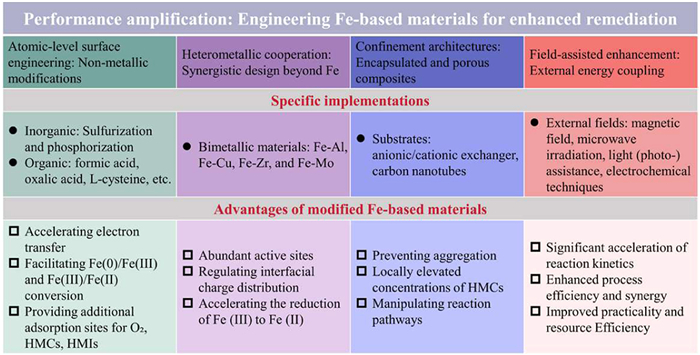
The ZVI has been widely applied, but common drawbacks such as easy passivation and poor electron selectivity significantly reduce its performance in removing HMCs. For instance, due to the surface passivation layer formed during preparation and storage hindering electron transfer, pristine ZVI exhibits poor effectiveness for removing Cr [84]. Non-metallic surface modification effectively addresses the practical limitations of ZVI by tailoring its electronic and interfacial properties. Atomic-scale doping with S or P, or grafting of organic groups, alters charge distribution and creates tailored surface phases. Sulfidation accelerates corrosion and electron transfer via conductive FeS phases; phosphorization favors selective non-radical oxidation pathways. Organic modifiers (e.g., carboxylates, thiols) stabilize Fe(Ⅱ), inhibit passivation, and provide additional sorption sites. Research by Liang et al. demonstrated that S-nZVI exhibited superior performance in removing Cd(Ⅱ)-EDTA. Under optimal conditions, S-nZVI achieved an excellent removal capacity of 746.6 mg/g within 90 min, representing a 6.2-fold and 2.5-fold improvement compared to pristine nZVI and Na2S, respectively. This significant enhancement was attributed to the synergistic effects between Fe and S species during the purification process. The S accelerated the corrosion of ZVI, generating abundant Fe(Ⅲ) ions to displace Cd(Ⅱ) in the Cd(Ⅱ)-EDTA. Subsequently, the released Cd(Ⅱ) ions were immobilized by S sites. The coordination between S and Cd was stronger than coprecipitation and adsorption by Fe species [85]. The S-nZVI maintained a high adsorption capacity of 39.5 mg/g even at a 5% salt concentration, demonstrating its enhanced resistance to inorganic salts [86]. Additionally, phosphorylated ZVI (P-ZVI) catalyzed PMS to selectively produce 1O2 rather than SO4·-. The 1O2 exhibited milder reactivity towards disrupting coordination bonds. The incorporation of P promoted the capacity of inner-sphere Fe to reduce HMIs [87]. In terms of organic modification, small organic molecules (such as formic acid, oxalic acid, L-cysteine) play significant roles. Zhang et al. developed formic acid-modified ZVI via ball milling (FA-ZVIbm), which removed Cu(Ⅱ)-EDTA 80 times faster than ZVIbm. Because the formed ferrous formate (Fe(HCOO)2) shell facilitated the activation of DO into ROS and promoted Fe(Ⅲ) ions dissolution more effectively than FeOx. As shown in Fig. S3a (Supporting information), O2 adsorption energy on FA-ZVIbm (-0.11 eV) was lower than on ZVIbm (0.18 eV), while its Bader charge was higher (1.98 vs. 1.14), indicating FA-ZVIbm had a stronger capacity for O2 enrichment. Simultaneously, the interlayer Fermi level differences for FA-ZVIbm and ZVIbm were 0.45 V and 0.40 V, respectively, demonstrating faster electron transfer in FA-ZVIbm [88]. Qin and co-workers proposed that L-cysteine enhanced the capture of Ni(Ⅱ)-EDTA by C-ZVIbm and promoted the reduction of Fe(Ⅲ) to Fe(Ⅱ), thereby efficiently purifying electroplating wastewater [89]. These non-metallic modified Fe-based materials demonstrate great potential for efficient HMCs removal through accelerating electron transfer, facilitating Fe(0)/Fe(Ⅲ) and Fe(Ⅲ)/Fe(Ⅱ) conversion, and providing additional adsorption sites for O2, HMCs, and HMIs.
The design and fabrication of Fe-based materials capable of both decomplexing HMCs and HMIs represent a developing trend. However, such bifunctional materials face two major challenges: (1) Insufficient active sites, a single metal active site must simultaneously be responsible for HMCs adsorption, RS generation and HMIs reduction, and (2) the Fe species regeneration efficiency is inadequate. Therefore, constructing catalysts with dual active sites featuring heterostructures and tunable electronic properties has been proposed as a promising strategy to overcome these limitations [90]. Bimetallic materials such as Fe-Al, Fe-Cu, Fe-Zr, and Fe-Mo typically exhibit superior properties distinct from single Fe-based materials due to their heterometallic elements. For HMCs adsorption, Zhang et al. synthesized Al-containing ferrihydrite (Fh-Al) adsorbents for Cr(Ⅲ)-EDTA removal. Al doping modified the structural properties and surface charge of Fh-Al, expanding its effective working pH range to 3–9 while significantly increasing its maximum adsorption capacity (1.41 times higher than conventional Fh materials). At a 6% Fh/Al molar ratio, Fh-Al-6 exhibited maximum adsorption capacities of 41.47, 16.51, and 31.27 mg/g for Pb(Ⅱ)-EDTA, Cu(Ⅱ)-EDTA, and Cd(Ⅱ)-EDTA, respectively. Comparative studies revealed Fh-Al-6's superior adsorption performance for EDTA complexes over free HMIs, attributed to its higher isoelectric point, stronger surface complexation ability, and larger specific surface area [91]. Regarding AOPs, Shen et al. developed a novel catalyst by embedding both Cu2O and Fe3O4 within a chitosan matrix. This catalyst synergistically combined the Fenton-like catalytic activity of Fe3O4 with the electron transfer capability of Cu2O, achieving simultaneous catalytic degradation of Cr(Ⅲ)-organic complexes and effective suppression of Cr(Ⅵ) accumulation. The Fe-Cu bimetallic synergy significantly enhanced the reaction kinetics [92]. Pan and co-workers designed an innovative core-shell nanostructure, designated as YHZO, comprising magnetic Fe3O4@Zr(OH)x hollow spheres for effective Pb(Ⅱ)-EDTA removal. This bifunctional material operated through a synergistic mechanism: The Fe3O4 core acted as an efficient Fenton-like catalyst that oxidatively cleaved the EDTA ligands in the presence of H2O2, liberating free Pb(Ⅱ) ions; concurrently, the porous Zr(OH)x shell served as a high-capacity adsorbent for the released Pb(Ⅱ) ions through strong surface complexation. Under optimized operational conditions, the system demonstrated excellent treatment performance, achieving 65.3% TOC removal and 89.8% Pb elimination efficiency within 120 min. The outstanding performance was attributed to the well-designed architecture that combined AOPs with superior adsorption capacity, while the magnetic properties enabled convenient catalyst recovery and reuse [93]. Che et al. constructed a dual-active-site catalyst (S-Fe3O4/MoS2) by integrating sulfidated Fe3O4 with MoS2 to improve PMS activation while concurrently inhibiting intermediate Cr(Ⅵ) residual (Fig. S3b in Supporting information). The Mo(Ⅳ) sites were primarily used to reduce Cr(Ⅵ) and Fe(Ⅲ). This catalyst demonstrated Cr(Ⅲ)-organic complex removal rate constants 2–10 times higher than those of single-active-site Fe-based catalysts, outperforming other reported ZVI, pyrite, iron oxides, etc. [94].
Fe-based catalysts are prone to agglomeration in engineering applications. Immobilizing them within diverse substrates to form composite materials presents a viable alternative. When the spatial confinement of the material reaches the nanoscale, a nanoconfinement effect occurs, altering the phase behavior of substances and their chemical reactions [95]. Liu et al. immobilized ZVI onto the anion exchange resin D201 to enhance the removal of Cu(Ⅱ)-EDTA. The results demonstrated that D201-ZVI significantly improved the removal efficiency compared to standalone ZVI within a pH range of 5–9, with 97.2% of Cu being immobilized within the D201-ZVI matrix [96]. In another study, the Xu’s group successfully synthesized a heterogeneous Fenton-like catalyst, nanoscale HFOD, for the efficient degradation of Cu(Ⅱ)-citrate in aqueous solutions. HFOD was prepared by irreversibly loading hydrous ferric oxide (HFO) nanoparticles onto a cation exchange resin. Under optimized conditions (pH 4, reaction time of 6 h, and H2O2 concentration of 40 mmol/L), the removal efficiencies of Cu and TOC reached 81.6% and 75.6%, respectively. The removal mechanism of Cu(Ⅱ) by HFOD involved ion exchange through the D-001 shell and inner-sphere coordination by the HFO core, which was unaffected by pore blockage. Additionally, HFOD exhibited high catalytic efficiency for H2O2 decomposition (84.3%). Fixed-bed experiments further confirmed its high treatment capacity, excellent acid-base tolerance, and reusability. The spent HFOD could be regenerated using a 0.1 mol/L HCl-NaCl solution, and even after five cycles, the removal efficiencies of Cu and TOC remained above 50% [97]. Liu and co-workers successfully synthesized a catalyst with a nanotube-confined structure, Fe2O3(100)-in-CNTs, supported on carbon nanotubes. The nanoconfinement induced electron localization and orbital rearrangement around Fe and C atoms, facilitating the formation of high-valent Fe(Ⅳ) species and enhancing the catalytic decomposition of H2O2 and O3 (Fig. S3c in Supporting information). Moreover, the nanoconfinement shifted the decomplexation pathway of Cu(Ⅱ)-EDTA from a radical to a non-radical mechanism. Compared to the non-confined catalyst Fe2O3(100)-out-CNTs, Fe2O3(100)-in-CNTs exhibited more active sites, superior catalytic performance, and enhanced electron transfer capability. When coupled with non-thermal plasma (NTP), the NTP/Fe2O3(100)-in-CNTs system achieved 98.8% Cu(Ⅱ)-EDTA decomplexation within 20 min, with a kinetic constant 2.5 times higher than that of the NTP/Fe2O3(100)-out-CNTs system [98].
Beyond intrinsic material engineering, coupling Fe-based remediation systems with external energy fields offers a powerful strategy to substantially amplify reaction kinetics and HMCs removal efficiency. The application of physical or electromagnetic fields, such as magnetic fields, microwaves, light, or electrochemical potentials, can profoundly alter reaction pathways, enhance mass transfer, and generate synergistic effects. Guan et al. proposed utilizing a weak magnetic field (WMF) to ZVI reactivity. Their results demonstrated that WMF significantly accelerated both the Fe0 corrosion rate and Cu(Ⅱ)-EDTA removal kinetics. Exposure to WMF achieved over 95% Cu(Ⅱ)-EDTA removal within 30 min across a pH range of 4–6. This enhancement was attributed to WMF-induced localized galvanic corrosion of Fe0 and improved mass transfer across the diffusion boundary layer [99]. Microwave technology represents another promising intensification approach for degrading organic and metal-complexed pollutants. Lin et al. applied microwave-enhanced Fenton oxidation coupled with hydroxide precipitation to treat wastewater containing metal-EDTA complexes. Remarkably, the Cu(Ⅱ)-Ni(Ⅱ)-EDTA mixed system exhibited higher removal efficiencies for both Cu and Ni compared to individual Ni(Ⅱ)-EDTA or Cu(Ⅱ)-EDTA systems. The study revealed that Ni(Ⅱ) ions released from Cu(Ⅱ)-Ni(Ⅱ)-EDTA complexes possessed strong microwave absorption capacity, inducing rapid temperature elevation. This thermal effect synergized with the Cu(Ⅱ)-catalyzed Fenton-like reaction, not only accelerating degradation rates but also altering the EDTA decomposition pathway. Consequently, the strategy combining microwave-enhanced Fenton oxidation with controlled Cu(Ⅱ) addition showed significant practical applicability for Ni(Ⅱ)-EDTA wastewater treatment [100]. Light assistance constitutes a crucial step following the Fe(Ⅲ) displacement/precipitation process, enabling self-degradation of Fe(Ⅲ)-complexes via LMCT. The addition of small organic molecules, such as acetylacetone, can further enhance the photo-Fenton reaction, attributable to their ability to promote H2O2 generation and metal reduction (Fig. S3d in Supporting information) [101]. Recent advances integrate internal electrolysis (IM) technology, employing iron and carbon as anode and cathode materials, respectively, to augment conventional homogeneous Fenton processes. This configuration generates substantial Fe(Ⅱ) to sustain Fenton reactions. As demonstrated by Lan and co-workers, an integrated IM-Fenton oxidation-coagulation (IM-FOC) process achieved exceptional treatment efficiency for Cu(Ⅱ)-EDTA contaminated wastewater. Under optimized conditions, the system attained complete Cu(Ⅱ) removal (100%) with concurrent 87% COD reduction [102]. Zhao et al. employed a three-dimensional electrolytic device for Cu(Ⅱ)-EDTA wastewater treatment. Within this system, the cathode (activated biochar) reduced Cu(Ⅱ) to metallic Cu for electrode deposition, while the anode oxidized EDTA. This process eliminated chemical reductants and enabled potential-regulated selective recovery of target metals (e.g., Cu, Ni) [72]. Liu et al. utilized glow discharge plasma electrolysis, generating highly reactive atomic hydrogen (H*) at the cathode to reduce Cu(Ⅱ) to high-purity Cu(0) for deposition. Operating at 700 V, this system achieved 87% Cu(Ⅱ)-EDTA decomplexation and 64% Cu recovery within 90 min [103].
While Fe-based materials demonstrate significant potential for HMCs remediation in controlled settings, their transition to real-world applications is challenged by complex aquatic matrices and economic constraints. This chapter bridges the gap between fundamental research and practical implementation by systematically evaluating the operational deployment and economic viability of these technologies. It first analyzes how key environmental factors (pH, DO, and inorganic ions) critically influence remediation efficiency by altering iron’s reactivity and reaction pathways. Furthermore, case studies using genuine industrial wastewater demonstrate the robustness of advanced Fe-based systems in achieving regulatory standards and managing secondary pollution. Finally, a techno-economic assessment highlights the cost structures of different treatment processes and emphasizes the economic benefits of resource recovery, underscoring the importance of balancing performance with feasibility. This integrated analysis provides critical insights for designing efficient and sustainable Fe-based water treatment strategies.
The reaction pathways and efficiency of Fe-based materials for removing HMCs are influenced not only by their intrinsic morphology and configuration but also critically dependent on the physicochemical conditions of the reaction system. Key environmental factors, including pH, DO, and inorganic ions, can significantly alter Fe dissolution behavior, valence transition kinetics, radical generation efficiency, and the decomplexation mechanisms of HMCs (Fig. 4a). This section systematically analyzes the influence of key reaction conditions on Fe behavior from multiple perspectives.
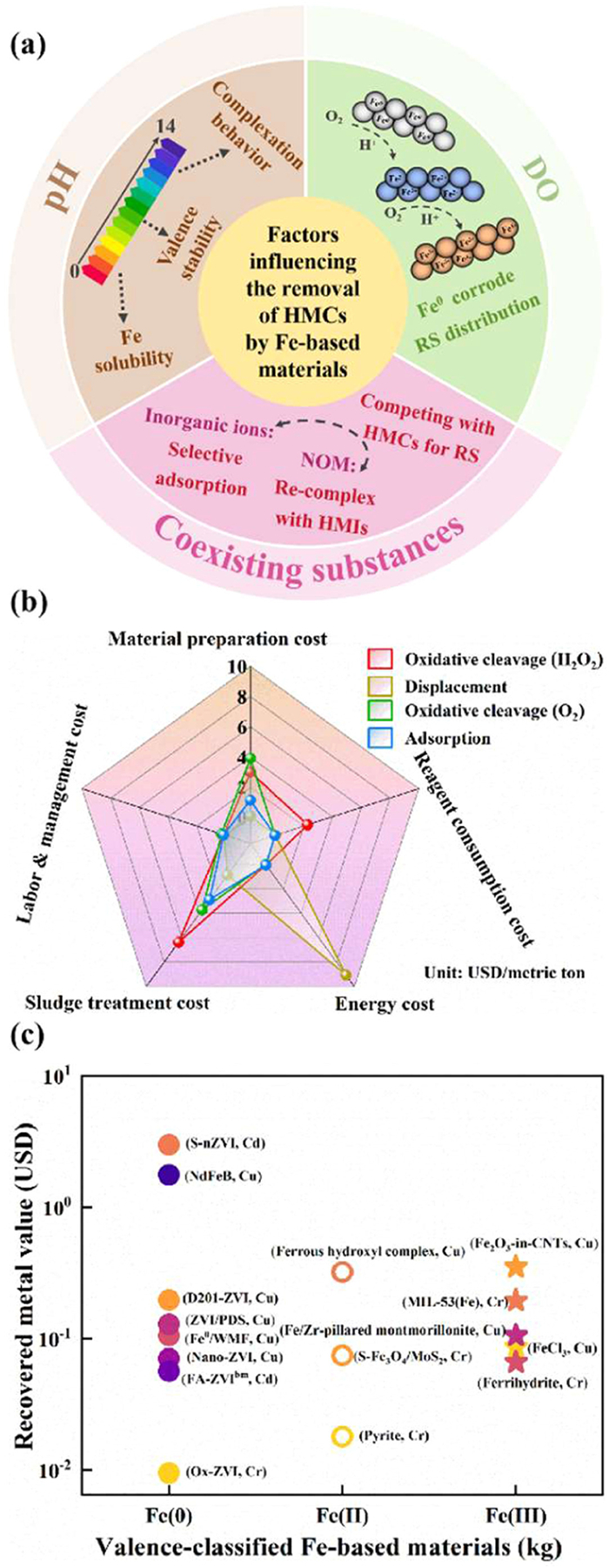
The pH is one of the most critical environmental factors governing the performance of Fe-based materials. It regulates Fe solubility, valence stability, complexation behavior, and the underlying mechanisms for HMCs removal. Under varying pH conditions, Fe exhibits distinct reaction pathways, forming interconnected coupling effects. These range from promoting Fe0 dissolution and Fe(Ⅱ) generation to inducing ligand dissociation and reductive deposition of HMCs. For instance, acting as an electron donor, ZVI demonstrates significantly accelerated dissolution rates under acidic conditions. Increased proton concentration (lower pH) directly drives Fe0 dissolution into Fe(Ⅱ) ions with concurrent H2 evolution. Studies reveal that at pH < 4, Fe0 dissolution occurs rapidly, enabling sustained Fe(Ⅱ) ions release. These ions serve as a reductant source for critical steps like reductive decomplexation and radical-mediated reactions. However, as pH rises (particularly above pH 5), decreased H+ concentration facilitates the formation of a dense passivation oxide layer on Fe0 surfaces, impeding electron transfer and further dissolution, thereby markedly suppressing reactivity. This pH dependence was demonstrated by Yu et al. in an O3/H2O2/Fe0 system: when pH increased from 3.0 to 6.0, Fe(Ⅱ) ions release dropped by over 60%, leading to a pronounced decline in Ni(Ⅱ)-EDTA removal efficiency (Fig. S4a in Supporting information). The outcome underscored the pivotal role of Fe(Ⅱ) availability under low-pH conditions for the reductive decomplexation of HMCs [82]. The strict pH dependence of Fe-based processes limits their application, but this can be overcome through material design. Atomic-level surface engineering (e.g., sulfidation or phosphorization of ZVI) alters surface electronic structure and corrosion behavior, reducing passivation and maintaining reactivity under near-neutral conditions. Additionally, bimetallic systems (e.g., Fe-Al, Fe-Cu) create synergistic interfaces that preserve functionality across a wider pH range. Such strategies address Fe solubility and speciation shifts, enabling robust performance in diverse water chemistries.
The DO concentration critically determines reaction pathways and RS distribution, particularly in reductive systems based on Fe(0) or Fe(Ⅱ). The presence and level of DO significantly influence the stability of Fe(Ⅱ) in the system, thereby affecting key processes such as radical generation, decomplexation, and reductive deposition. Under aerobic conditions, Fe(Ⅱ) can be rapidly oxidized to Fe(Ⅲ), which subsequently combines with OH- to form Fe(OH)3 precipitates. This leads to Fe(Ⅱ) deactivation, potentially reduces pH, and may cause precipitate-induced clogging, ultimately impairing the system’s reductive capacity for HMIs. Liu et al. investigated the effect of DO on the removal of Cu(Ⅱ)-EDTA by D201-ZVI, exploring the impact under N2, air, and O2 conditions, respectively. After 6 h, the decomplexation efficiencies of Cu(Ⅱ)-EDTA were 92.6%, 59.0%, and 19.4%, respectively, indicating high DO inhibited Cu(Ⅱ)-EDTA removal (Fig. S4b in Supporting information) [96]. Studies have shown that DO, as an oxidant, can lead to the deposition of a thicker corrosion product layer (such as maghemite or lepidocrocite) on the surface of ZVI, thereby reducing the reactivity of Fe0 [104]. Furthermore, DO concentration governs the composition of RS and the dominant reaction mechanisms. In O2-rich environments, Fe(Ⅱ) reacts efficiently with H2O2 to generate ·OH, promoting Fenton-like AOPs for non-selective degradation of HMCs. Conversely, under O2-limited conditions, ·OH production is restricted, and the system tends to favor direct electron transfer and reductive pathways. These findings highlight DO as a crucial parameter in Fe-based systems, affecting both Fe redox chemistry and the subsequent reaction pathways for HMCs removal, emphasizing the importance of controlling DO levels to optimize treatment performance for specific mechanisms like reduction or oxidation. To counteract the inhibitory effects of DO on Fe(Ⅱ) stability and reductive pathways, material design strategies can be adopted. Encapsulating ZVI or Fe oxides within porous matrices (e.g., resins, silica, carbon nanotubes) minimizes direct DO contact, mitigates surface passivation, and preserves electron transfer capacity for reductive decomplexation. Incorporating oxygen-scavenging components, such as sulfide phases or mild organic reductants, can establish localized anaerobic microenvironments that protect Fe(Ⅱ) from oxidation. Additionally, electrochemically assisted systems, where a cathodic potential is applied to Fe-based electrodes, enable continuous in situ regeneration of Fe(Ⅱ), counteracting DO-induced deactivation and sustaining long-term reactivity under realistic conditions.
In real wastewater systems, HMCs rarely exist as single contaminants but typically coexist with various inorganic ions (both cations and anions), organic acids, complexing agents, and NOM. These coexisting components can interact with Fe-based materials or target complexes through diverse physicochemical mechanisms, resulting in either synergistic enhancement or, more commonly, competitive inhibition of removal efficiency. Specifically, common inorganic cations (e.g., Ca2+, Mg2+, Na+, K+) can influence the process through multiple pathways. Divalent cations like Ca2+ and Mg2+ may compete with target HMIs for binding sites on complexing agents or material surfaces, potentially shielding the HMCs from direct attack. Furthermore, high concentrations of background cations increase ionic strength, which can compress the electrical double layer and alter the surface charge of Fe-based materials, thereby affecting their aggregation state and interfacial reactivity towards anionic complexes [105]. In some cases, cations like Ca2+ might also precipitate with anions, indirectly altering water chemistry. On the other hand, inorganic anions with strong coordination capabilities, such as phosphate (PO43-), carbonate (CO32-), and humic acid, tend to preferentially coordinate with either Fe ions or the target HMIs. This preferential coordination consequently weakens the decomplexation interaction between Fe and HMCs. For example, Wu et al. demonstrated that PO43- and tartrate coexistence significantly reduced Cu(Ⅱ)-EDTA adsorption efficiency using poly-hydroxyl Fe/Zr-pillared montmorillonite [53]. Similarly, Li and co-workers reported that in an Fe(Ⅲ) substitution-precipitation system, the presence of organic ligands like citrate formed stable complexes with Fe(Ⅲ), preventing its effective substitution for the central metal ion in Ni(Ⅱ)-EDTA complexes and thereby substantially inhibiting decomplexation [106]. As shown in Fig. S4c, while Cl- showed no significant effect, CO32- progressively diminished ferrous/ferric hydroxide complex (FHC(SO42-))’s Cr(Ⅵ) removal performance. The competitive adsorption by NO3- and B4O72- proved negligible due to stronger Cr(Ⅵ) attraction, whereas PO43- exerted a prominent, dose-dependent inhibitory impact stemming from mineral transformation. And the EDTA exhibited the strongest suppression of FHC(SO42-)’s Cr(Ⅵ) removal efficiency among complexing agents (EDTA > citric acid > NTA > tartaric acid > oxalic acid). This structure-dependent suppression stemmed primarily from hydrogen bonding between surface groups of FHC(SO42-) and -OH/-COOH functionalities of the agents, which impeded electron transfer through spatial resistance, with the collective density of these functional groups governing inhibitory potency more than their individual presence or type [107]. These findings underscore the complex interplay between coexisting substances and treatment performance, highlighting the importance of considering water matrix composition when designing Fe-based systems for HMCs removal due to the significant impact of competitive coordination effects. To mitigate competitive inhibition from coexisting ions in wastewater, material design can improve the selectivity of Fe-based materials for target heavy metal contaminants. Surface functionalization with selective coordinating groups (e.g., amino, thiol, phosphate) enhances specific binding toward target metals, preserving adsorption efficiency amid competing ions. Furthermore, constructing mesoporous or molecularly imprinted Fe-based composites allows precise pore-size control for physical sieving, excluding macromolecular interferents while ensuring access to active sites. Bimetallic systems introduce dual-functional sites that dissociate complexes and immobilize released HMIs synergistically, boosting overall interference resistance and selectivity.
The long-term cycling stability and reusability of Fe-based materials are paramount for assessing their practical potential and economic viability in treating HMCs. A comprehensive stability evaluation extends beyond initial removal efficiency to include performance retention over multiple cycles, structural integrity, and the critical issue of Fe leaching. As summarized in Table S2 (Supporting information), stability performance varies significantly with material design. Conventional materials like ferrihydrite often suffer rapid deactivation (e.g., efficiency drop from 97.1% to 50.3% over 10 cycles) [51]. In contrast, engineered composites, such as those with structural confinement (e.g., Fe2O3-in-CNTs), synergistic doping (e.g., S-Fe3O4/MoS2), or stable frameworks (e.g., Fe-MOFs), demonstrate remarkable durability, maintaining > 90%-100% efficiency over 4–8 consecutive cycles [94,98,108]. This underscores the effectiveness of targeted material design in mitigating common degradation mechanisms like surface passivation and active site loss. Fe leaching is a key stability metric with direct implications for treated water quality and operational sustainability. Excessive Fe release can increase effluent turbidity and total dissolved solids, potentially interfering with subsequent treatment stages or discharge standards. Table S2 indicates that advanced composites successfully suppress leaching, often to levels below 0.1 mg/L (e.g., Fe2O3-in-CNTs, HFOD), whereas less stable materials (e.g., S-nZVI) may leach over 10 mg/L [85]. Effective strategies to minimize Fe loss include surface passivation via sulfidation/phosphorization, encapsulation within carbon or polymer matrices, and constructing core-shell structures that enhance mechanical and chemical robustness. Despite these advances, current stability assessments remain largely confined to batch tests using simulated wastewater under controlled pH. There is a pronounced lack of systematic, long-term studies under continuous-flow conditions, in complex and fluctuating real matrices, and employing standardized protocols for tracking both efficiency decay and Fe leaching. Future research must bridge this gap by integrating in situ characterization to correlate performance loss with material evolution, explicitly evaluating the environmental impact of leached Fe, and developing universally accepted stability testing frameworks. Such efforts are essential to transition promising Fe-based materials from laboratory-scale discovery to reliable, long-term field application.
Translating laboratory findings to operational deployment requires validation under complex industrial conditions [109]. The practical effectiveness, economic viability, and regulatory compliance of advanced Fe-based technologies for treating HMCs are demonstrated through case studies using real electroplating wastewater. Examples highlight system robustness across diverse water matrices, achievement of stringent discharge standards, and integrated solutions for secondary pollution control, underscoring their potential for industrial implementation. Yuan et al. developed an innovative low-Fe(Ⅲ)-driven UV/air process (LFUA) to effectively disrupt strong complexation in HMCs, facilitating enhanced HMIs recovery via chelating resin adsorption (CRA). Biological toxicity tests confirmed the treated effluent induced no significant toxicity to zebrafish embryos. Practical feasibility was validated using actual electroplating wastewater from a Jiangsu Province manufacturing facility, containing three predominant metal stabilizers: EDTA, citric acid, and malic acid. The integrated system achieved 99% Cu purity and a breakthrough capacity of 475 bed volumes, representing a 2.4-fold improvement over direct adsorption. This technology offered: (1) High HMCs treatment efficiency, (2) an environmentally benign process without hazardous sludge generation, and (3) effective HMIs recovery capability. Thus, the low-Fe(Ⅲ)-driven UV/air process provided a practical solution for treating HMCs while recovering valuable resources. The biological toxicity effects of this process were also evaluated. Superoxide dismutase (SOD) activity and malondialdehyde (MDA) levels were jointly used to reflect the degree of damage caused by radicals. By comparing the changes in SOD activity and MDA levels in zebrafish exposed to wastewater before and after treatment, it was found that the combined LFUA and CRA process significantly reduced the biological toxicity of the complexed wastewater [75]. Li and co-workers developed an effective Fe(Ⅲ) substitution-dimethyl dithiocarbamate chelation precipitation process for Ni(Ⅱ)-EDTA removal using actual electroplating wastewater from Suzhou, Jiangsu Province. Under optimized conditions, residual Ni concentrations fell below 0.1 mg/L, meeting China’s stringent discharge standards. Secondary pollutants were addressed innovatively: Residual Fe(Ⅲ) ions formed a homogeneous photo-Fenton system with H2O2 to degrade remaining dimethyl dithiocarbamate and organics, with final reverse osmosis polishing removing soluble salts [106]. Che et al. engineered a Fe-Mo dual-active site catalyst via a facile one-step hydrothermal method for Cr(Ⅲ)-EDTA treatment. This system demonstrated enhanced PMS activation efficiency while effectively suppressing toxic Cr(Ⅵ) intermediate accumulation. In actual electroplating wastewater, it reduced total Cr from 9.78 mg/L to 0.5 mg/L, significantly below China’s discharge standards (total Cr < 1.5 mg/L, Cr(Ⅵ) < 0.5 mg/L) [94]. Beyond meeting regulatory limits, the environmental significance of these Fe-based applications is multifaceted: (1) Resource circularity: Technologies like the low-Fe(Ⅲ)/UV process enable the recovery of high-purity metals, contributing to a circular economy. (2) Toxicity reduction: Biological toxicity tests (e.g., using zebrafish) confirm the detoxification of treated effluents. (3) Secondary pollution mitigation: Integrated designs, such as in-situ utilization of residual Fe for advanced oxidation, minimize the generation and release of secondary pollutants (e.g., degradation by-products, excess chemicals). (4) Process sustainability: The use of abundant Fe, coupled with strategies to reduce chemical and energy inputs (e.g., catalytic activation of air/O2), lowers the overall environmental footprint. The case studies reveal distinct practical trajectories for different Fe-based materials. ZVI is effective for reductive pretreatment, yet require solutions for passivation and separation. Fe (oxyhydr)oxides serve as stable adsorbents/catalyst supports; their advancement lies in composite design for enhanced catalysis. Homogeneous Fe2+/Fe3+ AOPs reliably degrade complexes, with future work targeting sludge reduction and process integration. Multifunctional hybrids aim to concurrently address catalysis, toxicity, and secondary pollution, necessitating cost-effective validation in real matrices. Ultimately, material selection should be tailored to the specific HMCs, water chemistry, and economic context.
A comprehensive economic analysis is conducted to evaluate the cost-effectiveness of four representative Fe-based processes for treating HMCs wastewater: adsorption, displacement, oxidative cleavage using O2, and oxidative cleavage by H2O2. The radar chart (Fig. 4b and Table S3 in Supporting information) illustrates the distribution of major cost components, including material preparation, reagent consumption, energy, sludge treatment, as well as labor and management expenses, all expressed in USD per metric ton of treated wastewater. Among these processes, the adsorption method demonstrates the lowest overall cost, particularly in terms of reagent consumption and energy usage, making it economically favorable for large-scale applications despite moderate sludge treatment expenses. In contrast, displacement shows balanced cost distribution but slightly higher energy and labor costs due to more complex operational requirements. The oxidative cleavage by O2 process incurs significant energy and material preparation costs, though it remains more affordable than its H2O2 counterpart. Notably, oxidative cleavage (H2O2) is the most expensive process, primarily due to high reagent (H2O2) consumption and elevated sludge treatment costs, despite relatively lower energy inputs. While adsorption appears to be the most cost-efficient option, the choice of process should also consider technical performance and specific wastewater characteristics. Oxidative methods, though costly, may be justified in scenarios requiring high removal efficiency or rapid treatment. It is crucial to note that this analysis reflects direct operational costs. A complete techno-economic assessment must further integrate the long-term material lifecycle costs, which are governed by the stability and reusability of the Fe-based materials (as discussed in Section 5.2). Factors such as material longevity, the frequency of replacement, and costs associated with mitigating performance loss or Fe leaching are critical for determining the true levelized cost of treatment in practical, continuous operations. These findings provide critical insights for selecting and optimizing Fe-based technologies in practical applications.
In addition to the operational expenses associated with wastewater treatment, the potential economic return from recovering heavy metals during the process constitutes a critical aspect of the overall cost-benefit analysis. As illustrated in Fig. 4c and Table S4 (Supporting information), the value recovered per kilogram of valence-classified Fe-based materials varies significantly depending on both the material type and the target heavy metal. ZVI and its modified forms, such as S-nZVI used for Cd recovery, demonstrate notably high recovery values, reaching up to 1 USD/kg. These materials exhibit strong reduction potential and high reactivity, enabling efficient retrieval of valuable metals. Similarly, NdFeB-based systems show considerable economic return in Cu recovery, benefiting from their strong reduction and adsorption capabilities. In contrast, Fe(Ⅱ) and Fe(Ⅲ)-based materials, such as ferrihydrite and pyrite applied in Cr recovery, generally yield lower returns, typically in the range of 0.1 USD/kg, due to less efficient metal reduction and recovery pathways. Composite materials like D201-ZVI and Fe2O3-in-CNTs, designed for Cu removal, also present moderate yet competitive recovery values, highlighting the role of material design in enhancing economic performance. The significant divergence in recovered value across different Fe-based materials underscores the importance of selecting appropriate agents based on the target metal and treatment mechanism. Furthermore, the economic benefit of resource recovery is intrinsically linked to material durability. A material that maintains high recovery efficiency over multiple cycles significantly improves the economic viability by amortizing its initial cost and sustaining revenue from metal reclamation. Materials capable of leveraging high reduction potential and large surface areas tend to offer greater economic benefits, which can partially offset treatment operational costs. These insights affirm that beyond removal efficiency, the valorization of recovered heavy metals should be integrated into the technology selection process for sustainable wastewater management.
This review has systematically consolidated the latest advances and mechanistic understanding in utilizing Fe-based materials for the remediation of persistent HMCs and the recovery of valuable HMIs, traversing from atomic-scale interactions to ecosystem-scale applications. The exceptional environmental recalcitrance of HMCs, rooted in their unique coordination structures, high stability constants, ligand-shielded solubility, and resistance to conventional treatments, demands innovative approaches. Fe-based materials emerge as a highly versatile and potent platform, leveraging their intrinsic multi-valent nature (Fe(0)/Fe(Ⅱ)/Fe(Ⅲ)/Fe(Ⅳ)) to orchestrate multiple complementary mechanisms: (1) Activation of oxidants (H2O2, PS, O3) to generate diverse RS (·OH, SO4·-, 1O2, Fe(Ⅳ/Ⅴ)) for oxidative cleavage of coordination bonds; (2) exploitation of Fe(Ⅲ)’s superior ligand affinity and ligand field stabilization energy to displace toxic HMIs via thermodynamically favored substitution; (3) utilization of photosensitivity for LMCT-induced self-decomplexation of Fe(Ⅲ)-complexes under UV light; (4) direct adsorption via surface complexation and electrostatic attraction; and (5) electron transfer for reductive dissociation or HMIs reduction/recovery. This multifunctionality allows Fe-based materials to act as catalysts, adsorbents, complexing agents, and flocculants.
Significant progress has been made in engineering Fe-based materials to overcome inherent limitations and enhance performance. Atomic-level surface engineering (e.g., sulfidation, phosphorization, organic ligand functionalization) mitigates passivation, accelerates electron transfer, and tailors reactivity/selectivity. Heterometallic cooperation (e.g., Fe-Al, Fe-Cu, Fe-Mo) creates synergistic systems expanding pH windows, enhancing adsorption capacities, establishing dual-active sites for concurrent decomplexation and reduction, and suppressing toxic byproducts like Cr(Ⅵ). Confinement architectures (e.g., within ion-exchange resins or carbon nanotubes) prevent agglomeration, induce nanoconfinement effects altering reaction pathways, and promote high-valent Fe species generation. Integration with external energy fields (magnetic fields, microwaves, photoirradiation, electrochemical potentials) intensifies kinetics, improves mass transport, and enables synergistic effects like accelerated corrosion or in-situ reductant formation. These strategies bridge the gap between mechanistic potential and practical efficacy.
Crucially, validation in genuine industrial wastewater has bridged the gap from proof-of-concept to practical deployment. These case studies confirm that advanced Fe-based systems can overcome matrix complexity, achieve regulatory compliance, and facilitate resource recovery at a competitive cost, thereby addressing the primary economic and technical barriers to industrial adoption. Furthermore, techno-economic analyses reveal that the value recovered from reclaimed metals can substantially offset operational expenditures, enhancing the overall economic attractiveness and sustainability of Fe-based remediation processes.
Despite substantial advances, key challenges and opportunities remain for future research:
(1) Advancing HMCs identification by hierarchical analytics: The complex molecular structure of HMCs in real wastewater necessitates improved monitoring. Initial screening uses spectral fingerprints (UV–vis peaks) and size fractionation. Complementary mass spectrometry resolves metal-ligand associations, including size exclusion chromatography-inductively coupled plasma-mass spectrometry (SEC-ICP-MS) for sizing, ion chromatography (IC)-ICP-MS for speciation, and electrospray ionization (ESI)-high-resolution MS for molecular formulas. Multistage MS remains essential for structural elucidation, while excitation-emission matrix (EEM) fluorescence characterizes co-existing organics. This integrated framework enables precise unknown complex deconvolution.
(2) Deepening mechanistic understanding: Advanced in situ/operando characterization techniques (synchrotron X-ray absorption spectroscopy (XAS), Mössbauer spectroscopy, liquid-phase transmission electron microscopy (TEM)) is crucial to probe dynamic interfacial processes, transient species (Fe(Ⅳ/Ⅴ)), and bond cleavage kinetics in real-time under realistic conditions. Elucidating the precise role of nanoconfinement and the interplay between different removal mechanisms in complex matrices requires further study.
(3) Smart material design: Future efforts should focus on designing stimuli-responsive Fe-based materials (e.g., pH-, light-, or redox-triggered) for on-demand reactivity control. Advancing atomic-level precision, particularly in the development of single-atom iron catalysts (SAICs), represents a promising frontier. Their maximized atomic utilization, well-defined active sites, and tunable electronic structures offer potential for highly efficient and selective decomplexation, though targeted applications for HMCs remediation remain largely unexplored. Integrating computational screening (machine learning, DFT) with guided synthesis will accelerate the discovery of novel compositions and architectures, from nano-structured to single-atom systems, tailored for specific HMCs. Enhancing long-term stability under harsh conditions and mitigating Fe leaching remain critical goals across all advanced material designs.
(4) Addressing complex matrices: Strategies to mitigate the inhibitory effects of ubiquitous co-existing ions (PO43-, CO32-, NOM) and complex mixtures require further development, potentially through advanced pre-treatment or the design of highly selective materials/processes.
(5) System integration and sustainability: Scaling requires optimizing integrated “one-stop” processes combining decomplexation, HMIs recovery, and byproduct treatment within modular units. Life cycle assessment (LCA) and techno-economic analysis (TEA) must be systematically applied to evaluate the true environmental footprint and economic viability compared to established and emerging technologies. Furthermore, standardizing and incorporating comprehensive biological toxicity assessments (e.g., using aquatic organisms at multiple trophic levels) into treatment efficacy evaluation is crucial to ensure not only the removal but also the genuine detoxification of HMCs-laden wastewater. Exploring the valorization of spent materials and recovered metals within circular economy frameworks is essential. Field demonstration projects across diverse industrial sectors (e.g., electroplating, mining, electronics) are needed to prove robustness.
(6) Developing intelligent systems and process control: Future systems should integrate real-time monitoring (e.g., sensors for key water quality parameters or intermediate species) with responsive process control. Implementing adaptive feedback loops, potentially guided by machine learning algorithms, could dynamically optimize operating conditions (e.g., oxidant dosage, pH, or potential) in response to fluctuating HMCs compositions and water matrices. This shift toward smart, automated process management is crucial for maximizing treatment efficiency, resource recovery, and operational stability in real-world applications.
Mingjia Xu: Writing – original draft, Data curation, Conceptualization. Shuo Wang: Methodology, Investigation. Junjie Chen: Methodology, Investigation. Qizhan Zhang: Methodology, Investigation. Xuedong Du: Writing – review & editing, Validation, Supervision, Funding acquisition, Conceptualization. Qingrui Zhang: Writing – review & editing, Validation, Supervision, Funding acquisition.
The authors declare that they have no known competing financial interests or personal relationships that could have appeared to influence the work reported in this paper.
This work was financially supported by National Natural Science Foundation of China (Nos. 52300108 and U22A20403), Hebei Natural Science Foundation (No. E2023203123), also funded by Science Research Project of Hebei Education Department (No. BJK2024035).
Supplementary material associated with this article can be found, in the online version, at doi:
L. Järup, Br. Med. Bull. 68 (2003) 167–182. doi: 10.1093/bmb/ldg032
W. Shi, J. Li, F. Gao, et al., Nat. Commun. 15 (2024) 10828. doi: 10.1038/s41467-024-55174-1
S. Wang, H. Song, D. Li, et al., Water Res. 293 (2026) 125416. doi: 10.1016/j.watres.2026.125416
C. Chen, P. Liu, Y. Li, et al., Water Res. 218 (2022) 118502. doi: 10.1016/j.watres.2022.118502
J. Zhang, J. Luo, X. Zhao, et al., J. Environ. Sci. 126 (2023) 198–210. doi: 10.1016/j.jes.2022.05.023
Y. Zhu, W. Fan, T. Zhou, X. Li, Sci. Total Environ. 678 (2019) 253–266. doi: 10.1016/j.scitotenv.2019.04.416
R. Yang, H. Wang, X. Zhu, Z. Sun, Int. J. Electrochem. Sci. 20 (2025) 100971. doi: 10.1016/j.ijoes.2025.100971
W. Deng, X. Lv, Z. Xu, et al., J. Environ. Manage. 382 (2025) 125339. doi: 10.1016/j.jenvman.2025.125339
M. Sillanpää, A. Oikari, Chemosphere 32 (1996) 1485–1497. doi: 10.1016/0045-6535(96)00057-4
J. Sorvari, M. Sillanpää, Chemosphere 33 (1996) 1119–1127. doi: 10.1016/0045-6535(96)00251-2
Y. Wang, Y. Liu, B. Wu, et al., Chemosphere 240 (2020) 124942. doi: 10.1016/j.chemosphere.2019.124942
S. Li, R. Wang, X. Du, et al., Coord. Chem. Rev. 558 (2026) 217796. doi: 10.1016/j.ccr.2026.217796
A. Latif, D. Sheng, K. Sun, et al., Environ. Pollut. 264 (2020) 114728. doi: 10.1016/j.envpol.2020.114728
K.A. Sashkina, A.V. Polukhin, V.S. Labko, et al., Appl. Catal. B: Environ. 185 (2016) 353–361. doi: 10.1016/j.apcatb.2015.12.038
B. Jiang, Q. Niu, C. Li, N. Oturan, M.A. Oturan, Appl. Catal. B: Environ. 272 (2020) 119002. doi: 10.1016/j.apcatb.2020.119002
H. Zeng, Y. Cheng, E. Repo, et al., Water Res. 223 (2022) 118935. doi: 10.1016/j.watres.2022.118935
G. Ye, Y. Chen, W. Tai, et al., Water Res. 291 (2026) 125212. doi: 10.1016/j.watres.2025.125212
S. Li, Y. Yang, J. Niu, et al., Environ. Sci. Technol. 58 (2024) 21871-21881. doi: 10.1021/acs.est.4c08224
Z. Yang, J. Ma, F. Liu, et al., J. Colloid Interface Sci. 608 (2022) 864–872. doi: 10.1364/oe.444500
P. Kocot, K. Szaciłowski, Z. Stasicka, J. Photochem. Photobiol. A: Chem. 188 (2007) 128–134. doi: 10.1016/j.jphotochem.2006.11.030
Z. Jiang, Y. Ye, X. Zhang, B. Pan, Chemosphere 234 (2019) 917–924. doi: 10.1016/j.chemosphere.2019.06.128
D.Y. Chung, P.P. Lopes, P. Farinazzo Bergamo Dias Martins, et al., Nat. Energy 5 (2020) 222–230. doi: 10.1038/s41560-020-0576-y
Y. Fan, M. Chu, H. Li, et al., Small 20 (2024) 2403804. doi: 10.1002/smll.202403804
P. Huang, Z. Ye, W. Xie, et al., Water Res. 47 (2013) 4050–4058. doi: 10.1016/j.watres.2013.01.054
Q. Zhang, Y. Xu, H. Hao, et al., Chem. Eng. J. 517 (2025) 163856. doi: 10.1016/j.cej.2025.163856
R. Gan, L. Wang, Z. Zeng, et al., Sep. Purif. Technol. 330 (2024) 125577. doi: 10.1016/j.seppur.2023.125577
W. Liu, Y. Yu, J. Clean. Prod. 370 (2022) 133337. doi: 10.1016/j.jclepro.2022.133337
Z. Yan, J. Ouyang, B. Wu, et al., Environ. Sci. Ecotechnology 21 (2024) 100417. doi: 10.1016/j.ese.2024.100417
J. Liu, C. Peng, X. Shi, Environ. Pollut. 293 (2022) 118565. doi: 10.1016/j.envpol.2021.118565
Y. Zeng, E. Almatrafi, W. Xia, et al., Coord. Chem. Rev. 475 (2023) 214874. doi: 10.1016/j.ccr.2022.214874
J. Du, B. Zhang, J. Li, B. Lai, Chin. Chem. Lett. 31 (2020) 2575–2582. doi: 10.1016/j.cclet.2020.07.050
L. Wu, S. Garg, J. Xie, et al., Environ. Sci. Technol. 57 (2023) 12476-12488. doi: 10.1021/acs.est.3c02550
O. Tutusaus, C. Ni, N.K. Szymczak, J. Am. Chem. Soc. 135 (2013) 3403–3406. doi: 10.1021/ja400962h
T.P. Knepper, TrAC Trends Anal. Chem. 22 (2003) 708–724. doi: 10.1016/S0165-9936(03)01008-2
P.R. Varadwaj, A. Varadwaj, B.-Y. Jin, Phys. Chem. Chem. Phys. 17 (2015) 805–811. doi: 10.1039/C4CP03953J
J. Li, J. Bai, K. Huang, et al., Chem. Eng. J. 236 (2014) 59–65. doi: 10.1007/s11596-014-1232-1
J.P. Gustafsson, I. Persson, A.G. Oromieh, et al., Environ. Sci. Technol. 48 (2014) 1753–1761. doi: 10.1021/es404557e
F. Fu, Q. Wang, B. Tang, Chem. Eng. J. 155 (2009) 769–774. doi: 10.1016/j.cej.2009.09.021
X. Zou, Y. Zhang, K. Wei, et al., J. Hazard. Mater. 446 (2023) 130752. doi: 10.1016/j.jhazmat.2023.130752
Z. Wang, W. Qiu, S.-y. Pang, et al., Environ. Sci. Technol. 56 (2022) 1492–1509. doi: 10.1021/acs.est.1c04530
N.A. Lange, Soil. Sci. 58 (1944) 86. doi: 10.1097/00010694-194407000-00013
J. Zhao, Y. Jiang, M. Kong, G. Liu, D.D. Dionysiou, J. Hazard. Mater. 358 (2018) 319–326. doi: 10.1016/j.jhazmat.2018.07.001
Y. Ye, Z. Jiang, Z. Xu, et al., Water Res. 126 (2017) 172–178. doi: 10.1016/j.watres.2017.09.021
S. He, T. Li, L. Zhang, et al., Chem. Eng. J. 424 (2021) 130515. doi: 10.1016/j.cej.2021.130515
M.S. Bakshi, Acc. Mater. Res. 5 (2024) 1000–1012. doi: 10.1021/accountsmr.4c00151
Y. Shi, J. Guo, F. Gao, et al., Appl. Catal. B: Environ. Energy 365 (2025) 124901. doi: 10.1016/j.apcatb.2024.124901
M. Liao, S. Zhao, K. Wei, H. Sun, L. Zhang, Appl. Catal. B: Environ. 330 (2023) 122619. doi: 10.1016/j.apcatb.2023.122619
R. Bhateria, R. Singh, J. Water Process Eng. 31 (2019) 100845. doi: 10.1016/j.jwpe.2019.100845
Z. Xu, T. Wu, Y. Cao, et al., Chem. Eng. J. 392 (2020) 123639. doi: 10.1016/j.cej.2019.123639
X. Zhao, L. Guo, B. Zhang, H. Liu, J. Qu, Environ. Sci. Technol. 47 (2013) 4480–4488. doi: 10.1021/es3046982
W. Zhang, X. Ma, R. Li, et al., Colloids Surf. A 625 (2021) 126819. doi: 10.1016/j.colsurfa.2021.126819
J. Wang, M. Mao, S. Atif, Y. Chen, React. Funct. Polym. 156 (2020) 104720. doi: 10.1016/j.reactfunctpolym.2020.104720
P. Wu, J. Zhou, X. Wang, et al., Desalination 277 (2011) 288–295. doi: 10.1016/j.desal.2011.04.043
F. Fu, B. Tang, Q. Wang, J. Liu, Environ. Chem. Lett. 8 (2010) 317–322. doi: 10.1007/s10311-009-0226-x
Y. Ye, C. Shan, X. Zhang, et al., Environ. Sci. Technol. 52 (2018) 10657-10664. doi: 10.1021/acs.est.8b01693
S. Wang, M.R. Razanajatovo, X. Du, et al., Chin. Chem. Lett. 35 (2024) 109140. doi: 10.1016/j.cclet.2023.109140
H. Zhang, C. Song, X. Liu, et al., J. Environ. Chem. Eng. 12 (2024) 112028. doi: 10.1016/j.jece.2024.112028
Y. Zhang, H. Zhang, N. Zhang, et al., Sep. Purif. Technol. 354 (2025) 128772. doi: 10.1016/j.seppur.2024.128772
X. Lu, P. Su, G. Song, M. Zhou, Chem. Eng. J. 488 (2024) 150967. doi: 10.1016/j.cej.2024.150967
Z. Yang, J. Qian, A. Yu, B. Pan, Proc. Natl. Acad. Sci. U. S. A. 116 (2019) 6659–6664. doi: 10.1073/pnas.1819382116
H. Xu, R. Chen, S. Liang, et al., Water Res. 219 (2022) 118548. doi: 10.1016/j.watres.2022.118548
J. Xie, J. Xie, C.J. Miller, T.D. Waite, Environ. Sci. Technol. 57 (2023) 2557–2565. doi: 10.1021/acs.est.2c08467
L. Wu, D. Sun, H. Cao, et al., Chem. Eng. J. 497 (2024) 155678. doi: 10.1016/j.cej.2024.155678
T. Zhao, J. Pan, C. Mao, et al., Chemosphere 313 (2023) 137445. doi: 10.1016/j.chemosphere.2022.137445
S. Zheng, J. Yao, Y. Huang, et al., J. Hazard. Mater. 478 (2024) 135636. doi: 10.1016/j.jhazmat.2024.135636
W. Zhou, S. Lin, M. Li, et al., Chem. Eng. J. 497 (2024) 154956. doi: 10.1016/j.cej.2024.154956
Y. Mu, X. Tong, Y. Guan, et al., Environ. Sci. Technol. 59 (2025) 968–977. doi: 10.1021/acs.est.4c09970
H. He, D. Wu, L. Zhao, et al., J. Hazard. Mater. 309 (2016) 116–125. doi: 10.1016/j.jhazmat.2016.02.009
P. Fu, S. Yang, X. Bao, H. Wang, Z. Yang, Chem. Eng. J. 479 (2024) 147705. doi: 10.1016/j.cej.2023.147705
M. Han, J. He, X. Wei, et al., Chemosphere 300 (2022) 134546. doi: 10.1016/j.chemosphere.2022.134546
Z. Yang, X. Ma, H. Zhou, et al., J. Environ. Chem. Eng. 11 (2023) 110531. doi: 10.1016/j.jece.2023.110531
Z. Zhao, X. Wang, G. Zhu, et al., Chem. Eng. J. 430 (2022) 132661. doi: 10.1016/j.cej.2021.132661
W. Ge, P. Gao, J. Liu, et al., Appl. Surf. Sci. 687 (2025) 162206. doi: 10.1016/j.apsusc.2024.162206
C. Shan, Z. Xu, X. Zhang, et al., Chemosphere 193 (2018) 1235–1242. doi: 10.1016/j.chemosphere.2017.10.119
Y. Yuan, W. Zhao, Z. Liu, et al., Water Res. 171 (2020) 115375. doi: 10.1016/j.watres.2019.115375
V. Ya, Y.H. Chen, Y.H. Chou, et al., Environ. Technol. Innovation 23 (2021) 101726. doi: 10.1016/j.eti.2021.101726
Z. Xu, G. Gao, B. Pan, W. Zhang, L. Lv, Water Res. 87 (2015) 378–384. doi: 10.1016/j.watres.2015.09.025
M.K. Nguyen, V.S. Tran, T.T. Pham, et al., J. Water Process Eng. 39 (2021) 101836. doi: 10.1016/j.jwpe.2020.101836
X. Ye, J. Zhang, Y. Zhang, et al., Chemosphere 164 (2016) 304–313. doi: 10.1016/j.chemosphere.2016.08.043
J. Wang, Y. Chen, T. Sun, A. Saleem, C. Wang, Ecotoxicol. Environ. Saf. 209 (2021) 111858. doi: 10.1016/j.ecoenv.2020.111858
L. Fei, S. Ren, M. Xijun, et al., Sep. Purif. Technol. 279 (2021) 119721. doi: 10.1016/j.seppur.2021.119721
P. Yu, H. Shao, Y. Feng, et al., Water Res. 279 (2025) 123459. doi: 10.1016/j.watres.2025.123459
C. Xing, X. Yao, K. Zheng, et al., J. Hazard. Mater. 492 (2025) 138032. doi: 10.1016/j.jhazmat.2025.138032
X.Y. Huang, L. Ling, W.X. Zhang, J. Environ. Sci. 67 (2018) 4–13. doi: 10.1016/j.jes.2018.01.029
L. Liang, W. Li, Y. Li, W. Zhou, J. Chen, Sep. Purif. Technol. 276 (2021) 119332. doi: 10.1016/j.seppur.2021.119332
R. Li, Q. Li, W. Zhang, et al., Sci. Total Environ. 793 (2021) 148579. doi: 10.1016/j.scitotenv.2021.148579
L. She, F. Jia, Z. Xu, et al., Chem. Eng. J. 519 (2025) 165643. doi: 10.1016/j.cej.2025.165643
Y. Zhang, D. Li, L. She, et al., J. Hazard. Mater. 465 (2024) 133009. doi: 10.1016/j.jhazmat.2023.133009
Y. Qin, F. Zhou, T. Wang, W. Liu, L. Zhang, Chem. Eng. J. 491 (2024) 152134. doi: 10.1016/j.cej.2024.152134
M.-Y. Lan, Y.-H. Li, C.-C. Wang, et al., Nat. Commun. 15 (2024) 7208. doi: 10.1038/s41467-024-51525-0
W. Zhang, Q. Li, R. Li, et al., Sep. Purif. Technol. 282 (2022) 120151. doi: 10.1016/j.seppur.2021.120151
C. Shen, H. Li, Y. Wen, et al., Chem. Eng. J. 383 (2020) 123105. doi: 10.1016/j.cej.2019.123105
S. Pan, J. Li, L. Wang, C.T. Jafvert, J. Colloid Interface Sci. 556 (2019) 65–73. doi: 10.1016/j.jcis.2019.08.023
G. Che, W. Li, Z. Zhang, et al., Appl. Catal. B: Environ. Energy 367 (2025) 125083. doi: 10.1016/j.apcatb.2025.125083
J. Qian, X. Gao, B. Pan, Environ. Sci. Technol. 54 (2020) 8509–8526. doi: 10.1021/acs.est.0c01065
F. Liu, C. Shan, X. Zhang, et al., J. Hazard. Mater. 321 (2017) 290–298. doi: 10.1016/j.jhazmat.2016.09.022
B. Liu, S. Pan, Z. Liu, et al., J. Hazard. Mater. 386 (2020) 121969. doi: 10.1016/j.jhazmat.2019.121969
Y. Liu, Y. Yang, A. Li, et al., Appl. Catal. B: Environ. Energy 345 (2024) 123717. doi: 10.1016/j.apcatb.2024.123717
X. Guan, X. Jiang, J. Qiao, G. Zhou, J. Hazard. Mater. 300 (2015) 688–694. doi: 10.1016/j.jhazmat.2015.07.070
Q. Lin, H. Pan, K. Yao, Y. Pan, W. Long, Water Sci. Technol. 72 (2015) 1184–1190. doi: 10.2166/wst.2015.329
L. Zhang, B. Wu, G. Zhang, Y. Gan, S. Zhang, Chem. Eng. J. 358 (2019) 1218–1226. doi: 10.1016/j.cej.2018.10.124
S. Lan, F. Ju, X. Wu, Sep. Purif. Technol. 89 (2012) 117–124. doi: 10.1016/j.seppur.2012.01.009
Y. Liu, M. Lu, Y. Yin, et al., Chem. Eng. J. 433 (2022) 134601. doi: 10.1016/j.cej.2022.134601
S. Tang, X.M. Wang, Y.Q. Mao, et al., Water Res. 73 (2015) 342–352. doi: 10.1016/j.watres.2015.01.027
Y. Zou, X. Wang, A. Khan, et al., Environ. Sci. Technol. 50 (2016) 7290–7304. doi: 10.1021/acs.est.6b01897
S. Li, T. Yue, W. Sun, et al., Process Saf. Environ. Prot. 159 (2022) 1082–1091. doi: 10.1016/j.psep.2022.01.080
X. Lin, L. Xu, Z. Zhao, et al., Chem. Eng. J. 454 (2023) 140429. doi: 10.1016/j.cej.2022.140429
Y. Zhang, J. Sun, Z. Guo, et al., Chem. Eng. J. 430 (2022) 133025. doi: 10.1016/j.cej.2021.133025
J. Yu, Y. Cheng, A. Cai, X. Huang, Q. Zhang, Chin. Chem. Lett. 36 (2025) 110549. doi: 10.1016/j.cclet.2024.110549

Figure 3 Advanced engineering strategies for Fe-based materials toward enhanced HMCs removal.

Figure 4 (a) Schematic illustration of the influence of aqueous environmental factors on HMCs removal by Fe-based materials. (b) Comparative analysis of the comprehensive costs of four typical Fe-based material processes for purifying HMCs wastewater [43,51,55,58]. (c) The value generated from recovering heavy metals during the treatment of HMCs wastewater using Fe-based materials [25,39,43,44,47,51,53,55,58,68,81,85,94,96,98,99].

 扫一扫看文章


扫一扫关注我们
 DownLoad:

 下载:

 下载: