

Citation:
Ning Li, Mengwei Zhang, Xianglin Chang, Shouqiang Wan, Yangli Cui, Yukun Hao, Beibei Yan, Guanyi Chen. Polymerization versus mineralization in persulfate-based advanced oxidation: A multidimensional trade-off analysis[J]. Chinese Chemical Letters,
2026, 37(11): 112854.
doi:
10.1016/j.cclet.2026.112854

Polymerization versus mineralization in persulfate-based advanced oxidation: A multidimensional trade-off analysis
English
Polymerization versus mineralization in persulfate-based advanced oxidation: A multidimensional trade-off analysis
Abstract:
Persulfate-based advanced oxidation processes (PS-AOPs) have gained extensive attention for removing refractory organic contaminants. In PS-AOPs, mineralization and polymerization pathways exhibit significant contrasts in removal mechanisms and product characteristics. This review established a comparative framework from three dimensions: catalyst performance, reactor design, and economic-environmental benefits. First, based on total organic carbon (TOC) removal efficiency and activity decay, catalyst activity and stability in both pathways were systematically compared and analyzed, with deactivation mechanisms and control strategies identified. Second, the adaptability and operational modes of existing reactors were evaluated, and design concepts including electrochemical regeneration and backwashing were proposed for polymerization applications. Finally, the economic cost and environmental benefits of two pathways were compared based on continuous-flow data. Results indicate that polymerization pathways achieve a TOC removal rate three times higher than mineralization, with single-atom and metal catalysts performing outstandingly, but the stability requires urgent improvement. In continuous operation, the dosage of oxidant was a key factor affecting the treatment cost and environmental benefit. Mineralization pathways are more economical for treating low-concentration wastewater, whereas polymerization pathways work better overall cost-effectiveness for high-concentration wastewater. This review examines the differences between mineralization and polymerization from a global perspective, providing a theoretical basis and practical guidance for adaptive regulation of PS-AOPs pathways.
-
Key words:
- Polymerization
- / Catalyst performance
- / Reactor design
- / Aggregate assessment
- / Engineering standpoint
-
1. Introduction
With the advancement of detection technologies, numerous emerging pollutants have been continuously detected in aquatic environments, posing significant potential health risks. Persulfate-based advanced oxidation processes (PS-AOPs) have received widespread attention in water purification due to distinct advantages. Advantages include the ease of storage and transportation of oxidants, high oxidation potentials (2.5–3.1 V for sulfate radical (SO4•-) and 1.9–2.7 V for hydroxyl radical (•OH)), and long lifetimes (30–40 μs for SO4•- and 20 μs for •OH) of reactive species [1–3]. For a long time, PS-AOPs have focused on complete mineralization of organic pollutants. Mineralization typically involves multi-step oxidation reactions, resulting in high oxidant consumption and carbon emissions, which conflict with the objectives of low-carbon water treatment. With progress of in situ characterization techniques, researchers have discovered polymerization as an alternative removal pathway for certain contaminants. In polymerization, oxidants are mainly used to generate intermediate radicals instead of driving deep mineralization, significantly reducing oxidant consumption and offering a low-carbon implementation in PS-AOPs.
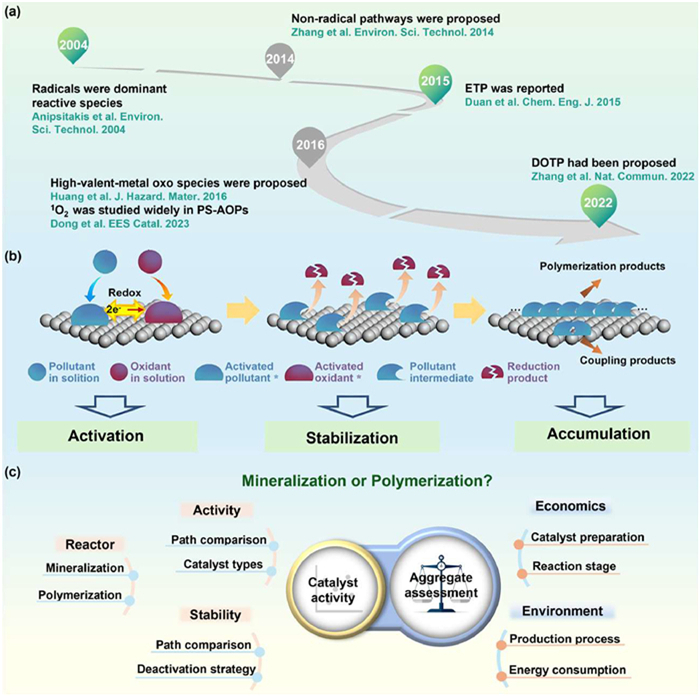
Fig. 1a illustrates the evolution of pollutant removal mechanism in PS-AOPs. The schematic clearly shows that, in addition to mineralization, polymerization also exists in PS-AOPs. Early studies suggested that pollutants were primarily degraded via radical routes [4]. As research deepened, oxidation processes expanded to non-radical routes with high selectivity and anti-interference capabilities [5], including electron transfer processes (ETP) [6], high-valent metal-based oxo species (HVMs) [7], and singlet oxygen (1O2) oxidation [8]. In 2017, Guan et al. first proposed that pollutants could be removed through polymerization [9]. In 2022, Zhang et al. proposed the direct oxidative transfer process (DOTP) to explain polymerization: pollutant and oxidant undergo electron transfer on catalyst surface, generating organic radicals that polymerize into surface-adhered polymers (Fig. 1b) [10]. Subsequent studies have confirmed that both radical and non-radical routes can initiate polymerization pathways [11–14]. For instance, Zhou et al. demonstrated that benzothiazole undergone both mineralization and polymerization under radical oxidation [15]. In peroxydisulfate/biochar (PDS/BC) system, phenol (PhOH) was removed through polymerization by electron transfer from PhOH to PDS-BC composites [16]. The above findings indicate that even under identical driving forces, pollutant removal can proceed through divergent pathways. A systematic comparison of mineralization and polymerization, coupled with comprehensive understanding of respective advantages, provides critical guidance for pathway selection in practical PS-AOPs applications.
Figure 1

Recent reviews have summarized pollutant transformation pathways in PS-AOPs, analyzed the kinetic and thermodynamic differences between polymerization and mineralization, and proposed strategies for process control and resource recovery [17–19]. Some have compared the advantages and limitations of polymerization and mineralization in selective oxidation and carbon recovery [20,21]. Others have summarized methods for reaction mechanism identification, the influence of pollutant properties on pathways, and proposed emerging mechanisms like direct oxidation transfer processes [21]. Existing reviews primarily focus on basic scientific issues such as reaction mechanisms, pathway regulation, and product characteristics. There is still a lack of engineering-oriented analyses that connect catalysts, reaction devices, and economic-environmental assessment across pathways. Furthermore, most studies are mostly based on laboratory-scale batch experiments, while practical wastewater treatment processes typically employ continuous or semi-continuous flow modes. Discrepancies in mass transfer behavior and system stability between two operational modes hinder the translation of the technology from laboratory research to engineering applications.
This review constructs and compares a multi-dimensional evaluation framework for the mineralization and polymerization pathways from an engineering application perspective (Fig. 1c). First, the difference in catalyst activity and stability between both pathways is analyzed, along with discussions on deactivation mechanisms and corresponding control strategies. This review further summarizes the operational characteristics of mineralization reactors, identifies key limitations of polymerization in continuous flow, and proposes a reactor design tailored to polymerization pathways. Based on continuous-flow data, the economic costs and environmental benefits of both pathways are evaluated. Finally, this review identifies major technological bottlenecks, emerging opportunities, and future research directions toward large-scale implementation, providing guidance for process optimization and practical deployment of PS-AOPs.
2. Catalyst performance comparison
2.1 Comparison of catalyst activity
In PS-AOPs, phenolic, aniline, thiophene, and vinyl pollutants can undergo both mineralization and polymerization reactions [17,19,22,23]. To explore differences in catalyst activation performance under distinct pathways, bisphenol A (BPA) and PhOH, which have been extensively studied, were selected as model pollutants [24–27]. Three metrics were employed to evaluate catalyst activity. (1) Normalized total organic carbon (TOC) removal rate constant (TOC-Normalization, Eq. 1); (2) Molar ratio of oxidant to pollutant (noxidant:npollutant); (3) Carbon equivalent oxidant utilization efficiency (ηC, Eq. 2).
(1) (2) where CPollutant, CCatalyst, and [PS] are the concentration of organic carbon in pollutants (mgC/L), catalyst dosage (g/L), and PS concentration (mmol/L), respectively. ΔTOC is the TOC removal efficiency, and t is reaction time (min). The constant 12 is the molar mass conversion factor for carbon (g/mol).
2.1.1 Catalyst activity: Mineralization vs. polymerization
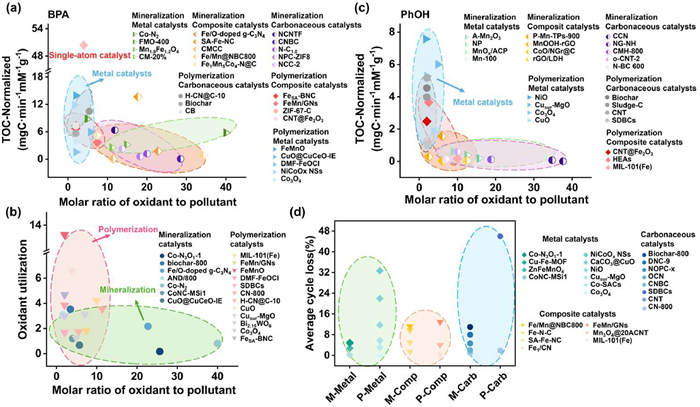
This review compared the TOC removal rates of BPA in mineralization and polymerization pathways under different catalysts (Fig. 2a, Table S1 in Supporting information). Results show that at low oxidant dosages (noxidant:ncatalyst = 1.8:1–10:1), polymerization achieves an average TOC removal of 10.72 per unit, approximately three times higher than that of mineralization (3.91 per unit). The marked difference originates from distinct reaction mechanisms. Mineralization relies on reactive oxygen species (ROS) to gradually oxidize pollutants into CO2, requiring multiple steps of ring-opening and small-molecule acid generation, which is a slow process with high oxidant consumption [19,20]. In contrast, polymerization generates intermediate radicals through electron transfer between pollutants and oxidants on catalyst surfaces [9,16], which then couple spontaneously into hydrophobic polymers stabilized. Polymerization achieves efficient TOC removal with lower oxidant demand [10,14,28]. It should be noted that the selection of mineralization or polymerization pathways is not determined by a single factor, but is closely associated with the catalyst-dominated activation pathways of PS [19]. Specifically, pathway selection is mainly regulated by two key factors: Intermediate radical concentration and system oxidative strength, along with the driving force for deep oxidation [18]. Systems characterized by mild oxidation and favorable intermediate enrichment tend to favor polymerization. While conditions with high steady-state concentrations of ROS or strong oxidative environments are more conducive to promoting mineralization. Therefore, different catalysts affect mineralization or polymerization by regulating PS activation, reactive species generation, and interfacial enrichment behaviors, as reflected in TOC removal and oxidant utilization efficiencies.
Figure 2
 Figure 2. (a) Comparison of TOC-Normalization for BPA. (b) Comparison of oxidant utilization efficiency. (c) Comparison of TOC-Normalization for PhOH. (d) Comparison of catalyst stability under mineralization and polymerization. Note: M- represents mineralization, P- represents polymerization; Metal, Comp, and Carb represent metal catalysts, metal-carbon composite catalysts, and carbonaceous catalysts, respectively. mM = mmol/L.
Mineralization can also achieve high TOC removal rates under specific conditions. As shown in Fig. 2a, at a similar oxidant dosage (noxidant:ncatalyst = 4.95:1), the fungal manganese oxide (FMO-400)/peroxymonosulfate (PMS) system achieved a TOC removal rate of 8.82 per unit [29], which is 1.4–5.3 times that of some polymerization-dominated systems [10,30,31]. The high efficiency stems from crystalline vernadite (δ-MnO2) crystals and layered structures with high specific surface area in FMO-400, which promote PMS activation to generate SO4•- and accelerate pollutant degradation. Additionally, the single-atom iron catalyst (SA-Fe-NC)/PMS system achieves 16.2 per unit TOC removal, attributed to high oxidant dosage (noxidant:ncatalyst = 20:1), which effectively promotes the deep mineralization of organic matter [32].
In addition to the TOC removal rate, this review further compares the oxidant utilization efficiency of two pathways by ηC (Fig. 2b). Typical phenolic pollutants (PhOH, BPA and 4-chlorophenol (4-CP), etc.) were selected as target analytes (Table S2 in Supporting information). Using ηC to measure organic carbon removal per unit of oxidant consumed improves comparability across pollutants. Results indicate that polymerization pathways generally exhibit higher ηC values (1.24–13.25) under low oxidant dosage conditions, whereas mineralization pathways show substantially lower ηC values (0.17–3.53). The discrepancy reflects the loss of oxidant utilization efficiency in mineralization pathways, which arises from multi-step deep oxidation processes and non-targeted oxidant consumption.
In summary, for conspecific catalysts, polymerization pathways generally exhibit higher TOC removal rates and oxidant utilization efficiencies than mineralization, demonstrating the potential for organic carbon removal. Nevertheless, certain mineralization-dominant systems can also attain high TOC when incorporating highly active metal oxides, single-atom structures, or high oxidant dosages. Therefore, the TOC removal efficiency depends not only on oxidant dosage but is driven by catalytic activity.
2.1.2 Catalyst types in polymerization
In PS-AOPs, the catalytic performance of mineralization pathways is well studied [33–35], with the activity trend well-established: metal-carbon composite catalysts > metal catalysts > carbonaceous catalysts, as shown in Figs. 2a and c. Accordingly, this review focused on polymerization and compared TOC removal rates of BPA under different catalyst conditions (Fig. 2a). Overall, TOC removal rates mediated by metal catalysts (3.83–50.4 per unit) are generally higher than those of carbonaceous catalysts (5.63–10.48 per unit) [10,24,36,37]. The disparity arises from differing electron transfer mechanisms among catalysts in PS activation. Metal catalysts activate PS through outer-sphere electron transfer to generate metastable complexes, resulting in slow reaction rates. The mild process allows intermediate radicals to stably adsorb on catalyst surfaces and promote chain growth, forming high degrees of polymerization (DP) products [17]. In addition, increased DP products enhance the hydrophobic interaction between polymers and catalyst surfaces, improving TOC removal [38]. In contrast, carbonaceous catalysts have high conjugated structures and excellent electrical conductivity, enabling rapid PS activation through inner-sphere electron transfer to generate a large number of intermediate radicals [39]. Excessive radicals are prone to chain termination reactions, generating oligomers that are difficult to adsorb on catalyst surfaces [17], thereby reducing TOC removal efficiency. Furthermore, excessive PS adsorption on carbonaceous catalysts can form high-potential oxidation complexes [17], oxidizing intermediate radicals into small molecules, inhibiting chain growth, and reducing polymer yield and TOC removal. Metal-carbon composites typically exhibit enhanced electron transfer capabilities, along with improved mechanical and chemical stability, as well as strong resistance to deactivation. Metal sites activate PS efficiently, while carbon frameworks provide conductive networks and microporous confinement, promoting the formation of intermediate radicals and chain growth, thereby enhancing polymerization efficiency. However, reports on metal-carbon composite catalysts are still limited at present. In the subsequent research, the advantages of composite catalysts should be fully exploited to explore polymerization. Single-atom catalysts also exhibit excellent catalytic activity. For example, the boron-induced Fe-N5 catalyst (FeSA-BNC)/PMS system achieved a TOC removal rate of 50.4 per unit [40], which is 4.2 times that of the FeMnO/PMS system [10]. The high efficiency stems from the Fe-N5 asymmetric coordination and carbon electron (C-e-) active sites formed by boron doping [40]. Both promote the formation of metastable complexes between PMS and catalysts, achieving efficient electron transfer and driving BPA polymerization.
A comparison of TOC removal rates for BPA and PhOH in polymerization pathways (Figs. 2a and b, Table S3 in Supporting information) reveals that pollutant structures significantly influence TOC removal rates. Although both are phenolic compounds with 3–4 active hydrogens, the maximum TOC removal rate of BPA is 6.7 times that of PhOH (Fig. 2c). Wang et al. defined the thermodynamic descriptor ΔE2e1p as the energy change when pollutants lose two electrons and one proton [41]. In multiple systems, including carbon nanotubes (CNT)/PDS, Co3O4/PMS, MnFe2O4/PMS, and CuO/PDS (Fig. S1 in Supporting information), the ΔE2e1p value of BPA is consistently lower than that of PhOH. and the lower value is consistent with higher TOC removal rates. The difference originates from BPA's higher highest occupied molecular orbital (HOMO) energy level (−7.28 eV for BPA and −7.73 eV for PhOH), making it more prone to oxidation to generate intermediate radicals. In addition, BPA contains two phenolic hydroxyl groups, which can provide multiple reaction sites, promoting the coupling and chain growth of intermediate radicals and accelerating TOC removal.
In summary, the TOC removal rates in polymerization are determined by the combined influence of catalyst architecture and pollutant molecular characteristics. Metal catalysts promote chain growth and generally have higher removal rates than carbonaceous catalysts. Single-atom catalysts exhibit extremely high activity due to the ability to precisely control electronic structure.
2.2 Catalyst stability comparison and deactivation control strategies
Long-term catalyst stability is a core bottleneck limiting engineering applications, directly impacting process economics [42]. Given distinct reaction mechanisms and product characteristics between mineralization and polymerization, catalyst deactivation behaviors vary significantly. Clarifying stability differences and deactivation mechanisms is crucial for developing reasonable reaction and regeneration strategies. This review compared the performance decay laws of catalysts in both pathways, clarified the dominant deactivation mechanisms, and proposed corresponding regulation strategies.
2.2.1 Catalyst stability: Mineralization vs. polymerization
Using a minimum pollutant degradation rate of 65% as the criterion (excluding carbonaceous catalysts in polymerization), this review evaluated the average activity decay rates (ηaverage, Eq. 3) of different catalysts in mineralization and polymerization (Fig. 2d, Table S4 in Supporting information). Catalyst stability in polymerization (ηaverage = 0%−42%) is less than half that in mineralization (ηaverage = 0.2%−16.5%). This instability primarily results from deposition of hydrophobic polymers on catalyst surfaces, which cover active sites and hinder mass transfer. For instance, bimetallic oxide nanosheets (NiCoOx NSs) (ηaverage = 32.7%) and sludge biochar (SDBCs) (ηaverage = 54%) exhibit significant activity loss after the second cycle, though performance can be restored by heat treatment [16,36]. Although both metal and carbonaceous catalysts show high decay rates in polymerization, the deactivation mechanisms differ. Metal catalysts tend to produce high DP and hydrophobic products that firmly adhere to surfaces, suppressing catalytic activity [38]. Carbonaceous catalysts featuring porous structures and high specific surface areas are more susceptible to pore blockage by polymerization products, accelerating deactivation. Although the organic carbon transfer process (OCTP) occurs in mineralization [43], it mainly yields hydrophilic small molecules that dissolve in aqueous phase, leading to significantly lower activity decay than polymerization.
(3) where n, η1 and ηn represent the total number of catalytic cycles, and the pollutant removal rates after the first and the nth uses, respectively.
In addition to product coverage, catalyst structural integrity significantly influences service life. Reactive species generated during reactions may attack catalysts, causing structural degradation or loss of active components and accelerating performance decline [44]. Even under mild ETP, carbonaceous catalysts are susceptible to oxidative deactivation [45]. Metal catalysts tend to undergo metal ion leaching in strongly reducing or acidic conditions [46], which shortens catalyst life and poses risks of secondary pollution. Furthermore, metal nanoparticles may agglomerate during pyrolysis or reactions, increasing particle size and reducing surface active sites, thereby accelerating deactivation [47]. Metal-carbon composite catalysts demonstrate enhanced stability. Diverse carbon precursors, including graphene, CNT, and carbon black are commonly used carbon precursors for synthesizing carbon-based catalysts. Carbon supports not only facilitate dispersion of metal particles but also strengthen metal-support interactions through chemical bonds such as M–Nx [42,48], improving resistance to leaching and long-term durability. Nevertheless, carbon is thermodynamically unstable and prone to corrosion and oxidation. Catalyst deactivation mechanisms can be summarized into three categories: (1) Physical passivation resulting from product deposition; (2) structural damage from ROS attack; (3) active sites losing induced by agglomeration of metal particles or ion leaching. Clarifying deactivation mechanisms provides a theoretical foundation for developing targeted enhancement and regeneration strategies.
In summary, catalyst stability in polymerization is considerably lower than that in mineralization, primarily due to physical passivation caused by polymer deposition. Therefore, future research should prioritize high-performance single-atom catalyst systems and metal catalyst systems. Concurrently, researchers should explore effective approaches to improve the stability of metal and carbonaceous catalysts to reduce catalyst consumption and associated operational costs in practical applications.
2.2.2 Catalyst deactivation control strategies
Based on aforementioned deactivation mechanisms, this review proposed stability enhancement strategies from catalyst design to process regulation, providing theoretical guidance for the development of efficient, stable, and recyclable catalytic systems (Fig. 3).
Figure 3
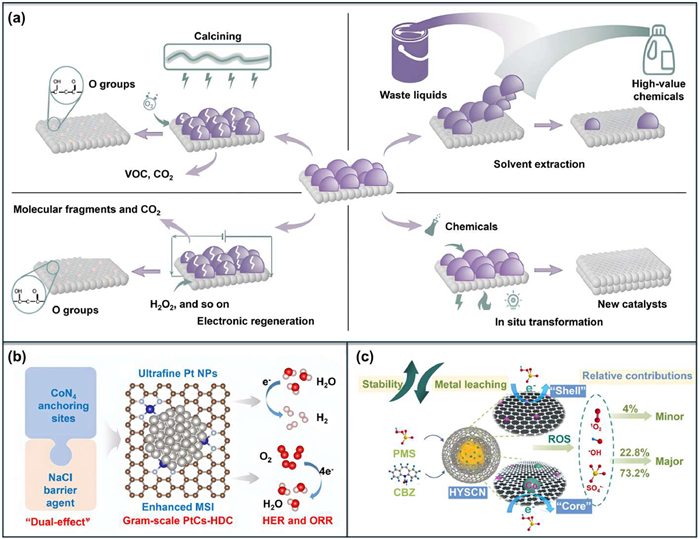
 Figure 3. (a) Existing and potential catalyst-regeneration methods. Reprinted with permission [43,52]. Copyright 2024, Springer Nature. (b) Synthetic strategy of PtNPs/CoNC. Reprinted with permission [55]. Copyright 2023, American Chemical Society. (c) Pivotal roles of N-doped carbon shell and hollow structure with spatial confined Co species in PS activation. Reprinted with permission [56]. Copyright 2022, Elsevier.
To mitigate physical passivation caused by product deposition, preventive regulation and deactivation regeneration can be adopted. For preventive regulation, the adsorption and accumulation of organic matter can be inhibited by enhancing the surface polarity of the catalyst [43]. A moderate increase in oxidant dosage promotes timely degradation of deposited organics by ROS, delaying passivation. For regeneration, high-temperature calcination, solvent washing, and energy field assistance effectively restore catalytic activity (Fig. 3a). High-temperature calcination can effectively decompose surface organic deposits, though temperature must be carefully controlled to prevent structural degradation [16]. Polar-matched solvents such as methanol and toluene can dissolve organic matter on catalyst surfaces [49]. Electrochemical polarization, ultraviolet (UV) irradiation, and microwave treatment facilitate decomposition and removal of organic layers by inducing ROS generation [50,51]. The “in situ transformation” strategy utilizes external reagents or energy inputs to convert deposited polymers into catalytically active species, achieving “zero-waste” regeneration and resource recovery [52]. It should be noted that regeneration processes need to be evaluated for reagent and energy costs to ensure overall process sustainability.
To mitigate catalyst structural damage caused by strongly oxidizing reactive species, regulation strategies can be performed from three aspects: Catalyst design, reaction operation, and deactivation regeneration. In catalyst design, the electron structure and surface chemical properties of catalysts can be modulated to convert intense radical reactions into milder non-radical reactions, fundamentally reducing damage to catalyst framework. In addition, stable materials, such as nano-carbon, metal oxides and carbides can be used as substrates to enhance the structural stability of catalysts, thereby effectively resisting the attack of ROS. During reaction operation, stepwise and low-concentration oxidant addition is preferred over conventional single high-dose dosing, effectively minimizing transient impact of high-concentration ROS and enhancing oxidant utilization efficiency. For catalysts suffering from oxidative damage, thermal treatment can effectively remove excess surface oxygen-containing functional groups, thus restoring both active sites and catalytic performance [53].
Metal ion leaching and agglomeration mainly result from the migration of metal species. To inhibit migration, regulation can be approached through two aspects: Electronic structure and spatial configuration. At electronic level, employing stable supports and introducing heteroatoms or defects can enhance metal–support interactions and increase the migration energy barrier of metal atoms [54]. As shown in Fig. 3b, Zhang et al. doped cobalt into carbon-supported platinum catalysts (PtNPs/CoNC), constructing Co-N4 active sites, which enhanced the electron transfer between support and platinum nanoparticles [55]. The interaction suppressed atom migration and thermal diffusion, improving nanoparticle stability and conferring high catalytic activity and long-term durability. At spatial level, constructing confined structures such as hollow carbon spheres and nanotubes can provide effective physical confinement for metal species, restricting metal migration. As illustrated in Fig. 3c, hollow yolk-shell nanoreactor (HYSCN) features a nitrogen-doped carbon shell and a hollow interior, which collectively inhibit cobalt ion leaching, facilitate electron transfer and mass diffusion, and improve both catalytic activity and structural stability [56].
2.3 Reactor comparison
As PS-AOPs transition from laboratory research to engineering applications, conventional suspension systems exhibit limitations in catalyst stability and mass transfer efficiency [48,57,58], hindering the engineering implementation. In addition to rational catalyst design, optimizing reactor configuration and operational parameters is crucial for achieving efficient pollutant removal. This section evaluated reactor configurations for mineralization and polymerization pathways and discussed the key technical bottlenecks and corresponding design directions for polymerization-oriented reactors.
2.3.1 Engineering foundation and application status of mineralization pathways reactors
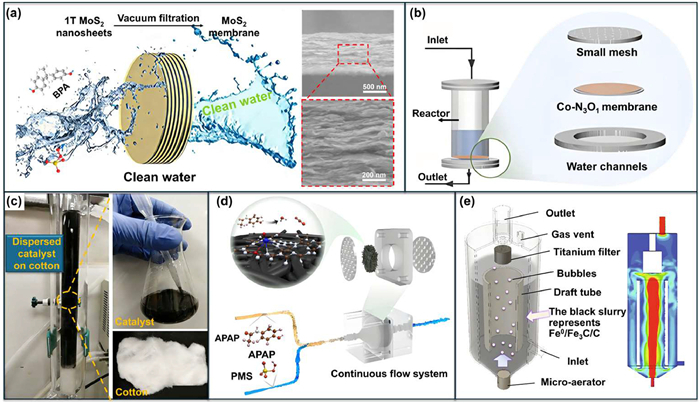
For mineralization, researchers have developed various reactors suitable for scaling up reaction [59–61], including catalytic membrane reactors, catalytic filters, and fluidized bed reactors. Catalytic membrane reactors utilize microporous structures and directional mass transfer channels to concentrate pollutants, oxidants, and active sites, shorten the migration distance of ROS, and accelerate mineralization kinetics [62–64]. For instance, membranes fabricated from 1T-phase molybdenum disulfide (MoS2) nanosheets exhibit uniform interlayer spacing and abundant nanochannels, enabling efficient generation of reactive oxygen ROS (Fig. 4a) [65]. Over 90% BPA oxidation efficiency can be sustained under long-term continuous flow conditions, while maintaining low molybdenum leaching levels (Fig. S2 in Supporting information). Wang et al. fabricated cobalt atoms with dual nitrogen and oxygen coordination (Co-N3O1) catalytic membrane with abundant nanochannels, promoting rapid permeation and deep degradation of contaminants (Fig. 4b) [66]. During continuous operation over 10 h with a residence time of only 312 milliseconds (ms), ciprofloxacin removal exceeded 97.5%, and TOC removal remained above 50%. However, flux decline and limited stability due to membrane fouling remain key challenges for practical implementation. Catalytic filters improve reaction stability by loading catalysts on porous supports such as carbon felt and natural fibers. Zhu et al. employed absorbent cotton as the catalyst support, which facilitated the uniform dispersion and robust immobilization of the catalyst on cotton fibers (Fig. 4c) [67]. The configuration effectively mitigates catalyst leaching while enhancing the efficient contact between reactants and the catalyst. Wu et al. achieved over 85% pollutant removal after 36 h of continuous operation with a carbon felt-based system and significantly reduced cobalt leaching, demonstrating strong operational stability (Fig. 4d) [68]. Fluidized bed reactors enhance solid-liquid contact efficiency through the suspension of catalyst particles in flowing fluids (Fig. 4e) [60]. To minimize catalyst loss, granular formulations are commonly employed to enhance mechanical strength and prevent clogging. Huang et al. immobilized Cu-Fe-Mn spinel oxide (CuFeMnO) on commercial ceramsite, achieving stable and efficient degradation in a pilot-scale fluidized bed reactor treating real wastewater [69]. In addition, prior studies have validated the feasibility of mineralization pathways under conditions approximating real-world engineering scenarios. Xing et al. immobilized catalysts onto polypropylene suspended carriers for the treatment of high-load thermal desorption wastewater from soil remediation (Fig. S3 in Supporting information) [61]. Within 2 h, total soluble solids (TSS) and chemical oxygen demand (COD) removal efficiencies reached 99% and 77% respectively, outperforming the control without catalyst immobilization. The performance indicates favorable engineering compatibility and promising application prospects.
Figure 4
 Figure 4. (a) Scheme of BPA removal by MoS2 membrane. High-magnification scanning electron microscopy (SEM) images of MoS2 membrane. Reprinted with permission [65]. Copyright 2019, John Wiley & Sons, Inc. (b) Schematic diagram of the water treatment process with Co-N3O1 membranes applied to a continuous flow system. Reprinted with permission [66]. Copyright 2022, Gesellschaft Deutscher Chemiker. (c) Photos of the catalytic column, the catalyst dispersion solution, and absorbent cotton. Reprinted with permission [67]. Copyright 2022, Elsevier. (d) Schematic diagram of the continuous flow of O-doped catalyst (Co-OCN)/PMS system. Reprinted with permission [68]. Copyright 2023, National Academy of Sciences. (e) Diagram of a circulating fluidized bed. Reprinted with permission [60]. Copyright 2022, Elsevier.
Overall, engineered reaction systems enhance ROS utilization efficiency by reducing the migration distance between ROS and pollutants, thereby significantly improving pollutant removal in mineralization. However, most existing systems remain at laboratory scale, and catalytic reactors suitable for large-scale applications are still limited.
2.3.2 Engineering bottlenecks and adaptive design for polymerization pathways reactors
Compared with mineralization, polymerization pathways exhibit distinct laboratory-scale advantages, particularly achieving high TOC removal even at low oxidant dosages, implying potential low-carbon characteristics.
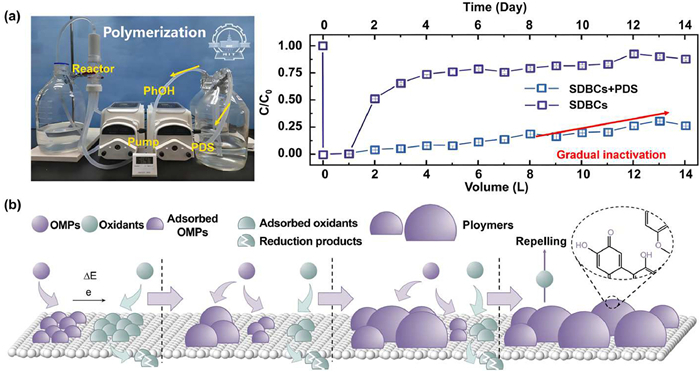
In recent years, preliminary continuous flow systems, such as catalytic filters and fluidized-bed reactors, have been used to evaluate long-term performance of catalysts in polymerization [13,16,24,40]. Yang et al. loaded SDBC-100 onto carbon felt to fabricate catalytic filters and evaluated operational stability under continuous flow mode in polymerization pathways (Fig. 5a) [16]. As the volume of treated water increased, pollutant degradation efficiency gradually declined, which is likely due to polymer adhesion on catalyst surfaces interfering with the reaction process. As shown in Fig. 5b, polymers are generated and robustly anchored onto catalyst surface, progressively covering the active sites [52]. The coverage impedes the diffusion of oxidants toward the catalyst surface and disrupts the electron transfer process. Thus, compared to mineralization, the main barrier to engineering-scale application of polymerization is the accumulation of hydrophobic polymers, which causes catalyst deactivation. However, targeted reactor designs to address the issue remain limited.
Figure 5

Therefore, polymerization-oriented reactor design should maintain efficient polymerization while minimizing deactivation and ensuring long-term continuous operation. First, a solvent-enhanced backwashing system strategy was proposed by adapting concepts from membrane bioreactors [70–72]. Suitable organic solvents such as methanol and toluene are used as backwashing media to enable deep cleaning of catalyst surfaces. Solvent reuse and polymer resource recovery are achieved through distillation processes, establishing a closed-loop process of “cleaning, recovery, and regeneration”. In addition, an electrochemical regeneration unit was proposed for integration into the reactor system, based on anodic oxidation and electro-assisted desorption. Anodic oxidation generates ROS in situ on the catalyst surface by applying voltage, achieving the oxidative degradation of the polymer layer [43]. Electro-assisted desorption reduces polymer–catalyst interactions by tuning the electrode potential, promoting the desorption of the polymer for resource recovery. By adjusting voltage and current density, electrochemical regeneration can achieve deep degradation or controlled desorption of polymers, providing a flexible strategy for maintaining catalytic activity over the long term [51]. Under specific conditions, a deactivated polymer layer can be in situ converted into a catalytically active layer [52]. Precise regulatory ability renders electrochemical regeneration a highly promising intelligent regeneration approach in academic scenarios. In structural design, a modular configuration encapsulates catalysts into standardized, easily replaceable units. Modularity facilitates off-site centralized regeneration of deactivated modules, significantly enhancing maintenance efficiency and operational flexibility [73].
In summary, the core design principle of mineralization reactors is to enhance mass transfer between ROS and pollutants to achieve complete degradation. For polymerization reactors, the primary focus lies in mitigating catalyst passivation and enabling sustainable operation while maintaining high polymerization efficiency. Adopting pathway-specific reactor design strategies tailored to the physicochemical characteristics of distinct reaction pathways is critical for advancing the large-scale implementation of PS-AOPs technology.
3. Comprehensive evaluation: Mineralization vs. polymerization
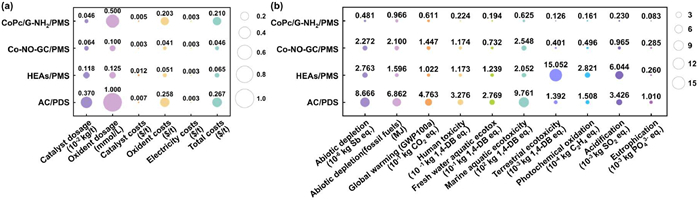
Economic and environmental benefit assessments serve as critical foundations for promoting the large-scale application of PS-AOPs, providing essential decision-making support for process selection and system optimization [74]. Based on industrial-scale amplification data from four continuous flow systems (Texts S1 and S2, and Table S5 in Supporting information), this review evaluated the economic and environmental impacts of treating one ton of PhOH-containing wastewater (Figs. 6a and b). The activated carbon (AC)/PDS and high-entropy alloys (HEAs)/PMS systems are dominated by polymerization [10,28], while the nitrogen-oxygen co-doped carbon (Co-NO-GC)/PMS and the amino-modified cobalt phthalocyanine anchored on graphene (CoPc/G-NH2)/PMS systems are dominated by mineralization [75,76].
Figure 6

3.1 Economic evaluation
The economic assessment covers catalyst preparation, the reaction stage, and catalyst regeneration (Table S6 in Supporting information). As shown in Fig. 6a, the total cost of the four systems from low to high are CoPc/G-NH2/PMS (0.046 $/t) < HEAs/PMS (0.0652 $/t) < Co-NO-GC/PMS (0.210 $/t) < AC/PDS (0.2675 $/t). Oxidant expenditure is the dominant component, accounting for 78%−96% of total cost (Fig. 6a). The AC/PDS system has the highest cost due to a 1 mmol/L oxidant dosage. The HEAs/PMS system achieves efficient treatment at only 0.125 mmol/L PMS, supported by strong catalytic activity, which lowers cost to 0.065 $/t. Mineralization systems present a cost advantage owing to lower oxidant concentrations. The higher oxidant demand of polymerization is mainly due to higher requirements for pollutant concentrations. Pollutant concentrations in AC/PDS and HEAs/PMS are approximately 2–50 times those in mineralization systems. High pollutant load increases oxidant consumption, weakens economic competitiveness, and may underestimate the economic potential of polymerization. In addition, polymerization shows a slightly higher average catalyst cost (0.0095 $/t), approximately 2.4 times that of mineralization, mainly attributed to shorter catalyst life and higher regeneration frequency in polymerization. In terms of treatment cost per unit mass of phenol, the average treatment cost of polymerization systems is 12.6 times that of mineralization, indicating that polymerization pathways are more suitable for the treatment of high-concentration wastewater (Table S7 in Supporting information). Catalysts used in mineralization exhibit more stable structures, which supports superior long-term economics. Therefore, enhancing catalyst stability is crucial for optimizing the economic performance of polymerization.
In summary, mineralization systems are suitable for the purification of low-concentration wastewater, whereas polymerization systems are preferable for treating high-concentration wastewater. In the future, combining pollutant enrichment technologies is expected to reduce the cost of polymerization systems. Regardless of reaction pathways, oxidant expense accounts for the largest proportion of treatment cost. Therefore, subsequent process optimization should reasonably regulate oxidant dosage on the premise of ensuring catalytic activity and operational stability to improve overall economic benefits.
3.2 Environmental evaluation
Evaluation of system application potential should not rely solely on pollutant degradation efficiency, but also consider environmental and human health impacts from waste emissions and resource consumption [77,78]. This review uses life cycle assessment (LCA) to analyze the environmental impacts of treating 1 ton of wastewater in four systems, covering stages such as catalyst preparation, reaction operation, and waste treatment (Fig. 6b). Calculation process results are shown in Tables S8-S10 (Supporting information).
As shown in Fig. 6b, the environmental burden of polymerization systems is higher than that of mineralization systems. The differences are mainly affected by the combined effects of oxidant dosage and catalyst preparation processes (Fig. S4 in Supporting information). In the AC/PDS and Co-NO-GC/PMS systems with high oxidant dosages, the production and application processes of oxidants constitute the main source of environmental impacts. The terrestrial ecotoxicity of the HEAs/PMS system (1.51 × 10⁻² kg 1,4-DB eq.) is approximately 10–114 times higher than that of other systems. The substantial environmental burden is primarily attributed to the synthesis of HEAs, which involves the use of metal precursors and large quantities of organic solvents. Polymerization products possess a recoverable calorific value, with the chemical energy of phenol dimers amounting to approximately 31 MJ/kg, which serves as the basis for assessing the thermal energy recovery potential. The results indicate that even 50% waste heat recovery efficiency, the recovered energy covers only 0.002% of the catalyst regeneration energy demand, leading to negligible improvements in overall energy consumption and environmental impact.
In summary, differences in environmental burden are mainly influenced by oxidant dosage and catalyst preparation, with oxidants representing the main contributing factor. To improve the environmental benefits of polymerization pathways, it is necessary to reduce the environmental burden associated with catalyst regeneration by improving its stability. Furthermore, future efforts should focus on developing efficient and low-energy polymer resource recovery technologies to fully realize the potential value of polymers.
4. Future perspectives and outlook
PS-AOPs are currently at a pivotal stage of transitioning from laboratory research to engineering-scale application. To facilitate large-scale and sustainable development, future research needs to make breakthroughs in the following three directions.
(1) Breaking bottlenecks of polymerization in “process, product, and equipment”.
Although polymerization represents a promising paradigm for low-carbon water treatment, its practical implementation faces challenges across three dimensions: Process, product, and equipment. At process level, the controllability of the molecular weight distribution and composition is inadequate. which can be improved through the construction of efficient catalytic active sites, optimization of reaction conditions, and precise control of pollutant concentrations. At product level, current separation technologies, such as solvent extraction and membrane filtration, are costly and prone to secondary pollution. The foundation for polymer recovery and high-value utilization remains limited. Future efforts should develop green, energy-efficient separation technologies and promote technological breakthroughs in high-value utilization of polymers. At equipment level, existing reactors are prone to catalyst deactivation due to polymer coverage. Thus, engineering scale-up must not only prioritize pollutant removal efficiency but also establish a closed-loop operational framework encompassing deposition control, in situ regeneration and long-term stability. The integration of in situ backwashing or electrochemical regeneration modules within the reactor facilitates the periodic removal of fouling layers and efficient recovery of catalytic activity. Meanwhile, long-term operation should be validated under real wastewater matrices and continuous flow conditions. Key performance indicators, including deposition rate, deactivation threshold, and regeneration efficiency, should be quantified, and boundary conditions for resource recovery and secondary pollution control should be clearly defined.
(2) Transformation from a single pathway to synergistic multidimensional pathways.
Mineralization enables complete pollutant removal by leveraging deep oxidative capacity, yet is typically associated with substantial oxidant consumption and energy expenditure. Polymerization offers economic advantages in treating high-concentration wastewater with low oxidant consumption. To balance treatment efficiency, cost, and environmental benefits, future research should move beyond the “either-or” single-pathway paradigm and develop integrated processes with synergistic effects. In such systems, polymerization can serve as a pretreatment step to concentrate and remove high-concentration organic pollutants, enabling simultaneous carbon resource recovery. Subsequently, mineralization is applied for deep purification to ensure effluent quality. The synergistic strategy overcomes the limitations of single pathways and achieves systematic optimization of treatment performance. Implementation of synergistic processes requires considering interfacial interactions between upstream and downstream unit operations, such as toxicological risks from residual oxidants and byproducts. Long-term stability testing should be conducted under real wastewater and continuous-flow conditions to quantify key parameters, including deposition rate, deactivation threshold and in situ regeneration efficiency, to support engineering-scale deployment. In addition, exploring synergistic integration of PS-AOPs with complementary technologies, such as membrane separation and biological treatment [79], is a key direction toward high-efficiency, sustainable water treatment systems.
(3) Data-driven and artificial intelligence (AI) assisting the development of PS-AOPs.
Currently, research on precise control of mineralization and polymerization pathways remains limited, which hinders the refined development of PS-AOPs. There is an urgent need to conduct a systematic study into the controllable regulation of reaction pathways. A multi-dimensional database encompassing catalyst characteristics, pollutant structures, reaction conditions, and performance outputs should be established. Machine learning approaches can be employed to identify key descriptors governing pathway selection [80,81], enabling a fundamental shift from empirical screening to precision regulation. Second, data-driven models can link water quality characteristics to oxidant requirements, enabling prediction and optimization of dosing strategies while reducing operational costs and environmental impacts. AI-driven PS-AOPs are expected to reduce reagent consumption and operating costs while maintaining treatment effects, alongside reducing carbon emissions, thereby enhancing the feasibility for engineering.
Through advances in these fields, PS-AOPs are emerging as an advanced water treatment technology that integrates resource recovery, energy efficiency, and environmental sustainability.
CRediT authorship contribution statement
Ning Li: Writing – review & editing, Supervision, Conceptualization. Mengwei Zhang: Writing – original draft, Visualization, Formal analysis. Xianglin Chang: Writing – review & editing. Shouqiang Wan: Writing – review & editing. Yangli Cui: Writing – review & editing. Yukun Hao: Writing – review & editing. Beibei Yan: Writing – review & editing. Guanyi Chen: Writing – review & editing, Supervision.
Declaration of competing interest
The authors declare that they have no known competing financial interests or personal relationships that could have appeared to influence the work reported in this paper.
Acknowledgments
This work was supported by the Tianjin Natural Science Foundation (No. 24JCYBJC01290), the National Natural Science Foundation of China (No. 52570170), the Young Scientific and Technological Talents (Level Two) in Tianjin (No. QN20230214), the Climbing Program of Tianjin University (No. 2023XPD-0006) and the National Key R&D Program (No. 2024YFC3908903).
Supplementary materials
Supplementary material associated with this article can be found, in the online version, at doi:
10.1016/j.cclet.2026.112854 .
-
-
[1]
F. Ghanbari, M. Moradi, Chem. Eng. J. 310 (2017) 41–62. doi: 10.1016/j.cej.2016.10.064
-
[2]
Z. Zhou, X. Liu, K. Sun, et al., Chem. Eng. J. 372 (2019) 836–851. doi: 10.1016/j.cej.2019.04.213
-
[3]
R. Xiao, Z. Luo, Z. Wei, et al., Curr. Opin. Chem. Eng. 19 (2018) 51–58. doi: 10.1016/j.coche.2017.12.005
-
[4]
G.P. Anipsitakis, D.D. Dionysiou, Environ. Sci. Technol. 38 (2004) 3705–3712. doi: 10.1021/es035121o
-
[5]
T. Zhang, Y. Chen, Y. Wang, et al., Environ. Sci. Technol. 48 (2014) 5868–5875. doi: 10.1021/es501218f
-
[6]
H. Lee, H.J. Lee, J. Jeong, et al., Chem. Eng. J. 266 (2015) 28–33. doi: 10.1016/j.cej.2014.12.065
-
[7]
Z. Huang, Y. Yao, J. Lu, et al., J. Hazard. Mater. 301 (2016) 214–221. doi: 10.1016/j.jhazmat.2015.08.063
-
[8]
C.C. Dong, Q.Y. Yi, J.H. He, et al., EES Catal. 1 (2023) 103–116. doi: 10.1039/d2ey00107a
-
[9]
C. Guan, J. Jiang, S. Pang, et al., Environ. Sci. Technol. 51 (2017) 10718–10728. doi: 10.1021/acs.est.7b02271
-
[10]
Y.J. Zhang, G.X. Huang, L.R. Winter, et al., Nat. Commun. 13 (2022) 3005. doi: 10.1038/s41467-022-30560-9
-
[11]
J.Y. Li, Z.Q. Liu, Y.H. Cui, et al., Environ. Sci. Technol. 57 (2023) 18575–18585. doi: 10.1021/acs.est.2c06137
-
[12]
S.Q. Yang, R.Q. Ye, Y.H. Cui, et al., J. Hazard. Mater. 472 (2024) 134498. doi: 10.1016/j.jhazmat.2024.134498
-
[13]
C. Wang, S.Y. Jia, Y. Han, et al., ACS ES&T Eng. 1 (2021) 1275–1286. doi: 10.1021/acsestengg.1c00091
-
[14]
H.Z. Liu, X.X. Shu, M. Huang, et al., Nat. Commun. 15 (2024) 2327. doi: 10.1038/s41467-024-46739-1
-
[15]
L. Zhou, Z. Xu, C. Hua, et al., Chemosphere 287 (2022) 131982. doi: 10.1016/j.chemosphere.2021.131982
-
[16]
Y. Yang, Z. Song, W. Ren, et al., App. Catal. B: Environ. 359 (2024) 124470. doi: 10.1016/j.apcatb.2024.124470
-
[17]
Y. Yang, W. Ren, K. Hu, et al., Chem Catal. 2 (2022) 1858–1869.
-
[18]
J. Qian, X. Zhang, Y. Jia, et al., Environ. Sci. Technol. 59 (2025) 1060–1079. doi: 10.1021/acs.est.4c10073
-
[19]
J. Rui, L. Zhang, Y. Li, et al., App. Catal. B: Environ. 380 (2026) 125747. doi: 10.1016/j.apcatb.2025.125747
-
[20]
P. Zhang, Y. Yang, X. Duan, et al., Water Res. 255 (2024) 121485. doi: 10.1016/j.watres.2024.121485
-
[21]
X. Zhao, Z. Zhang, Environ. Sci. Technol. 59 (2025) 5913–5924. doi: 10.1021/acs.est.4c11311
-
[22]
S.Q. Zhi, J.Y. Zhang, S.H. Wu, et al., Ind. Eng. Chem. Res. 62 (2023) 3909–3920. doi: 10.1021/acs.iecr.2c04484
-
[23]
J. Song, H.S. Yi, J.L. Zhang, et al., J. Environ. Chem. Eng. 12 (2024) 112817. doi: 10.1016/j.jece.2024.112817
-
[24]
Q. Wang, Z. Guan, Y. Xiong, et al., J. Colloid Interface Sci. 634 (2023) 231–242. doi: 10.1007/s11682-023-00813-2
-
[25]
X. Liu, J. Zhou, Q. Xia, et al., J. Hazard. Mater. 443 (2023) 130178. doi: 10.1016/j.jhazmat.2022.130178
-
[26]
L. Liu, Q. Liu, Y. Wang, et al., App. Catal. B: Environ. 254 (2019) 166–173. doi: 10.1016/j.apcatb.2019.04.094
-
[27]
E. Saputra, J.A. Pinem, M.A. Budihardjo, et al., Mater. Today Chem. 16 (2020) 100268. doi: 10.1016/j.mtchem.2020.100268
-
[28]
Z. Yao, Y. Chen, X. Wang, et al., Nat. Commun. 16 (2025) 148. doi: 10.1038/s41467-024-55627-7
-
[29]
Y. Xie, P. Li, Y. Zeng, et al., Chem. Eng. J. 335 (2018) 728–736. doi: 10.1016/j.cej.2017.11.025
-
[30]
R. Wang, H. Chen, L. Zhang, et al., Chem. Eng. J. 487 (2024) 150214. doi: 10.1016/j.cej.2024.150214
-
[31]
Y. Ding, S. Zuo, D. Li, et al., ACS Appl. Mater. Interfaces 15 (2023) 5058–5070. doi: 10.1021/acsami.2c16396
-
[32]
Y. Gao, Y. Zhu, T. Li, et al., Environ. Sci. Technol. 55 (2021) 8318–8328. doi: 10.1021/acs.est.1c01131
-
[33]
I.C. Gerber, P. Serp, Chem. Rev. 120 (2020) 1250–1349. doi: 10.1021/acs.chemrev.9b00209
-
[34]
D. Wang, Z. Wang, J. Xiong, et al., ChemCatChem 17 (2025) e00182. doi: 10.1002/cctc.202500182
-
[35]
N. Li, J. Ye, H. Dai, et al., Water Res. 235 (2023) 119926. doi: 10.1016/j.watres.2023.119926
-
[36]
M.M. Wang, P.X. Liu, F. Ye, et al., Environ. Int. 184 (2024) 108466. doi: 10.1016/j.envint.2024.108466
-
[37]
Y.J. Zhang, J.S. Tao, H.Q. Yu, Environ. Sci. Technol. 59 (2025) 11935–11944. doi: 10.1021/acs.est.5c05273
-
[38]
J.Y. Liu, P.J. Duan, M.X. Li, et al., Environ. Sci. Technol. 58 (2024) 12155–12166. doi: 10.1021/acs.est.4c05008
-
[39]
Y. Chen, W. Ren, T. Ma, et al., Environ. Sci. Technol. 58 (2024) 4844–4851. doi: 10.1021/acs.est.3c06376
-
[40]
Y. Deng, Y. Zhou, Z. Song, et al., Angew. Chem. Int. Ed. 64 (2025) e202509493. doi: 10.1002/anie.202509493
-
[41]
Z.H. Wang, G.X. Huang, Y.J. Zhang, et al., Environ. Sci. Technol. 59 (2025) 6097–6105. doi: 10.1021/acs.est.4c13406
-
[42]
Y. Shang, X. Xu, B. Gao, et al., Chem. Soc. Rev. 50 (2021) 5281–5322. doi: 10.1039/d0cs01032d
-
[43]
Z. Chen, J. Wang, B. Yang, et al., Nat. Water 3 (2025) 334–344. doi: 10.1038/s44221-025-00399-7
-
[44]
J. Saien, F. Jafari, Methods of persulfate activation for the degradation of pollutants: fundamentals and influencing parameters, in: M. Zhu, Z. Bian, C. Zhao (Eds.), Persulfate-based Oxidation Processes in Environmental Remediation, The Royal Society of Chemistry, 2022, pp. 1–59.
-
[45]
J. Yu, Z. Gong, S. Wang, et al., App. Catal. B: Environ. 364 (2025) 124850. doi: 10.1016/j.apcatb.2024.124850
-
[46]
P. Hu, M. Long, App. Catal. B: Environ. 181 (2016) 103–117. doi: 10.1016/j.apcatb.2015.07.024
-
[47]
S. Su, W. Guo, Y. Leng, et al., J. Hazard. Mater. 244-245 (2013) 736–742. doi: 10.1016/j.jhazmat.2012.11.005
-
[48]
Q. Tian, Y. Jiang, X. Duan, et al., Water Res. 268 (2025) 122621. doi: 10.1016/j.watres.2024.122621
-
[49]
Z. Chen, M. Xing, ACS Environ. Au. 5 (2025) 148–151. doi: 10.1021/acsenvironau.4c00063
-
[50]
X. Cheng, H. Guo, Y. Zhang, et al., Water Res. 157 (2019) 406–414. doi: 10.1016/j.watres.2019.03.096
-
[51]
O. Garcia-Rodriguez, A. Villot, H. Olvera-Vargas, et al., Carbon 163 (2020) 265–275. doi: 10.1016/j.carbon.2020.02.041
-
[52]
P.J. Duan, J.Y. Liu, L. Chen, et al., Nat. Water 3 (2025) 178–190. doi: 10.1038/s44221-024-00377-5
-
[53]
X. Duan, Z. Ao, L. Zhou, et al., App. Catal. B: Environ. 188 (2016) 98–105. doi: 10.1016/j.apcatb.2016.01.059
-
[54]
H. Zhao, X. Xu, W. Cui, et al., Adv. Mater. 37 (2025) 2503217. doi: 10.1002/adma.202503217
-
[55]
J. Zhang, A. Lv, J. An, et al., ACS Appl. Nano Mater. 6 (2023) 22320–22332. doi: 10.1021/acsanm.3c04529
-
[56]
Z. Wu, Z. Xiong, R. Liu, et al., J. Hazard. Mater. 427 (2022) 128204. doi: 10.1016/j.jhazmat.2021.128204
-
[57]
Q.V. Ly, L. Cui, M.B. Asif, et al., Water Res. 230 (2023) 119577. doi: 10.1016/j.watres.2023.119577
-
[58]
S. Zhang, M. Sun, T. Hedtke, et al., Environ. Sci. Technol. 54 (2020) 10868–10875. doi: 10.1021/acs.est.0c02192
-
[59]
F. Chen, Y.J. Sun, X.T. Huang, et al., Proc. Natl. Acad. Sci. U. S. A. 121 (2024) e2314396121. doi: 10.1073/pnas.2314396121
-
[60]
J. Li, H. Liu, H. Lan, et al., Chem. Eng. J. 398 (2020) 125565. doi: 10.1016/j.cej.2020.125565
-
[61]
L. Zhu, Q. Yan, M. Ran, et al., Sci. Bull. 68 (2023) 892–896. doi: 10.1016/j.scib.2023.04.011
-
[62]
J. Guo, B. Gao, Q. Li, et al., Adv. Mater. 36 (2024) 2403965. doi: 10.1002/adma.202403965
-
[63]
C. Meng, B. Ding, S. Zhang, et al., Nat. Commun. 13 (2022) 4010. doi: 10.1038/s41467-022-31807-1
-
[64]
K. Yin, L. Peng, D. Chen, et al., App.Catal. B: Environ. 336 (2023) 122951. doi: 10.1016/j.apcatb.2023.122951
-
[65]
Y. Chen, G. Zhang, H. Liu, et al., Angew. Chem. Int. Ed. 58 (2019) 8134–8138. doi: 10.1002/anie.201903531
-
[66]
Z. Wang, E. Almatrafi, H. Wang, et al., Angew. Chem. Int. Ed. 61 (2022) e202202338. doi: 10.1002/anie.202202338
-
[67]
C. Zhu, Y. Nie, S. Zhao, et al., App. Catal. B: Environ. 305 (2022) 121057. doi: 10.1016/j.apcatb.2021.121057
-
[68]
Q.Y. Wu, Z.W. Yang, Z.W. Wang, et al., Proc. Natl. Acad. Sci. U. S. A. 120 (2023) e2219923120. doi: 10.1073/pnas.2219923120
-
[69]
M. Huang, Y.S. Li, C.Q. Zhang, et al., Proc. Natl. Acad. Sci. U. S. A. 119 (2022) e2202682119. doi: 10.1073/pnas.2202682119
-
[70]
H. Chang, H. Liang, F. Qu, et al., J. Membr. Sci. 540 (2017) 362–380. doi: 10.1016/j.memsci.2017.06.077
-
[71]
A. Vargas, I. Moreno-Andrade, G. Buitrón, J. Membr. Sci. 320 (2008) 185–190. doi: 10.1016/j.memsci.2008.03.073
-
[72]
Y. Men, Z. Li, L. Zhu, et al., Sci. Total Environ. 869 (2023) 161775. doi: 10.1016/j.scitotenv.2023.161775
-
[73]
L.C. Brée, M. Wessling, A. Mitsos, Comput. Chem. Eng. 139 (2020) 106890. doi: 10.1016/j.compchemeng.2020.106890
-
[74]
J. Wunderlich, K. Armstrong, G.A. Buchner, et al., J. Cleaner Prod. 287 (2021) 125021. doi: 10.1016/j.jclepro.2020.125021
-
[75]
W. Peng, D. Li, D. Qin, et al., Chem. Eng. J. 519 (2025) 165195. doi: 10.1016/j.cej.2025.165195
-
[76]
B. Huang, X. Ren, J. Zhao, et al., Environ. Sci. Technol. 57 (2023) 14071–14081. doi: 10.1021/acs.est.3c04712
-
[77]
D. Zu, J. Liu, H. Wei, et al., Water Res. 279 (2025) 123489. doi: 10.1016/j.watres.2025.123489
-
[78]
R. Mahmud, S.M. Moni, K. High, et al., J. Cleaner Prod. 317 (2021) 128247. doi: 10.1016/j.jclepro.2021.128247
-
[79]
L. Cui, Y. Gong, S. Zhao, et al., Water Res. 257 (2024) 121684. doi: 10.1016/j.watres.2024.121684
-
[80]
W. Gao, Y. Xu, X. Chang, et al., Environ. Sci. Technol. 59 (2025) 24044–24054. doi: 10.1021/acs.est.5c07237
-
[81]
N. Li, W. Gao, B. Yan, et al., Sci. Bull. 70 (2025) 811–814. doi: 10.1016/j.scib.2025.01.022
-
[1]
-
Figure 2 (a) Comparison of TOC-Normalization for BPA. (b) Comparison of oxidant utilization efficiency. (c) Comparison of TOC-Normalization for PhOH. (d) Comparison of catalyst stability under mineralization and polymerization. Note: M- represents mineralization, P- represents polymerization; Metal, Comp, and Carb represent metal catalysts, metal-carbon composite catalysts, and carbonaceous catalysts, respectively. mM = mmol/L.
Figure 3 (a) Existing and potential catalyst-regeneration methods. Reprinted with permission [43,52]. Copyright 2024, Springer Nature. (b) Synthetic strategy of PtNPs/CoNC. Reprinted with permission [55]. Copyright 2023, American Chemical Society. (c) Pivotal roles of N-doped carbon shell and hollow structure with spatial confined Co species in PS activation. Reprinted with permission [56]. Copyright 2022, Elsevier.
Figure 4 (a) Scheme of BPA removal by MoS2 membrane. High-magnification scanning electron microscopy (SEM) images of MoS2 membrane. Reprinted with permission [65]. Copyright 2019, John Wiley & Sons, Inc. (b) Schematic diagram of the water treatment process with Co-N3O1 membranes applied to a continuous flow system. Reprinted with permission [66]. Copyright 2022, Gesellschaft Deutscher Chemiker. (c) Photos of the catalytic column, the catalyst dispersion solution, and absorbent cotton. Reprinted with permission [67]. Copyright 2022, Elsevier. (d) Schematic diagram of the continuous flow of O-doped catalyst (Co-OCN)/PMS system. Reprinted with permission [68]. Copyright 2023, National Academy of Sciences. (e) Diagram of a circulating fluidized bed. Reprinted with permission [60]. Copyright 2022, Elsevier.
-

 DownLoad:

 下载:


 扫一扫看文章
计量
- PDF下载量: 0
- 文章访问数: 25
- HTML全文浏览量: 4
 下载:

