
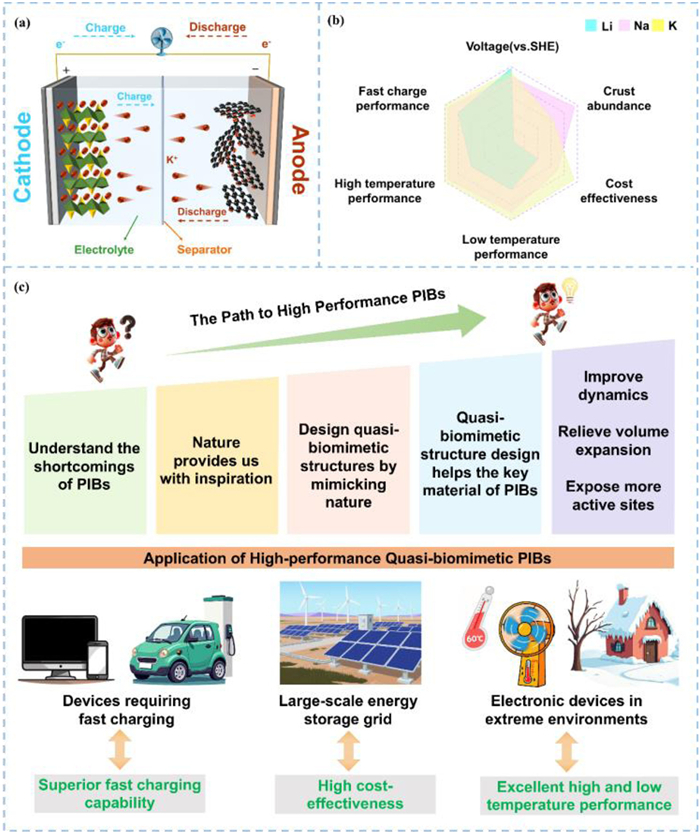
Figure 1.
(a) Schematic diagram of the PIBs. (b) Radar plots of various indicators of LIBs, SIBs, and PIBs. (c) Design philosophy and applications for quasi-biomimetic PIBs.


Over the past few centuries, the excessive use of non-renewable energy sources, primarily coal, oil, and natural gas, has led to issues like resource depletion and environmental degradation. Renewable energy sources such as solar, wind and geothermal have gradually become the key to optimize the energy structure due to their non-polluting characteristics. However, natural renewable energy also has the disadvantages of high cost and unstable safety performance, advancing electrochemical energy storage technology can contribute significantly to addressing these challenges. Lithium-ion batteries (LIBs) are widely used in mobile devices due to their advantages of high energy density, high operating voltage, high power, low self-discharge rate, long cycle life and environmental friendliness [1,2]. However, their further development faces multiple challenges, including uneven lithium resource distribution, high material and manufacturing costs, safety risks such as thermal runaway, limited performance under extreme temperatures, and environmental concerns associated with large-scale extraction and processing of lithium and cobalt [3]. Sodium-ion batteries (SIBs) and potassium-ion batteries (PIBs) are considered alternatives to LIBs due to their abundant resources and widespread distribution [4]. Research on PIBs was inspired by the discovery of graphite anodes for electrochemical potassium storage. Their energy storage mechanism resembles that of LIBs, both following a “rocking chair” operating principle and exhibiting similar physical and chemical properties (Fig. 1a) [5,6]. Specifically, K+/K (−2.94 V, vs. SHE) is closer to Li+/Li (−3.04 V, vs. SHE) than the standard redox potential of Na+/Na (−2.71 V, vs. SHE), PIBs may have higher operating voltages [7,8]. It is worth noting that, compared with Li+ and Na+, K+ has a larger Shannon radius, a smaller stokes radius, weaker Lewis acidity, and a more disordered and flexible solvation structure, which promotes ion migration and conductivity. K exhibits faster diffusion kinetics than Li and Na, granting PIBs greater potential advantages in applications demanding rapid charge/discharge [9,10]. Compared to Li+ and Na+, the relatively weaker ion-solvent interactions between K+ and electrolyte solvents enable PIBs to maintain sustained electrochemical activity even under extreme temperatures. Moreover, PIBs perform excellently in terms of overall performance, particularly in high-temperature and low-temperature performance, safety, and cost-effectiveness. Compared with the ternary LIBs, lithium iron phosphate batteries, and lead-acid batteries currently commercialized on the market, they have significant competitive advantages [11]. PIBs are considered a highly promising energy storage technology due to their suitable operating voltage, fast charging speed, impressive high- and low-temperature performance, and cost-effectiveness, as summarized in Fig. 1b, which compares the various performance metrics of LIBs, SIBs, and PIBs.
However, the larger sizes of K+ lead to severe volume expansion, slow kinetics as well as safety issues associated with the high reactivity of K, the low specific capacity of K compounds within the specified electrode voltage range, and low ionic conductivity at room temperature, hindering the practical development of PIBs [12,13]. To facilitate the practical application of PIBs, future research must focus on the careful design of electrodes and electrolytes [14–16]. Fortunately, in the actual design of PIBs electrodes, researchers drew inspiration from the morphological characteristics exhibited by certain electrode materials. These structures demonstrate similarities to biological structures in nature in terms of both structural organization and functional performance. Based on this similarity, we have summarized relevant research to identify a class of electrode structures with quasi-biomimetic characteristics. These structures share common features such as rapid ion transport properties, exceptional mechanical performance, high specific surface area, and ultra-strong bonding interfaces [17–21]. It is crucial to emphasize that “quasi-biomimetic” here does not imply direct replication of biological forms or mechanisms. Instead, grounded in the synthesis conditions of artificial materials and electrochemical application scenarios, it involves abstracting and translating structural design principles from realized or tunable electrode material morphologies that align with biological system functions. This approach guides the rational design of subsequent materials and electrode structures. By clarifying this conceptual boundary, this review aims to establish a quasi-biomimetic design framework centered on material morphology and function-inspired principles, rather than emphasizing the replication of biological prototypes themselves. The core of these advantages stems from the synergistic optimization of electrode materials, with the discovery and application of quasi-biomimetic features serving as a crucial breakthrough. Reported design practice has revealed a close correlation between quasi-biomimetic structural morphology and energy storage performance. By regulating the microstructure of electrode materials to approximate the superior characteristics of biological structures, studies have demonstrated that the overall performance of batteries can be significantly enhanced [22,23]. The design philosophy and applications of quasi-biomimetic PIBs are illustrated in Fig. 1c. Relevant research indicates that incorporating quasi-biomimetic properties into electrode design holds promise for alleviating the limitations of PIBs in terms of kinetics and volume expansion, while endowing it with rapid charging capability, extended cycle life, high energy density, excellent performance across a wide temperature range, and cost advantages. These advantages stem from the optimization of electrode materials structures. For instance, by emulating the efficient ion transport mechanisms found in biological systems, quasi-biomimetic PIBs can achieve faster charge/discharge rates, making them well-suited for applications like electric vehicles and portable devices, which require fast energy replenishment. Long cycle life is attributed to stable material structures that degrade minimally over time, ensuring sustained performance. Quasi-biomimetic PIBs also feature high energy density due to optimized surface area and active sites, providing greater energy storage capacity. Additionally, their outstanding performance in high and low-temperature environments makes them suitable for extreme environmental conditions. Finally, by utilizing abundant and sustainable materials, quasi-biomimetic PIBs offer a cost-effective alternative to other battery technologies, promoting their widespread adoption in various energy storage applications.
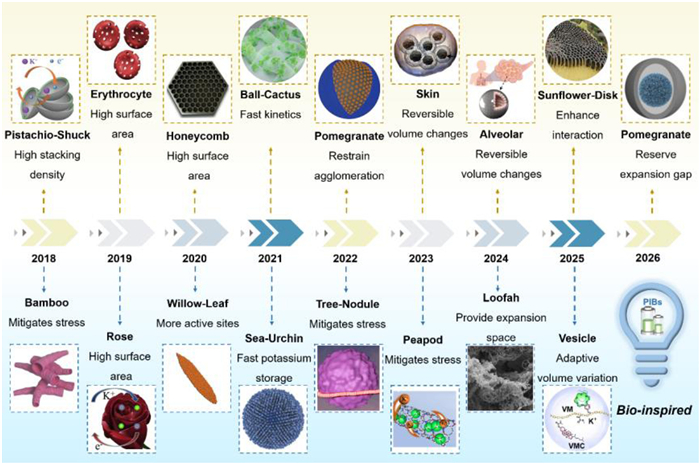
Since 2018, researchers have for the first time discovered significant similarities between the microstructure of PIBs electrode materials and unique biological structures found in nature. This review distills and summarizes the corresponding quasi-biomimetic structural features, opening new avenues for PIBs material design (Fig. 2) [24–40]. Shell-like structures in plants provide inspiration for the design of high-voltage real-density electrode materials, which can help increase the volumetric energy density of batteries. Bamboo-like and trellis-like structures, on the other hand, can effectively resist external forces and provide structural stability, which is crucial for the mechanical stresses that PIBs electrode materials may encounter during charging and discharging. Plant structures with large specific surface area, including flower and leaf structures, can provide more active sites for electrode materials to enhance redox reactions for higher capacity, certain materials boast a high specific surface area while also improving electronic conductivity and ion diffusion pathways. Animals and humans are equally capable of providing PIBs with extremely effective biological structures and adaptive mechanisms for inspiration, especially in withstanding external forces, protecting tissues, and maintaining internal and external equilibrium. The robust support properties are able to withstand the structural changes brought about by K+ intercalation. For instance, honeycomb structure resists external stresses by virtue of its hollow cells and uniformly distributed support points, and skin tissue structure can mimic the cytoplasm and epidermis to ease the expansion of active substances and resist external stresses; Adaptability represents another core advantage of these quasi-biomimetic features, as the morphological behavior of certain electrode materials closely mimics the deformation characteristics of red blood cells and alveolar structures. They flexibly accommodate volume changes induced by K+ insertion/deintercalation. The discovery of this dynamically adaptive quasi-biomimetic property offers a key approach to resolving the volume expansion challenge in PIBs electrodes, with its deformation regulation mechanism analogous to the adaptive adjustments observed in biological tissues during diastole and systole.
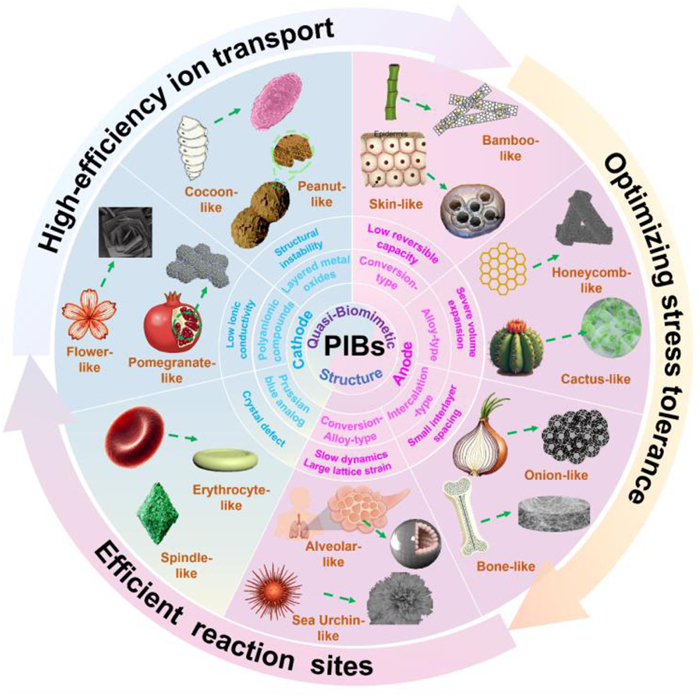
In this review, we first explore the design principles of quasi-biomimetic materials, conducting an in-depth analysis of how to incorporate the unique functional properties of natural biological structures into the development of PIBs materials. We then summarize the potassium storage mechanisms of various materials used in the cathodes and anodes of PIBs, detailing the role of quasi-biomimetic structures in optimizing the performance of these materials and their improvements in electrochemical performance (Fig. 3) [30,34,38,41–51]. Finally, we discuss the challenges that quasi-biomimetic PIBs may face in practical applications and outline potential future research directions. This review is intended to offer valuable perspectives on designing key PIBs materials, drawing inspiration from biological structures, further driving the development of PIBs technology toward higher efficiency, greater stability, and broader applications, thereby laying a solid foundation for their widespread use in energy storage.
PIBs demonstrate tremendous potential, particularly in high-power applications such as electric vehicles and portable electronic devices, thanks to their outstanding fast-charging capabilities. To further leverage this advantage, researchers have keenly observed in practice that the microstructures of numerous PIBs electrodes exhibit striking similarities to biological structures evolved in nature to optimize rapid transport capabilities. By systematically summarizing the inherent natural advantages of such quasi-biomimetic structures and strategically applying them to the subsequent design and development of key PIBs materials, it is anticipated that the rapid charging potential of PIBs can be further harnessed. This includes multi-layered pore networks, low-bend channels, and vertical structures that shorten K+ migration paths and homogenize ion distribution. Through quasi-biomimetic design, resistance during charging and discharging can be significantly reduced, ion migration efficiency can be greatly improved, charging time can be shortened, and battery power density can be enhanced. Quasi-biomimetic design can also draw on nature’s optimized fluid dynamics, such as the distribution and flow patterns of intercellular fluids, to further enhance ion mobility within the battery. This not only accelerates charging speed but also improves long-term stability, preventing performance degradation caused by heat accumulation during fast charging [52–55]. Consequently, these quasi-biomimetic structures maximize the fast-charging advantages of PIBs, enhance overall performance, and ensure competitiveness in high-power applications.
In terms of efficient transport channels, many structures in nature follow Murray’s Law, the relationship between pipe size and flow rate for fluid flow, and are designed to maximize mass transfer rates and reaction rates [56]. By way of example, the stems, leaf veins and blood vessels of plants have a multilevel pore network structure within them, a structure that not only optimizes the transport paths of substances, but also ensures the efficient flow of fluids and nutrients. In plant stems, the size and shape of the pores vary from region to region. This hierarchical pore structure facilitates the gradient transport of fluids and thus avoids the bottleneck of fluid transport caused by a single pore scale. The inspiration of this multistage pore structure has been applied to battery materials to optimize the efficiency of ion transport (Fig. 4a). Inspired by biological blood vessels, as an illustration, a glass MOF-based quasi-solid-state electrolyte (QNGZ) is designed with quasi-biomimetic vascularized channels [57]. These channels have no grain boundaries, an isotropic structure, and the surface is modified with N vacancies. Due to its pore structure and the highly quasi-biomimetic nature of the vascularized channels, QNGZ is able to efficiently utilize tiny propylene carbonate solvents and provide rapid ion transport. QNGZ exhibits a high conductivity of 1.18 × 10⁻⁴ S/cm at 30 ℃ and a transference number of 0.92. Furthermore, to the optimization of the pore network structure, the low curvature channel structure is also effective in improving the rapid transport of ions and electrons. The low curvature channel design can reduce the collision and resistance of particles in the channel, thus increasing the transport rate. This design is similar to the smooth structure of the inner wall of a channel in a plant stem, which effectively reduces the resistance to the flow of matter (Fig. 4b). Inspired by the vertical structure of a shallot-like plant, a typical channel with low tortuosity, scientists have developed a graphene-based macroscopic assembly (GBOMA). This graphene component is constructed through a highly oriented and orderly stacking method, ensuring that the anode exhibits an ultra-low overpotential of approximately 11.3 mV after operating for 1800 h at a current density of 1 mA/cm2 in carbonate electrolyte. This performance surpasses that reported in the vast majority of previous studies [58].
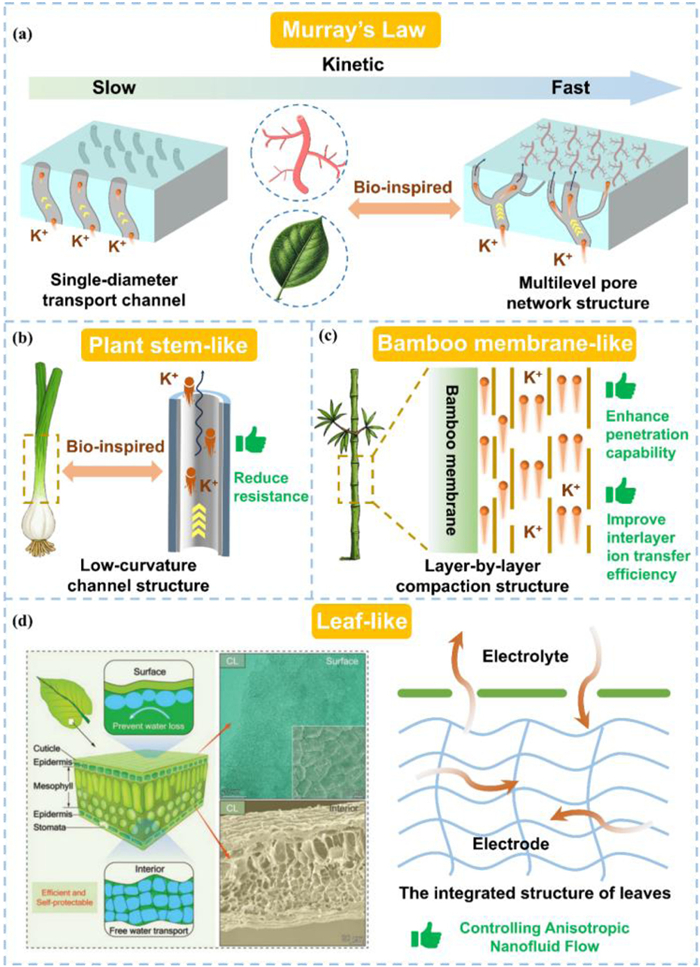
Interestingly, nanohydrodynamics matched with an integrated structure can also access fast transport capabilities. The structure of the bamboo membrane is also a very interesting example of a layer-by-layer compacting design that plays an important transport role in biology, as the compactness of the structure increases as it approaches the inner ring (Fig. 4c) [59]. This structure allows water and nutrients to move up the bamboo at an extremely fast rate. The bamboo membrane-inspired multistage channel design not only enables rapid transport of substances, but also enhances surface permeability and ion transfer efficiency between layers. Therefore, similar multistage pore structure and interlayer design in batteries can also be applied to achieve fast ion transportation. Similar examples of matching nanofluid dynamics to integrated structures can be found in other organisms, such as the integrated structure of a leaf with fine-tuned surface pores and internal porous media that can spatially control anisotropic nanofluid fluxes. Materials that mimic the integrated structure of a leaf can be tuned for outflow from the electrode surface and free transport within for fast and stable energy conversion (Fig. 4d) [60]. This type of quasi-biomimetic structure exhibits outstanding cycling stability in K-CoS2 and K-S systems, with capacity decay rates of only 0.15% and 0.21% per cycle, respectively. By mimicking nature’s design principles of multistage pore networks, low curvature channels, vertical structures, and fine-tuned pores, researchers have been able to develop key materials for efficient, fast, and stable batteries. These quasi-biomimetic structures not only improve the ion transportation capacity of the battery, but also promote rapid energy conversion and stable output, providing innovative solutions for future battery technologies and a new perspective on the development of PIBs.
The mechanical properties of a battery are one of the key factors determining its long-term stability. During charging and discharging, the electrode materials in PIBs undergo significant expansion and contraction due to the large volume of K+, and this periodic deformation can easily lead to the propagation of internal cracks, poor interface contact, and even battery failure. In particular, the inherent rapid charging and discharging characteristics of PIBs can cause more severe volume changes in the PIBs, thereby affecting its stability and cycle life. To address these issues, quasi-biomimetic design offers important improvement strategies. Quasi-biomimetic structures combining rigidity and flexibility, such as skeletal frameworks or interpenetrating hierarchical structures like arthropod exoskeletons, effectively suppress crack propagation and enhance cyclic stability. This is achieved by converting local volume expansion and stress concentration caused by K+ insertion/extraction into multiscale, reversible structural deformation and energy dissipation. This effectively suppresses crack initiation and propagation, maintains electrode structural integrity, and significantly enhances the cycling stability, safety, and long-term reliability of PIBs under rapid charge/discharge conditions at the mechanistic level. Additionally, quasi-biomimetic design can improve PIBs structural stability and conductivity by enhancing material interface interactions in PIBs, such as introducing adaptive interface layers or strengthening the adhesion between electrodes and electrolytes.
It is worth noting that many organisms exhibit exceptional mechanical properties through ordered hierarchical structures, helical morphologies, and strong interfacial interactions [61]. A prime example is the animal spine, a structure whose delicate features include a soft bone marrow component interconnected with a hard vertebral bone portion, giving the spine exceptional resilience and flexibility when under stress. This combination of stiffness and flexibility allows the spine to maintain its structural integrity under high stress while accommodating a degree of deformation (Fig. 5a) [62]. The maximum strain of this biomimetic structure (~0.08%) is significantly lower than that of conventional stacked batteries (~1.1%). Specifically, the proposed biomimetic structure regulates stress bearing and transmission through structural reconfiguration. The entry of relatively large K+ into the lattice or channels causes significant expansion, which can easily lead to microcracks or even powdering in traditional rigid electrodes. In contrast, within this multi-layered, heterogeneously matched quasi-biomimetic structure, the rigid components act as a framework to confine and support the active materials. The outer layer or continuous flexible network provides additional deformation freedom, redistributing and sequentially releasing expansion stresses across larger scales. Concurrently, the hierarchical architecture disrupts continuous stress transmission pathways, suppressing strain accumulation and crack propagation.
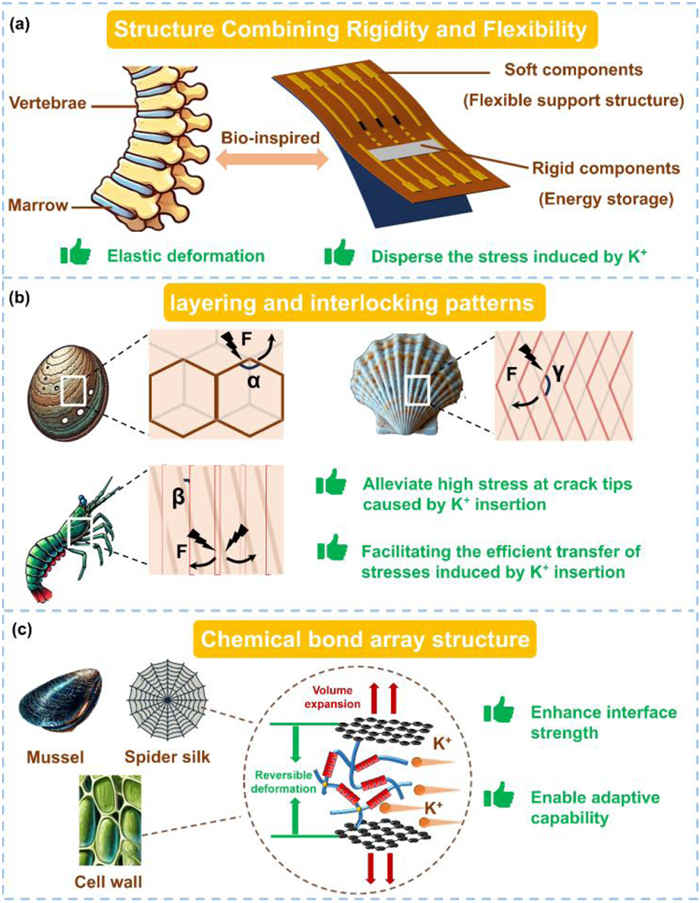
Furthermore, many organisms in nature possess unique interlocking laminar structures to resist external stresses and spread forces more evenly, significantly increasing mechanical efficiency as well as compressive strength and toughness. These structures are optimized through intricate layering and interlocking patterns (Fig. 5b) [63]. This is evident in the case of the exoskeleton of arthropods, the Bouligand structure enhances the compressive strength of the exoskeleton by means of interlocking layers. Therefore, the introduction of quasi-biomimetic structures featuring continuous interpenetration and hierarchical synergy represents not merely structural optimization, but a necessary design strategy to counteract the volume effects induced by large-sized K+. Exoskeleton-inspired quasi-biomimetic structures convert localized volume expansion caused by K+ insertion into distributed deformation at the structural scale through multiphase synergistic load-bearing and strain redistribution. Furthermore, the hierarchical interpenetrating configuration activates energy dissipation mechanisms such as crack deflection, rotation, and residual bridging during electrochemical cycling. This effectively shields the high stress at the crack tip caused by volume expansion due to K+ insertion and extraction, thereby inhibiting the continued evolution of structural damage and exhibiting a continuously increasing fracture resistance characteristic.
Beyond typical hard structures, interfacial interactions in living organisms play a crucial role in enhancing mechanical properties (Fig. 5c). The natural pearl layer also exhibits superior fracture toughness. Researchers drew inspiration from natural spider silk and nacre, achieving interfacial reinforcement and adaptive toughness by introducing flexible disulfide bonds and dynamic hydrogen bonds into polyurethane (PU) [64]. The material of the reverse artificial nacre structure exhibits record-breaking mechanical strength (78.3 MPa) and toughness (505.7 MJ/m3). This quasi-biomimetic structure provides an outstanding solution to the volume expansion of PIBs electrode materials. By dynamically dispersing local swelling stresses caused by large-sized K+ insertion/extraction through interfacial chemical bonds, and restoring structural continuity after stress release, it suppresses crack initiation and propagation. This effectively alleviates stress concentration induced by volume expansion while enhancing cycling stability and electrode safety. In addition, many sea mussels acquire self-healing and strong stickiness through ionic bonding in order to resist the impact of seawater. Plants harden and strengthen the cell walls of plants through the action of covalent bonds, and so on. These interfacial interactions can inspire researchers to develop materials that can alleviate external stresses through chemical bonding.
Although K+ has a high ionic conductivity in electrolytes, this property leads to rapid insertion and extraction of K+ at the electrode interface, affecting structural stability and reaction kinetics, thereby limiting the potential of K+ energy storage systems. Therefore, in the design of PIBs, in addition to enhancing ionic transport capacity and mechanical strength, improving potassium storage capacity is another key factor in enhancing electrochemical performance. Functionally, these structural features bear striking similarities to highly optimized structures found in natural biological systems. Such structures typically feature large accessible surface areas, hierarchical pore architectures, and interconnected three-dimensional networks that maximize ion accessibility and active site exposure at the electrode-electrolyte interface. The synergistic enhancement of adsorption storage and interfacial storage significantly improves the storage capacity, reaction kinetics, and rate performance of K+, thereby markedly enhancing the overall electrochemical performance of energy storage devices. Notably, this highly efficient energy storage behavior does not simply rely on size reduction or conventional nanostructure effects, but rather stems from the synergistic regulation of structural hierarchy, spatial distribution, and interfacial properties. Thus, quasi-biomimetic design, by mimicking high specific surface-area biological structures, helps enhance the K+ storage capacity, reaction efficiency, and cycle stability, demonstrating stronger competitiveness in high energy density and long lifespan applications.
Many organisms in nature including plants, marine organisms and fungi have developed structures with large specific surface area during evolution. Inspired by this, researchers can design many nanostructures with large contact areas and efficient functionality (Fig. 6a) [65,66]. By adjusting the melamine content and calcination temperature, 3D nitrogen-doped carbon nanotube structures can be precisely engineered to resemble marine organisms, ranging from “seaweed” to “anemones”, “sea cucumbers” and even “rocky seabeds”. The resulting enlarged hollow structures optimize sulfur loading, thereby enhancing their specific capacity [67]. What is more, the efficient use of solar energy by green plants in nature can also inspire researchers, and this exceptional photocatalytic performance is attributed to the unique leaf mosaic structure of V-CN, which enhances light absorption and increases the specific surface area (Fig. 6b) [68]. Therefore, the photocatalytic activity of V-CN is several orders of magnitude higher than that of conventional g-C3N4. This idea of increasing the surface area could inspire researchers to develop energy storage equipment that can accommodate more K+.
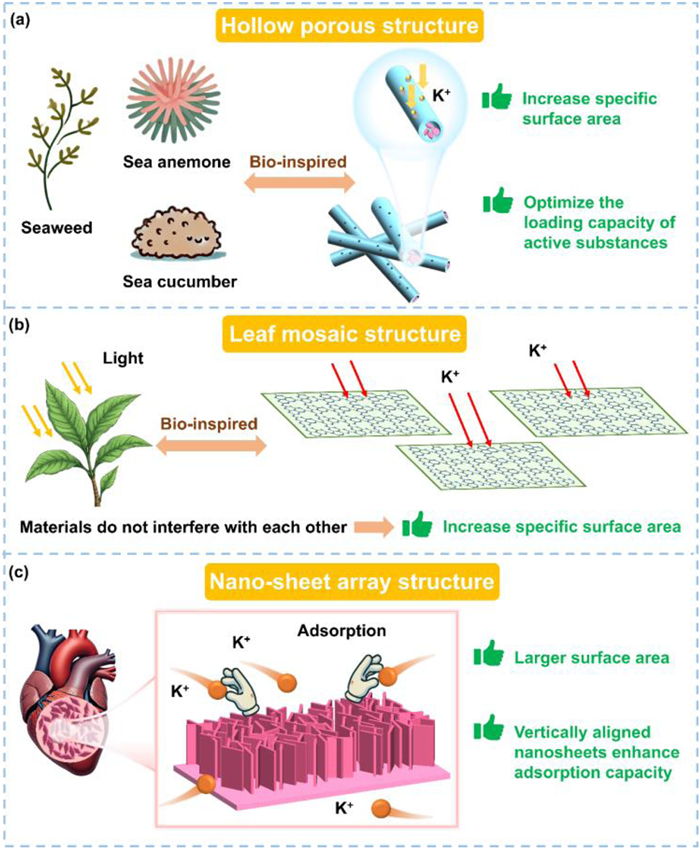
Apart from large specific surface area, adsorption capacity is an important factor affecting the performance of energy storage devices [69]. In nature, many organisms are structured in such a way as to enhance adsorption capacity and thus accelerate electrochemical reactions by means of special molecular or structural designs. Inspired by the fractal structure of cardiac trabeculae on the inner surface of the heart, electrodes with superhydrophilic, adsorption-dominated fractal surfaces have been developed [70]. After being immersed in natural seawater for 7 days, the electrode exhibited a uranium adsorption capacity of 13.2 mg per gram. The storage mechanism of this electrode is primarily dominated by surface adsorption, achieving efficient molecular adsorption through chemical coordination that provides a large surface area and abundant active sites. Concurrently, vertically aligned nanosheets further enhance the electrochemical accessibility of adsorbents and ion transport efficiency, synergistically boosting overall adsorption performance. The combination of these features not only optimizes adsorption efficiency but also significantly improves the material’s overall performance in electrochemical applications (Fig. 6c). Likewise, the porous membranous architecture of renal glomeruli enables efficient filtration of metabolic biomolecules. Natural sponges, characterized by a dense porous structure, also exhibit robust adsorption of molecules [71].
Overall, through quasi-biomimetic thinking, researchers can draw inspiration from structures in nature to design PIBs materials with large specific surface areas and abundant active sites, which are essential for improving battery performance. A large specific surface area not only provides the material with more reactive interfaces and increases the contact area between the battery material and the electrolyte, but also significantly improves the efficiency of ion adsorption and transport. The larger the surface area of the material, the more ions can be adsorbed and stored, thus improving the specific capacity and cycle stability of the battery. At the same time, the abundant active sites are able to provide more chemical reaction sites, further enhancing the energy density and power density of the battery by enhancing the electrochemical reaction process inside the battery.
Compared to other alkali metal ion batteries, the larger volume of K+ results in more significant volume changes in PIBs. To efficiently store energy, the cathode of PIBs must meet several basic requirements. First, the cathode material should have an appropriate crystal structure or space to support the reversible insertion and release of K+. Additionally, the cathode material must have a stable crystal structure and abundant active sites to ensure good cycle stability and reversible performance. Furthermore, a high and broad operating voltage range is another key feature of their superior performance [72,73]. Common cathode materials for PIBs include layered metal oxides, polyanion compounds, Prussian blue analogues, and organic materials. However, traditional electrode material designs often struggle to significantly enhance the overall performance of PIBs. It has been proven that quasi-biomimetic structural materials exhibit outstanding functional regulation capabilities and performance optimization potential (Table 1). This section will explore the structural advantages and potassium storage mechanisms of quasi-biomimetic PIBs cathode materials, and summarize the challenges they face along with corresponding optimization strategies (Fig. 7) [43,74,75].
 DownLoad:
CSV
| Materials | Type | Quasi-biomimetic structure | Structural advantages | Active mass | Cycling performance | Rate capability | Ref. |
| K0.5Mn0.7Ni0.3O2 | Layered metal oxides | Cocoon | Stress reduction | 1.5–2.0 mg/cm2 | 77%, 300, 100 mA/g | 77.4 mAh/g, 100 mA/g | [41] |
| K0.45Mn0.5Co0.5O2 | Layered metal oxides | Peanut | Stress reduction | 0.8–1.2 mg/cm2 | 73.8%, 300, 300 mA/g | 83.4 mAh/g, 100 mA/g | [42] |
| K1+δVOPO4F | Polyanionic compound | Flower | Flexible framework | ~1.0 mg/cm2 | 76%, 700, 1 C | 74 mAh/g, 1 C | [43] |
| KVPF@C-PMS | Polyanionic compound | Pomegranate | Higher compaction density | 1.5–3.0 mg/cm2 | 85.1%, 200, 0.5 C | 86.3 mAh/g, 1 C | [44] |
| K1.72Fe[Fe(CN)6]0.96·0.342H2O | Prussian blue analogs | Spindle | Accelerate the transportation of K+ | 3.0 mg/cm2 | 97.8%, 100, 50 mA/g | 111.8 mAh/g, 100 mA/g | [45] |
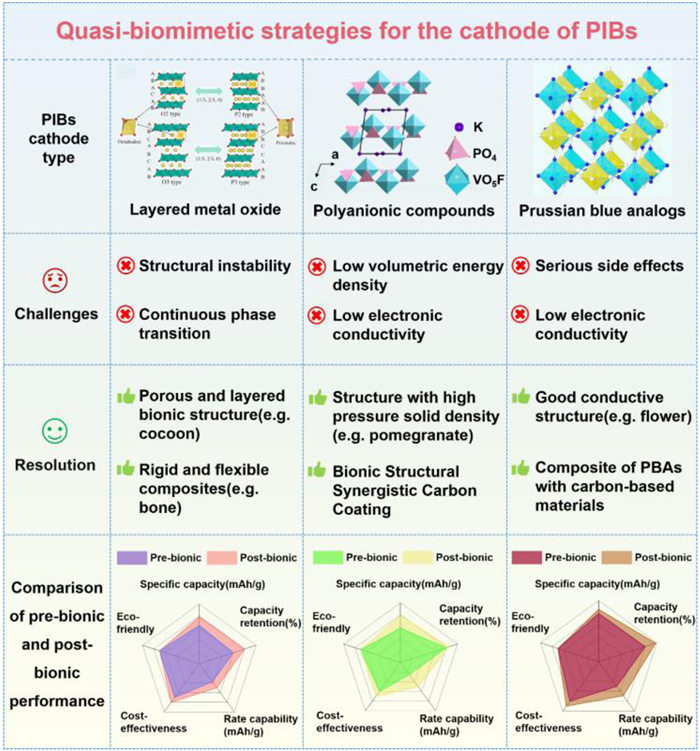
Layered metal oxides are receiving increasing attention as cathode for PIBs due to their stable backbone structure, simple synthesis chemistry and high working potential [76]. Layered metal oxides are constructed from edge-sharing MO sheets. Six alkali metal ions are inserted between octahedra to form a triangular prismatic or octahedral environment, and the layered frameworks can be classified as P2-type, P3-type, O2-type, and O3-type based on the oxygen buildup between the two neighboring oxygen layers and the environment of the alkali metal ions [77,78]. The P2/P3 type layered structure has a prismatic K occupancy site, and the ion diffusion barrier is lower than that of the O-type structure, so the ionic conductivity is higher. The O-type structure, on the other hand, consistently shows a high reversible capacity over the same voltage range [79]. Among them, manganese-based transition metal oxides KxMO2 are stand out as the most promising candidates owing to their low cost and excellent safety. However, KxMO2 cathode materials may cause structural damage during K+ insertion, undergo continuous phase transitions under high pressure, and the presence of Mn3+ may trigger the Jahn-Teller effect. These major challenges lead to structural changes and irreversibility, resulting in a decrease in cathode material capacity and slow K+ diffusion kinetics [80,81]. For the resolution of these problems, it is necessary to draw inspiration from biological structures with fast dynamics and sturdy mechanical properties.
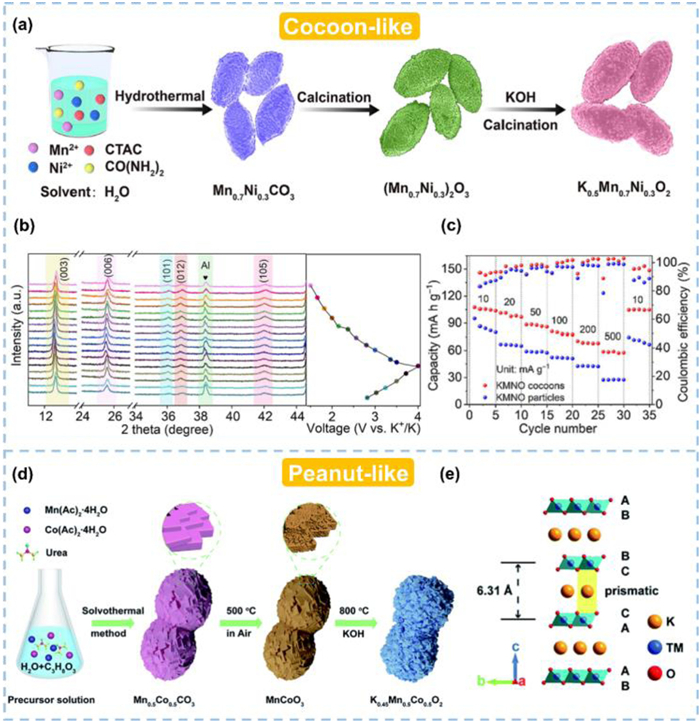
Current non-biomimetic nanostructures can improve the slow ion diffusion kinetics in traditional electrode materials and increase electrode surface area. However, the high reactivity of nanomaterial surfaces remains a key factor limiting their performance. Cocoon-like structure features a complex three-dimensional hierarchical network. Its relatively high porosity and exceptional mechanical strength, synergistically optimized, hold promise for overcoming the drawbacks of severe non-biomimetic side reactions and structural instability [82,83]. Inspired by the cocoon structure, a cocoon-like K0.5Mn0.7Ni0.3O2 formed by nanoparticle assemblies featuring a large specific surface area and mesoporous structure was developed by a self-template method (Fig. 8a) [41]. The cocoon-like quasi-biomimetic structure can shorten the K+ diffusion distance and reduce the stress caused by K+ uptake/release, preventing the cracking and inactivation of active substances. The precursor Mn0.7Ni0.3CO3 emits significant quantities of carbon dioxide upon calcination, thereby forming a porous cocoon, which is conducive to promoting the penetration of electrolytes. In-situ X-ray diffraction (XRD) shows that the (003) peak undergoes a continuous shift toward a lower angle during charging. At the same time, the (101) and (012) peaks shifted to higher angles. During subsequent discharge, all three peaks revert to their initial positions, demonstrating the material’s high structural reversibility and the completion of a single-phase transition (Fig. 8b). The KMNO cocoon-like cathode material provides remarkable rate performance of 57.1 mAh/g at 500 mA/g (Fig. 8c). This study reveals that cocoon-like quasi-biomimetic structures play a key role in inhibiting phase transitions, enhancing structural stability, and improving K+ diffusion capabilities, which are important parameters for advancing high performance PIBs cathode materials. Nevertheless, manganese based layered transition metal oxides still suffer from significant issues with electrolyte side reactions. To address these challenges, it is necessary to employ ingenious quasi-biomimetic designs to prepare transition metal oxides with layered structures, thereby reducing side reactions and promoting rapid potassium ion diffusion. The peanut-shaped layered structure of K0.45Mn0.5Co0.5O2 perfectly meets this requirement (Fig. 8d) [42]. Benefiting from a unique layered structure and the synergistic effect of primary particles, the contact area with the electrolyte can be reduced, accelerating K+ diffusion kinetics. The gaps between primary particles can adapt to volume changes and stabilize the surface passivation layer, thereby ensuring enduring cycle stability. The P3 crystal structure inherently facilitates ion transfer (Fig. 8e), but non-biomimetic P3-phase materials often suffer from mass transfer bottlenecks due to particle agglomeration. In contrast, the interstitial and layered design of peanut-shaped quasi-biomimetic structures enables the inherent advantages of crystals to be combined with those of macroscopic structures.
In response to the structural instability of layered metal oxides in PIBs, multidimensional innovative design can be carried out in the future through the principle of bionics. Firstly, drawing on the multi-layered structure of cocoons or shells in nature, as well as precisely regulating the layers and pore distributions of bionic layered metal oxides on micro- and macro-scales, can help to improve the mechanical strength and ion diffusion capacity of the materials, and to reduce the volume change and stress accumulation in the process of intercalation/deintercalation. Secondly, the synergistic effect of composite structure is utilized. For instance, similar to the composite structure of bones and hard shells, the strength and toughness of these biomaterials often derive from the synergistic effect of different components. The introduction of highly conductive materials or highly elastic polymers not only enhances the ionic conductivity, but also improves the flexibility and durability of the material. Finally, interface engineering (passivation layers and thin films) and material size control played a crucial role in addressing the serious side reaction challenges faced by layered transition metal oxides.
AxMy(XOz)n is the most representative polyanionic cathode material structure in PIBs (A = Li, Na, K; M = transition metals; X = P, S, As, Si, Mo or W), which is composed of a tetrahedral XOz group connected by a MO6 octahedron shared by the angle through the same side or common point [84,85]. Polyanionic cathode materials with polyanion induction effect and structural stability have the potential to provide high energy density and long cycle for next generation PIBs [86]. However, the low electronic conductivity and severe side reactions of polyanionic materials lead to poor electrode rate and rapid capacity decay. Therefore, researchers have proposed many modification strategies, such as introducing large-sized weak-field ligands to regulate the coordination environment and expand the lattice structure [87]. Besides, doping with impurity atoms can be used to adjust the relevant lattice parameters and electronic structure [88]. Although these methods have improved the ionic conductivity of polyanionic cathode materials and suppressed side reactions to a certain extent, they are still insufficient to meet the performance requirements of high energy density energy storage devices.
Many electrode structures tend toward flower-like quasi-biomimetic designs, which feature larger specific surface areas and interlayer spacings, providing more active ion storage sites. Their tightly packed thin nanosheets form an efficient conductive pathway network, significantly enhancing the electrode’s ion diffusion capacity and electrical conductivity [89,90]. Building upon this universal nanostructure effect, researchers further drew inspiration from the spatial organization of multi-level hierarchical structures found in nature to develop multi-anionic cathode materials with quasi-biomimetic characteristics. These characteristics are in line with the modification strategy of polyanionic cathode materials, the flower structure inspired the design of a polyanionic compound K1+δVOPO4F with a layered stacked structure in the form of quasi-biomimetic flowers (Fig. 9a) [43]. This quasi-biomimetic construction approach preserves universal nanostructure characteristics such as high specific surface area and short diffusion pathways. Through hierarchical stacking and spatial orientation control, it achieves synergistic optimization of structural stability, ion accessibility, and volume change buffering capacity. Interestingly, K1+δVOPO4F features a hierarchical [VOPO4F]∞ framework, where its [VOPO4F]∞ layers stacked along the c-axis, and K+ in the interlayer position, endowing the material with high flexibility and stability. Charge-discharge curves and in-situ XRD patterns are shown in Fig. 9b. In-situ XRD spectroscopy reveals reversible migration of (001),
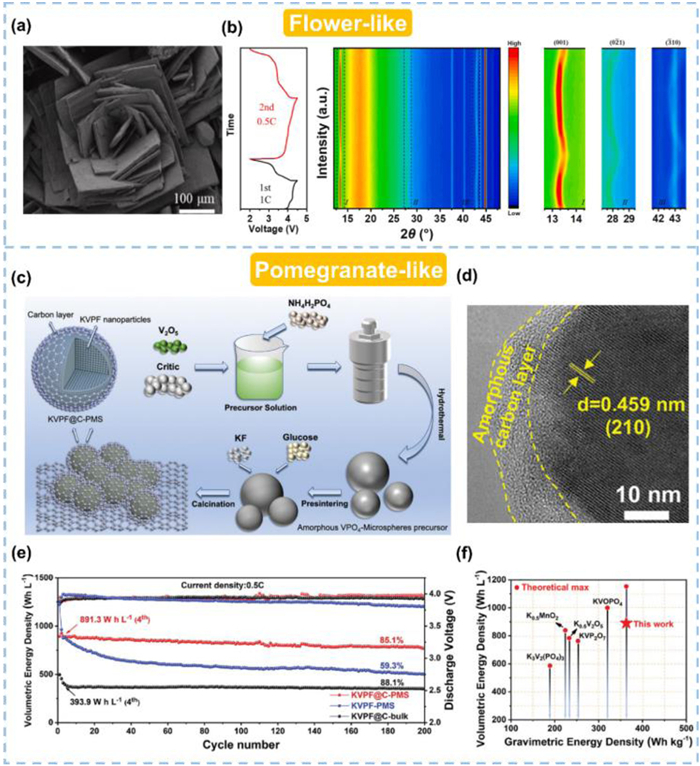
Therefore, a pomegranate-like micro/nano multi-grade carbon coating of KVPF@C-PMS can be used as an effective strategy to reduce the side reactions of electrolytes and polyanionic materials [44]. The authors assembled nanoscale KVPF particles into pomegranate-like microspheres, which were then carbon-coated (Fig. 9c). The carbon cladding prevents KPF6 salts from eroding the KVPF lattice structure by reacting with trace amounts of water in the electrolyte solution to form HF [94]. From high-resolution transmission electron microscopy (HRTEM), it can be seen that there is a clear interface between the core of KVPF and the amorphous carbon layer (Fig. 9d). Due to the synergistic effect of the higher compaction density of the pomegranate-like structure and the carbon cladding, it exhibits a high volumetric energy density of 891.3 Wh/L at 0.5 C, achieving a high energy retention rate of 85.1%, which is better than most reported cathode materials (Figs. 9e and f). However, there was an overcharge behavior in the first three cycles of this work, resulting in low initial coulombic efficiency, which may be due to oxidative degradation of the electrolyte at high pressure. Although compounding with carbon reduces the side reaction between the material and the electrolyte, the solvent and electrolyte concentration of the electrolyte may affect the stability of the battery. Therefore, it is important to explore suitable electrolytes for polyanion cathodes operating in the high operating potential range, and even to design thermally stable solid electrolytes that are in good contact with the polyanion cathode.
PBAs are regarded as promising cathode materials for PIBs due to their good stability and fast K+ diffusion efficiency in a unique open-frame crystal structure. However, low electronic conductivity and poor structural stability of PBAs lead to insufficient rate and cycling performance. To address these problems, researchers have proposed many improvement methods, such as by structural design [95], high entropy strategy [96], coordination state coexistence strategy [97], and metal doping [98] to achieve high capacity and impressive cycling stability. In recent years, researchers have obtained materials with special morphologies by controlling the composition of mixed solvents. In order to solve the problem of insufficient PBAs rate and cycling performance, it is also necessary to design quasi-biomimetic materials from the aspect of improving kinetics and stability.
The multi-level porous spindle structure has often attracted a lot of attention because it can provide more active sites and transport ions quickly [99,100]. As an illustration, spindle-shaped potassium-rich K1.72Fe[Fe(CN)6]0.96·0.342H2O (PW) with low defects and low moisture content prepared by a self-template method (Fig. 10a) [45]. The spindle PW material still has an 89.2% capacity retention rate after 500 cycles (Fig. 10b). Non-biomimetic structures typically employ simple shapes and arrangements. In contrast, quasi-biomimetic spindle structures enhance specific surface area through multi-level pore designs while optimizing ion diffusion pathways and reducing migration resistance. Furthermore, the incorporation of nanocrystalline subunits not only increases ion storage sites but also improves structural stability and durability. In-situ XRD showed that the spindle-like PW maintained its monoclinic phase throughout the cycle, revealing the lack of structural evolution (Fig. 10c). What is more, the peaks of the (200), (220), and (400) crystal planes moved slightly to a lower angle during charging and returned to their initial positions during discharge, demonstrating the high reversibility of the structure (Fig. 10d).
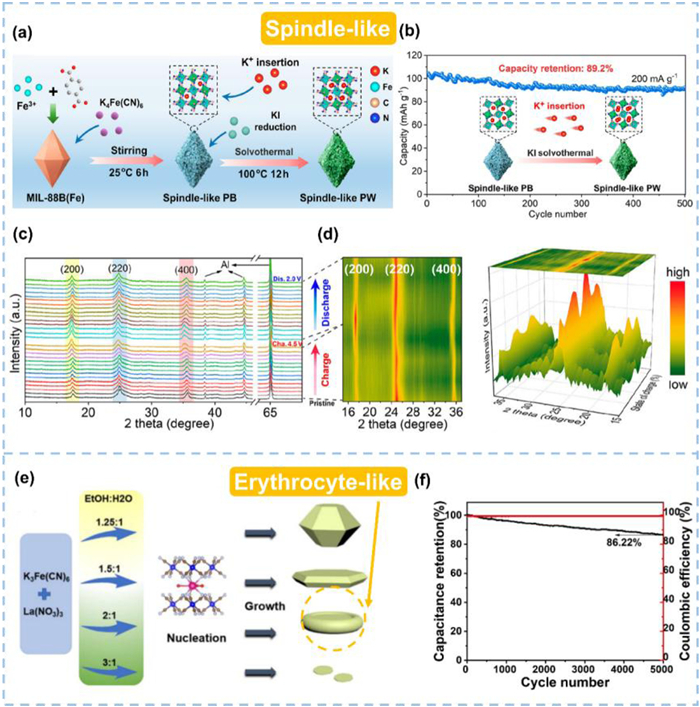
Erythrocyte, as an important result of long-term natural selection, possess a specific biconcave shape that can adapt to volume changes caused by osmotic pressure [101,102]. If this principle is applied to electrodes, it may alleviate volume changes caused by the large radius of K+. Additionally, the reduced formation energy and surface energy of erythrocyte-like structures may also aid in ion/electron transfer in PIBs. The erythrocyte-like electrode material, LFO, synthesized by altering the ethanol/water ratio of the solvent mixture, has been reported to exhibit a high specific capacity of 330 C/g at 1 A/g due to its uniformly porous structure [46]. Supersaturation regulates the formation of different morphologies by influencing the growth kinetics of each crystal plane. As the ethanol content increases, a microstructure similar to that of erythrocytes is formed, which reduces the formation energy and surface energy (Fig. 10e). The erythrocyte LFO maintained a volume retention rate of 86.22% after 5000 cycles at a current density of 2 A/g (Fig. 10f). However, researchers have yet to systematically investigate the potassium storage mechanisms of electrode materials, as well as the cycling and multiplicity performance of these materials. Nevertheless, the mechanism by which animal cells can self-adjust their morphology to adapt to volume changes caused by material ingress and egress may inspire future developments and designs of high-performance PBAs cathode electrode materials. For the reported PBAs quasi-biomimetic materials, the focus has primarily been on mimicking porous biological structures. Future research should focus on further enhancing the ionic conductivity and mechanical stability of electrode materials through quasi-biomimetic design, particularly by addressing side reactions between the electrolyte and electrode through composite materials, surface modification, or nanostructure optimization, to achieve more efficient and stable PBAs cathode material.
By studying and simulating sophisticated biological structures, PIBs cathode materials can meet the requirements of appropriate lattice spacing, stable crystal structure, and abundant active sites, effectively solving the problem of significant volume changes caused by the large volume of K+. Quasi-biomimetic layered structures and pore networks (such as cocoons and shells) feature more suitable storage spacing and optimized pore distribution, providing ample space for K+ insertion while effectively mitigating volume expansion caused by larger radius K+. This reduces stress accumulation and crack formation during cycling, thereby maintaining structural stability of PIBs. Additionally, quasi-biomimetic design can enhance the ionic diffusion capability of electrode materials. Inspired by nature’s high specific surface area and multidimensional arrangement structures (such as flowers and red blood cells), shorter ionic transport paths can be created within the material, thereby increasing K+ diffusion rates. This is crucial for improving the high power density and fast charging/discharging capabilities of PIBs, meeting the demands of modern high energy storage devices. Looking ahead, the application of quasi-biomimetic methods holds promise for further leveraging the advantages of PIBs in potassium salt electrolytes, including high ionic conductivity, high energy density, and stability under both high and low-temperature conditions, thereby expanding their application potential in energy storage systems. By further optimizing these quasi-biomimetic structures, PIBs will demonstrate exceptional competitiveness in energy storage systems requiring fast charging and discharging, high energy density, and adaptability to extreme conditions.
The anode serves as another critical component governing the overall capacity and efficiency of PIBs. To accelerate the practical application of PIBs, anode materials must meet several key criteria. First, they must have remarkable structural stability, high ionic conductivity, and high initial coulombic efficiency (ICE). Second, the materials must be able to accommodate large amounts of K+ while reducing side reactions with the electrolyte. Finally, anode materials must maintain a stable operating voltage over long periods of use [103]. In order to cope with the above challenges, the composition, morphology, and local atomic structure of anode materials have been optimized by nanostructural design in the past [104–106]. In recent years, quasi-biomimetic strategies have come into focus, with an increasing number of quasi-biomimetic anode materials featuring unique structural designs and remarkable principles being published. Anode materials of various sizes have achieved satisfactory progress, primarily involving conversion-type, alloy-type, intercalation-type, and dual-mechanism conversion-alloy materials. It has been proved that the quasi-biomimetic anode materials largely improve the electrochemical performance (Table 2) [25,30,34,38,47–50, 107–117]. This subsection outlines the research advances regarding quasi-biomimetic PIBs anode materials, proposing optimization strategies for the challenges specific to each type of anode materials (Fig. 11) [9,118–120].
DownLoad:
CSV
| Materials | Type | Quasi-biomimetic structure | Structural advantages | Active mass (mg/cm2) | Specific capacity | Cycling performance | Ref. |
| MoS2/N-doped-C | Conversion-type | Bamboo | Stress reduction | 1.0 | 400 mAh/g, 0.1 A/g | 74%, 1000, 0.5 A/g | [25] |
| Bi NSs/NCN | Alloy-type | Ball-cactus | Increased utilization of active substances | 0.6–1.0 | 600 mAh/g, 1 A/g | 83%, 2000, 10 A/g | [30] |
| Bi2O3-Bi@CHNSs | Conversion-Alloy-type | Alveolar | Structural stability | 0.8–1.0 | 370 mAh/g, 1 A/g | 61%, 1000, 5 A/g | [34] |
| SC-Fe3O4 | Conversion-type | Skin | Stress reduction | 0.8–1.2 | 340 mAh/g, 0.1 A/g | 84.3%, 1000, 0.1 A/g | [38] |
| CoS2/CNTs-600 | Conversion-type | Bamboo | Stress reduction | / | 570 mAh/g, 0.1 A/g | 39%, 3500, 1 A/g | [47] |
| Bi-N4—O2@HCR-1000 | Alloy-type | Honeycomb | Stress reduction | 0.8–1.0 | 260 mAh/g, 1 A/g | 58%, 4200, 5 A/g | [48] |
| OLSC | Intercalation-type | Onion | Structural stability | 1.0 | 310 mAh/g, 0.1 A/g | 95%, 1600, 1 A/g | [49] |
| Bi2S3@C | Conversion-Alloy-type | Sea urchin | Large contact area | ~2.0 | 520 mAh/g, 0.125 A/g | 28%, 600, 0.125 A/g | [50] |
| FMS@NC | Conversion-type | Hydrangea | Stress reduction | / | 570 mAh/g, 0.1 A/g | 91%, 400, 1 A/g | [107] |
| ZnS@C | Conversion-type | Trumpet | Stress reduction, Increased contact area | 1.0–1.2 | 210 mAh/g, 0.1 A/g | 63%, 2000, 5 A/g | [108] |
| MoS2@rGO | Conversion-type | Rose | Large specific surface area | 1.4 | 313 mAh/g, 0.1 A/g | 107.9%, 100, 0.1 A/g | [109] |
| ZMS@FC | Conversion-type | Flower | Enriched active site | 0.8 | 390 mAh/g, 0.2 A/g | 66%, 1000, 2 A/g | [110] |
| FeSe2—NC | Conversion-type | Honeycomb | Stress reduction | 1.0 | 480 mAh/g, 0.1 A/g | 81%, 950, 2 A/g | [111] |
| FLGC | Intercalation-type | Flower | Numerous mesopores, large interlayer spacing | 0.8 | 301 mAh/g, 0.1 A/g | 79.2%, 1700, 0.5 A/g | [112] |
| BiSb@TCS | Alloy-type | Tremella | Stress reduction, fast dynamic | 0.6–0.8 | 390 mAh/g, 1 A/g | 100%, 5700, 2 A/g | [113] |
| SPB@NC | Alloy-type | Spindle | Stress reduction | 0.8 | 350 mAh/g, 1 A/g | 99.8%, 2000, 5 A/g | [114] |
| HPRP@Bi | Alloy-type | Honeycomb | Large specific surface area | 0.9–1.1 | 384 mAh/g, 0.1 A/g | 77.2%, 200, 0.5 A/g | [115] |
| OFGC | Intercalation-type | Honeycomb | Structural stability | 0.6–1.0 | 500 mAh/g, 0.05 A/g | 100%, 10,000, 3 A/g | [116] |
| Bi2S3/rGO | Conversion-Alloy-type | Dandelion | Large interlayer distance | 1.0–2.0 | 740 mAh/g, 0.1 A/g | 40%, 1200, 0.1 A/g | [117] |

The charge contribution mainly comes from materials involved in the conversion reaction, which are referred to as conversion-type materials [121–123]. The general conversion reaction is MaXb + (b·n)K ↔ aM + bKnX. Here, M is a transition metal, X is an anion, and n is the oxidation state of X. The conversion reaction involves reducing the transition metal to its metallic state to ensure that the converted anode material has a high theoretical capacity. Conversion reactions involve reducing transition metals to their metallic state to ensure that the conversion-type anode materials have high theoretical capacity [124]. Transition metal dichalcogenides, such as metal sulfides and metal oxides, are common conversion-type materials for PIBs. However, conversion-type anode materials experience phase decomposition and reorganization during cycling, resulting in considerable volume expansion. Additionally, large voltage hysteresis during charging and discharging leads to capacity loss, further affecting its reversible capacity performance. Furthermore, poor ionic conductivity and low ICE are major challenges that must be overcome. Modification strategies such as heteroatomic doping and heterostructure design have been proven effective for modifying conversion type materials, but may lead to more severe side reactions [125,126]. To address these common issues, efficient quasi-biomimetic structures and mechanisms have garnered widespread attention from researchers.
As a case in point, the quasi-biomimetic design inspired by bamboo structures offers an efficient remedy for the severe volume expansion and inferior ionic conductivity of modified conversion materials. The high porosity and axial gaps of bamboo structures not only reduce the stress caused by volume expansion during charging and discharging, but also provide an excellent path for rapid ion diffusion, while enhancing electronic conductivity [127,128]. A material that encapsulates CoS2 nanoparticles in carbon nanotubes (CNTs) to form a bamboo-like structure is a typical example (Fig. 12a) [47]. In-situ XRD revealed that bamboo-like CoS2/CNTs-600 was a typical transformation reaction. CoS2/CNTs-600 maintains a discharge specific capacity of 325.7 mAh/g after 500 cycles at a current density of 100 mA/g (Fig. 12b). This clearly demonstrates that bamboo-like materials exhibit significantly superior long-term cyclic stability compared to conversion-type materials without quasi-biomimetic design, while further validating that the encapsulating structure of bamboo-inspired carbon nanotubes can effectively alleviate volume expansion induced by phase decomposition and reorganization in conversion-type materials. Analogous to bamboo’s efficient transport of water and substances, carbon nanotubes enable continuous, rapid electron transport channels, thereby reducing interfacial resistance. Electrochemical impedance spectroscopy (EIS) characterizations demonstrated that the bamboo-like quasi-biomimetic structure exhibits rapid charge transfer capability and favorable conductivity. Nonetheless, the specific capacity decay of this material stems from the irreversible consumption of K+ and the dissolution of free sulfur into the electrolyte, which further forms an SEI film. Future quasi-biomimetic design strategies may prioritize regulating the morphology and interface structure of materials, as well as incorporating advanced interface engineering techniques, to effectively inhibit side reactions on the surface of PIBs conversion-type materials.
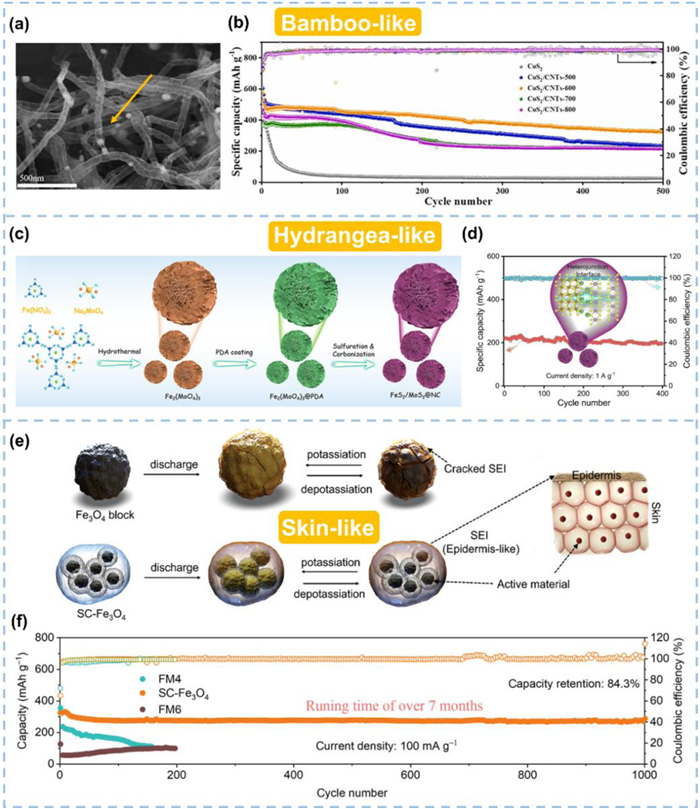
2D layered lamella promotes ion diffusion and conductivity due to its abundant pore structure and active sites [129]. However, in the absence of structural guidance, individual two-dimensional nanosheets often exist in the form of disordered stacking or localized agglomeration. This readily leads to limitations in effective specific surface area, disruption of ion transport pathways, and insufficient structural stability, thereby restricting their performance during long-term cycling processes. Single crystal nanosheets are likely to self-assemble into flower-like microstructures due to the effects of crystal plane attraction and hydrogen bonding [130]. A carbon-coated bimetallic sulfide FMS@NC, consisting of a large number of 2D nanosheets with a hydrangea-like structure, has been reported (Fig. 12c) [107]. The formidable electrochemical performance is likely due to the synergistic effect of the quasi-biomimetic structure and the composite material. The integration of the carbon network and the finely layered hydrangea-like structure increase the surface area of the material. Specifically, it is manifested as K intercalation into metal sulfides during the discharge process, followed by the generation of K2S, Mo, and Fe, while the charging process is the reverse. The hydrangea-like FMS@NC electrode is able to maintain a stable capacity of 197 mAh/g after 400 cycles (Fig. 12d). However, the high carbon content of this heterogeneous structural material, reaching 38.4%, may affect the overall energy density. Therefore, the development of metal oxide and carbon composite materials can reduce carbon content and increase the proportion of active materials. Innovations in structural design can also be explored, for example, by mimicking the strong core-shell hollow ball structures found in nature to enhance structural stability.
Conversion-type materials often face the challenge of low ICE due to the formation of SEI films and irreversible side reactions. Nature offers abundant inspiration for humans to realize the integration of structure and function. A typical instance is the uniform localization of the cell nucleus at the center of skin cell somas, with the cytoplasm and epidermis assuming their respective roles in regulating the internal environment and defending against the external environment. Drawing on this inspiration, the conversion material serves as the core for capacity provision, with amorphous carbon acting as the cytoplasm to mitigate the material’s volume changes and offer ion exchange channels. Moreover, the in-situ formed SEI film mimics the epidermis’s role, guarding the anode against external environmental interference (Fig. 12e) [38]. By comparing FM4, which lacks surrounding amorphous carbon, and FM6, which does not have uniformly distributed quantum dots as “nuclei”, the researchers demonstrated the advantages of an intact quasi-biomimetic skin structure. SC-Fe3O4 showed a higher reversible capacity, The SC-Fe3O4 anode exhibited a capacity of 329.6 mAh/g at 100 mA/g for 7 months (Fig. 12f). This structure and function integrated quasi-biomimetic design provides new ideas for improving ICE.
Alloy-type anode materials, including tin, antimony, phosphorus, bismuth, and silicon, offer high theoretical capacities by forming potassium-rich alloys through the reversible reaction: Potassiation (xM + yK+ + ye- → MxKy) and depotassiation (MxKy → xM + yK+ + ye-). Alloy-type anode materials have high theoretical capacity, high conductivity, and suitable average voltage, making them extremely promising [131,132]. However, compared with other storage mechanisms, alloy-type materials undergo greater volume changes. Due to significant volume changes, alloy-type materials are prone to fragmentation and inevitably undergo crystallization and aggregation processes. The increase in resistance hinders K+ insertion and extraction, and these major challenges result in their actual reversible capacity being far lower than their theoretical capacity [133–135]. This section systematically analyzes the intrinsic limitations of alloy-type materials and highlights several bio-inspired structural designs that enhance mechanical robustness and K+ transport kinetics, thereby improving the electrochemical performance of these high-capacity anodes.
The strong structural stability and layered porous structure of natural honeycomb structure are considered as potential candidates [136,137]. A good example of this is the anchoring of nitrogen-oxygen coordinated bismuth metal atomic sites to honeycomb carbon rods, which outperform most reported PIBs anodes (Fig. 13a) [48]. The intercalation and mesopores of the honeycomb structure can provide additional potassium storage, maximizing the utilization of the active Bi site. Besides, nitrogen-oxygen coordination enhances the electronic localization within the material and promotes the redistribution of charges (Fig. 13b), as evidenced by the overall transfer resistance (Rct) calculations (Fig. 13c). Therefore, making full use of the metal site by using the quasi-biomimetic structure is one of the breakthroughs to improve the performance of the alloy type (Fig. 13d).
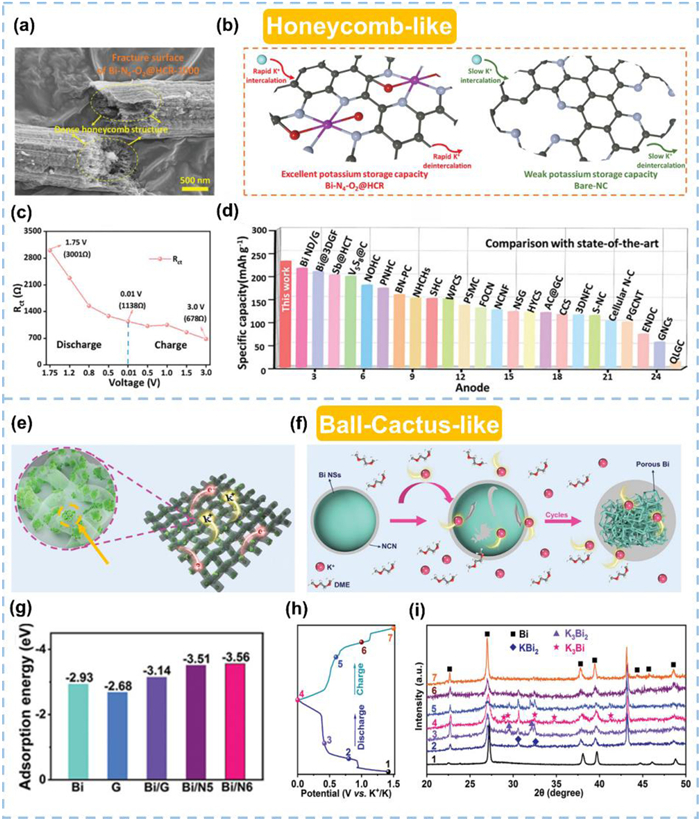
In conjunction with designing materials with inherently stable structures, there are also reports of quasi-biomimetic structures with adaptive functions. These structures can respond to changes in material volume during charging and discharging, thereby improving the long-term stability and electrochemical performance of batteries. Spherical cactus-shaped Bi nanospheres are a typical example (Fig. 13e) [30]. which gradually transform into 3D porous nanonetworks during cycling, while the isotropy of the amorphous structure can provide a rich percolation path for rapid K diffusion, which can greatly increase multiple electrode-electrolyte interfaces and provide an efficient electron/ion transport path through the entire electrode (Fig. 13f). This type of quasi-biomimetic structure more readily adsorbs K atoms from electrolytes, promoting potassium storage (Fig. 13g). During the potassiumization of Bi NSs/NCN, there is a gradual phase transition from initial Bi to KBi2, K3Bi2 and K3Bi, where KBi2 serves as the reaction front (Figs. 13h and i). This quasi-biomimetic structure, which adaptively alleviates volume expansion and provides an efficient electron/ion transport path, is also a good idea to solve the problem of alloy-type materials.
To address the issues of larger volume changes and lower actual capacity in alloy-type materials, future research on quasi-biomimetic alloy-type anode materials should focus on the following areas. Firstly, utilizing multi-layered, multi-dimensional quasi-biomimetic structures (honeycomb-like or cactus-like structures) to better accommodate volume expansion during charging and discharging. Secondly, modifying the metal sites within quasi-biomimetic structures or applying surface chemical modifications can maximize the utilization of active metal sites, thereby enhancing the actual capacity of alloy-type materials. Additionally, future quasi-biomimetic materials could incorporate self-adaptive mechanisms, utilizing materials that can adjust their porosity or structure to modulate their electronic/ionic transport properties under different operating conditions, thereby optimizing battery performance. In summary, the incorporation of quasi-biomimetic structures offers new avenues for enhancing the performance of alloy-type anode materials.
Intercalated materials can reversibly intercalate/deintercalate moving ions or molecules in the lattice of the host material without significant structural changes. The main intercalated anode materials include carbon, titanium, and vanadium-based compounds. Compared to other potassium storage mechanisms, the intercalation reaction results in smaller volume changes and higher reversible volumes. During the interaction reaction, K+ are inserted into the anode material and a new phase is formed. Take carbon-based materials as an example. Due to the large radius of K+, the spacing of traditional intercalation materials is often unable to accommodate the insertion of K+, resulting in low intrinsic kinetics of the intercalation reaction [138,139]. At the same time, the p electrons of carbon materials are not fully utilized, leading to low catalytic activity [140,141]. To address these issues, nanostructure design and heteroatom doping have become common strategies for modifying carbon-based anodes. The incorporation of non-metallic atoms can increase the interlayer spacing and introduce structural defects, thereby enhancing K+ adsorption capacity and reducing its diffusion energy barrier. Metal doping, on the other hand, facilitates electron delocalization, thereby enhancing the material’s affinity for K+ and further improving its electrochemical performance [142]. Building on these insights, quasi-biomimetic design offers a viable approach for synergistically regulating the structure, dimensions, and surface properties of carbon-based anode materials, potentially expanding pathways for enhancing the electrochemical performance of PIBs intercalation materials.
In response to the challenges of low catalytic activity of carbon-based materials and incompatibility between interlayer spacing and K+, designing compressible and layered porous quasi-biomimetic structures is an excellent approach. A quasi-biomimetic carbon nanofiber foam (CNFF) similar to bone tissue has been reported (Fig. 14a) [51]. The material’s layered pores and three-dimensional foam carbon network resemble the structural characteristics of bone tissue, providing K+ with abundant effective storage sites and efficient transport pathways, thereby significantly enhancing the catalytic activity of carbon-based materials (Fig. 14b). Compared to traditional graphite materials, the larger interlayer spacing of quasi-amorphous carbon offers more accommodation space for potassium ions. The CNFF material within this quasi-biomimetic bone structure demonstrates remarkable rate performance (Fig. 14c). Simultaneously, it exhibits outstanding long-cycle performance under varying high current densities (Fig. 14d). Additionally, thanks to its bone-like structure, CNFF maintains its shape after exposure to an ethanol flame and can withstand 90% volume compression while retaining its original form, demonstrating the quasi-biomimetic material’s high elasticity and durability. During the charging and discharging of intercalation electrodes, the chemical deintercalation behavior of ions often exhibits asynchronous coupling and periodic decoupling with the physical response of solid particles, readily leading to localized stress accumulation, particle rearrangement, and structural degradation. This issue is particularly pronounced in PIBs, stemming from K+ with larger ionic radius and relatively slow diffusion kinetics. Introducing elastic quasi-biomimetic structures can absorb and disperse stresses through reversible deformation, maintain interlayer stability and continuous electrical contact, suppress strain propagation and structural damage, thereby significantly enhancing the cycling stability and long-term service reliability of intercalation-type materials. Therefore, quasi-biomimetic bone-like structures with abundant storage sites, large interlayer spacing, and high elasticity, as well as similar quasi-biomimetic structures, offer new insights for further improving the electrochemical performance of PIBs intercalation-type materials.
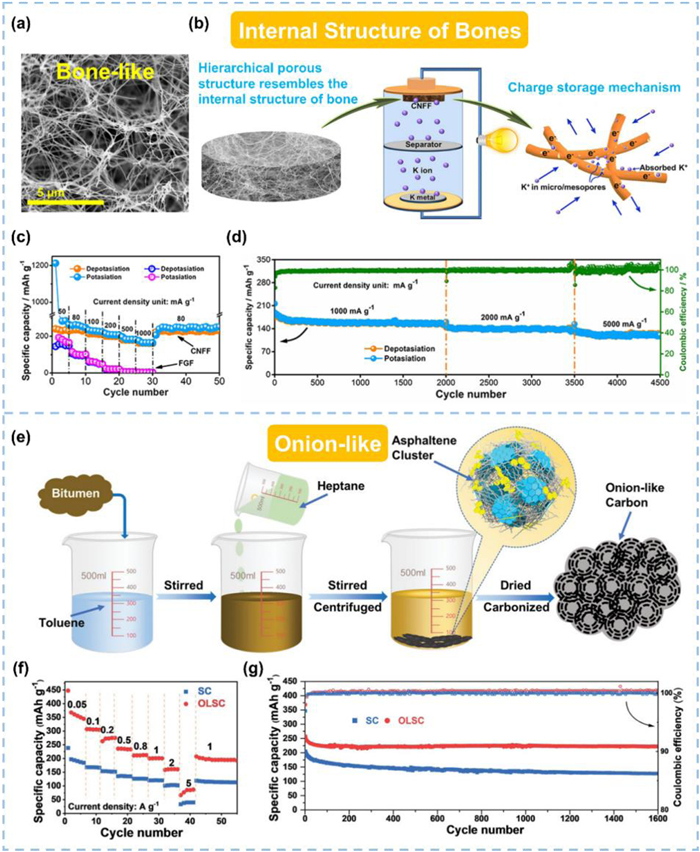
Another quasi-biomimetic design approach is to introduce interlaced and curved structures, adjusting the interlayer spacing and stability. As an illustration, a stable onion-like structure of soft carbon (OLSC) has been reported (Fig. 14e) [49]. The onion-like structure consists of interlocking and curved graphite planes, which can effectively increase the layer spacing while maintaining high mechanical stability, thus providing more space for potassium ions with larger radii. Compared with conventional materials, this structure is unique in that it avoids the structural rupture of the graphite material due to over-expansion during potassium ion intercalation, thus improving the multiplicity performance and cycling stability of the material. Thanks to the stable onion-like structure and increased layer spacing, the OLSC electrodes not only show higher reversible capacity than the irregularly structured SCs at various current densities, but also better capacity retention at 1600 cycles (Figs. 14f and g).
Overall, the aforementioned design ideas provide an important reference for the modification of the intercalation-type materials, especially for the incompatibility between K+ and anode materials. By increasing the porosity and layer spacing of the materials, the intercalation efficiency of K+ can be effectively improved and the compatibility between the anode material and the electrolyte can be enhanced. An example is the unique interlocking structure to improve the suitability of K+ with the anode material. In the future, these quasi-biomimetic structures can be used to further promote their application in PIBs by introducing innovative multi-storage mechanisms and self-adaptive functions, and to lay the foundation for the realization of high-efficiency and low-cost energy storage systems.
Conversion alloy-type anode materials include oxides, sulfides, and selenides based on Bi, Sb, or Sn, which are alloyed with K after combining conversion and alloying mechanisms. Conversion alloy anodes exhibit higher specific capacity than pure conversion-type or pure alloying-type materials due to the dual capacity contribution of cationic metal conversion reactions and elemental metal alloying processes [143]. In this dual-mechanism reaction, the alloying reaction helps reduce the overall operating voltage, while the conversion reaction products act as a buffer, alleviating stress and strain. However, dual-mechanism anodes still face significant lattice strain and slow kinetic reactions, which remain key challenges in enhancing the energy density of PIBs [144,145]. Strategies such as designing highly elastic nanostructures, carbon composites, optimizing electrolyte engineering, and preparing multi-element solid solutions are crucial for improving the performance of this material [146]. On this basis, the introduction of quasi-biomimetic structures not only helps to suppress lattice changes but also effectively improves ionic conductivity, thereby further enhancing the stability and electrochemical performance of the material.
3D structures typically have interconnected porous channels and good self-supporting properties. In recent years, a number of interesting 3D quasi-biomimetic structures have been reported, such as Bi2O3-Bi@CHNSs, which is inspired by the respiration mechanism of the alveoli [34]. The hollow part of the nanospheres is filled due to volume expansion during the potassiumization process, and the hollow structure is restored to a certain extent after potassium removal (Figs. 15a and b). The functional advantages of simulating alveolar relaxation and contraction, Bi2O3-Bi@CHNSs, which mimics alveolar structure, can effectively alleviate volumetric expansion. At the same time, the alveolar structure can also increase the specific surface area, so as to obtain rapid response kinetics. The multiple potassium storage mechanism of Bi2O3 (conversion reaction) and Bi (alloying reaction) is also the key to obtaining high-performance batteries (Figs. 15c-e), and Bi2O3-Bi@CHNS as the negative electrode exhibits ultra-high rate performance, a reversible capacity of 267.7 mAh/g at a high current density of 40 A/g (Fig. 15f).
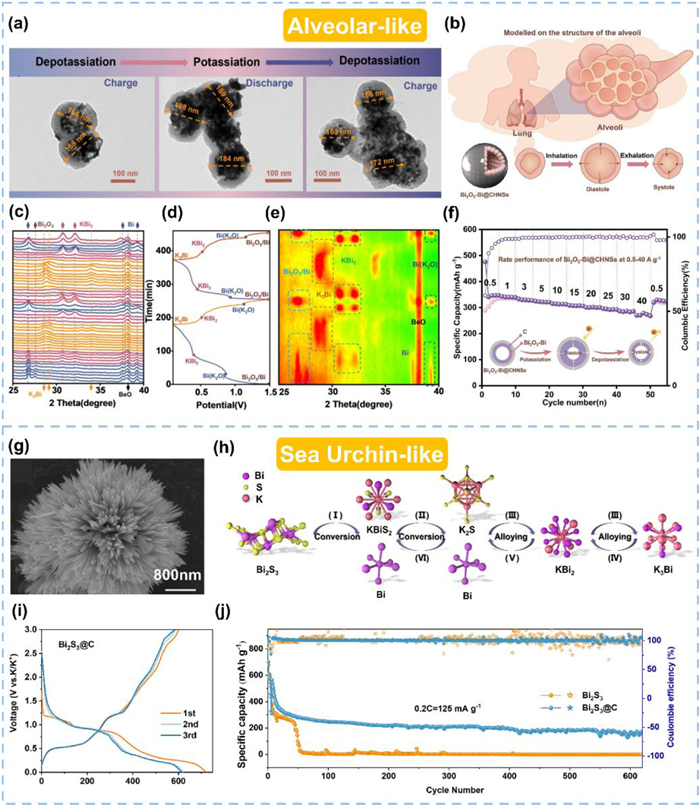
With the inclusion of mitigating the volume expansion of the transformation alloy-type material with an ingenious structure, it is also possible to increase the utilization rate of the active material and thus the capacity. Sea urchin is one of the oldest echinoderms in the ocean, because its osmotic effect of the cell membranes to sodium/potassium seawater and a porous spinous structure like a hydraulic pump. This efficient ability to absorb and transport K+ inspired researchers to develop a Bi2S3@C with a sea urchin-like structure (Fig. 15g) [50]. The sea urchin-like structure of Bi2S3@C integrates and amplifies nano/microscale advantages through multi-level channels, radially open pathways, and interlaced nanorod arrays. This design achieves synergistic optimization of volume buffering, rapid ion/electron transport, and dual storage mechanisms, embodying functional inspiration from natural sea urchin architecture. The staggered nanorod shape of the quasi-biomimetic sea urchin-like structure maximizes the electrolyte contact area, provides space for K+ intercalation and volume expansion, and shortens its diffusion length to accelerate the electron transfer rate. Ex-situ XRD and ex-situ TEM results show that the Bi2S3@C electrode has a dual storage K conversion alloy mechanism (Fig. 15h). Under the above synergistic effect, the Bi2S3@C electrode with a sea urchin-like structure exhibits impressive specific capacity and cycling performance (Figs. 15i and j).
By mimicking the self-expanding and contracting mechanisms found in biological structures in nature, lattice strain can be effectively alleviated, improving specific surface area and thereby accelerating ion diffusion and electron transfer rates. Additionally, quasi-biomimetic structures in the form of nanorods maximize the contact area between the electrolyte and the material, effectively shortening ion diffusion paths and enhancing kinetic reactions. In the future, the application of quasi-biomimetic structures is expected to overcome the limitations of traditional conversion-alloy-type materials, such as large lattice strain and slow kinetics, and show great potential in the development of PIBs with fast charging and discharging capabilities and long-term cycling stability.
This review comprehensively analyzes quasi-biomimetic design strategies for various components of PIBs. By summarizing existing research findings and identifying key technical bottlenecks, it aims to provide valuable references for the future development and practical application of PIBs devices. Due to differing potassium storage mechanisms among various materials in the positive and negative electrodes of PIBs, distinct challenges arise. To systematically evaluate the practical efficacy of quasi-biomimetic strategies within PIBs systems, we comprehensively compiled and assessed the role of specific quasi-biomimetic architectures in enhancing key parameters from published literature, demonstrating optimized performance. Relevant data are summarized in Table 1, Table 2. For instance, when addressing the issue of slow K+ kinetics, nature-inspired quasi-biomimetic designs featuring multi-layered pore networks, low-bending channels, and vertical structures can significantly reduce charge/discharge resistance, thereby enhancing rate capability and cycling performance. Examples include bamboo and honeycomb structures. Internal lattice strain caused by repeated K+ insertion/extraction, along with contact stress between particles, can readily lead to structural damage. Certain organisms in nature exhibit high mechanical stability due to interlocking and curved structures, such as onion-like layering. Additionally, some structures demonstrate adaptability to volume changes, including alveoli and skin tissues. Inspired by these ingenious structures and functions, more robust and flexible key materials have been developed, providing practical solutions for volume changes and structural integrity during cycling processes. Biological structures in nature with high specific surface areas or strong interfacial interactions can also inspire PIBs materials to better adsorb or store K+, promote redox reactions, and enhance the utilization of active materials. Examples include pomegranate-like and red blood cell-like structures.
Quasi-biomimetic design offers a promising approach to enhance the multifunctionality of PIBs materials by optimizing structural hierarchy, pore distribution, interfacial interactions, and mechanical buffering, rather than altering chemical composition. Inspired by nature, such structures improve ion transport, accommodate volume changes, and enhance cycling stability, energy density, and overall performance synergy. However, practical implementation remains limited due to challenges in scalable and controllable synthesis, efficient reproduction of complex multiscale architectures, and the need to balance mechanical strength, electrolyte permeability, and electrochemical activity. Safety concerns, including potassium dendrite growth and side reactions with organic electrolytes, further constrain performance. Advancing this field requires integrated strategies that combine rational structural design, careful material selection, scalable fabrication, in-situ characterization, and computational modeling, supported by interdisciplinary collaboration and techno-economic considerations (Fig. 16). Such approaches are expected to enable the development of high-performance and safe quasi-biomimetic PIBs.
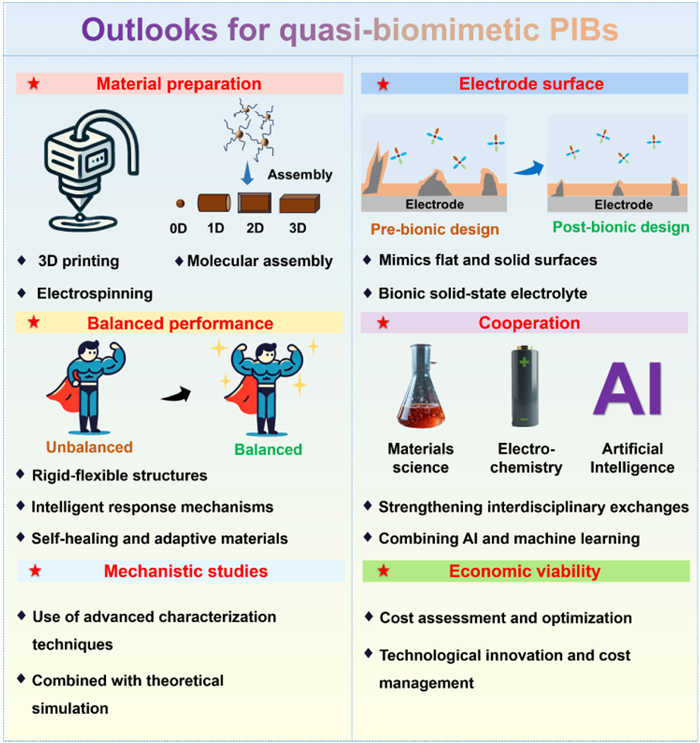
(1) Material preparation. The feasibility of large-scale production depends not only on fabrication precision but also on cost, energy consumption, and environmental sustainability. Advanced manufacturing strategies, including 3D printing, self-templating, molecular self-assembly, and electrospinning, offer effective routes to construct quasi-biomimetic architectures with high structural fidelity, multiscale features, and ordered morphologies. These approaches enable the rational design of porous, mechanically robust, and functionally integrated materials while improving material efficiency. Overall, the development of precise, controllable, and environmentally benign manufacturing technologies is essential for accelerating the industrialization of quasi-biomimetic PIBs.
(2) Balanced performance. Regarding the multifunctional balance issue in quasi-biomimetic structures, solutions should be explored in depth from both structural design and material selection perspectives. In terms of structural design, approaches can be taken at both micro and macro scales. At the microscopic level, designing quasi-biomimetic channels with rapid ion transport is essential. The inner layer can be engineered as a high-strength material framework to ensure structural stability and load-bearing capacity. At the macroscopic level, flexible materials can be employed for the outer layer to enhance the structure’s adaptability and elasticity [147,148]. This multiscale composite design not only effectively buffers mechanical stress and dynamic strain generated by repeated K+ insertion/extraction, but also ensures thorough electrolyte permeation and interfacial contact within the electrode, thereby improving the electrochemical performance of quasi-biomimetic PIBs. What is more, for material selection, choosing quasi-biomimetic materials with self-healing properties and inherent high-strength toughness is beneficial to maintaining the stability and safety of the PIBs.
(3) Mechanistic studies. In-situ characterization techniques are essential for elucidating quasi-biomimetic mechanisms under realistic operating conditions by tracking real-time structural and chemical evolution [149]. Techniques such as in-situ XRD, in-situ X-ray photoelectron spectroscopy (XPS), and synchrotron radiation X-ray absorption spectroscopy (XAS) enable direct observation of phase transitions, interfacial reactions, and ion migration during electrochemical cycling, providing critical insights for rational structural optimization. Complementarily, modeling frameworks and theoretical calculations, including molecular dynamics and density functional theory, offer predictive understanding of dynamic structural evolution and ion-transport behavior at multiple scales. The integration of advanced characterization, modeling, and computation is therefore crucial for maximizing the functional advantages of quasi-biomimetic architectures and accelerating their translation toward practical viable PIBs.
(4) Electrode surface. Safety challenges in PIBs, particularly potassium dendrite formation and electrolyte flammability, may be effectively addressed through quasi-biomimetic design [150]. Inspired by naturally robust and stable biological structures, such designs enable the construction of mechanically strong, flat, and uniform electrode surfaces that promote homogeneous charge distribution and suppress dendrite growth. In addition, quasi-biomimetic hydrophobic or hydrophilic surface coatings can regulate electrode–electrolyte interactions by controlling electrolyte adsorption and ion transport, thereby further mitigating dendrite formation. When combined with advanced nanostructuring, these surface architectures also enhance electrical conductivity and corrosion resistance. Collectively, quasi-biomimetic strategies contribute to improved thermal stability and reduced safety risks under high-power operation, positioning them as a promising pathway for resolving the safety and stability challenges of PIBs.
(5) Cooperation. Future advances in quasi-biomimetic structural design for PIBs will be driven by strengthened interdisciplinary collaboration across materials science, electrochemistry, and nanotechnology, enabling effective mitigation of volume expansion and kinetic limitations associated with large K+. Such integration facilitates precise microstructural control, optimized ion-transport pathways, and concurrent improvements in energy density, cycling stability, rate capability, and temperature adaptability at reduced cost. In parallel, artificial intelligence and machine learning provide powerful tools for rapid structure screening, property prediction, and data-driven optimization, significantly accelerating the design and development of quasi-biomimetic materials. Coupled with enhanced industry–academia collaboration, these advances are expected to promote the practical deployment of quasi-biomimetic PIBs in sustainable energy applications.
(6) Economic viability. Ensuring economic viability is critical alongside technological innovation in the development of quasi-biomimetic PIBs. The fabrication of quasi-biomimetic structures involves multiple stages, including raw material selection, production, and post-processing, each directly influencing costs. High-cost functional and nanoscale materials can be partially replaced by valorizing green industrial byproducts, reducing expenses while promoting resource recycling. Process innovations improve production efficiency and lower energy and equipment costs, while effective recycling strategies are essential for managing diverse composite materials. Incorporating life cycle assessment into design and fabrication enables quantitative evaluation and optimization of costs throughout the material lifecycle.
The authors declare no conflict of interest.
Linxin Huang: Writing – review & editing, Writing – original draft. Zhiwang Liu: Writing – review & editing. Tao Wu: Supervision. Hongyan Li: Writing – review & editing, Supervision, Project administration, Investigation, Funding acquisition.
The authors declare that they have no known competing financial interests or personal relationships that could have appeared to influence the work reported in this paper.
This work was financially supported by the National Natural Science Foundation of China (No. 22209057), the Guangdong Basic and Applied Basic Research Foundation (No. 2024A1515140047) and the Fundamental Research Funds for the Central Universities (No. 21625402).
Z.W. Liu, Y.H. Zhou, X.L. Chen, et al., Adv. Mater. 38 (2026) e23296. doi: 10.1002/adma.202523296
B. Cao, M.J. Du, Z.R. Guo, et al., Carbon Future 1 (2024) 9200017. doi: 10.26599/cf.2024.9200017
J.F. Zheng, Y.J. Wu, Y.J. Sun, et al., Nano-Micro Lett. 13 (2021) 12. doi: 10.1007/s40820-020-00541-y
B. Cao, Z. Cui, H. Liu, et al., New Carbon Mater. 40 (2025) 717–737. doi: 10.1016/S1872-5805(25)61025-0
J.Q. Wei, Z.X. Wang, H.Y. Li, Appl. Surf Sci. 726 (2026) 165945. doi: 10.1016/j.apsusc.2026.165945
B. Cao, H. Liu, P. Zhang, et al., Adv. Funct. Mater. 31 (2021) 2102126. doi: 10.1002/adfm.202102126
Y.S. Zheng, H.X. Xie, J.F. Li, et al., Adv. Energy Mater. 14 (2024) 2400461. doi: 10.1002/aenm.202400461
J.F. Zheng, Y.J. Wu, Y. Tong, et al., Nano-Micro Lett. 13 (2021) 174. doi: 10.1007/s40820-021-00706-3
Z.L. Jian, W. Luo, X.L. Ji, et al., J. Am. Chem. Soc. 137 (2015) 11566–11569. doi: 10.1021/jacs.5b06809
X. Liu, Y. Tong, Y.J. Wu, et al., Chem. Eng. J. 431 (2022) 133986. doi: 10.1016/j.cej.2021.133986
W.C. Zhang, J. Lu, Z.P. Guo, Mater. Today 50 (2021) 400–417. doi: 10.1016/j.mattod.2021.03.015
X. Liu, Z.F. Sun, Y.J. Sun, et al., Adv. Funct. Mater. 33 (2023) 2307205. doi: 10.1002/adfm.202307205
Z.H. Yan, W.Q. Su, W.W. Xu, et al., Chin. Chem. Lett. 36 (2025) 110217. doi: 10.1016/j.cclet.2024.110217
Y.J. Wu, J.F. Zheng, Y. Tong, et al., ACS Appl. Mater. Interfaces 13 (2021) 51066–51077. doi: 10.1021/acsami.1c16267
X.M. Ma, H.W. Fu, J.Y. Shen, et al., Angew. Chem. Int. Ed. 135 (2023) e202312973. doi: 10.1002/anie.202312973
H.X. Lin, Z.X. Wang, J.H. Quan, et al., Chem. Eng. J. 498 (2024) 155644. doi: 10.1016/j.cej.2024.155644
Y. Yang, X. Song, X.J. Li, et al., Adv. Mater. 30 (2018) 1706539. doi: 10.1002/adma.201706539
U.G.K. Wegst, H. Bai, E. Saiz, et al., Nat. Mater. 14 (2015) 23–36. doi: 10.1038/nmat4089
Y.J. Sun, J.Q. Wei, Z.W. Liu, et al., J. Colloid Interface Sci. 707 (2026) 139741. doi: 10.1016/j.jcis.2025.139741
D.T. Wijaya, C.W. Lee, Chem. Eng. J. 446 (2022) 137311. doi: 10.1016/j.cej.2022.137311
Y.P. Chen, J.X. Meng, Z. Gu, et al., Adv. Funct. Mater. 30 (2020) 1905287. doi: 10.1002/adfm.201905287
J. Ren, Q. Liu, Y. Pei, et al., Adv. Mater. Technol-Us. 6 (2021) 2001301. doi: 10.1002/admt.202001301
L. Qu, Q.Z. Gou, J.B. Deng, et al., Langmuir 40 (2024) 6601–6611. doi: 10.1021/acs.langmuir.3c03679
W. Wang, B. Jiang, C. Qian, et al., Adv. Mater. 30 (2018) 1801812. doi: 10.1002/adma.201801812
B.R. Jia, Q.Y. Yu, Y.Z. Zhao, et al., Adv. Funct. Mater. 28 (2018) 1803409. doi: 10.1002/adfm.201803409
Z. Chen, M. Zhang, J. Alloys Compd. 779 (2019) 505–510. doi: 10.1016/j.jallcom.2018.11.316
S.K. Chong, L. Sun, C.Y. Shu, et al., Nano Energy 63 (2019) 103868. doi: 10.1016/j.nanoen.2019.103868
J.P. Li, Y.J. Li, X.D. Ma, et al., Chem. Eng. J. 384 (2020) 123328. doi: 10.1016/j.cej.2019.123328
C.F. Dong, L.Q. Wu, Y.Y. He, et al., Small 16 (2020) 2004580. doi: 10.1002/smll.202004580
R.C. Cui, H.Y. Zhou, J.C. Li, et al., Adv. Funct. Mater. 31 (2021) 2103067. doi: 10.1002/adfm.202103067
L.K. Zhao, H. Yang, F.X. He, et al., Electrochim. Acta 388 (2021) 138565. doi: 10.1016/j.electacta.2021.138565
J.J. Yuan, X.F. Li, J. Liu, et al., J. Colloid Interf. Sci. 613 (2022) 84–93. doi: 10.1016/j.jcis.2022.01.022
N. Cheng, X.Y. Chen, Z.G. Liu, Energ. Fuel. 36 (2022) 694–702. doi: 10.1021/acs.energyfuels.1c03800
L. Cheng, Y.Y. Tang, H.X. Lin, et al., Chem. Eng. J. 499 (2024) 156156. doi: 10.1016/j.cej.2024.156156
X.W. Tao, Z.G. Zhang, Z. Li, et al., ACS Appl. Mater. Inter. 16 (2024) 772–783. doi: 10.1021/acsami.3c15188
K. Zhai, H.B. Huang, X.N. Li, et al., J. Alloy Compd. 976 (2024) 172953. doi: 10.1016/j.jallcom.2023.172953
C.J. Fu, C.L. Liu, H.B. Huang, et al., Appl. Surf. Sci. 687 (2025) 162307. doi: 10.1016/j.apsusc.2025.162307
X.T. Yang, Y. Gao, L. Fan, et al., Adv. Energy Mater. 13 (2023) 2302589. doi: 10.1002/aenm.202302589
J. Wang, F.S. Liu, G.H. Qin, et al., Energy Storage Mater. 76 (2025) 104101. doi: 10.1016/j.ensm.2025.104101
H.M. Jiang, Q.J. Fu, X.Y. Sang, et al., Adv. Energy Mater. 16 (2026) e05082. doi: 10.1002/aenm.202505082
L.P. Duan, J. Xu, Y. Xu, et al., J. Energy Chem. 76 (2023) 332–338. doi: 10.1016/j.jechem.2022.10.006
Z.Z. Zhang, J.L. Sun, L.P. Duan, et al., J. Mater. Chem. A 10 (2022) 554–560. doi: 10.1039/d1ta09739c
H.Y. He, K. Cao, S. Guo, et al., J. Power Sources 564 (2023) 232862. doi: 10.1016/j.jpowsour.2023.232862
C. Xie, X. Liu, J. Han, et al., Small 18 (2022) 2204348. doi: 10.1002/smll.202204348
A. Li, Y.H. Man, J.Y. Liao, et al., Nano Lett. 23 (2023) 10066–10073. doi: 10.1021/acs.nanolett.3c03558
X.Y. Liu, H.T. Xie, J. Mao, J. Electroanal. Chem. 911 (2022) 116228. doi: 10.1016/j.jelechem.2022.116228
Y. Liu, X.C. Liu, Z.G. Liu, J. Alloy Compd. 978 (2024) 173444. doi: 10.1016/j.jallcom.2024.173444
Z.S. Chen, H.X. Lin, Y.Y. Tan, et al., Adv. Funct. Mater. 34 (2024) 2407653. doi: 10.1002/adfm.202407653
W. Tan, L.N. Wang, K. Liu, et al., Small 18 (2022) 2203494. doi: 10.1002/smll.202203494
Y. Chen, B.Z. Yang, S.J. Yang, et al., J. Energy Storage 103 (2024) 114360. doi: 10.1016/j.est.2024.114360
H.Y. Li, Z. Cheng, Q. Zhang, et al., Nano Lett. 18 (2018) 7407–7413. doi: 10.1021/acs.nanolett.8b03845
S.C. Yang, Y.X. Zhang, Y. Zhang, et al., Adv. Funct. Mater. 33 (2023) 2304280. doi: 10.1002/adfm.202304280
X.Y. Fan, C. Zhong, J. Liu, et al., Chem. Rev. 122 (2022) 17155–17239. doi: 10.1021/acs.chemrev.2c00196
Y.Y. Tan, F.L. Mo, H.Y. Li, Nano-Micro Lett. 17 (2025) 126. doi: 10.26689/ssr.v7i8.11972
T.Y. Zhang, F. Ran, Adv. Funct. Mater. 31 (2021) 2010041. doi: 10.1002/adfm.202010041
X.F. Zheng, G.F. Shen, C. Wang, et al., Nat. Commun. 8 (2017) 14921. doi: 10.1038/ncomms14921
Y.C. Yan, Z. Liu, W.N. Li, et al., Energy Storage Mater. 74 (2025) 103892. doi: 10.1016/j.ensm.2024.103892
T. Ma, T.Y. Su, L. Zhang, et al., Nano Lett. 21 (2021) 2347–2355. doi: 10.1021/acs.nanolett.0c04033
D.H. Li, J.H. Xu, J.J. Huang, et al., Adv. Funct. Mater. 36 (2026) e14738. doi: 10.1002/adfm.202514738
X.X. Zhang, F. Wu, X.W. Lv, et al., Adv. Mater. 34 (2022) 2204370. doi: 10.1002/adma.202204370
J.S. Peng, Q.F. Cheng, Adv. Mater. 29 (2017) 1702959. doi: 10.1002/adma.201702959
G.Y. Qian, B. Zhu, X.B. Liao, et al., Adv. Mater. 30 (2018) 1704947. doi: 10.1002/adma.201704947
M.Y. Zhang, N. Zhao, Q. Yu, et al., Nat. Commun. 13 (2022) 3247. doi: 10.1038/s41467-022-30873-9
X.B. Zhu, W.J. Zhang, G.M. Lu, et al., ACS Nano 16 (2022) 16724–16735. doi: 10.1021/acsnano.2c06264
I. Hussain, C. Lamiel, M.S. Javed, et al., Mater. Chem. Front. 6 (2022) 3460–3488. doi: 10.1039/d2qm00826b
I. Hussain, C. Lamiel, M.S. Javed, et al., Chem. Eng. J. 454 (2023) 140313. doi: 10.1016/j.cej.2022.140313
T.Y. Wang, D.W. Su, Y. Chen, et al., Chem. Eng. J. 401 (2020) 126079. doi: 10.1016/j.cej.2020.126079
Y. Zhang, L.L. Wu, X.Y. Zhao, et al., Adv. Energy Mater. 8 (2018) 1801139. doi: 10.1002/aenm.201801139
C. Lu, X. Chen, EcoMat 4 (2022) e12181. doi: 10.1002/eom2.12181
T.Y. Li, Z.D. Yan, S.S. Chen, et al., Adv. Funct. Mater. 35 (2025) 2412349. doi: 10.1002/adfm.202412349
J.B. Fan, J. Luo, Z. Luo, et al., ACS Nano 13 (2019) 8374–8381. doi: 10.1021/acsnano.9b03918
Z.X. Wang, Z.W. Liu, H.Y. Li, J. Colloid Interf. Sci. 691 (2025) 137387. doi: 10.1016/j.jcis.2025.137387
J.Q. Wei, Z.W. Liu, H.Y. Li, Adv. Powder Mater. 4 (2025) 100337. doi: 10.1016/j.apmate.2025.100337
Z.X. Huang, Z.Y. Gu, Y.L. Heng, et al., Chem. Eng. J. 452 (2023) 139438. doi: 10.1016/j.cej.2022.139438
P. Hong, C.F. Xu, C.Z. Yan, ACS Energy Lett. 10 (2025) 750–778. doi: 10.1021/acsenergylett.4c02915
H.X. Lin, Y.J. Wu, H.Y. Li, Appl. Surf. Sci. 633 (2023) 157603. doi: 10.1016/j.apsusc.2023.157603
X. Wang, Z. Xiao, K. Han, et al., Adv. Energy Mater. 13 (2023) 2202861. doi: 10.1002/aenm.202202861
Z.W. Liu, J.H. Quan, X.L. Chen, et al., Energy Storage Mater. 83 (2025) 104708. doi: 10.1016/j.ensm.2025.104708
Z. Liu, H. Su, Y. Yang, et al., Energy Storage Mater. 34 (2021) 211–228. doi: 10.1016/j.ensm.2020.09.010
Z.W. Liu, Z.X. Wang, H.Y. Li, Chem. Eng. J. 514 (2025) 163226. doi: 10.1016/j.cej.2025.163226
Z.Z. Zhang, Y.R. Qiao, J. Zhao, et al., Chin. Chem. Lett. 36 (2025) 109907. doi: 10.1016/j.cclet.2024.109907
J.Y. Li, L. Lu, H.B. Liang, et al., Compos. Struct. 339 (2024) 118161. doi: 10.1016/j.compstruct.2024.118161
H.Y. Luo, M.X. Chen, J.H. Cao, et al., Nano-Micro Lett. 12 (2020) 113. doi: 10.1007/s40820-020-00454-w
H.J. Huang, X.W. Wu, Y.J. Gao, et al., Adv. Energy Mater. 14 (2024) 2304251. doi: 10.1002/aenm.202304251
J. Lu, C. Wang, G. Xia, et al., J. Mater. Chem. A 8 (2020) 23939–23946. doi: 10.1039/d0ta08845e
R. Tian, H. Zhang, Z. Yuan, et al., J. Energy Chem. 89 (2024) 250–258. doi: 10.1016/j.jechem.2023.10.018
J. Ke, F. He, H. Wu, et al., Nano-Micro Lett. 13 (2021) 24. doi: 10.1007/s40820-020-00545-8
J.H. Quan, H.X. Lin, H.Y. Li, Small 20 (2024) 2403065. doi: 10.1002/smll.202403065
K.F. Yu, J. Zheng, T. Liu, et al., Ionics 28 (2022) 4205–4216. doi: 10.1007/s11581-022-04666-5
S. Anwer, Y.X. Huang, J. Liu, et al., ACS Appl. Mater. Inter. 9 (2017) 11669–11677. doi: 10.1021/acsami.7b01519
J.Y. Liao, Q. Hu, B. Che, et al., J. Mater. Chem. A 7 (2019) 15244–15251. doi: 10.1039/c9ta03192h
J. Xu, L. Duan, J. Liao, et al., Green Energy Environ. 8 (2023) 1469–1478. doi: 10.1016/j.gee.2022.12.007
B. Cao, Z.R. Guo, H. Liu, et al., Chem. Eng. J. 511 (2025) 161950. doi: 10.1016/j.cej.2025.161950
Z. Liu, J. Wang, B. Lu, Sci. Bull. 65 (2020) 1242–1251. doi: 10.1016/j.scib.2020.04.010
Q. Song, Z. Li, S. Gan, et al., J. Mater. Chem. A 11 (2023) 1532–1550. doi: 10.1039/d2ta08573a
A. Li, L. Duan, J. Liao, et al., ACS Appl. Energ. Mater. 5 (2022) 11789–11796. doi: 10.1021/acsaem.2c02288
J. Dai, S. Tan, L. Wang, et al., ACS Nano 17 (2023) 20949–20961. doi: 10.1021/acsnano.3c02323
C. Gao, Y. Lei, Y. Wei, et al., Chem. Eng. J. 431 (2022) 133926. doi: 10.1016/j.cej.2021.133926
Y. Zhu, Z. Zhang, J. Bao, et al., Int. J. Energ. Res. 44 (2020) 9205–9212. doi: 10.1002/er.5576
W.X. Zhao, X.Q. Ma, Y.Y. Zheng, et al., Chem. Eng. J. 459 (2023) 141629. doi: 10.1016/j.cej.2023.141629
F.L. Mo, L. Cheng, H.Y. Li, J. Colloid Interf. Sci. 703 (2026) 139089. doi: 10.1016/j.jcis.2025.139089
J.Q. Cui, J. Liu, X. Chen, et al., Carbon 196 (2022) 70–77. doi: 10.1016/j.carbon.2022.04.034
Y.Y. Tan, H.X. Lin, Z.S. Chen, et al., J. Energy Chem. 99 (2024) 365–374. doi: 10.1016/j.jechem.2024.07.054
L. Ma, Y.H. Lv, J. Wu, et al., Nano Res. 14 (2021) 4442–4470. doi: 10.1007/s12274-021-3439-3
M. Sha, L. Liu, H.P. Zhao, et al., Carbon Energy 2 (2020) 350–369. doi: 10.1002/cey2.57
M.N. Li, C.Y. Wang, C. Wang, et al., Adv. Mater. 37 (2025) 2416717. doi: 10.1002/adma.202416717
H.Y. Liang, X.Y. Wang, J. Shi, et al., J. Colloid Interf. Sci. 664 (2024) 96–106. doi: 10.1016/j.jcis.2024.03.029
Y.F. Gan, M.Q. Mu, M.Q. Li, et al., Chem. Eur. J. 29 (2023) e202300373. doi: 10.1002/chem.202300373
K.Y. Xie, K. Yuan, X. Li, et al., Small 13 (2017) 1701471. doi: 10.1002/smll.201701471
P. Zhou, M.Y. Zhang, L.P. Wang, et al., Small 18 (2022) 2203964. doi: 10.1002/smll.202203964
H. Min, M.H. Li, H. Shu, et al., Electrochim. Acta 366 (2021) 137381. doi: 10.1016/j.electacta.2020.137381
Q.R. Pan, B.B. Li, S.Q. Liu, et al., Chem. Eng. Sci. 304 (2025) 121043. doi: 10.1016/j.ces.2024.121043
C.Y. Huang, A.D. Xu, G.L. Li, et al., Small 17 (2021) 2100685. doi: 10.1002/smll.202100685
X. Liu, Y.J. Sun, Y. Tong, et al., Small 18 (2022) 2204045. doi: 10.1002/smll.202204045
X. Liu, J.L. Zhu, X.Y. Wang, et al., Adv. Funct. Mater. 33 (2023) 2209388. doi: 10.1002/adfm.202209388
N. Cheng, W. Zhou, J.L. Liu, et al., Nano-Micro Lett. 14 (2022) 146. doi: 10.1007/s40820-022-00892-8
X.P. Sun, L. Wang, C.C. Li, et al., Nano Res. 14 (2021) 4696–4703. doi: 10.1007/s12274-021-3407-y
Z.S. Chen, Y.J. Wu, X. Liu, et al., J. Energy Chem. 81 (2023) 462–471. doi: 10.1016/j.jechem.2023.02.050
Z.Z. Wang, S.Y. Qiao, M. Ma, et al., ACS Nano 19 (2025) 15148–15160. doi: 10.1021/acsnano.5c03792
S.T. Geng, T. Zhou, M.Y. Jia, et al., Energy Environ. Sci. 14 (2021) 3184–3193. doi: 10.1039/d1ee00193k
Y.J. Wu, Y.J. Sun, Y. Tong, et al., Small 18 (2022) 2201934. doi: 10.1002/smll.202201934
Y.J. Wu, Y.J. Sun, Y. Tong, et al., Energy Storage Mater. 41 (2021) 108–132. doi: 10.1016/j.ensm.2021.05.045
J.H. Zheng, Y.J. Wu, H.Y. Li, Adv. Sustain. Syst. 8 (2024) 2400210. doi: 10.1002/adsu.202400210
X. Liu, Y.J. Sun, Y. Tong, et al., Nano Energy 86 (2021) 106070. doi: 10.1016/j.nanoen.2021.106070
B.L. Huang, L. Cheng, X.L. Chen, et al., Chem. Eng. J. 522 (2025) 167138. doi: 10.1016/j.cej.2025.167138
S.M. Wu, Y.N. Li, L.T. Chen, et al., Chin. Chem. Lett. 36 (2025) 109796. doi: 10.1016/j.cclet.2024.109796
W.C. Ma, H.M. Wu, T. Long, et al., Small 20 (2024) 2308109. doi: 10.1002/smll.202308109
B.W. Cong, S.F. Sun, B. Wang, et al., Chem. Eng. J. 435 (2022) 135185. doi: 10.1016/j.cej.2022.135185
Q.B. Yun, L.X. Li, Z.N. Hu, et al., Adv. Mater. 32 (2020) 1903826. doi: 10.1002/adma.201903826
A.Q. Pan, H.B. Wu, L. Yu, et al., Angew. Chem. Int. Ed. 52 (2013) 2226–2230. doi: 10.1002/anie.201209535
L. Cheng, J.H. Quan, H.Y. Li, Chin. Chem. Lett. 36 (2025) 110685. doi: 10.1016/j.cclet.2024.110685
Q. Chen, H.B. Li, H. Li, et al., Chin. Chem. Lett. 34 (2023) 107402. doi: 10.1016/j.cclet.2022.03.124
Y.J. Wu, Y.J. Sun, J.F. Zheng, et al., Chem. Eng. J. 404 (2021) 126565. doi: 10.1016/j.cej.2020.126565
Y. Wang, X.J. Xu, F.K. Li, et al., Batteries 9 (2023) 440. doi: 10.3390/batteries9090440
F.L. Mo, Z.W. Liu, H.Y. Li, Adv. Funct. Mater. 36 (2026) e13591. doi: 10.1002/adfm.202513591
R. Bhandari, Appl. Energ. 393 (2025) 126140. doi: 10.1016/j.apenergy.2025.126140
R.X. Li, Z.W. Zhao, H.H. Bao, et al., Eng. Fail. Anal. 158 (2024) 108041. doi: 10.1016/j.engfailanal.2024.108041
Y. Tong, Y.J. Wu, Z.H. Liu, et al., Chin. Chem. Lett. 34 (2023) 107443. doi: 10.1016/j.cclet.2022.04.041
H. Liu, H.L. Du, W. Zhao, et al., Energy Storage Mater. 40 (2021) 490–498. doi: 10.1016/j.ensm.2021.05.037
Y.J. Sun, Y.Y. Tang, H.Y. Li, J. Colloid Interf. Sci. 700 (2025) 138516. doi: 10.1016/j.jcis.2025.138516
B. Cao, S. Gao, Y. Ma, et al., J. Colloid Interf. Sci. 661 (2024) 598–605. doi: 10.1016/j.jcis.2024.01.201
Y.Y. Tang, L. Cheng, J.H. Zheng, et al., J. Colloid Interf. Sci. 674 (2024) 634–642. doi: 10.1016/j.jcis.2024.06.207
S.J. Wang, P. Xiong, X. Guo, et al., Adv. Funct. Mater. 30 (2020) 2001588. doi: 10.1002/adfm.202001588
Z.S. Chen, L. Cheng, H.X. Lin, et al., J. Colloid Interf. Sci. 677 (2025) 769–779. doi: 10.1016/j.jcis.2024.08.109
J.F. Zheng, Y.J. Wu, Y. Tong, et al., J. Colloid Interf. Sci. 622 (2022) 738–747. doi: 10.1016/j.jcis.2022.04.154
B. Cao, M.J. Du, Y. Ma, et al., Carbon 234 (2025) 120033. doi: 10.1016/j.carbon.2025.120033
B. Yan, Y.L. Yu, H. Sun, et al., Energy Storage Mater. 74 (2025) 103908. doi: 10.1016/j.ensm.2024.103908
B. Yan, H. Sun, X.P. Liu, et al., Energy Environ. Sci. 17 (2024) 3419–3432. doi: 10.1039/d4ee00086b
X. Liu, Y. Tong, Y.J. Wu, et al., Small Methods 5 (2021) 2101130. doi: 10.1002/smtd.202101130
M.F. Zhou, P.X. Bai, X. Ji, et al., Adv. Mater. 33 (2021) 2003741. doi: 10.1002/adma.202003741

Figure 1 (a) Schematic diagram of the PIBs. (b) Radar plots of various indicators of LIBs, SIBs, and PIBs. (c) Design philosophy and applications for quasi-biomimetic PIBs.


Figure 3 Overview of quasi-biomimetic structural materials covered in this review. Reproduced with permission [30,34,38,41–51]. Copyright 2021, 2022, 2023, 2024, Wiley-VCH; Copyright 2022, 2023, 2024, Elsevier; Copyright 2022, Royal Society of Chemistry; Copyright 2018, 2023, American Chemical Society.

Figure 4 (a) Schematic diagram illustrating the mechanism of transmission efficiency enhancement in quasi-biomimetic Murray’s Law structures. (b) Schematic diagram of the mechanism for efficient ion transport in quasi-biomimetic plant stem structures. (c) Schematic diagram of bamboo membrane layer-by-layer compaction structure. (d) Schematic illustration of smart hierarchical nanofluidic structure of natural leaf. Reproduced with permission [60]. Copyright 2022, Wiley-VCH.

Figure 5 (a) Schematic diagram of a quasi-biomimetic structure combining rigidity and flexibility. (b) Schematic diagram of complex layered and interlocking quasi-biomimetic structures. (c) Schematic diagram of quasi-biomimetic structure based on chemical bond array architecture.

Figure 6 (a) Schematic diagram of hollow porous structures inspired by biological structures. (b) Schematic diagram of the mosaic structure of quasi-biomimetic leaves. (c) Schematic diagram of a bio-inspired nanosheet array structure.


Figure 8 (a) Schematic diagram of the synthesis steps of KMNO cocoons. (b) Ex-situ XRD patterns of the KMNO cocoon electrode collected during the first charge/discharge at 20 mA/g in the voltage range of 1.5–4.0 V. (c) Rate properties of the KMNO cocoons and KMNO particles and the relevant Columbic efficiencies. Reproduced with permission [41]. Copyright 2023, Elsevier. (d) Schematic illustration of the synthesis of peanut-like P3-type K0.45Mn0.5Co0.5O2 microparticles; (e) crystal structure of p-KMCO. Reproduced with permission [42]. Copyright 2022, Royal Society of Chemistry.

Figure 9 (a) Scanning electron microscope (SEM) image of K1+δVOPO4F. (b) The voltage profile of the K1+δVOPO4F/K half cells throughout the in-situ charge-discharge process and in-situ XRD of K1+δVOPO4F upon K+ extraction and reinsertion. Reproduced with permission [43]. Copyright 2023, Elsevier. (c) Illustration of the synthesis process for the KVPF@C-PMS cathode for PIBs. (d) HRTEM photo of the surface of the KVPF particles. (e) Cyclic performance comparison of volumetric energy density and discharge voltage with different KVPF samples. (f) Comparison of energy density between PIBs cathode materials and KVPF@C-PMS electrode slice. Reproduced with permission [44]. Copyright 2022, Wiley-VCH.

Figure 10 (a) Schematic illustration of the formation procedure of spindle-like PW. (b) Long-term cyclic performance of spindle-like PW. (c) In-situ XRD patterns. (d) The relevant 2D and 3D contour maps of spindle-like PW. Reproduced with permission [45]. Copyright 2023, American Chemical Society. (e) Schematic representation for shape-controlled preparation. (f) Cycling life and coulombic efficiency at 2 A/g of the LFO-2//NC ASC. Reproduced with permission [46]. Copyright 2022, Elsevier.


Figure 12 (a) SEM of bamboo-like Co/CNTs. (b) EIS spectra of fresh CoS2, CoS2/CNTs-500, CoS2/CNTs-600, CoS2/CNTs-700, and CoS2/CNTs-800 in the frequency range of 0.01–100 kHz. Reproduced with permission [47]. Copyright 2024, Elsevier. (c) Schematic diagram of the preparation procedure of the title FMS@NC material. (d) Cycling performance of the FMS@NC and the FMS samples at 1 A/g. Reproduced with permission [107]. Copyright 2024, Elsevier. (e) The schematic diagram of quasi-biomimetic skin structure. (f) Long-term cycling performance of the SC-Fe3O4, FM4, and FM6 Reproduced with permission [38]. Copyright 2023, Wiley-VCH.

Figure 13 (a) FESEM images of Bi-N4—O2@HCR-1000. (b) Schematic illustration of K intercalation/deintercalation on Bi-N4—O2@HCR and Bare-NC. (c) Corresponding Rct values. (d) Rate capability comparisons at 5 A/g. Reproduced with permission [48]. Copyright 2024, Wiley-VCH. (e) Ball-cactus-like Bi nanospheres. (f) Schematic diagram of morphological evolution of Bi NSs/NCNs during cycling. (g) The adsorption energy values of K on Bi, G, Bi/G, Bi/N5, and Bi/N6, respectively. (h, i) Ex-situ XRD patterns. Reproduced with permission [30]. Copyright 2021, Wiley-VCH.

Figure 14 (a) SEM image of the CNFF with a bone-like structure. (b) Schematic diagram of the quasi-biomimetic bone tissue structure CNFF electrode with compressibility and rapid electron and ion transfer capability. (c) Rate capability of CNFF and free-standing graphene film at current densities from 50 mA/g to 1000 mA/g for PIBs. (d) Long-term cycling performances of CNFF anode at different current densities of 1000, 2000, and 5000 mA/g. Reproduced with permission [51]. Copyright 2018, American Chemical Society. (e) Schematic illustration of the preparation process of OLSC; (f) Rate performance; (g) Cyclability at 1 A/g. Reproduced with permission [49]. Copyright 2022, Wiley-VCH.

Figure 15 (a) Ex-situ TEM images of Bi2O3-Bi@CHNSs. (b) Schematic diagram of Bi2O3-Bi@CHNSs anode systole/diastole during the charging/discharging process inspired by changes during alveolar respiration. (c-e) In-situ XRD pattern of Bi2O3-Bi@CHNSs electrode. (f) Rate performance. Reproduced with permission [34]. Copyright 2024, Elsevier. (g) SEM images of Bi2S3@C. (h) Schematic representation of K storage mechanisms of the Bi2S3@C. (i) The constant current discharge/charge curves of Bi2S3@C at 0.2 C. (j) Long-term cycling stability of Bi2S3@C at 0.2 C. Reproduced with permission [50]. Copyright 2024, Elsevier.
Table 1. Summary of structural advantages and electrochemical performance of cathode of quasi-biomimetic PIBs.
| Materials | Type | Quasi-biomimetic structure | Structural advantages | Active mass | Cycling performance | Rate capability | Ref. |
| K0.5Mn0.7Ni0.3O2 | Layered metal oxides | Cocoon | Stress reduction | 1.5–2.0 mg/cm2 | 77%, 300, 100 mA/g | 77.4 mAh/g, 100 mA/g | [41] |
| K0.45Mn0.5Co0.5O2 | Layered metal oxides | Peanut | Stress reduction | 0.8–1.2 mg/cm2 | 73.8%, 300, 300 mA/g | 83.4 mAh/g, 100 mA/g | [42] |
| K1+δVOPO4F | Polyanionic compound | Flower | Flexible framework | ~1.0 mg/cm2 | 76%, 700, 1 C | 74 mAh/g, 1 C | [43] |
| KVPF@C-PMS | Polyanionic compound | Pomegranate | Higher compaction density | 1.5–3.0 mg/cm2 | 85.1%, 200, 0.5 C | 86.3 mAh/g, 1 C | [44] |
| K1.72Fe[Fe(CN)6]0.96·0.342H2O | Prussian blue analogs | Spindle | Accelerate the transportation of K+ | 3.0 mg/cm2 | 97.8%, 100, 50 mA/g | 111.8 mAh/g, 100 mA/g | [45] |
 下载: 导出CSV
Table 2. Summary of structural advantages and electrochemical performance of anode of quasi-biomimetic PIBs.
| Materials | Type | Quasi-biomimetic structure | Structural advantages | Active mass (mg/cm2) | Specific capacity | Cycling performance | Ref. |
| MoS2/N-doped-C | Conversion-type | Bamboo | Stress reduction | 1.0 | 400 mAh/g, 0.1 A/g | 74%, 1000, 0.5 A/g | [25] |
| Bi NSs/NCN | Alloy-type | Ball-cactus | Increased utilization of active substances | 0.6–1.0 | 600 mAh/g, 1 A/g | 83%, 2000, 10 A/g | [30] |
| Bi2O3-Bi@CHNSs | Conversion-Alloy-type | Alveolar | Structural stability | 0.8–1.0 | 370 mAh/g, 1 A/g | 61%, 1000, 5 A/g | [34] |
| SC-Fe3O4 | Conversion-type | Skin | Stress reduction | 0.8–1.2 | 340 mAh/g, 0.1 A/g | 84.3%, 1000, 0.1 A/g | [38] |
| CoS2/CNTs-600 | Conversion-type | Bamboo | Stress reduction | / | 570 mAh/g, 0.1 A/g | 39%, 3500, 1 A/g | [47] |
| Bi-N4—O2@HCR-1000 | Alloy-type | Honeycomb | Stress reduction | 0.8–1.0 | 260 mAh/g, 1 A/g | 58%, 4200, 5 A/g | [48] |
| OLSC | Intercalation-type | Onion | Structural stability | 1.0 | 310 mAh/g, 0.1 A/g | 95%, 1600, 1 A/g | [49] |
| Bi2S3@C | Conversion-Alloy-type | Sea urchin | Large contact area | ~2.0 | 520 mAh/g, 0.125 A/g | 28%, 600, 0.125 A/g | [50] |
| FMS@NC | Conversion-type | Hydrangea | Stress reduction | / | 570 mAh/g, 0.1 A/g | 91%, 400, 1 A/g | [107] |
| ZnS@C | Conversion-type | Trumpet | Stress reduction, Increased contact area | 1.0–1.2 | 210 mAh/g, 0.1 A/g | 63%, 2000, 5 A/g | [108] |
| MoS2@rGO | Conversion-type | Rose | Large specific surface area | 1.4 | 313 mAh/g, 0.1 A/g | 107.9%, 100, 0.1 A/g | [109] |
| ZMS@FC | Conversion-type | Flower | Enriched active site | 0.8 | 390 mAh/g, 0.2 A/g | 66%, 1000, 2 A/g | [110] |
| FeSe2—NC | Conversion-type | Honeycomb | Stress reduction | 1.0 | 480 mAh/g, 0.1 A/g | 81%, 950, 2 A/g | [111] |
| FLGC | Intercalation-type | Flower | Numerous mesopores, large interlayer spacing | 0.8 | 301 mAh/g, 0.1 A/g | 79.2%, 1700, 0.5 A/g | [112] |
| BiSb@TCS | Alloy-type | Tremella | Stress reduction, fast dynamic | 0.6–0.8 | 390 mAh/g, 1 A/g | 100%, 5700, 2 A/g | [113] |
| SPB@NC | Alloy-type | Spindle | Stress reduction | 0.8 | 350 mAh/g, 1 A/g | 99.8%, 2000, 5 A/g | [114] |
| HPRP@Bi | Alloy-type | Honeycomb | Large specific surface area | 0.9–1.1 | 384 mAh/g, 0.1 A/g | 77.2%, 200, 0.5 A/g | [115] |
| OFGC | Intercalation-type | Honeycomb | Structural stability | 0.6–1.0 | 500 mAh/g, 0.05 A/g | 100%, 10,000, 3 A/g | [116] |
| Bi2S3/rGO | Conversion-Alloy-type | Dandelion | Large interlayer distance | 1.0–2.0 | 740 mAh/g, 0.1 A/g | 40%, 1200, 0.1 A/g | [117] |
下载: 导出CSV

 扫一扫看文章


扫一扫关注我们

 下载: