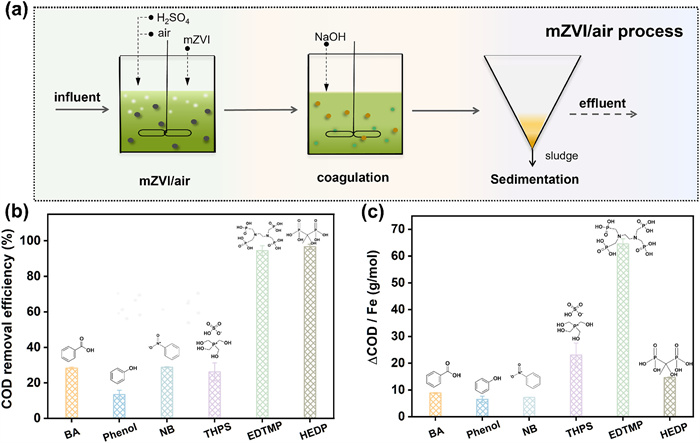
Figure 1.
(a) The mZVI/air process schematic diagram, comparison of (b) COD removal and (c) iron utilization efficiency for treating representative pollutants in mZVI/air system.

mZVI/air enabled selective oxidation of phosphonates via LMCT-triggered Fenton-like pathway: Self-enhanced radical generation and phosphorus immobilization
Mengchun Zhou , Huihui Peng , Ankang Wang , Peng Zhou , Bo Lai


The expansion of agricultural activities, rapid industrialization, and social development have led to various pollutants entering the receiving water bodies, posing a serious threat to the safety and sustainability of water resources [1]. Consequently, developing and implementing effective water treatment technologies to remove pollutants is crucial. Among existing methods, advanced oxidation processes (AOPs) have been widely used for the degradation of recalcitrant organic compounds [2-4]. Especially, microscale zero valent iron (mZVI) has become an attractive material in AOPs due to its wide availability, low cost, and high reduction potential, often exhibits excellent performance in degrading persistent organic compounds [5]. However, in actual water bodies with complex chemical compositions, the reactive oxygen species (ROS) generated by AOPs may be no selectively captured by coexisting dissolved organic matter and inorganic ions, thereby reducing treatment efficiency [6]. Therefore, achieving selective degradation of target pollutants in this complexity remains a key and long-term challenge for the further development of AOPs. Here, “selectivity” refers to the ability to preferentially oxidize the target pollutants [7].
Theoretically, selectivity can be improved by altering the reactivity of the target pollutant [8]. As is well known, ligands can regulate catalytic processes by forming coordination bonds with active metal sites, thereby altering local electronic structures and spatial environments [9-12]. Therefore, the formation of metal ligand complexes has been proven as an effective strategy for designing selective oxidation pathways, primarily by modulating ligand reactivity and, more importantly, by creating intramolecular electron transfer channels. Among various organic pollutants, phosphonates present a dual advantage: they are representative contaminants in wastewater and, owing to their abundant lone-pair electrons, they also act as strong chelating agents. Specifically, when forming coordination bonds with iron, phosphonates exhibit significant ligand metal charge transfer (LMCT) effects, which may enable highly active and selective degradation in iron-based systems [13]. In addition, in the mZVI/air heterogeneous Fenton-like system, Fe(Ⅱ) species can catalyze the generation of highly oxidative hydroxyl radicals (•OH), which can break the C-P bond, leading to the dephosphorylation and degradation of phosphonates, and the generated phosphates (o-PO43-) can be precipitated through flocculation. Given the strong chelating affinity of phosphonates for iron, it is speculated that the mZVI/air system may achieve selective and efficient degradation of phosphonates through complexation mediated activation and iron species transformation.
Phosphonates contain one or more phosphonic acid groups (C-PO(OH)2). The high bond energy of the C-P covalent bond renders these compounds chemically inert, resistant to biodegradation, and strongly chelating [14]. They are extensively used as flame retardants, plasticizers, and additives in industrial products, electronics, household goods, and personal care items [15]. The global output surged from 56,000 tons (1998) to 94,000 tons (2012), of which the use of organic phosphonate (OPE) flame retardant increased by 100% (300–620 tons) from 2004 to 2013, accounting for 30% of the global flame retardant market [16]. This widespread use increases the risk of environmental and human exposure. Carcinogens such as namely tris-(2-chloroethyl) phosphonate (TCEP), tris-(1-chloro-2-propyl)phosphonate (TCIPP), and tris(1,3-dichloro-2-propyl)phosphonate (TDCPP) are often detected in children’s products and upholstered furniture [17,18]. The aquatic system bears a huge load, and the wastewater concentration reaches 5–20 mg/L [19]. Certain phosphonates such as TCEP and TDCIPP have been associated with increased cancer risk, and some OPEs may exhibit neurotoxicity. Moreover, transformation products like aminomethylphosphonic acid (AMPA) are often more toxic, further amplifying environmental concerns [20-22].
Conventional phosphonate remediation technology include adsorption, chemical precipitation, biological treatment, and AOPs. Adsorption is cost-effective but merely transfers the pollutant phase and faces challenges in material regeneration [23]. Precipitation requires excessive coagulant doses due to the formation of stable soluble complexes [24]. Biological treatment is often inefficient owing to the recalcitrance of the C-P bond. In contrast, AOPs offer a more effective and economically viable approach for mineralizing or transforming phosphonates, such as UV/PMS [19] and electrochemistry [25], showing rapid phosphonate oxidation ability [26,27]. Sun et al. [28] demonstrated that the UV/Fe(Ⅲ) coupling precipitation process converts over 60% of phosphonates into o-PO4 and removed over 90% of total phosphorus (TP) from the aqueous phase. The process relies on UV driven photodegradation of photoactive Fe(Ⅲ)-phosphonate complexes, followed by phosphorus precipitation by adjusting pH to 6.0. Hydrogen peroxide (H2O2) can also generate •OH via Fenton reaction. The degradation efficiency of o-PO43- increases to 80% in UV/Fe(Ⅱ)/H2O2 systems, and TP is almost completely removed by precipitation. However, effective o-PO43- fixation is still the top priority of the environment. In view of this, the strategy of “oxidation-precipitation” approach to mineralize phosphonates and immobilize phosphate is the key research focus to reduce the ecological risk derived from phosphate. The iron mediated AOPs process can achieve dual function: Fe(Ⅱ)/Fe(Ⅲ) cyclic catalysis for •OH formation to split the C-P bond, and in-situ iron flocculant for o-PO43- precipitation. Previous studies have shown that ZVI induced Fenton chain reactions is effective in degrading refractory organics (for example, 95% phenol removal [29], 85% MTBE removal [30]). The strong complexation between phosphonates and iron is expected to enhance selectivity and degradation efficiency [31]. Therefore, the mZVI/air system may achieve selective degradation of phosphonate through complexation and transformation of iron species.
In this study, a two stage mZVI/air process is developed to address phosphonate contamination by integrating the dual role of iron in free radical generation and phosphate fixation. This “oxidation-precipitation” strategy achieves the simultaneous degradation of phosphonate and the fixation of o-PO43-, and reduces the risk of compound persistence and eutrophication. Critically, this study clarifies performance and mechanism of the mZVI/air system for selective oxidation of phosphonate. These findings provide important insights into iron mediated redox kinetics and ligand specific reactivity, and lay a theoretical foundation for advanced organophosphorus pollution control technologies.
Batch experiments were conducted in 250 mL glass reactors at 25.0 ℃ with continuous stirring (300 rpm, PTFE-coated impeller). A 100 mg/L phosphonate solution was prepared by diluting stock solutions with ultrapure water, followed by pH adjustment to 3.0 using 0.1 mol/L NaOH/H2SO4. Reactions were initiated by adding 1.5 g/L mZVI under air aeration (1.5 L/min) with real-time pH control. Subsequently, mZVI was separated by magnetic attraction, and the supernatant was adjusted to pH 7.50 for coagulation and precipitation. After standing for 2 h, the supernatant was collected for subsequent analysis (detailed in Texts S1-S6 in Supporting information).
In order to evaluate the selective oxidation ability of the mZVI/air system in complex aqueous matrices, the treatment performance on representative pollutants with different electronic functional groups commonly found in industrial wastewater was assessed. The target compounds include phenols with electron donating hydroxyl groups [28,29] and aromatic pollutants with electron attracting groups, such as carboxylic acids, benzoic acid, and nitrobenzene [30]. This selection enabled a comparative assessment of reactivity governed by their distinct electronic structures [31]. In addition, three typical organic phosphonates, tetrakishydroxymethyl phosphonium sulfate (THP, nitrogen-containing phosphonates (EDTMP), and nitrogen free phosphonates (HEDP), were selected to investigate the treatment efficiency of the mZVI/air system for strongly chelating pollutants. The experimental design aims to compare the degradation efficiency of pollutants with different electronic properties, in order to explore the potential selective oxidation mechanism of the mZVI/air system.
Fig. 1a shows a schematic flowchart of the mZVI/air process. Under acidic conditions, mZVI transfers two electrons to O2, releasing Fe(Ⅱ) and generating H2O2. The released Fe(Ⅱ) then reacts with H2O2 to generate •OH, which are responsible for oxidizing organic compounds and entering the coagulation and precipitation stage. Fig. 1b shows the degradation performance of the mZVI/air system on these organic compounds under acidic conditions (pH 3.0). The COD removal efficiency of benzoic acid and nitrobenzene in 30 min was negligible, while the removal efficiency of phenol was only 13.4%. And all phosphonate compounds showed significantly higher reaction activity, with COD removal efficiencies exceeding 26.2%. It is worth noting that the COD removal efficiency of EDTMP reached 94.5%, which was 7.1 times higher than that of phenol. According to the data of iron leaching (Fig. S1 in Supporting information), the iron utilization efficiency of pollutants was calculated. The iron utilization efficiency was calculated as the ratio of COD removed to total dissolved iron, expressed as ΔCOD/TFe. As shown in Fig. 1c, the iron utilization efficiency of EDTMP is 64.6 g/mol, which is 9.9 times and 7.3 times higher than those for treating phenol (6.5 g/mol) and benzoic acid (8.9 g/mol), respectively. These results clearly demonstrate that the mZVI/air system preferentially facilitates the oxidative degradation of phosphonates, particularly exhibiting a significant advantage for nitrogen-containing species such as EDTMP. The superior electron transfer characteristics displayed by EDTMP during oxidation provide a critical clue for understanding the selective degradation mechanism to this system.
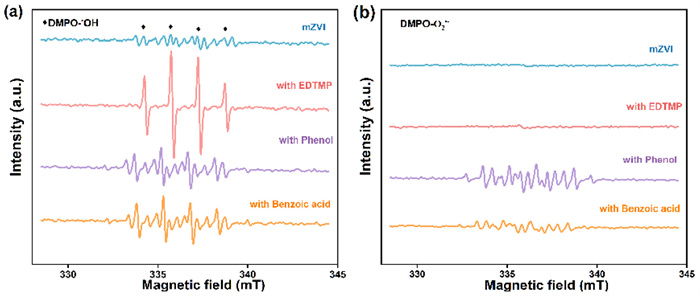
The reaction and kinetic steps of free radical generation and transformation are the key to clarify the selective interaction between ROS and target pollutant [32]. Electron paramagnetic resonance (EPR) spectroscopy directly identifies free radical types through spectral fingerprint analysis [33]. In order to stabilize short-lived •OH, spin-trapping agents such as 5,5-dimethyl-1-pyrroline N-oxide (DMPO) form metastable radical adducts, which are characterized by their distinct hyperfine splitting patterns in EPR spectra [33,34]. The mechanism of ROS generation in the mZVI/air system is discussed by EPR spectra. Fig. 2a shows a characteristic quartet signal (1:2:2:1 intensity ratio) in all four systems, which confirms the generation of •OH in the mZVI/air system. The addition of EDTMP significantly amplified the signal of DMPO-•OH adduct, indicating that EDTMP improved the iron electron transfer efficiency, thus enhancing the oxygen activation and •OH production. In contrast, the effect of phenol and benzoic acid on the yield of •OH is negligible, which is consistent with their poor iron utilization efficiencies. The lack of superoxide radical (O2•-) signatures in Fig. 2b confirms that •OH plays a dominant role in the degradation process. The control experiment without aeration showed that the COD removal rate decreased from 94.47% to 56.75%, which confirms the importance of oxygen supply through aeration for oxidation (Fig. S2 in Supporting information).
We identified the main ROS in the mZVI/air system and found that EDTMP could promote the generation of •OH. Furthermore, we explored the mechanism of EDTMP enhanced selective degradation by iron speciation analysis. Considering the key role of the redox state of iron in controlling the kinetics of oxygen activation, we monitored the data changes of iron species with time. As shown in Fig. 3a, it is obvious that low valent Fe(Ⅱ) shows a continuous iron species advantage throughout the reaction process. This is because EDTMP is a strong polydentate ligand due to its high oxygen and nitrogen content, so it shows strong complexation ability to Fe. Therefore, FTIR spectra shows a characteristic absorption band at 1056 cm-1, corresponding to the tensile vibration of Fe-O-P, which directly confirms the formation of phosphonate-iron complex in aqueous solution (Fig. S3 in Supporting information). Raman spectral analysis of the reaction solutions provides further structural evidence for the coordination process (Fig. 3b). In the presence of EDTMP, the Fe-O stretching band exhibits a distinct blueshift to 980.51 cm-1 compared to the mZVI/air solution alone. This shift indicates the donation of lone-pair electrons from oxygen into the d-orbitals of iron. Concurrently, the appearance of a new peak at 1095.81 cm-1 signifies the formation of Fe-P bonds. These spectral features collectively confirm the successful coordination between EDTMP and iron in the mZVI/air system.
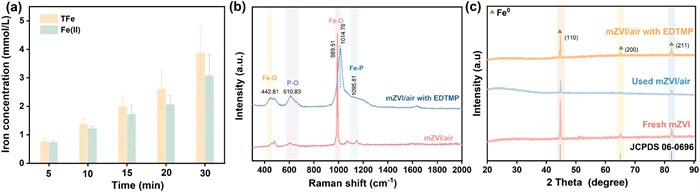
Spectroscopic analysis confirmed the coordination between EDTMP and iron, providing direct evidence for the LMCT mechanism. FTIR and Raman spectroscopy revealed characteristic Fe-O-P and Fe-P bonds with spectral shifts indicative of electron donation from EDTMP to iron d-orbitals (Fig. 3b). The LMCT mechanism between Fe(Ⅲ) and EDTMP complexes promotes the rapid reduction of Fe(Ⅲ) to Fe(Ⅱ) (Fig. 3a) and accelerates the redox cycle of iron. Consistent with this mechanism, Fe(Ⅱ) species dominates the iron form during the whole reaction process, confirming the continuous iron cycle. As shown in Fig. 3a, Fe(Ⅱ) species predominate throughout the reaction, confirming enhances reaction activity of iron. It is important that the strong surface coordination and the coordination of the dissolved and passivated iron oxide layer maintain the highly active mZVI surfaces. The combined XRD and EDS analysis (Fig. 3c and Fig. S4 in Supporting information) provide evidence for this coordination mechanism. The XRD patterns indicate enhancement in the surface iron crystal structure of mZVI, and EDS further confirms that the surface iron content increased by 23.5% compared to the system without EDTMP (Fig. S4). This coordination effect promotes the acceleration of iron cycle and the activation of mZVI surface, thus enhancing the transfer of interface electrons to oxygen. These results indicate that Fe-EDTMP complex is the key to the iron cycle and ROS formation.
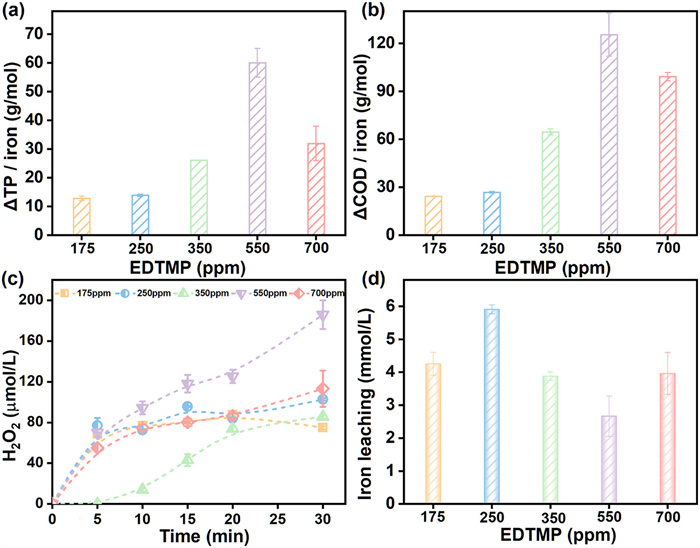
It can be seen from the above results that EDTMP can form an iron phosphorus complex with iron ions to remove the surface passivation layer, and the iron phosphorus complex can promote the oxygen reduction process to produce more •OH. Considering that the concentration of dissolved iron is 3.88 mmol/L, the concentration of EDTMP is 350 ppm, the coordination number of iron ion and EDTMP is 6, the effect of varying EDTMP concentration on the mZVI/air system was investigated considering that iron-phosphorus complex formation depends on EDTMP concentration.
As shown in Figs. 4a and b, with the increase of EDTMP concentration, the COD removal efficiency exhibits a significant dose-dependent enhancement trend and reaches its peak at 550 ppm. The quantitative analysis of the Fe:EDTMP molar ratio (Table S1 in Supporting information) showed that as the EDTMP dosage increased, the ratio gradually decreases from 10.59 to 2.11. When the concentration was further increased to 700 ppm, the ratio rose to 2.47, while the removal performance declined. Based on these observations, that the optimal stoichiometric ratio corresponding to the best performance was estimated to occur at 550 ppm, yielding a Fe:EDTMP ratio of 2.11. From the perspective of coordination chemistry, iron ions provide empty d orbitals, while the phosphonate group and nitrogen atom in EDTMP are coordinating atoms. This indicates that at this optimal ratio, two Fe(Ⅱ) ions coordinate with one EDTMP molecule to form a stable multidentate ligand. The generation of H2O2 generation is a key indicator of the generation of ROS, which is closely related to the optimal Fe-EDTMP ratio and reaches a peak at 550 ppm (Fig. 4c), which verifies that the optimal coordination state can promote the generation of •OH. It is worth noting that in combination with the data of iron dissolution, it is found that low EDTMP concentrations (<550 ppm) enhances the dissolution of iron from the surface of mZVI, while excessive EDTMP concentrations (>550 ppm) cause steric hindrance effect and partially hinder the dissolution of iron (Fig. 4d). This further confirms the crucial role of EDTMP concentration in regulating the iron phosphine coordination state and reaction activity.
It is well known that EDTMP is oxidized to inorganic phosphate via hydroxyl radical induced cleavage of C-P and C-N bonds. The morphological analysis of phosphate at different pH (Fig. S5 in Supporting information) shows that inorganic phosphorus mainly exists in the form of H2PO4- at the reaction pH of the system (pH 3.0) [35]. It was reported that the phosphate brine solution significantly inhibits the oxidation kinetics of pyrite by slowing down the oxidation rate of Fe(Ⅱ) [36-38]. In terms of mechanism, phosphate anion acts as lewis base, which can provide the lone electron pair of oxygen atom to the empty orbit of transition metal. The formation of this coordination complex inhibits the redox potential of the coordination metal in thermodynamics [39].
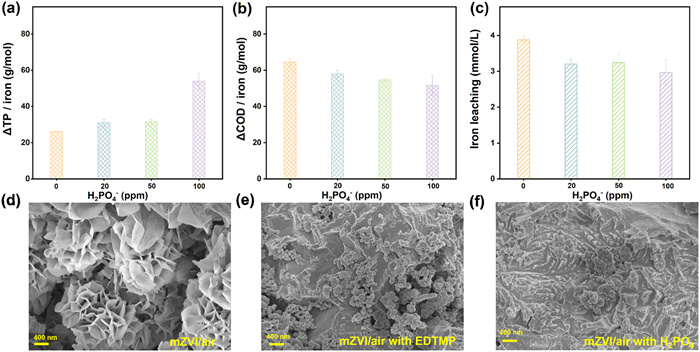
In order to clearly identify the active phosphate species in the system, we selected H2PO4- as the inorganic phosphorus compound, which is the terminal mineralization product produced by the oxidative cracking of EDTMP. The effect on the performance of the mZVI/air system was evaluated in different concentrations of inorganic phosphorus (Figs. 5a and b). It is worth noting that the effect of phosphate on the degradation efficiency of pollutants in mZVI/air system can be ignored. This experimental evidence clearly established that phosphate released through covalent bond breaking was not the active substance responsible for catalytic enhancement. The SEM analysis reveals the change of mZVI surface morphology under different conditions, which further demonstrates the iron corrosion. As shown in Fig. 5c, the addition of phosphate [40] decrease iron dissolution. The comparative analysis of the iron surface after the reaction of the three systems (Figs. 5d-f) further indicates that H2PO4- can promote the transformation of the originally smooth mZVI surface into a rough raised corrosion layer. In contrast, the surface only exhibits stronger corrosion in the mZVI/air system, characterized by the formation of flower shaped cluster structures. Consistent with the EDS data (Fig. S6 in Supporting information) indicate that the iron content in the H2PO4- system is equivalent to that in the mZVI/air system, while its oxygen content is between that of the EDTMP system and the mZVI/air system. Therefore, these collective results clearly confirm that H2PO4- is not the active substance in the selective oxidation process in mZVI/air system.
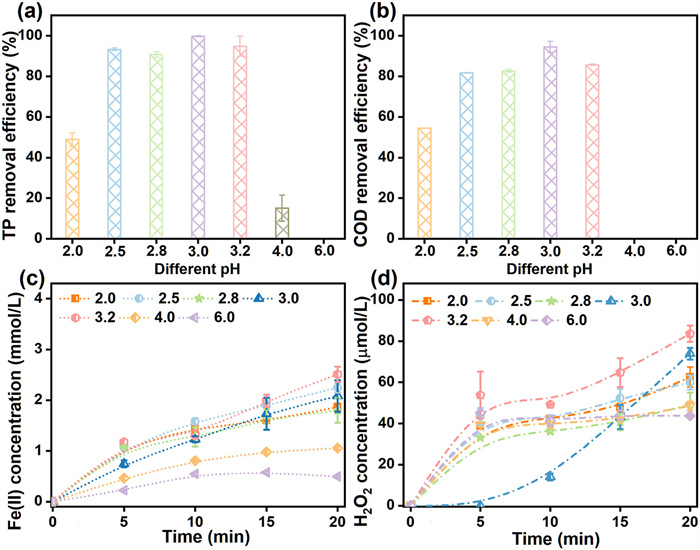
The effect of pH on the system reaction is significant because it directly affects the release of iron ions on the surface of mZVI [41-43], the morphology and redox potential of iron species [44], the stability of hydrogen peroxide [45-47] and the efficiency of •OH generation [48]. Therefore, we discuss the effect of pH on the mZVI/air system with EDTMP. As shown in Figs. 6a and b, the TP and COD removal efficiency decreased with increasing pH (2.0–6.0). Under acidic conditions (pH < 3.2), accelerated iron corrosion can promote the release of Fe(Ⅱ) or Fe(Ⅲ), thus promoting the degradation of EDTMP. Further analysis of the morphology of iron (Fig. 6c) shows the concentration of Fe(Ⅱ) decreases with the increase of pH. Therefore, XPS analysis of the Fe 2p region shows that the surface Fe(Ⅱ) content is the largest at pH 2.0, followed by pH 3.0 (Fig. S7 in Supporting information), indicating that the ligand exchange kinetics between phosphonate ligand and corrosive iron was the best. This synergistic process promotes the continuous regeneration of the active surface through phosphonate iron complexation, and effectively inhibits the formation of passive oxide layer. This trend is consistent with the activity data, which confirms that the form of iron is the key factor for the degradation activity of the system. The monitoring of H2O2 production during oxygen reduction shows that the H2O2 production follows the volcanic profile (Fig. 6d) and reaches the peak at pH 3.2 during oxygen reduction. The reaction equation (Eq. 1) shows that Fe(Ⅱ) and H2O2 come from the release of electrons from iron to oxygen. This electron transfer selectivity preferentially drives the generation of H2O2 rather than the complete reduction of four electron O2 to H2O, thus establishing a unique redox behavior at the phosphonate modified mZVI interface.
|
|
(1) |
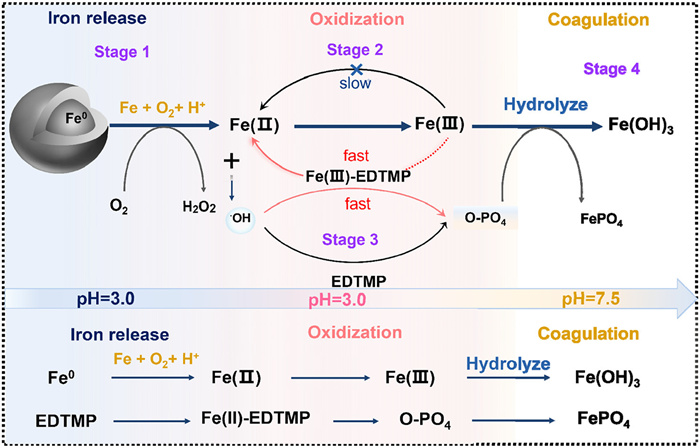
The mZVI/air system continues to operate using different reaction mechanisms caused by changes in iron morphology (Fig. 7). Firstly, the mZVI corrosion can release Fe(Ⅱ) ions with oxygen reduction to form H2O2 under acidic conditions. Subsequently, the Fenton reaction produces •OH for preferentially attacking C-P bonds or C-N bonds in EDTMP. Specifically, •OH initiates C-N bond cleavage before C-P bond cleavage, leading to the formation of hydroxymethylphosphonic acid as a primary intermediate. Then, the intermediate is oxidized to dimethylphosphonic acid (IDMP) and ethyl substrates.
This study proves the selective and efficient oxidative degradation of phosphonate in the mZVI/air system, exhibiting markedly higher degradation efficiency for phosphonates compared to common organic compounds, while achieving 94.5% COD removal. EPR spectroscopy confirms the amplified •OH generation in the presence of EDTMP. Under acidic conditions, mZVI corrosion releases Fe(Ⅱ) and reduce O2 to form H2O2. Phosphonates act as ligands to form Fe(Ⅲ)-phosphonate complexes and trigger LMCT, thereby accelerating the Fe(Ⅱ)/Fe(Ⅲ) cycle, which collectively underpins the selective oxidation mechanism. The optimal Fe-EDTMP coordination maximizes the degradation efficiency, while excessive phosphonate will cause steric hindrance and inhibit the reaction activity. The degradation releases o-PO43-, which alters the surface morphology of mZVI and suppresses mZVI corrosion, thereby limiting its catalytic activity in the mZVI/air system. The mZVI/air system provides a dual-function advantage: Phosphonate degradation via iron-phosphonate coordination coupled with o-PO43- immobilization through iron induced flocculation-precipitation. Future study should elucidate the underlying mechanism via advanced coordination chemistry and assess the generalizability of ligand-driven enhancement to other coordinating pollutants.
Mengchun Zhou: Writing – review & editing, Writing – original draft, Investigation, Formal analysis, Data curation, Conceptualization. Huihui Peng: Writing – review & editing, Writing – original draft, Formal analysis, Data curation, Conceptualization. Ankang Wang: Formal analysis. Peng Zhou: Writing – review & editing, Writing – original draft, Supervision, Project administration, Formal analysis. Bo Lai: Writing – review & editing, Supervision, Project administration, Funding acquisition.
The authors declare that they have no known competing financial interests or personal relationships that could have appeared to influence the work reported in this paper.
This research was supported financially by National Natural Science Foundation of China (No. U24A20561) and Sichuan Science and Technology Program (No. 2024NSFTD0014).
Supplementary material associated with this article can be found, in the online version, at doi:
E.L. Marron, W.A. Mitch, U. von Gunten, et al., Acc. Chem. Res. 52 (2019) 615–622. doi: 10.1021/acs.accounts.8b00612
W. Lu, M. Zhou, R. Liu, et al., Chin. Chem. Lett. 37 (2026) 112736. doi: 10.1016/j.cclet.2026.112736
S. Xie, L. Jiang, W. Liu, et al., J. Mater. Chem. A 13 (2025) 20868–20883. doi: 10.1039/d5ta02142a
R. Xiong, L. Jiang, J. Li, et al., Mater. Today 90 (2025) 629–646. doi: 10.1016/j.mattod.2025.08.035
Y.F. Zhang, C.H. Zhang, J.H. Xu, et al., Chin. Chem. Lett. 35 (2024) 109385. doi: 10.1016/j.cclet.2023.109385
X. Li, B. Yang, K. Xiao, et al., Water Res. 203 (2021) 117541. doi: 10.1016/j.watres.2021.117541
Z. Yang, J. Qian, C. Shan, et al., Environ. Sci. Technol. 55 (2021) 14494–14514. doi: 10.1021/acs.est.1c05862
J. Mahatthananchai, A.M. Dumas, J.W. Bode, Angew. Chem. Int. Ed. 51 (2012) 10954–10990. doi: 10.1002/anie.201201787
X. Song, Z. Chen, X. Wang, et al., Water Res. 114 (2017) 218–227. doi: 10.1016/j.watres.2017.02.040
S.M. Morgan, M.A. Diab, A.Z. El-Sonbati, et al., J. Mol. Struct. 1352 (2026) 144355. doi: 10.1016/j.molstruc.2025.144355
S. Rasheed, S.S. Ahmed, S. Sadiq, et al., Coord. Chem. Rev. 555 (2026) 217640. doi: 10.1016/j.ccr.2026.217640
P. Xia, C. Tang, T. Xu, et al., Chin. Chem. Lett. 37 (2026) 112442. doi: 10.1016/j.cclet.2026.112442
Y. Jia, S. Sun, S. Wang, et al., Crit. Rev. Environ. Sci. Technol. 53 (2023) 435–456. doi: 10.1080/10643389.2022.2068362
E. Rott, R. Minke, U. Bali, et al., Water Res. 122 (2017) 345–354. doi: 10.1016/j.watres.2017.06.009
M. Liu, S.H. Brandsma, E. Schreder, Chemosphere 365 (2024) 143319. doi: 10.1016/j.chemosphere.2024.143319
Z. Xie, P. Wang, X. Wang, et al., Nat. Rev. Earth Environ. 3 (2022) 309–322. doi: 10.1038/s43017-022-00277-w
S. Pan, X. Nie, X. Guo, et al., Chin. Chem. Lett. 34 (2023) 107620. doi: 10.1016/j.cclet.2022.06.043
S. Ai, X. Chen, Y. Zhou, Environ. Pollut. 343 (2024) 123218. doi: 10.1016/j.envpol.2023.123218
O.A. Abafe, B.S. Martincigh, Chemosphere 230 (2019) 239–247. doi: 10.1016/j.chemosphere.2019.04.175
Y. Li, C. Wang, F. Zhao, et al., Environ. Sci. Technol. Lett. 5 (2018) 649–654. doi: 10.1021/acs.estlett.8b00546
X. Wang, Q. Liu, W. Zhong, et al., Environ. Int. 134 (2020) 105321. doi: 10.1016/j.envint.2019.105321
C.P.M. Bento, X. Yang, G. Gort, et al., Sci. Total Environ. 572 (2016) 301–311. doi: 10.1016/j.scitotenv.2016.07.215
C. Ni, N. Chen, J. He, et al., Water Res. 246 (2023) 120705. doi: 10.1016/j.watres.2023.120705
E. Rott, M. Nouri, C. Meyer, et al., Water Res. 145 (2018) 608–617. doi: 10.1016/j.watres.2018.08.067
Y. He, C. Qu, N. Ren, et al., Chin. Chem. Lett. 35 (2024) 109262. doi: 10.1016/j.cclet.2023.109262
L. Jiang, J. Yang, S. Zhou, et al., Coord. Chem. Rev. 439 (2021) 213947. doi: 10.1016/j.ccr.2021.213947
J. Yang, H. Wang, L. Jiang, et al., Chem. Eng. J. 427 (2022) 130991. doi: 10.1016/j.cej.2021.130991
S. Sun, S. Wang, Y. Ye, et al., Water Res. 153 (2019) 21–28. doi: 10.1016/j.watres.2019.01.007
X. Wang, P. Zhang, W. Wang, et al., Environ. Sci. Technol. 59 (2025) 6319–6330. doi: 10.1021/acs.est.4c14797
J. Qin, Y. Wei, W. Geng, et al., ACS ES&T Water 3 (2023) 1223–1232. doi: 10.1021/acsestwater.3c00002
E. Matthus, N.T. de Oude, M. Bolte, et al., Water Res. 23 (1989) 845–851. doi: 10.1016/0043-1354(89)90008-0
W. Jiang, Y. Wang, H. Guo, J. Hazard. Mater. 492 (2025) 138138. doi: 10.1016/j.jhazmat.2025.138138
L. Chen, J. Duan, P. Du, et al., Water Res. 221 (2022) 118747. doi: 10.1016/j.watres.2022.118747
L. Qin, W. Zhu, L. Yang, et al., J. Hazard. Mater. 493 (2025) 138332. doi: 10.1016/j.jhazmat.2025.138332
Y.J. Xiang, Y. Liu, B.Y. Cong, et al., Water Res. 267 (2024) 122494. doi: 10.1016/j.watres.2024.122494
A.R. Elsetinow, M.A.A. Schoonen, D.R. Strongin, Environ. Sci. Technol. 35 (2001) 2252–2257. doi: 10.1021/es0016809
S. Deng, Y. Yang, X. Han, et al., Water Res. 260 (2024) 121912. doi: 10.1016/j.watres.2024.121912
V. Santoro, M. Martin, P. Persson, et al., Geoderma 348 (2019) 168–180. doi: 10.1016/j.geoderma.2019.04.004
Z.S. Huang, L. Wang, Y.L. Liu, et al., Environ. Sci. Technol. 52 (2018) 13897–13907. doi: 10.1021/acs.est.8b04655
Q. Hong, C. Liu, Z. Wang, et al., Chem. Eng. J. 417 (2021) 129238. doi: 10.1016/j.cej.2021.129238
J.A. Donadelli, L. Carlos, A. Arques, et al., Appl. Catal. B: Environ. 231 (2018) 51–61. doi: 10.1016/j.apcatb.2018.02.057
S.Y. Pang, J. Jiang, J. Ma, Environ. Sci. Technol. 45 (2011) 307–312. doi: 10.1021/es102401d
Y. Hu, G. Zhan, X. Peng, et al., Chem. Eng. J. 389 (2020) 124414. doi: 10.1016/j.cej.2020.124414
Q. Yan, C. Lian, K. Huang, et al., Angew. Chem. Int. Ed. 60 (2021) 17155–17163. doi: 10.1002/anie.202105736
J.H. Ramirez, C.A. Costa, L.M. Madeira, et al., Appl. Catal. B: Environ. 71 (2007) 44–56. doi: 10.1016/j.apcatb.2006.08.012
G.V. Buxton, C.L. Greenstock, W.P. Helman, et al., J. Phys. Chem. Ref. Data 17 (1988) 513–886. doi: 10.1063/1.555805
M. Angelaki, J. d’Erceville, D.J. Donaldson, et al., J. Am. Chem. Soc. 146 (2024) 25889–25893. doi: 10.1021/jacs.4c07356
G. Chu, S. Yao, Z. Zhang, et al., Chin. Sci. Bull. 42 (1997) 296–301. doi: 10.1007/BF02882464

Figure 1 (a) The mZVI/air process schematic diagram, comparison of (b) COD removal and (c) iron utilization efficiency for treating representative pollutants in mZVI/air system.

Figure 2 EPR spectrum on radicals in the mZVI/air system captured by DMPO: (a) Signal of DMPO-•OH and (b) signal of DMPO-O2•-.

Figure 3 (a) Concentrations of Fe(Ⅱ) and total dissolved iron (TFe) over time in the mZVI/air system. (b) Raman spectral of reaction solutions in the mZVI/air system with and without EDTMP. (c) XRD patterns of the mZVI surface.

Figure 4 Effect of EDTMP concentrations on (a) TP removal, (b) COD removal, (c) H2O2 generation, and (d) iron leaching.

Figure 5 Different H2PO4- concentrations of (a) TP removal efficiency, (b) COD removal efficiency, and (c) iron leaching. (d-f) SEM images of mZVI after reaction of three systems.

Figure 6 Effects of pH on (a) TP removal, (b) COD removal, (c) Fe(Ⅱ) concentration, and (d) H2O2 concentration.

 扫一扫看文章


扫一扫关注我们
 DownLoad:
 下载:

 下载: