
Figure 1.
Early research on the atropisomerism.

Recent advances in the organocatalyzed atroposelective synthesis of axially chiral arene-alkenes
Wenbo Li , Zhuo Wang , Jingyi Duan , Kai-Kai Wang , Xiao-Long He


Atropisomerism is a phenomenon caused by the restricted rotation about a single bond between two steric hindered rigid-planar groups, which was first verified by Christie and Kenner through the successful resolution of the biaryl 6,6′-dinitro-2,2′-diphenic acid in 1922 (Fig. 1a) [1]. Since then, the atropisomeric structure has constituted an important class of molecular chirality, conferring a unique three-dimensional structure. However, the significance of this structure had been neglected for the following decades until the BINAP was discovered as a privileged chiral ligand for the catalytic enantioselective transition-metal (TM)-catalyzed reactions in 1980s [2]. Thereafter, a diverse array of structurally novel axially chiral biaryl-based catalysts and ligands were discovered, playing a pivotal role in advancing the field of asymmetric synthetic chemistry [3-8]. Meanwhile, the atropisomeric biaryl structure has been recognized as a prominent structural motif in numerous bioactive natural products and pharmaceuticals [9-12]. Consequently, a wealth of efficient catalytic asymmetric protocols has been developed over recent decades for the construction of such axially chiral biaryls [13-23].
In fact, based on the hypothesis proposed by Hyde and Adams in 1928 (Fig. 1b) [24], the impeded rotation about a single bond constitutes the fundamental origin of the atropisomerism. By extension, replacing one aryl group in a biaryl system with a sterically bulky olefin was postulated to generate an atropisomeric arene-alkene scaffold. This supposition was first corroborated by Mills and Dazeley via the successful resolution of the o-(β,β-dimethyl-α-isopropylvinyl)phenyltrimethyl ammonium iodide in 1939 [25]. Later, Adams and co-workers made intensive research into the atropisomeric arene-alkene system through the preparation and resolution of a variety of steric hindered styrenes in 1940s [26-35], that undoubtedly verified the existence of the atropisomeric arene-alkenes. Despite these early breakthroughs, research on axially chiral alkenes remained dormant for nearly half a century until Fuji and co-workers fortuitously attained an axially chiral styrene via the O-alkylation of a centrally chiral compound through a central to axial chirality transfer approach in 1991 (Fig. 1c) [36], that ignited the investigation for the synthesis and application of the axially chiral arene-alkenes. However, due to the low rotational energy barriers and configurational instability of axially chiral arene-alkenes, the development of their catalytic asymmetric synthesis has lagged behind compared to that of atropisomeric biaryls. Of note, the axially chiral-alkene has emerged as an important structure since they can be used as synthons for total synthesis and serve as key structural motif in chiral catalysts and ligands [37-42]. In 2016, Gu and co-workers pioneered an asymmetric synthesis of axially chiral vinyl arenes from aryl bromides and hydrazones via the palladium catalysis in combination with TADDOL-based phosphoramidite [43]. Since then, various transition metal-catalyzed asymmetric synthetic strategies, including the cross-coupling, C–H activation, alkene formation, and arene-formation, were extensively exploited for accessing the axially chiral arene-alkenes (Fig. 2, left) [44-50]. Most recently, the Shi’s group has published a comprehensive and systematic review that summarizes the progress in this rapidly evolving research area [44].
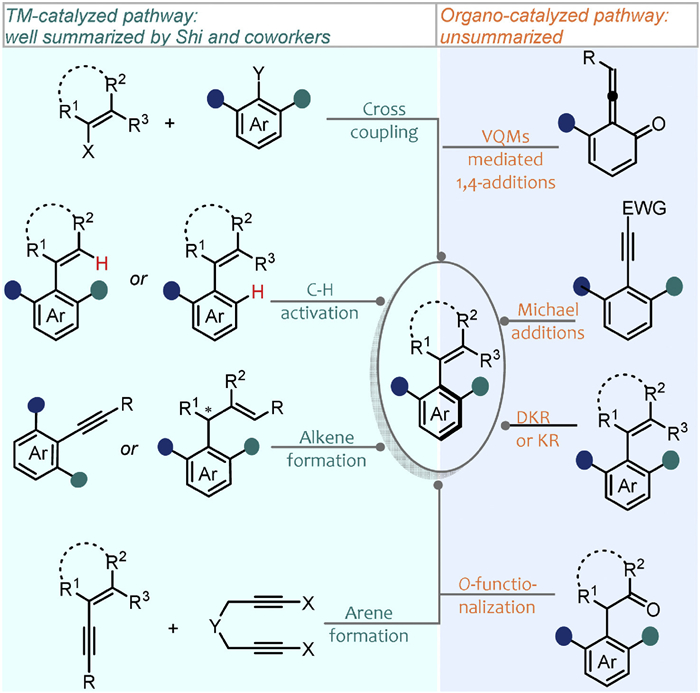
Organocatalysis offers a distinct and attractive paradigm complementary to the metal catalytic approaches. Featuring mild reaction conditions and versatile activation-modes, these approaches enable precise stereocontrol via unique intermediates such as VQMs and noncovalent interactions, thus establishing various design principles for constructing axially chiral arene–alkenes. Herein, the organocatalyzed approach has proven to be another versatile and efficient pathway to address this objective, that was pioneered by the work of Tan’s group in 2017 [51]. In this seminal work, the aryl substituted alkynals were activated by asymmetric imine catalysis, thus inducing an atroposelective Michael addition with substituted diones to achieve atropisomeric styrenes. Moreover, the Yan’s and Tan’s group independently disclosed a novel and widely applicable approach, which employed 2-alkynylnaphthols as the precursor for the in-situ generation of highly electrophilic vinylidene ortho-quinone methides (VQMs) under the catalysis of chiral Brønsted bases or chiral phosphoric acids (CPAs), thus allowing asymmetric 1,4-additions with various nucleophiles to access the axially chiral styrenes [52,53]. This method not only streamlined the synthesis of axially chiral styrenes but also expanded the scope of accessible scaffolds by tolerating diverse nucleophilic partners. Besides, the N-heterocyclic carbene (NHC) promoted conjugated addition of alkynals [54], and phase-transfer catalytic (PTC) functionalization of aryl-substituted enolates [55], have emerged as complementary tactics for promoting the rapid development of the atroposelective synthesis of axially chiral arene-alkene backbones in recent years (Fig. 2, right). In comparison to the well summarized TM-catalyzed approach, the progress of organocatalytic atroposelective synthesis of axially chiral arene-alkenes has yet been systematically organized or discussed to date. Herein, we present a coherent and comprehensive review on this topic. This review is structured into four distinct sections based on the core synthetic strategy: (1) Asymmetric nucleophilic additions to in-situ generated VQMs; (2) Direct Michael addition of electron-deficient alkynes; (3) Organocatalytic functionalization of preformed arene–alkene scaffolds; (4) Atroposelective enolate O-functionalizations of α-aryl-substituted ketones.
Vinylidene-quinone methides (VQMs) [56], a structural variant of the well-known ortho-quinone methides (o-QMs) [57-60], act as highly reactive Michael acceptors (Scheme 1, top). This reactivity stems from the conjugated ketone group and inherent thermodynamic inclination towards aromatization. The latter drives VQMs to react with nucleophiles due to subsequent aromatization post-Michael addition stabilizes the product, further enhancing their reactivity. In 2012, Freccero and co-workers first discovered the generation of VQMs via the irradiation of ortho-alkynylphenols 1 through an excited state intramolecular proton transfer (ESIPT) approach (Scheme 1a) [61]. The exceptional electrophilicity of the VQMs was explicitly verified in their reaction with water or amines, that smoothly afforded acetophenones or imines 2 via the sequential nucleophilic addition and keto-enol tautomerization process. In 2013, Irie and co-workers subsequently used o-phenylene-linked bis(arenols) 3 as precursors for VQM-generation under inorganic basic conditions (Scheme 1b) [62]. This process initiated an intramolecular inverse-electron-demand hetero Diels-Alder (IEDDA) reaction via TS1, affording indeno[1,2-c]chromene derivatives 4 in excellent yields. It is noteworthy that the chiral cinchona base enabled the formation of chiral VQM intermediates, which then underwent a cycloaddition in an enantioselective manner, albeit with moderate enantiomeric excess (ee) values (4x). In 2017, the same group extended this protocol by using o-phenylene-linked ethynylnaphthol-benzofuran 5 as the substrate (Scheme 1c) [63]. Under cinchonine or cinchonidine catalysis, an asymmetric intramolecular dearomative IEDDA reaction proceeded via TS2, yielding stereochemically complex structures 6 with good enantioselectivities. Almost simultaneously, Yan and co-workers reported the same reaction with excellent enantiocontrol by using the quinine-derived thiourea bifunctional catalyst [64]. These elegant earlier studies authenticated the highly reactivity of the VQMs.
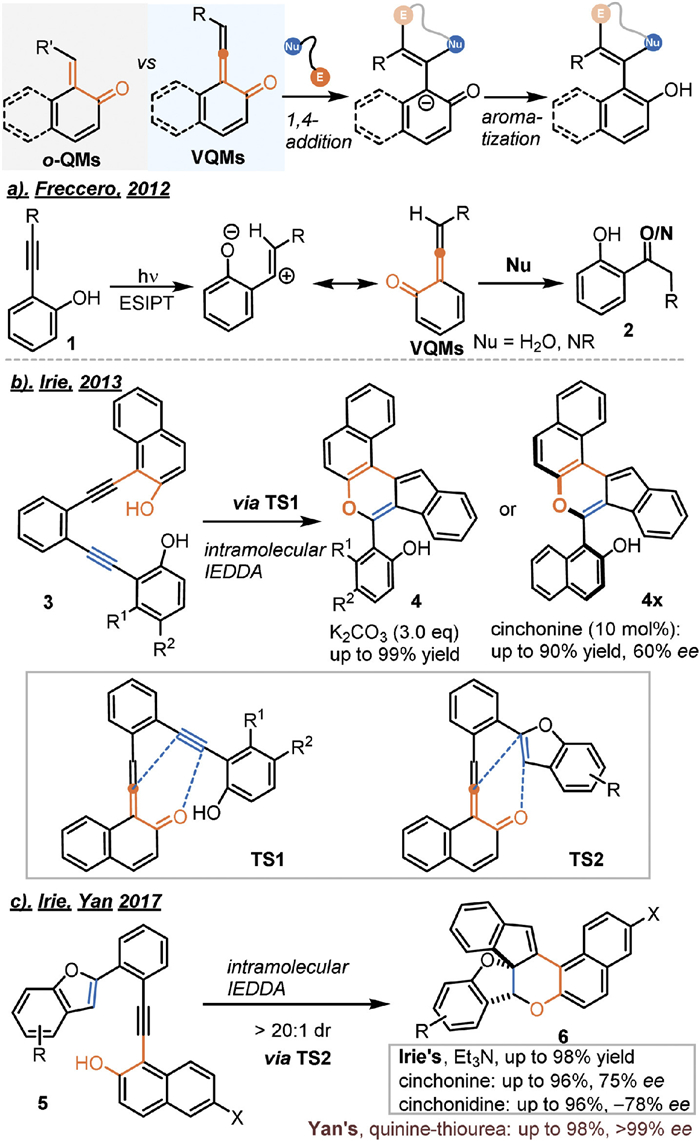
Leveraging this property, if a single atroposelective addition to the VQMs with appropriate nucleophiles would produce axially chiral styrenes under a chiral base condition, which was pioneered by the work of Yan in 2018 [52]. Beyond chiral bases, Tan and co-workers demonstrated that CPAs would enable VQM generation via prototropic rearrangement—providing a powerful alternative approach for the transformation of the ortho-alkynylphenols [53]. In this section, we discuss VQM-mediated asymmetric 1,4-additions for the synthesis of axially chiral arene-alkenes, divided into two parts: Chiral Brønsted base catalysis and CPA catalysis.
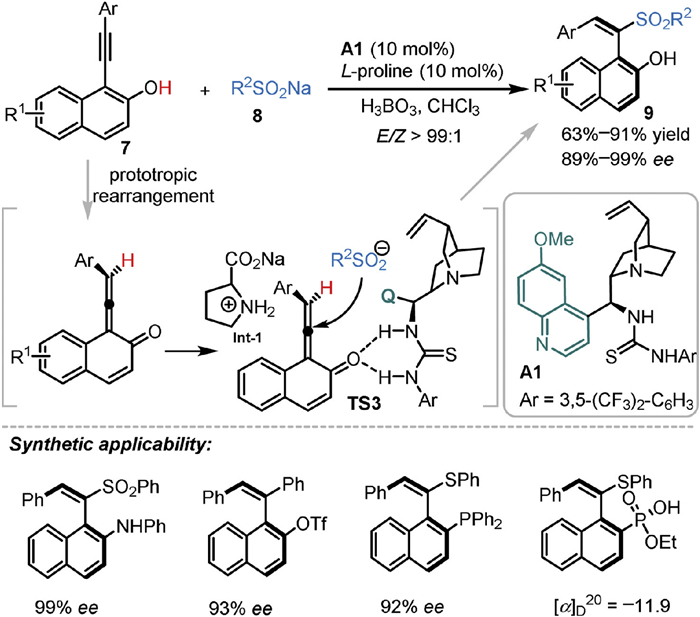
In 2018, Yan and co-workers discovered the first chiral Brønsted base catalyzed atroposelective synthesis of axially chiral styrenes via the nucleophilic addition to the in-situ generated VQMs (Scheme 2) [52]. In this reaction, 1-(phenylethynyl)naphthalen-2-ol 7 was deprotonated by the quinuclidine moiety of the chiral catalyst A1. With the assistance of hydrogen bonding from the thiourea component of the catalyst, an enantioselective 1,5-proton shift then occurred to form a chiral VQM, which induced the atroposelective 1,4-sulfonylation of sodium benzenesulfinate 8 to afford axially chiral styrenes 9 with excellent enantioselectivities. It is noteworthy that the l-proline was essential for increasing the solubility and nucleophilicity of the sodium benzenesulfinate in this organic system by forming a quaternary ammonium salt Int-1. Intriguingly, d-proline yielded identical enantioselectivity to l-proline, indicating that the enantiocontrol relied on the bifunctional tertiary amine catalyst A1 rather than the chiral proline. In contrast, benzenesulfinic acid was inert in this reaction, likely because its acidity was incompatible with the chiral Brønsted base. Additionally, the H3BO3 presumably acted as a proton-buffer to regenerate l-proline to fulfil the catalytic cycle. Moreover, the hydroxyl and sulfonyl group in the products could be readily converted to other functional group via simple operations, undoubtedly verifying the practical applicability of this protocol.
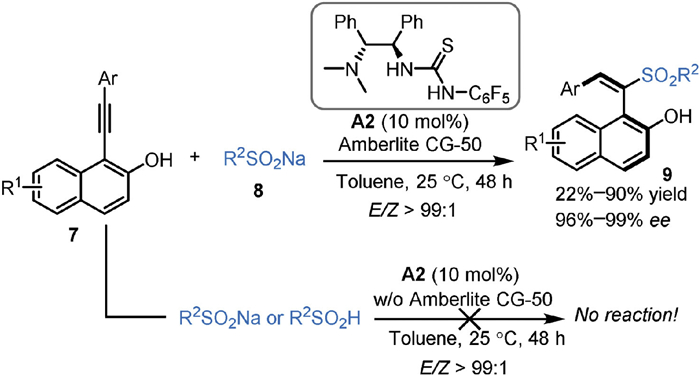
In 2024, Bai and co-workers developed this atroposelective sulfonylation reaction by using sodium benzenesulfinate 8 as sulfonyl source via an ion-exchange strategy (Scheme 3) [65]. In the presence of Amberlite CG-50, sodium benzenesulfinate 8 would slowly and continuously convert into reactive and soluble benzenesulfinate acid via ion-exchange. Subsequently, the in-situ formed chiral VQMs was attacked by the benzenesulfinate acid, delivering a wide range of target axially chiral styrenes 9 in high yields with excellent enantioselectivities. However, sodium benzenesulfinate proved inert in the absence of Amberlite CG-50 due to its poor solubility; Meanwhile, neither the benzenesulfinate acid was effective, that was ascribed to its strong acidity would spoil the basic catalyst and prevent the reaction. Herein, the slow release of the benzenesulfinate acid promoted by the Amberlite CG-50 was really a valid strategy to achieve the atroposelective sulfonylation under a basic catalytic system.
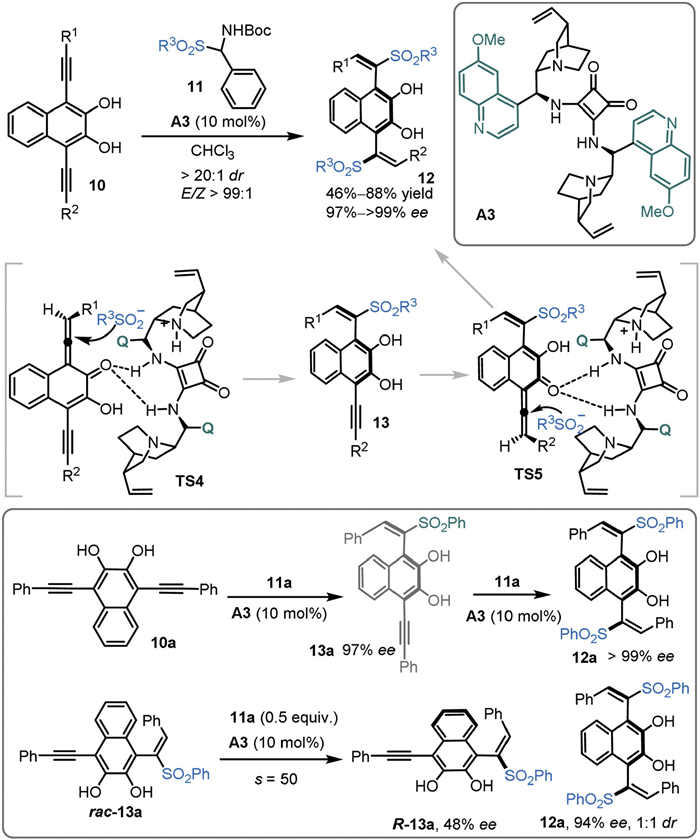
α-Amido sulfones, which exhibit good solubility in organic solvents, typically serve as highly nucleophilic sulfone sources for the synthesis of sulfonyl-containing compounds [66]. Accordingly, Yan and co-workers utilized α-amido sulfones 11 in the reaction with 1,4-bis(phenylethynyl)naphthalene-2,3-diols 10, leveraging the in-situ formed VQMs to mediate the reaction (Scheme 4) [67]. Promoted by the biscinchona squaramide catalyst A3, the chiral VQMs was generated twice to capture the sulfone anion species, delivering bis-axially chiral styrenes 12 as exclusive E-configuration in moderate to good yields with generally excellent enantioselectivities and diastereoselectivities. Control experiments revealed that mono-axially chiral styrenes 13 were observed and isolated as optically active products, which would further convert into a chiral VQM to initiate the second addition to afford bis-axially chiral target products 12. Meanwhile, racemic mono-sulfonylated intermediates rac-13 were converted to bis-sulfonylated products 12 with high ee values (albeit with poor diastereoselectivity), leaving unreacted substrates 10 with moderate enantiomeric excess. These results indicated the reaction proceeded via a stepwise mechanism and with the chiral catalytic system governing the second sulfonylation step. Notably, the resulting axially chiral diols proved to be promising chiral ligands in the enantioselective addition of diethylzinc to naphthaldehyde, confirming the practical applicability of such bis-axially chiral styrenes.
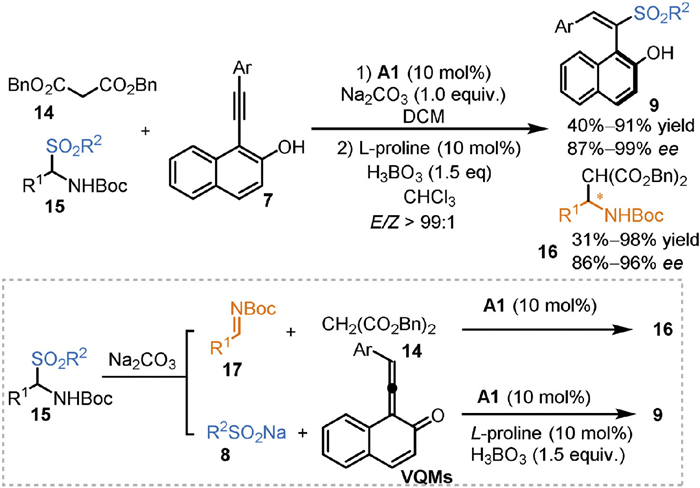
Beyond serving as sulfone sources, α-amido sulfones also act as N-protected imine precursors (particularly for unstable N-alkyl-substituted imines) upon releasing sulfone anions. Consequently, they are widely used in the asymmetric synthesis of chiral nitrogen derivatives via Mannich-type reactions with various nucleophiles [68-72]. Based on the principle of atom economy and waste-reuse strategies, Yan’s group employed nucleophilic malonic acid derivatives 14 to trap imine byproducts 17 prior to the sulfonylation of 15 in the reaction with alkynyl naphthols (Scheme 5) [73]. In the presence of A1 combined with Na2CO3 in dichloromethane, the in-situ formed imines 17 underwent asymmetric Mannich reactions with malonic acid derivatives 14, yielding chiral β-amino diesters 16 in good results. Upon the completion of the Mannich reaction, the reaction mixture was concentrated prior to be dissolved in CHCl3. Then followed by the sequential addition of alkynyl naphthol 7, L-proline, and H3BO3, initiating the atroposelective sulfonylation to afford axially chiral styrenes 9 in good yields with outstanding enantioselectivities and E/Z selectivities.
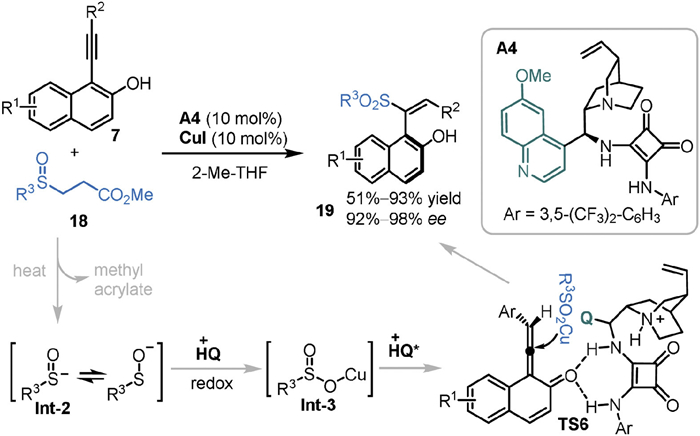
In 2023, Zhao and co-workers employed β-sulfinyl esters 18 as the precursor for the generation of sulfone anions to achieve the atroposelective sulfonylation reaction with the alkynyl naphthols 7 under the catalysis of A4 in combination with CuI (Scheme 6) [74]. In this reaction, the sulfenate anion Int-2 was generated by heating via a retro-Michael addition, then followed by a redox pathway in the presence of CuI to form the sulfone anion Int-3, which reacted with the in-situ generated chiral VQMs, delivering axially chiral styrenes 19 with excellent enantioselectivities.
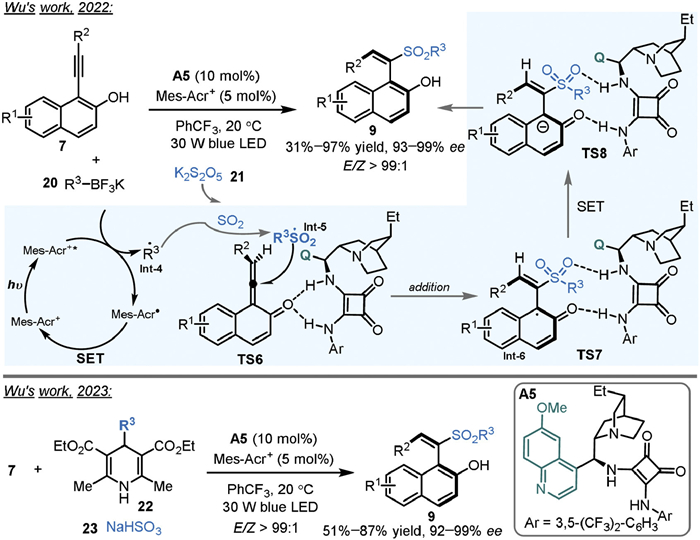
Besides sulfone anions, sulfone radicals are applicable to the VQMs for the atroposelective sulfonylation to access axially chiral styrenes. In 2022, Wu’s group developed this strategy by employing potassium alkyltrifluoroborates 20 as radical precursor and potassium metabisulfite 21 as the SO2 surrogate (Scheme 7) [75]. Under the visible-light irradiation in the presence of a photocatalyst Mes-Acr+, an alkyl radical Int-4 was generated to trap the SO2, thus forming an alkylsulfonyl radical Int-5. Meanwhile, the alkynyl naphthol 7 transformed to chiral VQMs under the catalysis of A5. As a result, the alkylsulfonyl radical Int-5 attacked the VQMs to give the radical intermediate Int-6 (in TS7) as E-configuration. Subsequently, a catalyst assisted sequential single electron transfer (SET) reduction, enol-tautomerization and protonation cascade process happened, delivering the axially chiral styrenes 9 in high yields with excellent ee values. Besides, 4-alkyl-substituted Hantzsch esters 22 have proven to be excellent radical precursors to trap SO2 for the generation of alkyl-sulfonyl radicals under photo-induced conditions. Therefore, in 2023, Wu and co-workers extended the above protocol by using the 4-alkyl-substituted Hantzsch ester 22 as radical precursors and NaHSO3 23 as SO2 surrogates [76]. With this protocol, a wide range of axially chiral styrenes 9 were obtained in good yields with excellent enantioselectivities.
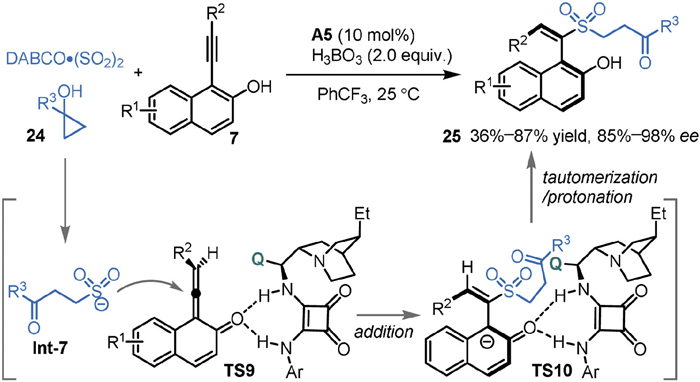
Besides radicals, Wu and co-workers found that cyclopropan-1-ols 24 could trap SO2 to form γ-keto sulfinate intermediates Int-7, which would be engaged with electrophiles to prepare various sulfones [77-79]. Herein, in 2024, Wu and co-workers reported an atroposelective sulfonylation reaction of alkynyl naphthols 7 by using cyclopropan-1-ols 24 in combination with DABCO·(SO2) as the sulfinate precursor (Scheme 8) [80]. Under the catalysis of A5, the in-situ formed chiral VQMs was smoothly attacked by the in-situ formed γ-keto sulfinate intermediate Int-7, delivering target axially chiral styrenes 25 in moderate to good yields with excellent enantioselectivities. This method provides an alternative efficient pathway to access densely functionalized sulfonyl-containing axially chiral styrenes.
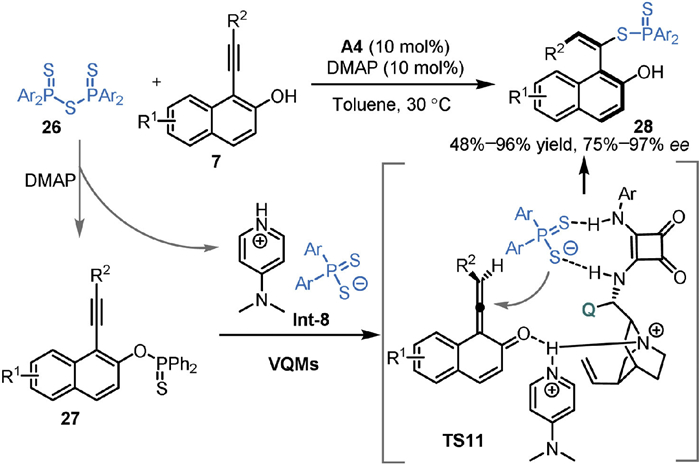
Unlike traditional phosphinic anhydride, phosphinothioic thioanhydrides exhibit not only electrophilicity but also strong nucleophilicity of its thiophosphoryl anion (S-P=S moiety). Herein, in 2025, Jiang and co-workers developed an efficient atroposelective synthesis of axially chiral styrenes by using phosphinothioic thioanhydrides 26 as the nucleophile to react with the VQMs (Scheme 9) [81]. In the presence of DMAP, the phosphinothioic thioanhydride 26 converted into the activated thiophosphoryl donor intermediate Int-8 along with the esterification byproduct 27. Resultantly, the in-situ formed chiral VQMs was attacked by the thiophosphoryl with the assistance of the hydrogen-bonding interactions, delivering the valuable axially chiral phosphorodithiolated styrenes 28 in good yields with excellent enantioselectivities.
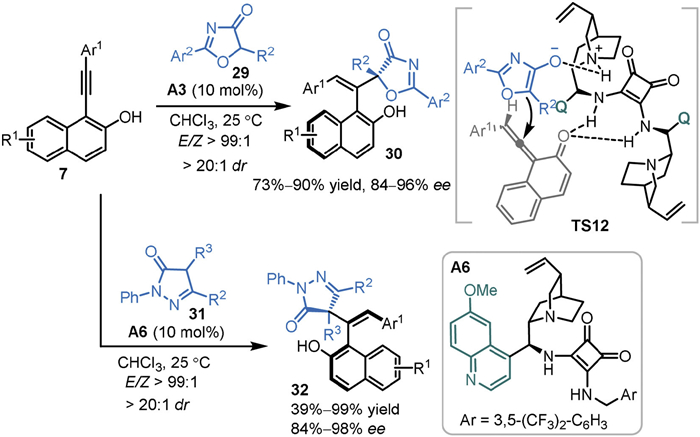
In addition to sulfonylation reaction, the carbon nucleophiles could be applied to trap the VQMs to achieve densely functionalized axially chiral styrenes, particularly the ones containing centrally chiral element. In 2019, Li and co-workers developed an elegant atroposelective synthesis of axially chiral styrenes by employing 5H-oxazol-4-ones 29 as the nucleophilic partner under the catalysis of squaramide-based biscinchona catalyst A3 (Scheme 10) [82]. The 5H-oxazol-4-ones 29 were deprotonated by the basic quinuclidine of catalyst to form a reactive nucleophilic enolate, which approached the chiral VQMs from Re-face with the assistance of the hydrogen bonding interaction, thus delivering a wide range of axially chiral styrenes 30 containing a stereogenic carbo-center in good yields with high enantioselectivities and diastereoselectivities. Pyrazolones exhibit similar nucleophilicity via an enolate conversion under basic conditions. In 2021, Wang and co-workers utilized pyrazolones 31 to react with the in-situ formed VQMs under the catalysis of A6 [83], enabling the smooth synthesis of a series of axially chiral styrenes 32 bearing a stereogenic carbon center with excellent stereoselectivities.
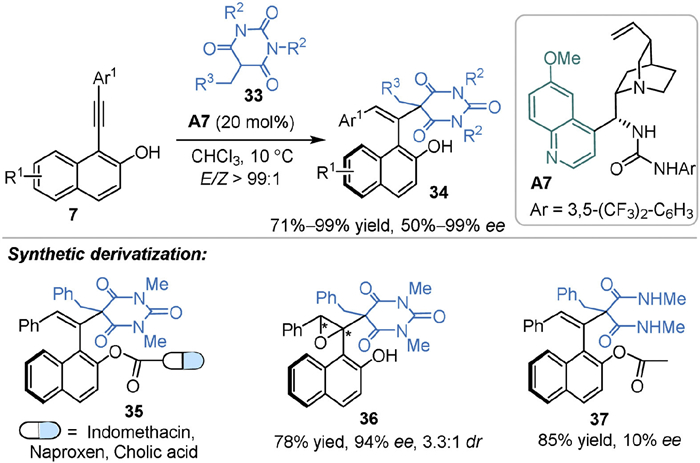
In 2026, Singh and co-workers reported an enantioselective synthesis of axially chiral barbiturate-substituted styrenes via the nucleophilic addition of 5-substituted barbituric acids 33 to in-situ generated VQMs from 1-alkynylnaphthalen-2-ols 7 under the catalysis of A7 (Scheme 11) [84]. A wide range of axially chiral barbiturate-bearing styrenes 34 were obtained in excellent yields with complete E/Z selectivity, and high enantioselectivities. The synthetic utility was demonstrated by gram-scale synthesis and versatile derivatizations (35–37), such as esterification with bioactive molecules, epoxidation for axial-to-point chirality transfer, and hydrolysis. This work complements the existing VQM-mediated atroposelective additions by introducing medicinally privileged barbiturate motifs into axially chiral styrene scaffolds, expanding the structural diversity of bioactive axially chiral molecules.
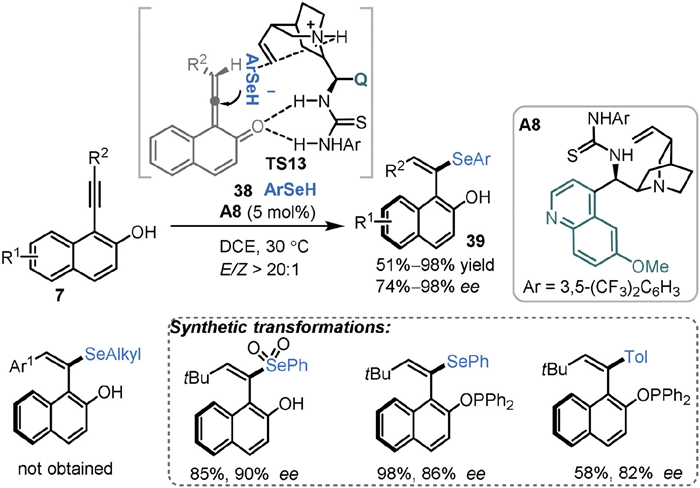
The selenol represents a nucleophilic reagent for the synthesis of skeletal diversified organoselenides, which is usually played as a key structural motif of the nucleophilic chiral catalyst [85-91]. Therefore, incorporating the selenium into an axially chiral skeleton is of great significance for the novel chiral catalyst design. In 2025, Yang and co-workers developed an atroposelective method for the synthesis of axially chiral styrenes 39 bearing a selenide group (Scheme 12) [92]. They used selenols 38 to capture the VQMs generated in-situ from alkynyl naphthols 7 under the catalysis of quinidine-derived thiourea A8. Due to the steric repulsion between the t-Bu group and the quinuclidine moiety of the catalyst, the key electrophilic VQMs were inclined to form as the S-configuration. Then, with the assistance of the bifunctional interaction of the chiral catalyst A8, the selenol underwent a nucleophilic addition from the less sterically hindered opposite side of the t-Bu group. As a result, the selenide-based axially chiral styrenes 39 were obtained as E-configuration with high enantioselectivities. It should be pointed out that the aliphatic selenols failed to participate in this reaction. Moreover, several derivatizations were readily performed to achieve various functional group enriched compounds, that well elucidated the applicability of this protocol.
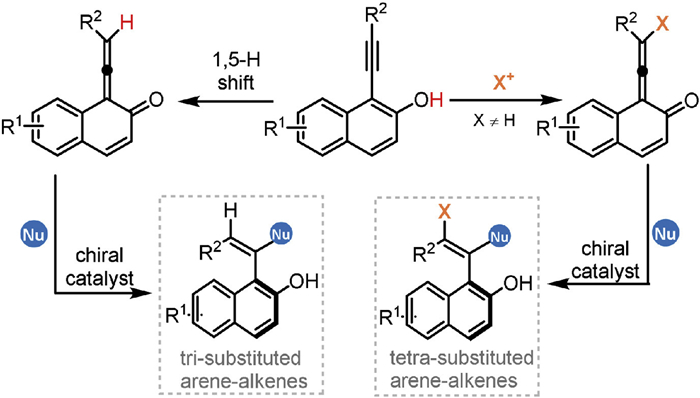
In the cases mentioned above, the asymmetric protonation of alkynyl group (or named as 1,5-H shift) to form a chiral VQMs is critical for the following atroposelective nucleophilic addition to give the axially chiral styrenes. Consequently, the resulting alkenes are limited to trisubstituted derivatives (Scheme 13, left route). In contrast, the atroposelective synthesis of axially chiral styrenes bearing four substituents is really a daunting task to date. Drawing inspiration from the 1,5-H shift strategy, replacing the proton with another electrophile (e.g., halogen cations) could lead to the formation of tetrasubstituted axially chiral VQMs. As a result, a tetra-substituted axially chiral styrene would be produced via the subsequent 1,4-additions with nucleophiles (Scheme 13, right route).
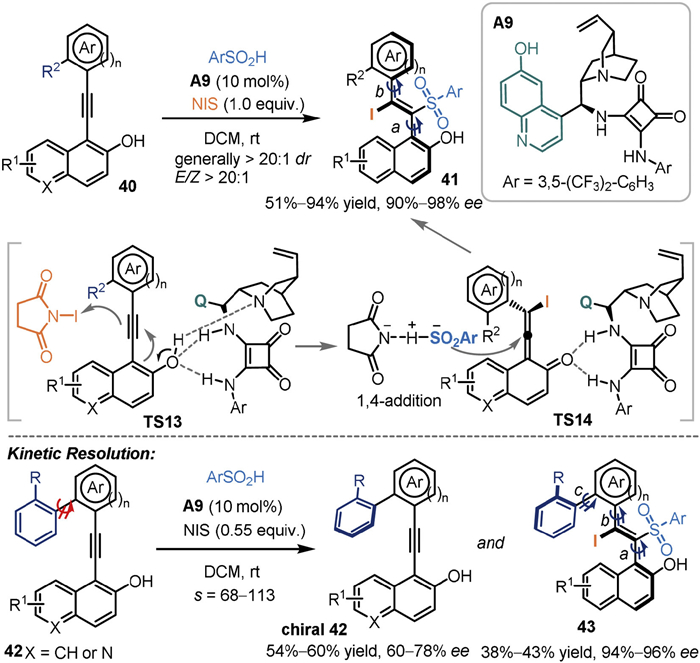
In 2018, Yan’s group pioneered this strategy by using NIS as the source of electrophilic I+ (Scheme 14) [93]. Assisted by Brønsted base A9, enantioselective iodination of the alkyne occurred, generating a highly reactive tetrasubstituted iodinated chiral VQM, which induced subsequent asymmetric sulfonylation with phenylsulfinic acid, thus yielding target tetrasubstituted axially chiral styrenes 41. Notably, the formation of trisubstituted VQMs via the prototropic rearrangement was suppressed likely due to the high electrophilicity of the I+. Notably, steric hindrance between the terminal aryl group and the iodine atom gave rise to an additional atropisomeric axis (b)—distinct from the intrinsic stereogenic axis (a) formed via the conventional 1,4-addition of VQMs. Furthermore, when the R2 group was replaced by a sterically hindered unsymmetric aryl substituent, a third atropisomeric axis (c) was generated via this protocol through a kinetic resolution (KR) process. This afforded the target product 43 bearing three contiguous stereogenic axes in high yields and ee values, albeit with the retention of atropisomeric 42 in modest enantioselectivity. This protocol not only enables the synthesis of a broad range of structurally diversified axially chiral styrenes, but also provides a powerful platform for the construction of tetrasubstituted atropisomeric styrenes, that is of great significance for the development of asymmetric catalysis.
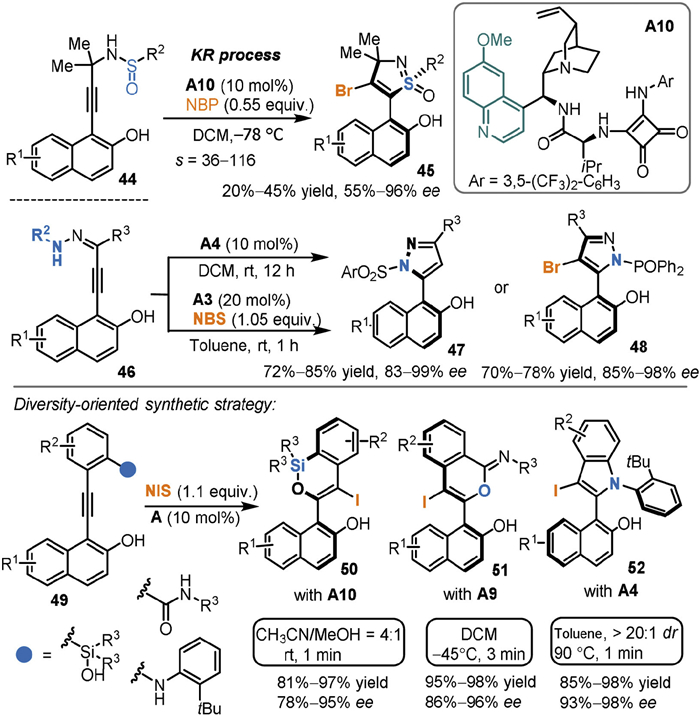
In addition to the intermolecular reaction pathway, the intramolecular nucleophilic addition of the halogenated VQMs—with a nucleophilic moiety tethered at the terminal of the alkynyl group—would yield axially chiral heterobiaryls or alkenes endowed with a heterocycle. In 2022, Yan’s group adopted racemic sulfinamide containing alkynyl naphthols 44 as the precursor for the generation of halogenated VQMs (Scheme 15) [94]. Under the catalysis of cinchona-derived squaramide A9 in the presence of NBP (N-bromophthalimide), an atroposelective bromination induced an intramolecular cyclization via a KR pathway to give the axially chiral naphthyl-isothiazole S-oxides 45 as a cyclic alkene atropisomer with high ee values. Additionally, the hydrazone-containing precursor 46 was shown to be compatible with this protocol, both in the absence and presence of NBS, smoothly producing axially chiral pyrazoles 47 and 48 respectively in good results. In the same year, Yan’s group developed a diversity-oriented synthetic strategy based on the intramolecular cyclization mediated by in-situ formed halogenated VQMs [95]. By preinstalling various nucleophilic functional group at the terminal of the alkynal group in 49—including silanol, amide and aniline—the corresponding cyclization reaction delivered a collection of axially chiral structures 50–52 in high yields with generally excellent ee values. It is noteworthy that all reactions accomplished within 1–3 min while maintaining satisfactory enantiocontrol. This demonstrated that halogenated VQM precursors are really powerful platform for the straightforward construction of diverse axially chiral backbones.
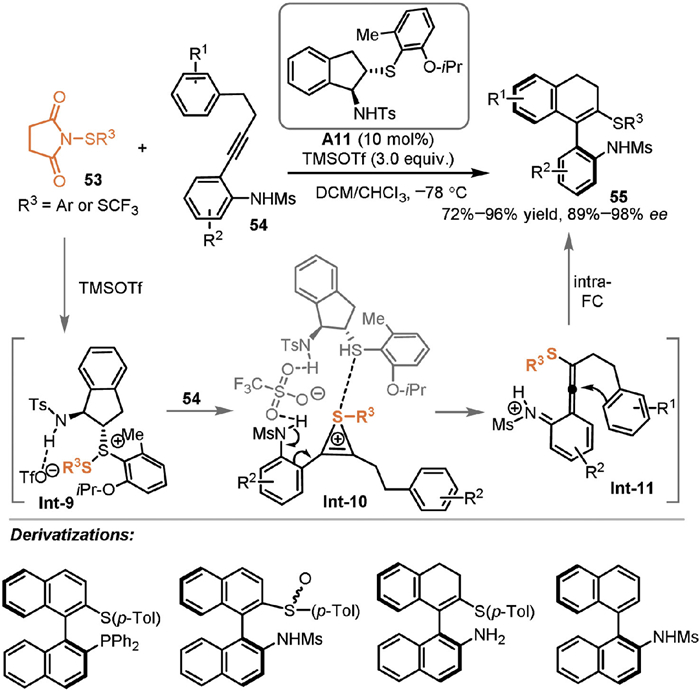
In 2019, Zhao and co-workers developed a chiral sulfide-catalyzed electrophilic carbothiolation of alkynes using electrophilic sulfur reagents, enabling access to axially chiral amino sulfide vinyl arenes (Scheme 16) [96]. Under the catalysis of catalyst A11, the electrophilic sulfur reagent 53 was attacked by the nucleophilic chiral sulfide, forming an activated chiral carbothiolation intermediate Int-9 with the assistance of TMSOTf. Subsequent hydrogen bonding-facilitated asymmetric electrophilic attack on the alkynylaniline generated a thiirenium ion intermediate Int-10, which further converted into a chiral aza-vinylidene quinone methide (aza-VQM) intermediate Int-11 with concurrent release of the catalyst. As a result, The Int-11 underwent an intramolecular asymmetric FC-type reaction, affording the axially chiral products 55 in good yields with excellent enantioselectivities. Furthermore, these valuable chiral products could be readily converted into biaryl amino sulfides, biaryl amino sulfoxides, biaryl amines, and vinyl-aryl amines via simple derivatizations, that unambiguously confirming the applicability of this protocol.
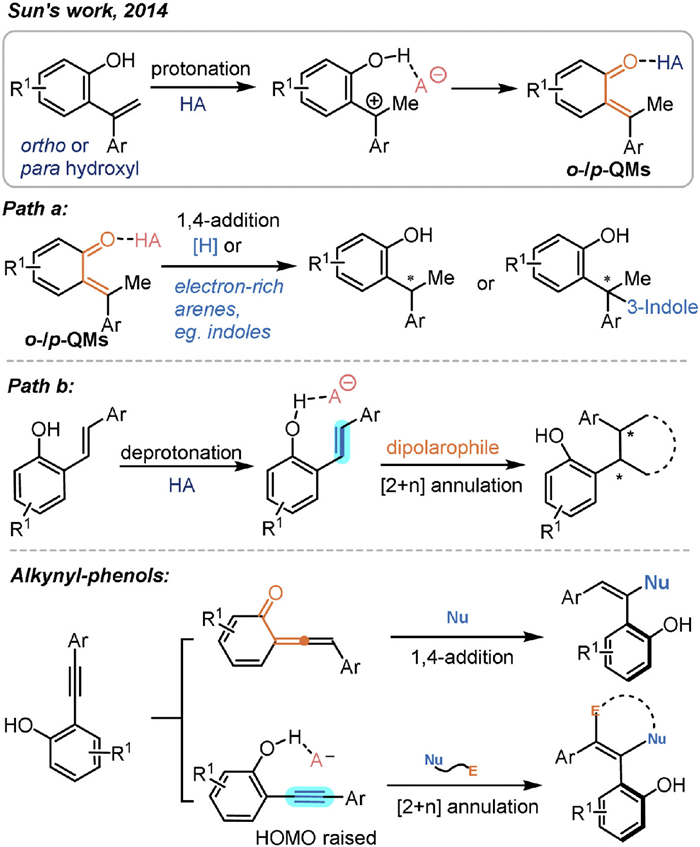
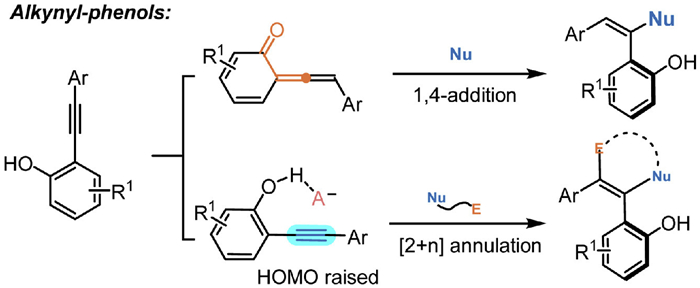
CPAs are recognized as powerful chiral bifunctional catalysts. Their Lewis basic P = O group acts as a hydrogen-bond acceptor, complementing the hydrogen-bond donor ability of their OH group. This enables a dual activation mode, where CPAs coordinate both substrates simultaneously, facilitating excellent stereocontrol [6-8,97-103]. Notably, the protonation of olefins by the chiral Brønsted acid was demonstrated as an elegant pathway for the asymmetric transformation of alkenes [104-106]. Particularly, Sun and co-workers demonstrated that ortho-hydroxyl substituted styrenes would be protonated by CPA, promoting the formation of a highly electrophilic o-quinone methide (oQM). These intermediates then readily underwent hydrogenation with Hantzsch esters or reacted with indoles, yielding a broad range of enantioenriched 1,1-diarylethanes and 1,1,1-triarylethanes (Scheme 17, path a) [104]. Alternatively, the deprotonation of OH-group by the Lewis basic moiety of the CPA would activate the olefin by raising its HOMO, thus allowing the electron-rich olefin as a 2C synthon for asymmetric electrophilic [2 + n] annulations (Scheme 17, path b). Analogous to phenol-based styrenes, phenol substituted alkynes are likely to be activated by the CPAs via a similar process, thus resulting in the nucleophilic additions or the cycloadditions to achieve axially chiral alkenes (Scheme 17, path c).
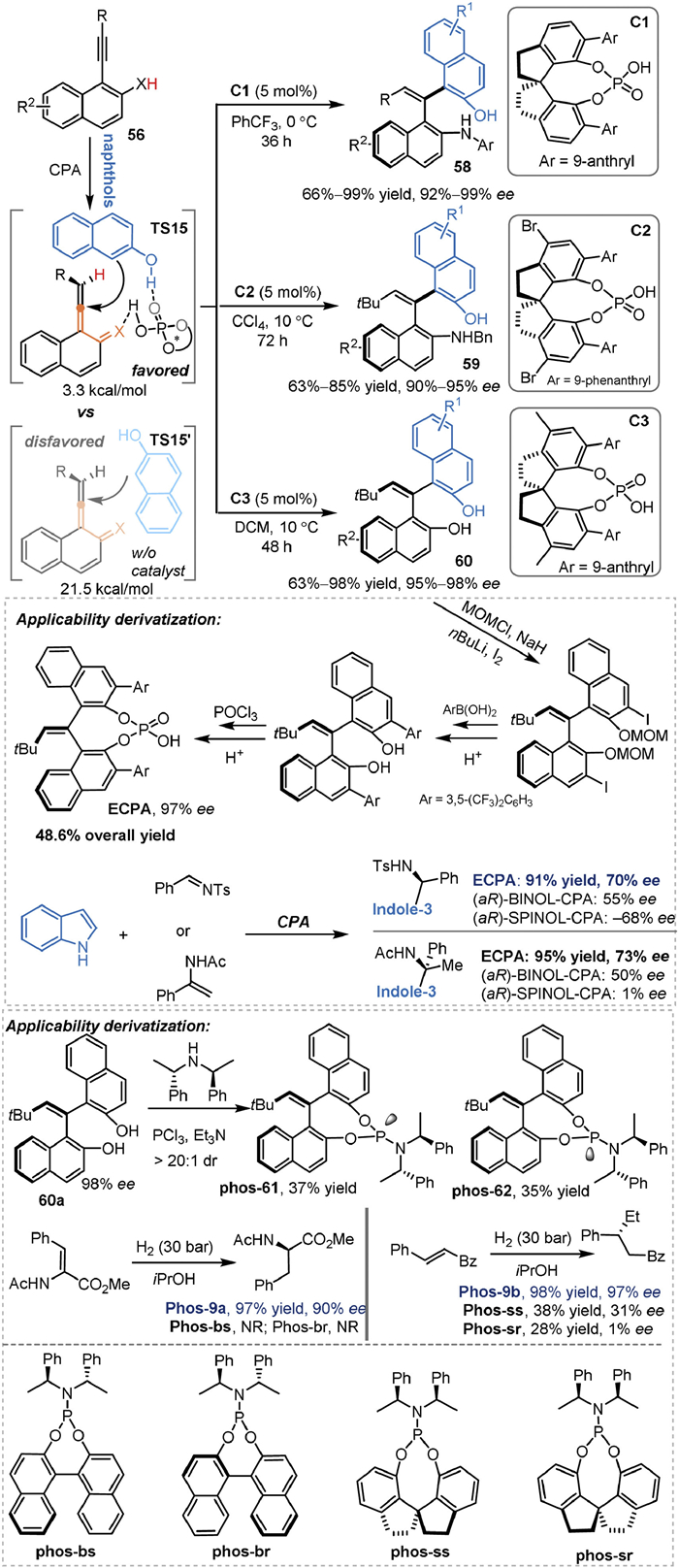
In 2019, Tan and co-workers pioneered this strategy by employing ortho-alkynylnaphthols or ortho-alkynyl naphthylamines 56 as precursors of VQMs under CPA catalysis (Scheme 18) [53]. 2-Naphthols 57 were utilized to capture in-situ generated chiral VQMs, that provided a facile route for the synthesis of EBINOLs and analogs 58–60 with excellent enantioselectivities and E/Z selectivities. Density functional theory (DFT) calculations indicated that the hydroxyl proton was transferred to the terminal of the alkynyl group by the CPA via a concerted 1,5-hydrogen (1,5-H) transfer process, generating axially chiral VQMs. Subsequently, naphthols attacked these VQMs from the side opposite to the bulky tBu group via a conjugate 1,4-addition pathway, ultimately yielding axially chiral styrenes. It should be pointed out that the direct attack of naphtholson chiral VQMs without CPA assistance via TS15′ required surmounting a significantly higher energy barrier compared to the CPA-assisted pathway via TS15 (21.5 kcal/mol vs 3.3 kcal/mol). This unambiguously indicated the vital conjugate 1,4-addition proceeded with the assistance of hydrogen-bonding interactions between the CPA and both reactive partners. More importantly, the obtained EBINOLs are structurally analogous to the well-known BINOLs and SPINOLs, which have made significant contributions to the advancement of asymmetric catalysis. To demonstrate the practical utility of this protocol, the authors successfully converted the EBINOL skeleton into chiral phosphoric acid ECPA and phosphoramidites phos-61/phos-62 via facile transformations. These novel catalysts and ligands were subsequently applied to catalytic asymmetric Friedel-Crafts reactions and hydrogenation, respectively, demonstrating comparable performance advantages to their BINOL-derived counterparts without further catalyst screenings. This Brønsted acid-promoted asymmetric hydroarylation of alkynes, mediated by in-situ generated VQMs, provides a new efficient route to access structurally diverse atropisomeric alkenes. It also represents an elegant paradigm for utilizing asymmetric synthetic chemistry as a tool to discover privileged chiral functional molecules.
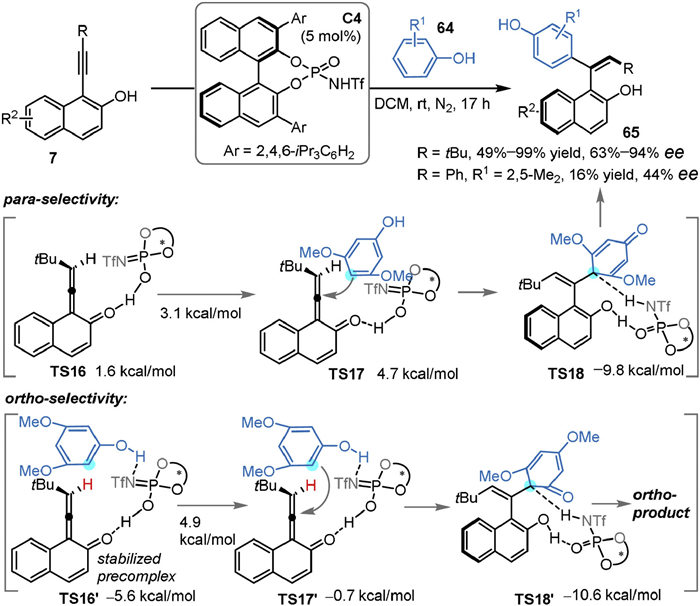
Besides naphthols, the 3,5-dimethoxyphenol was also well tolerated in the Tan’s work mentioned above, delivering the target product derived from the ortho-selective alkenylation of the phenol. In 2025, Toullec and co-workers developed this protocol by using universal phenols 64 to react with the ortho-alkynylnaphthols 7 under the catalysis of C4 (Scheme 19) [107]. In contrast, a variety of axially chiral alkenes 65 were exclusively obtained as the para-substituted isomers with exceptional enantioselectivities, this held true even for phenol nucleophiles that are weakly nucleophilic and sterically unhindered. To rationalize the unconventional para-selectivity of this transformation, detailed DFT calculations were performed. Specifically, the direct para-attack of phenols on VQMs via TS17 bypassed the formation of a stabilized precomplex TS16′, thus leading to a lower activation barrier compared to the ortho-attacked pathway, which requiring a preformation of energy-lowered stabilized complex prior to the formation of reaction transition state (3.1 kcal/mol vs. 4.9 kcal/mol). Finally, the nucleophilic C–C bond formation via the para-selective approach released significantly more energy than that via the ortho-attack pathway, that further rationalizing the favorable para-selectivity (11.4 kcal/mol vs. 5.0 kcal/mol).
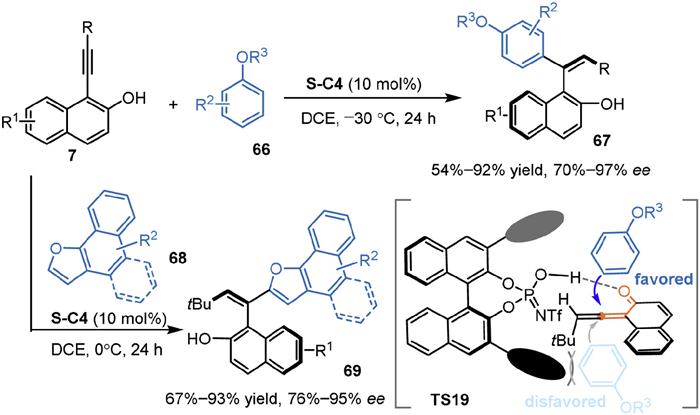
In 2022, Lv and co-workers disclosed that aromatic ethers 66 were workable in the reaction with ortho-alkynylnaphthols 7 to undergo the asymmetric hydroarylation of alkynes under the catalysis of N-triflyl phosphoramide S-C4 (Scheme 20) [108]. Mechanistically, the acid promoted the formation of a chiral axially chiral VQMs, which was further coordinated by the chiral Brønsted acid and followed by the Si-face attack of aromatic ethers without H-bonding assistance. The steric repulsion between the aromatic ether and the C3-substituents of the catalyst was found to be the key factor controlling enantioselectivity—this was distinctly different from the enantioselectivity-determining factors in reactions using phenols or indoles as nucleophiles. As a result, the desired axially chiral alkenes 67 were delivered with high enantioselectivities. In 2024, the Lv’s group extended this protocol by using naphthofurans 68 as nucleophiles, providing the axially chiral products embed 69 with a furan-moiety with high enantioselectivities [109].
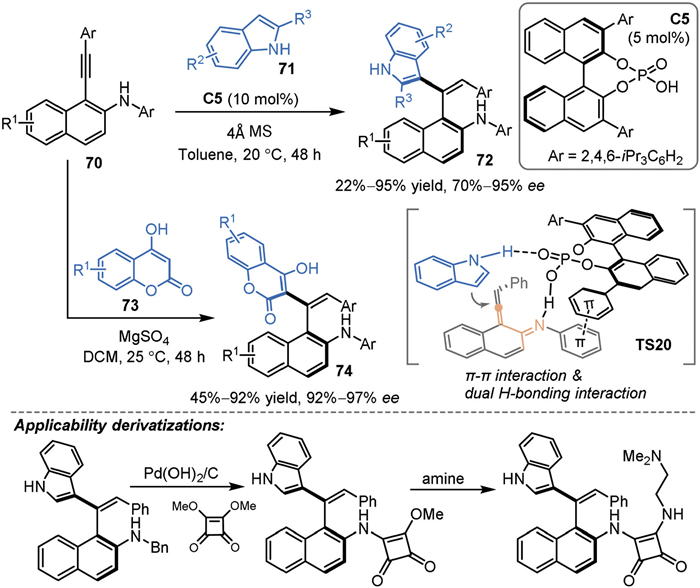
Indoles are regarded as versatile, prominent electron-rich aromatics owing to their multiple nucleophilic sites—including the NH group, C2, C3, and even C5 and C6 positions—enabling various types of electrophilic reactions for accessing densely functionalized indole-based scaffolds (Scheme 21). In 2020, Zhang and co-workers found that indoles 71 were applicable to trap in-situ generated aza-VQMs from ortho-alkynyl-naphthylamines 70 under CPA catalysis, delivering the desired trisubstituted axially chiral styrenes 72 in moderate to good yields with high enantioselectivities and Z/E selectivities [110]. Furthermore, 4-hydroxycoumarins 73 were also viable under identical conditions, enabling access to coumarin-containing axially chiral styrenes 74 in good results. In this work, the in-situ formed chiral aza-VQMs were tightly coordinated through hydrogen-bonding interactions and π−π stacking effects (TS20)—these noncovalent interactions arise between the aryl substituents of the catalyst and the aryl protecting groups of the naphthylamine, thus allowing the enantioselective nucleophilic attack by the indole. Furthermore, such axially chiral alkenes could be converted into squaramide-based organic catalysts via simple operations, which would be found further applications in asymmetric catalysis.
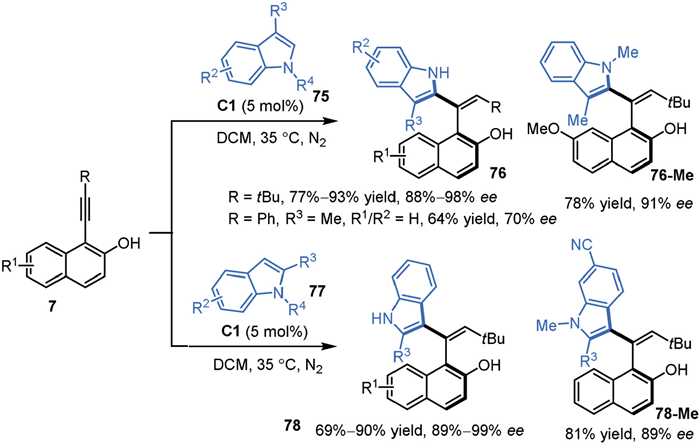
In 2022, Lv and co-workers extended CPA catalytic VQM-chemistry by using 3-substituted indoles 75 to react with ortho-alkynylnaphthols 7 (Scheme 22) [111]. Under the catalysis C1, the in-situ generated chiral VQMs that were further coordinated by C1 to facilitate the subsequent enantioselective C2-attack by 3-substituted indoles 75. Under the established optimal conditions, indoles 77 without C3 substituent were also tolerate, affording the desired axially chiral alkenes 78 via C3-attack on the VQMs. Notably, N-methyl-protected indoles were well tolerated in this protocol, giving the desired products in good results.
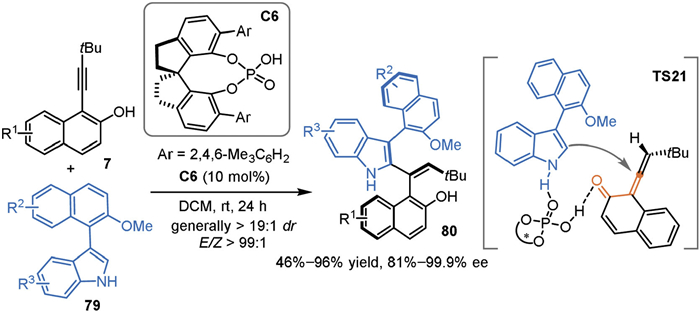
The C3-naphthylindole 79 has proven to be a versatile platform molecule for the construction of stereogenic carbo-centers containing axially chiral 3-arylindoles via a dynamic kinetic Friedel-Crafts (FC) reaction at its C2 position (Scheme 23) [112-116]. Based on this protocol, Lin’s group utilized ortho-alkynylnaphthols 7 as precursors for the in-situ generation of VQMs [117]. These in-situ formed VQMs were then trapped by 3-naphthylindoles, enabling an asymmetric FC reaction at the C2 position of the indoles under CPA catalysis. As a result, an axially chiral styrene fragment was formed along with the generation of the axially chiral biaryl structure. Notably, nearly all products 80 were obtained as a single diastereoisomer with excellent ee values and E/Z selectivities. Overall, the authors developed an efficient protocol for the simultaneous construction of axially chiral styrenes and axially chiral biaryls.
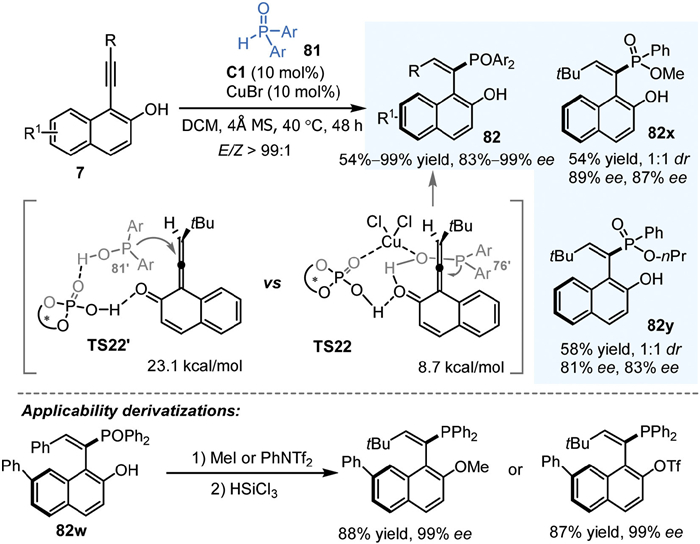
The diphenylphosphine oxide would be performed as a nucleophile to react with electron-deficient olefins for accessing various functionalized phosphorous compounds [118-122]. Particularly, the P-containing axially chiral ligands and organocatalysts were perceived as the most prominent compounds in the asymmetric catalysis [123-126]. Herein, Wang’s group developed an atroposelective hydrophosphinylation by using diphenylphosphine oxides 81 to react with ortho-alkynylnaphthols 7 under the catalysis of C1 in combination with CuBr (Scheme 24) [127]. Mechanistically, the acid-promoted the formation of axially chiral VQMs, which was attacked by the nucleophilic hydroxydiarylphosphane 81′ (derived from the tautomerization of diarylphosphine oxide) with the cooperative assistance of Cu-salt and CPA. Control experiments demonstrated that neither C1 nor the Cu salt alone could promote the reaction—this was even true for copper phosphate. These results indicated that C1 and Cu complex activated the reaction through a synergistic pathway. Furthermore, their DFT calculations revealed that Cu2+ coordinates with two chlorine atoms and two oxygen atoms from C1 and 81′ (TS22). This coordination facilitated the formation of a new hydrogen bond between the hydroxyl hydrogen atom in 81′ and the oxygen atom on the VQM, which efficiently lowered the activation barrier for C-P bond formation compared to the C1-only mediated pathway (TS22′). As a result, with the assistance of CuCl2, the rate-determining step switched from C-P bond formation to VQM formation. Furthermore, the O-protected product underwent smooth reduction to afford trivalent phosphine without enantioerosion.
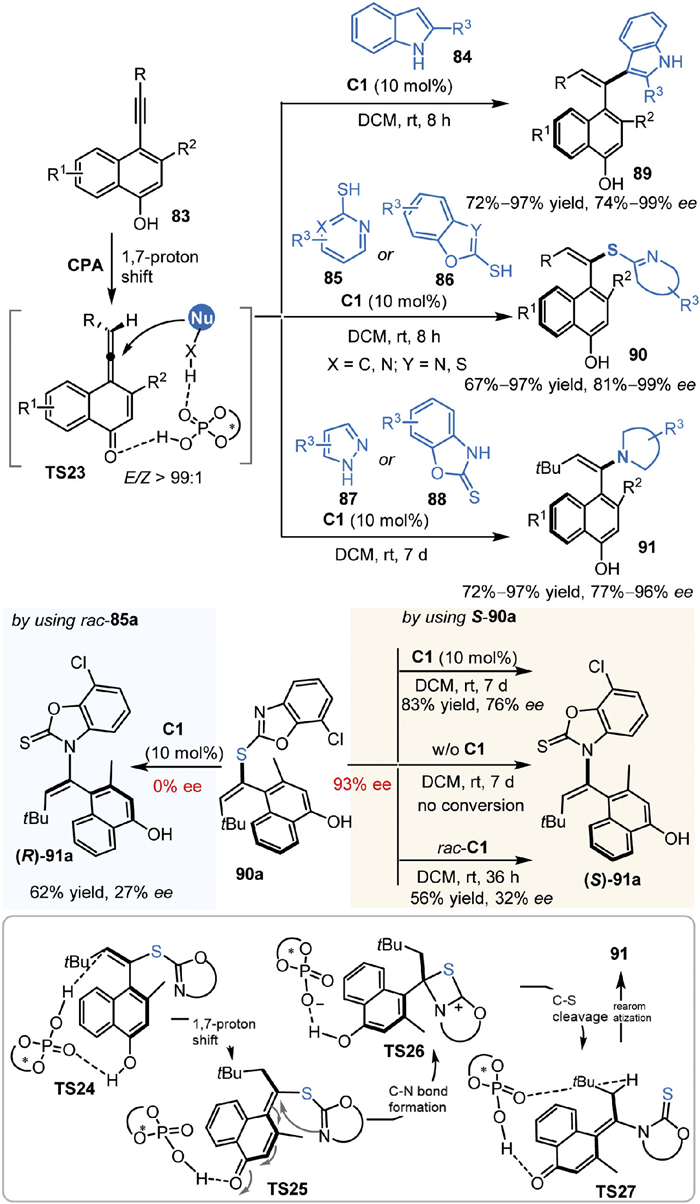
As a variant of the ortho-VQMs, the para-VQMs would be amenable to perform a nucleophilic 1,6-addition for accessing axially chiral styrenes under asymmetric catalysis. However, this type of reaction manner was rarely studied until Tan’s group pioneered this strategy by using para-hydroxyl-substituted arylacetylene 83 as the precursor for generating the para-VQMs (Scheme 25) [128]. Under the catalysis C1, the para-hydroxyl-substituted arylacetylene 83 underwent a 1,7-proton shift to form the axially chiral para-VQMs (TS23). These in-situ formed para-VQMs were successfully intercepted by three distinct classes of nucleophiles—indoles 84, mercapto-substituted heteroarenes 85/86, and pyrazoles 87—affording structurally diverse axially chiral styrenes 89–91. It should be mentioned that 2-mercaptobenzothiazoles 86 and 2-mercaptobenzoxazoles 88, which possess two nucleophilic sites (N and S), participated in this reaction through a time-dependent regioselective pathway. When the reaction time was limited within 12 h under the optimized condition, the thio-adducts 90 were obtained as a single product in excellent yields with enantioselectivities. Interestingly, extending the reaction time to 7 days, that leaded to the conversion of the products to N-adducts 91 in quantitative yields, albeit with relatively lower ee values compared to the corresponding 90. To elucidate this phenomenon, the authors elaborated control experiments using 90a. Upon treatment with C1, the 90a (93% ee) was completely converted to the N-adduct 86a within 7 days, with enantioselectivity comparable to that of the directly formed N-adduct. However, the 90a was found to be stable in the absence of C1. Furthermore, when the reaction was conducted in the presence of a racemic C1, significant enantioerosion was observed for the resulting N-adduct (32% ee). These results indicate that thio-adducts were unstable under acidic conditions, undergoing an intramolecular S-to-N rearrangement to form the thermodynamically favored N-adduct. Remarkably, when the racemic product 90a was subjected to the optimal conditions, (R)-91a was obtained as the major product—this result was the exact opposite of that observed under the standard reaction conditions. This finding implied that the second rearrangement proceeded via a kinetic resolution pathway, where the conversion rate of (S)-90a is relatively slower than that of (R)-90a. Herein, the authors deduced that a second acid-promoted 1,7-proton shift via TS24 occurred to form chiral quinone methide (QM) intermediate-based TS25. This was followed by a S-to-N rearrangement on an electron-deficient structure with CPA assistance, ultimately yielding N-adducts 91 with good enantioretention. This work comprehensively expands the applicability of existing VQM chemistry and provides a novel pathway for remote activation.
Actually, the VQM mediated asymmetric nucleophilic additions has emerged as a powerful protocol for the stereo-divergent construction of various axially chiral structures. Generally, the bifunctional organo-catalyst promoting 1,5- or 1,7-proton shift proved to be a key step to initialize the atroposelective addition, that rely on the raising HOMO of the alkynyl group by the deprotonation of the phenolic OH with the aid of Lewis basic function of the catalyst. In principle, the HOMO-raised alkynyl group is capable of playing as an electron-rich 2C synthon to undergo an asymmetric [2 + n] annulation with electrophilic dipoles (Scheme 26).
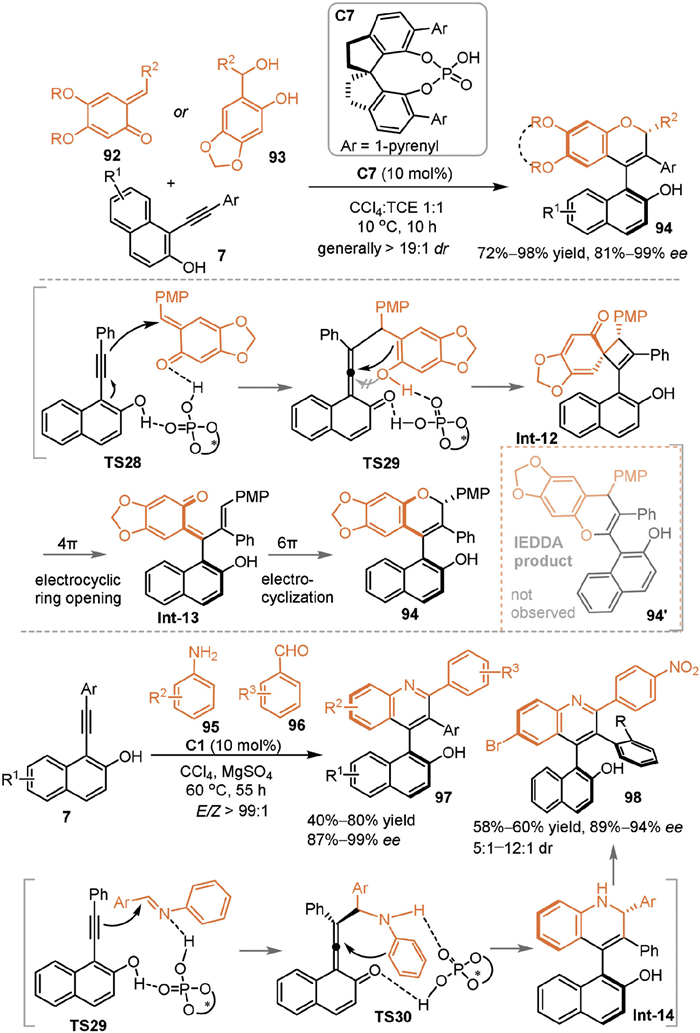
In 2022, Zhou and co-workers pioneered an atroposelective formal [4 + 2] cycloaddition of ortho-alkynylnaphthols 7 with two kinds of electrophilic dipoles under CPA catalysis, delivering a series of structurally diversified axially chiral naphthyl-2H-chromenes 94 and axially chiral quinone-naphthols 97/98 in good to excellent yields with high diastereoselectivities and enantioselectivities (Scheme 27) [129]. Initially, the oQMs, including the isolable ones 92 and the in-situ generated ones from ortho-hydroxybenzyl alcohols 93, which has proven to be versatile and highly reactive electrophiles in various asymmetric nucleophilic additions and cycloadditions, were utilized in this protocol. Intriguingly, a class of cycloadduct 94, which was not the predicted IEDDA 94′ cycloadduct, was obtained in good yields with excellent ee values. Mechanistically, the tetrasubstituted VQM was generated via electrophilic substitution of the ortho-alkynylnaphthol with oQMs 92. This was followed by an intramolecular dearomative C-nucleophilic Michael addition via TS29 (rather than an O-attack pathway in TS29), yielding chiral spirointermediate Int-12. Subsequently, 4π-electrocyclic ring opening of intermediate Int-12 produced an axially chiral intermediate Int-13, which then underwent an oxa-6π-electrocyclization to form the product 94—retaining axial chirality and incorporating a newly formed stereogenic center. On the other hand, imines generated in-situ via the condensation of anilines 95 and aromatic aldehydes 96 were also applied in this reaction under modified conditions. As a result, the anticipated asymmetric formal Povarov reaction was achieved, yielding a series of axially chiral quinone-naphthols 97/98 via auto-oxidative aromatization from cyclointermediate Int-14.
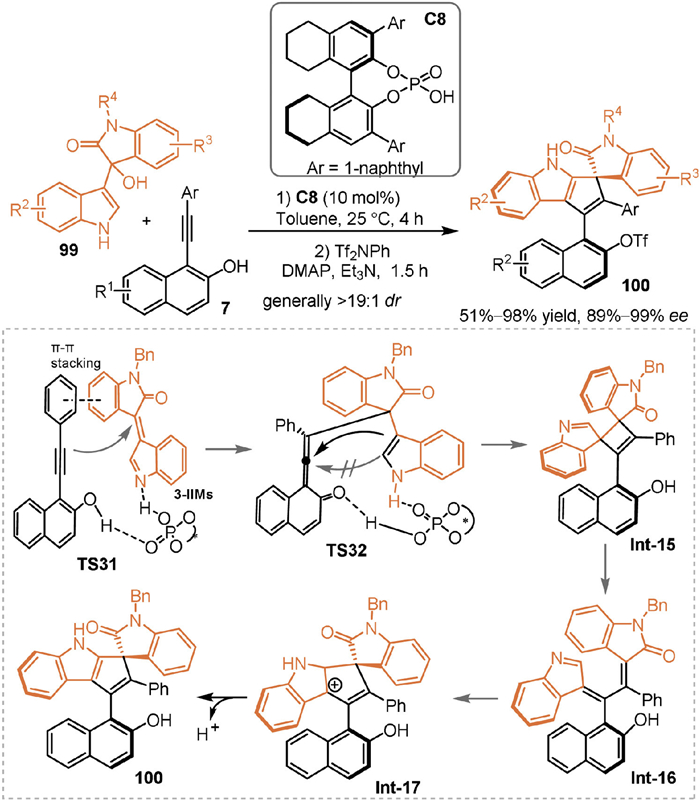
3-Indolylmethanols have been demonstrated to as highly reactive electrophiles via acid-promoted dehydration to form 3-IIMs, that is a versatile electrophile to achieve various benzylic functionalization of indoles (Scheme 28) [130-134]. In 2024, Shi’s group developed a CPA-catalyzed atroposelective synthesis of axially chiral styrenes incorporated five-membered cyclic alkenes by using ortho-alkynylnaphthols 7 in the reaction with isatin-derived 3-indolylmethanols 99 [135]. Mechanistically, acid-promoted the in-situ formation of 3-IIMs, which was attacked by the ortho-alkynylnaphthols with the aid of H-bonding and the π–π stacking interaction via TS31 to give the axially chiral tetrasubstituted VQMs. Subsequently, an intramolecular Michael addition occurred via TS32 where the C3 position of the indole (rather than its C2 position) attacked the VQMs, forming a four-membered spiroindolenine intermediate Int-15. This intermediate then underwent a ring-opening process—driven by ring strain—to yield an axially chiral styrene intermediate Int-16 containing a nucleophilic IIM moiety. As a result, the reactive imine triggered an intramolecular ring-closing process, forming a carbocation intermediate Int-17 with both axial and point chirality. This intermediate then underwent deprotonation by the CPA anion, inducing aromatization and yielded the final product 100—bearing both a stereogenic axis and a stereogenic carbon center—with excellent enantioretention.
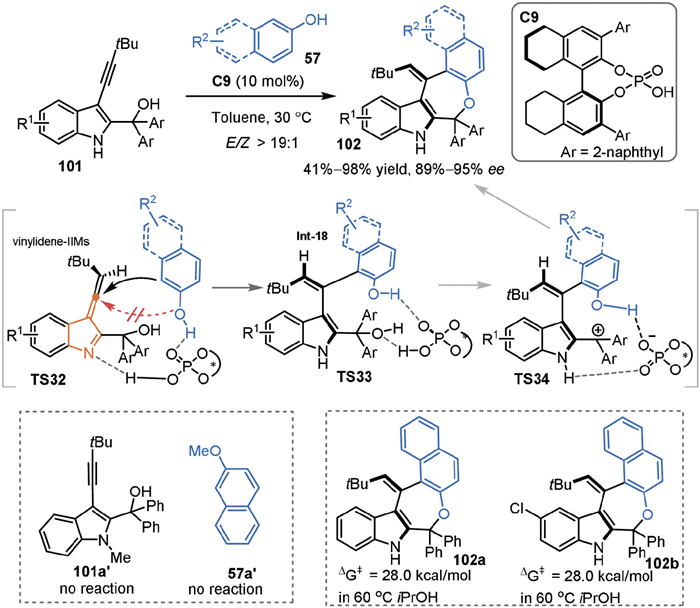
Compared with six-membered arene-derived styrenes, five-membered heteroarene-derived styrenes have much lower rotational barrier and poorer configurational stability, thus making the catalytic asymmetric synthesis of such skeletons a challenging task. Similar to the indole imine methides (IIMs), which were generally in-situ generated from the relevant indolylmethanols under acid conditions, vinylidene-IIMs was capable to participate in the asymmetric reactions with nucleophiles to afford the axially chiral indole-alkenes. To achieve this goal, in 2020, Shi’s group integrated a bulky alkyl group at the C3 position of 2-indolylmethanols as a platform molecule 101 for the synthesis of axially chiral indole-alkene system 102 (Scheme 29) [136]. Under CPA catalysis, vinylidene-IIMs were generated via a formal 1,5-proton transfer process, which was followed by the nucleophilic attack of naphthols to give an axially chiral intermediate Int-18. Subsequently, the CPA promoted a protonation and dehydration to generate a carbocation species, triggering an intramolecular cyclization to form the seven-membered axially chiral alkene-indole skeletons 102. In their control experiments, neither OMe protected naphthols 57a′ nor N-Me protected 3-alkynyl-2-indolylmethanol 101a′ worked under this optimized condition, implying hydrogen-bonding interaction and the formation of vinylidene-IIMs were critical for promoting this reaction. Furthermore, DFT calculations revealed that the second possible pathway, which was initiated by the carbocation induced O-attack of the naphthol other than the nucleophilic addition to the vinylidene-IIMs, encountered higher reaction barrier in certain steps than that of the observed pathway. Additionally, racemization experiments with representative product 102a and 102b indicated that the rotational barrier of such indole-alkene skeleton was only slightly higher than the critical threshold for maintaining isolable atropisomers (28 kcal/mol vs. 24 kcal/mol), verifying the formidable challenges for the construction of indole-alkene atropisomers.
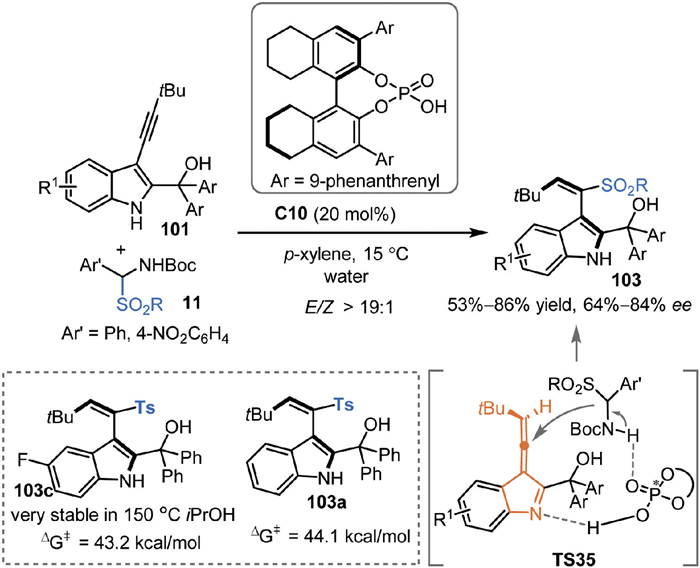
Shortly thereafter, the same group utilized 2-indolylmethanols 101 to react with the α-amido sulfones 11, which acted as sulfonyl anion surrogates in the presence of C10 (Scheme 30) [137]. Therefore, a CPA-catalyzed atroposelective addition of sulfone anion to the in-situ formed vinylidene IIMs was developed, giving a class of sulfonyl-containing acyclic indole-alkene atropisomers 103 in good yields albeit with moderate ee values. However, unlike their previous reported seven-membered indole-alkene atropisomers 102, racemization studies verified such acyclic indole-alkene structure was stable even under 150 ℃ for 8 h. In fact, the obtained indole-alkene atropisomers has much higher rotational barrier than that of the critical threhold for maintaining an isolable atropisomer (approximately 40 kcal/mol vs. 24 kcal/mol), most likely due to the steric repulsion between the tBu group and the tertiary alcohol group.
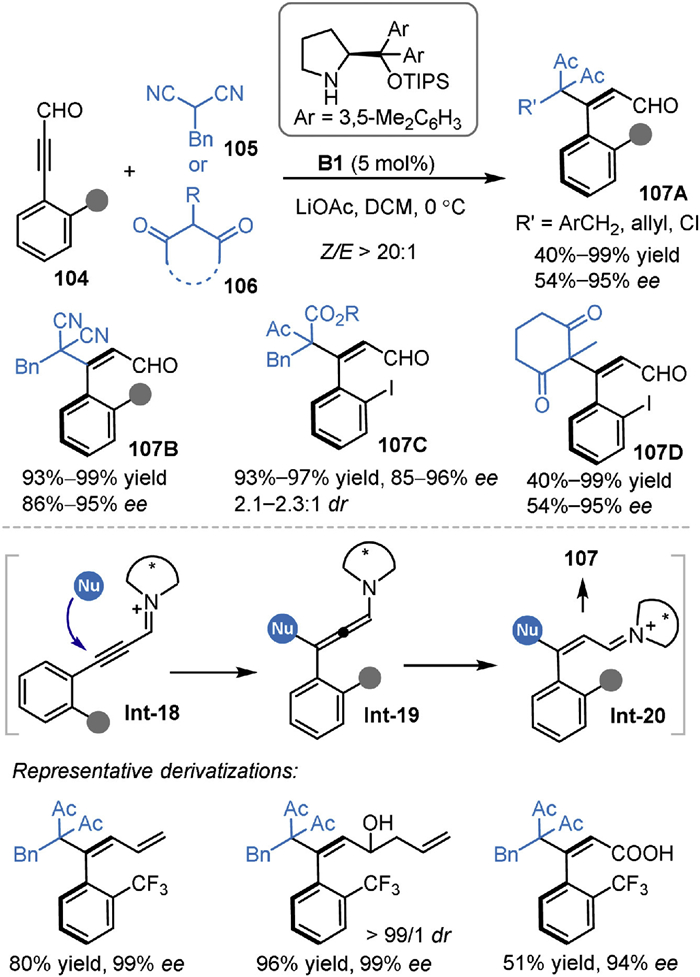
The catalytic asymmetric Michael addition of electron-deficient olefins is one of the most powerful and straightforward methods for constructing new carbon-carbon (C–C) or carbon-heteroatom (C-X) bonds [138-143]. In stark contrast, the asymmetric Michael addition of electron-deficient alkynes has received far less attention, primarily due to their relatively lower reactivity and the absence of new stereogenic carbon center formation [144-148]. Notably, if rotation about the single bond connecting the arene and the newly formed olefin is restricted, an axial chirality would be formed. Consequently, the direct Michael addition of electron-deficient alkynes with sterically bulky nucleophiles represents a viable strategy for constructing axially chiral styrenes. Based on this principle, Tan’s group developed the first atroposelective Michael addition of the alkynal 104 in the reaction with substituted dione derivatives 105/106 under the catalysis of chiral secondary amine B1 (Scheme 31) [51]. This protocol afforded a variety of axially chiral enals 107 in outstanding yields with high enantioselectivities and Z/E selectivities. Furthermore, a series of derivatizations toward the aldehyde group proceeded smoothly, delivering a range of functional axially chiral styrenes with promising potential as axially chiral diene ligands in further applications.
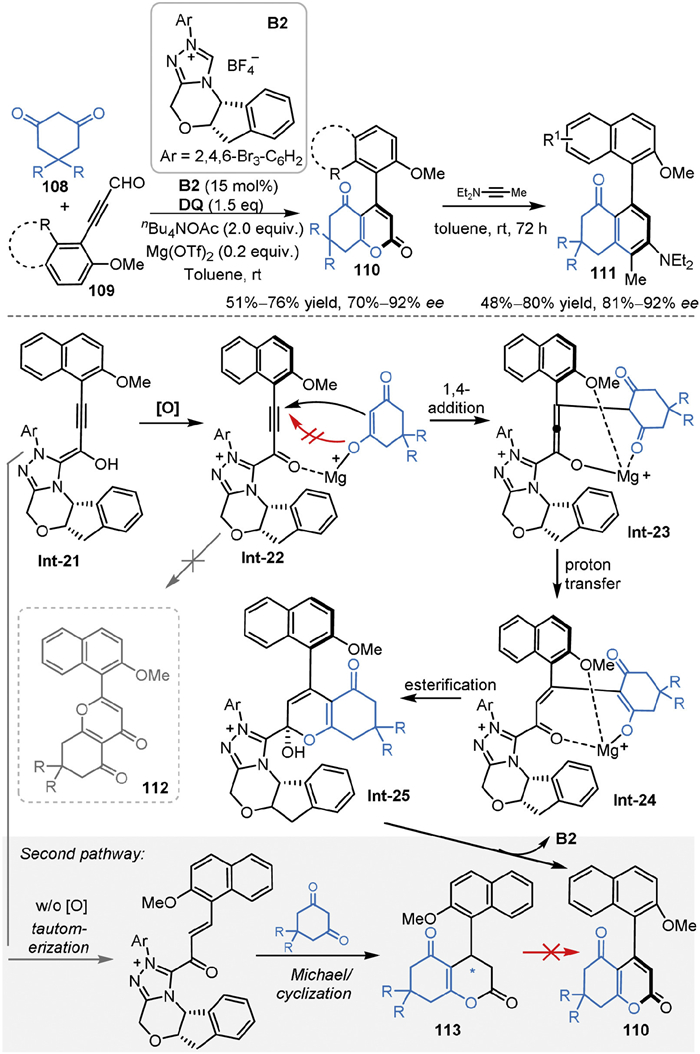
Besides amine catalysis, N-heterocyclic carbene (NHC) catalysis is widely recognized as another powerful strategy for aldehyde-activation. In 2018, Wang’s group developed an NHC-catalyzed atroposelective [3 + 3] annulation of cyclic 1,3-diones 108 with alkynals 109, providing a facile pathway to access the α-pyrone-aryls 110 in good yields with high enantioselectivities (Scheme 32) [149]. Under an oxidative NHC catalytic system, the Breslow intermediate Int-21 was first formed and subsequently oxidized to give the alkynyl acyl azolium species Int-22, then followed by the Michael attack of 1,3-dione to form an allenolate intermediate Int-23. It should be noted that the Mg2+ ion here was coordinated to the O-atom between the dione and the acyl azolium, that impeded the ketoenolate′s O-attack of diones to prevent the formation of the byproduct 112. Subsequently, a proton transfer took place from the 1,3-dione to the allene moiety, generating the vinyl acyl azolium intermediate Int-24, which was followed by the intramolecular esterification to give the final product 110. Interestingly, an alternative pathway—encompassing the classic NHC-bound vinyl acyl azolium-mediated sequential Michael addition, cyclization, and oxidative dehydration—was ruled out by control experiments. These experiments showed that the centrally chiral compound 113 failed to undergo dehydrogenation when treated with oxidant alone or under standard reaction conditions. Furthermore, the obtained α-pyrone-aryls could be further converted to axially chiral biaryls 111 via an IEDDA reaction with N,N-diethylprop-1-yn-1-amine.
In 2022, Chi and co-workers employed sulfinic acids as nucleophiles to capture the alkynyl acyl azolium species (Scheme 33) [54]. Specifically, under oxidative NHC catalysis, alkynals 114 were activated via the formation of an acyl azolium intermediate Int-26, which was then attacked by sulfinic anions and followed by an E-selective protonation, providing an axially chiral intermediate Int-28. Finally, esterification with 2-methoxyphenol happened to give the product 115 in moderate to good yields with high enantioselectivities and E/Z selectivities. The configurational stability of these open-chain axially chiral styrenes were evaluated using experimental and computational methods, indicating that the obtained atropisomeric alkenes exhibited high stability at ambient temperature. Notably, the phenol was proved crucial for improving the yields—probably due to its relatively lower nucleophilicity compared to the alcohol, which impeded the competitive oxa-Michael addition to the acyl azolium intermediate. Less sterically congested alkynals delivered products 115y/115z with good enantiocontrol but diminished E/Z selectivities. This observation may stem from the increased flexibility of the newly formed allenolate intermediates, leading to partial Z-selective protonation. Additionally, the ester group was successfully converted into a diverse range of functional groups through straightforward procedures, highlighting the potential utility of this protocol in synthetic and pharmaceutical chemistry.

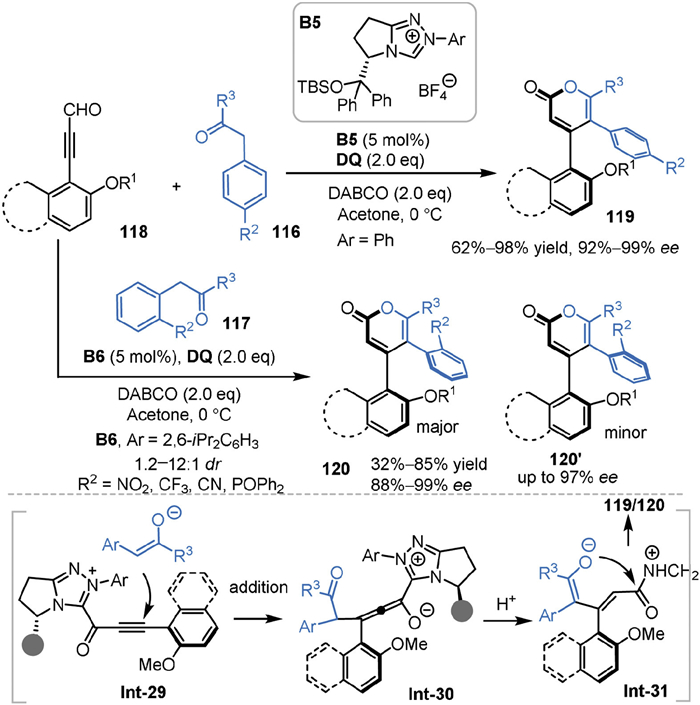
In 2023, Lu’s group developed an atroposelective [3 + 3] annulation between 2-arylketones 116/117 and alkynals 118 under an oxidative NHC catalytic system. This protocol afforded a series of triaryl-2-pyrones featuring either monoaxial chirality (119) or contiguous diaxial chirality (120), with good yields, excellent enantioselectivities, and moderate to good diastereoselectivities (Scheme 34) [150]. In the presence of DABCO or DBU, 2-arylketones were deprotonated to give the reactive enolizable intermediate, which attacked the NHC-bound acyl azolium intermediate enantioselectively (Int-29) and followed by the intramolecular esterification process (Int-31) to reach the axially chiral aryl-2-pyrone skeletons. Electron-withdrawing-groups such as NO2, CF3, CN, and POPh2 at the ortho- or para-position of the phenyl ring was essential for ensuring the nucleophilicity of arylketones to initiate the Michael addition. Remarkably, ortho-substituted arylketones 117 enabled the formation of axially chiral aryl-2-pyrones 120 bearing two adjacent stereogenic axes, with moderate to good diastereoselectivities.
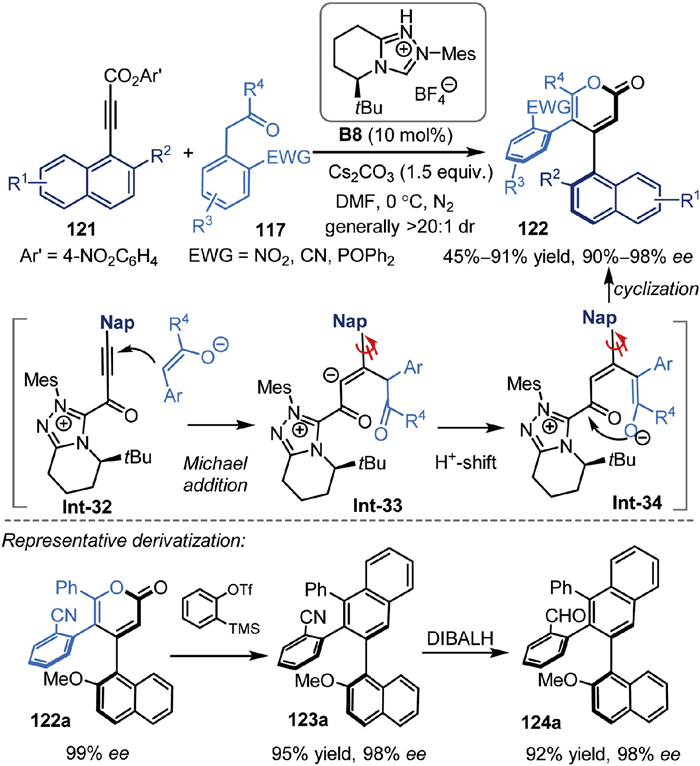
In addition to aldehydes, a para-nitrophenolic esters were commonly used as precursors for the generation of NHC-bound active species. In 2022, Du’s group employed alkynylesters 121 to react with 2-aryl ketones 117 under the catalysis of B8 (Scheme 35). Mechanistically, nucleophilic addition of B8 to the alkynylester 121 and followed by C–O cleavage to give the reactive chiral alkynyl acyl azolium intermediate Int-32 [151]. Subsequently enantioseletive Michael addition of the enolized 2-aryl ketone 117 to the alkynyl acyl azolium gave an axially chiral intermediate Int-33. A further 1,3-proton shift and enolization produced another intermediate Int-34, which induced an intramolecular acylation to give the final triaryl α-pyranones 122 bearing two axes with excellent diastereoselectivities and enantioselectivities. Notably, these atropisomeric pyranones could be transformed to 1,2-diaxially chiral triaryls 123 through [4 + 2] cycloaddition with the benzyne precursor under mild condition without enantioerosion.
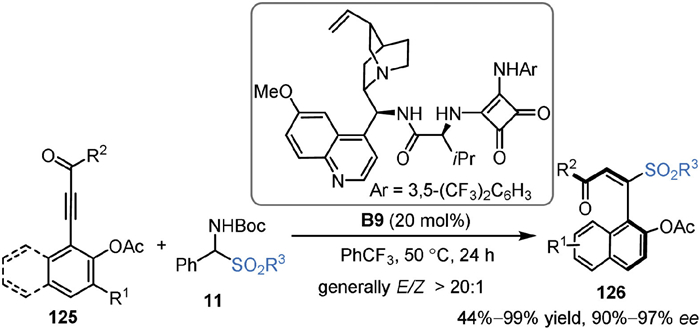
Conjugated unsaturated ketones performed as another canonical Michael acceptors for the construction of functionalized chiral ketones. However, ynones have seen limited use in asymmetric reactions, primarily due to their inability to form stereogenic carbon centers and relatively low reactivity. In 2019, Yan and co-workers reported a direct atroposelective Michael reaction of ynones 125 in the reaction with α-amido sulfones 11 by using a multiple hydrogen-bonding N-squaramide catalyst B9 (Scheme 36) [152]. This protocol afforded a diverse range of sulfinated axially chiral styrenes 126 in good yields, with excellent enantioselectivities and E/Z selectivities.
The asymmetric functionalization of axially prochiral scaffold—encompassing dynamic kinetic resolution (DKR), kinetic resolution (KR), and desymmetrization—has been recognized as a versatile approach to access axially chiral (hetero)biaryls [18,153-157]. In contrast, this methodology has rarely been applied to construct atropisomeric arene-alkenes, primarily due to their significantly lower rotational barriers and reduced configurational stability. To date, only a very limited number of examples based on this strategy have been reported.
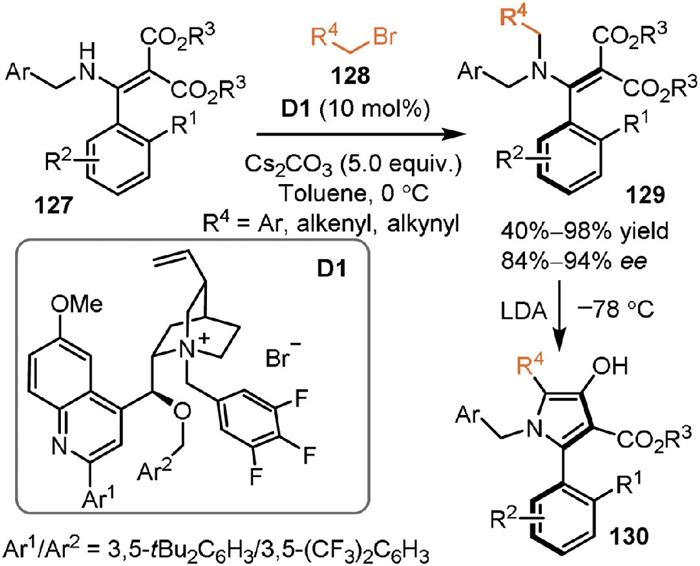
Functionalization of the alkene motif adjacent to the rotation axis has emerged as an effective strategy for increasing steric hindrance between the alkene and arene, enabling a DKR process for constructing axially chiral arene-alkenes under asymmetric catalysis. In 2019, Tan and co-workers reported a phase-transfer catalyst (PTC)-catalyzed N-alkylation reaction of aryl-substituted enamines 127 (Scheme 37) [158]. This protocol exhibited good tolerance toward various bromoalkanes 128, including allyl bromide, benzyl bromide, and propargyl bromide, thereby generating a diverse range of multifunctionalized atropisomeric arene-alkene backbones 129. Asymmetric induction by the alkyl group significantly increased the rotational barrier, facilitating the formation of a configurational axis. Consequently, this protocol represents a facile DKR approach to access axially chiral styrenes. Furthermore, the resulting axially chiral alkenes 129 were successfully converted into axially chiral 2-arylpyrroles 130 via LDA-promoted intramolecular cyclization, achieving chirality transfer from arene-alkenes to heterobiaryls.
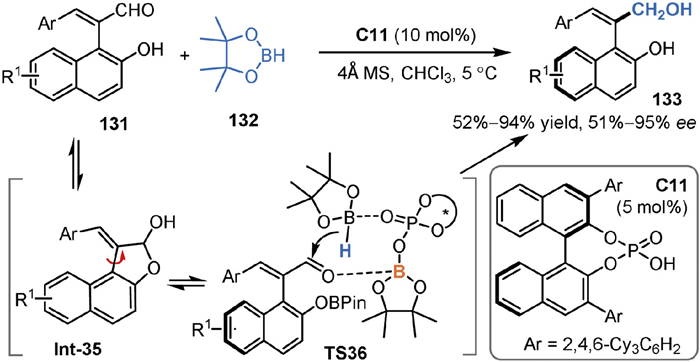
In 2022, Cheng’s group developed a CPA-catalyzed atroposelective hydrogenation of 1-enal-substituted 2-naphthols 131, utilizing HBPin 132 as the hydride source (Scheme 38) [159]. Under the catalysis of C11, the aldehyde group was hydrogenated via a DKR process, affording axially chiral styrene-type allyl alcohols 133 with good results. In this reaction, HBPin interacted with C11 to form a highly bifunctional boro-phosphate catalyst (TS36): the boron center acts as a Lewis acid to activate the carbonyl group, while the P = O moiety functions as a Lewis base to facilitate hydride generation from uncoordinated HBPin. This bifunctional catalytic mode enabled asymmetric nucleophilic hydrogenation. Notably, intramolecular acetalization generated a configurationally labile five-membered cyclic hemiaminal Int-35, which induced rapid racemization of the substrate, thus allowing the "well-matched" atropisomer to be continuously generated and hydrogenated until the full conversion. Consequently, this protocol stands as a classic example of DKR for accessing axially chiral styrenes.
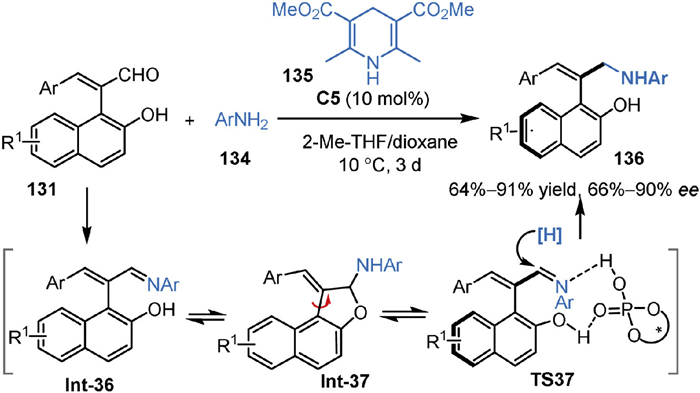
Almost simultaneously, Cheng’s group developed a CPA-catalyzed reductive amination of 131 by using Hantzsch ester 130 as the hydride source in combination with various anilines 129, providing a convenient approach for the construction of styrene-type allylamine atropisomers 136 with good to high enantioselectivities (Scheme 39) [160]. Mechanistically, condensation between the aldehyde and anilines generate an imine intermediate Int-36, which then underwent intramolecular cyclization to form a configurationally labile N,O-acetal Int-37—this species enabled racemization of the substrate. Consequently, the favored atropisomeric imine was formed continuously throughout the reaction, underwent enantioselective hydrogenation to afford the target product 136.
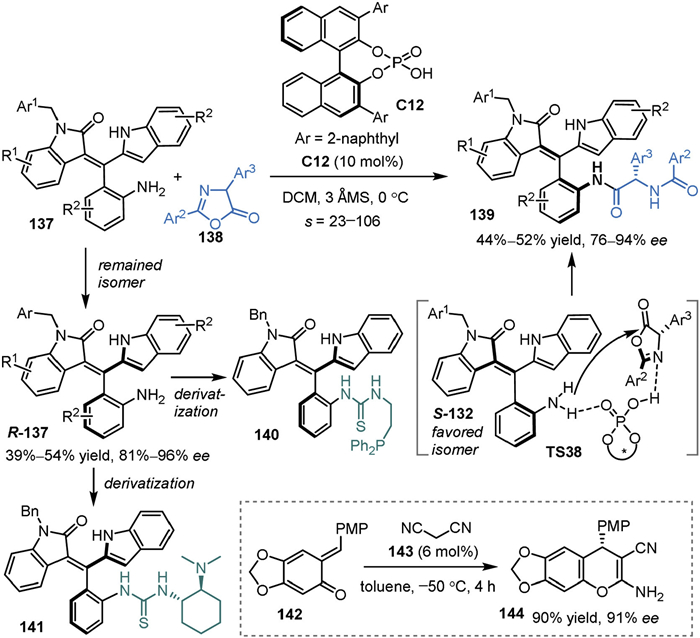
Beyond atroposelective functionalization of the alkene motif, asymmetric substitution on the arene moiety adjacent to the axis has emerged as an alternative strategy for accessing axially chiral arene-alkenes. In 2020, Shi and co-workers developed a CPA-catalyzed kinetic resolution approach to synthesize oxindole-based axially chiral styrenes (Scheme 40) [161]. Racemic oxindole-based styrenes 137 containing an ortho-amine group were employed as substrates, where the amine group underwent smooth acylation with azlactone 138 in the presence of C12. Notably, the rotational barrier of the substrate 137 (27.2 kcal/mol) exceeded the threshold required for isolating atropisomers (24 kcal/mol), thus enabling a KR process. This reaction simultaneously afforded two distinct oxindole-based axially chiral styrene derivatives with excellent enantioselectivities (up to 98% ee), good diastereoselectivities (up to 94:6 dr), and high selectivity factors (S up to 106). Through the bifunctional role of C12, both reaction partners formed hydrogen-bonding interactions with the catalyst. Consequently, the "well-matched" substrate S-137 underwent acylation with azlactones 138 to generate axially chiral styrenes 139 bearing a stereogenic carbon center, while the "mismatched" atropisomeric substrate R-137 remained unreacted as a valuable axially chiral aniline precursor. This precursor can be converted into various axially chiral organocatalysts or ligands via simple derivatization of the amine group. Among these derivatives, the axially chiral thiourea 141 outperformed typical chiral thiourea-amine organocatalysts, achieving the outstanding enantioselectivities in the asymmetric [4 + 2] annulation between ortho-quinone methide 142 and malononitrile.
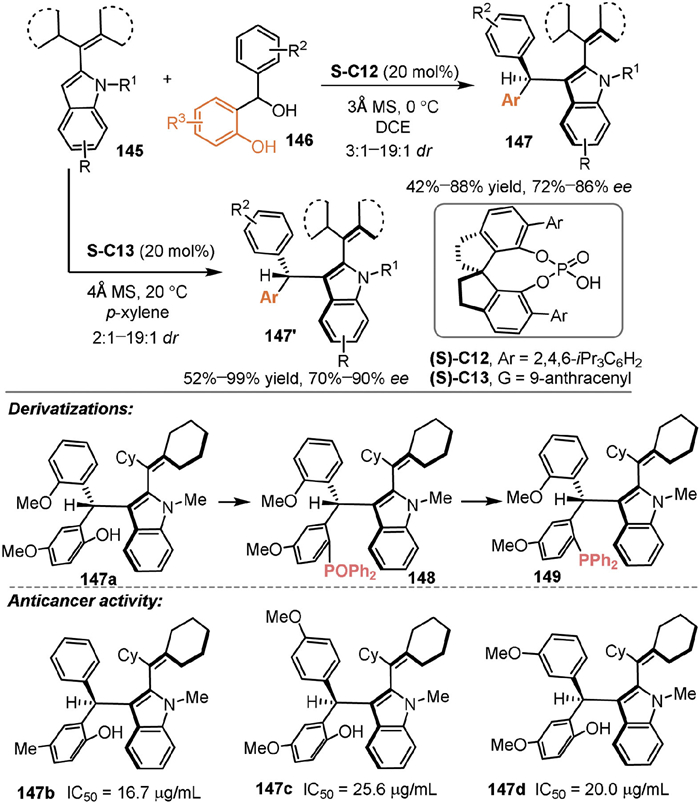
Besides the asymmetric functionalization of axially prochiral styrenes, heteroarene-based alkene can also perform as precursors for accessing axially chiral heteroarene-alkene backbones via the asymmetric introduction. In 2024, Shi’s group designed C3-unsubstituted 2-alkenylindoles 145, where the highly reactive C3-position can undergo various asymmetric Friedel-Crafts type reactions, thus providing a pathway to access axially chiral 2-alkenylindoles (Scheme 41) [162]. It is noteworthy that the steric bulky alkyl group (such as cyclohexyl group) was adorned on the olefin to ensure the configurational stability required in the resulting formed atropisomer. Since the rotation barrier of the substrate 145a (21.4 kcal/mol) was significantly lower than the threshold for isolating atropisomers (24 kcal/mol), leading to a rapid racemization of 145 for the following DKR reactions. In this work, o-hydroxybenzyl alcohols 146, which would undergo dehydration to generate highly reactive oQMs in the presence of Brønsted acid, were employed as electrophiles for the C3-functionalization of 145 under the catalysis of S-C12, affording axially chiral 2-alkenylindoles 147 bearing central chirality in moderate to high yields, with good enantioselectivities and diastereoselectivities. Interestingly, when S-C13 was engaged in this reaction, the diastereoisomer 147′ was obtained in high yields with good enantioselectivities and diastereoselectivities. As a result, four stereoisomers could be obtained by switching the absolute configuration of the corresponding CPAs. Furthermore, the resulting axially chiral 2-alkenylindoles could be converted into new chiral ligands or exhibited potent anticancer activities, demonstrating their promising applications in asymmetric catalysis and medicinal chemistry.
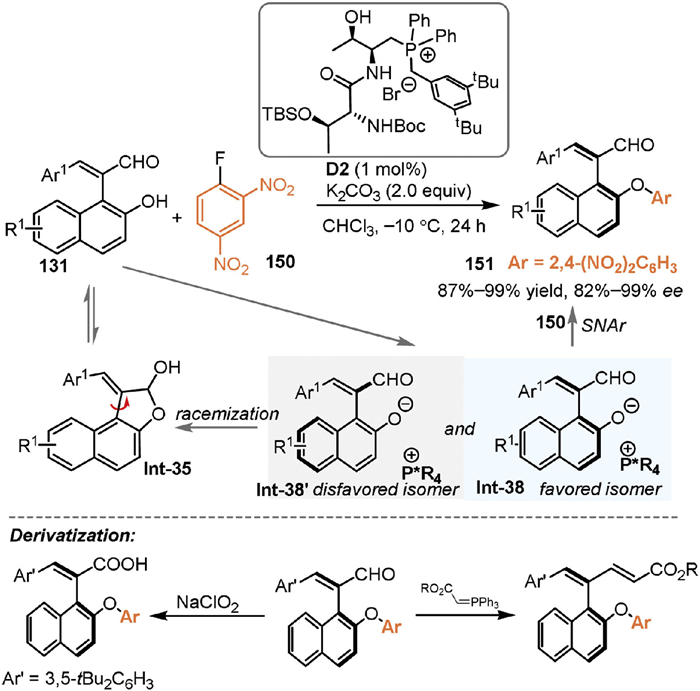
In 2023, Wang and co-workers developed an atroposelective nucleophilic aromatic substitution of 131 with 2,4-dinitrofluorobenzene derivatives 150 under the catalysis of chiral peptide-phosphonium salt D2 (Scheme 42) [163]. Intramolecular hemiacetalization between the phenol hydroxyl group and aldehyde group induced rapid racemization of the substrate, enabling a dynamic kinetic atroposelective nucleophilic substitution with 2,4-dinitrofluorobenzenes. This process afforded various substituted axially chiral styrenes 151 in excellent yields, with outstanding enantioselectivities and complete E/Z selectivities. Notably, the catalyst loading was as low as 1 mol%, demonstrating the practicality and efficiency of this protocol. Furthermore, simple transformations were performed to prepare axially chiral styrene molecules bearing extended C = C units and carboxylic acid groups, indicating the promising application of this method in asymmetric synthesis.
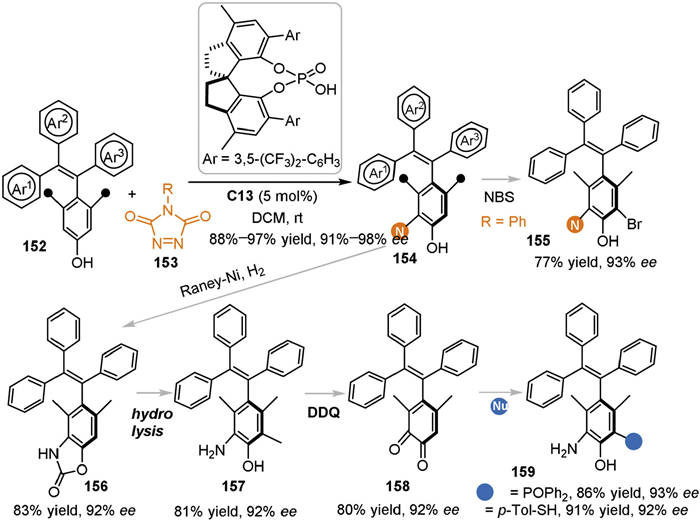
Very recently, Tan’s group pioneered a CPA-catalyzed desymmetrization strategy for the catalytic enantioselective synthesis of axially chiral tetraarylethenes (TAEs), which represents a groundbreaking advance in the construction of axially chiral arene-alkene scaffolds with unique skeletal characteristics (Scheme 43) [164]. This protocol took advantage of the enantioselective aromatic substitution of phenols 152 in prochiral TAEs with 1,2,4-triazole-3,5-diones 153 as electrophiles under the catalysis of a (S)-C13. A highly efficient Friedel-Crafts type reaction occurred to break the symmetry of 152, delivering a diverse range of axially chiral TAEs 154 in excellent yields with high enantioselectivities. Notably, the optimized catalytic system features low catalyst loading (5 mol%) and good scalability, as demonstrated by the gram-scale synthesis of the representative product 154a with 92% yield and 93% ee retained. Besides, the resulting axially chiral TAEs exhibit excellent configurational stability (no obvious racemization at 100 ℃ for 8 h) and can undergo a series of stereospecific post-transformations (155–159) without erosion of stereochemical integrity, further enriching the structural diversity of axially chiral TAE derivatives. Moreover, the application of these axially chiral TAEs in chiroptical materials was explored by doping the carbamate derivative 156 into the nematic liquid crystal 4-cyano-4-pentylbiphenyl, and the resulting doped systems exhibited strong circular dichroism (CD) and circularly polarized luminescence (CPL) signals with favorable absorption dissymmetry factors (gabs~0.1) and luminescence dissymmetry factors (glum up to 0.22), as well as high photoluminescence quantum yields. Mechanistic studies revealed that the phenolic hydroxyl group in prochiral TAEs is essential for the transformation, and the CPA exerts bifunctional catalysis by simultaneously activating the phenol 152 and 1,2,4-triazole-3,5-dione 153 via multiple hydrogen-bonding interactions, realizing the remote control of the axial chirality of TAE skeletons. This desymmetrization of prochiral TAEs not only establishes a new mode of CPA-catalyzed aromatic substitution for atroposelective synthesis but also constructs a novel axially chiral arene-alkene skeleton with AIE properties. TAEs, as the core structure of AIE molecules, have been widely applied in biological probes, chemosensors and theranostic agents, and the introduction of axial chirality into TAE skeletons paves a new avenue for the development of high-performance CPL-active materials and chiral sensing materials.
Ketones and their derivatives containing an α-CH group can undergo deprotonation under basic conditions to form enolates. These enolates are recognized as versatile precursors for achieving various electrophilic functionalizations at the α-carbon, enabling access to stereogenic ketone derivatives—particularly in the synthesis of amino acid derivatives via C-alkylation of enolates derived from glycine Schiff base derivatives [165-167]. In stark contrast, the alternative O-functionalization pathway has received less attention, due to no stereogenic carbon center generated. However, with the growing focus on the synthesis of atropisomeric alkenes, atroposelective O-functionalization of α-aryl-substituted ketones has emerged as a novel and efficient strategy for accessing axially chiral arene-alkene systems.
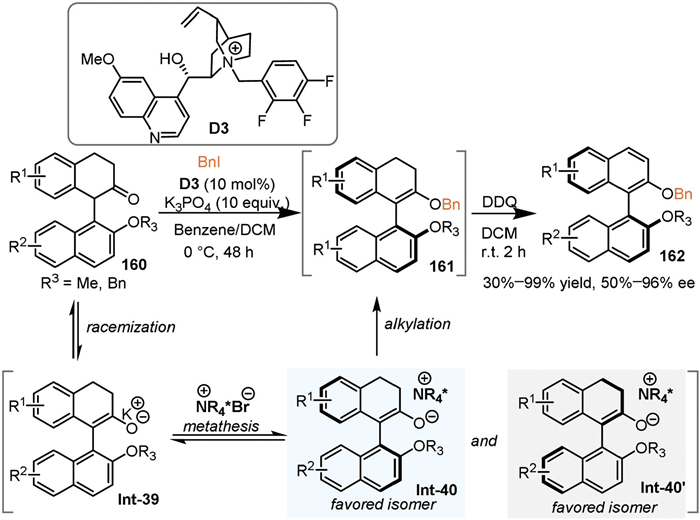
In 2017, Smith and co-workers reported a seminal atroposelective O-alkylation of racemic 1-aryl-2-tetralones 160 with benzyl iodide under a PTC catalytic system (Scheme 44) [55]. Initially, interfacial deprotonation of the 1-aryl-2-tetralone gave rise to racemic atropisomeric potassium enolates Int-39. Subsequently, isomer S-60 underwent faster counterion metathesis with the chiral quaternary ammonium salt D3 than that of R-160, delivering a soluble ion pair Int-40 as the favored intermediate for alkylation. The disfavored isomer Int-40′ underwent racemization via the reversible tautomerization, regenerating the favored isomer S-160. Herein, the target axially chiral alkenes 161 were produced in high yields and enantioselectivities via a DKR process. Given the utility and significance of BINOL skeletons in asymmetric catalysis, these axially chiral enol-ethers underwent smooth oxidation with DDQ, affording a diverse range of non-C2-symmetric atropisomeric BINOL derivatives 162 in good yields and excellent enantioselectivities.
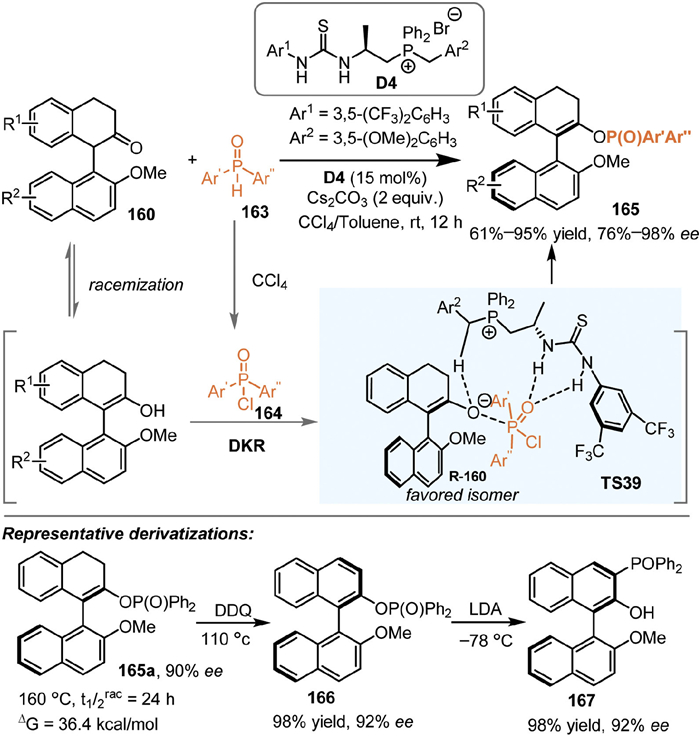
In 2023, Wang and co-workers developed an atroposelective Atherton−Todd (A−T) reaction between 1-aryl-2-tetralones 160 and phosphine oxides 163 under the catalysis of bifunctional phosphonium salt D4 (Scheme 45) [168]. Initially, phosphine oxides converted to phosphoryl chloride 164 under a basic condition in the presence of CCl4, which were preferentially attacked by the R-160 with the assistance of hydrogen-bonding effects of the phosphonium salt (TS39). Moreover, racemization experiments demonstrated the rotational barrier of the obtained axially chiral styrenes was really high enough to maintain the configurational stability at room temperature, that highlighted the practicability of this protocol. Furthermore, such axially chiral cyclic styrenes could be further oxidized by DDQ into axially chiral biaryls 166, which served as a platform molecule for accessing functional axially chiral skeletons, such as axially chiral ligands and catalysts 167, without enantioerosion.
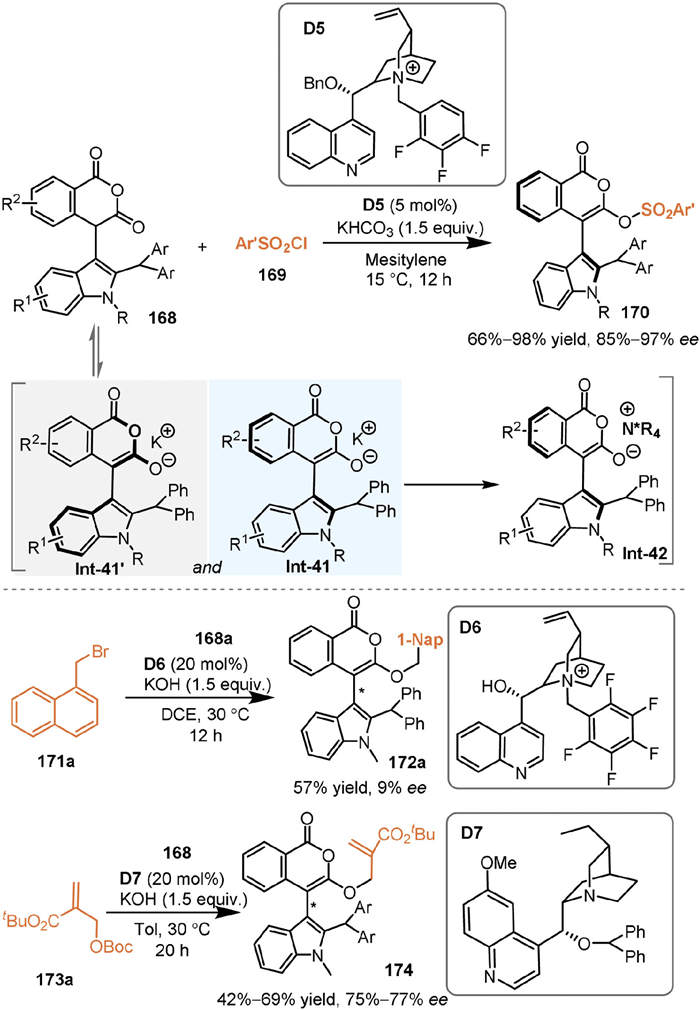
In 2022, Shi’s group reported a PTC-catalyzed atroposelective sulfonylation reaction by designing novel homophthalic anhydride-based indoles 168 as platform molecules (Scheme 46) [169]. Initially, the substrate was deprotonated to form an enolate species with a stereogenic axis, in which the Int-41 underwent faster counterion metathesis with the chiral catalyst than that of Int-41′. Subsequently, this “well-matched” intermediate was attacked by 169, delivering axially chiral isochromenone-indoles 170 with excellent enantioselectivities. In contrast, the “mismatched” intermediate Int-41′ underwent a racemization process via a tautomerization to regenerate the favored isomer Int-41, enabling a DKR process for the synthesis of axially chiral isochromenone-indoles in high yield. Besides the sulfonylation, this work also explored the atroposelective alkylation of 168a with benzyl halides 171a. However, despite extensive screening, only inferior atroposelectivity was achieved (172a, 57% yield, 9% ee). Additionally, the authors further employed Morita-Baylis-Hillman (MBH) carbonates 173a as alkylating reagents for reaction with homophthalic anhydride-based indoles 168 under the catalysis of D7, affording alkylated atropisomeric products 174 with acceptable enantioselectivities.
Axially chiral arene-alkene system represents a typical atropisomeric scaffold, which have emerged as an important synthon for the total synthesis of natural products, as well as a privileged scaffold for the chiral catalyst and ligand. As the complementary of TM-catalyzed approaches, the organo-catalytic atroposelective pathway for the construction of atropisomeric arene-alkenes offers mild reaction conditions, high functional group tolerance, and unique activation modes that are difficult to achieve with metal catalysts. Particularly, the asymmetric VQMs-mediated nucleophilic additions under bifunctional Brønsted base or CPA catalysis have proven to be the most powerful and versatile platform to access structurally diversified axially chiral arene-alkenes, including the tetrasubstituted and multiaxial atropisomeric styrenes. Notably, the vinylidene-IIMs generated in-situ from alkynyl indolylmethanols has demonstrated a feasible pathway to access indole-based atropisomeric alkenes via 1,4-addition under CPA catalysis. The NHC-catalyzed conjugate addition of electron-deficient alkynes provides a straightforward but less versatile pathway, that is confined to limited nucleophiles probably due to the steric hindrance effects and the absence of aromatization driven force compared to the VQMs-mediated approach. The asymmetric functionalization of preformed arene-alkene scaffolds via DKR/KR or desymmetrization process, as well as the atroposelective O-functionalization of α-aryl-substituted ketones, rely on elaborate substrate design to increase the rotational barrier of the stereogenic axis, and have been developed into efficient strategies for the construction of axially chiral arene-alkenes with specific structures. Collectively, these strategies overcome the inherent challenge of low rotational barriers in arene-alkenes, delivering high enantioselectivities and versatile functionalizations.
Despite the significant progress, there still exist several critical challenges and promising research directions in this field. First, most of the reported organocatalytic reactions focus on the synthesis of axially chiral arene-alkenes with single stereogenic axis, and the construction of multi-axial atropisomers with contiguous or multiple stereogenic axes is still in its infancy, which requires the design of highly stereocontrolled catalytic systems to realize the simultaneous control of multiple axial chiralities. Second, the integration of organocatalysis with other catalytic modes (e.g., photoredox catalysis, electrocatalysis, flow chemistry) is expected to expand the reaction scope, improve reaction efficiency and scalability, and enable the construction of axially chiral arene-alkenes with novel structures that are inaccessible by traditional methods. Third, the construction of axially chiral heteroarene-alkenes (e.g., indole, thiophene, furan-derived) remains a formidable task due to their inherently low rotational barriers, and the development of novel catalytic strategies and substrate design principles to improve their configurational stability is highly desirable. Fourth, the exploration of practical applications of the synthesized axially chiral arene-alkenes is still insufficient; in particular, their applications in chiral catalysis (as ligands/catalysts), chiral materials (CPL, chiral sensors) and medicinal chemistry (bioactive molecules) need to be further developed, and the structure-property relationship between the axial chirality and their functional performance should be systematically investigated. Ultimately, advancing these frontiers will not only expand the toolbox for axially chiral arene-alkene synthesis but also facilitate the development of novel chiral catalysts, ligands, materials, and bioactive molecules with unique three-dimensional architectures.
Wenbo Li: Writing – original draft, Funding acquisition. Zhuo Wang: Data curation. Jingyi Duan: Data curation. Kai-Kai Wang: Writing – review & editing, Data curation. Xiao-Long He: Writing – review & editing.
The authors declare that they have no known competing financial interests or personal relationships that could have appeared to influence the work reported in this paper.
This work was supported by the Henan Photoelectrocatalytic Material and Micro-Nano Application Technology Academician Workstation, the Sichuan Science and Technology Program (No. 2026NSFSC0050).
G.H. Christie, J. Kenner, J. Chem. Soc. Trans. 121 (1922) 614–620. doi: 10.1039/CT9222100614
A. Miyashita, A. Yasuda, H. Takaya, et al., J. Am. Chem. Soc. 102 (1980) 7932–7934. doi: 10.1021/ja00547a020
S. Shirakawa, K. Maruoka, Angew. Chem. Int. Ed. 52 (2013) 4312–4348. doi: 10.1002/anie.201206835
W. Tang, X. Zhang, Chem. Rev. 103 (2003) 3029–3070. doi: 10.1021/cr020049i
Y. Chen, S. Yekta, A.K. Yudin, Chem. Rev. 103 (2003) 3155–3212. doi: 10.1021/cr020025b
D. Parmar, E. Sugiono, S. Raja, et al., Chem. Rev. 114 (2014) 9047–9153. doi: 10.1021/cr5001496
J. Yu, F. Shi, L.Z. Gong, Acc. Chem. Res. 44 (2011) 1156–1171. doi: 10.1021/ar2000343
T. Akiyama, K. Mori, Chem. Rev. 115 (2015) 9277–9306. doi: 10.1021/acs.chemrev.5b00041
J. Clayden, W.J. Moran, P.J. Edwards, S.R. LaPlante, Angew. Chem. Int. Ed. 48 (2009) 6398–6401. doi: 10.1002/anie.200901719
G. Bringmann, T. Gulder, T.A.M. Gulder, M. Breuning, Chem. Rev. 111 (2011) 563–639. doi: 10.1021/cr100155e
S.R. LaPlante, L.D. Fader, K.R. Fandrick, et al., J. Med. Chem. 54 (2011) 7005–7022. doi: 10.1021/jm200584g
J.E. Smyth, N.M. Butler, P.A. Keller, Nat. Prod. Rep. 32 (2015) 1562–1583. doi: 10.1039/C4NP00121D
X.L. Min, X.L. Zhang, R. Shen, Q. Zhang, Y. He, Org. Chem. Front. 9 (2022) 2280–2292. doi: 10.1039/d1qo01699g
J.K. Cheng, S.H. Xiang, S. Li, L. Ye, B. Tan, Chem. Rev. 121 (2021) 4805–4902. doi: 10.1021/acs.chemrev.0c01306
J.K. Cheng, S.H. Xiang, B. Tan, Acc. Chem. Res. 55 (2022) 2920–2937. doi: 10.1021/acs.accounts.2c00509
H.H. Zhang, F. Shi, Acc. Chem. Res. 55 (2022) 2562–2580. doi: 10.1021/acs.accounts.2c00465
S.H. Xiang, W.Y. Ding, Y.B. Wang, B. Tan, Nat. Catal. 7 (2024) 483–498. doi: 10.1038/s41929-024-01138-z
A. Kim, Y. Kwon, Synlett 33 (2022) 201–206. doi: 10.1055/a-1694-4695
J. Feng, C.J. Lu, R.R. Liu, Acc. Chem. Res. 56 (2023) 2537–2554. doi: 10.1021/acs.accounts.3c00419
R. Song, Y. Xie, Z. Jin, Y.R. Chi, Angew. Chem. Int. Ed. 60 (2021) 26026–26037. doi: 10.1002/anie.202108630
C. Zhao, J. Liao, Y. Zhu, et al., Chin. Chem. Lett. 36 (2025) 110337. doi: 10.1016/j.cclet.2024.110337
Z.Q. Wang, L.W. Wei, Z.Q. Wang, et al., Chin. Chem. Lett. 37 (2026) 111377. doi: 10.1016/j.cclet.2025.111377
L. Jin, J. Han, D. Fang, et al., Chin. Chem. Lett. 35 (2024) 109212. doi: 10.1016/j.cclet.2023.109212
J.F. Hyde, R. Adams, J. Am. Chem. Soc. 50 (1928) 2499–2506. doi: 10.1021/ja01396a027
W. Mills, G. Dazeley, J. Chem. Soc. 1939 (1939) 460–463.
R. Adams, J.W. Mecorney, J. Am. Chem. Soc. 67 (1945) 798–802. doi: 10.1021/ja01221a031
R. Adams, C.W. Theobald, J. Am. Chem. Soc. 65 (1943) 2208–2211. doi: 10.1021/ja01251a057
R. Adams, L.O. Binder, F.C. McGrew, J. Am. Chem. Soc. 64 (1942) 1791–1794. doi: 10.1021/ja01260a012
R. Adams, R.S. Ludington, J. Am. Chem. Soc. 67 (1945) 794–797. doi: 10.1021/ja01221a030
R. Adams, J. Gross, J. Am. Chem. Soc. 64 (1942) 1786–1790. doi: 10.1021/ja01260a011
R. Adams, A.W. Anderson, M.W. Miller, J. Am. Chem. Soc. 63 (1941) 1589–1593. doi: 10.1021/ja01851a028
R. Adams, M.W. Miller, J. Am. Chem. Soc. 62 (1940) 53–56. doi: 10.1021/ja01858a011
R. Adams, L.O. Binder, J. Am. Chem. Soc. 63 (1941) 2773–2776. doi: 10.1021/ja01855a079
R. Adams, M.W. Miller, F.C. McGrew, et al., J. Am. Chem. Soc. 64 (1942) 1795–1801. doi: 10.1021/ja01260a013
R. Adams, C.W. Theobald, J. Am. Chem. Soc. 65 (1943) 2383–2387. doi: 10.1021/ja01252a040
T. Kawabata, K. Yahiro, K. Fuji, J. Am. Chem. Soc. 113 (1991) 9694–9696. doi: 10.1021/ja00025a057
X. Feng, H. Du, Asian J. Org. Chem. 1 (2012) 204–213. doi: 10.1002/ajoc.201200069
H. Song, Y. Li, Q. Yao, et al., Angew. Chem. Int. Ed. 59 (2020) 6576–6580. doi: 10.1002/anie.201915949
K. Mori, K. Ohmori, K. Suzuki, Angew. Chem. Int. Ed. 48 (2009) 5633–5637. doi: 10.1002/anie.200901968
K. Mori, K. Ohmori, K. Suzuki, Angew. Chem. Int. Ed. 48 (2009) 5638–5641. doi: 10.1002/anie.200901974
C. Yang, T.R. Wu, Y. Li, et al., Chem. Sci. 12 (2021) 3726–3732. doi: 10.1039/d0sc06661c
C. Yang, F. Li, T.R. Wu, et al., Org. Lett. 23 (2021) 8132–8137. doi: 10.1021/acs.orglett.1c02692
J. Feng, B. Li, Y. He, et al., Angew. Chem. Int. Ed. 55 (2016) 2186–2190. doi: 10.1002/anie.201509571
P.F. Qian, T. Zhou, B.F. Shi, Chem. Commun. 59 (2023) 12669–12684. doi: 10.1039/d3cc03592a
Z.H. Li, Q.Z. Li, H.Y. Bai, et al., Chem. Catal. 3 (2023) 100594–100624. doi: 10.1016/j.checat.2023.100594
A.G. Woldegiorgis, A. Mustafai, F.Y. Muhammad, et al., ACS Omega 9 (2024) 33351–33364. doi: 10.1021/acsomega.4c04206
E. Kumarasamy, R. Raghunathan, M.P. Sibi, et al., Chem. Rev. 115 (2015) 11239–11300. doi: 10.1021/acs.chemrev.5b00136
H. Wu, Z.S. Han, B. Qu, et al., Adv. Synth. Catal. 359 (2017) 3927–3933. doi: 10.1002/adsc.201700837
S. Wu, S.H. Xiang, J.K. Cheng, et al., Tetrahedron Chem. 1 (2022) 100009. doi: 10.1016/j.tchem.2022.100009
J. Feng, Z. Gu, SynOpen 5 (2021) 68–85. doi: 10.1055/s-0040-1706028
S.C. Zheng, S. Wu, Q. Zhou, et al., Nat. Commun. 8 (2017) 15238–15246. doi: 10.1038/ncomms15238
S. Jia, Z. Chen, N. Zhang, et al., J. Am. Chem. Soc. 140 (2018) 7056–7060. doi: 10.1021/jacs.8b03211
Y.B. Wang, P. Yu, Z.P. Zhou, et al., Nat. Catal. 2 (2019) 504–513. doi: 10.1038/s41929-019-0278-7
J.L. Yan, R. Maiti, S.C. Ren, et al., Nat. Commun. 13 (2022) 84–91. doi: 10.1038/s41467-021-27771-x
J.D. Jolliffe, R.J. Armstrong, M.D. Smith, Nat. Chem. 9 (2017) 558–562. doi: 10.1038/nchem.2710
W. Qin, Y. Liu, H. Yan, Acc. Chem. Res. 55 (2022) 2780–2795. doi: 10.1021/acs.accounts.2c00486
L.N. Gao, K. Zheng, H.Y. Chen, et al., Org. Biomol. Chem. 23 (2025) 2775–2792. doi: 10.1039/d4ob01936a
Y.L. Li, Z.M. Li, K.K. Wang, et al., Chin. Chem. Lett. 35 (2024) 109322–109340. doi: 10.1016/j.cclet.2023.109322
H. Liao, S. Miñoza, S. Lee, et al., Chem. Eur. J. 28 (2022) e202201112. doi: 10.1002/chem.202201112
M. Zurro, A. Maestro, ChemCatChem 15 (2023) e202300500. doi: 10.1002/cctc.202300500
F. Doria, C. Percivalle, M. Freccero, J. Org. Chem. 77 (2012) 3615–3619. doi: 10.1021/jo300115f
M. Furusawa, K. Arita, T. Imahori, et al., Tetrahedron Lett. 54 (2013) 7107–7110. doi: 10.1016/j.tetlet.2013.10.080
S. Beppu, S. Arae, M. Furusawa, et al., Eur. J. Org. Chem. 2017 (2017) 6914–6918. doi: 10.1002/ejoc.201701481
X. Wu, L. Xue, D. Li, et al., Angew. Chem. Int. Ed. 56 (2017) 13722–13726. doi: 10.1002/anie.201707523
P.F. Lian, Y. Wang, Z.H. Li, et al., Org. Lett. 26 (2024) 3498–3502. doi: 10.1021/acs.orglett.4c00704
X. Wu, L. Xue, S. Luo, et al., Synthesis 49 (2017) 5017–5024. doi: 10.1055/s-0036-1589073
S. Li, D. Xu, F. Hu, et al., Org. Lett. 20 (2018) 7665–7669. doi: 10.1021/acs.orglett.8b03398
J. Shan, B. Cui, Y. Wang, et al., J. Org. Chem. 81 (2016) 5270–5277. doi: 10.1021/acs.joc.6b00278
S. Mazzotta, L. Gramigna, L. Bernardi, et al., Org. Process Res. Dev. 14 (2010) 687–691. doi: 10.1021/op1000308
H.Y. Wang, J.X. Zhang, D.D. Cao, et al., ACS Catal. 3 (2013) 2218–2221. doi: 10.1021/cs400594e
N. Lu, R. Li, Z. Wei, et al., J. Org. Chem. 82 (2017) 4668–4676. doi: 10.1021/acs.joc.7b00306
L. Yu, X. Wu, M.J. Kim, et al., Adv. Synth. Catal. 359 (2017) 1879–1891. doi: 10.1002/adsc.201700015
D. Li, Y. Tan, L. Peng, et al., Org. Lett. 20 (2018) 4959–4963. doi: 10.1021/acs.orglett.8b02087
S. Xiang, T. Lu, J. Liu, et al., Org. Chem. Front. 10 (2023) 3975–3981. doi: 10.1039/d3qo00932g
C. Zhang, Z. Tang, Y. Qiu, et al., Chem Catal. 2 (2022) 164–177. doi: 10.1016/j.checat.2021.12.008
X. Wang, Q. Ding, C. Yang, et al., Org. Chem. Front. 10 (2023) 92–98. doi: 10.1039/d2qo01654k
C. Zhang, C. Zhang, J. Tang, et al., Adv. Synth. Catal. 363 (2021) 3109–3114. doi: 10.1002/adsc.202100066
Y. Qiu, J. Yao, H. Xia, et al., Adv. Synth. Catal. 365 (2023) 3392–3396. doi: 10.1002/adsc.202300839
C. Zhang, J. Huang, S. Ye, et al., Chem. Commun. 56 (2020) 13852–13855. doi: 10.1039/d0cc06465c
C. Zhang, S. Ye, J. Wu, Org. Lett. 26 (2024) 3321–3325. doi: 10.1021/acs.orglett.4c01011
F. Yang, M. Gong, Y. Zhang, et al., Chin. Chem. Lett. 37 (2026) 111219–111226. doi: 10.1016/j.cclet.2025.111219
A. Huang, L. Zhang, D. Li, et al., Org. Lett. 21 (2019) 95–99. doi: 10.1021/acs.orglett.8b03492
W. Zhang, S. Wei, W. Wang, et al., Chem. Commun. 57 (2021) 6550–6553. doi: 10.1039/d1cc01123e
L. Shao, Y. Li, J. Lu, et al., Org. Chem. Front. 6 (2019) 2999–3041. doi: 10.1039/c9qo00620f
M. Devi, G. Jain, N. Gupta, et al., Chem. Commun. 62 (2026) 1845–1849. doi: 10.1039/d5cc06302g
L. Liao, X. Zhao, Acc. Chem. Res. 55 (2022) 2439–2453. doi: 10.1021/acs.accounts.2c00201
R. Nishiyori, T. Mori, K. Okuno, et al., Org. Biomol. Chem. 21 (2023) 3263–3275. doi: 10.1039/d3ob00292f
X. Liu, Y. Liang, J. Ji, et al., J. Am. Chem. Soc. 140 (2018) 4782–4786. doi: 10.1021/jacs.8b01513
Z. Tao, B.B. Gilbert, S.E. Denmark, J. Am. Chem. Soc. 141 (2019) 19161–19170. doi: 10.1021/jacs.9b11261
Y. Li, R. Zhang, L. Du, et al., Catal. Sci. Technol. 6 (2016) 73–80. doi: 10.1039/C5CY00777A
Y. Kawamata, T. Hashimoto, K. Maruoka, J. Am. Chem. Soc. 138 (2016) 5206–5209. doi: 10.1021/jacs.6b01462
Y.X. Wang, J.R. Wang, C. Cui, et al., ACS Catal. 15 (2025) 4051–4060. doi: 10.1021/acscatal.4c07281
Y. Tan, S. Jia, F. Hu, et al., J. Am. Chem. Soc. 140 (2018) 16893–16898. doi: 10.1021/jacs.8b09893
Y. Chang, C. Xie, H. Liu, et al., Nat. Commun. 13 (2022) 1933–1943. doi: 10.1038/s41467-022-29557-1
D. Xu, S. Huang, F. Hu, et al., CCS Chem. 4 (2022) 2686–2697. doi: 10.31635/ccschem.021.202101154
Y. Liang, J. Ji, X. Zhang, et al., Angew. Chem. Int. Ed. 59 (2020) 4959–4964. doi: 10.1002/anie.201915470
R. Maji, S.C. Mallojjala, S.E. Wheeler, Chem. Soc. Rev. 47 (2018) 1142–1158. doi: 10.1039/c6cs00475j
S.L. You, Q. Cai, M. Zeng, Chem. Soc. Rev. 38 (2009) 2190–2201. doi: 10.1039/b817310a
W. Liu, X. Yang, Asian J. Org. Chem. 10 (2021) 692–710. doi: 10.1002/ajoc.202100091
W. Liu, X. Yang, Beilstein J. Org. Chem. 21 (2025) 1864–1889. doi: 10.3762/bjoc.21.145
X. Li, Q. Song, Chin. Chem. Lett. 29 (2018) 1181–1192. doi: 10.1016/j.cclet.2018.01.045
T. Akiyama, Chem. Rev. 107 (2007) 5744–5758. doi: 10.1021/cr068374j
M. Tang, X. Yang, Chin. J. Org. Chem. 45 (2025) 1785–1818. doi: 10.6023/cjoc202409028
Z. Wang, F. Ai, Z. Wang, et al., J. Am. Chem. Soc. 137 (2015) 383–389. doi: 10.1021/ja510980d
L. Schreyer, R. Properzi, B. List, Angew. Chem. Int. Ed. 58 (2019) 12761–12777. doi: 10.1002/anie.201900932
N. Tsuji, J.L. Kennemur, T. Buyck, et al., Science 359 (2018) 1501–1505. doi: 10.1126/science.aaq0445
A. Dahiya, K. Dhara, J. Garo, et al., Adv. Synth. Catal. 367 (2025) e202401457. doi: 10.1002/adsc.202401457
W. Zhang, J. Sun, Z. Lian, et al., J. Org. Chem. 87 (2022) 9100–9111. doi: 10.1021/acs.joc.2c00762
W. Zhang, J. Sun, D. Yang, et al., Adv. Synth. Catal. 366 (2024) 2710–2714. doi: 10.1002/adsc.202400251
Q.Z. Li, P.F. Lian, F.X. Tan, et al., Org. Lett. 22 (2020) 2448–2453. doi: 10.1021/acs.orglett.0c00659
W. Zhang, R. Song, D. Yang, et al., Org. Chem. 87 (2022) 2853–2863. doi: 10.1021/acs.joc.1c02750
P. Wu, L. Yu, C.H. Gao, et al., Fundam. Res. 3 (2023) 237–248. doi: 10.1016/j.fmre.2022.01.002
H.Q. Wang, S.F. Wu, J.R. Yang, et al., J. Org. Chem. 88 (2023) 7684–7702. doi: 10.1021/acs.joc.2c02303
S.Y. Liu, Z.Q. Zhu, F.X. Chen, et al., Chem. Sci. 16 (2025) 21394–21403. doi: 10.1039/d5sc05320j
F. Sheng, Z. Li, Y. Zhang, et al., Chin. J. Chem. 38 (2020) 583–589. doi: 10.1002/cjoc.202000022
F. Jiang, K. Chen, P. Wu, et al., Angew. Chem. Int. Ed. 58 (2019) 15104–15110. doi: 10.1002/anie.201908279
A.G. Woldegiorgis, H. Gu, X. Lin, Org. Lett. 25 (2023) 2068–2072. doi: 10.1021/acs.orglett.3c00425
J.M. Pérez, R. Postolache, M.C. Reis, et al., J. Am. Chem. Soc. 143 (2021) 20071–20076. doi: 10.1021/jacs.1c10756
B. Wang, Y. Liu, C. Jiang, et al., Angew. Chem. Int. Ed. 62 (2023) e202216605. doi: 10.1002/anie.202216605
C. Wang, K. Huang, J. Ye, et al., J. Am. Chem. Soc. 143 (2021) 5685–5690. doi: 10.1021/jacs.1c02772
Y. Chen, Z. Pang, G. Li, et al., Chem. Commun. 61 (2025) 9666–9669. doi: 10.1039/d5cc01440a
A.A. Wani, S.S. Chourasiya, D. Kathuria, et al., Chem. Commun. 57 (2021) 11717–11720. doi: 10.1039/d1cc04657h
N.W. Alcock, J.M. Brown, D.I. Hulmes, Tetrahedron 4 (1993) 743–756. doi: 10.1016/S0957-4166(00)80183-4
F. Wan, W. Tang, Chin. J. Chem. 39 (2021) 954–968. doi: 10.1002/cjoc.202000605
G. Xu, C.H. Senanayake, W. Tang, Acc. Chem. Res. 52 (2019) 1101–1112. doi: 10.1021/acs.accounts.9b00029
Y. Uozumi, T. Hayashi, J. Am. Chem. Soc. 113 (1991) 9887–9888. doi: 10.1021/ja00026a044
B. Cai, Y. Cui, J. Zhou, et al., Angew. Chem. Int. Ed. 62 (2023) e202215820. doi: 10.1002/anie.202215820
Y. Cui, Y.B. Wang, H.H. Liu, et al., J. Am. Chem. Soc. 147 (2025) 3450–3458. doi: 10.1021/jacs.4c14589
B. Gou, Y. Tang, Y. Lin, et al., Angew. Chem. Int. Ed. 61 (2022) e202208174. doi: 10.1002/anie.202208174
W.R. Zhu, Q. Su, X.Y. Deng, et al., Chem. Sci. 13 (2022) 170–177. doi: 10.1039/d1sc05174a
G.J. Mei, F. Shi, J. Org. Chem. 82 (2017) 7695–7707. doi: 10.1021/acs.joc.7b01458
R. Sarkar, I. Kallweit, C. Schneider, Org. Lett. 24 (2022) 6433–6437. doi: 10.1021/acs.orglett.2c02548
J. Zhang, J. Chen, C. Gao, et al., Angew. Chem. Int. Ed. 62 (2023) e202305450. doi: 10.1002/anie.202305450
L. Wang, Y. Chen, J. Xiao, Asian J. Org. Chem. 3 (2014) 1036–1052. doi: 10.1002/ajoc.201402093
P. Wu, W. Zhang, J. Yang, et al., Angew. Chem. Int. Ed. 63 (2024) e202410581.
C. Wang, T. Li, S. Liu, et al., Chin. J. Chem. 38 (2020) 543–552. doi: 10.1002/cjoc.202000131
J. Wang, M. Sun, X. Yu, et al., Chin. J. Chem. 39 (2021) 2163–2171. doi: 10.1002/cjoc.202100214
P. Wadhwa, A. Kharbanda, A. Sharma, Asian J. Org. Chem. 7 (2018) 634–661. doi: 10.1002/ajoc.201700609
K.R. Rohit, S.M. Ujwaldev, K.K. Krishnan, et al., Asian J. Org. Chem. 7 (2018) 85–102. doi: 10.1002/ajoc.201700491
T. Inokuma, K. Takasu, T. Sakaeda, et al., Org. Lett. 11 (2009) 2425–2428. doi: 10.1021/ol9006053
Y. Zhou, Z.L. Xia, Q. Gu, et al., Org. Lett. 19 (2017) 762–765. doi: 10.1021/acs.orglett.6b03610
J. Nie, M.Q. Hua, H.Y. Xiong, et al., J. Org. Chem. 77 (2012) 4209–4216. doi: 10.1021/jo300500r
F. Guo, J. Chen, Y. Huang, ACS Catal. 11 (2021) 6316–6324. doi: 10.1021/acscatal.1c01908
A. Fraile, A. Parra, M. Tortosa, Tetrahedron 70 (2014) 9145–9173. doi: 10.1016/j.tet.2014.07.023
C. Liu, X. Zhang, R. Wang, et al., Org. Lett. 12 (2010) 4948–4951. doi: 10.1021/ol102096s
X. Zhang, S. Zhang, W. Wang, Angew. Chem. Int. Ed. 49 (2010) 1481–1484. doi: 10.1002/anie.200906050
J. Zhang, M.J. Ajitha, L. He, et al., Adv. Synth. Catal. 357 (2015) 967–973. doi: 10.1002/adsc.201400977
J. Alemán, A. Núñez, L. Marzo, et al., Chem. Eur. J. 16 (2010) 9453–9456. doi: 10.1002/chem.201001293
C. Zhao, D. Guo, K. Munkerup, et al., Nat. Commun. 9 (2018) 611–620. doi: 10.1038/s41467-018-02952-3
S.C. Zhang, S. Liu, X. Wang, et al., ACS Catal. 13 (2023) 2565–2575. doi: 10.1021/acscatal.2c05570
S. Zhang, X. Wang, L. Han, et al., Angew. Chem. Int. Ed. 61 (2022) e202212005. doi: 10.1002/anie.202212005
N. Zhang, T. He, Y. Liu, Org. Chem. Front. 6 (2019) 451–455. doi: 10.1039/c8qo01241e
H. Pellissier, Eur. J. Org. Chem. 2022 (2022) e202101561. doi: 10.1002/ejoc.202101561
Q. Shi, F. Fang, D. Cheng, Adv. Synth. Catal. 366 (2024) 1269–1284. doi: 10.1002/adsc.202301484
S. Ayad, V. Posey, A. Das, et al., Chem. Commun. 55 (2019) 1263–1266. doi: 10.1039/c8cc07949h
G. Ma, M.P. Sibi, Chem. Eur. J. 21 (2015) 11644–11657. doi: 10.1002/chem.201500869
J.A. Carmona, C. Rodríguez-Franco, R. Fernández, et al., Chem. Soc. Rev. 50 (2021) 2968–2983. doi: 10.1039/d0cs00870b
Y. Wang, Q. Wu, Z. Zhou, et al., Angew. Chem. Int. Ed. 58 (2019) 13443–13447. doi: 10.1002/anie.201907470
H. Jiang, D. Han, R. Song, et al., Adv. Synth. Catal. 365 (2023) 1398–1404. doi: 10.1002/adsc.202300042
Y.D. Shao, J.S. Feng, D.D. Han, et al., Org. Chem. Front. 9 (2022) 764–770. doi: 10.1039/d1qo01672e
C. Ma, F.T. Sheng, H.Q. Wang, et al., J. Am. Chem. Soc. 142 (2020) 15686–15696. doi: 10.1021/jacs.0c00208
S. Yang, J.B. Huang, D.H. Wang, et al., Precis. Chem. 2 (2024) 208–220. doi: 10.1021/prechem.4c00008
F. Guo, S. Fang, J. He, et al., Nat. Commun. 14 (2023) 5050–5060. doi: 10.1038/s41467-023-40840-7
W. Bao, S.Q. Qiu, S.H. Wang, et al., Angew. Chem. Int. Ed. 64 (2025) e202519340. doi: 10.1002/anie.202519340
S. Jew, B.S. Jeong, M.S. Yoo, et al., Chem. Commun. (2001) 1244–1245. doi: 10.1039/b102584h
B.R. Lichtenstein, J.F. Cerda, R.L. Koder, et al., Chem. Commun. (2009) 168–170. doi: 10.1039/b815915g
E.J. Corey, F. Xu, M.C. Noe, J. Am. Chem. Soc. 119 (1997) 12414–12415. doi: 10.1021/ja973174y
S. Fang, J. He, Z. Liu, et al., ACS Catal. 13 (2023) 13077–13088. doi: 10.1021/acscatal.3c03304
Q.Q. Hang, S.F. Wu, S. Yang, et al., Sci. China Chem. 65 (2022) 1929–1937. doi: 10.1007/s11426-022-1363-y

Scheme 6 Atroposelective sulfonylation of VQMs via redox transformation of β-sulfinyl esters.

Scheme 8 Atroposelective sulfonylation of VQMs with in-situ generated γ-keto sulfinates.

Scheme 10 Atroposelective synthesis of axially chiral styrenes bearing central chirality.

Scheme 14 Atroposelective construction of vicinal diaxial styrenes and multiaxis system.

Scheme 15 Atroposelective intramolecular cyclization to access axially chiral heterocycles.

Scheme 16 Chiral sulfide-catalyzed electrophilic carbothiolation of alkynes to access axially chiral amino sulfides.

Scheme 18 Atroposelective synthesis and catalytic applications of axially chiral EBINOLs.

Scheme 21 Atroposelective synthesis of heterocycle substituted styrenes with chiral atropisomerism.

Scheme 23 Atroposelective synthesis of axially chiral styrenes connecting an axially chiral naphthyl-indole moiety.

Scheme 24 Atroposelective hydrophosphinylation of alkynes to access axially chiral styrene-phosphines.

Scheme 25 Organocatalytic activation of alkynes enabled remote control of atroposelectivity via para-VQMs.

Scheme 28 Atroposelective annulation of 3-indolylmethanols with ortho-alkynylnaphthols involved rearrangement.

Scheme 32 Carbene catalyzed atroposelective [3 + 3] annulation of cyclic 1,3-diones with alkynals.

Scheme 34 Carbene catalyzed atroposelective [3 + 3] annulations of 2-arylketones with alkynals.

Scheme 35 Carbene catalyzed atroposelective synthesis of triaryl α-pyranones with 1,2-diaxes via [3 + 3] annulations.

Scheme 38 Chiral boro-phosphate catalyzed asymmetric transfer hydrogenation of 1-enal substituted 2-naphthols.

Scheme 39 CPA catalyzed atroposelective reductive aminations of 1-enal substituted 2-naphthols.

Scheme 41 Catalytic atroposelective diastereodivergent FC reactions of 2-alkenylindoles.

Scheme 42 Atroposelective nucleophilic aromatic substitution of 1-enal substituted 2-naphthols.

Scheme 45 Atroposelective A−T reaction between 1-aryl-2-tetralones and phosphine oxides.

 扫一扫看文章


扫一扫关注我们
 DownLoad:

 下载:


