Received Date:
20 January 2026 Accepted Date:
20 April 2026 Revised Date:
08 April 2026 Available Online:
15 December 2026
Abstract:
The development of efficient hydrogen evolution reaction (HER) electrocatalysts that operate across various pH levels is of paramount importance for advancing the green hydrogen economy. In this work, we report a sequential pre-immobilization and selective nitridation strategy to fabricate ultrasmall Co/VN Mott-Schottky heterojunctions confined in dual-dimensional carbon shells (Co/VN@DDC) for pH-universal HER catalysis. Theoretical calculations show that the work function difference-induced d-orbital electron transfer from metal Co to semiconductor VN at the Mott-Schottky heterointerface creates a built-in electric field, resulting in optimal energy barriers with accelerated water dissociation and H2 evolution kinetics. Besides, the in situ generated carbon protective layers, consisting of two-dimensional (2D) nanosheets modified three-dimensional (3D) nanospheres, can protect the internal Co/VN cores from dissolution and aggregation. Therefore, the well-designed Co/VN@DDC exhibits low overpotentials and high catalytic durability in acidic, neutral, and alkaline electrolytes, respectively. This work provides an innovative approach to fabricating ultrasmall Co/VN Mott-Schottky heterojunctions confined in dual-dimensional carbon shells to advance electrocatalytic applications.
Water electrolysis stands out as an eco-friendly and sustainable technique for generating high-purity green hydrogen [1-3]. As for the hydrogen evolution reaction (HER), the fluctuation in proton concentration across various pH levels from acidic to alkaline environments presents significant challenges in maintaining stable performance [4,5]. Traditionally, Pt-group metals dominate as benchmark HER electrocatalysts, yet their prohibitive costs and limited availability hinder their large-scale implementation [6]. Therefore, there is an urgent demand for cost-effective and widely accessible non-precious metal catalysts capable of efficiently facilitating the HER across a broad pH range.
Recent studies underscore vanadium nitride (VN) as a highly active HER electrocatalyst owing to its Pt-like d-band electronic structure that facilitates favorable interactions with H-containing intermediates [7]. Particularly, encapsulating VN with carbon protective shells can improve electrical conductivity and protect internal cores from corrosion [8]. Nevertheless, their catalytic activity still proves inadequate due to relatively weak hydrogen adsorption stemming from a limited number of d-orbital electrons [9]. Note that the combination of VN with late transition metals rich in 3d-orbital electrons represents an effective strategy to optimize energy barriers for H-containing intermediates. Given that the crystal structure of cobalt (Co) is well-aligned with VN, integrating semiconductor VN with metallic Co can form Co/VN Mott-Schottky heterojunctions with minimal lattice mismatch, thereby maximizing the creation of multiple functional sites [10]. Despite this promising outcome, challenges persist in fully exposing the interfacial active sites between Co and VN, and further enhancing HER performance. In contrast, constructing ultrasmall heterojunctions can significantly improve the active site density of the metal and enhance the interfacial contact between components to maximize exposure of active sites. In this regard, it remains intriguing to explore controllable protocols for engineering carbon-supported small-size Co/VN Mott-Schottky heterojunctions with superior HER performance across diverse pH environments.
Inspired by the aforementioned concerns, we report a sequential pre-immobilization and selective nitridation strategy to fabricate ultrasmall Co/VN Mott-Schottky heterojunctions rooted in two-dimensional (2D) nanosheet-modified three-dimensional (3D) nanosphere dual-dimensional carbon (DDC) shells (Co/VN@DDC). Unlike direct nitridation of CoV-MOF under an ammonia (NH3) atmosphere, pre-immobilizing a certain amount of melamine (C3N6H6) within the pores of CoV-MOF was deployed, followed by one subsequent nitridation process. Herein, a fixed amount of C3N6H6 preferentially combines with V atoms to form VN due to its lower formation enthalpy in contrast to cobalt nitride (CoN), thus achieving the targeted design of Co/VN@DDC Mott-Schottky heterojunctions. Experimental and theoretical results confirm that the well-designed Co/VN@DDC heterojunction effectively triggers the self-driving charge transfer at Mott-Schottky heterointerfaces, which can form a built-in electric field and substantially lower the adsorption free energy for both the Volmer and Heyrovsky steps. Meanwhile, the DDC shells confine Co/VN Mott-Schottky heterojunctions to prevent particle agglomeration. As a result of the cooperative interaction, the constructed Co/VN@DDC heterojunctions show pH-universal HER activity with overpotentials of 136, 143, and 200 mV to drive 10 mA/cm2 in acidic, alkaline, and neutral electrolytes, respectively. Furthermore, the Co/VN@DDC-equipped electrolyzer exhibits a low cell voltage and remarkable stability, surpassing even the performance of the noble metal benchmark pair Pt/C//RuO2 in water electrolysis. This work underscores the essential role of d-orbital electrons in regulating the adsorption energy of H-containing intermediates in Mott-Schottky-type heterojunctions and thus boosts intrinsic HER activity.
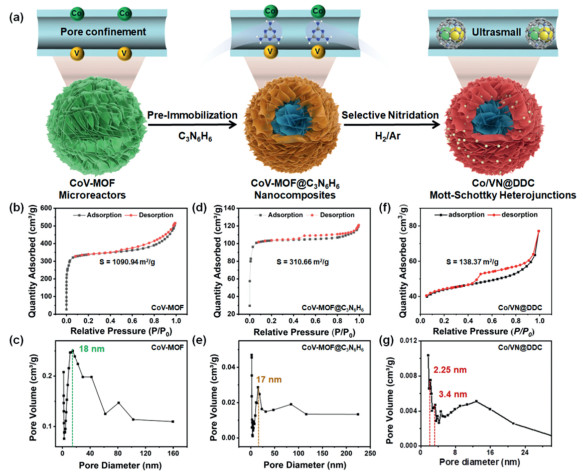
The ultrasmall Co/VN@DDC Mott-Schottky heterojunctions are facilely synthesized through a sequential pre-immobilization and selective nitridation strategy from CoV-MOF microreactors (Fig. 1a). Note that bimetallic CoV-MOF was meticulously prepared through a room-temperature self-assembly process. In this process, deionized water along with Co(NO3)2·6H2O, NH4VO3, and 2-methylimidazole (2-MeIm) were employed as starting materials [11]. Initially, melamine (C3N6H6) was pre-immobilized into the mesoporous cavities of CoV-MOF using a vacuum-assisted impregnation method, resulting in the formation of CoV-MOF@C3N6H6 nanocomposites (Figs. S1 and S2 in Supporting information). The nitrogen adsorption-desorption isotherm of CoV-MOF@C3N6H6 resembled that of CoV-MOF, yet displayed a reduced BET surface area from 1094.94 to 310.66 m2/g (Figs. 1b and d). The pore size of CoV-MOF@C3N6H6 slightly decreased from 18 nm to 17 nm, further confirming that C3N6H6 is filled in the pores of CoV-MOF, and maintains the CoV-MOF structure (Figs. 1c and e) [12,13]. Following this, the CoV-MOF@C3N6H6 nanohybrids were pyrolyzed in a flowing H2/Ar atmosphere, yielding Mott-Schottky-type Co/VN@DDC heterojunctions. The BET surface area of Co/VN@DDC heterojunctions was measured as 138.37 m2/g with pore-size distributions around 2.25 and 3.4 nm (Figs. 1f and g, Fig. S3 in Supporting information). Note that VN has a formation enthalpy of −217 kJ/mol, while cobalt nitride is −41 kJ/mol. A more negative formation enthalpy indicates greater thermodynamic stability and likelihood of spontaneous formation. Under a fixed total nitrogen source in the pores, nitrogen preferentially combines with V atoms to form VN rather than cobalt nitride, triggering the formation of Co/VN phases. This innovative approach not only eliminates reliance on traditional ammonia sources, but also provides a versatile approach towards eco-friendly and sustainable nitride preparation.
Figure 1
Figure 1.
(a) A schematic illustration of the synthesis process for Co/VN@DDC Mott-Schottky heterojunctions from CoV-MOF microreactors. (b, d, f) N2 adsorption-desorption isotherms and (c, e, g) corresponding pore size distribution plots of CoV-MOF, CoV-MOF@C3N6H6, and Co/VN@DDC.
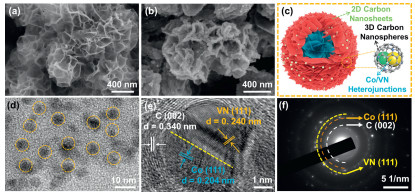
As shown in the scanning electron microscopy (SEM) images of Fig. 2a and Fig. S4 (Supporting information), CoV-MOF and CoV-MOF@C3N6H6 precursors both display a nanoflower-like 3D architecture consisting of interconnected 2D nanosheets and abundant voids. After selective nitridation, the resultant Co/VN@DDC well preserves the initial nanoflower morphology along with the formation of numerous nanoparticles on the surface (Figs. 2b and c). The transmission electron microscopy (TEM) images reveal the presence of ultrafine nanoparticles embedded within the carbon matrix, with an average diameter of approximately 5 nm (Fig. 2d and Fig. S5 in Supporting information). This size is significantly larger than the atomic scale of isolated cobalt atoms, thereby definitively excluding the formation of isolated single-atom Co. The reduced particle size promotes greater accessibility to active sites, facilitating faster charge transfer at the electrode interface and thereby improving the overall reaction efficiency. The high-resolution TEM (HRTEM) image in Fig. 2e highlights the well-organized core-shell structure of Co/VN@DDC with distinct three-phase heterointerfaces. Measured lattice fringes of 0.240, 0.204, and 0.34 nm are assigned to the (111) plane of VN, the (111) plane of metallic Co, and the (002) plane of graphitic carbon, respectively. The elemental mapping analysis of Fig. S6 (Supporting information) verifies the homogeneous dispersion of Co, V, C, and N elements throughout the Co/VN@DDC architecture. Meanwhile, the selected area electron diffraction (SAED) pattern in Fig. 2f exhibits clear concentric rings, corresponding to the (111), (111), and (002) crystallographic planes of Co, VN, and carbon in Co/VN@DDC heterostructures. For comparison, single-component Co@DDC and VN@DDC were also synthesized via the same method as that used for Co/VN@DDC.
Figure 2
Figure 2.
The SEM images of (a) CoV-MOF@C3N6H6, and (b) Co/VN@DDC. (c) The structural schematic, (d) TEM, (e) HRTEM, and (f) SAED images of Co/VN@DDC heterojunctions.
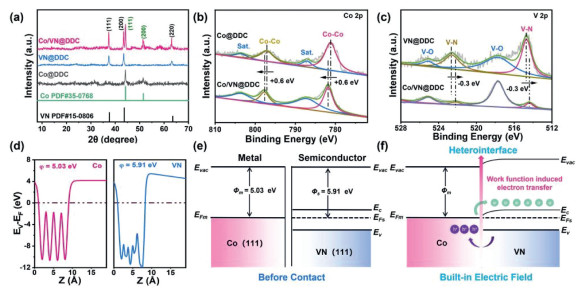
The XRD patterns of Co@DDC, VN@DDC, and Co/VN@DDC present their phase composition (Fig. 3a and Fig. S7 in Supporting information). Notably, the two distinct diffraction peaks at 44.2° and 51.5° in both Co/VN@DDC and Co@DDC align precisely with the (111) and (200) planes of Co (PDF #15-0806), respectively [14]. Conversely, in the cases of both Co/VN@DDC and VN@DDC samples, three characteristic peaks at 37.6°, 43.7°, and 63.5° correspond to the (111), (200), and (220) facets of VN (PDF #35-0768) [15]. Additionally, a prominent peak centered at 26.2° is attributed to the (002) facets of graphitic carbon, indicating the successful integration of Co and VN within the carbon protective shell (Fig. S8 in Supporting information) [16,17]. X-ray photoelectron spectroscopy (XPS) analysis was utilized to verify the chemical bonding environments of Co@DDC, VN@DDC, and Co/VN@DDC. Regarding the C 1s spectrum for Co/VN@DDC, three clearly defined peaks at 284.8, 286.6, and 288.2 eV correspond to C–C, C–N, and C═O bonding configurations, respectively (Fig. S9 in Supporting information). The C 1s spectra of VN@DDC and Co@DDC show analogous peaks to those of Co/VN@DDC, indicating a similar bonding environment for the three samples. The N 1s region of Co/VN@DDC reveals four distinct peaks at 396.9, 398.7, 399.8, and 401.7 eV. These peaks are considered to originate from the V-N, pyridinic-N, pyrrolic-N, and graphitic-N bonds, respectively (Fig. S10 in Supporting information) [18]. The core level region of Co shows the typical satellite peaks as shown in Fig. 3b, where the peaks at 781.8 and 797.7 eV can be assigned to the Co-Co bond, while the peaks at 787.1 and 803.5 eV are identified as satellite peaks [19]. Notably, when compared to that of Co@DDC, the Co 2p peaks in Co/VN@DDC underwent an upshift of approximately 0.6 eV, implying the electronic modulation of Co due to the interaction with VN. From the V 2p spectrum of Co/VN@DDC presented in Fig. 3c, a series of peaks centered at 514.4 and 522.2 eV indicate the formation of V-N bonding, while the peaks at 517.7 and 525.1 eV are attributed to V-O bonds. Interestingly, the binding energy of V 2p in VN@DDC displays a negative shift of ~0.3 eV relative to that in Co/VN@DDC. Such a dramatic shift highlights the strong electron interaction between Co and VN at the Co/VN heterointerface. Meanwhile, the work functions of VN and Co are 5.03 and 5.91 eV, respectively (Fig. 3d). The higher work function of VN compared to Co will induce a built-in electric field and drive electrons to move from Co to VN at the Co-VN Mott-Schottky heterointerfaces (Figs. 3e and f) [20]. According to the theoretical calculation results, the valence band maximum (Ev) and conduction band minimum (Ec) of VN are determined to be −1.89 and 1.88 eV relative to the Fermi level (EFS), respectively. The distinct non-zero band gap (Eg ≈ 3.77 eV) between Ev and Ec in the spin-down channel confirms the typical semiconducting feature of VN. Furthermore, the charge density difference map reveals a transfer of 2.86 e- from Co to VN, leading to electron accumulation on VN and electron deficiency on Co (Fig. S11 in Supporting information). Consequently, this oriented electron transfer optimizes interface charge-transfer kinetics involved in the HER, ultimately leading to improved efficiency of the overall electrocatalytic process.
Figure 3
Figure 3.
(a) XRD patterns of Co/VN@DDC, Co@DDC, and VN@DDC. XPS spectra of (b) Co 2p for Co/VN@DDC and Co@DDC, and (c) V 2p for Co/VN@DDC and VN@DDC. (d) Electrostatic potential profiles of Co (111) and VN (111) surfaces, and both profiles are plotted relative to the corresponding Fermi levels. (e, f) The energy band diagrams for Co (111) and VN (111) semiconductor before and after contact.
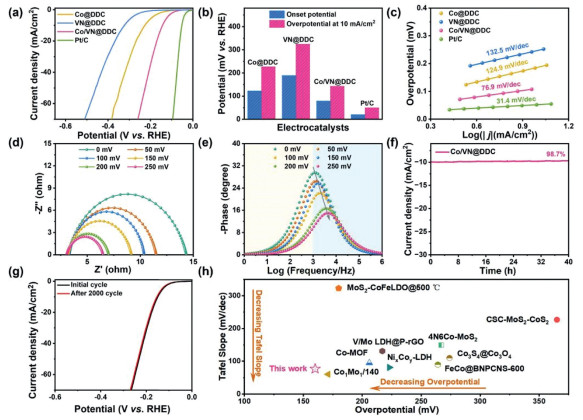
The pH-universal HER activities of Co@DDC, VN@DDC, and Co/VN@DDC were assessed by employing a three-electrode electrochemical apparatus [21,22]. As depicted in the linear sweep voltammetry (LSV) curves of Fig. 4a, Co/VN@DDC exhibits an onset potential of 79 mV, which is significantly lower than that of 123 and 189 mV for Co@DDC and VN@DDC, respectively (Fig. 4b and Fig. S12 in Supporting information). The Tafel slope for Co/VN@DDC is determined to be 76.9 mV/dec, suggesting that it operates through the Volmer-Heyrovsky mechanism with the dissociation of H2O being the rate-determining step (Fig. 4c). In contrast, the Tafel slopes of VN@DDC (132.5 mV/dec) and Co@DDC (124.9 mV/dec) are relatively higher, indicating slower kinetics mainly dominated by the Volmer process. Electrochemical impedance spectroscopy (EIS) data were used to generate fitted Bode plots exhibiting distinct phase angle profiles (Figs. 4d and e). For Co/VN@DDC, the Bode plot can be separated into high-frequency and low-frequency domains. As the applied potential rises, a notable decrease in phase angle is evident in the high-frequency region. This behavior implies that electron transport through the inner layers or interfacial regions is more rapid compared to the catalyst-electrolyte boundary [23]. Furthermore, the movement of the phase angle peak toward higher frequencies with increasing potential reflects a shortened response time for the HER, disclosing enhanced catalytic efficiency [24]. Moreover, the double-layer capacitance (Cdl) value for Co/VN@DDC is 16.2 mF/cm2, which is higher than that of Co@DDC (6.9 mF/cm2) and VN@DDC (2.8 mF/cm2) (Figs. S13 and S14 in Supporting information) [25]. This result suggests that Co/VN@DDC exhibits the greatest electrochemically active surface area compared to the other two samples, which can maximize catalytic site exposure and facilitate the mass transfer, thus reducing the energy barrier for hydrogen evolution. In addition, a long-term chronoamperometric test was carried out under a constant overpotential of 143 mV for Co/VN@DDC. As illustrated in Fig. 4f, the Co/VN@DDC electrode preserves 98.7% of its initial current density even after 40 h of continuous water electrolysis, with only slight decay detected during the long-term operation. The electrocatalytic durability of Co/VN@DDC was evaluated by comparing the LSV curves recorded before and after 2000 cyclic voltammetry cycles. Note that there is almost no activity degradation compared to the pre-cycling period (Fig. 4g) [26]. It is conclusive that Co/VN@DDC heterojunctions possess remarkable alkaline HER activity that surpasses most transition metal-based electrocatalysts recently reported (Fig. 4h and Fig. S15 in Supporting information).
Figure 4
Figure 4.
HER performance in 1.0 mol/L KOH solution: (a) LSV curves, (b) overpotentials required to achieve 10 mA/cm2, (c) Tafel slopes, (d) EIS Nyquist plots, and (e) Bode phase diagrams of Co/VN@DDC measured at various overpotentials ranging from 0 to 250 mV. (f) Chronoamperometric i-t curve and (g) polarization profiles before and after 2000 accelerated cycling tests for Co/VN@DDC. (h) Performance comparison of the HER activity between Co/VN@DDC and other transition metal-based nanomaterials.
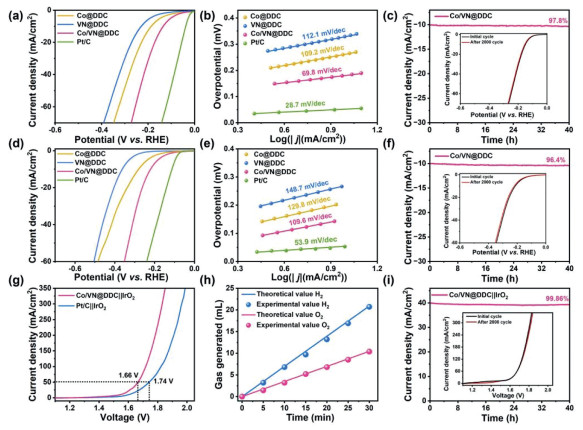
The pH-universal HER performance of Co/VN@DDC was subsequently evaluated in both acidic and neutral media. As depicted in Fig. 5a, Co/VN@DDC exhibited relatively low onset potential and overpotential of 62 and 136 mV at 10 mA/cm2 under acidic conditions (Fig. S16 in Supporting information). Notably, the Co/VN@DDC exhibits a Tafel slope of 69.8 mV/dec, which was much smaller than that of Co@DDC (109.2 mV/dec) and VN@DDC (112.1 mV/dec), as presented in Fig. 5b. Co/VN@DDC also exhibits excellent HER performance in a neutral 1.0 mol/L PBS electrolyte, achieving a current density of 10 mA/cm2 at an overpotential of 200 mV and a Tafel slope of 109.6 mV/dec (Figs. 5d and e, Fig. S17 in Supporting information). Such superiority is further validated by the much higher durability of Co/VN@DDC in both acidic and neutral solutions. As shown in Figs. 5c and f, the Co/VN@DDC electrode retains 97.8% and 96.4% of its initial current density after prolonged continuous operation in acidic and neutral PBS electrolytes, respectively. Such impressive long-term durability can be attributed to the dual-dimensional carbon shells and robust heterointerfaces, which effectively suppress the dissolution and aggregation of active species during the electrocatalytic process [27]. Table S1 (Supporting information) offers a comprehensive comparison of Co/VN@DDC’s η10 and Tafel slope values against those of recently reported Co-based catalysts across acidic, neutral, and alkaline electrolytes. Consequently, Co/VN@DDC stands out as a highly promising candidate for pH-universal HER applications, as it delivers not only exceptional catalytic activity but also robust long-term operational stability.
Figure 5
Figure 5.
HER performance in 0.5 mol/L H2SO4 and 1.0 mol/L PBS solutions: (a, d) LSV curves and (b, e) Tafel slopes of Co@DDC, VN@DDC, and Co/VN@DDC. (c, f) Chronoamperometric i-t curves for Co/VN@DDC, with insets showing polarization curves before and after 2000 cycling cycles. Overall water splitting performance: (g) LSV curves, (h) comparison of experimentally measured and theoretically calculated amounts of H2 and O2 produced, and (i) chronoamperometric i-t curve for overall water splitting using Co/VN@DDC|||IrO2 two-electrode system, with an inset showing polarization curves before and after 2000 cycling cycles.
Motivated by the excellent HER performance of Co/VN@DDC, the overall water electrolysis test was conducted by pairing the Co/VN@DDC cathode with a IrO2 anode in 1.0 mol/L KOH solution [28,29]. As depicted in Fig. 5g, the Co/VN@DDC||IrO2 electrolyzer achieves a current density of 50 mA/cm2 at a cell voltage of 1.66 V, outperforming the conventional Pt/C||IrO2 system. At this operating condition (j = 50 mA/cm2), the system generates approximately 20.7 mL of H2 and 10.5 mL of O2. This corresponds to a Faradaic efficiency of nearly 99.1% for HER and 99.3% for OER (Fig. 5h). Furthermore, the device maintains 99.86% of its initial current density after 40 h of continuous operation at 40 mA/cm2, demonstrating its outstanding long-term stability (Fig. 5i). Post-stability characterizations including SEM, TEM, and XRD were conducted on the Co/VN@DDC electrode. The SEM image revealed that the nanostructure of Co/VN@DDC remained well with no evident structural collapse observed (Fig. S18 in Supporting information). Meanwhile, the uniform distribution of Co/VN nanoparticles within the carbon matrix was well-preserved, although some slight unavoidable agglomeration occurred (Fig. S19 in Supporting information). Co/VN@DDC after stability test toward HER showed no phase structure changes, indicating that Co/VN@DDC has excellent structural stability during the HER process (Fig. S20 in Supporting information). This suggests that the interaction between Co/VN and carbon shells effectively prevents the activity degradation during prolonged operation. Meanwhile, the unique Mott-Schottky heterojunction enhances the HER activity by facilitating charge transfer [30].
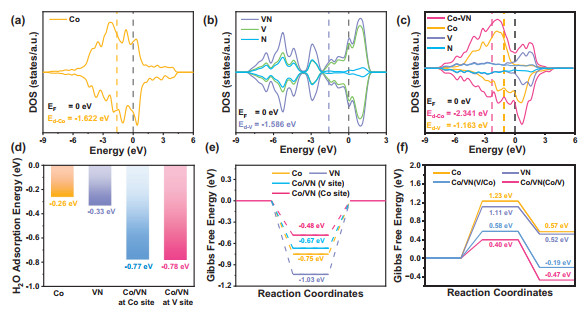
Density functional theory (DFT) calculations were conducted to investigate the interface interaction between Co and VN, aiming to uncover the origin of pH-universal HER activity [31]. Firstly, the structure models of Co (111), VN (111), and Co(111)/VN(111) heterojunctions were constructed to accurately simulate the phase structures based on observed facets from HRTEM. Based on the widely accepted d-band center theory, a moderate regulation of the d-band center position can optimize the adsorption strength of reaction intermediates to a thermodynamically favorable level, thus effectively accelerating the reaction kinetics [32]. As depicted in Figs. 6a and b, the d-band centers of bare Co and VN are calculated to be −1.622 and −1.586 eV, respectively, which lead to excessively strong adsorption toward H* intermediates. Notably, the d-band center of V sites in the Co/VN heterojunction is regulated to −1.163 eV, which is moderately closer to the Fermi level compared with pristine VN (Fig. 6c). Such electronic modulation induced by the Mott-Schottky heterointerface effectively weakens the excessively strong H* adsorption of VN, thereby achieving the optimal H* adsorption energy for hydrogen evolution. This finding strongly confirms that there is a directional transfer of d-orbital electrons from Co to VN at the Mott-Schottky interface [33]. As shown in Fig. 6d, Co/VN heterojunctions show an H2O adsorption energy of −0.78 eV, which is stronger than that of Co (−0.26 eV) and VN (−0.33 eV). The optimized water adsorption of Co/VN heterojunctions is favorable for the subsequent water dissociation [34]. Fig. 6e compares the ΔGH* values for the Co(111)-H, VN(111)-H, and Co(111)/VN(111)-H systems. The calculated ΔGH* values for the Co and VN models are −0.75 and −1.03 eV, respectively, indicating strong hydrogen binding on these sites. Such strong binding results in difficult desorption, which could hinder the subsequent release of H2. In contrast, the optimal ΔGH* values for Co and V sites in the Co/VN heterojunction are −0.48 and −0.67 eV. The decreased ΔGH* suggests that coupling Co with VN optimizes the binding strength of hydrogen, thus favoring the following conversion of H* to H2 at both active sites on the interface [35].
Figure 6
Figure 6.
(a-c) Total density states of Co, VN, and Co/VN. Free energies about (d) H2O adsorption, (e) H adsorption, and (f) H2O dissociation of Co, VN, Co/VN at V site, and Co/VN at Co site.
As shown in Fig. 6f, the energy barriers for water dissociation on the surface of Co(111) and VN(111) were deduced to be 1.23 and 1.11 eV, respectively, indicating sluggish water dissociation with limited catalytic efficiency. In contrast, this reaction barrier only needs 0.40 eV at the Co(111)/VN(111) interface, suggesting that Co promotes the water dissociation step on VN. This reduced barrier is comparable to that of the Pt surface (0.56 eV), demonstrating that the incorporated Co acts as an effective promoter for water dissociation [36]. Specifically, the interfacial Co sites dramatically lower the energy barrier of the Volmer step to 0.40 eV. In contrast, VN demonstrates a greater preference for the Heyrovsky step, exhibiting a barrier of -0.47 eV. By integrating these two active components within the Co/VN structure, the energy barriers associated with both reaction steps are markedly reduced. Figs. S21-S23 (Supporting information) illustrate the process of H2O adsorption, dissociation, and hydrogen generation on Co, VN, and Co-VN models. Thus, we can firmly conclude that the Co/VN heterojunction exhibits optimal reaction energies for water dissociation and hydrogen evolution, greatly enhancing the HER activity [37].
In conclusion, this work utilized CoV-MOF microreactors as precursors to fabricate Mott-Schottky-type Co/VN heterojunctions embedded in dual-dimensional N-doped carbon for pH-universal HER. This innovative approach differs notably from previous methods, which heavily rely on highly corrosive ammonia gas as the nitrogen source. By contrast, our strategy involves pre-encapsulating melamine into the pore structure of CoV-MOF, followed by selective nitridation to fabricate Co/VN@DDC with intimate heterointerfaces. The as-made Co/VN@DDC heterojunctions achieve relatively low overpotentials and high cycling stability in acidic, alkaline, and neutral electrolytes, respectively. Theoretical calculation suggests that the direct migration of d-orbital electrons from Co to VN at the Mott-Schottky interface may modify the electronic configuration, thereby facilitating hydrogen adsorption and desorption processes. This work offers not only deep insights into the design of Mott-Schottky heterojunction electrocatalysts but also presents an eco-friendly approach for the sustainable synthesis of nitrides.
This work was supported by National Natural Science Foundation of China (Nos. 22501102, 22275210), Natural Science Foundation of Shandong Province (No. ZR2024QB025), and Jinan University Excellent Master’s Innovation Program Project (No. 2025ZYSS15).
Supplementary materials
Supplementary material associated with this article can be found, in the online version, at doi:10.1016/j.cclet.2026.112806.
H.W. Ren, J.M. Zhang, T.J. Hu, et al., Green Chem. 27 (2025) 10711. doi: 10.1039/d5gc02244d
[37]
J.X. Tang, N. Tian, C. Xiao, et al., Inorg. Chem. Front. 12 (2025) 7548. doi: 10.1039/d5qi01247c
Figure 1
(a) A schematic illustration of the synthesis process for Co/VN@DDC Mott-Schottky heterojunctions from CoV-MOF microreactors. (b, d, f) N2 adsorption-desorption isotherms and (c, e, g) corresponding pore size distribution plots of CoV-MOF, CoV-MOF@C3N6H6, and Co/VN@DDC.
Figure 2
The SEM images of (a) CoV-MOF@C3N6H6, and (b) Co/VN@DDC. (c) The structural schematic, (d) TEM, (e) HRTEM, and (f) SAED images of Co/VN@DDC heterojunctions.
Figure 3
(a) XRD patterns of Co/VN@DDC, Co@DDC, and VN@DDC. XPS spectra of (b) Co 2p for Co/VN@DDC and Co@DDC, and (c) V 2p for Co/VN@DDC and VN@DDC. (d) Electrostatic potential profiles of Co (111) and VN (111) surfaces, and both profiles are plotted relative to the corresponding Fermi levels. (e, f) The energy band diagrams for Co (111) and VN (111) semiconductor before and after contact.
Figure 4
HER performance in 1.0 mol/L KOH solution: (a) LSV curves, (b) overpotentials required to achieve 10 mA/cm2, (c) Tafel slopes, (d) EIS Nyquist plots, and (e) Bode phase diagrams of Co/VN@DDC measured at various overpotentials ranging from 0 to 250 mV. (f) Chronoamperometric i-t curve and (g) polarization profiles before and after 2000 accelerated cycling tests for Co/VN@DDC. (h) Performance comparison of the HER activity between Co/VN@DDC and other transition metal-based nanomaterials.
Figure 5
HER performance in 0.5 mol/L H2SO4 and 1.0 mol/L PBS solutions: (a, d) LSV curves and (b, e) Tafel slopes of Co@DDC, VN@DDC, and Co/VN@DDC. (c, f) Chronoamperometric i-t curves for Co/VN@DDC, with insets showing polarization curves before and after 2000 cycling cycles. Overall water splitting performance: (g) LSV curves, (h) comparison of experimentally measured and theoretically calculated amounts of H2 and O2 produced, and (i) chronoamperometric i-t curve for overall water splitting using Co/VN@DDC|||IrO2 two-electrode system, with an inset showing polarization curves before and after 2000 cycling cycles.
Figure 6
(a-c) Total density states of Co, VN, and Co/VN. Free energies about (d) H2O adsorption, (e) H adsorption, and (f) H2O dissociation of Co, VN, Co/VN at V site, and Co/VN at Co site.


 DownLoad:

 下载:


 下载:

