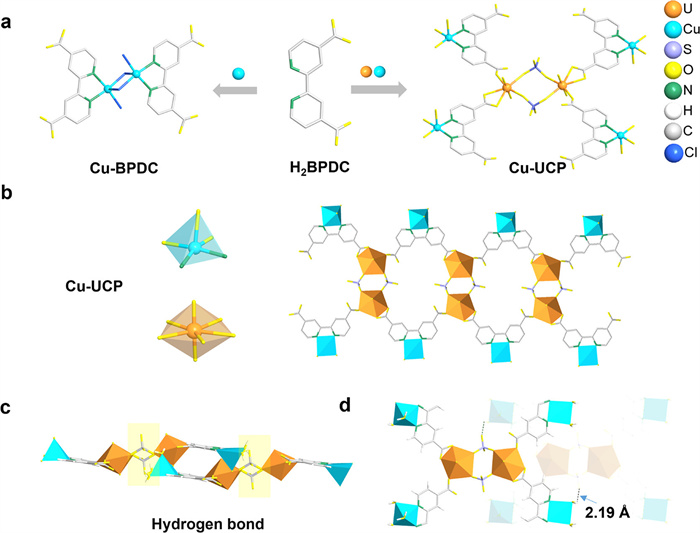
Figure 1.
(a) Diagram of the synthesis process for Cu-BPDC and Cu-UCP. (b) Oblique and side views of the 1D Cu-UCP chain. (c, d) Side view of 2D stair-like layers of the Cu-UCP.

Engineering uranyl sites into Cu-based metal coordination polymer for solar-driven hydrogen peroxide production
Lisha Jiang , Mengnan Yuan , Peixin Yang , Erpeng Wang , Yunhe You , Yicen Liu , Zhenyu Li , Wei Liu , Xiufang He , Juanshan Du , Yi Hu , Wanqian Guo


Hydrogen peroxide (H2O2) is a highly versatile and environmentally benign compound, widely used in applications such as chemical synthesis, medical disinfection, biological sterilization, and environmental remediation [1-3]. Despite its usefulness, the industrial production of H2O2 relies primarily on the anthraquinone (AQ) oxidation process [4]. While this method is efficient, it has significant drawbacks, including the generation of large amounts of organic solvents and by-products. These by-products not only increase the production costs but also introduce environmental concerns and complex purification requirements. As such, there is an urgent need for more sustainable, cost-effective, and environmentally friendly methods for H2O2 production. Photocatalytic technology, which harnesses sunlight to activate photocatalysts that drive the mild reaction between water (H2O) and oxygen (O2) to produce H2O2, offers a promising alternative from our previous review [5-7]. This process is green, non-polluting, and energy-efficient, positioning it as a viable solution for solar-powered H2O2 production.
Traditional photocatalysts, including carbon nitride, metal oxides, and sulfides, have been widely studied for this purpose [8,9]. However, these materials have inherent limitations, such as small surface areas, low porosity, and a limited number of active sites. These factors hinder their ability to efficiently absorb light and facilitate photocatalytic reactions. Moreover, the photocatalytic efficiency is further hindered by rapid H2O2 decomposition on the catalyst surface, particularly on titanium dioxide (TiO2) where exposed titanium sites can lead to recombination of photogenerated charge carriers [10]. This rapid recombination effectively lowers the overall photocatalytic performance, making it difficult to achieve high yields of H2O2 under mild conditions. As a result, there is a need to explore new materials with improved photocatalytic properties, particularly those that can enhance light absorption and reduce charge carrier recombination.
Metal coordination polymers (MCPs) are regarded as promising material for overcoming these limitations. MCPs are constructed from metal ions or clusters coordinated with organic ligands, resulting in one-dimensional, two-dimensional, or three-dimensional frameworks [11,12]. These polymers combine the advantages of both inorganic and organic materials, such as large specific surface areas, diverse pore structures, and tunable properties. Due to these characteristics, MCPs are well-suited for a wide range of applications, including energy conversion, sensing, catalysis, and even drug delivery [13]. In the context of photocatalytic H2O2 synthesis, MCPs serve as promising candidates for optimizing production efficiency through enhanced charge separation and tunable light-harvesting capabilities. However, monometallic MCPs predominantly comprising single transition metal nodes interconnected by structurally simple organic linkers-exhibit pronounced electron-hole recombination, a critical limitation that restricts their photocatalytic performance [14].
Recent progress in MCPs has centered on the incorporation of more complex metal centers or the introduction of multiple metal ions within a single framework. Such modifications can profoundly influence the electronic structure of the material, thereby enhancing its photocatalytic performance [15,16]. For instance, Tang et al. demonstrated that substituting the Cu node in Cu-CTU with Ag or Au significantly improved the photocatalytic generation of H2O2 [17]. This finding underscores the potential of heterometallic strategies to modulate the electronic configuration of MCPs, promoting more effective charge separation and improved photocatalytic efficiency. Despite these advances, Cu-based coordination polymers generally suffer from limited light absorption and inefficient charge separation, resulting in relatively low H2O2 production efficiencies. Notably, bimetallic catalysts often exhibit superior activity across various catalytic processes, attributed to the synergistic interplay between distinct metal sites [18]. This synergistic effect enhances catalytic performance by modulating the local electronic structure, optimizing the coordination environment, and facilitating beneficial interactions between the two metal atoms [19]. Lei et al. find the distinct role separation within the heterobimetallic MCPs: Cu(Ⅰ) species function as the active sites for photocatalysis, while the secondary coordination of Zr(Ⅳ)/Hf(Ⅳ) is crucial for conferring high framework stability [20]. Hu et al. demonstrate an enhanced photocatalytic performance in Cu-NH2-MIL-125, which they attribute to a synergistic effect that extends light absorption via the Cu d-d transition and improves charge separation [21]. Nevertheless, the rational selection of compatible metal ions and precise control over their spatial distribution within the framework continue to present significant synthetic and design challenges.
Uranium (U), a naturally occurring element, offers a promising opportunity to enhance the photocatalytic activity of MCPs. UO22+ is one of the most prevalent forms of uranium in nature, due to the strong U=O double bonds present in its structure. These bonds give the UO22+ unique light-absorbing properties, particularly in the UV–visible range [22,23]. When photoexcited, the uranyl ion forms an excited-state species (*UO22+), which is highly oxidizing (E0 = 2.6 V). This excited-state uranyl ion can facilitate a range of photocatalytic reactions. As a photocatalyst, the UO22+ can be activated through a ligand-to-metal charge transfer (LMCT) process, in which electrons from the O 2p orbitals of the O=U=O structure are transferred to the U 5f orbitals [24,25]. This electron transfer promotes the excitation of the system, leading to the formation of highly reactive species that can drive photocatalytic reactions. The LMCT-induced photosensitivity of UO22+ significantly enhances its potential for photocatalysis, particularly in reactions like H2O2 production. UO22+-based photocatalysts, while possessing strong oxidative characteristics, often lack a structurally integrated framework that can effectively coordinate charge transport and catalytic site accessibility. The incorporation of UO22+ as an active site within MCPs has been demonstrated to markedly enhance their photocatalytic performance. Through precise control over the integration of UO22+ into the framework, more efficient and robust catalysts for solar-driven H2O2 production can be realized [26]. This strategy presents new opportunities for the rational design of MCPs with improved photocatalytic activity. Nonetheless, further investigation is required to elucidate the individual roles of each metal component in bimetallic systems and to understand the nature of their synergistic interactions in optimizing photocatalytic efficiency.
Herein, a copper-based metal coordination polymer (Cu-BPDC) with inherently low photocatalytic activity for H2O2 production, as previously reported [27], was employed as the baseline material. Upon incorporation of UO22+, a copper/uranyl bimetallic coordination polymer (Cu-UCP) was constructed, exhibiting semiconducting characteristics. The introduction of UO22+ enhanced the photoresponse and photocatalytic efficiency of the material, effectively promoting both the ORR and WOR. Furthermore, the strong oxidizing nature of UO22+ not only facilitated WOR but also enabled efficient hydrogen abstraction from organic substrates. This work provides mechanistic insights into the improved solar-driven H2O2 production of Cu-UCP and presents a promising strategy for the rational design of advanced photocatalytic systems.
The structure of Cu-BPDC, illustrated in Fig. S1 (Supporting information), consists of an asymmetric unit containing a chloride-bridged Cu(Ⅱ) dimer coordinated with a protonated H2BPDC ligand (Fig. S1a). The copper center adopts a square pyramidal geometry, with the equatorial positions occupied by two nitrogen atoms from the H2BPDC, a bridging chloride, and a monodentate chloride atom, while the apical position is occupied by another bridging chloride. Carboxylic acid interactions link these units into continuous one-dimensional chains (Fig. S1b). Additionally, adjacent H2BPDC ligands are connected by double hydrogen bonds, forming a stepped two-dimensional sheet.
The Cu-UCP structure crystallizes in the triclinic P1 space group, with an asymmetric unit comprising a UO22+, Cu2+, BPDC2- ligand, a sulfate anion, alongside three coordinated water molecules and an additional pair of guest water molecules (Fig. 1a). The uranium center adopts a pentagonal bipyramidal geometry, coordinated by five ligands: Two axial oxygen atoms from the uranyl group, three oxygen atoms from BPDC2- ligands, and two oxygen atoms from sulfate ions (SO42-). Each BPDC2- ligand bridges two uranyl centers through carboxylate groups and one Cu2+ center via bipyridine nitrogen atoms, forming a one-dimensional chain. SO42- further link adjacent uranyl centers, generating a secondary one-dimensional chain (Fig. 1b). These chains assemble through U=O-Cu cation-cation interactions, forming a stair-like two-dimensional layered structure (Fig. 1c). The planar configuration in Fig. 1d highlights the connectivity between the ions, where each UO22+ unit is linked to two S atoms and two Cu2+, forming a four-connected node that defines the 2D layered architecture. The experimental and simulated XRD patterns for Cu-BPDC and Cu-UCP are shown in Fig. S2 (Supporting information) and Fig. 2a, respectively. The close alignment between the experimental and simulated diffraction peaks confirms that the synthesized materials match those described in earlier studies [27,28].
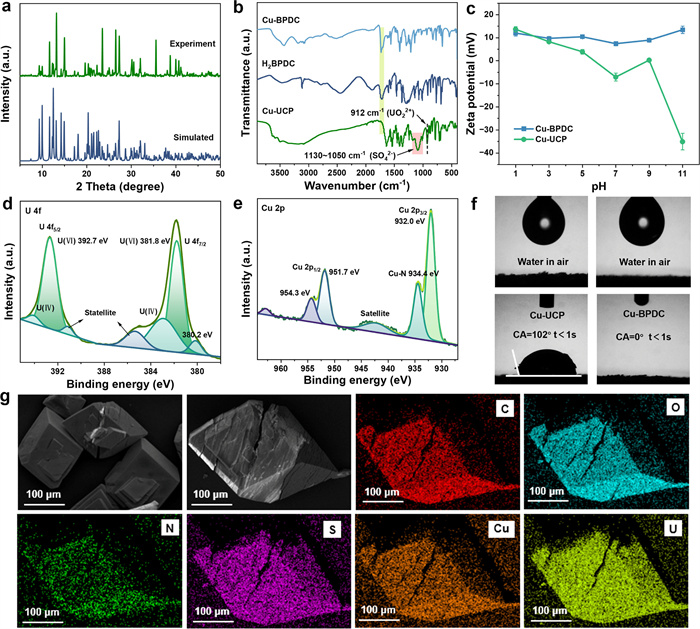
The uniform distribution of C, O, N, Cl, and Cu in Cu-BPDC throughout the material can also be observed from the EDS elemental mapping (Figs. S3a-f in Supporting information). The FTIR spectrum of Cu-UCP (Fig. 2b) shows intense absorption bands at 1630 and 1340 cm−1, corresponding to carboxyl group asymmetric/symmetric stretching vibrations and pyridine ring characteristic absorptions [29]. Notably, Cu-UCP lacks the FTIR characteristic absorption band at 1730–1690 cm−1 observed in Cu-BPDC and H2BPDC, indicating that the carboxylic acid group is fully coordinated to the metal center. The absorption bands near 1130–1050 cm−1 confirm the presence of SO42-, while the peaks at 912 and 810 cm−1 correspond to the asymmetric and symmetric stretching vibrations of O-U=O [30,31]. These FTIR results align with the single-crystal structural analysis. For photocatalyst, the higher absolute value of Zeta potential indicates the stronger proton adsorption ability (Fig. 2c) [32]. Obviously, the absolute value of zeta potential of Cu-UCP is higher than that of Cu-BPDC, which proves that the uranyl bimetallic structure has stronger proton extraction ability. However, although Cu-UCP exhibits a higher zeta potential under strongly alkaline conditions (e.g., pH 11), its coordination bonds and uranyl-ligand linkages undergo partial hydrolysis and framework degradation, thus necessitating photocatalytic experiments to be conducted under milder pH conditions to preserve structural integrity and ensure a fair performance comparison.
The XPS survey scan results (Fig. S4a in Supporting information) demonstrate that the synthesized Cu-BPDC and Cu-UCP materials contain C, O, N, Cu, Cl, and S as constituent elements. Notably, the Cu-UCP sample exhibits additional characteristic peaks corresponding to U. The high-resolution C 1s XPS spectrum of Cu-UCP (Fig. S4b in Supporting information) reveals three peaks corresponding to C-C (284.8 eV), C-O/C-N (286.1 eV), and C=O (288.2 eV) [33]. The O 1s XPS spectra (Fig. S4c in Supporting information) of both H2BPDC and Cu-BPDC are decomposed into two peaks at 531.3 eV (C=O) and 532.7 eV (C-O/O-H) for H2BPDC, while for Cu-BPDC, these peaks shift to 531.7 and 533.1 eV, respectively. The O 1s spectrum of Cu-UCP, however, contains four peaks at 529.9, 531.2, 532.3, and 533.2 eV, corresponding to U-O/Cu-O, C=O/U=O, S-O, and C-O/O-H bonds, respectively [34,35]. The N 1s spectra of H2BPDC, Cu-BPDC, and Cu-UCP (Fig. S4d in Supporting information) show peaks at 398.9 eV (pyridine N) and 400.0 eV (C-N). In Cu-BPDC and Cu-UCP, N is coordinated with Cu, as indicated by Cu-N peaks at 399.5 and 399.3 eV, respectively [36]. Notably, the N 1s peak in Cu-UCP shifts to a higher binding energy, reflecting the involvement of nitrogen in coordination with the metal during the reaction [37]. The U 4f XPS spectrum (Fig. 2d) shows characteristic peaks at 392.7 and 381.8 eV, corresponding to the U 4f5/2 and U 4f7/2 states, confirming the U(Ⅵ) oxidation state [38]. In the Cu 2p XPS spectrum (Fig. 2e), the Cu 2p3/2 peak is located at 932.0 eV, with additional peaks at 951.7 and 954.3 eV, attributed to Cu 2p1/2. The satellite peaks and the Cu-N peak at 934.4 and 942.4 eV further corroborate the coordination of Cu in the Cu-UCP structure [39,40].
As illustrated in Fig. S5 (Supporting information), Cu-UCP exhibits a significantly larger CO2 uptake capacity than Cu-BPDC across the entire pressure range, indicating a more developed porous structure after the incorporation of uranyl sites. The BET surface area of Cu-UCP is 25.43 m2/g, which is higher than that of Cu-BPDC (4.31 m2/g). This enhancement clearly demonstrates that uranyl coordination induces structural expansion and generates additional accessible channels or voids within the framework. This can provide more exposed active sites and facilitates efficient mass transport of O2 and H2O molecules, which are crucial for the ORR and WOR half-reactions.
From the water contact angles measurement, Cu-UCP displayed a hydrophobic surface with a contact angle of 102°, while Cu-BPDC was hydrophilic, absorbing water immediately upon contact (Fig. 2f). In photocatalytic H2O2 production experiments, the hydrophobic surface of Cu-UCP facilitated the adsorption of nonpolar O2 molecules, increasing their concentration on the photocatalyst surface and promoting a higher diffusion rate [41]. The SEM images of Cu-UCP and Cu-BPDC show that both exhibit a massive polyhedral single crystal morphology. The EDS mapping of Cu-UCP confirms the uniform distribution of C, O, N, S, Cu, and U elements throughout the material (Fig. 2g). Stability is a critical factor in assessing photocatalyst performance.
Thermo-gravimetric analysis (TGA) under inert gas conditions demonstrated that Cu-UCP exhibits excellent thermal stability (Fig. S6 in Supporting information). The first loss of weight at temperatures below 150 ℃ is 9.4%, which is related to the release of two guest water molecules, while a subsequent weight loss above 500 ℃ is attributed to the decomposition of SO42- groups [42]. As a consequence, Cu-UCP is able to maintain its structural integrity within 400 ℃ and has good thermal stability. The water stability of Cu-UCP was evaluated by immersing the material in an aqueous solution for 1, 4, and 7 days. XRD patterns (Fig. S7 in Supporting information) showed no significant changes compared to the untreated sample, confirming its outstanding water resistance.
The photocatalytic production of H2O2 was carried out in a mixed solution of aqueous ethanol (9:1 by volume) in an air environment under visible light irradiation. After the reaction, the H2O2 yield was quantified by iodometric titration and the absorbance at specific time intervals was measured by UV-visible spectroscopy (Fig. 3a). The measured absorbance values were used to calculate H2O2 concentrations based on a standard calibration curve (Fig. S8 in Supporting information). The photocatalytic activities of Cu-UCP and Cu-BPDC are shown in Fig. 3b, illustrating a significant linear relationship between H2O2 yield and irradiation time. Cu-BPDC produced only 1.41 μmol/L of H2O2 after 60 min of visible light irradiation, whereas Cu-UCP exhibited a much higher catalytic efficiency, achieving a yield of 38.76 μmol/L in the same time frame-27 times higher than Cu-BPDC. Throughout the photocatalytic reaction, the system maintained a stable pH of approximately 6 (Fig. S9 in Supporting information), demonstrating a consistent reaction environment. In the absence of light, no H2O2 was measured, which indicates that light is imperative (Fig. 3c). Similarly, using only the catalyst or ethanol individually did not result in significant H2O2 generation. However, in the combined presence of Cu-UCP and ethanol, H2O2 yield reached 38.76 μmol/L, highlighting their synergistic effect. These results confirmed the essential roles of both the photocatalyst and sacrificial agent in H2O2 production. When placed alongside representative systems from the recent literature, Cu-UCP demonstrates competitive performance in the sacrificial aqueous route (Table S1 in Supporting information).
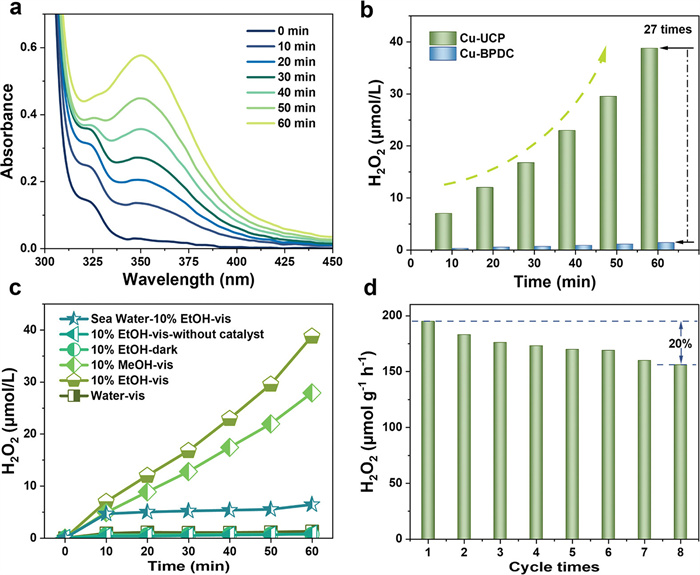
The impact of different sacrificial agents on H2O2 production was also investigated (Fig. 3c). Addition of methanol resulted in a slightly lower yield (27.90 μmol/L) compared to that of ethanol, leading to the latter’s selection for subsequent experiments. The photocatalytic performance of Cu-UCP in seawater was tested by replacing the deionized water in the reaction system with filtered fresh seawater. Under identical conditions, the H2O2 yield was 6.43 μmol/L, demonstrating Cu-UCP’s potential for seawater applications. The apparent quantum yield (AQY) of Cu-UCP was also examined under monochromatic light irradiation (Fig. S10 in Supporting information). The AQY declined with increasing wavelength, reflecting the wavelength-dependent efficiency of the photocatalytic process. The recyclability of Cu-UCP was evaluated over eight reaction cycles (Fig. 3d). Although the yield slightly decreased, the catalytic efficiency remained above 80%, with the reduction attributed to catalyst mass loss during recycling. These results confirm Cu-UCP’s consistent photocatalytic performance. Furthermore, comparative analysis of XRD (Fig. S11 in Supporting information), XPS spectra (Fig. S12 in Supporting information), and FTIR spectra (Fig. S13 in Supporting information) before and after photocatalytic H2O2 generation revealed no significant structural or chemical changes. Inductively coupled plasma-mass spectrometry (ICP-MS) analysis of the post-reaction filtrate was conducted to assess structural stability and metal leaching. The detected concentrations of copper and uranyl ion were only 0.18 and 0.07 mg/L, respectively, indicating minimal leaching and excellent framework stability. This affirms the environmental safety and practical durability of Cu-UCP, and collectively attests to its superior thermal, water, and chemical stability, making it a robust candidate for photocatalysis.
The light absorption properties and energy band structures of Cu-UCP and Cu-BPDC are shown in Fig. 4. Both materials exhibit absorption characteristics within the visible light range. Compared to Cu-BPDC, Cu-UCP demonstrates enhanced light absorption properties after the introduction of UO22+ (Fig. 4a). The optical band gaps of Cu-UCP and Cu-BPDC were determined to be 2.44 and 2.32 eV, respectively. Both Cu-UCP and Cu-BPDC are n-type semiconductors, as confirmed by the positive slopes observed in the Mott-Schottky plots (Fig. 4b) [43]. The flat band potentials for Cu-UCP and Cu-BPDC were measured at −0.67 and −0.41 V (vs. Ag/AgCl), respectively.
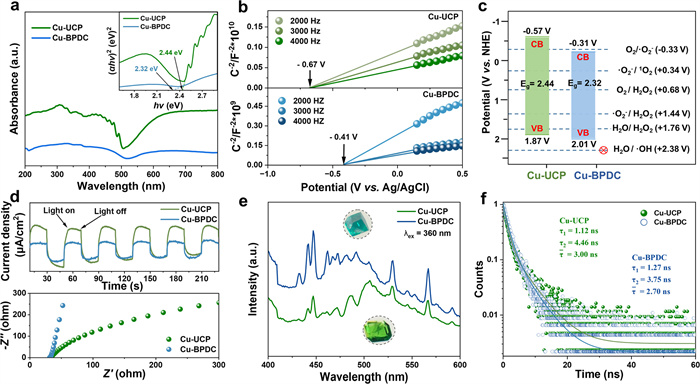
Based on these values and the optical band gaps, the conduction band (ECB) potentials for Cu-UCP and Cu-BPDC were calculated to be −0.57 and −0.31 V (vs. NHE), while the valence band (EVB) potentials were estimated at 1.87 and 2.01 V (vs. NHE), as illustrated in Fig. 4c. Both Cu-UCP and Cu-BPDC exhibit more negative ECB than the redox potential of O2/H2O2 (0.68 V vs. NHE). However, it is worth noting that ECB of Cu-UCP is more negative than the redox potential of the 1e− ORR (−0.33 V vs. NHE for indirect ORR) compared to Cu-BPDC. Meanwhile, EVB of Cu-UCP were more positive than the redox potential of direct 2e− WOR (1.76 V vs. NHE). Therefore, with the introduction of the UO22+ site, it is thermodynamically possible for Cu-UCP to drive H2O2 photo-generation through both ORR and WOR pathways.
Electrochemical properties were further examined through transient photocurrent response and electrochemical impedance spectroscopy (EIS). Cu-UCP exhibited a higher photocurrent response than Cu-BPDC (Fig. 4d), demonstrating the superior photoinduced charge separation and transport efficiency induced by the introduction of UO22+ in Cu-UCP. The Nyquist plot in Fig. 4d shows a smaller semicircular radius for Cu-UCP, which corresponds to faster charge transport. Additionally, Cu-UCP displayed lower PL intensity (Fig. 4e) compared to Cu-BPDC, indicating reduced recombination of photoinduced charge carriers. The fluorescence decay curves in Fig. 4f further reveal that Cu-UCP has a longer average fluorescence lifetime (τa) of 3.00 ns, compared to 2.70 ns for Cu-BPDC. The longer fluorescence lifetime and stronger oxidative capacity of Cu-UCP promote the formation of more reactive oxygen species (ROS), enhancing H2O2 yield [44]. These findings suggest that the incorporation of UO22+ into Cu-UCP effectively modifies the electronic structure and improves charge carrier separation, thereby enhancing its photocatalytic performance for H2O2 production.
To understand the reaction pathways involved in H2O2 production, a series of control experiments were conducted (Fig. 5a). Under a N2-saturated atmosphere, where O2 was absent, Cu-UCP still produced a small amount of H2O2 at a rate of 14.54 μmol/L. This result suggests that WOR contributes to H2O2 formation. However, the yield of H2O2 in the N2 atmosphere was lower compared to the air atmosphere, indicating that in the presence of O2, both the ORR and WOR contribute to H2O2 production. Subsequently, the potential reaction pathways responsible for the evolution of H2O2 in the two half-reactions (ORR and WOR), were investigated. Cu-UCP was utilized as the catalyst in this study. When EDTA-2Na was added as a hole acceptor for ORR, a continuous production of H2O2 was observed at a rate of 33.37 μmol/L. This confirmed that Cu-UCP facilitates the reduction of O2 to H2O2 in ORR half-reaction. In contrast, when KBrO3 was used as the electron acceptor in the WOR half-reaction under sufficient N2 bubbling to remove oxygen, only a small amount of H2O2 (4.97 μmol/L) was produced. The experimental results conclusively demonstrate that H2O acts as a reactant, whereas O2 is not an intermediate in the photocatalytic WOR for H2O2 generation. Thus, Cu-UCP underwent the 2e− WOR pathway to produce H2O2.
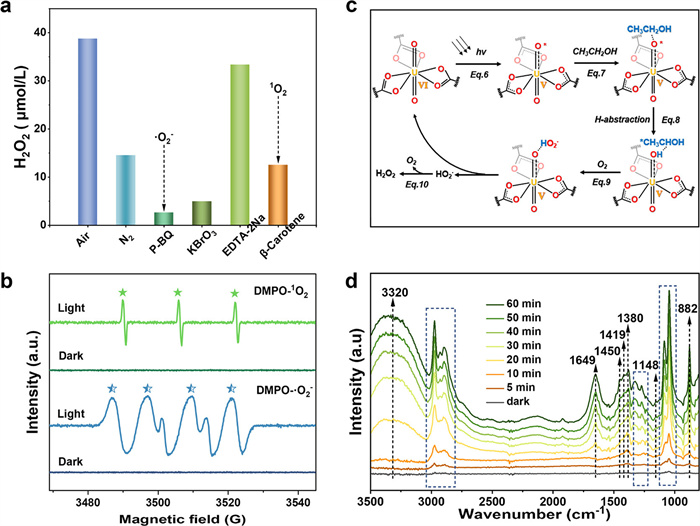
Free radical quenching experiments were further performed to identify the reactive species involved. p-Benzoquinone (p-BQ), carotenoids (β-carotene), and isopropanol (IPA) were used as scavengers for superoxide anion (·O2-), and singlet oxygen (1O2) [45,46], respectively. When p-BQ and β-carotene were added in the photocatalytic carotene after 60 min of visible light irradiation. This indicates that ·O2- and 1O2 are the primary active species in the photocatalytic production of H2O2. In conclusion, O2 serves as the reactant in the ORR, while ·O2- and 1O2 are the key reactive species in the photocatalytic generation of H2O2. To gain deeper insight into the mechanism of photocatalytic H2O2 production, ESR measurements were conducted. As shown in Fig. 5b, clear signals for both ·O2- and 1O2 were detected under illumination, using 5,5-dimethyl-1-pyrroline N-oxide (DMPO) and 2,2,6,6-tetramethylpiperidine (TEMP) as trapping agents, respectively. These findings confirm that ·O2- and 1O2 are key intermediates in the generation of H2O2 via the ORR on the Cu-UCP photocatalyst, suggesting that Cu-UCP generates H2O2 through a two-step, one-electron reduction of O2. When Cu-UCP is exposed to visible light, it becomes photoexcited, producing electrons and holes (Eq. 1). Based on the values of the conduction band (ECB = −0.57 V) and valence band (EVB = +1.87 V) potentials for Cu-UCP (Fig. 4e), it is capable of reducing oxygen via two possible pathways: O2 → ·O2- → ·OOH → H2O2 (Eqs. 2–4) and O2 → ·O2- → 1O2 → H2O2 (Eqs. 2 and 5), as well as oxidizing H2O to produce H2O2 (Eq. 6). The possible reaction steps for photocatalytic H2O2 production by Cu-UCP are as follows:
|
|
(1) |
|
|
(2) |
|
|
(3) |
|
|
(4) |
|
|
(5) |
|
|
(6) |
The unique properties of UO22+ in Cu-UCP contribute to its enhanced photocatalytic efficiency and rapid response. This is due not only to its high absorption of sunlight but also to its distinct photocatalytic mechanism, which involves hydrogen abstraction and electron transfer processes. As shown in Fig. 5c, upon photoexcitation, UO22+ undergoes electron transfer, generating an excited-state uranyl ion (*UO22+) with a higher oxidation potential (E0 = 2.6 V, Eq. 7). *UO22+ is capable of abstracting hydrogen from organic substrates in the presence of O2, as illustrated by the reactions in Eqs. 8 and 9. In these reactions, *UO22+ facilitates the oxidation of ethanol molecules, while [UO(OH)2+‧‧‧CH3CHOH] can also be oxidized by O2 molecules, resulting in the formation of UO22+, peroxyhydroxyl radicals (HO2·), and other oxidized products (Eq. 10). The HO2· radicals can further convert into H2O2 (Eq. 11), thus contributing to the overall photocatalytic H2O2 production. This unique hydrogen abstraction mechanism, coupled with ORR and WOR reactions, plays a pivotal role in enhancing the photocatalytic H2O2 generation process in Cu-UCP. The UO22+, through its appropriate oxidation potential and reactive capabilities, significantly boosts the photocatalytic performance of Cu-UCP.
|
|
(7) |
|
|
(8) |
|
|
(9) |
|
|
(10) |
|
|
(11) |
In situ diffuse reflectance infrared Fourier transform spectroscopy (DRIFTS) was performed on Cu-UCP under ethanol-containing mixed vapor conditions to elucidate the photocatalytic pathway for H2O2 formation. Prior to the measurement, the catalyst was pretreated by purging with O2-saturated vapor for 30 min in a closed system to ensure stable reaction conditions. As shown in Fig. 5d, the gradually enhanced peak at 882 cm−1, assigned to adsorbed *O2 species, confirms the efficient O2 adsorption on the Cu-UCP surface. Simultaneously, the emergence and growth of the characteristic band at 1148 cm−1 are indicative of ·O2- intermediates, demonstrating that the adsorbed O2 molecules are reduced by photogenerated e-. In addition, intensified signals corresponding to H2O2 species, including the O-H stretching vibration (3320 cm−1) and H-O-O bending modes (1380, 1419, and 1450 cm−1), provide clear evidence for the generation and accumulation of H2O2 during the reaction [47]. The band observed at 1649 cm−1 is attributed to the H-O-O deformation vibration, suggesting the presence of adsorbed water, while the peak at 1267 cm−1 is likely associated with the δ(OH) vibration of molecularly adsorbed ethanol [48,49]. Strong absorption bands in the ranges of 1000–1100 cm−1 and 2700–3100 cm−1, corresponding to ν(C-O) and ν(CHx) vibrations [49,50], respectively, further confirm the involvement of ethanol molecules in the photocatalytic process. Notably, the progressive enhancement of these characteristic bands with prolonged light irradiation strongly supports the occurrence of a hydrogen abstraction process from ethanol molecules. This process facilitates the formation of reactive oxygen species and ultimately promotes the stepwise reduction of O2 to H2O2. Under N2-saturated conditions, the bands of adsorbed *O2 species and ·O2- are absent or negligibly weak, while only weak features related to ethanol-related remained (Fig. S14 in Supporting information). This clear contrast between O2 and N2 conditions confirms that the observed intermediates arise exclusively from the photocatalytic reduction of O2, thereby validating the ORR pathway and hydrogen abstraction process from ethanol molecules for H2O2 generation.
To further elucidate the mechanism of H2O2 generation, ESP calculations were performed using simplified models of Cu-BPDC and Cu-UCP (Fig. 6a and Fig. S15 in Supporting information). In Cu-BPDC, the electrostatic potential near the Cu sites is predominantly negative. In contrast, Cu-UCP exhibits a negative potential region around the uranyl center, while the Cu-based coordination framework is positive, suggesting that photoexcited electrons preferentially accumulate at the UO22+ centers, which act as electron sinks. This charge redistribution promotes spatial charge separation and facilitates the ORR [51]. Concurrently, the strong oxidative potential of *UO22+ supports the WOR, sustaining the continuous formation of H2O2. Therefore, the synergistic coupling between uranyl nodes and the Cu-based coordination framework enhances both the interfacial charge transfer efficiency and the kinetics of the redox half-reactions.
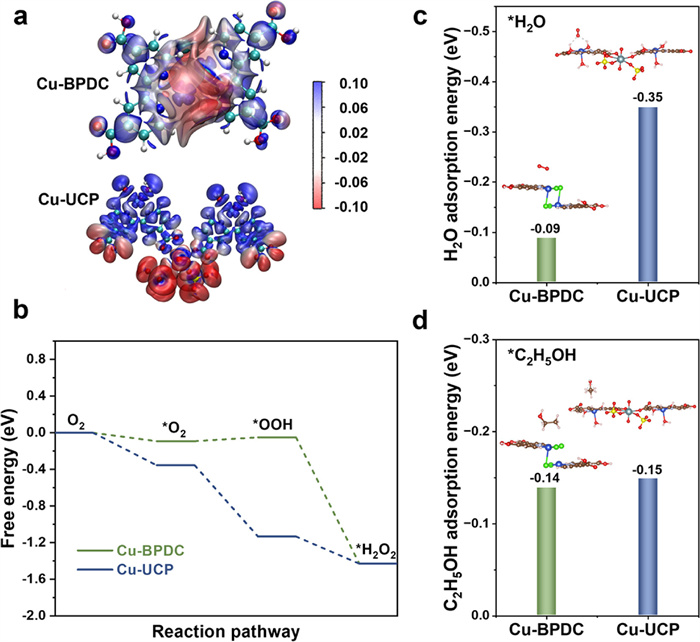
DFT calculations were performed to elucidate the origin of the enhanced H2O2 production observed for Cu-UCP. As shown in Fig. 6b, the adsorption energies (ΔEad) of O2 on both Cu-BPDC and Cu-UCP are negative, indicating that O2 adsorption on these surfaces is thermodynamically favorable. The reaction free-energy profiles for the ORR pathway leading to H2O2 formation were subsequently constructed. In this mechanism, the adsorbed O2 molecule undergoes hydrogenation to form the *OOH intermediate, which is then further reduced to yield H2O2. Notably, Cu-UCP exhibits the lowest Gibbs free energy change (ΔG) for these steps, demonstrating that the uranyl incorporation thermodynamically facilitates O2 reduction to H2O2, consistent with its experimentally observed photocatalytic activity. In addition, H2O molecules adsorbed on Cu-UCP exhibited a lower ΔEad of −0.35 eV than that on Cu-BPDC (−0.09 eV), suggesting the preferential adsorption of H2O on Cu-UCP (Fig. 6c) [47]. Regarding the hydrogen abstraction with ethanol, the adsorption energies of ethanol on Cu-BPDC and Cu-UCP were also evaluated (Fig. 6d). Ethanol adsorption on Cu-UCP exhibits a more negative ΔEad value (−0.15 eV) compared with that on Cu-BPDC, indicating stronger ethanol-surface interactions on Cu-UCP via incorporation of UO22+ into Cu-based coordination framework. This can promote efficient hydrogen abstraction from ethanol of *UO22+ in Cu-UCP, thereby accelerating the formation of reactive intermediates and sustaining continuous H2O2 generation.
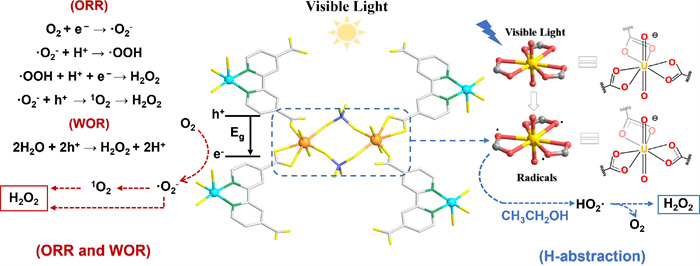
Based on the analysis above, a plausible mechanism for H2O2 production in Cu-UCP is proposed, as illustrated in Fig. 7. Upon visible light excitation, Cu-UCP generates photoinduced electrons and holes. The efficient separation of these charge carriers facilitates electron transfer between the uranyl sites and the surrounding ligands. In the ORR, photoinduced electrons migrate from the valence band to the conduction band, reducing O2 to form ·O2-, further converted into H2O2. Additionally, ·O2- is partially oxidized by holes, producing 1O2, which also contributes to H2O2 formation. In the WOR, *UO22+, under visible light, transfers electrons from its highest occupied molecular orbital (HOMO) to its lowest unoccupied molecular orbital (LUMO), resulting in the formation of *UO22+ with an oxidation potential of E0 = 2.6 V. This excited species then oxidizes water to generate H2O2. The hydrogen abstraction process plays a critical role in this reaction, where *UO22+ extracts the H atom from ethanol, acting as a proton donor in the presence of O2. The excited *UO22+ further oxidizes ethanol, producing aldehydes and protons, which provide continuous electrons for the ORR process. Thus, the dual functionality of Cu-UCP, combining semiconductor properties with the unique reactivity of UO22+, enables a synergistic photocatalytic process that efficiently generates H2O2 through both ORR and WOR mechanisms, enhanced by the hydrogen abstraction properties of the uranyl species.
In this study, uranyl sites as a secondary metal node were introduced into the single-metal coordination polymer Cu-BPDC, resulting in the synthesis of uranyl coordination polymers (Cu-UCP) with bimetallic nodes. This modification imparts unique structural advantages to the material. Compared to the Cu-BPDC polymer with a single metal node, Cu-UCP exhibits superior separation of photogenerated electron-hole pairs, significantly enhancing the photocatalytic generation of H2O2. Under ambient air conditions, Cu-UCP achieved a H2O2 production rate of 38.76 μmol/L, which is 27 times greater than that of Cu-BPDC. Experimental and characterization analyses reveal that Cu-UCP facilitates two main pathways for H2O2 production: A two-step one-electron oxygen reduction reaction (O2 → ·O2- →·OOH → H2O2 and O2 →·O2-→ 1O2→ H2O2) and direct water oxidation (H2O → H2O2). Additionally, the UO22+ sites enable the generation of HO2· via a hydrogen abstraction process, further contributing to H2O2 formation. In situ DRIFTS analysis confirms the presence of key intermediates (·O2-, ·OOH, and 1O2) during the photocatalytic process. Overall, this study offers valuable insights into the design and application of engineering uranyl sites into MCPs for efficient H2O2 production, providing a foundation for future advancements in photocatalytic systems.
The authors declare that they have no known competing financial interests or personal relationships that could have appeared to influence the work reported in this paper.
Lisha Jiang: Writing – review & editing, Supervision, Project administration, Funding acquisition, Conceptualization. Mengnan Yuan: Writing – review & editing, Software, Investigation, Formal analysis. Peixin Yang: Validation, Software, Formal analysis. Erpeng Wang: Validation, Software, Resources. Yunhe You: Investigation, Formal analysis. Yicen Liu: Investigation. Zhenyu Li: Resources. Wei Liu: Writing – review & editing, Supervision, Project administration. Xiufang He: Formal analysis. Juanshan Du: Writing – review & editing, Visualization, Funding acquisition. Yi Hu: Writing – review & editing. Wanqian Guo: Writing – review & editing, Resources, Funding acquisition.
This work was supported by grants from the National Natural Science Foundation of China (Nos. 22176163, 22506169), the Natural Science Foundation of Heilongjiang Province of China (No. ZD2024E004), the Natural Science Foundation of Shandong Province (Nos. ZR2023QB099, ZR2024MB074 and ZR2024QB270) and Young Scientist Studio of Harbin Institute of Technology.
Supplementary material associated with this article can be found, in the online version, at doi:
J.M. Campos-Martin, G. Blanco-Brieva, J.L.G. Fierro, Angew. Chem. Int. Ed. 45 (2006) 6962–6984. doi: 10.1002/anie.200503779
X. Yang, W. Qiu, R. Gao, et al., Sens. Actuators B: Chem. 354 (2022) 131201. doi: 10.1016/j.snb.2021.131201
J. Liu, B. Viana, N. Mignet, et al., Small 19 (2023) 2303509. doi: 10.1002/smll.202303509
A.A. Ingle, S.Z. Ansari, D.Z. Shende, et al., Environ. Sci. Pollut. Res. Int. 29 (2022) 86468–86484. doi: 10.1007/s11356-022-21354-z
Y.H. Wu, Y.H. Chen, Z.P. Zhang, et al., Trans. Tianjin Univ. 31 (2025) 370–389. doi: 10.1007/s12209-025-00442-4
L. Jin, M. Deng, J. Gao, et al., Chem. Eng. J. 515 (2025) 163722. doi: 10.1016/j.cej.2025.163722
L. Wang, D. Ma, A. Liu, et al., Angew. Chem. Int. Ed. 64 (2025) e202518097. doi: 10.1002/anie.202518097
Z. Liu, Y.Q. Bian, G. Dawson, J.W. Zhu, K. Dai, Chin. Chem. Lett. 36 (2025) 111272. doi: 10.1016/j.cclet.2025.111272
T. Gao, D. Zhao, S. Yuan, et al., Carbon Energy 6 (2024) e596. doi: 10.1002/cey2.596
X.Y. Liu, K.L. Wu, Y.C. Tang, et al., Chin. Chem. Lett. 36 (2025) 110882. doi: 10.1016/j.cclet.2025.110882
J. Zhao, J. Yuan, Z. Fang, et al., Coord. Chem. Rev. 471 (2022) 214735. doi: 10.1016/j.ccr.2022.214735
Z. Lin, J.J. Richardson, J. Zhou, F. Caruso, Nat. Rev. Chem. 7 (2023) 273–286. doi: 10.1038/s41570-023-00474-1
H.Y. Chu, G.C. Liu, F.X. Wang, L.S. Cui, C.C. Wang, Chin. Chem. Lett. 36 (2025) 110745. doi: 10.1016/j.cclet.2024.110745
M.J. Tsai, M.Y. Chung, M.Y. Kuo, J.Y. Wu, J. Environ. Chem. Eng. 11 (2023) 109258. doi: 10.1016/j.jece.2022.109258
M.R. Esposito, R. Newar, M. Kim, S.M. Cohen, Coord. Chem. Rev. 531 (2025) 216491. doi: 10.1016/j.ccr.2025.216491
L. Yuan, L. Zhang, X.X. Li, et al., Chin. Chem. Lett. 34 (2023) 107146. doi: 10.1016/j.cclet.2022.01.039
Y.Y. Tang, X. Luo, R.Q. Xia, et al., D. Li, Angew. Chem. Int. Ed. 63 (2024) e202408186. doi: 10.1002/anie.202408186
M. Lan, R.M. Guo, Y. Dou, et al., Nano Energy 33 (2017) 238–246. doi: 10.1016/j.nanoen.2017.01.046
W.J. Shi, T.B. Lu, Chem. Eur. J. 31 (2025) e202500636. doi: 10.1002/chem.202500636
H. Lei, J. Zhang, Z. Wu, et al., Angew. Chem. Int. Ed. 64 (2025) e202509572. doi: 10.1002/anie.202509572
H. Hu, X. Li, K. Zhang, et al., Adv. Mater. 37 (2025) 2419023. doi: 10.1002/adma.202419023
G. Wei, Z.S. Chen, X.S. Tai, Z.L. Sun, X.K. Wang, Trans. Tianjin Univ. 31 (2025) 390–402. doi: 10.1007/s12209-025-00441-5
X. Zhang, P. Li, M. Krzyaniak, et al., Inorg. Chem. 59 (2020) 16795–16798. doi: 10.1021/acs.inorgchem.0c00850
Y. Li, J. Su, E. Mitchell, G. Zhang, J. Li, Sci. China Chem. 56 (2013) 1671–1681. doi: 10.1007/s11426-013-4965-y
P. Gao, Z. Shen, Y. Chen, et al., J. Catal. 442 (2025) 115900. doi: 10.1016/j.jcat.2024.115900
J. Song, C. Liang, B. Li, et al., Sci. China Chem. 67 (2024) 2274–2281. doi: 10.1007/s11426-023-1987-0
E. Tynan, P. Jensen, A.C. Lees, et al., CrystEngComm. 7 (2005) 90–95. doi: 10.1039/B417520D
R. Zhao, L. Mei, K.Q. Hu, et al., Inorg. Chem. 57 (2018) 6084–6094. doi: 10.1021/acs.inorgchem.8b00634
X. Gao, Y. Zhang, Y. Liu, Atmos. Environ. 191 (2018) 312–319. doi: 10.1016/j.atmosenv.2018.08.021
F. Berger, E. Beche, R. Berjoan, D. Klein, A. Chambaudet, Appl. Surf. Sci. 93 (1996) 9–16. doi: 10.1016/0169-4332(95)00319-3
Y. Hu, D. Tang, Z. Shen, et al., Appl. Catal. B 322 (2023) 122092. doi: 10.1016/j.apcatb.2022.122092
Q. Zhang, K. Gu, C. Dong, et al., Angew. Chem., Int. Ed. 64 (2025) e202417591. doi: 10.1002/anie.202417591
L. Dambies, C. Guimon, S. Yiacoumi, E. Guibal, Colloids Surf. A 177 (2001) 203–214. doi: 10.1016/S0927-7757(00)00678-6
A. Sahai, N. Goswami, S.D. Kaushik, S. Tripathi, Appl. Surf. Sci. 390 (2016) 974–983. doi: 10.1016/j.apsusc.2016.09.005
S. Vargas Villanueva, D.A. Torres Ceron, S. Amaya Roncancio, et al., Appl. Surf. Sci. 599 (2022) 153811. doi: 10.1016/j.apsusc.2022.153811
H. Liu, Q. Jin, L. Meng, et al., Nanoscale 15 (2023) 13459–13465. doi: 10.1039/d3nr01810e
L. Lin, Q. Zhu, A.W. Xu, J. Am. Chem. Soc. 136 (2014) 11027–11033. doi: 10.1021/ja504696r
M. Schindler, F.C. Hawthorne, M.S. Freund, P.C. Burns, Geochim. Cosmochim. Acta 73 (2009) 2488–2509. doi: 10.1016/j.gca.2008.10.041
Y. Chen, S. Fan, B. Qiu, et al., ACS Appl. Mater. Interfaces 13 (2021) 24795–24803. doi: 10.1021/acsami.1c04155
J.Y. Choi, B. Check, X. Fang, et al., J. Am. Chem. Soc. 146 (2024) 11319–11327.
X. Chen, Y. Kondo, Y. Kuwahara, et al., Phys. Chem. Chem. Phys. 22 (2020) 14404–14414. doi: 10.1039/d0cp01759k
R. Zhao, L. Mei, L. Wang, Z.F. Chai, W.Q. Shi, Inorg. Chem. 55 (2016) 10125–10134. doi: 10.1021/acs.inorgchem.6b00786
Y. Bai, S.J. Li, B.L. Yin, J.P. Zhao, H.X. Li, Trans. Tianjin Univ. 30 (2024) 130–139. doi: 10.1007/s12209-024-00386-1
J. Cheng, S. Wan, S. Cao, Angew. Chem. Int. Ed. 62 (2023) e202310476. doi: 10.1002/anie.202310476
L. Jin, J. Xu, H. Zhu, et al., Chin. Chem. Lett. 37 (2026) 111865. doi: 10.1016/j.cclet.2025.111865
B. Shen, H. Du, A. Liu, et al., J. Clean. Prod. 523 (2025) 146458. doi: 10.1016/j.jclepro.2025.146458
Q. Zuo, B. Chu, X. Ye, et al., J. Am. Chem. Soc. 147 (2025) 34681–34689. doi: 10.1021/jacs.5c09922
E.Y. Mironova, A.A. Lytkina, M.M. Ermilova, et al., Int. J. Hydrog. Energy 40 (2015) 3557–3565. doi: 10.1016/j.ijhydene.2014.11.082
A.C. Sola, N. Homs, P.R.í de la Piscina, Int. J. Hydrog. Energy 43 (2018) 16922–16928. doi: 10.1016/j.ijhydene.2018.02.098
L. Luo, T. Zhang, X. Zhang, et al., Catalysts 10 (2020) 539. doi: 10.3390/catal10050539
Y.Y. Tang, X. Luo, R.Q. Xia, et al., Angew. Chem. Int. Ed. 63 (2024) e202408186. doi: 10.1002/anie.202408186

Figure 1 (a) Diagram of the synthesis process for Cu-BPDC and Cu-UCP. (b) Oblique and side views of the 1D Cu-UCP chain. (c, d) Side view of 2D stair-like layers of the Cu-UCP.

Figure 2 (a) The experimental and simulated PXRD patterns of Cu-UCP. (b) FTIR spectra of H2BPDC, Cu-BPDC and Cu-UCP. (c) The zeta potential of Cu-UCP and Cu-BPDC. High resolution XPS spectra of (d) U 4f and (e) Cu 2p for Cu-UCP. (f) Water contact angle of Cu-UCP and Cu-BPDC. (g) The SEM and EDS figures of Cu-UCP.

Figure 3 (a) Time-resolved UV-visible absorption spectra of H2O2 on Cu-UCP catalysts irradiated with visible light in a 10% ethanol solution system under air atmosphere. (b) H2O2 yield of Cu-UCP and Cu-BPDC under visible light irradiation. (c) Time-dependent photocatalytic H2O2 production by Cu-UCP under various reactive systems. (d) Eight cycle experiments result for Cu-UCP.

Figure 4 (a) UV–vis DRS spectra, inset: the corresponding Tauc plot, (b) Mott-Schottky analysis, (c) band structure diagram, (d) transient photocurrent response capacities and EIS Nyquist plots, (e) the steady state photoluminescence measurements, (f) fluorescence decay curves of Cu-UCP and Cu-BPDC.

Figure 5 (a) Effect of different quenching experiments on the H2O2 production of Cu-UCP. (b) ESR signals of the reaction solution with Cu-UCP under dark and light illumination in the presence of DMPO as the spin-trapping reagents. (c) Hydrogen uptake after photoexcitation of UO22+ and electron transfer processes. (d) In situ DRIFT spectra of Cu-UCP during photocatalytic H2O2 reaction in an O2 atmosphere.

Figure 6 (a) Electrostatic potential (ESP) surfaces of Cu-BPDC and Cu-UCP, where red and blue regions represent electron-rich and electron-deficient areas, respectively. (b) H2O adsorption energies, (c) Gibbs free energy profiles for the ORR pathway, and (d) ethanol adsorption energies over Cu-BPDC and Cu-UCP.

 扫一扫看文章


扫一扫关注我们
 DownLoad:
 下载:

 下载: