jiangh@bnu.edu.cn (H. Jiang). 1 These authors contributed equally to this work.
Received Date:
05 February 2026 Accepted Date:
17 April 2026 Revised Date:
07 April 2026 Available Online:
12 January 2027
Abstract:
Donor-acceptor cycloparaphenylenes (D-A CPPs) represent a promising class of macrocyclic nanomaterials with finely adjustable photophysical properties. However, developing D-A CPPs with efficient near-infrared emission remains challenging due to inherent limitations in electronic modulation and quantum yield compromise. In this study, we designed and synthesized a series of chalcogen-engineered D-A CPPs by incorporating benzoselenadiazole or benzothiadiazole acceptors, synergistically combined with thiophene donors. Notably, precise control over the ring size, chalcogen type and solvent polarity enabled a significant redshift in emission, achieving wavelengths up to 731 nm-extending into the near-infrared region-while maintaining fluorescence efficiencies of 23.8%-58.8% in nonpolar toluene and 9.0%-50.4% in polar DMF. Furthermore, the introduction of selenium enhanced spin-orbit coupling, thereby promoting efficient singlet oxygen generation with a quantum yield as high as 40%. As a result, these compounds serve as effective photocatalysts, demonstrated through the selective oxidation of thioanisole to sulfoxide with high yield and selectivity under irradiation. Our work thus establishes an atom engineering strategy for developing functionalized nanohoops, offering substantial potential for advanced applications in photocatalysis and optical materials.
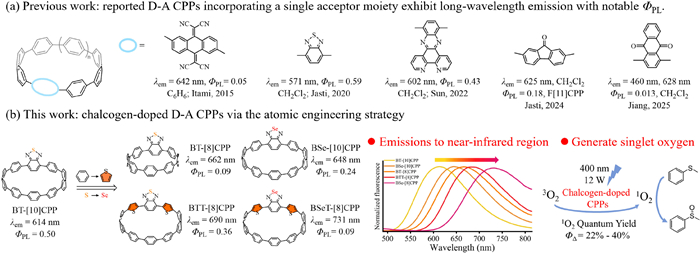
Cycloparaphenylenes (CPPs) are the precise structural subunits for armchair carbon nanotubes [1-10]. Distinct from conventional nanomaterials with structural heterogeneity, CPPs feature a radially constrained topology that inherently provides size-dependent optoelectronic properties to achieve exquisite control [11-29]. To further modulate the intrinsic bandgaps imposed by their curvature, donor-acceptor (D-A) integration has emerged as a pivotal strategy [30-45]. Nevertheless, extending this approach to construct near-infrared (NIR) emissive nanohoops remains a considerable challenge, as it necessitates striking a delicate balance between strain engineering, electronic structure modulation and synthetic feasibility. Specifically, this requires leveraging strain and incorporating D-A motifs to narrow the bandgap, while mitigating structural instability and suppressing reductions in photoluminescence quantum yields (ΦPL) caused by excessive strain or charge transfer [46]. In 2015, Itami reported red-emitting CPPs based on tetracyanoanthraquinone, showing a low ΦPL of 5% [47]. Recently, Ke presented BODIPY-CPP nanorings via distinct linkage modes that result in redshifted emission at the expense of quantum yield (ΦPL = 0.16%) [48]. Our group achieved acceptor engineering of quinone-based CPPs with dual emission peaks at 460 and 628 nm, consequently resulting in single-molecule white light emission [44]. Furthermore, incorporating acceptors such as phenanthrene derivatives [49] or fluorenone [50] has also afforded D-A nanohoops with emission beyond 600 nm and notable ΦPL (Fig. 1a). Despite these achievements, the realization of CPPs exhibiting efficient NIR emission, a capability crucial for diverse applications in biomedicine and energy science, demand further innovation in D-A architectural designs.
Figure 1
Figure 1.
(a) D-A CPP derivatives exhibiting red-shifted emission with notable ΦPL in previous work. (b) Design and synthesis of D-A CPP derivatives (BT-[10]CPP, BT-[8]CPP, BSe-[10]CPP, BTT-[8]CPP and BSeT-[8]CPP) exhibiting tunable emissions from yellow-green to the NIR region through size effects of CPPs and atom engineering strategy with concurrent singlet oxygen generation in this work. The corrected fluorescence spectroscopic data of CPPs in Fig. 1b were measured in DMF. BT: Benzothiadiazole, BSe: benzoselenadiazole, T: Thiophene.
Benzoselenadiazole has attracted considerable interest due to its exceptional optoelectronic properties [51-59]. Compared to its sulfur-containing analogue, it benefits from the larger atomic radius and greater polarizability of the selenium atom [60], which promotes extensive electron delocalization within the π-conjugated framework. This effect narrows the optical bandgap and stabilizes excited states, enabling a substantial bathochromic shift in emission while simultaneously mitigating the fluorescence quenching from the heavy-atom effect to yield high ΦPL and superior photostability [61,62]. These merits underscore the limitations of conventional sulfur-based acceptors. The study reported by Jasti on the benzothiadiazole incorporated CPP [63], with its emission confined to 571 nm, demonstrates that the lighter chalcogen exhibits inherent electronic constraints in accessing the NIR regime. To address this constraint, we propose an atomic engineering strategy involving sulfur-to-selenium substitution to achieve efficient NIR luminescence (Fig. 1b). This chalcogen exchange leverages selenium's lower electronegativity to enhance electron-accepting capability, while concurrent thiophene incorporation boosts electron donation. These modifications synergistically enhance intramolecular charge transfer (ICT) to enable significant spectral red-shifting [64].
Beyond these attractive optical properties, we further envision that such CPP derivatives hold significant potential for photocatalysis. While conventional systems such as metal complexes [65,66], carbon-based materials [67-73] and organic polymers [74,75] have been extensively explored, CPP-based architectures remain markedly underexplored. The unique radial conjugation, high photostability and synthetically tunable electronic structures of CPPs offer an ideal platform for photocatalytic design. However, their practical development has been impeded by a general lack of efficient intersystem crossing (ISC) pathways. Our selenium-based strategy holds promise for addressing this shortcoming by intensifying spin-orbit coupling (SOC), thereby harnessing triplet states to facilitate energy-transfer processes. These attributes establish CPPs as highly promising candidates for the design of sustainable and environmentally benign photocatalytic systems.
Herein, we present a series of D-A CPPs incorporating benzoselenadiazole or benzothiadiazole as electron acceptors: BSe-[10]CPP, BT-[8]CPP, BTT-[8]CPP and BSeT-[8]CPP. All these CPPs exhibit characteristic solvatofluorochromism mediated by D-A architectures. Remarkably, precise modulation of the nanohoop size, chalcogen identity and solvent polarity enables tuning of the maximum emission wavelength up to 731 nm with emissions spanning from yellow-green to the NIR region. Furthermore, the strategic incorporation of heavy atoms markedly promotes efficient ISC, which facilitates efficient photosensitization and subsequent generation of singlet oxygen (1O2), with singlet oxygen quantum yields (ΦΔ) reaching up to 40%. Under photoirradiation, the generated 1O2 enables these CPPs to function as potent photosensitizers for the photocatalytic oxidation of thioanisole. This transformation proceeds with near-quantitative conversion and exceptional chemoselectivity to afford methyl phenyl sulfoxide, demonstrating the expanded functional scope of carbon nanohoops in photoredox catalysis.
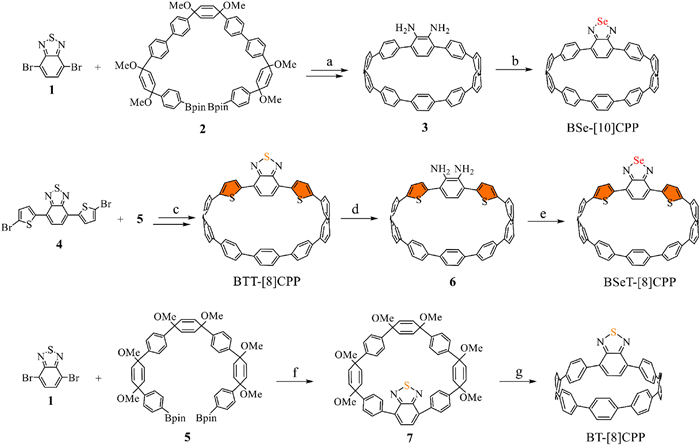
The synthetic routes to four nanohoops (BSe-[10]CPP, BTT-[8]CPP, BSeT-[8]CPP and BT-[8]CPP) are summarized in Scheme 1. The C-shaped boronic esters 2 [76], 5 [77] and BT-[10]CPP [63] were readily prepared according to previous literature procedures. To access BSe-[10]CPP, Suzuki-Miyaura coupling between 4,7-dibromobenzothiadiazole 1 and 2 was carried out, followed by reduction with lithium aluminium hydride to yield the diamino-functionalized macrocycle 3. Subsequent cyclization of 3 with selenium dioxide afforded the benzoselenadiazole-embedded nanohoop in 37% yield. The thiophene-embedded macrocycle BSeT-[8]CPP was synthesized from BTT-[8]CPP, which was itself prepared in 8% yield over two steps via Suzuki-Miyaura coupling of 4 with 5 followed by reductive aromatization. Reduction of BTT-[8]CPP with NaBH4 afforded the nanohoop 6, and subsequent cyclization with selenium dioxide yielded BSeT-[8]CPP in 9% yield over two steps. For the preparation of BT-[8]CPP, coupling between 1 and 5, respectively, afforded the macrocyclic precursors 7. Subsequent reductive aromatization of the intermediates using H2SnCl4 furnished the BT-[8]CPP in isolated yields of 5% over two steps [63]. The structures of these CPPs were characterized by 1H NMR, 13C NMR and MALDI-TOF MS (Fig. S20-S32 in Supporting information).
Scheme 1
Scheme 1.
Synthetic route of BSe-[10]CPP, BTT-[8]CPP, BSeT-[8]CPP and BT-[8]CPP. Reaction conditions: (a) (ⅰ) Pd(PPh3)4, K2CO3, 1,4-dioxane/H2O, 115 ℃, 12 h; (ⅱ) LiAlH4, THF, 0 ℃ to 66 ℃, overnight, 7% in two steps. (b) SeO2, EtOH/H2O, 100 ℃, 2 days, 37%. (c) (ⅰ) Pd(PPh3)4, K2CO3, toluene/H2O, 115 ℃, overnight; (ⅱ) SnCl2, HCl, THF, r.t., 24 h, 8% in two steps. (d) NaBH4, EtOH/THF, 0 ℃ to r.t., 12 h. (e) SeO2, EtOH/H2O 100 ℃, 2 days, 9% in two steps. (f) Pd(PPh3)4, K2CO3, 1,4-dioxane/H2O, 115 ℃, 12 h. (g) SnCl2, HCl, THF, r.t., 24 h, 5% in two steps.
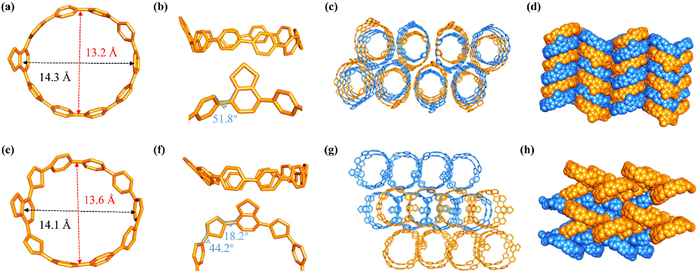
The structures of BSe-[10]CPP and BTT-[8]CPP were further confirmed by single-crystal X-ray analysis (Fig. 2 and Table S1 in Supporting information). Suitable crystals were obtained by slow diffusion of n-hexane into chloroform solution at room temperature. The single-crystal structure of BSe-[10]CPP reveals that it crystallizes in the orthorhombic space group Pbca and features an elliptical cavity, with distances between the centers of opposing aromatic faces measuring 14.3 and 13.2 Å, which are comparable to that of [10]CPP (13.9 Å) [78]. The crystal structure of BTT-[8]CPP belongs to the monoclinic space group P21/c and exhibits a cavity of similar size to that of BSe-[10]CPP. In addition, the packing diagrams of BSe-[10]CPP (Figs. 2c and d) and BTT-[8]CPP (Figs. 2g and h) reveal tube-like channels when viewed from the top and a herringbone arrangement when observed from the side.
Figure 2
Figure 2.
(a, b) X-ray crystal structures, (c) long range channel alignment, and (d) Herringbone packing model of BSe-[10]CPP. (e, f) X-ray crystal structures, (g) long range channel alignment, and (h) Herringbone packing model of BTT-[8]CPP.
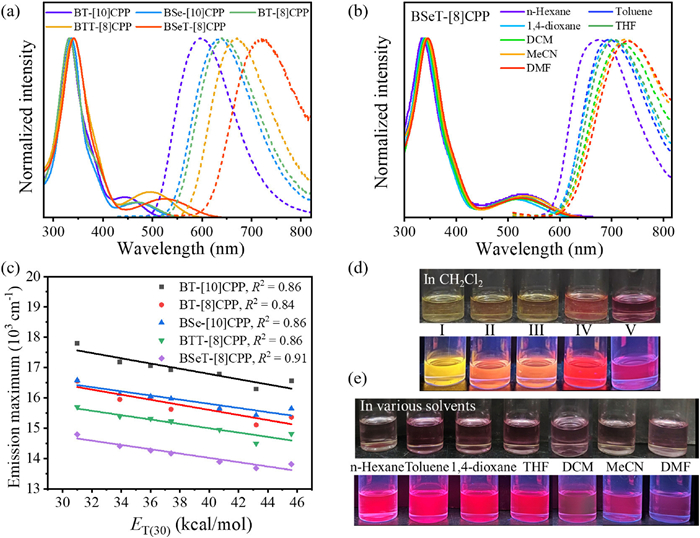
The optical properties of five D-A CPP derivatives in this work were examined by UV–vis absorption spectroscopy, corrected fluorescence emission spectroscopy and time-resolved fluorescence decay (Fig. 3 and Figs. S1-S7 in Supporting information). The key data were compiled in Table 1. To establish a connection between the electronic structure and photophysical properties, time-dependent density functional theory (TD-DFT) calculations were performed. The UV–vis absorption spectra of BSe-[10]CPP, BTT-[8]CPP, BSeT-[8]CPP, BT-[8]CPP and BT-[10]CPP in CH2Cl2 exhibited comparable absorption maxima (λmax) around 333–340 nm, consistent with the characteristic absorption of CPP structure. According to the DFT calculations, the main absorption peak can be attributed to the HOMO → LUMO+2 and HOMO-2 → LUMO+1 transitions (Table S10 in Supporting information). Among them, BTT-[8]CPP and BSeT-[8]CPP showed a bathochromic shift with λmax at 340 nm compared to BT-[10]CPP (333 nm) and BSe-[10]CPP (335 nm), which can be attributed to the incorporation of electron-donating thiophene units that enhance electron delocalization and extend the effective conjugation length. Moreover, all five macrocycles exhibit a weaker and red-shifted broad band within the range of 413 nm to 630 nm. These red-shifted broad bands are primarily associated with electronic transitions from HOMO-1 → LUMO and from HOMO → LUMO (Table S10).
Figure 3
Figure 3.
(a) The UV–vis spectra and corrected fluorescence spectra of BT-[10]CPP (I, λex = 333 nm), BSe-[10]CPP (II, λex = 335 nm), BT-[8]CPP (III, λex = 333 nm), BTT-[8]CPP (IV, λex = 340 nm) and BSeT-[8]CPP (V, λex = 340 nm) in CH2Cl2 (1.0 × 10⁻⁵ mol/L). (b) The UV–vis spectra and corrected fluorescence spectra of BSeT-[8]CPP in various solvents (1.0 × 10⁻⁵ mol/L). (c) Fluorescence peak energy of BT-[10]CPP, BT-[8]CPP, BSe-[10]CPP, BTT-[8]CPP and BSeT-[8]CPP versus the solvent polarity parameter, ET(30). Pictures of (d) BT-[10]CPP, BSe-[10]CPP, BT-[8]CPP, BTT-[8]CPP and BSeT-[8]CPP in CH2Cl2 at ambient light (up) and their emissions excited at λ = 365 nm (bottom), and (e) BSeT-[8]CPP in various solvents at ambient light (up) and their emissions excited at λ = 365 nm (bottom).
a UV–vis absorption and corrected fluorescence spectra were measured in CH2Cl2 (1 × 10⁻⁵ mol/L) at room temperature. b Wavelength of the maximum absorption. c Corrected emission maximum. d Absolute fluorescence quantum yield. e Lifetime in CH2Cl2 (XBT-[10]CPP2 = 0.935, XBSe-[10]CPP2 = 0.800, XBT-[8]CPP2 = 0.932, XBTT-[8]CPP2 = 0.994, XBSeT-[8]CPP2 = 1.127). f Radiative transition rate, kr = ΦPL/τ. g Nonradiative transition rate, knr = kr(1- ΦPL)/ΦPL. h Calculated using PBE0 DFT with implicit solvation (SMD). i HOMO = −(4.8 + Eonsetox) eV (calibrated by ferrocene). j Estimated from absorption onset, Eg(opt) = 1240/λonset.
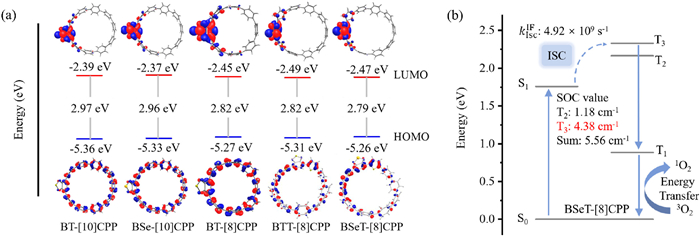
To further investigate the photophysical properties, DFT calculations were conducted to analyze the electronic structure (Fig. 4a and Figs. S13-S17, computational details are provided in Supporting information). As illustrated in Fig. 4a, the HOMO of BSeT-[8]CPP is localized on the thiophene units, while the LUMO resides on the benzoselenadiazole moieties. For BSe-[10]CPP, it exhibits a delocalized HOMO around the nanohoop, with its LUMO remaining primarily situated on the benzoselenadiazole unit. A similar electronic distribution is observed in the benzothiadiazole-containing nanohoops. This distinct orbital localization pattern confirms that incorporating thiophene effectively promotes charge separation, thereby enhancing ICT. The resulting enhancement in ICT substantially narrows the energy gap, as reflected in the reduction from 2.96 eV for BSe-[10]CPP to 2.79 eV for BSet-[8]CPP, and similarly from 2.97 eV for BT-[10]CPP to 2.82 eV for BTT-[10]CPP, implying that chalcogen-doping acts as an effective approach for reducing the energy gaps of these D-A nanohoops.
Figure 4
Figure 4.
(a) Energy diagrams and pictorial representations of the frontier molecular orbitals for BT-[10]CPP, BSe-[10]CPP, BT-[8]CPP, BTT-[8]CPP and BSeT-[8]CPP calculated by DFT. (b) TD-DFT calculated the energy levels and SOC constants of the singlet and triplet excited states of BSeT-[8]CPP.
Subsequently, the corrected fluorescence emission spectroscopies in CH2Cl2 were also conducted (Fig. 3a). The emission maxima of BT-[10]CPP, BSe-[10]CPP, BT-[8]CPP, BTT-[8]CPP and BSeT-[8]CPP in CH2Cl2 are located at 596, 639, 640, 669 and 720 nm. These nanohoops exhibit substantial Stokes shifts of 263, 304, 307, 329 and 380 nm, respectively, indicating significant structural relaxation in the excited state due to enhanced ICT, where more pronounced D-A characteristics lead to larger Stokes shifts. In this study, we observed that BT-[10]CPP displays a fluorescence emission peak at 596 nm in CH2Cl2, with a redshift of 25 nm compared to the value reported by Jasti [63]. This difference is presumably attributed to the application of spectral correction in our case. In contrast, the fluorescence emissions of BT-[10]CPP in various solvents obtained herein without applying spectral correction are consistent with those reported by Jasti, as detailed in Fig. S2 (Supporting information). Meanwhile, the absolute ΦPL of BT-[10]CPP, BSe-[10]CPP, BT-[8]CPP, BTT-[8]CPP and BSeT-[8]CPP in CH2Cl2 were determined to be 0.59, 0.39, 0.28, 0.56 and 0.18, respectively. Interestingly, although the emission extends into the NIR region, these nanohoops exhibit a relatively high ΦPL compared to other long-wavelength emitting CPPs that are largely non-emissive [34,48]. Notably, the selenium-containing nanohoops exhibit substantially reduced ΦPL. The diminished ΦPL implies enhanced ISC from the singlet to the triplet excited state.
To quantitatively assess the excited-state deactivation, we calculated the excited-state decay rates for these CPPs using the formula of kr = ΦPL/τ and knr = kr(1 - ΦPL)/ΦPL. The introduction of selenium increased the nonradiative decay rate by an order of magnitude, which surpassed the radiative decay rate, suggesting that the strong heavy-atom effect of selenium may facilitate ISC. Subsequently, TD-DFT calculations were performed to evaluate the SOC constants and ISC rates (kISC) (Fig. 4b and Table S12 in Supporting information). Indeed, the SOC values increased significantly upon replacing sulfur with selenium, leading to a substantial enhancement of kISC (Fig. S19 in Supporting information). For example, kISC for BSe-[10]CPP was an order of magnitude greater than that of BT-[10]CPP, while kISC for BSeT-[8]CPP was four times larger than that of BTT-[8]CPP. Furthermore, the dominant ISC pathway was identified as S1 → T2 for BTT-[8]CPP, whereas for the BSe-[10]CPP and BSeT-[8]CPP, the S1 → T3 transition constituted the major route for triplet formation. Additionally, BT-[8]CPP exhibits an emission red-shift of 44 nm along with a reduced ΦPL compared to BT-[10]CPP, consistent with the established size effect of [n]CPPs.
Solvatochromic fluorescence is a characteristic signature of an ICT state, which originates from charge separation [79,80]. The chalcogen-doped CPPs photophysical properties were systematically evaluated in solvents of increasing polarity, including n-hexane, toluene, 1,4-dioxane, tetrahydrofuran (THF), acetonitrile (MeCN) and N,N-dimethylformamide (DMF) (Figs. 3b and e, Figs. S3-S7 and Tables S2-S6 in Supporting information). For BSeT-[8]CPP, a distinct bathochromic shift was observed in each emission spectrum, with the fluorescence maximum shifting from 676 nm to 731 nm (Fig. S7 and Table S6), consistent with the presence of an ICT process. Similar solvatochromic behavior was also observed for the other nanohoops under the same measurement conditions. Specifically, the emission maxima ranged from 604 nm to 662 nm for BT-[8]CPP, from 603 nm to 648 nm for BSe-[10]CPP, and from 637 nm to 690 nm for BTT-[8]CPP. To quantitatively correlate the fluorescence behavior with solvent properties, the solvent polarity parameter ET(30) was applied (Fig. 3c) [79,80]. A linear relationship between the maximum emission wavenumber and ET(30) confirms that the fluorescence of these nanohoops is significantly modulated by solvent polarity. These observations suggest that chalcogen-doped approach can precisely tune the photophysical properties of these D-A nanohoops.
The electrochemical properties were investigated by cyclic voltammetry (CV) and differential pulse voltammetry (DPV) in CH2Cl2 (Fig. S8 and Table S7 in Supporting information). All five macrocycles exhibited one oxidative process. The introduction of thiophene significantly lowered the oxidation potential, as evidenced by comparing BSeT-[8]CPP (0.57 V) with BSe-[10]CPP (0.78 V), and similarly, BTT-[8]CPP (0.63 V) with BT-[10]CPP (0.81 V). Moreover, the replacement of sulfur with selenium further reduced the oxidation potential synergistically. Additionally, BT-[8]CPP showed an oxidation peak at 0.67 V, which is lower than that of BT-[10]CPP (0.81 V). The oxidative wave of BT-[8]CPP was reversible, while that of BT-[10]CPP was irreversible, suggesting that the smaller ring size facilitates stabilization of the oxidized species, which is consistent with size-dependent redox behavior. The trend of decreasing oxidation potential aligns with a corresponding reduction in the HOMO energy level. And the HOMO energies derived from the onset oxidation potentials (Eonsentox) are consistent with those obtained from DFT calculations (Table 1 and Table S9 in Supporting information).
The singlet oxygen (1O2) has garnered significant interest as a clean oxidant owing to its high selectivity and superior oxidation efficiency [81,82]. Upon irradiation at an appropriate wavelength, the photosensitizer (PS) is excited to S1, which subsequently undergoes ISC process to the triplet excited states. The triplet-excited PS can then transfer energy to ground-state molecular oxygen (3O2), generating 1O2, or initiate photochemical reactions to produce reactive radical species [83-87]. Recently, the Shao group reported nanohoops formed by integrating chalcogen-doped trichalcogenasumanenes with [10]CPP [88]. The experimental results demonstrated the efficacy of this system as a PS for 1O2 generation, although its potential applications remain unexplored.
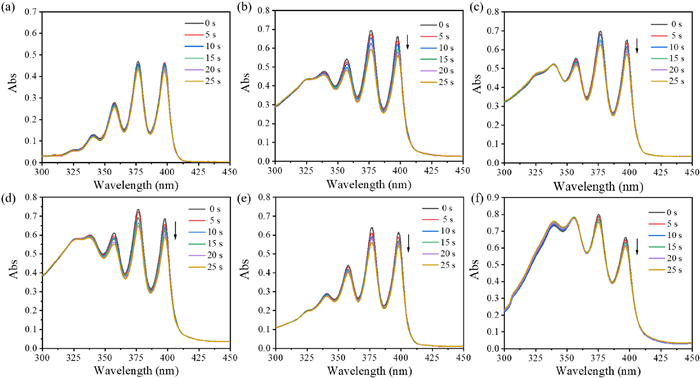
To evaluate the potential of the chalcogen-doped CPPs as PSs, anthracenediyl-bis(methylene)dimalonic acid (ABDA) was employed as a trapper agent for singlet oxygen. 1O2 reacts with the anthracene core of ABDA via a Diels-Alder reaction to form an endoperoxide, which disrupts the conjugated system of anthracene and results in a decrease of its characteristic absorption band at 378–400 nm [89]. Solutions containing ABDA and each nanohoops were irradiated with a 400 nm light source (12 W). The absorption spectra of these mixtures were monitored over time using UV–vis spectroscopy. In contrast to the control experiment with ABDA alone in MeCN (Fig. 5a), the CPPs-containing systems exhibited a continuous and pronounced decrease in absorbance at 398 nm within 25 s of irradiation (Figs. 5b-f). This pronounced reduction clearly demonstrates that all the function as effective photosensitizers for 1O2. The singlet oxygen quantum yield (ΦΔ) was determined in MeCN using Rose Bengal (RB) as a reference standard. A linear fit of the decrease in absorbance at 398 nm versus irradiation time was used to calculate the ΦΔ values of the samples according to Eq. S1 (Supporting information) [90]. The measured ΦΔ values for BSe-[10]CPP, BTT-[8]CPP, BSeT-[8]CPP, BT-[8]CPP and BT-[10]CPP were 0.30, 0.26, 0.22, 0.37 and 0.40, respectively. While the heavy-atom effect of Se is expected to enhance SOC and facilitate ISC, BSe-[10]CPP exhibits a lower ΦΔ (0.30) than BT-[10]CPP (0.40) and BT-[8]CPP (0.37). Our TD-DFT calculations indeed confirm that BSe-[10]CPP possesses larger SOC constants and a higher ISC rate constant, particularly for the S1 → T3 channel (Table S12 in Supporting information). However, the ΦΔ is not governed solely by ISC efficiency. It reflects the overall balance among triplet formation, nonradiative deactivation within the triplet manifold, and triplet-triplet energy transfer to 3O2. Although Se incorporation promotes ISC, it may also enhance competing nonradiative pathways, reducing the fraction of triplet excitons available for 1O2 generation. Given that the T1 energies of all three macrocycles exceed the threshold for 1O2 sensitization, the observed differences in ΦΔ likely stem from variations in triplet utilization efficiency rather than triplet energy deficiency. Thus, the higher ΦΔ values of BT-[10]CPP and BT-[8]CPP can be attributed to a more favorable balance between triplet formation and energy transfer, despite their comparatively smaller SOC.
Figure 5
Figure 5.
The absorption spectra of ABDA after irradiation (400 nm, 12 W) for different time in the presence of different photosensitizers (2 × 10⁻⁵ mol/L in MeCN): (a) Control: ABDA without any additive, (b) BT-[10]CPP, (c) BSe-[10]CPP, (d) BT-[8]CPP, (e) BTT-[8]CPP and (f) BSeT-[8]CPP.
Building on the efficient 1O2 generation capability of the nanohoops, they were utilized as photocatalysts for the heteroatom oxidation of thioanisole to assess their potential in photoredox applications. As previously reported, oxidation of thioanisole can lead to methyl phenyl sulfoxide as the major product, with methyl phenyl sulfone generated as a byproduct [91,92]. A systematic screening of reaction conditions was conducted (Table 2). Specifically, the reaction was carried out by treating thioanisole with either 0.01 or 0.1 equiv. of BSe-[10]CPP as the PS in various solvents (MeCN, toluene and DMF) under irradiation with 400 nm light (12 W). Notably, employing 0.01 equiv. of the macrocycle in DMF resulted in quantitative conversion after 24 h, selectively affording methyl phenyl sulfoxide. This high efficiency in DMF may be explained by reduced physical quenching of 1O2 in solvents of higher polarity, which enhances the availability of 1O2 for substrate oxidation [93]. Under optimized conditions with DMF as the solvent, chalcogen-doped CPPs functioned as efficient photocatalysts for heteroatom oxidation (Table 3). When employed at 0.01 equiv. BSe-[10]CPP, BT-[8]CPP and BT-[10]CPP each achieved nearly quantitative conversion to the sulfoxide product. In contrast, BTT-[8]CPP and BSeT-[8]CPP exhibited lower performance at this catalyst amount, likely due to their intrinsically reduced ΦΔ combined with the use of a low catalytic equivalent. Increasing the catalyst quantity to 0.1 equiv. resulted in near-quantitative sulfoxide yields for all five nanohoops. These results underscore the promise of chalcogen-doped CPPs as highly efficient and tunable photocatalysts for selective oxidation reactions.
Table 2
Table 2.
Control experiments for the oxidation of thioanisole employing BSe-[10]CPP as photosensitizer.a
a Reaction condition: Thioanisole (1.0 equiv.), BSe-[10]CPP as PS, LED light irradiation (400 nm, 12 W), room temperature, to air. b Reaction concentration 0.5 mol/L. c Isolated yields.
Table 3
Table 3.
Control experiments for the oxidation of thioanisole employing BSe-[10]CPP, BTT-[8]CPP, BSeT-[8]CPP, BT-[8]CPP and BT-[10]CPP as PSs respectively.a
a Reaction condition: Thioanisole (1.0 equiv.), LED light irradiation (400 nm, 12 W), room temperature, to air, 24 h. b Reaction concentration: 0.5 mol/L. c Isolated yields.
In summary, we report a series of chalcogen-embedded D-A CPPs (BSe-[10]CPP, BT-[8]CPP, BT-[10]CPP, BTT-[8]CPP and BSeT-[8]CPP) that exhibit tunable photophysical properties and efficient photocatalytic activity via precise atom engineering strategy. By employing benzoselenadiazole or benzothiadiazole as electron-accepting motifs in conjunction with integrated thiophene-based donor units, these nanohoops display significant solvatofluorochromism originating from intrinsic and pronounced ICT character. Their emission is readily tunable into the NIR region with ΦPL ranging from 23.8% to 58.8% in toluene and from 9.0% to 50.4% in DMF, representing superior performance relative to the reported weakly emissive long-wavelength emitting nanohoops. Experimental and theoretical analyses confirm that heavy atom induced spin-orbit coupling enhances ISC, resulting in high singlet oxygen quantum yields of up to 40%. Notably, these CPPs serve as highly effective photosensitizers for the selective oxidation of thioanisole to sulfoxide, achieving near-quantitative conversion with excellent chemoselectivity. The tunable NIR emission and efficient 1O2 generation position these nanohoops as promising candidates for advanced optical materials, such as near-infrared organic light-emitting diodes and chemical sensors. Furthermore, their excellent photocatalytic performance demonstrates significant potential in sustainable organic synthesis, particularly for selective oxidation reactions under mild and environmentally benign conditions. This work not only extends the emission range of D-A CPPs into the NIR region but also establishes a functional platform for applications in optoelectronics and green catalysis.
CRediT authorship contribution statement
Xiaonan Li: Writing – review & editing, Writing – original draft, Visualization, Validation, Supervision, Software, Resources, Project administration, Methodology, Investigation, Formal analysis, Data curation, Conceptualization. Shimin Fan: Writing – review & editing, Writing – original draft, Visualization, Validation, Supervision, Software, Resources, Project administration, Methodology, Investigation, Formal analysis, Data curation, Conceptualization. Lin Liu: Writing – review & editing, Writing – original draft, Visualization, Validation, Supervision, Software, Resources, Project administration, Methodology, Investigation, Formal analysis, Data curation, Conceptualization. Shengzhu Guo: Writing – review & editing, Writing – original draft, Investigation, Data curation. Siwei Wu: Writing – review & editing, Writing – original draft, Investigation, Data curation. Leping Zhang: Writing – review & editing, Writing – original draft, Investigation. Liu Lu: Writing – review & editing, Writing – original draft, Investigation. Zhe Lian: Writing – review & editing, Writing – original draft, Methodology, Investigation, Data curation, Conceptualization. Xuebo Chen: Writing – review & editing, Writing – original draft, Software, Resources, Project administration, Methodology, Investigation, Data curation, Conceptualization. Ying Wang: Writing – review & editing, Writing – original draft, Methodology, Investigation, Funding acquisition, Data curation, Conceptualization. Hua Jiang: Writing – review & editing, Writing – original draft, Visualization, Validation, Supervision, Software, Resources, Project administration, Methodology, Investigation, Funding acquisition, Formal analysis, Data curation, Conceptualization.
Declaration of competing interests
The authors declare that they have no known competing financial interests or personal relationships that could have appeared to influence the work reported in this paper.
Acknowledgments
This work was supported by the National Natural Science Foundation of China (Nos. 22271019, 22471022 and 225B2104) and the Beijing National Natural Science Foundation (No. 2262012).
Supplementary materials
Supplementary material associated with this article can be found, in the online version, at doi:10.1016/j.cclet.2026.112797.
[1]
R. Jasti, J. Bhattacharjee, J.B. Neaton, C.R. Bertozzi, J. Am. Chem. Soc. 130 (2008) 17646–17647. doi: 10.1021/ja807126u
[2]
H. Omachi, T. Nakayama, E. Takahashi, Y. Segawa, K. Itami, Nat. Chem. 5 (2013) 572–576. doi: 10.1038/nchem.1655
[3]
Z. Sun, T. Suenaga, P. Sarkar, et al., Proc. Natl. Acad. Sci. U. S. A. 113 (2016) 8109–8114. doi: 10.1073/pnas.1606530113
[4]
Y. Fan, J. He, S. Guo, H. Jiang, ChemPlusChem 89 (2024) e202300536. doi: 10.1002/cplu.202300536
[5]
R. Jasti, C.R. Bertozzi, Chem. Phys. Lett. 494 (2010) 1–7.
S. Nonell, L. Moncayo, F. Trull, et al., J. Photochem. Photobio. B 29 (1995) 157–162. doi: 10.1016/1011-1344(95)07137-Q
Figure 1
(a) D-A CPP derivatives exhibiting red-shifted emission with notable ΦPL in previous work. (b) Design and synthesis of D-A CPP derivatives (BT-[10]CPP, BT-[8]CPP, BSe-[10]CPP, BTT-[8]CPP and BSeT-[8]CPP) exhibiting tunable emissions from yellow-green to the NIR region through size effects of CPPs and atom engineering strategy with concurrent singlet oxygen generation in this work. The corrected fluorescence spectroscopic data of CPPs in Fig. 1b were measured in DMF. BT: Benzothiadiazole, BSe: benzoselenadiazole, T: Thiophene.
Figure 2
(a, b) X-ray crystal structures, (c) long range channel alignment, and (d) Herringbone packing model of BSe-[10]CPP. (e, f) X-ray crystal structures, (g) long range channel alignment, and (h) Herringbone packing model of BTT-[8]CPP.
Figure 3
(a) The UV–vis spectra and corrected fluorescence spectra of BT-[10]CPP (I, λex = 333 nm), BSe-[10]CPP (II, λex = 335 nm), BT-[8]CPP (III, λex = 333 nm), BTT-[8]CPP (IV, λex = 340 nm) and BSeT-[8]CPP (V, λex = 340 nm) in CH2Cl2 (1.0 × 10⁻⁵ mol/L). (b) The UV–vis spectra and corrected fluorescence spectra of BSeT-[8]CPP in various solvents (1.0 × 10⁻⁵ mol/L). (c) Fluorescence peak energy of BT-[10]CPP, BT-[8]CPP, BSe-[10]CPP, BTT-[8]CPP and BSeT-[8]CPP versus the solvent polarity parameter, ET(30). Pictures of (d) BT-[10]CPP, BSe-[10]CPP, BT-[8]CPP, BTT-[8]CPP and BSeT-[8]CPP in CH2Cl2 at ambient light (up) and their emissions excited at λ = 365 nm (bottom), and (e) BSeT-[8]CPP in various solvents at ambient light (up) and their emissions excited at λ = 365 nm (bottom).
Figure 4
(a) Energy diagrams and pictorial representations of the frontier molecular orbitals for BT-[10]CPP, BSe-[10]CPP, BT-[8]CPP, BTT-[8]CPP and BSeT-[8]CPP calculated by DFT. (b) TD-DFT calculated the energy levels and SOC constants of the singlet and triplet excited states of BSeT-[8]CPP.
Figure 5
The absorption spectra of ABDA after irradiation (400 nm, 12 W) for different time in the presence of different photosensitizers (2 × 10⁻⁵ mol/L in MeCN): (a) Control: ABDA without any additive, (b) BT-[10]CPP, (c) BSe-[10]CPP, (d) BT-[8]CPP, (e) BTT-[8]CPP and (f) BSeT-[8]CPP.
Table 1.
The photophysical and electrochemical data of BT-[10]CPP, BSe-[10]CPP, BT-[8]CPP, BSe-[8]CPP, BTT-[8]CPP and BSeT-[8]CPP.
Compd.
λabsa,b (nm)
λema,c (nm)
ΦPLd (%)
τe (ns)
krf (107 s−1)
knrg (107 s−1)
Eonsentox (eV)
HOMO h (eV)
LUMOh (eV)
HOMOi (eV)
gaph (eV)
Eg(opt)j (eV)
BT-[10]CPP
333
596
59.0
7.68
7.68
5.34
0.71
−5.36
−2.39
−5.51
2.97
2.38
BSe-[10]CPP
335
639
39.3
5.88
6.68
10.3
0.71
−5.33
−2.37
−5.51
2.96
2.30
BT-[8]CPP
333
640
28.5
7.20
3.96
9.93
0.50
−5.27
−2.45
−5.30
2.82
2.26
BTT-[8]CPP
340
669
56.7
7.70
7.36
5.62
0.43
−5.31
−2.49
−5.23
2.82
2.13
BSeT-[8]CPP
340
720
18.6
4.35
4.28
18.73
0.43
−5.26
−2.47
−5.23
2.79
2.03
a UV–vis absorption and corrected fluorescence spectra were measured in CH2Cl2 (1 × 10⁻⁵ mol/L) at room temperature. b Wavelength of the maximum absorption. c Corrected emission maximum. d Absolute fluorescence quantum yield. e Lifetime in CH2Cl2 (XBT-[10]CPP2 = 0.935, XBSe-[10]CPP2 = 0.800, XBT-[8]CPP2 = 0.932, XBTT-[8]CPP2 = 0.994, XBSeT-[8]CPP2 = 1.127). f Radiative transition rate, kr = ΦPL/τ. g Nonradiative transition rate, knr = kr(1- ΦPL)/ΦPL. h Calculated using PBE0 DFT with implicit solvation (SMD). i HOMO = −(4.8 + Eonsetox) eV (calibrated by ferrocene). j Estimated from absorption onset, Eg(opt) = 1240/λonset.
Table 2.
Control experiments for the oxidation of thioanisole employing BSe-[10]CPP as photosensitizer.a
Entry
BSe-[10]CPP (equiv.)
Solvent b
Time (h)
Yield (%)c
1
0.01
MeCN
24
82
2
0.1
MeCN
24
>99
3
0.01
Toluene
48
>99
4
0.1
Toluene
24
>99
5
0.01
DMF
24
>99
6
0.1
DMF
24
>99
a Reaction condition: Thioanisole (1.0 equiv.), BSe-[10]CPP as PS, LED light irradiation (400 nm, 12 W), room temperature, to air. b Reaction concentration 0.5 mol/L. c Isolated yields.
Table 3.
Control experiments for the oxidation of thioanisole employing BSe-[10]CPP, BTT-[8]CPP, BSeT-[8]CPP, BT-[8]CPP and BT-[10]CPP as PSs respectively.a
Entry
Photosensitizer
CPPs (equiv.)b
Yield (%)c
1
BSe-[10]CPP
0.01
>99
2
BSe-[10]CPP
0.1
>99
3
BTT-[8]CPP
0.01
81
4
BTT-[8]CPP
0.1
>99
5
BSeT-[8]CPP
0.01
57
6
BSeT-[8]CPP
0.1
>99
7
BT-[8]CPP
0.01
>99
8
BT-[8]CPP
0.1
>99
9
BT-[10]CPP
0.01
>99
10
BT-[10]CPP
0.1
>99
a Reaction condition: Thioanisole (1.0 equiv.), LED light irradiation (400 nm, 12 W), room temperature, to air, 24 h. b Reaction concentration: 0.5 mol/L. c Isolated yields.


 DownLoad:


 下载:


 下载:

