Citation:
Xiaoping Zhang, Xiaoyun Wang, Liqun Cheng, Lijuan Liu, Jianchuan Liu, Jianhua Ding, Roman Balabin, Xinglei Zhang, Konstantin Chingin, Huanwen Chen. Catalyst-free production of hydrogen peroxide enabled by plasma-microdroplet-generated water radical cations[J]. Chinese Chemical Letters,
2026, 37(12): 112774.
doi:
10.1016/j.cclet.2026.112774
Catalyst-free production of hydrogen peroxide enabled by plasma-microdroplet-generated water radical cations
English
Catalyst-free production of hydrogen peroxide enabled by plasma-microdroplet-generated water radical cations
The Jiangxi Key Laboratory for Mass Spectrometry and Instrumentation, East China University of Technology, Nanchang 330013, China
b.
Cancer Research Center, The Key Laboratory for Diagnosis, Treatment, and Rehabilitation of Cancer using Chinese Medicine, Jiangxi University of Chinese Medicine, Nanchang 330004, China
* Corresponding author at: The Jiangxi Key Laboratory for Mass Spectrometry and Instrumentation
Received Date:
17 November 2025 Accepted Date:
14 April 2026 Revised Date:
04 March 2026 Available Online:
15 December 2026
Abstract:
The development of efficient and sustainable synthesis methods for hydrogen peroxide (H2O2) is crucial, given its broad utility as a green oxidant in chemical manufacturing and environmental remediation. Herein, we report a catalyst-free strategy for the abundant production of H2O2 directly from water under ambient conditions via a plasma-microdroplet platform. This approach achieves a high H2O2 yield of 42.7 mg/h and >96% selectivity, substantially surpassing those of other water-activation methods. Mechanistic studies reveal that the reaction proceeds through the in-situ generation of water dimer radical cations ((H2O)2+•), which then follow two possible pathways: (1) Dissociation into hydroxyl radicals (•OH) that recombine to form H2O2, or (2) directly conversion to H2O2+• and H2. Theoretical calculations support these pathways and underscore the ubiquity of (H2O)2+• in various aqueous activation systems (e.g., microdroplets, pneumatic atomization, and ultrasonic β-cyclodextrin cavitation). With its operational simplicity, scalability, and avoidance of complex purification, this method offers a promising and industrially viable route to H2O2 production.
Hydrogen peroxide (H2O2) is an environmentally benign oxidant pivotal to chemical synthesis, environmental remediation, and energy conversion [1–3]. Its industrial production, however, predominantly depends on the energy-intensive anthraquinone process or the direct reaction of hydrogen (H2) and oxygen (O2), which pose significant safety and sustainability challenges [4–7]. Consequently, substantial research efforts have been directed toward developing alternative catalytic routes, such as electrochemical and photocatalytic water oxidation [8–16]. Nevertheless, these methods often depend on precious metal catalysts or complex material architectures, which hinder their broad applicability. Therefore, the development of efficient, green, scalable, and catalyst-free methods for H2O2 production thus remains a critical and ongoing challenge.
Recent advances in microdroplet chemistry have unveiled unconventional pathways for H2O2 production [17–19]. A landmark study by Zare and co-workers demonstrated that H2O2 can be generated spontaneously in water microdroplets without conventional catalysts or external energy input, a phenomenon attributed to the recombination of hydroxyl radicals (•OH) at the air-water interface [20]. They proposed that an intense intrinsic electric field (~109 V/m) at the interface polarizes water molecules, facilitating charge separation and radical formation (e.g., OH− to •OH). Subsequent work by Zhang and coworkers highlighted the role of a [•OH···H3O+] complex formed through the capture of •OH by hydronium ions [21]. Despite these insights, the mechanism of interfacial H2O2 formation remains actively debated. Among proposed mechanisms, contact-electro-catalysis (CEC) has gained attention as a plausible pathway [22,23], suggesting that electron transfer during water-solid contact electrification generates water radical cations (H2O+•), which further dissociate into H+ and •OH. Notably, beyond the monomolecular H2O+•, water dimer radical cations, (H2O)2+•, are increasingly recognized as potential intermediates in interfacial reactions. Our group has contributed to this emerging framework by elucidating the reactivity of (H2O)2+• with a diverse range of compounds [24–28]. Despite this progress, whether and how (H2O)2+• directly contributes to H2O2 synthesis remains an open question. This gap motivates the central objective of this work: To determine whether (H2O)2+• is a key intermediate and to uncover the mechanism by which it enables the direct synthesis of H2O2 under ambient conditions?
In this study, we report a catalyst-free strategy for efficient H2O2 production mediated by (H2O)2+• using a plasma-microdroplet platform. The presence of key intermediates, including (H2O)2+•, and the resulting H2O2 was confirmed across various gas-liquid interfaces (e.g., corona discharge, sprayed microdroplets, and pneumatic atomization), as well as in solid-liquid interfaces such as ultrasonic β-cyclodextrin cavitation. Operating under mild conditions without precious-metal catalysts or energy-intensive infrastructure, this approach offers a sustainable and cost-effective alternative to conventional H2O2 synthesis.
In our initial experiments, water radical cations were generated through ionization of water/argon vapor mixture. Real-time mass spectrometry (MS) analysis revealed the formation of characteristic ionic species, including protonated water clusters, (H2O)2H+ (m/z 37), as well as abundant water dimer radical cation, (H2O)2+• (m/z 36) (Fig. S1 in Supporting information). These experimental observations aligned with previous studies [27,29], which have characterized the formation of (H2O)2+• in plasma system. To probe the subsequent chemical fate of the generated (H2O)2+• species, we specifically designed an experimental system to investigate its potential conversion to H2O2 under ambient conditions.
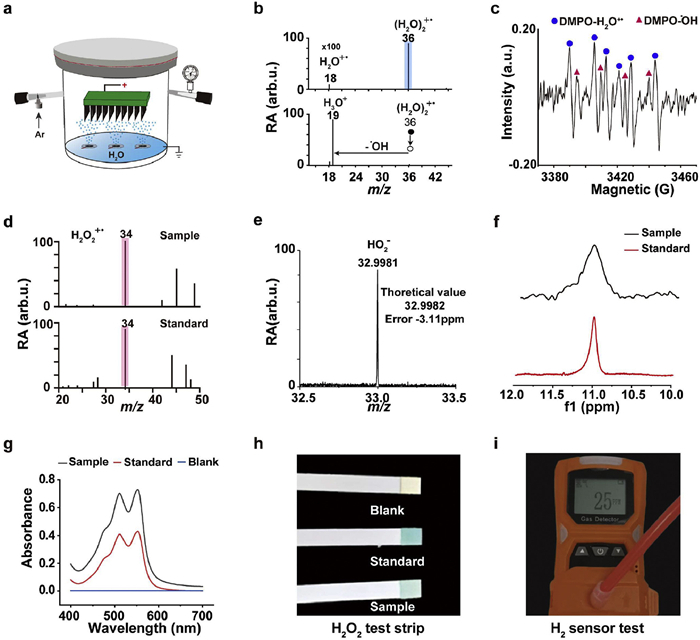
The custom-designed reactor (Fig. 1a) consisted of four key components: (1) A reactant introduction system with solenoid-valve-controlled polyether ether ketone (PEEK) tubing to evacuate air and introduce high-purity argon gas into the reaction chamber, (2) a (H2O)2+• generation system featuring an array of tungsten needles that produced a tailored electric field, (3) a sealed reaction chamber, and (4) a product collection system with water as reactant and absorbent. The resulting solution was subsequently subjected to comprehensive analytical characterization employing multiple complementary techniques.
Figure 1
Figure 1.
Generation and characterization of H2O2 product via (H2O)2+•. (a) Schematic illustration of the homemade reactor including material inlet, product outlet, and grounded/HV-electrodes. (b) Mass spectrum of (H2O)2+• (m/z 36) generated by corona discharge ionization and corresponding tandem MS spectrum of m/z 36. (c) Spin-trapping electron paramagnetic resonance spectra identifying DMPO−H2O+• (AN = 15.8 G, AHβ = 22.5 G) and DMPO-•OH (AN = AHβ = 15 G) adducts. (d) Electrospray ionization mass spectra of the sample solution compared with H2O2 standard in positive ion mode. (e) High resolution mass spectrometry of the sample solution in negative ion mode. (f) 1H nuclear magnetic resonance spectroscopy of the sample solution compared with H2O2 standard. (g) Ultraviolet-visible spectra of the sample solution, H2O2 standard, and a blank control, with a characteristic absorbance at 511 nm and 552 nm. (h) Colorimetric test results for H2O2 detection. (i) H2 detection result. RA: relative abundance. DMPO: 5,5-dimethyl-1-pyrroline-N-oxide.
The H2O2 obtained in product collection system via the intermediate (H2O)2+• was characterized and validated through a series of experiments. Fig. 1b (top) displays the characteristic mass spectrum of (H2O)2+• at m/z 36 (base peak) and H2O+• at m/z 18, generated by the plasma-microdroplet reaction system and detected in real time using a mass spectrometer (Fig. S2 in Supporting information). The dominance of the m/z 36 peak confirms the efficient formation of (H2O)2+• as the primary reactive intermediate under these conditions, while the minor signal at m/z 18 corresponds to the monomeric radical cation. The collision-induced dissociation (CID) spectrum of m/z 36 (Fig. 1b, bottom) yielded two diagnostic fragment ions: m/z 19 (H3O+) and m/z 18 (H2O+•), corresponding to the elimination of •OH and H2O, respectively. This fragmentation pattern suggests the coexistence of two structural isomers of (H2O)2+•, namely, [•OH···H3O+] and [H2O+···OH2], consistent with previous theoretical predictions [30,31]. These two isomers can also undergo rapid interconversion through a low-energy barrier pathway. The [•OH···H3O+] species has also been commonly observed in water microdroplets, as previously reported by Zhang and co-workers [21]. Specifically, upon formation, H2O+• readily combines with a neutral H2O molecule to form the more thermodynamically stable [H2O+•···OH2] complex (further discussed later).
Fig. 1c shows the electron paramagnetic resonance (EPR) spectroscopy of the reaction solution analyzed using the spin-trapping agent 5,5-dimethyl-1-pyrroline N-oxide (DMPO), employed to stabilize and detect short-lived radical species. The spectrum reveals distinct signals corresponding to radical adducts: A quartet pattern assigned to DMPO-•OH and a sextet pattern attributed to DMPO−H2O+•, confirming the generation of both •OH and H2O+• radicals within 5 min of reaction initiation. The measured hyperfine splitting constants (AN = AHβ = 15 G for DMPO-•OH; AN = 15.8 G, AHβ = 22.5 G for DMPO−H2O+•) match reported literature values, supporting the identification of these radical intermediates [24,32]. Mechanistically, the formation of DMPO-•OH can be explained by proton transfer via the reaction pathway: H2O + H2O+• → (H2O)2+• → H3O+ + •OH. These results are in good agreement with previous reports by Cui and coworkers using bubble technology [33,34]. Collectively, the data confirm the generation of H2O+•, (H2O)2+•, and •OH species during water ionization using our plasma-microdroplet setup shown in Fig. 1a.
The H2O2 product was characterized by electrospray ionization mass spectrometry (ESI-MS) in positive ion mode. A prominent peak at m/z 34 was observed (Fig. 1d), assigned to H2O2+•, which matches the ESI-MS spectrum of an H2O2 standard. This species was further confirmed by high-resolution MS in negative-ion mode, revealing an exact mass at m/z 32.9981 with an error of −3.1 ppm (Fig. 1e). To corroborate these findings, the sample was analyzed by 1H nuclear magnetic resonance (NMR) spectroscopy (Fig. 1f). The 1H NMR spectrum of the sample (dissolved in D2O solvent) showed a singlet peak at 11 ppm, characteristic of the protons in H2O2, matching the chemical shift of the H2O2 standard. This signal, attributed to the labile protons of H2O2, is consistent with reported NMR data for H2O2 in water microdroplets [35,36]. Further validation was achieved through ultraviolet-visible (UV–vis) spectroscopy using a classical Fenton-mediated N,N-diethyl-p-phenylenediamine sulfate oxidation method as described previously [37,38]. As shown in Fig. 1g, both the collected samples and the H2O2 standard display consistent absorption peaks at 511 nm and 552 nm. This indicates that the presence of H2O2 in the collected sample. Qualitative confirmation was also obtained using H2O2 test strips (Fig. 1h), where the colorimetric response matched the expected concentration ranges. Together, these complementary analytical techniques confirm the identity of the produced H2O2, which may originate from the dissociation of (H2O)2+•. In addition to H2O2, H2 was identified as a secondary product of the reaction. Under the specified conditions, a 30-min reaction yielded ~25 ppm of hydrogen gas, as quantified by a hydrogen sensor (Fig. 1i). The formation mechanism of H2 will be discussed later, which may involve two major pathways: (1) The direct dissociation of H2O+•, and (2) the direct dissociation of (H2O)2+•.
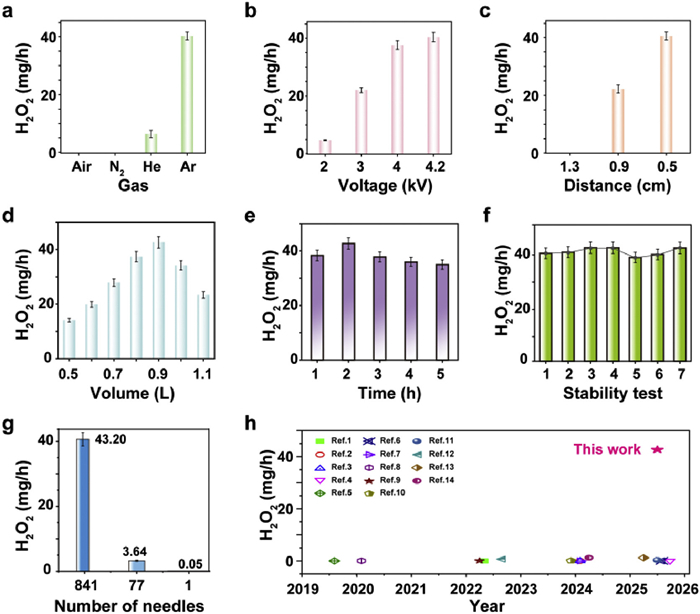
To optimize the H2O2 generation rate, we systematically evaluated the effects of several key parameters. As shown in Fig. 2a, the H2O2 production rate was evaluated under air, nitrogen, helium, and argon atmospheres. The highest production rate of 42.7 mg/h was achieved in argon. This can be attributed to argon’s, role as an inert gas, which facilitates more stable plasma formation and thereby promotes H2O ionization more effectively than air. Plasma stability is the critical prerequisite. For instance, at a fixed applied voltage of 4 kV, a stable plasma was sustained in argon but not in pure N2 due to the latter’s higher breakdown voltage. This also accounts for the absence of H2O2 formation in N2 under these specific conditions. Of note, H2O2 production was observed in N2 at elevated voltage (Fig. S3 in Supporting information), confirming that successful plasma initiation and the subsequent generation of (H2O)2+• are the key rate-determining steps in the overall process. Voltage-dependent experiments (Fig. 2b) revealed that the H2O2 yield increased steadily with the applied voltage from 2 kV to 4.2 kV, reaching a maximum of 42.7 mg/h. The operating voltage was therefore established at 4.2 kV, representing a balance between performance and stability, as higher voltage induced visible discharge phenomena. The significant H2O2 yield is directly attributed to the plasma activation. This conclusion is supported by control experiments in which H2O2 production was undetectable when the plasma was not ignited (high-voltage off or electrode removed) under otherwise identical conditions (Fig. S4 in Supporting information). The effect of the needle-to-liquid distance was examined over a range of 0.5–1.3 cm (Fig. 2c). The results demonstrated an inverse correlation between the distance and the H2O2 production rate, with the highest yield obtained at the shortest distance of 0.5 cm. This distance was therefore chosen for subsequent experiments. The spray height was optimized and fixed at 0.5 cm, while yielded the highest H2O2 production within the tested range of 0.5–0.9 cm (Fig. S5 in Supporting information). To clarify the role of water in the system, experiments were performed in which both its concentration and the total volume were varied. The results indicated that H2O2 production increased with higher water concentration, reaching an optimum when pure water was used as the electrode (Fig. S6 in Supporting information). Conversely, the effect of total water volume was non-monotonic: The production rate initially increased, peaked at an optimal volume, and then declined upon further addition (Fig. 2d).
Figure 2
Figure 2.
Optimization of H2O2 production under varying reaction conditions and comparison with other methods. (a) Gas atmosphere dependence: Air, nitrogen, helium, and argon atmospheres. (b) Applied voltage dependence. (c) Needle-to-liquid distance. (d) Reaction time. (e) Yield stability with different reaction time. (f) Stability test with seven independent experiments. (g) Experimental verification of scalability. (h) Summary of H2O2 production yields by catalyst-free methods (Refs. 1–14) [18,20,36,39–49].
The long-term stability, electrode durability, and scalability of the system were evaluated for practical implementation. Under optimized conditions (4.2 kV), continuous H2O2 production remained stable at 40 ± 5 mg/h over 5 h, with a relative standard deviation (RSD) < 5% (Fig. 2e). The electrode durability was further confirmed through seven independent 1-h test cycles, yielding a consistent production rate of 40 ± 5 mg/h (mean ± SD, n = 7; Fig. 2f), which demonstrates excellent reproducibility. Additionally, the system demonstrated linear scalability, with the production rate proportional to the number of electrodes (e.g., from 0.05 mg/h with 1 electrode to 43.20 mg/h for 841 electrodes; Fig. 2g). Visual inspection of the tungsten needles electrodes after 7 h of continuous operation revealed no apparent corrosion. This observed stability can be attributed to the inherent corrosion resistance of tungsten combined with the mild operational parameters employed in our system. While the system demonstrates promising performance within the tested timeframe, long-term durability over hundreds of hours and energy cost optimization remain key challenges for industrial-scale implementation. Future work will focus on exploring corrosion-resistant coatings or alternative alloys, alongside reactor design optimizations (e.g., pulsed power supply, cooling systems), to further enhance scalability and economic viability.
Under optimized experimental conditions (argon atmosphere, 4.2 kV, 0.5 cm needle-to-liquid distance, and 60 min reaction time), the introduction of water into the reaction chamber facilitates the efficient generation of highly reactive (H2O)2+• species. These abundant radical cations serve as the dominant reactive intermediates in the system, providing the driving force for subsequent H2O2 formation. Remarkably, this plasma-microdroplet system achieves a high H2O2 production rate of 42.7 mg/h under ambient conditions, without the use of chemical catalysts. For comparison, Fig. 2h summarizes the performance of previously reported catalyst-free methods for H2O2 production [18,20,36,39–49]. The (H2O)2+•-mediated process exhibits a substantial enhancement in performance, surpassing existing microdroplet-based methods by a factor of 40–1000,000. The energy efficiency of our plasma-driven process was calculated to be 6.0 g/kWh under optimal conditions (4.2 kV, 1.7 mA), corresponding to an H2O2 production rate of 42.7 mg/h. This efficiency is competitive with advanced electrocatalytic systems (Table S1 in Supporting information), while offering the distinct advantages of catalyst-free operation and high selectivity with minimal byproducts. Notably, our production rate matches or even surpasses the highest yields reported for electrocatalysis [50,51], and photocatalysis [52,53] systems. Importantly, this high performance is achieved without precious metal catalysts or energy-intensive inputs, suggesting a more sustainable and scalable pathway for H2O2 production. Therefore, our catalyst-free method outperforms other catalyst-free approaches and rivals the performance of many advanced catalytic systems.
In addition to H2O2, H2 was also detected using a hydrogen sensor, confirming its simultaneous generation with H2O2. The measured yield of H2 (0.05 mmol/h) was 25 times lower than that of H2O2 (1.26 mmol/h). This pronounced difference in product yields demonstrates that the reaction overwhelmingly favors the formation of H2O2. The observed product distribution can be attributed to the dominance of alternative reaction pathways, most likely involving highly efficient proton-coupled electron transfer process that are favored for H2O2 production. The absence of detectable byproducts corresponds to a high H2O2 selectivity exceeding 96%.
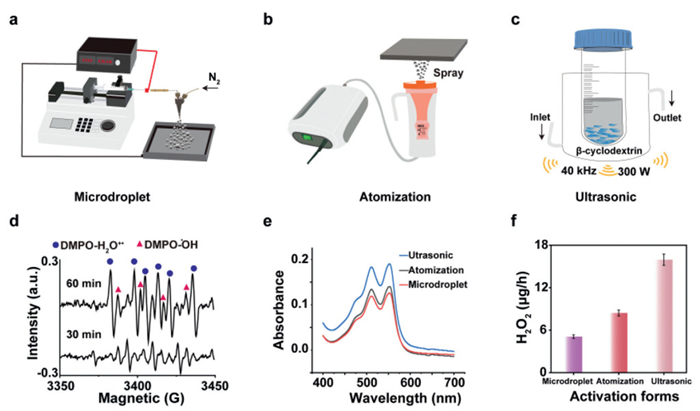
To elucidate the universal mechanism of H2O2 generation mediated by water radical cations, we investigated multiple activation approaches using different experimental setups. Figs. 3a-c illustrates the three configurations employed: Sprayed water microdroplets, pneumatic atomization, and ultrasonic β-cyclodextrin-assisted cavitation. In the sprayed water microdroplet system, H2O+• is generated through high-voltage-induced charge separation at the gas-liquid interface, resulting in the formation of reactive charged microdroplets. The pneumatic atomization approach produces H2O+•via mechanical shear-induced charge separation, which generates intense electric fields on the order of 109 V/m during droplet fragmentation. In the ultrasonic β-cyclodextrin system, H2O+• is generated through the synergistic combination of cavitation (40 kHz) and contact electrification, where the hydrophobic cavities of β-cyclodextrin further enhance radical stability. Despite their differences in their activation mechanisms, all three methods consistently lead to the formation of H2O+•, which readily dimerizes to form (H2O)2+• as the key intermediate. This shared pathway supports a universal mechanism for H2O2 production via the dissociation of for (H2O)2+•, underscoring the broad applicability of water radical cation chemistry across diverse physicochemical activation environments.
Figure 3
Figure 3.
H2O2 generation via water radical cations with different setups. (a) Setup for spraying water microdroplets. (b) Setup for pneumatic atomization. (c) Setup for ultrasonic β-cyclodextrin. (d) Spin-trapping electron paramagnetic resonance spectrum identifying DMPO−H2O+• (AN = 15.8 G, AHβ = 22.5 G) and DMPO-•OH (AN = AHβ = 15 G) adducts via ultrasonic with different time. (e) Ultraviolet-visible spectra of the sample solutions of different setups, with a characteristic absorbance at 511 nm and 552 nm. (f) H2O2 yields for three different setups.
Fig. 3d and Fig. S7 (Supporting information) present the EPR spectroscopic analysis using DMPO as a spin-trapping reagent for ultrasonic and microdroplet, respectively. The EPR spectra consistently reveal the formation of two characteristic radical adducts across all activation methods: (1) A quartet signal with hyperfine coupling constants (AN = AHβ = 15 G), characteristic of the DMPO-•OH adduct, and (2) a distinct sextet pattern (AN = 15.8 G, AHβ = 22.5 G), uniquely assigned to the DMPO−H2O+• adduct. These spectroscopic features provide direct experimental evidence for the generation of both H2O+• and •OH radicals as key reactive intermediates in all three systems. As shown in Fig. 3d and Fig. S7, the EPR signal intensities of the spin-trapped radicals increased over time, reflecting the continuous accumulation of radical adducts under steady-state reaction conditions.
Fig. 3e shows the UV–vis spectra of the solution samples collected from the spray water microdroplets, pneumatic atomization, and ultrasonic β-cyclodextrin cavitation systems. All spectra exhibit consistent absorption peaks at 511 and 552 nm, confirming the presence of H2O2 in samples produced by each activation method. Time-dependent spectroscopic analysis further revealed a progressive increase in the intensities of these characteristic peaks, as quantified in Fig. S8 (Supporting information). The concurrent rise in absorbance and EPR signal intensity strengthens the evidence for a radical-driven formation mechanism of H2O2.
Fig. 3f displays the H2O2 yields with three alternative methods. The comparison clearly demonstrates that our plasma-microdroplet approach achieves an H2O2 yield of 42,700 μg/h, which is orders of magnitude higher than those of conventional methods, including microdroplets (~5 μg/h), atomization (~10 μg/h), and ultrasonic (~15 μg/h) approaches. While these alternative methods exhibited stable operation over 5 h with RSD <5% (Fig. S9 in Supporting information), their characteristically low production rates inherently limit practical throughput. Furthermore, as summarized in Table S2 (Supporting information), these methods face inherent constraints such as carrier gas dependency and limited scalability. In contrast, our plasma-microdroplet system combines high efficiency, catalyst-free operation, and scalability potential, making it a promising solution for on-demand H2O2 production.
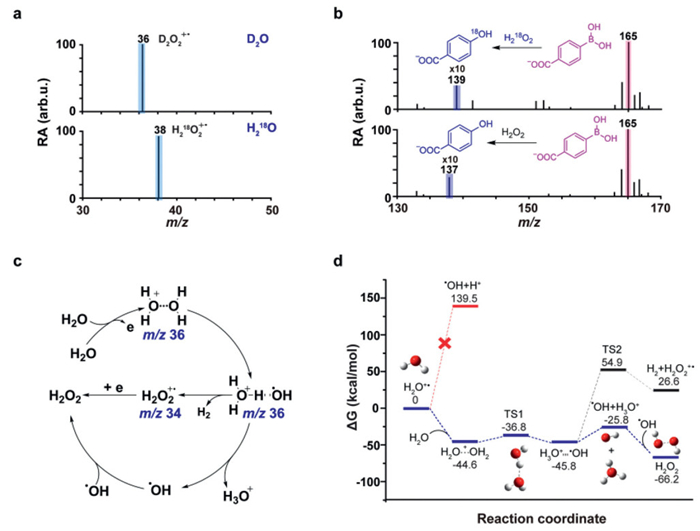
To elucidate the reaction mechanism for the formation of H2O2, we conducted isotopic labeling experiments. Through isotopic labeling experiments using D2O and H218O, we confirmed that both hydrogen and oxygen atoms in the generated H2O2 originate from water. Mass spectrometric analysis revealed characteristic mass shifts corresponding to the formation of isotopically labeled peroxide species. Replacement of H2O with D2O resulted in the formation of D2O2+•, as evidenced by a distinct mass shift from m/z 34 (H2O2+•) to m/z 36 (D2O2+•) in the mass spectrum (Fig. 4a, top). Similarly, the use of H218O led to the formation of H218O2+•, confirmed by the corresponding shift to m/z 38 (H218O2+•) (Fig. 4a, bottom). We further employed 4-carboxyphenylboronic acid (MW 166, C7H7BO4) as a molecular probe to detect H2O2, based on its specific oxidation to 4-hydroxybenzoic acid (MW 138, C7H6O3) in the presence of H2O2 [23]. After conducting experiments with both H218O and H2O, the collected samples were separately mixed with solutions of 4-carboxyphenylboronic acid. The resulting labeled oxidation product (m/z 139, C7H5O218O–) was detected by ESI-MS, exhibiting the expected +2 m/z shift compared to the unlabeled product (m/z 137, C7H5O3–) (Fig. 4b). The structures of the corresponding products were confirmed by tandem MS (Fig. S10 in Supporting information). Total ion chromatograms and extracted ion chromatograms for these signals are provided in Fig. S11 (Supporting information), which further confirmed the reaction between 4-carboxyphenylboronic acid and H2O2. These results collectively confirm that both hydrogen and oxygen atoms in the generated H2O2 are derived from water.
Figure 4
Figure 4.
Reaction mechanism for the formation of H2O2 from water radical cations. (a) Mass spectrometric characterization of isotopic labeling experiments with labeled D2O and H218O. (b) Comparative mass spectra of 4-carboxyphenylboronic acid oxidation products via the reaction of 4-carboxyphenylboronic acid with labeled H218O and unlabeled H2O. (c) Schematic diagram summarizing the possible mechanisms for the formation of H2O2. (d) The geometries and energies (in kcal/mol at 298 K and 1 atm pressure) of possible molecular and ionic species involved in the generation of H2O2, calculated with the B3LYP method.
Based on the experimental evidence, we propose a mechanism for H2O2 formation mediated by water radical cations. As shown in Fig. 4c, the process begins with the one-electron oxidation of a water molecule, forming the highly reactive H2O+• (m/z 18). The H2O+• rapidly associates with a neutral H2O molecule to generate [H2O+•···OH2] (m/z 36). This ion is stabilized by a two-center three-electron (2c-3e) bond, which has been confirmed in our earlier work using high-resolution MS [24]. Oxygen-containing compounds such as acetone or H2O can further stabilize H2O+•via hydrogen bonding and charge delocalization [24,32]. The [H2O+•···OH2] complex can undergo proton transfer to form its isomer [•OH···H3O+]. Subsequent H2O2 formation proceeds mainly through two pathways. (1) Direct dissociation of [•OH···H3O+] releases •OH, and the recombination of two •OH radicals yield H2O2 (Eq. 1). (2) Direct elimination of H2 from [•OH···H3O+] generates H2O2+• (Eq. 2), which then obtains an electron to form H2O2. Alternatively, H2O+• may also undergo high-energy dissociation into H+ and •OH, followed by •OH recombination to produce H2O2 (Eq. 3).
Our experimental observations of •OH, H2O+• and (H2O)2+• (via EPR and MS), combined with the mechanistic framework outlined in Fig. 4c, provide strong evidence for a radical-mediated pathway in H2O2 generation. This process is further elucidated by the potential energy surface (PES) scan in Fig. 4d, which compares the energetics of competing reaction pathways and identifies the dominant pathway under kinetic control. To confirm the proposed mechanism, density functional theory (DFT) calculations employing the B3LYP functional were conducted. The results show that the formation of the [H2O+•···OH2] complex through combination of a neutral H2O molecule with H2O+• is accompanied by a remarkable energy stabilization of 44.6 kcal/mol. This substantial energy decrease underscores the thermodynamic driving force of the interaction, which arises from two key factors: (1) Electrostatic stabilization, wherein the neutral H2O molecule donates electron density to the electron-deficient H2O+•, thereby reducing its radical character; and (2) the formation of a 2c-3e bond in the resulting complex. The 2c-3e bonding further stabilizes the system through symmetry-matched orbital overlap, effective electron delocalization, and partial occupation of antibonding orbitals, collectively lowering the system energy. These computational findings are consistent with experimental MS data, where the signal intensity at m/z 36 significantly exceeds that at m/z 18.
Further calculations indicate that the [H2O+•···OH2] complex lies only ~1.2 kcal/mol above its isomer [•OH···H3O+], allowing rapid interconversion between the two. This transformation proceeds via a low-energy transition state (TS) with a negligible barrier of 7.8 kcal/mol (TS1), as demonstrated by intrinsic reaction coordinate (IRC) calculations that trace the pathway connecting [H2O+•···OH2] to [•OH···H3O+] (Fig. S12 in Supporting information). The [•OH···H3O+] complex serves as a key intermediate in H2O2 generation, branching into two energetically distinct pathways: (1) Direct dissociation into •OH and H3O+ with an activation energy of 20 kcal/mol, followed by spontaneous, barrierless recombination of •OH radicals to yield H2O2; and (2) direct H2 elimination to generate H2O2+•, which subsequently acquires an electron to produce H2O2, a process requiring overcoming a significantly higher energy barrier of 100.7 kcal/mol (TS2). This marked energy difference (20 vs. 100.7 kcal/mol) clearly demonstrates a thermodynamic preference for the radical recombination pathway under most conditions. We also evaluated an alternative route proposed by Wang and co-workers [22,23], which involves the direct dissociation of H2O+• into •OH and H+. Our calculations reveal that this route requires overcoming a high energy barrier of >139.5 kcal/mol. In contrast, the route via the [•OH···H3O+] intermediate followed by •OH recombination proceeds with markedly lower energy demand, indicating a clear preference for the latter under typical conditions. These results are further supported by recent work from Cooks and co-workers, who also identified (H2O)2+• as key intermediate in microdroplet chemistry [54]. Thus, we propose a more favorable and energetically feasible mechanistic pathway for H2O2 formation than that reported by Wang and co-workers [22,23]. The electric field at the needle tip was estimated to be ~0.1 × 10⁹ V/m [55] (details see Supporting information). While not explicitly included in the DFT calculations, fields of this magnitude are known to lower energy barriers. However, given the low intrinsic energy barriers of the proposed mechanism and the good agreement between experiment and theory, the field is not expected to qualitatively change the reaction feasibility.
The consistent observation of H2O2 generation across diverse activation systems (e.g., corona discharge arrays, sprayed water microdroplets, pneumatic atomization, and ultrasonic β-cyclodextrin cavitation) strongly suggests a common mechanism meditated by H2O+•. This unified pathway involves three key steps: (1) interfacial charge separation: H2O+• is generated at gas-liquid (e.g., corona discharge) or solid-liquid (e.g., ultrasonication) interfaces. In ultrasonic β-cyclodextrin systems, contact electrification between cyclodextrin and water induces electron transfer, creating hydrated electrons and H2O+•. Corona discharge ionizes water via high-energy electrons, while spray microdroplets achieve ionization via strong electric fields. Pneumatic atomization produces charged microdroplets via contact electrification at water-air and water-wall interfaces. (2) Proton-coupled electron transfer (PCET) [56]: H2O+• rapidly dimerizes to (H2O)2+•, which undergoes PCET to form •OH and H3O+. This step is accelerated by hydrogen-bonded water networks via the Grotthuss mechanism [57], enabling long-range proton hopping. (3) Radical recombination: •OH radicals combine to yield H2O2.
In summary, we have developed a simple, catalyst-free plasma-microdroplet system for the efficient production of H2O2 directly from water. The system achieved a high H2O2 production rate of 42.7 mg/h, as quantified by UV–vis spectroscopy. MS and EPR analyses confirmed (H2O)2+• as the key intermediate in H2O2 formation, supporting a reaction pathway that offers a more reasonable mechanistic interpretation than that proposed by Wang and co-workers. DFT calculations further revealed that H2O2 generation proceeds predominantly through the [•OH···H3O+] intermediate, followed by spontaneous, barrierless recombination of •OH radicals. The proposed mechanism is also applicable to other water activation systems, including microdroplet spray, pneumatic atomization, and ultrasonic β-cyclodextrin cavitation, demonstrating its broad relevance. This work establishes a fundamental connection between proton transfer dynamics and radical-mediated reactions, offering new insight into the intrinsic reactivity of water. The effectiveness of radical-driven water chemistry not only offers a practical strategy for sustainable H2O2 production but also opens new avenues for research in energy conversion and environmental applications. The strategy of in situ generating (H2O)2+• as a reactive mediator at the plasma-droplet interface is potentially extendable to other chemical transformations. Representative extensions may include selective oxidation of organic compounds, ambient condition nitrogen fixation, and advanced degradation of refractory pollutants.
CRediT authorship contribution statement
Xiaoping Zhang: Writing – original draft, Supervision, Funding acquisition, Data curation. Xiaoyun Wang: Data curation. Liqun Cheng: Data curation. Lijuan Liu: Data curation. Jianchuan Liu: Data curation. Jianhua Ding: Writing – review & editing. Roman Balabin: Writing – review & editing. Xinglei Zhang: Writing – review & editing, Supervision. Konstantin Chingin: Writing – review & editing. Huanwen Chen: Writing – review & editing, Supervision.
Declaration of competing interest
The authors declare that they have no known competing financial interests or personal relationships that could have appeared to influence the work reported in this paper.
Acknowledgments
The work was supported by National Natural Science Foundation of China (Nos. 22427805, 22364002, 22376084), Jiangxi Provincial International Cooperation Project (No. 20232BBH80012), Jiangxi Provincial Talent Project (Nos. 2025QT06, gpyc20240074, 20243BCE51056), and Jiangxi University of Chinese Medicine (Nos. CXTD22005, 2004–5252300403, 2025BSZR0012, 2025BSZR0013). East China University of technology Talent Project (No. DHTJBJ202404).
Supplementary materials
Supplementary material associated with this article can be found, in the online version, at doi:10.1016/j.cclet.2026.112774.
M. de la Puente, A. Gomez, D. Laage, J. Phys. Chem. Lett. 16 (2025) 2645–2653. doi: 10.1021/acs.jpclett.5c00172
Figure 1
Generation and characterization of H2O2 product via (H2O)2+•. (a) Schematic illustration of the homemade reactor including material inlet, product outlet, and grounded/HV-electrodes. (b) Mass spectrum of (H2O)2+• (m/z 36) generated by corona discharge ionization and corresponding tandem MS spectrum of m/z 36. (c) Spin-trapping electron paramagnetic resonance spectra identifying DMPO−H2O+• (AN = 15.8 G, AHβ = 22.5 G) and DMPO-•OH (AN = AHβ = 15 G) adducts. (d) Electrospray ionization mass spectra of the sample solution compared with H2O2 standard in positive ion mode. (e) High resolution mass spectrometry of the sample solution in negative ion mode. (f) 1H nuclear magnetic resonance spectroscopy of the sample solution compared with H2O2 standard. (g) Ultraviolet-visible spectra of the sample solution, H2O2 standard, and a blank control, with a characteristic absorbance at 511 nm and 552 nm. (h) Colorimetric test results for H2O2 detection. (i) H2 detection result. RA: relative abundance. DMPO: 5,5-dimethyl-1-pyrroline-N-oxide.
Figure 2
Optimization of H2O2 production under varying reaction conditions and comparison with other methods. (a) Gas atmosphere dependence: Air, nitrogen, helium, and argon atmospheres. (b) Applied voltage dependence. (c) Needle-to-liquid distance. (d) Reaction time. (e) Yield stability with different reaction time. (f) Stability test with seven independent experiments. (g) Experimental verification of scalability. (h) Summary of H2O2 production yields by catalyst-free methods (Refs. 1–14) [18,20,36,39–49].
Figure 3
H2O2 generation via water radical cations with different setups. (a) Setup for spraying water microdroplets. (b) Setup for pneumatic atomization. (c) Setup for ultrasonic β-cyclodextrin. (d) Spin-trapping electron paramagnetic resonance spectrum identifying DMPO−H2O+• (AN = 15.8 G, AHβ = 22.5 G) and DMPO-•OH (AN = AHβ = 15 G) adducts via ultrasonic with different time. (e) Ultraviolet-visible spectra of the sample solutions of different setups, with a characteristic absorbance at 511 nm and 552 nm. (f) H2O2 yields for three different setups.
Figure 4
Reaction mechanism for the formation of H2O2 from water radical cations. (a) Mass spectrometric characterization of isotopic labeling experiments with labeled D2O and H218O. (b) Comparative mass spectra of 4-carboxyphenylboronic acid oxidation products via the reaction of 4-carboxyphenylboronic acid with labeled H218O and unlabeled H2O. (c) Schematic diagram summarizing the possible mechanisms for the formation of H2O2. (d) The geometries and energies (in kcal/mol at 298 K and 1 atm pressure) of possible molecular and ionic species involved in the generation of H2O2, calculated with the B3LYP method.


 DownLoad:

 下载:


 下载:

