Received Date:
25 December 2025 Accepted Date:
08 April 2026 Revised Date:
31 January 2026 Available Online:
15 December 2026
Abstract:
Photocatalytic production of hydrogen peroxide (H2O2) offers a sustainable alternative to the traditional anthraquinone process. Herein, a 0D/2D heterojunction photocatalyst was constructed by coupling AgInS2 quantum dots with Mg-doped poly (triazine imide), exhibiting excellent photocatalytic performance under visible light and ambient air. Glycerol was employed as a hole scavenger and proton donor, the optimally proportioned catalyst AIS@M0.1PTI-2 enabling an H2O2 production rate of 4002.81 μmol g-1 h-1 in 40 vol% glycerol solution-nearly 9.9 times higher than that in pure water. Meanwhile, selective oxidation of glycerol yielded 3398.47 μmol g-1 h-1 dihydroxyacetone (DHA) with 60.01% selectivity. Mg doping improved PTI crystallinity, enhanced charge mobility. AgInS2 quantum dots further boosted visible-light absorption and interfacial electron transfer. Mechanistic investigations, including LSV, EPR, XPS, 13C NMR, DFT, and radical trapping, confirmed selective promotion of the two-electron oxygen reduction pathway and clarified the electron flow across the heterojunction. The mutual enhancement between oxidation and reduction processes enables efficient solar-to-chemical energy conversion, highlighting the potential of this system for green chemical manufacturing.
Hydrogen peroxide (H2O2) is a stable, easily transportable, and environmentally friendly oxidant with the highest available active oxygen content (47.1%, w/w). It finds widespread applications in chemical synthesis, disinfection, environmental remediation, and pulp bleaching [1–3]. Currently, industrial-scale H2O2 is predominantly synthesized via the anthraquinone process. However, this method relies on toxic organic intermediates and requires substantial energy input, resulting in severe environmental and economic drawbacks [4–7]. In contrast, photocatalytic H2O2 production using water and atmospheric oxygen as feedstocks and solar energy as the driving force via a two-electron oxygen reduction reaction (2e- ORR) has emerged as a promising green alternative [8–10]. Meanwhile, the introduction of organic alcohols into the reaction medium has been proven effective in enhancing H2O2 yields by acting as sacrificial agents that suppress charge recombination [11]. More importantly, such systems enable the simultaneous conversion of biomass-derived feedstocks into high-value products [12]. Glycerol, a major by-product of biodiesel production, is a sustainable feedstock with multiple hydroxyl groups capable of hole scavenging, promoting the 2e- ORR process. Its oxidation product, dihydroxyacetone (DHA), is a value-added chemical widely used in cosmetics and pharmaceuticals [13–15]. While the tandem production of H2O2 and DHA presents an attractive strategy for sustainable chemical research, achieving both high yield and high selectivity simultaneously remains an unresolved challenge.
With the advancement of photocatalysis, a wide variety of photocatalysts have been developed for various applications [16]. Among them, graphitic carbon nitride (g-C3N4) has gained attention due to its environmental friendliness and the abundance of raw materials [17–19]. However, its high charge carrier recombination rate and poor visible-light absorption significantly limit its performance [20]. Poly(triazine imide) (PTI), an isomer of g-C3N4 synthesized by co-pyrolyzing molten salts and precursors [21], possesses a highly crystalline triazine unit structure constructed using KCl/LiCl as a eutectic flux. The molten salt enables structural reconstruction of the precursors and facilitates the formation of a crystalline framework with fewer defects, thereby enhancing charge carrier transport. The extended two-dimensional π-conjugated structure in PTI also enhances visible-light absorption [22].
Doping engineering and the construction of heterojunction are effective strategies to enhance photocatalytic activity. Dopants not only act as charge transport centers and adsorption sites but also significantly influence the electronic structure and charge dynamics of photocatalysts, thereby improving overall catalytic efficiency [23]. Among various dopants, magnesium (Mg), the central ion in chlorophyll, plays a vital role in electron transfer and structural stabilization in biological systems. As a cofactor in numerous metabolic and biochemical pathways, Mg has demonstrated its capacity to improve oxygen affinity and extend photogenerated charge carrier lifetimes in photocatalytic systems, including NOx removal [24], CO2 conversion [25], and tetracycline degradation [26]. Concurrently, the construction of heterojunctions is one of the most promising approaches for spatially separating photogenerated electrons and holes, thereby suppressing their recombination and enhancing photocatalytic efficiency [27]. For example, Zhao et al. [28]. reported an S-scheme TD COF/g-C3N4 heterojunction that effectively retained high-energy charge carriers and facilitated simultaneous Rhodamine B degradation and H2O2 production, where heterojunction formation was identified as a key performance-enhancing factor. Silver indium sulfide (AgInS2, AIS) quantum dots, featuring pronounced quantum confinement effects, a narrow bandgap (1.5–2.3 eV), and excellent visible-light responsiveness, have emerged as highly promising photocatalytic materials [29]. These properties enable AgInS2 quantum dots to act as an efficient electron donor and to form heterojunctions with semiconductors such as CeVO4 [30], thereby facilitating charge separation and migration, and significantly enhancing photocatalytic performance.
In this work, a high-crystallinity Mg-doped PTI (MxPTI) was synthesized and coupled with 0D AgInS2 quantum dots to construct a 0D/2D band-aligned heterojunction photocatalyst, to improve charge separation and drive sustainable photocatalytic reactions. Under visible light, AIS@M0.1PTI catalyzed the conversion of atmospheric oxygen into H2O2 and the selective oxidation of glycerol into DHA. The synergistic interplay between Mg doping and AgInS2 quantum dots induces effective spatial separation of redox sites, thereby facilitating charge utilization and accelerating the two-electron oxygen reduction reaction (ORR) pathway. Concurrently, photogenerated holes oxidized glycerol into DHA, while the released protons provided additional sources for the ORR, establishing a cooperative redox mechanism. The improved catalytic performance was validated by activity measurements, EPR spectroscopy, rotating disk electrode (RDE) analysis, DFT, and radical scavenging experiments. This study provides new insights into the green and efficient synthesis of H2O2 and the high-value conversion of organic compounds, holding promising potential for applications in sustainable chemical processes.
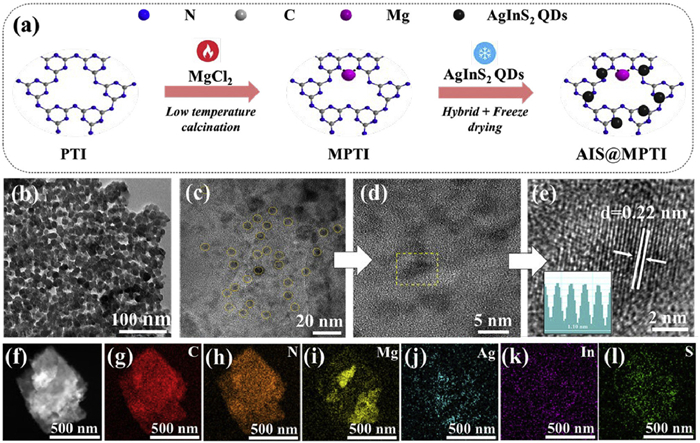
Fig. 1a presents a schematic illustration of the synthesis of the AIS@M0.1PTI composite, where M0.1PTI was prepared via a cationic strategy and AgInS2 quantum dots were subsequently assembled onto the M0.1PTI surface through electrostatic interactions. Full experimental details are provided in Supporting information. Transmission electron microscopy (TEM) reveals that PTI synthesized via the molten salt method exhibits a nanosheet morphology with lateral dimensions in the nanometer range (Fig. 1b). High-resolution TEM (HRTEM) reveals a lattice spacing of 0.74 nm, corresponding to the (100) crystal plane (Figs. S1a-c in Supporting information) [31]. Following Mg2+ doping, the nanosheet morphology of PTI is largely preserved, with an average lateral size of approximately 30 nm (Fig. 1c, Figs. S2a and b in Supporting information). However, the observed lattice spacing in MPTI is 0.35 nm (Figs. S3a-c in Supporting information), which is assigned to the (002) plane of MPTI (Figs. S4a in Supporting information) [32]. Energy-dispersive X-ray spectroscopy (EDS) mapping confirms the presence and uniform distribution of Mg2+ in the PTI matrix, indicating successful Mg2+ incorporation (Figs. S4a-d in Supporting information). Comparison of Fig. 1c with Figs. S5a and b (Supporting information) shows that AgInS2 quantum dots are uniformly anchored on the AIS@M0.1PTI nanosheets, appearing as dark-contrast particles with sizes ranging from 5 nm to 10 nm. These 0D quantum dots display a lattice spacing of 0.22 nm, corresponding to the (202) plane of AgInS2 (Figs. 1d and e) [29], in agreement with previously reported values. EDS elemental mapping of AIS@M0.1PTI reveals the presence and uniform distribution of C, N, Mg, Ag, In, and S, confirming successful composite formation (Figs. 1f-l and Fig. S6 in Supporting information).
Figure 1
Figure 1.
(a) Schematic representation of the synthesis route for AIS@M0.1PTI. (b) TEM image of pristine PTI. (c, d) HRTEM images of AIS@M0.1PTI, and (e) enlarged view showing the lattice spacing of AgInS2 quantum dots. (f-l) EDS elemental mapping of C, N, Mg, Ag, In, and S in AIS@M0.1PTI.
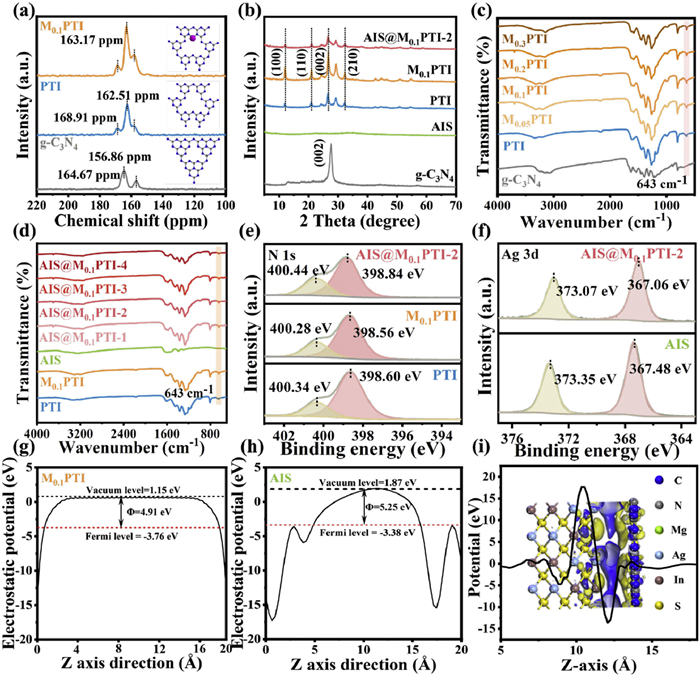
Solid-state 13C NMR offers direct structural evidence for the transformation of g-C3N4 into a triazine-based PTI framework, as depicted in Fig. 2a. The chemical shifts at 164.67 and 156.86 ppm, observed in g-C3N4, are assigned to CN2(NHx) and CN3 moieties, respectively. A new resonance at 168.91 ppm in PTI corresponds to a less protonated CN3 environment, clearly differentiating it from the CN2(NHx) signal of g-C3N4 at 164.67 ppm [33]. Upon Mg2+ doping, the resonance originally located at 162.51 ppm exhibits a downfield shift to 163.17 ppm, indicative of coordination interactions between Mg2+ and the PTI framework, thereby confirming the successful incorporation of Mg2+ into the PTI lattice.
Figure 2
Figure 2.
(a) 13C NMR spectra of g-C3N4, PTI, and M0.1PTI. (b) XRD patterns of g-C3N4, PTI, AgInS2, M0.1PTI, and AIS@M0.1PTI-2. (c) FTIR spectra of MxPTI with varying MgCl2 concentrations. (d) FTIR spectra of quantum dot composites at different ratios. (e) N 1s XPS spectra of AIS@M0.1PTI-2, M0.1PTI, and PTI. (f) Ag 3d XPS spectra of AIS@M0.1PTI-2 and AgInS2. Work function of (g) M0.1PTI, (h) AIS. (i) Differential charge density of AIS@M0.1PTI.
X-ray diffraction (XRD) analysis was employed to elucidate the structural characteristics of PTI, confirming its successful synthesis. As shown in Fig. 2b, PTI exhibits multiple well-resolved diffraction peaks compared to the heptazine-based g-C3N4, indicating significantly enhanced crystallinity [31]. The dominant reflection at 26.6° corresponds to the (002) plane, while peaks at 12.9°, 20.9°, 26.5°, 29.3°, and 32.7° are assigned to the (100), (110), (002), (102), and (210) planes, disrupts the structural periodicity of PTI, leading to a significant decrease in peak intensity. The diffraction peaks of AgInS2 quantum dots align well with the standard pattern (JCPDS No. 25–1328) (Fig. 2b and Fig. S7 in Supporting information) [34], confirming successful synthesis. The absence of distinct AgInS2-related peaks in the composite is attributed to the homogeneous dispersion of zero-dimensional quantum dots on the M0.1PTI surface, where nanoscale effects and reduced scattering intensity obscure their XRD signatures, in good agreement with previous literature. The MxPTI obtained via cation exchange exhibits a diffraction pattern consistent with pristine PTI [35], with no additional peaks attributable to impurity phases or metallic clusters. This suggests that Mg2+ is incorporated into the triazine framework as an ionic species without disrupting the overall structure. At low Mg2+ doping concentrations, the diffraction peaks of PTI are notably intensified, implying improved structural ordering and reduced lattice defects, thereby enhancing crystallinity.
Fourier-transform infrared (FTIR) diffuse reflectance spectroscopy was employed to probe the chemical bonding features of the synthesized materials. As depicted in Figs. 2c and d, the absorption band centered at 810 cm-1 is ascribed to the out- of-plane bending vibrations of the triazine ring, while the broad range between 1200 cm-1 and 1600 cm-1 corresponds to the characteristic stretching vibrations of aromatic C–N heterocycles [21]. A broad absorption band around 3200 cm-1 originates from N–H stretching and hydrogen-bond interactions associated with terminal -NH or -NH2 groups. Compared to g-C3N4 synthesized without molten salt treatment, the PTI sample displays a distinct absorption band at 2170 cm-1, attributed to the stretching vibration of cumulene-type -N=C=N- linkages. This feature indicates the formation of -NH- salt bridges, analogous to those found in ketene imines. In addition, a sharp peak at 810 cm-1 and the emergence of a new band at 643 cm-1 further corroborate the dominance of triazine units as the fundamental structural motifs in PTI, thereby distinguishing it from the heptazine-based framework [32].
The FTIR spectra of MxPTI retain the major vibrational features of pristine PTI, indicating that Mg2+ doping does not alter the fundamental chemical bonding environment within the PTI framework. Moreover, the characteristic vibrational modes of AgInS2 quantum dots are weak and remain essentially indistinguishable in the composite spectra, which are still dominated by the intrinsic features of the PTI framework. This observation aligns with the XRD findings and further confirms that the structural integrity of PTI is preserved in the composite.
A systematic XPS analysis provides important insights into the electronic structure and interfacial charge transfer within the composites. The pristine PTI exhibits a C/N ratio of 0.95 (Table S1 in Supporting information), which is much higher than that of conventional g-C3N4 (0.63) and close to the theoretical value of unity, confirming the dominance of the C3N3 triazine motif as the structural unit [36,37]. As shown in Fig. 2e, the N 1s spectrum can be fitted into two peaks at 398.60 and 400.34 eV, attributed to sp2-hybridized nitrogen (C–N = C) and bridging nitrogen, respectively [33]. Upon Mg2+ doping, the peak at 398.60 eV shifts slightly to 398.56 eV, along with the appearance of a Mg 1s peak at 1303.44 eV (Fig. S10 in Supporting information), suggesting coordination between Mg2+ and pyridinic nitrogen atoms, which introduces localized electronic perturbations to the PTI framework.
After coupling AgInS2 quantum dots with M0.1PTI, pronounced interfacial electronic interactions are observed. Compared with pristine AIS, the S 2p spectrum of AIS@M0.1PTI-2 exhibits a distinct binding-energy shift with slight peak broadening, while the spin-orbit splitting remains unchanged, indicating an altered local chemical environment of sulfur without a change in its oxidation state. (Fig. S11 in Supporting information) Such an evolution would not be expected for a simple physical mixture. Therefore, the S 2p results clearly demonstrate a tightly anchored interface and strong electronic coupling between AIS and M0.1PTI. Meanwhile, the Ag 3d peaks shift (Fig. 2f) negatively from 373.35/367.48 eV to 373.07/367.06 eV, the In 3d5/2 peak (Fig. S12 in Supporting information) decreases from 445.67 eV to 445.02 eV, suggesting electron enrichment within AgInS2 quantum dots. In contrast, both the N 1s and Mg 1s peaks of M0.1PTI shift positively, confirming electron depletion. These observations unambiguously demonstrate the successful coupling of AgInS2 quantum dots and M0.1PTI and the occurrence of directional electron transfer from M0.1PTI to AgInS2 quantum dots, which contributes to the formation of an efficient interfacial charge separation pathway, thus underpinning the improved photocatalytic activity of the composite system.
The electron transfer pathway was further verified by DFT calculations. As shown in Figs. 2g and h, the work function of M0.1PTI is 4.91 eV, while that of AgInS2 quantum dots is 5.25 eV. The higher work function of AgInS2 quantum dots corresponds to a lower Fermi level, driving electrons from M0.1PTI to AgInS2 quantum dots to compensate for the energy difference [38]. In addition, the differential charge density clearly reveals electron accumulation around AgInS2 quantum dots, further supporting the electron transfer direction (Fig. 2i) [39]. These theoretical results are fully consistent with the XPS analysis.
Photocatalytic experiments were conducted under a 300 W xenon lamp equipped with a λ > 400 nm cutoff filter, using a quartz reactor with magnetic stirring and an air pump. The H2O2 production was quantified by UV–vis spectrophotometry in systems containing either pure water or various volume fractions of glycerol (10, 20, 30, and 40 vol%) (Fig. S13 in Supporting information). The accuracy of the iodometric method for H2O2 quantification was first validated in the presence of glycerol, DHA, and other reaction components, confirming that these species do not interfere with the determination of H2O2 (Fig. S14 in Supporting information) [40]. In addition, the optimal ratio between the catalyst and the reaction solution was established to be 1:1 (Fig. S15 in Supporting information). The addition of glycerol as a hole sacrificial agent led to increased H2O2 yields, indicating that hole scavengers can effectively enhance the photocatalytic reaction (Fig. S16a in Supporting information).
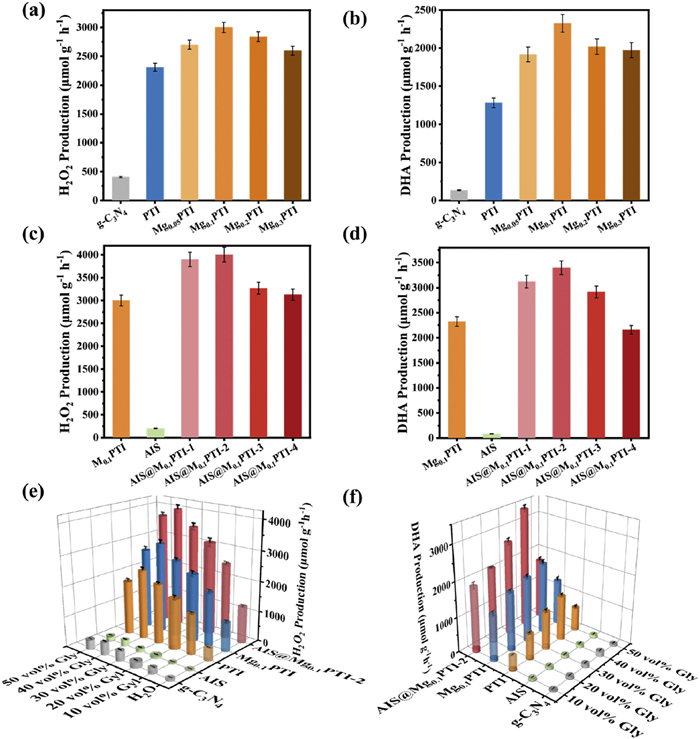
Compared with conventional g-C3N4, PTI synthesized via the molten salt method exhibits higher crystallinity and extended π-conjugation, achieving an H2O2 production rate of 402.57 μmol g-1 h-1 in pure water under ambient air, which is 5.3 times higher than that of g-C3N4 under identical conditions. Moderate Mg2+ doping further improved the photocatalytic performance by enhancing O2 adsorption, reinforcing the structural periodicity of PTI, and promoting charge separation (Fig. S16a). However, excessive Mg2+ doping induced structural distortion, reducing carrier mobility and consequently decreasing the photocatalytic activity (Fig. 3a). Upon loading AgInS2 quantum dots onto M0.1PTI, the photocatalytic performance was further enhanced, as the quantum dots markedly strengthened visible-light absorption and promoted interfacial charge transfer. The optimized AIS@M0.1PTI-2 sample achieved a high H2O2 yield of 1228.06 μmol g-1 h-1 in pure water under air (Fig. S16c in Supporting information). This improvement is attributed to efficient electron migration from M0.1PTI to AgInS2, as revealed by the work function analysis (4.91 vs. 5.25 eV), where electrons preferentially flow toward the lower fermi level of AgInS2 [41]. Control experiments using undoped PTI-AgInS2 composites and their physical mixtures show significantly lower activity, confirming that the superior performance does not arise from simple blending. These results demonstrate that efficient interfacial electron transfer together with Mg-induced electronic modulation are essential for the enhanced photocatalytic behavior (Fig. S17 in Supporting information). Such electron transfers suppressed charge recombination and spatially separated the redox sites, thereby enhancing carrier utilization efficiency. Excessive loading of quantum dots leads to a decline in photocatalytic performance, likely due to aggregation occurring at high quantum dot concentrations [42]. With glycerol serving as a hole scavenger, the photocatalytic activity was further enhanced, delivering a maximum H2O2 production rate of 4002.81 μmol g-1 h-1 at 40 vol% glycerol (Fig. 3c). This value is 1.7 and 9.8 times higher than those of pristine PTI and g-C3N4, respectively, placing this system among the most efficient photocatalysts reported to date and demonstrating superior performance compared with representative g-C3N4- and COF-based systems (Table S2 in Supporting information). However, excessive glycerol (>40 vol%) suppresses photocatalytic performance by competitive surface adsorption, mass-transfer limitations, and reduced dissolved oxygen availability (Fig. S18 in Supporting information), collectively inhibiting the interfacial ORR pathway [43].
Figure 3
Figure 3.
Photocatalytic performance in 40 vol% glycerol aqueous solution: (a, b) H2O2 and DHA production with varying Mg doping levels. (c, d) H2O2 and DHA production over composites with different ratios. (e, f) H2O2 and DHA production of various materials at different glycerol concentrations.
Simultaneously, glycerol underwent selective oxidation to DHA, as confirmed by HPLC and UV–vis analysis (Figs. S19-S21 in Supporting information). The positive correlation between DHA formation and H2O2 yield (Fig. S16) indicates, thereby establishing a synergistic redox cycle. In 40 vol% glycerol solution, PTI delivered a DHA yield 9.4 times higher than that of g-C3N4, benefiting from its superior charge separation efficiency and light-harvesting ability. With Mg doping (Figs. 3b and e, Fig. S16b in Supporting information) and subsequent incorporation of AgInS2 quantum dots (Figs. 3d and f, Fig. S16d in Supporting information), the DHA yield was further enhanced, reaching a maximum of 3398.47 μmol g-1 h-1 for AIS@M0.1PTI-2. This system also exhibited excellent stability under 3 h of continuous irradiation and after five recycling runs, with negligible loss of activity (Figs. S22-S24 in Supporting information). Post-reaction XRD and FTIR analyses confirmed the preservation of structural integrity (Figs. S25a and b in Supporting information). Based on the DHA yield and the glycerol conversion determined by HPLC, the DHA selectivity of AIS@M0.1PTI-2 was calculated to be 60.01% (Fig. S26 in Supporting information), outperforming most reported systems (Table S3 in Supporting information). The performance enhancement can be ascribed to the pronounced electron redistribution at the AgInS2 quantum dots/MPTI interface, which effectively promotes interfacial charge separation and ensures the spatial segregation of redox sites [44]. This microscopic synergistic effect provides a rational explanation for the concomitant improvement in DHA production and H2O2 generation.
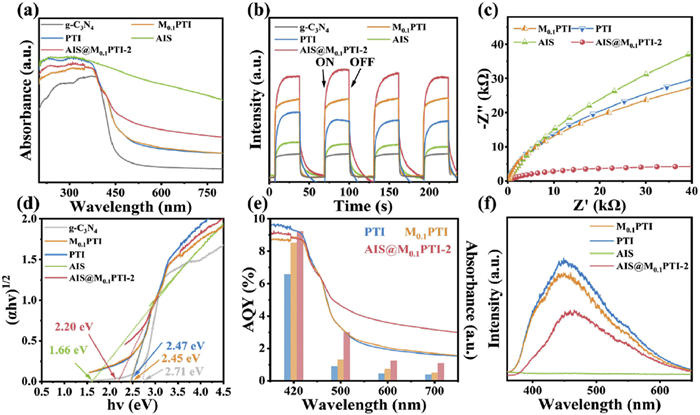
The excellent photocatalytic performance of the materials was elucidated through investigations of their photoelectrochemical properties. The UV–vis absorption spectra confirmed the light-harvesting capabilities of the materials. As illustrated in Fig. 4a, the PTI synthesized via the molten salt method exhibited pronounced absorption in the 400–550 nm range, which can be attributed to the formation of an extended two-dimensional π-conjugated system that enhances the rigidity of the polymeric backbone and significantly improves light absorption [6].
Figure 4
Figure 4.
UV–vis spectra (a), transient photocurrent responses (b), EIS Nyquist plots (c), optical bandgap values (d), apparent quantum yields (e), and PL spectra (f) of g-C3N4, PTI, M0.1PTI, AgInS2, and AIS@M0.1PTI-2.
The black AgInS2 quantum dots demonstrated strong absorption across the entire spectral range; consequently, the AgInS2-modified M0.1PTI displayed markedly enhanced visible-light absorption. According to the UV–vis absorption data (Fig. 4d), the optical bandgap of PTI was calculated to be 2.45 eV, which is 0.26 eV narrower than that of g-C3N4 (2.71 eV). This narrower bandgap facilitates electronic transitions and thereby contributes to improved light absorption.
The charge separation efficiency was further investigated via steady-state photoluminescence (PL) spectroscopy. As shown in Fig. 4f, Mg2+-doped PTI exhibited markedly lower PL intensity than pristine PTI under 365 nm excitation, indicating that Mg2+ doping effectively suppresses radiative recombination and enhances carrier separation. Upon integration of AgInS2 quantum dots, the PL signal was further quenched, reflecting the highest separation efficiency among all samples. This improvement is attributed to the formation of a heterojunction between AgInS2 and M0.1PTI, which promotes spatial charge separation.
Electrochemical impedance spectroscopy (EIS) Nyquist plots reveal the charge transfer resistance and carrier separation efficiency. A smaller semicircle radius in the EIS spectrum indicates lower charge transfer resistance, facilitating efficient carrier migration. As shown in Fig. 4c, AIS@M0.1PTI-2 exhibits a significantly smaller semicircle radius than PTI, M0.1PTI, and AgInS2 quantum dots, indicating the lowest charge transfer resistance. This enables enhanced carrier migration, optimizing the ORR and glycerol oxidation processes. Additionally, the composite material shows the highest photocurrent response (Fig. 4b), confirming the highest concentration of photogenerated carriers, consistent with the observed photocatalytic performance. The photocatalytic activity of the materials under various wavelengths (365, 420, 500, 600, and 700 nm) was evaluated using monochromatic light filters. The apparent quantum yield (AQY) results at different wavelengths are shown in Fig. 4e. The composite material achieved an AQY of 9.48% at 420 nm, significantly higher than that of PTI and M0.1PTI. This enhancement aligns with the UV–vis absorption spectra, highlighting the crucial role of light absorption capacity in influencing photocatalytic efficiency.
The band-edge positions of M0.1PTI and AgInS2 quantum dots were determined using Mott-Schottky analysis [45], revealing flat-band potentials of −1.07 V and −1.46 V, respectively (Fig. S27 in Supporting information). The valence band positions, determined from XPS-VB spectra, were 1.38 eV and 0.24 eV for M0.1PTI and AgInS2 (Fig. S28 in Supporting information).
Contact angle measurement serves as a widely adopted technique for assessing the surface wettability of materials, providing critical insights into their liquid affinity. A lower contact angle generally corresponds to superior wettability, indicative of enhanced hydrophilicity or solubility of the surface with respect to the contacting liquid [20]. As shown in Fig. S29a (Supporting information), AIS@M0.1PTI-2 exhibits a water contact angle of 16.5°, signifying excellent hydrophilic behavior. In Fig. S29b (Supporting information), its contact angle with a 40 vol% glycerol aqueous solution is measured at 29.2°, likewise demonstrating favorable wettability. Within the framework of the present reaction system, such low contact angles are advantageous, as they promote more efficient dispersion and interfacial contact between the catalyst surface and the reactants (water and glycerol). This enhanced interaction facilitates interfacial mass transfer and improves the accessibility of active sites, thereby contributing to elevated catalytic conversion efficiency.
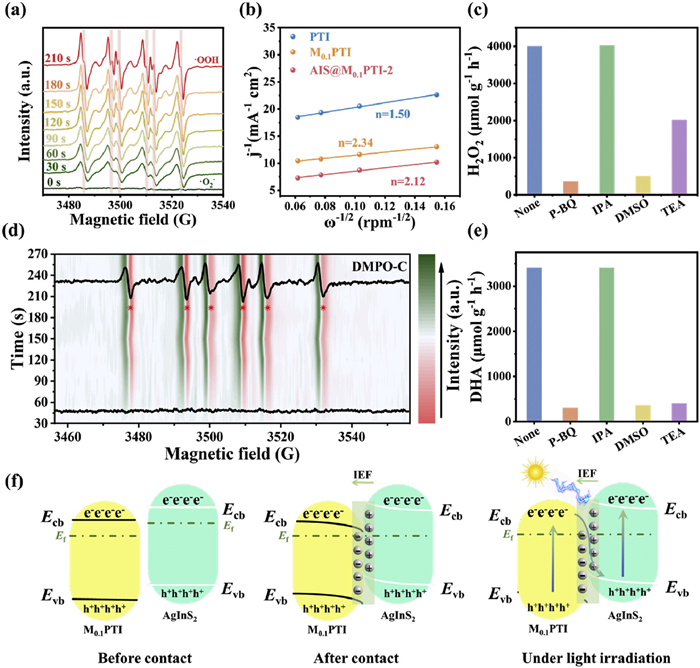
5,5-Dimethyl-1-pyrroline N-oxide (DMPO) spin-trapping experiments confirm that reactive radicals are generated exclusively under light irradiation, whereas no detectable signals are observed in the dark or in the absence of light (Fig. S30a in Supporting information). The markedly suppressed activity under N2-saturated conditions indicates that dissolved oxygen serves as the electron acceptor, acting as a key precursor for superoxide formation. (Fig. S31 in Supporting information) Among PTI, AgInS2 quantum dots, M0.1PTI, and AIS@M0.1PTI-2, the latter exhibits the strongest •OOH signals, demonstrating that Mg doping and heterojunction construction significantly enhance the photocatalytic reactivity. Time-dependent electron paramagnetic resonance (EPR) spectra reveal the transformation from •O2- to •OOH with prolonged irradiation (Fig. 5a and Fig. S30b in Supporting information), suggesting a stepwise O2 → •O2- → •OOH → H2O2 pathway via a 2e- ORR [46–47]. Consistently, rotating disk electrode (RDE) measurements show an electron transfer number of 2.12 for AIS@M0.1PTI-2 (Fig. 5b and Figs. S32a-c in Supporting information), further confirming its high selectivity toward the 2e- ORR route.
Figure 5
Figure 5.
(a) EPR spectra of DMPO trapping •O2- and •OOH radicals generated by AIS@M0.1PTI-2. (b) Electron transfer number (n) based on RDE measurements. (c) Free radical trapping experiment for photocatalytic H2O2 production by AIS@M0.1PTI-2. (d) EPR spectra of DMPO-C radical capture for AIS@M0.1PTI-2 with times. (e) Free radical trapping experiment for photocatalytic DHA production by AIS@M0.1PTI-2. (f) Possible photocatalytic mechanism of AIS@M0.1PTI-2.
In glycerol oxidation experiments (Fig. 5d) [48], the DMPO trapping experiment showed that glycerol radicals were generated under light irradiation, and their intensity increased over time, suggesting that photogenerated holes have a long lifetime. No •OH radical signal from water oxidation was detected, confirming that h+ is the active species responsible for glycerol oxidation (Fig. S33 in Supporting information). The composite material exhibited the highest glycerol radical peak intensity, aligning with the highest DHA production observed, indicating that the photogenerated holes enhance the glycerol oxidation process. Radical scavenging experiments using quinone, isopropanol, dimethyl sulfoxide (DMSO), and triethanolamine (TEA) confirmed the roles of •O2-, •OH, e-, and h+ in the reactions. Significant decreases in H2O2 production were observed when quinone or DMSO was added, indicating that •O2- and e- are critical active species (Fig. 5c). Similarly, DHA production decreased when TEA (h+ scavenger) was added, confirming that h+ is the primary active species in glycerol oxidation (Fig. 5e), consistent with EPR results. Based on EPR analysis, radical scavenging experiments, and reported literature, the formation of DHA is proposed to proceed via an initial oxidation of glycerol by photogenerated holes to form glycerol-centered radicals, followed by further reaction with water to yield DHA [49]. Owing to the absence of highly oxidative species such as •OH, the formation of over-oxidized byproducts, including glyceraldehyde and glyceric acid, is effectively suppressed [50].
Taken together, the photocatalytic mechanism of AIS@M0.1PTI-2 for H2O2 production and DHA oxidation can be described as follows (Fig. 5f): O2 and glycerol molecules are first adsorbed on the catalyst surface, where light irradiation generates photogenerated electrons and holes. Photogenerated electrons on M0.1PTI migrate to AIS quantum dots due to the work function difference (Figs. 2g and h, Fig. S34 in Supporting information), leaving holes on PTI for glycerol oxidation. This spatial separation of electrons and holes enhances the reducing capability of electrons on AIS, which then participate in the 2e- ORR to produce H2O2. Simultaneously, glycerol dehydrogenation to DHA provides additional protons for the 2e- ORR, establishing a synergistic interplay between oxidation and reduction reactions.
Beyond the mechanistic insights described above, the superior photocatalytic performance of the AIS@MxPTI system can be attributed to two cooperative factors. First, Mg doping effectively tailors the electronic structure of PTI and its improved crystallinity overcomes the intrinsic charge-transport limitations typically found in disordered g-C3N4. Second, the interfacial coupling between AgInS2 quantum dots and M0.1PTI further accelerates charge separation through the formation of a robust 0D/2D heterojunction. Such a dual-regulation strategy is difficult to achieve simultaneously in conventional g-C3N4 or COF-based materials, thereby endowing the present system with pronounced advantages in both photocatalytic activity and selective oxidation performance [51].
In summary, a dual-functional photocatalytic system composed of AgInS2 quantum dots and Mg-doped PTI was successfully designed and synthesized for simultaneous H2O2 production and selective glycerol oxidation to DHA. Under optimized conditions (40 vol% glycerol aqueous solution, air), the system achieved an H2O2 production rate of 4002.81 μmol g-1 h-1–9.9 times higher than in pure water, and significantly outperforming pristine PTI and g-C3N4, and a DHA yield of 3398.47 μmol g-1 h-1 with 60.01% selectivity. The enhanced performance arises from multiple synergistic factors: Improved PTI crystallinity via molten salt synthesis, Mg2+ doping that optimizes electronic structure and promotes O2 adsorption, and the incorporation of AgInS2 quantum dots, which extends visible light absorption and spatially separates redox sites to enhance charge carrier separation. Mechanistic investigations, including HPLC, UV–vis, EPR, LSV, scavenger tests, DFT, and XPS, confirmed that electrons reduce O2via the selective 2e- ORR pathway while holes oxidize glycerol, with interfacial electron transfer facilitating efficient spatial separation of redox sites. This study demonstrates a robust and sustainable strategy for co-producing H2O2 and value-added chemicals, highlighting the potential of rationally engineered 0D/2D heterojunctions in tandem photocatalysis.
The National Natural Science Foundation of China (No. 22472145), the Priority Academic Program Development Project of Jiangsu Higher Education Institutions, contributed to the funding of this study.
Supplementary materials
Supplementary material associated with this article can be found, in the online version, at doi:10.1016/j.cclet.2026.112752.
Figure 1
(a) Schematic representation of the synthesis route for AIS@M0.1PTI. (b) TEM image of pristine PTI. (c, d) HRTEM images of AIS@M0.1PTI, and (e) enlarged view showing the lattice spacing of AgInS2 quantum dots. (f-l) EDS elemental mapping of C, N, Mg, Ag, In, and S in AIS@M0.1PTI.
Figure 2
(a) 13C NMR spectra of g-C3N4, PTI, and M0.1PTI. (b) XRD patterns of g-C3N4, PTI, AgInS2, M0.1PTI, and AIS@M0.1PTI-2. (c) FTIR spectra of MxPTI with varying MgCl2 concentrations. (d) FTIR spectra of quantum dot composites at different ratios. (e) N 1s XPS spectra of AIS@M0.1PTI-2, M0.1PTI, and PTI. (f) Ag 3d XPS spectra of AIS@M0.1PTI-2 and AgInS2. Work function of (g) M0.1PTI, (h) AIS. (i) Differential charge density of AIS@M0.1PTI.
Figure 3
Photocatalytic performance in 40 vol% glycerol aqueous solution: (a, b) H2O2 and DHA production with varying Mg doping levels. (c, d) H2O2 and DHA production over composites with different ratios. (e, f) H2O2 and DHA production of various materials at different glycerol concentrations.
Figure 5
(a) EPR spectra of DMPO trapping •O2- and •OOH radicals generated by AIS@M0.1PTI-2. (b) Electron transfer number (n) based on RDE measurements. (c) Free radical trapping experiment for photocatalytic H2O2 production by AIS@M0.1PTI-2. (d) EPR spectra of DMPO-C radical capture for AIS@M0.1PTI-2 with times. (e) Free radical trapping experiment for photocatalytic DHA production by AIS@M0.1PTI-2. (f) Possible photocatalytic mechanism of AIS@M0.1PTI-2.


 DownLoad:

 下载:


 下载:

