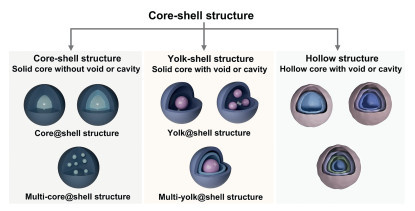
Figure 1.
Classification illustration of core-shell structures.

Core-shell structured materials for photocatalysis: Understanding the structure-performance correlation
Yujia Xiang , Shuo Chen , Yan Zhang , Jing Zhang , Chuanshu He , Zhaokun Xiong , Peng Zhou , Bo Lai


As global population and living standards rise, the increasing demand for energy and consumer goods has brought tremendous pressure to the earth. Energy shortage and environmental pollution have become the primary challenges facing social progress and human survival [1,2]. As the most abundant, highly sustainable and readily accessible form of energy on Earth, solar energy is widely regarded as one of the most promising energy sources [3,4]. The annual amount of solar energy that reaches earth surface through radiation is approximately between 15,575 and 49,387 EJ. It significantly exceeds the total annual global energy consumption (55.98 EJ), revealing the abundant potential of solar energy to support the sustainable development of human society [5]. Scientists are dedicated to developing innovative technologies for sufficient use of solar energy. Scientists hope to fully utilize the potential of these technologies to promote efficient and environmentally friendly processes [6]. Among them, photocatalytic technology is a widely used and highly promising strategy. It can both promote the production of solar fuels and facilitate specific chemical reactions. Solar energy can be effectively converted into storable and utilizable chemical energy through these processes [7,8]. In these photochemical processes, the catalysts play a crucial role in energy conversion. Catalysts would drive and accelerate photocatalytic reactions through absorbing photons and generating an excited state [9,10]. This process ultimately achieves the cycle of energy conversion.
The efficiency of photocatalytic reactions is largely determined by light absorption, charge separation, and surface redox reactions. The efficient progress of these steps is closely related to the physical and chemical properties of catalysts [11]. Hence, modulation of catalyst properties has a crucial effect on the optimization of photocatalytic process, thereby realizing effective conversion of solar energy to chemical energy [12]. An ideal photocatalyst should integrate several key characteristics, such as efficient light capture, abundant surface active sites, excellent pore structure, appropriate positions of the conduction band (CB) and valence band (VB), and excellent separation ability of photogenerated carriers. To further finely regulate the properties of catalysts, recent research has focused on some strategies such as bandgap tuning, elemental doping, defect engineering, constructing heterostructures, and controlling morphology [13-16]. However, the aggregation of catalysts is the main bottleneck for restricting their performance, resulting in insufficient light utilization, intensified charge recombination, and reduced active sites [11]. To overcome this limitation, it is urgent to promote the structural design and fabrication of catalysts for meeting the severe requirements of photocatalytic process photocatalysts is crucial to meeting the stringent demands of the entire photocatalytic process [17].
Broadly speaking, the core-shell structure is generally defined as a composite nanomaterial composed of two different materials, the inner core and the outer shell. It usually includes classical core-shell structures, yolk shell structures, and hollow structures (Fig. 1) [18-20]. Due to its tunable composition and flexible structure, core-shell catalysts are receiving considerable and growing interest in photocatalysis. As portrayed in Fig. S1 (Supporting information), the core-shell structured photocatalyst offers self-supported 3D structures that enhance architectural stability, effectively preventing the aggregation of catalysts during reaction processes. In addition, three main advantages of core-shell photocatalyst need to be mentioned: (1) The coexistence of inner and outer surfaces results in a relatively large specific surface area, which can enhance surface reactions; (2) The void space allows light to reflect inside shells, which could boost the utilization efficiency of light; (3) Controllable shell thickness adjusts the diffusion distance of charges, facilitating charge transfer; (4) The synergistic effect between core and shell can achieve superior efficiency and/or selectivity in photocatalytic reaction; (5) The combination properties of core and shell is beneficial to broaden the range of potential applications.
There already have been some high-quality reviews on the synthesis and applications of core-shell structured photocatalysts over the past decade (Fig. S2 in Supporting information). However, the existing reviews have not paid enough attention to the key mechanism between physicochemical properties of core-shell photocatalysts and photocatalytic process, which constitutes a significant gap (Fig. S2b in Supporting information). This knowledge gap lies in the inadequate elucidation of effect of catalyst properties (such as interface band structure, defect state) on the core steps of photogenerated carrier separation, interface migration and surface reaction kinetics. A deep understanding of the structure–activity relationship is of great significance for overcoming existing efficiency limitations and advancing the rational design of catalysts. In this review, we first briefly introduce the synthesis strategies of core-shell structured materials, followed by a discussion on the optimization strategy to boost the photocatalytic performance of core-shell structured materials. Afterwards, the fundamental structure-performance correlations of core-shell structured materials in photocatalysis reaction are explored to present the research trends associated with core-shell structured photocatalysts. In this review, we aim to provide guidance for the design and preparation of core-shell structured photocatalysts, thereby promoting more sustainable solar energy conversion. Moreover, we hope that this systematic summary and discussion on optimizing surface strategies and structure-activity relationships will not only play a crucial role in the field of photocatalysis but also hold significance in the areas of electrocatalysis and thermal catalysis.
The performance of core-shell structured materials is determined by structures, dimensions and composition, which can be tailored by adjusting the fabrication process. By synthesizing core-shell structured photocatalysts with specific spatial distributions and designed composition, the interaction between each layer can be well controlled to tune their application performance. However, it is widely acknowledged that as the complexity of a target structure increases, a more advanced synthetic procedure is required. Consequently, some unique spatial distributions and special composition need to exceptional synthetic strategies distinct from conventional methods. In this section, we focus on the key design principles and synthetic methodologies of the core-shell structured materials to present the fundamental considerations and technical challenges involved.
Since the soft templating method was firstly reported in 1992, template-oriented synthesis has gradually become a cutting-edge method for the nanomaterial synthesis [21,22]. The templating methods can use pre-designed templates as a support to precisely control the size, shape, and structure of nanomaterials [23]. Furthermore, it could generate the assembly of nanomaterials, further affecting the physi-chemical properties and performance of the materials [24]. Based on the type and property of the template, the templating method can be categorized into the hard templating and soft templating. The former offers rigid and stable support, while the latter characterized by flexibility and variability [25]. The templating method primarily involves three key steps: (ⅰ) To select and prepare a suitable template; (ⅱ) to synthesize target product in the presence of the template through common method (e.g., co-precipitation, solvothermal, spray drying) [26-28] (ⅲ) to selectively remove the template by appropriate means (e.g., dissolution, etching, and sintering) [29]. In certain instances, the template simultaneously as both a template and a reactant, being consumed during the reaction process without the need for any additional etching, which is called as the sacrificial templating method.
The hard templating method generally employs rigid particles of specific shapes as templates and coats precursor materials onto the surface of the hard template through layer-by-layer self-assembly or chemical precipitation methods. Once the desired structure is formed, the template is selectively removed to obtain the target substance by chemical etching, dissolving and calcination process. Due to its ability to precisely regulate catalyst size, structure, composition, and shell parameters, the hard templating method is the most widely employed method for synthesizing core-shell structured materials. At present, the most commonly used hard templates mainly include carbon spheres, calcium carbonate, polymers (such as polypropylene), metal ions, and metal oxides.
A great number of works used carbonaceous spheres as the templates and coated diverse compositions (e.g., Fe2O3, TiO2, V2O5, and CeO2@TiO2) [30-34]. By modifying the coat process of precursor (such as precursor type, pH value, reaction temperature, reaction duration, and solvent) and the removal process of template (including heating rate, atmosphere, and etching solution), the structural parameters of core-shell structured materials (e.g., shell thickness, shell number, size) can be accurately controlled. Wei et al. fabricated CeO2/A-TiO2 hollow multi-shelled structure with spatial ordered hetero-shells are fabricated through sequential templating approach (Figs. S3a-d in Supporting information) [34]. The hollow multi-shelled structure was modulated by adjusting the amount of Ce precursors, followed by the calcination process to form an amorphous TiO2 layer and remove C layer. Zhang and his colleagues revealed the formation mechanism of unique hollow core/shell structure [35]. As displayed in Figs. S3e and f (Supporting information), when only Ce(OH)3 nucleates were presented, a hollow structure would be formed. However, Ti(OH)4 nucleates coated upon C—Ce(OH)3 precursor, a unique core-shell structure formed, which was due to the mismatch between the growth rate of the shell and the disintegration rate of the C microspheres.
Polymers, such as polystyrene (PS), poly(sodium 4-styrenesulfonate) (PSS), and poly(diallyldimethylammonium chloride) (PDDA), are commonly employed as hard templates to generate void spaces between the cores and shells [36-39]. Cai et al. used PS as the template to prepare the double-shelled and sandwiched TiO2@Au@C hollow sphere though hydrothermal method and calcination process (Figs. S3g and h in Supporting information) [40]. After multiple hydrothermal reactions and calcination, Au nanoparticles (NPs) were sandwiched between TiO2 shell and C layer. Meanwhile, as a neutral surfactant, glucose was used to control the growth of nanocrystals due to its non-polar long carbon chains. In addition to traditional heat treatment methods, some researchers have leveraged the easily photodegradable properties of polymers to generate hollow space. Ren et al. employed layer-by-layer assembly deposition to coat TiO2 particles with PSS and PDDA, followed by deposition of SiO2 layer on the outer surface of polymers [41]. Upon the decomposition of multilayer polyelectrolytes by photocatalytic TiO2 under UV irradiation, voids developed between the TiO2 core and the SiO2 shell, leading to the formation of rattle-type TiO2@void@SiO2 composite particles. The void space obtained through photodegradation can effectively avoid the aggregation of NPs.
Amphiphilic molecules, such as surfactants and block copolymers, can self-assemble into micelles or vesicles with various structures [42]. These micelles and vesicles can serve as soft templates, adsorbing one or more layers of inorganic substances through electrostatic interactions, and then removing the template to obtain a core-shell structure [43-45]. Compared to hard-templating method, soft templating method exhibits economic applicability, high flexibility, and convenience. However, the limited structural control and stability issues in practical applications are the main bottlenecks.
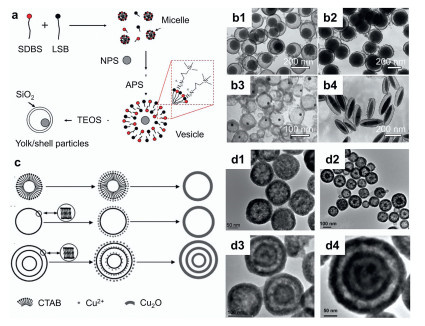
Despite the challenges encountered, various inorganic materials with core-shell structures have been successfully synthesized using micelle/vesicle template technology. Among these, silica and its hybrid materials stand out as the most outstanding examples, owing to the well-controlled hydrolysis and condensation processes of silica precursors in water solutions [45]. For example, Wu et al. reported a simple soft templating method for the synthesis of yolk/shell structures through the encapsulation of particles by SiO2 shells in aqueous mixtures of surfactants [44]. As presented in Fig. 2a, the NPs were dispersed into a water mixture of lauryl sulfonate betaine (LSB) and sodium dodecyl benzenesulfonate (SDBS), followed by the addition of 3-amino-propyltriethoxysilane (APS) to further form of vesicles with movable NP cores. Finally, SiO2 shells were formed via a sol-gel process (Fig. 2b). In addition to silica-based materials, micelle/vesicle templating can also be utilized for the fabrication of core-shell structures with various compositions [46,47]. Xu et al. successfully fabricated the well-organized Cu2O hollow nanospheres with various shells through a micelle template method [48]. The number of shells of Cu2O hollow spheres was modulated by changing cetyltrimethylammonium bromide (CTAB) concentration (Figs. 2c and d). However, the structures of vesicle templates are sensitive to various parameters (e.g., temperature, pH, concentration, and solvent), which complicates the use of vesicles as templates for the fabrication of core-shell structures.
The template-free method of core-shell structured materials, without the need for additional templates, not only significantly reduces production costs but also facilitates large-scale production, making it more suitable for industrial applications. Thus, a great number of researchers have been dedicated to developing template free methods for constructing core-shell structures, primarily including Ostwald maturity, Kirkendall effect, surface-protected etching, spray drying, and self-assembly.
The Kirkendall effect primarily relies on the differences in diffusion rates between two types of metal ions to generate defects, which then lead to the formation of a core-shell structure [49,50]. Wu et al. used the Kirkendall effect to accelerate the diffusion of Ag toward the outer metal shell, thereby determining the compositional and structural evolution [51]. As depicted in Figs. S4a and b (Supporting information), the core/shell nanocrystals transformed into the hollow spheres through oxygen plasma treatment. This phenomenon was mainly due to the oxidation of Ag within the Pt or Pd lattice disrupted the crystal structure, creating defects where nanochannels form on the Pt or Pd shell. Subsequently, the remaining Ag atoms traveled through these nanochannels, ultimately leaving behind a hollow structure. In addition, the unique characteristics of metal elements can also be taken into account in the design and preparation of core-shell structured materials. For example, Zhai et al. constructed core-shell catalysts with heterogeneous structures through the difference in metal melting points and Kirkendall effect [52]. It was primarily attributed to the unique cold expansion and thermal shrinkage characteristics of Bi, which allowed the Bi-metal mixture to collectively form a spherical core through the fusion aggregation and expansion process, while indium species were converted into In2O3 to create the shell (Figs. S4c-f in Supporting information). The nano-confinement effects of the outermost carbon layer, internal cavity, and hybrid Bi/In2O3 interface had significant effects on catalytic reaction.
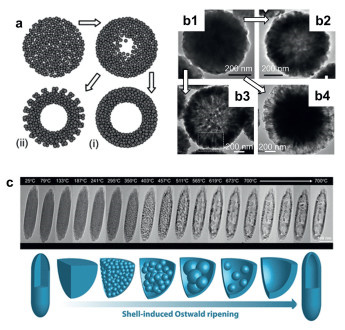
Ostwald ripening mainly relies on crystal growth, which refers to the growth process of large particles by the re-deposition of dissolved substances from small particles [53,54]. In 2004, Yang et al. reported a straightforward synthetic method for hollow anatase TiO2 nanospheres. First, solid TiO2 spheres were formed through the hydrolysis of TiF4 [54]. Subsequently, hollow interiors were achieved through Ostwald ripening following an extended hydrothermal treatment (Figs. 3a and b). This method could obtain anatase hollow spheres with the inter-crystallite channels and unique textural structures. In addition to traditional Ostwald ripening, Yu et al. also reported a hollowing mechanism which called “shell-induced Ostwald ripening” [55]. This method was different from the previously reported inside-out Ostwald ripening, which typically resulted in a polycrystalline hollow structure. As illustrated in Fig. 3c, the small particles in the center of the material gradually dissolved and redeposited onto the inner surface of the larger crystal shell, resulting in the formation of a hollow cavity.
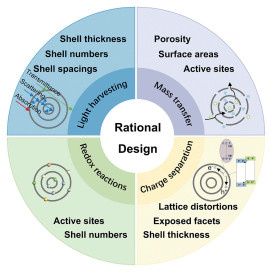
The design of photocatalysts plays a crucial role in determining their photocatalytic performance. In comparison to traditional photocatalysts, the 3D core-shell structured photocatalysts possess several unique features, involving the extremely large surface area, abundant active sites, separate void space, tunable shell thickness, and various shell number. These distinctive characteristics provide core-shell structured photocatalysts with obvious advantages for photocatalytic applications. The core-shell structure can boost the light capture efficiency through multiple light scattering within the shell layer. Its unique pore structure is also beneficial for the mass transfer of reactants. Meanwhile, the abundant active sites on both the inner and outer surfaces of core-shell structured catalyst are of significance to accelerate the redox reaction. Moreover, the composition and shell thickness of catalysts have a crucial effect on the migration and separation of carriers (Fig. 4). Hence, precise control of their surface properties and shell structure is an effective means to improve photocatalytic performance (Fig. S1 in Supporting information). This section would provide an overview of the latest research progress on optimization strategies for core-shell catalysts.
The photocatalytic performance of core-shell materials is crucially governed by their composition, which determines the spectral response and the efficiency of carrier dynamics. Consequently, precise control of catalyst composition is essential to adjust performance for tailored application across diverse photocatalytic systems.
For a single catalyst, photo-generated electrons can easily transfer back from the CB to the VB of the semiconductor, leading to recombination with holes [56]. This process results in a reduced photocatalytic performance. It is not conducive to the progress of photocatalytic reactions, resulting in a decline in photocatalytic performance. To suppress the recombination of charge carriers, a widely used approach is to construct heterostructures for photocatalysts [57]. Wei et al. fabricated the hollow multi-shelled structure with spatial ordered hetero-shells through the sequential template method [34]. They reported that heterogeneous ATiO2/CeO2 outer-most shell could enhance both charge separation efficiency and light harvesting ability, thereby boosting the performance of tandem catalytic conversion of CO2 to CH4. Fe2O3 is classified as a narrow-bandgap photocatalyst with a bandgap ranging from 1.9 eV to 2.2 eV, whereas TiO2 is considered a wide-bandgap photocatalyst with a bandgap between 3.0 eV and 3.2 eV. The construction of heterostructures combining Fe2O3 and TiO2 can effectively retain their individual photocatalytic activities, broaden the spectral absorption range, and enhance the separation of photo-generated electrons and holes. In general, heterojunction of catalyst can promote the effective separation and migration of photogenerated carriers by regulating its band structure and increase surface active sites, ultimately enhancing the efficiency in photocatalytic reactions.
The crystal plane effect plays a vital role in modulating the photocatalytic activity, because different crystal facets of semiconductor possess various charge separation abilities. To date, it is widely accepted that exposing different crystal planes in a semiconductor can facilitate charge separation between these planes. Li et al. reported that the reduction reaction with photogenerated electrons took place on the facet of monoclinic bismuth vanadate crystal under photo-irradiation, while the oxidation reaction with photogenerated holes occurred on its facet [58]. These results provided strong evidence that photo-generated electrons and holes can be effectively separated across the various facets of semiconductor crystals. Furthermore, some researchers have discovered that catalysts with high-index surface exposure tend to exhibit superior catalytic activity [59]. It is attributed to the fact that crystal planes with high indices possess lower coordination saturation, making them more likely to adsorb or activate reactant molecules. Consequently, it leads to a reduction in reaction activation energy, facilitating the reaction.
For semiconductor materials, defects are usually considered to capture excited state electrons, and even narrow their bandgap to some extent, expand the absorption of visible light, thereby achieving the improvement of photocatalysis performance [60,61]. Previous studies have demonstrated that the introduction of defects facilitates the capture of photogenerated electrons, which is beneficial to suppress the recombination of these electrons and holes [62]. It was due to surface defects caused the minimum value of the CB and the maximum value of the valence band to shift downwards and upwards, respectively. It resulted in the formation of an I-type junction between the solid solution and the surface, which enhances the migration of photogenerated charges to the surface of the nanostructure, thereby enhancing photocatalytic activity. Currently, it is widely accepted that defects can alter the crystal structure of catalysts, leading to changes in their band structure. These defects could produce trapping states that are expected to impede the recombination of photo generated electrons and holes.
As a widely strategy, doping with heterogeneous atoms (such as metal cations and heteroatoms) can tailor the reaction activity of catalysts through altering the electronic structure of the active sites. However, a core challenge remains in elucidating relationship between the modulation of electronic structure and the evolution of the active sites. Nowadays, the underlying mechanism of this relationship has not yet been fully clarified. Ya et al. reported a novel phosphorus-doped tubular g-C3N4 with a hierarchical core-shell structure [63]. In this structure, the phosphorus atoms acted as electron trapping centers, resulting in the inhibition of electron-hole recombination and further promotion of carrier lifetime. In addition, the doping of non-metallic elements has also been proven to boost photocatalytic performance of catalysts. Ma et al. reported that N doping not only enhances the photocatalytic activity but also improves the stability of catalyst by forming coordination bonds with metal ions [64]. On the other hand, doping can change the energy band type of the semiconductor. For instance, Behera et al. demonstrated that B doping in the catalyst can transform it from an n-type to a p-n heterojunction semiconductor [65]. Furthermore, some studies have shown that metal doping can effectively regulate the band gap of the catalyst, thereby obviously broadening the range of light response [66]. Doping with heteroatoms can adjust the positions of the CB and VB of the catalyst, further controlling its redox capacity [67]. The underlying mechanism of doping on photocatalytic performance continues to be current research hotspots and challenges.
The morphology and structure of catalyst play a critical part in light absorption, carrier migration, and the accessibility of active sites. These properties collectively determine the overall efficiency of photocatalytic process. Hence, control of morphology and structure has become a valid strategy to enhance the photocatalytic performance of catalysts. According to different performance requirements, the optimal photocatalysis performance of catalysts can be achieved by precisely regulating their shape, size and shell structure.
To achieve optimal light harvesting, the shell thickness and spacing of core-shell structured materials need to be regulated. An overly thick shell layer can impede light transmission, which would restrict the generation of photogenerated carriers. Conversely, a thinner shell layer is beneficial to enhance charge separation efficiency and provide a larger surface area, but it is difficult to meet sufficient stability for catalysts. The increase in the number of shell layers can improve light capture efficiency through the multiple refractions of light within shell layers. According to the research by Wei et al., compared with double-shelled and triple-shelled catalysts, the quadruple-shelled catalyst exhibited a wider range of light absorption and stronger light response [34]. Increase in the number of shell layers can provide a larger surface area and expose more active sites, creating favorable conditions for the occurrence of multi-level reactions. In addition, it is possible to realize the spatial separation of oxidation and reduction reactions by meticulously designing the shell structure [68]. It is of vital importance for suppressing carrier recombination and optimizing the reaction kinetics. Furthermore, designing the catalyst with a unique morphology (such as urchin-like nanostructures) is an effective and promising strategy. This method could offer additional reaction sites for accelerating redox reactions [69,70].
It is reported that the particle size of catalyst can directly affect the process of photocatalytic reaction [71]. It is because the particle size of the catalyst is closely related to the quantity and distribution of surface active sites and the trajectories of electron migration. Smaller particles generally provide more active sites and a higher specific surface area for redox reactions and mass transfer. However, further reduction in particle size may trigger quantum effects and alter the degree of electron localization. Meanwhile, catalysts with excessively small particle sizes are prone to agglomeration or structural collapse during the reaction, which is detrimental to the progress of the photocatalytic reaction. A profound understanding of correlation between particle size and performance would provide crucial guidance to rationally design core-shell structured catalysts, thereby meeting the specific requirements for efficiency and performance in different reaction.
At present, a variety of core-shell materials with different compositions and structural properties have been developed through precise control in synthesis processes. However, the current understanding of the relationship between its structural properties and specific application performance is still insufficient. This section systematically explores the correlation between structure and performance, providing a vital guidance for designing core-shell materials.
With the acceleration of social industrialization, a large amount of organic pollutants have been discharged into water bodies, posing a serious threat to human health and ecosystems [72-75]. A variety of water treatment technologies have been developed and applied in the pollutant control, including adsorption, flocculation, biological treatment, and advanced oxidation methods [76-80]. Photocatalytic technology possesses excellent cost-effectiveness, environmental friendliness and sustainability, which has been regarded as promising water treatment [81]. At present, photocatalytic technology has been widely applied for eliminating various pollutants, including antibiotics, phenolic compounds, and dyes. In recent years, the researchers have conducted extensive studies on the core-shell structure materials used in photocatalytic degradation. Table S1 (Supporting information) systematically provides an important reference basis for optimization of core-shell structured materials in environmental remediation.
Efficient carrier separation and transport are the key to realizing deep degradation of pollutants. It can promote the generation of active species, thereby obviously enhancing the photodegradation efficiency. Cai et al. fabricated double-shelled, sandwiched, and nanostructured hollow spheres through hydrotherm reaction and calcination [36]. Negatively charged NPs (such as Au, Ag, and Pt) can be sequentially adsorbed onto positively charged hollow spheres (e.g., TiO2, ZnO, and ZrO2). In comparison to TiO2 hollow spheres, the degradation of 4-nitroaniline and 4-nitrophenol was significantly enhanced by the double-shelled and sandwiched TiO2@Au@C hollow spheres, which was mainly attributed to the enhancement of the electron-hole pair separation efficiency. Moreover, Chen et al. designed the sandwich hollow structure to avoid the sintering or leaching of noble metal NPs [82]. Due to its special structure and the synergistic effects among its components, the CeO2@Au@CeO2−MnO2 catalyst exhibited exceptional catalytic performance in the reduction of 4-nitrophenol. Wang and his colleagues chosen polystyrene nanospheres as templates and coated TiO2 and NiO, thereby forming NiO/TiO2 p-n heterojunctions with graphite carbon [40]. The synthesized mesoporous NiO/TiO2/C hybrid shells exhibited the superior photocatalytic performance, which can be attributed to the incorporation of electrically conductive graphite carbon and the formation of p-n heterojunctions that enhanced exciton separation and visible-light absorption. The enhanced efficiency of organic matter degradation results from a synergistic multifactorial effect. However, it is undeniable that the key factor driving this improvement is the improvement of electron and hole separation efficiency.
Nowadays, it is urgent to develop valid technologies for reducing and utilizing carbon dioxide, because excessive carbon dioxide emissions have become a major global challenge. The photocatalytic CO2 reduction technology can achieve efficient storage of solar energy as chemical energy, converting carbon dioxide into valuable fuels, such as methane, methanol, and ethanol. Optimizing the photocatalyst can significantly boost the selectivity and conversion rate of the products obtained during the photocatalytic CO2 reduction process. Devoting to the design and development of photocatalysts is crucial to advance the development of sustainable energy. Table S2 (Supporting information) briefly compares the structural properties and performance of various core-shell structured materials in photocatalytic CO2 reduction.
Dai et al. used in situ dissolution-recrystallization method to fabricate a bifunctional Cu2O@Cu-MOF catalyst [83]. The experimental results showed that Cu2O@Cu-MOF catalyst achieved a high CH4 yield of 366.0 µmol g−1 h−1 and excellent hydrocarbon selectivity of 95.5%. The mechanism analysis indicates that Cu+ sites in Cu2O enhanced charge separation, while Cu2+ sites in the Cu-MOF improved CO2 adsorption and activation. In addition, Wang et al. successfully prepared microsphere catalysts that simultaneously held a hydrophobic surface and hydrophilic platelets [38]. The combination of hydrophobic and hydrophilic interfaces gathered *CO and *H through facilitating the CO2 mass transfer and H2O adsorption. Meanwhile, the establishment of covalent bonds and a Z-type heterojunction between the hydrophilic NiAl-layered double hydroxides and hydrophobic melamine-resorcinol-formaldehyde layers boosted the charge separation. Zhang et al. synthesized a novel hollow core-shell Co9S8@ZnIn2S4/CdS heterostructure through solvothermal sulfidation and chemical deposition methods, which exhibited obvious broad-spectrum response and photothermal effect [84]. The distinctive hollow core-shell structure and excellent photothermal effect of nanoreactors presented high surface reactivity, enhanced charge carrier separation, and prolonged the lifespan of photoexcited carriers, significantly promoting CO2 conversion. The construction of heterojunctions and the modulation of shell morphology can optimize the ligand effect and geometric effect of the core-shell structured materials, thus improving the photocatalytic performance.
Carbon-free hydrogen energy is anticipated to replace traditional fossil fuels, significantly contributing to the reform and optimization of energy structure and the achievement of carbon neutrality goals. Photocatalytic H2 evolution on the photocatalyst is a cutting-edge technology that effectively converts solar energy into hydrogen gas [85]. However, limited light absorption capacity and suboptimal carrier dynamics present significant challenges to achieving efficient and stable the processes of photocatalytic H2 evolution. The efficiency of photocatalytic hydrogen production can be significantly improved through the optimization of photocatalyst structure, thereby enhancing product selectivity and higher conversion rates. A brief comparison of core-shell structured materials regarding structural characteristics and photocatalytic hydrogen evolution performance is manifested in Table S3 (Supporting information).
Rao et al. successfully synthesized monodisperse ZnS/NiO core/shell nanostructures by using ZnS nanospheres as the cores and uniformly depositing NiO shells around them [86]. The thickness of the NiO shell can be tailored by manipulating the heat treatment conditions, thereby optimizing H2 production efficiency. The hydrogen yield of the optimized ZnS/NiO core/shell (162.1 mmol h−1 gcat−1) was 1.42 times greater than that of the original ZnS core (113.2 mmol h−1 gcat−1). Additionally, it achieved a remarkable 64.5-fold increase over the original NiO shell (2.5 mmol h−1 gcat−1). In addition to the chemical deposition method, Li and his colleagues used the one-pot hydrothermal method to integrate the cubic core-shell structure with nanorod morphology for obtaining the concentric CdS nanorod phase junctions (NRPJs), which exhibited high H2 productivity and unprecedented photocatalytic stability [87]. In the CdS NRPJs, the majority of the surface states of the hexagonal CdS core were passivated by the cubic CdS shell. This design enhanced the energetic suitability of electrons and holes for facilitating the photocatalytic reaction. Due to the ultra-thin shell thickness of CdS NRPJs, the confined high-energy electrons and holes in the core can easily traverse the cubic CdS shell to reach the outer surface for reaction. Therefore, photogenerated holes can be rapidly consumed by sacrificial reagents, significantly reducing the recombination probability of electron-hole pairs. In addition, the construction of heterojunction structure can significantly improve the photocatalytic performance of the catalyst. Que et al. synthesized ZnIn2S4/CdS hollow core-shell catalysts with heterostructure and bimetallic synergistic effect by hybrid chemical method [88]. It demonstrated significant visible light photocatalytic hydrogen evolution (approximately 5209.43 μmol g−1 h−1) was nearly 40 times higher than that of single CdS and around 12 times greater than that of single ZnIn2S4. Additionally, it exhibited good photocatalytic stability, with an average hydrogen evolution rate of approximately 5056.80 μmol g−1 h−1. The ZnIn2S4/CdS heterostructure and Zn/In bimetallic synergism can effectively enhance carrier transport by increasing carrier transportation, reducing recombination, and prolonging carrier lifetimes.
The excellent photocatalytic performance of core-shell structured materials mainly depends on its highly designable and fine-tuning structural characteristics, which is directly determined by the preparation method. The directional control of the structural characteristics of the catalyst can be realized through the precise design of the synthesis strategy, thereby obviously affecting photocatalytic process from different dimensions. First, the architectural parameters of catalyst shell can regulate the light harvesting and mass transfer. The number and thickness of shell layer play a key role in the absorption and utilization of light, and significantly affect the total amount of photogenerated carriers. The porosity and crystalline phase of catalyst determine the mass transfer efficiency and stability. Subsequently, the interfacial microstructure of catalyst primarily governs charge carrier dynamics on its surface. The atomic arrangement and defect distribution of catalyst could jointly determine the strength and direction of the built-in electric field. The built-in electric field directly dominates the separation and migration behavior of photogenerated carriers. Thus, clarifying the structure-activity relationship in core-shell catalysts is important for achieving the leap from empirical accumulation to rational design in catalyst preparation (Fig. 5).
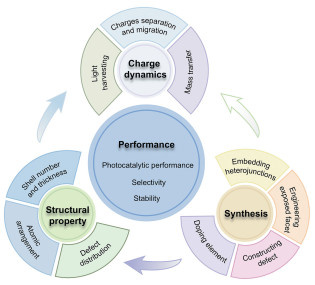
The optimization of core-shell structure catalysts essentially means precise multi-scale regulation for them. For different reaction conditions (e.g., light sources), different combinations of catalyst components need to be selected. Meanwhile, it is also necessary to further explore the correlation between catalyst components and its performance. To design high-performance catalysts, future research should avoid continuing to use the traditional trial-and-error method. A new strategy that combines high-throughput screening with machine learning prediction should be widely adopted. Furthermore, future research should focus on in-depth studies of key issues such as charge separation, electron transfer processes, and photothermal synergy effects through a series of in situ characterization techniques.
Core-shell structure materials exhibit extraordinary application potential in photocatalysis, which are regarded as important tools for solving environmental and energy issues. Herein, this review presents a pioneering systematic retrospective analysis and a comprehensive summary of core-shell structured materials in photocatalysis. It summarizes the templating methods and the template-free methods and presents examples of different catalyst morphologies. Subsequently, the review discusses the optimization strategy for core-shell structured materials, detailing the specific mechanism by precisely regulating their structure and composition to achieve performance improvement. At present, the methods for optimizing core-shell structured materials mainly include embedding heterojunctions, engineering exposed facet, constructing defect, doping element, and modulating morphology and size. These strategies can obviously promote carrier separation, improve light harvesting, enhance the exposure of abundant active sites, and optimize molecular adsorption and activation.
Recently, progress has been made in the optimization of core-shell structured catalysts, while it is still difficult to meet the actual demands of industrial applications. There is considerable potential for improvement in each step of the photocatalytic reaction process. Therefore, it remains a key challenge to develop catalytic systems for meeting industrial-scale efficiency. Core-shell heterojunctions may induce localized accumulation of photogenerated charges in the core during the photocatalytic process. For core-shell heterojunction, photogenerated charges may locally accumulate in the core region during the photocatalytic process. If these charges are not consumed in time, it would result in charge saturation, thereby leading to a decline in catalytic performance. Additionally, the accumulated charges can intensify side reactions (like photo corrosion), which would cause structural collapse and performance decrease of catalysts. Consequently, future designs should balance efficient charge separation with structural stability to address the key bottleneck in practical applications.
Photocatalysis is a complex reaction process which involves light, electricity and chemical reactions as well as energy conversion. When designing a high effective photocatalyst, it is recommended to give priority to the following directions:
(ⅰ) To achieve full utilization of solar energy, it is essential to design core-shell structure materials with a wide light absorption range (up to 600–700 nm).
(ⅱ) The long-term stability and solar conversion efficiency of catalysts should be regarded as key performance indicators.
(ⅲ) To better utilize photogenerated carriers, more attention should be placed to surface and interface engineering.
(ⅳ) Considering practical applications, it is crucial to develop core-shell structured materials made from inexpensive and abundantly available elements to ensure that solar energy conversion is cost-effective.
Yujia Xiang: Writing – review & editing, Writing – original draft, Validation, Investigation, Formal analysis. Shuo Chen: Investigation, Formal analysis. Yan Zhang: Investigation, Formal analysis. Jing Zhang: Supervision. Chuanshu He: Supervision. Zhaokun Xiong: Supervision. Peng Zhou: Writing – review & editing, Writing – original draft, Supervision. Bo Lai: Writing – review & editing, Supervision, Project administration, Funding acquisition.
The authors declare that they have no known competing financial interests or personal relationships that could have appeared to influence the work reported in this paper.
This work was supported by National Natural Science Foundation of China (No. U24A20561) and Sichuan Science and Technology Program (No. 2024NSFTD0014).
Supplementary material associated with this article can be found, in the online version, at doi:
S. Gao, B.C. Gu, X.C. Jiao, et al., J. Am. Chem. Soc. 139 (2017) 3438–3445. doi: 10.1021/jacs.6b11263
J.T. Li, N.Q. Wu, Catal. Sci. Technol. 5 (2015) 1360–1384. doi: 10.1039/C4CY00974F
M. Zhou, Z.Q. Wang, A.H. Mei, et al., Nat. Commun. 14 (2023) 2473. doi: 10.1038/s41467-023-37545-2
M. Shi, G.N. Li, J.M. Li, et al., Angew. Chem. Int. Ed. 59 (2020) 6590–6595. doi: 10.1002/anie.201916510
A. Li, W.J. Zhu, C.C. Li, et al., Chem. Soc. Rev. 48 (2019) 1874–1907. doi: 10.1039/c8cs00711j
M. Wang, H.R. Zhou, F. Wang, Joule 8 (2024) 604–621. doi: 10.1016/j.joule.2023.12.017
G.B. Chen, G.I.N. Waterhouse, R. Shi, et al., Angew. Chem. Int. Ed. 58 (2019) 17528–17551. doi: 10.1002/anie.201814313
F.P.G. de Arquer, D.V. Talapin, V.I. Klimov, et al., Science 373 (2021) eaaz8541. doi: 10.1126/science.aaz8541
L. Jiang, J. Yang, S. Zhou, et al., Coord. Chem. Rev. 439 (2021) 213947. doi: 10.1016/j.ccr.2021.213947
J. Yang, H. Wang, L. Jiang, et al., Chem. Eng. J. 427 (2022) 130991. doi: 10.1016/j.cej.2021.130991
Y.Z. Wei, N.L. Yang, K.K. Huang, et al., Adv. Mater. 32 (2020) 2002556. doi: 10.1002/adma.202002556
D. Zu, Y.R. Ying, Q. Wei, et al., Angew. Chem. Int. Ed. 63 (2024) e202405756. doi: 10.1002/anie.202405756
M.H. Elsayed, M. Abdellah, A.Z. Alhakemy, et al., Nat. Commun. 15 (2024) 707. doi: 10.1038/s41467-024-45085-6
L.Q. Xiong, H.F. Qi, S.X. Zhang, et al., Adv. Mater. 35 (2023) 2209646. doi: 10.1002/adma.202209646
J.Y. Qiu, K. Meng, Y. Zhang, et al., Adv. Mater. 36 (2024) 2400288. doi: 10.1002/adma.202400288
B.C. Zhu, J. Sun, Y.Y. Zhao, et al., Adv. Mater. 36 (2024) 2310600. doi: 10.1002/adma.202310600
X.G. Yang, D.W. Wang, ACS Appl. Energy Mater. 1 (2018) 6657–6693. doi: 10.1021/acsaem.8b01345
M.B. Gawande, A. Goswami, T. Asefa, et al., Chem. Soc. Rev. 44 (2015) 7540–7590. doi: 10.1039/C5CS00343A
S. Das, J. Pérez-Ramírez, J.L. Gong, et al., Chem. Soc. Rev. 49 (2020) 2937–3004. doi: 10.1039/c9cs00713j
H. Wang, L.Y. Chen, Y.H. Feng, et al., Acc. Chem. Res. 46 (2013) 1636–1646. doi: 10.1021/ar400020j
C.T. Kresge, M.E. Leonowicz, W.J. Roth, et al., Nature 359 (1992) 710–712. doi: 10.1038/359710a0
M. Inagaki, M. Toyoda, Y. Soneda, et al., Carbon 107 (2016) 448–473. doi: 10.1016/j.carbon.2016.06.003
Z.Y. Shi, Y.Y. Ge, Q.B. Yun, et al., Acc. Chem. Res. 55 (2022) 3581–3593. doi: 10.1021/acs.accounts.2c00579
Z.Q. Liu, W. Li, W.B. Sheng, et al., J. Am. Chem. Soc. 145 (2023) 5310–5319. doi: 10.1021/jacs.2c12977
J.J. Zhu, Y.X. Shang, H.Y. Yu, et al., Chem. Res. Chin. Univ. 36 (2020) 171–176. doi: 10.1007/s40242-020-9035-3
Z.F. Li, X. Ren, W.C. Tian, et al., J. Electrochem. Soc. 167 (2020) 090516. doi: 10.1149/1945-7111/ab819e
J. Xiang, Q. Yin, K. Zhang, et al., Mater. Technol. 30 (2015) 213–217. doi: 10.1179/1753555714Y.0000000248
M.C. Mascolo, Y.B. Pei, T.A. Ring, et al., Materials 6 (2013) 5549–5567. doi: 10.3390/ma6125549
M. Pérez-Page, E. Yu, J. Li, et al., Adv. Colloid Interface Sci. 234 (2016) 51–79. doi: 10.1016/j.cis.2016.04.001
S.M. Xu, C.M. Hessel, H. Ren, et al., Energy Environ. Sci. 7 (2014) 632–637. doi: 10.1039/C3EE43319F
H. Ren, R.B. Yu, J. Qi, et al., Adv. Mater. 31 (2019) 1805754. doi: 10.1002/adma.201805754
J.Y. Wang, H.J. Tang, L.J. Zhang, et al., Nat. Energy 1 (2016) 16050. doi: 10.1038/nenergy.2016.50
P.F. Xu, R.B. Yu, H. Ren, et al., Chem. Sci. 5 (2014) 4221–4226. doi: 10.1039/C4SC01882F
Y.Z. Wei, F.F. You, D.C. Zhao, et al., Angew. Chem. Int. Ed. 61 (2022) e202212049. doi: 10.1002/anie.202212049
L.X. Zhang, J. Zhang, H.F. Jiu, et al., J. Mater. Sci. 50 (2015) 5228–5237. doi: 10.1007/s10853-015-9070-5
J.B. Cai, X.Q. Wu, S.X. Li, et al., ACS Appl. Mater. Interfaces 7 (2015) 3764–3772. doi: 10.1021/am508554t
L. Zhou, Z. Su, J. Wang, et al., Appl. Catal. B: Environ. 341 (2024) 123290. doi: 10.1016/j.apcatb.2023.123290
R.A. Wang, M.J. Zhang, S.L. Zhang, et al., ACS Nano 17 (2023) 24363–24373. doi: 10.1021/acsnano.3c10352
J.B. Joo, H.Y. Liu, Y.J. Lee, et al., Catal. Today 264 (2016) 261–269. doi: 10.1016/j.cattod.2015.09.008
M.G. Wang, J. Han, Y.M. Hu, et al., ACS Appl. Mater. Interfaces 8 (2016) 29511–29521. doi: 10.1021/acsami.6b10480
Y.A. Ren, M. Chen, Y. Zhang, et al., Langmuir 26 (2010) 11391–11396. doi: 10.1021/la1008413
X.W. Lou, L.A. Archer, Z.C. Yang, Adv. Mater. 20 (2008) 3987–4019. doi: 10.1002/adma.200800854
C. Berg, L. Fu, Y.H. Liu, et al., Ceram. Int. 49 (2023) 16501–16513. doi: 10.1016/j.ceramint.2023.02.169
X.J. Wu, D.S. Xu, J. Am. Chem. Soc. 131 (2009) 2774–2775. doi: 10.1021/ja808452r
X.J. Wu, D.S. Xu, Adv. Mater. 22 (2010) 1516–1520. doi: 10.1002/adma.200903879
J.P. Wang, N. Li, J. Mater. Chem. B 5 (2017) 8430–8445. doi: 10.1039/C7TB02381B
X.Y. Lai, J. Li, B.A. Korgel, et al., Angew. Chem. Int. Ed. 50 (2011) 2738–2741. doi: 10.1002/anie.201004900
H.L. Xu, W.Z. Wang, Angew. Chem. Int. Ed. 46 (2007) 1489–1492. doi: 10.1002/anie.200603895
K.Y. Niu, J. Park, H.M. Zheng, et al., Nano Lett. 13 (2013) 5715–5719. doi: 10.1021/nl4035362
Y.P. Chen, M.S. Duyar, R.R. Han, et al., Mater. Today 75 (2024) 259–284. doi: 10.3390/insects15040259
W.Y. Wu, S.D. Wu, W.W. Tjiu, et al., ACS Nano 17 (2023) 17536–17544. doi: 10.1021/acsnano.3c06148
J.R. Zhai, Y. Hu, M.F. Su, et al., Small 19 (2023) 2206440. doi: 10.1002/smll.202206440
W. Ostwald, Zeitschrift Für Physikalische Chem. 34 (1900) 495–503. doi: 10.1515/zpch-1900-3431
H.G. Yang, H.C. Zeng, J. Phys. Chem. B 108 (2004) 3492–3495. doi: 10.1021/jp0377782
L. Yu, R.X. Han, X.H. Sang, et al., ACS Nano 12 (2018) 9051–9059. doi: 10.1021/acsnano.8b02946
C. Hiragond, S. Ali, S. Sorcar, et al., Catalysts 9 (2019) 370–394. doi: 10.3390/catal9040370
C. Jin, B. Han, C. Luo, et al., Water Res. 287 (2025) 124420. doi: 10.1016/j.watres.2025.124420
R.G. Li, F.X. Zhang, D.G. Wang, et al., Nat. Commun. 4 (2013) 1432. doi: 10.1038/ncomms2401
D.E. Wang, H.F. Jiang, X. Zong, et al., Chem. Eur. J. 17 (2011) 1275–1282. doi: 10.1002/chem.201001636
Z. Zhao, X.Y. Zhang, G.Q. Zhang, et al., Nano Res. 8 (2015) 4061–4071. doi: 10.1007/s12274-015-0917-5
J. Qin, Q. Wang, B. Han, et al., Appl. Catal. B: Environ. 360 (2025) 124538. doi: 10.1016/j.apcatb.2024.124538
X.Y. Zhang, Z. Zhao, W.W. Zhang, et al., Small 12 (2016) 793–801. doi: 10.1002/smll.201503067
Z.Y. Ya, X.Y. Jiang, P. Wang, et al., Small 19 (2023) 2208254. doi: 10.1002/smll.202208254
Y.Y. Ma, M.Z. Zhang, M. Sun, et al., Fuel 324 (2022) 124577. doi: 10.1016/j.fuel.2022.124577
A. Behera, A. Ghoshal, R. Srivastava, ChemistrySelect 8 (2023) e202204202. doi: 10.1002/slct.202204202
Z. Cirena, Y. Nie, Y.F. Li, et al., Chin. Chem. Lett. 34 (2023) 107726. doi: 10.1016/j.cclet.2022.08.006
X.Q. Sun, T.Y. Wang, X.X. Xu, Int. J. Hydrogen Energy 68 (2024) 149–158. doi: 10.3390/batteries10050149
D.A. Wang, T. Hisatomi, T. Takata, et al., Angew. Chem. Int. Ed. 52 (2013) 11252–11256. doi: 10.1002/anie.201303693
T. Mitsudome, A. Noujima, T. Mizugaki, et al., Adv. Synth. Catal. 351 (2009) 1890–1896. doi: 10.1002/adsc.200900239
Q.F. Wang, B. Liu, X.F. Wang, et al., J. Mater. Chem. 22 (2012) 21647–21653. doi: 10.1039/c2jm34705a
H. Wang, X.K. Gu, X. Zheng, et al., Sci. Adv. 5 (2019) eaat6413. doi: 10.1126/sciadv.aat6413
Y.Y. Zhou, Y.J. Xiang, Y.Z. He, et al., J. Hazard. Mater. 359 (2018) 396–407. doi: 10.1016/j.jhazmat.2018.07.083
Y.J. Xiang, L. Jiang, Y.Y. Zhou, et al., J. Hazard. Mater. 422 (2022) 126843. doi: 10.1016/j.jhazmat.2021.126843
Y. Chai, F. Wang, Y. Gao, et al., Environ. Res. 282 (2025) 122099. doi: 10.1016/j.envres.2025.122099
Y. Hu, M. Chen, J. Pu, et al., Water Res. 253 (2024) 121262. doi: 10.1016/j.watres.2024.121262
F.C. Wang, Y. Liu, J.L. Yin, et al., Chem. Eng. J. 500 (2024) 156952. doi: 10.1016/j.cej.2024.156952
Y.J. Xiang, Y. Liu, B.Y. Cong, et al., Water Res. 267 (2024) 122494. doi: 10.1016/j.watres.2024.122494
X. Zhou, Y. Liu, C.S. He, et al., J. Hazard. Mater. 480 (2024) 136441. doi: 10.1016/j.jhazmat.2024.136441
Y.J. Xiang, T.B. Liu, B.Y. Jia, et al., Biosens. Bioelectron. 220 (2023) 114895. doi: 10.1016/j.bios.2022.114895
Y. Hu, Z. Jiang, S. Lei, et al., J. Environ. Chem. Eng. 13 (2025) 118245. doi: 10.1016/j.jece.2025.118245
X. Li, Y. Liu, J. Wei, et al., Chin. Chem. Lett. 36 (2024) 110811.
G.Z. Chen, Y. Wang, Y.W. Wei, et al., ACS Appl. Mater. Interfaces 10 (2018) 11595–11603. doi: 10.1021/acsami.7b18371
F.X. Dai, M.M. Zhang, J.S. Han, et al., Nano Res. 17 (2024) 1259–1266. doi: 10.1007/s12274-023-6107-y
Y. Zhang, Y.X. Wu, L. Wan, et al., Appl. Catal. B: Environ. 311 (2022) 121255. doi: 10.1016/j.apcatb.2022.121255
S. Wan, J. Xu, S. Cao, et al., Interdiscip. Mater. 1 (2022) 294–308. doi: 10.1002/idm2.12024
V.N. Rao, P. Ravi, M. Sathish, et al., J. Hazard. Mater. 413 (2021) 125359. doi: 10.1016/j.jhazmat.2021.125359
K. Li, M. Han, R. Chen, et al., Adv. Mater. 28 (2016) 8906–8911. doi: 10.1002/adma.201601047
L.X. Que, L. Lu, Y.L. Xu, et al., Int. J. Hydrogen Energy 48 (2023) 4708–4718. doi: 10.1016/j.ijhydene.2022.11.019

Figure 2 (a) Schematic procedure used to generate yolk/SiO2 shell particles containing movable NP cores. (b) TEM images of yolk/shell structures encapsulated different kinds of NP cores. Reproduced with permission [44]. Copyright 2009, American Chemical Society. (c) The formation of different Cu2O hollow structures in the presence of a CTAB template. (d) TEM images of the Cu2O hollow spheres. Reproduced with permission [48]. Copyright 2007, John Wiley & Sons.

Figure 3 (a) Schematic illustration (cross-sectional views) of the ripening process and two types (i and ii) of hollow structures. (b) TEM images of hollow structures. Reproduced with permission [54]. Copyright 2004, American Chemical Society. (c) TEM images of a β-FeOOH NR as it is heated in situ. Reproduced with permission [55]. Copyright 2018, American Chemical Society.

Figure 4 Ration design of core-shell structured materials for enhanced photocatalysis.

 扫一扫看文章


扫一扫关注我们
 DownLoad:

 下载:

 下载: