Hydroxylamine-regulated reactive oxygen species generation in an iron-biochar composite activated peracetic acid system for ultra-rapid degradation of atrazine
Citation:
Mingze Sun, Jianhua Qu, Kaige Li, Yue Lei, Jingyi Wang, Juncheng Wang, Yue Tao, Yifan Wang, Ying Zhang. Hydroxylamine-regulated reactive oxygen species generation in an iron-biochar composite activated peracetic acid system for ultra-rapid degradation of atrazine[J]. Chinese Chemical Letters,
2026, 37(12): 112750.
doi:
10.1016/j.cclet.2026.112750
Hydroxylamine-regulated reactive oxygen species generation in an iron-biochar composite activated peracetic acid system for ultra-rapid degradation of atrazine
English
Hydroxylamine-regulated reactive oxygen species generation in an iron-biochar composite activated peracetic acid system for ultra-rapid degradation of atrazine
State Key Laboratory of Black Soils Conservation and Utilization, Northeast Institute of Geography and Agroecology, Chinese Academy of Sciences, Changchun 130102, China
b.
School of Resources and Environment, Northeast Agricultural University, Harbin 150030, China
c.
University of Chinese Academy of Sciences, Beijing 100049, China
d.
Key Laboratory of Agro-Forestry Environmental Processes and Ecological Regulation of Hainan Province (Hainan University), Haikou 570228, China
Received Date:
12 October 2025 Accepted Date:
07 April 2026 Revised Date:
02 April 2026 Available Online:
15 December 2026
Abstract:
Iron-based catalysts-activated peracetic acid (PAA) for water treatment has been seriously limited by the difficulties in Fe(Ⅱ) regeneration and catalyst recovery. Herein, we employed the hydroxylamine (HA) to regulate a facilely prepared iron-carbon composite to activate PAA for organics degradation. Compared with the FONC@BC/PAA system, the incorporation of HA could accomplish about 100% removal of atrazine (ATZ) within only 4 min, which exhibited a high reaction rate constant of 0.524 min−1, representing a remarkable 4.63-fold increase. Notably, in contrast to prior research focusing on the function of HA supplementation in iron cycling, HA in this study played a triple role by activating PAA to generate HO•, accelerating the conversion of Fe(Ⅲ) and FeⅣO2+ to Fe(Ⅱ), and generating additional, more reactive oxygen species (ROS) that were susceptible to ATZ degradation such as R−O• and HO•. Moreover, the system possessed remarkable efficacy in removing ATZ within an extensive pH suitability range from 3 to 11 and high anti-interference capacity to coexisting substances, and maintained complete ATZ removal even after five recycles with effective magnetic recovery of FONC@BC. This study shed light on the overlooked enhancement of ROS production during HA regulation, putting forward a promising solution to optimize PAA - based advanced oxidation processes for water treatment.
Recently, advanced oxidation processes (AOPs) have gained popularity in converting pollutants into nontoxic or less toxic substances by activating various oxidants to generate reactive oxygen species (ROS), yielding impressive results in the treatment of organic pollutants in wastewater [1]. Peroxides, including persulphate (PS), hydrogen peroxide (H2O2), and peracetic acid (PAA) are extensively employed as sources of ROS, among which PAA has recently emerged as a prominent oxidant and positioned as a valuable alternative to H2O2 in water treatment [2,3]. Synthesized from a combination of H2O2 and acetic acid, PAA exists as an equilibrium mixture, boasting a relatively high oxidation potential of 1.96 V and making it a favorable substitute in AOPs [4].
Due to the limitations of PAA alone for refractory pollutants, various methods such as UV, heat, metal oxides, and transition metal ions have been employed to activate PAA [5]. Iron-based catalysts like zero-valent iron (Fe0), Fe(Ⅱ), and iron oxides have been widely used, with Fe3O4 standing out due to its convenient synthesis, low-cost, safety, and non-toxicity [6,7]. Nonetheless, the strong magnetism of Fe3O4 may cause it to agglomerate, thus inhibiting its activation ability [8]. Given the low cost and wide availability of biochar (BC), it can be used to disperse Fe3O4 evenly [9,10]. In addition, oxygen-containing functional groups located on the surface of BC serve as active sites to activate PAA for generating ROS, thereby efficiently degrading organic compounds [11]. Hence, compared with other reported Fe-carbon-based catalysts, BC loaded with Fe3O4 (FONC@BC) emerges as a prospective catalyst for activating PAA to degrade refractory organic contaminants, given its low-cost, environmental friendliness, and simplicity of synthesis [12,13]. Compared with the reported Fe(Ⅱ)/PAA system, using FONC@BC as a heterogeneous iron-based catalyst effectively alleviates the production of iron sludge [14]. Nevertheless, the activation ability of Fe(Ⅲ) produced during the reaction towards PAA is inferior to that of Fe(Ⅱ), limiting the degradation efficiency due to the slow conversion from Fe(Ⅲ) to Fe(Ⅱ) (k = 2.72 ± 0.38 L mol−1 s−1) [15]. In conclusion, it is of significant meaning to explore strategies to accelerate Fe(Ⅱ) regeneration in FONC@BC/PAA system.
To overcome aforementioned limitations, some researches focused on reductants such as p-hydroquinone, small molecular organic acids, and hydroxylamine hydrochlo ride (HA) for promoting iron circulation [16]. Compared to various reductants, HA, as a relatively weaker radical scavenger, exhibits a more excellent reduction effect and is capable of regenerating Fe(Ⅱ) through a swift equilibrium reaction with Fe(Ⅲ). In addition, HA, a room-temperature stable solid, is less affected by the environment, easy to store and transport, with simple reaction products, a mature production process, abundant raw materials and low cost, facilitating its wide practical use. It has been reported that HA could be used as a regulator to accelerate the iron cycle for pollutants degradation [17]. Nevertheless, there have been a few reports of the addition of HA to regulate ROS production in FONC@BC/PAA system and relevant studies need to be carried out urgently.
Among the various ROS generated by activating PAA, HO• has high oxidation potential and strong oxidizing ability, which facilitates the rapid pollutants degradation. Therefore, adding HA to the FONC@BC/PAA system to regulate HO• generation is of great significance. This study took atrazine (ATZ), which is more readily degraded by HO•, as the model pollutant to deeply investigate how HA enhances the generation of ROS in the FONC@BC/PAA system. The surface configuration and chemical component of the facile FONC@BC were depicted via various characterizations. Through comparisons made with electron paramagnetic resonance (EPR) and quenching experiments, it was verified that the HA activation of PAA system combined with iron cycling had an effect of enhancing ROS formation. Moreover, the regulation mechanism of HA was further explored by comparing the degradation pathways, and the toxicity of intermediates in both FONC@BC/PAA and FONC@BC/PAA/HA systems with the assistance of DFT calculation. Additionally, the practical application of FONC@BC/PAA/HA system for wastewater treatment was assessed, evaluating its effectiveness against various pollutants and water-based substances.
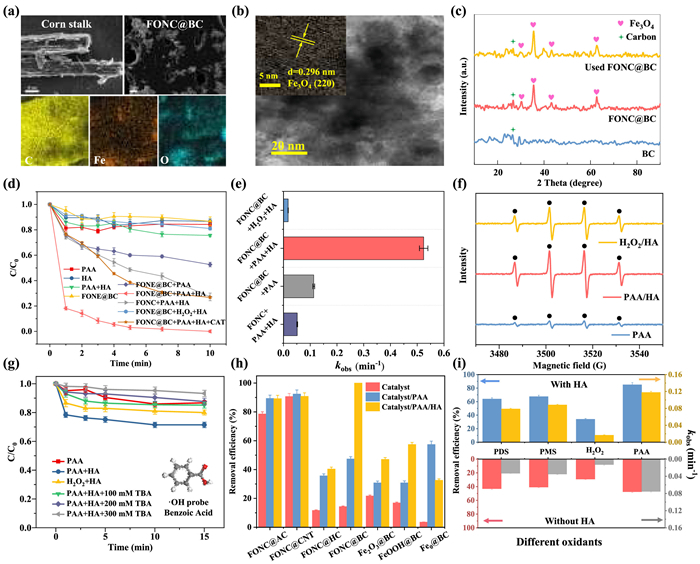
The details including chemicals, characterizations, experimental procedure and analytical methods are presented in Text S1 (Supporting information). A series of characterizations verified the successful loading of Fe3O4 particles onto the BC substrate. SEM and HRTEM images confirmed that Fe3O4 nanoparticles with high crystallinity were uniformly loaded on the BC, with the planar magnetite stripe of (220) on the FONC@BC corresponding to the standard crystalline structure of Fe3O4 (Figs. 1a and b) [18,19]. XRD analysis further indicated the crystal structure of the catalyst, showing characteristic peaks at 2θ = 30.5, 35.3, 42.8, and 62.8°, corresponding to the (220), (311), (400), and (440) planes of crystalline Fe3O4. Following the reaction, there was a slight decrease in the intensity of Fe3O4 peaks due to its involvement in ATZ degradation (Fig. 1c) [20]. Furthermore, FONC@BC demonstrated recyclable catalyst properties, with the magnetization saturation value of 11.9 emu/g (Fig. S1 in Supporting information).
Figure 1
Figure 1.
(a) SEM images of corn stalk and FONC@BC and EDS mapping of FONC@BC. (b) HRTEM images of FONC@BC. (c) XRD patterns of BC and FONC@BC. (d) ATZ removal and (e) kobs in different systems. (f) EPR signals of DMPO spin trapping adducts produced by HA and PAA. (g) Inhibition effect of TBA on the oxidation of BA in the HA/PAA reaction. (h) The activation properties of various catalysts. (i) Degradation of ATZ and the corresponding kobs in various AOPs systems with and without HA. General conditions: [ATZ] = 10 mg/L, [catalyst] = 1 g/L, [oxidizing agent] = 2.33 mol/L, [HA] = 10 mol/L, pH 7.0, T = 25 ± 2 ℃, t = 10 min. Specific conditions: (d) [catalase]0 = 10 units/mL, (g) [BA] = 10 mg/L, t = 15 min, (h) [ATZ] = 30 mg/L.
As depicted in Fig. 1d, the ATZ degradation efficiencies for various systems were presented. The results indicated that PAA and FONC@BC could only remove 15.79% and 13.28% of ATZ, suggesting minimal contribution from individual single PAA degradation and physical adsorption alone. Additional experiments (Fig. S2 in Supporting information) demonstrated that the pore structure of BC inadequately enriched ATZ (9.49%), and only 15.52% of ATZ degraded in FONC/PAA system due to the agglomerate of FONC and limited Fe(Ⅱ) release. What is more, the ATZ removal efficiency significantly increased to 47.40% when FONC@BC was employed as PAA activator, inferring that the pore structure of BC mitigated FONC agglomeration and facilitated Fe(Ⅱ) and Fe(Ⅲ) discharge. However, the ATZ decomposition efficiency within FONC@BC/PAA system was still limited because the low catalytic activity of Fe(Ⅲ) towards PAA. Therefore, HA was introduced to promote the transformation between Fe(Ⅲ) and Fe(Ⅱ).
It was found that 24.42% of ATZ was degraded in PAA/HA system, which was 8.63% higher than in PAA system (Fig. 1d), indicating that the activation of PAA might be promoted with the addition of HA to generate ROS. Meanwhile, only 18.87% of ATZ was removed in FONC@BC/H2O2/HA system, indicating that H2O2, as one of four equilibrium mixtures, did not significantly contribute to ATZ removal in FONC@BC/PAA/HA system [21]. It was primarily because PAA exhibited stronger oxidation capacity due to its lower lowest unoccupied molecular orbital (LUMO) energy and higher electron affinity. Interestingly, when the co-existing H2O2 in the PAA solution was removed by catalase (CAT) at a concentration of 10 units/mL, approximately 26.67% of the degradation of ATZ was inhibited in the FONC@BC/PAA/HA system. Therefore, the co-existing H2O2 and PAA actually had a synergistic effect on the degradation of atrazine in the FONC@BC/PAA/HA system [22]. Not unexpectedly, the addition of 10 mol/L HA into FONC@BC/PAA system realized the 81.88% and almost 100% degradation efficiency of ATZ within 1 and 10 min, and the corresponding kobs value of FONC@BC/PAA/HA system was 0.524 min−1, 10.06-fold greater compared to that of the FONC@BC/PAA system (Fig. 1e). Therefore, it could be inferred that the efficient removal of ATZ might mainly due to the Fe(Ⅱ) regeneration and ROS generation by HA regulation. Fig. 1f depicted typical EPR signals of 5,5–dimethyl–1–pyrroline N–oxide (DMPO) adducts in three systems included PAA, H2O2/HA, and PAA/HA. Previous studies had demonstrated the production of HO• in H2O2/HA system [16]. Importantly, a stronger DMPO–OH signal of 1:2:2:1 was observed in PAA/HA system compared to H2O2/HA system, demonstrating that both H2O2 and PAA could be activated by HA to produce HO• [23]. Additionally, benzoic acid (BA) was chosen as a probe to validate HO• production in PAA/HA system (Fig. 1g) [24]. And TBA was used as a HO• quenching agent, which competed with BA for HO• [25]. BA was almost completely inhibited by 300 mol/L TBA, further confirming the significant production of HO• in PAA/HA system.
To evaluate the activation performance of various catalysts, various carbon matrixes (activated carbon (AC), carbon nanotubes (CNT), and hydrothermal char (HC)) and iron-based compounds (Fe2O3, FeOOH, and Fe0) were prepared with the intention of activating PAA to degrade ATZ under conditions of both the deficiency and existence of HA (Fig. 1h) [26,27]. In the case of Fe-carbon/PAA/HA systems, AC and CNT exhibited 89.19% and 90.79% of ATZ removal efficiency mainly due to their superior adsorption capabilities [28]. HC, with its limited porosity, achieved only 39.38% of ATZ degradation, as it struggled to effectively disperse FONC. Among different iron-based materials loaded onto BC as catalysts, Fe2O3 and FeOOH presented lower degradation efficiencies due to the presence of predominant Fe(Ⅲ) species, which showed weaker activation effect on PAA than FONC. The catalytic efficiency of Fe0@BC was limited by the existence of excessive Fe(Ⅱ) (the details were shown in Fig. S3 and Text S7 in Supporting information). Therefore, FONC@BC could be considered as the most effective iron-based carbon catalysts in the system. In addition, several common AOPs systems enhanced by HA on ATZ (30 mol/L) removal were also investigated (Fig. 1i). FONC@BC/PAA system attained an ATZ degradation rate of 0.0756 L mol−1 s−1, with the value 2.28, 2.15, and 5.90 folds that of FONC@BC/PDS, FONC@BC/PMS, and FONC@BC/H2O2 systems. Meanwhile, the degradation rate value was 1.49, 1.33, and 6.97 times higher for PAA (0.118 L mol−1 s−1) compared to PDS, PMS, and H2O2 in four AOPs systems with HA, which might be mainly attributed to kFe(Ⅱ)/PAA has the value of 1.10 × 10⁵–1.56 × 10⁴ L mol−1 s−1, higher than reaction rates of Fe(Ⅱ) with other peroxides. Additionally, FONC@BC/PAA/HA system had a suitable amount of dissolved total iron reaching 4.50 mg/L and higher dissolved Fe(Ⅱ) at 2.59 mg/L, exhibiting better utilization efficiency of iron and less secondary iron sludge pollution (Fig. S4 in Supporting information).
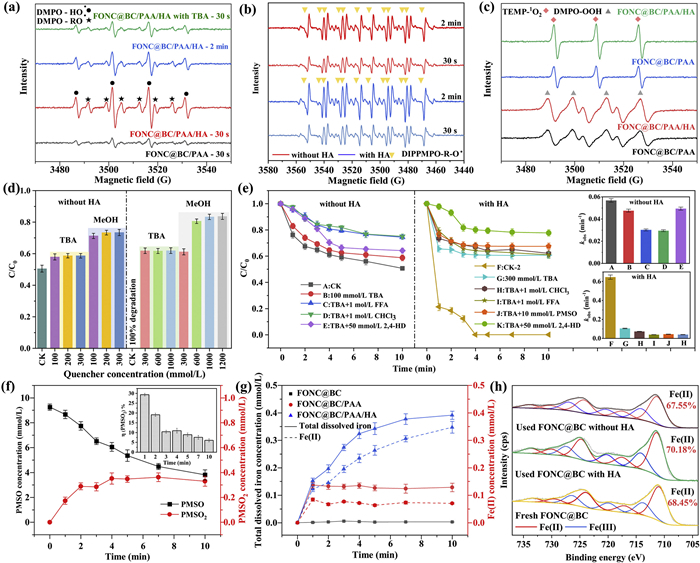
To preliminarily determine the generation of ROS in FONC@BC/PAA and FONC@BC/PAA/HA systems, electron paramagnetic resonance (EPR) was utilized for identifying the formation of ROS. As presented in Fig. 2a, when DMPO was employed as the trapping agent, a prominent peak with an intensity ratio of 1:2:2:1 was clearly discerned, signifying DMPO-•OH compound might be generated in two systems [28–30]. Notably, apart from the HO• generation via the PAA-Fe(Ⅱ) reaction (Eq. 1) that formed DMPO-•OH with DMPO, DMPO-•OH could also result from the reaction of DMPO-trapped FeⅣO2+. While FeⅣO2+ could indeed be formed during the process of the reaction between Fe(Ⅱ) and PAA via Eq. 2 [31]. Moreover, the peak of DMPO–•OH compound was found to still exist after addition of excessive TBA for quenching HO•, revealing the possible simultaneously presence of HO• and FeⅣO2+. Furthermore, phenyl methyl sulfoxide (PMSO) was employed to detect FeⅣO2+ since FeⅣO2+ could oxidized it to methyl phenyl sulfoxide (PMSO2) [32]. Obviously, PMSO2 gradually formed with the decrease of PMSO concentration in FONC@BC/PAA/HA system, while PMSO concentration had no change in FONC@BC/PAA system (Fig. 2f and Fig. S5 in Supporting information), indicating the formation of FeⅣO2+ with the addition of HA. Moreover, the yield of PMSO2 calculated by Eq. 3 was 29.4% at 1 min, after which it gradually decreased. This decline might be ascribed to the reaction between FeⅣO2+ and organic compounds through various pathways, and HA could transform FeⅣO2+ into Fe(Ⅱ) for accelerating iron cycle Eq. 4 [33].
CH3C(O)OOH+Fe(Ⅱ)→CH3C(O)O−+Fe(Ⅲ)+HO•
(1)
CH3C(O)OOH+Fe(Ⅱ)→CH3C(O)OH+FeⅣO2+
(2)
η(PMSO2)=Δ[PMSO2]/Δ[PMSO]
(3)
FeⅣO2++NH2OH→NHO+Fe(Ⅱ)+H2O
(4)
Figure 2
Figure 2.
(a) Simulated EPR spectra of DMPO–•OH and DMPO–R−O•. (b) Simulated EPR spectra of DIPPMPO–R−O•. (c) Simulated EPR spectra of DMPO–OOH and TEMP-1O2. (d) Effect of TBA and MeOH on ATZ degradation in two systems. (e) Effect of various scavengers on the degradation of ATZ in the presence of excess TBA. (f) Change in concentrations of PMSO and PMSO2 in FONC@BC/PAA/HA system (Inset: the yield of PMSO2). (g) Dissolved Fe ion concentration by different catalytic systems. (h) XPS spectra of Fe 2p of fresh and used FONC@BC in two systems. General conditions: [ATZ] = 10 mg/L, [catalyst] = 1 g/L, [PAA] = 15 mol/L, [HA] = 10 mol/L, [PMSO] = 10 mol/L, [TBA] = [MeOH] = 0–1 mol/L, pH 7.0, T = 25 ± 2 ℃, t = 10 min.
As observed in Fig. 2a, there was another DMPO-X signal that might be attributed to the mutual effect between DMPO and R−O• (Eqs. 5 and 6) [34]. The DIPPMPO was further employed as a trapping agent in FONC@BC/PAA and FONC@BC/PAA/HA systems to further identify the types of HO• and R−O•, which could be distinguished by different numbers of line signals. As expected, a typical 12-line signal of R−O• in Fig. 2b could be clearly observed in FONC@BC/PAA and FONC@BC/PAA/HA systems, indicating R−O• played the possible role in two systems [35]. Moreover, the signal peaks generated in the system containing HA were stronger, indicating that more R−O• produced. Besides, the DMPO–OOH signal was identified in Fig. 2c, demonstrating the existence of O2•− (Eqs. 7–12). And Fig. 2c also presented the triple signal peak associated with TEMP−1O2 exhibiting an intensity ratio of 1:1:1, suggesting 1O2 formation in the system (Eqs. 13 and 14). Hence, it could be concluded by EPR that HO•, R−O•, O2•−, and 1O2 were produced in two systems, and FeⅣO2+ was confirmed to be caused by the reaction between FONC@BC and PAA by the addition of HA.
In order to further determine the ROS that contributed to ATZ degradation, quenching experiments were carried out between FONC@BC/PAA and FONC@BC/PAA/HA systems. Previous studies indicated that ATZ was more prone to degradation by HO• among various ROS [34]. Therefore, different doses of TBA and MeOH were firstly selected as quenching agents. It was because MeOH was used as a powerful quencher for HO•, FeⅣO2+, and R−O• [36]. TBA was a representative quencher to HO• and was inert towards FeⅣO2+ and R−O• [37,38]. On the basis of Text S8 (Supporting information), TBA at concentrations of 73.25 and 231.59 mol/L effectively scavenged approximately 95% of HO• in FONC@BC/PAA and FONC@BC/PAA/HA systems, indicating that TBA exerted a potent inhibitory influence on ATZ removal. Therefore, TBA concentrations of 100–300 mol/L were selected for the quenching experiment in the FONC@BC/PAA system, and 300–1000 mol/L for the FONC@BC/PAA/HA system.
As shown in Fig. 2d, when a suitable quantity of quenchers was added, the degradation of ATZ was suppressed by 8.11% with 100 mol/L TBA and 20.74% with 200 mol/L MeOH. This demonstrated that both HO• and R−O• were involved in FONC@BC/PAA system (where the presence of FeⅣO2+ has previously been ruled out in this system). These results unequivocally eliminated the sole significance of HO• in FONC@BC/PAA system, indicating the involvement of other ROS during ATZ degradation. The inhibition of ATZ removal could reach equilibrium in FONC@BC/PAA/HA system with 61.76% and 83.33% when using 300 mol/L TBA and 1 mol/L MeOH. Obviously, the disparity in the ATZ inhibition effect between TBA and MeOH was merely 21.43%, indicating that HO• was mainly responsible for ATZ degradation, along with at least one of FeⅣO2+ and R−O• played a role in ATZ removal in FONC@BC/PAA/HA system. In comparison, it was preliminarily determined that the addition of HA enhanced ROS generation, not only regulated the production of FeⅣO2+, but also increased the yield of HO•, which was conducive to the degradation of ATZ.
As previously stated, the addition of a specific concentration of TBA no longer led to the suppression of the ATZ removal rate. In order to further explore the roles of other ROS in the system, 2,4-hexanedione (2,4-HD), furfuryl alcohol (FFA), chloroform (CHCl3), and PMSO were added to explore how efficiently ATZ degraded in the two systems when 100 and 300 mol/L TBA were present, further identifying the roles of R−O• and FeⅣO2+, O2•−, 1O2, and FeⅣO2+ [39,40]. Since the presence of FeⅣO2+ has previously been ruled out in the FONC@BC/PAA system, adding 2,4-HD to the system with TBA was mainly used to observe the role of R−O• during ATZ degradation. As observed from Fig. 2e, in the HA-free system, the inhibitions of ATZ degradation were 15.73% (1 mol/L FFA), 16.37% (1 mol/L CHCl3), and 5.41% (50 mol/L 2,4-HD) higher than that of 100 mol/L TBA quenching system, indicating O2•−, 1O2, R−O• and HO• collectively participated in ATZ degradation within the FONC@BC/PAA system. In terms of FONC@BC/PAA/HA system, when 300 mol/L TBA was present, the 1 mol/L FFA and 1 mol/L CHCl3 systems had slight effects on ATZ removal with the degradation efficiency inhibited by about 3.92% and 6.86% compared with TBA system in 4 min, indicating O2•− and 1O2 had less contribution to ATZ degradation. Moreover, the addition of 10 mol/L PMSO was able to suppress the formation of FeⅣO2+ and consequently inhibit approximately 6.69% of ATZ degradation, and the characteristic byproduct PMSO2 was detected in Fig. 2f. Together, these results strongly supported the involvement of FeⅣO2+ with HA regulation. The possible reason was that the addition of HA accelerated the regeneration of Fe(Ⅱ), leading to the formation of FeⅣO2+ by the reaction of Fe(Ⅱ) with PAA (Eq. 4). Moreover, HO• was confirmed to be caused by the reaction between FeⅣO2+ and water (Eq. 15, k = 1.3 × 10 −2 s −1), enhancing HO• production [41].
FeⅣO2++H2O→HO•+Fe(Ⅲ)+OH−
(15)
In order to thoroughly elucidate the regulatory mechanism of HA on iron in FONC@BC/PAA system, the transformation of dissolved iron concentration was evaluated. The concentration of total iron of in FONC@BC system was almost zero in Fig. 2g, indicating the stability of the catalyst. While after reaction for 10 min, the leached concentrations of total dissolved irons in FONC@BC/PAA and FONC@BC/PAA/HA systems were 0.128 and 0.391 mol/L, respectively, demonstrating that HA could promote the dissolution of iron on the FONC@BC. Furthermore, compared with FONC@BC/PAA system, the Fe(Ⅱ)/total iron molar ratio in FONC@BC/PAA/HA system was significantly higher, revealing that HA was also capable of expediting Fe(Ⅱ) regeneration, thereby enhancing the catalytic activity of FONC@BC.
The X-ray photoelectron spectroscopy (XPS) survey spectra indicated that FONC@BC was mainly consisted of C, Fe, and O elements (Fig. S6 and Text S9 in Supporting information). The iron content showed only a slight decrease before and after the reaction in both systems, supporting the low iron dissolution. Fig. 2h presented the hyperfine XPS spectra of Fe. The distinctive peaks detected at roughly 712.3 eV (assigned to Fe 2p3/2) and 724.7 eV (assigned to Fe 2p1/2), accompanied by a satellite peak at 718.4 eV, were all attributed to the presence of Fe(Ⅲ). While the peak centered at 710.5 eV is attributed to Fe(Ⅱ) 2p1/2 [42]. In the HA-free system, the Fe(Ⅱ) content on the surface of FONC@BC decreased by about 0.70%, while in FONC@BC/PAA/HA system, the Fe(Ⅱ) content increased by 10.02%. Combined with the iron content of the solution, the incorporation of HA led to a decrease in the Fe(Ⅲ)/Fe(Ⅱ) value both on the FONC@BC surface and in the solution, further proving that HA facilitated the transformation of Fe(Ⅲ) to Fe(Ⅱ) within the system and expedited the iron cycling process.
Following HA regulation, the heightened yield of Fe(Ⅱ) not only facilitated the production of FeⅣO2+, but also enhanced the roles of HO• and R−O•. When considered in conjunction with Fig. 2e, the presence of 300 mol/L TBA led to a 60.69% inhibition of the ATZ removal, whereas the inhibition escalated to 77.66% within the initial 2 min after the addition of 2,4-HD (50 mol/L). Therefore, 2,4-HD, as a quencher for HO•, R−O• and FeⅣO2+, could further inhibit the ATZ degradation efficiency by about 16.97% based the system with a sufficient amount of TBA (where HO• was inhibited). Since FeⅣO2+ has been proven to inhibit approximately 6.69% of ATZ degradation in the system with HA, R−O• was demonstrated to play a certain role during ATZ degradation.
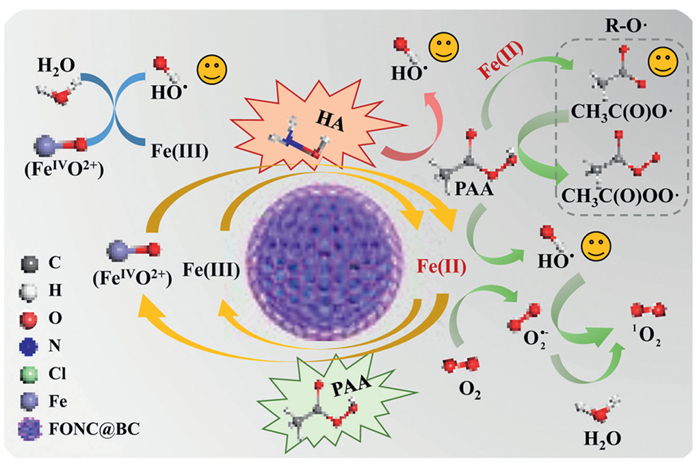
HA played a triple role by activating PAA to generate HO•, accelerating the transition of Fe(Ⅲ) into Fe(Ⅱ), and generating additional, more ROS susceptible to ATZ degradation. The proposed mechanisms for ATZ degradation in FONC@BC/PAA and FONC@BC/PAA/HA systems were illustrated in Fig. 3. First of all, FONC@BC acted as a catalyst could provide Fe(Ⅱ) to rapidly activate PAA for the production of such ROS as R−O•, O2•−, 1O2, and HO•. Subsequently, the presence of HA obviously accelerated regeneration of Fe(Ⅱ), which could be transformed from Fe(Ⅲ) and FeⅣO2+. Furthermore, the regulation of HA enhanced the production of ROS, resulting in a high-efficiency degradation of ATZ.
Figure 3
Figure 3.
The schematic of possible mechanism for ATZ degradation.
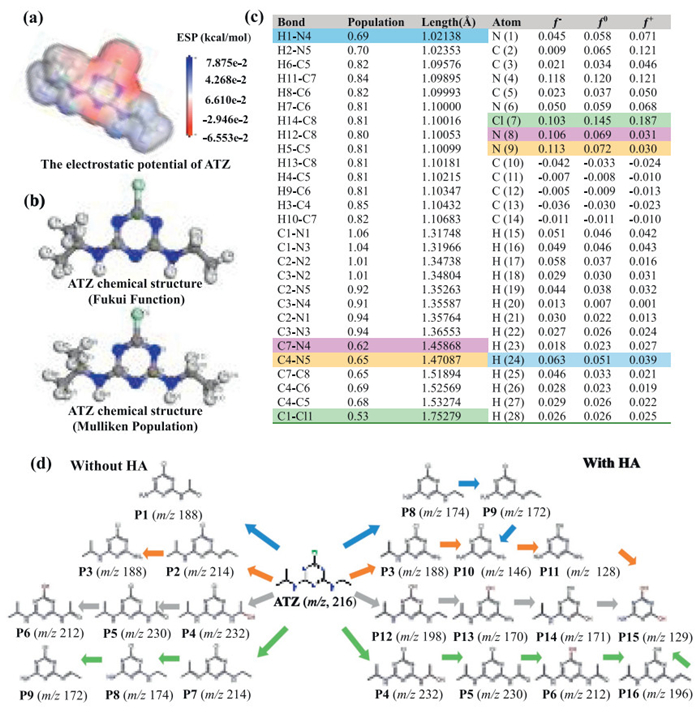
As observed from Fig. 4, ATZ was degraded into 16 intermediates in FONC@BC/PAA and FONC@BC/PAA/HA systems. The possible cleavage sites and active sites of ATZ were calculated using density functional theory (DFT) calculation [43]. Firstly, it could be speculated through electrostatic potential (ESP) that the Cl atom was vulnerable to be electrophilic attacked (Fig. 4a). While the C1-Cl1 bond features the lowest Mulliken population value and the longest bond length was prone to cleavage to produce P12 by dechlorination-hydroxylation. Similarly, it was found that N(8) and N(9) atoms on ATZ could be electrophilic attacked on account of their larger f- values, while corresponding C7-N4 and C4-N5 bonds were easily broken to generate P1, P3 and P8. Meanwhile, H(24) on ATZ with larger f- value was vulnerable to be attacked, leading to alkylic-hydroxylation process to generate P2 and P4, which could further be oxidated to form P5 (Figs. 4b and c). In addition, although 13 intermediates were detected in the system with HA, compared with 9 in the system without HA, the content of chlorinated compounds was significantly reduced in FONC@BC/PAA/HA system with more small molecule products produced (Fig. 4d). Noteworthy, the ratio of chlorine release was confirmed to reach 86.2% in Text S8 and Fig. S7 (Supporting information), indicating that dechlorination-hydroxylation was a leading process during ATZ decomposition in FONC@BC/PAA/HA system (Text S7). Overall, in the FONC@BC/PAA system, ATZ underwent degradation primarily through hydrolysis and dealkylation reactions, yielding triazine intermediates that were highly resistant to ring-opening. In FONC@BC/PAA/HA system, HA mediated reductive dechlorination to break ring stability, accelerated dealkylation and ring activation, and promoted triazine ring opening to form cyanuric acid for further decomposition into small molecules.
Figure 4
Figure 4.
(a) ESP distribution for ATZ. (b) Chemical structure of ATZ. (c) Fukui function and Mulliken population analysis of ATZ. (d) Possible ATZ decomposition pathway in FONC@BC/PAA and FONC@BC/PAA/HA system.
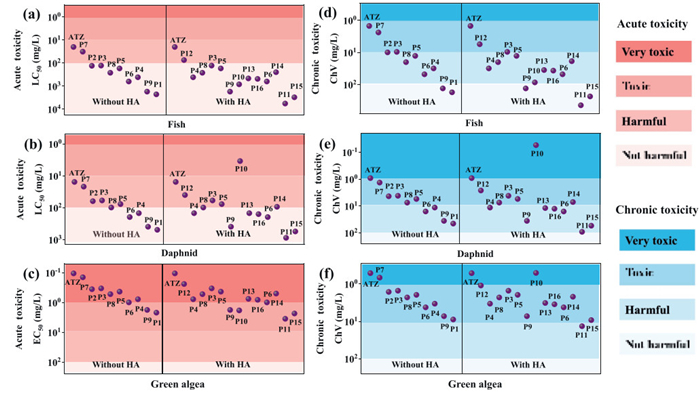
Besides, the ECOSAR program was employed to forecast the acute and chronic toxicities linked to ATZ and its 16 types of degradation products (Fig. 5). The results clearly demonstrated that the environmental toxicological impacts of the majority of the transformation products were significantly less severe than those of ATZ itself. Overall, the FONC@BC/PAA/HA system could more effectively alleviate environmental harm caused by ATZ by producing intermediates with less eco-toxicity.
Figure 5
Figure 5.
Prediction of acute toxicity (a-c) and chronic toxicity (d-f) of ATZ with intermediate products in FONC@BC/PAA and FONC@BC/PAA/HA systems via ECOSAR.
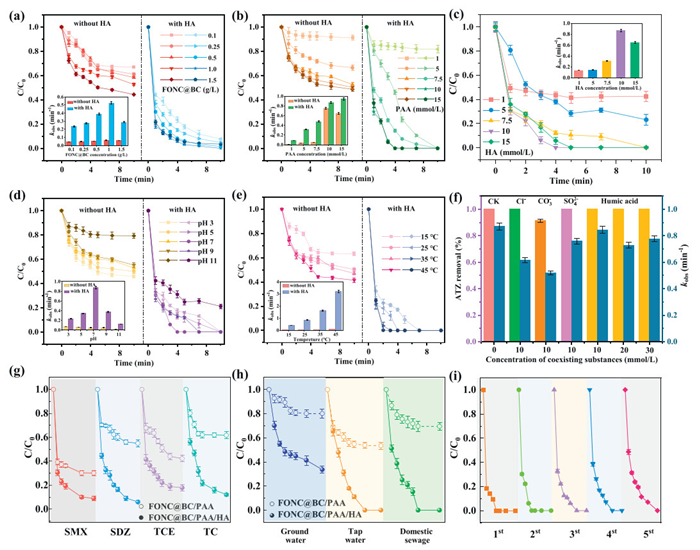
To evaluate the elimination performances of ATZ by with and without HA systems, the effects of experimental factors including catalyst dosage, PAA concentration, pH and temperature were investigated. Compared with FONC@BC/PAA system, the degradation efficiency of ATZ showed an average 2.23-fold improvement in FONC@BC/PAA/HA system under various catalyst dosage, while kobs increased by 6.19 times. From Fig. 6a, with FONC@BC input raising from 0.1 g/L to 1.0 g/L, the kobs value elevated by about 1.49 and 2.19 times in FONC@BC/PAA and FONC@BC/PAA/HA systems, which could be ascribed to the augmentation of active sites, leading to the increase of ROS. Nonetheless, when the FONC@BC dosage further improved to 1.5 g/L, corresponding kobs values were lower than that of 1 g/L. This was due to that some of ROS were quenched by excessive Fe(Ⅱ) released from FONC@BC (Eqs. 16 and 17).
CH3C(O)O•+Fe(Ⅱ)→CH3C(O)O−+Fe(Ⅲ)
(16)
Fe(Ⅱ)+HO•→Fe(Ⅲ)+OH−
(17)
Figure 6
Figure 6.
Effects of (a) catalyst dosage, (b) PAA concentration, (c) HA concentration, (d) initial pH, (e) temperature, (f) inorganic anions and humic acid on ATZ degradation. Application performance of FONC@BC/PAA/HA system for (g) different pollutants, (h) various water matrices, and (i) reusability study. General conditions: [ATZ] = 10 mg/L, [catalyst] = 1 g/L, [PAA] = 15 mol/L, [HA] = 10 mol/L, $ \left[\mathrm{Cl}^{-}\right]=\left[\mathrm{HCO}_3^{-}\right]=\left[\mathrm{SO}_4^{2-}\right] $ = 10 mol/L, pH 7.0, T = 25 ± 2 ℃, t = 10 min.
As observed from Fig. 6b, the FONC@BC/PAA/HA system exhibited a notable enhancement in both degradation efficiency and kobs value compared to the FONC@BC/PAA system across varying PAA concentrations, with an average increase of 2.17- and 4.81-fold, respectively. From Fig. 6c, the removal rate of ATZ was only 56.4% at 1 mol/L HA after reaction for 4 min, while it notably increased to 100% at 10 mol/L HA, and the corresponding kobs value elevated from 0.137 min−1 to 0.871 min−1. It was highly probable that the additive HA could convert Fe(Ⅲ) to Fe(Ⅱ), thereby promoting PAA activation and expediting ROS formation in FONC@BC/PAA/HA system [43–44]. However, as the HA concentration was additionally elevated to 15 mol/L, the ATZ decomposition efficiency was slightly restrained and the kobs value declined to 0.649 min−1, which was possibly due to quenching of ROS by excessive HA.
It could be observed in Fig. 6d that in FONC@BC/PAA system, as the pH of the polluted water rose from 3.0 to 11.0, the degradation rate of ATZ dropped significantly from 54.3% to 21.7% and the kobs decreased from 0.0704 min−1 to 0.0185 min−1. The ATZ was totally removed during the pH range of 3.0–7.0 with the addition of HA, and the corresponding kobs value increased by 3.7 times. It was noteworthy that the pHPZC of FONC@BC was 3.67, indicating that the FONC@BC surface had a positive charge when pH was below 3.67, while it displayed a negative charge at the pH over 3.67 (Fig. S8 in Supporting information). Moreover, with the pKa of PAA being 8.2, CH3C(O)OOH predominated in PAA system when pH was below 8.2, and the conjugate base morphology of PAA (i.e., CH3C(O)OO-) gradually improved as pH increased. Therefore, when the pH increased from 3.67 to 7.0, a hydrogen bond was formed by hydrogen ions interacting with O–O part of PAA, which could result in positively charged PAA, thereby facilitating its electrostatic attraction with negatively charged FONC@BC [45]. Yet the amount of Fe(Ⅱ) obtained through the iron cycle was limited in FONC@BC/PAA system. Under acidic conditions, more Fe(Ⅱ) released from FONC@BC could participate in PAA activation, thus achieving greater ATZ degradation. However, when the pH further improved from 7.0 to 11.0, the ATZ degradation rate declined from 100% to 78.9%, which was mainly on account of the generation of Fe(Ⅲ) precipitates and the electrostatic repulsion between PAA and FONC@BC in an alkaline environment. Additionally, the pKa value of HA was 5.96. Thus NH3OH+ was the main morphology of HA at pH < 5.96, whereas NH2OH became the main morphology at pH > 5.96 [46]. Because NH2OH was generally considered more reactive with ROS than NH3OH+, more ROS were consumed by HA as the pH elevated. Overall, the addition of HA improved ATZ degradation efficiency and the kobs value under various pH conditions, especially at pH of 7.0, which increased by 2.11 and 16.9 times, respectively. And the FONC@BC/PAA/HA system could remove >78% of ATZ in the pH range from 3.0 to 11.0, demonstrating its excellent performance in degrading ATZ over a wide pH range. The kobs values in FONC@BC/PAA system ranged from 0.0463 min−1 to 0.0812 min−1 at different temperatures (15–45 ℃), and increased from 0.400 min−1 to 3.188 min−1 with the addition of HA (Fig. 6e). The PAA thermolysis could occur as the temperature increased, which promoted ATZ degradation. Moreover, the Arrhenius equation was used to calculated the activation energy (EA) at different temperatures (Eq. 18 and Fig. 6e). Here, A represents the pre-exponential/frequency factor with reactant collision frequency, R denotes the gas constant (8.314 J mol−1 K−1), and T signifies the thermodynamic temperature in Kelvin. Although the EA for ATZ degradation in FONC@BC/PAA/HA system was about 39.51 kJ/mol, higher than that in the FONC@BC/PAA system (10.05 kJ/mol), the addition of HA led to an increase in the kobs value by 8.64, 11.35, 25.82, and 39.27 times.
ln(kobs)=ln(A)−A/RT
(18)
The generally existing substances in natural water might exert influences on ATZ degradation, showing that 10 mol/L Cl−, HCO3− and SO42− had an inhibition of ATZ degradation in FONC@BC/PAA/HA system (Fig. 6f). This was because that Cl−could convert HO• and R−O• into chlorine radicals (Cl•andCl2•−), thus reducing the ATZ degradation efficiency. Similarly, HCO3− could also be converted into CO3•− with lower redox potentials, resulting in inhibition on ATZ decomposition. Additionally, it was also found from Fig. 6f that the FONC@BC/PAA/HA system possessed high tolerance to SO42−. Humic acid, as common natural organic matter, could capture ROS to restrain pollutant decomposition [47,48]. As presented in Fig. 6f, increasing the humic acid concentration to 30 mg/L reduced the kobs from 0.870 min−1 to 0.777 min−1. The slight inhibition of ATZ removal might be due to competition between humic acid and PAA for active sites on FONC@BC. Overall, the FONC@BC/PAA/HA system possessed high anti-interference capacity to coexisting substances, suggesting its high potential for practical application.
To validate the adaptability of the FONC@BC/PAA/HA system in the degradation process of typical recalcitrant pollutants, the removal rates of four pollutants by this system were investigated. As shown in Fig. 6g, the degradation of sulfamethoxazole (SMX), sulfadiazine (SDZ), trichloroethylene (TCE) and tetracycline (TC) by FONC@BC/PAA/HA system reached 90.99%, 93.98%, 82.13% and 87.96% after 10 min, which was significantly higher than FONC@BC/PAA system.
To explore the adaptability of FONC@BC/PAA/HA system in complex water matrix, the ATZ removal rate of the system in typical water matrices was investigated. The system completely degraded ATZ in both tap water and domestic sewage within 10 min in Fig. 6h. In groundwater, the performance of system was marginally inhibited, attributing to the ROS consumption by background ions. Considering the performance of the system in ATZ production wastewater, it demonstrated extensive adaptability to complex natural water matrices. In addition, FONC@BC not only functioned as an iron oxide dispersant but also served as a carrier for the controlled, slow, and sustainable release of Fe(Ⅱ). This controlled release mechanism mitigated the reaction between excessive Fe(Ⅱ) and ROS, thereby facilitating a sustainable Fenton-like oxidation process. Fig. 6i indicated that after 5 cycling tests, the ATZ removal efficiency within the FONC@BC/PAA/HA system still approximated 100.0%. This remarkable performance might be attributed to effective dispersion ability and its high stability with a low-level release of Fe(Ⅱ) concentration of FONC@BC during cycling tests. The abovementioned findings confirmed that HA boosted FONC@BC activated PAA process was a green strategy with great promise for wastewater treatment.
Previous studies have predominantly focused on the action mechanism of HA supplementation in iron cycling, while overlooking the enhancement of ROSs production. In this study, we presented evidence that the regulation of HA could selectively enhance ROS formation including R−O•, HO•, and FeⅣO2+ in the system, which were highly beneficial for the degradation of a wide range of organic pollutants. Furthermore, it was proposed that HA could activate PAA to produce HO•, thus expecting a significant enhancement in the generation of HO•. This novel AOPs system effectively overcame the critical shortcomings of traditional Fenton reactions, where ROS degradation was restricted by the existence of inorganic or organic substrates. Moreover, the outcomes of this study were capable of furnishing a fundamental insight into the activation of peroxides by iron-based materials upon the addition of HA. Overall, this system could greatly enhance the roles of ROS and iron cycle, putting forward a feasible method for the remediation of various pollutants and water matrices in water treatment.
The authors declare that they have no known competing financial interests or personal relationships that could have appeared to influence the work reported in this paper.
Acknowledgment
The research was supported by the Strategic Pilot Project of Science and Technology in CAS (No. XDA28010502).
Supplementary materials
Supplementary material associated with this article can be found, in the online version, at doi:10.1016/j.cclet.2026.112750.
S. Komtchou, A. Dirany, P. Drogui, D. Robert, et al., Water Res. 125 (2017) 91–103. doi: 10.1016/j.watres.2017.08.036
Figure 1
(a) SEM images of corn stalk and FONC@BC and EDS mapping of FONC@BC. (b) HRTEM images of FONC@BC. (c) XRD patterns of BC and FONC@BC. (d) ATZ removal and (e) kobs in different systems. (f) EPR signals of DMPO spin trapping adducts produced by HA and PAA. (g) Inhibition effect of TBA on the oxidation of BA in the HA/PAA reaction. (h) The activation properties of various catalysts. (i) Degradation of ATZ and the corresponding kobs in various AOPs systems with and without HA. General conditions: [ATZ] = 10 mg/L, [catalyst] = 1 g/L, [oxidizing agent] = 2.33 mol/L, [HA] = 10 mol/L, pH 7.0, T = 25 ± 2 ℃, t = 10 min. Specific conditions: (d) [catalase]0 = 10 units/mL, (g) [BA] = 10 mg/L, t = 15 min, (h) [ATZ] = 30 mg/L.
Figure 2
(a) Simulated EPR spectra of DMPO–•OH and DMPO–R−O•. (b) Simulated EPR spectra of DIPPMPO–R−O•. (c) Simulated EPR spectra of DMPO–OOH and TEMP-1O2. (d) Effect of TBA and MeOH on ATZ degradation in two systems. (e) Effect of various scavengers on the degradation of ATZ in the presence of excess TBA. (f) Change in concentrations of PMSO and PMSO2 in FONC@BC/PAA/HA system (Inset: the yield of PMSO2). (g) Dissolved Fe ion concentration by different catalytic systems. (h) XPS spectra of Fe 2p of fresh and used FONC@BC in two systems. General conditions: [ATZ] = 10 mg/L, [catalyst] = 1 g/L, [PAA] = 15 mol/L, [HA] = 10 mol/L, [PMSO] = 10 mol/L, [TBA] = [MeOH] = 0–1 mol/L, pH 7.0, T = 25 ± 2 ℃, t = 10 min.
Figure 4
(a) ESP distribution for ATZ. (b) Chemical structure of ATZ. (c) Fukui function and Mulliken population analysis of ATZ. (d) Possible ATZ decomposition pathway in FONC@BC/PAA and FONC@BC/PAA/HA system.
Figure 5
Prediction of acute toxicity (a-c) and chronic toxicity (d-f) of ATZ with intermediate products in FONC@BC/PAA and FONC@BC/PAA/HA systems via ECOSAR.


 DownLoad:

 下载:


 下载:

