
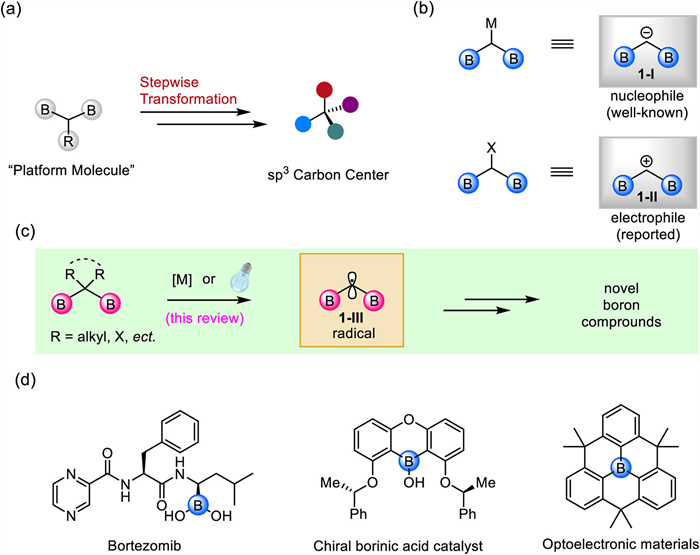
Scheme 1.
gem-Diboron compound as multifunctional synthons.


The pursuit of three-dimensional (3D) molecular architectures (“Escape from Flatland”) has become a central goal in synthesis and medicinal chemistry, as sp3-rich scaffolds show superior drug-like properties, including enhanced metabolic stability and target selectivity [1-5]. Among motifs enabling this dimensional expansion, boron-containing groups stand out for their versatile reactivity and ability to modulate steric and electronic properties, making them key tools for building complex 3D frameworks [6-22] (Scheme 1a). This strategic advantage stems from three key attributes of boron-based functionalities: (1) Orthogonal reactivity: Boryl groups undergo transformations (e.g., protodeboronation, Suzuki couplings, 1,2-metallate rearrangements) that are often orthogonal to traditional organic functional groups; (2) Stereochemical control: Boron’s vacant p-orbital enables hyperconjugative stabilization of adjacent stereocenters, facilitating the construction of congested 3D architectures; (3) Dynamic behavior: Transient boron centered intermediates (e.g., boronate complexes) can unlock unconventional disconnections in retrosynthetic analysis.
Well-defined molecular building blocks containing multiple boron functional groups have been increasingly employed in the design of complex three-dimensional molecular architectures [23-29]. Among these, gem-diboryl molecules have emerged as versatile synthons, enabling stepwise orthogonal functionalization in organic synthesis [18-20,30,31]. Since Matteson’s seminal report on the first gem-diboryl system in 1995, these structurally tunable building blocks have evolved into powerful and widely utilized tools in synthetic chemistry [32]. Traditionally, gem-diborylalkanes have been employed as synthetic equivalents of gem-diboron anions (1-Ⅰ) or carbocation surrogates (1-Ⅱ) (Scheme 1b), enabling diverse C–C bond-forming reactions [33-44]. In contrast, the chemistry of gem-diboryl carbon-centered radicals (Scheme 1c) remained underdeveloped until recent years, despite their hypothesized stability through hyperconjugation between the radical center and the empty p-orbitals of adjacent boronate groups [45]. The unique stability and bifunctional nature of gem-diboryl radicals make them ideal intermediates for constructing sp3-rich architectures with orthogonal reactivity. Furthermore, they serve as versatile synthons for the development of diverse boron-containing compounds across multiple fields, including medicinal chemistry [46], organic catalysis [47], and materials science (Scheme 1d) [48]. Pioneering studies by Masarwa, Renaud, Sharma, and Zhu have demonstrated their utility in transformations involving 1,1-diborylalkenes and gem-diborylcyclopropanes. Concurrently, groups such as Hong, Molloy, Liu, Tan, Hu, and Huang have expanded the toolbox by developing halogen atom transfer (XAT)-based methods for radical generation. Despite these advances, a systematic review of this rapidly growing field is lacking. This review summarizes recent progress in gem-diboryl radical chemistry, with a focus on innovative strategies for generating these intermediates and mechanistic paradigms governing their reactivity. By highlighting unmet challenges and opportunities, we aim to inspire further exploration of these multifaceted synthons in complex molecule synthesis.
In 2020, Masarwa et al. [45] reported a pioneering photoredox-mediated decarboxylative radical addition to gem-diborylalkanes, marking the first exploration of these motifs as radical acceptors (Scheme 2). This method enables the synthesis of β-substituted alkyl gem-diborylalkanes under mild conditions, leveraging abundant carboxylic acids, ubiquitous in natural products and pharmaceuticals, as versatile precursors for late-stage diversification.
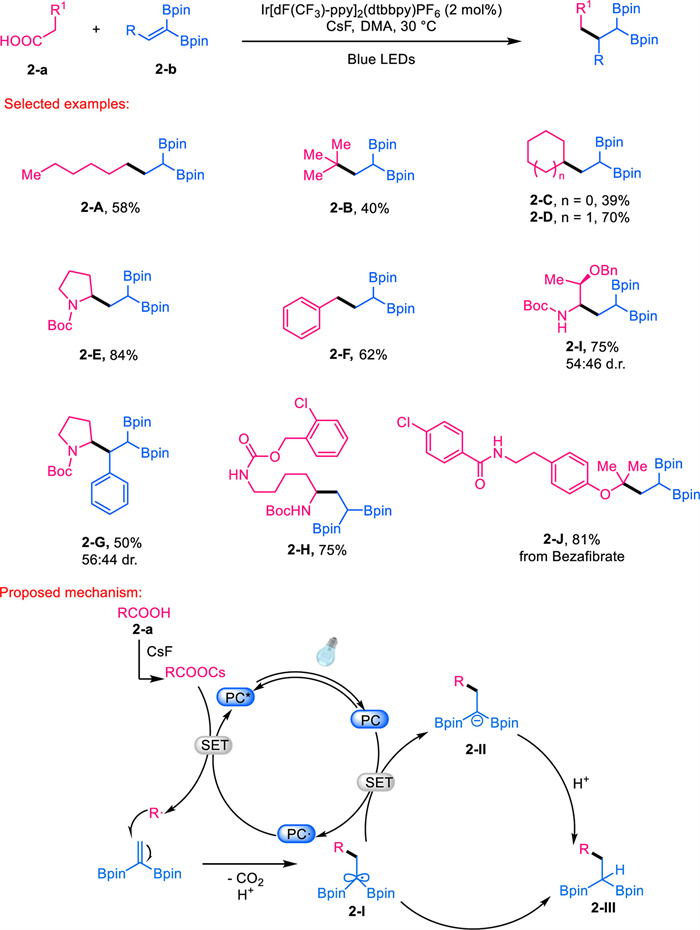
During reaction optimization, the authors discovered that the choice of base critically dictated the reaction outcome. Notably, Cs2CO3 exclusively promoted photodeboronation, whereas optimized conditions efficiently suppressed this pathway, enabling the desired decarboxylative radical addition. The enhanced stability of the gem-diboryl carbon-centered radical was elucidated through computational analysis of radical stabilization energies (RSEs). Theoretical studies revealed that while a single boronate group stabilizes an adjacent radical by ≥6.7 kcal/mol, gem-diboron-substituted radicals exhibit further stabilization (1.1–3.4 kcal/mol) due to synergistic hyperconjugative interactions. This thermodynamic advantage explains the persistent generation and observed selectivity for the gem-diboryl radical intermediate. Experimental validation was achieved via deuterium-labeling and EPR spectroscopy, corroborating a reaction pathway initiated by single-electron transfer (SET) from the carboxylate to the photoexcited photocatalyst (PC*). The resultant alkyl radical engages in Giese addition with the gem-diborylalkene, forming the stabilized gem-diborylmethyl radical (2-Ⅰ). A subsequent SET between 2-Ⅰ and the reduced photocatalyst (PC) generates the gem-diboryl anion (2-Ⅱ), which is protonated to deliver the final product (2-Ⅲ).
A key limitation of Masarwa’s earlier methodology was its restriction to alkyl carboxylic acids. To address this, the same group developed a groundbreaking approach in 2022 [49], enabling the direct deoxygenative radical addition of aromatic carboxylic acids to 1,1-diborylethene and 1-borylstyrene via photoredox catalysis (Scheme 3). This advancement significantly broadens the synthetic utility of these transformations, providing access to β-keto-gem-diborylalkanes and β-keto-gem-boryl/aryl-alkanes which are valuable intermediates in pharmaceutical and natural product synthesis due to their versatile β-boryl carbonyl scaffolds.
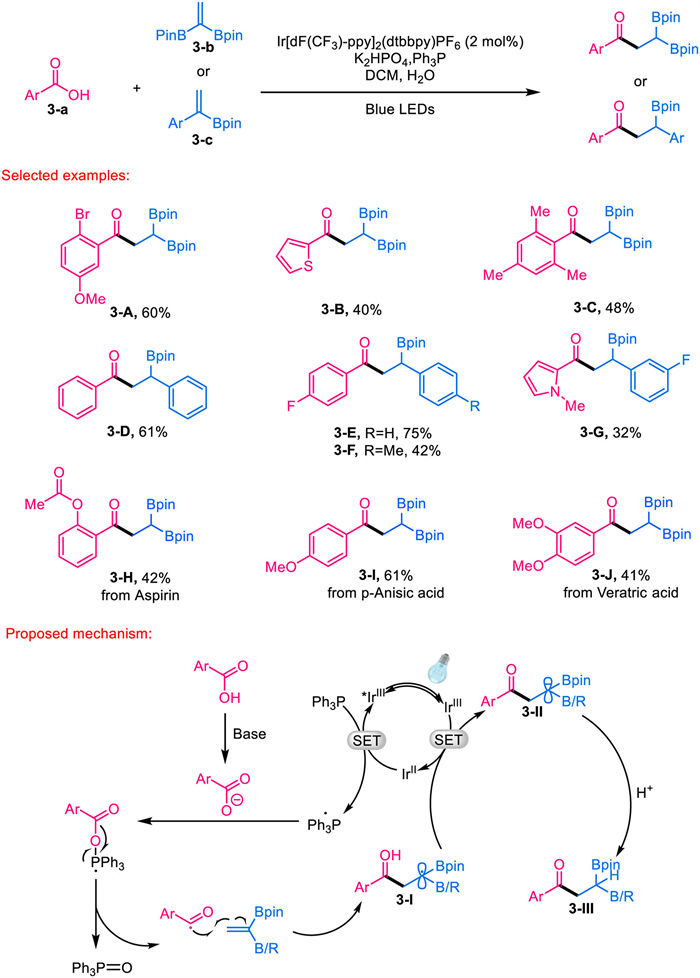
Control experiments underscored the indispensable roles of PPh3, base, photocatalyst, and light, as the reaction failed to proceed in the absence of any of these components. Radical inhibition by TEMPO further corroborated the involvement of radical intermediates. Deuterium labeling studies under standard conditions (using D2O) revealed 40% deuterium incorporation at the α-carbonyl position and 98% at the geminal carbon, strongly supporting the generation of the gem-diboryl anion 3-Ⅴ via single-electron reduction of intermediate 3-Ⅳ. Based on these findings, a plausible reaction mechanism was proposed. Initially, Ph3P undergoes single-electron transfer (SET) with photoexcited Ir* to generate the triphenylphosphine radical cation, which reacts with the carboxylate anion 3-Ⅰ to produce the phosphoryl radical 3-Ⅱ. This radical then undergoes β-selective C(acyl)−O bond cleavage, driven by the formation of thermodynamically stable Ph3P=O, yielding the acyl radical 3-Ⅲ. The acyl radical then regioselectively attacks 1-borylstyrene or 1,1-diborylethene to form a stabilized radical intermediate 3-Ⅳ, which undergoes SET with the reduced Ir(Ⅱ) species to produce the corresponding ketone 3-Ⅵ in the presence of H2O.
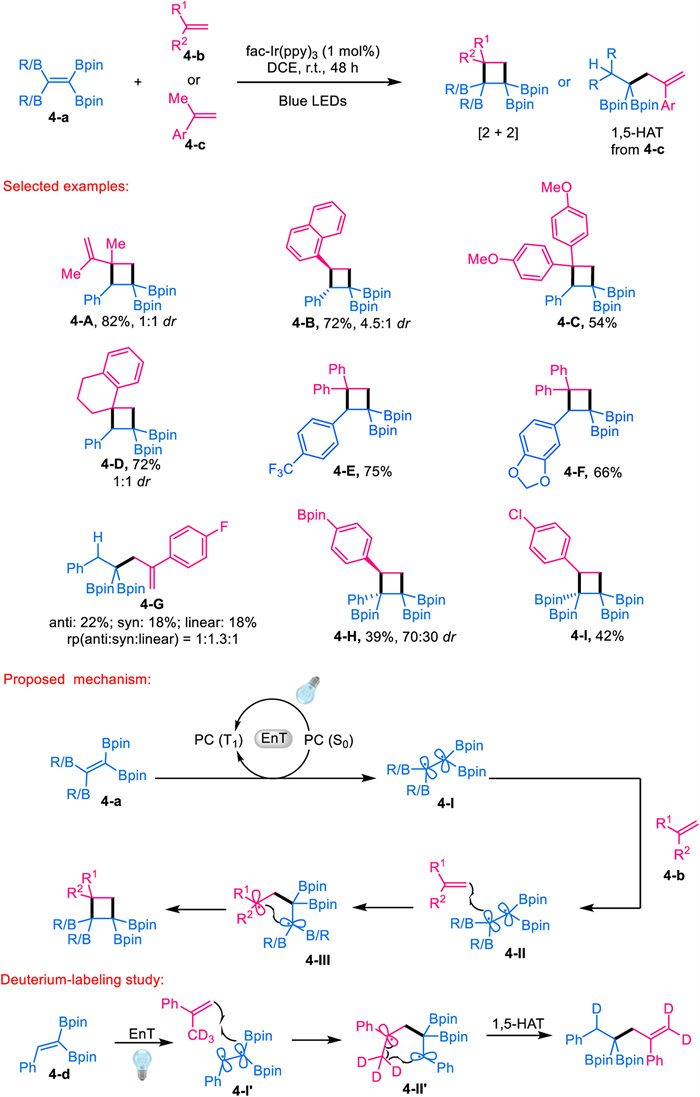
Polyborylated alkenes are highly valuable in organic synthesis [50-56], enabling the construction of complex molecules through diverse boryl group transformations and serving as potential energy transfer reactive species. Recently, Masarwa and co-workers [57] introduced an energy transfer strategy for the photosensitized [2 + 2] cycloaddition of polyborylated alkenes with various olefins, yielding versatile boron-containing cyclobutane rings (Scheme 4). These products offer new prospects for the further functionalization of the cyclobutyl moiety, a fundamental strained four-membered ring motif with wide ranging applications. Notably, using α-methylstyrene led to acyclic products via a 1,5-hydrogen atom transfer (HAT) process. Based on experimental evidence, the authors proposed that the reaction is initiated by energy transfer from the photoexcited triplet state of fac-Ir(ppy)3 (T1) to polyborylated alkenes, generating polymetalated biradical intermediates 4-Ⅰ. These undergo addition to the olefin, forming a 1,4-diradical intermediate 4-Ⅱ. Subsequent intersystem crossing and bond formation from 4-Ⅲ afford the final cyclobutane products. In addition, they performed a deuterium-labeling study to verify that the formation of acyclic products proceeds via a 1,5-HAT pathway in the final step.
Recently, Renaud and co-workers [58] reported an efficient atom transfer radical annulation (ATRAn) strategy for synthesizing gem-diborylated cyclopentanes with a vicinal iodomethyl substituent (Scheme 5). This reaction involves 1,1-diborylethene reacting with homoallyl radicals. The resultant γ-iodo-gem-diboronic esters can be easily transformed into valuable borylated bicyclo[3.1.0]hexane derivatives, which are structural motifs prevalent in natural products like Thujone, Sabinene, and related Terpenoids.
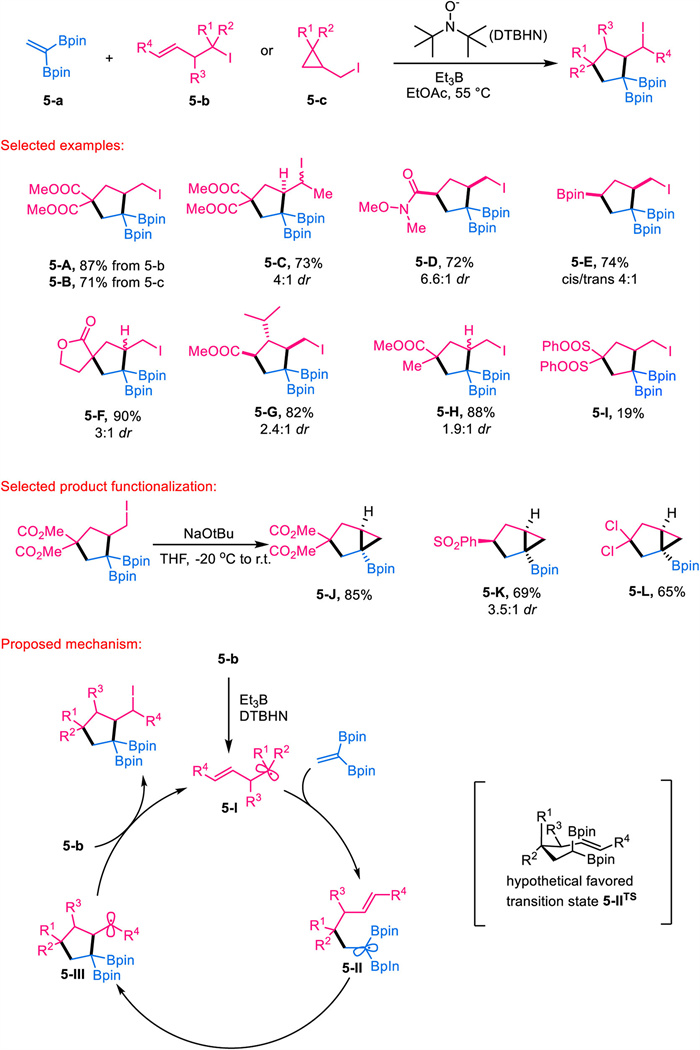
Based on previous studies, a classical annulation mechanism was proposed. The iodide precursor 5-b is activated by Et3B and DTBHN to generate the radical intermediate 5-Ⅰ, which adds to 1,1-diborylethene to yield a bis-borylated carbon-centered radical 5-Ⅱ stabilized by two empty p-orbitals on the boron atoms. Intramolecular annulation of 5-Ⅱ forms a cyclic radical intermediate 5-Ⅲ, which abstracts an iodine atom from the iodide precursor 5-b to regenerate the active species 5-Ⅰ and furnish the final product. Interestingly, in view of the high yield observed for this reaction, the results suggest that the final cyclized radical 5-Ⅲ abstracts an iodine atom from 5-b more rapidly than it participates in oligomerization via addition to the 1,1-diborylethene. Another notable observation is that the initial radical 5-Ⅰ reacts preferentially with 1,1-diborylethene rather than its own terminal, electron-rich alkene moiety. The stereochemical outcome of the cyclization process can be rationalized according to the Beckwith−Schiesser−Houk model (5-ⅡTS).
The vinyl cyclopropane (VCP) motif has long been acknowledged as a highly versatile and potent building block for the synthesis of cyclopentenes, primarily due to its remarkable ability to undergo rearrangement reactions [59-64]. Moreover, it readily engages in a diverse array of other chemical transformations, such as cycloaddition and difunctionalization reactions. When activated by a radical catalyst, VCPs initially generate cyclopropyl carbinyl radicals. These radicals can either undergo ring-opening to form homoallylic radicals or revert to the original VCP structure via β-fragmentation. Because both processes occur at comparable rates, electron-withdrawing groups are often introduced to accelerate the ring-opening step of VCPs. In this context, Sharma and co-workers [65] reported the generation and application of novel homoallylic α,α-diboryl radicals using vinyl cyclopropane diborons (VCPDBs) 6-a as versatile precursors through light-promoted thiyl radical catalysis (Scheme 6). This work represents the first use of a geminal diboryl group to activate VCP ring opening and the first application of boron-stabilized radicals in cycloaddition reactions.
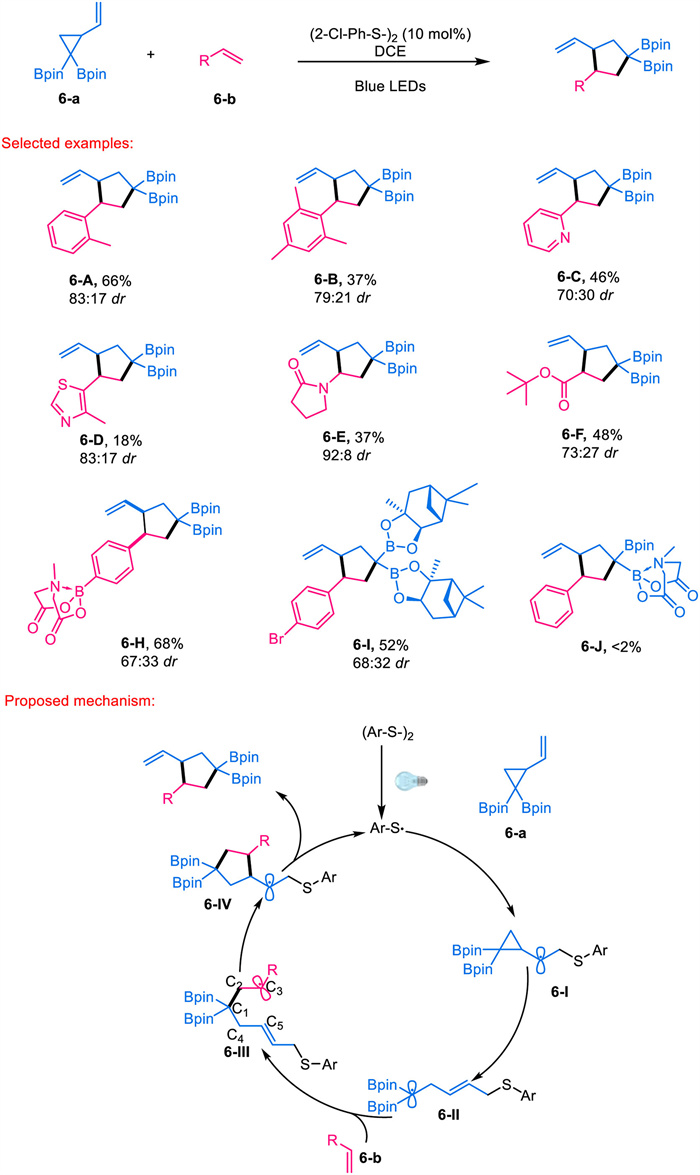
To elucidate the reaction mechanism, the authors designed several control experiments. The addition of TEMPO or replacement of UV light with thermal activation completely suppressed product formation, confirming the involvement of radical intermediates. Isotopic labeling experiments further revealed deuterium incorporation at the carbon bearing the two boronate groups, supporting the formation of an α,α-diboryl radical intermediate. Moreover, quantitative NOE and 2D NOESY studies, intramolecular Heck reactions, and DFT calculations revealed why the cycloaddition of VCPDBs favors cis-cyclopentane distereomers, in contrast to the trans-selectivity typically observed with dicarbonyl-activated VCPs. Based on these findings, the authors proposed a plausible mechanism. Photo irradiation activates the thiyl catalyst to generate a thiyl radical, which reacts with 6-a to form intermediate 6-Ⅰ. Ring opening of 6-Ⅰ affords intermediate 6-Ⅱ, which subsequently reacts with the olefin substrate 6-b to form intermediate 6-Ⅲ. In this step, C1−C2 bond formation occurs, and the Ar−S moiety in 6-Ⅲcis engages in π−π interactions with the aryl substituent, stabilizing 6-Ⅲcis relative to 6-Ⅲtrans. In 6-Ⅲcis, the radical at C3 attacks the adjacent C5 carbon, closing the five-membered ring to afford intermediate 6-Ⅳ. Finally, catalyst release from 6-Ⅳ regenerates the active species, delivering the desired product.
In 2024, Sharma’s research group [66] reported a photocatalytic [3 + 2] cycloaddition reaction. Specifically, vinyl cyclopropyl diborons (VCPDB) were reacted with propiolates, resulting in the formation of highly substituted allyldiborons conjugated to an ester group (Scheme 7). This reaction approach is mild, as it does not require the use of a base or a transition metal. It enables a tandem cycloaddition-allylboration reaction. During this process, allyl diborons are formed in situ and then undergo nucleophilic addition to aldehydes. This one-pot multicomponent reaction has a broad substrate scope and excellent diastereoselectivity. It can afford highly functionalized borylated homoallylic alcohols. These products feature the β-hydroxy ester and β-vinyl ester motifs across contiguous quaternary, tertiary, and secondary stereogenic centers.
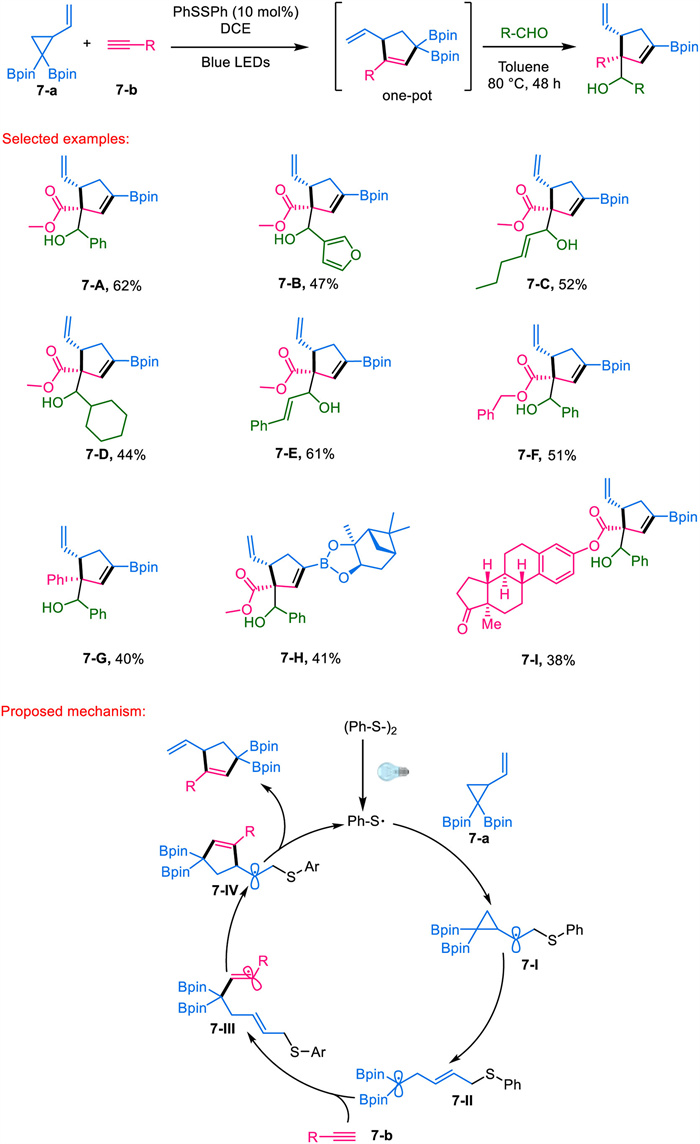
Based on these experimental results and their previous research findings, the authors put forward a reasonable reaction mechanism. Specifically, the homolysis of the disulfide leads to the generation of a thiyl radical. This thiyl radical then adds to the vinyl cyclopropyl diboron (VCPDB), resulting in the formation of the cyclopropyl carbinyl radical 7-Ⅰ. The cyclopropyl carbinyl radical 7-Ⅰ can undergo two possible pathways. One is ring-opening to form the homoallylic radical 7-Ⅱ, and the other is reversion to the starting material through β-fragmentation. The ring-opening pathway is favored due to the stabilization of the homoallylic radical 7-Ⅱ. This stabilization is attributed to the conjugation between the empty p-orbitals of the two boron atoms. Subsequently, the homoallylic radical 7-Ⅱ adds to the alkyne. After that, a ring-closure reaction occurs, and simultaneously, the thiyl radical catalyst is regenerated.
The [2σ + 2π] cycloaddition reaction stands as a potent tool for the construction of intricate cyclic scaffolds adorned with multiple stereocenters [67,68]. Acknowledging the constraints of prior studies, Sharma and co-workers [69] posited that utilizing a geminal diboron group as an activator for the ring-opening of cyclopropyl ketones (CPKs) could integrate ketyl radical chemistry with aldehyde allylboration. This integration would enable the creation of sterically congested, ketone-functionalized organoborons. Consequently, they devised a one-pot, multicomponent protocol that involved cyclopropyl ketone diborons 8-a (CPKDBs), alkynes, and aldehydes (Scheme 8). This innovative method offered highly diastereoselective access to densely functionalized cyclopentenes. These cyclopentenes feature homoallylic alcohol, ketone, and alkenyl boronate motifs situated on adjacent quaternary, tertiary, and secondary stereogenic centers.
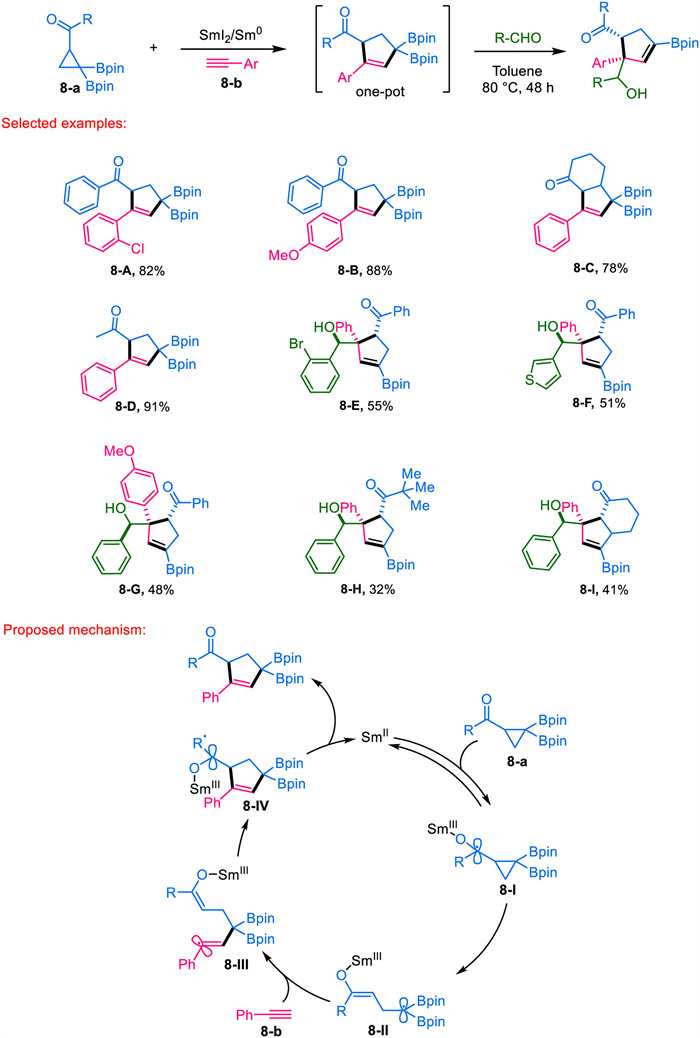
Base on previous reports regarding SmI2/Sm0 dual catalysis, a plausible reaction mechanism has been put forward. At the onset, SmⅡ initiates a single-electron transfer (SET) to CPKDB (8-a), giving rise to the cyclopropyl ketyl radical 8-Ⅰ. This radical then undergoes a diboron-assisted ring-opening process, leading to the formation of the more stable α,α-diboryl carbon-centered radical 8-Ⅱ. The resultant homoallylic radical subsequently engages in a cycloaddition reaction with an alkyne. This reaction yields the final product and regenerates the SmⅡ catalyst. The final product then participates in a highly stereoselective addition reaction with an aldehyde, ultimately furnishing multifunctionalized cyclopentenes that incorporate homoallylic alcohol, ketone, and alkenyl boronate moieties.
Post-polymerization modification (PPM) is an extremely powerful strategy for constructing libraries of functional polymers from commonly used precursors. This protocol makes use of a variety of synthetic methods, such as radical-mediated transformations [70-73], C–H activation [74-78], and click reactions [79-82]. These methods can convert pendant groups into targeted polar functional groups, thus improving the polymer’s morphology, chemical properties, and physical performance. Diversity-oriented synthesis (DOS) has demonstrated its great value in drug development [83-86]. It has the ability to rapidly generate libraries of small molecules rich in functionality. Nevertheless, its application in polymer chemistry has remained largely uncharted territory. Capitalizing on the remarkable functional transformation capabilities of the gem-diboryl moiety, Zhu and his co-workers [87] developed a diversity-oriented post-polymerization modification (DOPPM) strategy. They achieved this by synthesizing a novel gem-diboryl polyolefin through the radical ring-opening polymerization of a gem-diboryl-substituted vinylcyclopropane (VCP) monomer (Scheme 9). The resultant gem-diboryl polyolefin acts as a highly versatile platform polymer, facilitating a wide range of post-polymerization modifications. These include hydrogenation, proto-/deutero-deboronation, hydroxydeboronation, deborylative allylation, pyridylation, and Suzuki-Miyaura cross-coupling.
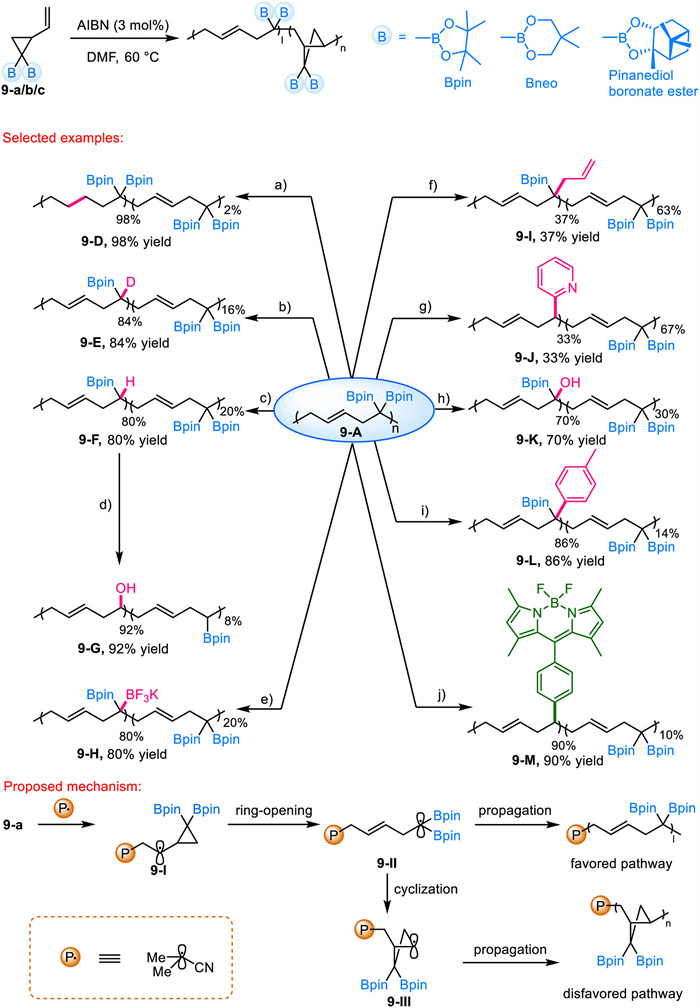
Density functional theory (DFT) calculations have shed light on the polymerization mechanism. The monomer 9-a undergoes a radical addition reaction with an alkyl radical generated from AIBN, giving rise to the linear intermediate 9-Ⅰ. Subsequently, this intermediate undergoes ring-opening to produce intermediate 9-Ⅱ, which can follow two competing reaction pathways. In the more favorable pathway, an intermolecular radical addition occurs between intermediate 9-Ⅱ and 9-a, which promotes chain growth and results in the formation of a linear gem-diboryl polymer. In the less favorable pathway, the intramolecular cyclization of intermediate 9-Ⅱ leads to the formation of a cyclic intermediate 9-Ⅲ, ultimately yielding cyclic gem-diboryl polymers.
α-Halogen-diboron compounds have recently emerged as highly valuable synthetic intermediates due to their unique ambiphilic nature, featuring both electrophilic and nucleophilic sites within the same molecule [39,41,44,88,89]. These compounds enable efficient stepwise functionalization and participation in multicomponent reactions, facilitating the rapid construction of structurally complex molecules. In a significant advancement, Hong et al. [90] showcased the synthetic utility of α-iodide gem-bis(boronates) by integrating a palladium-catalyzed Heck cross-coupling with a highly diastereoselective allylboration of aldehydes or imines (Scheme 10). This innovative approach provides a streamlined platform for the modular assembly of polyfunctionalized, boron-rich scaffolds with broad functional group tolerance, including various heterocycles and sensitive substituents (e.g., bromo, iodo, and nitro groups). The model reaction, employing an iododiboron substrate, styrene, and benzaldehyde, was conducted under Pd(OAc)2/Xantphos catalysis with i-Pr2NEt as the base in THF at 80 ℃. The transformation proceeded smoothly, delivering the desired product in 92% yield with >20:1 diastereoselectivity within just 2 h. Further substrate exploration demonstrated excellent compatibility across a diverse range of aldehydes, including: aromatic aldehydes (electron-rich and electron-deficient substituents), heteroaromatic aldehydes, ɑ,β-unsaturated and aliphatic aldehydes.
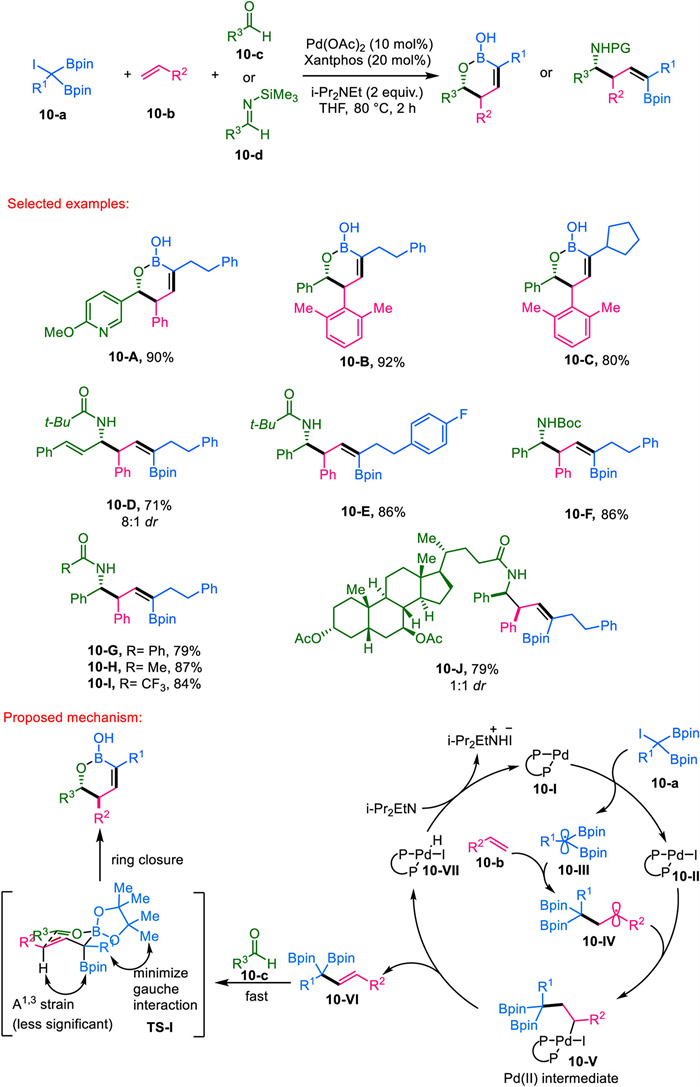
Integrated mechanistic investigations and density functional theory (DFT) calculations revealed a well-defined catalytic cycle involving Pd(Ⅰ)/diboryl radical intermediates. The proposed mechanism is outlined as follows: The active Pd(0) species (10-Ⅰ), generated in situ via reduction of Pd(OAc)2, abstracts iodine from the iododiboron substrate through a single-electron transfer (SET) process, yielding a Pd(Ⅰ) intermediate (10-Ⅱ) and a stabilized gem-diboryl carbon-centered radical (10-Ⅲ). This nucleophilic radical undergoes regioselective addition to the alkene, forming a benzylic radical (10-Ⅳ), which subsequently recombines with the Pd(Ⅰ) species (10-Ⅱ) to afford the Pd(Ⅱ) alkyl complex (10-Ⅴ). A β-hydride elimination from 10-Ⅴ then releases the Heck-coupled product (10-Ⅵ) and a Pd(Ⅱ)–H intermediate (10-Ⅶ), which is rapidly reduced by the base (i-Pr2NEt) to regenerate the catalytically active Pd(0) species (10-Ⅰ). Concurrently, the Heck product (10-Ⅵ) engages in an allylboration reaction with the aldehyde via a concerted, chair-like six-membered transition state (TS-Ⅰ), ensuring high diastereoselectivity (dr > 20:1). The reaction proceeds through a cyclization pathway, ultimately delivering the densely functionalized boronate ester product.
Building upon their seminal work on palladium-mediated gem-diboryl carbon-centered radicals, Hong and co-workers [91] recently developed an efficient palladium-catalyzed coupling of gem-iododiborylalkanes with electron-rich silyl enol ethers, providing direct access to valuable β,β-diboryl ketones with excellent efficiency (Scheme 11). Notably, this strategy was successfully extended to N-vinylacetamide derivatives, enabling the synthesis of previously inaccessible β,β-diboryl aldehydes and thereby significantly expanding the substrate scope beyond the previously limited mono-substituted styrenes. Detailed mechanistic investigations confirmed the involvement of a key gem-diboryl carbon-centered radical intermediate and revealed a unique Pd(0)/Pd(Ⅰ) catalytic manifold, distinct from conventional Pd(Ⅱ)-based pathways reported in earlier studies.
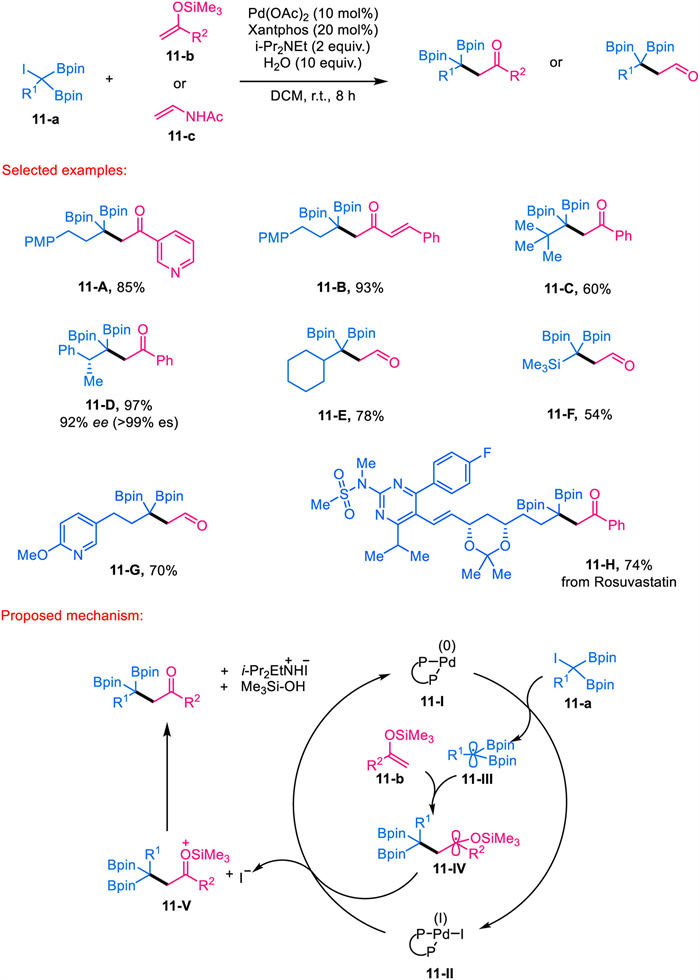
A plausible catalytic cycle, supported by mechanistic experiments and literature precedents [92-97], was proposed as follows: The catalytically active Pd(0) species (11-Ⅰ) undergoes iodine abstraction from the gem-iododiborylalkane substrate (11-a), generating a Pd(Ⅰ) intermediate (11-Ⅱ) and a diboryl-stabilized carbon-centered radical (11-Ⅲ). This nucleophilic radical 11-Ⅲ then undergoes regioselective addition to the silyl enol ether (11-b), forming the radical intermediate 11-Ⅳ, which subsequently engages in halogen atom transfer with the Pd(Ⅰ) species 11-Ⅱ. This step not only regenerates the Pd(0) catalyst (11-Ⅰ) but also furnishes the silyl-protected intermediate 11-Ⅴ. Finally, protodesilylation of 11-Ⅴ under basic aqueous conditions delivers the desired β,β-diboryl carbonyl product.
The halogen-atom transfer (XAT) reaction has emerged as a powerful strategy for the direct difunctionalization of alkynes, offering exceptional step and atom economy while enabling the construction of structurally diverse scaffolds [98-104]. In parallel, recent advances have expanded the reactivity of α-halogenated diboron compounds, uncovering novel reaction modes and synthetic pathways. Capitalizing on these developments, Hu and Jing [105] reported a photoinduced XAT strategy leveraging (diboronmethyl)iodide to generate diboron-stabilized carbon radicals under manganese catalysis. This method facilitates the stereoselective difunctionalization of alkynes, delivering previously challenging-to-access γ-iodo-allylic diboronic esters with broad utility as modular intermediates for complex molecule synthesis (Scheme 12).
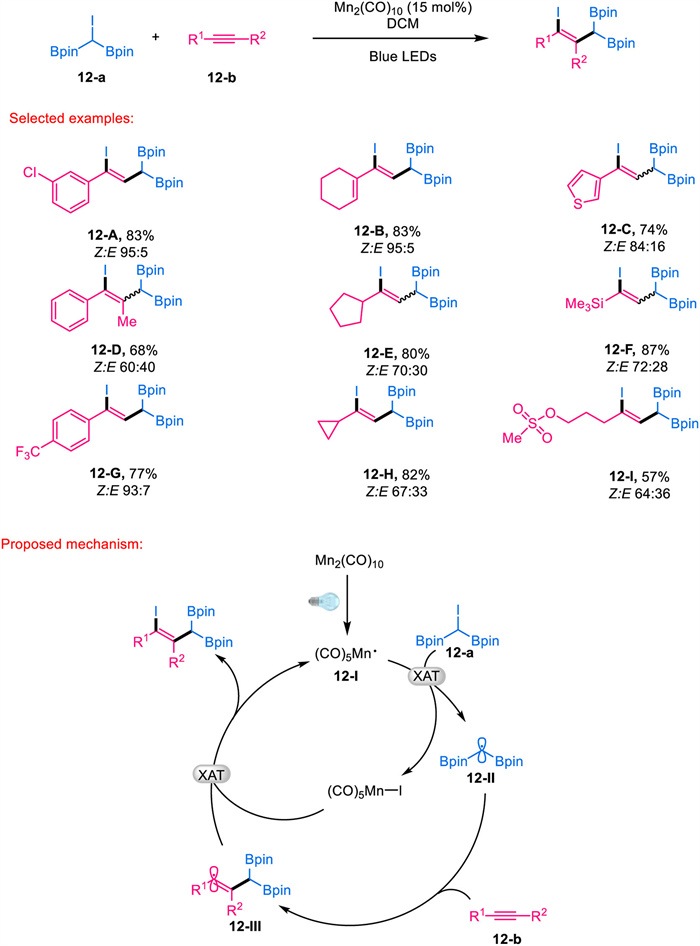
Using [(diboronmethyl)iodide] and phenylacetylene as model substrates, the authors conducted comprehensive reaction optimization, identifying Mn2(CO)10 (15 mol%) as the optimal photocatalyst in dichloromethane (DCM) under blue LED irradiation (40 W). These conditions enabled the transformation to proceed smoothly at ambient temperature within 15 min, delivering the target product in excellent yield (85%–92%) with outstanding stereoselectivity.
Based on control experiments and previous reports [106-108], a plausible reaction mechanism was proposed. Initially, the Mn2(CO)10 precatalyst undergoes homolytic cleavage under blue light irradiation to generate the (CO)5Mn radical species 12-Ⅰ. This active species abstracts an iodine atom from substrate 12-a to form the Mn(CO)5−Ⅰ complex and a gem-diboryl carbon-centered radical 12-Ⅱ. The latter adds to the alkyne to yield an alkenyl radical intermediate 12-Ⅲ, which then transfers an iodine atom from the Mn(CO)5−Ⅰ complex to produce the final product while regenerating the active (CO)5Mn radical catalyst. This process likely involves a reversible halogen abstraction and radical rebound mechanism, favoring the formation of the thermodynamically more stable Z-isomer.
Subsequently, Hu and Marder [109] developed a photoinduced, manganese-catalyzed halogen-atom transfer (XAT) protocol for the modular synthesis of gem-di(boryl)cyclopropanes. This method involves the radical addition of (diboronmethyl)iodide to alkenes, followed by base-mediated nucleophilic cyclization (Scheme 13), demonstrating broad functional group tolerance and excellent applicability in late-stage natural product derivatization. The synthetic versatility of this strategy was further showcased through downstream transformations, reinforcing its utility in complex molecular settings. In their initial exploration, 4-phenyl-1-butene and (diboronmethyl)iodide were chosen as model substrates to optimize the reaction conditions. The optimal conditions entailed using 10 mol% of Mn2(CO)10 in n-hexane, irradiating the reaction mixture with 440 nm blue LEDs at a temperature ranging from 25 ℃ to 40 ℃ for 3 h. Subsequently, the mixture was cooled to −20 ℃. After that, a base was added, and the resulting mixture was stirred at 0 ℃ for 2 h.
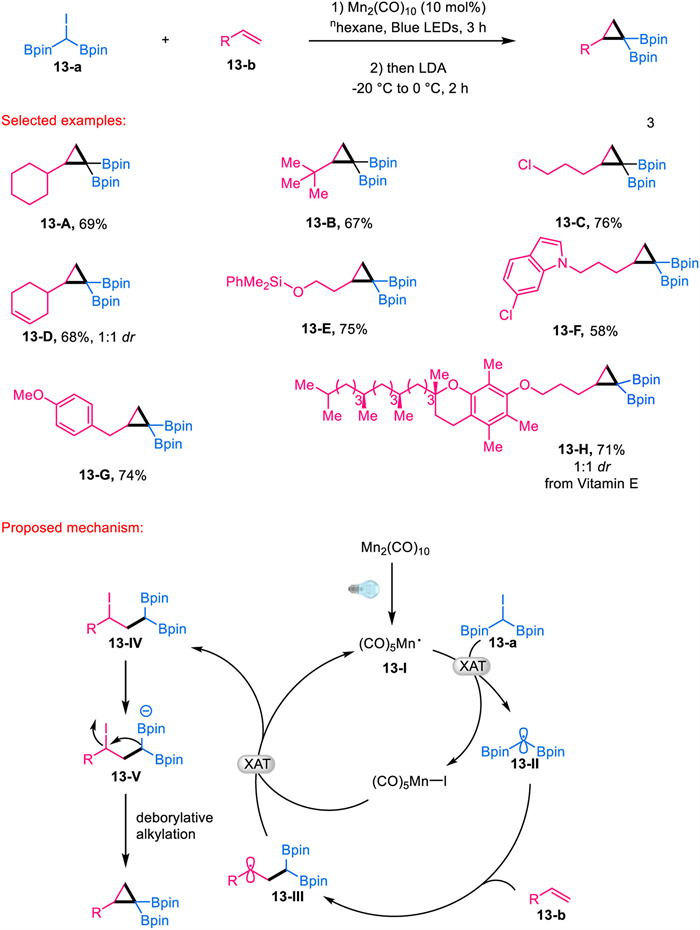
To delve deeper into the reaction mechanism, a comprehensive series of mechanistic experiments were carried out. Drawing on the outcomes of these experiments and previous relevant studies, a plausible mechanism has been proposed. This mechanism shares similarities with the XAT (halogen atom transfer) and radical-addition process reported by Hu and Jing [105]. Initially, photoinduced homolysis of the Mn2(CO)10 precatalyst takes place, leading to the generation of the active (CO)5Mn radical species 13-Ⅰ. This highly reactive radical then abstracts an iodine atom from substrate 13-a, resulting in the formation of the Mn(CO)5−Ⅰ complex and the generation of a gem-diboryl carbon-centered radical 13-Ⅱ. Subsequently, the gem-diboryl carbon-centered radical 13-Ⅱ undergoes a radical addition reaction with an alkene, giving rise to an alkyl radical intermediate 13-Ⅲ. In the next step, intermediate 13-Ⅲ transfers an iodine atom from the Mn(CO)5−Ⅰ complex. This transfer leads to the formation of adduct 13-Ⅳ and, at the same time, regenerates the (CO)5Mn radical catalyst 13-Ⅰ, thus completing the catalytic cycle. Finally, in the presence of a base, adduct 13-Ⅳ undergoes an intramolecular nucleophilic cyclization reaction. This reaction ultimately affords the desired gem-di(boryl)cyclopropane product.
Recently, Liu and Tan [110] put forward an efficient and practical approach for the Fe-mediated reduction of diborodichloromethane (DBDCM). This method generates a gem-diboryl carbon-centered radical, which then couples with alkenes. As a result, a diverse range of cyclopropanation and chlorocarbonation products are obtained, as shown in Scheme 14. One of the remarkable features of this reaction is its excellent tolerance towards various functional groups. Moreover, it offers a high degree of selectivity. By merely changing the iron source, one can selectively obtain either cyclopropanation or chlorocarbonation products. The late-stage functionalization of drugs and natural products has effectively demonstrated the wide applicability and synthetic utility of this method.
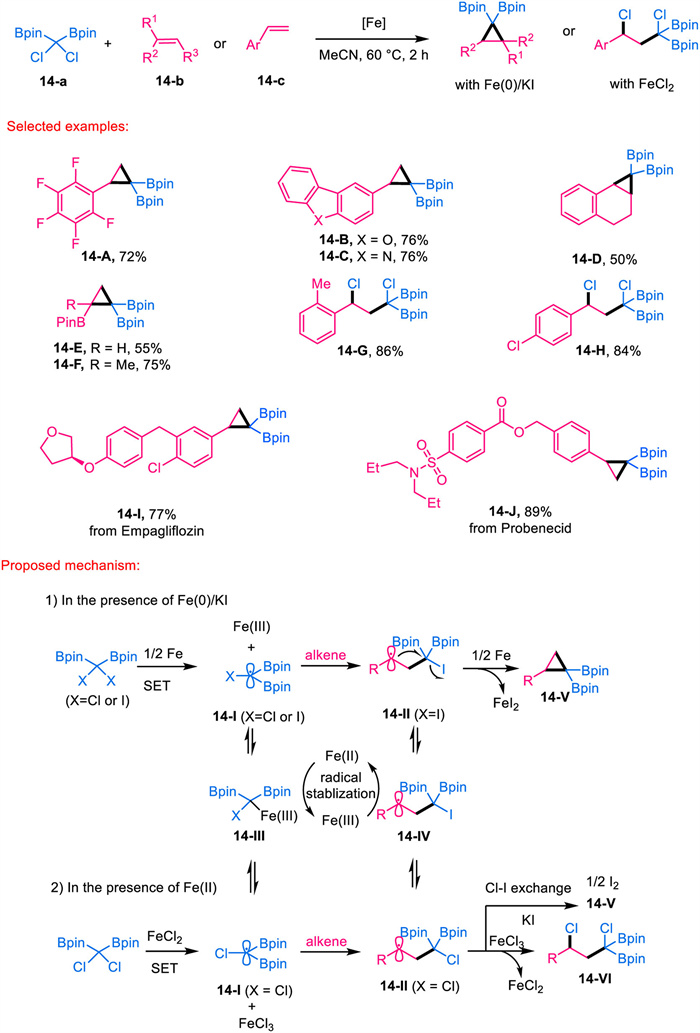
The optimal conditions were identified as using Fe powder as the reducing agent, KI as an additive, and acetonitrile as the solvent, affording the desired product in nearly quantitative yield. The reaction exhibited outstanding tolerance towards a wide array of functional groups on the styrene substrate. Whether the substituents were electron-donating or electron-withdrawing and located at the ortho, meta, or para positions, the reaction proceeded smoothly. Functional moieties such as silyl, borate, hydroxyl, halogen, ester, nitro, and nitrile groups were all well-tolerated, and the corresponding products were obtained in yields ranging from moderate to good. To showcase the practicality and synthetic utility of this method, the authors devised a complementary Fe-mediated chlorocarbonation of alkenes. This was achieved by simply changing the iron source from Fe(0) to FeCl2. The modified reaction system was successfully applied to a diverse set of styrene substrates, resulting in the formation of chlorocarbonation products in good yields.
Based on mechanistic investigations, a plausible catalytic cycle has been proposed. In the Fe(0)/KI catalytic system, substrate 14-a first undergoes single-electron reduction by Fe(0), leading to the generation of intermediate 14-Ⅰ. This intermediate then adds to an alkene, forming intermediate 14-Ⅱ. Subsequently, intermediate 14-Ⅱ undergoes a Cl−Ⅰ exchange reaction with KI, followed by a radical 3-exo-tet cyclization process, ultimately yielding the final product 14-Ⅴ. In the FeCl2-catalyzed system, the initial reduction of substrate 14-a is accompanied by the formation of FeCl3. FeCl3 can transfer a chlorine atom to 14-Ⅱ (where X = Cl), thus affording product 14-Ⅵ. Significantly, the Fe(Ⅱ) species present in the reaction can stabilize radical intermediates through the formation of an Fe(Ⅲ)−C bond, effectively serving as a radical reservoir. This proposed catalytic cycle provides a detailed and logical framework for understanding the reaction mechanisms in both catalytic systems.
Recently, Huang’s research group [111] reported the very first instance of a nickel-catalyzed reductive cross-coupling reaction between α-chloro-gem-diboron compounds and diverse carbon-based electrophiles (Scheme 15). This innovative method offers an efficient avenue to access a wide spectrum of gem-diboron architectures. These architectures include alkyl-and alkenyl-derivatives, as well as the previously less-explored α-arylated derivatives. The reaction occurs under mild conditions and is operationally straightforward. Moreover, the authors showcased the synthetic potential of this protocol by preparing a series of biologically active drug derivatives. This not only validates the robustness of the approach but also highlights its broad compatibility with various functional groups. α-Chloro gem-diboron ester and iodobenzene were selected as model substrates to investigate their reactivity under reductive cross-coupling conditions. The authors identified an optimal catalytic system comprising 10 mol% NiBr2·DME, 12 mol% of ligand, and 3.0 equiv. of Zn powder in acetone (0.1 mol/L) at ambient temperature, affording the α-aryl/vinyl substituted products in good to excellent yields. Under these optimized conditions, a broad range of aryl electrophiles was successfully employed. The reaction exhibited excellent tolerance toward various functional groups, including halides, ethers, thioethers, carbamates, trifluoromethyl ethers, hydroxyl groups, silyl ethers, ketones, boronic esters, alkenes, and alkynes. Notably, heteroaromatic substrates such as thiophenes, unprotected indoles, and carbazoles also participated smoothly, providing the corresponding products in moderate to good yields. In addition, the authors have applied this simple system to alkyl electrophiles for the synthesis of α-alkyl-substituted gem-diboron compounds. The reaction of n-butyl iodide with α-chloro gem-diboron ester proceeded smoothly using NiBr2·DME (10 mol%) and ligand (12 mol%) with Zn powder (3.0 equiv.) as the reductant and TMSCl (1.0 equiv.) as an additive in DME as the solvent.
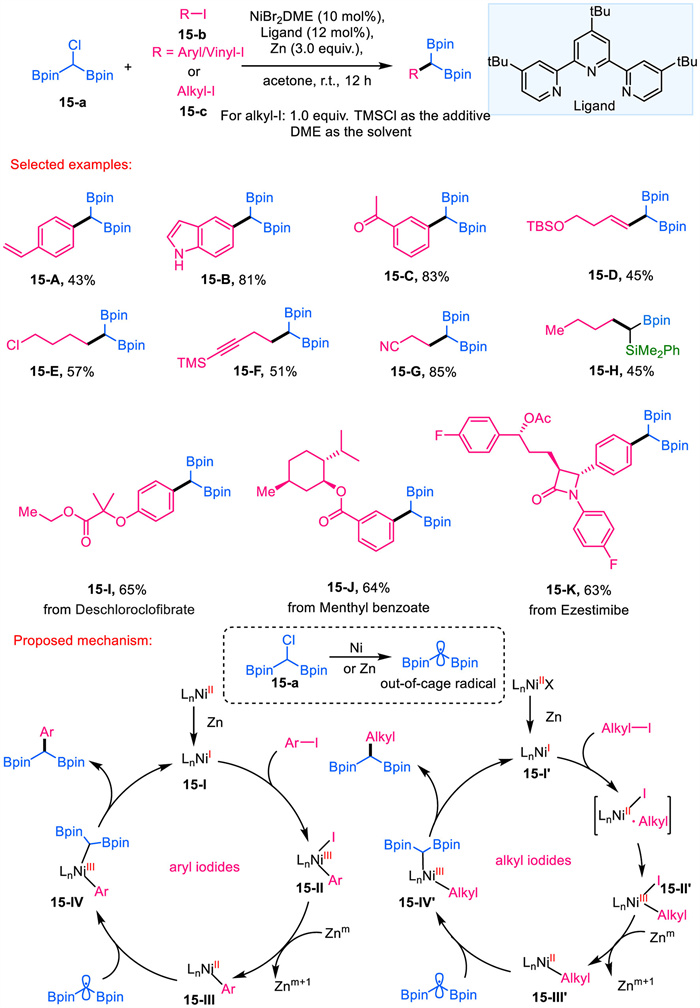
Based on control experiments and previous mechanistic investigations, a plausible catalytic cycle has been proposed. Initially, the Ni(Ⅱ) precatalyst is reduced by an external reductant, leading to the formation of the active Ni(Ⅰ) species 15-Ⅰ. When dealing with aryl electrophiles, the Ni(Ⅰ) species 15-Ⅰ first undergoes an oxidative addition reaction with aryl iodides. This process results in the generation of a Ni(Ⅲ) intermediate 15-Ⅱ. Subsequently, the Ni(Ⅲ) intermediate is reduced by Zn, giving rise to the Ni(Ⅱ) species 15-Ⅲ. This Ni(Ⅱ) species then couples with the gem-diboron radical, forming the Ni(Ⅲ) complex 15-Ⅳ. Through reductive elimination from the Ni(Ⅲ) complex, the coupling product is obtained, and the Ni(Ⅰ) catalyst is regenerated. In the case of alkyl iodides, Ni(Ⅰ) undergoes oxidative addition via a single-electron transfer (SET) process. This generates a transient alkyl radical, which recombines within the solvent cage to yield a Ni(Ⅲ)-alkyl intermediate 15-Ⅱ′. Reduction of 15-Ⅱ′ produces a Ni(Ⅱ)-alkyl species 15-Ⅲ′. This Ni(Ⅱ)-alkyl species then reacts with the gem-diboron carbon radical, generating a Ni(Ⅲ)-alkyl-gem-diboron intermediate 15-Ⅳ′. Finally, reductive elimination from 15-Ⅳ′ furnishes the desired product and regenerates the Ni(Ⅰ) catalyst.
In 2025, Wang’s group [112] developed a nickel-catalyzed C(sp3)–C(sp3) cross-coupling reaction between various ambiphilic reagents and cyclopropanols, enabling the synthesis of a range of highly valuable γ-carbonyl gem-diboronate esters, as well as extending the method to γ-carbonyl gem-silylboronate and γ-carbonyl gem-germylboronate esters in good yields (Scheme 16). Moreover, this protocol accommodates a wide variety of cyclopropanol substrates and exhibits good functional-group tolerance, including methoxy, halide, trifluoromethyl, and ester groups. Notably, a conjunctive cross-coupling reaction was successfully achieved using phenylcyclopropan-1-ol, iododiborylmethane, and a vinyl boronic ester, enabling efficient construction of 1,1,3-triborylalkane frameworks, thereby addressing limitations of existing synthetic methods.
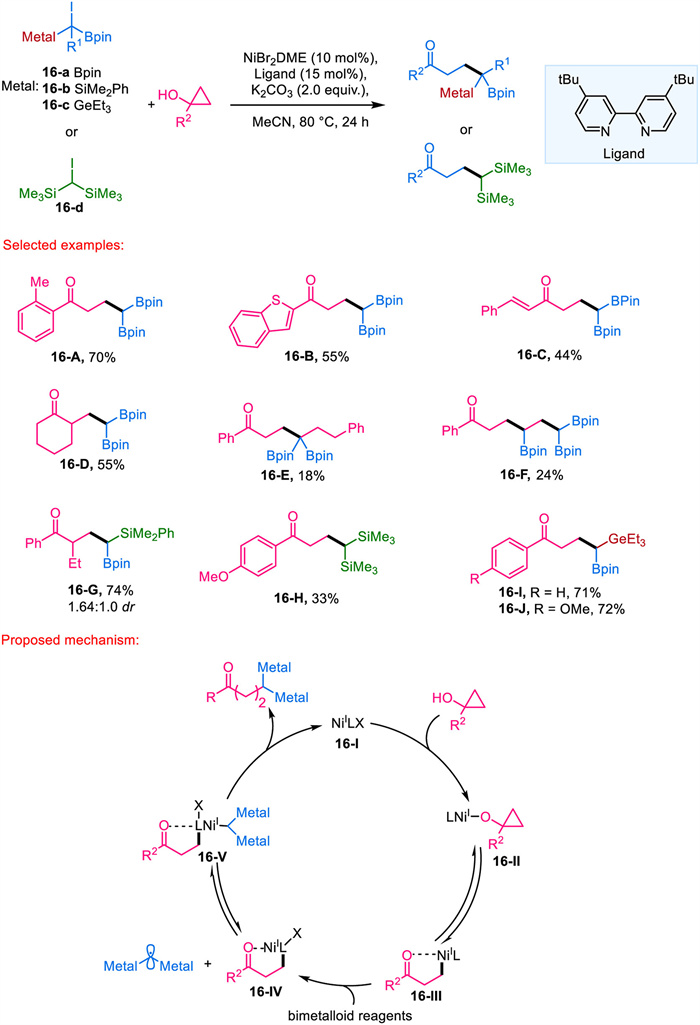
Based on control experiments, a plausible catalytic cycle was proposed. Initially, a Ni(Ⅰ) complex 16-Ⅰ is generated in situ. Complex 16-Ⅰ then undergoes base-promoted ligand exchange with cyclopropanol to afford a Ni(Ⅰ) cyclopropoxide intermediate 16-Ⅱ. Intermediate 16-Ⅱ subsequently undergoes β-carbon elimination to produce a Ni(Ⅰ) homoenolate species 16-Ⅲ, which then reacts with ambiphilic reagents to form a Ni(Ⅱ) intermediate 16-Ⅳ along with the corresponding α-bimetalloid radical. This radical recombines with intermediate 16-Ⅳ to generate a Ni(Ⅲ) intermediate 16-Ⅴ, which finally undergoes reductive elimination to furnish the desired product and regenerate the active Ni(Ⅰ) species.
Molloy and co-workers [113] presented a straightforward and chemoselective strategy. This approach involves the photoactivation of ambiphilic C1 units to generate α-bimetalloid radicals. Remarkably, it only requires a Lewis base and light to directly activate the C−Ⅰ bond, as depicted in Scheme 17. These short-lived radicals can react with a diverse array of SOMOphiles, leading to the formation of a wide spectrum of organic scaffolds. These scaffolds incorporate multiple synthetic handles such as B, Si, and Ge, which can be utilized for subsequent orthogonal transformations. Through in-depth mechanistic and computational investigations, the authors uncovered the pivotal role of the boron p-orbital and 2,6-lutidine in promoting the activation of the C−Ⅰ bond. Moreover, computational studies suggested that photoinduced homolytic bond cleavage takes place in the triplet excited state. This finding enables a photocatalytic stereodivergent route to Z-isomers.
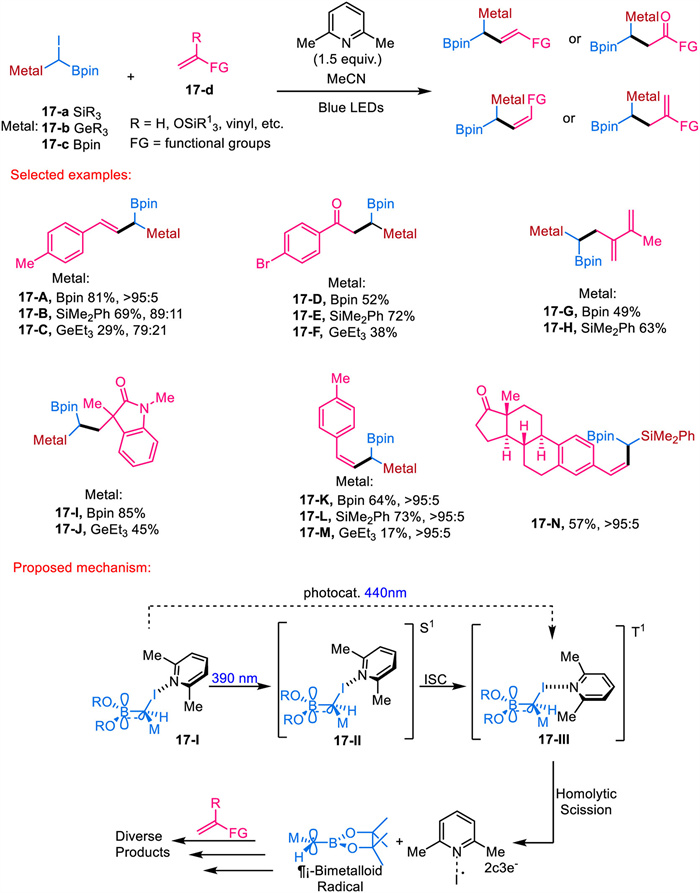
The authors proposed a mechanistic hypothesis for the activation process. Initially, 2,6-lutidine engages in an n → σ-hole interaction 17-Ⅰ with the ambiphilic reagent, weakening the C−Ⅰ bond and inducing a bathochromic shift in absorption to enable efficient photoexcitation. Upon irradiation, adduct 17-Ⅰ is promoted to the singlet excited state 17-Ⅱ via photon absorption. The heavy-atom effect of iodine facilitates intersystem crossing to the triplet excited state 17-Ⅲ, from which barrierless homolytic cleavage of the C−Ⅰ bond occurs, generating an iodine radical stabilized by 2,6-lutidine and an α-bimetalloid radical that subsequently reacts with a SOMOphile. Ultimately, the stabilized iodine radical closes the catalytic cycle via a net neutral pathway that varies depending on the SOMOphile involved, encompassing mechanisms such as hydrogen atom abstraction, radical recombination followed by elimination, or oxidation followed by deprotonation.
In organic synthesis, the N-heterocyclic carbene (NHC) boryl radical serves as a highly valuable tool for reducing halides to hydrocarbons through a halogen atom transfer (XAT) process [114-116]. Typically, this transformation leads to the conversion of C−X bonds to C−H bonds. The reason lies in the fact that the electrophilic radicals generated from electron-deficient alkyl halides react swiftly with boranes. Conversely, when electron-neutral or electron-rich alkyl halides are employed, the resulting nucleophilic radicals react more sluggishly with boranes. This slower reaction rate allows for the formation of C−C bonds instead of the typical C−X to C−H conversion. In 2024, Liu and co-workers [117] reported a method for achieving C−C bond formation between an electrophilic-deficient alkyl halide (α-iodide gem-di(B(pin))methane) and various alkenes using a sterically hindered NHC borane (IPr·BH3) as the boryl radical precursor (Scheme 18).
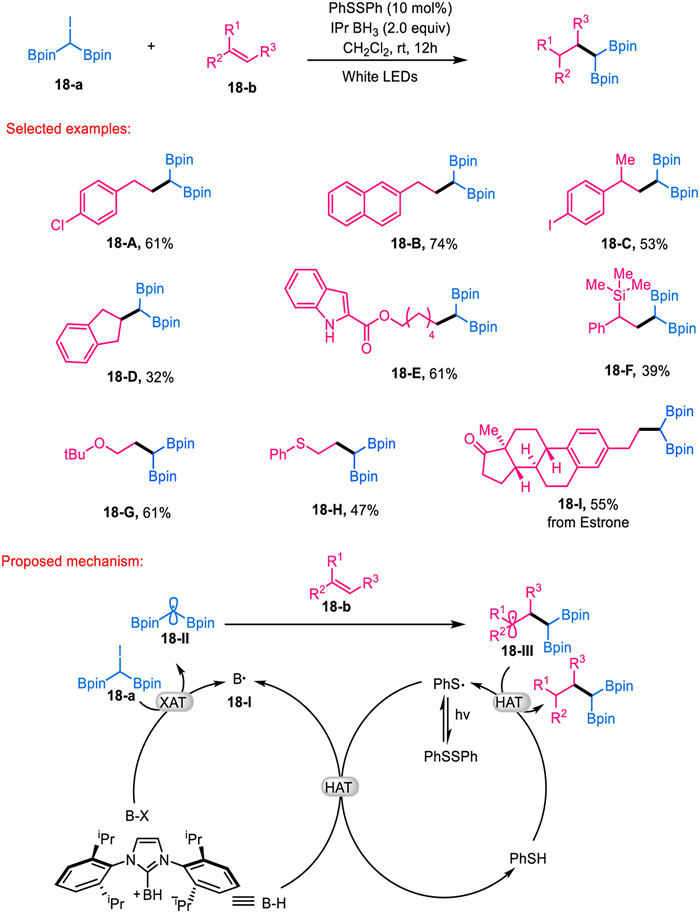
To optimize the reaction conditions, the researchers chose styrene and α-iodo gem-di(B(pin))methane 18-a as model substrates. After a comprehensive and systematic screening process, they were able to obtain the desired product with an 83% yield. The optimal conditions involved using 10 mol% PhSSPh and 2.0 equiv. of NHC borane under white LED irradiation. Moreover, the authors conducted a series of synthetic transformations to showcase the versatility of their protocol. Concurrently, they performed control experiments to shed light on the reaction mechanism. Based on the findings of these mechanistic investigations, they put forward the following catalytic cycle: Upon light irradiation, PhSSPh undergoes homolytic cleavage, giving rise to a thiyl radical. This thiyl radical then abstracts a hydrogen atom from the NHC borane, leading to the generation of both the NHC boryl radical 18-Ⅰ and benzenethiol. Subsequently, the NHC boryl radical 18-Ⅰ facilitates the halogen atom transfer (XAT) from compound 18-a, resulting in the formation of a gem-di(B(pin))methyl radical 18-Ⅱ. This gem-di(B(pin))methyl radical 18-Ⅱ adds to the olefin 18-b, generating an alkyl radical 18-Ⅲ. Finally, this alkyl radical 18-Ⅲ undergoes a hydrogen atom transfer (HAT) with benzenethiol. This step concludes the catalytic cycle and yields the hydro(gem-diboryl)methylation product.
gem-Diboronalkanes represent a critical class of intermediates in organic synthesis, distinguished by their unique reactivity and broad utility in constructing multifunctional molecular scaffolds. Among the various synthetic strategies, the gem-diboryl carbon radical pathway has emerged as a promising yet underexplored route. Radical-based methodologies offer access to unconventional reaction manifolds and enable bond formation under mild conditions, thereby facilitating the assembly of complex molecular architectures with potential applications in drug discovery and functional materials.
Despite these advantages, the radical approach to gem-diboronalkanes remains constrained by several limitations. Currently, the strategy heavily relies on photo-induced processes for generating gem-diboryl carbon radicals, which poses challenges for scalability and often leads to issues related to reaction selectivity. Moreover, the dependence on pre-synthesized radical precursors introduces additional synthetic burdens. These precursors typically require multi-step preparations, are time-consuming to access, and are often limited in structural diversity, thereby restricting the overall scope and generality of the methodology.
Looking ahead, generating gem-diboryl carbon radicals from gem-diboronalkanes via hydrogen atom transfer (HAT) processes [118-121] is a promising direction. HAT offers milder conditions, better selectivity, and can use more accessible starting materials. Consequently, the application of gem-diboryl carbon radicals in the cross-coupling reactions of secondary alkyl moieties and heteroatom-based partners is largely unexplored. Significant advances in these areas will promote the development of multifunctional scaffolds and contribute to drug discovery, providing more building blocks for novel drug design.
Zhen-Qi Wang: Writing – original draft. Zhuo Zhang: Writing – review & editing. Si-Yu Wan: Writing – review & editing. Yuan Huang: Writing – review & editing, Project administration, Funding acquisition.
The authors declare no competing financial interest.
The authors are grateful for the general financial support from the National Natural Science Foundation of China (No. 22471209), the Fundamental Research Funds for the Central Universities (No. xtr052024013) and the funds from Xi’an Jiaotong University.
F. Lovering, J. Bikker, C.J. Humblet, Med. Chem. 52 (2009) 6752–6756. doi: 10.1021/jm901241e
F. Lovering, Med. Chem. Commun. 4 (2013) 515–519. doi: 10.1039/c2md20347b
J.L. Reymond, Acc. Chem. Res. 48 (2015) 722–730. doi: 10.1021/ar500432k
M.J. Caplin, D.J. Foley, Chem. Sci. 12 (2021) 4646–4660. doi: 10.1039/d1sc00161b
J.A. Johnson, C.A. Nicolaou, S.E. Kirberger, et al., ACS Med. Chem. Lett. 10 (2019) 1648–1654. doi: 10.1021/acsmedchemlett.9b00414
K.A.C. Bastick, D.D. Roberts, A.J.B. Watson, Nat. Rev. Chem. 8 (2024) 741–761. doi: 10.1038/s41570-024-00650-x
E. Ahrweiler, M.D. Schoetz, G. Singh, et al., Angew. Chem. Int. Ed. 63 (2024) e202401545. doi: 10.1002/anie.202401545
V. Fasano, R.C. Mykura, J.M. Fordham, et al., Nat. Synth. 1 (2022) 902–907. doi: 10.1038/s44160-022-00158-6
S. Jin, J. Li, K. Liu, et al., Nat. Commun. 13 (2022) 3524. doi: 10.1038/s41467-022-31234-2
H.A. Sharma, J.Z. Essman, E.N. Jacobsen, Science 374 (2021) 752–757. doi: 10.1126/science.abm0386
Y. You, S. Ge, Angew. Chem. Int. Ed. 60 (2021) 20684–20688. doi: 10.1002/anie.202107405
S. Sun, R. Martin, Angew. Chem. Int. Ed. 57 (2018) 3622–3625. doi: 10.1002/anie.201712428
T. Bootwicha, J.M. Feilner, E.L. Myers, V.K. Aggarwal, Nat. Chem. 9 (2017) 896–902. doi: 10.1038/nchem.2757
J.C.H. Lee, R. McDonald, D.G. Hall, Nat. Chem. 3 (2011) 894–899. doi: 10.1038/nchem.1150
M. Xu, W. Jiang, M. Xia, et al., Angew. Chem. Int. Ed. 63 (2024) e202317284. doi: 10.1002/anie.202317284
W.J. Teo, X. Yang, Y.Y. Poon, S. Ge, Nat. Commun. 11 (2020) 5193. doi: 10.1038/s41467-020-19039-7
K. Hong, X. Liu, J.P. Morken, J. Am. Chem. Soc. 136 (2014) 10581–10584. doi: 10.1021/ja505455z
Y. Lee, S. Han, S.H. Cho, Acc. Chem. Res. 54 (2021) 3917–3929. doi: 10.1021/acs.accounts.1c00455
W. Jo, J.H. Lee, S.H. Cho, Chem. Commun. 57 (2021) 4346–4353. doi: 10.1039/d1cc01048d
Y. Wei, K. Hong, ChemCatChem 17 (2025) e00708. doi: 10.1002/cctc.202500708
C. Chen, Z. Ding, Y. Gao, et al., Sci. China Chem. 68 (2025) 3927–3995. doi: 10.1007/s11426-025-2886-2
Y. Guo, X. Wang, C. Li, et al., Nat. Commun. 14 (2023) 5693. doi: 10.1038/s41467-023-41254-1
L.H. Zou, M. Fan, L. Wang, C. Liu, Chin. Chem. Lett. 31 (2020) 1911–1913. doi: 10.1016/j.cclet.2019.12.016
L. Liu, B. Zhang, Y. Liu, et al., Chin. Chem. Lett. 35 (2024) 108631. doi: 10.1016/j.cclet.2023.108631
W. Jian, M.F. Chiou, Y. Li, H. Bao, S. Yang, Chin. Chem. Lett. 35 (2024) 108980. doi: 10.1016/j.cclet.2023.108980
Q.Q. Xuan, Y.H. Wei, Q.L. Song, Chin. Chem. Lett. 28 (2017) 1163–1166. doi: 10.1016/j.cclet.2017.04.031
C. Sun, G. Yin, Chin. Chem. Lett. 33 (2022) 5096–5100. doi: 10.1016/j.cclet.2022.04.026
Y. Wang, Y. Ping, W. Kong, Chin. Chem. Lett. 34 (2023) 108453. doi: 10.1016/j.cclet.2023.108453
S. Tang, Z. Wang, M. Zhu, et al., Chin. Chem. Lett. 36 (2025) 110503. doi: 10.1016/j.cclet.2024.110503
Y. Li, D. Shen, H. Zhang, Z. Liu, Chin. Chem. Lett. 34 (2023) 108048. doi: 10.1016/j.cclet.2022.108048
T. Fang, B. Ren, C. Liu, Acc. Chem. Res. 58 (2025) 2511–2525. doi: 10.1021/acs.accounts.5c00373
R. Soundararajan, D.S. Matteson, Organometallics 14 (1995) 4157–4166. doi: 10.1021/om00009a018
H. Lee, Y. Lee, S.H. Cho, Org. Lett. 21 (2019) 5912–5916. doi: 10.1021/acs.orglett.9b02050
S. Xu, P.F. Ning, Y. Wei, M. Li, K. Hong, Org. Lett. 27 (2025) 3893–3898. doi: 10.1021/acs.orglett.5c00638
M. Shin, M. Kim, C. Hwang, et al., Org. Lett. 22 (2020) 2476–2480. doi: 10.1021/acs.orglett.0c00721
S. Han, Y. Lee, Y. Jung, S.H. Cho, Angew. Chem. Int. Ed. 61 (2022) e202210532. doi: 10.1002/anie.202210532
T. Fang, P. Zhang, C. Liu, Angew. Chem. Int. Ed. 64 (2025) e202415301. doi: 10.1002/anie.202415301
C. Wu, L. Xu, B. Ren, J. Lu, C. Liu, Eur. J. Org. Chem. 28 (2025) e202401396. doi: 10.1002/ejoc.202401396
G. Kim, M. Kim, C. Ryu, J. Choi, S.H. Cho, Org. Lett. 25 (2023) 4130–4134. doi: 10.1021/acs.orglett.3c01395
C. Hwang, Y. Jang, Y. Jung, et al., Org. Lett. 26 (2024) 7010–7014. doi: 10.1021/acs.orglett.4c02510
P. Ning, Y. Wei, X. Chen, et al., Angew. Chem. Int. Ed. 63 (2024) e202315232. doi: 10.1002/anie.202315232
M. Li, Y. Wei, D. Chen, et al., Chin. J. Chem. 43 (2025) 949–955. doi: 10.1002/cjoc.202400840
Y.F. Yang, P.F. Ning, B. Zhang, et al., Org. Lett. 26 (2024) 10285–10290. doi: 10.1021/acs.orglett.4c03804
T. Fang, L. Wang, M. Wu, X. Qi, C. Liu, Angew. Chem. Int. Ed. 63 (2024) e202315227. doi: 10.1002/anie.202315227
N. Kumar, N. Eghbarieh, T. Stein, A.I. Shames, A. Masarwa, Chem. Eur. J. 26 (2020) 5360–5364. doi: 10.1002/chem.202000603
A. Nagar, D. Sarkar, R. Bardiya, et al., Eur. J. Med. Chem. 301 (2026) 118224. doi: 10.1016/j.ejmech.2025.118224
J. Song, W.H. Zheng, J. Am. Chem. Soc. 145 (2023) 8338–8343. doi: 10.1021/jacs.3c02331
Z. Zhou, A. Wakamiya, T. Kushida, S. Yamaguchi, J. Am. Chem. Soc. 134 (2012) 4529–4532. doi: 10.1021/ja211944q
A. Nagaraju, T. Saiaede, N. Eghbarieh, A. Masarwa, Chem. Eur. J. 29 (2023) e202202646. doi: 10.1002/chem.202202646
M. Zhang, Y. Yao, P.J. Stang, W. Zhao, Angew. Chem. Int. Ed. 59 (2020) 20090–20098. doi: 10.1002/anie.202008113
X. Wang, Y. Wang, W. Huang, C. Xia, L. Wu, ACS Catal. 11 (2021) 1–18.
J. Royes, A.B. Cuenca, E. Fernández, Eur. J. Org. Chem. 2018 (2018) 2728–2739. doi: 10.1002/ejoc.201701786
K.N. Babu, F. Massarwe, R.R. Reddy, et al., Molecules 25 (2020) 959. doi: 10.3390/molecules25040959
O. Salvadó, E. Fernández, Molecules 25 (2020) 1758. doi: 10.3390/molecules25071758
N. Eghbarieh, N. Hanania, A. Masarwa, Nat. Commun. 14 (2023) 2022. doi: 10.1038/s41467-023-37733-0
N. Eghbarieh, N. Hanania, A. Zamir, et al., J. Am. Chem. Soc. 143 (2021) 6211–6220. doi: 10.1021/jacs.1c01471
N. Hanania, N. Eghbarieh, A. Masarwa, Angew. Chem. Int. Ed. 63 (2024) e202405898. doi: 10.1002/anie.202405898
D. Circule, F. Dénès, P. Renaud, Adv. Synth. Catal. 366 (2024) 2945–2955. doi: 10.1002/adsc.202400340
K. Miura, K. Fugami, K. Oshima, K. Utimoto, Tetrahedron Lett. 29 (1988) 5135–5138. doi: 10.1016/S0040-4039(00)80701-7
G. Archer, P. Cavalère, et al., Angew. Chem. Int. Ed. 61 (2022) e202205596. doi: 10.1002/anie.202205596
D.F. Chen, C.H. Chrisman, G.M. Miyake, ACS Catal. 10 (2020) 2609–2614. doi: 10.1021/acscatal.0c00281
A.K. Turek, M.H. Sak, S.J. Miller, J. Am. Chem. Soc. 143 (2021) 16173–16183. doi: 10.1021/jacs.1c07323
T. Hashimoto, Y. Kawamata, K. Maruoka, Nat. Chem. 6 (2014) 702–705. doi: 10.1038/nchem.1998
K.S. Feldman, A.L. Romanelli, R.E. Ruckle, G. Jean, J. Org. Chem. 57 (1992) 100–110. doi: 10.1021/jo00027a020
H. Vyas, A.J. Gangani, A. Mini, et al., Chem. Eur. J. 30 (2024) e202303175. doi: 10.1002/chem.202303175
H. Vyas, A.J. Gangani, A. Mini, et al., Chem. Sci. 16 (2025) 1205–1215. doi: 10.1039/d4sc06514j
B.H. Rotstein, S. Zaretsky, V. Rai, A.K. Yudin, Chem. Rev. 114 (2014) 8323–8359. doi: 10.1021/cr400615v
V. Pirenne, B. Muriel, J. Waser, Chem. Rev. 121 (2021) 227–263. doi: 10.1021/acs.chemrev.0c00109
A. Mini, H. Vyas, A.J. Gangani, et al., Org. Lett. 27 (2025) 2902–2907. doi: 10.1021/acs.orglett.5c00469
A. Adili, A.B. Korpusik, D. Seidel, B.S. Sumerlin, Angew. Chem. Int. Ed. 61 (2022) e202209085. doi: 10.1002/anie.202209085
E. Schué, D.R.L. Rickertsen, et al., Chem. Sci. 14 (2023) 11228–11236. doi: 10.1039/d3sc03827k
L. Huang, M. Chen, W. Hao, S. Tang, ACS Macro Lett. 14 (2025) 490–494. doi: 10.1021/acsmacrolett.5c00115
M. Otten, I. Klein Gebbink, et al., J. Am. Chem. Soc. 147 (2025) 22827–22838. doi: 10.1021/jacs.5c05212
S.R. Gitter, W.P. Teh, X. Yang, et al., Angew. Chem. Int. Ed. 62 (2023) e202303174. doi: 10.1002/anie.202303174
E.K. Neidhart, M. Hua, Z. Peng, et al., J. Am. Chem. Soc. 145 (2023) 27450–27458. doi: 10.1021/jacs.3c08682
J.B. Williamson, C.G. Na, R.R. Johnson, et al., J. Am. Chem. Soc. 141 (2019) 12815–12823. doi: 10.1021/jacs.9b05799
W. Yi, J. Liu, X.Q. Hu, Chem. Commun. 61 (2025) 407–418. doi: 10.1039/d4cc05866f
L. Chen, K.G. Malollari, A. Uliana, et al., Chem 7 (2021) 137–145. doi: 10.1016/j.chempr.2020.11.020
Y. Chen, J.A. Wilson, S.R. Petersen, et al., Angew. Chem. Int. Ed. 57 (2018) 12759–12764. doi: 10.1002/anie.201807419
M. Li, X. Jing, J. Xia, et al., Angew. Chem. Int. Ed. 63 (2024) e202410846. doi: 10.1002/anie.202410846
P. Leophairatana, S. Samanta, C.C. De Silva, J.T. Koberstein, J. Am. Chem. Soc. 139 (2017) 3756–3766. doi: 10.1021/jacs.6b12525
L. Trachsel, K.A. Stewart, D. Konar, et al., J. Am. Chem. Soc. 146 (2024) 16257–16267. doi: 10.1021/jacs.4c04664
S.L. Schreiber, Science 287 (2000) 1964–1969. doi: 10.1126/science.287.5460.1964
M.D. Burke, S.L. Schreiber, Angew. Chem. Int. Ed. 43 (2004) 46–58. doi: 10.1002/anie.200300626
N. Kato, E. Comer, T. Sakata-Kato, et al., Nature 538 (2016) 344–349. doi: 10.1038/nature19804
L. Hudson, J.W. Mason, M.V. Westphal, et al., Nat. Commun. 14 (2023) 4930. doi: 10.1038/s41467-023-40575-5
Y. Gu, T. Wang, X. Zhang, C. Zhu, Angew. Chem. Int. Ed. 64 (2025) e21643. doi: 10.1002/anie.202521643
T. Fang, L. Xu, Y. Qin, N. Jiang, C. Liu, Chin. J. Org. Chem. 43 (2023) 777–780. doi: 10.6023/cjoc202207030
C. Hwang, Y. Lee, M. Kim, Y. Seo, S.H. Cho, Angew. Chem. Int. Ed. 61 (2022) e202209079. doi: 10.1002/anie.202209079
Y. Wei, X. Xie, J. Liu, et al., Angew. Chem. Int. Ed. 63 (2024) e202401050. doi: 10.1002/anie.202401050
X. Xie, Y. Wei, X. Chen, M. Li, K. Hong, Adv. Sci. 12 (2025) e08566. doi: 10.1002/advs.202508566
J. Tsuji, K. Sato, H. Nagashima, Tetrahedron 41 (1985) 5003–5006. doi: 10.1016/S0040-4020(01)96745-6
Q.Y. Chen, Z.Y. Yang, C.X. Zhao, Z.M. Qiu, J. Chem. Soc., Perkin Trans. 1 (1988) 563–567.
H. Liu, Z. Qiao, X. Jiang, Org. Biomol. Chem. 10 (2012) 7274–7277. doi: 10.1039/c2ob25990g
B.M. Monks, S.P. Cook, Angew. Chem. Int. Ed. 52 (2013) 14214–14218. doi: 10.1002/anie.201308534
M. Ratushnyy, M. Parasram, Y. Wang, V. Gevorgyan, Angew. Chem. Int. Ed. 57 (2018) 2712–2715. doi: 10.1002/anie.201712775
A.D. Marchese, A.G. Durant, C.M. Reid, et al., J. Am. Chem. Soc. 144 (2022) 20554–20560. doi: 10.1021/jacs.2c09716
X. Ren, Z. Lu, Chin. J. Catal. 40 (2019) 1003–1019. doi: 10.1016/S1872-2067(19)63278-X
V.P. Boyarskiy, D.S. Ryabukhin, N.A. Bokach, A.V. Vasilyev, Chem. Rev. 116 (2016) 5894–5986. doi: 10.1021/acs.chemrev.5b00514
T. Xu, X. Hu, Angew. Chem. Int. Ed. 54 (2015) 1307–1311. doi: 10.1002/anie.201410279
D.P. Curran, C.M. Seong, J. Am. Chem. Soc. 112 (1990) 9401–9403. doi: 10.1021/ja00181a057
W. Liu, W. Kong, Org. Chem. Front. 7 (2020) 3941–3955. doi: 10.1039/d0qo01097a
H. Yao, W. Hu, W. Zhang, Molecules 26 (2020) 105. doi: 10.3390/molecules26010105
H. Yorimitsu, T. Nakamura, H. Shinokubo, et al., J. Am. Chem. Soc. 122 (2000) 11041–11047. doi: 10.1021/ja0014281
K. Zhang, J. Zhang, Q. He, J. Hu, S. Jing, Org. Lett. 27 (2025) 4152–4157. doi: 10.1021/acs.orglett.5c00730
J. Han, J. Han, S. Chen, et al., Nat. Synth. 1 (2022) 475–486. doi: 10.1038/s44160-022-00074-9
S.M. Rafferty, J.E. Rutherford, L. Zhang, L. Wang, D.A. Nagib, J. Am. Chem. Soc. 143 (2021) 5622–5628. doi: 10.1021/jacs.1c00886
C. Hu, J. Mena, I.V. Alabugin, Nat. Rev. Chem. 7 (2023) 405–423. doi: 10.1038/s41570-023-00479-w
J. Hu, K. Zhang, J. Wang, et al., Chem. Sci. 16 (2025) 10595–10601. doi: 10.1039/d5sc02670a
J. Li, Y. Pan, C. Liu, X. Tan, CCS Chem. 8 (2026) 2832–2841. doi: 10.31635/ccschem.025.202506428
Z.Q. Wang, Y.J. Yang, X.B. Liu, et al., Org. Lett. 27 (2025) 11474–11479. doi: 10.1021/acs.orglett.5c03291
L. Zhu, X. Zhang, H. Wang, Org. Lett. 27 (2025) 11408–11413. doi: 10.1021/acs.orglett.5c03886
L. McGhie, A. Marotta, P.O. Loftus, et al., J. Am. Chem. Soc. 146 (2024) 15850–15859. doi: 10.1021/jacs.4c02261
F. Juliá, T. Constantin, D. Leonori, Chem. Rev. 122 (2022) 2292–2352. doi: 10.1021/acs.chemrev.1c00558
T. Wan, Ł.W. Ciszewski, D. Ravelli, L. Capaldo, Org. Lett. 26 (2024) 5839–5843. doi: 10.1021/acs.orglett.4c02034
L. Zeng, Y. Zhang, M. Hu, X.H. Ouyang, J.H. Li, Chem. Soc. Rev. 55 (2026) 955–1007. doi: 10.1039/d5cs00849b
R. Zhang, H. Zhang, P. Xu, X. Chen, Z. Liu, Org. Lett. 26 (2024) 10859–10864. doi: 10.1021/acs.orglett.4c04018
D. Zhang, X. Hui, C. Wu, Y. Zhu, ChemCatChem 13 (2021) 3370–3380. doi: 10.1002/cctc.202100248
L. Capaldo, D. Ravelli, Eur. J. Org. Chem. 2017 (2017) 2056–2071. doi: 10.1002/ejoc.201601485
L. Capaldo, D. Ravelli, M. Fagnoni, Chem. Rev. 122 (2022) 1875–1924. doi: 10.1021/acs.chemrev.1c00263
K. Mukherjee, A. Ben David, H. Nikoghosyan, R. Hakobyan, V. Gevorgyan, Nat. Catal. 8 (2025) 1146–1158. doi: 10.1038/s41929-025-01431-5

Scheme 2 Photoredox-mediated decarboxylative radical addition of carboxylic acids with 1,1-diborylethenes.

Scheme 3 Photoredox-mediated decarboxylative radical addition of aromatic acids with 1,1-diborylethenes.

Scheme 4 Photosensitized [2 + 2] cycloaddition of polyborylated alkenes with various olefins.

Scheme 5 Atom transfer radical annulation of 1,1-diborylethene with homoallyl radicals.

Scheme 7 Photoredox-mediated [3 + 2] cycloaddition reactions of vinyl cyclopropyl diborons with alkynes.

Scheme 8 Sm-catalyzed [2σ + 2π] cycloaddition of cyclopropyl ketone diborons with alkynes.

Scheme 9 Post-polymerization modification by developing gem-diboryl polyolefin as a platform polymer.

Scheme 10 Palladium-catalyzed Heck coupling cascade allylboration of iododiboron compounds.

Scheme 11 Palladium-catalyzed gem-diborylalkylation of silyl enol ethers and N-vinyl acetamides.

Scheme 13 Manganese-catalyzed XAT radical addition of (diboronmethyl)iodide and alkenes.

Scheme 14 Iron-mediated chemoselective cyclopropanation and chlorocarb-onation of alkenes with diborodichloromethane.

Scheme 15 Nickel-mediated reductive cross-coupling reaction of α-chloro-gem-diboron compounds and carbon-based electrophiles.

Scheme 16 Nickel-catalyzed C(sp3)-C(sp3) coupling reaction of α-bimetalloid reagents and cyclopropanols.

Scheme 17 Lewis base-mediated radical addition of α-bimetalloid compounds with various SOMOphiles.

 扫一扫看文章


扫一扫关注我们
 DownLoad:

 下载:


 下载: