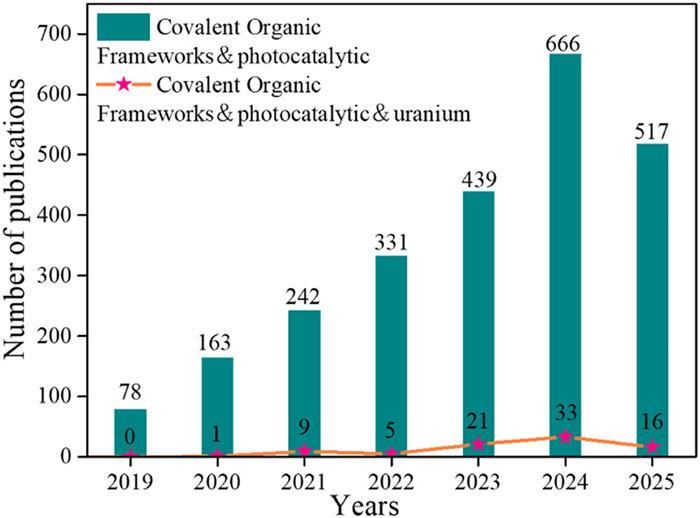
Figure 1.
Number of published articles on COF photocatalytic application and its photocatalytic separation of uranium.

Covalent organic framework photocatalysts: Design and photocatalytic U(Ⅵ) separation
Yougan Wang , Sanmei Liu , Fangfang Li , Zhijian Li , Leilei Sun , Congbin Fan , Chunhui Deng


The utilization of nuclear energy can accelerate the transition of energy towards carbon neutrality. Uranium which exists primarily as 235U and 238U is an indispensable resource for nuclear fuel. 238U, the most radioactive and stable forms, is produced by the loss of an α particle to produce 234U [1]. According to the Nuclear Fuel Report 2023 released by the World Nuclear Association (WNA), global nuclear power capacity is expected to nearly double by 2040, rising from the current 391 gigawatts (GW) to 686 GW [2]. However, estimates suggest that the current global uranium reserves can only sustain nuclear energy applications for about 100 years, posing a significant constraint on the future sustainable development of nuclear power [3]. Noteworthily, U(Ⅵ) is highly mobile and toxic, typically presenting in nature as uranyl ions or their complexes [4]. Especially, the leakage of untreated wastewater containing radioactive uranium severely impairs the safety of both the public health and surrounding ecological environment. As the standards set by the U.S. Environmental Protection Agency (EPA), a uranium concentration of 30 ppb is the maximum permissible level in drinking water [5]. The accumulation of radioactive isotopes will increase the risk of human beings contracting diseases such as anemia, bone cancer, leukemia and metabolic disorders. Therefore, recovering and extracting of uranium from wastewater containing radioactive uranium and seawater is essential for environmental sustainability and nuclear energy conservation.
Recent advancements have developed a variety of technique to selectively separate and recover uranium, such as solvent extraction, adsorption, evaporation, ion exchange, electrocatalysis, photocatalysis and membrane separation [6-10]. For ion exchange technology, when multiple competing ions are present, other ions interfere with the binding of U(Ⅵ), resulting in poor selectivity and high costs for ion exchange resins. The limitations of membrane filtration stem from the tendency for scaling during membrane formation, which reduces removal efficiency and necessitates frequent cleaning or replacement. Biosorption requires large quantities of biological materials to treat uranium in solutions, yet exhibits low adsorption efficiency and poor selectivity. It is highly susceptible to environmental conditions such as the type of adsorbent material, solution pH, and temperature. Although electrochemical methods have gained widespread application due to their advantages such as rapid reaction rates, high controllability, and simple operation, their limitations, including high energy consumption, slow mass transfer rates, and susceptibility to deactivation, hinder their practical implementation on a large scale [11]. Reducing soluble U(Ⅵ) to insoluble (U(Ⅳ)) using photocatalysts represents a green, efficient, and straightforward method for uranium extraction. Especially, for low-concentration wastewater, the photocatalytic technology shows significant advantages. Up to now, multifarious photocatalyst materials have been employed to separate and extract the radioactive U(Ⅵ). For instance, TiO2, g-C3N4, CdS, and metal-organic frameworks. Although TiO2 has advantages such as low cost, good durability, and strong usability, its 3.2 eV wide bandgap only allows for ultraviolet light absorption, limiting its utilization of solar spectra and resulting in low photocatalytic efficiency and photocurrent quantum yield [12]. In addition, some transition metal sulfides and oxides similar to CdS have good visible light absorption and carrier transport capabilities, but the toxicity and photo-corrosion effects of heavy metals hinder their practical applications [13-16]. g-C3N4, as a non-metallic polymer, has good stability, but the recombination rate of photo generated charge carriers is fast and lacks abundant accessible active sites. Metal-organic frameworks have a clear pore structure, but their framework stability is insufficient due to metal coordination bonds, making it difficult to function for a long time in photocatalytic systems [17]. Compared with metal-organic frameworks, inorganic semiconductors, conjugated polymers and other photocatalysts, COFs exhibit greater potential due to their unique properties. COF is a type of emerging three-dimensional (3D) or two-dimensional (2D) porous crystal framework that is precisely constructed through chemical reactions between organic building units, formed by covalent combinations between two or more organic monomers following a network chemistry self-assembly process [18,19]. Since Yaghi et al. developed the first COFs in 2005 [20], a variety of COF structures currently have been developed, in which most of classical COFs are generated with only two monomers [21,22]. In the realm of photocatalysis, COFs have been recognized as excellent semiconductor photocatalyst with highly advantageous attributes [23]. While it was not until 2014 that the first photocatalytic application of COF was demonstrated by Lotsch and co-workers, which involved hydrogen evolution via proton reduction employing COF with hydrazone linkage [24]. Following this discovery, extensive research for various photocatalytic applications of COFs has been occurred, encompassing pollutant elimination, carbon dioxide reduction, organic transformations, nitrogen reduction, hydrogen peroxide generation, and water oxidation. For the separation of radioactive nuclide uranium, COF can selectively capture uranyl ions by designing and controlling certain appropriate pore sizes, active sites and functional groups due to its organized porous structure and adjustable physicochemical properties [25]. The covalent organic framework linked by covalent bond demonstrate remarkable crystallinity and chemical stability, even when subjected to harsh photocatalytic conditions. Furthermore, building blocks periodically interacted and extended across different layers, endowing the features of regular channel walls and exact pore diameters. The porous structures and high surface areas for COFs provide the appropriate reactive centers, further shortening the distance of electron-transfer in photocatalytic reactions. In photocatalytic reduction of U(Ⅵ) system, performance is governed by several key factors: Large π-conjugation structure for the effective separation and transfer of e- and h+, reasonable uranyl affinity and suitable pore size, abundant catalytic center and suitable band gap to harvest visible light. These features provide prerequisites and feasibility for its application in the photocatalysis field. The fact that the search for keywords covalent organic frameworks and photocatalytic on the Web of Science indicates that COF, as a photocatalyst, has a relatively high level of research interest. And the research on the photocatalytic reduction of U(Ⅵ) via COF photocatalysts shown an almost gradually increasing trend, which is an indicator of increasing interest in the area of radioactive uranium treatment (Fig. 1). This is attributed to the rapid advancement in reticular chemistry, which has led to the reporting of an increasing number of COFs with superior stability. These breakthroughs have overcome the bottleneck of poor stability in humid or strong acid/base environments, significantly expanding the application scope of COFs.
While several review articles summarize the COFs as photocatalyst to U(Ⅵ) photocatalytic reduction, a latest critical perspective is missing on the significant advances achieved by COFs in photocatalytic separation U(Ⅵ). Especially, there is no systematic elaboration for U(Ⅵ) photocatalytic reduction based on COF photocatalyst, and no structural-activity relationship between performance and structure has been proposed. Moreover, there is a lack of in-depth discussion on the COF-based photocatalysts' design for the U(Ⅵ) photocatalytic reduction. Here, we aim to briefly outline significant advances in the application of COF photocatalysts for photocatalytic reduction U(Ⅵ) while proposing unified design principles. In the first part, we summarize the advances and progress of a myriad of COF linkages and their applications in the U(Ⅵ) photocatalytic reduction from wastewater or seawater. Subsequently, we focus exclusively on morphology of COF and strategies for improving the U(Ⅵ) photocatalytic performance, emphasizing on the design strategy of the relationship of structure-property-activity. And the mechanism was analyzed deeply for photocatalytic reduction of U(Ⅵ). Finally, we highlight the critical features of COFs in photocatalytic reduction system, overviewing the remaining challenges and offered insights into potential developments for COF in U(Ⅵ) photocatalytic reduction. We examined the opportunities and challenges facing COFs in this area, aiming to inspire innovative approaches for designing efficient COF photocatalysts.
The selection of linkages and building blocks can generate different COF topologies, which determines their unique pore architecture. Common COF topologies include hexagonal, tetragonal, trigonal, rhombic, and dual-pore Kagome [22]. The topological structure of COFs can significantly influence their photocatalytic performance. The light absorption properties of COFs with different topological dimensions vary considerably. Different topologies exert varying effects on the embedded electric field within COFs. Differences also exist in the stacking structures during carrier separation and the selection of electron transport pathways [26]. Especially, different linkages can cause significant difference in structure and properties, and usually determine the stability of COFs. Stability is a significant parameter for photocatalytic application of U(Ⅵ), especially in water and under light irradiation. By judiciously engineering these linkages, one can precisely modulate the electronic states, pore architecture, and structural stability of COFs. Common linkages involved in boron-containing linkages, dioxin, imide and amide linkages are nonconjugated COFs linking bonds. The utilization of hydrazone, imine, thiazole, azine, squaraine and oxazole linkages can enhance the conjugation degree of COF (Fig. 2).
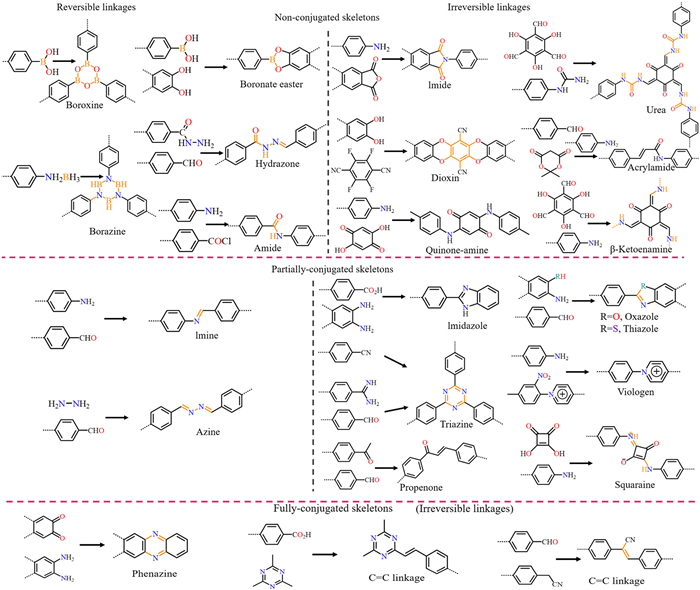
The COF-1 and COF-5 synthesized from boroxines and boronic esters are the first and most prominent COFs. Since then, various monomers such as 4,4′-phenylazobenzoyl diboronic acid [27], pyrene-2,7-diboronic acid (PDA) [28] and biphenyldiboronic acid [29] have been extensively employed to develop boron-containing COFs by self-condensation strategy. The co-condensation by two or more organic units and the self-condensation by single building unit are commonly synthesis method of boron-based COFs. Yaghi et al. found a porous borosilicate COF with the strong covalent bonds [30] in Pyrex which marks the beginning of a new chapter in the exploration of boron-containing COF. Subsequently, the first 3D boronate-linkage covalent organic framework, namely COF-102 and COF-103, were reported [31]. Typically, boron-containing linked COFs have high surface area and low density. However, boronic esters and borates are prone to oxidation reactions and hydrolysis, which restricts their application as catalysts. Evidence has suggested that the B−O bonds are unstable and prone to decomposition, even in humid atmospheres resulting from the electron-deficient properties of boron centers. Therefore, there are few reports on the treatment of uranium from wastewater or seawater through boronate-linked COFs.
Hydrazone linkages are reversible condensation reaction between aldehyde and hydrazides building unit. In 2011, two COFs with hydrazone-containing linkage (COF-42 and COF-43) have been first reported [32]. Subsequently, by transforming one of the monomers, the other two COFs with hydrazone linkages, TFPT-COF [33] and COF-JLU-4 [34], were synthesized. Another hydrazone-bonded COF with thioether functional group, namely COF-LZU8, was synthesized through "bottom-up" strategy in quite mild synthetic conditions [35]. The strategy not only embeds the uniformly and intensively distributed sulfide ether side chains as ion carriers (cation receptor), but also constructs a rigid and extended π conjugation framework as the fluorophore carriers (signal transducer). Under mild conditions, COFs with amide linkages can be exfoliated into several layers of two-dimensional polymers due to their weak interlayer interactions. Compared to imine linkages, the hydrazone linkage has better stability and could readily coordinate with metals such as Ni2+, Zn2+ and Cu2+ [18], which can effectively enhance photogenerated charge transfer. A novel nanosheet-shaped hydrazone-linked 2D redoxactive COF [36] material was synthesized by the condensation of hydroquinone (2,5-dihydroxyterephthalaldehyde, DHPA) and hydrazide (benzene-1,3,5-tricarbohydrazide, BTCH) components. Under high acidity conditions, the ability of redox adsorption should enable effectively alleviate the functional groups protonation, immensely improving the selectivity of UO22+. The removal rate of UO22+ achieved unprecedented 97% under pH 3 condition. Subsequently, their team reported a family of hydrazone-linked COFs [37] with abundant metal chelating sites for addressing the bottleneck of selective extraction uranium from natural seawater. The architecture of COFs comprised different assistant groups (R) and hydrazine-carbonyl partner chelating sites synergistically serving as "uranium nanotraps". Introduction of auxiliary groups onto the organic ligands for the building units of COF can programme and regulate the microenvironment surrounding the uranium binding site of hydrazine carbonyl. This strategy will provide inspiration for enhancing the U(Ⅵ) photocatalytic reduction performance of hydrazone-linked COF.
Imide-based linkage is constructed through the imidization reaction between functional amines and anhydride building units. The polyimide (PI) COFs have outstanding stability that can withstand harsh basic (14 mol/L NaOH) and acidic (12 mol/L HCl) condition. A variety of polyimide COFs with high crystalline, PI-COF1, PI-COF2 and PI-COF3, were synthesized by reversible imidization reaction [38]. The resulting polyimide-based covalent organic frameworks, namely PI-COFs, represent exceptional thermal stability as well as larger surface areas compared to their amorphous counterparts. For example, a microporous poly(imide-benzoquinone) COF has been successfully synthesized from pyromellitic dianhydride and tetraminobenzoquinone [39]. In 2015, the three-dimensional (3D) polyimide COFs (PI-COF-4 and PI-COF-5) with high surface area and thermal stability were developed by imidization reaction to integrate linear with tetrahedral building blocks [40]. These 3D polyimide functionalized covalent organic frameworks can form either non-interpenetrated or interpenetrated architectures, depending on the size selection of the tetrahedral building units. Moreover, recent literature has also documented the emergence of imide-linked metallophthalocyanine-based COFs [41]. Compared to non-metallic COFs, this COF with higher photocatalytic activity exhibits excellent photocatalytic potential.
Azine bonds constructed by the condensation of hydrazine and aldehydes is another version of imine linkage. A frequent building unit of azine linkage, hydrazine, reacts with multifarious aldehydes, enabling the formation of COFs with diverse functionalities. The first example of COF with azine-linkage was developed through the condensation of hydrazine with 1,3,5,8-tetrakis(4-formylphenyl)pyrene [42]. Furthermore, various knots, including benzenes, pyrene, triphenyltriazine (TPT) and triphenylbenzene, were used to synthesize the azine-linked COFs with diversified topologies, such as rhombic, trigonal, and hexagonal [43-46]. Azine linked COFs have enhanced porosity, robust linkage, improved thermal and chemical stability.
Imine-based linkage was formed by co-condensing aromatic amines with aldehydes using organic acid or a Lewis acid as catalyst. The layered imine linked COFs resembles boron ester COFs, but COFs with imine linkage have higher hydrolytic stability, which differs significantly from boron containing COFs. Although the stability of these materials can also be affected by the choice of linkers, imine bonds remain highly attractive as connecting units in COFs, not only due to the wide availability of amine and aldehyde building blocks but also because of their ability to support extended π-conjugation in the framework layers.
The versatility of the synthetic method and highly reversible nature make Schiff base condensation the most widely reported chemical reaction in COF synthesis. In 2018, Ma et al. [47] proposed the first time an imine linked COF functionalized with amidoxime, COF-TpDb-AO, for highly selective extraction radioactive uranium from seawater. Although COFs with imine bonds are widely prepared as photocatalysts for various applications due to their ease of synthesis, the high polarization of C = N bonds leads to low efficiency of π delocalization, severely limiting the photocatalytic performance of imine linkage COF.
Triazine-based linkage is partially π-conjugated linkages, which can serve as a strong electron-withdrawing unit. The triazine ring with an aromatic and planar rigid structure endows COFs remarkable chemical stability (acid/alkali resistance) and thermal stability. The first example of triazine-based COFs with hexagonal packing of pores (CTFs) was reported in 2008 [48], which was constructed by cyclotrimerization of 1,4-dicyanobenzene in the presence of one equivalent of ZnCl2. However, the requirement for harsh synthesis conditions including elevated temperatures and acidic purification steps could damage long-range structural order, thereby constraining the preparation and advancement of crystalline covalent triazine frameworks (CTFs). Accordingly, only a limited number of microporous crystalline CTFs have been synthesized via the ZnCl2 mediated route, with notable examples including CFT-0, CTF-1, and CTF-2, derived respectively from 2,6-dicyanonaphthalene, 1,4-dicyanobenzene monomers, and 1,3,5-tricyanobenzene [49,50]. These monomers must be capable of enduring the temperature of at least 400 ℃ in molten ZnCl2. Considering the limited structural diversity and harsh synthesis conditions, it hinders the advancement and practical large-scale synthesis of CTFs. Tan and co-workers introduced a novel method for creating CTFs (CTF-HUSTs) by condensing amidines with aldehydes, which enables the production of CTFs from a wide array of building blocks in mild conditions [51]. The recently synthesized CTFs possess high surface areas, layered structures and tunable geometries and functions. Shortly thereafter, a new strategy was proposed for synthesizing highly crystalline CTFs via the in-situ oxidation of ethanol to generate aldehydes at a controlled reaction rate. The underlying principle of this approach is that slowing the nucleation rate and reducing monomer concentration can promote framework crystallization [52]. Despite these advances, most reported CTF materials still suffer from limited crystallinity [53,54]. To overcome these issues, Baek and co-workers [55] employed P2O5 to make aromatic primary amide groups [C(=O)@NH2] directly condensation into s-triazine rings in 2018, synthesizing a triazine-based framework (pCTF-1). The pCTF-1 with highly crystalline possess high specific surface area with 2034.1 m2/g. Cesium carbonate (Cs2CO3) was also employed as a catalyst to synthesize two-dimensional amorphous covalent triazine-based frameworks (PHT and PYT), which exhibit intraband states near the valence band and a pronounced red-edge effect [56]. Compared to low-crystalline or amorphous CTFs, those with higher crystallinity exhibit superior photocatalytic performance and are often regarded as structural analogs of graphitic carbon nitride (g-C3N4). Despite challenges related to crystallinity, CTFs have prominent stability of thermal and chemical, tunable C/N/H composition and a high specific surface area, which collectively contribute to their promising potential in catalytic applications, particularly for the efficient U(Ⅵ) photocatalytic reduction.
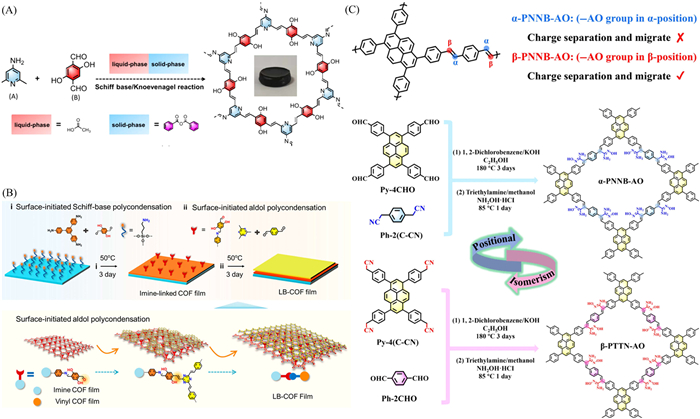
Vinylene-linkages is irreversible bonds. The generation of C=C bonds is formed by the reaction of Knoevenagel condensation [57], Horner-Wadsworth-Emmons reaction [58] and the aldol condensation reaction [59,60]. The carbon-carbon double bonds have less polarity compared to imine and imine-derived bonds, which improves π-electron delocalization across the framework, and renders them promising candidates for U(Ⅵ) photocatalytic reduction. Typically, the synthesis of vinylene-linked COFs proceeds through a two-stage mechanism: Initial generation of an enol intermediate, followed by its dehydration to form vinylene bridges. The stabilization and controlled formation of the enol intermediate play a critical role in this process, which can be facilitated by introducing strong electron-withdrawing groups near the methyl moiety. Moreover, Knoevenagel condensation reaction between benzyl cyanide and aldehydes utilizing base as catalyst, offers an efficient route for constructing fully π-conjugated COFs [61]. The sp2 carbon-conjugated COFs with excellent photoconductivity can regulate the band structure via varying the linker units and the C2-symmetryic knots. The first COF with C=C linkage (sp2C-COF) was condensed by 1,4-phenylenediacetonitrile and tetrakis(4-formylphenyl) pyrene in a mixture of 4 mol/L NaOH, 1,4-dioxane and mesitylene [62]. Subsequently, Yaghi et al. utilized the aldol condensation to synthesize the first conjugated unsubstituted C=C linked 2D COF (COF-701) [63]. Furthermore, the first sp2 carbon-conjugated 3D COF (BUCTCOF-4) is developed using the saddle-shaped aldehyde-substituted cyclooctatetrathiophene and 1,4-phenylenediacetonitrile [64]. Notablely, Luo and co-workers [19] presented a novel synthetic tactic to access linkage-mixed COFs through using both reversible Schiff base and irreversible Knoevenagel reactions in a one-pot manner. This hybrid-linkage COF demonstrates exceptional performance in photo-enhanced uranium extraction (Fig. 3A). Subsequently, the team [65] developed a layer-blocked covalent organic framework (LB-COF) heterogeneous film incorporating both imine and vinylene linkers, fabricated via two sequential surface-initiated polycondensation reactions. The resulting LB-COF film incorporates the satisfactory crystallinity typical of imine-based COFs with the enhanced optoelectronic properties characteristic of vinylene-linked frameworks (Fig. 3B). The photocatalytic extraction capacity of uranium for the LB-COF reaches 320 mg/g, markedly exceeding those of the vinylene-linked COF with 295 mg/g and the imine-linked COF with 35 mg/g. In addition, a regioisomeric engineering strategy was proposed to design vinylene-linked COFs for synergistic adsorption-photocatalytic uranium extraction from seawater (UES) [66]. By strategically adjusting the substitution positions of amidoxime (AO) groups on the vinylene backbone, two isomeric covalent organic frameworks, β-PTTN-AO and α-PNNB-AO, were successfully synthesized (Fig. 3C). The β-PTTN-AO isomer exhibits a notable capacity with 12.74 ± 0.21 mg/g in natural seawater, outperforming its α-configuration analogue (8.90 ± 0.18 mg/g). Nevertheless, the formation of COFs with sp2 vinylene-linked linkage remains challenging due to the limited reversibility inherent in carbon-carbon double bond formation.
In addition to the aforementioned COF bonds, other linkages also employed to synthesize COF, including Urea-linkage [67], propenone-linkage [68], acrylamide linkage [69], carbamate linkage [70], squaraine linkage [71] and β-ketoenamine-linkage [72]. In addition, fused heterocycle linkages including dioxin [73,74], piperazine [75,76] thianthrene [77], and benzimidazobenzophenanthroline [78], are means for the construction of fused hydrocarbon COFs. The phenazine linkage is formed via the condensation of a diketone with a diamine [79]. Comparing with hydrazone-, imine-, and azine-linked COFs, those with fused heterocycle, phenazine or triazine linkages could tolerate acidic or basic conditions and extended π-conjugation, which accelerate the transfer of charge carriers to the material surface or active center during U(Ⅵ) photocatalytic reduction [80,81]. Ma and co-works [82] presented an innovative approach for synthesizing quinone-amine-linked COFs by directly combining 2,5-dihydroxy-1,4-benzoquinone (DHBQ) with various amine monomers and introduce a novel photocatalyst, DHBQ-TAPP-COF, specifically tailored to efficiently reduce uranium in harsh environments (Fig. S1A in Supporting information). The quinone-amine linkages contribute to enhanced acid stability, extended π-conjugation, increased local polarity, and improved conductivity. These features facilitate efficient charge carrier transfer within the material, thereby boosting the overall performance of the uranium photocatalyst. The proposed photocatalyst efficiently reduces U(Ⅵ) without requiring sacrificial agents and precipitates UO2 without decomposition, achieving a recovery rate of over 98%. Moreover, under acidic conditions (pH 3), DHBQ-TAPP-COF exhibits a markedly higher efficiency for uranium removal compared to COF-366 (Fig. S1B in Supporting information). Unbound U(Ⅵ) species are immobilized on the COF framework through chemisorption with the C═O functional groups. Under light irradiation, TAPP acts as a photosensitizer, absorbing photons to generate electron–hole pairs. The spatially well-separated distributions of the HOMO and LUMO orbitals within the DHBQ unit facilitate highly efficient charge carrier separation. This optimized charge separation process significantly promotes the photocatalytic reduction of adsorbed U(Ⅵ), resulting in the precipitation of U3O8 (Fig. S1C in Supporting information).
Boronate ester and boroxine-linked COFs is easily hydrolyzed under humid conditions, significantly restricting their applicability in photocatalysis. In contrast, imine-linked COFs demonstrate markedly enhanced hydrolytic stability, a property attributed to their electron-rich framework structures. Similarly, the COFs β-ketoenamine-linkage formed via enol-keto tautomerization of their imine precursors exhibit considerably improved stability and have been successfully employed in photocatalytic applications. Furthermore, COFs featuring hydrazone and azine linkages have also shown notable activity in photocatalytic processes. The studies indicated that the COFs retained their chemical connectivity and photoactivity after photocatalytic use; however, a partial loss of long-range order emerged. This decrease in crystallinity is likely attributable to exfoliation in aqueous media, but it could be able to recover under the conditions of original reaction. Comparing with the azine, hydrazine, and imine COFs, phenazine and triazine-linked COFs represent excellent chemical stability, and triazine groups have been extensively explored as photoactive functional groups in photocatalysis. Intramolecular hydrogen bonding was demonstrated to enhance the stability of COFs hydrolysis. Moreover, the linkage types conversion represents a fungible method for improving their robustness in water. For instance, imine linkages in COFs can be directly oxidized to form amide linkages, which confer enhanced aqueous stability in both basic and acidic conditions. Xia et al. [83] developed two new pyrene-based COFs with amide linkages or imine linkages, and applied in U(Ⅵ) photocatalytic reduction (Fig. S1D in Supporting information). The introduction of oxygen atoms into the skeleton, accompanied by a change in polarity, leads to an increase in the number of photoexcited electrons and a broader band gap in amide-linked COFs. These changes also enhanced the material's hydrophilicity and dispersibility. Han and his collaborators [25] use unsaturated bond regulation strategies to regulate the production of H2O2 and the capture of uranium. Compared with vinyl (-C=C-), azo groups (-N=N-) anchored on the skeleton (Azo COF) can promote charge separation/transport in COFs, and the introduction of azo groups can effectively improve O2 adsorption, promote H2O2 generation, and convert soluble uranium into insoluble ((UO2)O2·2H2O) (Fig. S1E in Supporting information).
The linkages of COFs also are one of the core factors regulating the photocatalytic performance of heterostructures. By rationally designing the chemical and electronic properties of these linkers, it is possible to construct highly efficient, stable, and broad-spectrum photocatalytic systems. For donor-acceptor configuration COFs, the linking bonds act as electronic bridges, effectively "stitching" donor and acceptor units together. This forms an intramolecular electric field within the framework, promoting the separation of photoexcited excitons. Furthermore, appropriate linkages designs can regulate heterojunction types (such as p-n junctions and Schottky junctions), thereby optimizing redox potential retention capabilities. Compared to the weak electron transport properties of non-conjugated linkages, highly conjugated bonds such as C=C effectively promote π-electron delocalization, providing rapid charge transport pathways and reducing photogenerated carrier recombination. Polar bonds like imine bonds can modulate local electric fields through hydrogen bonding or protonation, facilitating charge separation, laying the foundation for S-type heterojunction design.
COFs can be precisely engineered at the molecular level through various strategies, such as the integration of tailored building blocks with specific linkages, the formation of extended π-conjugated systems, the incorporation of photosensitizing units, the implementation of metalation strategies, and the fabrication of electron donor-acceptor (D-A) structure into the conjugated backbone. These design elements collectively enhance the light-harvesting efficiency and improve both light absorption range as well as charge migration capability. In photocatalytic systems, photoinduced carriers transfer to the catalytic sites, where electrons undergo reduction reactions and holes undergo oxidation reactions. Indeed, strong electrostatic Coulomb interactions between electron-hole pairs typically generate intense exciton effects, which significantly hinder exciton dissociation and the formation of free carriers, resulting in reduced catalytic activity. In addition, the pH, band position, and catalytic sites are the main regulatory factors for reduction and oxidation reactions of COFs. Especially, under the photocatalytic reduction U(Ⅵ) system, the conduction band (CB) of the COF must be below the U(Ⅵ) reduction potential to guarantee that the photo-generated electrons possess adequate power to drive the reduction reaction. Compared to conventional organic semiconductors, such as disordered polymers or amorphous small molecules reliant on weak van der Waals interactions, covalent organic frameworks exhibit exceptional chemical stability owing to their robust covalent linkages between molecular building units [84]. However, not all COFs exhibit photocatalytic activity. Photocatalytic systems universally involve a sequential series of key processes: Solar light absorption, separation and transfer of carriers, generation of charge carriers, and interfacial charge transfer leading to catalytic reactions [85]. Significant research efforts have been directed toward developing photocatalytic materials that exhibit extended solar spectral absorption, efficient charge separation, and abundant surface active sites both in the bulk and at the surface. Diverse synthetic strategies and structural designs have been explored to improve solar energy conversion efficiency (Table S1 in Supporting information). A key challenge in this pursuit remains the identification of materials capable of broad-spectrum light harvesting while simultaneously generating long-lived, high-energy charge carriers [86]. This chapter will focus on strategies for strengthening the photocatalytic performance of COF.
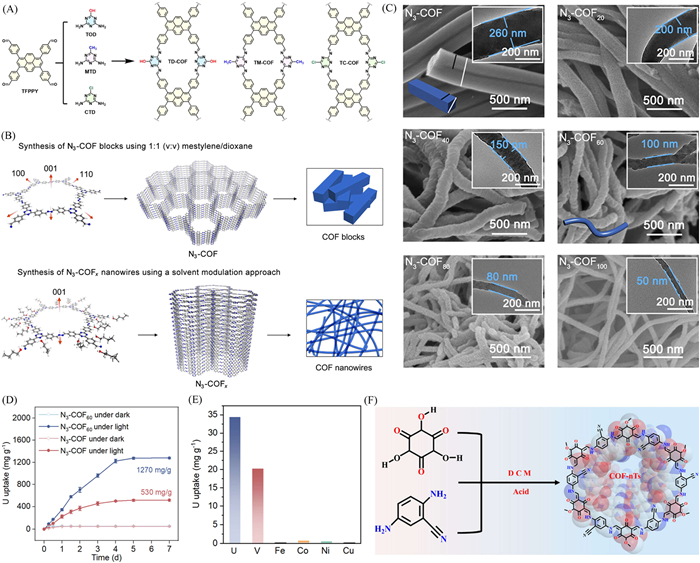
Morphology control is a common design idea to optimize the photocatalytic performance of COF-based photocatalysts. The structure features of COFs are classed 0D structure, 1D structure, 2D structure, 3D structure. Currently, some studies have been explored the relation of structure morphology between photocatalytic performance. Owing to the large surface area, the materials with 0D-structural are regarded as promising photocatalysts. However, their practical ability is often limited by severe agglomeration, which reduces photocatalytic efficiency. The 1D structures involved in nanoribbons, nanofibers, and nanowires, possess eminent surface-to-volume ratio [87], as shown in Fig. 4A. The 1D structure synergistically maximizes active site exposure while establishing a directed electron transfer pathway, optimizing exciton dissociation and charge transport to achieve unprecedented uranium reduction efficiency. Apart from 0D and 1D, 2D structures like few-layered nanosheets and thin films also extensively explored in photocatalytic application. The aspect ratio and high smoothness of photoexcited electrons and holes, and the short stroke of photogenerated charge carriers, endow the thin film significant photocatalytic ability. In 2024, Zhu et al. [88] conformed the formation of a triazine-linked COF with nanowires structure through a solvent modulation approach, achieving controllable external diameters between 50 nm and 200 nm (Figs. 4B and C). Nanowires with diameters around 100 nm exhibit excellent selectivity and ultra-high U(Ⅵ) extraction capacity under light irradiation (Figs. 4D and E). Another strategy combines morphology control through acid modification and defect engineering with the introduction of cyano groups as nano-traps within the COF pore channels [89], achieving a maximum uranium extraction capacity of 3548.1 mg/g (Fig. 4F). Hollow and flower-like architectures are typically categorized as three-dimensional structure. Through precise modulation of the template diameter, well-defined and uniformly arranged cavities can be achieved within the hollow structure. This tailored porosity significantly shortens the diffusion distance and enhances interactions between active sites and reactant molecules. Furthermore, the internal cavity facilitates multiple light reflections, promoting more efficient light harvesting and increased generation of photo-excitate carriers. Although the morphology control of COF has an important effect for the photocatalytic performance of U(Ⅵ) photocatalytic reduction, there are currently few reports on this aspect of research.
The selection of the building units in COF has an important effect on the photocatalytic activity. Especially, π-conjugated structure also plays a significant role in dredges channels for smooth charge migration, and light harvesting. The built-in extended π-conjugated framework within D-A heterojunction not only generates a narrow bandgap, enabling broad spectrum light harvesting from visible to near-infrared regions, but also promotes forward electron transfer while preventing the recombination of charge carriers. Aromatic stacking interactions generally promote the periodic spatial organization of molecular building blocks and enhance framework crystallization. The resulting columnar π-arrays facilitate charge transport and exciton migration through the molecular skeleton to catalytic surfaces. Therefore, achieving extended π-conjugation has long been considered a fundamental requirement for designing photocatalytic COFs. When both aromatic and quinoid forms are accessible for π-conjugation, the quinoid configuration, owing to its lower energy state, can effectively reduce the material bandgap [90]. The light absorption intensity, defined as the number of photons absorbed per unit time by the photocatalyst, is determined by the degree of π orbitals spatial overlap and therefore exhibits a positive correlation with the length of the π-conjugated system. Extending the π-conjugated system can induce a redshift in the absorption spectrum, thereby improving light capture in the longer-wavelength region. Moreover, the dimensions and geometry of the connecting units and building units dictate the pore size of the resulting COF. The pore architecture and distribution within the photocatalyst critically influence reactant diffusion and access to active surfaces. Rational modulation of pore channels and their chemical microenvironments can impart tailored permeability and affinity for target molecules, significantly improving the activity and selectivity of photocatalytic processes. To date, various functional organic compounds such as triazine [91], sulfone [92], pyrene [93,94], Porphyrins [95], benzothiadiazole [96], Nanographene [97] and thiophene [98,99] have been extensively used for active units to synthesize COFs with satisfying photocatalytic performance. Notably, photosensitizers serve as cocatalysts and can accelerate the charge transfer and light absorption in COFs.
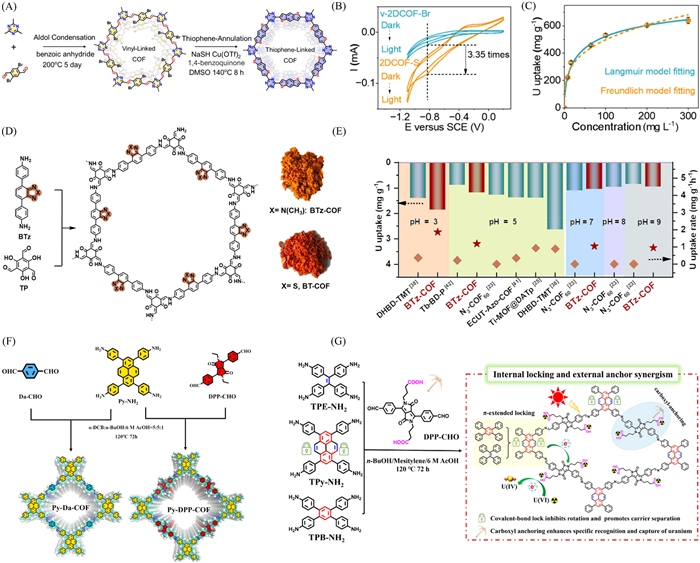
Thiophene units exhibit electron-rich and p-type semiconducting properties, and widely used for the construction of numerous high-performance semiconducting molecules over the whole organic electronics. Extending the thiophene structure from 1D linear polymers to 2D COFs shown to significantly boost the efficiency of light conversion/absorption. Zhang et al. [100] reported a fully conjugated 2D benzothiophene-linked COF for enhancing photoelectrocatalytic uranium extraction (Fig. 5A). High π conjugation systems significantly expanded the light harvesting range from 480 nm to 800 nm. The cyclic voltammetry measurements indicated that UO22+ is restored to UO2 at a potential of −0.82 V versus SCE, with the current intensity exhibiting a positive correlation with the COF's uranium reduction capability (Fig. 5B). And the resulting COF achieves a maximum extraction capacity of uranium with 643 mg/g within 2 h in uranium-fortified simulated seawater, demonstrating its high potential for efficient uranium extraction (Fig. 5C). In 2025, Li et al. [101] demonstrated that the benzotriazole-based COF have the ability of U(Ⅵ) photocatalytic reduction and hydrogen evolution in solutions containing low concentrations after the uranium coordination (Fig. 5D), outperforming most reported COF-based photocatalysts (Fig. 5E). This work highlights the important role of hydrated metal ions in hydrogen evolution photocatalytic system, and provides a new perspective for uranium separation to directly hydrogen by water splitting without precious metals. In another case, it was demonstrated that using dye diketopyrrolopyrrole as a receptor can effectively reduce exciton binding energy (Fig. 5F) [102]. The research team further designed three diketopyrrole-based COFs through a synergistic π-extension lock and carboxyl-functionalized anchoring molecular engineering strategy (Fig. 5G) [103]. Among these, TPy-DPP-COF features a covalently locked π-conjugated structure that enhances planarity, optimizes energy alignment, and minimizes exciton binding energy, thereby promoting charge transfer and suppressing recombination. Simultaneously, the carboxyl groups enable uranium-specific coordination and generate localized electric fields to promote charge separation. These characteristics endow TPy-DPP-COF with outstanding performance.
Bipyridine is also commonly used as a building block for photoactive COFs. Hu and co-workers [104] employed bipyridine unit (Bpy) react with polyhydroxy-containing unit (Tp) to form the COF-TpBpy for photocatalytic detoxification U(Ⅵ). Subsequently, the team [105] systematically explored the properties of various isostructural β-ketoenamine COFs with a series of functional groups (–Cl, –SO3H, –COOH, and –NO2) for photocatalytic reduction of U(Ⅵ). By introducing functional groups can boost the strength of internal electric field between the acceptor (Pa-X) and donor (Tp) units, enhancing hydrogen bonding interactions (such as O⋯H, Cl⋯H or N⋯H) within the COF framework. Stronger hydrogen bonds promote enhanced electron delocalization between the donor and acceptor molecules. In the same year, another example of anthraquinone-functionalized COF with β-ketoenamine structure (DQTP) was presented [106]. Anthraquinone moieties were identified as pivotal active sites for reduction U(Ⅵ), functioning not only to promote carriers separation and enhance photocatalytic activity, but also to facilitate the production of H2O2, which subsequently reacts with U(Ⅵ) via in situ processes to produce (UO2)O2·2H2O. In addition to the aforementioned functional building unit selection, identifying the appropriate functional groups is also one of the effective strategies for enhancing the U(Ⅵ) photocatalytic reduction [107]. Ma et al. [108] constructed a series of highly conjugated hydrazide-linked COF with different numbers of hydroxyl groups via adjusting the electron transportation, electronic donation sites, and excited state electron distribution (Fig. S2A in Supporting information). A record-high capacity with ~6.84 mg g-1 d-1 in seawater was obtained (Figs. S2B and C in Supporting information). In addition, three COFs, Tp-Tapb, Tp-Taz and TpTt, were developed to investigate the effect of varying number acceptors [109], and the impact of altering the distance between the two acceptors by modifying the length of bridging benzene ring on electron-hole separation was examined (Fig. S2D in Supporting information). In contrast to Tp-Tapb, both TpTt and Tp-Taz demonstrated higher efficiency of electron-hole separation and superior photocatalytic ability, attributable to the synergistic presence of ketone and triazine functional groups. Moreover, TpTt incorporates two short-range acceptor units with a high heteroatom content (ketone and triazine), contributing to its exceptional extraction capacity with 505 mg/g and photoreduction rate (0.22 h-1).
Considering the inherent characteristics of the strong exciton effect in COF materials [110], strategies such as D-A, defect engineering and multi-component also are adopted to decrease the exciton binding energy, and enhance the photocatalytic activity [98,111,112]. Sheridan et al. [113] affirmed the availability of the D-A strategy via developed a D-A COF with long-lived excited states (TTT-DTDA) (Fig. S2E in Supporting information). Under illumination for 10 h at pH 5 and TTT-DTDA demonstrated a maximum uranium extraction capacity of 123 mg/Ug without protective gases or sacrificial reagents. Yu et al. [114] developed three D-A olefin-linked COFs with amidoxime units to minimize exciton binding energy (Eb) by regulating π-skeleton (Fig. S2F in Supporting information). Evidence that increasing planarity and π-conjugation of donor units can markedly reduce Eb, thus facilitating the separation of charge carriers. A novel site engineering strategy [115] to integrate multiple merits into one COF (COF-AQ) was presented (Fig. S2G in Supporting information). In contrast to imine linkage, the β-ketoenamine linkage in COF-AQ can improve the π-electron delocalization and chemical stability. More importantly, introducing anthraquinone unit into COF-AQ instead of anthracene unit in COF-A not only can increase the charge transfer channel from two to four but also provide the hydrogen bond to strengthen [UO2(H2O)2]2+ adsorption.
Although the D-A structure can effectually suppress the photoinduced carrier recombination, due to random charge transfer and the scarcity of sites, conventional donor-acceptor COFs severely limit catalytic efficiency. More efficient strategies are still worth exploring. Utilizing molecular engineering concepts, an isoreticular family of multicomponent COFs with chromenoquinoline rings has been established (Fig. 6A) [116]. The intramolecular donor-acceptor interaction and the presence of electron withdrawing groups or electron donating could regulate local charge distribution, which is conducive to charge carriers separation and effective exploitation of carriers, thereby improving the photocatalytic reduction performance of U(Ⅵ) extraction from seawater (Fig. 6B). As expected, a nitro-functionalized multicomponent covalent organic framework achieved the extraction rate with 8.02 mg g-1 d-1 in natural seawater and the fastest kinetics among all COF (Fig. 6C). Another trains of quaternary and ternary COFs were constructed containing amidoxime nanotraps for selecting capture uranyl [117] (Fig. 6D), with the high uranium extraction capacity (2.45 mg g-1 d-1) in natural seawater (Fig. 6E).
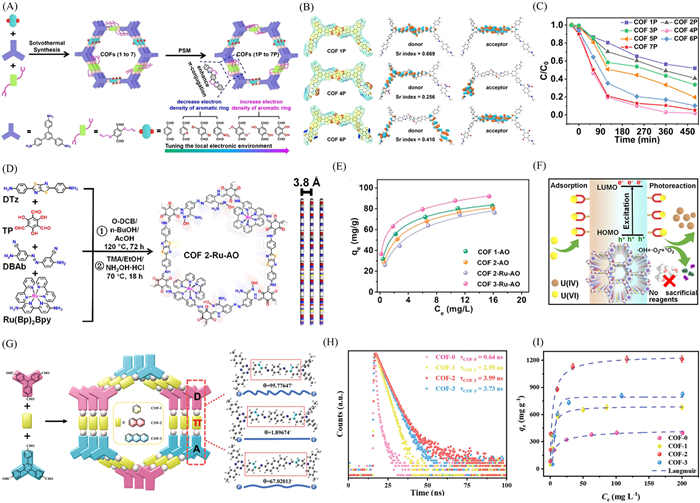
Under light illuminated condition, the photoexcitated electrons reduce U(Ⅵ) and produce 1O2, •OH, and •O2− species, while the valence holes simultaneously enhanced anti-biofouling properties in seawater (Fig. 6F). Another donor-acceptor COF case, the multi-site carboxyl-functionalized COFs via the Doebner reaction was constructed [118]. The highly electronegative carboxyl substituents enhanced charge transfer pathways, enabling complete separation of electrons and holes. Furthermore, the compounds exhibited favorable hydrophilicity and affinity toward uranium, accelerating the interfacial reaction during uranium extraction. The D-π-A structure has attracted the extensive attention for the design system of COF based photocatalytic materials in recent years. In 2024, Qiu et al. [119] synthesized a series of COFs photocatalysts with D-π-A structure for efficient U(Ⅵ) photocatalytic reduction from rare earth tailings wastewater. In terms of the selection of organic ligands, triphenyltriazine is employed as an electron donor, while triphenylamine served as an acceptor; benzene, anthracene and naphthalene are utilized as π-bridges with progressively increasing conjugation (Fig. 6G). Notably, within the framework of conjugated polymers, coplanarity does not always improve with increasing degrees of π-bond conjugation. COF-2 features the smallest dihedral angle of any naphthalene π-bridge. This reduction promotes a flatter, more delocalized electron transport pathway between the donor and acceptor moieties. Consequently, exciton binding energy decreases and exciton recombination is suppressed. Time-resolved photoluminescence spectroscopy further revealed that an insertion motif with moderate π-conjugation proved most effective in mitigating exciton recombination (Fig. 6H). Therefore, the removal capacity of COF-2 with a medium π-conjugated extension structure is as high as 1258.92 mg/g, which preceded the COF-1 with 690.39 mg/g and COF-3 with 793.20 mg/g (Fig. 6I). The observed enhancement in performance can be attributed to the improved molecular planarity achieved through naphthalene incorporation in COF-2, which establishes a highly delocalized electron transfer pathway and facilitates efficient excited-state electron migration. The research group subsequently proposed a D-A-D strategy [120], incorporating two electron-donating units into the triazine skeleton to form an asymmetric D-A-D topological structure (Fig. S3A in Supporting information). The topologically asymmetric ternary imine COF (NCOF-3) synthesized via this strategy optimizes exciton binding energy through amine-mediated aldol-type polycondensation. This facilitates forward dissociation of photogenerated excitons and promotes carrier separation, achieving outstanding performance in uranium photocatalytic reduction. Furthermore, this team achieved efficient uranium removal from real nuclear wastewater by introducing highly polar carboxyl groups to construct defect-type COF frameworks (Fig. S3B in Supporting information) [121]. Luo et al. constructed defective COFs and non-defective COFs by controlling reaction conditions and developed an innovative selective uranium extraction mineralization strategy (Fig. S3C in Supporting information) [122]. Given the superior H2O2 generation performance in defective COFs, this strategy enhances uranium extraction efficiency by 4.9-fold and achieves uranium selectivity three orders of magnitude higher than other metal ions compared to conventional one-step photocatalysis.
Hybrid materials often demonstrate excellent photocatalytic activity by forming heterojunctions or utilizing one component as a photosensitizer or semiconductor support. The enhanced in composite photocatalysts performance primarily stems from significantly improved transfer efficiency and carriers separation. This is ascribed to the band alignment between other semiconductors and covalent organic frameworks, which promotes the transfer of excited electrons from the high-energy conduction band (LUMO orbital) of one component to the low-energy conduction band of the other, while simultaneously promoting the transfer of holes from the higher-energy valence band (HOMO orbital) to the lower-energy valence band. The charge transfer between two materials inhibits the recombination of photogenerated charge carriers, thereby improving photocatalytic ability. The features of extremely high specific surface area and porous, visible light absorption capability make the newly-developing COFs ideal candidate to couple with inorganic nanoparticles (CdS, MXene, MoS2, TiO2, BiOBr, CuSe, etc.) to synthesize heterojunction photocatalyst. Generally, Type II, Schottky junction, Z-scheme [123,124], and S-scheme [125] heterojunction photocatalysts can achieve efficient photogenerated electron−hole separation (Fig. S4 in Supporting information). Among these, S-scheme and Z-scheme heterojunctions are designed to retain the strong redox ability of each component, thereby achieving superior catalytic activity. The following content provides a detailed introduction to several common heterojunctions.
Type II heterojunction: It is composed of two photocatalytic semiconductors with staggered band position. The photogenerated electrons can migrate from semiconductor 1 (denoted as S1) with the more negative conduction band to the CB of semiconductor 2 (denoted as S2), and the photoinduced holes transfer from S2 with the more positive valence band (VB)to the VB of S1. Thereby, the generation of internal electric field is constructed because of the different electric potentials of S1 and S2, effectively promoting photogenerated carrier separation. Nevertheless, the charge transfer pathway weakens the oxidation–reduction capacity of the photocatalytic system. Qiu's research [126] group synthesized a bifunctional MOF525@BDMTp with the type-II heterojunction by covalent linkage between COFs and MOFs (Fig. S5A in Supporting information). The composite material MOF525@BDMTp can simultaneously facilitate the U(Ⅵ) photocatalytic reduction and the chlorpyrifos (CP) degradation (Fig. S5B in Supporting information). The U(Ⅵ) removal capacity of MOF525@BDMTp is up to 625.0 mg/g and achieved a removal rate of 94.0% for CP, with excellent selectivity in practical application (Fig. S5C in Supporting information). Other type-II heterojunction cases, such as CdS@COF-X [127], BiOX@TpPa-1 [128], COFs@Bi/BiOBr [129] were presented for the photocatalytic reduction of U(Ⅵ).
Schottky junction: Metals and n-type semiconductors typically exhibit distinct work functions, denoted as ϕm and ϕs, respectively. When n-type semiconductor contacted with metal, free electrons spontaneously transfer from the higher Fermi energy (EF) material to that with lower EF until their Fermi levels align. If ϕm > ϕs, electron flow from the semiconductor to the metal, causing the metal to become negatively charged, while positive charges accumulate in the semiconductor region adjacent to the interface. This charge redistribution forms a depletion layer and establishes a Schottky barrier. In 2023, Qiu and co-workers [130] reported a Schottky barrier (NH2-Ti3C2Tx@COF) for high-efficiency photoreduction U(Ⅵ) without additional scavengers (Fig. S5D in Supporting information). The introduction of a reductive alkynyl-functionalized COF induces the formation of localized nucleophilic/electrophilic regions, establishing a Schottky interface with a unidirectional electronic channel. This structure enhances the separation of photogenerated carriers and elevates solar energy conversion efficiency. More importantly, negatively charged NH2-Ti3C2Tx functions as both transfer channel and an electron collector effectually conquer the lower performance resulted from imine-linked high polarization. Huang et al. [131] pioneered a comprehensive strategy combining pore wall engineering and heterojunction design to rationally construct a novel photocatalyst (NH2-MX@Por-COFOMe) for photocatalytic reduction of U(Ⅵ) (Fig. S5E in Supporting information). The photocatalyst exhibits outstanding photocatalytic activity and adsorption capability can reach up to 1858.7 mg/g, nearly twice the dark adsorption value of 943.3 mg/g.
Z-scheme heterojunction: In 1979, Bade first reported the conception of the Z-scheme photocatalytic system, suggesting the use of an electron medium as a charge transfer bridge between two photosystems to facilitate spatially separated reduction and oxidation reactions. Unlike heterojunction-based semiconductor composites, Z-scheme systems exhibit a distinct electron transfer pathway facilitated by an integrated electron-relaying mediator [132]. The first experimental exhibition of a Z-scheme photocatalytic system was reported in 2001, utilizing an IO3-/I- redox shuttle as an ionic electron mediator to regulate charge migrate between two semiconductor-based photocatalytic system [133]. However, redox mediator-assisted Z-scheme systems often face inherent limitations. These include reverse redox reactions caused by the reversible nature of ionic mediators, which compete with forward reactions through carrier back-donation. Additionally, the light absorption by the redox species can significantly reduce photon availability for photocatalytic processes, a phenomenon known as the shielding effect [134]. The Z-scheme of second generation is the all-solid-state Z-scheme system consisted of two semiconductors and Au as electron mediator [135], opens up new avenues for low-impedance electron shift by Ohmic contact. This system addresses the issue of reverse reactions inherent in conventional Z-scheme configurations; however, the high cost of noble metals limits its broad applicability. Furthermore, noble metals and reduced graphene oxide exhibit strong optical absorption, leading to an inevitable light-shielding effect that reduces photon utilization. The system of direct Z-scheme, representing the third generation, eliminates the need for mediators entirely. In 2009, Wang et al. attested a discovery of Z-schematic vector electron transfer spectra for coupled ZnO and CdS through chemical formation methods [136]. Defects concentrated at the interface between two photocatalyst materials may potentially generate a build in electric field, providing a low-impedance path for charge migration, known as an ohmic contact. That is to say, the solid-solid contact interface can possibly be employed for Z-schematic vectorial electron transfer among semiconductors. To address the issue of composite components without hanging bond, Qiu's team [137] combined COFs with semiconductors (SnS2) to in situ design a heterojunction photocatalyst with Z-scheme van der Waals (SnS2COF) for the U(Ⅵ) reduction from wastewater containing rare earth tailings (Fig. S5F in Supporting information). Van der Waals heterojunctions feature a simple synthesis method, with large-area van der Waals interactions forming high-speed electron transport channels within the heterojunction.
S-scheme heterojunction: The S-scheme heterojunction, formed by coupling an oxidation semiconductor with a reduction semiconductor, has been developed based on the direct Z-scheme. It effectively resolves longstanding controversies associated with the mechanism of Z-scheme, particularly concerning the transfer pathways of photoinduced electrons and holes [138,139]. The step-scheme (S-scheme) heterojunction concept was first presented by Yu et al., and its charge transfer pathway macroscopically resembles a "step-like" structure [140-142]. The electrons transfer from the higher EF S1 to lower EF S2 the across the interface when two photocatalysts with different EF are into close contact. Simultaneously, the S1 side carries a positive charge, exhibiting upward band bending on account of electron loss, while the S2 side shows opposite band bending due to electron gain. This creates a built-in electric field directed from S1 to S2. The synergistic interaction between the band bending and build in electric field, along with the Coulombic attraction between holes and electrons, effectively accelerates the photo-generated electrons recombination at the CB in S2 with holes at the VB in S1. Eventually, photoinduced charge carriers with strong oxidation–reduction capabilities remain in the VB of S2 and the CB of S1. Although S-scheme heterojunctions have excellent photogenerated carriers separation capabilities, there are currently few reports on COF based photocatalysts with S-scheme heterojunctions for photocatalytic separation of uranium.
Traditional multiphase hybrid heterojunctions commonly suffer from uneven junction distribution and low connectivity, which hinders the migration of photo-generated charges. Metal clusters (nanoparticles) exhibit numerous advantages, including photosensitivity, localized surface plasmon resonance, and quantum size effects [143,144]. Smaller clusters (nanoparticles) expose more low-coordination sites, which facilitate interaction with reactants. The method of introducing metal ions into COFs through coordination is termed metallization, encompassing both pre- and post-synthesis approaches [145]. Depending on the location of the metal species, metallated COFs could be categorized as three categories: Metal ions coordinated to the linking moieties of the framework, metal nanoparticles embedded within the COF matrix, and COF monomers coordinate with metal ions. Salen-based COF is a typical representative of metalized COF. Wang et al. constructed the first example of a Salen-based COF connecting by imine bond [141], which offers an efficient tactic for the development of metallized COFs. In addition, porphyrin derivatives are widely employed as photoactive molecules in both photocatalysis and electrocatalysis. The sp2-hybridized pyrrolic cavity enables the metal ions coordination, including Zn2+, Cu2+, Co2+, and Ni2+, thereby forming photocatalytic centers that facilitate the directional migration of photogenerated electrons between electron-rich porphyrin units and intra- or intermolecular positively charged metal ions. For instance, Jiang et al. [146] developed a series of porphyrin functionalized COFs (DhaTph-M) synthesized in the presence or absence of various metal ions at the center of porphyrin linkers. Under irradiation, the metal-free COF shows the coexistence of charge carriers and excitons. However, this balance is disrupted by the doping of various metal ions, leading to significant changes in exciton dynamics. Specifically, the Zn2+ ion at the center of porphyrin efficiently converts singlet excitons into triplet excitons, facilitating the activating oxygen molecules and energy transfer process to generate 1O2. On the contrary, the Ni2+ at the center of porphyrin promotes the excitons dissociation into electrons and holes, promoting the charge transfer process that generates O2•− from O2. In contrast to metalloporphyrin- and metallophthalocyanine-based COFs, metalated 2,2′-bipyridine-based COFs may enhance catalytic performance, which can be ascribed to their frequently occurring coordinatively unsaturated metal centers. Moreover, the ease of functionalization at the 5,5′-positions makes 2,2′-bipyridine ligands ideal building blocks for constructing such metalated COFs. 1,10-Phenanthroline can be regarded as a rigidified analogue of 2,2′-bipyridine, in which the rotation of the pyridine rings is sterically constrained. Employing benzidine (BZ) and aldehyde appended Cu(I)-bisphenanthroline tetrafluoroborate, Cu(PDB)2(BF4) as building blocks, Yaghi et al. [147] developed a 3D metallized COF (COF-505) constructed via Schiff base reactions. The center of Cu element is topologically independent from the braided structure in COF and acts as a template, guiding molecular wires into an interwoven pattern rather than the more common parallel arrangement. By reversibly removing and re-inserting the copper(I) ions, the COF still retain the structural integrity. Notably, demetalation results in a tenfold enhancement in the material's elasticity. Except for homometallic and heterometallic COFs, there are also some common organic ligands that are prone to metallizing COFs, such as 1H-pyrazole [148,149], catecholate [150-152], triphenylphosphine [153-155] and N-heterocyclic carbene [156,157]. Indeed, the COF-linkages with electron-enrich, such as β-ketoenamine [158,159], imine [157,160,161], and acylhydrazone [162], are also an effective strategy for metallized COFs to enhance the photocatalytic performance. These strategies may partially overcome the limitations of the aforementioned COF metallization methods, but they sometimes fail to clearly demonstrate the precise location and coordination patterns of the metal loadings within the COF. In 2023, Wang et al. [163] developed a COF photocatalyst functionalized by titanium oxide clusters (TiOCs) through a precursor pre-organization strategy for the direct reduction of UO2(CO3)34- in alkaline seawater environments (Fig. S6A in Supporting information). At the molecular level, constrained TiOCs covalently bond with the COF matrix, facilitating efficient electron transfer from the light-harvesting, electron-donor COF to the active catalytic sites. Similarly, a second metallated COF was developed by incorporating nickel into the porphyrin centers to acquire efficient U(Ⅵ) photocatalytic reduction [164] (Fig. S6B in Supporting information). Under ambient air and in a basic solution, uranium can be photoreduced to a residual concentration of 1 ppm in absence of any scavenger, achieving the removal rate of 97.1% under solar illumination. In 2024, Zhou et al. [165] designed a covalent organic framework-based molecular junction, denoted as Cu3-Ti6—COF, by covalently integrating a Ti-O cluster as the reduction site and a Cu-N cluster as the oxidation site. This structure significantly promotes the directed migration and photogenerated carriers separation (Fig. S6C in Supporting information). The Cu3-Ti6—COF has a good single-phase periodic distribution, wherein reductive sites (Ti6 clusters) for U(Ⅵ) photoreduction and the oxidative sites (Cu3 clusters) for water oxidation are periodically and spatially separated at the molecular level. The impact of different stacking modes within metallic COFs on their U(Ⅵ) photocatalytic reduction performance was studied [166]. Cu3-PA-COF-ABC with staggered ABC stacking and Cu3-PA-COF-AA with eclipsed AA stacking are constructed by the parallel building units of Cu3(PyCA)3·H2O (Cu3, 1H-PyCA = 1H-pyrazole-4-carbaldehyde) and PA (pphenylenediamine) (Fig. S6D in Supporting information). Compared to ABC stack mode, the Cu3-PA-COF-AA variant demonstrates more efficient photoproduced charge separation, superior photoreduction activity of U(Ⅵ), and enhanced light absorption. This stacking regulation has greater advantages compared to the stacking regulation of metal-free COFs. Another C=C double bond metal-covalent organic framework (Cu-TMT) for the highly efficient chemical and photocatalytic synergistic reduction of U(Ⅵ) was proposed by Qiu group [167]. The research group further investigated the effect of intercalating preassembled pyridine-nickel metal complexes into the COF on its photocatalytic reduction of U(Ⅵ) [168].
Elemental doping serves as an effective strategy for tailoring both the surface properties and semiconductor materials electronic structures, thereby enhancing their performance. Integrating heteroatoms, such as O, S, N, F, and Cl, into covalent organic frameworks enables precise structural modulation at the atomic level [169]. Among them, the sulfur element as one of the most frequent dopants can effectively regulate the optical absorption features and the electronic structure [170]. Element B often serves as an active center coordinating with N (B-N unit), capable of pulling electrons and modifying the band structure of COF materials. Halogens such as F and Cl exhibit strong electron-withdrawing effects, profoundly altering electronic structures, enhancing oxidation capabilities, and improving stability. Typically, doping introduces new impurity energy levels within the bandgap or broadens the delocalization range of conjugated systems, thereby significantly reducing the bandgap (Eg). This extends the light absorption range from the ultraviolet to the visible spectrum and even into the near-infrared region. In addition to non-metal doping strategies mentioned above, metal elements such as Zn, Re, and Fe also introduced into COFs to improve their performance of photocatalytic application. Nevertheless, the mechanism through which elemental doping influences U(Ⅵ) separation remains unclear and presents significant challenges for precise control. The impact of heteroatom incorporation into the building units on the crystallinity of COFs has also been systematically investigated [171]. The incorporation of pyridine nitrogen atoms enhances both the planarity of aromatic rings and mitigates steric hindrance with adjacent functional groups, thereby effectively preserving the overall molecular planar rigidity. The incorporation of pyridine-type nitrogen atoms facilitates face-to-face stacking among aromatic molecules, driven by strong dipole–dipole interactions that arise from the significant electronegativity difference between nitrogen and carbon atoms within the conjugated system. Zhong et al. [172] synthesized isomeric COF containing thiadiazole through heteroatom tuning strategy and studied the effect of different heterogeneous elements (N/S) on the photocatalytic reduction performance of U(Ⅵ). This provides another approach to strengthen the ability of U(Ⅵ) photocatalytic reduction. Notably, there are few reports on the use of element doping strategies for photocatalytic reduction of U(Ⅵ).
In addition to the strategies mentioned above, piezoelectric catalysis, which relies on carrier separation efficiency or charge energy, has also garnered widespread attention. Piezo-photocatalysis is regarded as an integrated tandem process that combines piezoelectric and photocatalytic functionalities. The piezoelectric affect produces an internal electric potential sufficient to drive catalytic reactions. When the induced electric potential in the piezoelectric material surpasses the reaction energy barrier, the piezoelectric photocatalysis effect was activated [173]. In recent years, the incorporation of piezoelectric fields in photocatalytic reactions has been affirmed to be a rapid and effective strategy for reducing photogenerated carriers recombination [174]. Currently, there is limited research on synthesizing composites of COFs and piezoelectric materials. These studies primarily focus on enhancing piezoelectric photocatalytic efficiency by forming heterojunctions between COFs and piezoelectric materials (such as BiFeO3, BaTiO3, ZnO, MXene, CdS, and bismuth halide oxides), rather than utilizing COFs as the primary piezoelectric component [16,175-178]. In 2024, Qiu and coworkers [179] constructed a D-COF@ZnO heterojunction by COFs grown in situ on the surface of zinc oxide (ZnO) for piezoelectric catalytic uranium removal, wherein defects are introduced into the COF shell layer via imine exchange reactions (Fig. S7A in Supporting information). The Kelvin probe force microscopy (KPFM) shown that COF@ZnO produces a surface voltage of 22.83 mV (Fig. S7B in Supporting information), which is lower than that of D-COF@ZnO with a surface voltage of 46.59 mV (Fig. S7C in Supporting information). Upon illumination, electrons and holes within the built-in electric field move in opposite directions under the driving force of the piezoelectric potential, achieving spatial charge separation. This process significantly amplifies the photovoltage difference between the positive and negative piezoelectric regions. Subsequently, the research team [180] synthesized another Z-type ZnO@COF heterostructure without defect by in situ growth of COFs on the ZnO surface (Fig. S7D in Supporting information). The ZnO core endows the heterostructure with piezoelectric properties, while the outer COF shell is conducive to efficient electron transfer, enhances structural stability, and provides abundant catalytic active sites. Concurrently, the generated electric field of heterojunction interface extends across the ZnO entire surface, effectively promoting electron hole separation and reducing the metal edge shielding effect. Benefiting from this rational design, the ZnO@COF-40 heterojunction enables efficient U(Ⅵ) extraction under mild mechanical stimulation (Fig. S7E in Supporting information). This study significantly advances the understanding of how COFs enhance the performance of piezoelectric photocatalysis for 2D materials, offering valuable guidance for the rational optimization and design of piezocatalytic systems.
Due to the complexity of the actual water environment, the photocatalytic separation performance of U(Ⅵ) will be affected by various factors, such as cycling stability, temperature, pH value, contact time, dosing amount, initial U(Ⅵ) concentration, co-existing ions and ionic strength. Usually, the above influencing factors will affect the efficiency of U(Ⅵ) photocatalytic reduction through at least two pathways: The adsorption of U(Ⅵ) on the photocatalyst under the above conditions is a prerequisite for achieving photocatalytic reactions; The properties of photocatalysis, such as the potentials of CB and VB, light absorption, the redox potential of U(Ⅵ), and the electron-hole separation efficiency, are largely determined by these factors. Notably, anaerobic conditions and the addition of sacrificial agents are commonly employed methods to enhance the photocatalytic performance of photocatalysts, but these undoubtedly increase the cost of uranium extraction. Therefore, the evaluation of photocatalytic performance should be conducted in photocatalytic systems without sacrificial agents or anaerobic atmospheres. For a more detailed discussion, see Supporting information.
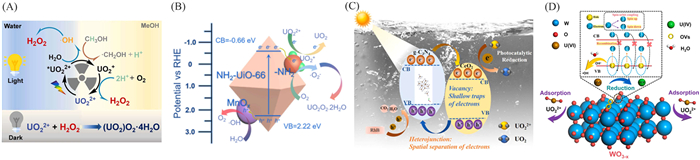
Natural uranium primarily exists in four valence states (Ⅵ, Ⅴ, Ⅳ, and Ⅲ), of which the Ⅵ and Ⅳ oxidation states exhibit the highest stability. In wastewater containing uranium or seawater, uranium predominantly exists in the U(Ⅵ), typically as the uranyl ion (UO22+), which exhibits high mobility in aquatic environments. The U(Ⅳ) is insoluble in solution and the ion radius is about 1.05 × 10⁻⁸ cm, which typically exists in the formation of solid UO2 or U3O8. Uranium is present mainly as Ca2[UO2(CO3)3] stable complex in seawater [181]. Typically, the pore size of COF plays a decisive role in its ability to enrich UO22+, and its mechanism of action is not singular but involves multi-level synergistic effects. Pores of specific shapes and sizes can function as "nanoreactors" or "templates", facilitating the formation of more favorable geometric configurations between uranyl ions and functional groups within the pores upon entry, or enabling the ordered arrangement of multiple uranyl ions within the pore channels. Among these, the pore confinement effect occurs when uranium ions or their complexes enter pores matching their size. This restricts their translational and rotational degrees of freedom, shortens the interaction distance with pore wall functional groups, and increases the number of interaction points. Two primary chemical states of uranium mainly are U(Ⅵ) and U(Ⅳ) and the reduction potentials of UO22+/UO2 and UO22+/U4+ are 0.411 and 0.327 V, respectively [182]. As long as the CB potential of the semiconductor is more negative than the reduction potential of the U(Ⅵ)/U(Ⅳ) redox pair, photoinduced electrons can reduce U(Ⅵ) to U(Ⅳ) [9]. Currently, three distinct mechanisms for photocatalytic reduction U(Ⅵ) have been presented. The first is the mechanism of single-electron reduction, in which U(Ⅵ) accepts one photoelectron to form U(Ⅴ), followed by the transfer of an additional photoelectron to further reduce U(Ⅴ) to U(Ⅳ) (Figs. 7A and B). The conclusions of this potential mechanism can be verified through EPR and radical quenching experiments (Figs. S8A and B in Supporting information) [14]. Experimental results indicate that the superoxide radicals (•O2−) was the crucial active species in the photocatalytic reduction reaction system for U(Ⅵ). The results indicate that photoelectrons tend to combine with dissolved oxygen in water to form •O2- rather than recombining with holes. The superoxide radical further oxidizes U(Ⅴ) to UO2O2·2H2O. Similar studies have also confirmed the potential mechanism of the single-electron reduction process [183]. And using DFT theoretical calculations elucidates the electron transport pathways and the adsorption mechanism of uranyl ions (Figs. S8C—H in Supporting information). Under certain specific conditions, U(Ⅴ) can automatically transform disproportionately into U(Ⅵ) and U(Ⅳ). Another adopted mechanism is two-electron reduction, which assumes that U(Ⅵ) is directly converted to U(Ⅳ) in a single two-electron photocatalytic reduction step (Fig. 7C) [7,184]. Furthermore, a third mechanism of U(Ⅵ) photocatalytic reduction can occur by participation of acidic solutions hydrogen ions (H+) in the two-electron reduction process (Fig. 7D) [15,185]. Notably, triplet excitons formed by excited-state electrons that combine with holes via Coulomb interactions and align their spins parallel can spontaneously convert O2 into a singlet oxygen (1O2) intermediate, which was confirmed by Li's team through extensive DFT theoretical calculations and experimental characterization such as near-infrared photoluminescence spectra spectroscopy, EPR spectra, and in situ DRIFTS (Fig. S9 in Supporting information) [186], for more details, see Supporting information. This process may contribute to the photocatalytic reduction of U(Ⅵ), though direct evidence remains lacking. Most current mechanisms are inferred from experimental phenomena observations and known uranium-water chemistry, but they still lack sufficient direct evidence for confirmation.
The mechanism of single-electron [187,188] might be as follows (Eqs. 1 and 2):
|
|
(1) |
|
|
(2) |
or the resulting U(Ⅴ) may undergo disproportionation (Eq. 3):
|
|
(3) |
For a two-electron reaction system, this reaction mechanism might be as follows (Eq. 4):
|
|
(4) |
In some systems, hydrogen ions are involved in the reaction process of double-electron reactions (Eq. 5).
|
|
(5) |
Here, some functional materials could produce superoxide radicals (•O2−) under light condition, and these free radicals will participate in the U(Ⅵ) photocatalytic reduction reaction (Eqs. 6–8) [189-192].
|
|
(6) |
|
|
(7) |
|
|
(8) |
To date, several impactful reviews on uranium photoreduction have been reported. However, the mechanism of U(Ⅵ) reduction has not been elaborated in detail, especially the connection between COF design and U(Ⅵ) photocatalytic reduction system. Based on the above analysis, several pivotal indexes must be taken into account on COFs design for U(Ⅵ) photocatalytic reduction. Fundamental aspects such as band gap, energy band structure, carrier transfer as well as separation efficiency noticeably influence the photocatalytic activity and represent general design principles. Moreover, the presence of adequate adsorption sites is crucial, as it enhances the likelihood of interaction between U(Ⅵ) and the photocatalyst, a decisive step in the photoreduction process. When U(Ⅵ) is adsorbed onto the active sites of a photocatalyst, it acts as an electron acceptor, enabling subsequent reduction. Abundant adsorption sites are essential for efficient U(Ⅵ) photoreduction. More specifically, the uranyl ions are adsorbed on the COFs framework. After illumination, the COFs are generated and excited photoinduced e- and h+. Some of the e- and h+ will quickly combine due to the Coulomb force and release energy in other forms, while some electrons will participate in the process of reducing U(Ⅵ) to U(Ⅳ).
The tunable molecular structure of COF allows for precise customization of optoelectronic properties and active sites, improving interactions with cocatalysts or substrates, and facilitating surface reactions. The essence to enhancing photocatalytic ability is to improve the separation efficiency of charge carriers and the light capture ability, while simultaneously restraining charge recombination. In view of this, COF as a photocatalyst is generally considered a promising candidate for U(Ⅵ) photocatalytic reduction. This review summarizes and analyzes the progress of COF-based photocatalysts for photocatalytic separation U(Ⅵ) from wastewater and seawater, focusing on their intrinsic properties, characteristics of COF linkages and the morphology of COF and emphasizing the relationship between structure-property-activity. Especially, potential strategies for improving the photocatalytic ability of COFs are highlighted, such as skeleton functionalization, hybrid materials, metalized COF, elemental doping and piezoelectric photocatalysis. In addition, we elaborated the design principle of COF based photocatalysts for U(Ⅵ) photocatalytic reduction, with particular emphasis on the various mechanistic pathways involved. Although significant advance has been achieved in the photocatalytic U(Ⅵ) reduction based on COF, there are still significant challenges and opportunities for mechanistic understandings, the design and synthesis of COF based photocatalysts, and practical application.
(ⅰ) The exploration of novel COFs based photocatalysts was conducted through linkages, building blocks, topological configurations and the construction of donor acceptor structures. Furthermore, developing novel COF photocatalytic materials by screening suitable building blocks through high-throughput computational screening is considered the most promising strategy. The fundamental principles include improving charge carrier separation efficiency and transportation, and enhancing the visible light absorption ability. Furthermore, enhancing light harvesting across the entire visible spectrum and even into the near-infrared region remains a critical challenge for developing innovative COF-based photocatalysts, some potential strategies can be attempted, such as defect engineering, multicomponent strategies.
(ⅱ) Considering economic benefits, the commercialization of efficient U(Ⅵ) separation from seawater or wastewater using COF photocatalysts remains a great challenge. Although various strategies for synthesizing COFs have been developed, traditional synthetic methods such as solvothermal, mechanochemical and grinding ionothermal are still restricted to experimental level synthesis. Therefore, to synthesize crystals and porous COFs on a large scale, it is necessary to optimize the thermodynamic parameters and kinetic.
(ⅲ) The actual situation of solutions containing uranyl ions is usually complex, and high photocatalytic stability is a fundamental requirement for COFs in practical application.
(ⅳ) Exploration of COF-based photocatalysts with fully conjugated bonds shows great potential for enhancing photocatalytic activity. In addition, the key factor of COFs crystallinity affects the lifetime and mobility of photoinduced carriers, which can be finely tuned by predesigning appropriate monomers and bonds.
(ⅴ) Owing to the multiphase nature and complexity of COFs photocatalytic processes, the detailed mechanism of photocatalytic reactions is still unclear. Furthermore, the types of intermediate uranium in the COF photocatalytic reaction system are still unclear, and the understanding and identification of intermediate uranium types are crucial for understanding the potential mechanisms of uranium reduction. Therefore, examining the generation process of products and using theoretical calculations or advanced techniques to demonstrate intermediates in COF photocatalytic processes can provide direct evidence for the mechanism of U(Ⅵ) photocatalytic reduction, leading to further research and in-depth understanding. Notably, the synthesis and design of COF single crystals have important promoting effects on the understanding of the mechanism, but they are also major challenges.
(ⅵ) The currently developed COF-based photocatalysts are mostly in powder form, which is difficult to meet practical needs. It is necessary to process the COF-based photocatalysts into various forms and introduce some typical non-contact external fields (such as magnetic field, thermal energy, ultrasonic field and microwave field) and their coupling fields to develop a macroscopic photocatalytic comprehensive system with mechanical properties for actual wastewater or seawater uranium extraction [174,175]. This can provide additional energy input for the photocatalytic system, thereby boosting the photocatalytic separation ability of U(Ⅵ) via COFs. However, there is still a lack of relevant research in this area at present.
The high crystallinity of COF is attributed to the "dynamic covalent chemistry" employed in its synthesis. Reversible covalent bonds, such as imine bonds and borate ester bonds, enable bond cleavage and reformation, allowing the structure to self-correct errors. This ultimately leads to the formation of thermodynamically stable crystalline phases characterized by the lowest energy and long-range order. Conversely, achieving exceptional chemical stability (e.g., stability in strong acids, strong bases, or water) often requires the use of irreversible or kinetically inert strong covalent bonds (e.g., C=C, triazine rings, amide bonds). The greater the irreversibility of these bonds, the more difficult it becomes for molecules to undergo rearrangement and self-correction during synthesis, thereby increasing the challenge of obtaining high crystallinity. To enhance stability, post-modification of crystalline COFs is often performed (such as reducing imine bonds to more stable secondary amine bonds or performing ring-closing reactions). Notably, higher crystallinity in COFs does not necessarily equate to superior performance. Researchers have discovered that amorphous or partially crystalline COFs may exhibit higher activity than perfectly crystalline COFs. As mentioned in previous sections regarding defect engineering strategies, intentionally introducing controllable defects (such as dislocations, edges, or impurity atoms) into crystalline COFs can disrupt structural "perfection, " creating new active sites while preserving the charge transport capability of the main framework. Therefore, achieving gradient control of COF crystallinity through sophisticated synthesis strategies to synergistically optimize core material properties remains a significant challenge.
In brief, the application of COFs in heterogeneous photocatalysis is an extremely dynamic and relevant research field, and COF based photocatalysts pave the avenue for more effective and environmentally friendly radioactive uranyl ion recovery approach by integrating advanced functionalization and photochemical strategies.
Yougan Wang: Writing – original draft, Supervision, Investigation. Sanmei Liu: Supervision, Investigation. Fangfang Li: Supervision, Investigation. Zhijian Li: Writing – review & editing, Supervision, Investigation. Leilei Sun: Writing – review & editing, Investigation. Congbin Fan: Writing – review & editing, Validation, Investigation. Chunhui Deng: Writing – review & editing, Supervision, Investigation.
The authors declare that they have no known competing financial interests or personal relationships that could have appeared to influence the work reported in this paper.
This work was supported by the National Natural Science Foundation of China (No. 22261020), Ph.D. Start-up Funds of Jiangxi Science and Technology Normal University (Nos. 2024BSQD52, 2024BSQD67), Jiangxi Provincial Career Early Young Science and Technology Talent Cultivation Special Fund Project (Nos. 20244BCE52246, 20252BEJ730336), and Jiangxi Provincial Key Laboratory of Organic Functional Molecules (No. 2024SSY05141).
Supplementary material associated with this article can be found, in the online version, at doi:
J.O. Ighalo, Z. Chen, C.R. Ohoro, et al., Chemosphere 352 (2024) 141322. doi: 10.1016/j.chemosphere.2024.141322
Z. Li, Z. Zhang, Z. Lin, et al., ChemSusChem 18 (2025) e202500972. doi: 10.1002/cssc.202500972
T. Chen, K. Yu, C. Dong, et al., Coord. Chem. Rev. 467 (2022) 214615. doi: 10.1016/j.ccr.2022.214615
Q. Zeng, Y. Wen, B. Gao, et al., Chin. Chem. Lett. 36 (2025) 110673. doi: 10.1016/j.cclet.2024.110673
D. Mei, L. Liu, B. Yan, Coord. Chem. Rev. 475 (2023) 214917. doi: 10.1016/j.ccr.2022.214917
T. Xiu, S. Zhang, P. Ren, et al., Chin. Chem. Lett. 34 (2023) 108440. doi: 10.1016/j.cclet.2023.108440
Y. Zhang, Q. Chen, Q. Xiao, et al., Chemosphere 335 (2023) 139022. doi: 10.1016/j.chemosphere.2023.139022
L. Guo, Y. Yang, L. Gong, et al., Adv. Funct. Mater. 34 (2024) 2400588. doi: 10.1002/adfm.202400588
E. Hu, Q. Chen, Q. Gao, et al., Adv. Funct. Mater. 34 (2024) 2312215. doi: 10.1002/adfm.202312215
Y.L. Liu, C. Zhang, L. Guo, et al., Water Res. 245 (2023) 120666. doi: 10.1016/j.watres.2023.120666
T. Lin, T. Chen, C. Jiao, et al., Nat. Commun. 15 (2024) 4149. doi: 10.1038/s41467-024-48564-y
X. Gong, L. Tang, J. Zou, et al., J. Hazard. Mater. 423 (2022) 126935. doi: 10.1016/j.jhazmat.2021.126935
Z. Dong, D. Gao, Z. Li, et al., Energy Environ. Mater. 7 (2024) e12705. doi: 10.1002/eem2.12705
X. Cao, K. Yu, Y. Zhang, et al., ACS Appl. Mater. Interfaces 15 (2023) 1063–1072. doi: 10.1021/acsami.2c17849
X. Yang, F. Li, W. Liu, et al., Appl. Catal. B: Environ. Energy 324 (2023) 122202. doi: 10.1016/j.apcatb.2022.122202
Z. Liu, S. Yao, A. Zhang, et al., Appl. Catal. B: Environ. Energy 338 (2023) 123023. doi: 10.1016/j.apcatb.2023.123023
K. Yu, L. Tang, X. Cao, et al., Adv. Funct. Mater. 32 (2022) 2200315. doi: 10.1002/adfm.202200315
J. Yang, Z. Chen, L. Zhang, et al., ACS Nano 18 (2024) 21804–21835. doi: 10.1021/acsnano.4c06783
L. Guo, Z. Yu, X. Xie, et al., Nano Lett. 24 (2024) 9854–9860. doi: 10.1021/acs.nanolett.4c01836
A.I.B. Adrien, P. Coˆté, N.W. Ockwig, et al., Science 310 (2005) 1166–1170. doi: 10.1126/science.1120411
K. Qian, X. Guan, N. Sun, et al., Sci. China Chem. 66 (2023) 436–442. doi: 10.1007/s11426-022-1473-5
J. Yu, Y. Huang, P. Zhang, et al., Chin. Chem. Lett. 37 (2026) 111378. doi: 10.1016/j.cclet.2025.111378
J. Wang, J. Zhang, S.B. Peh, et al., Sci. China Chem. 63 (2019) 192–197.
B. Mishra, A. Alam, A. Chakraborty, et al., Adv. Mater. 37 (2025) 2413118. doi: 10.1002/adma.202413118
B. Han, Z. Wang, Y. Wen, et al., J. Mater. Chem. A 13 (2025) 34927–34937. doi: 10.1039/D5TA03821A
R. Shen, J. Xing, Q. Yue, et al., Sci. China Mater. 68 (2025) 3925–3954. doi: 10.1007/s40843-025-3573-5
C. Liu, W. Zhang, Q. Zeng, et al., Chem. Eur. J. 22 (2016) 6768–6773. doi: 10.1002/chem.201601199
S. Wan, J. Guo, J. Kim, et al., Angew. Chem. Int. Ed. 48 (2009) 5439–5442. doi: 10.1002/anie.200900881
J.F. Dienstmaier, D.D. Medina, M. Dogru, et al., ACS Nano 6 (2012) 7234–7242. doi: 10.1021/nn302363d
J.R. Hunt, C.J. Doonan, J.D. LeVangie, et al., J. Am. Chem. Soc. 130 (2008) 11872–11873. doi: 10.1021/ja805064f
H.M. El-Kaderi, J.R. Hunt, J.L. Mendoza-Cortés, et al., Science 316 (2007) 268–272. doi: 10.1126/science.1139915
F.J. Uribe-Romo, C.J. Doonan, H. Furukawa, et al., J. Am. Chem. Soc. 133 (2011) 11478–11481. doi: 10.1021/ja204728y
L. Stegbauer, K. Schwinghammer, B.V. Lotsch, Chem. Sci. 5 (2014) 2789–2793. doi: 10.1039/C4SC00016A
Y. Zhang, X. Shen, X. Feng, et al., Chem. Commun. 52 (2016) 11088–11091. doi: 10.1039/C6CC05748A
S.Y. Ding, M. Dong, Y.W. Wang, et al., J. Am. Chem. Soc. 138 (2016) 3031–3037. doi: 10.1021/jacs.5b10754
Y. Li, X. Guo, X. Li, et al., Angew. Chem. Int. Ed. 59 (2020) 4168–4175. doi: 10.1002/anie.201916360
Y. Xie, Y. Wu, X. Liu, et al., Cell Rep. Phys. Sci. 4 (2023) 101220. doi: 10.1016/j.xcrp.2022.101220
Q. Fang, Z. Zhuang, S. Gu, et al., Nat. Commun. 5 (2014) 4503. doi: 10.1038/ncomms5503
Z. Luo, L. Liu, J. Ning, et al., Angew. Chem. Int. Ed. 57 (2018) 9443–9446. doi: 10.1002/anie.201805540
Q. Fang, J. Wang, S. Gu, et al., J. Am. Chem. Soc. 137 (2015) 8352–8355. doi: 10.1021/jacs.5b04147
B. Han, X. Ding, B. Yu, et al., J. Am. Chem. Soc. 143 (2021) 7104–7113. doi: 10.1021/jacs.1c02145
S. Dalapati, S. Jin, J. Gao, et al., J. Am. Chem. Soc. 135 (2013) 17310–17313. doi: 10.1021/ja4103293
Y. Zhu, S. Wan, Y. Jin, et al., J. Am. Chem. Soc. 137 (2015) 13772–13775. doi: 10.1021/jacs.5b09487
S.B. Alahakoon, C.M. Thompson, A.X. Nguyen, et al., Chem. Commun. 52 (2016) 2843–2845. doi: 10.1039/C5CC10408D
V.S. Vyas, F. Haase, L. Stegbauer, et al., Nat. Commun. 6 (2015) 8508. doi: 10.1038/ncomms9508
L. Stegbauer, M.W. Hahn, A. Jentys, et al., Chem. Mater. 27 (2015) 7874–7881. doi: 10.1021/acs.chemmater.5b02151
Q. Sun, B. Aguila, L.D. Earl, et al., Adv. Mater. 30 (2018) 1705479. doi: 10.1002/adma.201705479
P. Kuhn, M. Antonietti, A. Thomas, Angew. Chem. Int. Ed. 47 (2008) 3450–3453. doi: 10.1002/anie.200705710
P. Katekomol, J. Roeser, M. Bojdys, et al., Chem. Mater. 25 (2013) 1542–1548. doi: 10.1021/cm303751n
M.J. Bojdys, J. Jeromenok, A. Thomas, et al., Adv. Mater. 22 (2010) 2202–2205. doi: 10.1002/adma.200903436
K. Wang, L.M. Yang, X. Wang, et al., Angew. Chem. Int. Ed. 56 (2017) 14149–14153. doi: 10.1002/anie.201708548
P. Srinivasan, K. Dhingra, K. Kailasam, J. Mater. Chem. A 11 (2023) 17418–17451. doi: 10.1039/D3TA02660D
S. Dey, A. Bhunia, D. Esquivel, et al., J. Mater. Chem. A 4 (2016) 6259–6263. doi: 10.1039/C6TA00638H
A. Bhunia, D. Esquivel, S. Dey, et al., J. Mater. Chem. A 4 (2016) 13450–13457. doi: 10.1039/C6TA04623A
S.Y. Yu, J. Mahmood, H.J. Noh, et al., Angew. Chem. Int. Ed. 57 (2018) 8438–8442. doi: 10.1002/anie.201801128
Y. Zou, S. Abednatanzi, P.G. Derakhshandeh, et al., Nat. Commun. 13 (2022) 2171. doi: 10.1038/s41467-022-29781-9
X. Zhuang, W. Zhao, F. Zhang, et al., Polym. Chem. 7 (2016) 4176–4181. doi: 10.1039/C6PY00561F
D.L. Pastoetter, S. Xu, M. Borrelli, et al., Angew. Chem. Int. Ed. 59 (2020) 23620–23625. doi: 10.1002/anie.202010398
S. Li, R. Ma, S. Xu, et al., J. Am. Chem. Soc. 144 (2022) 13953–13960. doi: 10.1021/jacs.2c06042
T. Jadhav, Y. Fang, W. Patterson, et al., Angew. Chem. Int. Ed. 58 (2019) 13753–13757. doi: 10.1002/anie.201906976
C.R. Zhang, W.R. Cui, C.P. Niu, et al., Chem. Eur. J. 428 (2022) 131178.
M.A.E. Jin, Q. Xu, S. Dalapati, et al., Science 357 (2017) 673–676. doi: 10.1126/science.aan0202
H. Lyu, C.S. Diercks, C. Zhu, et al., J. Am. Chem. Soc. 141 (2019) 6848–6852. doi: 10.1021/jacs.9b02848
S. Wang, X. -X. Li, L. Da, et al., J. Am. Chem. Soc. 143 (2021) 15562–15566. doi: 10.1021/jacs.1c06986
Y. Zhao, S. Li, G. Fu, et al., ACS Cent. Sci. 10 (2024) 775–781.
F. Yu, M. Xu, Y. Sha, et al., Nano Res. 18 (2025) 94907677. doi: 10.26599/NR.2025.94907677
C. Zhao, C.S. Diercks, C. Zhu, et al., J. Am. Chem. Soc. 140 (2018) 16438–16441. doi: 10.1021/jacs.8b10612
C.P. Niu, C.R. Zhang, X. Liu, et al., Nat. Commun. 14 (2023) 4420. doi: 10.1038/s41467-023-40169-1
R. Zhang, C.P. Niu, N.H. Dong, et al., Angew. Chem. Int. Ed. 137 (2025) e202511163. doi: 10.1002/ange.202511163
S.J. Lyle, T.M. Osborn Popp, P.J. Waller, et al., J. Am. Chem. Soc. 141 (2019) 11253–11258. doi: 10.1021/jacs.9b04731
A. Nagai, X. Chen, X. Feng, et al., Angew. Chem. Int. Ed. 52 (2013) 3770–3774. doi: 10.1002/anie.201300256
M. Traxler, S. Gisbertz, P. Pachfule, et al., Angew. Chem. Int. Ed. 61 (2022) e202117738. doi: 10.1002/anie.202117738
B. Zhang, M. Wei, H. Mao, et al., J. Am. Chem. Soc. 140 (2018) 12715–12719. doi: 10.1021/jacs.8b08374
X. Guan, H. Li, Y. Ma, et al., Nat. Chem. 11 (2019) 587–594. doi: 10.1038/s41557-019-0238-5
Y. Yue, H. Li, H. Chen, et al., J. Am. Chem. Soc. 144 (2022) 2873–2878. doi: 10.1021/jacs.1c13012
Q. Zhi, W. Liu, R. Jiang, et al., J. Am. Chem. Soc. 144 (2022) 21328–21336. doi: 10.1021/jacs.2c09482
S. Haldar, M. Wang, P. Bhauriyal, et al., J. Am. Chem. Soc. 144 (2022) 9101–9112. doi: 10.1021/jacs.2c02346
M. Wang, S. Fu, P. Petkov, et al., Nat. Mater. 22 (2023) 880–887. doi: 10.1038/s41563-023-01581-6
J. Guo, Y. Xu, S. Jin, et al., Nat. Commun. 4 (2013) 2736. doi: 10.1038/ncomms3736
J. You, Y. Zhao, L. Wang, et al., J. Clean. Prod. 291 (2021) 125822. doi: 10.1016/j.jclepro.2021.125822
M.A. Gatou, P. Bika, T. Stergiopoulos, et al., Energies 14 (2021) 3197. doi: 10.3390/en14113197
X. Pei, P. He, K. Yu, et al., Adv. Funct. Mater. 34 (2024) 2410827. doi: 10.1002/adfm.202410827
J. Kang, J. Hang, B. Chen, et al., ACS Appl. Mater. Interfaces 14 (2022) 57225–57234. doi: 10.1021/acsami.2c16702
Q. Yang, M. Luo, K. Liu, et al., Appl. Catal. B: Environ. Energy 276 (2020) 119174. doi: 10.1016/j.apcatb.2020.119174
G. Murali, J.K. Reddy Modigunta, Y.H. Park, et al., ACS Nano 16 (2022) 13370–13429. doi: 10.1021/acsnano.2c04750
A. Zadehnazari, A. Khosropour, A.A. Altaf, et al., Adv. Mater. 36 (2024) 2311042. doi: 10.1002/adma.202311042
Y.X. He, F.T. Yu, J.L. Gui, et al., Adv. Funct. Mater. 36 (2026) e17374. doi: 10.1002/adfm.202517374
X. Ma, K.R. Meihaus, Y. Yang, et al., J. Am. Chem. Soc. 146 (2024) 23566–23573. doi: 10.1021/jacs.4c07699
M. Ahmad, X. Mao, K. Zhao, et al., Small 21 (2025) 2501578. doi: 10.1002/smll.202501578
H. Zhou, L. Yang, W. You, Macromolecules 45 (2012) 607–632. doi: 10.1021/ma201648t
M. Luo, Q. Yang, K. Liu, et al., Chem. Commun. 55 (2019) 5829–5832. doi: 10.1039/C9CC02144B
X. Wang, L. Chen, S.Y. Chong, et al., Nat. Chem. 10 (2018) 1180–1189. doi: 10.1038/s41557-018-0141-5
L. Stegbauer, S. Zech, G. Savasci, et al., Adv. Energy Mater. 8 (2018) 1703278. doi: 10.1002/aenm.201703278
W. Wu, Z. Li, S. Liu, et al., Angew. Chem. Int. Ed. 63 (2024) e202404563. doi: 10.1002/anie.202404563
Y.H. Kim, J.P. Jeon, Y. Kim, et al., Angew. Chem. Int. Ed. 62 (2023) e202307991. doi: 10.1002/anie.202307991
W. Chen, Z. Yang, Z. Xie, et al., J. Mater. Chem. A 7 (2019) 998–1004. doi: 10.1039/C8TA10046B
E. Jin, S. Fu, H. Hanayama, et al., Angew. Chem. Int. Ed. 61 (2021) e202114059.
W. Huang, Q. He, Y. Hu, et al., Angew. Chem. Int. Ed. 131 (2019) 8768–8772. doi: 10.1002/ange.201900046
L. Dai, A. Dong, X. Meng, et al., Angew. Chem. Int. Ed. 62 (2023) e202300224. doi: 10.1002/anie.202300224
Y. Zhao, S. Li, J. Han, et al., ACS Mater. Lett. 6 (2024) 3985–3992. doi: 10.1021/acsmaterialslett.4c01042
T. Wang, R. Yang, M. Li, et al., Appl. Catal. B: Environ. Energy 365 (2025) 124939. doi: 10.1016/j.apcatb.2024.124939
Z. Chen, J. Zhang, F. Yu, et al., Sep. Purif. Technol. 359 (2025) 130376. doi: 10.1016/j.seppur.2024.130376
F. Yu, X. Zhang, J. Xu, et al., J. Energy Chem. 112 (2026) 284–293. doi: 10.1016/j.jechem.2025.08.061
X. Zhong, Z. Ren, Q. Ling, et al., Appl. Surf. Sci. 597 (2022) 153621. doi: 10.1016/j.apsusc.2022.153621
X. Zhong, Q. Ling, P. Kuang, et al., Chem. Eng. J. 467 (2023) 143415. doi: 10.1016/j.cej.2023.143415
Q. Ling, P. Kuang, X. Zhong, et al., Appl. Surf. Sci. 639 (2023) 158220. doi: 10.1016/j.apsusc.2023.158220
Y. Liu, Q. Deng, Y. Yu, et al., Sep. Purif. Technol. 361 (2025) 131461. doi: 10.1016/j.seppur.2025.131461
Z. Chen, J. Wang, M. Hao, et al., Nat. Commun. 14 (2023) 1106. doi: 10.1038/s41467-023-36710-x
X. Zhong, Q. Ling, Z. Ren, Appl. Catal. B: Environ. Energy 326 (2023) 122398. doi: 10.1016/j.apcatb.2023.122398
F. Liu, Y. He, X. Liu, et al., ACS Catal. 12 (2022) 9494–9502. doi: 10.1021/acscatal.2c02173
Z.A. Lan, G. Zhang, X. Chen, et al., Angew. Chem. Int. Ed. 58 (2019) 10236–10240. doi: 10.1002/anie.201904904
M. Hussain, B. Kim, I. Ullah, et al., Chem. Eng. J. 521 (2025) 166567. doi: 10.1016/j.cej.2025.166567
Y. Song, A. Li, P. Li, et al., Chem. Mater. 34 (2022) 2771–2778. doi: 10.1021/acs.chemmater.1c04407
F. Yu, C. Li, W. Li, et al., Adv. Funct. Mater. 34 (2023) 2307230.
Q. Huang, H. Zhang, H. Yang, et al., Appl. Catal. B: Environ. Energy 362 (2025) 124721. doi: 10.1016/j.apcatb.2024.124721
H. Yang, M. Hao, Y. Xie, et al., Angew. Chem. Int. Ed. 62 (2023) e202303129. doi: 10.1002/anie.202303129
M. Hao, Y. Xie, X. Liu, et al., JACS Au 3 (2023) 239–251. doi: 10.1021/jacsau.2c00614
C. Liu, Y. Wang, Z. Dong, et al., Chem. Eng. J. 514 (2025) 163078. doi: 10.1016/j.cej.2025.163078
X.X. Wang, C.R. Zhang, R.X. Bi, et al., Adv. Funct. Mater. 35 (2025) 2421623. doi: 10.1002/adfm.202421623
Y.X. He, X.J. Chen, R. Zhang, et al., J. Hazard. Mater. 492 (2025) 138055. doi: 10.1016/j.jhazmat.2025.138055
H.X. He, C.R. Zhang, X.J. Chen, et al., ACS Appl. Polym. Mater. 7 (2025) 4525–4534. doi: 10.1021/acsapm.5c00178
L. Guo, Z. Huang, L. Gong, et al., CCS Chem. 7 (2025) 3146–3159. doi: 10.31635/ccschem.024.202405043
S. Li, H. Yu, Y. Wang, et al., Appl. Surf. Sci. 615 (2023) 156335. doi: 10.1016/j.apsusc.2023.156335
Y. Wang, Z. Hu, W. Wang, et al., Appl. Catal. B: Environ. Energy 327 (2023) 122419. doi: 10.1016/j.apcatb.2023.122419
Y. He, P. Hu, J. Zhang, et al., ACS Catal. 14 (2024) 1951–1961. doi: 10.1021/acscatal.4c00026
X. Liu, Z.H. Peng, L. Lei, et al., Appl. Catal. B: Environ. Energy 342 (2024) 123460. doi: 10.1016/j.apcatb.2023.123460
K. Yu, P. He, N. He, et al., Sci. China Mater. 66 (2023) 4680–4688. doi: 10.1007/s40843-023-2599-9
X. Zhong, Q. Ling, S. Wang, et al., J. Environ. Chem. Eng. 10 (2022) 108097. doi: 10.1016/j.jece.2022.108097
B. Chen, Y. Pan, Y. Deng, et al., Sep. Purif. Technol. 370 (2025) 133120. doi: 10.1016/j.seppur.2025.133120
Y.G. Wang, W. Jiang, X. Liu, et al., Chem. Eng. J. 477 (2023) 146975. doi: 10.1016/j.cej.2023.146975
M. Li, F. Zhou, Z. Dai, et al., J. Colloid Interf. Sci. 699 (2025) 138180. doi: 10.1016/j.jcis.2025.138180
B.J. Ng, L.K. Putri, X.Y. Kong, et al., Adv. Sci. 7 (2020) 1903171. doi: 10.1002/advs.201903171
R. Abe, K. Sayama, K. Domen, et al., Chem. Phys. Lett. 344 (2001) 339–344. doi: 10.1016/S0009-2614(01)00790-4
H. Li, W. Tu, Y. Zhou, et al., Adv. Sci. 3 (2016) 1500389. doi: 10.1002/advs.201500389
T. Sekitani, H. Nakajima, H. Maeda, et al., Nat. Mater. 8 (2009) 494–499. doi: 10.1038/nmat2459
G. Liu, L. Wang, H.G. Yang, et al., J. Mater. Chem. 20 (2010) 831–843. doi: 10.1039/B909930A
X. Liu, R.X. Bi, C.R. Zhang, et al., Chem. Eng. J. 460 (2023) 141756. doi: 10.1016/j.cej.2023.141756
M. Xu, Z. Li, R. Shen, et al., Chin. J. Catal. 70 (2025) 431–443. doi: 10.1016/S1872-2067(24)60247-0
F. Li, G. Zhu, J. Jiang, et al., J. Mater. Sci. Technol. 177 (2024) 142–180. doi: 10.1016/j.jmst.2023.08.038
L. Zhang, J. Zhang, H. Yu, et al., Adv. Mater. 34 (2022) 2107668. doi: 10.1002/adma.202107668
Q. Xu, L. Zhang, B. Cheng, et al., Chem 6 (2020) 1543–1559. doi: 10.1016/j.chempr.2020.06.010
B. Zhu, J. Sun, Y. Zhao, et al., Adv. Mater. 36 (2023) 2310600.
Q. Shang, Y. Liu, J. Ai, et al., J. Mater. Chem. A 11 (2023) 21109–21122. doi: 10.1039/D3TA03966H
L. Liu, X. Zhang, L. Yang, et al., Nat. Sci. Rev. 4 (2017) 761–780. doi: 10.1093/nsr/nwx019
Q. Guan, G.B. Wang, L.L. Zhou, et al., Nanoscale Adv 2 (2020) 3656–3733. doi: 10.1039/D0NA00537A
Y. Qian, D. Li, Y. Han, et al., J. Am. Chem. Soc. 142 (2020) 20763–20771. doi: 10.1021/jacs.0c09727
Y. Liu, Y. Ma, Y. Zhao, et al., Science 351 (2016) 365–369. doi: 10.1126/science.aad4011
R.J. Wei, H.G. Zhou, Z.Y. Zhang, et al., CCS Chem. 3 (2021) 2045–2053. doi: 10.31635/ccschem.020.202000401
X. Li, J. Wang, F. Xue, et al., Angew. Chem. Int. Ed. 60 (2021) 2534–2540. doi: 10.1002/anie.202012947
X. Chen, N. Huang, J. Gao, et al., Chem. Commun. 50 (2014) 6161–6163. doi: 10.1039/C4CC01825G
H. Vardhan, G. Verma, S. Ramani, et al., ACS Appl. Mater. Interfaces 11 (2018) 3070–3079.
H. Vardhan, L. Hou, E. Yee, et al., ACS Sustainable Chem. Eng. 7 (2019) 4878–4888. doi: 10.1021/acssuschemeng.8b05373
R. Tao, X. Shen, Y. Hu, et al., Small 16 (2020) 1906005. doi: 10.1002/smll.201906005
Y. Li, X. Li, J. Li, et al., Micropor. Mesopor. Mater. 325 (2021) 111351. doi: 10.1016/j.micromeso.2021.111351
Y. Liu, A. Dikhtiarenko, N. Xu, et al., Chem. Eur. J. 26 (2020) 12134–12139. doi: 10.1002/chem.202002150
P. Bellotti, M. Koy, M.N. Hopkinson, et al., Nat. Rev. Chem. 5 (2021) 711–725. doi: 10.1038/s41570-021-00321-1
G.H. Gunasekar, K. Park, V. Ganesan, et al., Chem. Mater. 29 (2017) 6740–6748. doi: 10.1021/acs.chemmater.7b01539
P. Sarkar, A. Hazra Chowdhury, S. Biswas, et al., Mater. Today Chem. 21 (2021) 100509. doi: 10.1016/j.mtchem.2021.100509
X. Han, J. Zhang, J. Huang, et al., Nat. Commun. 9 (2018) 1294. doi: 10.1038/s41467-018-03689-9
C.T. Kuo, Y. Lu, P. Arab, et al., Cell Rep. Phys. Sci. 2 (2021) 100495. doi: 10.1016/j.xcrp.2021.100495
Z. Almansaf, J. Hu, F. Zanca, et al., ACS Appl. Mater. Interfaces 13 (2021) 6349–6358. doi: 10.1021/acsami.0c21370
G. Chen, H.H. Lan, S.L. Cai, et al., ACS Appl. Mater. Interfaces 11 (2019) 12830–12837. doi: 10.1021/acsami.9b02640
S. Zhang, L. Chen, Z. Qu, et al., Chem 9 (2023) 3172–3184. doi: 10.1016/j.chempr.2023.06.008
L. Chen, J. Hang, B. Chen, et al., Chem. Eng. J. 454 (2023) 140378. doi: 10.1016/j.cej.2022.140378
Z. Gao, Y. Wang, Z. Sun, et al., Appl. Catal. B: Environ. Energy 352 (2024) 124053. doi: 10.1016/j.apcatb.2024.124053
Z. Gao, S. Lv, Y. Wang, et al., Adv. Sci. 11 (2024) 2406530. doi: 10.1002/advs.202406530
J.L. Liu, M.X. Lin, J. Huang, et al., Chem. Eng. J. 491 (2024) 151982. doi: 10.1016/j.cej.2024.151982
X.X. Wang, R. Zhang, Z.H. Peng, et al., Chem. Eng. J. 521 (2025) 167061. doi: 10.1016/j.cej.2025.167061
B. Chen, Y. Pan, Y. Deng, et al., Adv. Funct. Mater. 36 (2026) e23735. doi: 10.1002/adfm.202523735
L.Y. Li, W. Fang, P. Zhang, et al., J. Mater. Chem. A 4 (2016) 12402–12406. doi: 10.1039/C6TA04711D
M. Li, X. Chi, Z. Zhang, et al., Angew. Chem. Int. Ed. 63 (2024) e202411474. doi: 10.1002/anie.202411474
X. Zhong, Z. Ji, J. Xu, Sep. Purif. Technol. 367 (2025) 132890. doi: 10.1016/j.seppur.2025.132890
S. Tu, Y. Guo, Y. Zhang, et al., Adv. Funct. Mater. 30 (2020) 2005158. doi: 10.1002/adfm.202005158
P. Jia, J. Li, H. Huang, et al., Adv. Funct. Mater. 34 (2024) 2407309. doi: 10.1002/adfm.202407309
Z.Z. Liang, X.A. Li, Q.Z. Chen, et al., ACS Catal. 14 (2024) 10447–10461. doi: 10.1021/acscatal.4c02243
Y. Cai, Y. Zhang, Z. Lv, et al., Appl. Catal. B: Environ. Energy 310 (2022) 121343. doi: 10.1016/j.apcatb.2022.121343
M.L. Xu, M. Lu, G.Y. Qin, et al., Angew. Chem. Int. Ed. 61 (2022) e202210700. doi: 10.1002/anie.202210700
T. Ren, J. Han, Y. Miao, et al., J. Alloy. Compd. 925 (2022) 166638. doi: 10.1016/j.jallcom.2022.166638
J.X. Qi, J.W. Gong, Z.H. Peng, et al., Small 21 (2025) 2409682. doi: 10.1002/smll.202409682
J.X. Qi, J.W. Gong, C.R. Zhang, et al., Nat. Commun. 16 (2025) 1078. doi: 10.1038/s41467-025-56471-z
C. Wen, Y. Yao, L. Meng, et al., Ind. Eng. Chem. Res. 62 (2023) 18230–18250. doi: 10.1021/acs.iecr.3c02831
Y. Zhang, M. Zhu, S. Zhang, et al., Appl. Catal. B: Environ. Energy 279 (2020) 119390. doi: 10.1016/j.apcatb.2020.119390
Y. Hu, D. Tang, Z. Shen, et al., Appl. Catal. B: Environ. Energy 322 (2023) 122092. doi: 10.1016/j.apcatb.2022.122092
S. Li, D. Pan, Z. Cui, et al., Sep. Purif. Technol. 301 (2022) 121966. doi: 10.1016/j.seppur.2022.121966
P. Liang, L. Yuan, K. Du, et al., Chem. Eur. J. 420 (2021) 129831.
C. Huang, Y. Zhang, R. Shen, et al., Adv. Mater. 38 (2026) e11092. doi: 10.1002/adma.202511092
Y. Guo, L. Li, Y. Li, et al., J. Radioanal. Nucl. Ch. 310 (2016) 883–890. doi: 10.1007/s10967-016-4820-7
Z.J. Li, Z.W. Huang, W.L. Guo, et al., Environ. Sci. Technol. 51 (2017) 5666–5674. doi: 10.1021/acs.est.6b05313
L. Hu, X.W. Yan, X.J. Zhang, et al., Appl. Surf. Sci. 428 (2018) 819–824. doi: 10.1016/j.apsusc.2017.09.216
Y.K. Kim, S. Lee, J. Ryu, et al., Appl. Catal. B: Environ. Energy 163 (2015) 584–590. doi: 10.1016/j.apcatb.2014.08.041
W. Li, N. Wu, C. Li, et al., Chin. Chem. Lett. 37 (2026) 110733. doi: 10.1016/j.cclet.2024.110733
Q. Li, M. Liang, H. Zhuang, et al., Chin. Chem. Lett. 37 (2026) 111593. doi: 10.1016/j.cclet.2025.111593

Figure 1 Number of published articles on COF photocatalytic application and its photocatalytic separation of uranium.

Figure 3 (A) Synthesis route of r-i-COF-1. Copied with permission [19]. Copyright 2024, American Chemical Society. (B) Synthetic scheme to LB-COF heterogeneous film and the mediated aldol polycondensations conducted by unreacted aldehyde edges. Copied with permission [65]. Copyright 2024, American Chemical Society. (C) Synthetic routes of β-PTTN-AO and α-PNNB. Copied with permission [66]. Copyright 2025, Tsinghua University Press.

Figure 4 (A) The synthesis route of 1D COF (TFPPY-TOD, TFPPY-MTD and CTD). Copied with permission [87]. Copyright 2025, Wiley-VCH. (B) Formation of the COF nanocrystals with block and nanowires morphology. (C) SEM and TEM (inset) of N3—COF and N3—COFx (x = 20, 40, 60, 80, 100). (D) Extraction ability of N3—COF60 and N3—COF following exposure to an aqueous solution of uranyl(VI) (10 ppm at pH 5) under illumination and dark. (E) Comparison of the uptake of U6+, Fe3+, V5+, Ni2+, Cu2+, and Co2+ in N3—COF60 after irradiation in commercial seawater for 42 days. Copied with permission [88]. Copyright 2024, American Chemical Society. (F) The synthesis scheme of COF-nTs. Copied with permission [89]. Copyright 2025, Wiley-VCH.

Figure 5 (A) Synthesis route of v-2DCOF-Br and 2DCOF-S. (B) Cyclic voltammetry curves of v-2DCOF-Br and 2DCOF-S measured in simulated seawater containing 8 ppm uranium, under both dark and illuminated conditions. (C) Fitting of the equilibrium adsorption isotherms. Copied with permission [100]. Copyright 2024, American Chemical Society. (D) The synthesis routes and optical photos of BT-COF and BTz-COF. (E) The adsorption rate and capacities of BTz-COF as comparison with different COF based photocatalyst. Copied with permission [101]. Copyright 2024, Elsevier. (F) The synthesis of Py-DPP-COF and Py-Da-COF. Copied with permission [102]. Copyright 2024, Elsevier. (G) The representation three diketopyrrole-based COF. Copied with permission [103]. Copyright 2025, Elsevier.

Figure 6 (A) The synthesis route of COFs 1P to 7P, demonstrating programmable modulation of the local electronic environment through combined post-synthetic modification and remote linker installation strategies. (B) The acceptor and donor distributions, electrostatic potential for COFs 1P, 4P, and 6P. (C) Uranium photocatalytic extraction from simulated seawater spiked with ~20 ppm using COF series 1P to 7P. Copied with permission [116]. Copyright 2023, Wiley-VCH. (D) Synthetic preparation of COF 2-Ru-AO. (E) Adsorption isotherms of COF in uranyl-spiked seawater. (F) Potential photocatalytic mechanism of COF 2-Ru-AO. Copied with permission [117]. Copyright 2023, American Chemical Society. (G) Schematic illustration of the D-π-A type COFs synthesis. (H) The time-resolved PL spectra. (I) Adsorption isotherms for the photocatalytic reduction of uranium. Copied with permission [119]. Copyright 2024, Wiley-VCH.

Figure 7 (A) The proposed schematic mechanism of U(Ⅵ) photocatalytic reduction. Copied with permission [183]. Copyright 2022, Elsevier. (B) The possible mechanism of U(Ⅵ) photocatalytic reduction by MnOx/NH2-UiO-66. Copied with permission [14]. Copyright 2022, American Chemical Society. (C) Schematic diagram of the U(Ⅵ) photoreduction process on CN—CeO2-x. Copied with permission [184]. Copyright 2022 Elsevier. (D) Schematic diagram of photoreduction mechanism of U(Ⅵ) by WO3-x. Copied with permission [15]. Copyright 2022, Elsevier.

 扫一扫看文章


扫一扫关注我们
 DownLoad:
 下载:

 下载: