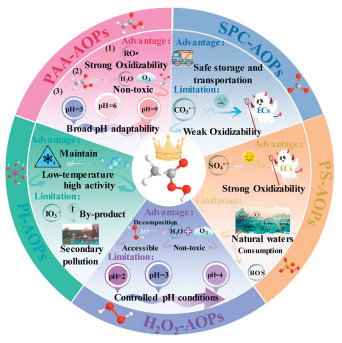
Figure 1.
Comparative analysis of diverse AOPs.

Peracetic acid-mediated dual-path oxidation of hazardous emerging contaminants: Mechanisms, toxicity analysis, and practical implications
Wen Lu , Mingzhu Zhou , Rui Liu , Jiaheng Teng , Cheng Chen , Leihong Zhao , Liguo Shen , Bisheng Li , Hongjun Lin , Shaobin Wang


Rapid population expansion together with continued industrialization has placed mounting stress on both water availability and environmental integrity [1,2]. Within the wide spectrum of aquatic pollutants, a growing body of research now highlights emerging contaminants (ECs) as an issue of particular concern. These compounds, often newly detected in environmental matrices or only recently recognized for their potential risks, remain insufficiently regulated and poorly characterized in existing risk assessment frameworks [3,4]. Because of their complex molecular structures, diverse sources, strong environmental persistence, and tendency to bioaccumulate, these contaminants are often difficult to eliminate through conventional treatment or natural attenuation [5]. This challenge highlights the pressing need for advanced and innovative approaches that can efficiently transform or mineralize such resilient pollutants.
Various technologies, such as ion exchange [6], adsorption [7], and biodegradation [8], have been successfully employed to remove ECs. Nevertheless, these treatment methods are not without drawbacks. In practice, they may lead to secondary contamination, exhibit limited pollutant removal, or generate unwanted reaction products, and the overall process can often be time-consuming [1,9]. In recent years, heterogeneous Fenton-like advanced oxidation processes (AOPs) have been increasingly studied as promising treatment options because they combine strong oxidative capability with relatively low operational cost [10]. The fundamental principle of AOPs involves activating oxidants to generate highly reactive species (RS), such as hydroxy (•OH), sulfate (SO4•−), superoxide (•O2−), alkoxy radicals (RO•), and singlet oxygen (1O2), which are capable of effectively degrading ECs [11]. Peracetic acid (PAA) is increasingly recognized as a viable alternative to hydrogen peroxide (H2O2) because it exhibits stronger resistance to substrate interference, lower toxicity, and overall better oxidation efficiency [12]. Notably, the O—O bond in PAA is much weaker, with a bond energy of about 159 kJ/mol, compared with 213 kJ/mol in H2O2 and 317 kJ/mol in persulfate. This relatively low bond strength makes PAA more prone to activation under mild reaction conditions [13]. In addition, activating PAA can give rise to several reactive oxygen-centered radicals, including CH3CO•, CH3C(O)O•, and CH3C(O)OO•. These species are relatively stable and show higher selectivity during oxidation, which contributes positively to the breakdown of emerging contaminants [14]. In addition, the lowest unoccupied molecular orbital (LUMO) of PAA lies at a comparatively low energy level, which makes the molecule more capable of accepting electrons during activation [15]. Owing to these advantages, PAA-AOPs have attracted growing interest for wastewater purification. As an example, Wang and colleagues reported that a heterogeneous catalyst combined with PAA was able to remove tetracycline almost completely within 10 min, and their results further indicated that both RO• and non-RO• species contributed predominantly to the degradation process [16].
Although PAA-AOPs have been widely investigated for the removal of organic contaminants, many fundamental questions remain unresolved. Various activation routes have been explored, yet the detailed mechanisms that govern PAA activation are still not clearly understood or systematically summarized [17]. Moreover, while RO• are generally regarded as the dominant oxidizing species responsible for the degradation of emerging contaminants, their detailed formation pathways, reliable detection approaches, and possible toxicological effects have not yet been thoroughly investigated [18]. In addition, environmental conditions, such as pH, temperature, and the presence of coexisting ions or organic matter, strongly affect how RS are produced and behave in PAA-AOPs, while the detailed mechanisms that govern these influences are still not completely understood [19]. Therefore, gaining a more complete picture of how these factors influence the removal of emerging contaminants in PAA-AOPs is crucial for improving our understanding of their real-world performance and practical application. Despite the growing interest in PAA-AOPs, comprehensive reviews specifically addressing their use for removing ECs are still relatively scarce.
This review aims to bring together the present knowledge on PAA-AOPs, with an emphasis on their role in removing emerging contaminants from aquatic systems. Rather than simply restating what has been published, it discusses major activation routes and the mechanistic insights behind them, while also examining how operating and environmental variables shape overall degradation performance. Attention is further given to pollutant transformation behavior during treatment, highlighting representative reaction pathways and the key intermediates involved. Toward the end, the paper turns to the practical side of the field, considering the technical obstacles that still limit broader implementation and suggesting several directions for research that could improve their effectiveness in real applications.
PAA (CH3C(O)OOH) is an organic peracid consisting of carbon, hydrogen, and oxygen atoms, featuring a peroxide linkage (O—O bond) similar to that found in H2O2 [20]. In general, PAA is prepared via two main routes [21]: (1) Reaction of acetic acid with H2O2 in the presence of a sulfuric acid catalyst (1 wt%) (Eq. S1 in Supporting information); (2) oxidation of acetaldehyde in either the liquid or gas phase (Eq. S2 in Supporting information). In laboratory practice, PAA is most often produced by reacting either acetic acid or acetic anhydride with hydrogen peroxide. However, when acetic anhydride is used as the precursor, improper control of the reaction can lead to the formation of diacetyl peroxide, a highly unstable and explosive compound, so acetic acid is generally preferred [21]. Because the reaction between acetic acid and H2O2 is reversible, a strong acid catalyst, typically sulfuric acid, is added to drive the equilibrium toward PAA formation and to accelerate the overall reaction process.
PAA typically appears as a clear, colorless to faint yellow liquid with a sharp, vinegar-like odor. It behaves as a moderately strong acid (pKa ≈ 8.2) and partially dissociates in water, giving rise to peracetate ions (CH3C(O)OO−), which play an important role in subsequent activation reactions [22]. The stability of PAA depends strongly on both pH and temperature. In mildly acidic to near-neutral solutions (approximately pH 5.5–8.2), PAA gradually decomposes on its own, with only a minor fraction undergoing hydrolysis [23]. When the pH rises above this range, the decomposition rate increases noticeably, and hydrolysis becomes the dominant pathway, producing acetic acid and H2O2 as the main products [24]. Although PAA is fairly stable under normal room conditions, it becomes thermodynamically unstable when heated and readily decomposes. For this reason, the temperature during thermal activation must be carefully controlled, and PAA solutions are generally kept below about 30 ℃ to maintain stability. Structurally, the peracetate ion carries an extra oxygen atom and features a relatively weak O—O bond, which makes it inherently more reactive. The O—O bond energy of PAA (159 kJ/mol) is much lower than that of hydrogen peroxide (213 kJ/mol), explaining why PAA can be activated more easily. In addition, the O—O group in PAA is linked to an acetyl moiety (-CH3CO), further weakening the molecular framework compared with H2O2 [25].
When the O—O bond in PAA breaks homolytically, it produces CH3C(O)O• and •OH, which can further interact to yield a series of secondary species (Eq. S3 in Supporting information). These newly formed radicals may then continue to react with additional PAA molecules, promoting a chain process that increases the overall oxidative activity of the system. For example, Rokhina et al. proposed that PAA reacts with peroxyhydroxyl radicals (HO2•) to yield CH3C(O)OO• (Eq. S4 in Supporting information) and that bimolecular CH3C(O)OO• species undergo termination via recombination and disproportionation when β-H atoms are available together with α-H atoms (Eq. S5 in Supporting information) [26]. Moreover, kinetic studies on CH3C(O)O• have reported a branching ratio of approximately 1:9 between CH3C(O)O• and its decarboxylation products [27]. Zhang and Huang estimated the decarboxylation rate constant of CH3C(O)O• to be ≤ 2.0 × 10⁵ s-1, in reasonable agreement with quantum-mechanical predictions (1.0 × 10⁶ s-1) [28]. The decarboxylation of CH3C(O)O• yields •CH3, which rapidly combines with dissolved oxygen to form methoxy peroxy radicals (•OOCH3) (Eq. S6 in Supporting information). These peroxy radicals subsequently undergo bimolecular decay (Eqs. S7–S9 in Supporting information), and the resulting methoxy radicals (•OCH3) may further rearrange in aqueous solution (Eq. S10 in Supporting information). Finally, the bimolecular decay of CH3C(O)OO• to CH3C(O)O• may also proceed through radical-radical coupling pathways (Eq. S11 in Supporting information) [29].
AOPs based on peroxydisulfate (PS), H2O2, percarbonate (SPC), and periodate (PI) have been widely explored for water purification. Nevertheless, PAA-AOPs offer several distinct advantages, including a lower O—O bond energy that facilitates activation, improved pH tolerance, and the generation of long-lived organic radicals (e.g., CH3C(O)OO•) with high selectivity toward electron-rich pollutants (Fig. 1).
PAA-AOPs have attracted substantial interest owing to their strong oxidative capacity, environmental compatibility, and flexible reaction pathways, which are achieved by finely tuning the mechanisms of RS generation. Through different activation strategies, the O-O bond in PAA can be selectively cleaved, thereby establishing oxidation systems driven by radicals such as •OH and CH3C(O)O• (Fig. S1 in Supporting information). Specifically, (1) energy-driven systems (e.g., photonic, cavitation, and thermal activation) directly cleave the O-O bond through photon energy, cavitation effects, or heat input, providing rapid reaction kinetics and chemical-free operation but suffering from reliance on external energy and increased operating costs. (2) Metal-driven systems, involving homogeneous or heterogeneous catalysis, rely on the redox cycling of transition metals to generate radicals; although they exhibit high catalytic efficiency, they are vulnerable to metal leaching and the risk of secondary pollution [30]. (3) Carbon-driven systems with nonradical-dominated pathways utilize π-π electron transfer interactions and functional-group-mediated electron transfer, offering environmentally benign characteristics but being limited by structure-dependent reactivity and long-term stability [31]. (4) Emerging systems based on single-atom catalysts and nanoconfined catalysts enable precise, atomic-level control of active sites and synergistic interactions, delivering promising catalytic performance yet still encountering challenges in practical implementation and material stability [32]. In this section, we systematically examine the mechanisms of RS generation and ECs degradation, together with optimization strategies in PAA-AOPs, with the aim of providing a solid theoretical basis for subsequent material innovation, process optimization, and engineering applications.
In PAA-based AOPs, external energy inputs are leveraged as efficient activation levers that complement and, in many cases, surpass purely catalyst-mediated routes. Ultrasound, heat, and light provide orthogonal control over oxidant speciation and flux, enabling on-demand generation of both radical (e.g., CH3C(O)O•, CH3C(O)OO•, •OH) and non-radical (1O2, direct electron transfer) pathways. By decoupling activation from dissolved metals, these energy-assisted modes reduce risks of metal leaching, secondary sludge formation, and narrow pH windows, and thereby maintaining activity in complex matrices.
Ultrasound (US) is an environmentally friendly and safe technology and has been increasingly used in the environmental field in recent years. The ultrasonics primarily operate through cavitation, which initially creates cavities in water. These cavities grow gradually and eventually collapse violently [33]. The temperature inside and near the cavities becomes relatively high, and the collapse process is often accompanied by a significant energy exchange [34]. In recent years, extensive research has been conducted on the degradation of ECs using US/PS, US/H2O2, and US/O3 systems. While there are reports on the degradation of ECs using US/PAA, such studies remain relatively few.
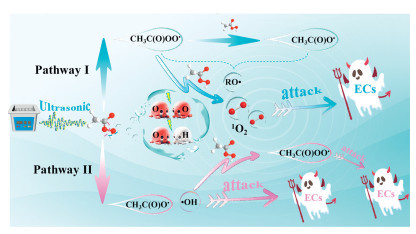
Ultrasound markedly promotes oxidant activation and RS production, thereby enhancing the degradation efficiency toward ECs [35]. In US/PAA system, ultrasonic irradiation cleaves both the O-O and O-H bonds in PAA, generating radical (such as •OH, CH3C(O)O•) and non-radicals (such as 1O2) (Eqs. S17–S19 in Supporting information). In addition, reaction of •OH with PAA proceeds via hydrogen abstraction to yield CH3C(O)OO• [36]. This pathway has been associated with acoustic cavitation, which facilitates O-O bond scission and, at the same time, favors subsequent hydrogen-abstraction steps (Fig. 2). Recently, Yao et al. showed that US/PAA systems generated substantial RS and achieved 99.4% tetracycline degradation within 30 min [37]. They attribute RS formation to acoustic cavitation, whereby rapid cycles of bubble nucleation, growth, and collapse release intense local energy and promote cleavage of the O-O and O-H bonds in PAA. Increasing ultrasound power significantly enhances cavitation bubble formation, thereby facilitating PAA activation and promoting the generation of RS for improved degradation of ECs in water [38]. A more detailed analysis further reveals that pH also exerts a substantial influence on the process. The pH level affects both the decomposition and hydrolysis of PAA and pH variations can alter the molecular and ionic states of certain pollutants. These changes can, in turn, modify the interactions between pollutants and RS, thereby influencing the overall degradation efficiency.
Thermally activated AOPs are a class of relatively green environmental treatment methods, as pollutants treated with the thermally activated AOPs generally do not cause secondary pollution. However, due to the significant energy demands associated with thermal activation, there has been limited research on thermally activated PAA processes to date [20]. The mechanism of thermally activated PAA is similar to the US activation. The O-O bond in PAA has relatively weak bond energy, which allows heat to accelerate its cleavage, producing •OH and CH3C(O)O•. Typically, there are two pathways for the thermally activated process of PAA: Radical and non-radical pathways (Fig. 3). The radical pathway involves the thermal activation of PAA to generate •OH and CH3C(O)O• (Eq. S21 in Supporting information). The non-radical pathway involves the production of 1O2 from PAA under thermal conditions (Eq. S22 in Supporting information) [39].
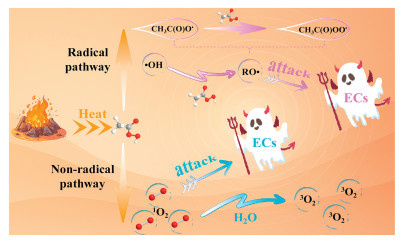
Wang et al. reported that thermally activated PAA was effective in degrading sulfamethoxazole (SMX) [40]. Under a heating condition of 60 ℃, thermally activated PAA achieves the highest degradation efficiency of SMX (86%) compared to thermally activated PS and H2O2. The active species of •OH and CH3C(O)O• are identified, and CH3C(O)O• is found to undergo H-transfer reactions with PAA, leading to the formation of CH3C(O)OO•. Tert-butyl alcohol (TBA) is used as a scavenger, and the pronounced inhibition observed in its presence indicates that RO• is the principal reactive species responsible for SMX degradation. From the kinetic data, the second-order rate constant for the reaction between 1O2 and SMX is about 1.4 × 10⁶ L mol-1 s-1, which is much lower than that for RO• reacting with SMX (9.0 × 10⁹ L mol-1 s-1).
Under thermal activation, the supplied heat increases molecular mobility and effectively lowers the energy barriers of key steps, so PAA decomposes more rapidly and reactive species are generated at an accelerated rate, with concurrent changes in reaction pathways and product selectivity. Higher temperatures also reshape the distribution of transient intermediates and shift the balance between radical oxidants (•OH, CH3C(O)O•, •O2−) and non-radical oxidants (1O2, high-valent metal-oxo complexes). These temperature effects mainly arise because heating affects both the mode of O—O bond cleavage in PAA and the electron-transfer kinetics between PAA and catalytic sites or metal ions. Consequently, temperature-dependent shifts in the composition and relative abundance of reactive species modulate pollutant degradation pathways and oxidation selectivity.
In a photo-activation PAA process, UV activation has been extensively studied, primarily due to the light absorption of PAA predominantly within the UV range [41]. Under UV irradiation, the O-O bond in PAA undergoes homolytic cleavage to produce CH3C(O)O• and •OH (Eq. S3), which constitutes the initial and rate-determining step in PAA activation. The resulting CH3C(O)O• then rapidly decarboxylates to yield a methyl radical (•CH3) and CO2 (Eq. S12) [42], and the resulting •CH3 subsequently reacts with dissolved oxygen to form the relatively weak peroxy radical (CH3OO•) (Eq. S6). Meanwhile, •OH and CH3C(O)O• further attack PAA, producing CH3C(O)OO• and additional RS (Eqs. S13–S16 and Fig. S2 in Supporting information) [28]. In UV/PAA systems, the irradiation wavelength critically governs RS yields, and 254 nm is most commonly employed because it coincides with the principal emission line of low-pressure mercury lamps. These lamps are widely adopted because they are cost-effective, provide long service lifetimes, and require minimal maintenance. Beyond that, 254 nm UV irradiation can rupture chemical bonds and initiate oxidation steps, which accounts for its widespread application in PAA activation.
In 2017, evaluated a UV/PAA system for the degradation of pharmaceuticals and reported that •OH was the principal reactive species responsible for ibuprofen (IBP) removal under UV/PAA conditions. In contrast, for naproxen (NAP) and 2-naphthoxyacetic acid (2-NAP), CH3C(O)O• and CH3C(O)OO•, together with •OH, make substantial contributions to their degradation. This distinction is ascribed to the preferential attack of RO• on the naphthalene ring in NAP, a structural selectivity that is not evident for IBP [43]. From a kinetic perspective, the relatively low activation-energy barrier for hydrogen abstraction from PAA means that, once the primary CH3C(O)O• and •OH radicals are generated, CH3C(O)OO• can be produced comparatively easily.
Although photoactivation of PAA shows considerable promise for pollutant treatment, its practical application is constrained by dependence on light sources, relatively slow reaction rates, by-product formation, and limited light penetration. To enhance its efficiency and broaden its applicability, reaction conditions often need to be carefully adjusted or combined with other treatment technologies to optimize the photoactivation process. Coupling PAA with photocatalysts to construct new activation processes has recently emerged as a promising strategy. In these systems, the photocatalyst absorbs photons and becomes excited to generate electron-hole pairs; the photogenerated electrons are then transferred to the O-O bond in PAA, promoting its cleavage and yielding a range of reactive radicals that efficiently degrade pollutants [44].
At present, a range of innovative photocatalysts, including nanostructured metal oxides and single-atom catalysts, is being developed to improve the activation efficiency of PAA. Based on detailed theoretical calculations, Chen et al. introduced nitrogen vacancies (Nv) into Fe single-atom catalysts (Fe-SACs), thereby increasing the electron density around Fe centers and constructing dual-site Fe-SACs (Fig. S3a in Supporting information). Under visible-light irradiation, this catalyst activates PAA to achieve complete degradation of bisphenol A (BPA) within 7 min and sustains high removal efficiency over 20 successive cycles. Based on a combination of experimental observations and theoretical calculations, the authors propose a synergistic enhancement pathway (Fig. S3b in Supporting information). Under visible-light irradiation, electrons are excited from the valence band (VB) of the catalyst to the conduction band (CB), leaving holes in the VB and enriching electrons in the CB. The nitrogen vacancies (Nv) behave as electron-trapping centers that capture these photoexcited electrons and transfer them to adjacent Fe single-atom sites, thereby strengthening their reducing capacity and promoting PAA activation [14]. In addition, the introduction of Nv decreases the adsorption energy of O2 and elongates the O-O bond, which in turn facilitates the generation of •O2− and 1O2. This synergistic effect promotes the in-situ adsorption and activation of BPA. Likewise, Zhang et al. reported that •O2− and 1O2 were the principal species responsible for SMX degradation in the C2N3/PAA/SMX system. C2N3 behaves as an electron donor, transferring electrons to O2 to generate •O2− (Fig. S3c in Supporting information). At the same time, PAA functions as an additional electron acceptor, capturing electrons to produce 1O2 [45]. A similar degradation pathway was reported by Yu et al., who employed a catalyst composed of nitrogen-doped carbon hollow nanotubes decorated with dispersed Cu(I) sites (Cu(I)-TCN) for sulfisoxazole (SIZ) removal [46]. Under visible-light irradiation, Cu(I)-TCN generates electrons in the CB and holes in the VB; the electron-deficient Cu(II) centers then capture photogenerated electrons from the CB to form •O2−, which is subsequently oxidized to 1O2, thereby promoting SIZ degradation (Eqs. S23 and S24 in Supporting information). In addition, the Cu(I)-TCN complex directly oxidizes SIZ by abstracting electrons from the pollutant (Fig. S3d in Supporting information).
In PAA activation, different classes of metal-based catalysts each exhibit distinct advantages and limitations, yet can complement one another in practical applications. Dissolved transition-metal ions such as Fe, Co, Cu, and Mn readily drive the formation of reactive oxygen species through reversible redox cycling, so PAA activation and pollutant oxidation usually proceed with fast kinetics. However, these homogeneous systems suffer from challenges in recovering the dissolved metals and show marked sensitivity to solution pH. By contrast, metal oxides offer robust structural stability and good recyclability, and they generally maintain acceptable catalytic activity over a broad pH range, although interfacial electron transfer can be somewhat limited. Metal sulfides typically exhibit more favorable electron-transfer characteristics, and the intrinsic reducibility of sulfur can partially convert high-valent metal species back to lower oxidation states, thereby sustaining efficient PAA activation. Nanoscale zero-valent metals, with their highly reactive surfaces, can generate multiple types of reactive species and achieve high removal efficiencies for recalcitrant contaminants; nonetheless, particle aggregation and surface passivation often weaken their long-term catalytic durability. Taken together, combining catalysts with complementary features or constructing multifunctional composite materials appears to be an effective strategy to simultaneously enhance catalytic efficiency, pathway selectivity, and matrix tolerance in PAA-based AOPs, thereby broadening their applicability to the removal of ECs in complex water matrices.
PAA activation by a metal ion is the most prevalent technique. This approach enables rapid PAA activation under ambient temperature and pressure without an external energy input, and has been extensively studied and widely applied. The primary metal ions to activate PAA include Fe(II), Co(II), Cu(II), and Mn(II). The activation process predominantly involves two reaction mechanisms: (1) PAA accepts electrons from low-valence metal ions, leading to the formation of reactive radicals; (2) Under the action of oxidants, metal ions lose multiple electrons to form high-valent metal-oxo species.
Co is considered an efficient metal for PAA activation to treat ECs [47]. Recently, Liu et al. employed the Co(II)/PAA system to degrade emerging contaminants in water and, for the first time, unveiled the previously overlooked role of Co(IV) species in this process (Fig. S4a in Supporting information) [48]. Using PMSO as a probe together with 18O isotope labeling techniques, they comprehensively investigate the formation mechanism of RS within Co(II)/PAA system and reveal its strong pH dependence. As the solution pH increases from acidic to neutral conditions, the predominant reactive species shift from Co(IV) to RO• (Eqs. S25–S29 in Supporting information). Furthermore, based on DFT calculations, it is further demonstrated that this pH-dependent behavior is closely related to the speciation of PAA. The LUMO-HOMO gap of PAA0 (7.54 eV) is much larger than that of PAA− (4.88 eV), indicating that single-electron transfer from Co(II) to PAA- is energetically more favorable than to PAA0. Meanwhile, the shorter O-O bond length of PAA0 (1.444 Å) compared with PAA- (1.454 Å) suggestes that O—O bond in PAA0 is more stable and less prone to cleavage for radical generation.
Fe is also a favorable catalyst due to its low environmental toxicity, wide availability, and cost-effectiveness. Notably, the Fe/PAA process preserves high catalytic activity over a broad pH window, making it particularly suitable and efficient for real water treatment applications [49]. In this system, PAA oxidizes Fe(II) to Fe(III) while simultaneously generating reactive species such as CH3C(O)O• and •OH (Eqs. S30 and S31 in Supporting information). Subsequently, the generated Fe(III) can also react with PAA to produce CH3C(O)OO• and regenerate Fe(II) (Eq. S32 in Supporting information) [50]. Li and colleagues investigated how protocatechuic acid (PCA) coordinates with Fe(III) at neutral pH to markedly improve the Fe(III)/PAA system for the degradation of sulfonamide antibiotics [51]. The pseudo-first-order rate constant for SMX removal in the PCA/Fe(III)/PAA process is 63.5 times higher than that of the Fe(III)/PAA process, surpassing most previously reported Fe(III)/PAA processes [52]. PCA forms a complex with Fe(III) under neutral conditions, which then interacts with the oxygen atom in the O-O bond to create a peroxo complex with a higher oxidation potential (CH3C(O)OO-Fe(III)-PCA). This complex is the primary RS for SMX degradation (Fig. S4b in Supporting information). Additionally, CH3C(O)OO-Fe(III)-PCA regenerates Fe(III), allowing the recycled Fe(III) to continually form complexes with PCA. This process not only suppresses Fe(III) precipitation but also enhances the degradation efficiency toward SMX. To further clarify the reaction mechanism, DFT calculations are carried out. The energy gap between the lowest unoccupied molecular orbital (LUMO) of PAA and the highest occupied molecular orbital (HOMO) of PCA-Fe(III)(H2O)2 is smaller than that between the LUMO of PAA and the HOMO of Fe(III)(H2O)6. When PAA accepts electrons into its lowest LUMO, PCA-Fe(III)(H2O)2 preferentially supplies the HOMO, indicating that it donates electrons to PAA more readily than Fe(III)(H2O)6 and thereby facilitates electron transfer.
Mn, a common transition metal in nature, exhibits oxidation states ranging from +2 to +7 in aqueous solutions. Although it has been extensively studied as a homogeneous activator for various oxidants, activating PAA has received less attention [53]. He et al. developed a NaHCO3−enhanced Mn(II)/PAA system to effectively degrade ECs. Within an initial pH range of 3.0–11.0, NaHCO3− significantly enhances the oxidation capacity of the Mn(II)/PAA system, achieving complete degradation of naproxen (NPX) within 10 min [54]. In the NaHCO3−/Mn(II)/PAA system, Mn(V) is identified as the primary RS for NPX degradation. HCO3− complexed with Mn(II) to form Mn(II)-HCO3−, which has a lower redox potential and enhances the catalytic activity of Mn(II) (Eq. S33 in Supporting information). Mn(II)-HCO3− then reacts with PAA to produce Mn(III)-HCO3− and CH3C(O)O• (Eq. S34 in Supporting information), while Mn(V)-HCO3− was generated through a two-electron transferred between Mn(III)-HCO3− and PAA (Eq. S35 in Supporting information). Although organic radicals are detected in the NaHCO3−/Mn(II)/PAA system, NPX is primarily degraded via single-electron transfer with Mn(V)-HCO3−, leading to the formation of MnO2 (Fig. S4c in Supporting information).
Recently, Cu-catalyzed AOPs have received increasing attention owing to their wide pH range and relatively low toxicity. Cu(II) is commonly found in wastewater, with concentrations ranging from mg/L to g/L [55]. It is reported that there is 0.2–8.0 mg/L of Cu(II) in municipal wastewater, and the concentration of Cu(II) in municipal wastewater can reach hundreds of g/L. Cu(II)-catalyzed PAA system should be promising and economically feasible for the elimination of ECs in wastewater, especially in Cu(II)-contained wastewater. The degradation of ECs in the Cu(II)/PAA system is primarily driven by the cyclic conversion of Cu(II)/Cu(I), which induces the generation of RS from PAA (Eqs. S36-S38 in Supporting information).
Wu et al. conducted a comprehensive investigation into the effect of PAA and H2O2 on the Cu(II)/Cu(I) cycle within a pH range of 7.0 to 10.5 [56]. Previous studies have suggested a negligible role of H2O2 in the Cu(II)/PAA system, while this study indicates that deprotonated H2O2 (HO2−) plays a crucial role in accelerating the Cu(II)/Cu(I) cycle. From a kinetic standpoint, the rate constant for HO2−/Cu(II) ranges from 0.17 × 10⁶ L mol-1 s-1 to 1.0 × 10⁶ L mol-1 s-1, which substantially exceeds that for PAA/Cu(II) (2.33 ± 0.3 L mol-1 s-1). Further studies using NPX as the target pollutant in the Cu(II)/PAA system shows that CH3C(O)OO• is the main RS for NPX degradation, while Cu(III) plays an indirect role (Fig. S4d in Supporting information). Additionally, the synergistic effect of H2O2 and PAA in the Cu(II)/PAA system is highly dependent on solution's pH, with alkaline conditions more favorable for NPX degradation. Due to the slow reduction of Cu(II) to Cu(I), Wu et al. proposed the use of hydroxylamine (HA) to promote the Cu(II)/Cu(I) cycle, thereby enhancing the oxidation efficiency of the Cu(II)/PAA system [57]. Electron paramagnetic resonance (EPR) and quenching experiment reveal that CH3C(O)OO• is the primary RS responsible for diclofenac degradation (Fig. S4e in Supporting information). Unlike Cu(II)/PAA system, CH3C(O)OO• is generated in a HA/Cu(II)/PAA through the reaction between PAA and Cu(III) rather than from CH3C(O)O• and •OH (Eq. S39 in Supporting information).
Transition metal ions significantly enhance the degradation efficiency of pollutants in Fenton-like AOPs. Table S2 (Supporting information) summarizes the current development of transition-metal-ion-activated PAA for ECs degradation in water, highlighting its potential in practical applications. However, certain inherent drawbacks still limit its broader implementation. Challenges such as solubility issues of certain metal ions forming precipitates in aqueous solutions or losing activity at high pH, along with residual metal contamination due to the persistence of unreacted metals, especially iron ions, pose significant concerns [58]. Additionally, because the composition and amount of RS generated vary with the operating conditions, the degradation efficiency is not always reproducible. In future studies, it would be useful to explore metal/nonmetal co-catalyst systems that maintain high activity with a reduced metal dosage, and to design supported catalysts that suppress metal leaching and the risk of secondary contamination.
Homogeneous metal ions such as Fe(II) and Cu(I) react readily with PAA and efficiently generate RS. Yet residual dissolved metals in the treated water can give rise to secondary pollution and associated environmental and health concerns. Their use also often leads to the formation of metal-rich sludge, complicating subsequent handling and disposal. These drawbacks have prompted growing interest in heterogeneous catalysts for PAA activation, which can alleviate many of the problems inherent to transition-metal ion systems. Heterogeneous metal catalysts that have been widely employed for PAA activation include metal oxides, metal sulfides, and nanoscale zero-valent metals [59].
Cobalt ferrite (CoFe2O4), a spinel-type ferrite, shows high chemical stability and is therefore considered a promising catalyst in PAA-AOPs [60]. Furthermore, its strong magnetic response allows convenient solid-liquid separation under an external magnetic field. This property helps to overcome practical difficulties in catalyst recovery and, in turn, reduces the risk of secondary pollution. Wang et al. introduced sulfur into CoFe2O4 (SCFO) and applied the resulting SCFO/PAA system to degrade SMX in water (Fig. S5a in Supporting information) [61]. On the basis of quenching tests and EPR measurements, CH3C(O)O• and CH3C(O)OO• are implicated as the main RS responsible for SMX degradation. Further analysis of the SCFO-0.3/PAA system indicates that Co(II) and Fe(II) sites in SCFO-0.3 behave as Lewis acids, binding H2O to generate surface Co(II)-OH− and Fe(II)-OH− species. The resulting Co(II)-OH− activates PAA, transforming into Co(III)-OH− with the generation of CH3C(O)O• and •OH in the process (Eqs. S25 and S26). The generated Co(III)-OH− reacts with PAA to convert back to Co(II)-OH−, forming a Co(II)/Co(III) cycle, while also producing CH3C(O)OO• (Eq. S27). However, this process is relatively slow in CoFe2O4/PAA and requires additional substances to accelerate it. In the SCFO-0.3/PAA system, S2− and SO32− reduce Co(III) to regenerate Co(II), promoting PAA activation (Eqs. S40 and S41 in Supporting information). Similarly, Zhang et al. reported a Co-Mn spinel oxide (Co3-xMnxO4) system for PAA activation, and CH3C(O)OO• played a key role in SMX degradation (Fig. S5b in Supporting information). Mechanistic analysis shows that Mn doping not only facilitates electron transfer and accelerates the reduction of Co(III) to Co(II), but also reduces the activation energy of PAA, making it more readily activated. Furthermore, DFT calculations indicate that the activation barrier at the Co site is 0.68 eV in the presence of Mn and 1.82 eV in its absence. From a thermodynamic standpoint, the Mn-coordinated Co site is more favorable for PAA activation than the Mn-free Co site [62].
Beyond Co-based catalysts, other metal-based heterogeneous systems have also been shown to markedly promote PAA activation. For instance, ball-milled Mn2O3 displayed a substantially improved capacity to activate PAA, achieving 93.9% removal of BPA [63]. Mechanistic investigations indicated that BPA degradation is predominantly controlled by a Mn2O3-PAA intermediate complex, Mn(III)-OO(O)CCH3 (Fig. S5c in Supporting information). In this pathway, Mn2O3 coordinates with the oxygen atom in the O—O bond of PAA to form the Mn(III)-OO(O)CCH3 complex, which serves as the main reactive species responsible for BPA transformation. A portion of this Mn(III)-OO(O)CCH3 intermediate subsequently decomposes, producing secondary reactive species (Eq. S42 in Supporting information). DFT analysis shows that the HOMO of BPA (−4.75 eV) and the LUMO of Mn2O3 (−1.95 eV) are favorably aligned, allowing electrons in the HOMO of BPA to transfer to the LUMO of Mn2O3 and thereby promote BPA oxidation. Moreover, the Mn2O3-mediated electron transfer from BPA to PAA is driven by the band-gap characteristics of Mn2O3. Consequently, ball-milled Mn2O3 facilitates and accelerates electron transfer from BPA to PAA, leading to BPA oxidation and PAA decomposition. In contrast, a hollow spherical Co-modified LaFeO3 (LFC730) primarily relies on CH3C(O)O• and CH3C(O)OO• as the RS for SMX degradation [64]. Co doping serves as the main active site, while Fe atoms act as auxiliary sites. The Co(III)/Co(II) cycle facilitates the generation of CH3C(O)O• and CH3C(O)OO• from PAA (Fig. S5d in Supporting information).
Chalcopyrite (CuFeS2) is a common sulfide mineral and one of the most abundant ores in nature. Its unique chemical properties and reactive surface make it valuable not only for metal extraction but also for AOPs. CuFeS2 can act as a catalyst to promote PAA-based oxidation reactions and degrade ECs in the environment [65]. An et al. developed a visible-light-assisted CuFeS2-activated PAA system (CuFeS2/PAA/Vis-LED) [66]. They demonstrate that the CuFeS2/PAA/Vis-LED system achieves 95% degradation efficiency of SMX within 30 min, significantly higher than other processes. Photogenerated electrons on visible-light-activated CuFeS2 enhance the surface Fe(III)/Fe(II) and Cu(II)/Cu(I) cycles, thereby activating PAA to produce •OH and CH3C(O)OO• (Fig. S6a in Supporting information). Meanwhile, S22− can reduce Fe(III) and Cu(II), promoting the Fe(III)/Fe(II) and Cu(II)/Cu(I) cycles (Eqs. S43 and S44 in Supporting information).
Pyrite (FeS2) is one of the most abundant transition metal sulfides in the earth's crust, demonstrating excellent performance in AOPs. Its superior activation properties are attributed to its strong electron-donating capability, which reduces sulfur species and facilitates the reduction of Fe(III), thereby promoting the Fe(II)/Fe(III) cycle [67]. In a pyrite/PAA/tetracycline (TC) system, TC degradation is primarily driven by CH3C(O)OO•, which is generated during the reduction of Fe(III) to Fe(II) by sulfur species (Fig. S6b in Supporting information). In this system, surface Fe(II) acts as the main active site, not S(I), as the Fe-O bond length in PAA (2.150 Å) is shorter than the S-O bond length (3.369 Å), facilitating electron transfer between PAA and pyrite [68]. Additionally, DFT calculations indicate that the HOMO energies of Fe2+ and Fe2+-TC are −7.21 and −5.26 eV, respectively, suggesting that the Fe2+-TC complex engages in electron transfer more readily than bare Fe2+ and thus activates PAA more efficiently. Meanwhile, the HOMO-LUMO gaps of TC before and after complexation are 4.44 and 3.37 eV, respectively, and the smaller gap implies that Fe2+-TC is more prone to degradation.
Zero-valent metals (ZVMs) have garnered significant attention in the field of environmental catalysis due to their unique physicochemical properties [69]. ZVMs refer to metals in the zero-oxidation state, such as nano zero-valent iron (nZVI) and zero-valent nickel (nZVN). With highly active surface sites, ZVMs exhibit excellent catalytic performance in water treatment. In PAA-based systems, zero-valent metals (ZVMs) utilize their strong reductive character and electron-donating ability to cleave PAA and generate highly oxidative radicals, such as •OH and CH3C(O)O•, thereby promoting pollutant degradation [70]. They generally exhibit appreciable selectivity and can sustain high activity in complex water matrices. Experimental evidence further indicates that tailoring the morphology and particle size of ZVMs accelerates PAA consumption and enhances catalytic performance, thus broadening their potential in advanced water treatment.
Zhang et al. developed a novel AOP by coupling PAA with nZVI and showed that the nZVI/PAA system effectively degraded TC over a pH range of 3.5–7.5 [71]. Mechanistic investigations indicated that TC first adsorbs onto the nZVI surface to form an nZVI-TC complex, which lowers the contact angle between the aqueous phase and nZVI and thereby facilitates Fe(II) release. In the aqueous phase, TC coordinates with Fe(II) to form a Fe(II)-TC complex, which activates PAA more efficiently than free Fe(II) and thereby promotes the formation of CH3C(O)OO• (Fig. S6c in Supporting information). Xu et al. also reported a sulfidated nano zero-valent iron-copper (S-nZVIC)/PAA system for SMX degradation [72]. Mechanistic investigations yields three main insights: (1) Cu0 doping drives the Fe(II)/Fe(III) redox cycle via the Cu(I)/Cu(II) couple, thereby promoting Fe(II) regeneration and strengthening PAA activation; (2) sulfur-containing species scavenge part of the RO• pool, diminishing the contribution of RO• to SMX degradation, and (3) sulfidation enhances the electrical conductivity of nZVIC, facilitates electron transfer from S-nZVIC to PAA, and shifts the dominant RS from RO• to •OH (Fig. S6d in Supporting information). In addition, the prevailing RS in the RO• pathway is distinguished on the basis of kinetic analysis. The •CH3 radical is formed via self-decomposition of CH3C(O)O•, but its second-order rate constant with the pollutants is only 2.3 × 10⁵ L mol-1 s-1, whereas CH3(O)O• reacts with the pollutants with a rate constant of 1.0 × 10⁵ L mol-1 s-1, which lower than that of CH3C(O)OO• (1.0 × 10⁷ L mol-1 s-1). Therefore, CH3C(O)OO• plays the predominant role in pollutant degradation.
Although nZVI-activated PAA systems in water treatment exhibit high catalytic efficiency, they also present several limitations. nZVI particles readily agglomerate in aqueous media, which reduces the accessible reactive surface area and thereby diminishes catalytic activity. In addition, nZVI is easily oxidized during operation, leading to activity loss and compromising the stability of the process. To alleviate these problems, subsequent work may (1) construct well-dispersed nanocomposites by anchoring nZVI on suitable supports (e.g., carbonaceous or oxide materials) to improve stability and suppress aggregation, and (2) investigate doping and surface-modification strategies that enhance the catalytic performance and durability of nZVI under different pH and environmental conditions.
Table S3 (Supporting information) summarizes and contrasts the activation pathways and associated reactive species in different metal-mediated PAA systems. In these systems, metal ions, metal oxides, metal sulfides, and nanoscale zero-valent metals trigger PAA activation through distinct mechanisms, although some of the resulting routes and intermediates partially overlap. Metal ions mainly drive homogeneous electron-transfer reactions that generate •OH, CH3C(O)O•, CH3C(O)OO•, and 1O2, but their use is often limited by concerns over secondary contamination. Metal oxides, by comparison, activate PAA through redox cycling at the solid-liquid interface, which generally improves catalyst stability and reusability, with performance closely linked to the physicochemical properties of the oxide surface. Metal sulfides, owing to their electron-rich sulfur sites and lattice defects, can activate PAA via both radical and nonradical pathways. However, their catalytic stability is often limited because surface sulfur species are gradually depleted and metal ions tend to leach during operation. Zero-valent metals enable rapid electron transfer at the catalyst-oxidant interface and efficiently generate reactive oxygen species, but their long-term performance is usually impaired by particle agglomeration and surface passivation.
Beyond metal-based systems, non-metal catalysts also warrant attention. Among these, carbon catalysts are notable for their high surface area, excellent thermal stability, efficient electron-transport properties, and their ability to avoid secondary pollution arising from metal leaching. Unlike metal catalysts, which activate PAA mainly via surface redox reactions that cleave the peroxide bond, carbon-based catalysts operate predominantly through an electron-transfer pathway [73]. Defects and electron-rich surface functional groups (e.g., C-O, -OH, -OOH) on carbon materials act as key active sites for PAA activation.
Biochar (BC), an effective adsorbent, also offers notable benefits for PAA activation. Its high surface area and well-developed pore network provide abundant reactive sites, thereby improving PAA activation efficiency [74]. Secondly, various functional groups on the biochar surface can chemically interact with PAA, thereby facilitating the formation of RS and accelerating pollutant degradation. In addition, biochar is widely available, inexpensive to produce, and generally considered environmentally friendly, which highlights its potential as a sustainable material. Taken together, these attributes make biochar a promising candidate for PAA activation and a practical option for environmental pollution control.
Zhou et al. synthesized a sludge-derived biochar (SDBC) and used it to activate PAA for the degradation of fluoroquinolone antibiotics (FQs) [75]. In the SDBC/PAA system, both RO• and 1O2 pathways contributed to FQ removal, with the nonradical route being predominant (Fig. S7a in Supporting information). This is likely due to the rich π electron content and carbon-containing functional groups on the SDBC surface, which facilitate electron transfer to PAA for 1O2 generation. Similarly, Ning et al. doped biochar with Fe-N to create porous carbon materials (FeN-BC) with highly catalytic activity [76]. Mechanistic analysis reveals that 1O2 is produced from the decomposition of RO• (Fig. S7b in Supporting information). The synergy between Fe and N doping has the following advantages: (1) It promotes the formation of extensive defects and Fe0 between FeN-BC and PAA, facilitating electron transfer and the regeneration of Fe(II) in the FeN-BC/PAA system; (2) it modifies the surface area and isoelectric point of FeN-BC, enhancing PAA adsorption on the catalyst surface. Additionally, DFT calculations further confirm that the adsorption energy of PAA on FeN-BC is −1.60 eV, which is lower than that on Fe-BC (−1.06 eV), indicating that N doping enhances the adsorption between PAA and the catalyst. Unlike the previous examples, Li et al. prepared biochar loaded with cobalt-zeolitic imidazolate framework nanoparticles and boron nitride quantum dots (BN3Z0.5BC) and investigated its activation mechanism [77]. Main degradation pathways involve a synergistic combination of radicals and non-radicals (Fig. S7c in Supporting information). The defect structure on the BC surface not only exhibits a higher charge density for the activation of PAA, but also generates π-electrons from the edge carbon atoms. These electrons can be transferred to PAA, thereby promoting the generation of RS. In addition, catalysts synthesized under N2 and air atmospheres exhibit clearly different performances. Air favors the creation of vacancies, resulting in a greater number of active sites and, consequently, a superior catalytic activity.
CNTs exhibit a set of physicochemical characteristics that make them highly attractive for PAA activation. Their large specific surface area, excellent electrical conductivity, and strong mechanical robustness offer numerous accessible sites for PAA activation and the subsequent catalytic transformations [78]. In addition, the intrinsic structural stability and corrosion resistance of CNTs enable them to retain catalytic activity over repeated cycles, thereby markedly prolonging the catalyst lifetime.
Miao et al. used CNTs as a representative catalyst to activate PAA for the degradation of phenolic compounds [79]. By combining experimental observations with DFT calculations, they identified two distinct degradation pathways (Fig. S8a in Supporting information). In the nonradical pathway, PAA adsorbs onto the sp2-hybridized CNT surface to form a stable CNT-PAA* complex, which acts as the main reactive species and drives phenolic oxidation via an electron-transfer process (ETP). In the radical pathway, edge C-OH groups on the CNT surface react with PAA, leading to the decomposition of the CNT-PAA* complex and the generation of •OH and RO• (Eqs. S45 and S46). Kong et al. examined the quantitative structure-activity relationship (QSAR) of CNTs in PAA activation and micropollutant removal by tuning the physicochemical properties of CNTs via thermal annealing [80]. The results show that with increasing pyrolysis temperature, the degree of disorder in CNT gradually decreases, which is likely attributed to partial defect repair during the annealing process. Furthermore, the CNT/PAA system primarily follows a DET oxidation pathway. QSAR analysis reveals that enhancing the oxidation potential of the CNT-PAA composites and improving the conductivity of CNT can strengthen the DET process (Fig. S8b in Supporting information). Additionally, DFT calculations verify the direct electron transfer (DET) pathway in the CNT/PAA system based on energy-level alignment. The HOMO of the micropollutant (−5.71 eV) is lower than the LUMO of CNT (−4.27 eV), rendering electron transfer from the micropollutant to CNT thermodynamically favorable. Meanwhile, the small HOMO-LUMO gap of CNT (0.072 eV) facilitates electron transport on the CNT.
Apart from the above-mentioned carbon nanomaterials, activated carbon has also been demonstrated to be a promising catalyst for PAA activation. Firstly, the oxygen-containing functional groups on the surface of activated carbon (such as carbonyl, hydroxyl, and quinone groups) can enhance the PAA activation efficiency. Secondly, the abundant microporous structures and edge defects on the activated carbon surface provide ample active sites for PAA activation. Additionally, the aromatic domains of activated carbon can form π-π associations with certain organic pollutants, thereby increasing their uptake on the carbon surface. These interactions not only strengthen pollutant retention but also bring the adsorbed species into close contact with radicals generated during activation, which in turn promotes their degradation. Notably, activated carbon functioned as a carrier, which can extend the PAA lifespan and reduce chemical consumption [81]. These characteristics make activated carbon-mediated PAA-AOPs a green, economical, and efficient water treatment technology with important implications for environmental protection and sustainable resource use.
Thermally modified activated carbon (AC600) with PAA demonstrates significantly higher efficiency in SMX degradation compared to PAA, AC600, and AC600/H2O2 [82]. Mechanistic analysis reveals that the π-π electrons on AC600 surface and oxygen-containing functional groups (COOH and C=O) interact with PAA to generate CH3C(O)O• and CH3C(O)OO• as primary RS for SMX degradation (Fig. S8c). However, non-radical degradation pathways have typically been the dominant mechanism in carbon-based materials. Recently, Wang et al. used powdered activated carbon (PAC) to activate PAA for SMX degradation [83]. They propose a pathway for 1O2 generation through persistent free radicals (PFRs) and electron-donating C-OH groups (Eqs. S47-S49 in Supporting information). Additionally, due to the stretching motion of sp2 bonds, ETP represents another non-radical pathway in carbon-based AOPs (Fig. S8d in Supporting information).
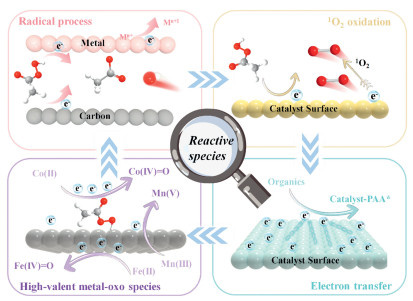
Carbon materials exhibit excellent catalytic performance in PAA activation, which was attributed to their abundant surface functional groups, high specific surface area, and favorable electronic properties. Biochar primarily relies on surface oxygen-containing groups such as phenolic hydroxyl, carboxyl, and quinone, which act as active sites to promote electron transfer and facilitate the generation of reactive oxygen species, including •OH and 1O2. The catalytic activity of biochar is further enhanced by the incorporation of heteroatoms such as nitrogen, sulfur, or phosphorus. Carbon nanotubes utilize structural defects and edge sites as main active centers, enabling PAA activation through π-π interactions and electron transfer, resulting in the formation of organic radicals and 1O2. Activated carbon, with its extensive microporous structure and numerous surface functional groups, provides abundant adsorption sites and promotes surface redox reactions, thus facilitating PAA decomposition. The typical mechanisms of carbon materials in PAA activation generally include free radical generation, 1O2 production, high-valent metal-mediated processes, and surface electron transfer pathways (Fig. 4).
EC oxidation technology is known for its operational simplicity and high efficiency in treating pollutants. In recent years, EC activation of persulfate has gained considerable attention, whereas fewer studies focus on the electrochemical activation of PAA. In such a system, pollutant degradation occurs through two pathways: Direct oxidation at anode and the combined action of electric energy and PAA at cathode [84]. Specifically, at anode, water loses electrons to produce •OH, which then reacts with PAA to generate CH3C(O)O• and CH3C(O)OO•. Simultaneously, at cathode, PAA and O2 gains electrons to form CH3C(O)O•, CH3C(O)OO•, and •O2− (Eqs. S50 and S51 in Supporting information), and •O2− further converts into 1O2. Pollutants are removed through the combined action of these RS (Fig. 5).
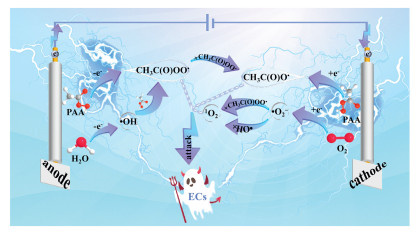
Lu et al. constructed an EC/PAA system using a boron-doped diamond anode and an iron-doped graphene cathode to remove antibiotics from wastewater [85]. This study distinguishes different mechanisms at the anode and cathode. The anode predominantly generates •OH, while the cathode primarily produces RO•, with CH3C(O)OO• serving as the dominant RS. However, the anode was less effective in degrading SMX than the cathode, due to the heterogeneous catalytic process of Fe(II) with graphene oxide at the cathode. PAA more readily gains electrons to break the O-O bond. In an EC/PAA system, current density influences the degradation efficiency of pollutants. At higher current densities, side reactions such as oxygen evolution at the anode and hydrogen evolution at the cathode can occur, which might inhibit PAA activation and consequently reduce the degradation efficiency of SMX. In a recent study, Yang et al. pioneered the application of mixed metal oxide (MMO) electrodes in a EC/PAA system to elucidate the degradation mechanism of propranolol [86]. PAA activation generates RO• by losing electrons at the MMO anode and PAA gains electrons at the MMO cathode. Meanwhile, under the electric field, self-decomposition of O2 generated from PAA is enhanced, producing 1O2 at the anode and •O2− at the cathode.
Although electrochemical activation of PAA is promising for ECs degradation, several limitations persist. During extended operation, electrode materials can gradually deactivate, leading to loss of active sites, diminished performance, and reduced overall stability. Furthermore, a continuous power demand of electrochemical systems also leads to substantial energy consumption, which limits their feasibility at large scale. Future work on electrochemical PAA activation could therefore emphasize coupling with other AOPs, such as ozonation, to exploit synergistic effects, as well as the development of more efficient and low-cost electrode materials to facilitate practical deployment.
In the previous discussion, several primary activation methods for PAA are thoroughly examined, including photo, metal, and non-metal activation. These methods have shown significant potential in emerging pollutant degradation. However, emerging activation technologies are continually developing, demonstrating unique advantages and broad application prospects. Table S4 (Supporting information) summarizes the current development of PAA Fenton-like oxidation of ECs in water. For example, nitrite activation of PAA significantly enhances the oxidative degradation efficiency of sulfonamide antibiotics and facilitates the pollutant removal. The reactive nitrogen species generated during this process, such as peroxy nitrite, are more effective than traditional organic radicals or reactive oxygen species [87]. This activation mode generally produces fewer harmful disinfection by-products during wastewater treatment, which is advantageous from both environmental and human health perspectives. Among the available activation pathways, chloride-assisted PAA activation is particularly noteworthy because it can simultaneously generate reactive chlorine species (such as Cl2 and HClO) together with carbon-centered radicals. These chlorine-derived oxidants react rapidly with a wide range of organic contaminants, and the high reactivity of Cl2, in particular, allows for efficient degradation of emerging pollutants like BPA. Furthermore, carbon-centered radicals (e.g., CH3C(O)OO•) participate in and accelerate the overall oxidation sequence. The transformation products generated under these conditions are generally devoid of chlorinated moieties, thereby lowering the risk of toxic by-product formation while maintaining high treatment efficiency and environmental safety [88]. Plasma has also been employed as a means to activate PAA. In plasma/PAA systems, the electrical discharge produces a suite of RS (•OH, CH3C(O)O•, CH3C(O)OO•, 1O2, etc.) that markedly promote pollutant degradation; compared with PAA or plasma used individually, the combined plasma-PAA process achieves higher removal efficiencies with reduced energy consumption [6,89].
Activation of PAA proceeds through intertwined radical and non-radical pathways, whose contributions are governed by the catalyst’s electronic structure and its capacity to mediate interfacial electron transfer. In the radical route, homolytic cleavage of the O-O bond generates highly reactive species such as RO• and •OH, which can further evolve into intermediates including •O2− and 1O2. In parallel, non-radical oxidation typically occurs via direct interactions among PAA, the catalyst surface, and the target contaminant, giving rise to electron-transfer reactions and high-valent metal-oxo complexes [90]. These reaction manifolds are strongly coupled and may shift from one to the other during the course of the reaction. The distribution of individual reactive species is controlled by factors such as the redox potential and surface coordination environment of the catalyst, as well as solution conditions like pH and oxidant dosage. The balance between short-lived radicals and more persistent non-radical oxidants ultimately dictates oxidation selectivity and determines the system’s tolerance to interference from coexisting matrix components. In general, metal-based systems tend to promote redox-driven radical production with fast kinetics, whereas carbon materials and defect-engineered catalysts bias the process toward controlled nonradical pathways with improved stability and selectivity [91]. Overall, the kinetics and efficiency of PAA activation are governed by the dynamic equilibrium among these reactive species. The interfacial electron-transfer rate, together with the balance between radical chain propagation and nonradical conversion, ultimately controls the oxidative capacity and long-term sustainability of PAA-based AOPs [92].
Additionally, in PAA-AOPs systems, radical and nonradical pathways differed fundamentally in their reaction nature and engineering behavior, yet still complemented each other. Radical pathways typically originate from the homolytic cleavage of the O-O bond in PAA or from metal-centered single-electron transfer, generating short-lived but highly reactive species such as •OH and CH3C(O)O•. These radicals exhibit almost nonselective addition or hydrogen-abstraction toward organic pollutants and thus afford high apparent rate constants, but they are also readily quenched by inorganic anions, natural organic matter, and background reductants, which lower oxidant utilization efficiency and increase the risk of over-mineralization and undesired by-product formation [93]. By contrast, nonradical pathways rely more on interfacial electron-transfer and the 1O2 formed from the conversion of •O2−, such as the formation of coordinated, activated PAA on catalytic surfaces, outer-sphere electron transfer driven by metal-peroxo intermediates, or the generation of mild oxidants such as 1O2 mediated by defect or heteroatom sites. These routes tend to be more selective toward electron-rich moieties or specific functional groups, tolerate coexisting ions and natural organic matter more effectively, enhance the atomic utilization of PAA, and slow catalyst deactivation [94]. By comparison, radical pathways favor strong oxidizing power and rapid reaction, often at the expense of selectivity and tolerance to background constituents. Nonradical routes, in turn, rely on milder, interface-controlled oxidation, affording more tunable selectivity, more stable long-term performance, and more economical oxidant usage, while being more sensitive to the structure of the catalytic interface, the reaction environment, and the mass-transfer/adsorption behavior of PAA.
Apart from catalysts, the influences of critical environmental parameters on PAA activation and consequent pollutant–degradation efficiency are also important. Herein, we will systematically discuss the effects of solution pH, PAA dosage, catalyst dosage, and the presence of coexisting species in aqueous matrices on governing degradation kinetics, elucidate underlying mechanistic pathways, and control the generation of reactive radical species (Fig. S9 in Supporting information).
The pH of a solution is a crucial parameter in PAA activation, significantly affecting the forms of substances in the reaction system, including the catalyst, pollutants, and even PAA itself [95]. At varying pH levels, PAA exists as either a conjugate acid (PAA0) or conjugate base (PAA−), with PAA0 dominant in acidic and neutral conditions and PAA− in alkaline conditions. Shao et al. investigated the effect of different pH levels on UV/PAA efficiency and found that the degradation efficiency of BPA is optimal at pH 9 [96]. BPA, with pKa values of 9.6 and 10.2, forms zwitterion BPA± at pH 7.2 and anion BPA− at pH 9 through sequential deprotonation reactions [97]. The anionic BPA−, carrying a negative charge, is more susceptible to electrophilic attack, accelerating the reaction rate, thus making BPA degradation most effective under alkaline conditions. Some studies have shown that, under UV irradiation, the photolysis rate of PAA− is significantly higher than that of PAA0, indicating that more radicals are produced at higher pH levels [98]. However, Zhang et al. found that carbamazepine (CBZ) removal in a nano-CuO (nCuO)/PAA system was most efficient under nearly neutral pH conditions [99]. Their DFT calculations indicate that the neutral species PAA0 dominate in acidic solution and exhibit a shorter O—O bond than PAA−, making it more difficult to activate. Under alkaline conditions, PAA− is more readily activated but also undergoes faster hydrolysis, which accelerates PAA consumption. As the solution becomes alkaline, nanosized CuO particles tend to acquire a negatively charged surface, leading to electrostatic repulsion with anionic PAA−, hindering its approach to the catalyst and slowing the heterogeneous oxidation process. In addition, insoluble Cu(OH)2 can form on the catalyst surface under these conditions, further decreasing its activity. As a result, reactions operated close to neutral pH generally display more favorable catalytic performance.
Cheng et al. investigated how solution pH modulates the reactive species in a HA-assisted Fe(II)/PAA system during naproxen (NPX) degradation [100]. At strongly acidic pH (around 3.0), NPX oxidation is dominated by high-valent iron intermediates, with Fe(IV) acting as the principal reactive oxidant. When the pH is raised to approximately 4.5, the reaction pattern changes markedly and RO• becomes the major species responsible for NPX transformation. This shift is attributed to the more efficient reduction of Fe(III) by HA under mildly acidic to near-neutral conditions. Collectively, these observations highlight that the dominant oxidant type in this system is highly sensitive to pH variation.
The pH of the reaction medium is a key factor controlling how effectively emerging contaminants are removed in PAA-based AOPs, and it exerts its influence through several interconnected mechanisms. First, pH governs the speciation and stability of PAA in solution, thereby modulating its intrinsic reactivity and, consequently, the overall rate of oxidation reactions. In parallel, pH-induced changes in the surface charge and electronic structure of catalysts can alter pollutant adsorption behavior and reshape interfacial reaction pathways. The distribution and relative importance of RS are likewise pH-dependent: Low pH typically favors the generation of high-valent metal-oxo species or 1O2, whereas higher pH tends to promote the formation of •OH and RO•, giving rise to distinct degradation routes and differences in removal performance. Looking ahead, more emphasis should be placed on elucidating, in an integrated manner, how reactive species are produced, transformed, and mutually interact under different pH conditions during PAA activation. Such understanding could enable more rational tuning of operational parameters and, in turn, improve both the efficiency and selectivity of contaminant abatement in complex water matrices. To avoid misinterpretation, pH should also be monitored continuously throughout experiments, because even small shifts can modify catalyst surface chemistry or PAA reactivity, leading to noticeable changes in reaction kinetics and transformation pathways [101].
In PAA-based AOPs, the removal efficiency of pollutants is highly sensitive to both the oxidant dose and the catalyst loading. The concentration of PAA dictates the rate and extent of RS generation, thereby steering the predominant oxidation pathways. When the oxidant level is too low, RS production is inadequate to sustain efficient degradation; in contrast, overdosing PAA can induce competing reactions that scavenge active species or cause non-productive self-decomposition, ultimately reducing treatment efficiency [102]. Likewise, selecting a suitable catalyst dosage is crucial for controlling PAA decomposition and the subsequent formation of RS. When the loading is well balanced, both the decomposition of PAA and the production of RS proceed efficiently, leading to higher contaminant removal. However, once the catalyst is added in excess, it may start to react with the active intermediates themselves, consuming valuable RS and, as a result, weakening the overall catalytic activity. Therefore, an optimal catalyst concentration range is essential for the PAA activation process and water treatment effectiveness.
In a PAA system activated by a bimetallic spinel oxide (CuCoO4) for BPA degradation, Shen et al. found that BPA degradation efficiency increased with PAA dosage (0–400 μmol/L) [103]. However, when the PAA dosage is further increased, BPA degradation efficiency shows only a slight improvement, as excess PAA causes a self-quenching effect. In a UV/hydrated ferric oxide (HFO) coupled PAA system for norfloxacin (NX) degradation, NX degradation efficiency also increases with a PAA/NX ratio, because the main active species, RO• and •OH, in the UV/HFO/NX system, are primarily derived from PAA [104]. Then, in the CuS-assisted Fe(III)-activated PAA system, increasing the CuS dosage from 0.05 g/L to 0.3 g/L improves the BPA degradation efficiency from 79 to 97%, and further increasing the amount of PAA slightly enhances the degradation of BPA [105]. This is because the increased Cu dosage provides more active sites for Fe(III) transformation and direct PAA activation. Additionally, in a Cu2O-activated PAA degradation system for TC, it is found that increasing the amounts of Cu2O and PAA improves the TC degradation efficiency. In this study, Wang et al. focused on analyzing the reasons for the decrease in TC degradation efficiency with excessive Cu2O addition. First, excessive Cu2O competes with TC for RS, reducing the RS available for TC degradation. Secondly, the •OH generated in the system is quenched by excess Cu2O, releasing excess Cu(I).
Inorganic anions such as Cl−, HCO3−/CO32−, and H2PO4− are commonly found in water and can have either positive or negative effects on PAA-AOPs [106]. In a L-cysteine/Fe(III)/PAA system, Cl− inhibits the degradation of SMX to some extent, due to Cl− reacting with •OH to form less reactive RS (Eqs. S52–S54 in Supporting information). The addition of HCO3− significantly suppresses SMX degradation as it quenches •OH (Eqs. S55 and S56 in Supporting information). Additionally, HCO3− might promote the precipitation of Fe(III) through pH buffering effects. Similarly, the addition of H2PO4− significantly inhibits SMX degradation in the L-cysteine/Fe(III)/PAA system, as H2PO4− forms complexes with Fe ions, reducing the concentration of free Fe ions and hindering the reaction between PAA and Fe ions [107]. Similarly, in B2O3-ZVI/PAA, Na2B4O7-ZVI/PAA, and H3BO3-ZVI/PAA systems, Cl− reacts with •OH to produce HOCl•− (Eq. S52). However, this reaction is reversible and does not result in significant depletion of •OH, thereby rendering the inhibitory effect of Cl− on the overall degradation efficiency relatively minor when compared to that of HCO3−, CO32−, and H2PO4−. Both HCO3− and CO32− exert a stronger inhibitory effect because they scavenge •OH to form CO3•−, which is much less reactive and thus slows the degradation process (Eqs. S56 and S57 in Supporting information). In addition, the impact of H2PO4− on the B2O3-ZVI/PAA and Na2B4O7-ZVI/PAA systems is weaker than that observed for the H3BO3–ZVI/PAA system. This behavior is probably related to the dual function of H2PO4−: It scavenges •OH and can also coordinate with metal ions, thereby blocking the catalytic active sites. Notably, upon addition of H2PO4−, DMPO—HO• signal in the H3BO3-ZVI/PAA system is markedly weaker than that observed in the other two systems. This result suggests that H2PO4− occupies a greater number of active sites on the surface of H3BO3-ZVI/PAA, thereby significantly reducing the generation of •OH in the H3BO3-ZVI/PAA system [108].
In addition, natural organic matter (NOM) and dissolved organic matter (DOM) like humic acid (HA) and fulvic acid (FA), found in natural water bodies and soils, may also influence the degradation of pollutants. In a Fe(II)-zeolite/PAA system, SMX degradation efficiency decreases from 100% to 8.2% at 2 mmol/L FA. The reduced degradation efficiency is due to the competitive reaction between FA and SMX for •OH [109]. However, in PAA activation by nano zero-valent copper (ZVC) for DCF degradation [110], the addition of DOM promotes DCF degradation. Here, DOM acts as an electron shuttle or mediator to enhance electron transfer in redox reactions. Compared to Cu(I), the formed Cu(I)-DOM might react with PAA more quickly, and a Cu(II)-DOM/Cu(I)-DOM cycle might be faster than the Cu(II)/Cu(I) cycle.
To date, studies on the degradation of ECs by PAA-based AOPs in complex water matrices remain limited. Most research focuses on the effects of coexisting substances, such as inorganic anions and NOM, on contaminant removal via radical-mediated PAA activation, clarifying the interactions between radicals and these components. However, the mechanisms by which non-radical pathways, including those involving 1O2 or high-valent metal-oxo species, interact with various coexisting substances have not been fully elucidated. Future studies should systematically examine how coexisting substances affect nonradical PAA activation systems, with particular attention to their influence on the formation and transformation of reactive species and the consequent degradation pathways.
Previous studies have examined the degradation mechanisms and pathways of pollutants in PAA-AOPs [111]. However, the reasons why the transformation products of ECs often exhibit reduced toxicity have not been analyzed in sufficient depth. Therefore, clarifying these mechanisms is essential for improving the practical use of PAA in real wastewater treatment processes [112]. The schematic below summarizes how the various RS formed during PAA activation interact with pollutants (Fig. S10 in Supporting information). It highlights the distinct roles of each RS and the associated degradation pathways that together account for the reduced toxicity of the transformation products.
Due to the electrophilic nature of RO•, it tends to selectively attack electron-rich sites of pollutants. For example, the highest occupied molecular orbital and the positive regions of the electrostatic potential in SMX are mainly located on the aniline and S-N bond, indicating that these sites are prone to an electron loss. In a MgCoOX/PAA system, seven products from SMX transformation are identified using UPLC-Q-TOF MS/MS and DFT calculations, and three degradation pathways are identified. Among these intermediate products, TP1 (The intermediate products generated from the S-N bond cleavage of SMX) exhibits higher toxicity than SMX, while all hydroxylation products derived from TP1 show lower toxicity than SMX. This indicates that the RO• generated in the MgCoOX/PAA system significantly contributes to the reduction in SMX toxicity [113]. Similarly, in a Co-Fe-Cube/PAA system for SMX degradation, TP1 shows high acute and chronic toxicity, and other degradation products have the toxicity significantly lower than SMX [58]. RO• plays a dominant role in the Co-Fe-Cube/PAA system, further confirming the critical contribution of RO• to the reduction of toxicity in ECs. The same conclusion is also demonstrated in a CoFe-LDH/PAA system [114]. Fortunately, although RO• plays a leading role in the SMX degradation in the systems above, no substitution or addition oxidation product from RO• is observed. However, a BiOI/PAA demonstrates the strong oxidative nature of RO• in the oxidative transformation of BPA. It is found that the high oxidative potential of RO• prevents the formation of highly toxic by-products, such as dimerization or polymerization products. Specifically, RO• preferentially attacks the aromatic ring of BPA, forming ortho-hydroxylated BPA (a ring-opening product), which could be further oxidized into smaller oxidation products [115]. As a result, only oxidative degradation intermediates are detected in this system, with no other by-products identified. Apart from RO•, other reactive species, such as 1O2, •OH, and high-valent metal-oxo species, can be also generated in the PAA-AOPs, However, only limited studies have evaluated their respective contributions to by-product formation or systematically identified potentially toxic intermediates. Therefore, more effort should be invested to this aspect.
It is important to highlight that PAA, along with its breakdown product acetic acid, serves as an easily accessible organic carbon source for microbial utilization. This property suggests that integrating PAA-based AOPs with subsequent biological treatment may offer a feasible treatment train. Nevertheless, most existing studies have mainly addressed the detoxification benefits of PAA toward ECs, whereas its possible unintended impacts have not been fully clarified. For instance, in PAA-driven degradation of sulfonamide antibiotics, nitroso-or chlorine-containing derivatives with enhanced antibacterial activity may be generated, which could in turn increase the likelihood of antibiotic resistance gene propagation.
In recent years, PAA-AOPs processes have attracted considerable attention due to their potential for treating emerging water pollutants. However, the oxidation efficiency of these processes remains suboptimal, thereby driving more exploration and development of various PAA activation strategies. Therein, we provide an overview of the different oxidation mechanisms of PAA and highlight recent advancements in activation techniques, including ultrasonic, thermal, photochemical, photocatalytic, metal, carbon-based material, and electrochemical activations. Furthermore, the potential applications of PAA-AOPs in real-world water treatment are explored. Although the prospects of the PAA-AOPs process are attractive, there are theoretical and practical challenges for future research in the following aspects (Fig. S11 in Supporting information).
Firstly, in many PAA-AOP systems, the reaction mechanisms are still not fully resolved. The formation of intermediates, the identities of RS, and the corresponding reaction pathways remain only partially characterized, which hampers process optimization and leads to variability in treatment efficiency. Because RO• is generally produced together with other RS, more detailed studies are needed to clarify its selective reaction mechanisms and kinetics. At present, there is no reliable approach for selectively quenching RO•. As a result, only the overall concentration of RO• can be measured, and no suitable method is yet available to quantify CH3C(O)O• and CH3C(O)OO• separately.
Secondly, understanding the RS that appear in PAA systems remains crucial but technically difficult. Despite many studies on PAA activation, uncertainty persists about which RS truly form and how they transform or vanish during reactions. Reliable analytical methods are essential to address these issues. Conventional techniques provide useful evidence but often lack selectivity or clarity. Better accuracy can be achieved by combining complementary tools or new detection approaches. Recent in-situ EPR studies have improved the ability to track short-lived species such as •OH, •CH3, CH3C(O)OO•, and 1O2.
Thirdly, PAA-AOPs alone often fail to remove emerging contaminants completely, especially in complex wastewaters. Integrating PAA with other treatment technologies has therefore become a practical choice. Membrane-assisted systems are promising because they allow controlled reactions and stable operation. When catalytic materials are embedded within the membrane matrix, degradation efficiency and durability both improve. The membrane also retains catalysts and prevents loss during continuous operation.
Fourthly, if residual oxidants and their by-products are not properly managed, they can introduce new environmental risks. Overdosing oxidants increases treatment costs and may harm aquatic organisms. Careful control of oxidant dosage is therefore important. Understanding how dosage relates to secondary by-product formation helps reduce toxicity and improves process safety. Proper adjustment of treatment conditions can minimize environmental stress and make PAA-based systems more sustainable.
Wen Lu: Writing – original draft. Mingzhu Zhou: Writing – review & editing. Rui Liu: Formal analysis. Jiaheng Teng: Writing – review & editing. Cheng Chen: Writing – review & editing. Leihong Zhao: Formal analysis. Liguo Shen: Writing – review & editing. Bisheng Li: Supervision. Hongjun Lin: Supervision, Funding acquisition, Project administration. Shaobin Wang: Supervision.
The authors declare that they have no known competing financial interests or personal relationships that could have appeared to influence the work reported in this paper.
This study was supported by the National Natural Science Foundation of China (Nos. 52200206, 52400229), Zhejiang Provincial Natural Science Foundation of China (No. LY23E080003), and the Open Research Project of Innovation Center of Yangtze River Delta, Zhejiang University (No. 2025KFKY003).
Supplementary material associated with this article can be found, in the online version, at doi:
Y. Zeng, S. Maxwell, R.K. Runting, et al., Nat. Sustain. 3 (2020) 795–798. doi: 10.1038/s41893-020-0555-0
C.W. Bai, F.Q. Yang, P.J. Duan, et al., Nat. Commun. 16 (2025) 3019. doi: 10.1038/s41467-025-58392-3
J.H. Wu, T.H. Yang, F. Chen, et al., PNAS Nexus 3 (2024) pgae040.
K. Zhao, L.X. Tan, N. Gao, et al., Nat. Commun. 16 (2025) 5698. doi: 10.1038/s41467-025-60292-5
Y.S. Zhang, X.J. Chen, X.T. Huang, et al., Water Res. 260 (2024) 121907. doi: 10.1016/j.watres.2024.121907
A. Zhang, X. Jiang, Y. Ding, et al., J. Hazard. Mater. 452 (2023) 131357. doi: 10.1016/j.jhazmat.2023.131357
J.R. Li, J. Yu, W. Lu, et al., Nat. Commun. 4 (2013) 1538. doi: 10.1038/ncomms2552
L.D. Ellis, N.A. Rorrer, K.P. Sullivan, et al., Nat. Catal. 4 (2021) 539–556. doi: 10.1038/s41929-021-00648-4
P.J. Duan, J.Y. Liu, L. Chen, et al., Nat. Water 3 (2025) 178–190. doi: 10.1038/s44221-024-00377-5
F. Sun, T. Chen, Z. Chu, et al., Water Res. 219 (2022) 118529. doi: 10.1016/j.watres.2022.118529
S. Yang, S. Sun, Z. Xie, et al., Environ. Sci. Technol. 58 (2024) 19571–19583. doi: 10.1021/acs.est.4c06676
R. Zou, W. Yang, B. Rezaei, et al., Water Res. 261 (2024) 122065. doi: 10.1016/j.watres.2024.122065
W. Lu, N. Chen, C. Feng, et al., Water Res. 261 (2024) 122007. doi: 10.1016/j.watres.2024.122007
F. Chen, Y.J. Sun, X.T. Huang, et al., Proc. Natl. Acad. Sci. U. S. A. 121 (2024) e2314396121. doi: 10.1073/pnas.2314396121
S. Wacławek, H.V. Lutze, K. Grübel, et al., Chem. Eng. J. 330 (2017) 44–62. doi: 10.1016/j.cej.2017.07.132
L. Wang, J. Wei, Y. Li, et al., Chem. Eng. J. 477 (2023) 147051. doi: 10.1016/j.cej.2023.147051
B. Liu, X. Huang, W. Guo, et al., Chem. Eng. J. 499 (2024) 156042. doi: 10.1016/j.cej.2024.156042
D. Guo, Y. Yao, S. You, et al., Appl. Catal. B 309 (2022) 121289. doi: 10.1016/j.apcatb.2022.121289
J. Wang, J. Kim, J. Li, et al., Environ. Sci. Technol. 58 (2024) 17157–17167.
Z. Li, X. Wang, F. Peng, et al., J. Hazard. Mater. 475 (2024) 134839. doi: 10.1016/j.jhazmat.2024.134839
X. Zhao, T. Zhang, Y. Zhou, et al., J. Mol. Catal. A: Chem. 271 (2007) 246–252. doi: 10.1016/j.molcata.2007.03.012
M. Kitis, Environ. Int. 30 (2004) 47–55. doi: 10.1016/S0160-4120(03)00147-8
Z. Yuan, Y. Ni, A.R.P. Van Heiningen, Can. J. Chem. Eng. 75 (1997) 37–41. doi: 10.1002/cjce.5450750108
L. Kunigk, S. Galizia, R. Shikishima, et al., Lat. Am. Appl. Res. 44 (2014) 195–201. doi: 10.52292/j.laar.2014.441
J. Chen, S.G. Pavlostathis, Bioresour. Technol. 7 (2019) 100285. doi: 10.1016/j.biteb.2019.100285
E.V. Rokhina, K. Makarova, E.A. Golovina, et al., Environ. Sci. Technol. 44 (2010) 6815–6821. doi: 10.1021/es1009136
Z. Lu, R.E. Continetti, J. Phys. Chem. A 108 (2004) 9962–9969.
T. Zhang, C.H. Huang, Environ. Sci. Technol. 54 (2020) 7579–7590. doi: 10.1021/acs.est.9b06826
D. Kamath, S.P. Mezyk, D. Minakata, Environ. Sci. Technol. 52 (2018) 7763–7774. doi: 10.1021/acs.est.8b00582
J. Dong, H. Dong, J. Xiao, et al., Environ. Sci. Technol. 58 (2024) 12179–12188. doi: 10.1021/acs.est.4c00901
F. Miao, C. Cheng, W. Ren, et al., Environ. Sci. Technol. 58 (2024) 8554–8564. doi: 10.1021/acs.est.3c10361
F. Chen, L.L. Liu, J.H. Wu, et al., Adv. Mater. 34 (2022) 2202891. doi: 10.1002/adma.202202891
W.P. Fagan, F.A. Villamena, J.L. Zweier, et al., Environ. Sci. Technol. 56 (2022) 3729–3738. doi: 10.1021/acs.est.1c08562
J. Monteagudo, H. El-Taliawy, A. Durán, et al., J. Hazard. Mater. 357 (2018) 457–465. doi: 10.1016/j.jhazmat.2018.06.031
C. Cai, S. Kang, X. Xie, et al., J. Hazard. Mater. 385 (2020) 121519. doi: 10.1016/j.jhazmat.2019.121519
D. Kiejza, J. Karpińska, A. Piotrowska-Niczyporuk, et al., Environ. Pollut. 333 (2023) 122029. doi: 10.1016/j.envpol.2023.122029
K. Yao, L. Fang, P. Liao, et al., Sep. Purif. Technol. 306 (2023) 122635. doi: 10.1016/j.seppur.2022.122635
J. Chen, S.G. Pavlostathis, Bioresour. Technol. 7 (2019) 100285. doi: 10.1016/j.cej.2025.161334
Y.X. Shi, L. Li, D.M. Xu, et al., Environ. Technol. 28 (2022) 102882.
J. Wang, Y. Wan, J. Ding, et al., Environ. Sci. Technol. 54 (2020) 14635–14645. doi: 10.1021/acs.est.0c02061
C. Caretti, C. Lubello, Water Res. 37 (2003) 2365–2371. doi: 10.1016/S0043-1354(03)00025-3
H.C. Shi, Y. Li, J. Mol. Catal. A. Chem. 271 (2007) 32–41. doi: 10.1016/j.molcata.2007.02.012
C.M. Cai MeiQuan, S.P. Sun PeiZhe, Z.L. Zhang LiQiu, et al., Environ. Sci. Technol. 51 (2017) 14217–14224. doi: 10.1021/acs.est.7b04694
F. Chen, L.L. Liu, J.J. Chen, et al., Water Res. 191 (2021) 116799. doi: 10.1016/j.watres.2020.116799
H. Zhang, G. Xu, Y. Yu, Chem. Eng. J. 485 (2024) 150035. doi: 10.1016/j.cej.2024.150035
Z. Yu, J. Wu, J. Zhang, et al., J. Hazard. Mater. 460 (2023) 132401. doi: 10.1016/j.jhazmat.2023.132401
Z. Wang, J. Wang, B. Xiong, et al., Environ. Sci. Technol. 54 (2019) 464–475.
B. Liu, W. Guo, W. Jia, et al., Water Res. 201 (2021) 117313. doi: 10.1016/j.watres.2021.117313
S.J. Campbell, C. La, Q. Zhou, et al., Environ. Sci. Technol. 58 (2024) 7505–7515. doi: 10.1021/acs.est.3c10684
T. Yang, L. An, G. Zeng, et al., Water Res. 241 (2023) 120091. doi: 10.1016/j.watres.2023.120091
S. Li, J. Zou, J. Wu, et al., Water Res. 259 (2024) 121891. doi: 10.1016/j.watres.2024.121891
J. Wu, J. Zou, S. Li, et al., Sep. Purif. Technol. 330 (2024) 125382. doi: 10.1016/j.seppur.2023.125382
Y. Zong, Y. Shao, W. Ji, et al., Chem. Eng. J. 451 (2023) 139106. doi: 10.1016/j.cej.2022.139106
L. He, J. Zou, J. Wu, et al., Environ. Sci. Technol. 58 (2024) 20313–20326. doi: 10.1021/acs.est.4c06878
L. Wang, J. Jiang, J. Ma, et al., Chem. Eng. J. 427 (2022) 131721. doi: 10.1016/j.cej.2021.131721
J. Wu, J. Zou, J. Lin, et al., Environ. Sci. Technol. 58 (2024) 15741–15754. doi: 10.1021/acs.est.3c09753
J. Wu, J. Zou, J. Lin, et al., J. Hazard. Mater. 460 (2023) 132461. doi: 10.1016/j.jhazmat.2023.132461
Y. Cheng, Z. Wang, L. Cao, et al., Appl. Catal. B 342 (2024) 123409. doi: 10.1016/j.apcatb.2023.123409
J. Wu, X. Zheng, Y. Wang, et al., J. Hazard. Mater. 431 (2022) 128579. doi: 10.1016/j.jhazmat.2022.128579
J. Wang, B. Xiong, L. Miao, et al., Appl. Catal. B 280 (2021) 119422. doi: 10.1016/j.apcatb.2020.119422
X. Wang, Z. Zheng, J.H. Man, et al., Water Res. 256 (2024) 121595. doi: 10.1016/j.watres.2024.121595
L. Zhang, J. Chen, T. Zheng, et al., Water Res. 229 (2023) 119462. doi: 10.1016/j.watres.2022.119462
Y. Dong, C.S. He, S. Sun, et al., Water Res. 255 (2024) 121486. doi: 10.1016/j.watres.2024.121486
Y. Guo, M. Sui, S. Liu, et al., J. Hazard. Mater. 461 (2024) 132662. doi: 10.1016/j.jhazmat.2023.132662
K. Yang, Z. Zhai, H. Liu, et al., Sep. Purif. Technol. 305 (2023) 122500. doi: 10.1016/j.seppur.2022.122500
L. An, X. Kong, M. Jiang, et al., Water Res. 257 (2024) 121699. doi: 10.1016/j.watres.2024.121699
Y. Yang, J. Ding, Y. Ding, et al., Sep. Purif. Technol. 350 (2024) 127963. doi: 10.1016/j.seppur.2024.127963
D. Xing, S. Shao, Y. Yang, et al., Water Res. 222 (2022) 118930. doi: 10.1016/j.watres.2022.118930
M.F. He, W.Q. Li, Z.H. Xie, et al., Water Res. 222 (2022) 118887. doi: 10.1016/j.watres.2022.118887
Z. Dong, Z. Li, J. Zhang, et al., Sep. Purif. Technol. 330 (2024) 125574. doi: 10.1016/j.seppur.2023.125574
P. Zhang, X. Zhang, X. Zhao, et al., J. Hazard. Mater. 424 (2022) 127653. doi: 10.1016/j.jhazmat.2021.127653
W. Xu, D. Huang, G. Wang, et al., Water Res. 256 (2024) 121621. doi: 10.1016/j.watres.2024.121621
L. Wang, J. Wei, Y. Li, et al., Chem. Eng. J. 477 (2023) 147051. doi: 10.1016/j.cej.2023.147051
T.B. Nguyen, C.W. Chen, W.H. Chen, et al., Environ. Pollut. 350 (2024) 123970. doi: 10.1016/j.envpol.2024.123970
Z. Zhou, Y. Yang, G. Xue, et al., Chem. Eng. J. 480 (2024) 148048. doi: 10.1016/j.cej.2023.148048
R. Ning, Y. Dong, S.-R. Yang, et al., J. Hazard. Mater. 470 (2024) 134139. doi: 10.1016/j.jhazmat.2024.134139
S. Li, Y. Liu, H. Zheng, et al., Bioresour. Technol. 397 (2024) 130452. doi: 10.1016/j.biortech.2024.130452
W. Shen, L. Yang, Z. Zhou, et al., Chem. Eng. J. 474 (2023) 145521. doi: 10.1016/j.cej.2023.145521
F. Miao, X. Yue, C. Cheng, et al., Water Res. 227 (2022) 119346. doi: 10.1016/j.watres.2022.119346
D. Kong, Y. Zhao, H. Guo, et al., ACS EST Eng. 3 (2023) 1030–1041. doi: 10.1021/acsestengg.3c00042
S. Li, C. Dai, J. Li, et al., J. Hazard. Mater. 469 (2024) 133911. doi: 10.1016/j.jhazmat.2024.133911
C. Dai, S. Li, Y. Duan, et al., Water Res. 216 (2022) 118347. doi: 10.1016/j.watres.2022.118347
Z. Wang, Z. Chen, Q. Li, et al., Environ. Sci. Technol. 57 (2023) 10478–10488. doi: 10.1021/acs.est.3c03370
D. Yuan, K. Yang, S. Pan, et al., Sep. Purif. Technol. 276 (2021) 119317. doi: 10.1016/j.seppur.2021.119317
W. Lu, N. Chen, C. Feng, et al., J. Hazard. Mater. 463 (2024) 132819. doi: 10.1016/j.jhazmat.2023.132819
J. Yang, Y. Jia, J. Yao, et al., Chem. Eng. J. 481 (2024) 148083. doi: 10.1016/j.cej.2023.148083
T. Liu, J. Chen, N. Li, et al., Environ. Sci. Technol. 56 (2021) 1300–1309.
Z. Song, Y. Zhang, X. Zhang, et al., Water Res. 242 (2023) 120274. doi: 10.1016/j.watres.2023.120274
Y. Su, Y. Yang, W. Jiang, et al., Chem. Eng. J. 476 (2023) 146469. doi: 10.1016/j.cej.2023.146469
W. Jia, C. Qiao, D. Zhao, et al., Chin. Chem. Lett. 36 (2025) 110886. doi: 10.1016/j.cclet.2025.110886
H. Wang, C. Qiao, C. Chen, et al., Chin. Chem. Lett. 36 (2025) 110244. doi: 10.1016/j.cclet.2024.110244
Y. Wu, H. Wang, J. Du, et al., Environ. Sci. Technol. 57 (2023) 16662–16672. doi: 10.1021/acs.est.3c05798
W. Jia, H. Wang, Q. Wu, et al., Sci. Total Environ. 880 (2023) 163054. doi: 10.1016/j.scitotenv.2023.163054
S. Liu, J. Du, H. Wang, et al., Water Res. 254 (2024) 121417. doi: 10.1016/j.watres.2024.121417
L. Li, X. Niu, D. Zhang, et al., Water Res. 259 (2024) 121842. doi: 10.1016/j.watres.2024.121842
Y. Shao, S. Li, X. Wei, et al., J. Hazard. Mater. 465 (2024) 133053. doi: 10.1016/j.jhazmat.2023.133053
X. Ao, X. Zhang, S. Li, et al., J. Hazard. Mater. 445 (2023) 130480. doi: 10.1016/j.jhazmat.2022.130480
X. Ao, W. Wang, W. Sun, et al., Water Res. 203 (2021) 117458. doi: 10.1016/j.watres.2021.117458
L. Zhang, J. Chen, Y. Zhang, et al., Water Res. 216 (2022) 118322. doi: 10.1016/j.watres.2022.118322
Y. Cheng, Z. Wang, J. Wang, et al., J. Hazard. Mater. 441 (2023) 129885. doi: 10.1016/j.jhazmat.2022.129885
H. Zhou, W. Ren, S. Wang, et al., Nat. Sustain. (2025). doi: 10.1038/s41893-025-01655-0
J. Wu, J. Zou, S. Li, et al., Sep. Purif. Technol. 330 (2024) 125382. doi: 10.1002/adfm.202514518
P. Shen, K. Hou, F. Chen, et al., Chem. Eng. J. 463 (2023) 142344. doi: 10.1016/j.cej.2023.142344
X. Guo, R. Li, Y. Zhang, et al., Chem. Eng. J. 481 (2024) 148468. doi: 10.1016/j.cej.2023.148468
Y. Tong, N. Wang, F. Cheng, et al., Chem. Eng. J. 487 (2024) 150510. doi: 10.1016/j.cej.2024.150510
A.D. Shah, Z.Q. Liu, E. Salhi, et al., Environ. Sci. Technol. 49 (2015) 1698–1705. doi: 10.1021/es503920n
Y. Dai, H. Cao, C. Qi, et al., Chem. Eng. J. 451 (2023) 138588. doi: 10.1016/j.cej.2022.138588
Y. Zheng, X. Wang, Y. Dong, et al., Appl. Catal. B: Environ. 361 (2025) 124580. doi: 10.1016/j.apcatb.2024.124580
S. Wang, H. Wang, Y. Liu, et al., Sep. Purif. Technol. 233 (2020) 115973. doi: 10.1016/j.seppur.2019.115973
L. Zhang, Y. Fu, Z. Wang, et al., Sep. Purif. Technol. 276 (2021) 119319. doi: 10.1016/j.seppur.2021.119319
S. Li, Y. Yang, H. Zheng, et al., Water Res. 225 (2022) 119176. doi: 10.1016/j.watres.2022.119176
D. Kong, Y. Zhao, X. Fan, et al., Environ. Sci. Technol. 56 (2022) 11707–11717. doi: 10.1021/acs.est.2c02636
X. Li, J. Liu, Y. Chu, et al., Appl. Catal. B 361 (2025) 124601. doi: 10.1016/j.apcatb.2024.124601
Z.H. Xie, C.S. He, Y.L. He, et al., Water Res. 232 (2023) 119666. doi: 10.1016/j.watres.2023.119666
J.H. Wu, T.H. Yang, Y.J. Sun, et al., Proc. Natl. Acad. Sci. U. S. A. 121 (2024) e2403544121. doi: 10.1073/pnas.2403544121

Figure 4 Generation pathways of reactive species in carbon-based PAA activation systems.

 扫一扫看文章


扫一扫关注我们
 DownLoad:

 下载:


 下载: