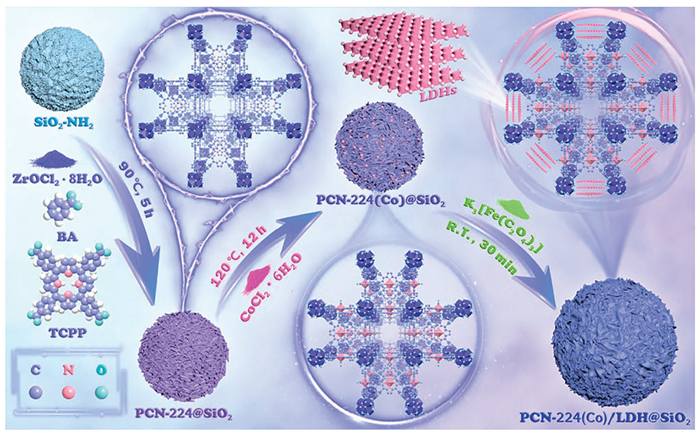
Figure 1.
A synthetic scheme for the preparation of PCN-224(Co)/LDH@SiO2.

Synergistic bimetallic MOF-LDH composite: A multifunctional stationary phase for universal chromatographic separations
Wenwen Zhang , Ziyi Ke , Jian Hu , Yuefei Zhang , Wei Chen , Sheng Tang


Metal-organic frameworks (MOFs) are nanoporous materials assembled through coordination bonding between metal nodes and organic linkers [1–6], and their structural robustness is predominantly determined by metal-ligand bond strength [7]. Among various metal nodes, Zr(Ⅳ) has garnered considerable interest owing to its high oxidation state and strong affinity for oxygen atoms [8], which produce stable Zr-O bonds and establish Zr-MOFs as particularly promising candidates for practical applications [9]. PCN-224 is a porphyrinic MOF (PMOF) constructed from Zr6 clusters and tetrakis(4-carboxyphenyl)porphyrin (TCPP) [10,11]. PCN-224 features a high specific surface area and well-defined porosity, enabling diverse and tunable interaction mechanisms. However, the presence of single-metal active sites in conventional MOFs often results in limited separation selectivity when processing complex multi-analyte mixtures, thereby hindering efficient differentiation and accurate identification of diverse components [12,13].
Early-stage strategies for enhancing MOF functionality have primarily relied on modifications to organic ligands [14]. Recently, the introduction of multiple metal centers has emerged as a powerful alternative approach. The synergistic interplay among different metals substantially enhances the performance of MOFs and effectively expands their functional diversity [15,16]. Bimetallic MOFs (BMOFs) can leverage polymetallic metal centers to improve their structural stability, surface adsorption capacity and overall performance [17,18]. Moreover, the incorporation of a secondary metal node promotes defect formation in MOFs. These defective BMOFs provide increased unsaturated active sites [19], leading to superior adsorption performance over their monometallic counterparts. PCN-224 can serve as an ideal platform for this strategy, as the central cavity of its porphyrin ligand readily accommodates metal insertion, thereby forming well-defined M-N4 active sites for constructing BMOFs [20]. Incorporating extraneous transition metal (TM) elements into PMOF can introduce additional π-backbonding and cation-π interactions [21]. The π-backbonding, originating from the backdonation of d-orbital electrons of TM into the π* antibonding orbitals of adsorbates, exhibits a bond strength uniquely positioned between physisorption and chemisorption, thereby combining high adsorption capacity with favorable reversibility [22]. The presence of π-backbonding allows for selective interaction with aromatic or unsaturated analytes, significantly enhancing separation efficiency and selectivity. Additionally, the small size and high charge density of Co2+ ions promote strong cation-π interactions with aromatic compounds. However, despite their adsorptive potential, the practical deployment of BMOFs is primarily hindered by the intrinsic microporous mass transfer resistance, which poses a critical challenge to structural optimization [23].
Two-dimensional layered double hydroxides (LDHs) are a class of metallic hydroxides, featuring a unique structure composed of positively charged host layers and exchangeable interlayer anions [24–26]. Owing to their excellent stability, high ion exchange capacity, low cost, and facile synthesis, LDHs can serve as efficient multifunctional adsorbents [27]. However, conventional LDH synthesis frequently induces self-agglomeration and stacking, which reduces specific surface area, compromises porosity, and limits active site accessibility [28]. Fortunately, strategically leveraging the inherent structural features of MOFs enables their use as versatile templates for designing and deriving novel functional materials. Under precisely controlled conditions, MOFs can be partially converted into LDHs, enhancing structural stability through the transformation of coordination networks into robust inorganic lamellae [29]. This self-templated derivatization strategy enables the resulting composite to inherit the advantageous attributes of MOFs, including enhanced surface area and porous structure, while also effectively overcoming the self-agglomeration and stacking issues of LDHs. Furthermore, the derived LDHs not only expose additional active sites within their layered structure but also utilize their inherent hierarchical channels to alleviate the mass transfer limitations of conventional MOFs [30].
In this work, a novel multimodal PCN-224(Co)@SiO2 stationary phase with integrated hydrophilic/hydrophobic/ion-exchange functionalities was developed through the synergistic combination of BMOFs and LDHs. Initially, PCN-224 was anchored onto SiO2 via in-situ growth using ZrOCl2·8H2O and TCPP. Subsequently, the TM (CoCl2·6H2O) was incorporated into the central cavity of TCPP to form PCN-224(Co), creating well-defined M-N4 active sites. Finally, utilizing the unsaturated coordination of surface Co2+, K3[Fe(C2O4)3] was introduced to partially convert PCN-224(Co) into CoFe-LDH through controlled etching, yielding the target PCN-224(Co)/LDH@SiO2 stationary phase (Fig. 1). By synergistically integrating the complementary properties of PCN-224(Co) and CoFe-LDH, the resulting composite is expected to exhibit enhanced chromatographic performance. Specifically, the porphyrin ligands of PCN-224 provide strong hydrophobicity, whereas the LDH component contributes hydrophilicity and ion-exchange functionality, thereby creating a multifunctional separation system. The developed PCN-224(Co)/LDH@SiO2 column was applied for efficient separation of nucleosides (NSs) under high-water-content mobile phase conditions, and its separation efficiency for diverse analytes was also evaluated. Furthermore, the practical applicability of the PCN-224(Co)/LDH@SiO2 column was demonstrated through the detection of polycyclic aromatic hydrocarbons in ophthalmic solutions and vitamin B1 in tablets, highlighting its potential for real-world analytical applications.
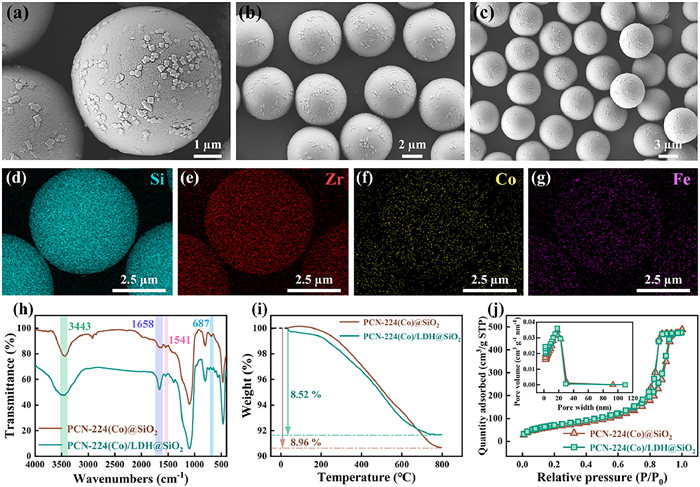
In contrast to the original PCN-224(Co) with its irregular block-like morphology on the silica surface (Fig. S1 in Supporting information), the derived PCN-224(Co)/LDH composite displays a markedly smoother and flake-like cubic architecture (Figs. 2a-c), indicating the effectiveness of the etching-conversion process. Energy dispersive spectroscopy (EDS) mapping (Figs. 2d-g) reveals the coexistence of Si, Zr, Co and Fe in the PCN-224(Co)/LDH@SiO2 composite, providing compelling evidence for the successful integration of PCN-224(Co) and LDH with the silica microsphere. The powder X-ray diffraction (PXRD) patterns of both PCN-224(Co)@SiO2 and PCN-224(Co)/LDH@SiO2 correspond well with the simulated spectrum (Fig. S2 in Supporting information), demonstrating that the characteristic MOF architecture remains preserved throughout the etching and conversion process. The observed attenuation in diffraction intensity of PCN-224(Co)/LDH@SiO2 directly results from the partial transformation of PCN-224(Co) into CoFe-LDH. The Fourier-transform infrared spectroscopy (FT-IR) analysis of PCN-224(Co)/LDH@SiO2 and PCN-224(Co)@SiO2 shows characteristic peaks of Zr-O (687 cm−1) and aromatic ring (1541 cm−1) (Fig. 2h), confirming the existence of PCN-224. The enhanced intensity of the C=O stretching band at 1658 cm−1 in PCN-224(Co)/LDH@SiO2 can be attributed to the intercalation of oxalate anions within the LDH interlayers. The FT-IR spectrum of PCN-224(Co)/LDH@SiO2 displays a broad O—H stretching band at 3443 cm−1 with markedly greater intensity and bandwidth compared to PCN-224(Co)@SiO2. This pronounced spectral change originates from the abundant hydroxyl groups introduced by the LDH component, thereby providing clear evidence for the presence of LDH in the PCN-224(Co)/LDH@SiO2 composite. Elemental analysis confirms an elevated C and H content in the PCN-224(Co)/LDH@SiO2 relative to PCN-224(Co)@SiO2 (Table S1 in Supporting information), which is a direct consequence of the intercalated oxalate anions and abundant hydroxyl groups within the LDH component. As shown in the thermogravimetric analysis (Fig. 2i), the PCN-224(Co)/LDH@SiO2 experiences a weight loss of 8.52%, whereas the PCN-224(Co)@SiO2 displays a higher weight loss of 8.96%, demonstrating that the integration of LDH effectively enhances the thermal stability of the composite. Furthermore, the PCN-224(Co)/LDH@SiO2 exhibits a substantially larger specific surface area than PCN-224(Co)@SiO2 (Fig. 2j and Table S2 in Supporting information), indicating that the partial MOF-to-LDH conversion effectively enhances the exposure of accessible active sites.
Nucleoside drugs are essential antiviral and anticancer therapeutics [31], creating a critical demand for reliable analytical methodologies to support their development and clinical application. Conventional analysis of NSs by hydrophilic interaction liquid chromatography (HILIC) relies on mobile phases with high acetonitrile (ACN) content [32], raising substantial concerns regarding environmental impact, health risks, and operational costs [33]. Typical HILIC separations, exemplified by the XAmide column, require an organic-rich mobile phase to achieve optimal performance in separating NSs (Fig. S3 in Supporting information). Comparatively, the developed PCN-224(Co)/LDH@SiO2 column can achieve effective separation of NSs under high-aqueous conditions (Fig. 3a), aligning with green chromatography. The inability of the PCN-224(Co)@SiO2 column to resolve uracil and cytosine underscores the crucial role of LDH integration in enhancing hydrophilic selectivity. Therefore, the partial MOF-to-LDH conversion proves indispensable for achieving efficient separation of NSs in an environmentally benign and water-rich mobile phase. Table S3 (Supporting information) provides a systematic comparison that highlights the superiority of the PCN-224/LDH@SiO2 composite over other reported HILIC stationary phases [14,34–40]. The MOF/LDH synergy facilitates enhanced separation efficiency, resulting in faster analyses without compromising resolution. Most importantly, the PCN-224/LDH@SiO2 column achieves high-efficiency separation with a significantly reduced ACN consumption, thereby establishing a more environmentally sustainable and cost-effective chromatographic process. The compilation of these merits distinguishes PCN-224(Co)/LDH@SiO2 as an advanced and adaptable separation platform. The elution order of NSs correlates with their hydrogen bond acceptor/donor (HBA/HBD) and LogD values (Table S4 in Supporting information). Zidovudine, possessing the highest number of HBA/HBD, exhibits the longest retention. This suggests that hydrogen-bonding interaction is the predominant cause of its delayed elution. The effect of water content on the retention of NSs on the PCN-224(Co)/LDH@SiO2 column was investigated. The observed U-shaped retention curves (Fig. S4 in Supporting information) confirm typical mixed-mode chromatography (MMC). The retention factor (k) initially decreases under HILIC-mode conditions, followed by an increase with increasing water content, signifying a transition in the retention behavior toward reversed-phase liquid chromatography (RPLC) mode. Remarkably, a pronounced increase in k values occurs under high aqueous conditions (water content ≥ 85%) as the water content rises. This phenomenon occurs because minor variations in ACN content under aqueous-rich conditions can cause significant changes in the multilayer adsorption system on the PCN-224(Co)/LDH@SiO2 surface. This pronounced sensitivity to eluent composition under high aqueous conditions is a characteristic of per-aqueous liquid chromatography retention mechanism [41].
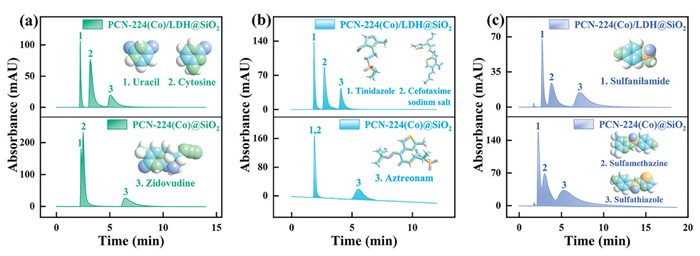
While essential for treating bacterial infections, antibiotics (ABXs) present serious challenges, such as escalating drug resistance and environmental contamination resulting from overuse and improper disposal. Fig. 3b displays a baseline separation of tinidazole, cefotaxime sodium salt, and aztreonam on the PCN-224(Co)/LDH@SiO2 column. In contrast, the PCN-224(Co)@SiO2 fails to effectively separate these ABXs, further confirming the superior hydrophilic separation capability of PCN-224(Co)/LDH@SiO2. Notably, the partial MOF-to-LDH conversion reduces mass transfer resistance, consequently alleviating the peak broadening. The retention of ABXs follows a HILIC mode, as evidenced by the progressive increase in k values with ACN content (Fig. S5a in Supporting information). An increased organic phase proportion strengthens retention by favoring the partitioning of hydrophilic analytes into the expanded aqueous layer on the stationary phase. The adsorption and partitioning mechanisms in HILIC mode can be described by Eq. S1 (Supporting information) [42,43]. The excellent fits for ABXs (Fig. S5b and Table S5 in Supporting information) confirm the synergistic adsorption-partitioning mechanisms.
Sulfonamides (SAs) are essential antimicrobial agents with critical healthcare applications, necessitating accurate detection methods to monitor their residual presence. The PCN-224(Co)/LDH@SiO2 composite capitalizes on the intrinsic advantages of LDH, where the uniformly distributed cations within the layers and interlayer anions work synergistically to enhance electrostatic interactions, resulting in superior ion-exchange performance [44]. Fig. 3c clearly demonstrates the superior separation performance of the PCN-224(Co)/LDH@SiO2 over PCN-224(Co)@SiO2 for SAs, exhibiting improved separation efficiency and selectivity. The observed peak tailing originates from insufficient homogeneity of the PCN-224(Co)/LDH composite on the silica substrate. This structural heterogeneity promotes eddy diffusion and mass transfer resistance, leading to significant peak broadening. The elution order of SAs exhibits no significant correlation with either LogD values (Table S6 in Supporting information) or the number of HBA/HBD, establishing electrostatic interactions as the dominant separation mechanism over hydrophilic partitioning and hydrogen bonding. This directly corresponds to the strengthened electrostatic interactions enabled by LDH integration. The LDH-induced surface charge modulation significantly improves selectivity toward charged analytes by reinforcing ion-exchange mechanisms. The buffer salt concentration constitutes a critical factor influencing separation efficiency in ion-exchange chromatography (IEC). A significant decrease in k values is observed for SAs as buffer concentration increases (Fig. S6a in Supporting information). Under high salt conditions, the enhanced Debye shielding effect causes rapid attenuation of electric fields around the stationary phase and analytes, thereby weakening electrostatic attraction and reducing retention [45]. The relationship between the k and buffer salt concentration is mechanistically interpreted by Eq. S2 (Supporting information) [34]. Good fitting curves for SAs can be observed with R2 values exceeding 0.9986 (Fig. S6b and Table S7 in Supporting information), confirming that the separation of SAs is predominantly influenced by ion-exchange interactions. As another critical factor in IEC, the eluent pH governs separation efficiency through its direct impact on the protonation and surface charge of analytes. The k values of all three SAs demonstrate a marked decrease with increasing pH, confirming their strongly pH-dependent retention behavior (Fig. S6c in Supporting information). The progressive increase in pH leads to reduced protonation of SAs, which weakens electrostatic attraction with the PCN-224(Co)/LDH@SiO2 stationary phase, consequently decreasing analyte retention. These systematic observations demonstrate a characteristic ion-exchange mechanism, revealing the broad potential of the PCN-224(Co)/LDH@SiO2 column for separation science.
To evaluate the aromatic selectivity of the PCN-224(Co)/LDH@SiO2 column, polycyclic aromatic hydrocarbons (PAHs) were analyzed as probe molecules. As illustrated in Fig. S7a (Supporting information), baseline separation of four PAHs was realized within 5 min on the PCN-224(Co)/LDH@SiO2 column, demonstrating excellent separation efficiency. The structural expansion of π-conjugated systems from benzene to phenanthrene confirms that the retention mechanism is governed by synergistic effects of π-π, cation-π, and π-backbonding interactions. Moreover, the progressively rising LogP values of these PAHs (Table S8 in Supporting information) demonstrate that hydrophobic interactions also contribute significantly to the separation process. The hydrophobic selectivity of the PCN-224(Co)/LDH@SiO2 column was further characterized through the separation of representative phthalate esters (PEs), phenyl ketones (PKs) and alkylbenzenes (ABs). PEs, a class of endocrine-disrupting plasticizers, adversely affect hormonal systems, impairing reproductive health, development, and metabolic regulation. The PCN-224(Co)/LDH@SiO2 column demonstrates efficient baseline separation of four critical PEs (Fig. S7b in Supporting information). Notably, the elution order of PEs shows a strong correlation with their LogP value (Table S9 in Supporting information), confirming the dominance of the hydrophobic retention mechanism. Additionally, the capability of the PCN-224(Co)/LDH@SiO2 column was further demonstrated by the baseline separation of five PKs (Fig. S7c in Supporting information). With the exception of 2-phenylacetophenone, the retention of the other four PKs shows a positive correlation with their hydrophobicity (Table S10 in Supporting information). The longer retention of 2-phenylacetophenone relative to valerophenone is attributed to its extra aromatic ring, which promotes stronger binding via synergistic π-π, cation-π, and π-backbonding interactions with the PCN-224(Co)/LDH@SiO2 stationary phase. The PCN-224(Co)/LDH@SiO2 column achieves faster and more environmentally benign separation of PKs than the conventional C18 column by leveraging multiple interaction mechanisms. In contrast, the C18 column primarily relies on hydrophobic interactions, resulting in longer analysis time and higher organic solvent consumption (Fig. S8 in Supporting information). Featuring alkyl-substituted aromatic rings, ABs serve as ideal model analytes for investigating hydrophobic separation mechanism and facilitating comparative analysis. The PCN-224(Co)/LDH@SiO2 column enables effective separation of the five ABs, whereas the PCN-224(Co)@SiO2 column exhibits limited separation selectivity (Fig. 4a). Hydrophobic selectivity (β) can be characterized by the relationship between the logk and the number of methylene groups in ABs, as defined in Eq. S3 (Supporting information) [46]. The results reveal a strong linear correlation (Fig. S9 in Supporting information), confirming the alkyl chain length-dependent retention behavior and superior hydrophobic selectivity of PCN-224(Co)/LDH@SiO2. The five ABs were eluted sequentially in the order of their increasing hydrophobicity (Table S11 in Supporting information). The retention of all five ABs decreases with increasing ACN content, which is a characteristic of hydrophobic retention mechanism (Fig. 4b).
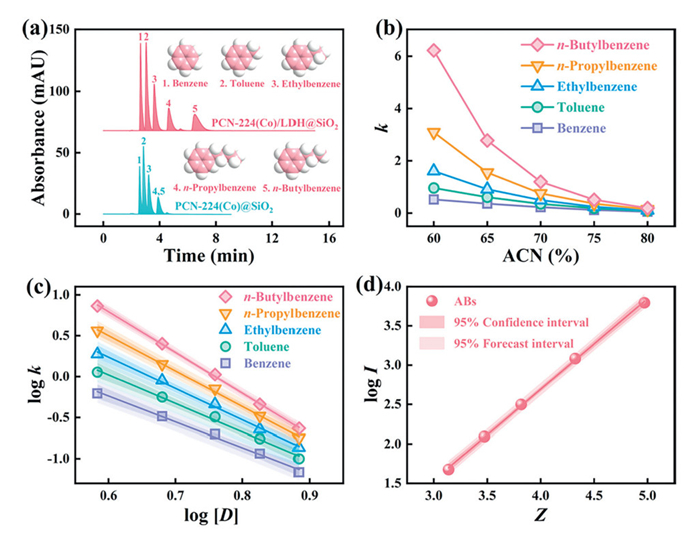
The stoichiometric displacement theory for retention (SDT-R), a well-established model for elucidating retention mechanisms in RPLC [47], is mathematically represented by Eqs. S4 and S5 (Supporting information). A strong inverse linear relationship (R2 ≥ 0.9942) is observed between logk and log[D] (Fig. 4c), unequivocally confirming hydrophobic interaction as the dominant retention mechanism for ABs. Furthermore, the logI values display a progressive increase from benzene to n-butylbenzene (Fig. 4d), indicating a sequentially enhanced affinity with the stationary phase. Concurrently, the Z value increases progressively, indicating that longer-retained analytes release more moles of solvent upon binding to the stationary phase. The strong linear correlation between logI and Z (R2 = 0.9994) serves as robust evidence that the separation of ABs is governed by a classic RPLC retention mechanism.
The van Deemter equation models the relationship between linear velocity (u) and theoretical plate height (Eq. S6 in Supporting information) [48]. A kinetic evaluation was conducted with seven hydrophobic analytes (Fig. S10 in Supporting information). Kinetic analysis reveals that significant mass transfer resistance (C term) directly links to peak broadening by impeding instantaneous phase equilibrium. The minimum theoretical plate height is achieved at a linear velocity of 0.07 cm/s, resulting in a column efficiency of 47,173 N/m for 2-hydroxyacetophenone. In order to yield a favorable balance of separation performance and analysis efficiency, the operational flow rate has been ultimately set at 1.0 mL/min, a deviation from the theoretical optimum of 0.7 mL/min.
Column temperature influences separation efficiency by modulating eluent viscosity and analyte diffusion coefficients. The van't Hoff equation can be used to describe the relationship between the ln k and column temperature (Eq. S7 in Supporting information) [49]. Pronounced linear correlations are showcased in the van't Hoff plots for all the tested four classes of analytes (Fig. S11 and Table S12 in Supporting information), suggesting that the retention mechanism remains virtually constant. ABXs, NSs, and SAs show slightly poorer fits than ABs, likely due to their more complex retention behaviors. The involvement of temperature-sensitive interactions may cause slight variations in relative intensities with changing temperature [50]. Thermodynamic analysis reveals uniformly negative ΔH values for all analytes (Table S12 in Supporting information), confirming an exothermic separation process.
The PCN-224(Co)/LDH@SiO2 column exhibits excellent repeatability, demonstrating intra-day and inter-day relative standard deviations (RSDs) of 0.52%−0.87% and 0.23%−1.29% in the separation of PKs (Fig. S12 in Supporting information). To assess the robustness of the synthesis procedure, batch-to-batch reproducibility was investigated by fabricating PCN-224(Co)/LDH@SiO2 columns from three independently synthesized batches. Excellent method reproducibility is evidenced by the low RSDs (≤ 2.19%) for the retention time of all PKs (Fig. S13 in Supporting information). Excellent acid-base stability of the PCN-224(Co)/LDH@SiO2 column was also confirmed, showing minimal variation (RSDs ≤ 0.11%) in the separation of NSs under both acidic and basic conditions (Fig. S14 in Supporting information). Moreover, an investigation into the operational lifetime and long-term stability of the PCN-224(Co)/LDH@SiO2 column was conducted. The separation performance remains highly consistent from the initial injection through testing after 10 months (Fig. S15 in Supporting information), demonstrating excellent long-term robustness.
The linear solvation energy relationship (LSER) establishes a quantitative framework to evaluate solute-phase interactions in chromatographic systems (Eq. S8 in Supporting information) [51], elucidating the distinction in the primary retention mechanisms between PCN-224(Co)@SiO2 and PCN-224(Co)/LDH@SiO2. By employing LSER analysis, the differential contributions of interaction forces (hydrophobic, hydrogen bonding, and π-π effects) can be systematically resolved, providing mechanistic insights into the distinct separation selectivities of these two composite stationary phases. In this study, a series of solutes was analyzed, and the logk and solute descriptors are shown in Table S13 (Supporting information). The system coefficients (e, s, a, b, v) reflect the differences between the stationary phase and mobile phase with respect to specific interactions with solutes (Fig. S16a and Table S14 in Supporting information). Positive coefficients indicate stronger interactions with the stationary phase, whereas negative values suggest a greater affinity for the mobile phase. The coefficient s reflects the propensity of the phase to engage in dipole-dipole interactions with solutes. Coefficients a and b represent hydrogen-bond basicity and acidity interactions with the phase, respectively. The significantly higher positive s and a coefficients observed for PCN-224(Co)/LDH@SiO2 relative to PCN-224(Co)@SiO2 can be attributed to the unique layered structure of LDH, which possesses pronounced charge separation that induces strong polarity, significantly enhancing dipole-dipole interactions and hydrogen-bond basicity. The negative b coefficient indicates that hydrogen-bond donation from the mobile phase dominates over that from the stationary phase, primarily because of the overwhelming hydrogen-bond donor capacity of water in the eluent [52]. The v coefficient, associated with dispersion forces and cavity effects, serves to evaluate hydrophobic interactions. The PCN-224(Co)/LDH@SiO2 manifests moderately improved hydrophobic interactions relative to PCN-224(Co)@SiO2. However, a notable reduction in the e coefficient (characterizing π-π interactions) is observed for PCN-224(Co)/LDH@SiO2. Due to the partial MOF-to-LDH conversion, the accessibility to the π-conjugated moieties in PCN-224(Co) is reduced, leading to the observed attenuation. Despite this reduction, the PCN-224(Co)/LDH@SiO2 composite maintains effective separation of π-conjugated analytes through compensatory π-backbonding and cation-π interactions. Notably, the maximal enhancement in a and s values achieved by PCN-224(Co)/LDH@SiO2 validates the strategic advantage of LDH integration, which amplifies material polarity to optimize hydrophilic separations. The strong linear correlation between experimental and calculated logk values (absence of outliers) confirms the applicability of the LSER model for elucidating interaction mechanisms in both PCN-224(Co)@SiO2 and PCN-224(Co)/LDH@SiO2 systems (Figs. S16b and c in Supporting information).
The practical potential of the PCN-224(Co)/LDH@SiO2 column for complex sample analysis was validated by detecting hydrophobic analytes in liquid pharmaceuticals and hydrophilic active pharmaceutical ingredients in solid oral dosage forms. Residual PAHs, formed during plastic manufacturing, can migrate from packaging into pharmaceutical products, such as eye drops. This migration potential highlights the importance of systematic PAH monitoring to ensure drug safety. Current research on PAH detection in pharmaceutical plastic packaging remains limited, while most existing studies have predominantly centered on food, soil, and aquatic environments. Using the PCN-224(Co)/LDH@SiO2 column, this study demonstrates the absence of detectable PAH migration from packaging into ophthalmic formulations. Spiking experiments show no significant matrix effects on the detection of PAHs in ophthalmic solutions, validating the reliability of the analytical method (Fig. S17 in Supporting information).
Thiamine hydrochloride (VB1), also termed an anti-neuritic factor, is an essential nutrient that regulates neurological function and energy metabolism [53]. As humans cannot synthesize or store VB1 significantly, daily intake via diet or supplements is essential. Rising public health awareness has further raised demands for its quality and safety. Precise determination of VB1 content in tablets is crucial for ensuring pharmaceutical efficacy and safety in quality control. The PCN-224(Co)/LDH@SiO2 column enables efficient quantification of VB1, offering a novel analytical approach for detecting VB1 in complex matrices. A standard calibration curve with excellent correlation (R2 = 0.9997) was established for VB1 (Fig. S18 in Supporting information). Based on the linear regression equation, the VB1 content in the commercial tablets was quantified as 617.24 μg/mL. The developed method shows detection and quantitation limits of 0.013 and 0.038 μg/mL, respectively (Table S15 in Supporting information). Spike-recovery tests at 50, 100, and 150 μg/mL demonstrate excellent accuracy, with quantitative recoveries of 102.22%−105.36% and RSDs of 0.33%−0.77% (Table S16 in Supporting information). These findings collectively demonstrate the effectiveness of the PCN-224(Co)/LDH@SiO2 column for pharmaceutical analysis, highlighting its practical applicability.
A novel multimodal PCN-224(Co)/LDH@SiO2 stationary phase was successfully developed via the synergistic combination of BMOF and LDH. The BMOF was strategically constructed by introducing Co2+ into the porphyrinic ligand of PCN-224, thereby establishing the M-N4 active site as well as introducing π-backbonding and cation-π interactions to enhance the separation selectivity. Furthermore, the partial MOF-to-LDH conversion via controlled etching simultaneously inhibited LDH self-agglomeration and preserved the original porous architecture. This synergistic composite seamlessly integrates hydrophobicity, hydrophilicity, and ion-exchange capacity, achieving multifunctionality within a single material. The PCN-224(Co)/LDH@SiO2 column enables efficient separation of NSs under high-aqueous conditions, coupled with superior separation performance for other structurally diverse analytes. The systematic mechanistic study reveals that the separations are governed by multiple retention mechanisms. Successful determination of PAHs in ophthalmic formulations and VB1 in tablets confirms the practical applicability of PCN-224(Co)/LDH@SiO2 column, underscoring its adaptability for complex sample analysis. This work demonstrates a novel strategy of integrating BMOF and LDH as stationary phase fillers, establishing a theoretical basis for synergistic structure-performance optimization in advanced chromatographic materials. Future studies may pursue analogous MOF-LDH hybrids to unlock new levels of versatility, further optimizing their utility in chromatographic science.
Wenwen Zhang: Writing – original draft, Validation, Methodology, Investigation, Data curation, Conceptualization. Ziyi Ke: Validation, Investigation. Jian Hu: Investigation. Yuefei Zhang: Resources. Wei Chen: Supervision. Sheng Tang: Writing – review & editing, Supervision, Resources, Project administration, Methodology, Funding acquisition, Conceptualization.
The authors declare that they have no known competing financial interests or personal relationships that could have appeared to influence the work reported in this paper.
This work was supported by National Natural Science Foundation of China (No. 21906124) and Natural Science Foundation of Hubei Province (No. 2017CFB220).
Supplementary material associated with this article can be found, in the online version, at doi:
T. De Villenoisy, X.R. Zheng, V. Wong, et al., Adv. Mater. 35 (2023) 2210166. doi: 10.1002/adma.202210166
Y.X. Sun, K.J. Quan, J. Chen, et al., Chin. Chem. Lett. 34 (2023) 108166. doi: 10.1016/j.cclet.2023.108166
G.L. Sun, Y.C. Luo, Z.H. Yan, H.D. Qiu, W.Y. Tang, Chin. Chem. Lett. 35 (2024) 109787. doi: 10.1016/j.cclet.2024.109787
D.X. Li, Y.G. Hao, H.N. Zhou, et al., Chem. Eng. J. 507 (2025) 160784. doi: 10.1016/j.cej.2025.160784
H.N. Zhou, Y. Yuan, Z.Z. Liu, et al., Trends Anal. Chem. 191 (2025) 118355. doi: 10.1016/j.trac.2025.118355
Y.C. Xiang, J.T. Wei, H.P. Sun, et al., J. Anal. Test. 8 (2023) 28–39.
Y. Bai, Y.B. Dou, L.H. Xie, et al., Chem. Soc. Rev. 45 (2016) 2327–2367. doi: 10.1039/C5CS00837A
Z.J. Chen, S.L. Hanna, L.R. Redfern, et al., Coord. Chem. Rev. 386 (2019) 32–49. doi: 10.1117/12.2541914
C. Jia, T. He, G.M. Wang, Coord. Chem. Rev. 476 (2023) 214930. doi: 10.1016/j.ccr.2022.214930
J. Park, Q. Jiang, D.W. Feng, L.Q. Mao, H.C. Zhou, J. Am. Chem. Soc. 138 (2016) 3518–3525. doi: 10.1021/jacs.6b00007
Y.M. Gao, X. Tian, Y.M. Wang, et al., J. Hazard. Mater. 476 (2024) 135019. doi: 10.1016/j.jhazmat.2024.135019
Q.G. Zhai, X.H. Bu, C.Y. Mao, X. Zhao, P.Y. Feng, J. Am. Chem. Soc. 138 (2016) 2524–2527. doi: 10.1021/jacs.5b13491
G. Kaur, R.K. Rai, D. Tyagi, et al., J. Mater. Chem. A 4 (2016) 14932–14938. doi: 10.1039/C6TA04342A
Z.F. Hu, J.W. Liao, J.W. Zhou, et al., Chin. Chem. Lett. 36 (2025) 109985. doi: 10.1016/j.cclet.2024.109985
L.Y. Chen, H.F. Wang, C.X. Li, Q. Xu, Chem. Sci. 11 (2020) 5369–5403. doi: 10.1039/d0sc01432j
S. Abednatanzi, P.G. Derakhshandeh, H. Depauw, et al., Chem. Soc. Rev. 48 (2019) 2535–2565. doi: 10.1039/c8cs00337h
Y.T. Zhou, R. Abazari, J. Chen, et al., Coord. Chem. Rev. 451 (2022) 214264. doi: 10.1016/j.ccr.2021.214264
B. Dey, M.W. Ahmad, R. Al-Shannaq, et al., J. Anal. Test. 8 (2024) 451–465. doi: 10.1007/s41664-024-00312-3
M. Gimenez-Marques, A. Santiago-Portillo, S. Navalon, et al., J. Mater. Chem. A 7 (2019) 20285–20292. doi: 10.1039/c9ta01948k
Y.J. Wei, H. Chen, Z.W. Zhou, et al., Small 20 (2024) 2403679. doi: 10.1002/smll.202403679
S.S. Shang, C. Yang, C.G. Wang, et al., Angew. Chem. Int. Ed. 59 (2020) 19680–19683. doi: 10.1002/anie.202007054
D.E. Jaramillo, D.A. Reed, H.Z.H. Jiang, et al., Nat. Mater. 19 (2020) 517–521. doi: 10.1038/s41563-019-0597-8
X.Q. Zha, W. Sun, J.Y. Liu, et al., Mater. Today Chem. 35 (2024) 101883. doi: 10.1016/j.mtchem.2023.101883
H. Yi, S.Y. Liu, C. Lai, et al., Adv. Energy Mater. 11 (2021) 2002863. doi: 10.1002/aenm.202002863
P.R. Chowdhury, H. Medhi, K.G. Bhattacharyya, C.M. Hussain, Coord. Chem. Rev. 483 (2023) 215083. doi: 10.1016/j.ccr.2023.215083
M.T. Duan, S.J. Liu, Q.M. Jiang, et al., Chin. Chem. Lett. 33 (2022) 4428–4436. doi: 10.1016/j.cclet.2021.12.033
X.F. Feng, R.X. Long, L.L. Wang, et al., Sep. Purif. Technol. 284 (2022) 120099. doi: 10.1016/j.seppur.2021.120099
Z.X. Yan, L.X. Zhao, N. Liu, N. Li, R.S. Zhao, Sep. Purif. Technol. 345 (2024) 127413. doi: 10.1016/j.seppur.2024.127413
M.H. Huang, C.S. Cao, L. Liu, et al., eScience 3 (2023) 100118. doi: 10.1016/j.esci.2023.100118
G.F. Wang, D.L. Huang, M. Cheng, et al., Coord. Chem. Rev. 460 (2022) 214467. doi: 10.1016/j.ccr.2022.214467
D.C. Schultz, R.M. Johnson, K. Ayyanathan, et al., Nature 604 (2022) 134–140. doi: 10.1038/s41586-022-04482-x
Z.X. Huang, Q.L. Liu, Z.Y. Ke, et al., Anal. Chim. Acta 1342 (2025) 343673. doi: 10.1016/j.aca.2025.343673
T. Chen, X. Yang, S.Y. Wang, et al., Talanta 235 (2021) 122795. doi: 10.1016/j.talanta.2021.122795
C.Y. Liu, Y.J. Liu, Y.F. Zhang, W. Chen, S. Tang, Sep. Purif. Technol. 349 (2024) 127827. doi: 10.1016/j.seppur.2024.127827
W.W. Zhang, Z.Y. Ke, Y.J. Liu, et al., Sep. Purif. Technol. 369 (2025) 133126. doi: 10.1016/j.seppur.2025.133126
T.T. Si, L.C. Wang, X.F. Lu, et al., Analyst 145 (2020) 3851–3856. doi: 10.1039/d0an00304b
T.T. Si, X.J. Liang, X.F. Lu, et al., Talanta 222 (2021) 121603. doi: 10.1016/j.talanta.2020.121603
Y.F. Liu, W.J. Wei, X. Liu, et al., Chin. Chem. Lett. 37 (2026) 111186. doi: 10.1016/j.cclet.2025.111186
T. Zhang, S. Wang, X.F. Lu, Y. Guo, X.J. Liang, J. Chromatogr. A 1707 (2023) 464300. doi: 10.1016/j.chroma.2023.464300
F.B. Fan, X.F. Lu, X.J. Liang, L.C. Wang, Y. Guo, J. Chromatogr. A 1662 (2022) 462745. doi: 10.1016/j.chroma.2021.462745
Y.Y. Li, J. Li, T. Chen, X.Y. Liu, H.X. Zhang, J. Chromatogr. A 1218 (2011) 1503–1508. doi: 10.1016/j.chroma.2011.01.044
Y.F. Liu, L.L. Zhao, Y.J. Liu, et al., Talanta 276 (2024) 126238. doi: 10.1016/j.talanta.2024.126238
F.B. Fan, X.F. Lu, L.C. Wang, X.J. Liang, Y. Guo, Anal. Chem. 93 (2021) 16017–16024. doi: 10.1021/acs.analchem.1c03514
Q.L. Liu, S.Y. Yu, Y.H. Deng, et al., Sep. Purif. Technol. 359 (2025) 130667. doi: 10.1016/j.seppur.2024.130667
T. Zhang, X.J. Liang, T.T. Si, X.F. Lu, S. Wang, Talanta 280 (2024) 126768. doi: 10.1016/j.talanta.2024.126768
L.X. Chen, J. Gao, Q. Wu, et al., Eur. Polym. J. 116 (2019) 9–19. doi: 10.1016/j.eurpolymj.2019.04.002
H. Li, W.B. Xie, L. Zeng, et al., J. Chromatogr. A 1665 (2022) 462815. doi: 10.1016/j.chroma.2022.462815
X. Wang, X.R. Wang, J.J. Wu, et al., Anal. Chim. Acta 1321 (2024) 343018. doi: 10.1016/j.aca.2024.343018
Y.F. Liu, J. Hu, Y.D. Zhou, et al., Sep. Purif. Technol. 355 (2025) 129701. doi: 10.1016/j.seppur.2024.129701
W.J. Wei, H.Y. Long, Y.J. Liu, et al., Anal. Chim. Acta 1276 (2023) 341635. doi: 10.1016/j.aca.2023.341635
Y.X. Hu, P.C. Zhang, K.J. Liu, et al., J. Chromatogr. A 1736 (2024) 465333. doi: 10.1016/j.chroma.2024.465333
M.L. Zhang, T. Tan, Z. Li, et al., J. Chromatogr. A 1365 (2014) 148–155. doi: 10.1016/j.chroma.2014.09.018
K.S. Hossain, S. Amarasena, S. Mayengbam, Microorganisms 10 (2022) 1168. doi: 10.3390/microorganisms10061168

Figure 2 Scanning electron microscopy images (a-c) and EDS mapping (d-g) of PCN-224(Co)/LDH@SiO2. (h) FT-IR spectra of PCN-224(Co)/LDH@SiO2 and PCN-224(Co)@SiO2. (i) Thermogravimetric curves of PCN-224(Co)/LDH@SiO2 and PCN-224(Co)@SiO2. (j) Nitrogen adsorption-desorption isotherms and pore size distribution of PCN-224(Co)/LDH@SiO2 and PCN-224(Co)@SiO2.

Figure 3 Chromatographic separation of NSs (a), ABXs (b) and SAs (c) on the PCN-224(Co)/LDH@SiO2 and PCN-224(Co)@SiO2. Eluent: (a) ACN/H2O = 15/85 (v/v); (b) ACN/buffer (120 mmol/L ammonium acetate) = 70/30 (v/v); (c) ACN/buffer (10 mmol/L ammonium acetate) = 60/40 (v/v).

 扫一扫看文章


扫一扫关注我们
 DownLoad:

 下载:

 下载: