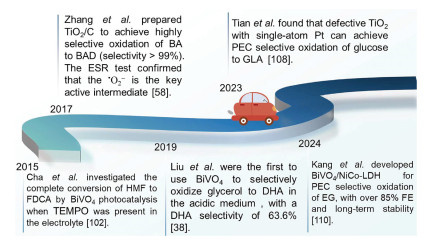
Figure 1.
The timeline of the technological breakthroughs in PEC alcohols/aldehydes oxidation.

Photoelectrocatalytic upgrading conversion of biomass-derived alcohols/aldehydes: Regulating the oxidation pathway by designing photoanode materials
Lingyi Wang , Zhitao Xu , Shuyan Gong , Yang Tian , Sihui Zhan


Biomass is a vital component of the renewable energy family, derived directly or indirectly from crop residues, forestry waste, livestock manure, and municipal solid waste [1]. According to the International Energy Agency (IEA), biomass is projected to account for 17% of global final energy consumption by 2060. As one of the most promising alternatives to fossil fuels, biomass is unique among non-fossil energy sources in its ability to provide energy in multiple forms. Furthermore, its use in producing organic chemicals provides a sustainable alternative to fossil-based raw materials, thus promoting the growth of a bio-based economy [2-5]. Bio-based materials can be categorized into five core groups: Bio-based platform chemicals, bio-based plastics, polysaccharide-based substrates, amino acid-based substrates, and wood-plastic composites. Among these, alcohols and aldehydes, such as 5-hydroxymethylfurfural (HMF), glucose, and glycerol (GLY), serve as key platform compounds in the biorefinery system. These compounds play a crucial role in bridging the gap between raw biomass resources and high-value chemicals, advanced materials, and clean fuels [6-11].
Photoelectrocatalysis (PEC) is an advanced oxidation technology that integrates photocatalysis (PC) and electrocatalysis (EC). In this process, semiconductor photon absorption generates electron-hole pairs, which are separated by an external electric field to drive efficient redox reactions. The foundational study in this field was reported by Fujishima and Honda in 1972, who achieved hydrogen production via ultraviolet-driven water splitting using a TiO2 photoanode [12]. This experiment confirmed the feasibility of PEC water splitting and laid the theoretical groundwork for its use in energy conversion. Unlike conventional PC, where efficiency is hindered by charge recombination under illumination, PEC suppresses recombination through an applied bias. This feature enables reactions under low-intensity light and facilitates product separation electrically, thereby enhancing operational stability and environmental adaptability [13-15]. By synergizing light and electrical energy, PEC offers distinct advantages in energy conversion.
Alcohols and aldehydes are pivotal in the synthesis of bio-based platform chemicals. With C–C and C–O backbones, they have dynamic active sites, such as hydroxyl and aldehyde groups [16]. Their PEC oxidation offers three key advantages over other biomass derivatives: (1) Oxidation typically proceeds via a proton-coupled electron transfer (PCET) pathway, which lowers the activation barrier [17-19]. Terminal positioning of functional groups minimizes steric hindrance, facilitating access to catalytic sites. (2) High water solubility allows direct oxidation in aqueous media, avoiding toxic solvents like DMF or acetonitrile, thereby cutting costs and reducing environmental impact. (3) Diverse functional groups enable multiple reaction pathways, yielding a broad range of value-added chemicals essential to fine chemicals, pharmaceuticals, cosmetics, and food production. Consequently, selective PEC conversion of alcohols and aldehydes has become one of the most intensively investigated routes for cost-effective biomass valorization (Fig. 1).
The primary challenge in the PEC upgrading of alcohols and aldehydes lies in achieving high selectivity. The selective oxidation process requires precise control over the oxidized depth, oxidized functional group at different positions, oxidized quantity of functional groups, and C–C bond cleavage, which collectively lead to diverse reaction pathways and product distributions [20,21]. Compared with low-selectivity systems, which usually produce complex mixtures requiring multi-stage separation and additional technical support and cost, high-selectivity systems can simplify the reaction network, avoid multi-step tandem processes, increase the added value of products and reduce separation costs. Furthermore, high selectivity results in reduced carbon emissions and mitigates catalyst poisoning or electrolyte pH fluctuations caused by by-products. Therefore, rationally steering the PEC oxidation pathway of alcohols/aldehydes toward a single-product channel offers valuable theoretical insights and a practical route to commercial application.
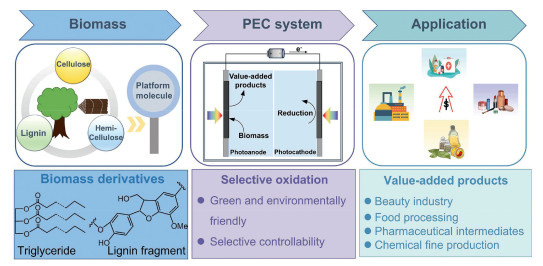
PEC operates under ambient conditions, offers tunable selectivity and requires low energy input, making it an attractive option for converting biomass into chemicals, fuels and everyday commodities (Fig. 2). Although previous reviews have examined PEC upgrading of alcohols and aldehydes, a systematic analysis of how photoanode materials steer oxidation pathways is still lacking [22-25]. This review emphasizes selectivity and elucidates the role of photoanode choice and design in directing oxidation routes toward desired products. Our aim is to provide guidance for designing highly selective PEC reaction systems in future work. Finally, we reviewed the challenges facing the PEC selective oxidation of alcohols/aldehydes system and proposed feasible solutions.
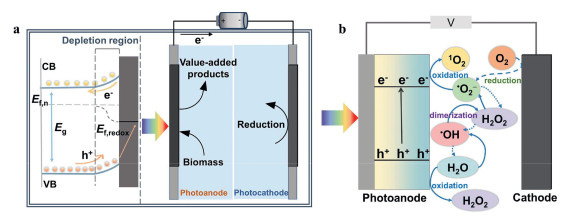
Understanding the underlying reaction mechanisms is essential for rationally regulating oxidation pathways and selectively generating desired products. Fig. 3a illustrates a typical PEC system for alcohols/aldehydes oxidation, consisting of a photoanode, a photocathode (typically Pt foil), and an electrolyte. Specifically, when the absorbed photon energy exceeds the semiconductor bandgap (Eg), electrons in the valence band (VB) are excited to the conduction band (CB), creating energetic electrons and leaving positively charged holes in the VB [26-29]. Due to energy loss during carrier transport and interfacial polarization resistance, however, a bias potential is generally required to efficiently separate the charge carriers [30,31]. Under the influence of the built-in or applied electric field, electrons migrate via the external circuit to the cathode to drive reduction, while holes move to the photoanode surface to promote organic oxidation [32]. When an n-type semiconductor photoanode contacts the electrolyte, upward band bending occurs at the interface as a result of the mismatch between the semiconductor Fermi level (Ef) and the electrolyte redox potential [33]. This band bending facilitates hole migration to the surface, thereby enabling efficient oxidation reactions.
In PEC systems, selective oxidation proceeds mainly through two mechanisms: Direct hole oxidation and indirect (mediator-assisted) oxidation. In the direct pathway, photogenerated holes directly oxidize organic molecules adsorbed on the photoanode surface [34,35]. This method is efficient and allows rapid conversion, with selectivity often tunable by applied potential or electrolyte pH [36,37]. For instance, Liu et al. demonstrated using a BiVO4 photoanode that pH is a key regulatory factor for product distribution. When pH shifted from 7 to 2, the primary product transitioned from formic acid to DHA [38]. This is because acidic conditions suppress side reactions and enhance selectivity toward aldehydes or ketones. Therefore, by optimizing the pH of the electrolyte, the selectivity for the target product can be enhanced. However, direct hole transfer suffers from limited mass transport efficiency, which can cause kinetic instability, low conversion, and poor pathway control [39]. In contrast, the indirect mechanism employs redox mediators (e.g., TEMPO) or reactive oxygen species (ROS) as intermediates [40-43]. These mediators are first oxidized at the photoanode into active species, which diffuse into the solution to oxidize organics. This homogeneous-like process helps overcome limitations of heterogeneous catalysis and is particularly valuable for directed organic synthesis [44,45].
Notably, ROS are generated by the reaction of holes and electrons with water or oxygen in an electrolyte (Fig. 3b), including hydroxyl radicals (•OH), superoxide radicals (•O2-), singlet oxygen (1O2) and hydrogen peroxide (H2O2) [46-51]. These species exhibit varied oxidative capacities and selectivity, enabling them to drive diverse alcohol/aldehyde oxidation pathways. A deeper mechanistic understanding of ROS formation and properties, along with rational strategies to control their generation, will further enhance the selectivity of PEC oxidation reactions:
(1) The •OH radicals exhibit strong oxidizing capacity and are typically generated through hole-induced oxidation of water or surface-adsorbed OH- (Eqs. 1 and 2) [52,53]. It is important to distinguish between free •OH radicals in the electrolyte and those bound to the photoanode surface. Freely diffusing •OH possesses a high oxidation potential and tends to cause deep over-oxidation to CO2, whereas surface-adsorbed •OH exhibits moderated reactivity, favoring selective oxidation of target molecules [54,55]. This moderation arises from the reduced overpotential associated with the adsorption of •OH intermediates during water oxidation. Thus, precisely controlling the adsorption state of •OH offers an effective strategy for achieving mild and controlled oxidation.
|
|
(1) |
|
|
(2) |
(2) When the conduction band potential of a semiconductor is more negative than the O2/•O2- redox potential, photogenerated electrons can reduce oxygen molecules to form •O2- radicals (Eq. 3) [56,57]. These •O2- radicals exhibit relatively mild oxidative capacity and an extended diffusion lifetime, allowing them to participate in selective oxidation reactions both on the catalyst surface and within the electrolyte [58]. Typically, •O2- radicals react with carbon-centered radicals generated from hole-activated intermediates. Their moderate oxidation power helps prevent over-oxidation, thereby contributing to high product selectivity.
|
|
(3) |
(3) The production of the 1O2 radicals on metal oxides is usually associated with oxygen vacancy (OV) [59]. These radicals are excited state oxygen molecule with relatively mild oxidizing ability. In the PEC process, oxygen molecules do not produce 1O2 radicals directly in the light, but require a photosensitive initiator to be excited by light radiation, which transfers energy to oxygen molecules in the triplet ground state, resulting in the production of 1O2 radicals (Eq. 4) [46,60]. In addition, photogenerated holes oxidation of •O2- can also lead to the generation of 1O2 radicals (Eq. 5).
|
|
(4) |
|
|
(5) |
(4) When the conduction band potential of a semiconductor is thermodynamically insufficient to drive the single-electron reduction of oxygen, the two-electron oxygen reduction reaction becomes the dominant pathway for O2 activation to generate H2O2 (Eq. 6). Furthermore, H2O2 can also be generated through two-hole oxidation of water under hole-rich conditions (Eq. 7).
|
|
(6) |
|
|
(7) |
A key challenge in PEC technology lies in the rational design and screening of semiconductor photoanodes. The performance of a semiconductor is governed by its intrinsic band structure and light absorption characteristics, which directly influence charge excitation efficiency and redox capability under illumination. Additionally, properties such as electrical conductivity, surface chemistry, and microstructure critically affect the separation of photogenerated carriers and the selectivity of surface reactions. An ideal photoanode must therefore harmoniously integrate the following key attributes:
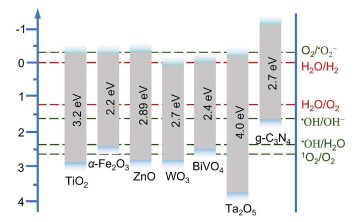
(1) Optimal bandgap and band edge positions. The Eg governs light absorption capability, defined by Eg = 1240/λ (where λ is the absorption edge wavelength). Since the solar spectrum consists of only ~5% ultraviolet, ~43% visible (400-700 nm), and ~52% infrared light [61,62], efficient visible-light harvesting requires a bandgap between 1.8 eV and 3.1 eV. This explains why rutile TiO2 (Eg = 3.02 eV) is primarily activated by ultraviolet light [63], whereas WO3 (Eg = 2.6 eV) responds up to ~480 nm [64]. The minimum point of the conduction band minimum (CBM) and the maximum point of the valence band maximum (VBM) determine the redox potential. A more negative CBM favors reduction, while a more positive VBM enhances oxidation. As shown in Fig. 4, the band alignment and bandgap distribution of typical n-type semiconductors significantly influence their PEC oxidation performance for alcohols and aldehydes. It should be noted that although narrow bandgaps improve light absorption, excessively small values lead to rapid charge recombination and insufficient driving force for surface reactions [65,66].
(2) Efficient charge carrier separation and transport. The separation of electrons and holes drives redox reactions, but their overall efficiency is often limited by kinetic processes, where rapid charge recombination is the primary cause of energy loss [67]. It is therefore essential to select semiconductors with high charge carrier mobility to facilitate transport toward the semiconductor/electrolyte interface. Effective charge transport relies on the material’s intrinsic electronic properties, microstructure, and interface design. Although traditional semiconductors are constrained by their inherent properties, surface and interface engineering offers effective strategies to enhance carrier separation and transport efficiency [68-71]. Common strategies to enhance separation efficiency include tailoring crystal morphology to shorten charge migration paths and constructing heterojunctions that introduce built-in electric fields to suppress recombination [72].
(3) High stability. High stability is essential for photoanode materials in PEC reactions. These materials often face challenges such as chemical dissolution, photoelectrochemical corrosion, phase transformation, and structural degradation, which are primary causes of performance decay. Therefore, evaluating their thermodynamic stability in specific reaction environments is critical during material screening. Most metal oxides (e.g., TiO2, Fe2O3, WO3) exhibit good stability, largely because their metal ions are already in the highest oxidation state, limiting further oxidation such as corrosion. In contrast, non-oxide semiconductors like sulfides, phosphides, and nitrides tend to oxidize into corresponding oxides or dissolve as ions under anodic potential and light, resulting in significantly lower photoelectrochemical stability. Moreover, extreme pH conditions of electrolyte can induce photoanode dissolution or surface passivation, directly compromising target product selectivity. This directly alters the oxidation driving force of photogenerated holes. It is noteworthy that most metal oxide photoanodes exhibit markedly different stability behaviors in acidic versus alkaline electrolyte. Consequently, future photoanode designs must be specifically optimized for their intended electrolyte conditions.
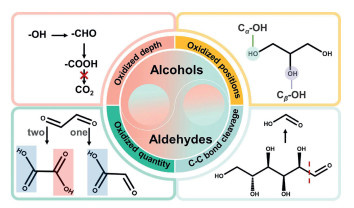
PEC selective oxidation of alcohols/aldehydes pathway begins with precise control over adsorption processes on the photoanode surface. Differences in adsorption energies for distinct functional groups determine subsequent reaction pathways, while competition between O–H bond and C–C bond activation pathways is governed by their activation barriers and thermodynamic driving forces. Furthermore, product selectivity strongly depends on desorption behavior—excessive adsorption leads to over-oxidation. Based on this, recent advances in preparing value-added chemicals in this field will be systematically reviewed from four dimensions: Oxidized depth, oxidized functional group at different positions, oxidized quantity of functional groups, and the C–C bond breakage (Fig. 5).
The reaction mechanism of PEC selective oxidation of alcohols fundamentally involves the regulation of oxidized depth. The core challenge lies in efficiently converting alcohols into aldehydes/ketones or further oxidizing them into acids while maximally suppressing over-oxidation to CO2. To achieve this goal, current effective strategies primarily include: Modulating the oxidative capacity of photogenerated holes, controlling the generation and ROS such as •OH and •O2-, optimizing the adsorption strength of target products (aldehydes/ketones) on the photoanode surface, and promoting their timely desorption to prevent secondary oxidation.
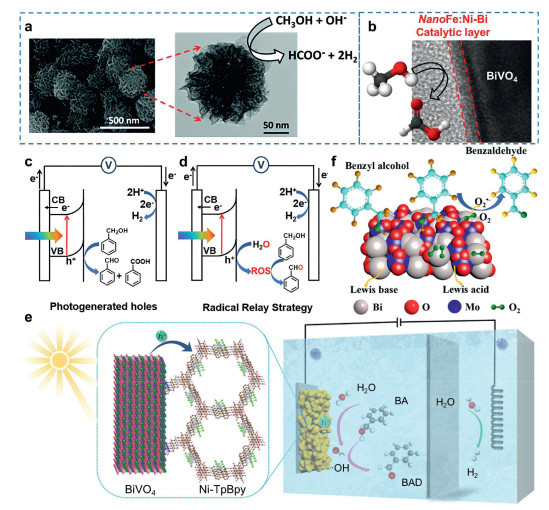
Carboxylic acids serve as essential building blocks for polymers, pharmaceuticals, and food additives, with their market value rising steeply alongside demand [73]. Among them, formic acid stands out as both a key synthetic intermediate and a reversible hydrogen storage molecule, offering exceptional added value [74,75]. Porous nickel-based nanomaterials have shown particular promise in the selective synthesis of formic acid [76-78]. Their strong oxidizing capability drives deep oxidation effectively, while the porous architecture reduces mass transfer resistance and promotes rapid product desorption, enhancing formic acid selectivity and suppressing over-oxidation to CO2. For instance, Lin et al. employed pulsed electrodeposition to fabricate a nanoporous nickel oxyhydroxide-borate (NiBi(PED)) film on α-Fe2O3, achieving 92.7% Faradaic efficiency (FE) for photoelectrochemical methanol to formate conversion [79]. As illustrated in Fig. 6a, the self-assembled nano-petals form porous microspheres with open channels that facilitate deep methanol diffusion and access to abundant Ni3+ sites. This shortens electron transport paths and mitigates formaldehyde accumulation, thereby improving formate selectivity. In another study, Huang’s group constructed a nanoporous NiFe oxyhydroxide-borate (nanoFe:Ni-Bi) film on BiVO4 photoanodes, reaching 94.6% FE for methanol oxidation to formate in a near-neutral electrolyte (Fig. 6b) [80]. The film’s porous structure provides ample active sites for methanol adsorption, improving accessibility to Ni3+ centers and minimizing mass transfer limitations. At the same time, the nanoporous network promotes rapid formic acid desorption, preventing its further oxidation to CO2.
In fine chemicals, aldehydes and ketones hold higher value and broader applications than carboxylic acids, serving as essential intermediates in fragrances, pharmaceuticals, agrochemicals, and advanced materials. However, selectively oxidizing alcohols to aldehydes or ketones remains technically challenging. Conventional electrocatalytic processes, due to strong oxidation conditions, often over-oxidize primary alcohols to carboxylic acids, leading to lower selectivity for the desired aldehydes or ketones [22]. In contrast, PEC systems enable precise control over carrier energy and reaction kinetics, allowing the oxidation process to be selectively terminated at the aldehyde/ketone stage. This offers a robust technological route for highly selective synthesis of these value-added compounds.
The design of photoanode that generate moderately ROS can significantly enhance aldehyde selectivity. Luo et al. developed a G@LDH@BVO photoanode by integrating ultrathin layered double hydroxide (U-LDH) and graphene (G) with BiVO4 (BVO), achieving >99% selectivity for benzaldehyde (BAD) in benzyl alcohol (BA) oxidation [81]. As shown in Figs. 6c and d, instead of directly oxidizing BA, the catalyst first oxidizes water to produce surface-adsorbed •OH radicals. These confined •OH species exhibit moderate oxidative strength compared to free •OH, selectively converting to BAD without over-oxidation to benzoic acid. Similarly, Lin's team constructed a bipyridine-based covalent organic framework with single Ni sites (Ni-TpBpy) on BiVO4 [82]. The synergy between isolated Ni sites and BiVO4 promotes the formation of surface-adsorbed •OH radicals. Confined within the Ni-TpBpy framework, these •OH species selectively cleave the C–H bond in BA, generating a carbon-centered radical that couples with an adjacent •OH to yield BAD with nearly 100% selectivity, effectively avoiding over-oxidation (Fig. 6e).
Compared with surface-adsorbed •OH, •O2- demonstrates even milder oxidizing capability. Zhou et al. reported a Bi2MoO6@TiO2 photoanode that generates •O2- radicals via photogenerated charges and surface Lewis acid–base pairs, achieving complete selectivity in oxidizing benzyl alcohol to benzaldehyde [83]. As shown in Fig. 6f, Lewis-acidic Mo sites selectively adsorb benzyl alcohol, while Lewis-basic Bi sites activate O2 to form •O2-. Unlike non-selective •OH radicals, the mild •O2- species enable precise oxidation control, stopping at the aldehyde stage without over-oxidation.
The construction of heterojunctions can modulate the adsorption and reaction energy barriers of reaction intermediates, thereby improving the selectivity of the target products [84]. The Z-scheme heterojunction ZOF@CN, composed of vacancy-rich Fe2O3 and g-C3N4, significantly enhances the selectivity (81.5%) for PEC conversion of methanol to formaldehyde by modulating the C–H bond cleavage energy barrier [85]. As shown in Fig. 7a, the interfacial interaction between g-C3N4 and Fe2O3 weakens the C–H bond in CH3O*, while a weak coordination bond formed between a nitrogen atom and the carbon atom in CH3O* stabilizes the intermediate and suppresses over-oxidation, thereby ensuring high formaldehyde selectivity. The α-Fe2O3/CoFe2O4 designed by Huang et al. selectively oxidizes methanol to formaldehyde, with the active site shifting from Fe in α-Fe2O3 to Fe in CoFe2O4 [86]. As illustrated in Fig. 7b, the FeO6 octahedra in α-Fe2O3 adopt a coplanar arrangement, whereas those in CoFe2O4 are connected via edge-sharing. This structural difference influence methanol adsorption, C–H bond activation, and formaldehyde desorption. DFT calculations (Fig. 7c) revealed that the heterojunction significantly reduces the activation energy barrier for methanol C–H bond cleavage and the free energy change for formaldehyde desorption, thereby promoting C–H activation and product desorption while suppressing side reactions.
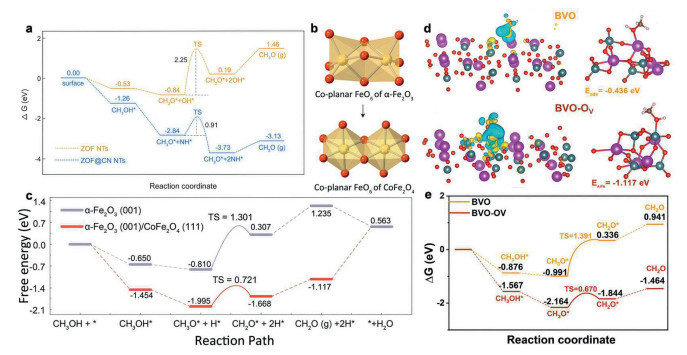
In PEC processes, the active site is crucial for absorbing reactant molecules and facilitating their conversion. Altering the active site, for example by changing the composition of the photoanode or through surface modification, can redirect the reaction pathway towards the desired product. The introduction of OVs modifies active sites, thereby tuning key reaction energy barriers and oxidized depth. Li et al. demonstrated this principle by creating OVs on BiVO4 using Na2SO3 photo-oxidation to modulate the selectivity with a FE of 94.7% [87]. As shown in Fig. 7d, the OVs shift the methanol adsorption site from Bi to V, thereby increasing the adsorption energy from −0.436 eV to −1.117 eV. This change in site lowers the energy barrier for the critical C–H bond-breaking step from 1.361 eV (pristine BVO) to 0.761 eV (BVO-OV), as confirmed by DFT calculations (Fig. 7e). Furthermore, formaldehyde desorption is facilitated, with the energy change reduced from 0.605 eV to 0.38 eV. Collectively, these changes enable the BVO-OV photoanode to exhibit high formaldehyde selectivity.
In PEC systems involving multifunctional biomass molecules like glycerol, selective oxidation of specific functional groups is crucial for the precise synthesis of high-value chemicals. Glycerol contains both primary (Cα-OH) and secondary (Cβ-OH) hydroxyl groups with similar activation energy barriers, making the reaction pathway and product distribution highly dependent on the photoanode's selective adsorption behavior toward these distinct groups. Glycerol oxidation yields various valuable C3 products: Glyceraldehyde (GLD) and glyceric acid (GLYA) originate from Cα-OH activation, while dihydroxyacetone (DHA) forms via Cβ-OH oxidation. Therefore, precise control over the photoanode’s selective adsorption affinity for either Cα-OH or Cβ-OH is essential to achieve high selectivity toward desired products.
The WO3 photoanode favored the adsorption of the Cα-OH group of glycerol, demonstrating excellent selectivity for GLD or GLYA. Ouyang et al. prepared WO3 photoanodes with (202) and (200) crystal planes, respectively [88]. Of these, the (202) WO3 achieved an exceptional GLD selectivity of 80% by PEC. As shown in Fig. 8a, after the addition of 0.1 mol/L glycerol, the magnitude of the OCP variation for the (202) WO3 was significantly greater than that for the (200) WO3, indicating a stronger adsorption energy of glycerol on the (202) facet. Based on DFT calculations (Fig. 8b), the (202) crystal surface was found to be more favorable for glycerol adsorption. Its enhanced electrostatic attraction with Cα-OH prompted spontaneous preferential adsorption of Cα-OH over Cβ-OH. Meanwhile, (202) WO3 promoted the desorption of GLD and inhibited deep oxidation, thus achieving high GLD selectivity. Similarly, Xiao et al. found that a WO3 photoanode with an exposed (002) crystalline surface was able to photo reduce glycerol to GLD through strong electrostatic attraction between W and Cα-OH, followed by further oxidation to produce GLYA with a selectivity of up to 79% [89]. These results affirm that the exposed crystal facet on W-based photoanodes determines the surface atomic arrangement and, ultimately, the selectivity of position-specific oxidation.
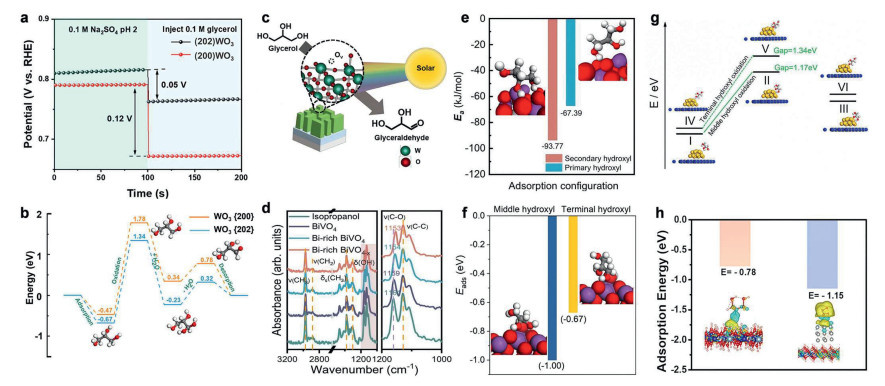
In addition, defect engineering can improve the precise identification of hydroxyl groups on the surface of a W-based semiconductor. Jung et al. optimized the adsorption conformation of the substrate by modulating the concentration of OV on the WO3 surface. This resulted in the highest selectivity for PEC glycerol selective oxidation to GLD: up to 86.1% [90]. It was shown that the introduction of OVs on the surface exposes more unsaturated W atoms to form Lewis acid sites, which preferentially adsorb the Cα-OH of glycerol and promote its targeted oxidation (Fig. 8c). Meanwhile, oxygen vacancies significantly reduced the activation energy of glycerol oxidation to GLD and inhibited the side reaction pathway.
Previous studies have shown that BiVO4 photoanodes preferentially adsorb the Cβ-OH group of glycerol [91]. To exploit this tendency, Lu and his colleagues deposited OV onto the BiVO4 surface. This modification significantly reduced the reaction energy barriers and exposed more active sites for Cβ-OH adsorption [92]. As illustrated in Figs. 8d and e, the OVs exposed more Bi atoms, strengthening the interaction between Bi and the Cβ-OH group. This combined effect facilitated PEC driven glycerol oxidation to DHA with markedly improved selectivity (80.3%).
Introducing Bi as an active site is an effective strategy for promoting Cβ-OH adsorption in glycerol and achieving selective DHA production. Luo's team constructed a Bi2O3/TiO2 heterojunction that selectively oxidized glycerol to DHA with 75.4% selectivity at 1.0 V vs. RHE [55]. According to DFT theoretical calculations (Fig. 8f), since the H atom of Cβ-OH is more electron deficient than that of Cα-OH, compared to TiO2, Cβ-OH interacts more strongly with Bi2O3, and thus the adsorption energy of Cβ-OH on Bi2O3 is higher than that of Cα-OH by 0.33 eV. In addition, the DHA is more readily desorbed on Bi2O3, which results in a higher selectivity. Similarly, Feng et al. reported a WO3/BiVO4/Bi ternary heterostructure, where the Bi0/Bi3+ interface enhanced Cβ-OH binding, yielding 60.6% DHA selectivity [93].
Noble metal modification offers an alternative strategy to enhance Cβ-OH affinity in glycerol oxidation, utilizing distinct d-band electronic properties and plasmon resonance effect (LSPR) effects to raise DHA selectivity. For instance, Sun et al. designed an Au/C3N4 photoanode that leverages the LSPR effect of Au, raising DHA selectivity to 53.7% in PEC glycerol oxidation [94]. Electron transfer from C3N4 to Au modified the latter’s electronic structure, enhancing its adsorption toward Cβ-OH over Cα-OH. Potential energy surface analysis confirmed a lower activation barrier for Cβ-OH (1.17 eV) than for Cα-OH (1.34 eV), indicating that the LSPR effect synergizes with preferential Cβ-OH adsorption to suppress Cα-OH oxidation (Fig. 8g). Liu et al. prepared a terpolymer photoanode composed of CoAl-LDH nanosheets loaded with Ag NPs (Ag@LDH@TiO2), which was used for PEC glycerol selective oxidation to DHA in a neutral medium [95]. As shown in Fig. 8h, the adsorption energy for the Cβ-OH on Ag@LDH surface (−1.15 eV) is more negative than that on LDH (−0.78 eV), indicating that Ag NPs can contribute to the enhancement of adsorption of Cβ-OH. In addition, the charge density difference also confirmed that the loading of Ag NPs significantly enhanced the charge transfer, such that the increase in electron density on Ag@LDH@TiO2 weakened the β-C–O bond, thus promoting the selective activation of Cβ-OH, leading to a further increase in the selectivity for the production of DHA. Similarly, Feng et al. reported a Pt single-atom-modified WOx amorphous/crystalline heterojunction (Pt-SA/WOx), in which Pt sites altered adsorption behavior to enhance DHA selectivity [96]. These works collectively underscore the role of noble metals in steering glycerol oxidation toward Cβ-OH activation.
In the PEC process involving complex, multifunctional organic molecules, precisely regulating the quantity of functional groups that are oxidized is key to determining the chemical properties of the final products and their potential applications. These molecules often contain multiple reaction sites and their oxidation pathways are complex, making them susceptible to interference from competing reactions, which can lead to the formation of non-target products. Therefore, to obtain a highly selective target product, it is necessary to precisely guide the adsorption configurations, activation energy barriers and subsequent electron/hole transfer paths of the reactant molecules on the photoanode surface.
Glyoxal has two aldehyde groups. Compared with oxalic acid, which is produced by oxidizing both aldehyde groups, glyoxylic acid (GA), which is obtained by oxidizing only one aldehyde group, has a higher economic value and is a key precursor for pharmaceutical synthesis, agrochemicals and the fragrance industry [97,98]. Therefore, achieving targeted oxidation of a single aldehyde group and inhibiting the double oxidation pathway is key to GA acquisition. Zhao et al. have reported the semi-oxidation of glyoxal on WO3 (200), which was successfully upgraded to GA with 86.5% selectivity [99]. As shown in Figs. 9a and b, glyoxal is most strongly adsorbed on the (200) crystal plane of WO3 (−1.84 eV), which is more stronger than on the (020) and (002) crystal planes. This favours the enrichment of reactants on this plane. Meanwhile, the reaction pathway for the oxidation of glyoxal to GA has a very low energy barrier (only 0.06 eV) on the (200) crystal face, making the reaction easy to initiate. Furthermore, the oxidation of GA to oxalic acid requires overcoming a higher energy barrier on the (200) crystal plane, effectively inhibiting over-oxidation.
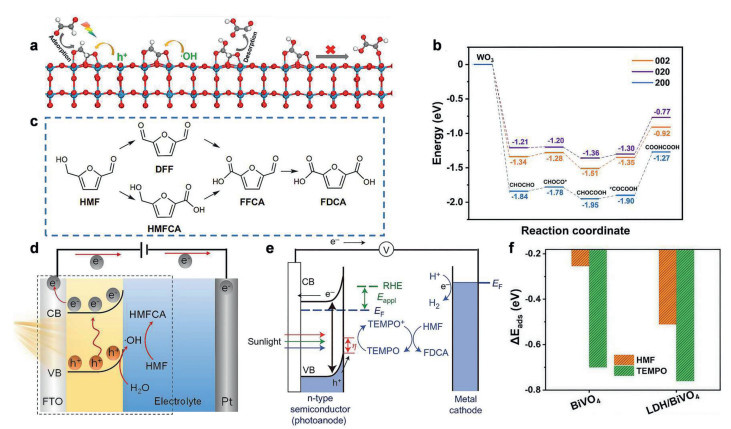
Unlike the symmetrical structure of glyoxal, 5-hydroxymethylfurfural (HMF) possesses an asymmetric architecture containing both aldehyde and hydroxymethyl groups. In PEC selective oxidation of HMF, precise control over the number and type of oxidized functional groups enables targeted synthesis of high-value products including 2,5-furandicarboxylic acid (FDCA), 2,5-diformylfuran (DFF), and 5-hydroxymethyl-2-furancarboxylic acid (HMFCA) (Fig. 9c). However, achieving such control remains challenging as both functional groups exhibit high reactivity with similar oxidation potentials, making selective regulation of oxidation extent particularly difficult.
Oxidizing the aldehyde group of HMF to a carboxyl group can lead to the target product, HMFCA. Sun's group reported that a photoanode consisting of NiOOH-modified BiVO4 (NO-2/BVO) can selectively oxidise the aldehyde group of HMF to generate HMFCA by regulating the generation of •OH radicals [100]. The oxidation potential of NO-2/BVO is more favorable for •OH radicals generating than that of BVO, and its oxidation potential precisely matches the selective oxidation of the aldehyde group to the carboxyl group. This avoids over-oxidation to FDCA (Fig. 9d).
The target product DFF can be obtained by selectively oxidizing the hydroxymethyl group of HMF and controlling it to the aldehyde stage. Lhermitte's team revealed the intrinsic mechanism of the high selectivity of DFF in the catalytic oxidation of HMF by WO3 photoanode in an acidic electrolyte (pH 4) by constructing a kinetic model [101]. It was shown that the unique oxidative selectivity (preferential oxidation of alcohol hydroxyls) and kinetic advantage (faster DFF generation rate than HMFCA) of WO3 are at the root of the high DFF selectivity.
The synthesis of FDCA proceeds through consecutive oxidation of both functional groups, involving the transformation of “hydroxymethyl → aldehyde → carboxylic acid” for one chain and “aldehyde → carboxylic acid” for the other. Chadderdon et al. significantly enhanced the TEMPO-mediated selective oxidation of HMF using a CoPi-coated BiVO4 photoanode (Fig. 9e) [102]. Similarly, Zheng et al. employed a NiFe-LDH/BiVO4 photoanode for HMF oxidation in the presence of TEMPO, achieving nearly 100% Faradaic efficiency for FDCA production [103]. As shown in Fig. 9f, the NiFe-LDH/BiVO4 composite exhibited stronger adsorption for both TEMPO (−2.31 eV vs. −2.18 eV on bare BiVO4) and HMF (−1.31 eV vs. −1.05 eV), thereby reducing the reaction energy barrier and ensuring high FDCA selectivity. Pahari et al. demonstrated that the formation of FeOOH intermediates during HMF oxidation significantly lowers the energy barrier and enables 100% selective FDCA production [104].
The design of photoanode materials is also influenced by the concentration of reactants in the electrolyte, thereby affecting the selectivity of the target product. This is because solute concentration determines the probability of contact and adsorption efficiency between reactants and the photoanode surface. For example, the competitive adsorption phenomenon between OH- and HMF concentration on Fe2O3 photoanodes with a NiOOH cocatalyst was investigated, which affected the selectivity of FDCA [105]. When the concentration of HMF is low, OH− dominates the adsorption process. When the concentration of HMF is high, the adsorption ability of OH− is weakened, thus inhibiting the formation of dangling oxygen, hindering the PECT process, and reducing the selectivity of the catalytic process of HMF to produce FDCA.
Glucose features five hydroxyl groups and one aldehyde group, and its high-value conversion requires precise control over the number of oxidized functional groups. Glucaric acid (GLA), a key raw material in healthcare applications such as cholesterol regulators and anticancer therapeutics, is formed when both the terminal aldehyde and the primary hydroxyl group are oxidized to carboxylic acids [106,107]. However, achieving complete oxidation to GLA is challenging due to competing reaction pathways. Tian et al. showed that a defective TiO2 photoanode (def-TiO2) modified with a Pt monolayer enhances selectivity toward GLA [108]. Electrochemically introduced oxygen vacancies and Ti3+ defects shift the valence band upward, moderating the oxidizing power of holes and suppressing C–C cleavage, thereby aligning the band structure with glucose oxidation potentials and favoring C6 products. Meanwhile, single-atom Pt sites promote the directed oxidation of glucose to GLA via selective adsorption of the C6–OH group in reaction intermediates, facilitating the stepwise conversion gluconic acid (GLU) → guluronic acid (GUR) → GLA.
Selective cleavage of C–C bonds enables profound structural modifications of molecules, yielding unique compounds unattainable through conventional methods. However, the inherent chemical stability and diversity of C–C bonds pose significant challenges for achieving efficient and highly selective cleavage.
In the PEC selective oxidation of alcohols and aldehydes, the deposition of co-catalysts on photoanodes proves particularly crucial for reactions involving C–C bond cleavage [109]. A representative example is found in the PEC oxidation of ethylene glycol (EG). Kang et al. constructed a BiVO4/NiCo-LDH photoanode that efficiently converts EG to formate under strongly alkaline conditions [110]. Under illumination and applied bias, holes transfer from BiVO4 to the NiCo-LDH layer, where they can oxidize Ni2+ and Co2+ to form highly active NiOOH and CoOOH species. Mechanistic studies showed that NiOOH dominated the C–C bond breaking step, while CoOOH mainly played a protective role to inhibit the over-oxidation of intermediates to CO2, and the synergistic effect of both of them precisely regulated the C–C bond breaking in the oxidation pathway of EG, which resulted in the highly selective formation of formic acid (Fig. 10a). Similarly, Li et al. developed a Fe2O3/Ni(OH)x photoanode that achieved nearly 100% Faradaic efficiency for converting ethylene glycol to formic acid [111]. While bare α-Fe2O3 exhibits excessively strong hole oxidation, the introduced Ni(OH)x forms a reversible Ni2+/Ni3+ redox pair that buffers hole oxidation strength. As illustrated in Fig. 10b, photogenerated holes from α-Fe2O3 first oxidize Ni2+ to Ni3+, which then selectively cleaves the C–C bond of EG to yield two formic acid molecules while being reduced back to Ni2+. This redox cycling mechanism prevents complete mineralization and enables highly selective partial oxidation. Building on this approach, the same group designed Ti-Fe2O3/Ni(OH)x photoanode, achieving >95% formic acid selectivity [112].
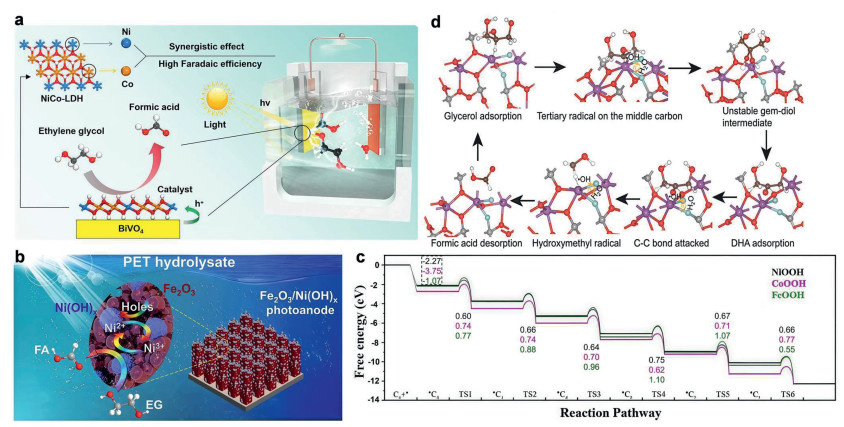
The high selectivity in PEC conversion of glucose to formic acid relies on precise cleavage of the C1–C2 bond, enabling controlled sequential C–C bond scission and regulated oxidation depth. In this process, co-catalysts play a crucial role by efficiently adsorbing and activating organic molecules, significantly lowering the activation energy barrier for C–C bond cleavage. Pan’s group developed a NiOOH/α-Fe2O3 photoanode that achieved up to 96% selectivity toward formic acid from glucose oxidation [113]. Key to this high selectivity is the significantly lower Gibbs free energy barrier for glucose-to-formate conversion on the NiOOH surface compared to α-Fe2O3, indicating a thermodynamically favored pathway. As shown in Fig. 10c, NiOOH exhibits the lowest energy barrier among co-catalyst systems including CoOOH and FeOOH. This advantage stems from the ability of Ni3+ sites to effectively adsorb and activate the C1–C2 bond in glucose, weakening its bond energy and facilitating sequential C–C cleavage while minimizing by-product formation.
The photocatalytic conversion of glycerol to formic acid involves multistep oxidation and precise C–C bond cleavage. Due to the high activation energy barrier, C–C bond cleavage constitutes the kinetic bottleneck of the entire reaction. Conventional electrocatalytic systems typically rely on strongly basic media (pH > 13) and high potentials (>1.3 V vs. RHE) to promote this step. While this approach can enhance formic acid selectivity to over 80%, it also triggers side reactions such as dehydration and Cannizzaro rearrangement, significantly increasing the complexity of the reaction network [114-116]. To address these challenges, Liu's team constructed a fluoride-modified layer (BVO-F) on the surface of BVO, successfully achieving efficient photoelectrochemical oxidation of glycerol to formic acid under acidic conditions [117]. Research indicates that the double hydrogen bonds formed between F-Bi-F sites and water molecules significantly reduce water adsorption energy, promoting water splitting into •OH radicals and substantially accelerating C–C bond cleavage kinetics. As shown in Fig. 10d, the double hydrogen bond structure enhances the adsorption of C=O bonds in the DHA intermediate, guiding the reaction pathway toward C–C bond cleavage and formic acid generation.
The selection of anions and cations in the electrolyte similarly influences the reaction pathways mediated by photoanodes. Different cations induce varying rates of oxidation/reduction reactions, while anions may undergo side reactions such as oxygen evolution with water at the electrode surface. Furthermore, the adsorption capabilities of different ions on the electrode surface vary, potentially altering the reaction mechanism. Using BiVO4 as a model, Kong et al. explored the effect of different electrolyte composition on the oxidation selectivity of glycerol [118]. Under identical conditions, they compared the selectivity of glycerol oxidation products in four electrolytes: Sodium nitrate (NaNO3), sodium perchlorate (NaClO4), sodium sulfate (Na2SO4), and potassium sulfate (K2SO4). In K2SO4, GLD was the predominant product; whereas in NaNO3, C–C bond cleavage occurred, resulting in C2 product selectivity exceeding 50%. Therefore, the high selectivity of the target product should also account for the influence of electrolyte ions.
This review provides a detailed account of the reaction mechanism in PEC alcohols/aldehydes selective oxidation system. We systematically investigated the regulation of reaction pathways by photoanodes: Regulating oxidized depth, selecting oxidized functional group at different positions, controlling oxidized quantity of functional groups, and the C–C bond breakage. This study reveals the design principles for photoanode materials, including synergistically regulating band structure and light absorption properties, suppressing interfacial charge recombination, and rationally optimizing surface reaction kinetics. To enhance the practical guidance of this paper, we presented a research roadmap for photoanodes from the perspective of materials chemistry and engineering (Fig. 11): Screen potential photoanode materials using existing methods (theoretical calculations, machine learning, or literature reviews); optimize the active sites of photoanodes through appropriate strategies (constructing heterojunction, doping, defect engineering, crystal surface engineering, co-catalyst and single-atom catalyst) to achieve high selectivity and stability; comprehensively evaluate their suitability for engineering applications in terms of selectivity, stability, and cost-effectiveness to determine their practical application potential.
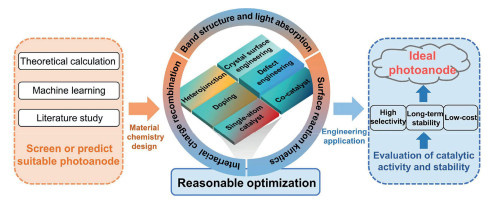
Based on existing research, we suggest practical solutions to address the three key challenges facing PEC alcohols/aldehydes selective oxidation system, aiming to guide future industrialization efforts.
(1) Low efficiency of photoanodes: First, the photoanode material itself exhibits significant photogenerated carrier recombination issues, resulting in actual photocurrent densities far below theoretical expectations. The mismatch between the kinetics and thermodynamics of anode and cathode reactions also severely constrains overall Faradaic efficiency. These can be mitigated through appropriate surface optimization strategies or structural design.
Besides, target products originate solely from the anodic half-reaction in existing systems, while cathodic reactions often fail to synergize effectively. To achieve efficient operation of alcohol/aldehyde selective oxidation systems, photoanodes and photocathodes can be synergistically designed such that both half-reactions co-produce the same high-value product. For instance, coupling the anodic oxidation of EG to GA with the cathodic reduction of oxalic acid to GA enables integrated system that simultaneously generates glycolic acid at both electrodes.
(2) Photoanodes stability bottleneck: The large-scale deployment of photoelectrochemical systems demands operational stability over thousands of hours. However, the service life of photoanodes is severely constrained by combined photochemical and electrochemical corrosion, inducing surface aggregation, reconstruction, or phase transitions in photoanodes. These processes diminish active site availability and hinder charge transfer.
To address the challenge of insufficient photoanode stability, a comprehensive strategy of “passive protection-active repair-system regulation” can be adopted. The dense protective layer is constructed on the photoanode surface. This layer must possess efficient hole transport capability while physically isolating the catalyst from direct contact with the electrolyte, thereby suppressing photo-corrosion and chemical corrosion at the source.
(3) Poor universality of photoanodes: Current PEC systems for the selective oxidation of alcohols and aldehydes are limited by a lack of photoanode universality. Even minor modifications to the substrate structure can disrupt the spatial and electronic compatibility between the photoanode active sites and the substrate molecules. This incompatibility often results in a significant decrease in target product selectivity and can initiate undesirable deep oxidation pathways.
To address this limitation, single-atom or dual-atom catalysts can be employed to construct synergistic multi-site systems on the surface of photoanodes. Within this system, distinct atomic sites perform specific functions: One site primarily anchors and activates the O–H bond of alcohols, while the adjacent site effectively modulates the activation energy barrier for the neighboring C–H bond break through its unique electronic structure or geometric configuration, thereby enabling “on-demand activation” of different reactants. Beyond diatomic systems, the continuous site energy distribution and diverse local environments within high-entropy alloys and oxides offer highly promising solutions for achieving stepwise, precise control over multi-step complex reactions.
Lingyi Wang: Writing – original draft, Conceptualization. Zhitao Xu: Writing – original draft. Shuyan Gong: Writing – original draft, Conceptualization. Yang Tian: Writing – review & editing, Supervision, Conceptualization. Sihui Zhan: Writing – review & editing.
The authors declare that they have no known competing financial interests or personal relationships that could have appeared to influence the work reported in this paper.
This work was supported by National Natural Science Foundation of China (Nos. 22375131 and 52172096).
K. Lee, Y. Jing, Y. Wang, N. Yan, Nat. Rev. Chem. 6 (2022) 635–652. doi: 10.1038/s41570-022-00411-8
Z. Sun, B. Fridrich, A. de Santi, S. Elangovan, K. Barta, Chem. Rev. 118 (2018) 614–678. doi: 10.1021/acs.chemrev.7b00588
P. Sudarsanam, E. Peeters, E.V. Makshina, V.I. Parvulescu, B.F. Sels, Chem. Soc. Rev. 48 (2019) 2366–2421. doi: 10.1039/c8cs00452h
X. Wu, N. Luo, S. Xie, et al., Chem. Soc. Rev. 49 (2020) 6198–6223. doi: 10.1039/d0cs00314j
X. Liu, X. Duan, W. Wei, S. Wang, B.J. Ni, Green Chem. 21 (2019) 4266–4289. doi: 10.1039/c9gc01728c
M.P.J.M. van der Ham, E. van Keulen, M.T.M. Koper, A.A. Tashvigh, J.H. Bitter, Angew. Chem. Int. Ed. 62 (2023) e202306701. doi: 10.1002/anie.202306701
J. Wang, Q. Zhao, Z. Li, et al., Appl. Catal. B: Environ. 360 (2025) 124526. doi: 10.1016/j.apcatb.2024.124526
W. Chen, L. Zhang, L. Xu, et al., Nat. Commun. 15 (2024) 2420. doi: 10.1038/s41467-024-46752-4
L. Yang, X. Li, P. Chen, Z. Hou, Chin. J. Catal. 40 (2019) 1020–1034. doi: 10.1016/S1872-2067(19)63301-2
M.K. Ke, Y. Min, S.C. Mei, et al., Appl. Catal. B: Environ. 358 (2024) 124431. doi: 10.1016/j.apcatb.2024.124431
X. Lu, D. Wang, X. Dai, et al., Chem. Eng. J. 496 (2024) 154092. doi: 10.1016/j.cej.2024.154092
A. Fujishima, K. Honda, Nature 238 (1972) 37–38. doi: 10.1038/238037a0
D. Liu, Y. Kuang, Adv. Mater. 36 (2024) 2311692. doi: 10.1002/adma.202311692
L. Yang, F. Li, Q. Xiang, Mater. Horiz. 11 (2024) 1638–1657. doi: 10.1039/d4mh00020j
G.T. Chavan, D.P. Dubal, E.C. Cho, et al., Small 21 (2025) 2411444. doi: 10.1002/smll.202411444
C.G. Yoo, X. Meng, Y. Pu, A.J. Ragauskas, Bioresour. Technol. 301 (2020) 122784. doi: 10.1016/j.biortech.2020.122784
W. Chen, J. Shi, Y. Wu, et al., Angew. Chem. Int. Ed. 63 (2024) e202316449. doi: 10.1002/anie.202316449
Y.Q. Zhu, H. Zhou, J. Dong, et al., Angew. Chem. Int. Ed. 62 (2023) e202219048. doi: 10.1002/anie.202219048
R. Tyburski, T. Liu, S.D. Glover, L. Hammarström, J. Am. Chem. Soc. 143 (2021) 560–576. doi: 10.1021/jacs.0c09106
H.H. Kuo, T.G. Vo, Y.J. Hsu, J. Photochem. Photobiol. C 58 (2024) 100649. doi: 10.1016/j.jphotochemrev.2023.100649
D. Tang, G. Lu, Z. Shen, et al., J. Energy Chem. 77 (2023) 80–118. doi: 10.1016/j.jechem.2022.10.038
Y. Miao, M. Shao, Chin. J. Catal. 43 (2022) 595–610. doi: 10.1016/S1872-2067(21)63923-2
M.G. Sendeku, T.A. Shifa, F.T. Dajan, et al., Adv. Mater. 36 (2024) 2470158. doi: 10.1002/adma.202470158
J. Yu, J. González-Cobos, F. Dappozze, et al., Green Chem. 26 (2024) 1682–1708. doi: 10.1039/d3gc03371f
C. Jin, M. Han, Y. Wu, S. Wang, Energy Environ. Sci. 17 (2024) 7459–7511. doi: 10.1039/d4ee02332c
R. Tang, S. Zhou, Z. Zhang, R. Zheng, J. Huang, Adv. Mater. 33 (2021) 2005389. doi: 10.1002/adma.202005389
Y. Liu, S. Bai, F. Wang, Y. Chen, Environ. Chem. Lett. 20 (2022) 1169–1192. doi: 10.1007/s10311-021-01364-y
J. Li, H. Yuan, W. Zhang, et al., Carbon Energy 4 (2022) 294–331. doi: 10.1002/cey2.179
X. He, W. Tian, L. Yang, Z. Bai, L. Li, Small Methods 8 (2024) 2300350. doi: 10.1002/smtd.202300350
K. Dang, S. Liu, L. Wu, et al., Natl. Sci. Rev. 11 (2024) nwae053. doi: 10.1093/nsr/nwae053
B. Li, L.I. Oldham, L. Tian, et al., J. Am. Chem. Soc. 146 (2024) 12324–12328. doi: 10.1021/jacs.4c03178
T. Hisatomi, J. Kubota, K. Domen, Chem. Soc. Rev. 43 (2014) 7520–7535. doi: 10.1039/C3CS60378D
C. Jiang, S.J.A. Moniz, A. Wang, T. Zhang, J. Tang, Chem. Soc. Rev. 46 (2017) 4645–4660. doi: 10.1039/C6CS00306K
T. Hardwick, A. Qurashi, B. Shirinfar, N. Ahmed, ChemSusChem 13 (2020) 1967–1973. doi: 10.1002/cssc.202000032
B. Mei, G. Mul, B. Seger, Adv. Sustain. Syst. 1 (2017) 1600035. doi: 10.1002/adsu.201600035
D. Zhu, L. Zhang, R.E. Ruther, R.J. Hamers, Nat. Mater. 12 (2013) 836–841. doi: 10.1038/nmat3696
H. Lu, J. Zhao, L. Li, et al., Energy Environ. Sci. 4 (2011) 3384–3388. doi: 10.1039/c1ee01476e
D. Liu, J.C. Liu, W. Cai, et al., Nat. Commun. 10 (2019) 1779. doi: 10.1038/s41467-019-09788-5
C. Lin, Y. Lu, J. Miao, et al., Sci. Bull. 69 (2024) 3395–3403. doi: 10.1016/j.scib.2024.08.014
S. Li, H. Shang, Y. Tao, et al., Angew. Chem. Int. Ed. 62 (2023) e202305538. doi: 10.1002/anie.202305538
B. Tang, S.C. Zhu, H. Liang, et al., J. Mater. Chem. A 10 (2022) 4032–4042. doi: 10.1039/d1ta10284b
B.M. Stratakes, A.J.M. Miller, ACS Catal. 10 (2020) 9006–9018. doi: 10.1021/acscatal.0c02265
T.H. Jeon, D. Monllor-Satoca, G.H. Moon, et al., Nat. Commun. 11 (2020) 967. doi: 10.1038/s41467-020-14775-2
D. Tang, K. Dang, J. Wang, et al., Sci. China Chem. 66 (2023) 3415–3425. doi: 10.1007/s11426-023-1757-4
X. Liu, Z. Chen, S. Xu, et al., J. Am. Chem. Soc. 144 (2022) 19770–19777. doi: 10.1021/jacs.2c06273
Y. Nosaka, A.Y. Nosaka, Chem. Rev. 117 (2017) 11302–11336. doi: 10.1021/acs.chemrev.7b00161
Y. Liu, B. Zhang, D. Yan, X. Xiang, Green Chem. 26 (2024) 2505–2524. doi: 10.1039/d3gc03554a
Z. Shen, Y. Hu, B. Li, et al., J. Energy Chem. 62 (2021) 338–350. doi: 10.1016/j.jechem.2021.03.033
X. Li, J. Wang, Y. Men, Z. Bian, Appl. Catal. B Environ. 187 (2016) 115–121. doi: 10.1049/hve.2016.0024
C. Ayed, W. Huang, G. Kizilsavas, K. Landfester, K.A.I. Zhang, ChemPhotoChem 4 (2020) 571–576. doi: 10.1002/cptc.202000070
M. Machreki, A. Badasyan, D. Žigon, G. Tyuliev, S. Emin, J. Environ. Chem. Eng. 13 (2025) 115363. doi: 10.1016/j.jece.2025.115363
I. Roger, M.A. Shipman, M.D. Symes, Nat. Rev. Chem. 1 (2017) 0003. doi: 10.1038/s41570-016-0003
M. Zhang, M. de Respinis, H. Frei, Nat. Chem. 6 (2014) 362–367. doi: 10.1038/nchem.1874
J. Ma, K. Mao, J. Low, et al., Angew. Chem. Int. Ed. 60 (2021) 9357–9361. doi: 10.1002/anie.202101701
L. Luo, W. Chen, S.M. Xu, et al., J. Am. Chem. Soc. 144 (2022) 7720–7730. doi: 10.1021/jacs.2c00465
Y. Shao, K. Feng, J. Guo, et al., J. Adv. Ceram. 10 (2021) 1025–1041. doi: 10.1007/s40145-021-0486-x
S. McMichael, P. Fernández-Ibáñez, J.A. Byrne, Water 13 (2021) 1198. doi: 10.3390/w13091198
R. Zhang, M. Shao, Z. Li, et al., Chem. Eur. J. 23 (2017) 8142–8147. doi: 10.1002/chem.201701107
M. Machreki, T. Chouki, G. Tyuliev, et al., ACS Omega 8 (2023) 21605–21617. doi: 10.1021/acsomega.3c00820
R. Arcas, E. Peris, E. Mas-Marzá, F. Fabregat-Santiago, Sustain. Energy Fuels 5 (2021) 956–962. doi: 10.1039/d0se01322f
I. Ahmad, M.Q. Alfaifi, S. Ben Ahmed, et al., Int. J. Hydrog. Energy 96 (2024) 1006–1066. doi: 10.1016/j.ijhydene.2024.11.388
J. Liu, N. Ma, W. Wu, Q. He, Chem. Eng. J. 393 (2020) 124719. doi: 10.1016/j.cej.2020.124719
X. Tang, A. Yu, Q. Yang, et al., J. Am. Chem. Soc. 146 (2024) 3764–3772. doi: 10.1021/jacs.3c10659
B. Yang, C. Ru, Y. Jiao, et al., J. Mater. Chem. A 12 (2024) 28521–28530. doi: 10.1039/d4ta04843a
B. Liu, M. Sun, B. Tan, Z. Zhang, W. Han, Adv. Opt. Mater. 10 (2022) 2200046. doi: 10.1002/adom.202200046
L. Wang, X. Shi, Y. Jia, et al., Chin. Chem. Lett. 32 (2021) 1869–1878. doi: 10.1016/j.cclet.2020.11.065
S. Li, W. Xu, L. Meng, W. Tian, L. Li, Small Sci. 2 (2022) 2100112. doi: 10.1002/smsc.202100112
S. Zhao, S.S. Shen, L. Han, et al., Rare Met. 43 (2024) 4038–4055. doi: 10.1007/s12598-024-02847-x
X. Li, Q. Liu, F. Deng, et al., Appl. Catal. B: Environ. 314 (2022) 121502. doi: 10.1016/j.apcatb.2022.121502
L. Xiao, W. Ren, S. Shen, et al., Acta Phys. Chim. Sin. 40 (2024) 2308036. doi: 10.3866/PKU.WHXB202308036
C. Duan, L. Xie, S. Wang, Y. Dai, L. Yin, Chemosphere 291 (2022) 132873. doi: 10.1016/j.chemosphere.2021.132873
X. Li, Y. Wan, F. Deng, et al., Chin. Chem. Lett. 36 (2025) 111418. doi: 10.1016/j.cclet.2025.111418
H.W. Hwang, J. Yoon, K. Min, et al., Chem. Eng. J. 389 (2020) 124394. doi: 10.1016/j.cej.2020.124394
M. Calabrese, D. Russo, A. di Benedetto, R. Marotta, R. Andreozzi, Renew. Sustain. Energy Rev. 173 (2023) 113102. doi: 10.1016/j.rser.2022.113102
N. Onishi, M. Iguchi, X. Yang, et al., Adv. Energy Mater. 9 (2019) 1801275. doi: 10.1002/aenm.201801275
P. Cox, D. Pletcher, J. Appl. Electrochem. 21 (1991) 11–13. doi: 10.1007/BF01103822
M. Fleischmann, K. Korinek, D. Pletcher, J. Electroanal. Chem. Interfacial Electrochem. 31 (1971) 39–49. doi: 10.1016/S0022-0728(71)80040-2
Y. Kunugi, T. Fuchigami, T. Nonaka, S. Matsumura, J. Electroanal. Chem. Interfacial Electrochem. 287 (1990) 385–388. doi: 10.1016/0022-0728(90)80014-W
C.Y. Lin, Y.C. Chueh, C.H. Wu, Chem. Commun. 53 (2017) 7345–7348. doi: 10.1039/C7CC02945D
S.C. Huang, C.C. Cheng, Y.H. Lai, C.Y. Lin, Chem. Eng. J. 395 (2020) 125176. doi: 10.1016/j.cej.2020.125176
L. Luo, Z.j. Wang, X. Xiang, D. Yan, J. Ye, ACS Catal. 10 (2020) 4906–4913. doi: 10.1021/acscatal.0c00660
C. Lin, Z. Shan, C. Dong, et al., Sci. Adv. 9 (2023) eadi9442. doi: 10.1126/sciadv.adi9442
Z. Zhou, Y.N. Xie, W. Zhu, et al., Appl. Catal. B: Environ. 286 (2021) 119868. doi: 10.1016/j.apcatb.2020.119868
S. Huang, T. Ouyang, B.F. Zheng, M. Dan, Z.Q. Liu, Angew. Chem. Int. Ed. 60 (2021) 9546–9552. doi: 10.1002/anie.202101058
S. Huang, B.F. Zheng, Z.Y. Tang, et al., Chem. Eng. J. 422 (2021) 130086. doi: 10.1016/j.cej.2021.130086
S. Huang, F. Feng, R.T. Huang, et al., Adv. Mater. 34 (2022) 2208438. doi: 10.1002/adma.202208438
S. Li, F. Chen, T. Ma, H. Huang, Chem. Eng. J. 467 (2023) 143421. doi: 10.1016/j.cej.2023.143421
J. Ouyang, X. Liu, B.H. Wang, et al., ACS Appl. Mater. Interfaces 14 (2022) 23536–23545. doi: 10.1021/acsami.2c04608
Y. Xiao, M. Wang, D. Liu, et al., Angew. Chem. Int. Ed. 63 (2024) e202319685. doi: 10.1002/anie.202319685
Y. Jung, S. Kim, S. Kim, et al., Small 21 (2025) 2409082. doi: 10.1002/smll.202409082
T.G. Vo, C.C. Kao, J.L. Kuo, C.C. Chiu, C.Y. Chiang, Appl. Catal. B: Environ. 278 (2020) 119303. doi: 10.1016/j.apcatb.2020.119303
Y. Lu, B.G. Lee, C. Lin, et al., Nat. Commun. 15 (2024) 5475. doi: 10.1038/s41467-024-49662-7
H. Tateno, S.Y. Chen, Y. Miseki, et al., ACS Sustain. Chem. Eng. 10 (2022) 7586–7594. doi: 10.1021/acssuschemeng.2c01282
Y. Sun, G. Han, L. Du, et al., Chem Catal. 1 (2021) 1260–1272. doi: 10.1007/s12274-020-3243-5
Y. Liu, M. Wang, B. Zhang, D. Yan, X. Xiang, ACS Catal. 12 (2022) 6946–6957. doi: 10.1021/acscatal.2c01319
X. Feng, T. Sun, X. Feng, et al., Adv. Funct. Mater. 34 (2024) 2316238. doi: 10.1002/adfm.202316238
M.A. Pozdniakov, I.V. Zhuk, A.S. Salikov, V.V. Botvin, A.G. Filimoshkin, Russ. J. Appl. Chem. 93 (2020) 1571–1577. doi: 10.1134/s107042722010122
A. Deffernez, S. Hermans, M. Devillers, Appl. Catal. A Gen. 282 (2005) 303–313. doi: 10.1016/j.apcata.2004.12.023
Z. Zhao, M. Qu, M. Zhu, et al., ACS Appl. Mater. Interfaces 14 (2022) 48752–48761. doi: 10.1021/acsami.2c14442
H. Sun, R. Tang, X. Zhang, et al., J. Mater. Chem. A 13 (2025) 14205–14215. doi: 10.1039/d5ta01209k
C.R. Lhermitte, N. Plainpan, P. Canjura, F. Boudoire, K. Sivula, RSC Adv. 11 (2021) 198–202. doi: 10.1039/d0ra09989a
H.G. Cha, K.S. Choi, Nat. Chem. 7 (2015) 328–333. doi: 10.1038/nchem.2194
L. Zheng, P. Xu, Y. Zhao, et al., Appl. Catal. B: Environ. 331 (2023) 122679. doi: 10.1016/j.apcatb.2023.122679
S.K. Pahari, Y.T. Chen, Chem. Eng. J. 473 (2023) 145232. doi: 10.1016/j.cej.2023.145232
B. Gao, X. Mu, J. Feng, et al., Angew. Chem. Int. Ed. 64 (2025) e202413298. doi: 10.1002/anie.202413298
J. Lee, B. Saha, D.G. Vlachos, Green Chem. 18 (2016) 3815–3822. doi: 10.1039/C6GC00460A
D. Mehta, S. Kaur, N. Thakur, T.C. Nagaiah, J. Mater. Chem. A 11 (2023) 25507–25515. doi: 10.1039/d3ta04856j
Z. Tian, Y. Da, M. Wang, et al., Nat. Commun. 14 (2023) 142. doi: 10.1007/s13131-022-2112-3
B. Zhang, H. Zhang, Y. Pan, et al., Chem. Eng. J. 462 (2023) 142247. doi: 10.1016/j.cej.2023.142247
F. Kang, Q. Wang, D. Du, et al., Angew. Chem. Int. Ed. 64 (2025) e202417648. doi: 10.1002/anie.202417648
X. Li, J. Wang, T. Zhang, T. Wang, Y. Zhao, ACS Sustain. Chem. Eng. 10 (2022) 9546–9552. doi: 10.1021/acssuschemeng.2c02244
X. Li, J. Wang, M. Sun, X. Qian, Y. Zhao, J. Energy Chem. 78 (2023) 487–496. doi: 10.1016/j.jechem.2022.12.031
Y. Pan, H. Zhang, B. Zhang, et al., Nat. Commun. 14 (2023) 1013. doi: 10.1080/02699206.2022.2126332
Y. Li, X. Wei, L. Chen, J. Shi, M. He, Nat. Commun. 10 (2019) 5335. doi: 10.1109/cac48633.2019.8997045
J. Wu, J. Li, Y. Li, et al., Angew. Chem. Int. Ed. 61 (2022) e202113362. doi: 10.1002/anie.202113362
H. Zhou, Y. Ren, B. Yao, et al., Nat. Commun. 14 (2023) 5621. doi: 10.1038/s41467-023-41497-y
Y. Liu, H. Shang, B. Zhang, D. Yan, X. Xiang, Nat. Commun. 15 (2024) 8155. doi: 10.1038/s41467-024-52161-4
H. Kong, S. Gupta, A.F. Pérez-Torres, et al., Chem. Sci. 15 (2024) 10425–10435. doi: 10.1039/d4sc01651c

Figure 1 The timeline of the technological breakthroughs in PEC alcohols/aldehydes oxidation.

Figure 2 The conceptual illustration of PEC alcohols/aldehydes selective oxidation for value-added chemical synthesis.

Figure 3 (a) Mechanism of the PEC alcohols/aldehydes oxidation reaction. (b) Mechanisms of production of various ROS.

Figure 4 The energy band structure of several common semiconductors and the redox potential of ROS.

Figure 5 Four dimensions of oxidation path for PEC alcohols/aldehydes selective oxidation.

Figure 6 (a) Porous structure of NiBi (PED) and the methanol oxidation pathway. Reprinted with permission [79]. Copyright 2017, Royal Society of Chemistry. (b) Methanol oxidation pathways occurring on nanoFe:Ni-Bi catalytic layer. Reprinted with permission [80]. Copyright 2020, Elsevier. (c) The mechanism of holes oxidizing BA. (d) The mechanism of ROS-mediated BA oxidation. (c, d) Reprinted with permission [81]. Copyright 2020, American Chemical Society. (e) Mechanism proposed for selective BA activation by the Ni-TpBpy/BiVO4 photoanode. Reprinted with permission [82]. Copyright 2023, The American Association for the Advancement of Science. (f) The possible mechanism of selective conversion of BA to BAD. Reprinted with permission [83]. Copyright 2021, Elsevier.

Figure 7 (a) Free energy diagram for the pathways of methanol oxidation into formaldehyde on the surface of ZOF (orange line) and ZOF@CN (blue line). Reprinted with permission [85]. Copyright 2021, Elsevier. (b) Difference of FeO6 octahedral configurations between Fe2O3 and CoFe2O4. (c) Calculated free energy profiles for each step of methanol reaction process. (b, c) Reprinted with permission [86]. Copyright 2022, John Wiley and Sons. (d) Charge difference and associated electron transfer of methanol molecules adsorbed on BVO and BVO-OV. (e) Path-dependent free energy diagrams of methanol oxidized to formaldehyde on BVO and BVO-OV surfaces. Reprinted with permission [87]. Copyright 2023, Elsevier.

Figure 8 (a) OCP curves of (200) WO3 and (202) WO3 in 0.1 mol/L Na2SO4 at pH 2 with subsequent injection of 0.1 mol/L glycerol. (b) Energy profiles of glycerol oxidation on (200) WO3 (orange) and (202) WO3 (blue). (a, b) Reprinted with permission [88]. Copyright 2022, American Chemical Society. (c) Schematic diagram of surface OV adsorption the Cα-OH to generate GLD. Reprinted with permission [90]. Copyright 2024, John Wiley and Sons. (d) FT-IR spectra of isopropanol on different photoanodes. (e) The DFT-calculated energies related to GLY adsorption on the Bi-rich BiVO4−x surface through either the Cα-OH or Cβ-OH. (d, e) Reproduced with permission. Reprinted with permission [92]. Copyright 2024, Springer Nature. (f) Adsorption energies of the GLY with its Cα-OH or Cβ-OH adsorbed on Bi2O3. Reprinted with permission [55]. Copyright 2022, American Chemical Society. (g) Potential energy profiles of the oxidation of Cα-OH and Cβ-OH on Au/ C3N4. Reprinted with permission [94]. Copyright 2021, Elsevier. (h) Adsorption energies of the Cβ-OH adsorption sites when adsorbed on the LDH and Ag@LDH surfaces. Reprinted with permission [95]. Copyright 2022, American Chemical Society.

Figure 9 (a) Mechanism of glyoxal oxidation to GA on WO3(200). (b) Energy profile of glyoxal oxidation on WO3(002), (020), and (200) surfaces. (a, b) Reprinted with permission [99]. Copyright 2022, American Chemical Society. (c) Two pathways for the oxidation of HMF. Reprinted with permission [102]. Copyright 2015, Springer Nature. (d) The proposed mechanism of PEC HMF in NO-2/BVO photoanode. Reproduced with permission. Reprinted with permission [100]. Copyright 2025, Royal Society of Chemistry. (e) Photoelectrochemical TEMPO-mediated HMF oxidation. Reprinted with permission [102]. Copyright 2015, Springer Nature. (f) Calculated adsorption energy of HMF and TEMPO molecules on BiVO4 and LDH/BiVO4. Reprinted with permission [103]. Copyright 2023, Elsevier.

Figure 10 (a) Mechanism of formic acid generation from EG on BiVO4/NiCo-LDH photoanode. Reprinted with permission [110]. Copyright 2024, John Wiley and Sons. (b) Mechanism of PEC EG oxidation to formic acid on α-Fe2O3/Ni(OH)x. Reprinted with permission [111]. Copyright 2022, American Chemical Society. (c) Gibbs free energy curves for glucose conversion on NiOOH, CoOOH and FeOOH. Reprinted with permission [113]. Copyright 2023, Springer Nature. (d) Proposed mechanism of the selective oxidation of glycerol to generate formic acid on BVO-F. Reprinted with permission [117]. Copyright 2024, Springer Nature.

 扫一扫看文章


扫一扫关注我们
 DownLoad:
 下载:

 下载: