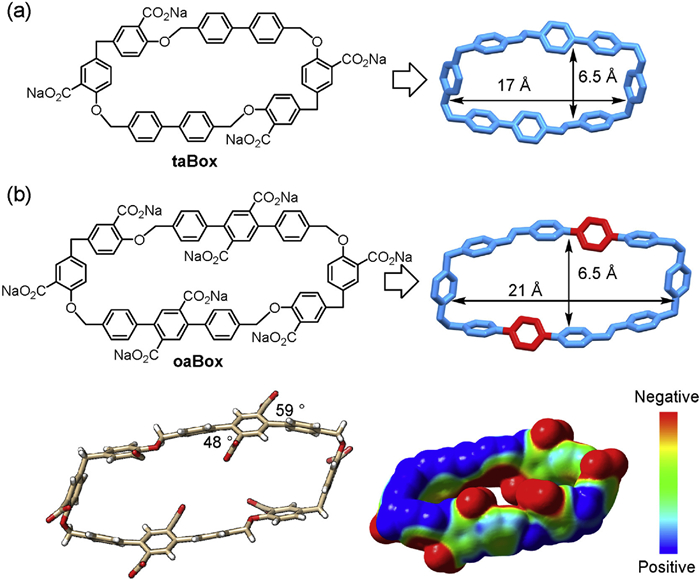
Figure 1.
(a) Macrocycle taBox and the backbone of its crystal structure. (b) Macrocycle oaBox, its crystal structure, and surface electrostatic potential. The Na+ ions are not shown for clarity.

Anionic rectangular macrocyclic box enabling quantitative formation of mono- and dihydrazones in water through host-guest complexation
Qihan Lin , Shi-Xian Gan , Hui Wang , Zhan-Ting Li , Dan-Wei Zhang


The discovery of the binding of crown ethers for metal ions by Pedersen marked the advent of chemistry beyond the molecule [1], while the synthesis of cryptands by Lehn for improved binding of metal ions led to the establishment of the research field of supramolecular chemistry [2]. With the design of more rigid spherands, carcerands and hemicarcerands [3], Cram made their entry as hosts with preorganized cavity for convergent recognition of ionic and molecular guests [4]. These seminal works have laid the foundations for the design and synthesis of host molecules such as calixarenes [5,6], cucurbiturils [7-10], pillararenes [11-17] and a variety of macrocycles [18-37] and molecular cages and capsules [38-43] for selective binding and detection of different kinds of guests. By making use of such host-guest binding mechanism, a large number of macrocycles have been developed as containers to realize the catalyzation or promotion of discrete organic transformations [39,44-49]. To search for other kinds of molecular hosts, in 1988 Stoddart developed tetracationic cyclobis(paraquat-p-phenylene) [50], which, also known as little blue box [51], bears two electron-deficient bipyridinium units and features rigid rectangular shape for including electron-rich aromatic guests driven through donor-acceptor interactions. By modifying the bipyridinium units and thep-phenylene spacers, a variety of cationic cyclophanes have been prepared for binding specifically designed aromatic guests and constructing interlocked supramolecular architectures and molecular machines [18,51-54]. Anionic, intrinsically rectangular cyclophanes incorporating electro-rich aromatic units are expected to include electron-deficient and/or hydrophobic aromatic guests in water. The resulting host-guest complexes not only constitute reverse complements for blue box-based counterparts, but also provide new binding patterns for exploring host-guest complexation-derived functions, which, however, have been rarely explored [55].
Hydrazone as one of the major dynamic covalent bonds has been widely used for the preparation of covalent organic frameworks [56,57] and biomedical polymers [58,59]. Although hydrazones possess higher intrinsic stability than imines [60], the formation of hydrazones in aqueous media is significantly dragged by water, which not only is one of the products, but also pushes the reverse reaction due to its high polarity and nucleophilicity as well as extremely large excess. Therefore, quantitative formation of hydrazones in water has been a challenge synthetically, even though multicovalency has been reported to quantitatively construct hydrazone-linked flexible organic frameworks and interlocked catenanes [61,62]. Herein we describe that an octaanionic, intrinsically rectangular macrocyclic container of 2.1 nm length can include two or three aromatic aldehyde and acylhydrazine precursors in water. We demonstrate that this inclusion can produce remarkably high confinement effect, which not only leads to quantitative formation of the resulting mono- and dihydrazones and high-yield formation (up to 95%) of a hydrazone from unreactive precursors, but also accelerates the kinetic process by up to 42.3 times.
Previous study revealed that tetraanionic macrocyclic box taBox gives rise to a rectangular cavity with a height of 7.3 Å and a length of 17 Å (Fig. 1a) [55]. Both crystal structure (Fig. 1a) and 1H NMR experiment confirmed that taBox can include electron-deficient aromatic guests, like 1,1'-dimethyl-4,4'-bipyridinium, through unique host-guest parallel arrangement, which maximizes donor-acceptor and hydrophobically driven intermolecular stacking. We thus designed and prepared extended octaanionic macrocyclic box oaBox by introducing two terphenyl units to extend the length (Fig. 1b), which was envisioned to enable the inclusion of two or even three aromatic molecules to promote their reaction through confinement effect [63].
The crystal structure of macrocycle oaBox showed that it also affords a rectangular shape (Fig. 1b). The terphenyl units and two of the four benzene rings constitute the two longer planes with a spatial separation of 21 Å, while another two benzene rings act as the shorter planes which has a spatial separation of 6.5 Å. The torsional angles between the central and two outward benzenes of the terphenyl unit are 48° and 59°, respectively. The crystal structure supports that this family of macrocycles have intrinsic tendency to form preorganized rectangular conformation, even though the four OCH2 linkers in the backbone may cause increased flexibility. The introduction of the eight carboxylate groups provides the macrocycle with a good water-solubility (≥50 mmol/L, 70 mg/mL). Surface electrostatic potential energy diagram revealed that the two longer surfaces of the backbone are relatively electron-rich (Fig. 1b) [64]. We thus conjectured that the macrocycle might simultaneously encapsulate two or even three electron-deficient and/or hydrophobic aromatic aldehyde and arylhydrazine guests in water to promote their reaction to afford hydrazone derivatves.
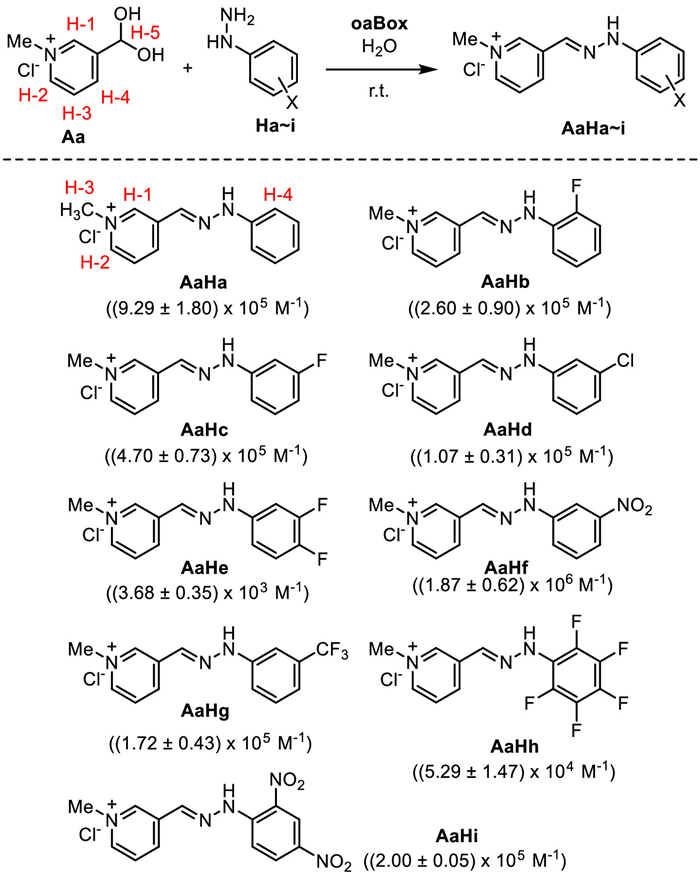
Before its potential for promoting hydrazone formation in water was investigated, we first studied the binding of oaBox for linear cationic hydrazone AaHa using 1H NMR spectroscopy (Scheme 1 and Fig. S1 in Supporting information). Compound AaHa was soluble in water due to the introduction of the pyridinium unit, and featured both hydrophobicity and electron-deficiency. Its signals in the 1H NMR spectrum could be assigned by analyzing their chemical shift, integrative strength, splitting modes, and coupling constants. Adding oaBox (0 to 1.5 equiv.) to the solution of AaHa (1.0 mmol/L) in D2O caused all its proton signals to shift upfield. Remarkably, the H-1~4 signals (Scheme 1) shifted upfield by 0.95, 0.95, 1.16, and 0.74 ppm, respectively, which indicated that the hydrazone was wholly included in the cavity of oaBox in parallel stacking manner, which maximized intermolecular donor-acceptor and hydrophobic interactions. Direct UV-vis absorption assays were then conducted by gradually adding oaBox to the solution of AaHa in water (Fig. S2 in Supporting information). Fitting the absorbance change of AaHa at 364 nm to a standard 1:1 binding model allowed the determination of the binding constant (Ka) for complex oaBox∙AaHa to be (9.29 ± 1.80) × 105 L/mol (Scheme 1). By assuming 1:1 complexation, we further conducted UV-vis titration assays to determine the Ka values of the complexes formed between oaBox and another eight hydrazones AaHb~i (Figs. S3–S10 in Supporting information), which ranged from (3.68 ± 0.35) × 103 to (1.87 ± 0.62) × 106 L/mol (Scheme 1). These values indicated that, at a relatively high concentration, the box can include the hydrazones in its cavity.
The binding affinity of oaBox for aldehyde Aa, which exclusively existed as hydrate in water as indicated by the 1H NMR spectrum in D2O, and phenylhydrazine Ha in D2O was also investigated using 1H NMR spectroscopy (Figs. S11 and S12 in Supporting information). Adding 1.0 equiv. of oaBox caused the H-1~5 signals of Aa (0.37 mmol/L) to shift upfield by 0.33-0.55 ppm. By assuming a 1:1 binding mode, the Ka of complex oaBox·Aa was determined to be (2.46 ± 0.68) × 103 L/mol using 1H NMR titration experiments (Fig. S11). For neutral phenyhydrazine Ha (0.37 mmol/L), the signals of ortho- and para-protons were induced oaBox (1.0 equiv.) to shift upfield by 0.04 and 0.07 ppm (Fig. S12). These results indicated that both Aa and Ha could be included into the cavity of oaBox, even though the inclusion for Ha was relatively weaker.
The reaction of compounds Aa and Ha (1:1, 1.0 mmol/L) in water in the absence and presence of oaBox (1.0 mmol/L) was then studied by using high performance liquid chromatography (HPLC) to determine the amount and final yield of the hydrazone product AaHa. The results are provided in Table 1. It was found that, in the absence of oaBox, the reaction reached equlibrium after 176 minutes (min) to afford AaHa in 98% yield. In the presence of 1.0 equiv. of oaBox, the time for reaction equilibrium was shorteded to 7.0 min, which represented 25.1 times of reaction acceleration, and the yield further increased to 99%. By using HPLC to moniter time-dependent yields of AaHa in the absence and presence of oaBox (Fig. S13 in Supporting information), and the reaction process was monitored by 1H NMR spectroscopy (Fig. S14 in Supporting information). Based on the classical second-order kinetic equation, the second-order rate constants (kn andkp) of the reaction in the absence and presence of oaBox were determined to be 74 and 3130 L mol-1 min-1, respectively (Figs. S15 and S16 in Supporting information), which showed that oaBox could realize 42.3 times of acceleration.
 DownLoad:
CSV
| Hydrazone | No oaBox | oaBox | kp/kn | |||||
| Yield (%) | Time (min) | kn (L mol-1 min-1) | Yield (%) | Time (min) | kp (L mol-1 min-1) | |||
| AaHa | 98 | 176 | 74 | 99 | 7 | 3130 | 42.3 | |
| AaHb | 85 | 170 | 30 | 97 | 73 | 190 | 6.33 | |
| AaHc | 91 | 209 | 33 | 99 | 72 | 330 | 10.0 | |
| AaHd | 93 | 214 | 44 | 96 | 72 | 250 | 5.68 | |
| AaHe | 80 | 243 | 19 | 97 | 90 | 410 | 21.5 | |
| AaHf | 62 | 248 | 8.0 | 98 | 150 | 98 | 12.2 | |
| AaHg | 64 | 271 | 9.0 | 97 | 135 | 81 | 9.00 | |
| AaHh | 0 | / | 0 | 95 | 642 | 16 | / | |
| AaHi | 0 | / | 0 | 61 | 1262 | 0.6 | / | |
| a The concentration of compounds Aa, Ha-h and oaBox was kept at 1.0 mmol/L, except for the case of AaHi where their concentration was 0.05 mmol/L due to the limited solubility of Hi in water. | ||||||||
The reactions of aldehyde Aa with phenylhydrazine derivatives Hb~i in water to form hydrazones AaHb~i were then investigated in the absence and presence of macrocycle oaBox (Figs. S17–S24 in Supporting information). The results are summarized in Table 1. It can be found that the introduction of the electron-withdrawing groups to the hydrazine reactants generally reduced the reactivity of the hydrazines. As a result, the yield of the resulting hydrazone products AaHb~g were all decreased. Although the time for the reaction of Hb to reach equilibrium was slightly shorter than that of the rection of Ha, the times needed for Hc-g were all longer. In the presence of oaBox, the yields of all the hydrazones were increased. Notably, the yields of AaHf and AaHg were increased from 62% and 64% to 98% and 97%, respectively. Although AaHh and AaHi could not be formed in a detectable yield from the mixtures of Aa with Hh and Hi, oaBox could promote the two reactions to take place to afford the corresponding hydrazones in 95% and 61% yields, respectively. For the reactions to form AaHb-g, 1.0 equiv. of oaBox could raise the rate constants by 5.68-21.5 times.
The promotion effect of macrocycle oaBox for the reaction of Aa and 4-chloroaniline in D2O was also investigated using 1H NMR spectrscopy, which showed that, at the 1.0 mmol/L concentration, no imine product was observed from their 1:1 mixture. In the presence of oaBox of 1.0 mmol/L, the imine product, which was less stable than the hydrazone products, was formed in 65% yield (Fig. S25 in Supporting information), which indicated the promotion effect of the container. 1H NMR spectroscipy also showed that that oaBox did not promote the reaction of sodium 4-formylbenzoate with Ha to form the corresponding hydrazone in D2O. This outcome was consistent with the observation that the container did not include 4-formylbenzoate since adding oaBox to the solution of the benzoate did not induce the shifting of its signals in the 1H NMR spectrum, which may be attributed to the electrostatic repulsion of their carboxylate units.
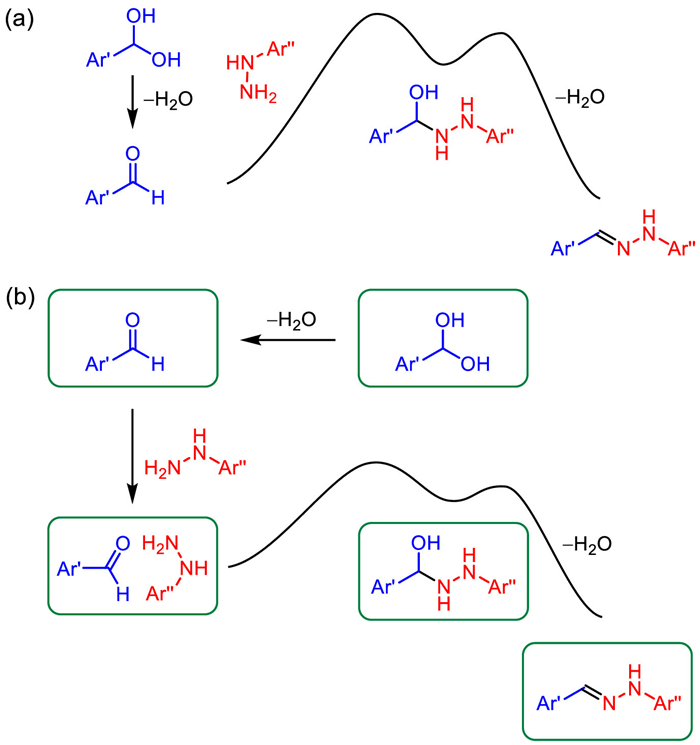
Both the aldehyde Aa, phenylhydrazine substrates Ha-i, hydrazineylmethanol intermediates, and the hydrazone products AaHa~i are hydrated (solvated) in water (Fig. 2a). The hydrated Aa was first dehydrated to the aldehyde itself and then reacted with the hydrazines to form the hydrazineylmethanol intermediates, which underwent dehydration to afford the hydrazone products. For hydrated aldehyde Aa, the complexation by oaBox was expected to promote its dehydration to the aldehyde state due to partial shield of water molecules in the cavity and thus improve the reactivity of the aldehyde toward the phenylhydrazines through desolvation (Fig. 2b). The above 1H NMR experiments showed that oaBox had a weak binding affnity for the neutral phenylhydrazine substrates. Thus, we may propose that, in one manner (Fig. 2b), the hydrazine was included into the cavity of oaBox and thereby significantly dehydrated to facilite its reaction with Aa included in the cavity of oaBox, which would faciliate the coupling reaction due to improved reactivity of the substrates and confinement effect produced by oaBox. That is, it is reasonable to propose that the oaBox container generally reduced the energy barrier of the reactions. Since oaBox also showed much higher binding affinity for the hydrazone products than the two reaction substrates, the hydrazone products should also be considerably dehydrated and stabilized by oaBox. This stabilization effect also helped to reduce the energy barrier of the reactions. As a result, oaBox could substantially accelerate the reactions and increase their yields. For all investigated reactions, the acceleration effect was obvious, reflecting the robustness of the anionic macrocyclic box in promoting this kind of chemical transformations in water, as revealed for organic transformations mediated by cyclodextrin, calixarene, resorcinarene, pillararene, and cucurbituril cavities in water [45,49,65-69]. In another manner, the hydrazines were not included into the cavity of oaBox, but reacted from the outside of the cavity to produce the intermediates, which were then included into the cavity to afford the hydrazones after dehydration. In this manner, the formation of the intermediates were also promoted by oaBox, which, however, was less efficient. Since the binding affinity of container oaBox for the Aa substrate was modest and for the hydrazines was limited, it is reasonalbe to propose that, at the concentration of 1.0 mmol/L for both the substrates and the container, this reaction promotion and acceleration should be mainly driven by inclusion-induced dehydration of Aa, even though inclusion-induced increase of the substrates in the oaBox container might also make a contribution.
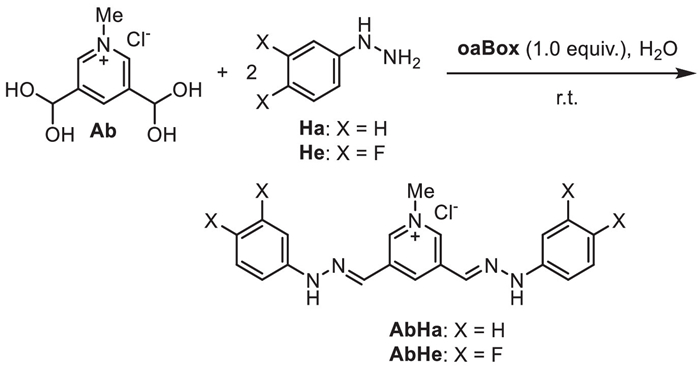
We then further explored whether oaBox was capable of promoting the three-component condensation reactions between dialdehyde Ab and hydrazine Ha or He to produce dihydrazones AbHa and AbHe (Scheme 2). 1H NMR showed that Ab existed exclusively in the dihydrated state. The concentration of all the substrates and oaBox were maintained at 1.0 mmol/L. The two reactions was monitored using 1H NMR (Figs. S26 and S27 in Supporting information). In the absence of oaBox, the reaction between Ab and Ha reached equilibrium in 300 min, and dihydrazone AbHa was formed in 71% yield. In the presence of oaBox, the reaction could reach equilibrium in about 100 min, and the yield of AbHa was increased to 99% (Fig. S28 in Supporting information). In both cases, the monohydrazone intermediate was not detected, which indicated that the formation of the second hydrazone bond was much quicker than the formation of the first one possibly as a result of enhanced confinement effect, since we may propose that oaBox should possess higher binding affinity for the intermediate than Ab. Dihydrazone AbHe was found to be insoluble in water. In the absence of oaBox, the reaction of Ab and He in water afforded AbHe as a precipitate. The reaction reached equilibrium after 360 min and AbHe was obtained in 41% yield. In the presence of 1.0 equiv. of oaBox, the reaction reached equilibrium in 120 min, with the yield of AbHe being increased to 99% (Fig. S28 in Supporting information). Clearly, oaBox not only accelerated the two reactions, but also raised the yields of the dihydrazone products.
In summary, we have demonstrated that a water-soluble octaanionic rectangular macrocyclic box can remarkably promote and accelerate the formation of hydrazones in water from aldehyde and phenylhydrazine substrates. This promotion effect is mainly realized through the complexation of the box for both substrates and products which weakens their hydration. For the substrates, this weakening effect reduces the stability of aldehyde hydrates, promotes its conversion to aldehydes, and increases the reactivity of the aldehydes. For the hydrazone products, the complexation suppresses their hydration and hydrolysis to the substrates as well as increases their stability. Both complexation effects facilitate the reduction of the energy barrier of the reactions, thus accelerate the reactions and raise the yields of the hydrazone products. The work provides a proof-in-concept example illustrating the usefulness of anionic macrocyclic boxes in promoting chemical transformations through efficient host-guest complexation. The solvation of the substrates for a bimolecular reaction in solution is unfavorable. When one or two substrates can be included into the cavity of a macrocyclic host to weaken their solvation, the reaction would be promoted and accelerated. Thus, in principle, the concept reported in this work should be applied for other macrocyclic hosts. When the binding affinity of the macrocycle for the product is lower than that for the substrate(s), we may expect the achievement of catalytic function for the macrocycle, which is the key feature of natural enzymes. New host-guest complexation-promoted chemical transformations are being investigated for these aims.
Qihan Lin: Writing – original draft, Investigation. Shi-Xian Gan: Writing – original draft, Investigation. Hui Wang: Supervision, Project administration. Zhan-Ting Li: Writing – review & editing, Validation, Supervision, Resources, Methodology, Funding acquisition, Data curation, Conceptualization. Dan-Wei Zhang: Writing – review & editing, Supervision, Resources, Funding acquisition, Data curation, Conceptualization.
The authors declare no interest conflict.
We thank the National Natural Science Foundation of China (Nos. 22271059 and 22531011) for financial support.
Supplementary material associated with this article can be found, in the online version, at doi:
C.J. Pedersen, J. Am. Chem. Soc. 89 (1967) 7017–7036. doi: 10.1021/ja01002a035
B. Dietrich, J.M. Lehn, J.P. Sauvage, Tetrahedron Lett. 10 (1969) 2889–2892. doi: 10.1016/S0040-4039(01)88300-3
D.J. Cram, T. Kaneda, R.C. Helgeson, et al., J. Am. Chem. Soc. 101 (1979) 6752–6754. doi: 10.1021/ja00516a048
D.J. Cram, Science 240 (1988) 760–767. doi: 10.1126/science.3283937
C.D. Gutsche, R. Muthukrishnan, K.H. No, Tetrahedron Lett. 20 (1979) 2213–2216. doi: 10.1016/S0040-4039(01)93679-2
Y.X. Yue, Y.L. Lin, M.M. Chen, et al., Sci. China Chem. 67 (2024) 1697–1706. doi: 10.1007/s11426-023-1857-2
W.A. Freeman, W.L. Mock, N.Y. Shih, J. Am. Chem. Soc. 103 (1981) 7367–7368. doi: 10.1021/ja00414a070
J. Kim, I.S. Jung, S.Y. Kim, et al., J. Am. Chem. Soc. 122 (2000) 540–541. doi: 10.1021/ja993376p
J. Li, Y. Zhang, S. Liu, et al., Chin. Chem. Lett. 35 (2024) 109645. doi: 10.1016/j.cclet.2024.109645
Q. Niu, Y. Ye, L. Su, et al., Sci. China Chem. 68 (2025) 2671–2679. doi: 10.1007/s11426-024-2410-x
T. Ogoshi, S. Kanai, S. Fujinami, et al., J. Am. Chem. Soc. 130 (2008) 5022–5023. doi: 10.1021/ja711260m
D. Cao, Y. Kou, J. Liang, et al., Angew. Chem. Int. Ed. 48 (2009) 9721–9723. doi: 10.1002/anie.200904765
J. Yang, X.Y. Lou, D. Dai, et al., Chin. Chem. Lett. 36 (2025) 109818. doi: 10.1016/j.cclet.2024.109818
C. He, R. Huang, L. Wei, et al., Chin. Chem. Lett. 36 (2025) 110103. doi: 10.1016/j.cclet.2024.110103
H. Yao, W. Cao, J. Wang, et al., Chin. J. Chem. 43 (2025) 1487–1494. doi: 10.1002/cjoc.70011
Q.L. Su, J.F. Chen, X.M. Sun, et al., Chin. J. Chem. 42 (2024) 2471–2478. doi: 10.1002/cjoc.202400394
Y. Zhu, Y. Gao, J.R. Jr, et al., Chem. Eur. J. 31 (2025) e202404424. doi: 10.1002/chem.202404424
Y. Feng, X. Zhao, D.A. Appleton, et al., CCS Chem. 6 (2024) 2679–2691. doi: 10.31635/ccschem.024.202404812
X.N. Han, Y. Han, C.F. Chen, Chem. Soc. Rev. 52 (2023) 3265–3298. doi: 10.1039/D3CS00002H
Q.Y. Hong, B. Huang, et al., Chin. J. Chem. 42 (2024) 1895–1900. doi: 10.1002/cjoc.202400134
Y.Y. Liu, X.Y. Yu, Y.C. Pan, et al., Sci. China Chem. 67 (2024) 1397–1441. doi: 10.1007/s11426-024-1971-4
C. Liu, L. Wang, Z. Wang, et al., Supramol. Mater. 4 (2025) 100107.
P. Wang, Y. Li, L. Zhao, et al., Chin. J. Chem. 43 (2025) 1173–1180. doi: 10.1002/cjoc.202401247
Y. Wu, C. Zhang, S. Fang, et al., Angew. Chem. Int. Ed. 61 (2022) e202209078. doi: 10.1002/anie.202209078
J. Zhu, X.D. Wang, Y.F. Ao, et al., Sci. China Chem. 68 (2025) 5001–5006. doi: 10.1007/s11426-025-2637-2
J. Guo, S. Li, H. Yao, et al., Chin. J. Org. Chem. 44 (2024) 1777–1785. doi: 10.6023/cjoc202401021
W. Zhu, Y. Zhou, B. Zhao, et al., Chin. J. Chem. 43 (2025) 3125–3132. doi: 10.1002/cjoc.70275
Z. Shen, S. Li, L. Yang, et al., Chin. J. Org. Chem. 44 (2024) 1151–1159. doi: 10.6023/cjoc202310017
W. Zhang, S. Su, P. Yang, Chin. J. Org. Chem. 45 (2025) 1395–1401. doi: 10.6023/cjoc202407038
Y. Guo, M. Zhang, Z. Gong, et al., Acta Chim. Sin. 83 (2025) 309–318. doi: 10.6023/A24110357
Y. Wang, R. Wang, P. Yang, et al., Acta Chim. Sin. 83 (2025) 588–595. doi: 10.6023/A25010028
T.H. Shi, Q.H. Guo, S. Tong, et al., Acc. Chem. Res. 58 (2025) 2573–2585. doi: 10.1021/acs.accounts.5c00328
X.N. Han, Y. Han, C.F. Chen, Angew. Chem. Int. Ed. 64 (2025) e202424276. doi: 10.1002/anie.202424276
H. Zhu, L. Chen, B. Sun, et al., Nat. Rev. Chem. 7 (2023) 768–782. doi: 10.1038/s41570-023-00531-9
F.Y. Chen, H.F. Zhang, K. Cai, et al., Supramol. Mater. 4 (2025) 100101.
X. Zhang, Z. Lu, T. Ren, et al., Chin. Chem. Lett. 36 (2025) 110946. doi: 10.1016/j.cclet.2025.110946
Y. Zhang, Y. Liu, Y. Wu, et al., CCS Chem. 7 (2024) 50–58.
C.J.T. Cox, J. Hale, P. Molinska, et al., Chem. Soc. Rev. 53 (2024) 10380–10408. doi: 10.1039/D4CS00761A
Q.Q. Wang, Acc. Chem. Res. 57 (2024) 3227–3240. doi: 10.1021/acs.accounts.4c00583
G. Montà-González, F. Sancenón, R. Martínez-Máñez, et al., Chem. Rev. 122 (2022) 13636–13708. doi: 10.1021/acs.chemrev.2c00198
Z. Zhang, Z. Li, C. Liu, et al., Chin. Chem. Lett. 36 (2025) 111322. doi: 10.1016/j.cclet.2025.111322
S. Guo, M. Li, C. Lian, et al., CCS Chem. 7 (2024) 1005–1015.
Y. Chen, Y. Gao, Y. Zhu, et al., Acta Chim. Sin. 83 (2025) 993–999. doi: 10.6023/A25050190
C. Wang, L. Xu, Z. Jia, et al., Chin. Chem. Lett. 35 (2024) 109075. doi: 10.1016/j.cclet.2023.109075
K. Wang, J.H. Jordan, K. Velmurugan, et al., Angew. Chem. Int. Ed. 60 (2021) 9205–9214. doi: 10.1002/anie.202010150
J. Meeuwissen, J.N.H. Reek, Nat. Chem. 2 (2010) 615–621. doi: 10.1038/nchem.744
H. Nie, D. Hu, Z. Zeng, et al., Sci. China Chem. 67 (2024) 1605–1612. doi: 10.1007/s11426-023-1926-9
X. Tang, J. Qin, W. Xu, et al., CCS Chem. 7 (2025) 2044–2053. doi: 10.31635/ccschem.025.202405229
Q. Liu, Y. Shi, K. Wang, et al., Chin. Chem. Lett. 36 (2025) 111462. doi: 10.1016/j.cclet.2025.111462
B. Odell, M.V. Reddington, A.M.Z. Slawin, et al., Angew. Chem. Int. Ed. 27 (1988) 1547–1550. doi: 10.1002/anie.198815471
X.Y. Chen, H. Chen, J.F. Stoddart, Angew. Chem. Int. Ed. 62 (2023) e202211387. doi: 10.1002/anie.202211387
I. Neira, A. Blanco-Gómez, J.M. Quintela, et al., Acc. Chem. Res. 53 (2020) 2336–2346. doi: 10.1021/acs.accounts.0c00445
E.J. Dale, N.A. Vermeulen, M. Juríček, et al., Acc. Chem. Res. 49 (2016) 262–273. doi: 10.1021/acs.accounts.5b00495
Y. Li, N. Li, G. Li, et al., J. Am. Chem. Soc. 145 (2023) 9118–9128. doi: 10.1021/jacs.3c00800
Q. Lin, J. Xing, Y.Y. Liu, et al., Chin. Chem. Lett. 35 (2024) 109119. doi: 10.1016/j.cclet.2023.109119
F.J. Uribe-Romo, C.J. Doonan, H. Furukawa, et al., J. Am. Chem. Soc. 133 (2011) 11478–11481. doi: 10.1021/ja204728y
H. Zhuang, C. Guo, J. Huang, et al., Angew. Chem. Int. Ed. 63 (2024) e202404941. doi: 10.1002/anie.202404941
F. Seidi, R. Jenjob, D. Crespy, Chem. Rev. 118 (2018) 3965–4036. doi: 10.1021/acs.chemrev.8b00006
D. Ramimoghadam, D.J. Eyckens, R.A. Evans, et al., Chem. Eur. J. 30 (2024) e202401728. doi: 10.1002/chem.202401728
J. Kalia, R.T. Raines, Angew. Chem. Int. Ed. 47 (2008) 7523–7526. doi: 10.1002/anie.200802651
J.L. Lin, Z.K. Wang, Z.Y. Xu, et al., J. Am. Chem. Soc. 142 (2020) 3577–3582. doi: 10.1021/jacs.9b13263
H. Li, H. Zhang, A.D. Lammer, et al., Nat. Chem. 7 (2015) 1003–1008. doi: 10.1038/nchem.2392
H. Takezawa, M. Fujita, Bull. Chem. Soc. Jpn. 94 (2021) 2351–2369. doi: 10.1246/bcsj.20210273
G. Wu, S.Y. Zhuang, J. Xing, et al., Org. Lett. 26 (2024) 2007–2012. doi: 10.1021/acs.orglett.4c00033
Y. Yu, J. Rebek Jr., Acc. Chem. Res. 51 (2018) 3031–3040. doi: 10.1021/acs.accounts.8b00269
M.D. Rosa, P.L. Manna, C. Talotta, et al., Front. Chem. 6 (2018) 84. doi: 10.3389/fchem.2018.00084
B. Tang, J. Zhao, J.F. Xu, et al., Chem. Eur. J. 26 (2020) 15446–15460. doi: 10.1002/chem.202003897
W. Yang, W. Zhang, J. Chen, et al., Chin. Chem. Lett. 35 (2024) 108740. doi: 10.1016/j.cclet.2023.108740
L. Mao, S. Li, X. Zhang, et al., Chin. Chem. Lett. 35 (2024) 109363. doi: 10.1016/j.cclet.2023.109363

Figure 1 (a) Macrocycle taBox and the backbone of its crystal structure. (b) Macrocycle oaBox, its crystal structure, and surface electrostatic potential. The Na+ ions are not shown for clarity.

Scheme 1 The reactions of hydrated aldehyde Aa and phenylhydrazones Ha~i in water in the presence of oaBox (1.0 equiv.). The values in the parentheses are the binding constant of the complexes formed between oaBox and the corresponding hydrazones.

Figure 2 The mechanism of the formation of the hydrazones in water in the absence (a) and presence (b) of oaBox, highlighting the promotion and acceleration of the macrocycle for the formation of the hydrazones through host-guest inclusion of the substrates, intermediates and the products.

Scheme 2 The reactions of Ab with Ha andHe in water in the presence of ocBox (1.0 equiv.).
Table 1. Summary of the yields, second-order rate constants and rate constant ratios of the reactions of Aa and Ha~i in water at 25 ℃ to produce hydrazones AaHa~i in the absence and presence of macrocycle oaBox.a
| Hydrazone | No oaBox | oaBox | kp/kn | |||||
| Yield (%) | Time (min) | kn (L mol-1 min-1) | Yield (%) | Time (min) | kp (L mol-1 min-1) | |||
| AaHa | 98 | 176 | 74 | 99 | 7 | 3130 | 42.3 | |
| AaHb | 85 | 170 | 30 | 97 | 73 | 190 | 6.33 | |
| AaHc | 91 | 209 | 33 | 99 | 72 | 330 | 10.0 | |
| AaHd | 93 | 214 | 44 | 96 | 72 | 250 | 5.68 | |
| AaHe | 80 | 243 | 19 | 97 | 90 | 410 | 21.5 | |
| AaHf | 62 | 248 | 8.0 | 98 | 150 | 98 | 12.2 | |
| AaHg | 64 | 271 | 9.0 | 97 | 135 | 81 | 9.00 | |
| AaHh | 0 | / | 0 | 95 | 642 | 16 | / | |
| AaHi | 0 | / | 0 | 61 | 1262 | 0.6 | / | |
| a The concentration of compounds Aa, Ha-h and oaBox was kept at 1.0 mmol/L, except for the case of AaHi where their concentration was 0.05 mmol/L due to the limited solubility of Hi in water. | ||||||||
 下载: 导出CSV

 扫一扫看文章


扫一扫关注我们
 下载: