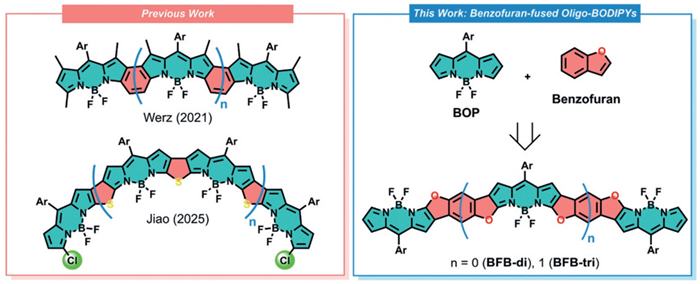
Figure 1.
Benzene-fused oligo-BODIPYs and thiophene-fused oligo-BODIPYs (left), as well as the modulation strategies for the benzofuran-fused oligo-BODIPYs reported in this work.

NIR fluorescent benzofuran-fused oligo-BODIPY dyes: Synthesis, characteristics and tunable electrochemical properties
Limin He , Xiaomao Zhou , Yongli Zhang , Luyan Tian , Yanqing Li , Yunxia Zhao , Shulin Gao , Yanni Li , Yanhua Yang , Weili Li , Xiangguang Li , Wei Fan , Wei Jiang , Zhaohui Wang


Large π-conjugated systems are key components of next-generation optoelectronic functional materials, with promising applications in cutting-edge fields such as semiconductor devices [1–6], molecular wires [7–10], organic photovoltaic [11–15], and NIR absorbers [16–19]. Owing to extensive electronic delocalization, these systems enable precise modulation of photophysical properties [20–25], making π-expanded luminescent molecules one of the most active research frontiers in modern organic materials science [26–29]. Nevertheless, conventional large π-conjugated systems remain fundamentally constrained by two major drawbacks: (1) Their synthetic routes are often cumbersome and low-yielding, and are further complicated by poor solubility, fluorescence quenching, and reduced photostability, challenges that primarily stemming from rigid, planar structures; and (2) the trade-off of extending absorption and emission into the near-infrared (NIR) region while maintaining high luminescent efficiency. These challenges, coupled with a still-limited understanding of their structure-property relationships, highlight the urgent need for efficient and controllable synthetic strategies that enable structurally diverse and performance-tunable π-extended molecular systems.
Boron-dipyrromethene (BODIPY) dyes, which share key structural motifs with porphyrinoid systems, offer several significant advantages [30–32], including high luminescence efficiency, excellent solubility and stability, and tunable optoelectronic properties, making them ideal building blocks for constructing large π-conjugated systems. Their pyrrole units can be readily functionalized to fine-tune electronic properties, which has led to a variety of π-extended BODIPY systems with enhanced optoelectronic behavior [33–38]. In particular, conformationally constrained BODIPY oligomers [39–49] enable precise tuning of photoelectronic properties into the NIR region, thereby expanding their utility in diverse applications, including NIR-absorbing dyes, thermally activated delayed fluorescence (TADF) emitters [50,51], photodynamic therapy agents [52–56], and organic light-emitting diodes (OLEDs) [57–59]. For instance, Werz and co-workers reported fully conjugated benzene-fused oligo-BODIPYs that exhibit strong solvatochromism, red-shifted emission, and sharpened bands at high concentrations, suggesting their promise for NIR-absorbing dyes and remote biomedical imaging (Fig. 1) [60,61]. Heteroatoms (S, N, O) incorporation into fused frameworks has further emerged as an effective strategy to tune BODIPY optoelectronic properties and improve luminescence efficiencies [62–67]. In 2025, Jiao and co-workers reported fully conjugated thiophene-fused oligo-BODIPYs, providing a new platform for designing narrow-band NIR-emissive TADF molecules via precisely singlet-triplet energy levels modulation (Fig. 1) [68]. However, many reported π-expanded BODIPY systems still suffer from relatively low fluorescence quantum yields (ΦF), with values seldom exceeding 0.5, and their synthesis and purification often remain practically challenges. Therefore, a deeper molecular-level understanding of structure–property relationships in heteroatom-containing π-conjugated systems is essential to guide the rational design of next-generation high-performance luminescent materials.
Herein, we report an efficient synthesis of a series of benzofuran-fused BODIPY architectures with well-defined oligomeric structures, enabled by halogenated BODIPY precursors through a synergistic combination of nucleophilic aromatic substitution (SNAr) and C–H coupling reactions. Photophysical studies show pronounced bathochromic shifts, with absorption maxima red-shifting from 503 nm for the parent BODIPY (BOP) to 716 nm for BFB-tri in toluene, demonstrating significant NIR absorption. Notably, the benzofuran-fused trimer BFB-tri exhibits an exceptionally high molar absorption coefficient (400,000 L mol−1 cm−1) and a ΦF of up to 65.4%. Further investigations reveal that benzofuran incorporation primarily modulates the highest occupied molecular orbital (HOMO) energy level, whereas the number of BODIPY subunits predominantly governs the lowest unoccupied molecular orbital (LUMO) energy level; increasing the number of fused units progressively raises the HOMO and lowers the LUMO, thereby narrowing the HOMO–LUMO gap. These trends are supported by cyclic voltammetry and theoretical calculations. Overall, this study demonstrates the precise construction of heteroatom-doped polycyclic π-systems and elucidates key mechanisms for HOMO/LUMO fine-tuning, offering new insights and design principles for next-generation NIR fluorescent dyes.
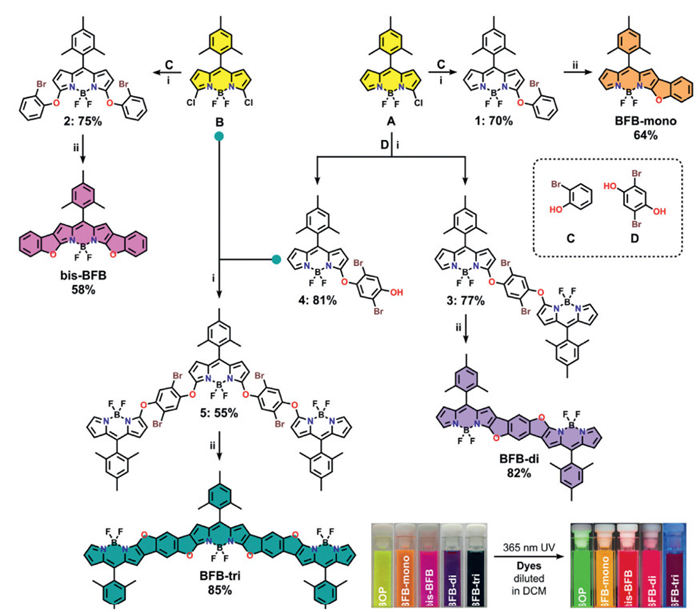
The synthesis of key precursors 1–5 was accomplished through regioselective chlorination followed by intermolecular nucleophilic aromatic substitution (SNAr), using compound A (3–chloro) or compound B (3,5-dichloro) as the starting materials. These chlorinated BODIPY derivatives reacted with different equivalents of 2-bromophenol C in the presence of K2CO3 at 80 ℃ in acetonitrile to furnish precursors 1 and 2 in 70% and 75% yields, respectively (Scheme 1). Reaction of compound A with 2,5-dibromobenzene-1,4-diol D afforded intermediates 3 and 4 in 77% and 81% yields, respectively, and a subsequent SNAr reaction of intermediate 4 with compound B provided precursor 5 in 55% yield. With these intermediates in hand, a Pd(OAc)2 (10 mol%)/(±)-2,2′-bis(diphenylphosphino)-1,1′-binaphthyl (BINAP) (20 mol%) catalytic system in the presence of Cs2CO3 (2.0 equiv.) under an argon atmosphere was employed to induce directed C–H activation and intramolecular cyclization in anhydrous toluene at 110 ℃. This strategy generated mono-benzofuran-fused (BFB-mono), bis-benzofuran-fused (bis-BFB), and benzofuran-fused oligo-BODIPYs (BFB-di and BFB-tri) in 58%–85% yields. Notably, BFB-di and BFB-tri were obtained in excellent yields of 82% and 85%, respectively, and were isolated as dark brown solids with a metallic luster, demonstrating high stability in both air and solution.
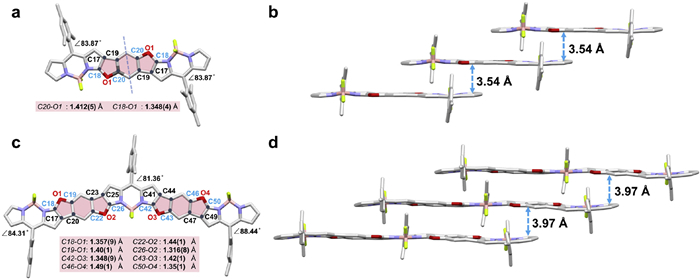
Deposition numbers CCDC: 2501623 (for BFB-di), and CCDC: 2501624 (for BFB-tri) are provided free of charge by the joint Cambridge Crystallographic Data Centre. Single-crystal X-ray configurations of the benzofuran-fused dimers BFB-di and trimers BFB-tri (Fig. 2), with crystallographic data summarized in Tables S1–S6 (Supporting information). Both structures display nearly orthogonal orientations between the BODIPY cores and the meso-mesityl groups, with dihedral angles ranging from 81.36° to 88.44° (Figs. 2a and c). The bulkier orthogonal mesityl substituents also account for the higher solubility of the trimer relative to the dimer. The side view of BFB-di (Fig. 2b) shows an expected planar π-conjugated framework. In contrast, the trimer BFB-tri (Fig. 2d) displays a slight curvature, with its terminal BODIPY units bending in opposite directions. This distortion arises from strain imposed by the central BODIPY unit, which links the two terminal subunits and induces asymmetry across the extended molecule. Analysis of the C–C bond lengths connecting the BODIPY and phenyl rings further elucidates the conjugation characteristics of the fused structures. Under C2 symmetry, BFB-di exhibits a uniform C–C bond length of 1.443 Å (Table S3). In contrast, BFB-tri shows pronounced bond-length variation: Bonds proximal to the central BODIPY unit are shorter (1.419–1.431 Å), whereas more distant are longer (1.433–1.489 Å), reflecting structural distortion arising from steric congestion and extended electronic delocalization (Table S5). The extension of the π-conjugated system also modulates intermolecular packing behavior. In the crystal structure of BFB-di, a short π–π stacking distance of 3.54 Å is observed (Fig. 2b), falling within the typical range for aromatic stacking interactions. For BFB-tri, the π–π distance increases by 0.43 Å (Fig. 2d), attributed mainly to steric hindrance from central mesityl substituents that weaken π–π interactions. These interactions promote highly directional stacking pathways, resulting in parallel alignment of both the dimer and trimer in the crystalline state.
To elucidate the aromatic characteristics of these oligomeric BODIPYs, nuclear independent chemical shift values (NICS(0)) were calculated for the series (Fig. 3a and Fig. S24 in Supporting information) and the associated aromatic ring currents were analyzed using anisotropy of the induced current density (ACID) plots (Fig. 3b and Fig. S26 in Supporting information). The furan rings in both oligomers exhibit clear aromatic character, with NICS(0) values of −4.11~−4.33 ppm, and their ACID plots display pronounced clockwise diatropic ring currents, confirming their aromaticity. A marked difference is observed between the pyrrole ring adjacent to the furan unit and the more distal pyrrole ring: The proximal pyrrole ring exhibits more negative NICS(0) values (−6.27~−6.52 ppm) than the distal pyrrole ring (−5.99~−6.02 ppm) (Fig. 3a). The ACID plots further reveal that the diatropic current within the B–N six-membered heterocycle mediates π-conjugation between the furan and pyrrole rings, indicating that the benzofuran incorporation significantly modifies the local aromatic character of the neighboring pyrrole units.
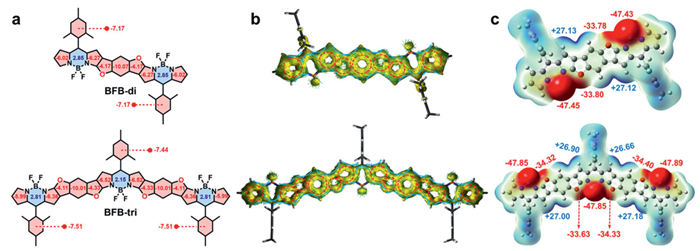
To further evaluate the influence of benzofuran fusion on charge distribution, electrostatic potential (ESP) maps were computed at the TPSSh/6–31+G* level (Fig. 3c and Fig. S23 in Supporting information). The fluorine atoms exhibit strong negative potential near both the oxygen-fused region and the BODIPY core, and the introduction of oxygen substantially alters the ESP distribution around BF2 unit [62]. As the extent of benzofuran fusion increases (BOP → BFB-mono → bis-BFB), the strong electronegativity of the oxygen atom renders the ESP at the BF2 center increasingly negative (−45.22 → −50.62 → −54.72 kcal/mol). In contrast, for the larger oligomers (BFB-di and BFB-tri), the ESP at the BF2 center becomes less negative (−47.43~−47.89 kcal/mol), and the ESP around the oxygen atoms also increases (−33.63~−34.40 kcal/mol). This trend can be attributed to enhanced intramolecular π-electron delocalization in the extended oligomers, consistent with the NICS(0) and ACID analyses. As π-conjugation becomes more extensively delocalized across the larger framework, the electron density around the BF2 unit is redistributed more evenly, thereby weakening localized charge accumulation and increasing the electrostatic potential.
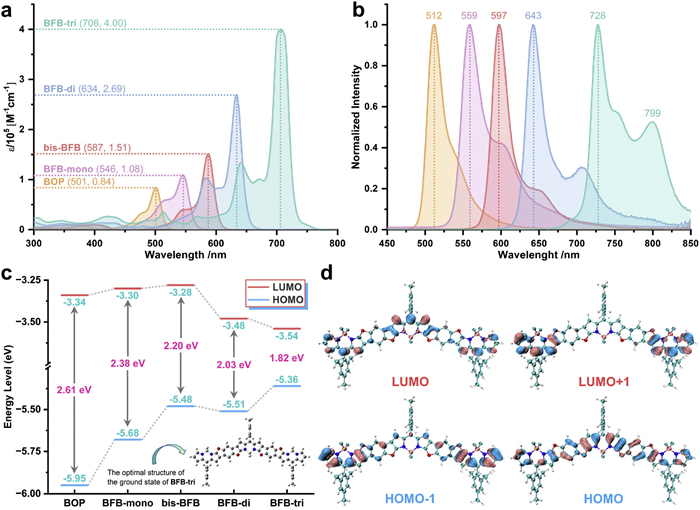
The photophysical properties of meso-mesityl BODIPY (BOP), mono-benzofuran-fused (BFB-mono), bis-benzofuran-fused (bis-BFB), and the benzofuran-fused oligo-BODIPYs (BFB-di and BFB-tri) were investigated using UV/visible absorption and fluorescence spectroscopy (Fig. 4, Table 1 and Figs. S3–S16 in Supporting information). Relative to BOP, the absorption maxima of the benzofuran-fused derivatives exhibit progressively red-shifted features as the number of fused benzofuran and BODIPY units increases. Correspondingly, the macroscopic solution colors transition from orange to deep green, consistent with the photographs shown in Scheme 1. Concomitant with the bathochromic shift, the molar extinction coefficients (ε) increase markedly, rising sharply from BFB-di onward. Notably, BFB-tri shows an exceptionally large ε of 400,000 L mol−1 cm−1 at 706 nm in dichloromethane (Table 1), underscoring its potential as a strong NIR-absorbing dye. The absorption edges of BFB-di and BFB-tri extend well into the NIR region, and both display red-shifted bands with clear vibronic structure. In toluene, BFB-tri, with its maximally extended π- system, exhibits a dramatic 213 nm bathochromic shift in absorption (λmax = 716 nm) relative to BOP and a 219 nm shift in emission (λem = 733 nm), accompanied by a secondary long-wavelength emission feature at 808 nm (Figs. S7 and S8, Table S7 in Supporting information). These substantial red shifts, together with the enhanced ε values and small Stokes shifts, demonstrate that increasing the number of fused BODIPY and benzofuran units preserves continuous π-conjugation and effectively extends the conjugation length along the entire molecular backbone. As π-conjugation further expands, additional absorption bands emerge at 583 nm for BFB-di and 641 nm for BFB-tri in dichloromethane (Figs. 4a and b), accompanied by secondary shoulder emission peaks at 705 and 799 nm, respectively, originating primarily from intramolecular charge-transfer transitions corresponding to HOMO-1 → LUMO and HOMO → LUMO+1 excitations (Fig. 4d) [68]. Remarkably, as benzofuran fusion increases from BOP → BFB-mono → bis-BFB, the molecules retain extremely high ΦF values (91.1%–97.9%), indicating that single or double benzofuran fusion minimally perturbs the radiative decay pathway. In contrast, the ΦF decreases to 66.1%–69.8% for BFB-di and further to 55.4%–65.4% for the trimer BFB-tri. This decline correlates with the reduced HOMO–LUMO gap (ΔEBFB-di = 2.03 eV, ΔEBFB-tri = 1.82 eV), revealing an enhanced S1 → Sn internal conversion governed by the energy gap law (Fig. 4c). Nevertheless, the ΦF of BFB-tri remains significantly higher than those of anthracene-fused (13%–26%) and benzene-fused (7%–13%) BODIPY trimers reported previously [46,61], suggesting that oxygen incorporation introduces moderate conformational flexibility that suppresses non-radiative decay while maintaining efficient emission. The twisted ring-fused architecture, combined with its moderate ΦF, makes BFB-tri a promising long-wavelength NIR, heavy-atom-free ring-fused BODIPY photosensitizer for triplet-state applications [69,70].
 DownLoad:
CSV
| Dye | λmaxa | ε (105) b | λemc | ΦFd | τ e | Kr (108) f | Knr (108) g |
| BOP | 501 | 0.84 | 512 | 95.9 | 7.00 | 1.37 | 0.06 |
| BFB-mono | 546 | 1.08 | 559 | 94.5 | 5.30 | 1.78 | 0.10 |
| bis-BFB | 587 | 1.51 | 597 | 92.3 | 4.84 | 1.91 | 0.16 |
| BFB-di | 634 | 2.69 | 643 | 66.1 | 2.83 | 2.34 | 1.20 |
| BFB-tri | 706 | 4.00 | 728 | 55.4 | 4.30 | 1.29 | 1.04 |
| a Absorption maxima (nm). b Molar extinction coefficients (L mol−1 cm−1). c Emission maxima (nm). d Fluorescence quantum yield (%). e Lifetime (ns). f Radiation rate constant (s−1). g Non-radiation rate constant (s−1). |
|||||||
Density functional theory (DFT) calculations at the TPSSh/6–31+G* level (see Supporting information) were employed to investigate the electronic structures and optical properties of BOP, BFB-mono, bis-BFB, and the extended π-conjugated benzofuran-fused BODIPY oligomers BFB-di and BFB-tri (Fig. 4c and Figs. S23–S25 in Supporting information). Analysis of the frontier molecular orbitals reveals a distinct trend. For BOP, BFB-mono, and bis-BFB, the LUMO is predominantly localized on the indacene core, whereas the HOMO is delocalized across the fused π-framework. As the degree of benzofuran fusion increases from BOP → BFB-mono → bis-BFB, the LUMO energy levels exhibit only minor fluctuations (0.04–0.06 eV), while the HOMO energy increases progressively from −5.95 eV (BOP) to −5.68 eV (BFB-mono) and −5.48 eV (bis-BFB). These observations indicate that benzofuran fusion primarily modulates the HOMO level, thereby narrowing the HOMO–LUMO gap and driving the observed bathochromic shifts.
A distinct electronic behavior emerges for BFB-di. Although its HOMO energy remains nearly identical to that of bis-BFB (differing by only 0.03 eV), its LUMO energy decreases substantially from −3.28 eV (bis-BFB) to −3.48 eV (BFB-di). Given that bis-BFB and BFB-di contain the same number of benzofuran units, this difference highlights the decisive role of the additional BODIPY subunit in lowering the LUMO energy. These observations suggest that the HOMO level is predominantly governed by the number of benzofuran rings, whereas the LUMO energy is strongly influenced by the number of BODIPY subunits. For BFB-tri, the frontier orbital energies follows the same trend: The HOMO energy increases from −5.51 eV (BFB-di) to −5.36 eV, while the LUMO energy decreases from −3.48 eV to −3.54 eV, further narrowing the HOMO–LUMO gap in excellent agreement with the experimental photophysical data.
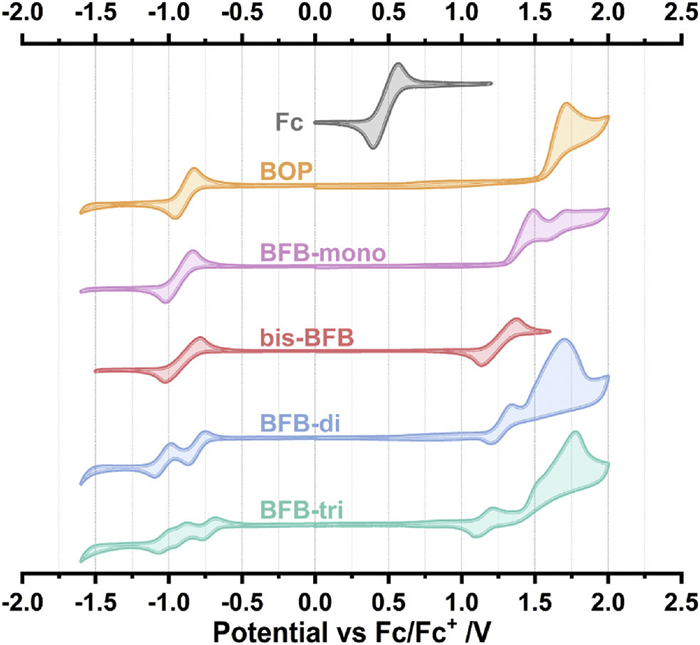
The electrochemical properties of BOP, BFB-mono, bis-BFB, BFB-di and BFB-tri were investigated using cyclic voltammetry (CV). The experimental data show excellent agreement with theoretical results (Fig. 5 and Table S8 in Supporting information). A clear trend is observed in the reduction processes: The formation of the radical anion on the BODIPY core is strongly correlated with the reduction potential. As the number of BODIPY subunits increases, both the number and magnitude of reversible reduction waves progressively increase. Correspondingly, the LUMO energy levels decrease steadily from −3.52 eV for BOP to −3.59 eV for BFB-di and further to −3.68 eV for BFB-tri, which confirm that extension of the π-conjugation in the benzofuran-fused BODIPY series enhances their reduction ability and strengthens their electron-accepting character.
In summary, a concise and efficient strategy has been established for the construction of mono-, bis-, and fully oligomeric benzofuran-fused BODIPY architectures via a synergistic combination of aromatic nucleophilic substitution and Pd-catalyzed C–H activation. Progressive benzofuran and BODIPY fusion enables precise modulation of molecular conformation and frontier orbital energies, resulting in narrowed HOMO–LUMO gaps, pronounced bathochromic shifts, markedly enhanced NIR absorption and emission, and sustained high fluorescence efficiencies. Notably, fully fused trimer BFB-tri exhibits intense absorption (λmax = 716 nm, ε = 400,000 L mol−1 cm−1), strong and bright NIR emission (λem = 733/808 nm, with fluorescence quantum yield up to 55.4%–65.4%) and a low LUMO level (−3.68 eV). Detailed photophysical, electrochemical, and theoretical analyses demonstrate that the HOMO energy level is predominantly governed by benzofuran fusion, whereas the LUMO energy level is mainly controlled by the number of BODIPY subunits, providing clear molecular-level insight into frontier-orbital modulation in π-extended BODIPY systems. This work highlights benzofuran fusion as a versatile and effective design principle for developing high-performance NIR BODIPY fluorophores and expands the structural toolbox for π-conjugated organic materials.
Limin He: Writing – original draft, Formal analysis. Xiaomao Zhou: Investigation. Yongli Zhang: Investigation. Luyan Tian: Investigation. Yanqing Li: Data curation. Yunxia Zhao: Data curation. Shulin Gao: Software. Yanni Li: Software. Yanhua Yang: Resources, Investigation. Weili Li: Resources, Investigation. Xiangguang Li: Writing – review & editing, Supervision, Software, Conceptualization. Wei Fan: Supervision, Resources. Wei Jiang: Supervision, Resources. Zhaohui Wang: Supervision.
The authors declare that they have no known competing financial interests or personal relationships that could have appeared to influence the work reported in this paper.
This work was support by the National Natural Science Foundation of China (Nos. 22065019, 22122503), the Program for Young and Middle Aged Academic and Technical Leaders Reserve Talents of Yunnan Province (No. 202105AC160043), the Kunming “Spring City Program” for Youth Top-Notch Talents (No. C202014001), the Scientific Research Funds of Kunming University (Nos. XPZJ2205 and XPZJ2205-2), the Research Projects of Yunnan Education Department (No. 2025Y1072), Yunnan Key Laboratory of Metal-Organic Molecular Materials and Device (No. YNMO-ZD-2402), and the Frontier Research Team of Kunming University 2023.
Supplementary material associated with this article can be found, in the online version, at doi:
P. Zhao, L. Zhang, Z. Meng, et al., Adv. Funct. Mater. 32 (2022) 2205092. doi: 10.1002/adfm.202205092
L. Wang, W. Zhu, Adv. Sci. 11 (2024) 2307227. doi: 10.1002/advs.202307227
J. Ma, M. Xu, Z. Zhuo, et al., Adv. Mater. 36 (2024) 2411449. doi: 10.1002/adma.202411449
Z. Zhuo, M. Ni, N. Yu, et al., Nat. Commun. 15 (2024) 7990. doi: 10.1038/s41467-024-50358-1
H. Wu, X. Liu, H. Wang, et al., InfoMat 8 (2025) e70075.
M. Tang, S. Zhu, Z. Liu, et al., Chem 4 (2018) 2600–2614. doi: 10.1016/j.chempr.2018.08.014
Y. Tanaka, Y. Kato, K. Sugimoto, et al., Chem. Sci. 12 (2021) 4338–4344. doi: 10.1039/d0sc06613c
R. Sakamoto, K.H. Wu, R. Matsuoka, et al., Chem. Soc. Rev. 44 (2015) 7698–7714. doi: 10.1039/C5CS00081E
J. Hergenhahn, J.M. Holmes, J.R. Deng, et al., J. Am. Chem. Soc. 147 (2025) 978–987. doi: 10.1021/jacs.4c14161
S.F. Ebel, F. Rominger, M. Mastalerz, Org. Lett. 27 (2025) 7944–7949. doi: 10.1021/acs.orglett.5c02272
R. Zhang, L. Qi, M. Wu, et al., Chin. J. Chem. 44 (2026) 268–276. doi: 10.1002/cjoc.70361
C. Liu, L. Shao, S. Chen, et al., Prog. Polym. Sci. 143 (2023) 101711. doi: 10.1016/j.progpolymsci.2023.101711
W. Liu, H. Zhang, S. Liang, et al., Angew. Chem. Int. Ed. 62 (2023) e202311645. doi: 10.1002/anie.202311645
S. He, C. Xiang, W. Liu, et al., J. Mater. Chem. A 12 (2024) 31581–31588. doi: 10.1039/d4ta05543h
Y. Yang, L. Wei, L. Zhan, et al., Adv. Mater. 37 (2025) e10980. doi: 10.1002/adma.202510980
D. Meng, R. Zheng, Y. Zhao, et al., Adv. Mater. 34 (2022) 2107330. doi: 10.1002/adma.202107330
Z. Jia, Q. Ma, Z. Chen, et al., Nat. Commun. 14 (2023) 1236. doi: 10.1038/s41467-023-36917-y
J. Xu, Y. Zhang, J. Liu, et al., Angew. Chem. Int. Ed. 62 (2023) e202310838. doi: 10.1002/anie.202310838
Y. Ni, S. Lee, M. Son, et al., Angew. Chem. Int. Ed. 55 (2016) 2815–2819. doi: 10.1002/anie.201511151
T. Zubair, M.M. Hasan, R.S. Ramos, et al., J. Mater. Chem. C 12 (2024) 8188–8216. doi: 10.1039/d4tc01391c
M. Stępień, I.A. Bhat, A.K. Gaur, et al., Org. Chem. Front. 12 (2025) 6301–6336. doi: 10.1039/d5qo00746a
C.P. Yu, R. Chowdhury, Y. Fu, et al., Sci. Adv. 10 (2024) eado3476. doi: 10.1126/sciadv.ado3476
J. Kim, J. Oh, A. Osuka, et al., Chem. Soc. Rev. 51 (2022) 268–292. doi: 10.1039/D1CS00742D
Y. Lv, J. Lin, K. Song, et al., Sci. Adv. 7 (2021) eabk3095. doi: 10.1126/sciadv.abk3095
K. Wang, K. Isono, H. Takano, et al., J. Am. Chem. Soc. 147 (2025) 45441–45451. doi: 10.1021/jacs.5c15893
H. Lee, H. Park, D.Y. Ryu, et al., Chem. Soc. Rev. 52 (2023) 1947–1974. doi: 10.1039/d2cs01066f
A. Mateo-Alonso, Chem. Mater. 35 (2023) 1467–1469. doi: 10.1021/acs.chemmater.2c03567
J.M. Park, K.I. Hong, H. Lee, et al., Acc. Chem. Res. 54 (2021) 2249–2260. doi: 10.1021/acs.accounts.1c00114
Y. Shi, F. Zhang, R.J. Linhardt, Dyes Pigm. 188 (2021) 109136. doi: 10.1016/j.dyepig.2021.109136
S. Ito, M. Gon, K. Tanaka, et al., Natl. Sci. Rev. 8 (2021) nwab049. doi: 10.1093/nsr/nwab049
L. Xu, B. Wen, G. Kim, et al., Angew. Chem. Int. Ed. 56 (2017) 12322–12326. doi: 10.1002/anie.201707237
Y. Rao, L. Xu, M. Zhou, et al., Angew. Chem. Int. Ed. 61 (2022) e202206899. doi: 10.1002/anie.202206899
S. Wu, L. Gai, Z. Zhou, et al., Org. Chem. Front. 9 (2022) 5989–6000. doi: 10.1039/d2qo01243j
M. Liu, S. Ma, M. She, et al., Chin. Chem. Lett. 30 (2019) 1815–1824. doi: 10.1016/j.cclet.2019.08.028
J. Wang, N. Boens, L. Jiao, et al., Org. Biomol. Chem. 18 (2020) 4135–4156. doi: 10.1039/d0ob00790k
N.A. Bumagina, E.V. Antina, A.A. Ksenofontov, et al., Coord. Chem. Rev. 469 (2022) 214684. doi: 10.1016/j.ccr.2022.214684
S. Wang, L. Gai, Y. Chen, et al., Chem. Soc. Rev. 53 (2024) 3976–4019. doi: 10.1039/d3cs00456b
A.S. Sherudillo, L.A. Antina, E.V. Antina, Coord. Chem. Rev. 545 (2025) 217030. doi: 10.1016/j.ccr.2025.217030
S.H. Röttger, L.J. Patalag, F. Hasenmaile, et al., Org. Lett. 26 (2024) 3020–3025. doi: 10.1021/acs.orglett.4c00827
S.H. Röttger, L.J. Patalag, H.F. Von Köller, et al., Org. Lett. 27 (2025) 68–72. doi: 10.1021/acs.orglett.4c03890
L. Wang, C. Cheng, Z.Y. Li, et al., Org. Lett. 26 (2024) 3026–3031. doi: 10.1021/acs.orglett.4c00669
L.J. Patalag, L.P. Ho, P.G. Jones, et al., J. Am. Chem. Soc. 139 (2017) 15104–15113. doi: 10.1021/jacs.7b08176
M. Sugino, Y. Tsuchido, R. Maeda, et al., Angew. Chem. Int. Ed. 64 (2025) e202519612. doi: 10.1002/anie.202519612
S.H. Röttger, P.A. Mader, H.F. Von Köller, et al., Org. Lett. 27 (2025) 4969–4973. doi: 10.1021/acs.orglett.5c01301
N. Liu, Y. Choi, Z. Zong, et al., CCS Chem. 7 (2025) 3650–3663. doi: 10.31635/ccschem.025.202505435
J. Labella, G. Durán-Sampedro, S. Krishna, et al., Angew. Chem. Int. Ed. 62 (2023) e202214543. doi: 10.1002/anie.202214543
Q. Gong, Q. Wu, X. Guo, et al., Org. Lett. 23 (2021) 7661–7665. doi: 10.1021/acs.orglett.1c02926
K. Teng, W. Chen, L. Niu, et al., Angew. Chem. Int. Ed. 60 (2021) 19912–19920. doi: 10.1002/anie.202106748
L.J. Patalag, J. Hoche, R. Mitric, et al., Angew. Chem. Int. Ed. 61 (2022) e202116834. doi: 10.1002/anie.202116834
Y. Zhang, Z. Yang, X. Suo, et al., Chin. Chem. Lett. 36 (2025) 111071. doi: 10.1016/j.cclet.2025.111071
B.T. Luppi, W.L. Primrose, Z.M. Hudson, Angew. Chem. Int. Ed. 63 (2024) e202400712. doi: 10.1002/anie.202400712
H. Cheng, X. Cao, S. Zhang, et al., Adv. Mater. 35 (2023) 2207546. doi: 10.1002/adma.202207546
S. Qi, N. Kwon, Y. Yim, et al., Chem. Sci. 11 (2020) 6479–6484. doi: 10.1039/d0sc01171a
Y. Guan, B. Yu, J. Ding, et al., Chin. Chem. Lett. 36 (2025) 110645. doi: 10.1016/j.cclet.2024.110645
Z. Zhu, X. Zhang, X. Guo, et al., Chem. Sci. 12 (2021) 14944–14951. doi: 10.1039/d1sc04893g
Z. Mao, J.H. Kim, J. Lee, et al., Coord. Chem. Rev. 476 (2023) 214908. doi: 10.1016/j.ccr.2022.214908
J. Liu, J. Liu, H. Li, et al., Angew. Chem. Int. Ed. 62 (2023) e202306471. doi: 10.1002/anie.202306471
Y. Gawale, P. Palanisamy, H.S. Lee, et al., ACS Appl. Mater. Interfaces 16 (2024) 22274–22281. doi: 10.1021/acsami.4c02002
S. Yokoyama, S. Utsunomiya, T. Seo, et al., Adv. Sci. 11 (2024) 2405656. doi: 10.1002/advs.202405656
G. Selvaggio, R. Nißler, P. Nietmann, et al., Analyst 147 (2022) 230–237. doi: 10.1039/d1an01850g
A. Patra, L.J. Patalag, P.G. Jones, et al., Angew. Chem. Int. Ed. 60 (2021) 747–752. doi: 10.1002/anie.202012335
L. He, Y. Li, Y. Zhang, et al., Org. Chem. Front. 13 (2026) 13–24. doi: 10.1039/D5QO01187F
L. He, N. Li, Y. Li, et al., J. Org. Chem. 89 (2024) 17643–17654. doi: 10.1021/acs.joc.4c02396
J. Li, N. Xue, S. Gao, et al., Org. Lett. 26 (2024) 5472–5477. doi: 10.1021/acs.orglett.4c01757
J.L. Belmonte-Vázquez, E. Avellanal-Zaballa, E. Enríquez-Palacios, et al., J. Org. Chem. 84 (2019) 2523–2541. doi: 10.1021/acs.joc.8b02933
Q. Wu, J. Yuan, C. Yu, et al., J. Porphyrins Phthalocyanin. 22 (2018) 837–846. doi: 10.1142/s1088424618500694
X. Zhou, Q. Wu, Y. Feng, et al., Chem. Asian J. 10 (2015) 1979–1986. doi: 10.1002/asia.201500516
Q. Gong, J. Shao, W. Li, et al., J. Am. Chem. Soc. 147 (2025) 21041–21052. doi: 10.1021/jacs.5c05873
Z. Wang, L. Huang, Y. Yan, et al., Angew. Chem. Int. Ed. 59 (2020) 16114–16121. doi: 10.1002/anie.202005269
J. Wang, W. Li, L. Jiao, et al., Chem. Commun. 61 (2025) 4465–4482. doi: 10.1039/d4cc06350c

Figure 1 Benzene-fused oligo-BODIPYs and thiophene-fused oligo-BODIPYs (left), as well as the modulation strategies for the benzofuran-fused oligo-BODIPYs reported in this work.

Scheme 1 Synthesis of BFB-mono, bis-BFB, BFB-di and BFB-tri. Reagents and conditions: (ⅰ) K2CO3, CH3CN, 80 ℃; (ⅱ) Pd(OAc)2 (10 mol%), BINAP (20 mol%), Cs2CO3 (2.0 equiv.), toluene, 110 ℃ under an argon atmosphere.

Figure 2 Front views of the X-ray structure of (a) BFB-di and (c) BFB-tri. Side views and π–π packing of (b) BFB-di and (d) BFB-tri.

Figure 3 (a) The NICS(0) values of BFB-di and BFB-tri. (b) The ACID plots of BFB-di and BFB-tri. (c) ESP of BFB-di and BFB-tri.

Figure 4 (a) Absorption spectra of BOP and benzofuran-fused oligo-BODIPYs in DCM. (b) Emission spectra of BOP and benzofuran-fused oligo-BODIPYs in DCM. (c) Frontline molecular orbitals of LUMO, HOMO and their energy levels for BOP and benzofuran-fused oligo-BODIPYs. (d) HOMO-1, HOMO, LUMO, and LUMO+1 of BFB-tri.
Table 1. Photophysical and electrochemical properties of BOP, BFB-mono, bis-BFB, BFB-di and BFB-tri in dichloromethane.
| Dye | λmaxa | ε (105) b | λemc | ΦFd | τ e | Kr (108) f | Knr (108) g |
| BOP | 501 | 0.84 | 512 | 95.9 | 7.00 | 1.37 | 0.06 |
| BFB-mono | 546 | 1.08 | 559 | 94.5 | 5.30 | 1.78 | 0.10 |
| bis-BFB | 587 | 1.51 | 597 | 92.3 | 4.84 | 1.91 | 0.16 |
| BFB-di | 634 | 2.69 | 643 | 66.1 | 2.83 | 2.34 | 1.20 |
| BFB-tri | 706 | 4.00 | 728 | 55.4 | 4.30 | 1.29 | 1.04 |
| a Absorption maxima (nm). b Molar extinction coefficients (L mol−1 cm−1). c Emission maxima (nm). d Fluorescence quantum yield (%). e Lifetime (ns). f Radiation rate constant (s−1). g Non-radiation rate constant (s−1). |
|||||||
 下载: 导出CSV

 扫一扫看文章


扫一扫关注我们

 下载: