Citation:
Guannan Zhou, Jiaqi Chen, Li Gong, Houyun Yang, Fazhi Xie, Yang Mu. Nitridated zero-valent iron-driven Fenton-like process for water purification: Performance and mechanism[J]. Chinese Chemical Letters,
2026, 37(11): 112651.
doi:
10.1016/j.cclet.2026.112651
Nitridated zero-valent iron-driven Fenton-like process for water purification: Performance and mechanism
English
Nitridated zero-valent iron-driven Fenton-like process for water purification: Performance and mechanism
Pollution Control and Resource Utilization in Industrial Parks Joint Laboratory of Anhui Province, School of Environment and Energy Engineering, Anhui Jianzhu University, Hefei 230601, China
b.
State Key Laboratory of Advanced Environmental Technology, Department of Environmental Science and Engineering, University of Science and Technology of China, Hefei 230026, China
c.
College of Environment, Zhejiang University of Technology, Hangzhou 310014, China
* Corresponding author. E-mail address: yangmu@ustc.edu.cn (Y. Mu). 1 These authors contributed equally to this work.
Received Date:
26 December 2025 Accepted Date:
19 March 2026 Revised Date:
18 March 2026 Available Online:
15 November 2026
Abstract:
Nitridated zero-valent iron (N-ZVI) exhibits distinct advantages in the reductive pollutant removal, while its driven Fenton-like oxidation process for water purification remains largely unexplored. This study shows that mechanically N-ZVI enhanced the degradation kinetics of five typical pollutants by 3.5–9.4 times relative to pristine ZVI via H2O2 activation. Moreover, the N-ZVI/H2O2 system demonstrated considerable potential for practical water treatment applications owing to its substantially improved total organic carbon removal efficiency, enhanced cyclic stability, extended continuous operational lifespan and reduced acute toxicity of degradation products. While •OH, O2•-, and 1O2 were detected in the N-ZVI/H2O2 system, •OH was identified as the dominant reactive oxygen species (ROS) responsible for pollutant degradation. Mechanistic investigations reveal that the Fe-Nx coordination structures on N-ZVI facilitated electron transfer from the Fe(0) core to the surface, thereby accelerating both Fe(0) corrosion and surface Fe(Ⅲ)/Fe(Ⅱ) cycle for H2O2 activation, which enhances the generation of surface •OH via Fenton-like reaction. This study advances the fundamental understanding of ZVI-based advanced oxidation processes for water purification.
Zero-valent iron (ZVI) has emerged as a promising Fenton-like catalyst due to its environmental friendliness and electron-donating properties [1,2]. Specifically, ZVI corrodes in aqueous environments and releases Fe(Ⅱ), which subsequently activates hydrogen peroxide (H2O2) to produce reactive oxygen species (ROS), such as hydroxyl radicals (•OH, E0 = 1.8–2.7 V), thereby facilitating the oxidative degradation of organic pollutants [3]. However, surface passivation, resulting from the formation of Fe(Ⅲ) (hydr)oxide layers on the ZVI surface, significantly impedes interfacial electron transfer, thereby limiting the Fe(Ⅱ) release rate. Additionally, the structural Fe(Ⅲ) exhibits poor reducibility, rendering its regeneration to Fe(Ⅱ) kinetically unfavorable and further reducing the catalytic efficiency for H2O2 activation and pollutant degradation [4,5]. To improve the Fenton-like catalytic performance of ZVI, it is imperative to implement strategies that regulate its surface structure, thereby facilitating electron transfer and accelerating Fe(Ⅲ)/Fe(Ⅱ) redox cycling.
The incorporation of nonmetallic p-block heteroatoms (e.g., S, P, B, and N) into ZVI represents a facile yet efficient strategy to improve its reactivity by finely tuning its crystalline structure and physicochemical characteristics [6-8]. Specifically, sulfide- and phosphide-modified ZVI has been explored in catalytic Fenton-like process owing to their enhanced ability to accelerate the degradation of diverse emerging contaminants [9,10]. For instance, He et al. [11] reported that sulfidated ZVI (S-ZVI) could effectively promoted peracetic acid activation and enhanced the degradation of various pollutants, and Wang et al. [12] revealed that the crystalline Fe3P shell on phosphidated ZVI facilitated peroxydisulfate activation and pollutant degradation. As an alternative strategy, surface modification of ZVI with N species garnered increasing attention [13]. N doping can modify the electronic structure of surface Fe species and increase the density of active sites through the formation of Fe-Nx coordination structures and/or iron nitrides, which is beneficial for lowering the Schottky barrier between the Fe(0) core and the FeOx shell and facilitating electron transfer from the Fe(0) core to surface [13,14]. Unlike other heteroatom-modified ZVI (e.g., S- or P-modified ZVI) enhancing reactivity through formation of conductive shells or sacrificial layers, N doping can introduce electronically active Fe-Nx coordination structures with enhanced conductivity and chemical stability, which intrinsically promote charge redistribution and Fe(Ⅲ) reducibility [15]. In addition, N-based modification avoids potential secondary pollution risks associated with sulfur or phosphorus leaching, making it more environmentally benign for water treatment applications [16]. Currently, nitridated ZVI (N-ZVI) has been reported to improve the reductive removal efficiency and selectivity for various refractory halogenated hydrocarbons under anaerobic conditions [17,18]. However, it remains largely unknown whether N doping could enhance the catalytic performance of ZVI for pollutant removal in Fenton-like process. Moreover, considering that N doping can regulate the electronic density and oxidation state of Fe atoms, thereby modulating the adsorption capability of oxidants [19], the mechanism of N-ZVI-catalyzed Fenton-like process for pollutant degradation warrants a further investigation.
In this study, we for the first time comprehensively investigated the catalytic performance and mechanism of N-ZVI on H2O2 activation and pollutant removal. Initially, the morphology and compositions of fabricated N-ZVI through ball-milling ZVI with melamine were characterized, and its capability of activating H2O2 for degradation of various pollutants including bisphenol A (BPA) was evaluated. After that, the dominant ROS in the N-ZVI/H2O2 system was identified using electron paramagnetic resonance (EPR) spectroscopy, probe experiments and quenching tests. Additionally, the degradation pathway of BPA and the ecotoxicity of intermediate products were elucidated from both experimental and simulation aspects. Furthermore, the influence of N doping on the electron transfer and Fe(Ⅲ)/Fe(Ⅱ) cycling behavior of ZVI was clarified, thereby unveiling the underlying mechanisms responsible for the enhanced Fenton-like activity of N-ZVI. This work further deepens the understanding of ZVI-based advanced oxidation processes for water purification.
Details of chemicals, N-ZVI fabrication and characterization, pollutant degradation experiments and analytical methods are provided in Texts S1-S4 (Supporting information).
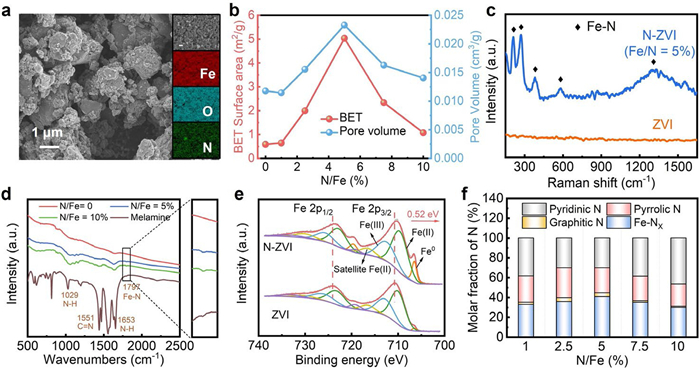
Scanning electron microscopy (SEM) images show that N-ZVI samples with N doping levels ranging from 0 to 10% exhibit a bulk- or sheet-like morphology with a progressive increase in particle size. Energy-dispersive spectroscopy (EDS) analysis confirms the uniform surface distribution of Fe, O and N with a measured N/Fe ratio of approximately 0.05, in good agreement with the theoretical value (Fig. 1a, Figs. S1 and S2 in Supporting information). The above results indicate successful N incorporation on the surface of N-ZVI via ball milling. Brunauer-Emmett-Teller (BET) analysis shows that the specific surface area of N-ZVI increased from 0.59 m2/g to 5.03 m2/g as the N/Fe ratio rose to 5%, but decreased to 1.07 m2/g at 10%, with similar trends observed for pore volume (Fig. 1b). These results suggest that moderate melamine addition facilitated particle refinement during the ball milling process, while excessive amounts resulted in residual formation on the particle surface, thereby reducing surface area and increasing particle size of N-ZVI [13].
Figure 1
Figure 1.
(a) SEM images of N-ZVI (inset shows EDS mapping of Fe, O and N elements). (b) BET surface area and pore volume of N-ZVI with N/Fe ratios from 0 to 10%. (c) Raman spectra of ZVI and N-ZVI. (d) FTIR spectra of melamine and N-ZVI with different N/Fe ratios. (e) Fe 2p spectra of ZVI and N-ZVI. (f) N species distribution of N-ZVI with different N/Fe ratios. Unless otherwise stated, the N/Fe ratio of the termed N-ZVI is 5%.
As shown in Fig. S3 (Supporting information), the X-ray diffraction diffractometer (XRD) patterns of N-ZVI primarily exhibit characteristic peaks of α-Fe at 44.6°, 64.9°, and 82.2°. These peaks shifted toward lower angles and broaden with increasing N/Fe ratios, suggesting lattice expansion due to strong Fe-N interactions [20]. Notably, no diffraction peaks corresponding to iron nitride phases (e.g., Fe3N or Fe4N) were detected in the XRD patterns, indicating that iron nitrides are either absent or exist only as trace amorphous forms on the surface of N-ZVI. Given the relatively mild nitridation conditions used in this study, the introduced N species are more likely to form Fe-Nx coordination species on the ZVI surface rather than iron nitrides. Raman spectra further confirm the formation of Fe-N bonds (Fig. 1c), as evidenced by vibration bands at 212 and 271 cm-1 [21,22]. Additionally, a new Fourier transform infrared spectroscopy (FTIR) absorption peak at 1797 cm-1 observed across N-ZVI samples supported the presence of Fe-N bond (Fig. 1d).
X-ray photoelectron spectroscopy (XPS) analysis was conducted to investigate the elemental composition and chemical states of N-ZVI. As shown in Fig. 1e, the Fe 2p spectrum exhibited characteristic peaks at 706.7, 709.6, and 712.5 eV for ZVI, corresponding to Fe(0), Fe(Ⅱ) and Fe(Ⅲ), respectively. In contrast, N doping led to a decreased proportion of Fe(Ⅲ) and an increased proportion of Fe(0) and Fe(Ⅱ), which is further supported by Fe L-edge X-ray absorption spectroscopy (XAS) results (Fig. S4 in Supporting information), suggesting that N doping disrupted the surface Fe(Ⅲ) oxide structure and promoted the formation of structural Fe(Ⅱ). The N 1s spectra of N-ZVI displayed characteristic peaks at 398.4, 400.0, and 401.3 eV (Fig. S5 in Supporting information), corresponding to pyridinic N, pyrrolic N, and graphitic N, respectively [23]. In addition, a metal-coordinated N signal at 399.4 eV was observed in the N 1s XPS spectra, accompanied by a negative shift of approximately 0.52 eV in the Fe 2p binding energies. These results indicate altered Fe valence distributions and the formation of electron-rich Fe sites induced by N incorporation, thereby suggesting the presence of Fe-Nx coordination structures on the surface of N-ZVI [24]. Such spectral characteristics have been widely reported as representative signatures of Fe-Nx coordination species in N-doped iron-based materials [25,26]. As the N/Fe ratio increased from 1% to 5%, the proportion of pyridinic N and pyrrolic N decreased from 38.2% to 29.9% and from 26.5% to 25.2%, respectively, while Fe-Nx increased from 33.1% to 41.0% (Fig. 1f and Fig. S5), suggesting that both pyridinic N and pyrrolic N may coordinate with Fe atoms through lone pair electrons to form Fe-Nx structures [27]. Further increasing N/Fe ratio led to a decline in Fe-Nx content, likely due to excess melamine hindering the ball milling process and inhibiting the active sites of N-ZVI. Collectively, the above results demonstrate that N doping could modulate the electronic structure of Fe through chemical bonding, leading to the formation of Fe-Nx coordination structures on the surface of ZVI, which may benefit to the removal of pollutants.
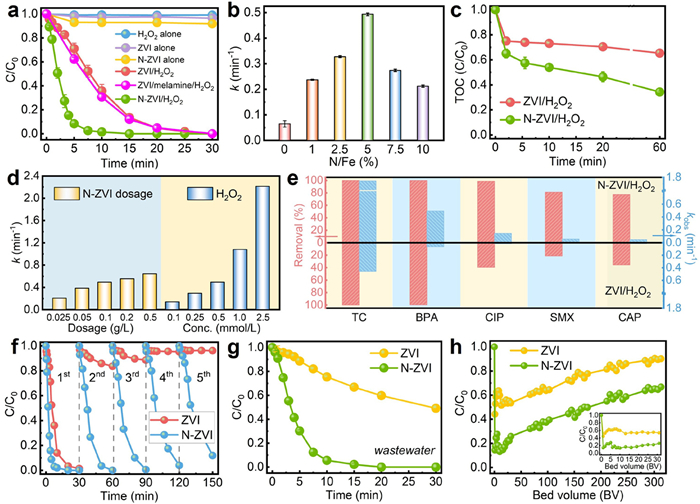
As illustrated in Fig. 2a, negligible BPA removal was observed when using ZVI, N-ZVI, or H2O2 alone, primarily because ZVI and N-ZVI exhibit limited adsorption toward BPA under the tested conditions, while H2O2 alone cannot effectively oxidize BPA without an activation process. In contrast, BPA removal efficiencies reached up to 64.2% and 98.5% within only 10 min in ZVI/H2O2 and N-ZVI/H2O2 systems, respectively. Moreover, the BPA removal rate exhibited negligible improvement after adding melamine to the ZVI/H2O2 system, excluding the synergistic effect arising from the simple physical coexistence of ZVI and N source on H2O2 activation. The above results collectively implied that the significantly enhanced pollutant degradation performance for N-ZVI can be attributed to the N incorporation into ZVI, which induces the formation of Fe-Nx coordination structures and alters the electronic structure of surface Fe species. The BPA degradation kinetics followed a pseudo-first-order model in N-ZVI//H2O2 systems, with rate constants progressively increasing from 0.06 to 0.49 min-1 as the N/Fe ratio rose from 0 to 5% (Fig. 2b and Fig. S6 in Supporting information). Further increasing the N/Fe ratio resulted in diminished activity of N-ZVI with rate constants decreasing gradually, indicating that an N/Fe ratio of 5% is optimal for H2O2 activation. Moreover, the TOC removal efficiency reached 65.7% within 60 min in the N-ZVI/H2O2 system, significantly higher than the 34.6% observed in the ZVI/H2O2 system (Fig. 2c). A similar trend was also observed in the H2O2 consumption rate (Fig. S7 in Supporting information). As depicted in Fig. 2d, the BPA removal rate slightly increased with increasing N-ZVI dosage, while a sharply promotion of BPA removal occurred with rising H2O2 concentration. The N-ZVI/H2O2 system achieved removal efficiency of 100%, 98.8%, 81.0%, and 77.5% for tetracycline (TC), ciprofoloxacin (CIP), sulfamethoxazole (SMX) and chloramphenicol (CAP), respectively, within 30 min, significantly outperforming the ZVI/H2O2 system (Fig. 2e). A comparable trend was also observed in the corresponding rate constants. Noting that the enhancement in pollutant removal varies significantly among different compounds in the N-ZVI/H2O2 system, which can be attributed to differences in molecular structures, functional group types, electron density distribution and inherent reactivity toward various ROS [28,29]. Furthermore, consecutive cycling experiments illustrate that the N-ZVI/H2O2 system maintained high BPA removal efficiency of 88.1% in the fifth cycle, whereas a sharp decline of BPA degradation happened after the first cycle in the ZVI/H2O2 system (Fig. 2f), confirming the excellent stability and reusability of N-ZVI in Fenton-like systems. These results clearly demonstrate that N doping remarkably enhances H2O2 activation by ZVI for BPA degradation and promotes more robust mineralization of organic pollutants.
Figure 2
Figure 2.
(a) Degradation efficiency of BPA in H2O2, ZVI, N-ZVI, ZVI/H2O2, ZVI/melamine/H2O2 and N-ZVI/H2O2 systems. (b) Comparison of BPA degradation rate constant in N-ZVI/H2O2 systems with varying N/Fe ratios. (c) TOC removal in ZVI/H2O2 and N-ZVI/H2O2 systems. (d) Variation in BPA degradation rate constant by N-ZVI/H2O2 at different N-ZVI dosages and H2O2 concentration. (e) BPA degradation efficiency by ZVI/H2O2 and N-ZVI/H2O2 in cycle experiments. (f) Removal efficiency of TC, BPA, CIP, SMX and CAP in ZVI/H2O2 and N-ZVI/H2O2 systems. (g) BPA degradation efficiency from actual wastewater in ZVI/H2O2 and N-ZVI/H2O2 systems. (h) BPA degradation efficiency in ZVI- and N-ZVI-based continuous flow systems. Batch experiment conditions: [ZVI] = [N-ZVI] = 0.1 g/L, [BPA] = [TC] = [CIP] = [SMX] = [CAP] = 10 mg/L, [H2O2] = 0.5 mmol/L, pH0 = 5.0, T = 25 ℃.
The performance of the N-ZVI/H2O2 system for BPA degradation under real wastewater conditions was also investigated. As shown in Fig. 2g, only 50.9% of BPA was removed within 30 min in the ZVI/H2O2 system, whereas the N-ZVI/H2O2 system achieved 97.8% BPA removal within 15 min, indicating superior interference resistance and highlighting its potential for industrial wastewater treatment. The continuous-flow column experiments reveal that 85.5% of BPA was removed during the first bed volume (BV) by N-ZVI/H2O2 (Fig. 2h). As reaction time increased, the BPA removal rate gradually decreased, leading to higher concentrations in the effluent. This behavior can be ascribed to the combined effects of several concurrent processes, including the gradual consumption of N-ZVI through Fe(0) corrosion and iron release, the progressive evolution of surface Fe-Nx coordination species and the buildup of iron (hydr)oxide layers that reduce the accessibility of reactive sites [14,30]. Nevertheless, N-ZVI/H2O2 demonstrated remarkably better BPA removal performance compared to ZVI/H2O2 in the continuous-flow system, underscoring the improvement in long-term Fenton-like activity of ZVI through N doping.
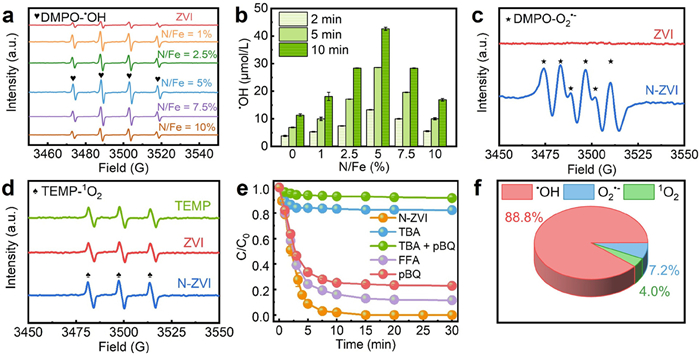
EPR spectroscopy was utilized to identify the primary ROS in the N-ZVI/H2O2 system in order to elucidate the mechanism of BPA degradation. As shown in Fig. 3a, the EPR spectra captured the characteristic quartet signal of DMPO-•OH, with the strongest signal observed when the N/Fe ratio was 5%, providing direct evidence for the generation of •OH in the N-ZVI/H2O2 system. Further quantitative analysis of •OH was performed using a sodium benzoate probe [31], revealing a significant increase in •OH production accompanied with reaction time. As illustrated in Fig. 3b and Fig. S8 (Supporting information), the amount of •OH accumulated in the N-ZVI system was 3.75 times higher than that in the ZVI system within 10 min. Additionally, •OH concentration exhibited a trend of initially increasing and then decreasing with increasing N/Fe ratio, which is consistent with the observed influence of N/Fe ratio on BPA degradation efficiency. Since the DMPO-•OH signal can also represent the presence of Fe(Ⅳ) [32], PMSO was used to probe Fe(Ⅳ) formation in the N-ZVI/H2O2 system. Although PMSO consumption varies across systems with different N/Fe ratios, the negligible PMSO2 generation excludes the involvement of Fe(Ⅳ) (Fig. S9). Moreover, characteristic peaks of DMPO-O2•⁻ and TEMP-1O2 were also detected in the EPR spectra of the N-ZVI/H2O2 system, while negligible relative signal was observed in the ZVI/H2O2 counterpart (Figs. 3c and d). Collectively, these findings suggest that N-ZVI facilitated efficient H2O2 activation and thus enhanced the production of •OH, O2•⁻, and 1O2.
Figure 3
Figure 3.
(a) EPR spectra of DMPO-•OH adducts and (b) time-dependent •OH generation in the presence of N-ZVI with varying N/Fe ratios. EPR spectra of (c) DMPO-O2•- and (d) TEMP-1O2 adducts in ZVI/H2O2 and N-ZVI/H2O2 systems. (e) BPA degradation efficiency with the addition of different scavengers in N-ZVI/H2O2 systems. (f) Proportional contribution of various ROS in the N-ZVI/H2O2 system. Reaction conditions: [ZVI] = [N-ZVI] = 0.1 g/L, [BPA] = 10 mg/L, [H2O2] = 0.5 mmol/L, [TBA] = 500 mmol/L, [p-BQ] = [FFA] = 50 mmol/L, pH0 = 5.0, T = 25 ℃.
The effects of various scavengers on BPA removal efficiency were examined to clarify the contributions of different ROS in the N-ZVI/H2O2 system. As shown in Fig. 3e, by adding tert-butanol (TBA), benzoquinone (p-BQ) and furfuryl alcohol (FFA), selective scavengers for •OH, O2•⁻ and 1O2 [33-36], the BPA removal efficiency decreased from 100% to 17.8%, 77.1% and 88.4%, respectively. The relative contributions of •OH, O2•⁻, and 1O2 to BPA degradation were calculated as 88.8%, 7.2%, and 4.0%, respectively, based on different BPA degradation rate constants derived from various quenching effects (Fig. 3f and Fig. S10 in Supporting information). These findings further confirm that •OH would be the primary reactive species responsible for BPA degradation in the N-ZVI/H2O2 system.
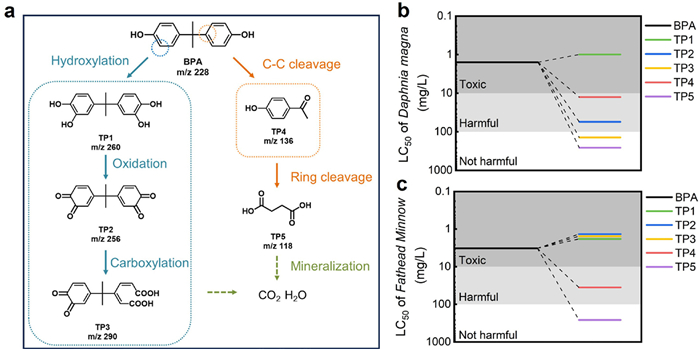
Furthermore, BPA degradation products and pathway in the N-ZVI/H2O2 system was analyzed using LC-MS-MS. Five degradation intermediates were detected at m/z values of 260, 256, 290, 136, and 118, corresponding to tetrahydroxyl bisphenol A (TP1), diketone bisphenol A (TP2), dicarboxylated bisphenol A (TP3), para-hydroxyacetophenone (TP4), and succinic acid (TP5), respectively (Fig. S11 in Supporting information) [37]. Accordingly, a possible BPA degradation pathway in the N-ZVI/H2O2 system was proposed. As depicted in Fig. 4a, the BPA degradation primarily involves in two pathways with •OH playing a predominant role. Specifically, •OH generated in the N-ZVI/H2O2 system electrophilically attacks the aromatic ring of BPA, leading to its hydroxylation and the formation of product TP1. TP1 is then further oxidized, resulting in the conversion of the phenolic hydroxyl group to a quinone group, followed by carboxylation to form products TP2 and TP3. In the second pathway, the C-C bond in the isopropyl group of BPA, with higher electron density, is more susceptible to ROS attack, leading to the formation of TP4. Subsequently, •OH continuously oxidizes the aromatic ring, causing ring-opening and the formation of small organic acids like TP5. These intermediates are further oxidized and mineralized to CO2 and water, driving the continuous TOC reduction in the N-ZVI/H2O2 system (Fig. 2c).
Figure 4
Figure 4.
(a) Degradation intermediates and proposed pathway of BPA in the N-ZVI/H2O2 system. (b) LC50 for Daphnia magna (48 h) and (c) LC50 for fathead minnow (96 h) of BPA and degradation intermediates in the N-ZVI/H2O2 system.
Quantitative structure-activity relationship (QSAR) models were employed to predict the acute toxicity of BPA and its degradation products for ecological safety evaluation [38]. As seen Fig. 4b, the LC50 values in Daphnia magna for almost all of BPA degradation intermediates significantly increased to the levels categorized as "Harmful" or even "Not harmful". Although the LC50 values in fathead minnows for TP1, TP2, and TP3 were slightly lower than BPA, indicating that the initial transformation products remained relatively high acute toxicity, these values sharply increased for TP4 and TP5 as the degradation process progressed (Fig. 4c). These findings suggest that the N-ZVI/H2O2 system not only efficiently removes BPA but also reduces the toxicity of its degradation products through deep oxidation, significantly mitigating the ecological risks of BPA in aquatic environments.
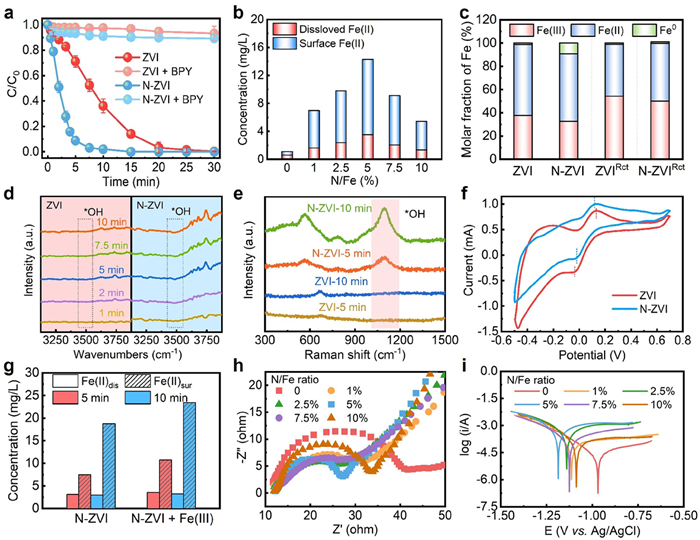
As seen in Fig. 5a, the addition of BPY, a complexing agent for Fe(Ⅱ) [39], almost completely suppressed BPA degradation in both ZVI/H2O2 and N-ZVI/H2O2 systems, confirming that Fe(Ⅱ) serves as the primary site for H2O2 activation in the BPA degradation process. To further elucidate how N doping influences the Fe(Ⅱ) release, the distribution and concentration of Fe(Ⅱ) species were analyzed in N-ZVI/H2O2 systems with varying N/Fe ratios. As shown in Fig. 5b, the release of both dissolved Fe(Ⅱ) (Fe(Ⅱ)dis) and surface Fe(Ⅱ) (Fe(Ⅱ)sur) were facilitated in all N-ZVI/H2O2 systems, with a more pronounced increase observed for Fe(Ⅱ)sur. Particularly, in the N-ZVI/H2O2 system with N/Fe ratio of 5%, the total Fe(Ⅱ) concentration reached up to 14.3 mg/L, approximately 13.0 times higher than that in the ZVI/H2O2 system, accompanied by a remarkable increase in the Fe(Ⅱ)sur proportion from 40.6 to 75.3%. XPS analysis further corroborated these findings. As illustrated in Fig. 5c, Figs. S12 and S13 (Supporting information), the reacted N-ZVI exhibited higher surface abundances of Fe(Ⅱ)sur and -OH species compared to ZVI, along with more extensive surface Fe(0) consumption. The increased proportion of Fe(Ⅱ)sur after N doping can be attributed to the formation of Fe-Nx coordination structures, which facilitate electron transfer from the Fe(0) core to the N-ZVI surface. This electron redistribution accelerates the surface reduction of Fe(Ⅲ) to Fe(Ⅱ) and stabilizes Fe(Ⅱ) species at the surface, making them less prone to dissolution into the solution. These results collectively demonstrate that N doping markedly promoted Fe(0) corrosion and Fe(Ⅱ)sur release, which are crucial for initiating the ZVI-mediated heterogeneous Fenton-like reaction for enhanced pollutant degradation.
Figure 5
Figure 5.
(a) Impact of BPY on BPA degradation in ZVI/H2O2 and N-ZVI/H2O2 systems. (b) Concentration of dissolved Fe(Ⅱ) and surface Fe(Ⅱ) at the reaction time of 10 min in the N-ZVI/H2O2 system with different N/Fe ratios. (c) Relative content of different Fe species on the surface of ZVI, N-ZVI, reacted ZVI (ZVIRct) and reacted N-ZVI (N-ZVIRct) based on Fe 2p spectra. (d) CV curves for ZVI and N-ZVI with K3[Fe(CN)6] as electrolyte. (e) Effect of Fe(Ⅲ) addition on the variation of dissolved Fe(Ⅱ) and surface-adsorbed Fe(Ⅱ) in the N-ZVI/H2O2 system. (f) In situ SR-FTIR spectra and (g) in situ Raman spectra of (N-)ZVI suspension samples during H2O2 activation. (h) EIS Nyquist plots and (i) polarization curves of N-ZVI with varying N/Fe ratio from 0 to 10%. Reaction conditions: [ZVI] = [N-ZVI] = 0.1 g/L, [BPA] = 10 mg/L, [H2O2] = 0.5 mmol/L, [BPY] = 2 mmol/L, [Fe(Ⅲ)] = 0.5 mmol/L, pH0 = 5.0, T = 25 ℃.
Furthermore, the occurrence of Fe(Ⅱ)sur-induced heterogeneous Fenton-like reaction on N-ZVI was confirmed by in situ spectroscopic analysis. As illustrated in Fig. 5d, a distinct vibrational band corresponding to -OH species was observed at approximately 3488 cm-1 on the N-ZVI surface using in situ synchrotron-based FTIR (SR-FTIR), with its intensity progressively increasing as the reaction proceeded [40]. In contrast, no OH-related signals were detected on the ZVI surface. This observation was further corroborated by in situ Raman spectroscopy (Fig. 5e), which revealed -OH generation exclusively on the N-ZVI surface in the N-ZVI/H2O2 system, with no detectable signal in the ZVI/H2O2 counterpart. Collectively, these results suggest that H2O2 is more readily activated on the surface of N-ZVI due to the dominant role of Fe(Ⅱ)sur, leading to the generation of surface-absorbed •OH through heterogeneous Fenton-like processes for enhanced pollutant degradation.
Apart from Fe corrosion, the Fe(Ⅲ)/Fe(Ⅱ) redox cycle is generally recognized as the rate-limiting step in Fenton-like oxidation systems, particularly those utilizing H2O2 as the oxidant [41,42]. Therefore, the effect of N doping on the Fe(Ⅲ)/Fe(Ⅱ) cycle during the H2O2 activation process by ZVI was investigated. As shown in Fig. 5f, characteristic redox peaks corresponding to the Fe(Ⅲ)/Fe(Ⅱ) couple were observed via CV analysis in both ZVI and N-ZVI systems. The potential difference between the anodic and cathodic peaks in the N-ZVI system was 138 mV, which is smaller than the 167 mV observed in the ZVI system, indicating a more reversible redox process and a higher Fe(Ⅲ) reduction rate by using N-ZVI [27,43]. Additionally, upon the additional implantation of Fe(Ⅲ) into the N-ZVI/H2O2 system, an increase in the Fe(Ⅱ)sur concentration was observed with the proportion rising from 75.3% to 87.8% after 10 min of reaction (Fig. 5g). Concurrently, the BPA degradation rate was further enhanced for nearly 2.6-fold (Fig. S14). The above results collectively substantiate the enhanced Fe(Ⅲ)/Fe(Ⅱ) cycle in the N-ZVI/H2O2 system, which predominantly occurred on the surface of N-ZVI.
To further elucidate the mechanism by which N doping promotes Fe(0) corrosion and Fe(Ⅲ)/Fe(Ⅱ) cycle from ZVI, the electrochemical properties of N-ZVI were characterized. As shown in Fig. 5h, the Nyquist plots obtained with EIS measurement reveal that N-ZVI samples with different N/Fe ratios exhibited smaller semicircle diameters than ZVI, indicating lower charge transfer resistance. LSV analysis, which is fitted by Tafel equation, further demonstrate that N-ZVI showed increased corrosion current density and a more negative corrosion potential compared to ZVI (Fig. 5i), suggesting enhanced electron transfer ability [44]. Moreover, both EIS and LSV results indicate that the electron transfer ability of N-ZVI initially increased and then decreased with rising N/Fe ratios, consistent with the trends observed in the relative abundance of Fe-Nx coordination structure, •OH yield, and BPA degradation rate (Figs. 1f, 2b and 3b). These findings underscore the crucial role of N doping in boosting electron donating capacity of ZVI. This is likely associated with the introduction of pyridinic and pyrrolic N species, which could modulate the surface coordination environment of N-ZVI via the formation of Fe-Nx coordination structures [13]. Accordingly, the electronic distribution of iron is optimized, leading to lower energy barrier for electron transfer between the Fe(0) core and surface Fe-Nx/FeOy species [17,45]. Unlike pristine ZVI, where surface passivation impedes H2O2 activation, the Fe-Nx coordination structures on the surface of N-ZVI enables rapid electron transfer, thereby simultaneously enhancing Fe(0) corrosion and Fe(Ⅲ)/Fe(Ⅱ) cycling (Eqs. 1 and 2). This synergistic effect enriches surface Fe(Ⅱ)sur and initiates a heterogeneous Fenton-like process, ultimately promoting ROS generation (Eqs. 3–7) and accelerating pollutant degradation.
This work for the first time comprehensively elucidated the performance and mechanisms of N-ZVI for H2O2 activation and pollutant degradation. N-ZVI exhibited enhanced pollutant degradation, improved TOC removal efficiency, excellent reusability and promising real-world applicability compared with ZVI. EPR spectroscopy, probe experiments and radical scavenging tests collectively confirmed •OH as the dominant ROS responsible for pollutant degradation in the N-ZVI/H2O2 system. Mechanistic analyses demonstrate that the Fe-Nx coordination structures in N-ZVI facilitated electron transfer from the Fe(0) core to the surface, thereby accelerating both Fe(0) corrosion and the surface Fe(Ⅲ)/Fe(Ⅱ) cycle. The synergistic enhancement of these processes increased the abundance of Fe(Ⅱ)sur, which in turn promoted heterogeneous H2O2 activation and pollutant degradation in the N-ZVI/H2O2 system.
CRediT authorship contribution statement
Guannan Zhou: Writing – original draft, Investigation, Formal analysis. Jiaqi Chen: Writing – original draft, Investigation, Formal analysis, Data curation, Conceptualization. Li Gong: Supervision, Conceptualization. Houyun Yang: Writing – review & editing, Supervision. Fazhi Xie: Supervision. Yang Mu: Writing – review & editing, Supervision, Project administration, Funding acquisition, Conceptualization.
Declaration of competing interest
The authors declare that they have no known competing financial interests or personal relationships that could have appeared to influence the work reported in this paper.
Acknowledgments
We gratefully acknowledge the financial support from the National Key Research and Development Program of China (No. 2023YFC3709604), the National Natural Science Foundation of China (Nos. 52300223 and U23A20676), and the Scientific Research Project of Anhui Jianzhu University (No. 2025QDHZ06).
Supplementary materials
Supplementary material associated with this article can be found, in the online version, at doi:10.1016/j.cclet.2026.112651.
H. Wang, J. Li, K. Li, et al., Chem. Soc. Rev. 50 (2021) 1354–1390. doi: 10.1039/D0CS00415D
Figure 1
(a) SEM images of N-ZVI (inset shows EDS mapping of Fe, O and N elements). (b) BET surface area and pore volume of N-ZVI with N/Fe ratios from 0 to 10%. (c) Raman spectra of ZVI and N-ZVI. (d) FTIR spectra of melamine and N-ZVI with different N/Fe ratios. (e) Fe 2p spectra of ZVI and N-ZVI. (f) N species distribution of N-ZVI with different N/Fe ratios. Unless otherwise stated, the N/Fe ratio of the termed N-ZVI is 5%.
Figure 2
(a) Degradation efficiency of BPA in H2O2, ZVI, N-ZVI, ZVI/H2O2, ZVI/melamine/H2O2 and N-ZVI/H2O2 systems. (b) Comparison of BPA degradation rate constant in N-ZVI/H2O2 systems with varying N/Fe ratios. (c) TOC removal in ZVI/H2O2 and N-ZVI/H2O2 systems. (d) Variation in BPA degradation rate constant by N-ZVI/H2O2 at different N-ZVI dosages and H2O2 concentration. (e) BPA degradation efficiency by ZVI/H2O2 and N-ZVI/H2O2 in cycle experiments. (f) Removal efficiency of TC, BPA, CIP, SMX and CAP in ZVI/H2O2 and N-ZVI/H2O2 systems. (g) BPA degradation efficiency from actual wastewater in ZVI/H2O2 and N-ZVI/H2O2 systems. (h) BPA degradation efficiency in ZVI- and N-ZVI-based continuous flow systems. Batch experiment conditions: [ZVI] = [N-ZVI] = 0.1 g/L, [BPA] = [TC] = [CIP] = [SMX] = [CAP] = 10 mg/L, [H2O2] = 0.5 mmol/L, pH0 = 5.0, T = 25 ℃.
Figure 3
(a) EPR spectra of DMPO-•OH adducts and (b) time-dependent •OH generation in the presence of N-ZVI with varying N/Fe ratios. EPR spectra of (c) DMPO-O2•- and (d) TEMP-1O2 adducts in ZVI/H2O2 and N-ZVI/H2O2 systems. (e) BPA degradation efficiency with the addition of different scavengers in N-ZVI/H2O2 systems. (f) Proportional contribution of various ROS in the N-ZVI/H2O2 system. Reaction conditions: [ZVI] = [N-ZVI] = 0.1 g/L, [BPA] = 10 mg/L, [H2O2] = 0.5 mmol/L, [TBA] = 500 mmol/L, [p-BQ] = [FFA] = 50 mmol/L, pH0 = 5.0, T = 25 ℃.
Figure 4
(a) Degradation intermediates and proposed pathway of BPA in the N-ZVI/H2O2 system. (b) LC50 for Daphnia magna (48 h) and (c) LC50 for fathead minnow (96 h) of BPA and degradation intermediates in the N-ZVI/H2O2 system.
Figure 5
(a) Impact of BPY on BPA degradation in ZVI/H2O2 and N-ZVI/H2O2 systems. (b) Concentration of dissolved Fe(Ⅱ) and surface Fe(Ⅱ) at the reaction time of 10 min in the N-ZVI/H2O2 system with different N/Fe ratios. (c) Relative content of different Fe species on the surface of ZVI, N-ZVI, reacted ZVI (ZVIRct) and reacted N-ZVI (N-ZVIRct) based on Fe 2p spectra. (d) CV curves for ZVI and N-ZVI with K3[Fe(CN)6] as electrolyte. (e) Effect of Fe(Ⅲ) addition on the variation of dissolved Fe(Ⅱ) and surface-adsorbed Fe(Ⅱ) in the N-ZVI/H2O2 system. (f) In situ SR-FTIR spectra and (g) in situ Raman spectra of (N-)ZVI suspension samples during H2O2 activation. (h) EIS Nyquist plots and (i) polarization curves of N-ZVI with varying N/Fe ratio from 0 to 10%. Reaction conditions: [ZVI] = [N-ZVI] = 0.1 g/L, [BPA] = 10 mg/L, [H2O2] = 0.5 mmol/L, [BPY] = 2 mmol/L, [Fe(Ⅲ)] = 0.5 mmol/L, pH0 = 5.0, T = 25 ℃.


 DownLoad:

 下载:


 下载:

