Citation:
Qing Shao, Ming Yang, Jie Wang, Tengda Wang, Bo Wang, Yaxun Fan, Yilin Wang. Ultrasound/light/pH interactive control over cycling reconfiguration of spiropyran surfactant bowl-shaped nano-assemblies[J]. Chinese Chemical Letters,
2026, 37(12): 112647.
doi:
10.1016/j.cclet.2026.112647
Ultrasound/light/pH interactive control over cycling reconfiguration of spiropyran surfactant bowl-shaped nano-assemblies
English
Ultrasound/light/pH interactive control over cycling reconfiguration of spiropyran surfactant bowl-shaped nano-assemblies
SINOPEC Research Institute of Petroleum Engineering Co., Ltd., Beijing 102206, China
b.
University of Science and Technology of China, Hefei 230026, China
c.
State Key Laboratory of Bioinspired Interfacial Materials Science, Suzhou Institute for Advanced Research, School of Nanoscience and Nanotechnology, University of Science and Technology of China, Suzhou 215123, China
d.
CAS Key Laboratory of Colloid, Interface and Chemical Thermodynamics, Beijing National Laboratory for Molecular Science, Institute of Chemistry, Chinese Academy of Sciences, Beijing 100190, China
* Corresponding author at: University of Science and Technology of China
Received Date:
02 October 2025 Accepted Date:
19 March 2026 Revised Date:
15 March 2026 Available Online:
15 December 2026
Abstract:
Control of surfactant self-assembly under multiple physical and chemical stimuli is critical in many applications. Although stimuli-responsive surfactants are no longer uncommon, surfactants with mechanical-responsive property are still in the nascent stage. Here, we report a triply responsive bowl-shaped nano-assembly of spiropyran surfactant capable of on-demand deformation to achieve controllable formation and reconfiguration. Under alternating ultrasonic/UV or pH/UV stimuli, the nano-bowl switching relies on the reversible conversion of the spiropyran moiety, from closed-ring isomer (SP-COOH) to mixed spiropyran isomers (SP/MC—COOH), and then to opened-ring isomer (MC—COOH). Accompanied with the change of the SP/MC—COOH ratio, various structures are captured, including irregular molecular nano-assemblies, spheroids, buckled inward spheroids, nano-bowls, and agglomerated nanoparticles. As far as we know, the reversible evolution process of nano-structures under multiple stimuli, particularly ultrasonic co-stimulation, is seldom to be seen. Such a triple-stimuli-responsive surfactant enriches the family of smart surfactants and provides new choices for constructing smart soft materials.
The desire to construct responsive structure and function of materials in novel applications has driven scientists to employ a host of synthetic strategies for their creation [1]. Stimuli-responsive self-assembly is considered to be an ideal method to obtain various smart nano-structured materials by modifying the assembly environment (e.g., light [2], heat, pH, or ions) [3] and choosing responsive amphiphilic building blocks [4]. Surfactants are the representative amphiphilic building blocks [5,6], which can self-assemble into various organized structures in solution such as micelles [7], vesicles [8], and complex hierarchical structures [9]. Therefore, stimuli-responsive surfactants, whose molecular structure and surface activity can be reversibly transformed in solution by various triggers [10], become universally attractive. Up to now, many stimuli-responsive surfactants have been developed to response light [11], pH, redox chemistry [12], temperature [13], CO2 [14], etc. For example, Reifarth and Böker group prepared a dual pH- and photo-responsive surfactant suitable for manipulating the stability of emulsions [11]. Kondo group reported the formation and disruption of vesicles from single-tailed ferrocenyl surfactant by varying pH and redox conditions [12]. Dong group demonstrated that N-dodecyl-1,3-diaminopropane surfactants exhibit pH- and temperature-induced micelle-to-vesicle transition behavior [13]. Wang group designed imine-based dynamic covalent surfactants whose coacervate can be controlled with the act of CO2 [14,15]. Although stimuli-responsive surfactants are no longer uncommon, surfactants with mechanical-responsive property are still in the nascent stage, even though mechanical activation is one of the common sources of external stimuli in our daily life. Furthermore, being able to integrate mechanical-responsive property with nano-structure switching has not yet been explored, let alone a mechanic-based multiple-stimuli-responsive system. The creation of materials with such stimuli-responsiveness would show remarkable potential for numerous applications, such as damage visualization, self-healing coating, drug delivery, and tactile simulation, for which mechanical property is highly desired [16].
Unlike other stimuli, mechanical energy is an alternative to thermal, electrical, and light activation, which can directly act on the specific covalent bonds and activate other kinetically inaccessible processes [17]. A combination of mechanical and other responses is possible to enable a more differentiated regulation of the properties and self-assembly structures of surfactant systems. What is more, developing such multiple-stimuli-responsive surfactants helps to understand variable structure-responsive mechanisms and may open new ways to novel smart materials. Therefore, constructing precisely controlled surfactant self-assembly structures under multiple-stimuli involving mechanical responsiveness is extremely desired.
Modulating interfacial property of particles is a feasible strategy for actively controlling the self-assembly of particles [18]. Spiropyran analogs can undergo a reversible isomerization between a closed spiropyran (SP) form and a highly planar merocyanine (MC) structure through rupture of spirocarbon-oxygen bond under the stimuli of UV light [19-21] and mechanical activation (sonication [22], stretching [23], or compression [24]) and pH [25]. The ring-closed SP moiety possesses non-polar property [26], while the ring-opened MC counterpart behaves either as a zwitterion or cation [27], depending on the external pH level [28]. Accordingly, the SP-to-MC transition renders a considerable shift in the hydrophobicity-hydrophilicity balance, leading to prominent microstructural rearrangement and disintegration of self-assembled nanoparticles [29]. The concomitant different hydrophobicity in water promises to translate the interfacial activity of spiropyran molecules [11,30]. Thus, spiropyran-based compounds meet the basic requirements for multiple-stimuli-responsiveness, making them promising building blocks for the creation of various dynamic materials [31]. Several kinds of synthetic spiropyran-based surfactant dynamic systems have recently been reported [32-34], including the transition from sphere to ellipsoid [35], and the formation and decomposition of ellipsoids [36]. However, up to now, the dynamic transition process of spiropyran-based surfactants is still underexplored, and the surfactant self-assembly is limited to photo- or thermal- responsiveness. It therefore remains a formidable challenge to prepare multiple-stimuli-responsive dynamic spiropyran-based surfactant assemblies with mechanical responsiveness.
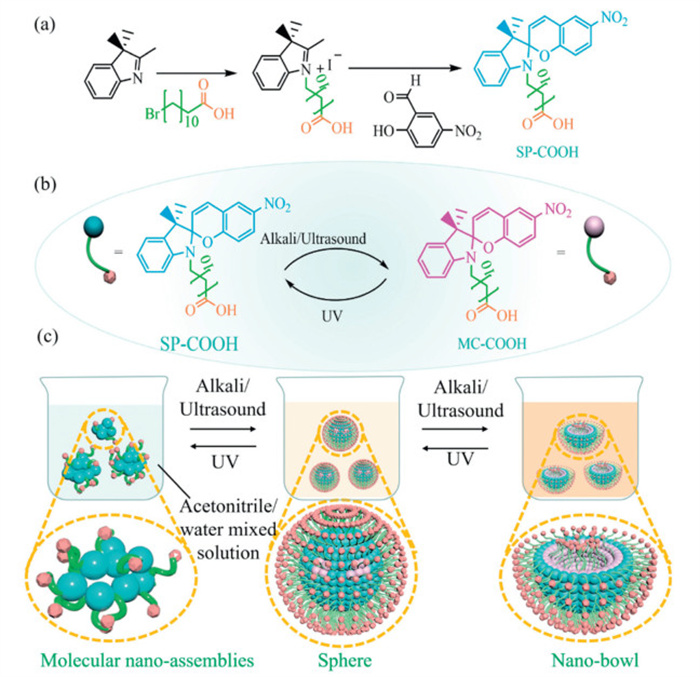
We herein report a triple-stimuli-responsive spiropyran-based surfactant that evidently exhibits an evolution process of self-assemblies under ultrasonic, UV, and pH triggers. Compared with classical surfactant architectures, the reported spiropyran-based surfactant shows appealing multiple-stimuli characteristics in self-assembly. As illustrated in Scheme 1a, the spiropyran-based surfactant consists of a hydrophilic carboxyl head group, a dodecyl spacer connecting the head with the spiropyran unit, and a terminal nitro group. Under alternating UV/pH or UV/ultrasonic excitation, the surfactant self-assemblies reversibly transfer from irregular nano-assemblies to spheroid, buckled inward spheroid, and then bowl-shaped nano-assemblies (Schemes 1b and c). The morphological reversibility is attributed to the reversible isomerization between SP and MC, and the resulting variations in interfacial property and hydrophobicity-hydrophilicity balance upon force perturbation (ultrasonic), UV irradiation, and pH variation. To the best of our knowledge, this is a rarely reported surfactant, displaying a clear self-assembly evolution process synergistically responsive to mechanic and other stimuli. The continuous deformation behaviors of surfactant assemblies could be taken as one of the key approaches for preparing self-adaptive intelligent soft materials.
Scheme 1
Scheme 1.
Schematic illustration of (a) the preparation, (b) the ultrasound-, UV- and pH-induced isomerization of spiropyran-based surfactant, and (c) the formation process of bowl-shaped nano-assemblies. Acetonitrile (5 vol% in water) is used as the co-solvent. For the convenience of viewing, the spiropyran units in ring-closed states and ring-opened states are painted blue and pink, respectively.
In order to obtain the desired spiropyran-based surfactant that can respond to multiple stimuli, the intermediate product 1-(11-carboxyundecyl)-2,3,3-trimethyl-3H-indolium bromide was firstly obtained by reacting 2,3,3-trimethylindolenine with 12-bromododecanoic acid. Then the target product 12-(3′,3′-dimethyl-6-nitrospiro[chromene-2,2′-indolin]−1′-yl)dodecanoic acid in the mixed isomer states (SP/MC—COOH), which refers to the system consisting of both ring-closed spiropyran-based surfactant (SP-COOH) and the ring-opened spiropyran-based surfactant (MC—COOH), was synthesized with a high yield from the reaction between 1-(11-carboxyundecyl)-2,3,3-trimethyl-3H-indolium bromide and 2–hydroxy-5-nitrobenzaldehyde. The NMR, high resolution mass spectra, and elemental analysis of the obtained spiropyran-based surfactant are shown in Figs. S1-S5 (Supporting information).
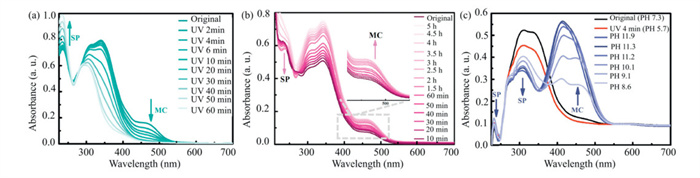
To confirm the isomer transformation between SP-COOH and MC—COOH under alternating ultrasonic/UV or pH/UV stimuli, the absorption peak changes of MC characteristic peak at 453 nm in UV–vis spectra and 1H NMR spectra are used to monitor the isomerization process. The characteristic peaks at 3.57 ppm and 4.12 ppm (Fig. S3), corresponding to the ring-closed isomer and ring-opened isomer, respectively, are detected in the SP/MC—COOH mixture (green line). The percentage content of MC—COOH in the SP/MC—COOH mixture is ~30.24%. However, after UV irradiation for 1 h, the MC absorption peak at 453 nm in the UV–vis spectra of the mixed SP/MC—COOH surfactant in pure acetonitrile (Fig. 1a) and the characteristic peak at 4.12 ppm in the 1H NMR spectrum for the ring-opened isomer almost disappear, while the characteristic peak at 3.57 ppm for the ring-closed isomer still clearly exists (blue line in Fig. S3). In order to exclude the effect of temperature, the UV–vis spectrum of the mixed SP/MC—COOH surfactant in pure acetonitrile is detected by elevating the temperature from 25 ℃ to 60 ℃ and 80 ℃ (Fig. S6 in Supporting information), and no significant change appears in the absorption intensity at 453 nm. These results demonstrate that the MC isomers in SP/MC—COOH are converted to SP isomers and the surfactant system is dominated by SP-COOH after UV irradiation. Since the SP characteristic peak in 200–400 nm range cannot be directly identified, the MC characteristic peak in UV–vis spectra is used to monitor the absorption peak blue-shifts with the change of the SP/MC—COOH ratio and solution polarity. Next, after adjusting the pH to 10.1 or ultrasonically treating the SP/MC—COOH pure acetonitrile solution in the dark for 3–4 h, the absorption peak at 453 nm appears (Figs. 1b and c), and the peak does not change anymore with continual stimuli (beyond pH 11.0 or extend the ultrasonic treatment for more than 4 h). Meanwhile, the 1H NMR spectrum manifests that the characteristic peak at 3.57 ppm for the ring-closed isomer SP-COOH disappears, but the characteristic peak at 4.12 ppm of the ring-opened isomer MC—COOH is maintained (red line in Fig. S3). These results indicate that SP-COOH has been fully transformed into MC—COOH. If adjusting the pH to 8.6 or ultrasound in the dark for 2 h, the absorption peak at 453 nm also appears, but the peak intensity is lower than that at pH 10.1 or after ultrasonic treatment for 4 h, indicating that the SP isomer does not fully convert to the MC isomer, i.e., the surfactant system presents as the mixture of the SP-COOH isomer with the MC—COOH isomer. In general, SP-COOH can be converted to MC—COOH under ultrasonic stimulation or increased pH, while the process can be reversed by UV irradiation. Additionally, the ratio of SP-COOH to MC—COOH can be controlled by ultrasonic treatment time, pH value, and UV irradiation.
Figure 1
Figure 1.
Variation in UV–vis absorption spectra of SP/MC—COOH (the percentage content of MC—COOH isomers in the SP/MC—COOH solution is ~30.24%) pure acetonitrile solution under (a) ultraviolet irradiation (365 nm) for 60 min, (b) ultrasonic treatment for 5 h and (c) pH change. The total concentration of SP/MC—COOH is 0.02 mg/mL, i.e., 0.04 mmol/L, and the experiment is conducted in room temperature.
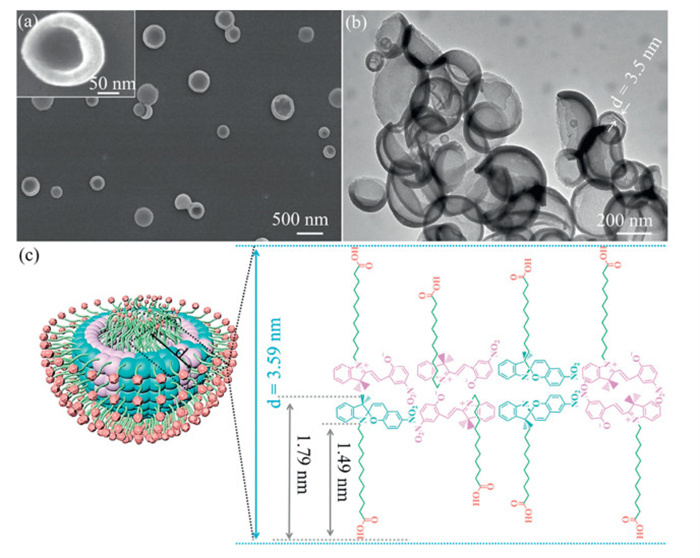
Due to the amphiphilic feature, the spiropyran-based surfactant can self-assemble into ordered structures in aqueous solution and at interface. Owing to the strong hydrophobicity of SP-COOH, a low dose of acetonitrile (5 vol% acetonitrile in water) is selected as the co-solvent for assembly. The critical micelle concentration (CMC) values of SP-COOH, MC—COOH and their mixture SP/MC—COOH acetonitrile/water solution (5 vol% acetonitrile in water) are determined from the surface tension curves (Fig. S7 in Supporting information), 0.044, 0.062 and 0.039 mmol/L, respectively. Prior to the assembly, the ring-closed spiropyran-based surfactant SP-COOH is obtained under UV irradiation (365 nm) for 1 h, while the ring-opened spiropyran-based surfactant MC—COOH is obtained by adjusting the pH to 10–12 or treating the acetonitrile solution of SP-COOH with ultrasound (220 V, 150 W, 40 kHz) in the dark for 3.5 h. The system consists of both SP-COOH and MC—COOH, and the SP/MC—COOH ratio changes by adjusting the pH range in 4–10 or ultrasonic treatment (220 V, 150 W, 40 kHz) in the dark for 1–3 h. The self-assembly is initiated by separately adding water into the acetonitrile solution of SP-COOH, MC—COOH and SP/MC—COOH (see detailed procedure in Supporting information). Intriguingly, a kind of bowl-shaped nano-assemblies of 200–450 nm are formed in the mixed SP/MC—COOH isomers above the CMC (Fig. 2a).
Figure 2
Figure 2.
Morphological characterizations of the isomer mixture SP/MC—COOH (the percentage content of MC—COOH isomers in the SP/MC—COOH solution is ~30.24%) nano-bowls: (a) SEM image and (b) TEM image. The inset in image (a) show a magnified nano-bowl. (c) A tentative interdigitated bilayer model of the nano-bowl.
The scanning electron microscopy (SEM, Fig. 2a) and DLS measurement (Fig. S8a in Supporting information) indicate that the nano-bowls show an average diameter of 214 nm, and the transmission electron microscopy (TEM, Fig. 2b) image shows that the bowl-shaped particles have a clear difference in contrast between the internal cavity and the outer membrane, presenting a membrane thickness of 3.5 nm. The Cryo-TEM images further confirm the bowl-shaped structure in the solution (Fig. S9 in Supporting information). Given that the length of the hydrophobic SP moiety plus C11H22- chain is around 1.79 nm, the nano-bowls membrane of 3.5 nm thickness is of a bilayer structure with the spiropyran and C11H22- chain moiety (Fig. 2c).
However, different from the SP-COOH and MC—COOH mixture, the individual SP-COOH forms irregular assemblies (Fig. S10a in Supporting information), while MC—COOH forms nanoparticle-like assemblies with an average diameter of 78 nm (Figs. S8b and S10b in Supporting information). Due to the hydrophobicity of SP-COOH, the formed nano-assemblies exhibit agglomeration in solution so that their average size cannot be accurately determined by DLS. The self-assembly is driven by hydrophobic interaction between the hydrophobic parts of the molecules, π-π stacking between the spiropyran moieties and hydrogen bonding between the OH groups. Obviously, the ring-opened, ring-closed, or mixed isomer state of the spiropyran moiety is supposed to affect the hydrophobic interaction and π-π stacking between them, and in turn influence the self-assembly structures. At the same concentration just above CMCSP-COOH, the surface tension (Fig. S7) slightly increases in the order of SP-COOH (~55 mN/m), SP/MC—COOH (~56 mN/m) and MC—COOH (~59 mN/m), suggesting that the molecular packing becomes looser in the same order at air/water interface. The similar variation of the molecular packing must also exist in the assemblies in solution, and may facilitate the deformation of the assemblies during the isomerization reaction between SP and MC, leading to the formation of bowl-shaped nano-assemblies in SP/MC—COOH. The MC—COOH to SP-COOH ratio is supposed to play a key role in the self-assembly.
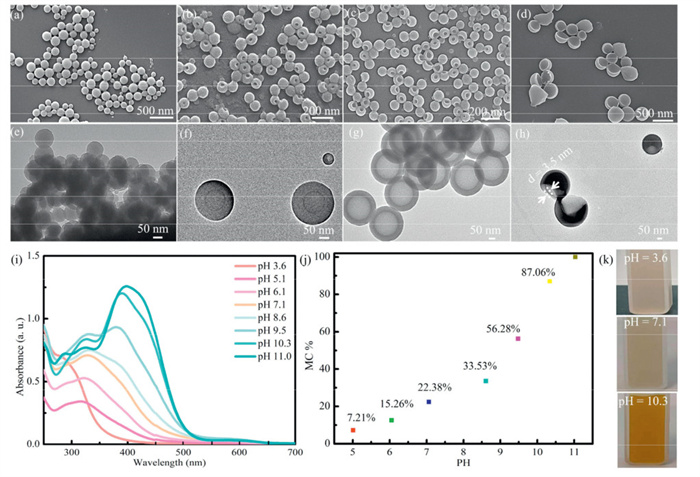
In order to know the pH effect on the changing process of the spiropyran-based surfactant assemblies, the deformation of assemblies with varying pH in the dark are firstly detected (Figs. 3a-h), starting with the SP-COOH assemblies at pH 3.6 (Fig. S11a in Supporting information). The ratio of SP-COOH to MC—COOH changes with the pH as evaluated by UV–vis absorption spectroscopy (Figs. 3i and j, see the detailed process in Supporting information). With increasing pH in the order of ~5.1, 6.1, 7.1, 8.6, 9.5, 10.3 and 11.0, the intensity of the absorption peak at 418 nm gradually increases (Fig. 3i), indicating the formation of the MC isomer. In comparison with pure acetonitrile solution (change from 453 nm to 418 nm), the blue-shift of the characteristic absorption peak of the ring-opened MC unit in acetonitrile/water solution is due to the increase in the solvent polarity, which lowers the barrier for the ring-open accompanied by a blue shift of up to 40 nm in merocyanine absorption [30]. With the isomerization reaction from SP to MC, the solution color changes from colorless (pH 3.6) to light yellow (pH 7.1), and finally to dark yellow (pH 10.3) (Fig. 3k). The SEM images reveal that the continuous transformation in structure can be divided into the following three stages. The average diameter and membrane thickness of the assemblies at each stage of the assemblies at each stage are shown in Fig. S12 and Table S1 (Supporting information).
Figure 3
Figure 3.
pH-induced morphology switch. The SEM images of SP/MC—COOH assemblies at (a) pH 5.1, (b) pH 6.1, (c) pH 7.1 and (d) pH 8.6. The TEM images of SP/MC—COOH assemblies at (e) pH 5.1, (f) pH 6.1, (g) pH 7.1 and (h) pH 8.6. (i) Variation in UV–vis absorption spectrum of SP/MC—COOH solution at different pH, and (j) the percentage content of the MC—COOH isomers in the SP/MC—COOH solution at different pH. (k) The photographs of SP/MC—COOH assemblies in acetonitrile/water at the pH of 3.6, 7.1 and 10.3. The concentration of SP/MC—COOH surfactant is 0.06 mg/mL (0.12 mmol/L).
The initial stage is that irregular nano-assemblies (Fig. S11a) are transformed into regular spheroids (Fig. 3a) after adjusting pH from 3.6 to 5.1. The percentage content of the MC—COOH isomers in the SP/MC—COOH solution is ~7.21% at pH 5.1 (Figs. 3i and j). So the formation of regular spheres may be attributed to that the formation of the MC isomer in the nano-assemblies, altering the hydrophobicity-hydrophilicity balance and non-covalent interactions such as π-π stacking, and dipole-dipole interaction.
The second stage shows a remarkable transition in structure from spheroids to buckled inward spheroids (Figs. 3a and b), and then become the nano-bowls (Figs. 3c and d) with increasing pH to 8.6. TEM images (Figs. 3e-h) confirm that the membrane thickness of the buckled inward spheroid and spheroid is 3.5 nm, which is almost the same as the membrane thickness of the nano-bowl. Meanwhile, the percentage content of the MC—COOH isomers in the SP/MC—COOH solution increases to ~33.53% at pH 8.6 (Fig. 3j), indicating much more MC isomers exist in the nano-assemblies. Given that the opened ring of MC—COOH is more hydrophilic than the closed ring of the SP-COOH, the increase of the MC isomers in the nano-assemblies further disrupts the hydrophobicity-hydrophilicity balance, and in turn the spontaneous rearrangement of spiropyran molecules may induce a tangential expansion of membranes by the hydration of the opened ring of MC—COOH. Evidently, the size of nano-bowls is larger than the irregular nano-assemblies and spheroids. Additionally, owing to the surface tension of spiropyran-based surfactant at pH 8.1 is larger than that at pH 3.6 at the same concentration just above CMCSP-COOH (Fig. S7), the molecular packing would become more looser at air/water interface when the pH rises to 8.6. The combination effect of hydration and interfacial property tends to make the spheres be buckled inward and then transferred into the nano-bowls.
The third stage displays that the nano-bowls disassemble into agglomerated nanoparticles with an average effective diameter of 78 nm (Figs. S11b and S8b), in which the spiropyran molecules in the assemblies at pH 10.3 are dominated by the MC isomers and the percentage content of the MC—COOH isomers in the SP/MC—COOH solution is ~87.00% (Fig. 3j). The significant change in the ratio of SP/MC—COOH further alters the hydrophobicity-hydrophilicity balance, and the surface tension of MC—COOH around this pH increases to ~59 mN/m at the same concentration (Fig. S7), indicating the self-assembling ability of the systems decreases. Thus the nano-assemblies become less ordered (Figs. S11b and S8b in Supporting information). This suggests that the longer chain flexibility and stronger hydrophilicity of MC—COOH are not conductive to the formation of ordered assemblies.
To directly confirm the transformation process at the third stage, the formation of intermediates in solution are tracked in real-time by adjusting pH from 7.5 to 10.0 (Fig. S13 in Supporting information). The nano-bowls gradually disassemble into nanoparticle-like assemblies during stirring for 10 h (Figs. S13a-e), and then change into agglomerated nanoparticles until string for 18 h in the dark (Fig. S13f). Adjusting the pH to around 10.0 makes the carboxyl group negatively charged, i.e., forming ionogenic merocyanine form MC—COO-. This also weakens the intermolecular interactions because of the electrostatic repulsion and causes the nano-bowls dissociate into smaller assemblies. Hence, after stirring for 10 h (Fig. S13e), only the dissociation process of the initial structures is captured.
The results above suggest that the structural transition from spheroids into nano-bowls occurs in the SP/MC—COOH ratio range of ~7.21%−33.53%, the transformation of nano-bowls into agglomerated nanoparticles is a slowly disassemblling process, and the agglomerated nanoparticles form when the percentage content of the MC—COOH isomers in the SP/MC—COOH solution decreases to ~87.00%.
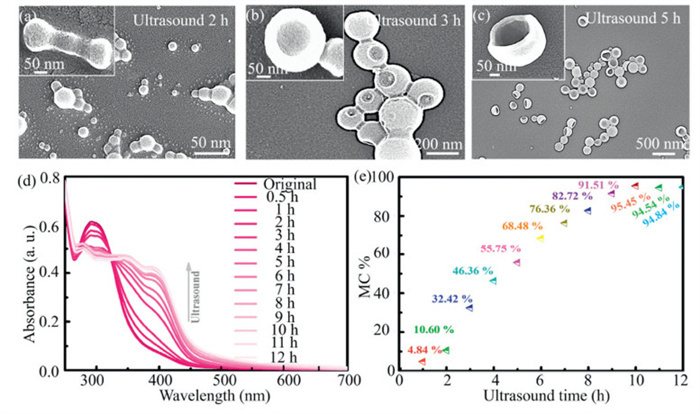
The morphological evolution process of assemblies is also monitored under ultrasonic stimulation in the dark (Figs. 4a-c), starting with the SP-COOH assemblies at pH 3.2 (Fig. S14a in Supporting information). With the extension of ultrasonic treatment time, the characteristic absorption peak intensity of the MC unit at 418 nm gradually increases (Fig. 4d), confirming the transformation of the SP isomers to the MC isomers under ultrasonic stimulation. The percentage content of the MC isomers in the assemblies against ultrasound time is calculated from the UV–vis absorption spectra (Fig. 4e). The irregular nano-assemblies (pH 3.2) are transformed to spheroids under ultrasonic treatment for 2 h (Fig. 4a and Fig. S14a), corresponding the percentage content of the MC—COOH isomers in the SP/MC—COOH solution is ~10.60%. After ultrasonic treatment for 3 h (Fig. 4b), the buckled inward spheroid appears and the percentage content of the MC—COOH isomers in the SP/MC—COOH solution increases to ~32.42%. By continuously extending the ultrasonic time to 5 h (Fig. 4c), the nano-bowls form and the percentage content of the MC—COOH isomers increases to ~55.75%. When the ultrasonic time reaches to 12 h, the nano-bowls disassemble (marked by pink in Fig. S14b in Supporting information), and then finally transform to agglomerated nanoparticles at the percentage content of the MC—COOH isomers is ~94.84% (Fig. S14c in Supporting information). The dissociation of the nano-bowls under ultrasonic stimulation is caused by the enhancement of the MC unit under ultrasonic. The MC—COOH isomers prefer to exist in the form of positively charged merocyanine (MCH+) during the SP-to-MC isomerization at low pH, and the electrostatic repulsion weakens the intermolecular self-assembling ability between the isomers. These results further support our conjecture that the membrane hydration and interfacial property variation lead to the deformation of the nano-assemblies. The average diameter of the assemblies at each stage of the assemblies at each stage are shown in Fig. S15 (Supporting information).
Figure 4
Figure 4.
Ultrasound-induced morphology switch. SEM images of the SP/MC—COOH assemblies at pH 3.2 under ultrasonic treatment for (a) 2 h, (b) 3 h and (c) 5 h. The inset in images (a-c) show the magnified assemblies. (d) The variation in UV–vis absorption spectra of SP/MC—COOH solution against ultrasonic time in the dark, and (e) the percentage content of the MC—COOH isomers in the SP/MC—COOH assemblies under ultrasonic treatment of different time in the dark. The concentration of SP/MC—COOH surfactant is 0.04 mg/mL (0.08 mmol/L).
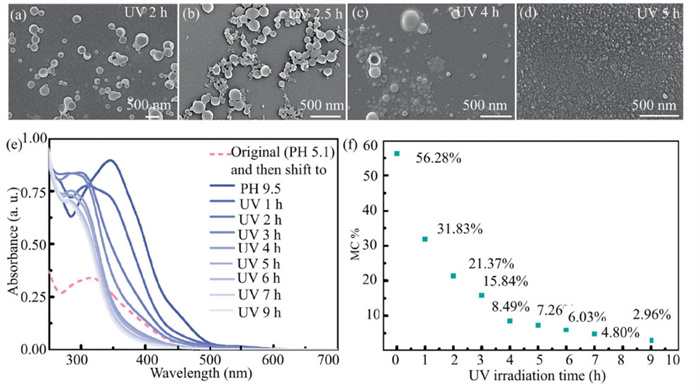
Given that the MC isomers can also be converted into the SP isomers under UV irradiation, the nano-assemblies should be reversible. The recovery process from the MC—COOH dominant assemblies to the SP-COOH dominant assemblies are characterized after UV irradiation (365 nm) for different time (Figs. 5a-e and Fig. S16 in Supporting information), starting with the MC—COOH dominant assemblies at pH 9.5 (Fig. S16a). As expected, the agglomerated nanoparticles are slowly transformed into the nano-bowls at the percentage content of the MC—COOH isomers in the SP/MC—COOH solution is ~21.37% (Fig. 5f) after UV irradiation for 2 h (Fig. 5a, Figs. S16b and c). When the UV irradiation time increases to 5 h, the nano-bowls slowly disassemble into the smaller nanoparticle (marked in blue in Fig. 5b), and then completely transform into the irregular nano-assemblies at the percentage content of the MC—COOH isomers is ~7.26% (Figs. 5c, d and f). The SP/MC—COOH ratios corresponding to the formation of irregular nano-assemblies and nano-bowls are consistent with the transformation range between the nano-bowls and the irregular nano-assemblies under the ultrasonic or pH stimuli (Figs. 3j and 4e). The results show that the deformation of either the agglomerated nanoparticles or the nano-bowls is a slow transition process, because the spontaneously regular arrangement of the spiropyran molecules needs some time. Thus, when the UV irradiation time is short (30 min and 2.5 h), only the initially dissociated structures are captured, while the contours of the nanoparticles, spheroids, and nano-bowls can still be distinguished (Figs. S16c and d).
Figure 5
Figure 5.
UV-induced morphology switch. SEM images of SP/MC—COOH surfactant nano-bowls after UV irradiation for (a) 2 h, (b) 2.5 h, (c) 4 h and (d) 5 h. (e) The variation in UV–vis absorption spectra of the SP/MC—COOH assemblies at pH 9.5, and (f) the percentage content of the MC—COOH isomer in the assemblies after UV irradiation for different time. The concentration of the SP/MC—COOH surfactant is 0.04 mg/mL (0.08 mmol/L).
These results further indicate that the entire morphological deformation process of the spiropyran-based surfactant nano-assemblies involves three states: The SP-COOH dominant irregular nano-assemblies, spheroids or nano-bowls of the SP/MC—COOH mixture, and the MC—COOH dominant agglomerated nanoparticles, depending on the percentage of the MC—COOH isomers in the SP/MC—COOH mixture. The nano-assembling structures can be switched by altering the SP/MC—COOH ratios through the stimulation of ultrasonic (Fig. 4), pH variation (Fig. 3), or UV. The transitions between the irregular nano-assemblies and spheroids, between the spheroids and the nano-bowls, and between the nano-bowls and agglomerated nanoparticles take place in the SP/MC—COOH solution with the percentage content of the MC—COOH isomers at 6.00%−11.00%, 11.00%−56.00%, and 56.00%−87.00%, respectively.
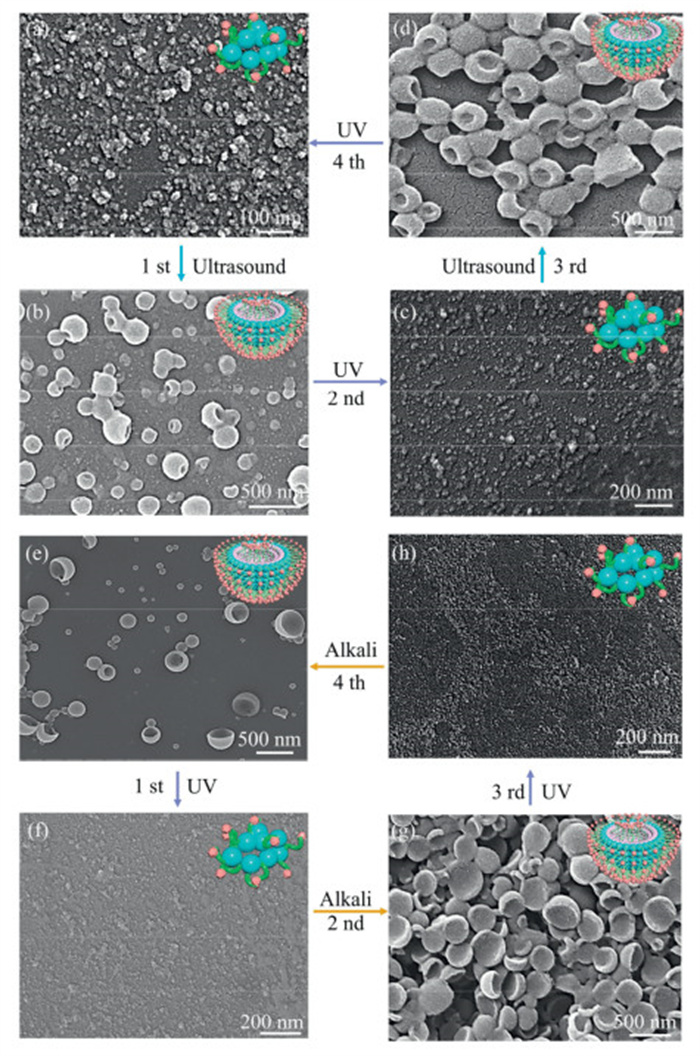
The achievement of a reversible response to external stimuli is one of the most important attributes for the potential applications of dynamic shape-switchable particles [35]. Herein, the reversible on-demand deformation between nano-bowls and irregular molecular nano-assemblies are demonstrated upon alternating pH/UV and ultrasonic/UV stimuli, respectively (Fig. 6). The irregular molecular nano-assemblies of SP-COOH are transformed into the nano-bowls of SP/MC—COOH after ultrasonic treatment for 5 h (Fig. 6a→b and Fig. 6c→d), and then returned to the irregular molecular nano-assemblies under UV stimulation for 3 h (Fig. 6b→c and Fig. 6d→a). Alternately, the nano-bowls can also be transformed into the irregular molecular nano-assemblies under UV irradiation for 3 h (Fig. 6e→f, Fig. 6g→h) and restored by increasing pH to ~8 (Fig. 6f→g, Fig. 6h→e). All the transformation processes can be repeated for 3 cycles without obviously morphological differences. As mentioned above, the phenomenon results from the advantage of adjustable solubility behaviors and interfacial property between SP-COOH and MC—COOH.
Figure 6
Figure 6.
Reversible responsiveness of the nano-bowls. The reversible shape changes of the nano-bowls under ultrasonic treatment for 5 h and then UV irradiation for 3 h: SEM images of the original irregular nano-assemblies (a), the nano-bowls after subsequently ultrasonic treatment (b), the irregular nano-assemblies after the following UV irradiation (c), the nano-bowls again after ultrasonic treatment (d), and the nano-bowls change back to the irregular nano-assemblies (a) after UV irradiation. The reversible shape changes of the nano-bowls after UV irradiation for 3 h and then adjusting pH: SEM images of the nano-bowls at pH 8 (e), the irregular nano-assemblies after UV irradiation and changing pH to 4 (f), the nano-bowls after adjusting pH to 8 (g), the irregular nano-assemblies upon UV irradiation and changing the pH to 4 (h). The concentration of the SP/MC—COOH surfactant is 0.13 mg/mL (0.25 mmol/L).
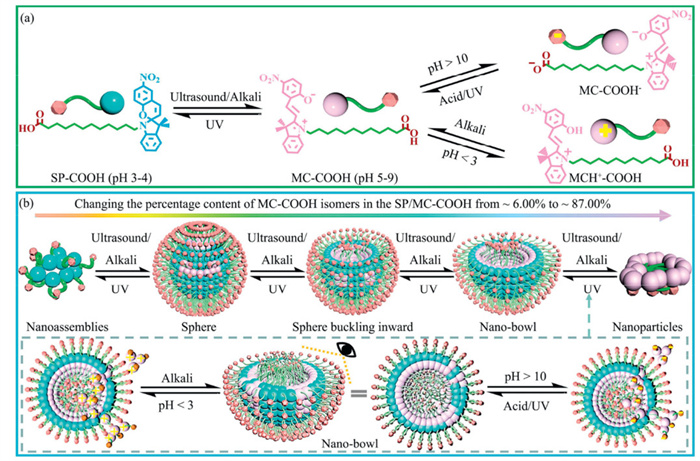
Based on the above results and literature reports [16,22,33,37-42], a possible structural transformation process of the spiropyran surfactant assemblies is proposed (Fig. 7). As the SP-COOH isomers gradually transform into the MC—COOH isomers under the stimulation of ultrasound or pH variation (Fig. 7a), the interestingly structural deformation is observed, including the slow transition of irregular nano-assemblies into spheroid, buckled inward spheroid, nano-bowl, and then into nanoparticles (Fig. 7b). Initially, the strong hydrophobic interaction of the ring-closed isomer SP-COOH induces the formation of irregular nano-assemblies. Accompany with the gradual isomerization of the ring-closed isomer SP-COOH in response to ultrasonic or pH variation, more hydrophilic MC isomers continue to form in the irregular nano-assemblies, leading to the destruction of hydrophobicity-hydrophilicity balance. The spiropyran molecules spontaneously rearrange into a looser structure at the air/water interface and at the water/assembly interface, thus the morphological evolution occurs.
Figure 7
Figure 7.
Transformation mechanism of the nano-bowls. (a) Reversible transformations among the four states: spiropyran (SP-COOH), merocyanine (MC—COOH), ionogenic merocyanine (MC—COO-), and protonated merocyanine (MCH+-COOH). (b) The dynamic evolution process of the spiropyran-based surfactant assemblies.
When the surfactant system is dominated by the SP-COOH isomers, the spheroids, buckled inward spheroid and nano-bowls sequentially form with the increase in the percentage of the MC—COOH isomers in the SP/MC—COOH mixture. The transition from the irregular nano-assemblies into regular spheres is attributed to the formation of a small amount of the MC isomers in the nano-assemblies, which disrupts the hydrophobicity-hydrophilicity balance and enhances the self-assembly capability. The formation of nano-bowls is caused by the further destruction of the hydrophobicity-hydrophilicity balance and the tangential expansion of the membrane through hydration. When the surfactant is dominated by the MC—COOH isomers, the strong hydrophilicity of ring-opened spiropyran molecules decreases the self-assembling ability and the molecules in the nano-assemblies become less orderly so that the nano-bowls are disaggregated and transferred into the agglomerated nanoparticles. The decline in self-assembling ability is due to the weakened molecular interaction of the building blocks in the assemblies, where the MC—COOH isomers are protonated to MCH+-COOH under acidic conditions or converted to ionogenic merocyanine form (MC—COO-) under strong alkaline conditions. Moreover, since MC—COOH, MCH+-COOH and MC—COO- can be reversibly transformed into SP-COOH under UV irradiation and the SP/MC—COOH ratio directly affects the morphology of assemblies, so the complete morphology transformation process is reversible under UV irradiation.
In conclusion, we report a triple-stimuli-responsive spiropyran surfactant bowl-shaped nano-assembly. Due to the inherent isomerization reaction between SP and MC in response to UV irradiation, ultrasonic, and pH variation, the nano-bowls display a clear and reversible evolution process, including irregular molecular nano-assemblies, spheroids, and buckled inward spheroids. By virtue of the tunability of the molecular packing, the structural transformation is controlled by the SP/MC—COOH ratio and can be repeated more than 3 times. To our knowledge, such continuous deformation behaviors of nano-bowls upon the molecular isomerization, which can be activated by either UV/pH or ultrasonic/UV, have hitherto not been observed. Although the mechanism behind the deformation processes has not been fully clarified herein, we believe that the controlled reversible deformations of nano-bowls by molecular isomerization enable the preparation of multifunctional smart materials with reconfigurable shapes, set up a possible new approach to construct responsive materials, and provide potential biological applications such as topical skin delivery and ex vivo/in vitro bioprocessing.
CRediT authorship contribution statement
Qing Shao: Writing – original draft, Data curation, Conceptualization. Ming Yang: Data curation. Jie Wang: Data curation. Tengda Wang: Data curation. Bo Wang: Data curation. Yaxun Fan: Data curation. Yilin Wang: Writing – review & editing.
Declaration of competing interest
The authors declare no conflict of interests.
Acknowledgments
We are grateful for financial support from the National Key R&D Program of China (No. 2021YFA0716700), the National Natural Science Foundation of China (No. 22202210), BMS Junior Fellow of BNLMS (No. 2021BMS20061), and the China Postdoctoral Science Foundation (Nos. 2022M723198, 2022T150657), Sinopec Ministry of Science and Technology Basic Prospective Research Project (Project title: Study on the Rapidly Dissolving Drag Reduction Agent Based on Amphiphilic Carbon Dots, No. P25086).
Supplementary materials
Supplementary material associated with this article can be found, in the online version, at doi:10.1016/j.cclet.2026.112647.
Scheme 1
Schematic illustration of (a) the preparation, (b) the ultrasound-, UV- and pH-induced isomerization of spiropyran-based surfactant, and (c) the formation process of bowl-shaped nano-assemblies. Acetonitrile (5 vol% in water) is used as the co-solvent. For the convenience of viewing, the spiropyran units in ring-closed states and ring-opened states are painted blue and pink, respectively.
Figure 1
Variation in UV–vis absorption spectra of SP/MC—COOH (the percentage content of MC—COOH isomers in the SP/MC—COOH solution is ~30.24%) pure acetonitrile solution under (a) ultraviolet irradiation (365 nm) for 60 min, (b) ultrasonic treatment for 5 h and (c) pH change. The total concentration of SP/MC—COOH is 0.02 mg/mL, i.e., 0.04 mmol/L, and the experiment is conducted in room temperature.
Figure 2
Morphological characterizations of the isomer mixture SP/MC—COOH (the percentage content of MC—COOH isomers in the SP/MC—COOH solution is ~30.24%) nano-bowls: (a) SEM image and (b) TEM image. The inset in image (a) show a magnified nano-bowl. (c) A tentative interdigitated bilayer model of the nano-bowl.
Figure 3
pH-induced morphology switch. The SEM images of SP/MC—COOH assemblies at (a) pH 5.1, (b) pH 6.1, (c) pH 7.1 and (d) pH 8.6. The TEM images of SP/MC—COOH assemblies at (e) pH 5.1, (f) pH 6.1, (g) pH 7.1 and (h) pH 8.6. (i) Variation in UV–vis absorption spectrum of SP/MC—COOH solution at different pH, and (j) the percentage content of the MC—COOH isomers in the SP/MC—COOH solution at different pH. (k) The photographs of SP/MC—COOH assemblies in acetonitrile/water at the pH of 3.6, 7.1 and 10.3. The concentration of SP/MC—COOH surfactant is 0.06 mg/mL (0.12 mmol/L).
Figure 4
Ultrasound-induced morphology switch. SEM images of the SP/MC—COOH assemblies at pH 3.2 under ultrasonic treatment for (a) 2 h, (b) 3 h and (c) 5 h. The inset in images (a-c) show the magnified assemblies. (d) The variation in UV–vis absorption spectra of SP/MC—COOH solution against ultrasonic time in the dark, and (e) the percentage content of the MC—COOH isomers in the SP/MC—COOH assemblies under ultrasonic treatment of different time in the dark. The concentration of SP/MC—COOH surfactant is 0.04 mg/mL (0.08 mmol/L).
Figure 5
UV-induced morphology switch. SEM images of SP/MC—COOH surfactant nano-bowls after UV irradiation for (a) 2 h, (b) 2.5 h, (c) 4 h and (d) 5 h. (e) The variation in UV–vis absorption spectra of the SP/MC—COOH assemblies at pH 9.5, and (f) the percentage content of the MC—COOH isomer in the assemblies after UV irradiation for different time. The concentration of the SP/MC—COOH surfactant is 0.04 mg/mL (0.08 mmol/L).
Figure 6
Reversible responsiveness of the nano-bowls. The reversible shape changes of the nano-bowls under ultrasonic treatment for 5 h and then UV irradiation for 3 h: SEM images of the original irregular nano-assemblies (a), the nano-bowls after subsequently ultrasonic treatment (b), the irregular nano-assemblies after the following UV irradiation (c), the nano-bowls again after ultrasonic treatment (d), and the nano-bowls change back to the irregular nano-assemblies (a) after UV irradiation. The reversible shape changes of the nano-bowls after UV irradiation for 3 h and then adjusting pH: SEM images of the nano-bowls at pH 8 (e), the irregular nano-assemblies after UV irradiation and changing pH to 4 (f), the nano-bowls after adjusting pH to 8 (g), the irregular nano-assemblies upon UV irradiation and changing the pH to 4 (h). The concentration of the SP/MC—COOH surfactant is 0.13 mg/mL (0.25 mmol/L).
Figure 7
Transformation mechanism of the nano-bowls. (a) Reversible transformations among the four states: spiropyran (SP-COOH), merocyanine (MC—COOH), ionogenic merocyanine (MC—COO-), and protonated merocyanine (MCH+-COOH). (b) The dynamic evolution process of the spiropyran-based surfactant assemblies.


 DownLoad:

 下载:


 下载:

