Key Laboratory of Rare Earths, Ganjiang Innovation Academy, Chinese Academy of Sciences, Ganzhou 341000, China
b.
CAS Key Laboratory of Chemistry of Northwestern Plant Resources and Key Laboratory for Natural Medicine of Gansu Province, Lanzhou Institute of Chemical Physics, Chinese Academy of Sciences, Lanzhou 730000, China
hdqiu@gia.cas.cn (H. Qiu). 1 These authors contributed equally to this work
Received Date:
16 February 2026 Accepted Date:
16 March 2026 Revised Date:
15 March 2026 Available Online:
15 November 2026
Abstract:
Rare earth elements (REEs) play an irreplaceable role in advanced fields such as electronics, optics and nuclear energy, giving rise to unprecedented global demand. but their similar atomic structures, ionic radii and intimate paragenesis in minerals make their purification and separation extremely challenging. Traditional REE separation materials, including organic extractants and inorganic adsorbents, are limited by poor selectivity, insufficient stability and difficulty in recycling, failing to meet the demand for efficient and green separation. Covalent organic frameworks (COFs), as a class of crystalline porous materials connected by covalent bonds, have attracted extensive attention due to their precisely designable pore structures, high-density tunable active sites, excellent chemical stability and good structural modifiability. In recent years, great progress has been made in the research of COFs for REE separation, and their unique structural advantages enable them to realize selective capture and separation of REEs through multiple synergistic mechanisms. This review outlines the design principles and synthetic strategies for chemically stable COFs and highlights recent advances in their application for efficient REE recovery. Key performance indicators such as adsorption capacity, recovery efficiency, and selectivity as well as critical influencing factors are systematically summarized. The mechanisms underlying COFs mediated REE separation are also critically examined. Finally, current challenges and future research directions are discussed, offering insights to guide the rational design, development, and industrial deployment of COFs for sustainable REE separation and recovery.
Rare earth elements (REEs) refer to the 17 special metallic elements in the periodic table, including the lanthanide series (lanthanum (La), cerium (Ce), praseodymium (Pr), neodymium (Nd), proium (Pm), samarium (Sm), europium (Eu), gadolinium (Gd), terbium (Tb), dysprosium (Dy), holmium (Ho), erbium (Er), thulium (Tm), ytterbium (Yb), lutetium (Lu)) as well as scandium (Sc) and yttrium (Y) [1]. They possess unique optical [2], electrical [3], magnetic [4], and catalytic [5] properties, playing an irreplaceable role in modern technology, industry, and defense sectors. With the continuous advancement of global science and technology, the demand for REEs across diverse sectors continues to rise [6–9]. Super-strong permanent magnets made from neodymium, praseodymium, dysprosium, etc., exhibit magnetism 4–10 times greater than that of ordinary permanent magnets. They are key components in wind turbine generators and new energy vehicle drive motors, and are widely used in televisions, medical equipment, maglev trains, and military industries [4,10]. In terms of luminescence, rare earth phosphors not only offer excellent luminous efficiency and long lifespan but also enhance the energy efficiency and color performance of LED lighting, making them more energy-efficient than incandescent bulbs [2]. In the field of electronics and information technology, REEs serve as critical foundational materials for miniaturized components such as mobile phone vibration motors and hard disk drives. Particularly, Er functions as a core functional component in signal amplifiers for fiber-optic communications, enabling enhanced data transmission efficiency. In national defense and military applications, rare earth materials can improve the accuracy of precision-guided weapons, the stealth capability of stealth aircraft, and enhance the stability and reliability of aerospace equipment. Moreover, rare earth-based catalysts play an important role in mitigating automotive emissions, contributing significantly to environmental protection through the efficient catalytic conversion of harmful exhaust pollutants.
REEs present great challenges in purification and separation due to their similar atomic structures, ionic radii, and intimate paragenesis in minerals. At present, the mainstream purification and separation methods mainly include solvent extraction [11–14], ion exchange [15,16], precipitation [17–19], extraction chromatography [20–24], and adsorption [25,26]. Among them, solvent extraction is widely applied for its large processing capacity, high separation efficiency, and suitability for continuous production, yet it has drawbacks such as the potential toxicity of extractants and the generation of organic wastewater [13]. Ion exchange enables ultra-high separation purity, capable of producing high-purity rare earth products with a purity of over 99.99%, but is limited by small processing capacity, high cost and long cycle, making it mainly applicable to the production of high-purity rare earth reagents or small quantities of high-end rare earth materials [16]. Precipitation is a traditional rare earth separation method featuring simple process and low cost, but suffers from low separation efficiency and poor product purity. Extraction chromatography combines the advantages of solvent extraction and ion exchange, yet is only suitable for preparing high-purity single rare earth elements and is mostly used in scientific research and small-to-medium scale production [17,27]. Adsorption exhibits high selectivity, ultra-high product purity, relatively simple operation and recyclable adsorbents, while its limitations lie in long separation cycle, limited adsorption capacity and high comprehensive cost [25]. To date, a wide range of materials for rare earth element separation have been reported, including functionalized silica [21–23], polymer [28], porous carbon [29], zeolite [30], covalent organic frameworks (COFs) [31–35], metal-organic frameworks (MOFs) [36,37], and hydrogen-bonded organic frameworks (HOFs) [38]. Nevertheless, the realization of efficient and selective separation of rare earth elements requires separation materials to simultaneously possess high selective binding affinity and excellent stability. Among these materials, Reticular material with diverse topological structures formed by the self-assembly of molecular building blocks have attracted extensive attention from researchers. Different from traditional porous materials, reticular materials including MOFs, COFs, and HOFs possess the characteristics of high structural stability, tunable pore size, facile functionalization and post-modification. MOFs are constructed from metal ions/clusters and organic ligands coordinated via coordination bonds, featuring high porosity and structural diversity. However, they exhibit limited stability under harsh conditions including strong acidity, high temperature, or high ionic strength, which are commonly present in industrial rare earth leachates. Their metal-ligand bonds tend to dissociate, leading to structural collapse, metal leaching, and declined separation performance. HOFs are assembled from organic ligands through reversible hydrogen bonds, enabling mild synthesis and facile regeneration. Nevertheless, their relatively weak intermolecular interactions result in poor structural robustness and low chemical stability, making it difficult for them to maintain their performance over a long period in complex rare earth separation systems. In contrast, COFs, which are formed by organic ligands linked through strong covalent bonds, present remarkable advantages. Their covalent linkage endows COFs with excellent thermal and chemical stability, especially strong resistance to acids, bases, and organic solvents, thus guaranteeing structural integrity and durable separation performance in harsh industrial environments. Furthermore, the purely organic composition eliminates metal leaching and secondary pollution, meeting the requirements of green and sustainable separation. For these reasons, COFs have emerged as an ideal platform for the separation of rare earth elements.
At present, systematic reviews comprehensively summarizing the research progress of COFs in REEs separation remain limited. Moreover, the separation mechanisms of COFs for REEs have not been elucidated in detail. In this review, we summarize various synthetic strategies for constructing COFs designed for the separation of rare earth elements. Subsequently, we focus on discussing the separation performance of COFs for rare earth elements and their underlying mechanisms. Finally, we present the challenges and future prospects in this field, aiming to provide guidance for the application of COFs in the highly efficient separation of rare earth elements.
2.
Design and synthesis of COFs for rare earth separation
COFs are a class of crystalline porous materials formed by organic molecules through strong covalent bonds, with regular nanoporous channels. They can regulate the pore size, shape and surface chemistry like assembling "molecular Lego", thereby achieving highly selective adsorption and separation of metal ions [39,40]. They have broad application prospects in fields such as efficient separation of rare earth elements. Owing to the lanthanide contraction effect, rare earth elements exhibit extremely similar physicochemical properties, oxidation states, ionic radii and atomic structures, thus rendering their separation more challenging [18]. Meanwhile, rare earth elements typically exist in various minerals, industrial metallurgical residues and electronic wastewater, which further complicates the matrix for their separation. Therefore, the design and synthesis of COFs materials with high selectivity are of crucial importance. This section introduces various synthesis methods of COFs materials: solvothermal method [41–47], ionothermal method [48–53], microwave synthesis method [54–59], and mechanochemical grinding method [60–64] and summarizes the design principles for constructing high-selectivity COFs.
2.1
Synthesis methods of COFs
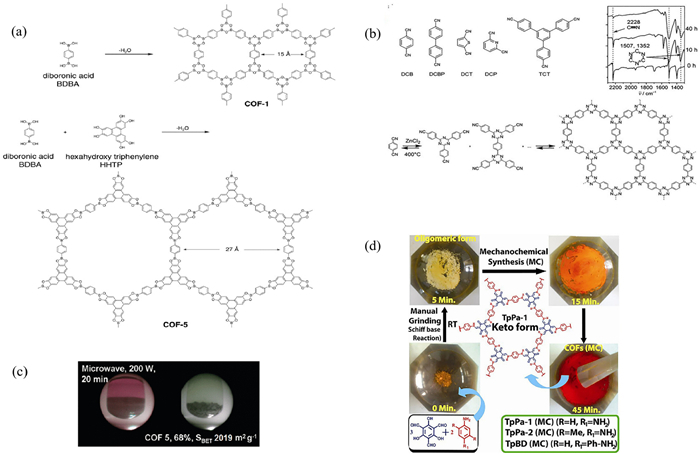
The solvothermal method is the earliest technique for the preparation of COFs (Fig. 1a) [41], and to date, the vast majority of COFs have been synthesized by this approach. The traditional solvothermal method involves dispersing the reaction raw materials in a mixed solvent, performing several freeze-vacuum-thaw cycles, sealing the system, and then conducting the reaction at an elevated temperature for 2–9 days. The high-temperature and high-pressure environment can facilitate the progress of reversible covalent reactions (e.g., Schiff base reaction [45], boronic acid condensation reaction [41]), while slowing down the reaction rate, which is conducive to the ordered arrangement and crystallization of monomers, ultimately yielding COFs powders with high crystallinity. This method features a broad applicability and can be used to synthesize most types of COFs, but it suffers from a long reaction cycle and high energy consumption.
Figure 1
Figure 1.
(a) Synthesis of COF-1 and COF-5 by solvothermal method. Copied with permission [41]. Copyright 2005, AAAS. (b) CTF-1 were prepared by ionothermal method. Copied with permission [53]. Copyright 2008, Wiley-VCH. (c) COF-5 were prepared by microwave assisted method. Copied with permission [59]. Copyright 2009, American Chemical Society. (d) Synthesis of TpPa-1, TpPa-2, and TpBD by mechanical chemical grinding. Copied with permission [64]. Copyright 2013, American Chemical Society.
The ionothermal synthesis method is an approach that uses ionic liquids as both solvents and reaction media, utilizing the characteristics of ionic liquids such as low vapor pressure, high boiling point, and strong solubility to promote monomer polymerization under high-temperature and high-pressure conditions [48,49]. In 2008, Thomas et al. [53] first synthesized triazine-based covalent organic framework materials via the ionothermal method. This method can effectively dissolve poorly soluble monomers and avoid volatile organic solvents, but it requires a high reaction temperature, the post-treatment (removal of molten salts) is relatively complex, and currently only a limited number of monomers can be used with this method (Fig. 1b).
The mechanochemical grinding method is an environmentally friendly synthetic approach that requires no organic solvents [62,63]. A solvent-free mechanochemical approach enables catalyst-mediated solid-state polymerization of COF precursors, where solid monomers are combined with catalytic amounts of acid (e.g., acetic acid) and subjected to ball-milling-induced mechanical activation at ambient conditions. In 2013, Banerjee et al. [64] successfully synthesized three types of COFs, namely TpPa-1, TpPa-2 and TpBD, for the first time through solvent-free manual grinding at room temperature (Fig. 1d). This method avoids the use of solvents and associated pollution, features high reaction efficiency, and is suitable for large-scale preparation; however, it has drawbacks: the crystallinity and porosity of the products are often lower than those obtained by the solvothermal method, and it has higher requirements on the solubility and reaction activity of monomers.
The microwave synthesis method was initially widely used for the synthesis of small-molecule organic compounds, as it can accelerate the reaction rate and improve the yield [57]. In 2008, Cooper et al. [59] utilized the characteristics of rapid and uniform heating of microwaves to accelerate the polymerization reaction of monomers (Fig. 1c). By placing the monomer solution in a microwave reactor, he successfully synthesized COF-5 in a short period of time (several minutes to several hours). This method has prominent advantages: It exhibits an extremely fast reaction rate, which can significantly shorten the synthesis time (reduced from several days in the solvothermal method to several hours), and the resulting product has high crystallinity. However, it also has limitations: it is selective for the reaction system, the condition optimization is complex, and it is relatively difficult to scale up the reaction system for large-scale production.
In summary, in addition to the aforementioned synthetic methods, an increasing number of strategies (including interfacial synthesis, Ionic liquid-mediated synthesis, sonochemical synthesis, etc.) have been developed to fabricate chemically stable COFs [65]. Nevertheless, the current approaches still suffer from several limitations. Firstly, traditional synthesis relies heavily on the solvothermal system, which typically requires high temperature, high pressure, and long reaction time. Such harsh conditions, high energy consumption, and poor reproducibility make large-scale and low-cost production difficult to achieve. Secondly, the cost of synthetic precursors is high. The core monomers for high-performance functionalized COFs (such as aromatic amines and aldehydes containing specific chelating groups, or customized topological ligands) are mostly niche fine chemicals with complicated synthetic routes, difficult purification, and an immature industrial supply system, which directly increase the overall manufacturing cost of COF materials. Thirdly, the processability is poor. Most synthesized COFs are obtained as micro/nano powders, which can hardly be directly processed into practical forms such as membranes, microspheres, and monolithic columns, mismatching actual separation processes. Therefore, deeper insights into the formation mechanism are urgently needed to develop simpler and more efficient methods for synthesizing chemically stable COFs.
2.2
Functional strategy of COFs
Based on their linkage types, COFs are generally classified into categories such as boroxine, imine, triazine, phenazine, C=C double bond, benzoxazole, and benzimidazole linkages [40,66–69]. This diversity in organic reaction synthesis provides a broad foundation for structural design. Furthermore, the availability of pre-designed monomers with different geometric structures endows COFs materials with considerable structural diversity. These features make the design and synthesis of functional COFs possible, allowing them to be tailored and fabricated for various application fields [70]. This section summarizes three commonly used strategies for designing functional COFs: The bottom-up strategy [71–78], post-synthetic modification strategy [79–87], and composite material strategy [73,81,88–93]. Through these different approaches, we can synthesize COFs materials that meet diverse requirements. Subsequently, the synthesized COFs can be applied for the selective separation of rare earth elements.
2.2.1
Bottom-up strategy
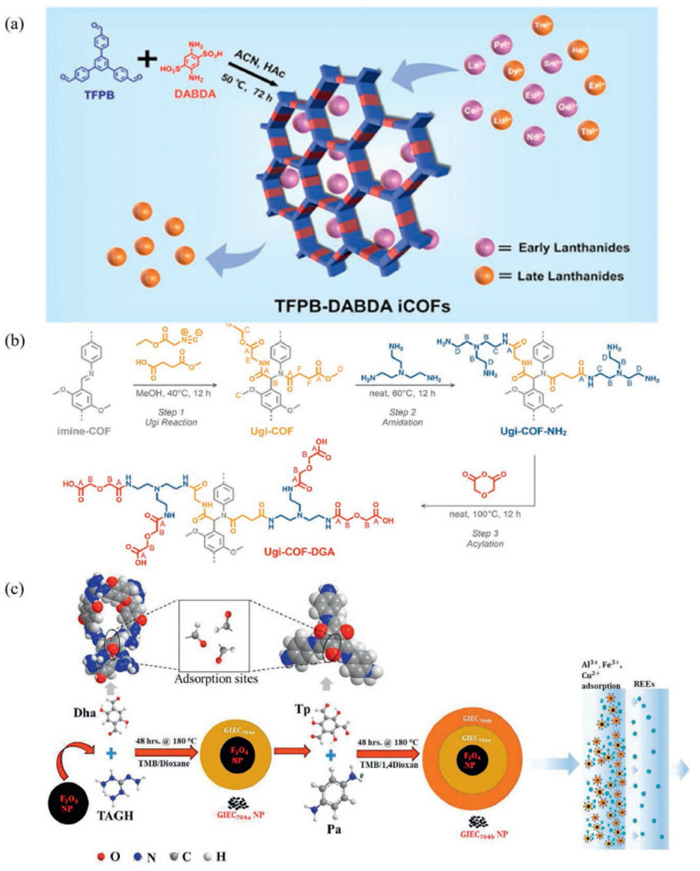
The bottom-up strategy is a simple yet time-consuming method that involves synthesizing functional COFs by pre-designing monomers with different functional groups [72]. These functional groups in the monomers exhibit strong interactions with rare earth ions This method ensures the structural integrity of COFs by directly introducing functional groups into their frameworks [71,75,77]. Commonly used functional groups mainly include phosphoric acid (H2PO3+), hydroxyl groups (-OH), carboxyl groups (-COOH), sulfur-containing groups (-SH, -SO3H), and amide groups (-CO—NH), etc. The introduction of functional groups can increase the active sites of COFs, enabling them to efficiently adsorb target substances (Fig. 2a) [78]. According to the topological structure and length of monomers, the shape and size of COFs can be designed and adjusted, making them crystalline, thermochemically stable, and partially functionalized [77]. However, it is extremely challenging to prepare COFs with stability, crystallinity, and functionality. When directly synthesizing COFs using monomers containing functional groups, the functional groups will affect the crystallization process, resulting in COFs with poor crystallinity. To solve this problem, a post-modification strategy must be developed.
Figure 2
Figure 2.
(a) Schematic representation for the synthesis of TFPB-DABDA iCOFs. Copied with permission [78]. Copyright 2023, American Chemical Society. (b) Schematic diagram for the fabrication of Ugi-COF-DGA. Copied with permission [87]. Copyright 2024, American Chemical Society. (c) The synthesis of magnetic GIEC704a and double-shell magnetic GIEC704b. Copied with permission [93]. Copyright 2024, Elsevier.
The purpose of the post-modification strategy is to introduce additional functional groups into pre-prepared COFs while retaining their original framework structure, thereby enhancing the functionality of COFs (Fig. 2b) [87]. This method uses COFs as a stable platform, taking the groups in the framework structure as the binding sites for reactions, and performs chemical modification through various chemical reactions such as esterification reactions, click reactions, and ring-opening reactions [80,85]. The commonly used binding sites in COFs structures include hydroxyl groups (-OH), carbon-carbon double bonds (C=C), and imine bonds (C=N). Through these binding sites and chemical reactions, mercapto groups, carboxyl groups, and amidoxime groups are introduced into COFs to modify their pore size, functionality, and affinity for rare earth elements [79,82,84]. Another post-modification method is chemical conversion, which is achieved by converting reversible bonds in COFs into irreversible bonds, such as the oxidation of imine bonds to amide bonds, enol-ketone tautomerism, and deprotonation of N—H bonds in COFs [80,83]. Post-modification can promote the mutual conversion between functional groups through different chemical reactions, introduce high-affinity groups, and improve the affinity of COFs for different target rare earth elements. It is a simple and efficient functionalization method. However, the post-modification method still has some shortcomings; for example, the number and distribution of functional groups introduced into the COFs structure cannot be specifically determined. Therefore, in order to improve the high selectivity and affinity of COFs for rare earth elements, further exploration and research on the post-modification strategies of COFs are required in the future.
2.2.3
Composites strategy
In addition to the aforementioned strategies targeting the structure of covalent organic frameworks, novel composite hybrid materials can also be fabricated by integrating functional materials with COFs via physical or chemical approaches (Fig. 2c) [93]. The core concept is to retain the inherent advantages of COFs (such as large specific surface areas, high porosity, high crystallinity, adjustable pore sizes, and easy functionalization), while compensating for the drawbacks of the powder (such as poor processability and recyclability, and insufficient mechanical strength) via compounding with other functional materials. Thereby, improving the selectivity, adsorption capacity, processability, and stability of the COFs composites [91]. For different applications, COFs can be composited with different functional materials to improve their performance. For example: For membrane separation [88,92], COF-based membranes are synthesized by interfacial growth or blending. They can perform size-exclusion and chemical sieving on target ions, thereby achieving an efficient and continuous separation process. In adsorption [81], in-situ growth and blending are used to composited COFs with MOFs, magnetic nanoparticles, and other functional materials, improving the overall activity, selectivity, and adsorption capacity. For instance, Cao et al. [94] used a solvothermal method to combine COFs (TAGH-Dha/TpPa) with Fe3O4 nanoparticles, creating two double-shell magnetic materials that significantly improved the adsorption capacity and selectivity for rare earth elements (lanthanum, yttrium, and neodymium). In the field of column separation, COFs are immobilized or embedded in polymer microspheres or SO2 microspheres to fabricate microspherical adsorbents, which can be directly applied in dynamic column adsorption for the efficient, continuous separation of rare earth elements [95]. Through innovative experimental design, covalent organic frameworks (COFs) are transitioned from high-performance laboratory materials to scalable, highly selective separation platforms, enabling their deployment across multidisciplinary technological domains.
3.
Separation of rare earth
Compared with traditional rare earth separation materials (such as porous carbon, porous silicon, and small-molecule extractants), COFs offer great advantages including high structural stability, tunable pore size, and facile functionalization and post-synthetic modification, among others [40]. These distinct characteristics have led to the widespread applications of COFs for the separation of rare earth. Inspired by the phenomenon that heteroatom-doped small-molecule organic extractants exhibit high affinity toward rare earth elements, a series of COFs bearing functional groups with different heteroatoms (such as N, O, P, S) have been developed [31,32]. In addition, through hybridization with various functional materials, COFs composites suitable for membrane separation and column separation have been successfully fabricated. Rare earth separation strategies are primarily categorized into the direct REEs separation method and the impurity removal approach. This section summarizes the application of COFs in REEs separation
3.1
Direct separation
3.1.1
Adsorption separation
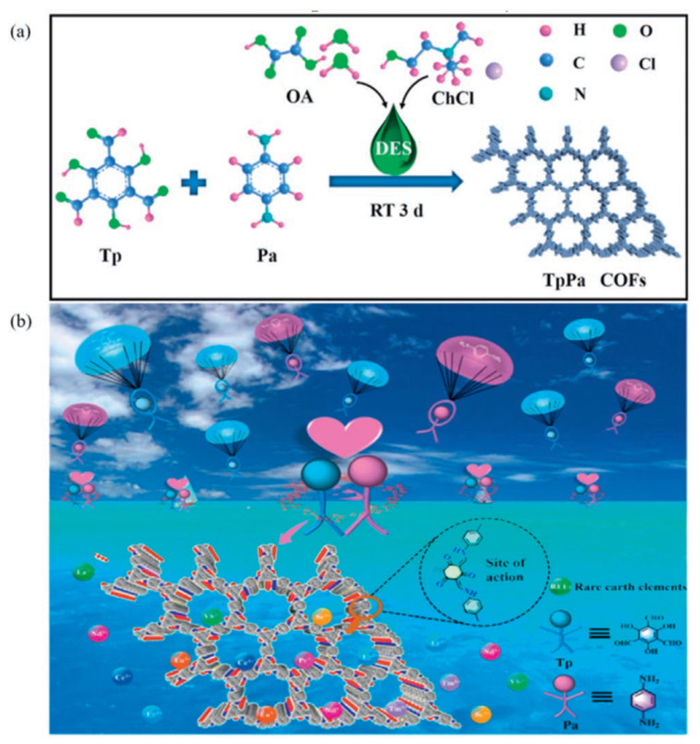
Increasing the density of active sites in COFs can enhance the adsorption capacity for rare earth elements. Functional groups containing heteroatoms such as N, O, P, and S exhibit high affinity toward rare earth elements; thus, a series of N/O-rich covalent organic frameworks have been developed [96–98]. For example, the honeycomb-shaped COF-TpPa-1 was synthesized in deep eutectic solvents, exhibiting a good separation effect on the nine REEs (Fig. 3) [96]. Among them, the separation factors of Eu/Yb, Eu/Tm and Eu/La are 15.34, 14.70 and 10.78, and exhibit an adsorption capacity of up to 84.6 mg/g for La3+ at pH 3.5. The adsorption and separation of the TpPa COFs for REEs relies on the coordination of REE ions with O to form a stable structure. In addition, N-rich COF-PA-CC and COF-ML-CC also exhibit effective separation capabilities for rare-earth elements [98]. They can adsorb 150.88 and 168.19 mg/g of La3+within 120 min, respectively, and demonstrate superior adsorption affinity for light rare-earth ions. Their remarkable adsorption performance toward La3+ is attributed to the complexation interaction between La3+ and the unoccupied nitrogen sites within the N-rich COFs structures.
Figure 3
Figure 3.
(a) Preparation of TpPa COFs in DES at room temperature. (b) Schematic illustration of TpPa COFs for selective separation of REEs. Copied with permission [96]. Copyright 2022, Elsevier.
Introducing specific functional groups such as COOH, -PO3H, and –SO3H into covalent organic frameworks can significantly enhance their separation ability for rare earth elements [99–103]. For instance, the sulfonic acid group-containing TFPB-DABDA iCOFs [97] synthesized via a top-down strategy can rapidly adsorb La3+within 45 min. Through a Ugi post-modification reaction, the highly efficient rare earth element capture group DGA was successfully introduced into the COFs (Ugi-COF-DGA) [87], which can adsorb 663 mg/g of Nd3+ at pH 6.4, 40 times that of unmodified COFs. Moreover, the selectivity can be improved by constructing COFs composites [93,94,104]. Yan et al. [94] incorporated metals into COFs through the solvothermal method, achieving selective capture and absorption of Sc3+. It can reach 98.5% adsorption capacity within 5 min, and the separation efficiency of scandium can reach 94.0% in the presence of interfering ions.
3.1.2
Column separation
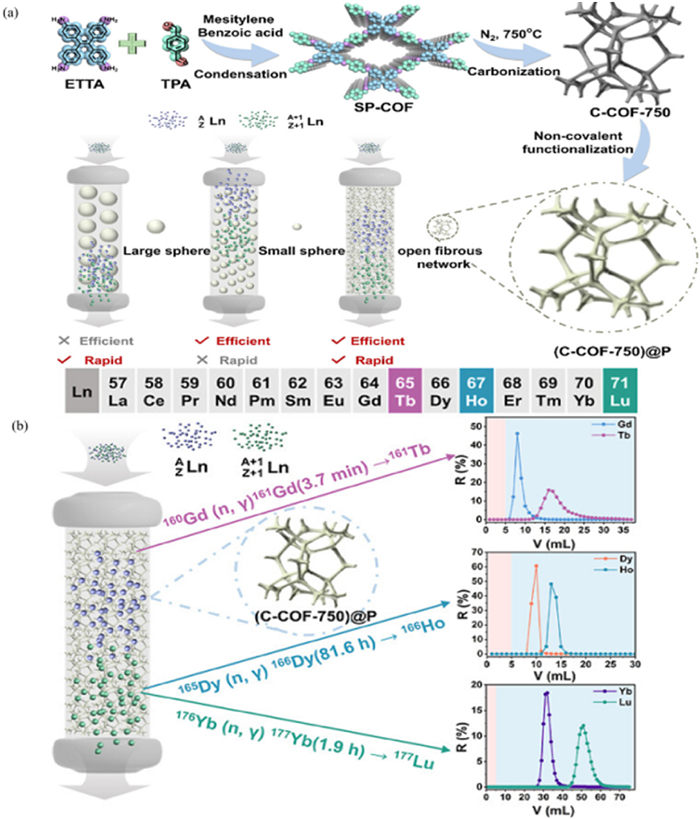
Column Separation is a promising rare earth elements separation technique, offers potential due to its ease of operation and excellent selectivity. Making the covalent organic frameworks into microspheres enables their direct application in the dynamic column adsorption of rare earth elements, achieving an efficient and continuous separation process.In contrast to static adsorbents, dynamic chromatography columns demonstrate significantly enhanced separation efficiency and greater potential for industrial-scale separation processes. For instance, Li et al. [95] constructed a functional core-shell silica-covalent organic framework composite (SiO2@COF) simultaneously decorated with 2-ethylhexyl phosphonic acid mono-2-ethylhexyl ester (P507) and diisooctylphosphinic acid (C272) as a potential chromatography material for NCA 177Lu separation. It can separate Lu3+from 300.0 mg simulated Yb target solution, with a high decontamination factor of Yb3+ (1.0 × 10⁵) and good Lu3+recovery (84.2%). In another example, Wang et al. [105] developed a strand-like ionic TpPa-SO3Na and combined it with a polyacrylonitrile (PAN) matrix to prepare composite beads for the efficient extraction of Nd3+. The TpPa-SO3Na nanofilaments exhibit high adsorption capacity (107.1 mg/g) and good selectivity for Nd3+. Moreover, the composite beads fabricated from the TpPa-SO3Na effectively retain the original microstructure and performance of the TpPa-SO3Na. Importantly, the composite beads can be used in dynamic processes and show excellent recovery efficiency and good operational stability at both low and high Nd3+concentrations. In addition, by fabricating covalent organic frameworks into carbon superstructures, they can become highly efficient new chromatographic stationary phases for rare earth separation applications [106]. Through the self-template strategy, Ma et al. [107] firstly used the thermal transformation method to synthesize a micrometer-sized hollow spherical carbon superstructure with significant micro/nano surface morphology and graded pore structure. This advanced structure helps to enhance the immobilized functional molecules during the dynamic non-equilibrium adsorption process within the column, thereby achieving efficient separation of lanthanide elements (Yb3+/Lu3+) even under actual harsh conditions with a mass ratio as high as 105:1. In addition, it also features low column pressure, high separation efficiency and excellent cycle stability. In the same year, they successfully developed a class of noncovalently functionalized carbon with an open fibrous network derived from COFs for the rapid and efficient separation of medical lanthanides through extraction chromatography (Fig. 4a) [108]. The open network facilitated rapid fluid flow, while the thorny surface further increased the effective accessible area. The carbonaceous structural frameworks also endowed the materials with excellent stabilities, enabling them to effectively withstand the high acidity (1 mol/L HNO3) during the separation process. Impressively, for the separation of medical lanthanide ions Dy3+/Ho3+. the prepared carbon fibers demonstrated a recovery rate of up to 98.6% (Fig. 4b). Moreover, the separation system also has the advantages of fast fluid flow (0.17 mL/min), small elution volume (6 mL), and excellent cycling performance (>4 times), which can also be applied to the effective separation of other lanthanide ions. Furthermore, they successfully synthesized ZZCOFs with different substituent electronic effects (–OCH3, –H, –F) via the Povarov reaction [109]. Introducing functional groups with different electrical properties into the COF pore walls can significantly affect the host-guest interactions between the COF carriers and the flexible extractant P507, thereby effectively regulating and optimizing the Yb3+/Lu3+ separation performance of the composite materials. Under this mechanism, the composite with electron-donating groups exhibited superior separation efficiency for NCA 177Lu, with a recovery rate up to 96.1%, compared with the COF-P507 composite containing electron-withdrawing groups.
Figure 4
Figure 4.
(a) Preparation process and separation diagram of extraction chromatography of (C-COF-x)@P. (b) The rapid and efficient separation of Gd/Tb, Dy/Ho, and Yb/Lu through extraction chromatography. Copied with permission [108]. Copyright 2025, American Chemical Society.
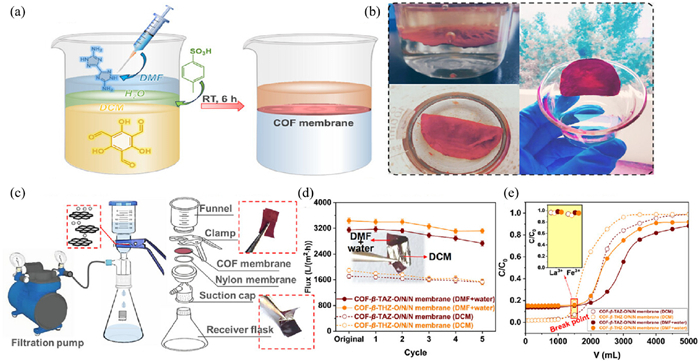
In addition to the aforementioned separation methods, COFs can also be fabricated into thin films, which are widely utilized in the continuous and efficient separation of rare earth elements through size-exclusion, chemical sieving, and selective adsorption mechanisms [110–113]. Furthermore, Kong et al. [113]. has developed specific adsorbents targeting rare earth ions via theoretical prediction and structural design (Figs. 5a and b). The as-synthesized β-ketoenamine-linked COFs feature tailored chelating sites, among which COF-β-TAZO/N/N demonstrates a maximum adsorption capacity of 263.2 mg/g for scandium ions, with a separation factor of 165 between scandium and lanthanum ions. In comparison, COF-β-THZ-O/N/N exhibits an adsorption capacity of 178.6 mg/g and a separation factor of 117. Janus membranes fabricated from these customized COFs are capable of selectively separating Sc3+ from complex multi-metal ion solutions. Specifically, the Sc3+ removal efficiency of COF-β-TAZO/N/N attains 93.1%, while the separation factors for Sc3+/La3+ and Sc3+/Fe3+ are 295 and 207, respectively (Figs. 5c–e).
Figure 5
Figure 5.
(a, b) Synthesis of COF membrane. (c) Schematic diagram of the experimental device used for the filtration of Sc3+ solution by COF membrane. (d) Variation in water flux through the membrane assessed over five cycles. (e) Dynamic adsorption curves of COF membrane used to separate Sc3+ from Sc3+/La3+/Fe3+ mixed solutions. Copied with permission [113]. Copyright 2025, Wiley-VCH.
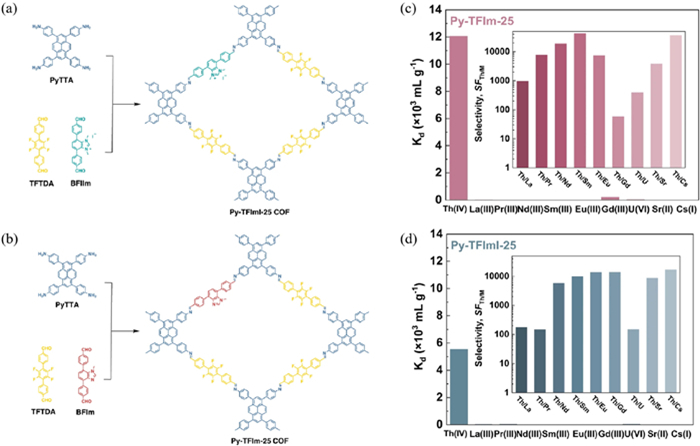
In addition to directly separating the pure rare earth elements from various ions, another strategy for separating rare earth elements is to remove the impurity ions within them. These impurities typically include transition metal ions (such as Fe3+, Cu2+, Zn2+ and Al3+), alkaline/alkaline earth metal ions (such as Ca2+, Mg2+), and some radioactive metals (such as Th4+, U6+), which tend to coexist with the rare earth ions in the leaching solution and significantly affect the purity of the rare earth products [18]. In contrast, the physicochemical properties of transition metal ions and alkali/alkaline earth metal ions differ significantly from those of rare earth elements. Thus, most of these impurity ions can be removed via simple extraction or precipitation, whereas only a subset of ions with similar properties are difficult to eliminate. Furthermore, COFs have demonstrated significant potential in the selective removal of impurity ions during REEs processing. Shi et al. [99] ingeniously combined rigid and flexible monomers to in-situ introduce both hard and soft donor sites into the backbone of COFs. These COFs enable efficient and selective capture of actinide elements from acidic aqueous solutions. By engineering the topological arrangement of rigid linkers to control conformational distortions in flexible spacers, a nitrogen/oxygen-rich coordination pocket was designed, significantly enhancing the separation of multi-valent actinides and lanthanides across diverse oxidation states. Specifically, in a 0.5 mol/L nitric acid solution, DAPhen-COF exhibits remarkable selectivity for Np(Ⅴ), with a separation factor of Np/Gd exceeding 5000. Furthermore, the removal of Th4+ and UO22+ from rare earth ions also remains a challenging task. As is well-known, numerous organic small-molecule extractants doped with nitrogen and oxygen atoms exhibit high affinity toward such elements. Consequently, a series of N,O-functionalized COFs have been developed for the removal of Th4+ from rare earth elements [114–117]. Gao et al. [117] synthesized a N,O-functionalized two-dimensional COFs, namely TAPT-DHTA, which achieves a saturated adsorption capacity of up to 1394 mg/g for Th4+ (at pH 4.0) with a distribution coefficient (Kd) as high as 5.2 × 10⁴. Additionally, Ye et al. [115] designed and fabricated a nitrogen-rich COF, Py-TFlml-25, which demonstrates a separation factor of up to 105 for Th4+. These results indicate that the synergistic coordination interactions between N/O atoms and Th4+, together with their specific binding mechanisms, can significantly enhance the material’s affinity for Th4+. The outstanding adsorption performance of TAPT-DHTA and Py-TFlml-25 provides a vital platform for the highly selective removal of thorium from rare earth elements, offering valuable insights for the design of rare earth separation adsorbents (Fig. 6). Moreover, COF composites prepared via composite material strategies have also been applied to uranium removal from rare earth leachates. Qiu et al. [118] synthesized a CNT/COF-OH composite by in-situ growing COFs on the surface of carbon nanotubes (CNTs), which is dedicated to uranium removal from rare earth tailings wastewater. Benefiting from the synergistic effects of the composite, CNT/COF-OH achieves a uranium adsorption capacity of 518.2 mg/g, with a uranium removal efficiency of 96.7% in rare earth tailings wastewater. COFs membranes are also widely employed for the removal of impurity ions from rare earth ions. Luo et al. [114] prepared a sulfonated COFs adsorbent, [NH4]+[COF-SO3−], for the selective extraction of thorium from rare earth elements. This adsorbent exhibits a distribution coefficient of up to 1.34 × 10⁵ mL/g and an adsorption capacity of 395 mg/g for Th4+. Furthermore, by fabricating this COF into a membrane, the effective separation of Th4+ from rare earth elements (Eu3+ and Ce3+) was achieved; most notably, a Th4+ solution with a purity of up to 93.5% was obtained.
Figure 6
Figure 6.
(a) Synthesis of Py-TFImI-25 COF. (b) Synthesis of Py-TFImI-25 COF. (c) Capture performance of Py-TFImI-25 COF for Th4+. (d) Capture performance of Py-TFIm-25 COF for Th4+. Copied with permission [115]. Coppyright 2023, the authors.
The separation of rare earth ions by COFs (Table 1) mainly relies on their designable pores and surface chemistry, achieving selective capture and separation through various molecular-level interactions. The mechanism is complex and usually results from the synergistic effect of multiple mechanisms such as coordination chelation, pore sieving effect, electrostatic interaction and ion exchange [34]. The analysis of separation mechanisms often needs to be carried out from multiple dimensions including macro-performance, micro-structure, and interactions. Various characterization technologies complement each other to jointly reveal the intrinsic correlation of "material structure - interaction - separation performance". Structural characterization of COFs serves as a critical basis for elucidating separation mechanisms by systematically analyzing pore architecture, spatial distribution of active sites, and adsorption-induced structural transformations, thereby establishing a foundation for mechanistic studies of metal-ligand interactions [32]. At present, a variety of characterization technologies have been used to analyze these structures, including X-ray diffraction (XRD), Brunauer-Emmett-Teller (BET) specific surface area analysis, Fourier transform infrared spectroscopy (FT-IR), solid-state nuclear magnetic resonance (ssNMR), transmission electron microscopy (TEM), scanning electron microscopy (SEM), and energy dispersive spectrometer (EDS). Among them, XRD is used to analyze the crystal structure and long-range order of COFs, and verify whether the material structure of COFs changes before and after adsorbing rare earth ions. BET specific surface area analysis is employed to determine the specific surface area, pore size distribution, and porosity of COFs. By comparing the relationship between the pore size of COFs and the hydration radius of rare earth ions, it provides evidence for the "size sieving" mechanism. In addition, by comparing the BET data of the material before and after adsorption, the adsorption sites of rare earth ions (either inside the pores or on the surface) can be determined. If the specific surface area and pore size decrease significantly after adsorption, it indicates that rare earth ions enter the interior of the pores; if the pore size does not change significantly but the specific surface area decreases, it suggests that ions are mainly adsorbed on the active sites on the material surface. FT-IR is used to determine whether the material contains specific functional groups and chemical bonds. In addition, the occurrence of coordination can be confirmed by comparing the displacement or intensity changes of characteristic peaks of functional groups (such as -COOH, -PO3H2, -SO3H) before and after adsorption. ssNMR is used to detect the chemical shift changes of internal groups in the material structure, and clarify the chemical environment changes of the COFs framework and functional groups during the adsorption process at the atomic level. SEM and TEM are used to observe the morphology, particle size, and dispersibility of COFs, while EDS can intuitively present the elemental distribution of rare earth ions in COFs materials, clarify whether ions are uniformly adsorbed on the material surface and inside the pores, and provide direct evidence for the localization of adsorption sites.
The essence of the interaction between COFs and rare earth ions lies in the specific binding between active sites and ions. Advanced characterization techniques such as X-ray photoelectron spectroscopy (XPS) and FT-IR enable precise identification of surface-active functionalities and their dynamic evolution during adsorption, thereby mapping critical active sites involved in rare earth ion separation and deciphering key metal-ligand interaction mechanisms. XPS can determine the changes in binding energy of heteroatoms such as C, N, O, and S, as well as rare earth ions, before and after adsorption, confirm the changes in electron cloud density of coordinating atoms such as N and O in COFs, and directly prove the formation of coordination bonds between materials and rare earth ions. Through FTIR analysis of the displacement and intensity changes of characteristic absorption peaks of functional groups before and after adsorption, the types of functional groups involved in the interaction can be verified. For example, the characteristic absorption peak of the imine bond (-C=N-) undergoes a blue shift or red shift after adsorption, indicating that the N atom participates in coordination; the change in the characteristic peak of the sulfonic acid group (-SO3H) can reflect its dissociation and binding state during the ion exchange process. However, a single experimental characterization is difficult to fully reveal the interaction at the atomic scale. Theoretical calculation and micro-simulation technologies can make up for the shortcomings of experiments. Through quantitative analysis of parameters such as electronic structure, bond energy, and adsorption energy, the essence of the separation mechanism can be accurately analyzed. Density functional theory (DFT) is the most widely used calculation method. Through computational modeling of COF-rare earth ion adsorption configurations and DFT calculations of parameters including adsorption energy, bond lengths, angles, differential charge density, and density of states the relative contributions of coordination chelation and ion exchange mechanisms can be quantified, while elucidating electron transfer pathways at the atomic level. Molecular dynamics (MD) simulation can simulate the interaction process between COFs and rare earth ions in a solution environment, analyze the influence of ion diffusion paths, pore confinement effects, and hydration on separation performance, and provide dynamic evidence for the verification of the pore sieving mechanism. Finally, inductively coupled plasma-mass spectrometry (ICP-MS) can be used to accurately determine the concentration changes of rare earth ions in the solution, calculate key parameters such as adsorption capacity, removal rate, and separation factor, so as to reflect the macroscopic separation performance of the material. By comparing the material structure with the separation effect, it provides a basis for the verification of the mechanism.
4.1
Coordination chelation
Based on the comprehensive analysis of the aforementioned characterization technologies, the separation of rare earth ions by COFs is usually the result of the synergy of multiple interactions such as coordination chelation, pore sieving effect, electrostatic interaction and ion exchange. In addition, these four mechanisms do not exist in isolation; they often work together with host-guest interactions and composite material synergy effects to regulate separation performance, and their internal logic can be accurately verified by characterization data. Coordination chelation is the core force for COFs to achieve highly selective separation of rare earth ions. Its essence is that heteroatoms such as N, O, P, and S in the COF framework or functionalized groups act as electron donors, forming stable coordination bonds or chelates with rare earth ions with empty orbitals, and realizing selective separation by virtue of the differences in chelating ability between different rare earth ions and active sites. This mechanism can be jointly verified by XPS, FT-IR, and DFT calculations: XPS shows the binding energy shift and electron transfer of heteroatoms, FT-IR presents the peak shape changes of characteristic functional groups, and DFT calculations quantify the differences in adsorption energy and bonding strength. Functional groups containing N and O are the most commonly used chelating units; structures such as imine bonds, β-ketoenamines, and triazine rings can construct multi-site coordination environments to enhance the binding ability with rare earth ions [96,97,101,113,117]. For example, the N,O-functionalized 2D TAPT-DHTA COF are used for the adsorption of thorium from uranium and rare earth elements. The XPS result analysis revealed that the extraordinarily strong coordinate bond occurs between bidentate ligand sites (N and O) on the COF framework and Th4+. These results strongly suggest that the high selectivity for Th4+ is due to the collaborative coordination interactions between N/O atoms and Th(Ⅳ) as well as their specific binding mechanism. In another work, the solid-state 13C NMR spectroscopy and XPS results illustrated that the strong coordination interaction between the carboxy groups in 3D–COOH–COF and Nd3+ is responsible for its excellent Nd3+ capture ability.
4.2
Ion exchange
Ion exchange mainly occurs in COFs containing ionic functional groups such as sulfonic acid groups and carboxyl groups. Its core is the charge displacement between exchangeable ions (such as H+and NH4+) on the material surface and rare earth ions, realizing ion adsorption while maintaining charge balance. For example, the efficient adsorption of Th4+ by the sulfonated COF adsorbent [NH4+][COF-SO3−] is precisely due to the ion exchange between NH4+ and Th4+, with a distribution coefficient as high as 1.34×10⁵ mL/g. XPS characterization confirms the shift of the characteristic peak of SO3− and a significant change in zeta potential, verifying the contribution of the ion exchange mechanism. In composite materials, this mechanism often synergizes with coordination chelation; for instance, CNT/COF-OH achieves a uranium adsorption capacity of 518.2 mg/g and a removal rate of 96.7% through the synergy of hydroxyl coordination and ion exchange [112].
4.3
Electrostatic interaction
Electrostatic interactions play a key synergistic role during the separation of rare earth ions by COFs. Its essence is to regulate the adsorption and migration of rare earth ions on the surface and in the pores of COFs through the Coulomb force generated between the charges carried by the COF material and the positively charged rare earth ions in solution, thereby assisting in improving separation efficiency.The strength of COFs primarily relies on which charge density and charge type is on the surface, along with solution pH, ionic strength and more. Alterations in the pH of the solution can result in the protonation/deprotonation of the functional groups on the surface of the COF [93,94]. This process can change the surface charge of the COF and thus affect the interactions with rare earth ions.Additionally, under low ionic strength in solution, electrostatic attraction is not affected, which brings about better separation efficiency; and under high ionic strength a large number of irrelevant ions in solution will shield the surface charge of COFs, weaken the electrostatic interaction and cause a decline of separation performance, which can provide a theoretical basis for regulating separation conditions in practical industrial applications. For instance, an increase in pH leads to the deprotonation of functional groups on the surface of MI-GIEC704b, significantly enhancing the adsorption capacity of Sc3+ through electrostatic interactions.
4.4
Pore sieving effect
The pore sieving effect relies on the regular pore structure and adjustable pore size of COFs to achieve separation through physical size screening. Its core is the precise matching between the pore size and the hydration radius of rare earth ions, allowing target ions to enter the pores for adsorption while blocking impurity ions with larger sizes. Due to the extremely small difference in the bare radii of adjacent rare earth ions (<0.01 Å), simple pore sieving is difficult to achieve efficient separation between rare earth ions. It is necessary to synergize with coordination chelation to construct a "size screening + chemical recognition" system [111,112]. For example, a cationic 3D COF membrane delivers the selective extraction of lanthanide ions from their competing ions, with an experimental La3+/Cs+ selectivity of up to 10.2 in a tri-component system. Combined with DFT simulation and EDS Mapping, it is confirmed that the pore confinement effect enhances the coordination between ions and active sites, synergistically improving separation efficiency.
In summary, The specific recognition of rare earth ions by COFs is essentially the precise matching between the material structure and the physical and chemical properties of rare earth ions. Relying on the dual synergy of "chemical recognition + physical screening", it achieves the targeted recognition and capture of target rare earth ions, which can be summarized into three points. First, coordination-specific recognition: by precisely designing the coordination environment of COF active sites (such as the type of coordination atoms, coordination number, and coordination spatial configuration), the active sites form thermodynamically stable coordination bonds or chelates with target rare earth ions, while the coordination interaction with interfering ions is significantly weaker. Specific recognition is achieved through the difference in coordination binding energy, which is the core mechanism of rare earth specific recognition and directly related to the coordination chelation effect. Second, size-specific recognition: based on the adjustable pore structure of COFs, the pore size and pore topological structure are precisely regulated, and physical-specific recognition is realized by virtue of the pore sieving effect. Third, charge-specific recognition: by regulating the surface charge density and charge type of COFs, the surface charge of the material forms a strong electrostatic attraction with target rare earth ions, while generating electrostatic repulsion or weak electrostatic interaction with interfering ions, and charge-specific recognition is realized through electrostatic interaction. In addition, host-guest interaction can further enhance the specific recognition ability of rare earth ions. By introducing rare earth-specific guest molecules (such as extractants, crown ethers, calixarenes) into the COF pores, relying on the specific binding between guest molecules and target rare earth ions, combined with the confinement effect of COF pores, the "host-guest-ion" triple specific recognition is realized, which significantly improves the recognition selectivity. And, the analysis of the separation mechanism of rare earth ions by COFs relies on the comprehensive application of multiple technologies such as structural characterization, surface analysis, and theoretical calculations. Various technologies reveal the essence of the interaction between materials and ions from different dimensions, providing solid experimental and theoretical support for the four core mechanisms (coordination chelation, pore sieving, electrostatic interaction and ion exchange) and auxiliary synergy effects. In the future, with the development of in-situ characterization technologies (such as in-situ XRD and in-situ XPS) and high-precision theoretical calculation methods, it is expected to further reveal the dynamic mechanism of the separation process at the atomic scale, providing more accurate guidance for the precise functional modification, pore structure optimization, and industrial application of COFs materials.
5.
Summary and future outlook
In summary, this review comprehensively outlines the research progress in the separation of rare earth elements using COFs. As a class of crystalline porous materials formed by the connection of organic monomers through covalent bonds, COFs have broken through the limitations of traditional rare earth separation materials (such as organic extractants and inorganic adsorbents), including poor selectivity, insufficient stability, and difficulty in recycling, by virtue of their precisely designable pore structures, high-density tunable active sites, excellent chemical stability, and good structural modifiability. They thus exhibit enormous application potential and research value in the field of rare earth element separation and purification. Compared with traditional separation materials, the core advantages of COFs for rare earth separation stem from their unique structural characteristics, which can accurately meet the core requirements of rare earth separation: first, structural designability. By selecting monomers with different topological structures and types of polymerization reactions, the pore size, pore topological structure, and active site distribution of COFs can be precisely regulated to achieve directional recognition and separation of specific rare earth ions; second, high density of active sites. Functional groups rich in heteroatoms such as N, O, P, and S can be introduced through bottom-up in-situ synthesis or post-modification methods to construct high-density chelating sites or ion exchange sites, thereby enhancing the interaction with rare earth ions; third, excellent chemical and thermal stability. The framework structure connected by covalent bonds enables them to withstand harsh working conditions such as acidic leachates and high temperatures in rare earth hydrometallurgy, avoiding material degradation or structural collapse, and improving the stability and recyclability of the separation process; fourth, high mass transfer efficiency. The regular pore structure and high porosity provide convenient pathways for the diffusion of rare earth ions, effectively shortening the mass transfer distance and improving the separation rate and adsorption capacity. These advantages together lay the application foundation of COFs in the field of rare earth separation, enabling them to adapt to rare earth separation needs under different scenarios.
Despite the significant progress made in the research of COFs in rare earth separation, there are still many challenges to their large-scale industrial application. First, difficulty in large-scale preparation. Currently, the preparation of COFs mostly remains at the laboratory-scale synthesis, with problems such as complex synthesis processes, high costs, and poor product dispersibility, which are difficult to meet the needs of large-scale industrial separation. Second, insufficient processability. Pure COFs are mostly in powder form and are difficult to be formed into practical morphologies such as membranes and microspheres, affecting their application in continuous separation processes, thus requiring composite modification to improve processability. Third, the separation performance of some systems still needs optimization. For some adjacent rare earth ions with extremely similar properties, the separation selectivity of COFs still needs to be improved, and the separation stability in high-concentration interfering ion systems needs further enhancement. Fourth, the mechanism research still needs to be deepened. The dynamic mechanism of the separation process at the atomic scale and the inherent laws of the synergistic effect of multiple mechanisms still need to be further revealed by combining high-precision in-situ characterization technologies and theoretical calculations. Fifth, lack of precise guidance in synthesis and separation. At present, the synthesis of functional COFs, design of active sites, and the optimization of separation methods and processes for rare earth elements still mainly rely on trial and error and empirical accumulation, which results in low efficiency and makes it difficult to achieve accurate matching between material performance and separation requirements.
In response to the above challenges, the future development directions of COFs in the field of rare earth separation can focus on three aspects: (1) Developing low-cost and large-scale synthesis processes, optimizing monomer selection and reaction conditions, simplifying the synthesis process, reducing the preparation cost, and realizing the mass production of COFs. (2) Strengthening research on composite modification. Combining COFs with polymers, carbon materials, nanoparticles, etc., to improve the processability, mechanical strength, and separation performance of materials, and promote the development of practical separation materials. (3) Precisely designing functionalized COFs. Combining theoretical calculations (such as DFT and MD simulations) with experimental characterization to directionally optimize the active site structure and pore parameters, improve the selectivity for difficult-to-separate rare earth ions, and break through the technical bottleneck in the separation of adjacent rare earth ions. (4) Deepening mechanism research and industrial application exploration. Using in-situ characterization technologies to reveal the dynamic mechanism of the separation process. (5) Applying AI technology to guide the synthesis of COFs and the separation of rare earth elements. Establish a closed-loop system of " data collection, model training, predictive optimization, and experimental verification" to accurately predict the influence of different monomer combinations and reaction parameters on the structure and active sites of COFs, and purposefully design COFs materials that meet the requirements of rare earth separation, significantly reducing ineffective trial and error, lowering synthesis costs, and improving synthesis efficiency.
In conclusion, COFs show broad application prospects in the field of rare earth separation due to their unique structural advantages and excellent separation performance. Although they still face challenges in large-scale preparation and processability, with the continuous development of material synthesis technologies, characterization technologies, and theoretical calculation methods, functionalized COFs will surely become one of the core materials in the field of rare earth separation, providing important technical support for promoting the efficient utilization of rare earth resources and boosting the development of the high-end rare earth industry.
The authors declare that they have no known competing financial interests or personal relationships that could have appeared to influence the work reported in this paper.
Acknowledgments
This work was supported by the National Natural Science Foundation of China (Nos. 22474141, 22501106 and 22404160) and the Strategic Priority Research Program of the Chinese Academy of Sciences (No. XDB1220000).
[1]
R.M. Hartshorn, K.H. Hellwich, A. Yerin, et al., Pure Appl. Chem. 87 (2015) 1039–1049. doi: 10.1515/pac-2014-0718
[2]
X. Zhang, Z. Zhao, X. Zhang, et al., J. Mater. Chem. C 1 (2013) 7202–7207. doi: 10.1039/c3tc31200c
[3]
M.K. Hossain, G.A. Raihan, M.A. Akbar, et al., ACS Appl. Mater. Interfaces 4 (2022) 3327–3353. doi: 10.1021/acsaelm.2c00069
Figure 1
(a) Synthesis of COF-1 and COF-5 by solvothermal method. Copied with permission [41]. Copyright 2005, AAAS. (b) CTF-1 were prepared by ionothermal method. Copied with permission [53]. Copyright 2008, Wiley-VCH. (c) COF-5 were prepared by microwave assisted method. Copied with permission [59]. Copyright 2009, American Chemical Society. (d) Synthesis of TpPa-1, TpPa-2, and TpBD by mechanical chemical grinding. Copied with permission [64]. Copyright 2013, American Chemical Society.
Figure 2
(a) Schematic representation for the synthesis of TFPB-DABDA iCOFs. Copied with permission [78]. Copyright 2023, American Chemical Society. (b) Schematic diagram for the fabrication of Ugi-COF-DGA. Copied with permission [87]. Copyright 2024, American Chemical Society. (c) The synthesis of magnetic GIEC704a and double-shell magnetic GIEC704b. Copied with permission [93]. Copyright 2024, Elsevier.
Figure 3
(a) Preparation of TpPa COFs in DES at room temperature. (b) Schematic illustration of TpPa COFs for selective separation of REEs. Copied with permission [96]. Copyright 2022, Elsevier.
Figure 4
(a) Preparation process and separation diagram of extraction chromatography of (C-COF-x)@P. (b) The rapid and efficient separation of Gd/Tb, Dy/Ho, and Yb/Lu through extraction chromatography. Copied with permission [108]. Copyright 2025, American Chemical Society.
Figure 5
(a, b) Synthesis of COF membrane. (c) Schematic diagram of the experimental device used for the filtration of Sc3+ solution by COF membrane. (d) Variation in water flux through the membrane assessed over five cycles. (e) Dynamic adsorption curves of COF membrane used to separate Sc3+ from Sc3+/La3+/Fe3+ mixed solutions. Copied with permission [113]. Copyright 2025, Wiley-VCH.
Figure 6
(a) Synthesis of Py-TFImI-25 COF. (b) Synthesis of Py-TFImI-25 COF. (c) Capture performance of Py-TFImI-25 COF for Th4+. (d) Capture performance of Py-TFIm-25 COF for Th4+. Copied with permission [115]. Coppyright 2023, the authors.


 DownLoad:


 下载:


 下载:

