
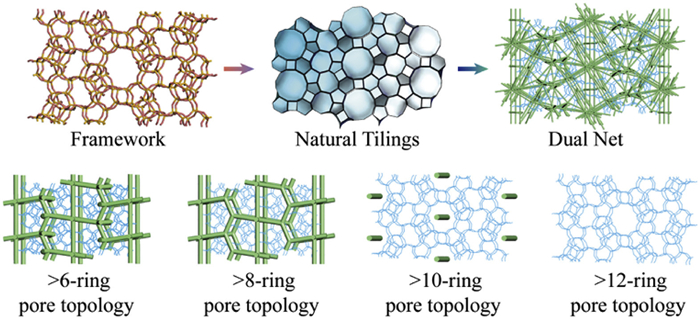
Figure 1.
Workflow for pore topological network construction.


Zeolites are a class of important inorganic microporous materials with unique microporous structures and indispensable applications across diverse industrial sectors [1-4]. Their framework structures consist of TO4 tetrahedra (T = Si, Al, P, etc.) linked via shared oxygen atoms. The uniformly ordered and highly regular channels within these frameworks provide a distinctive confined microenvironment for guest molecules. With TO4 tetrahedra as the fundamental building units, zeolite frameworks exhibit diverse channel structures arising from varied tetrahedral connectivity patterns. Pore sizes span multiple categories, including small pores (8-ring, ~0.40 nm), medium pores (10-ring, ~0.55 nm), large pores (12-ring, ~0.66 nm), and extra-large pores ( > 12-ring). Owing to their unique microporous structure, zeolites exhibit exceptional performance as adsorbents, catalysts, and ion exchangers in petrochemical, petroleum refining and other industries [5-9]. Furthermore, thanks to the development of synthetic strategies and structure determination techniques, the number of International Zeolite Association (IZA) recognized zeolite framework types has exceeded 250 [10]. However, these structures still cannot fully satisfy industrial demands for zeolites with exceptional physicochemical properties. Thus, function-oriented design and screening of candidate zeolites with ideal channel structures are important.
However, this task is challenging because a mature method for zeolite pore matching is currently lacking. Although various methods have been developed for pore analysis, most of these methods can only capture partial geometric features and require high computational costs, collectively limiting their practical utility. For instance, Blatov and co-workers introduced a Voronoi-Dirichlet-Polyhedra approach to characterize the voids in crystal structures [11]; Foster and co-workers combined geometric analysis and molecular simulations to identify and characterize the pores in metal-organic frameworks (MOFs) [12]; Sholl and co-workers provided a grid-based approach to identify the diameters of the largest included sphere and the largest free sphere in zeolite frameworks [13]; Floudas and co-workers developed an automated tool, ZEOMICS, for characterizing the cavities and channels within zeolite frameworks [14]. Among those methods, topological data analysis (TDA), rooted in algebraic topology techniques, is particularly representative [15]. Centered on Persistent Homology, TDA can reveal the topological characteristics of channels by tracking the generation and annihilation of rings and voids within structures. However, TDA suffers from two critical limitations: (1) It lacks explicit geometric descriptions and physicochemical interpretability; (2) It incurs prohibitive computational costs for high-throughput screening. In summary, the development of a simple, efficient method for pore network analysis and matching is important for materials discovery.
This study presents a topology-based pore matching method for pore structure description that enables systematic pore matching and rapid screening of candidate zeolites for the first time. By simplifying complex pore channels into node-link networks, this method can capture the connectivity and accessibility of porous systems. By changing the size of the probe molecule, this method can identify the diffusion pathways for different guest molecules. Using this method, we analyzed the distribution of pore channels in known zeolite structures and identified several prevalent pore structure types among known zeolites. Special emphasis was placed on seven industrially relevant zeolite structures (including CHA, FAU, and LTA), and their pores were matched against over 400,000 hypothetical structures [16,17]. We successfully identified 124 structures highly similar to CHA and 8 structures highly similar to FAU. Among them, the AABABBCCAABBCC structure shows exceptional catalytic performance for the methanol-to-olefins (MTO) reaction validated via density functional theory (DFT) calculations [18-20]. These results demonstrate the strong potential of this methodology for rapid discovery of candidate zeolites with tailored functionalities.
The calculation steps of the pore description method developed in this study are shown in Fig. 1. The core concept is to simplify the complex zeolite pores into "node-link" topological networks that keep essential connectivity information while eliminating redundant structural details.
For the target zeolite structure, we first generated the Natural Tiling (NT) using ToposPro [21] software. In the NT, individual polyhedra (tiles) share coplanar faces, and by linking the geometric centers of adjacent tiles, a fully interconnected pathway network (i.e., the dual net) can be obtained. However, the dual net treats all inter-tile connecting channels as accessible, including those through 6-rings or smaller ring structures that most guest molecules cannot pass through.
To obtain physically meaningful pore descriptions, we systematically removed inaccessible connections from the dual net. Specifically, for each connection in the dual net, we identified the ring size of the shared face between adjacent tiles using ToposPro software. If this ring size was smaller than the threshold corresponding to the probe molecule size, the connection was eliminated from the network (see Section S1 in Supporting information for detailed procedures). The resulting network is defined in this study as the pore topological network (or pore topology), and it represents the diffusion pathways accessible to specific guest molecules. This size-dependent filtering transforms a purely mathematical construct into a physically meaningful representation.
In this study, probe molecule sizes were set at 0.33, 0.42, 0.50, and 0.59 nm, corresponding to the thresholds for 6-, 8-, 10-, and 12-ring in zeolites, respectively. This range comprehensively spans the kinetic diameters of industrially important guest molecules such as methane (0.38 nm), ethane (0.40 nm), propane (0.43 nm), and benzene (0.58 nm). At the same time, it aligns with the intrinsic pore size distributions of most known zeolite frameworks, ensuring broad applicability. It should be noted that pore size is incorporated through the probe molecule filtering step. By using different probe sizes, we selectively remove connections that cannot accommodate molecules of the corresponding size. The resulting pore topological network under each probe size inherently reflects size-dependent accessibility. Although ring member count (e.g., 8-ring, 10-ring) is a more conventional concept in zeolite structure analysis, the actual pore dimensions can vary for rings with the same member count due to geometric factors such as ellipticity or distortion. Such geometric variations also affect molecular passage in practice, as a highly distorted ring may exhibit molecular sieving behavior comparable to a smaller ring. Our method captures this behavior implicitly through the probe-based filtering approach.
We analyzed the pore topological networks of over 250 IZA structures. Based on their spatial connectivity, these networks were classified into four classes: Zero-dimensional (0D), one-dimensional (1D), two-dimensional (2D), and three-dimensional (3D). 0D indicates the absence of effective pathways accessible to the probe molecule, while frameworks exhibiting interspersed but not interconnected 1D and 3D channels are defined as 1D + 3D composite networks. Detailed statistical distributions are shown in Table S1 (Supporting information). The statistical results reveal that pore network dimensionality decreases with increasing probe size. Specifically, 3D topologies predominate for probe sizes below 0.33 nm. Within the 0.33–0.59 nm range, which corresponds to the dimensions of larger guest molecules, 1D topologies become the most prevalent. For probe sizes exceeding 0.59 nm, accessible pathways effectively vanish in most of the frameworks, which means only ultra-large-pore zeolites such as AET (AlPO-8) and HZF (ZEO-5) are suitable for reactions involving large molecules.
Statistical analysis reveals that different frameworks can show the same pore topological network, implying similar transport behaviors. Building upon this observation, we categorized common pore topological networks in different dimensionalities to facilitate the targeted screening of zeolite candidates (Fig. 2). For 1D networks, the main pore topological networks include linear, zigzag, and spiral channels. Given that 1D networks are most prevalent in frameworks with > 8-ring networks, we systematically analyzed 86 such networks. Among these, 57 exhibit linear channels, 22 display zigzag configurations, and 6 possess spiral geometries. In 2D systems (analyzed for > 6-ring), the square and honeycomb are the most common types. Of the 39 identified 2D networks, 22 are square and 8 are honeycomb. 3D networks exhibit greater structural diversity than 1D and 2D, with rhombohedral and trigonal-prismatic networks serving as representative types. Within the 108 investigated 3D networks ( > 6-ring), rhombohedral and trigonal-prismatic configurations were identified 10 and 7 times, respectively. Because similar pore features may show similar functional characteristics, this classification offers a quick approach to screening of candidate zeolites. For instance, frameworks with 1D linear channels are preferred for molecular sieving, whereas those with 3D rhombohedral cage networks are suitable for confinement-driven catalysis. Collectively, these findings provide a simple method for enhancing the efficiency of structural pre-screening tailored to specific industrial applications.
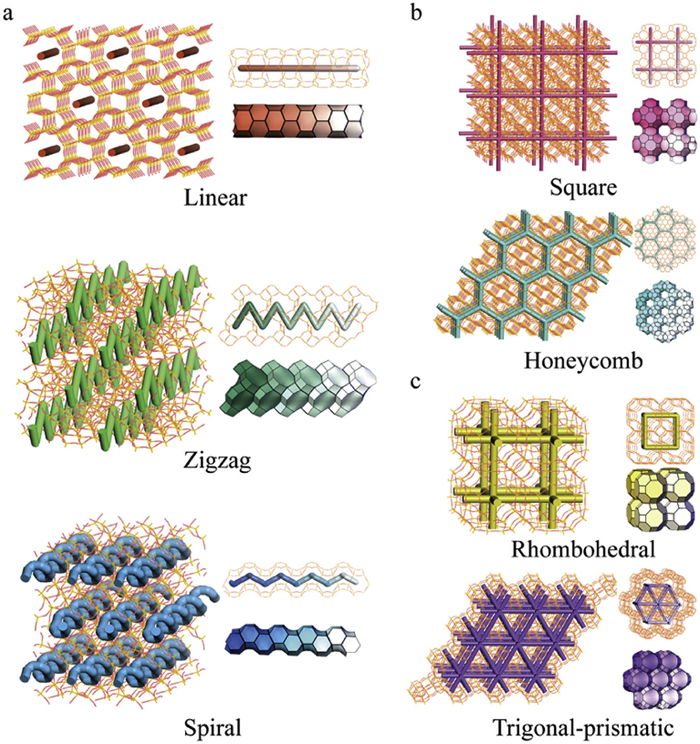
The simplified pore topological networks developed in this study enable both direct visualization of channel structures and predictive assessment of their transport properties. Taking 1D channels as a representative case (Fig. S1 in Supporting information), several diffusion behaviors can be inferred from the observed features: Linear channels are expected to provide significant diffusion advantages, representing the most favorable configuration for molecular transport; conversely, zigzag and spiral channels exhibit comparable diffusion resistance, the magnitude of which is intrinsically linked to the zigzag angle or degree of helicity. To validate these topological inferences, molecular dynamics (MD) simulations were performed to quantify the diffusion coefficients (D) of H2O molecules within those three types of 10-ring 1D channels. The computational results corroborate our predictions, with diffusion coefficients of 5.98 × 10⁻5, 1.53 × 10⁻5, and 1.99 × 10⁻5 cm2/s for linear, zigzag, and spiral channels, respectively. These data establish a clear trend in diffusion efficiency: linear > spiral ≈ zigzag. Such structure-performance insights are often obscured when observing the complex zeolite frameworks alone, yet they are intuitively captured through our simplified pore topological networks. These findings underscore that the proposed method offers superior descriptive clarity and practical utility compared to traditional topology-based approaches such as TDA, which often lack the direct physical interpretability required for materials design.
Beyond topological accuracy, a practical pore characterization method must also offer efficiency. Our pore topological network achieves this by dramatically reducing structural complexity, which enables its use in high-throughput screening. To quantify this simplification, we compared the topological density (TD10) and the number of nodes and links across three networks: The original zeolite framework, the dual net, and our pore topological network; results are shown in Figs. S2 and S3 (Supporting information). Zeolite frameworks' TD10 values always exceed 500 (with RWY as the sole exception), while dual nets are even more complex, with only two structures falling below 1000. In contrast, ~67.5% of pore topological networks ( > 6-ring) display TD10 values below 500. For nodes, the framework and dual net contain comparable numbers, whereas the pore topological network exhibits fewer nodes. For links, the dual net proves most complex: 68.8% of dual net nodes have coordination numbers exceeding 4, compared to a fixed coordination of 4 in zeolite frameworks (dictated by tetrahedral TO4 units) and below 13.2% in pore topological networks. These three descriptors (TD10, node count, and link count) establish the complexity ordering: dual net > framework > pore topological network. This substantial reduction in complexity, achieved without sacrificing essential structural information, underpins the computational efficiency of our method and enables rapid screening of candidate zeolites from hypothetical databases.
In practical applications, the pore topological networks of known zeolites with superior performance are typically selected as reference structures to identify materials with significant industrial potential. Matching proceeds in stages: First, candidate frameworks with identical topological coordination sequences across four probe sizes (0.33, 0.42, 0.50, 0.59 nm) are identified as "similar". The topological coordination sequence describes the connectivity pattern of each node in the pore network, including the number of neighboring nodes at successive topological distances. Two structures are considered topologically identical when their coordination sequences match exactly across all four probe sizes, indicating consistent pore connectivity patterns regardless of the specific molecular size.
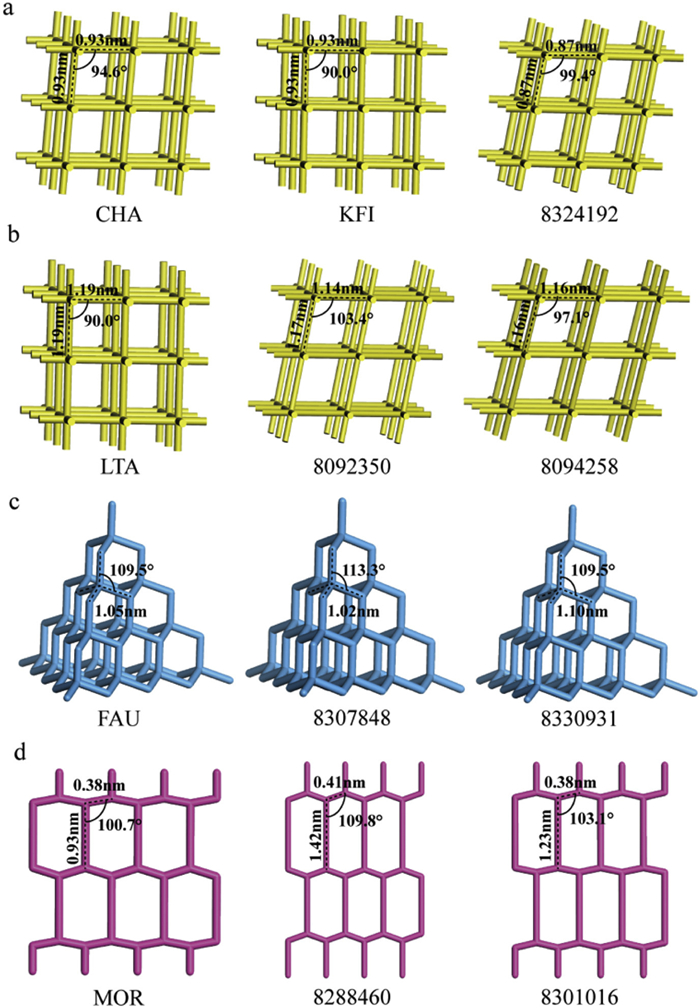
However, relying solely on coordination sequences presents inherent limitations, as this metric cannot evaluate critical geometric parameters such as cage-to-cage distances and channel intersection angles. To enhance precision, we employed two additional geometric descriptors derived from the pore topology: Link lengths and connectivity angles between topological nodes. We adopted a ± 15% geometric deviation threshold relative to the target zeolite to identify similar frameworks. Structures meeting this threshold are seen as highly similar to the target zeolite. In summary, the dual-layered matching strategy enables efficient classification of candidate structures into two distinct similarity degrees. One comprises similar structures characterized by identical topological coordination sequences, while the other consists of highly similar structures that satisfy both topological identity and minimal geometric deviations within the ± 15% threshold.
This study focuses on seven high-performance zeolite frameworks with significant industrial value: CHA, LTA, FAU, MFI, MOR, AEL, and AFI. Since the catalytic performance of these industrial zeolites is often constrained by factors such as Si/Al ratio and synthesis conditions, discovering structurally similar alternatives could provide new candidates that may overcome these limitations while maintaining favorable pore characteristics. Utilizing our pore matching methodology, we aimed to screen extensive hypothetical structures to identify potential candidate zeolites that could serve as alternatives to these established zeolites. Furthermore, this methodology can be readily extended to target pore systems suitable for specific reactions by selecting appropriate reference structures. To facilitate the selection process, we first analyzed the pore topological features of these seven target zeolites. The corresponding results are illustrated in Fig. S4 (Supporting information).
Both CHA and LTA zeolites feature three-dimensionally interconnected, rhombohedral 8-ring pore systems, a structural characteristic that renders them highly suitable for gas molecular sieving. At the same time, compared to the simpler LTA, CHA features a more intricate cage structure, which contributes to its superior MTO catalytic performance. FAU possesses 3D diamond-type 12-ring channels ideal for heavy hydrocarbon cracking. MFI exhibits intersecting ~0.55 nm channels enabling selective small-molecule adsorption. MOR displays 2D honeycomb networks with shape-selective linear channels. AEL and AFI feature 1D linear channels of 10-ring (~0.41 nm) and 12-ring (~0.73 nm), respectively, targeting different molecular sizes.
We performed systematic screening across multiple zeolite structure databases, including the IZA database of known structures, the ABC-6 database (containing over 80,000 hypothetical zeolite structures) [16], and Deem's PCOD database (containing over 330,000 hypothetical zeolite structures) [17,22,23]. For CHA, pore matching identified 4 highly similar known structures (AEI, IFW, KFI, SAV) and 3 similar structures (JOZ, LTA, SAT). It is worth noting that AEI, SAT, SAV, and LTA have experimentally confirmed MTO activity, which confirms that our search strategy is effective [24-26]. In the hypothetical databases, we found 4 highly similar structures in ABC-6 and 120 in Deem's PCOD. As shown in Fig. 3, the pore structures exhibit remarkable consistency. DFT calculations revealed that the screened AABABBCCAABBCC structure exhibits lower total reaction energy barriers than CHA for the MTO reaction via both the olefin and aromatic cycle mechanisms [27-32]. Detailed data are provided in Supporting information. This confirms that AABABBCCAABBCC holds significant potential as an MTO reaction catalyst.
We extended this screening to the remaining six target zeolites. Highly similar candidates identified from hypothetical databases are as follows: LTA (36), FAU (8), MFI (0), MOR (27), AEL (2462), and AFI (2250). Detailed statistics are provided in Table S2 (Supporting information). These results offer actionable targets for directed synthesis to meet diverse industrial needs.
This study introduces a topology-based pore matching method that abstracts complex pore systems into node-link networks, enabling precise pore matching and rapid screening while overcoming limitations of conventional approaches in computational cost and interpretability. Using this framework, we successfully identified multiple hypothetical structures with pore networks similar or highly similar to those of the seven representative industrial zeolites, with their industrial potential further supported by theoretical calculations. Our method significantly accelerates the identification of industrially promising candidate zeolites from vast material libraries, offering an efficient and interpretable tool for both fundamental research and industrial applications. It should also be noted that the current methodology is designed as a rapid structural pre-screening tool based on pore topology. While physicochemical properties such as chemical composition and crystal morphology can significantly influence catalytic performance, these factors are typically considered in subsequent detailed evaluation stages after initial topological screening. The integration of compositional and morphological parameters with topological descriptors represents a promising direction for future development.
Jiaze Wang: Writing – review & editing, Writing – original draft, Visualization, Formal analysis, Data curation. Rui Lin: Validation, Data curation. Yurong Hu: Writing – review & editing, Validation. Lin Li: Writing – review & editing, Validation. Wenfu Yan: Supervision, Project administration. Yi Li: Writing – review & editing, Supervision, Resources, Project administration, Funding acquisition, Conceptualization.
The authors declare that they have no known competing financial interests or personal relationships that could have appeared to influence the work reported in this paper.
This work was supported by the National Natural Science Foundation of China (Nos. 22175073, 22288101) and Science & Technology Development Program of Jilin Province (No. 20230101349JC).
Supplementary material associated with this article can be found, in the online version, at doi:
Y. Li, J. Yu, Chem. Rev. 114 (2014) 7268–7316. doi: 10.1021/cr500010r
Y. Wang, C. Tong, Q. Liu, R. Han, C. Liu, Chem. Rev. 123 (2023) 11664–11721. doi: 10.1021/acs.chemrev.3c00373
J. Ma, J. Wang, J. Yuan, et al., Chin. Chem. Lett. 35 (2024) 109693. doi: 10.1016/j.cclet.2024.109693
Y. Pu, X. Xie, W. Jiang, et al., Chin. Chem. Lett. 31 (2020) 2549–2555. doi: 10.1016/j.cclet.2020.04.012
Y. Li, J. Yu, Nat. Rev. Mater. 6 (2021) 1156–1174. doi: 10.1038/s41578-021-00347-3
Z. Moeinifar, M. Shayanmehr, A. Ghaemi, Environ. Sci. Pollut. Res. 32 (2025) 5703–5729. doi: 10.1007/s11356-025-36112-0
M.K. Tufail, M. Ifrahim, M. Rashid, et al., Sep. Purif. Technol. 354 (2025) 128739. doi: 10.1016/j.seppur.2024.128739
S. Cao, K. Zhang, B. Hanna, E. Al-Sayed, Chin. Chem. Lett. 33 (2022) 1757– 1762. doi: 10.1016/j.cclet.2021.08.091
K. Yang, A. Li, P. Zhang, et al., Chin. Chem. Lett. 36 (2025) 110663. doi: 10.1016/j.cclet.2024.110663
C. Baerlocher, L.B. McCusker, Database of Zeolite structures,
V.A. Blatov, O.A. Batova, G.D. Ilyushin, Dem’yanets, Eur. J. Mineral. 17 (2005) 819–827. doi: 10.1127/0935-1221/2005/0017-0819
M.D. Foster, I. Rivin, M.M.J. Treacy, O.Delgado Friedrichs, Microporous Mesoporous Mater. 90 (2006) 32–38. doi: 10.1016/j.micromeso.2005.08.025
E. Haldoupis, S. Nair, D.S. Sholl, J. Am. Chem. Soc. 132 (2010) 7528–7539. doi: 10.1021/ja1023699
E.L. First, C.E. Gounaris, J. Wei, C.A. Floudas, Phys. Chem. Chem. Phys. 13 (2011) 17339–17358. doi: 10.1039/c1cp21731c
Y. Lee, S.D. Barthel, P. Dłotko, et al., Nat. Commun. 8 (2017) 15396. doi: 10.1038/ncomms15396
Y. Li, X. Li, J. Liu, F. Duan, J. Yu, Nat. Commun. 6 (2015) 8328. doi: 10.1038/ncomms9328
R. Pophale, P.A. Cheeseman, M.W. Deem, Phys. Chem. Chem. Phys. 13 (2011) 12407–12412. doi: 10.1039/c0cp02255a
P. Hohenberg, W. Kohn, Phys. Rev. 136 (1964) B864–B871. doi: 10.1103/PhysRev.136.B864
W. Kohn, L.J. Sham, Phys. Rev. 140 (1965) A1133–A1138. doi: 10.1103/PhysRev.140.A1133
R.O. Jones, O. Gunnarsson, Rev. Mod. Phys. 61 (1989) 689–746. doi: 10.1103/RevModPhys.61.689
V.A. Blatov, A.P. Shevchenko, D.M. Proserpio, Cryst. Growth Des. 14 (2014) 3576–3586. doi: 10.1021/cg500498k
M.W. Deem, R. Pophale, P.A. Cheeseman, D.J. Earl, J. Phys. Chem. C 113 (2009) 21353–21360. doi: 10.1021/jp906984z
D.J. Earl, M.W. Deem, Ind. Eng. Chem. Res. 45 (2006) 5449–5454. doi: 10.1021/ie0510728
P. Ferri, C. Li, R. Millán, et al., Angew. Chem. Int. Ed. 59 (2020) 19708– 19715. doi: 10.1002/anie.202007609
I. Pinilla-Herrero, U. Olsbye, C. Márquez-Álvarez, E. Sastre, J. Catal. 352 (2017) 191–207. doi: 10.1016/j.jcat.2017.05.008
F.H. Alshafei, S.I. Zones, M.E. Davis, Chem. Eng. J. 482 (2024) 149045. doi: 10.1016/j.cej.2024.149045
M.J. Frisch, G.W. Trucks, H.B. Schlegel, et al., Gaussian 16 Rev. C.01. Wallingford, CT, 2016.
J.D. Chai, M. Head-Gordon, Phys. Chem. Chem. Phys. 10 (2008) 6615–6620. doi: 10.1039/b810189b
S. Dapprich, I. Komáromi, K.S. Byun, K. Morokuma, M.J. Frisch, J. Mol. Struct. Theochem. 461-462 (1999) 1–21. doi: 10.1016/S0166-1280(98)00475-8
J.J.P. Stewart, J. Mol. Model. 19 (2013) 1–32. doi: 10.1007/s00894-012-1667-x
S. Xu, A. Zheng, Y. Wei, et al., Angew. Chem. Int. Ed. 52 (2013) 11564–11568. doi: 10.1002/anie.201303586
B. Yu, C. Lou, W. Zhang, et al., Chem. Res. Chin. U. 36 (2020) 1203–1208. doi: 10.1007/s40242-020-0216-x

 扫一扫看文章


扫一扫关注我们
 DownLoad:

 下载:


 下载: