Department of Chemistry, College of Sciences, Northeastern University, Shenyang 110819, China
b.
Key Laboratory of Drinking Water Safety and Distribution Technology, Zhejiang University, Hangzhou 310058, China
c.
Zhejiang-Israel Joint Laboratory of Self-Assembling Functional Materials, ZJU-Hangzhou Global Scientific and Technological Innovation Center, Zhejiang University, Hangzhou 311215, China
Received Date:
05 December 2025 Accepted Date:
04 March 2026 Revised Date:
24 February 2026 Available Online:
12 January 2027
Abstract:
The separation of methylbenzyl chloride isomers is one of the challenges facing the chemical industry. However, traditional separation methods suffer from excessive energy consumption, complicated operation, and unsatisfactory separation efficiency for substances with similar boiling points. Herein, we develop a novel adsorptive separation strategy for p-methylbenzyl chloride (pMBC) based on nonporous adaptive crystals (NACs) of perethylated pillar[6]arene (EtP6β) and perbromoethylated pillar[5]arene (BrP5α). EtP6β and BrP5α are proved to be highly effective in the separation of pMBC from the binary or ternary vapour mixtures of methylbenzyl chloride isomers. The single-crystal structures and DFT calculations indicate that the high selectivity stems from multiple noncovalent interactions between the hosts (EtP6 and BrP5) and the guest (pMBC), as well as the thermodynamic stability of the new stable single crystals formed by pMBC@EtP6 and pMBC@BrP5. Furthermore, the perfect size matching between pMBC and BrP5 also contributes to selective separation. In addition, EtP6β and BrP5α show significant recyclability and stability.
p-Methylbenzyl chloride (pMBC) is a pivotal intermediate in chemical manufacturing industries, widely used in various fields such as pharmaceutical synthesis, agrochemical production, and specialty chemicals [1-3]. At present, the industrial synthesis of pMBC primarily involves two main strategies: chloromethylation and direct aromatic chlorination [4]. In the production process of pMBC, it is typically manufactured via the chloromethylation reaction of toluene. However, during the synthesis process, in addition to pMBC, o-methylbenzyl chloride (oMBC) and m-methylbenzyl chloride (mMBC) are inevitably generated. During the purification process, due to the small differences in boiling points between oMBC, mMBC, and pMBC (oMBC: 197 ℃; mMBC: 195 ℃; pMBC: 200 ℃), conventional distillation methods are energy-consuming and low efficient. To achieve effective separation, a more precise and energy-intensive distillation process must be adopted [5-9]. Therefore, it is urgent to explore novel methods to achieve efficient and energy-saving separation of methylbenzyl chloride isomers.
Porous materials are a novel type of materials with tunable pore sizes and unique structures, featuring highly open spaces and interconnected pore structures [10-17]. In recent years, zeolites, metal−organic frameworks (MOFs) and covalent organic frameworks (COFs) have shown promising application prospects in the adsorption and separation of hydrocarbons [18-33]. However, their inherent drawbacks to some extent constrain their application in industrial fields, such as long adsorption and desorption times, high energy consumption, low efficiency, and poor stability. Furthermore, the complex synthesis process and high cost further limit their potential for large-scale application. Therefore, it is imperative to develop a structurally stable and recyclable adsorbent material.
Nonporous adaptive crystals (NACs) represent a novel class of supramolecular adsorptive separation materials, exhibiting dynamic structural responsiveness and precise host−guest recognition capabilities [34-48]. These properties endow NACs with considerable innovation potential in the field of adsorption and separation [49-55]. NACs are characterized as dense, nonporous crystals in their initial states. However, through the stimulation of specific guest molecules, NACs are induced to undergo lattice adaptive reconstruction, forming transient pores and completing directional assembly. Pillar[n]arenes represent a novel generation of supramolecular hosts [56]. Due to their unique cavity characteristics and tunable multiple non-covalent interactions, they become ideal platforms for the construction of smart separation materials [57-64]. Huang and co-workers discovered that pillar[n]arenes-based NACs exhibited excellent performance in hydrocarbon separation [65-68]. Pillar[n]arenes underwent the transformation from the nonporous state to the porous state through the crystal structure transformation, endowing these materials with excellent structural stability and recyclability, providing a new solution for low-energy consumption and sustainable chemical separations technologies [68-71]. However, the separation of pMBC from methylbenzyl chloride isomers by pillar[n]arenes-based NACs materials has not been reported yet.
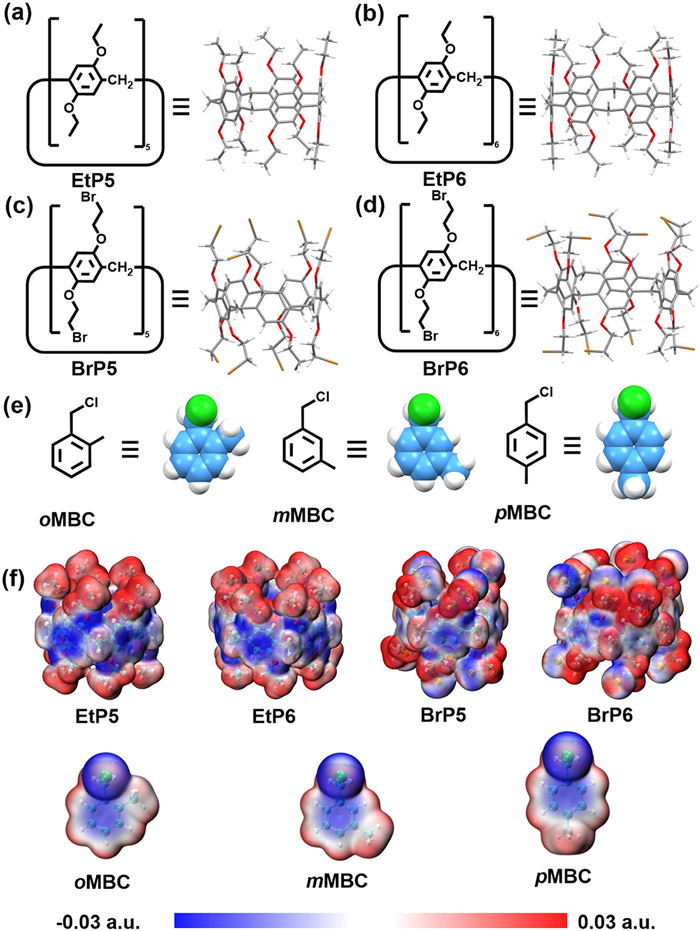
Herein, for the first time, the selective adsorption of pMBC from the binary or ternary mixtures of methylbenzyl chloride isomers by pillar[n]arenes-based NACs materials was investigated. Taking advantage of the differences in molecular geometry and size dimensions among oMBC, mMBC, and pMBC, we employed four different pillar[n]arenes-based NACs as adsorptive materials, namely perethylated pillar[5]arene (EtP5), perethylated pillar[6]arene (EtP6), perbromoethylated pillar[5]arene (BrP5), and perbromoethylated pillar[6]arene (BrP6) (Fig. 1). EtP5, EtP6, BrP5 and BrP6 were activated according to the reported procedure (referred to as EtP5α, EtP6β, BrP5α and BrP6β, respectively) [72,73]. It was found that EtP6β and BrP5α exhibited excellent adsorption properties for pMBC, as well as high selectivity in binary or ternary mixtures. Specifically, EtP6β could separate pMBC from the binary mixtures (oMBC/pMBC or mMBC/pMBC, v/v = 1:1) with purities of 98.4% and 96.4%, respectively. Furthermore, EtP6β could also separate pMBC from the ternary mixture (oMBC/mMBC/pMBC, v/v/v = 1:1:1) with purity of 96.8%. Similarly, BrP5α could separate pMBC from the binary mixtures (oMBC/pMBC or mMBC/pMBC, v/v = 1:1) with purities of 97.3% and 96.1%, respectively. Furthermore, BrP5α could also separate pMBC from the ternary mixture (oMBC/mMBC/pMBC, v/v/v = 1:1:1) with purity of 95.1% (Fig. 2a). The single-crystal structures and DFT calculations indicated that the high selectivity stemmed from multiple noncovalent interactions between the hosts (EtP6 and BrP5) and the guest (pMBC), as well as the thermodynamic stability of the new stable single crystals formed by pMBC@EtP6 and pMBC@BrP5. Furthermore, the perfect size matching between pMBC and BrP5 also contributed to selective separation. After five regeneration cycles, the structures of pMBC@EtP6 and pMBC@BrP5 reverted to their original guest-free forms (EtP6β and BrP5α), with no degradation. The regenerated EtP6β and BrP5α still maintained their high selectivity forpMBC and their intrinsic material properties, confirming exceptional recyclability and operational stability.
Figure 1
Figure 1.
Chemical structures of (a) perethylated pillar[5]arene (EtP5), (b) perethylated pillar[6]arene (EtP6), (c) perbromoethylated pillar[5]arene (BrP5), (d) perbromoethylated pillar[6]arene (BrP6), and (e) o-methylbenzyl chloride (oMBC), m-methylbenzyl chloride (mMBC) and p-methylbenzyl chloride (pMBC). (f) Electrostatic potential maps of EtP5, EtP6, BrP5, BrP6, oMBC, mMBC and pMBC.
Figure 2.
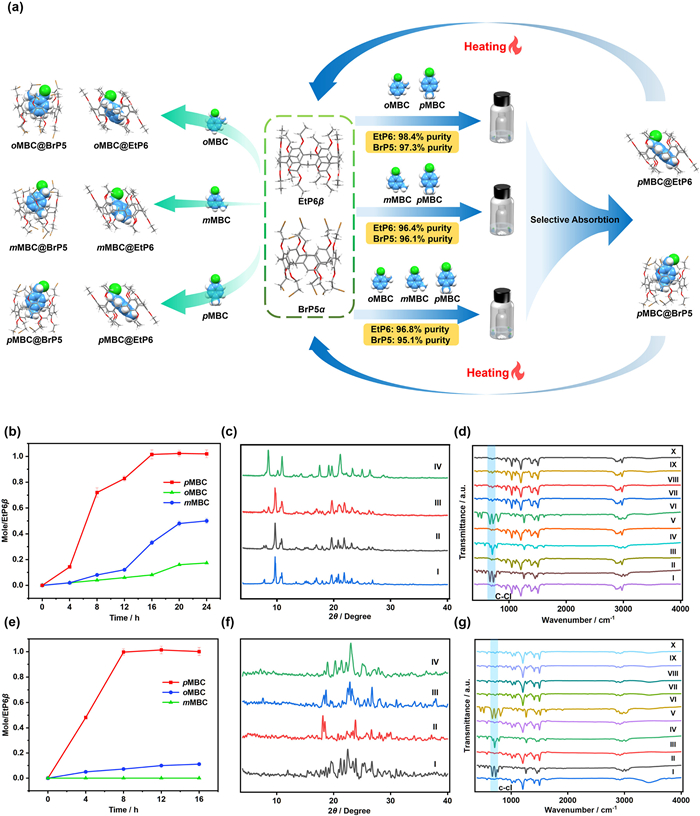
(a) Illustration of adsorption capabilities of EtP6β and BrP5α for single-component and binary or ternary mixture of methylbenzyl chloride isomers. Time-dependent vapour-solid adsorption plots of EtP6β (b) and BrP5α (e) for single-component methylbenzyl chloride isomers. (c) PXRD patterns of: (Ⅰ) original EtP6β; (Ⅱ) EtP6β after adsorption of oMBC vapour; (Ⅲ) EtP6β after adsorption of mMBC vapour; and (Ⅳ) EtP6β after adsorption of pMBC vapour. (d) Fourier transform infrared spectra of (Ⅰ) EtP6β; (Ⅱ) oMBC; (Ⅲ) EtP6β after adsorption oMBC vapour; (Ⅳ) mMBC; (Ⅴ) EtP6β after adsorption mMBC vapour; (Ⅵ) pMBC; (Ⅶ) EtP6β after adsorption pMBC vapour; (Ⅷ) EtP6β after adsorption of the binary vapour mixture (oMBC/pMBC, v/v = 1:1); (Ⅸ) EtP6β after adsorption of the binary vapour mixture (mMBC/pMBC, v/v = 1:1); (Ⅹ) EtP6β after adsorption of the ternary vapour mixture (oMBC/mMBC/pMBC, v/v/v = 1:1:1). (f) PXRD patterns of: (Ⅰ) original BrP5α; (Ⅱ) BrP5α after adsorption of oMBC vapour; (Ⅲ) BrP5α after adsorption of mMBC vapour; and (Ⅳ) BrP5α after adsorption of pMBC vapour. (g) Fourier transform infrared spectra of (Ⅰ) BrP5α; (Ⅱ)oMBC; (Ⅲ) BrP5α after adsorption oMBC vapour; (Ⅳ) mMBC; (Ⅴ) BrP5α after adsorption mMBC vapour; (Ⅵ) pMBC; (Ⅶ) BrP5α after adsorption pMBC vapour; (Ⅷ) EtP6β after adsorption of the binary vapour mixture (oMBC/pMBC, v/v = 1:1); (Ⅸ) BrP5α after adsorption of the binary vapour mixture (mMBC/pMBC, v/v = 1:1); (Ⅹ) BrP5α after adsorption of the ternary vapour mixture (oMBC/mMBC/pMBC, v/v/v = 1:1:1).
However, EtP5α showed almost negligible adsorption for these three methylbenzyl chloride isomers (Figs. S13-S15 in Supporting information). Moreover, BrP6β did not show selectivity in binary or ternary mixtures of methylbenzyl chloride isomers, although it could adsorb the single components of oMBC, mMBC, and pMBC, with the adsorption ratio of 1:1 (Figs. S22-S24 in Supporting information).
1H NMR and thermogravimetric analysis (TGA) demonstrated that the solvents in EtP5α, EtP6β, BrP5α and BrP6β were removed (Figs. S1-S8 in Supporting information). Powder X-ray diffraction (PXRD) patterns confirmed that EtP5α, EtP6β, BrP5α and BrP6β were both crystalline (Figs. S9-S12 in Supporting information). In addition, according to previously literatures, N2 adsorption experiments confirmed that EtP5α, EtP6β, BrP5α and BrP6β were nonporous [74,75].
For each vapor–solid adsorption experiment, an open 5 mL vial containing 1 mg of EtP5α, EtP6β, BrP5α and BrP6β were placed in a sealed 20 mL vial containing a liquid mixture of methylbenzyl chloride isomers in equal volumes (2 mL of a binary mixture or 3 mL of a ternary mixture). Methylbenzyl chloride isomers' uptake by EtP5α, EtP6β, BrP5α and BrP6β were measured by completely dissolving EtP5α, EtP6β, BrP5α and BrP6β and measuring the ratio of the three methylbenzyl chloride isomers by 1H NMR. EtP5α, EtP6β, BrP5α and BrP6β after adsorbing methylbenzyl chloride isomers were also tested by PXRD, TGA, and headspace gas chromatography (HS-GC).
The adsorption capacities of EtP5α, EtP6β, BrP5α and BrP6β for single-component oMBC, mMBC and pMBC vapours were investigated. The adsorption amounts of methylbenzyl chloride isomers were determined by 1H NMR and TGA. The 1H NMR showed that the adsorption amount of pMBC was 0.98 mol/EtP6β, while those of oMBC and mMBC were 0.18 mol/EtP6β and 0.64 mol/EtP6β, respectively (Figs. S16-S18 in Supporting information). The TGA indicated that the weight loss of EtP6β after exposure to oMBC, mMBC or pMBC below 140 ℃ was 2.28%, 7.68%, and 11.31%, respectively, further confirming the adsorption capabilities of EtP6β for single-component methylbenzyl chloride isomers (Figs. S25-S27 in Supporting information). The 1H NMR showed that the adsorption amount of pMBC was 0.98 mol/BrP5α, and that of mMBC was 0.11 mol/BrP5α, while the adsorption of oMBC was almost negligible (Figs. S19-S21 in Supporting information). TGA showed that the weight loss of BrP5α after exposure to mMBC or pMBC below 140 ℃ was 0.93% and 7.55%, respectively, thereby validating the capabilities of BrP5α to adsorb single-component methylbenzyl chloride isomers (Figs. S28-S30 in Supporting information).
Time-dependent vapour-solid experiments showed that with increasing adsorption time, the adsorption amount of EtP6β for pMBC reached the saturation point at about 18 h, while that of BrP5α reached the saturation point around 10 h (Figs. 2b and e). In order to investigate the structural changes of EtP6β and BrP5α upon adsorption of single-component methylbenzyl chloride isomer vapours, PXRD experiments were carried out. Compared to the original PXRD patterns of EtP6β and BrP5α, PXRD patterns of EtP6β and BrP5α after adsorption of oMBC, mMBC and pMBC vapours were changed, implying that new structures were formed after EtP6β and BrP5α absorbed oMBC, mMBC and pMBC vapours (Figs. 2c and f). The above results demonstrated that both EtP6β and BrP5α possessed certain adsorption capacities for methylbenzyl chloride isomers.
In order to investigate the host–guest interactions between the hosts (EtP6 and BrP5) and methylbenzyl chloride isomers, we obtained single-crystal structures of oMBC@EtP6, mMBC@EtP6, and pMBC@EtP6 suitable for X-ray analyses via the slow evaporation method. The specific method involved placing 5 mg of EtP6 or BrP5 powders into a vial containing 0.5 mL of oMBC, mMBC or pMBC, adding chloroform until the powder was completely dissolved, and then slowly evaporating the resulting transparent solution for 2–3 days to obtain well-formed colorless crystals. However, despite various attempts, single crystals of guests-loaded BrP5 remained difficult to obtain.
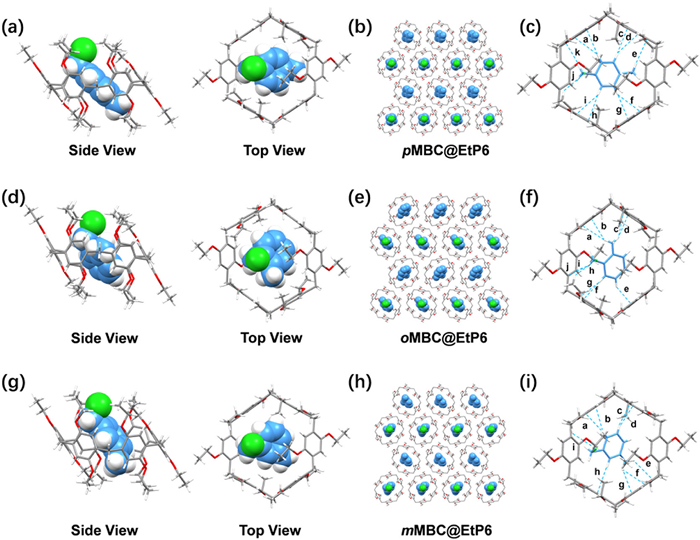
In the single-crystal structure of pMBC@EtP6, the pMBC molecule was situated in the cavity of EtP6, forming a 1:1 host−guest complex via multiple non-covalent interactions including C–H···π (C–H···π distances: a = 2.918 Å, b = 2.799 Å, c = 2.877 Å, d = 2.949 Å, f = 2.918 Å, g = 2.799 Å, h = 2.877 Å, i = 2.949 Å), C–H···O (C–H···O distances: e = 2.690 Å, k = 2.577 Å) and C–H···Cl (C–H···Cl distance: j = 2.720 Å) (Fig. 3a). In the single-crystal structure of oMBC@EtP6, the oMBC molecule was located in the cavity of EtP6, and formed a 1:1 host−guest complex through multiple non-covalent interactions including C–H···π (C–H···π distances: a = 2.836 Å, b = 2.725 Å, c = 2.847 Å, d = 2.793 Å, e = 2.663 Å, f = 2.721 Å, g = 2.796 Å, i = 2.913 Å, j = 2.879 Å) and C–H···Cl (C–H···Cl distance: h = 2.985 Å) (Fig. 3b). Similarly, the single-crystal structure of mMBC@EtP6 revealed a 1:1 host–guest complex, in which the mMBC molecule was situated in the cavity of EtP6, stabilized by multiple non-covalent interactions including C–H···π (C–H···π distances: a = 2.911 Å, b = 2.918 Å, c = 2.829 Å, d = 2.825 Å, f = 3.056 Å, g = 2.808 Å, h = 3.153 Å; C–H···O distances: e = 2.883 Å) and C–H···Cl (C–H···Cl distance: i = 3.044 Å) (Fig. 3c). Additionally, π–π stacking interactions of varying degrees were also observed in pMBC@EtP6, oMBC@EtP6 and mMBC@EtP6 (Figs. S32-S34 in Supporting information). Although the crystal structure revealed no significant differences in host–guest interactions or stacking patterns, EtP6 exhibited stronger π-π stacking interaction with pMBC, shorter C–H···O hydrogen distance, stronger C–H···O hydrogen bond, more uniform C–H···π interaction, shorter C–H···Cl distance, and the optimal spatial compatibility arising from positional substitution. Collectively, these factors conferred EtP6β with selectivity toward pMBC. This synergistic interplay endowed the pMBC@EtP6 complex with the highest binding stability. In addition, the PXRD patterns of EtP6β after the adsorption of pMBC, oMBC and mMBC vapours were consistent with that simulated from the single-crystal structures of pMBC@EtP6, oMBC@EtP6 and mMBC@EtP6, respectively, suggesting the structural transformation from EtP6β to pMBC@EtP6, oMBC@EtP6 and mMBC@EtP6 (Fig. S31 in Supporting information).
Figure 3
Figure 3.
Single-crystal structures: (a) pMBC@EtP6, (b) Packing mode of pMBC@EtP6, (c) C–H···π, C–H···O and C–H···Cl interactions between EtP6 and pMBC. C–H···π distances: a = 2.918 Å, b = 2.799 Å, c = 2.877 Å, d = 2.949 Å, f = 2.918 Å, g = 2.799 Å, h = 2.877 Å, i = 2.949 Å; C–H···O distances: e = 2.690 Å, k = 2.577 Å; C–H···Cl distance: j = 2.720 Å, (d) oMBC@EtP6, (e) Packing mode ofoMBC@EtP6, (f) C–H···π and C–H···Cl interactions between EtP6 and oMBC. C–H···π distances: a = 2.836 Å, b = 2.725 Å, c = 2.847 Å, d = 2.793 Å, e = 2.663 Å, f = 2.721 Å, g = 2.796 Å, i = 2.913 Å, j = 2.879 Å; C–H···Cl distance: h = 2.985 Å, (g) mMBC@EtP6, (h) Packing mode of mMBC@EtP6, (i) C–H···π, C–H···O and C–H···Cl interactions between EtP6 and mMBC. C–H···π distances: a = 2.911 Å, b = 2.918 Å, c = 2.829 Å, d = 2.825 Å, f = 3.056 Å, g = 2.808 Å, h = 3.153 Å; C–H···O distance: e = 2.883 Å; C–H···Cl distance: i = 3.044 Å.
Inspired by the adsorption capacities of EtP6β and BrP5α to methylbenzyl chloride isomers in single-component vapour-solid adsorption experiments, binary vapour-solid adsorption experiments were carried out. The selective adsorption of EtP6β and BrP5α to the binary mixture (oMBC/pMBC or mMBC/pMBC, v/v = 1:1) was investigated. The adsorption amounts of methylbenzyl chloride isomers were determined by 1H NMR and TGA.
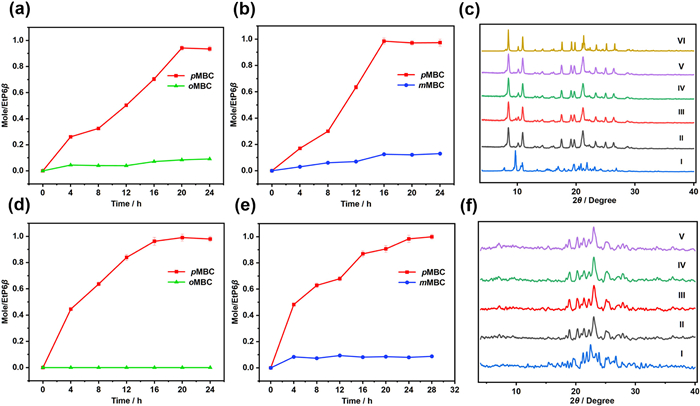
The 1H NMR showed that in the binary mixture (oMBC/pMBC or mMBC/pMBC, v/v = 1:1), the adsorption amount of pMBC was 0.92 mol/EtP6β and 0.92 mol/EtP6β respectively, while the adsorption amounts of oMBC and mMBC by EtP6β were almost negligible (Figs. S35 and S36 in Supporting information). Besides, the adsorption capability of EtP6β was further investigated through TGA experiments. TGA results showed that after EtP6β was exposed to the binary mixtures (oMBC/pMBC or mMBC/pMBC, v/v = 1:1), there was a weight loss of 10.66% and 10.69% below 140 ℃, respectively (Figs. S39 and S40 in Supporting information). Time-dependent vapour-solid experiments showed that with increasing adsorption time, the selective adsorption of EtP6β for pMBC reached the saturation point at about 22 and 18 h, respectively (Figs. 4a and b). Similarly, 1H NMR analysis showed that in the binary mixtures (oMBC/pMBC or mMBC/pMBC, v/v = 1:1), the adsorption amounts of pMBC were 0.99 mol/BrP5α and 1 mol/BrP5α respectively, while the adsorption amounts of oMBC and mMBC were almost negligible (Figs. S37 and S38 in Supporting information). TGA results showed that there was a weight loss of 7.68% and 7.97% after BrP5α exposing to the binary vapour mixture (oMBC/pMBC or mMBC/pMBC, v/v = 1:1) below 140 ℃, respectively, further confirming the adsorption capability of BrP5α (Figs. S41 and S42 in Supporting information). Time-dependent vapour-solid experiments showed that with increasing adsorption time, the selective adsorption of BrP5α for pMBC reached the saturation points at about 20 h and 24 h, respectively (Figs. 4d and e).
Figure 4
Figure 4.
Time-dependent vapour-solid adsorption plots of EtP6β for the binary mixture (a) and binary vapour mixture (b) (oMBC/pMBC, v/v = 1:1). (c) PXRD patterns of (Ⅰ) original EtP6β; (Ⅱ) EtP6β after adsorption of single-component pMBC; (Ⅲ) EtP6β after adsorption of the binary mixture (oMBC/pMBC, v/v = 1:1); (Ⅳ) EtP6β after adsorption of the binary vapour mixture (mMBC/pMBC, v/v = 1:1); (Ⅴ) EtP6β after adsorption of the ternary vapour mixture (oMBC/mMBC/pMBC, v/v/v = 1:1:1); (Ⅵ) simulated from the single-crystal structure of pMBC@EtP6. Time-dependent vapour-solid adsorption plots of BrP5α for the binary vapour mixture of oMBC/pMBC (v/v = 1:1) (d) and mMBC/pMBC (v/v = 1:1) (e). (f) PXRD patterns of: (Ⅰ) original BrP5α; (Ⅱ) BrP5α after adsorption of single-component pMBC; (Ⅲ) BrP5α after adsorption of the binary vapour mixture (oMBC/pMBC, v/v = 1:1); (Ⅳ) BrP5α after adsorption of the binary vapour mixture (mMBC/pMBC, v/v = 1:1); (Ⅴ) BrP5α after adsorption of the ternary vapour mixture (oMBC/mMBC/pMBC, v/v/v = 1:1:1).
Additionally, PXRD experiments were implemented to investigate the structural transformations of EtP6β and BrP5α after adsorption of methylbenzyl chloride isomers. After exposure to the binary mixtures (oMBC/pMBC or mMBC/pMBC, v/v = 1:1), the PXRD patterns of EtP6β and BrP5α changed and were closely matched those obtained when EtP6β and BrP5α adsorbed the single componentpMBC respectively, where the PXRD pattern of EtP6β was similar to that simulated from the single-crystal structure of pMBC@EtP6 (Figs. 4c and f). These results confirmed the structural transformation from the original guest-free state to the pMBC-loaded state. HS-GC experiments further confirmed that EtP6β could selectively adsorb pMBC in the binary mixtures (oMBC/pMBC or mMBC/pMBC, v/v = 1:1) with purities of 98.4% and 96.4%, respectively, as well as BrP5α could selectively adsorb pMBC with purities of 97.3% and 96.1% (Figs. S47-S50 in Supporting information). The above results demonstrated that EtP6β and BrP5α showed significant selectivity for pMBC in the binary mixtures (oMBC/pMBC or mMBC/pMBC, v/v = 1:1). In addition, we conducted the adsorption experiments of EtP5α and BrP6β to methylbenzyl chloride isomers. In the single-component adsorption experiments, 1H NMR showed that the adsorption amounts of EtP5α to the three methylbenzyl chloride isomers were almost negligible (Figs. S13-S15). Although BrP6β could adsorb single-components of oMBC, mMBC, and pMBC, and the adsorption amount could reach 1:1, it did not show selectivity in the binary mixtures (oMBC/pMBC or mMBC/pMBC, v/v = 1:1) (Figs. S22-S24).
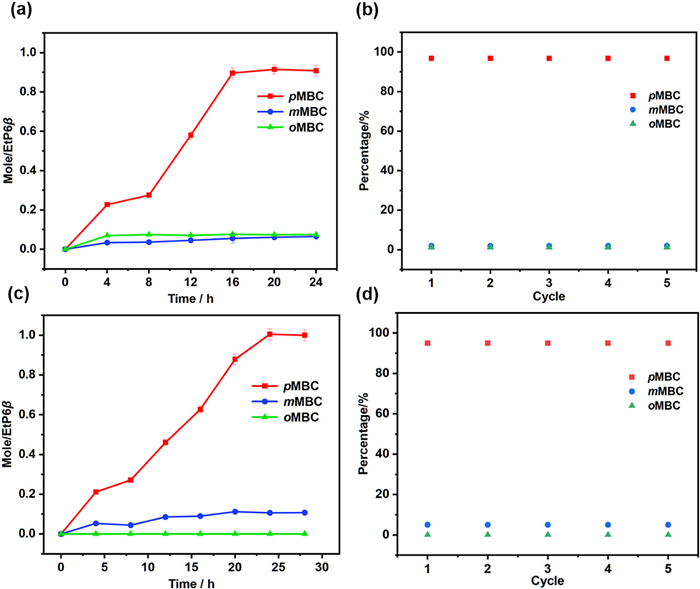
Based on the excellent selectivity of EtP6β and BrP5α for pMBC from the binary mixture (oMBC/pMBC or mMBC/pMBC, v/v = 1:1), we further investigated the selectivity of EtP6β and BrP5α for pMBC in the ternary mixture of methylbenzyl chloride isomers (oMBC/mMBC/pMBC, v/v/v = 1:1:1). The adsorption amounts of methylbenzyl chloride isomers were determined by 1H NMR and TGA. The 1H NMR results showed that in the ternary mixture (oMBC/mMBC/pMBC, v/v/v = 1:1:1), the adsorption amount of pMBC was 0.94 mol/EtP6β and 0.96 mol/BrP5α, while the adsorption amounts of oMBC and mMBC were <0.07 mol/EtP6β and 0.08 mol/BrP5α, respectively (Figs. S49 and S52 in Supporting information). TGA results showed that after EtP6β and BrP5α were exposed to the ternary mixture (oMBC/mMBC/pMBC, v/v/v = 1:1:1), there was a weight loss of 10.87% and 7.68% below 140 ℃, respectively (Figs. S53 and S54 in Supporting information). Time-dependent vapour-solid experiments showed that with increasing adsorption time, the selective adsorption of EtP6β and BrP5α for pMBC reached the saturation points at about 20 and 26 h, respectively (Figs. 5a and c).
Figure 5
Figure 5.
Time-dependent vapour-solid adsorption plots of EtP6β (a) and BrP5α (c) for the ternary mixture (oMBC/mMBC/pMBC, v/v/v = 1:1:1). Relative uptakes of oMBC, mMBC and pMBC by EtP6β (b) and BrP5α (d) after 5 cycles.
Besides, PXRD patterns of EtP6β and BrP5α after adsorption of the ternary mixture (oMBC/mMBC/pMBC, v/v/v = 1:1:1) changed and were closely matched those obtained when EtP6β and BrP5α adsorbed single componentpMBC respectively, where the PXRD pattern of EtP6β after adsorption of pMBC was similar to that simulated from the single-crystal structure of pMBC@EtP6. These results confirmed the structural transformation from the original guest-free state to the pMBC-loaded state (Figs. 4c and f). HS-GC experiments further confirmed that EtP6β and BrP5α could selectively adsorb pMBC in the ternary mixture of methylbenzyl chloride isomers (oMBC/mMBC/pMBC, v/v/v = 1:1:1), with purities of 96.8% and 95.1%, respectively (Figs. S57 and 58 in Supporting information). The above results demonstrated that EtP6β and BrP5α still showed significant selectivity for pMBC in the ternary mixture (oMBC/mMBC/pMBC, v/v/v = 1:1:1).
Fourier transform infrared (FT-IR) was used to investigate the selectivity of EtP6β and BrP5α. The FT-IR spectrum of oMBC, mMBC and pMBC respectively showed typical fingerprint peaks associated with the -Cl groups of oMBC, mMBC and pMBC. Furthermore, FT-IR analysis was performed on EtP6β and BrP5α after adsorption of binary and ternary mixture vapours, respectively. The characteristic fingerprint peaks of the -Cl groups observed in their spectra perfectly matched the peak positions recorded during the adsorption of pMBC alone. These results implied that EtP6β and BrP5α could selectively capture pMBC vapor from the binary mixtures (oMBC/pMBC or mMBC/pMBC, v/v = 1:1) or the ternary mixture (oMBC/mMBC/pMBC, v/v/v = 1:1:1) (Figs. 2d and g).
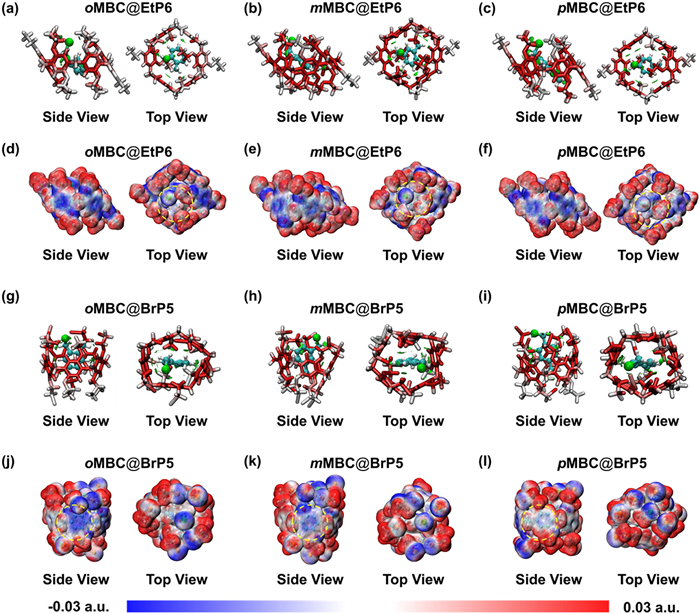
The weak intermolecular interaction between EtP6 and methylbenzyl chloride isomers was calculated by density functional theory (DFT). Based on DFT calculations, the Independent Gradient Model (IGM) analysis (a visualization study of weak interactions) was carried out by single-crystal structures of pMBC@EtP6, oMBC@EtP6 and mMBC@EtP6. It was found that there were multiple interactions between EtP6 and methylbenzyl chloride isomers, further confirming that EtP6 could form host–guest complexes with methylbenzyl chloride isomers. In addition, IGM analysis demonstrated that the aromatic area of EtP6 contributed the most to host–guest interaction, followed by the alkyl chain of EtP6 (Figs. 7a-c).
Besides, electrostatic potentials were taken to further investigate the selective adsorption of EtP6β for methylbenzyl chloride isomer vapours. The electrostatic potential maps of pMBC@EtP6, oMBC@EtP6 and mMBC@EtP6 showed that after adsorption, the electrons in the initially electron-deficient methylbenzyl chloride isomers were delocalized to varying extents in the electron-rich cavity of EtP6. Notably, compared to oMBC and mMBC, EtP6 revealed a greater degree of electronic delocalization in pMBC, resulting in forming a stable host–guest complex of pMBC@EtP6 (Figs. 7d-f). Therefore, the electrostatic potential maps further demonstrated that EtP6 formed a stable host−guest complex with pMBC, resulting in selectivity for pMBC.
Various attempts have been made to obtain single crystals of guests-loaded BrP5, but failed. In order to further investigate the selectivity of BrP5α towards methylbenzyl chloride isomers, the structural models of oMBC@BrP5, mMBC@BrP5 and pMBC@BrP5 were constructed and optimized by DFT, respectively (Fig. 6).
Figure 6
Figure 6.
DFT-optimized structures of oMBC@BrP5 (a, d), mMBC@BrP5 (b, e) and pMBC@BrP5 (c, f) at different views.
The optimized structures showed that the methylbenzyl chloride isomers tended to form 1:1 host−guest complexes with BrP5. Based on the constructed structural models, the IGM analysis was performed. It was found that there were non-covalent interactions between BrP5 and the methylbenzyl chloride isomers, further confirming that BrP5 could form host–guest complexes with methylbenzyl chloride isomers (Figs. 7g-i). The selective adsorption of pMBC by BrP5α is attributed to the compatibility between the symmetrical structure of pMBC and the cavity of BrP5, as well as the synergistic enhancement of multiple non-covalent interactions mediated by bromine atoms. The symmetrical configuration of pMBC not only has the minimum spatial steric hindrance, but also can completely fit into the cavity to achieve the maximum contact area. Moreover, it enables the chlorine atom to evenly distribute with the π electron cloud of the benzene ring, forming a stronger C-Br···Cl weak interaction force with the bromine atom in BrP5. Ultimately, through the dual mechanisms of space adaptation and electronic enhancement, pMBC becomes the preferred adsorption target. The electrostatic potential maps of pMBC@BrP5, oMBC@BrP5 and mMBC@BrP5 showed that after adsorption, the electrons in the initially electron-deficient methylbenzyl chloride isomers were delocalized to varying extents in the electron-rich cavity of BrP5. Notably, BrP5 reveals a greater degree of electron delocalization in pMBC compared to oMBC and mMBC, resulting in forming a stable host–guest complex of pMBC@BrP5 (Figs. 7j-l). Thus, electrostatic potential maps further confirmed that the established structural models of BrP5 formed more stable host–guest complexes with pMBC, resulting in selectivity towards pMBC.
Figure 7
Figure 7.
Visual study of the weak intermolecular interactions of (a) oMBC@EtP6, (b) mMBC@EtP6 and (c) pMBC@EtP6. Electrostatic potential maps of (d) oMBC@EtP6, (e) mMBC@EtP6, (f) pMBC@EtP6, (j) oMBC@BrP5, (k) mMBC@BrP5 and (l) pMBC@BrP5. Visual study of the weak intermolecular interactions of (g) oMBC@BrP5, (h) mMBC@BrP5 and (i) pMBC@BrP5. The yellow circles in the horizontal comparison indicate that EtP6 and BrP5 exhibit varying degrees of electron delocalization towards the methylbenzyl chloride isomer.
To further investigate the selectivity of EtP6β and BrP5α for pMBC, the thermodynamics of the host−guest complexes were calculated by DFT. The calculated energy values indicated that the formation of oMBC@EtP6, mMBC@EtP6 and pMBC@EtP6 was thermodynamically feasible by ΔH298Sol = −105.54, −116.14, −122.22 kJ/mol, and ΔG298Sol = −39.66, −44.71 and −53.06 kJ/mol, respectively. Compared with oMBC@EtP6 or mMBC@EtP6, pMBC@EtP6 possessed lower calculated energy values, indicating that the thermodynamic structure of pMBC@EtP6 was more stable. Similarly, the calculated energy values of pMBC@BrP5 (ΔH298Sol = −102.91 kJ/mol, ΔG298Sol = −39.93 kJ/mol) were lower than those of oMBC@BrP5 (ΔH298Sol = −56.40 kJ/mol, ΔG298Sol = 5.16 kJ/mol) and mMBC@BrP5 (ΔH298Sol = −91.73 kJ/mol, ΔG298Sol = −28.96 kJ/mol), which indicated that the thermodynamic structure of pMBC@BrP5 was more stable than that of oMBC@BrP5 or mMBC@BrP5. These results indicated that the selectivity in the adsorption process arose from the thermodynamic stability of the host−guest complexes formed by EtP6β and BrP5α after loading the preferred guests.
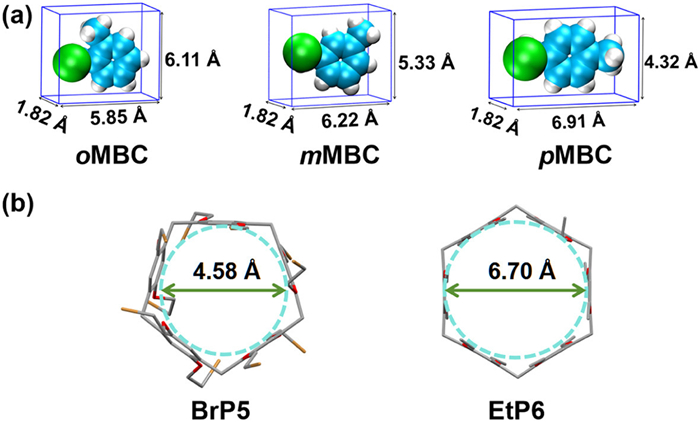
Selective adsorption by size matching effect is an effective strategy for separating hydrocarbon compounds [76]. Since the cavity size of BrP5 (4.58 Å) was smaller than the molecular sizes of oMBC (6.11 Å) and mMBC (5.33 Å), it was more difficult for BrP5α to adsorb oMBC and mMBC (Fig. 8). In contrast, the molecular size of pMBC (4.32 Å) was slightly smaller than the cavity size of BrP5. Due to the perfect size matching between pMBC and BrP5, BrP5α could selectively adsorb pMBC. The results confirmed that the high selectivity stemmed not only from the thermodynamic stability of the newly formed crystal structures after preferred guest adsorption, but also from the perfect size matching between BrP5 and pMBC. However, the cavity of EtP6 (6.70 Å) was larger than the molecular size of all methylbenzyl chloride isomers, and the selectivity could not be predicted merely through size comparison.
Figure 8
Figure 8.
(a) Molecular sizes of oMBC, mMBC and pMBC. (b) Molecular sizes of BrP5 and EtP6.
In addition, in actual industrial production, recoverability and stability are key criteria for the qualification of adsorbents [77,78]. 1H NMR and TGA results showed that pMBC@EtP6, pMBC@BrP5 could release the pMBC guest molecule by heating (Figs. S59-S62, S65 and S66 in Supporting information). PXRD patterns further showed that EtP6β and BrP5α recovered their original crystal structures upon heating (Figs. S63 and S64 in Supporting information). Furthermore, EtP6β and BrP5α still maintained the efficient selectivity for pMBC after five times of recycling, without any degradation, showing remarkable recyclability and stability (Figs. 5b and d).
In conclusion, we developed a novel adsorption and separation strategy for pMBC based on EtP6β and BrP5α. The experimental results showed that EtP6β and BrP5α could effectively adsorb pMBC vapour from the binary mixtures (oMBC/pMBC or mMBC/pMBC, v/v = 1:1) and the ternary mixture (oMBC/mMBC/pMBC, v/v/v = 1:1:1). Specifically, EtP6β could separate pMBC from the binary mixtures (oMBC/pMBC or mMBC/pMBC, v/v = 1:1) with purities of 98.4% and 96.4%, respectively. Furthermore, EtP6β could also separate pMBC from the ternary mixture (oMBC/mMBC/pMBC, v/v/v = 1:1:1) with purity of 96.8%. Similarly, BrP5α could separate pMBC from the binary mixtures (oMBC/pMBC or mMBC/pMBC, v/v = 1:1) with purities of 97.3% and 96.1%, respectively. Furthermore, BrP5α could also separate pMBC from the ternary mixture (oMBC/mMBC/pMBC, v/v/v = 1:1:1) with purity of 95.1%. The single-crystal structures and DFT calculations indicated that the high selectivity stemmed from multiple noncovalent interactions between the hosts (EtP6 and BrP5) and the guest (pMBC), as well as the thermodynamic stability of the new single crystals formed by pMBC@EtP6 and pMBC@BrP5. Furthermore, the perfect size matching between pMBC and BrP5 also contributes to selective separation. In addition, EtP6β and BrP5α demonstrated significant recyclability and stability, which was attributed to the reversible transition between the guest-free and guest-contained states. Based on the high separation efficiency and the excellent chemical stability of EtP6β and BrP5α, this study provided a new strategy for industrial low-cost and high-efficiency separation of aromatic isomers to meet the requirements of economic and sustainable mixture separation.
The authors declare that they have no known competing financial interests or personal relationships that could have appeared to influence the work reported in this paper.
Acknowledgments
This work was supported by the National Natural Science Foundation of China (No. 22101043), the Fundamental Research Funds for the Central Universities (Nos. N25LPY027, N2205013, N232410019, N25ZLL045), Natural Science Foundation of Liaoning Province (No. 2023-MSBA-068), and Northeastern University. Special thanks are due to the instrumental or data analysis from Analytical and Testing Center, Northeastern University.
Supplementary materials
Supplementary material associated with this article can be found, in the online version, at doi:10.1016/j.cclet.2026.112583.
[1]
E. Marquez, J.R. Mora, T. Cordova, G. Chuchani, Int. J. Chem. Kinet. 43 (2011) 537–546. doi: 10.1002/kin.20571
Figure 2
(a) Illustration of adsorption capabilities of EtP6β and BrP5α for single-component and binary or ternary mixture of methylbenzyl chloride isomers. Time-dependent vapour-solid adsorption plots of EtP6β (b) and BrP5α (e) for single-component methylbenzyl chloride isomers. (c) PXRD patterns of: (Ⅰ) original EtP6β; (Ⅱ) EtP6β after adsorption of oMBC vapour; (Ⅲ) EtP6β after adsorption of mMBC vapour; and (Ⅳ) EtP6β after adsorption of pMBC vapour. (d) Fourier transform infrared spectra of (Ⅰ) EtP6β; (Ⅱ) oMBC; (Ⅲ) EtP6β after adsorption oMBC vapour; (Ⅳ) mMBC; (Ⅴ) EtP6β after adsorption mMBC vapour; (Ⅵ) pMBC; (Ⅶ) EtP6β after adsorption pMBC vapour; (Ⅷ) EtP6β after adsorption of the binary vapour mixture (oMBC/pMBC, v/v = 1:1); (Ⅸ) EtP6β after adsorption of the binary vapour mixture (mMBC/pMBC, v/v = 1:1); (Ⅹ) EtP6β after adsorption of the ternary vapour mixture (oMBC/mMBC/pMBC, v/v/v = 1:1:1). (f) PXRD patterns of: (Ⅰ) original BrP5α; (Ⅱ) BrP5α after adsorption of oMBC vapour; (Ⅲ) BrP5α after adsorption of mMBC vapour; and (Ⅳ) BrP5α after adsorption of pMBC vapour. (g) Fourier transform infrared spectra of (Ⅰ) BrP5α; (Ⅱ)oMBC; (Ⅲ) BrP5α after adsorption oMBC vapour; (Ⅳ) mMBC; (Ⅴ) BrP5α after adsorption mMBC vapour; (Ⅵ) pMBC; (Ⅶ) BrP5α after adsorption pMBC vapour; (Ⅷ) EtP6β after adsorption of the binary vapour mixture (oMBC/pMBC, v/v = 1:1); (Ⅸ) BrP5α after adsorption of the binary vapour mixture (mMBC/pMBC, v/v = 1:1); (Ⅹ) BrP5α after adsorption of the ternary vapour mixture (oMBC/mMBC/pMBC, v/v/v = 1:1:1).
Figure 3
Single-crystal structures: (a) pMBC@EtP6, (b) Packing mode of pMBC@EtP6, (c) C–H···π, C–H···O and C–H···Cl interactions between EtP6 and pMBC. C–H···π distances: a = 2.918 Å, b = 2.799 Å, c = 2.877 Å, d = 2.949 Å, f = 2.918 Å, g = 2.799 Å, h = 2.877 Å, i = 2.949 Å; C–H···O distances: e = 2.690 Å, k = 2.577 Å; C–H···Cl distance: j = 2.720 Å, (d) oMBC@EtP6, (e) Packing mode ofoMBC@EtP6, (f) C–H···π and C–H···Cl interactions between EtP6 and oMBC. C–H···π distances: a = 2.836 Å, b = 2.725 Å, c = 2.847 Å, d = 2.793 Å, e = 2.663 Å, f = 2.721 Å, g = 2.796 Å, i = 2.913 Å, j = 2.879 Å; C–H···Cl distance: h = 2.985 Å, (g) mMBC@EtP6, (h) Packing mode of mMBC@EtP6, (i) C–H···π, C–H···O and C–H···Cl interactions between EtP6 and mMBC. C–H···π distances: a = 2.911 Å, b = 2.918 Å, c = 2.829 Å, d = 2.825 Å, f = 3.056 Å, g = 2.808 Å, h = 3.153 Å; C–H···O distance: e = 2.883 Å; C–H···Cl distance: i = 3.044 Å.
Figure 4
Time-dependent vapour-solid adsorption plots of EtP6β for the binary mixture (a) and binary vapour mixture (b) (oMBC/pMBC, v/v = 1:1). (c) PXRD patterns of (Ⅰ) original EtP6β; (Ⅱ) EtP6β after adsorption of single-component pMBC; (Ⅲ) EtP6β after adsorption of the binary mixture (oMBC/pMBC, v/v = 1:1); (Ⅳ) EtP6β after adsorption of the binary vapour mixture (mMBC/pMBC, v/v = 1:1); (Ⅴ) EtP6β after adsorption of the ternary vapour mixture (oMBC/mMBC/pMBC, v/v/v = 1:1:1); (Ⅵ) simulated from the single-crystal structure of pMBC@EtP6. Time-dependent vapour-solid adsorption plots of BrP5α for the binary vapour mixture of oMBC/pMBC (v/v = 1:1) (d) and mMBC/pMBC (v/v = 1:1) (e). (f) PXRD patterns of: (Ⅰ) original BrP5α; (Ⅱ) BrP5α after adsorption of single-component pMBC; (Ⅲ) BrP5α after adsorption of the binary vapour mixture (oMBC/pMBC, v/v = 1:1); (Ⅳ) BrP5α after adsorption of the binary vapour mixture (mMBC/pMBC, v/v = 1:1); (Ⅴ) BrP5α after adsorption of the ternary vapour mixture (oMBC/mMBC/pMBC, v/v/v = 1:1:1).
Figure 5
Time-dependent vapour-solid adsorption plots of EtP6β (a) and BrP5α (c) for the ternary mixture (oMBC/mMBC/pMBC, v/v/v = 1:1:1). Relative uptakes of oMBC, mMBC and pMBC by EtP6β (b) and BrP5α (d) after 5 cycles.
Figure 7
Visual study of the weak intermolecular interactions of (a) oMBC@EtP6, (b) mMBC@EtP6 and (c) pMBC@EtP6. Electrostatic potential maps of (d) oMBC@EtP6, (e) mMBC@EtP6, (f) pMBC@EtP6, (j) oMBC@BrP5, (k) mMBC@BrP5 and (l) pMBC@BrP5. Visual study of the weak intermolecular interactions of (g) oMBC@BrP5, (h) mMBC@BrP5 and (i) pMBC@BrP5. The yellow circles in the horizontal comparison indicate that EtP6 and BrP5 exhibit varying degrees of electron delocalization towards the methylbenzyl chloride isomer.


 DownLoad:


 下载:


 下载:

