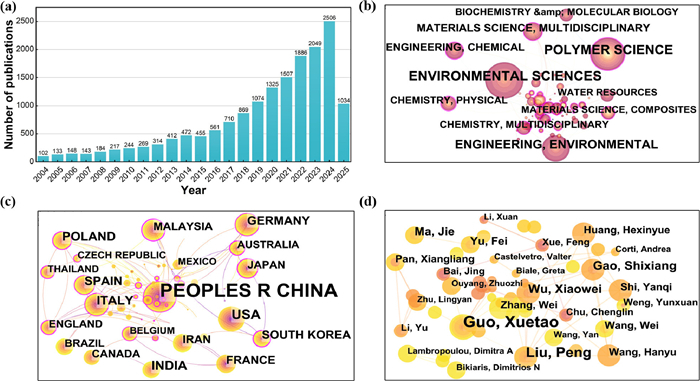
Figure 1.
Annual publications (a), research hotspots by discipline (b), international collaboration (c) and author co-authorship (d) network in PLA research.

Environmental risk analysis and sustainable modification of polylactic acid (PLA): Integrated bibliometric and machine learning insights
Qianyu Li , Juan Li , Binghua Jing , Didi Li , Zhimin Ao


Plastic pollution has become a defining global environmental crisis, prompting coordinated regulatory interventions [1]. For instance, the European Union mandates 100% recyclable or reusable plastic packaging by 2030, while China has banned non-degradable plastic straws and targeted a sharp reduction in plastic bag consumption by 2025 [2–4]. These policies have driven the rapid adoption of bio-based biodegradable plastics (BPs), among which polylactic acid (PLA) stands out [5,6]. Synthesized from renewable feedstocks via lactide ring-opening polymerization [7,8], PLA has superior mechanical properties and optical clarity, widely used in packaging (e.g., food bags, water bottles), medical devices (e.g., absorbable sutures, drug delivery carriers), agriculture (e.g., mulch films, controlled-release fertilizer matrices), and industrial applications (e.g., 3D printing filaments, electronic packaging materials) [5,9–14].
However, a critical misconception persists: PLA is frequently labeled "100% green" due to its bio-based origin, obscuring non-negligible lifecycle environmental risks. Its incomplete degradation under natural conditions (soil, freshwater degradation cycles last 2-5 years, far longer than the 3-6 months under industrial composting conditions) generates MPs and NPs that accumulate in ecosystems [15], adsorbing heavy metals and persistent organic pollutants to amplify toxicological impacts across trophic levels. For instance, farmland soil can contain 20-50 MPs per kg, freshwater lake MPs concentrations rise, and such pollutant-loaded particles reduce water flea reproduction by 20% and soil collembolan survival by 40% [16–20].
Despite these risks, existing PLA reviews lack a systematic integration of how these risks arise, how they are generated, and how they can be mitigated. First, most reviews prioritize performance optimization (e.g., improving PLA brittleness via blending) or isolated degradation pathways (e.g., enzymatic biodegradation, photocatalytic hydrolysis), treating environmental risks as tangential rather than core themes [21–24]; second, when risks are mentioned, they are limited to single media or single effects, failing to capture lifecycle-wide risks from raw material cultivation (e.g., corn cultivation for PLA feedstocks requires 500-1000 m3 of water per ton, exacerbating arid-region water scarcity) to end-of-life degradation (e.g., less than 30% degradation of PLA in anaerobic landfills over 5 years) [25,26]; third, modification strategies are rarely linked to risk mitigation, with evaluations focused on performance enhancement rather than targeting MPs formation or pollutant carrier effects [27–29]. This fragmentation hinders the development of low-risk PLA materials, as researchers and engineers lack a cohesive framework to translate risk insights into modification design.
To fill this gap, this review systematically analyzes PLA's lifecycle environmental risks and sustainable modification strategies using 1810 Web of Science Core Collection publications (2004-2025) and knowledge mapping tools CiteSpace and VOSviewer. This approach uses quantitative literature analysis to identify research trends, knowledge biases and understudied areas, and mechanistic interpretation to clarify links between degradation processes, risk generation and modification efficacy. Our core objectives are to (1) trace PLA's full-lifecycle environmental risk transmission, addressing incomplete coverage of lifecycle-wide risks and cross-medium pollution in existing reviews; (2) integrate mechanisms and assesses how modification strategies reduce risks, overcoming prior studies' focus on isolated changes without analyzing their mitigation effects; (3) evaluate ML’s role in quantifying environmental risks across PLA's lifecycle and predicting modification efficacy to accelerate low-risk PLA development, addressing the reliance on qualitative summaries rather than quantitative tools; (4) and identify critical knowledge gaps in "risk-modification" integration and propose future research priorities. By bridging mechanistic understanding of PLA degradation with targeted modification, this review establishes a foundation for green, low-risk PLA design, addressing a key shortcoming of prior dispersed research, and supports the standardization of BPs in a circular economy.
The Web of Science Core Collection (WOSCC) was selected as the primary data source for its reliable and comprehensive bibliometric data. The search period covered 2004-2025 (marking the first academic introduction of “microplastics” [1]) and adopted a title-based strategy with the formula: TI = (polylactic acids OR PLA OR biodegradable plastics OR microplastics) AND TI = (aging OR aged OR photoaging OR pollutant adsorption OR degradation OR modified OR modification). Publications were screened against strict criteria: Included studies focused on PLA microplastics, aging, degradation, pollutant interactions or modification, limited to research articles and reviews. Excluded items were incomplete records, duplicates, non-academic documents and those with missing key information. A total of 1810 publications were retained, with plain-text records and citation data exported from WOSCC; ethical approval was not required as data were publicly available.
Bibliometric analysis was conducted using VOSviewer 1.6.20 and CiteSpace 6.1R6. VOSviewer used Overlay and Network Visualization modes with Association Strength as the similarity metric; Attraction, Repulsion, Scale, Labels, Lines, and Colors parameters were dynamically adjusted for clarity. CiteSpace adopted “Full Record with Cited References” data, covering a time span from 2005 to 2024, one-year slices, cosine algorithm, node type set to “Keyword”, Top N = 50, k = 25, and Pathfinder pruning for network refinement. Keyword clustering was performed via the LLR algorithm, generating 10 clusters with a network of 530 nodes and 1440 edges (density = 0.0103). Validation included modularity Q = 0.5947 and silhouette S = 0.8254 for clustering quality; cross-validation was conducted via citation coupling and sensitivity analysis with adjusted Top N values. Bibliometric results were interpreted alongside high-impact literature analysis to link trends, gaps, and core mechanisms.
The number of PLA-related papers has increased sharply over two decades (Fig. 1a): From 244 in 2010 to 561 in 2016, and exceeding 1325 in 2020 and 2506 in 2024 (over 10 times the 2010 volume) driven by global plastic pollution policies. Fig. 1b shows PLA research focuses: environmental science (583 papers) assesses biodegradability, including degradation rates and residuals; materials science (156 papers) and engineering (326 papers) focus on anti-aging modifications to improve performance and reduce secondary pollution; chemistry (106 papers) develops composite modifications and adsorption technologies for pollutants; biochemistry and molecular biology (84 papers) explores molecular degradation mechanisms. The national cooperation network involves 86 regions (104 links, density 0.0285; Fig. 1c), with China, the USA, India and Italy as top producers, and China, Poland, Malaysia and Japan as core nodes. China exerts significant academic influence due to its large publication volume and extensive collaboration. Author co-authorship analysis (345 authors, 294 links, density 0.005; Fig. 1d) shows fragmented teams (e.g., Guo Xuetao, Gao Shixiang, Liu Peng) and underdeveloped collaboration, limiting systematic progress and in-depth PLA research.
CiteSpace identified 15 clusters (Q = 0.7965, S = 0.9284; Fig. 2). The keyword co-occurrence map (313 nodes, 515 links, density 0.0105) centers on “Polylactic Acid” and “Degradation”, which branches into three pathways: hydrolytic degradation (water-driven ester bond attack), biodegradation (microbe-mediated), and photodegradation (UV-induced chain scission, with photocatalysis for degradation control). Hydrolytic and biodegradation research peaked in 2019-2021, while photodegradation emerged later. Clustering analysis contextualizes degradation mechanisms (Fig. 2b): Cluster 9 “Thermal Degradation” focuses on thermal degradation hazards and sludge composting effects; Cluster 2 “Aging Process” assesses aging and biosafety in food packaging; Cluster 6 “Microplastics” quantifies MPs carrier effect; Cluster 10 “Additive” explores plasticizer-driven MP formation; Cluster 11 “Surface Modification” enhances flame retardancy via biomass compounding; Cluster 8 “Mechanical Properties” improves performance through CNT hybridization.
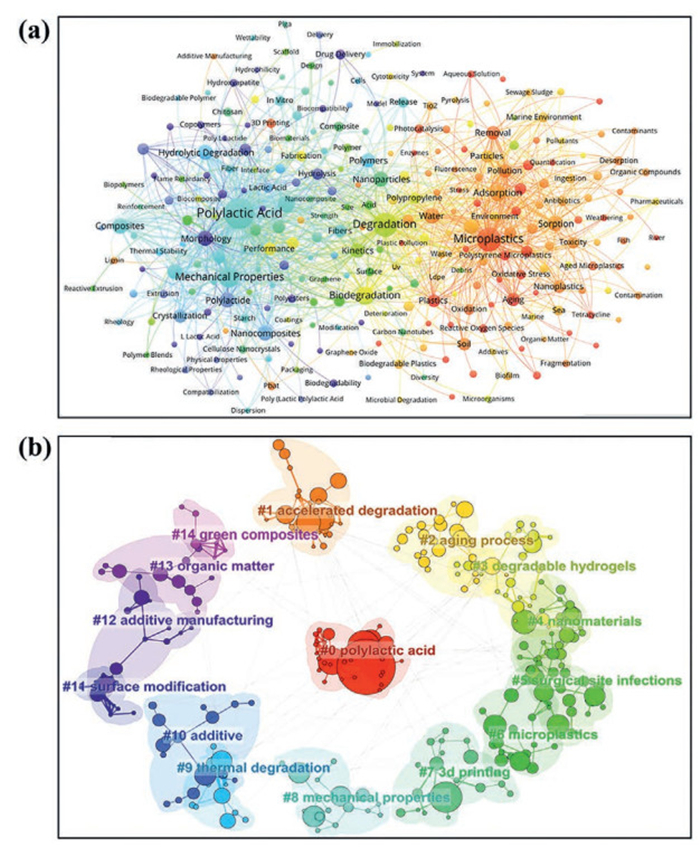
Growing awareness of MPs has made environmental risks of incomplete PLA degradation a new research focus. Microplastics ranks as the second major hotspot with publications surging post-2022; nanoplastics narrows focus to smaller particle scales. Photoaging accelerates MPs formation via light exposure, driving combined pollution research with Sorption and Adsorption as core keywords. In PLA-pollutant interaction studies, pollution correlates strongly with heavy metals, Wastewater and marine environment, highlighting ecological hazards of MPs-pollutant composite systems in these environments. To address incomplete degradation and inherent PLA limitations, modification research has two targeted directions. Around 2019, pure PLA’s brittleness made mechanical properties a key focus, with composites and blends as main modification methods to enhance practicality and shelf life. Post-2020, nanocomposites and nanoparticles initiated the nano-reinforcement stage, while surface modification enabled degradation regulation, though most studies still focus on performance optimization. In summary, keyword co-occurrence and clustering maps construct a PLA research correlation framework from degradation mechanisms to environmental risks and modification technologies, clearly presenting core keywords’ frequency characteristics and temporal evolution.
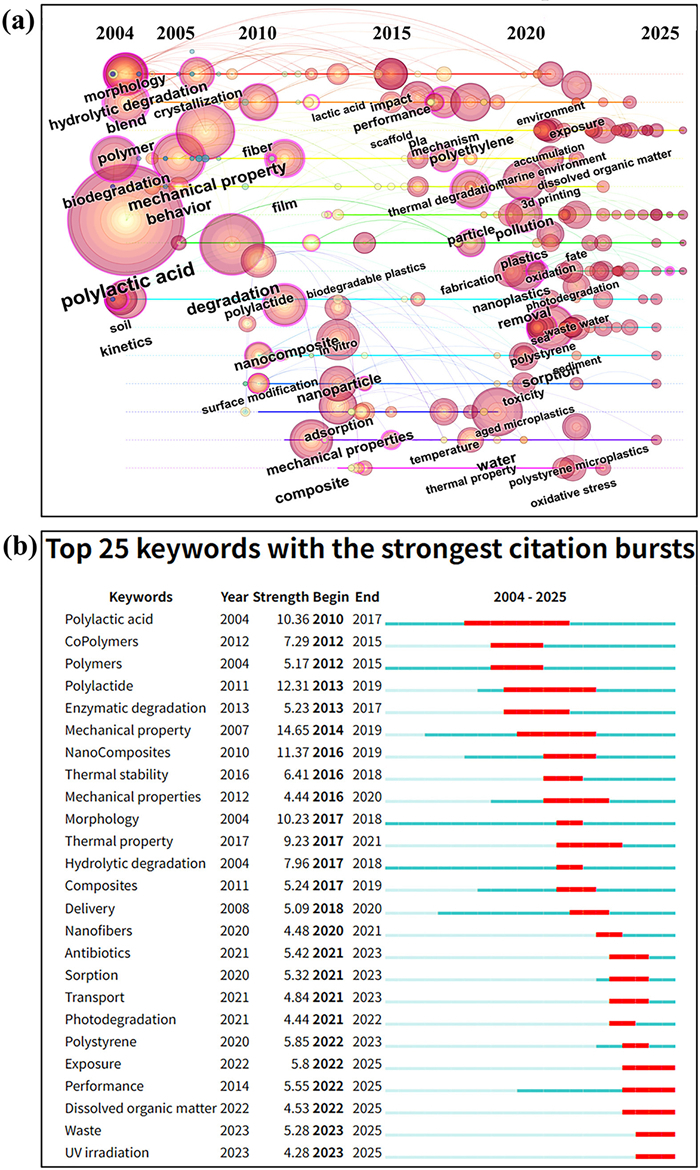
Three distinct evolutionary stages of PLA research were identified via keyword timeline (Fig. 3a) and burst keyword maps (Fig. 3b). The basic property exploration stage (2004-2008) was initiated by the first burst of “Polylactic acid”, with simultaneous emergence of “Biodegradation” and “Hydrolytic degradation” focusing on PLA’s environmental friendliness and verification of degradation potential and mechanisms, establishing “Degradability” as the core label of PLA research. The performance optimization stage (2009-2015) focused on pure PLA’s performance defects with expanding applications; “Mechanical property” became a hotspot in 2009, “Composites” and “Blends” became core optimization paths in 2011, and “Photodegradation” and “Films” drew attention in 2015 driving anti-aging modification; burst data (Fig. 3b) confirmed the technology upgrade trajectory, with “Copolymers” bursting in 2012-2015, “Mechanical property” maintaining high burst strength in 2014-2019, and early emergence of “Nanocomposites” and “Thermal stability” (2016-2019) laying the foundation for nanomodification. The risk-focused stage (2016-2024) shifted research from “Material development” to “Environmental safety” driven by global plastic pollution control policies; attention to “Pollution” and “Removal” increased in 2016, “Nanoparticles” emerged as a hotspot in 2019, and “Microplastics” and “Wastewater” became core focuses on aquatic cumulative risks in 2021; burst keywords (Fig. 3b) identified cutting-edge directions, including “Photodegradation” (2021-2022) linking photoaging and microplastic formation, “Exposure” and “Dissolved organic matter” (post-2022) focusing on environmental media interactions, and “Adsorption” and “Antibiotics” (2021-2023) studying pharmaceutical residue behavior.
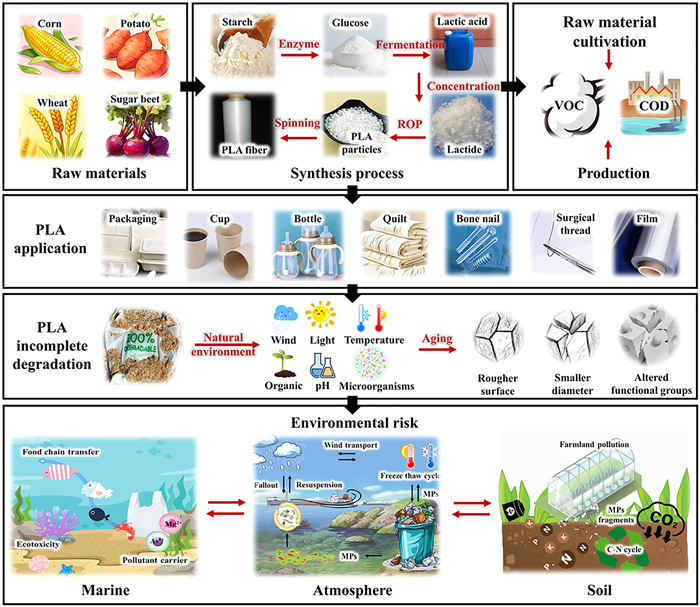
As illustrated in Fig. 4, the schematic outlines the relevant principle of PLA, covering raw material cultivation, synthesis processes, and production stages. It also presents the market applications of PLA products, along with diagrams depicting the factors influencing incomplete degradation in natural environments and the resulting adverse impacts on oceans, atmosphere, and soil.
Over 70% of global PLA raw materials are derived from corn. Each ton of corn requires 500-1000 m3 of water, worsening water scarcity in arid regions. Fertilizer and pesticide use acidifies soil, and 20%-30% higher nitrogen and phosphorus runoff causes water eutrophication [30]. Expanding corn cultivation may harm land ecosystems, such as through deforestation. In production, lactic acid fermentation requires constant 30-37 ℃ control, increasing energy use. Mishandled polymerization tin catalysts may contaminate water, and unregulated VOC emissions pollute air [31]. Producing 1 ton of PLA consumes 2.5-3.5 tons standard coal, with wastewater COD 1000-3000 mg/L (some exceeding limits) [32]. Notably, PLA is less environmentally impactful than traditional plastics and some BPs. For example, polyethylene (PE), consumes 7-9 tons standard coal/ton, has higher carbon emissions, and relies entirely on non-renewable oil; PHA (polyhydroxyalkanoate), a bio-based BP, consumes about 4.2 tons standard coal/ton with wastewater COD 5000-8000 mg/L. Moreover, PLA's biomass feedstock enables carbon sequestration, with lifecycle carbon footprint 40%-60% lower than traditional plastics. This section does not deny PLA’s environmental advantages but aims to identify weaknesses and advance full-lifecycle greening [33–35]. While existing studies have clarified the environmental risks of PLA’s production stage, quantitative research on its full-lifecycle environmental risks using machine learning (ML) remains scarce, but ML-driven methods for other microplastics offer actionable references. For instance, automated ML frameworks have accurately predicted soil greenhouse gas (CO, CH4, N2O) emissions induced by microplastics, with R2 up to 0.991 for CH4 [36], a method directly adaptable to PLA by inputting its specific aging and degradation parameters for ecological risk quantification. Additionally, ML-aided text mining has identified marine plastic degradation drivers [37], providing a framework to fill gaps in PLA’s non-biodegradation mechanism research.
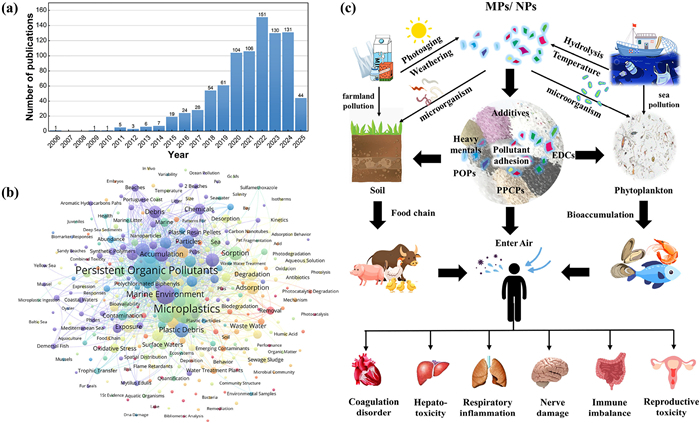
PLA natural degradation involves two steps: initial fragmentation into small fragments and subsequent microbial mineralization; microbial esterase only metabolizes PLA to CO2 and water when its molecular weight drops below 10,000 g/mol via mechanical and chemical processes [27]. Incomplete degradation leaves fragments above this threshold, causing persistent secondary pollution risks. For example, PLA films in Mediterranean soil had molecular weight decrease from 120,000 g/mol to 85,000 g/mol after 11 months [16]; 42% of soil mulch films were oligomers 2000-5000 g/mol after one year [38,39]; PLA food containers in freshwater lakes retained molecular weight above 100,000 after 6 months. The prevalence and persistence of incomplete PLA degradation fragments have attracted growing global attention; relevant papers increased from 1 in 2010 to 151 in 2022 and stabilized at 130-131 in 2023-2024, entering in-depth mechanism exploration (Fig. 5a). The keyword co-occurrence map (Fig. 5b) shows microplastics and persistent organic pollutants as dual cores. Microplastics correlates strongly with marine environment and freshwater, confirming incomplete degradation products penetrate multiple media such as water and soil; persistent organic pollutants correlate with bioaccumulation and toxicity, highlighting food chain cumulative risks; sorption and adsorption co-occur with photoaging-related keywords, confirming combined risks of photoaging products; transport and exposure confirm risk transmissibility (Fig. 5c).
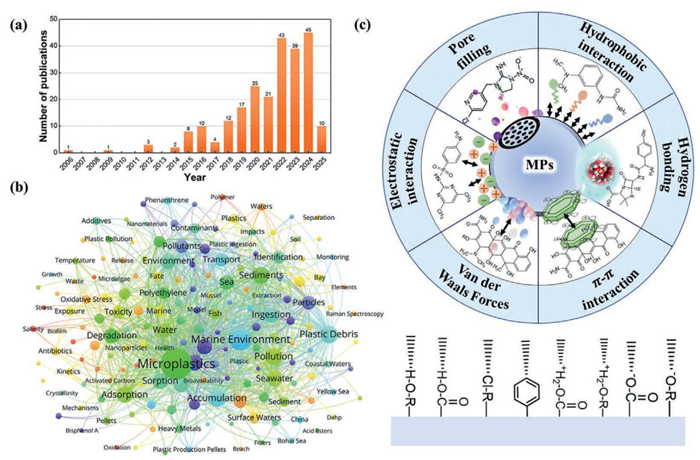
Bibliometric data (Fig. 6) reveal obvious medium dependence and research imbalance in PLA environmental risk keywords. Frequent keywords including "Persistent Organic Pollutants" and "Toxicity" indicate complex PLA-POPs interactions. "Adsorption" and "Sorption" highlight PLA's pollutant adsorption risk. "Bioaccumulation" and "Exposure" reflect PLA-aquatic organism interactions. "Freshwater" and "Marine pollution" suggest variable PLA behaviors across aquatic environments. "Nanoplastics" and "Microfibers" indicate microplastic diversity and environmental complexity. Under industrial composting (55-65 ℃, 60%-70% humidity), abundant microbes enable complete PLA degradation in 3-6 months. However, degradation slows drastically in natural environments due to fluctuating temperature, humidity and microbial activity [40]. 0.1 mm-thick PLA films degrade in 12-24 months in temperate farmland soil but 3-5 years in cold or arid regions; degradation decreases over 70% below 15 ℃ and stalls below 20% moisture. Heavy metals and pH shifts inhibit esterase activity, generating <500 μm fragments [25]. PLA particle size mediates soil MPs formation and migration: nanoscale PLA (≤100 nm) tends to aggregate with soil particles or penetrate plant roots, while micron-sized PLA (50-150 μm) adheres to root surfaces forming physical barriers [41,42]. Compared to non-degradable PE, PLA microbial hydrolysis produces lactic acid that alters soil physicochemical conditions and indirectly regulates MPs fragmentation rate [42].
In aquatic environments, 0.05 mm PLA degrades in 2-3 years in freshwater but 5-8 years in seawater due to low temperature and limited nutrients; it first undergoes UV and wave-induced photooxidation and mechanical fragmentation, forming microplastics with 1-2 years residence time [26]. Freshwater and seawater differ in regulating PLA MPs formation: Freshwater’s moderate temperature and nutrients promote microbial hydrolysis to accelerate MPs generation, while seawater’s low temperature and high salinity slow degradation, prolonging large fragment retention [43]. In anaerobic municipal landfills, PLA degrades <30% in 5 years, with undegraded portions occupying space and disrupting leachate treatment [26]. Compared to PHA, PLA generates MPs faster under UV aging but has fewer ecotoxic intermediates [44]. In summary, PLA MPs formation characteristics and risks are highly medium-dependent, differing from non-degradable plastics like PE, PP and other biodegradables such as PHA in degradation rate, MPs size distribution and environmental retention time [42,43]. However, existing studies have significant medium coverage gaps, lacking systematic freshwater and soil data and insufficiently clarifying seawater photooxidation-biodegradation coupling mechanisms.
PLA risk prediction can leverage mature microplastic ML models. Interpretable ML models identified key factors including carbonyl index and O/C ratio driving aged MPs vertical soil migration [45], enabling precise simulation of PLA soil transport. In aquatic systems, Tree algorithms predict riverine microplastic concentrations [46], which can model PLA freshwater diffusion by integrating temperature and anthropogenic factors. For sedimentation, physics-informed ML and shape-specific models predict settling velocities of various MPs forms [47,48], offering reliable tools for PLA aquatic migration risk assessment. ML studies on open-channel transport confirmed flow velocity and water depth interactions affecting microplastic travel distance [49], guiding parameter selection for modeling PLA MPs movement in agricultural drains and natural rivers. Meta-analysis integrated XGBoost models support medium-specific risk prediction by identifying environmental medium type, PLA particle size and exposure time as key regulators of PLA MPs formation and migration across soil-aquatic systems [42].
PLA photodegradation is a UV-initiated free radical chain reaction mainly in the atmosphere; carbonyl groups form excited states upon light absorption, causing ester bond cleavage via Norrish Type Ⅰ and Ⅱ reactions [50], with its mechanism research timeline in Fig. 7. Burst keyword analysis shows that research on photodegradation and aging process (Cluster 2) has increased significantly since 2020, focusing on MPs-UV interactions in atmospheric and marine environments (Cluster 6). Photoaging-related literature rose from 15% in 2016 to 38% in 2023, becoming a key research focus. Although residual tin catalysts promote free radical generation via photosensitization [23,51], PLA photodegradation in natural environments faces two major challenges. On one hand, light energy is insufficient: UV-C is fully blocked by the ozone layer, UV-B and UV-A account for over 95% of solar UV but have low energy, and UV-A only reduces PLA molecular weight by 15% after 1000 hours of irradiation versus 40% under UV-B [52,53]. On the other hand, effective light intensity is significantly attenuated by environmental conditions; cloud cover and seasonal variations weaken UV radiation, leading to over tenfold differences in PLA photodegradation rates between equatorial and temperate regions [45]; and PLA UV exposure on forest soil surfaces is only 15% of that in open areas [54,55]). For example, PLA mulch films contribute 20-50 MP particles/kg in farmland soils after one year of use, while lake MP concentrations increase by 0.08 mg/L annually [25]. These fragments adsorb Pb2+, Cd2+ and atrazine, reducing water flea reproduction by 20% and inducing zebrafish liver oxidative damage via food chain transfer [19].
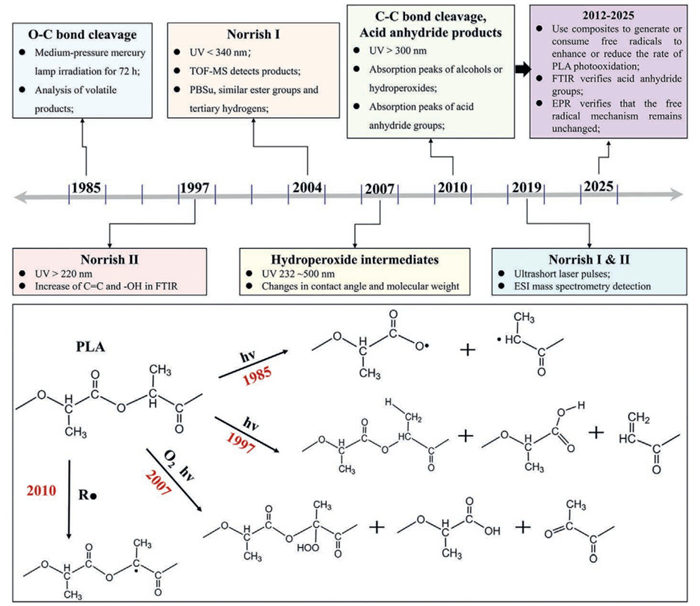
Over four decades, PLA photoaging mechanism research has advanced: McNeill identified the O-C bond as the primary photolysis site in 1985 [56]. Ikada proposed the Norrish Ⅱ mechanism in 1997 [57], later confirmed by Tsuji et al. and Janorkar et al., who found Norrish Ⅱ intramolecular hydrogen transfer dominates short-wavelength UV 200-300 nm chain scission [58]. Bocchini revealed a new long-wavelength light pathway in 2010; 2024 quantum chemical and kinetic simulations showed coexistence of Norrish Ⅰ and Ⅱ mechanisms [23,24]. Both cleave C-O bonds: Norrish Ⅰ mechanism targets ester bonds via α-cleavage, Norrish Ⅱ mechanism acts on tertiary carbon-adjacent bonds, resolving short- and long-wavelength UV degradation differences [59]. Despite these advances, several critical knowledge gaps remain. First, the role of specific ROS in indirect photoaging is unclear. While •OH and •HO2 oxidize PLA into oligomers, the inactivity of 1O2 and •O2− lacks a mechanistic explanation, and how ROS concentration gradients (e.g., seasonal •OH variations in Northeast China [59]) affect degradation kinetics is poorly understood. Second, PLA crystallinity’s photoaging effect is unresolved; Tsuji et al. found crystalline regions degrade slower than amorphous ones, but causes e.g., restricted chain mobility or limited ROS access and their microplastic generation impact remain unknown [58]. Third, nanofillers’ dual roles need clarification; TiO2 nanowires shield UV and enhance photocatalytic degradation [60], ZnO nanoparticles balance UV screening and pro-degradant activity, but tuning filler properties for specific applications remains unclear [61,62]. Fourth, multiple environmental factor interactions UV, humidity, microbes are insufficiently studied; Kaynak et al. observed reduced photooxidation of PLA under humidity [24,63], but synergistic or antagonistic effects between hydrolytic and photolytic pathways need quantitative.
Resolving these uncertainties is critical for fundamental research and industrial applications. Clarifying ROS induced mechanisms enables design of specific modifiers, e.g., tannic acid derivatives to inhibit photoaging, reducing microplastic accumulation. Understanding degradation guides processing conditions such as cooling rates to control PLA environmental fate. Unraveling filler dual effects supports development of composites with balanced UV stability and degradability. Quantifying multi-factor interactions improves PLA product environmental risk assessments, especially in complex ecosystems like marine and agricultural soils where photoaging-driven microplastic formation and pollutant adsorption pose cascading ecological risks [59,63]. To optimize kinetic parameters of incomplete PLA degradation pathways photoaging and hydrolysis, insights can be drawn from plastic degradation ML methods. For plastic photoaging, Convolutional Deep Neural Networks predict photooxidation products, e.g., carbonyl compounds in PE and polypropylene; given UV intensity and humidity, the model outputs molecular weight changes across aging stages [64]. This approach is adaptable for PLA: Inputting initial crystallinity and UV exposure time enables rapid prediction of molecular chain scission rate and microplastic <500 μm generation, supporting risk assessment of PLA mulch films in different light-exposed regions.
Hydrolysis is the primary chemical degradation pathway of PLA, involving water molecule attack on ester bonds to cause chain scission and generate carboxylic acid and hydroxyl products [65]. Early studies (2004–2010) focused on hydrolytic degradation, with keyword co-occurrence networks showing strong correlations with “Water” and “Crystallization”. After 2015, research shifted to regulating hydrolysis rates via nanocomposites Cluster 3. Hydrolysis incompleteness in natural environments arises from multiple constraints: water molecules first penetrate amorphous regions to rapidly reduce molecular weight, followed by carboxylic acid-induced autocatalysis [27]. However, natural temperatures typically remain below 30 ℃, resulting in a hydrolysis rate less than one-tenth of laboratory conditions; after one year in river water at 25 ℃, PLA’s molecular weight decreases by only 30% [66,67]. Environmental complexity further hinders degradation. Salts and humus form barrier layers; high salinity in seawater reduces water absorption by 40% and hydrolysis rate constant by 60% [68]; soil clay particles adsorb moisture, lowering surface hydration [28]. microbial density in seawater is only a few to dozens per milliliter, leading to PLA weight loss of less than 0.8% after 52 weeks [69]. In deep-sea sediments, low temperatures (10 ℃) reduce esterase activity to below 10% of optimal levels, leaving PLA MPs virtually undegraded [70]. Physical processes further fragment incompletely hydrolyzed PLA into pieces smaller than 1 mm; these fragments show only 5% molecular weight reduction after 52 weeks in seawater and persist in surface sediments. For instance, 12% of MPs in the Pacific Garbage Patch are PLA, all incomplete hydrolysis products [29,71–73].
Besides photodegradation and hydrolysis, thermal oxidative degradation, biophysical fragmentation and freeze-thaw cycles drive incomplete PLA degradation. Thermal oxidative degradation involves oxygen generating peroxyl radicals under temperature fluctuations and transition metal catalysis to trigger chain scission [74], but natural temperatures are mostly below 60 ℃ and oxygen is shielded by environmental media, so PLA molecular weight decreases only on surface without core area change [46]. For biophysical fragmentation dominated by biological mechanical effects, earthworms break PLA mulch films into 0.5-2.0 mm fragments [75]; zooplankton excrete MPs smaller than 100 μm after filter-feeding and grinding [76]; freeze-thaw cycles are notable in high-latitude regions; PLA fragments into 2-5 mm pieces in Arctic permafrost within one year, with 8% molecular weight reduction; its degradation cycle on compost surfaces triples, with 0.3% MPs, making it a hidden agricultural soil MPs source [77,78]. Additionally, ML combined with MD simulations has revealed plastic thermal degradation mechanisms; for palm leaf-polypropylene composites, the ML model integrates thermogravimetric analysis data and simulation trajectories to accurately predict thermal decomposition temperature (error <2 ℃) and product distribution [64]. This method can predict PLA composite thermal degradation behavior, providing parameter guidance for high-temperature processing safety and post-disposal pyrolysis [79].
Incomplete PLA degradation produces MPs and NPs, which act as environmental pollutant carriers due to high specific surface area and abundant carboxyl/hydroxyl groups. Ecotoxicity intensifies with adsorbed contaminant diversity and concentration, with two key research gaps: Pollutant type imbalance and experimental medium bias. Current research focuses on heavy metals and personal care products as main adsorbed pollutants [80–82]. For heavy metals Pb2+, Cd2+, Cr6+, Cu2+, As3+ etc., amino-functionalized PLA has a maximum Cd2+ adsorption capacity of 42.3 mg/g [83–85], and UV-aged or oxidized PLA enhances Cd2+ and Cr6+ uptake [86]. Nanoscale PLA amplifies plant heavy metal bioaccumulation, increasing wheat root Cd/Cr uptake by 114%-300% and 89%-215% respectively [42]. For PPCPs, tetracycline and ciprofloxacin sulfamethoxazole adsorption is driven by electrostatic interactions, hydrogen bonding and chelation [44]. PLA outperforms non-degradable plastics like PP and PE in tetracycline adsorption with an equilibrium capacity of up to 12 mg/g [43,80], and aging strengthens this capacity via enriched oxygen-containing groups [43,44,82]. PLA also adsorbs organic pollutants, including polycyclic aromatic hydrocarbons such as phenanthrene [87], endocrine disruptors such as 4-nonylphenol and bisphenol A [88], and perfluorooctanoic acid, where 80-day aged PLA shows a tenfold increase in monolayer adsorption capacity to 223 mg/g [89]. Adsorption is regulated by environmental factors: pH modulates hydrogen bond formation [90], salinity enhances phenanthrene adsorption [87], particle size affects optimal adsorption, while aging alters surface polarity, weakening algal organic matter adsorption but enhancing PFOA retention [43,89,91]. Notably, POPs have limited direct research, but several adsorbed contaminants exhibit POP-like characteristics.
Furthermore, PLA has unique adsorption behaviors compared to other plastics; its low crystallinity of 23.13% versus PE’s 46.81% enhances its affinity for polar pollutants [42], outperforming PE in algal organic matter adsorption [91] and retaining pollutants more stably with a lower desorption rate [88,92]. Combined PLA and co-contaminant exposure induces synergistic toxicity: PLA MPs reduce Daphnia magna reproduction by 35% with Cd2+ [93], enhance rice root arsenic accumulation [41], and amplify heavy metal phytotoxicity via vector effects. ML models quantify adsorption uncertainty, identifies microplastic chemical properties and pollutant hydrogen-bonding interactions as key drivers, with mechanisms like hydrophobic partitioning and π-π stacking applicable to PLA [94]. Furthermore, ML models predict combined toxicity by integrating PLA aging degree, pollutant structural parameters and environmental factors [42]; show that temperature contributes 32%–45% to PE and PVC adsorption [95]. Inputting PLA’s aging degree and pollutant structural parameters (e.g., tetracycline’s polar surface area) enables rapid prediction of heavy metal Pb2+, Cd2+ or antibiotic adsorption capacity, supporting efficient PLA carrier effect risk assessment [96].
The carrier effect amplifies PLA MPs ecotoxicity, posing threats to multi-trophic organisms. In aquatic ecosystems, 50–200 nm PLA NPs penetrate Chlorella membranes; 72-h exposure to 10 mg/L reduces chlorophyll a by 30%, and PAH adsorption enhances toxicity 2-3 times, increasing photosynthesis inhibition to 45% [17]. For zooplankton, PLA MPs with 5 mg/L Cd2+ reduce Daphnia reproduction by 20%, with intestinal mucosa damage 60% higher than pure MP group [18]; nanoscale PLA exacerbates this effect via stronger biofilm penetration and larger specific surface area [42]. For fish, 30-day exposure to 20 mg/L tetracycline-loaded PLA MPs increases zebrafish liver MDA content by 1.8 times, with muscle complex accumulation of 0.32 mg/kg [19]; PLA promotes higher ARG enrichment in its plastisphere than PE [43]. In terrestrial ecosystems, earthworm defecation decreases by 30% after PLA MP ingestion; 100 mg/kg exposure reduces springtail survival by 40%, accompanied by microbial imbalance and disrupted carbon-nitrogen cycling [20]. For soil organisms, earthworm defecation decreases by 30% after MP ingestion; at 100 mg/kg, springtail survival drops by 40%, accompanied by microbial imbalance and disrupted carbon-nitrogen cycling; For plants, 150 nm PLA inhibits wheat and rice growth by enhancing heavy metal Cd/Cr/As uptake, while 50-150 μm PLA induces mild oxidative stress and disrupts water-nutrient transport [41,42]. Regarding human health, PLA MPs are detected in seafood and vegetables; NPs cross biological barriers such as intestinal epithelium and blood-brain barrier, with chronic effects gaining attention [97–101];
ML research has revealed polymer-specific mechanisms for pharmaceutical and personal care products (PPCPs) adsorption; ML models show microplastic surface charge contributes 52% to PPCPs adsorption, with a stronger effect in polar polymers like PLA [102]. ML combined with meta-analysis has quantified how antibiotic adsorption varies by medium (seawater salinity reduces efficiency by 41%, and dissolved organic matter alters site competition [43]). In terms of toxicity assessment, ML enables efficient identification of biomarkers; for inhalable microplastics in mice, ML models identified five key exhaled VOC biomarkers [103], which can be extended to PLA microplastics for toxicity biomarker screening [104]; ML-based gut microbiota analysis also reveals how microplastic exposure disrupts gut flora [105].
PLA modification is key to reducing environmental risks by regulating material structure and properties. Related research has grown rapidly with papers increasing from 17 in 2020 to 65 in 2022 and 154 in 2024 (Fig. 8a). Keyword analysis (Fig. 8b) shows close links between Machine Learning and terms such as Microplastics and Degradation, indicating advanced computing's central role in guiding modification design. ML enables data-driven models linking formulation processing and performance to reduce experimental work and improve prediction accuracy. Three core modification pathways are as follows.
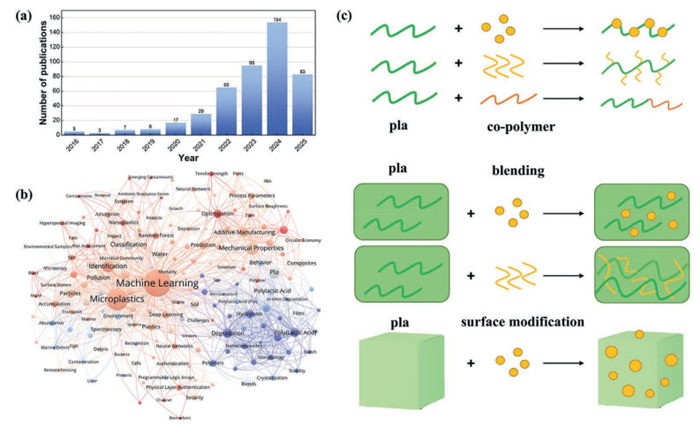
Chemical modification targets “performance adaptation” and “precise degradation regulation” through two primary strategies, functional modification and graft copolymerization, both developed since 2010 to improve PLA’s environmental adaptability and practicality, with ML increasingly supporting parameter optimization, performance prediction, and inverse design to address industrial challenges. Functional modification introduces polar or degradation-sensitive groups to regulate hydrophilicity and degradation. Hydroxylation and carboxylation lower the water contact angle, improving water absorption and penetration, thereby accelerating hydrolysis by promoting interfacial ester bond cleavage [106–108]. Adding esterase-sensitive linkages creates labile sites that increase microbial access, shortening PLA’s soil degradation time [109,110]. Notably, phosphate group modification enables rapid marine degradation, reducing breakdown time from over two years to just two weeks, by acting as intramolecular cleavage points inspired by RNA hydrolysis. The specific mechanism is shown in Fig. 8c [111,112]. The modified PLA retains sufficient mechanical strength for packaging, avoiding excessive weakening.
DFT calculations confirm efficacy: Among eight tested groups, phosphate exhibits the highest esterase binding affinity, driving the strongest catalytic effect on ester bond cleavage [113,114]. Grafting itaconic anhydride onto PLA introduces polar groups, enhancing interfacial compatibility with inorganic fillers and expanding applications to bone tissue engineering [108]. However, its industrial application is limited by high monomer costs and complex processing, requiring simpler and more scalable synthesis where ML plays a critical role. Graft copolymerization improves interfacial compatibility and structural stability; for example, grafting itaconic anhydride onto PLA introduces polar groups to enhance adhesion with inorganic fillers, improving filler dispersion and mechanical properties and expanding its application to bone tissue engineering scaffolds. ML complements inverse design for graft copolymerization: drawing on ML-based seawater degradation optimization for PE [95], researchers can input target properties of grafted PLA to derive optimal modification parameters, while ML models predict key properties of modified/grafted PLA to guide the balance between degradability, mechanical strength and synthesis cost and support 3D printing process optimization [115].
Physical modification mainly includes filler reinforcement, magnetic based multifunctional modification, and blending or additive regulation. Their principles and applications are as follows. Filler reinforcement combines filler addition with structural tuning to improve PLA performance and degradation behavior. Common fillers like titanium dioxide and nanoclay play synergistic roles: Titanium dioxide enhances crystallinity, mechanical stability and UV resistance [116]; nanoclay improves thermal stability and mechanical properties by regulating phase distribution and chain mobility [117,118]. Structural modifications such as nanocomposite design and star shaped architectures optimize pore structure for microbial adhesion and reduce brittleness. Titanium dioxide shows concentration dependent dual effects on degradation, and anatase phase promotes hydrolysis more effectively than rutile [119,120]. Nanoclay enhances degradation via multiple pathways but has no significant impact on overall degradation rate under controlled conditions [117,118]; magnetic based multifunctional modification uses iron oxides like Fe3O4 to regulate PLA structure, performance and degradation. Fe3O4 optimizes pore structure and filler distribution under magnetic field, enhances hydrophilicity and microbial accessibility, and enables magnetic recovery after service [121]. It accelerates PLA degradation through multiple pathways in different environments and improves thermal stability with low toxicity [122–124]. Blending PLA with biodegradable polymers like PBAT and PHA, along with functional additives, improves mechanical properties and regulates degradation. PBAT reduces PLA brittleness, and compatibilizers strengthen interfacial adhesion to balance toughness and tensile strength [125,126]. High PBAT content promotes degradation in natural environments, while low PBAT content may slow PLA degradation in non- enzymatic environments [126–128].
Physical modification faces several limitations. Nanofiller agglomeration affects product consistency in large scale production; composite extrusion requires specialized equipment, increasing initial costs. Long term environmental risks such as leaching of metal-based fillers into agricultural soil remain unmonitored. Future efforts can focus on combining chemical grafting to improve filler matrix compatibility or using recycled fillers to balance performance and industrial feasibility. ML drives the optimization of physical modification processes, including processing parameter optimization, performance prediction and inverse design. ML models establish the relationship between processing parameters and microstructure in PLA bead foam extrusion, predicting melt pressure and optimal conditions to ensure material uniformity [129,130]. For 3D printed PLA biomaterials, ML optimizes processing parameters to enhance fatigue life and structural stability, laying a foundation for scalable application [115]. Additionally, ML supports inverse design of physical modification, guiding the matching of modification schemes and target properties.
Biological modification has two developmental phases, and ML recently improves efficiency by analyzing complex microbial and enzymatic data to optimize degradation processes. This approach leverages plastic degrading enzyme engineering to accelerate complete PLA degradation and reduce MPs formation. Before 2020, the focus was on enzymatic degradation optimization; lipase immobilization increased PLA degradation efficiency threefold by targeting ester bonds to accelerate chain scission. After 2020, the focus shifted to microbial community regulation, expanding to other microbial resources for synergistic modification. Combining PLA with algae significantly enhances biodegradability, with complete degradation in 5-6 weeks under aerobic conditions compared to over three years for pure PLA. Algae also reduces the carbon footprint of production, and ML optimized cultivation parameters increase algae biomass yield by 16.5%. Algal sulfated polysaccharides form hydrogen bonds with PLA to enhance interfacial compatibility and maintain tensile strength [131]. Composting microbial communities accelerate PLA mineralization by synergistically secreting esterases.
Biological modification faces limitations including enzyme instability, complex microbial regulation, regional variations in compost communities that hinder industrial standardization, and high costs of enzyme purification and algae cultivation restricting large scale production. Improvement strategies include using synthetic biology to design heat resistant enzymes and combining physical mixing to enhance microbial accessibility. A key breakthrough is synthetic biology based custom degrading enzymes, which when combined with engineered microbial communities promote complete PLA degradation in natural environments and prevent MPs formation. ML plays a key role in advancing biological modification. It transforms enzyme optimization: ML models integrate enzyme structural features with degradation efficiency data to achieve high prediction accuracy, a method applicable to PLA degrading enzymes [132]. Drawing on ML based de novo design of PET degrading enzymes [133], similar tools can be applied to create PLA specific enzymes. ML also supports microbial community optimization by analyzing metagenomic data to identify key taxa and interactions, predicting composition effects on PLA degradation and reducing the development time of effective composting strategies from months to weeks. Combining MD simulations with ML enhances precision in regulating microbial communities, and ML predicts enzyme microbe synergy to improve modification efficacy and ensure full mineralization.
The three modification pathways have distinct focuses. Chemical modification focuses on precise degradation acceleration but is limited by cost and large-scale processing. Physical modification balances performance enhancement and degradation regulation, with advantages in mechanical property improvement and multi-scenario adaptability, though environmental regulation research is limited. Biological modification achieves green degradation via enzymes and microbial communities, with synthetic biology opening new possibilities, yet enzyme stability and microbial community compatibility need further breakthroughs. Notably, existing studies have quantified energy consumption and carbon footprint differences across PLA modification pathways. Chemical modification, such as functional grafting and copolymerization, consumes relatively high energy, primarily concentrated in monomer synthesis and temperature control, resulting in a notably higher carbon emission; the adoption of bio-based monomers can reduce such carbon emission to a certain extent [94]. Physical modification, such as filler blending and composite formation, avoids complex chemical reactions, with energy consumption concentrated in extrusion and compounding processes, and its carbon footprint is considerably lower than that of chemical modification; the use of recycled fillers can further reduce its environmental impacts [134]. Biological modification, such as enzyme engineering and microbial regulation, relies on reactions under ambient temperature and pressure, leading to much lower energy consumption compared to chemical modification. Additionally, microbial metabolism can sequester carbon, thereby resulting in a significantly lower carbon footprint compared to both chemical and physical modifications [131]. In summary, biological and physical modifications exhibit superior environmental performance, while the environmental costs associated with chemical modification can be reduced through the application of green catalysts and renewable energy sources.
Monitoring technologies and standards support PLA risk management effectively. FTIR and Raman spectroscopy enable qualitative and quantitative analysis of PLA microplastics in environmental samples [135]. ML improves identification and quantification: Raman-CNN model achieves 96% accuracy in distinguishing PLA, PE, and PS with a 0.1 μg/g detection limit [134], while NIRS-RF models quantify soil microplastics in 10 minutes [136]. Monitoring networks track mulch residues in agriculture and estuaries [137], and degradation standards should expand from industrial composting to natural environments (e.g., ≥90% degradation of agricultural PLA mulch in soil within 12 months) [138]. ML aids threshold derivation, such as a 0.08 mg/L freshwater safety limit for PE microplastics [139] and <10 mg/kg soil control limit [140], which can guide PLA risk benchmarks.
Recycling systems reduce PLA mixed pollution, and PLA plays a key role in the circular economy. Its bio-based feedstock reduces fossil fuel reliance, and chemical recycling via hydrolysis or alcoholysis enables closed-loop material recovery. The Extended Producer Responsibility (EPR) system expands with dedicated collection bins; NIRS sorts PLA from conventional plastics with >95% accuracy, and ML-SVM models further improve sorting efficiency [136]. Cities scale industrial composting, while rural areas adopt in-situ composting, and ML optimizes PLA hydrolysis to reduce lactic acid recovery time by 60% [141]. Policy support advances PLA’s sustainable use in circular economies. Policy support advances PLA’s sustainable use in circular economies. Financial subsidies and tax incentives promote green recycling technologies to curb secondary pollution; plastic restriction policies now define applications, environmental requirements, international cooperation unifies risk assessment and recycling standards, while integrating the above two standardization directions into policy implementation [142]. ML models predict policy impacts, such as forecasting 2025 plastic restriction orders including PLA, and linking recycling targets to deposit systems [141].
Based on 1,810 Web of Science publications (2004-2025), this review integrates PLA’s lifecycle environmental risks and sustainable modifications via bibliometric analysis, addressing a critical gap by linking risks to targeted modifications unlike previous fragmented studies. PLA research has evolved through three key stages: basic property exploration (2004-2008) focused on biodegradability verification; performance optimization (2009-2015) addressed brittleness via blending and copolymerization; risk-focused research (2016-2024) centered on incomplete degradation, MPs accumulation, and ecotoxicity. This work contributes by mapping full lifecycle risks to modifications, highlighting ML’s role in enhancing risk prediction and modification efficiency, and supporting the circular plastic economy.
PLA’s lifecycle risks are multifaceted and medium-dependent. Corn-based raw material cultivation consumes large water volumes and causes soil acidification; production is energy-intensive with wastewater and emissions; natural incomplete degradation generates persistent MPs in diverse ecosystems. Three complementary modifications exist: Chemical modification accelerates environment-specific degradation; physical modification balances mechanical performance and MP control; biological modification enhances mineralization via microbial regulation. ML improves predictions of MPs transport, pollutant adsorption, and ecotoxicity, reducing experimental effort. However, the mechanism of incomplete degradation is poorly understood, and degradation in complex media has been insufficiently studied. Future research should prioritize three directions. First, integrate DFT and in-situ characterization to clarify degradation mechanisms and synergistic toxic effects between PLA and key pollutants. Second, advance environment-specific modification by tailoring chemical, physical, and biological strategies to balance degradability, performance, and pollutant mitigation. Finally, leverage ML to predict PLA-pollutant interactions, simulate cross-medium transmission, optimize modification formulations, and standardize risk assessment protocols, accelerating low-risk PLA development.
Qianyu Li: Writing – original draft, Investigation. Juan Li: Writing – review & editing. Binghua Jing: Writing – review & editing. Didi Li: Writing – review & editing. Zhimin Ao: Writing – review & editing, Funding acquisition.
The authors declare that they have no known competing financial interests or personal relationships that could have appeared to influence the work reported in this paper.
This work was supported by the National Key R&D Program of China (No. 2022YFC3901800), the National Natural Science Foundation of China (Nos. T2421005, 22176041), and the “Fundamental Research Funds for the Central Universities”.
R.C. Thompson, W. Courtene-Jones, J. Boucher, et al., Science 386 (2024) eadl2746. doi: 10.1126/science.adl2746
Y. Jang, K.N. Kim, J. Woo, Waste Manage. 156 (2023) 177–186. doi: 10.1016/j.wasman.2022.11.036
H. Li, L. Zhu, Q. Shen, et al., Environ. Sci. 43 (2022) 5326–5332.
D. Briassoulis, A. Pikasi, M. Hiskakis, Crit. Rev. Environ. Sci. Technol. 49 (2019) 1835–1892. doi: 10.1080/10643389.2019.1591867
F. Haq, M. Kiran, I.A. Khan, et al., Mater. Today Sustain. 29 (2025) 101067.
M. Mattonai, F. Nardella, M. Filomena, et al., J. Anal. Appl. Pyrolysis 191 (2025) 107172. doi: 10.1016/j.jaap.2025.107172
J. Wu, Z. Chen, Z. Si, et al., Chin. J. Chem. Eng. 75 (2024) 214–221. doi: 10.1016/j.cjche.2024.07.018
R. Zhang, S. Jia, J. Li, et al., ACS Sustain. Chem. Eng. 13 (2025) 11226–11237. doi: 10.1021/acssuschemeng.5c01154
O. Changlake, P. Kaewkam, K.Y.A. Lin, et al., J. Hazard. Mater. 496 (2025) 139207. doi: 10.1016/j.jhazmat.2025.139207
E. Moshkbid, D.E. Cree, L. Bradford, W. Zhang, J. Compos. Sci. 8 (2024) 342-342. doi: 10.3390/jcs8090342
S. Amani, G. Faraji, H.K. Mehrabadi, M. Baghani, Proc. Inst. Mech. Eng. Part B: J. Eng. Manuf. 233 (2019) 1196–1205. doi: 10.1177/0954405418774600
J. Kharb, R. Saharan, IOP Conf. Ser. Mater. Sci. Eng. 1248 (2022) 012008. doi: 10.1088/1757-899x/1248/1/012008
A.A. Rosenbaum, C.M. Murphy, A.L. Wszelaki, et al., J. Food Prot. 88 (2024) 100444.
S.J. Royer, F. Greco, M. Kogler, D.D. Deheyn, PLoS One 18 (2023) e02846811.
J. Zhang, J. Wu, Y. Dou, Arch. Microbiol. 207 (2025) 91. doi: 10.1007/s00203-025-04293-4
S. Park, J. Kim, J.H. Choi, et al., Int. J. Biol. Macromol. 253 (2023) 127472. doi: 10.1016/j.ijbiomac.2023.127472
A.G. de Souza, R.R. Ferreira, J. Harada, D.S. Rosa, J. Appl. Polym. Sci. 138 (2021) e50020. doi: 10.1002/app.50020
A. Sanchez-Martinez, D. Minguez-Garcia, P. Diaz-Garcia, J. Gisbert-Paya, J. Polym. Environ. 33 (2025) 3897–3918. doi: 10.1007/s10924-025-03631-3
M. Di Giannantonio, C. Gambardella, R. Miroglio, et al., Toxics 10 (2022) 479. doi: 10.3390/toxics10080479
A. Luangrath, J. Na, P. Kalimuthu, et al., Ecotox. Environ. Saf. 271 (2024) 115974. doi: 10.1016/j.ecoenv.2024.115974
F.A. Tanjung, Y. Arifin, R.A. Kuswardani, Polymers 13 (2021) 3355. doi: 10.3390/polym13193355
B. Zehir, C. Boga, M. Seyedzavvar, J. Mol. Model. 29 (2023) 187. doi: 10.1007/s00894-023-05598-1
S. Bocchini, K. Fukushima, A. Di Blasio, et al., Biomacromolecules 11 (2010) 2919–2926. doi: 10.1021/bm1006773
C. Kaynak, B. Sari, Appl. Clay Sci. 121 (2016) 86–94.
E. Pesaranhajiabbas, M. Misra, A.K. Mohanty, Int. J. Biol. Macromol. 253 (2023) 126231. doi: 10.1016/j.ijbiomac.2023.126231
N.P. Sunesh, I. Suyambulingam, D. Divakaran, et al., Int. J. Biol. Macromol. 270 (2024) 132392. doi: 10.1016/j.ijbiomac.2024.132392
X.F. Meng, J.H. Qiu, B. Zhang, et al., Polym. Bull. 82 (2025) 3417–3437. doi: 10.1007/s00289-025-05676-9
N.H.I. Kamaludin, H. Ismail, A. Rusli, S.S. Ting, Iran. Polym. J. 30 (2021) 135–147. doi: 10.1007/s13726-020-00879-5
H.D. Touki, N.U. Ahmed, M. Motalab, P. Bose, Mater. Res. Express 12 (2025) 085307. doi: 10.1088/2053-1591/adfad5
X. Wang, Y. Sun, M. Liu, et al., Chem. Eng. J. 502 (2024) 157634. doi: 10.1016/j.cej.2024.157634
M. Colnik, M. Irgolic, M. Skerget, Polym. Test. 146 (2025) 108783. doi: 10.1016/j.polymertesting.2025.108783
Y. Chen, D. Zhang, H. Li, et al., J. Environ. Manage. 380 (2025) 125135. doi: 10.1016/j.jenvman.2025.125135
W. Leal Filho, J. Barbir, E. Carpio-Vallejo, et al., Sci. Total Environ. 999 (2025) 180337. doi: 10.1016/j.scitotenv.2025.180337
S. Yang, Y. Li, M. Nie, et al., Adv. Mater. 36 (2024) 2404115. doi: 10.1002/adma.202404115
R. Sangtani, R. Nogueira, A.K. Yadav, B. Kiran, J. Polym. Environ. 31 (2023) 2741–2760. doi: 10.1007/s10924-023-02787-0
X. Lin, J. Hou, X. Wu, D. Lin, Sci. Total Environ. 916 (2024) 170308. doi: 10.1016/j.scitotenv.2024.170308
H.d.M. Back, D. Pottmaier, C. Kneubl Andreusi, O.E. Alarcon, Environ. Sci. Adv. 2 (2023) 1629–1640. doi: 10.1039/d3va00106g
V. Poli, M.C. Lavagnolo, M. Basaglia, et al., J. Hazard. Mater. 491 (2025) 137974. doi: 10.1016/j.jhazmat.2025.137974
Z. Niu, M. Curto, M. Le Gall, et al., Ecotox. Environ. Saf. 271 (2024) 115981. doi: 10.1016/j.ecoenv.2024.115981
O. He, J. Cheng, X. Liu, et al., ACS Sustain. Chem. Eng. 12 (2024) 12534–12541. doi: 10.1021/acssuschemeng.4c04031
Q.Y. An, Z. Zhen, C.Z. Yan, Environ. Pollut. 382 (2025) 126669. doi: 10.1016/j.envpol.2025.126669
Y.Q. Zhen, T.H. Che, Y.X. Song, et al., J. Environ. Chem. Eng. 13 (2025) 120174. doi: 10.1016/j.jece.2025.120174
S. Bi, R. Wu, X. Liu, et al., J. Hazard. Mater. 489 (2025) 137479. doi: 10.1016/j.jhazmat.2025.137479
S.Y. Fu, S.X. Gao, X.Y. Zheng, L. Chen, Colloids Surf. A: Physicochem. Eng. Asp. 718 (2025) 136949. doi: 10.1016/j.colsurfa.2025.136949
Y. Qiu, J. Niu, C. Zhang, et al., Water Res. 274 (2025) 123129. doi: 10.1016/j.watres.2025.123129
A. Priyanto, D.A. Hapidin, D. Edikresnha, et al., Sci. Total Environ. 961 (2025) 178411. doi: 10.1016/j.scitotenv.2025.178411
J. Zhang, C.E. Choi, Water Res. 272 (2025) 122961. doi: 10.1016/j.watres.2024.122961
S. Qian, X. Qiao, W. Zhang, et al., Water Res. 249 (2024) 121001. doi: 10.1016/j.watres.2023.121001
A.Z. Fazil, P.I.A. Gomes, R.M.K. Sandamal, Environ. Pollut. 357 (2024) 124389. doi: 10.1016/j.envpol.2024.124389
J. Choi, P.J.H. Kim, J. Seo, et al., Adv. Eng. Mater. 20 (2018) 1700901. doi: 10.1002/adem.201700901
A. Babaei, M.H. Abdolrasouli, A. Rostami, J. Thermoplast. Compos. Mater. 36 (2023) 2998–3020. doi: 10.1177/08927057221118823
W. Wang, G. Ye, D. Fan, et al., Polym. Degrad. Stab. 194 (2021) 109762. doi: 10.1016/j.polymdegradstab.2021.109762
P. Praus, L. Rehackova, M. Filip-Edelmanova, et al., J. Environ. Chem. Eng. 13 (2025) 116998. doi: 10.1016/j.jece.2025.116998
K. Borska, P. Kasak, M. Danko, J. Mosnacek, Polym. Test. 91 (2020) 106821. doi: 10.1016/j.polymertesting.2020.106821
M. Bussa, A. Eisen, C. Zollfrank, H. Roeder, J. Clean. Prod. 213 (2019) 1299–1312. doi: 10.1016/j.jclepro.2018.12.048
I.C. McNeill, H.A. Leiper, Polym. Degrad. Stab. 11 (1985) 309–326. doi: 10.1016/0141-3910(85)90035-7
E. Ikada, J. Photopolym. Sci. Technol. 10 (1997) 265–270. doi: 10.2494/photopolymer.10.265
H. Tsuji, Y. Echizen, Y. Nishimura, Polym. Degrad. Stab. 91 (2006) 1128–1137. doi: 10.1016/j.polymdegradstab.2005.07.007
Q. Li, J. Cao, J. Li, et al., Sci. Total Environ. 954 (2024) 176350. doi: 10.1016/j.scitotenv.2024.176350
Y. Li, C. Chen, J. Li, X.S. Sun, Polymers 52 (2011) 2367–2375. doi: 10.1016/j.polymer.2011.03.050
S. Therias, J.F. Larche, P.O. Bussiere, et al., Biomacromolecules 13 (2012) 3283–3291. doi: 10.1021/bm301071w
E. Olewnik-Kruszkowska, I. Koter, J. Skopinska-Wisniewska, J. Richert, J. Photochem. Photobiol. A Chem. 311 (2015) 144–153. doi: 10.1016/j.jphotochem.2015.06.029
M. Gardette, S. Thérias, J.L. Gardette, et al., Polym. Degrad. Stab. 96 (2011) 616–623. doi: 10.1016/j.polymdegradstab.2010.12.023
A.J. Otaru, Z.A.A. Albin Zaid, Polymers 17 (2025) 1244. doi: 10.3390/polym17091244
M.A. Azka, S.M. Sapuan, E.S. Zainudin, Int. J. Biol. Macromol. 285 (2025) 138411. doi: 10.1016/j.ijbiomac.2024.138411
M.R. Salazar-Sánchez, L.I. Delgado-Calvache, J.C. Casas-Zapata, et al., Ing. Investig. 42 (2022) e93710. doi: 10.15446/ing.investig.93710
A. Can, E.D. Tomak, M.A. Ermeydan, O. Aykanat, Eur. Polym. J. 195 (2023) 112246. doi: 10.1016/j.eurpolymj.2023.112246
Y.N. Lu, Y.X. Lin, W.X. Jiang, et al., J. Hazard. Mater. 494 (2025) 138721. doi: 10.1016/j.jhazmat.2025.138721
N.H.I. Kamaludin, H. Ismail, A. Rusli, S.T. Sam, Polym. Compos. 43 (2022) 21–35. doi: 10.1002/pc.26354
E. Kelpsiene, M. Rydberg, M.T. Ekvall, et al., PLoS One 18 (2023) e0290748. doi: 10.1371/journal.pone.0290748
Y.F. Liu, L.Q. Wang, F.J. Wang, S.F. Ma, J. Appl. Polym. Sci. 141 (2024) e55483. doi: 10.1002/app.55483
J.H. Liu, C.B. Zhang, H. Huang, et al., Int. J. Biol. Macromol. 291 (2025) 139099. doi: 10.1016/j.ijbiomac.2024.139099
F. Nedaipour, H. Bagheri, S. Mohammadi, Nanocomposites 6 (2020) 99–110. doi: 10.1080/20550324.2020.1794688
C.Y. Li, Q. Liu, W.G. Gong, et al., Thermochim. Acta 709 (2022) 179144. doi: 10.1016/j.tca.2021.179144
H. Lim, S. Kim, J. Bang, et al., Sustain. Mater. Technol. 45 (2025) e01443.
Z. Zhong, W. Huang, Y. Yin, et al., Environ. Pollut. 359 (2024) 124741. doi: 10.1016/j.envpol.2024.124741
S. Zhang, Y. Li, L. Jiang, et al., J. Hazard. Mater. 495 (2025) 138960. doi: 10.1016/j.jhazmat.2025.138960
S. Zhang, M. Cao, Y. Li, et al., Environ. Pollut. 385 (2025) 127129. doi: 10.1016/j.envpol.2025.127129
K. Deekshitha, I. Hetman, Ö.U. Neli, et al., Eur. Polym. J. 239 (2025) 114278. doi: 10.1016/j.eurpolymj.2025.114278
P.F. Cheng, J.L. Chen, M. Tariq, et al., Process Saf. Environ. Prot. 201 (2025) 107541. doi: 10.1016/j.psep.2025.107541
Y.K. Feng, W. Zhang, J.L. Li, et al., Sep. Purif. Technol. 354 (2025) 128956. doi: 10.1016/j.seppur.2024.128956
H.C. Sha, W.A. Wang, Q. Li, et al., J. Water Process Eng. 77 (2025) 108414. doi: 10.1016/j.jwpe.2025.108414
J. Guo, W. Dai, X. Feng, et al., J. Hazard. Mater. 499 (2025) 140068. doi: 10.1016/j.jhazmat.2025.140068
A. Wijenayake, G.A. Appuhamillage, D. Mapage, et al., Sustain. Chem. Environ. 12 (2025) 100289. doi: 10.1016/j.scenv.2025.100289
H. Pan, X. Zhao, J. Zhao, et al., Chem. Eng. J. 521 (2025) 166576. doi: 10.1016/j.cej.2025.166576
X.F. Cheng, Z.F. Yang, K. Ji, et al., Environ. Res. 282 (2025) 122040. doi: 10.1016/j.envres.2025.122040
X.T. Liu, X.T. Hua, J. Lu, et al., New J. Chem. 49 (2025) 9829–9837. doi: 10.1039/d5nj00296f
F. Nacaratte, A. Valdivia, S. Copaja, J. Contam. Hydrol. 269 (2025) 104486. doi: 10.1016/j.jconhyd.2024.104486
S.H. Tumrani, B.P. Sharma, A.R. Otho, et al., Colloid Polym. Sci. 303 (2025) 1397–1408. doi: 10.1007/s00396-025-05423-6
Y.H. Wang, R.Z. Tong, R.H. Liu, et al., Environ. Pollut. 376 (2025) 126441. doi: 10.1016/j.envpol.2025.126441
C.H. Du, W.L. Sang, M. Abbas, et al., J. Hazard. Mater. 477 (2024) 135273. doi: 10.1016/j.jhazmat.2024.135273
L. Chen, C.K. Mao, S.N. Yuan, et al., Chem. Eng. J. 502 (2024) 157915. doi: 10.1016/j.cej.2024.157915
Y.L. Liao, C.D. Gan, X. Zhao, et al., Environ. Sci. Process. Impacts 27 (2025) 2049–2062. doi: 10.1039/d5em00144g
Y. Qiu, Z. Li, T. Zhang, P. Zhang, Water Res. 244 (2023) 120503. doi: 10.1016/j.watres.2023.120503
T. Zhu, C. Tao, H. Cheng, H. Cong, Sci. Total Environ. 846 (2022) 157455. doi: 10.1016/j.scitotenv.2022.157455
G. Astray, A. Soria-Lopez, E. Barreiro, et al., Nanomaterials 13 (2023) 1061. doi: 10.3390/nano13061061
W. Courtene-Jones, F. Burgevin, L. Munns, et al., Sci. Total Environ. 934 (2024) 172806. doi: 10.1016/j.scitotenv.2024.172806
I. Szymanek, M. Cvek, D. Rogacz, et al., Int. J. Mol. Sci. 25 (2024) 653. doi: 10.3390/ijms25010653
M. Torsello, S. Ben-Zichri, L. Pesenti, et al., Heliyon 10 (2024) e25417. doi: 10.1016/j.heliyon.2024.e25417
L. Mahalle, A. Alemdar, M. Mihai, N. Legros, Int. J. Life Cycle Assess. 19 (2014) 1305–1315. doi: 10.1007/s11367-014-0731-4
G. An, J. Na, J. Song, J. Jung, Aquat. Toxicol. 266 (2024) 106790. doi: 10.1016/j.aquatox.2023.106790
J. Yao, H. Li, H.Y. Yang, J. Hazard. Mater. 458 (2023) 131963. doi: 10.1016/j.jhazmat.2023.131963
S. Chen, L. Fang, T. Yang, et al., J. Hazard. Mater. 490 (2025) 137781. doi: 10.1016/j.jhazmat.2025.137781
Z. Shi, R. Guo, F. Yao, et al., J. Hazard. Mater. 496 (2025) 139178. doi: 10.1016/j.jhazmat.2025.139178
L. Yin, M. Yang, A. Teng, et al., ACS Nano 19 (2024) 369–380.
L. Yao, Y. Li, Y. Li, et al., J. Appl. Polym. Sci. 141 (2024) e55999. doi: 10.1002/app.55999
H. Simmons, M. Kontopoulou, Polym. Degrad. Stab. 158 (2018) 228–237. doi: 10.1016/j.polymdegradstab.2018.11.006
G. Dal Poggetto, U. D’Amora, A. Ronca, et al., Polym. Compos. 46 (2025) 7964–7980. doi: 10.1002/pc.29470
Q. Xu, Z. Huang, S. Ji, et al., J. Radioanal. Nucl. Chem. 323 (2019) 253–261. doi: 10.3390/nano9020253
W. Wang, G. Ye, X. Bian, et al., Polym. Degrad. Stab. 228 (2024) 110927. doi: 10.1016/j.polymdegradstab.2024.110927
T. Rheinberger, J. Wolfs, A. Paneth, et al., J. Am. Chem. Soc. 143 (2021) 16673–16681. doi: 10.1021/jacs.1c07508
M. Polidar, E. Metzsch-Zilligen, R. Pfaendner, Polymers 14 (2022) 4237. doi: 10.3390/polym14194237
M. Pokora, T. Rheinberger, F.R. Wurm, et al., Chemosphere 308 (2022) 136381. doi: 10.1016/j.chemosphere.2022.136381
T.P. Haider, O. Suraeva, I. Lieberwirth, et al., Chem. Sci. 12 (2021) 16054–16064. doi: 10.1039/d1sc05509g
H. Nasiri, A. Dadashi, M. Azadi, Mater. Today Commun. 39 (2024) 109054. doi: 10.1016/j.mtcomm.2024.109054
M.G. Peña-Juarez, B.A.V. Balderas, A. Almendarez-Camarillo, et al., Polym. Compos. 45 (2024) 14687–14705. doi: 10.1002/pc.28792
N. Karimpour-Motlagh, H.A. Khonakdar, S.M.A. Jafari, et al., Thermochim. Acta 691 (2020) 178709. doi: 10.1016/j.tca.2020.178709
P.C. Mayekar, E. Castro-Aguirre, R. Auras, et al., Polymers 12 (2020) 311. doi: 10.3390/polym12020311
Y.B. Luo, X.L. Wang, Y.Z. Wang, Polym. Degrad. Stab. 97 (2012) 721–728. doi: 10.1115/ESDA2012-82725
A.S. Luyt, A. Antunes, A. Popelka, et al., J. Appl. Polym. Sci. 138 (2021) e51266. doi: 10.1002/app.51266
Z. Han, Y. Ji, J. Cai, et al., J. Water Process Eng. 68 (2024) 106603. doi: 10.1016/j.jwpe.2024.106603
P.C. Mayekar, R. Auras, Environ. Sci. Process. Impacts 26 (2024) 530–539. doi: 10.1039/d3em00534h
Y. Lu, Y. Lin, W. Jiang, et al., J. Hazard. Mater. 494 (2025) 138721. doi: 10.1016/j.jhazmat.2025.138721
M. Ramezani, M. Shabanian, M.H. Mosslemin, Polym. Plast. Technol. Eng. 56 (2017) 1961–1968. doi: 10.1080/03602559.2017.1298795
W. Chen, C. Qi, Y. Li, H. Tao, Radiat. Phys. Chem. 180 (2021) 109239. doi: 10.1016/j.radphyschem.2020.109239
L. Schmitz, J. Harada, W.B. Ribeiro, et al., Colloid Polym. Sci. 301 (2023) 1405–1419. doi: 10.1007/s00396-023-05157-3
Y. Fu, G. Wu, X. Bian, et al., Molecules 25 (2020) 3946. doi: 10.3390/molecules25173946
J. Benninga, G.M.R. Lima, G. Érsek, et al., J. Polym. Sci. 63 (2024) 4537–4545.
K.A. Shah, R.Q. Albuquerque, C. Brütting, H. Ruckdäschel, J. Appl. Polym. Sci. 141 (2024) e56170. doi: 10.1002/app.56170
A. Mishra, V.S. Jatti, R.Q.E.M. Sefene, et al., Mater. Technol. 39 (2024) 2295089. doi: 10.1080/10667857.2023.2295089
A.D.A. Bin Abu Sofian, H.R. Lim, S. Manickam, et al., ChemBioEng Rev. 11 (2023) 39–59.
H. Lu, D.J. Diaz, N.J. Czarnecki, et al., Nature 604 (2022) 662–667. doi: 10.1038/s41586-022-04599-z
R. Jiang, L. Shang, R. Wang, et al., Environ. Sci. Technol. Lett. 10 (2023) 557–564. doi: 10.1021/acs.estlett.3c00293
L. Xie, M. Ma, Q. Ge, et al., Environ. Sci. Technol. 59 (2025) 8885–8899. doi: 10.1021/acs.est.4c11888
Q. An, Z. Zhen, C. Yan, Environ. Pollut. 382 (2025) 126669. doi: 10.1016/j.envpol.2025.126669
P. Guo, Y. Wang, P. Moghaddamfard, et al., J. Hazard. Mater. 471 (2024) 134405. doi: 10.1016/j.jhazmat.2024.134405
L. Lyu, M. Bagchi, K.T.W. Ng, et al., J. Environ. Manage. 370 (2024) 122731. doi: 10.1016/j.jenvman.2024.122731
T.Q. Chagas, I.N. Freitas, M.F. Montalvao, et al., Chemosphere 346 (2024) 140508. doi: 10.1016/j.chemosphere.2023.140508
M. Kida, K. Pochwat, S. Ziembowicz, J. Hazard. Mater. 461 (2024) 132565. doi: 10.1016/j.jhazmat.2023.132565
P.A. Withana, J. Li, S.S. Senadheera, et al., Environ. Pollut. 341 (2024) 122833. doi: 10.1016/j.envpol.2023.122833
V.C. Deivayanai, S. Karishma, P. Thamarai, et al., J. Contam. Hydrol. 267 (2024) 104449. doi: 10.1016/j.jconhyd.2024.104449
S. Singh, J. Pereira, T. Brandao, et al., J. Sci. Food Agric. 103 (2023) 1127–1138. doi: 10.1002/jsfa.12213

Figure 1 Annual publications (a), research hotspots by discipline (b), international collaboration (c) and author co-authorship (d) network in PLA research.

Figure 3 Keyword timeline map (a) and emerging topic hotspots map (b) in PLA research.

Figure 4 Environmental risk framework diagram of PLA throughout its entire life cycle.

Figure 5 Annual publications (a), keyword co-occurrence map (b) and schematic diagram on incomplete degradation and environmental risks of PLA (c).

Figure 6 Annual publications (a), keyword co-occurrence map (b) and interaction mechanism on PLA-pollutant co-contamination in aquatic environments (c).

 扫一扫看文章


扫一扫关注我们
 DownLoad:
 下载:


 下载: