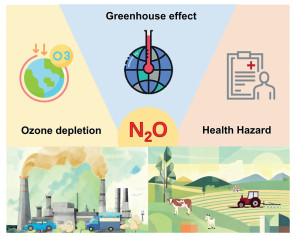
Figure 1.
N2O emission sources and hazards.

Recent progress in catalysts for direct catalytic decomposition of N2O
Yingxue Lu , Ying Xin , Hao Wu , Jin Wang , Zhaoliang Zhang


In the context of escalating global climate change, nitrous oxide (N2O) has drawn increasing concern as a potent greenhouse gas with profound impacts on the environment, ecology, and public health (Fig. 1) [1]. Despite its low atmospheric concentration, N2O possesses a global warming potential (GWP) that is approximately 310 times that of carbon dioxide (CO2) and 21 times that of methane (CH4) over a 100-year time scale [2]. Notably, emissions from agricultural activities, industrial sources, and vehicles are notably persistent, with an estimated atmospheric lifespan of about 116 ± 9 years, exacerbating stratospheric ozone depletion and posing growing risks to human and environmental health (Fig. 1) [3–6]. As the global population continues to expand and economies advance, the intensity of the emission sources increases, leading to a continuous rise in atmospheric N2O levels [7]. Specifically, the Euro Ⅶ emission regulations have formally introduced a control standard for the emission of this greenhouse gas [8]. In August 2025, China issued the "Action Plan for Nitrous Oxide Emission Control in the Industrial Sector" [9]. Consequently, it is imperative to implement effective measures to mitigate N2O emissions.
A range of technologies for reducing N2O emissions have been investigated, including thermal decomposition, selective catalytic reduction (SCR), direct catalytic decomposition, and other emerging approaches [10–15]. Among them, high-temperature thermal decomposition, which cleaves the N−O bond to form N2 and O2, typically requires high temperatures between 800 ℃ and 1000 ℃, resulting in significant energy consumption and stringent equipment requirements, thereby limiting its scalability [16]. Selective catalytic reduction (SCR) technology employs a reducing agent (e.g., NH3, urea, H2, CO, hydrocarbons) and a catalyst to selectively convert N2O to N2 [17,18]. Although its industrial adoption, SCR introduces secondary pollution and increases economic costs associated with reductant handling and consumption. Conversely, direct catalytic decomposition reduces the activation energy required for N−O bond cleavage by using catalysts, thereby enabling efficient conversion at moderate temperatures (250–500 ℃) without the necessity for external reductants [10]. This approach entails a substantial reduction in energy input, facilitates streamlined process design, circumvents high-temperature corrosion and safety concerns, and eliminates secondary pollutants. The aforementioned advantages render it particularly suitable for the treatment of high-concentration N2O, exhibiting high conversion efficiency. In addition to above conventional methods, several alternative strategies have been explored, including adsorption separation, biological treatment, photo/electrocatalysis, and plasma-assisted decomposition [19–23]. As the emerging technologies, their practical application is currently hindered by high energy requirements, low efficiency and unfavorable economics.
Direct catalytic decomposition has become the predominant and extensively utilized technology for N2O abatement owing to its efficiency, cost-effectiveness, and environmental friendliness [16], where catalysts play a decisive role in determining both activity and durability in this process. As such, the present review focuses on several categories of catalyst, including noble metal catalysts, transition metal oxides, zeolite-based materials, and other novel systems (Fig. 2), providing recent experimental and theoretical research progress [24,25]. The integration of fundamental understanding with practical performance is intended to delineate a roadmap for the rational design of next-generation N2O decomposition catalysts and proposing innovative solutions for the future research.
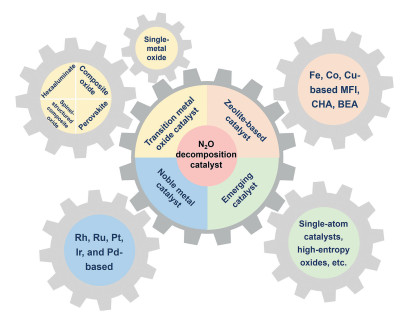
Noble metal catalysts are the first catalysts utilized for N2O decomposition and have been extensively studied due to their exceptional catalytic efficiency at low temperatures [26,27]. Despite their high activity, these catalysts face scarcity, non-renewability, high cost, susceptibility to deactivation, and limited practical applications. Among Rh, Ru, Pt, Ir, and Pd supported on Al2O3, CeO2, SiO2, and ZrO2, the order of catalytic activity is typically as follows: Rh > Ru ≈ Ir ≈ Ag > Pt > Pd, with Rh-, Ru-, and Ir-based catalysts being the most extensively studied ones [28]. This section provides a comprehensive overview of noble metal catalysts employed in N2O decomposition, detailing preparation methods, noble metal precursor types, support composition and structure, and the effect of promoter incorporation on catalytic performance.
The catalytic performance of noble metal catalysts in N2O decomposition is significantly affected by their preparation methods, which dictate metal dispersion, particle size, and surface chemistry. Common techniques employed in this field include impregnation (IMP), hydrothermal synthesis (HS), co-precipitation (COP), deposition-precipitation (DP) and ethylene glycol reduction (EGR). For instance, Ru/Al2O3 synthesized via EGR achieved high dispersion and small nanoparticles (≤3 nm), resulting in superior activity, while the DP method enhanced metal-support interactions and thus creating electron-deficient sites [29]. In contrast, IMP can lead to prevalent metallic sites or poisoning by residual species (e.g., Cl−), although pre-treatment or cyclic operation can alleviate these effects [30]. Electrodeposition produces Rh/Mg/Al catalysts on FeCrAlloy foams with uniform coatings, reduced activation energy, and 51% conversion retention after 24 h at 475 ℃ with 2.0 ± 1.1 nm Rh nanoparticles [31]. The selection of metal precursors also exerts a substantial influence on the density and accessibility of active sites, thereby affecting the catalytic performance. Chloride-based precursors (e.g., RhCl3) frequently result in site blocking, whereas nitrate-derived catalysts circumvent such complications [32]. Moreover, post-synthetic treatments, such as calcination atmosphere, further influence catalytic behavior [33].
Support materials govern reactivity via electronic effects, oxygen mobility, and interfacial synergy [26,34]. Mesoporous supports enhance metal dispersion and accessibility [35,36], and redox-active supports, such as ZrO2 and CeO2, facilitate the formation and replenishment of oxygen vacancy (Ov), which is crucial for the rate-determining O2 desorption step [37]. Furthermore, high-temperature steam treatment of the Rh/CeO2 catalyst activates the lattice oxygen at Rh–CeO2 interface, which facilitates oxygen desorption and enhances the redox cycling stability, thereby lowering the T50 by 127 ℃ relative to the untreated catalyst [38]. Supports with high oxygen lability, such as CeO2-modified Al2O3 (ACZ), improve sintering resistance and stability for Ir nanoparticles (Fig. 3a) [39,40]. Metal phosphates optimize the balance between O2 binding and desorption, improving both activity and durability [41]. Defect-rich supports increase metal exposure and stability, whereas inert supports often lead to sintering. Furthermore, the defect-rich La1.6Sr0.4NiO4 has been demonstrated to promote oxygen vacancy formation and stabilize active Ru states [42]. Ir supported on Fe-substituted La-hexaaluminate demonstrates exceptional activity (T50 = 284 ℃) due to the promotion of electron-rich Ir species by Ov, which enhances N2O activation synergistically [43]. Similarly, defect-rich CeO2-supported Rh nanoclusters have been observed to exhibit nearly complete metal exposure and optimal intermediate transformation, delivering a turnover frequency 4.6 times higher than that of Rh nanoparticles (Fig. 3b) [44]. The structure, composition, and redox properties of the support are essential in designing active and durable catalysts for N2O decomposition.
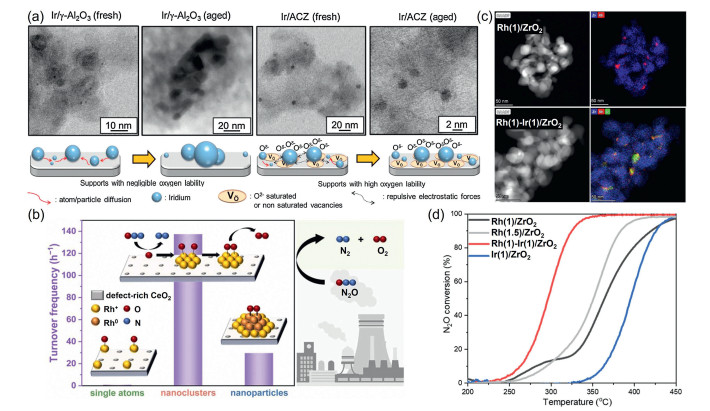
The utilization of promoters has been demonstrated to markedly augment the performance of noble metal catalysts in N2O decomposition, with enhancements observed in both redox properties and metal-support interactions. For instance, the addition of Ag or Pd to Rh-based catalysts increases reducibility and accelerates O2 desorption, which is the rate-determining step [45,46]. Furthermore, the modification of Ir has been demonstrated to facilitate oxygen removal (Figs. 3c and d) [47]. The dispersion of alkali metals, such as K, has been observed to enhance surface alkalinity and electron donation, as evidenced in Pt-M/SiO2 (M = K, Na, Cs) systems, where K enhances both oxygen mobility and catalytic activity [48]. However, the presence of inhibitors such as O2, and H2O can lead to reversible deactivation.
Transition metal oxides are the focus of significant research due to their advantageous redox capacity, thermal stability, and cost-effectiveness in the catalytic decomposition of N2O [49], which can generally be classified into the following categories: single-metal oxides, composite oxides, hexaaluminates, spinel-structured composite oxides, and perovskite oxides. Each of these exhibits unique benefits and catalytic mechanisms.
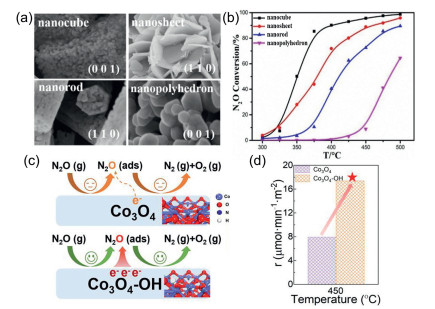
Single metal oxides are composed of straightforward compositions and easy to prepare. Amongst, Co3O4 exhibited remarkable catalytic efficiency, thus promoting deep investigation [50]. In the study by Ma et al., the synthesis of ordered mesoporous single-metal oxides was conducted, which exhibited superior catalytic activity in N2O decomposition when compared to commercial counterparts [51]. Stelmachowski et al. produced Co3O4 with diverse morphologies, finding that the catalyst calcined at 600 ℃ exhibited optimal activity due to its crystalline structure [52]. The findings of the study demonstrated that larger, more crystalline particles exhibited superior catalytic performance in comparison to their smaller counterparts. The unique properties of nanocubic Co3O4 were identified as the primary factor contributing to its enhanced catalytic performance (Figs. 4a and b) [53]. Yu et al. developed a Co3O4 catalyst with a "Yardang Landform" microstructure, which demonstrated high activity and stability under industrial conditions for N2O decomposition [54]. In addition to structural optimization, the refinement of synthesis conditions has been shown to markedly enhance the catalytic performance in N2O decomposition. The selection of precursor is of crucial importance, with β-Co(OH)2-derived catalysts demonstrating superior performance due to improved Co3+ reducibility and defect-rich structures [55]. Ov concentration is also pivotal, with the Mars-van Krevelen mechanism driving the reaction. Li et al. determined the optimal hydrothermal synthesis conditions for Co3O4 catalysts, achieving 91% N2O conversion at 400 ℃ in oxygen/steam atmospheres [56]. This was attributed to specific morphologies, weakened Co3+−O− bonds, and an enhanced Co2+/Co3+ ratio. Polyvinyl alcohol (PVA) modification has been demonstrated to enhance the performance of the Co3O4 catalyst, with improvements being observed in both the surface Co2+ concentration and the Ov density [57]. This enhancement is further confirmed by DFT calculations, which indicated that Co2+ is the preferred site for N2O adsorption. The employment of formic acid-treated Co3O4 catalysts results in enhanced N2O decomposition activity, attributable to increased surface area, elevated Co3+ concentration, augmented reducibility, and enhanced oxygen desorption capacity [58]. Despite the divergent views amongst researchers regarding the role of Co ions, it is evident that Co2+ sites facilitate N2O adsorption and activation, while Co3+ sites promote oxygen desorption. The overall activity of the catalyst is contingent upon a balanced Co2+/Co3+ ratio and the specific reaction conditions. Very recently, hydroxyl groups (−OH) were introduced onto Co3O4 via hydrothermal treatment, significantly enhancing N2O decomposition activity by facilitating electron transfer at the gas-solid interface (Figs. 4c and d) [59]. Electronic structure analysis and DFT simulations confirmed that −OH groups donate electrons to N2O, weakening the N–O bond and lowering the activation barrier.
Comparing with single-metal oxides that exhibit basic and limited catalytic functionality, mixed-metal oxides with precise stoichiometries and well-defined crystal structures often outperform them in N2O decomposition, which are typically engineered through the introduction of heteroatoms into oxides to modulate the electronic structure and/or induce defects for Ov formation. Based on the underlying regulation mechanisms, these strategies may be classified into three distinct types.
(1) Alkali and alkaline earth metals
Alkali metals (e.g., Li, Na, K, Rb, and Cs) significantly enhance the performance of N2O decomposition over transition metal oxide catalysts, primarily via electronic donation and work function reduction [60,61]. For instance, the introduction of Na into Co3O4 significantly enhances the low-temperature activity of N2O decomposition by facilitating Co3+/Co2+ cycling and electron donation [62]. K lowers the T50 (temperature for 50% conversion) by 150 ℃ for both Co3O4 and Mn3O4 by forming a K+–Osurf− dipole that reduces the work function and promotes oxygen desorption, with optimal activity at 2–8 atoms/nm2 [63]. Similarly, the light-off temperature for K-doped Zn0.4Co2.6O4 is reduced to ~150 ℃, attributing to the weakened Co−O bonds derived from the electronic effect of K, which also acts as the sacrificial site for SO2 adsorption, thus inhibiting the deactivation of the catalyst [64,65]. A monolayer of Cs on Co3O4 forms Cs−O−Co sites via 6s–2p orbital hybridization, generating abundant Co2+ and achieving over 95% N2O conversion at 300 ℃, though bulk doping leads to inactive Cs2O2/CsOH phases (Figs. 5a and b) [66,67]. Cs0.1-Co3O4 exhibits 39.5 times greater activity in comparison with pure Co3O4 and resists O2 inhibition [68]. However, Cs does not enhance the activity of oxides such as CuO or NiO, which indicates the importance of support-alkali metal interactions (Figs. 5c and d) [66]. In situ DRIFTS and DFT studies highlight the roles of O2 desorption kinetics and frontier orbital alignment.
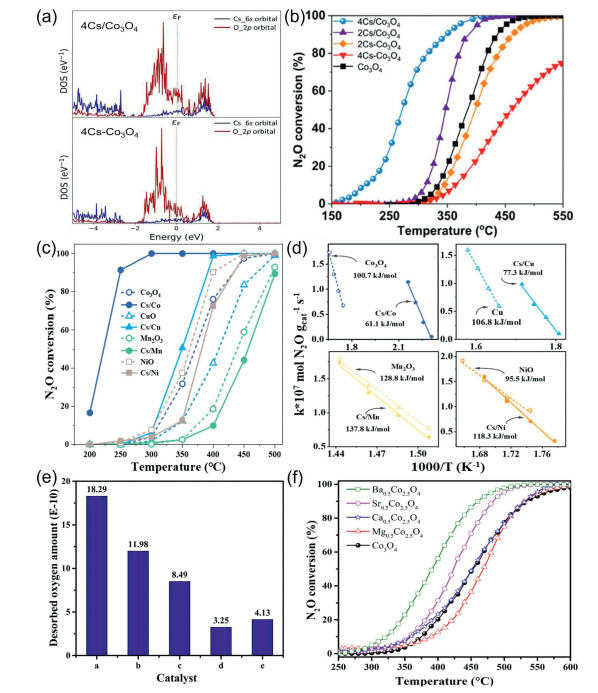
Comparatively, alkaline-earth metals (Mg, Ca, Sr, Ba) enhance catalysts via lattice distortion and improved redox properties [69]. In A0.5Co2.5O4 (A = Mg, Ca, Sr, Ba), Ca, Sr, or Ba facilitates the reduction of Co3+ to Co2+, increasing Ov concentration and weakening Co−O bonds, with Ba showing the best performance (Figs. 5e and f) [70]. Ca-doped Co3O4 with a Ca/Co molar ratio of 1:2 shows remarkable activity, reaching 100% N2O conversion at 400 ℃ [71]. This is due to preferential exposure of the (111) crystal plane and abundant surface oxygen. Core-shell structured Co0.24Ba catalysts (Co3O4 on BaCO3) use only 8.91 wt% Co3O4 to achieve complete N2O decomposition at 400 ℃ [72]. Alkaline-earth metals (Mg < Ca < Sr < Ba) are generally weaker promoters than alkali metals (Li < Na < K < Rb < Cs), with the effect of primarily modulating lattice oxygen mobility rather than electronic promotion [73]. DFT calculations confirm that larger dopants (e.g., Ba, Sr) induce greater lattice distortion, thereby improving N2O adsorption and O2 desorption.
In addition to alkali and alkaline earth metals, other main-group metal elements (e.g., Bi, Sn) dopants have been demonstrated to enhance the catalytic performance of N2O decomposition through electronic and structural modifications. The Bi-enhanced Co3O4 maintains a unique "Yardang Landform" microstructure, which exposes high-activity crystal planes (e.g., (422), (533), and (620)) that weaken the Co−O bonds [74]. The 3.0F-Bi0.015Co catalyst achieves > 88% N2O conversion at 300 ℃ and is resistant to O2, H2O, and NO [75]. The incorporation of Bi into NiO has been shown to increase both Ov and Ni3+ sites, whilst simultaneously forming inactive Bi2O3 at high loading. SnO2-Co3O4 composites utilize interfacial interactions in order to boost Co2+ electron donation and improve Co3O4 dispersion [76].
In summary, the introduction of alkali and alkaline-earth metals primarily serves as an electronic promoter, which facilitates the key O2 desorption step by lowering the work function and optimizing the surface electron density. Beyond simple electronic donation, the incorporation of redox-active elements, such as rare-earth and transition metal elements, offers a more dynamic pathway to enhance the catalytic cycle.
(2) Rare-earth and transition metals
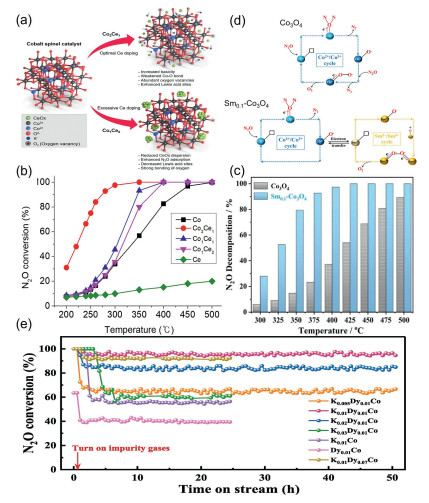
The doping of rare-earth elements (Ce, Sm, Gd, Eu) into metal oxides has been demonstrated to enhance the catalytic performance of N2O decomposition, which is achieved by modulating the concentration of Ov, the redox kinetics, and the electronic interactions. In the Co3O4-CeO2 systems, the incorporation of Ce promotes the Ov formation, thereby enabling Co2+ + Ce4+ ↔ Co3+ + Ce3+ redox cycles [77]. The Co2Ce1 oxide exhibits a N2O conversion of over 95% at 300 ℃ (Figs. 6a and b). CeO2 nanorods with {100/{110} facets optimize Co exposure and outperform nanocubes/polyhedral [78,79]. Furthermore, CuO–CeO2 nanorods exhibit lower activation energy of 87 kJ/mol, due to efficient Cu2+/Cu+ and Ce4+/Ce3+ cycling [80,81]. Sm-doped Co3O4 induces distortion and enables Co3+ + Sm2+ ↔ Co2+ + Sm3+ (Figs. 6c and d), while Gd doping increase in the Co3+/Co2+ ratio, and weakens Co−O bonds [82,83]. In the case of Pr-doped NiO, the superior catalytic activity (T100 = 400–440 ℃) and notable resistance to impurity gases (O2 and NO) in simulated nitric acid exhaust are achieved by the promoted Ni2+/Ni3+ redox cycle and regeneration of active Ni2+ sites [84]. Eu0.04Ni shifts the reaction mechanism from Langmuir–Hinshelwood (L−H) to Eley–Rideal (E−R), lowering the O2 desorption barrier and achieving 100% conversion at 400 ℃ with high impurity tolerance [85]. Furthermore, rare-earth elements also improve bimetallic systems: Nd-doped Cu0.8Al0.2 and Co0.8Al0.2 oxides form active CuNd2O4/NdCoO3 phases, lowering the full N2O conversion temperature by 100 ℃ [86,87]. In the Ce/Ba−NiO system, Ce inhibits NiO crystallization while Ba weakens Ni−O bonds, enabling complete N2O decomposition at 300 ℃ even with 5% O2 [88]. Dual promoters (e.g., Dy/K-Co3O4, Ba/Ce-CuO) further enhance impurity tolerance (Fig. 6e) [89,90].
Transition metal doping demonstrates notable efficacy in N2O decomposition through Ov generation, redox promotion, and metal-support interactions. Bimetallic CuxCoy and CuxMn oxides exhibit enhanced performance in comparison to single-metal oxides: Co3O4 offers abundant Ov sites for N2O adsorption (forming □−Co−ON2), while CuO or Mn2O3 enhances reducibility for N−O cleavage and Ov regeneration [91,92]. Very recently, Long et al. partially substituted Mn into octahedral Co3+ sites of Co3O4 to generate heterointerfaces between δ-MnO2 and Co3-xMnxO4 [93]. The enhanced hybridization between Co 3d and O 2p orbitals and high Co−O−Mn covalency lead to the formation of highly active lattice oxygen species, thereby enhancing N2O decomposition activities and stability. Supports such as m-ZrO2 strengthen metal-support interactions, increasing Co2+ and Ov density in Co3O4/m-ZrO2, while Co3O4/CaCO3 attains complete N2O conversion at 300 ℃ with highly dispersed Co3O4 [94,95]. Moreover, the morphology of the support plays a pivotal role: CeO2 nanorods in CuO/CeO2 favor {100}/{110} exposure, whereas Ni/CeO2 nanocubes exhibit superior activity due to the presence of more NiO clusters and Ni−O−Ce sites [80,96]. The egg-shell-type Cu/γ-Al2O3 catalyst with a reducible Cu+ shell demonstrates superior stability under temperature, air, and steam conditions [97]. Substitutional doping (e.g., Cd2+ in NiO, and Co3+ in MnO2) also optimizes Ov formation and redox behavior, and synergistic systems, such as CoxTi oxides, maintain 100% conversion for 30 h, even in the presence of O2, H2O, and NO [98–100]. Additionally, Zn doping in Co3O4/CeO2 catalyst (Co2.4Zn0.6O4/CeO2) significantly improved the overall N2O decomposition performance, evidenced by a 110 ℃ decrease in T90 and robust tolerance to O2, NOx, and H2O [101].
The strategies previously discussed highlight the critical role of rare-earth and transition metal dopants, which modify the host oxide by tuning the redox properties and Ov dynamics. In addition to the metallic elements, the introduction of non-metallic elements has the potential to enhance the catalytic performance.
(3) Non-metal dopants
Non-metallic (e.g., N, F) dopants improve the catalytic performance of N2O decomposition, primarily by introducing defects and facilitating electronic redistribution. N-doped Co3O4 (N-Co3O4−0.05) achieves 100% N2O conversion at 380 ℃, which is 160 ℃ lower than that of pristine Co3O4 [102]. This phenomenon can be attributed to N-induced Ov, higher Co2+ density, and increased basicity. F-doped Co3O4, where F substitutes for lattice oxygen, increases surface area and basicity, thereby lowering the temperature for complete N2O conversion to 380 ℃, while maintaining stability in O2 and H2O [103]. Non-metal doping offers a viable route to induce defects and modify surface electronic properties, thereby boosting N2O decomposition performance.
The above-discussed doping or strategic addition of metals and nonmetals has been demonstrated to modulate the surface properties of these catalysts by improving electron transfer, generating Oᵥ, weakening metal−O bonds, and accelerating redox/O2 desorption kinetics. It has been demonstrated that these alterations increase intrinsic activity and resistance to O2, H2O, and NO, and thus providing a framework for developing high-performance N2O decomposition catalysts. The integration of defect engineering, electronic tuning, and morphological control highlights the potential of mixed-metal oxides in industrial catalysis.
Beyond supported or doped oxide systems, well-defined crystalline structures such as hexaaluminates (ABAl11O19, where A = La, Ba and B = Mn, Fe, Ni) offer distinct advantages for high-temperature N2O decomposition featuring enhanced thermal/chemical stability and cost-effectiveness [104]. Fe- and Mn-substituted hexaaluminates exhibit high activity that are largely independent of the A-site cations (La or Ba), while the activity of Ni-substituted hexaaluminates adheres to a similar perform as unsubstituted counterparts [105]. The catalytic performance of the hexaaluminates is principally determined by the occupancy of specific sites within their crystal structure. In LaFexAl12-xO19, Fe3+ ions demonstrate a clear preference for occupying tetrahedral Al(2) and trigonal bipyramidal Al(5) sites within the magnetoplumbite structure, with octahedral Al(3) sites in the mirror plane exhibiting particular activity with regard to N2O decomposition [106]. It is noteworthy that Fe3+ ions derived from perovskite-type LaFeO3 intermediates show a marked preference for occupying these octahedral Al(3) sites, while the presence of Fe2+ species has a detrimental effect on activity. In the context of BaFexAl12-xO19, the stabilization of Fe3+ follows a dual-phase mechanism. In the context of low Fe contents (x = 1–4), Fe3+ occupies tetrahedral Al(5) sites within the βI-Al2O3 phase. In contrast, at higher loadings (x = 5–12), excess Fe3+ is accommodated in trigonal bipyramidal Al(5) and octahedral Al(3) sites within the magnetoplumbite phase [107]. The latter is particularly crucial for N2O activation. La-hexaaluminates surpass Ba-based ones by substituting a great number of Al sites in the exposed mirror plane, thus enhancing access to active Fe3+ centers.
Spinel-structured composite oxides (AB2O4) have been identified as highly effective N2O decomposition catalysts, prized for their adjustable redox properties, thermal stability, and Ov generation [108]. Co3O4-based spinels have been shown to be particularly active due to the facile reduction of octahedral Co3+ to Co2+, which has been demonstrated to promote Ov formation and accelerate O2 desorption. The Co2+/Co3+ ratio exerts a substantial influence on catalytic performance, which can be enhanced through elemental substitution and doping. In the context of NixCo1-xCo2O4 spinels, partial substitution of Co2+ with Ni2+ has been demonstrated to enhance activity by reducing crystallite size, increasing surface area, and facilitating Co3+ reduction, with optimal performance observed at intermediate Ni loadings [109]. Similarly, ZnxCo1-xCo2O4 has been demonstrated to exhibit superior activity in N2O decomposition at low temperatures, with ZnCo2O4 achieving 50% N2O conversion at 177 ℃ (Fig. 7a) [110]. Furthermore, Mn- and Zn-substituted ferrites (MnxFe1-xFe2O4, ZnxFe1-xFe2O4) have also been observed to demonstrate high activity, with Mn0.8Fe0.2Fe2O4 and Zn0.6Fe0.4Fe2O4 reaching complete N2O conversion at 250 ℃ and 280 ℃, respectively, although they are susceptible to O2 inhibition [111].
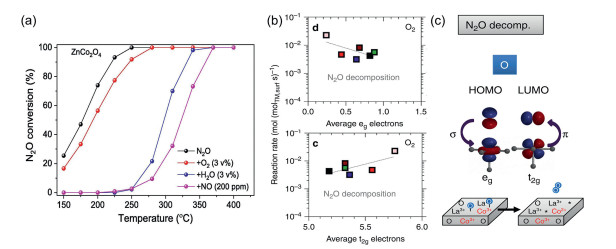
Perovskite-type oxides (ABO3), with A-site cations as rare-earth or alkaline-earth metals and B-sites as transition metals, exhibit exceptional catalytic performance in N2O decomposition [112]. For instance, LaCoO3 exhibits superior activity due to its optimal B-site reducibility linking to O 2p-B 3d covalency and eg orbital occupancy, which are crucial for N2O activation and O2 desorption (Figs. 7b and c) [113]. The synthesis methods significantly impact catalytic properties. The mechanochemical preparation of LaMnO3 under Ar creates oxygen-deficient surfaces, which exhibit enhanced activity in comparison to conventional sol-gel methods [114]. This phenomenon can be attributed to an increased N2O interaction at Ov. PrBaCoO3, synthesized via supercritical antisolvent techniques, has been observed to exhibit high mobile oxygen content and a considerable surface area, resulting in reduced operating temperatures [115]. Alternative methods, such as the thermal decomposition of oxalate/carbonate precursors for LaNiO3, have been demonstrated to preserve high activity while avoiding phase impurities [116]. The B-site identity has been identified as a critical factor in determining performance: ranked as LaMnO3 > LaCoO3 > LaNiO3 > LaFeO3. DFT calculations have attributed LaMnO3's superior activity to its distinct electronic structure and surface characteristics [117].
Tuning the A-site in ABO3 perovskites has been shown to significantly boost N2O decomposition activity by modifying the redox properties of B-sites through charge compensation. In La1-xSrxFeO3, optimal Sr substitution (x = 0.25) maximizes activity by facilitating reverse oxygen uptake from the lattice [118]. N2O(ads)− dissociation has been identified as the rate-determining step in this system. In the case of the Ce/Sr-substituted LaCo0.8Fe0.2O3, La-deficiency and Sr-substitution enhance thermal stability and resistance to deactivation [119]. Sr incorporation stabilizes Co3+ and generates Ov, while Ce substitution promotes Co exsolution, deactivating the catalyst. In the case of Pr1-xBaxMnO3, 20 mol% Ba substitution (Pr0.8Ba0.2MnO3) maximizes activity by elevating Mn4+ content without forming impurity phases, with supported configurations proving industrially viable [120]. In Ruddlesden-Popper perovskites (La2-x(Sr, Ce)xNiO4), dual Sr-Ce co-doping has been demonstrated to optimize performance: La0.7Ce0.3SrNiO4 demonstrates remarkable resistance to O2/H2O, maintaining 100% conversion at 600 ℃ [121]. This stability is attributed to the stabilization of Ni oxidation states and the promotion of enhanced oxygen vacancy formation.
B-site doping optimizes catalytic performance for N2O decomposition through the precise configuration of the active sites and the dynamics of the Ov [122]. In LaFe1-xNixO3 systems, Ni substitution enhances the catalytic activity for N2O decomposition [123]. In BaFe1-xSnxO3-δ, the introduction of Sn results in the formation of 5-coordinated Fe3+−O5 active centers, thus reducing the Fe valence state through the establishment of Fe−O−Sn bonds and the expansion of the unit cell [124]. These modifications leads to a reduction in the activation energy from 241 kJ/mol (x = 0) to 178 kJ/mol (x = 0.8), with BaFe0.2Sn0.8O3-δ exhibiting a 4-fold increase in intrinsic rate compared to undoped BaFeO3. In CaMn0.7Fe0.3O3-δ, the presence of Fe-induced Ov facilitates a regenerative cycle, with activity demonstrating a positive correlation with Ov concentration [125].
A/B-site co-doping and structural modifications also influence the catalytic performance of ABO3 in N2O decomposition [126]. La0.75Sr0.25Co0.81Fe0.19Ox has exhibited a T50 of 448 ℃ attributed to weakened Co−O bonds and mobile lattice oxygen species [127]. Support interactions and composite formations critically modulate performance. LaCoO3/ZrO2-La exhibits enhanced activity due to elevated Co2+/Co3+ and Oads./OL ratios, with coordinatively unsaturated Co2+ acting as the active site [128]. The heterostructured LaSrFeO4/La0.4Sr0.6FeO3 displays superior performance by combining enhanced surface oxygen exchange rates with preserved bulk oxygen diffusion, attributed to interfacial synergy between the LaSrFeO4 and La0.4Sr0.6FeO3 phases [129].
Zeolites feature well-defined pore structures, high surface areas, and ion-exchange capabilities, rendering them efficient and economical catalysts for N2O decomposition [25]. Their catalytic performance is significantly influenced by framework topology, which governs the nuclearity, coordination environment, and spatial distribution of active metal sites (e.g., Fe, Cu, Co) (Figs. 8a and b) [130]. A systematic categorization of zeolite catalysts is presented below, with the classification being based upon the porosity.
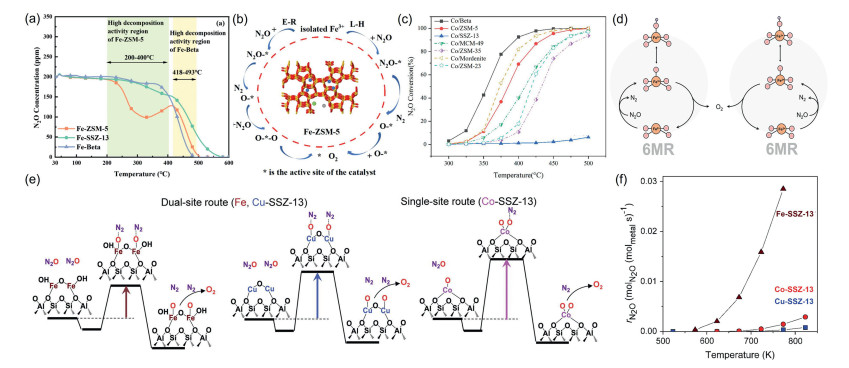
Large-pore zeolites facilitate enhanced molecular diffusion and active site accessibility. In MOR zeolites, the activity order is Co-MOR > Fe-MOR ≫ Ni-MOR, with Co2+ and Fe3+ facilitating N–O cleavage through redox cycling [131]. The introduction of In3+ increases active channel-bound β-type Co2+ sites, while La3+ and Mo6+ stabilize framework-coordinated γ-type Co2+, thereby inhibiting the formation of inactive Co3O4 clusters [132]. Fe-BEA exhibits a predominance of highly dispersed FeOx species within its straight channels [133]. The Fe(Ⅱ) sites in BEA zeolite undergo framework-induced distortions that favor N2O binding and isomerization, promoting efficient oxygen transfer [134]. Furthermore, Co-BEA benefits from enhanced Co exchange and N2O diffusion, achieving 99.6% N2O conversion at 450 ℃ with minimal NO2 byproduct formation (Fig. 8c) [135].
Medium-pore zeolites impose moderate spatial constraints, which significantly influence the nature and stability of active sites. In Fe-MFI zeolite (Fe-ZSM-5), low-nuclearity FexOy clusters demonstrate greater activity compared to mononuclear sites [136]. High performance is frequently linked to binuclear [Fe–O–Fe] sites, which reduce the activation barrier for N–O dissociation [137]. Post-synthetic treatments, such as alkaline leaching, can remove Si, introduce mesoporosity, and increase Fe2+ concentration, thereby enhancing N2O activation and O2 desorption [138]. Acid treatment improves stability and promotes the formation of active FexOy species by extracting Al and increasing the Si/Al ratio [139]. Furthermore, the utilization of ammonia steam treatments can lead to a significant increase in the number of accessible Fe sites, thereby enhancing the activity of the catalyst [140]. Fe-FER exhibits remarkable activity due to its unique β-site configuration, which enables cooperative N2O activation [141]. Furthermore, it demonstrates exceptional hydrothermal stability, maintaining over 90% N2O conversion after 24 days under simulated nitric acid plant conditions, whereas Fe-MFI and Fe-BEA suffer from accelerated deactivation due to Fe agglomeration and structural collapse [142]. In Co-MFI, there is a coexistence of multiple Co species, including surface Co3O4, framework-associated [Co−O−Co]2+/CoOx clusters, and isolated Co2+ at exchange sites [143]. The latter are identified as the primary active sites for N2O decomposition. Cu-MFI (Cu-ZSM-5) benefits from enhanced Cu+ accessibility, with ion-exchanged catalysts displaying superior low-temperatures performance [144].
The confined environment of small-pore zeolites favors the stabilization of specific, highly active metal sites. In Fe-CHA(SSZ-13), both monomeric and dinuclear Fe sites contribute to activity. Monomeric Fe2+ site confined within six-membered rings (6MR) of the chabazite cages acts as the active site (Fig. 8d) [145,146]. Dinuclear [HO–Fe–O–Fe–OH]2+ species are particularly stable and to facilitate O2 desorption, which is the rate-limiting step [147]. A comparative study of Cu, Fe, and Co-exchanged SSZ-13 shows that N2O decomposition on Cu- and Fe-SSZ-13 follows a dual-site mechanism on dimeric centers (Fig. 8e) [148]. The higher activity of Fe-SSZ-13 is attributed to a lower activation barrier for N−O cleavage (Fig. 8f). In contrast, Co-SSZ-13 functions via a single-site mechanism on isolated Co2+, which results in a higher pre-exponential factor but is counterbalanced by a considerably greater activation energy. Cu-SSZ-13 also demonstrates notable activity, particularly when featuring dimeric [Cu–Cu] sites.
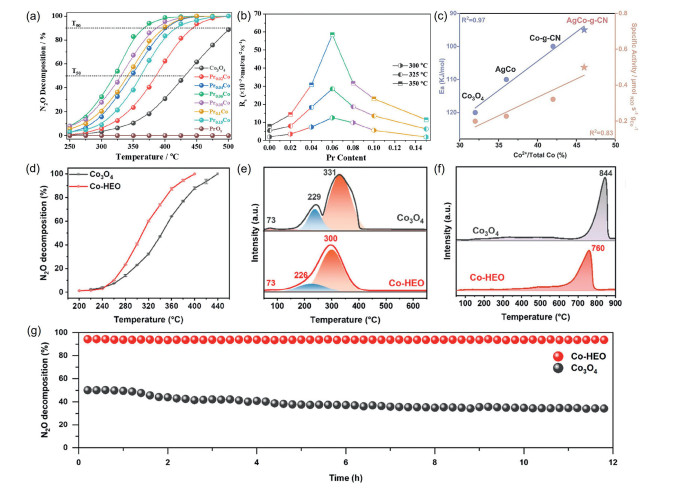
Recently, the emerging atomic-scale precision engineering and innovative materials and architectures have witnessed the breakthrough in N2O decomposition. Single-atom catalysts (SACs), such as Pt1/MgAl1.2Fe0.8O4 and Rh/CeO2, demonstrate exceptional activity due to optimized metal–support interactions [149,150]. The incorporation of single Pr atoms into Co3O4 boosts its activity by 5–7.5 times compared to the pristine oxide (Figs. 9a and b) [151]. Based on the DFT calculations, two-dimensional materials like Fe@C2N monolayers enable N2O reduction at ambient temperature, while Co-supported BN systems exhibit distinct configuration-dependent reaction pathways [152,153]. Composite catalysts, including Co3O4/g-CN and Ag-modified Co3O4/g-CN, show improved low-temperature performance through strengthened Co–N coordination and modulated metal valence states (Fig. 9c) [154,155]. Additionally, high-entropy oxides (HEOs), such as spinel-structured Co-HEOs, have been shown to achieve high N2O conversion at low temperatures by utilizing multi-element synergy [156]. This enhances reducibility and oxygen vacancy concentration without compromising thermal stability (Figs. 9d-g).
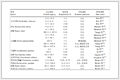
In order to facilitate a more intuitive comparison of N2O decomposition performance across different catalyst types, Table 1 lists key parameters of representative catalysts reported in recent years [157–164]. Noble metal catalysts exhibit superior low-temperature activity in comparison with other categories, while they suffer from high cost and limited impurity tolerance. Single-metal oxides offer optimal cost-effectiveness, rendering them ideal for medium-temperature and cost-sensitive applications. Co3O4 is the most active, and its performance is highly dependent on the synthesis method. However, their performance is often compromised by the presence of O2 and NO. In the case of composite oxides, the processes of doping and composite formation enhance activity and stability, especially against inhibitors. Hexaaluminates and perovskites exhibit elevated thermal stability, making them well-suitable for high-temperature applications. Zeolite-based catalysts provide well-dispersed active sites. It is evident that the catalytic activity is significantly impacted by the zeolite framework and preparation method. These catalysts frequently exhibit moderately active characteristics, however they can be susceptible to inhibition by O2 and H2O. The development of emerging catalysts has enabled the synthesis of catalysts that exhibit both high activity and durability. Especially, Co-HEO demonstrates promising activity and remarkable resistance to a complex gas mixture comprising O2, NO, and H2O.
 DownLoad:
CSV
DownLoad:
CSV
| Catalyst category | Catalysts | Synthesis method | Reaction conditions | Catalytic performance | Publish year | Ref. |
| Noble metal catalysts | Pd/Al2O3 | Wet impregnation method | 1% N2O, He balance, 76,690 h−1 | T50: 300 ℃; T100: 400 ℃ | 2020 | [30] |
| Rh/Mg/Al/FeCr alloy foams | Electrodeposition method | 1000 ppm N2O, N2 balance, 6800 h−1 | T50: 320 ℃; T100: 400 ℃ | 2020 | [31] | |
| RhOx/ZrO2 | Impregnation method | 1000 ppm N2O, 10% O2, 2% H2O, He balance, 100 mL/min | T50: 240 ℃; T100: 400 ℃ | 2022 | [37] | |
| Pt-K/SiO2 | Wet impregnation method | 2000 ppm N2O, He balance, 15,000 h−1 | T50: 560 ℃ | 2022 | [48] | |
| Ir/LFA, | Impregnation method | 30 vol% N2O, Ar balance, 100 mL/min, 60,000 cm−3 g−1 h−1 | T50: 284 ℃ | 2023 | [43] | |
| Ir/LMA | T50: 341 ℃ | |||||
| RhOx/Ag/Al2O3 | Impregnation method | 0.1% N2O, He balance, 100 mL/min | T50: 254 ℃; T100: 400 ℃ | 2023 | [45] | |
| Rh/CeO2 | Sol-gel method | 1000 ppm N2O, Ar balance, 30,000 mL g−1 h−1 | T50: 260 ℃; T90: 295 ℃ | 2024 | [34] | |
| Rh(1)–Pd(1)/ZrO2 | Impregnation method | 1000 ppm N2O, He balance, 100 mL/min | T50: 307 ℃; T90: 353 ℃ | 2024 | [46] | |
| 1000 ppm N2O, 10% O2, 5% CO2, 1% H2O, He balance, 100 mL/min | T50: 400 ℃; T90: 450 ℃ | |||||
| RhNC/CeO2-d | Defects-assisted adsorption method | 1000 ppm N2O, N2 balance, 120,000 mL g−1 h−1 | T50: 238 ℃ | 2025 | [44] | |
| 1000 ppm N2O, 5% O2, N2 balance, 120,000 mL g−1 h−1 | T50: 253 ℃ | |||||
| Rh(1)/CeO2-S | Incipient wetness impregnation method and steam-treatment | 0.3% N2O, He balance, 100 mL/min | T50: 275 ℃ | 2025 | [38] | |
| 0.3% N2O, 10% O2, 5% CO2, 1% H2O, He balance, 100 mL/min | T50: 425 ℃ | |||||
| Rh(1)−Ir(1)/ZrO2 | Impregnation method | 0.1% N2O, He balance, 100 mL/min | T50: 296 ℃ | 2025 | [47] | |
| 0.1% N2O, 10% O2, 5% CO2, 1% H2O, He balance, 100 mL/min | T50: 385 ℃ | |||||
| Single-metal oxides | Co3O4 (nanocube) | Hydrothermal method | 30% N2O, He balance, 34,000 h−1 | T50: 350 ℃; T100: 500 ℃ | 2021 | [53] |
| Co3O4 (Yardang Landform structure) | Sol-gel method | 2000 ppm N2O, Ar balance, 20,000 h−1 | T50: 300 ℃; T100: 400 ℃ | 2023 | [54] | |
| Co3O4 | PVA-assisted precipitation method | 500 ppm N2O, Ar balance, 400,000 h−1 | T50: 425 ℃ | 2024 | [57] | |
| Co3O4 | Hydrothermal method | 1000 ppm N2O, N2 balance, 60,000 mL g−1 h−1 | T50: 350 ℃; T100: 450 ℃ | 2024 | [59] | |
| Co3O4 | Precipitation method and etching | 2000 ppm N2O, N2 balance, 60,000 mL g−1 h−1 | T50: 304 ℃; T90: 353 ℃ | 2025 | [50] | |
| NiO | Coprecipitation method | 1000 ppm N2O, N2 balance, 100 mL/min | T50: 366 ℃; T90: 419 ℃ | 2023 | [98] | |
| CuO | Citric acid method | 2000 ppm N2O, Ar balance, 20,000 h−1 | T50: 455 ℃ | 2023 | [90] | |
| Composite oxides | CoCe0.1 | Hydrothermal method | 2000 ppm N2O, 2% O2, He balance, 38,000 h−1 | T50: 365 ℃; T90: 420 ℃ | 2020 | [78] |
| Co3O4/m-ZrO2 | Incipient wetness impregnation method | 1000 ppm N2O, Ar balance, 50 mL/min | T50: 375 ℃ | 2020 | [94] | |
| Co3O4/CaCO3 (CaCo2.5) | Coprecipitation method | 2000 ppm N2O, 2% O2, Ar balance, 20,000 h−1 | T50: 240 ℃; T100: 300 ℃ | 2020 | [95] | |
| Composite oxides | Mg0.5Co(H-120) | Coprecipitation method | 2000 ppm N2O, Ar balance, 50 mL/min | T50: 240 ℃; T100: 300 ℃ | 2021 | [157] |
| Ba0.5Co2.5O4 | Hydrothermal method | 0.65% N2O, 0.88% O2, N2 balance, 55,000 h−1 | T90: 460 ℃ | 2021 | [70] | |
| Bi0.1NiO1.15 | Coprecipitation method | 220 ppm N2O, N2 balance, 45,000 h−1 | T50: 328 ℃; T90: 385 ℃ | 2021 | [75] | |
| Sm0.1-Co3O4 | Sol-gel method | 1000 ppm N2O, N2 balance, 60,000 mL g−1 h−1 | T50: 322 ℃; T90: 375 ℃ | 2021 | [82] | |
| Gd0.06Co | Coprecipitation method | 2000 ppm N2O, Ar balance, 20,000 h−1 | T50: 260 ℃; T90: 325 ℃ | 2021 | [83] | |
| CeCoAl | Coprecipitation method | 1000 ppm N2O, N2 balance, 80 mL/min | T50: 300 ℃ | 2021 | [87] | |
| N-Co3O4−0.05 | g-C3N4-modified citrate sol-gel method | 1000 ppm N2O, Ar balance, 10,000 h−1 | T50: 320 ℃; T90: 360 ℃ | 2021 | [102] | |
| Cs/Co | Coprecipitation method | 1000 ppm N2O, N2 balance, 30,000 h−1 | T50: 225 ℃; T90: 250 ℃ | 2022 | [66] | |
| K0.025Gd0.06Co | Coprecipitation method | 2000 ppm N2O, Ar balance, 50 mL/min | T50: 225 ℃; T90: 275 ℃ | 2022 | [158] | |
| 2000 ppm N2O, 5 vol% O2, 100 ppm NO, 2 vol% H2O Ar balance, 50 mL/min | T50: 310 ℃; T90: 345 ℃ | |||||
| Na-Co3O4 | Hydrothermal method | 0.65 vol% N2O, 0.88 vol% O2, N2 balance, 55,000 h−1 | T50: 420 ℃ | 2023 | [62] | |
| 4Cs/Co3O4 | Wet impregnation method | 1000 ppm N2O, N2 balance, 30,000 mL g−1 h−1 | T50: 272 ℃; T90: 349 ℃ | 2023 | [67] | |
| Ba0.2Cu | Citric acid method | 2000 ppm N2O, Ar balance, 20,000 h−1 | T50: 365 ℃; T100: 450 ℃ | 2023 | [90] | |
| Cd0.04Ni | Coprecipitation method | 1000 ppm N2O, N2 balance, 30,000 mL g−1 h−1 | T50: 319 ℃; T90: 369 ℃ | 2023 | [98] | |
| Cs0.1-Co3O4 | Citric acid complexation method | 200 ppm N2O, 5% O2, N2 balance, 90,000 h−1 | T50: 230 ℃; T100: 300 ℃ | 2024 | [68] | |
| PrxNi | Coprecipitation method | 800 ppm N2O, N2 balance, 60,000 mL g−1 h−1 | T100: 400−440 ℃ | 2024 | [84] | |
| Bi0.015Co | Improved sol-gel method | 2000 ppm N2O, Ar balance, 20,000 h−1 | T100: 350 ℃ | 2024 | [74] | |
| N-Co3O4 | g-C3N4-modifed thermal decomposition method | 1000 ppm N2O, Ar balance, 10,000 h−1 | T50: 270 ℃; T90: 350 ℃ | 2024 | [159] | |
| 1000 ppm N2O, 3 vol% O2, 3.3 vol% H2O, Ar balance, 10,000 h−1 | T50: 365 ℃; T90: 450 ℃ | |||||
| F-Co3O4 | Coprecipitation method | 1000 ppm N2O, Ar balance, 10,000 h−1 | T50: 305 ℃; T90: 350 ℃ | 2024 | [103] | |
| Cs-Co3O4 | Coprecipitation method | 200 ppm N2O, N2 balance, 90,000 h−1 | T90: 297 ℃ | 2025 | [69] | |
| 200 ppm N2O, 5% O2, N2 balance, 90,000 h−1 | T90: 281 ℃ | |||||
| Cu0.15CoOy | Coprecipitation method | 500 ppm N2O, 5% O2, Ar balance, 120,000 h−1 | T100: 425 ℃ | 2025 | [160] | |
| δ-MnO2/Co3-xMnxO4 | Permanganate etching strategy | 2000 ppm N2O, N2 balance, 60,000 mL g−1 h−1 | T50: 350 ℃; T90: 400 ℃ | 2025 | [93] | |
| Co0.1-OMS-2 | Sol-gel method | 1000 ppm N2O, Ar balance, 10,000 h−1 | T90: 398 ℃ | 2025 | [99] | |
| K0.02Dy0.01Co | Coprecipitation method | 2000 ppm N2O, Ar balance, 20,000 h−1 | T90: 242 ℃ | 2025 | [89] | |
| Co2.4Zn0.6O4/CeO2 | Citric acid-assisted impregnation method | 2000 ppm N2O, 5% O2, Ar balance, 60,000 mL g−1 h−1 | T90: 442 ℃ | 2025 | [101] | |
| Eu0.04Ni | Coprecipitation method | 800 ppm N2O, N2 balance, 60,000 mL g−1 h−1 | T50: 325 ℃; T90: 357 ℃ | 2025 | [85] | |
| 800 ppm N2O, 5% O2, 200 ppm NO, N2 balance, 60,000 mL g−1 h−1 | T100: 440 ℃ | |||||
| Cu(10)/γ-Al2O3 | Spray coating followed by quick drying | 1% N2O, N2 balance, 1800 h−1 | T50: 410 ℃; T90: 450 ℃ | 2025 | [97] | |
| 5000 ppm N2O, 7.5% H2O, air balance, 1800 h−1 | T50: 500 ℃; T90: 575 ℃ | |||||
| Spinel-structured composite oxides | ZnCo2O4 | Co-precipitation method | 500 ppm N2O, N2 balance, 15,000 h−1 | T50: 178 ℃; T100: 250 ℃ | 2024 | [110] |
| CuFe2O4 | Hydrothermal method with microwave treatment | 100% N2O, 3000 h−1 | T50: 540 ℃; T100: 625 ℃ | 2024 | [161] | |
| 1K-Zn0.4Co2.6O4 | Incipient wetness impregnation method | 500 ppm N2O, N2 balance, 60,000 h−1 | T100: 200 ℃ | 2024 | [64] | |
| 500 ppm N2O, 3 vol% O2, 6 vol% H2O, 50 ppm SO2, N2 balance, 60,000 h−1 | T50: 275 ℃; T100: 350 ℃ | |||||
| Perovskite oxides | LaMnO3 | Sol-gel method | 0.5% N2O, 18,000 h−1 | T50: 490 ℃; T90: 520 ℃ | 2020 | [114] |
| PrBaCoO3 | Supercritical anti-solvent precipitation method | 1% N2O, He balance, 100 mL/min | T50: 410 ℃ | 2020 | [115] | |
| Citric acid preparation | T50: 445 ℃ | |||||
| LaSr0.5CoFe0.1O5.8 | Citric acid preparation | 1% N2O, He balance, 100 mL/min | T50: 448 ℃ | 2022 | [127] | |
| LaCo0.8Fe0.2O3 | Sol-gel method | 0.1 vol% N2O, 5 vol% NO, 6 vol% O2, 15 vol% H2O, He balance, 15,000 h−1 | T50: 564 ℃ | 2024 | [119] | |
| LaFe0.4Ni0.6O3 | Pechini method | 0.15% N2O, 3% О2, 3% Н2О, He balance, 1000 mL/min | T50: 870 ℃ | 2024 | [123] | |
| LaCoO3/ZrO2-La | Impregnation method | 90% N2O, 10% H2O, 18,000 h−1 | T50: 472 ℃; T90: 505 ℃ | 2024 | [128] | |
| LaCoO3 | Pechini method | 0.15% N2O, 3% О2, 3% Н2О, He balance, 1000 mL/min | T50: 785 ℃; T90: 890 ℃ | 2025 | [122] | |
| CaMn0.7Fe0.3O3-δ | Pechini method | 1000 ppm N2O, Ar balance, 50,330 h−1 | T50: 718 ℃ | 2025 | [125] | |
| Zeolite-based catalysts | Fe1/SAPO-34 Fe1/SSZ-13 | Solid-state ion exchange method | 500 ppm N2O, 5% H2O, Ar balance, 400,000 h−1 | T50 > 500 ℃; T90 > 600 ℃ | 2020 | [147] |
| FeHZSM-5 | Hydrothermal method followed by ion exchange | 100% N2O, 30,000 mL g−1 h−1 | T100 ≥ 520 ℃ | 2022 | [136] | |
| Co/Beta | Ion exchange method | 30 vol% N2O, He balance, 30,000 h−1 | T50: 355 ℃; T90: 395 ℃ | 2023 | [135] | |
| Fe-ZSM-5/Fe-SSZ-13/Fe-Beta | Wet impregnation method | 200 ppm N2O, N2 balance, 30,000 h−1 | T50: 330 ℃/467 ℃/430 ℃ | 2024 | [130] | |
| 10Co/HZSM-5 | Citric acid-complexion impregnation method | 0.65% N2O, 0.88% O2, Ar balance, 12,000 mL g−1 h−1 | T90: 430 ℃ | 2024 | [143] | |
| Fe-SSZ-13 | One-pot hydrothermal synthesis | 500 ppm N2O, N2 balance, 100 mL/min | T50: 374 ℃ | 2025 | [146] | |
| Incipient wetness impregnation followed by thermal treatment | T50: 435 ℃ | |||||
| Zeolite-based catalysts | Fe–ZSM-5 | Aqueous impregnation method | 200 ppm N2O, 5% O2, 100 ppm NO, N2 balance, 80,000 h−1 | T50: 440 ℃; T100: 570 ℃ | 2025 | [162] |
| Fe-MFI/Fe-MOR/Fe-FER/Fe-MRE | Mixed-alkali treatment and wet ion exchange | 200 ppm N2O, Ar balance, 15,000 h−1 | T50: 320 ℃/387 ℃/420 ℃/500 ℃ | 2025 | [163] | |
| 5%Fe-FER | Incipient wetness impregnation method | 100% N2O, 3000 h−1 | T100: 460 ℃ | 2025 | [164] | |
| Emerging catalysts | Pt1/MgAl1.2Fe0.8O4 | Colloid deposition method | 1000 ppm N2O, Ar balance, 20,000 mL g−1 h−1 | T50: 520 ℃; T90: 600 ℃ | 2020 | [150] |
| Co3O4/g-CN | Impregnation method | 0.1 vol% N2O, Ar balance, 10,000 h−1 | T100: 400 ℃ | 2021 | [154] | |
| Rh/CeO2 | Incipient wetness impregnation method | 0.02% N2O, 5% CO2, Ar balance, 100,000 mL g−1 h−1 | T50: 365 ℃; T90: 450 ℃ | 2023 | [149] | |
| AgCo-g-CN | Impregnation method | 500 ppm N2O, 3% O2, N2 balance, 30,000 h−1 | T100: 400 ℃ | 2024 | [155] | |
| Co-HEO | Coprecipitation method | 1000 ppm N2O, 5% O2, 800 ppm NO, 4.2% H2O, N2 balance, 100 mL/min | T50: 313 ℃; T90: 356 ℃ | 2024 | [156] |
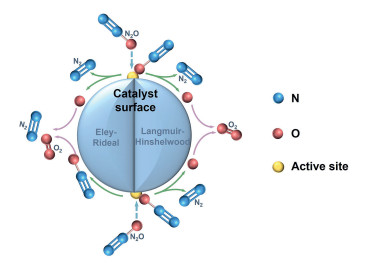
In order to facilitate the rational design of efficient catalysts, the optimization of active sites, and the refinement of reaction pathways for practical applications, it is imperative to comprehensively understand the reaction mechanisms of N2O decomposition. The direct catalytic decomposition of N2O typically initiates with its adsorption at an active site (*), resulting in the production of N2 and an adsorbed oxygen species (O*), as depicted by the following reaction: N2O + * → N2 + O*. The removal of O* then proceeds via two primary pathways: the recombination of two O* species (L−H mechanism) or the reaction between O* and gaseous N2O (E−R mechanism) (Fig. 10). Finally, O2 is formed by the recombination of O*, and subsequently desorbs from the surface of the catalyst. This process is widely accepted as the rate-determining step in N2O decomposition. Indeed, the predominant mechanism is contingent on the catalyst type, the active site structure, and the surface properties.
Mechanistic studies combining theoretical and experimental methods have revealed that charge state and support interactions significantly affect reactivity [165]. For instance, DFT calculations on Rh6− and Rh6+ clusters have indicated that anionic clusters lower activation barriers for N2O reduction [166]. In situ DRIFTS studies on Ir-supported rutile TiO2 have demonstrated the formation of peroxide (O22–) intermediates, thus highlighting the importance of oxygen spillover and Ov regeneration [39]. An Fe-substituted La-hexaaluminate-supported Ir catalyst (Ir/LFA) operates via a dual-path mechanism: N2O dissociation on Ir and Ov-mediated oxygen transfer has been shown to achieve high activity (T50 = 284 ℃) [43]. On defect-rich CeO2-supported Rh SACs, the L−H mechanism dominates, with Ov facilitating oxygen transfer and recombination (Fig. 11a) [44]. Redox mechanisms involving Ov govern N2O decomposition on metal oxides. In the CuxCoy mixed oxides, Co3O4 supplies Ov for N2O adsorption, forming □-Co-ON2 species, while the interfacial CuOx promotes N−O cleavage (Fig. 11b) [91]. Kinetic and DFT analyses reveal first-order kinetics with N2O concentration, identifying N−O cleavage as the rate-determining step. Similarly, in the Cu/CeO2 system, binuclear [Cu–O–Cu]2+ sites on CeO2 {100}/{110} planes have been shown to drive the reaction, facilitated by the presence of Ce3+/Ce4+ redox cycling (Fig. 11c) [167]. Nevertheless, the presence of H2 has been demonstrated to cause dissociative adsorption on Ov, resulting in the competition between NO and active oxygen, which consequently leads to the reversible deactivation of the catalyst. In the context of Co-doped CeO2, an increase in Ov density has been demonstrated to lower the light-off temperature (T90 = 375 ℃) and improve stability [168]. Notably, the doping of Zn introduces a dual modulation mechanism for the Co3O4/CeO2 catalyst: it alters the geometric/electronic structure of Co sites and enhances electron injection from CeO2, collectively leading to an electron-rich Co3O4 and increased Ov. This synergy effectively overcomes the energy barrier limiting the N−O activation and cleavage rate-determining step [101]. In Mn-modified Co3O4, the heterointerface between δ-MnO2 and Co3–xMnxO4 enhances Co 3d−O 2p hybridization and Co−O−Mn covalency, generating highly active lattice oxygen near the interface [93]. Isotope studies have confirmed a shift from the L−H mechanism on pristine Co3O4 to a dominant lattice-oxygen-mediated Mars-van Krevelen pathway, leading to improved N2O decomposition activity and stability (Fig. 11d). The presence of "boxed dot-Co2+" sites in Cu-doped Co3O4 has been identified through in situ DRIFTS, which has detected trans-N2O2− as an intermediate [160]. Perovskites, such as LaMnO3+δ, have been demonstrated to have high oxygen mobility, as evidenced by isotopic exchange (18O2/N216O), thereby enabling efficient lattice oxygen involvement [169].
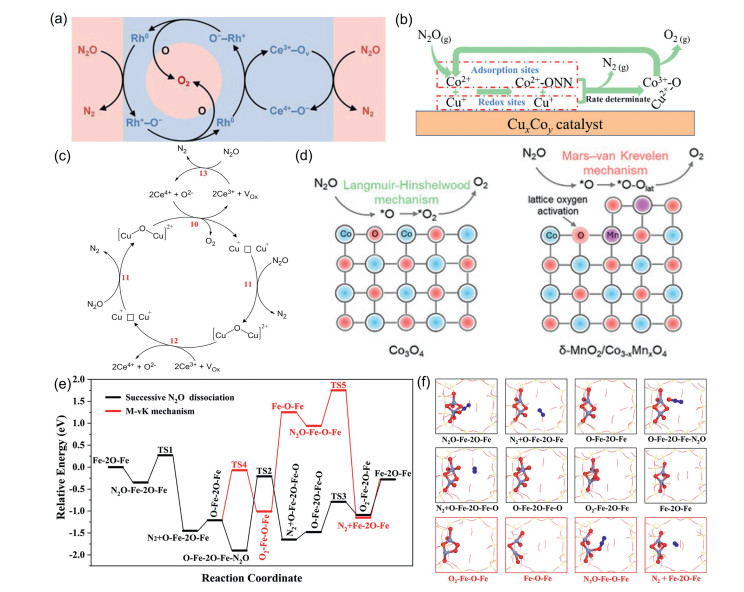
Transition metal-exchanged zeolites, such as those containing Fe, Cu, and Co, have been observed to exhibit metal-specific mechanisms that are sensitive to nuclearity and zeolite topology. In Rh- and Fe-modified ZSM-5, transient product analysis distinguishes between pathways: Rh-ZSM-5 follows the E−R mechanism, while Fe-ZSM-5 adheres to the L−H mechanism [170]. Mononuclear Fe sites have been found to present high activation barriers (> 180 kJ/mol), whereas binuclear clusters promote O2 release through spin-crossover cycles [171]. In Fe/CHA catalysts (e.g., SAPO-34, SSZ-13), dinuclear [HO−Fe−O−Fe−OH]2+ species enhance both O2 desorption and stability (Figs. 11e and f) [147]. Cu-ZSM-5 zeolites operate via dimeric [Cu−Cu]2+ sites using an E−R mechanism [172,173]. For Co-zeolites, isolated Co2+ ions are active, but their aggregation into Co3O4 results in diminished performance [148].
Notably, the reaction mechanisms of emerging N2O decomposition catalysts vary across different systems. In Rh/CeO2 SACs, the promotion of Ov formation and enhancement of redox properties is observed to be a consequence of engineered Rh−O coordination [149]. The doping of single Pr atoms into Co3O4 results in the formation of a "Pr 4f-O 2p-Co 3d" electronic network, which redistributes electron density redistribution to Co2+ sites, thereby reducing the N−O cleavage barrier [84]. In the case of Co-supported BN systems, the catalysts exhibit configuration-dependent pathways: CoN3 sites follow an E−R mechanism, whereas CoB3 sites adopt L−H kinetics [153]. Spinel-structured Co-HEOs achieve high conversion rates at low temperatures and maintain thermal stability at high temperature due to the enhanced reducibility and Ov concentration through multi-element synergy [156].
The mechanistic insights discussed above provide a fundamental blueprint for the rational design of next-generation N2O decomposition catalysts. A central tenet is that O2 desorption is often the rate-determining step, which directly informs strategies such as weakening metal−O bonds via alkali metal promoters (Section 2.2.2-(1)) or facilitating O2 release through Ov generation using redox-active dopants (Section 2.2.2-(2)). Moreover, the highly active of binuclear sites in zeolites emphasizes the critical need to control the nuclearity and coordination environment of metal cations during synthesis (Section 2.3). As outlined in Table 2, the predominant pathway, whether L−H or E−R, and the pivotal mechanistic steps are found to be contingent on the catalyst's architecture. Noble metal catalysts depend on efficient N2O dissociation at metal sites in conjunction with oxygen spillover to Ov-rich supports. Conversely, transition metal oxide catalysts are governed by redox cycles that hinge on the formation and replenishment of Ov. Zeolite-based catalysts exhibit metal-specific mechanisms that are sensitive to the nuclearity of active sites (mono- vs. binuclear) and the confinement effect of the zeolite topology. The advent of novel materials, such as SACs, underscores the significance of meticulously customizing the coordination environment and electronic structure to optimize reaction pathways. In conclusion, a targeted manipulation of the catalyst structure, guided by a deep mechanistic understanding, is the key to overcoming the activity and stability bottlenecks in N2O decomposition.
DownLoad:
CSV
| Catalyst category | Active site combination | N2O activation mode | O* desorption regulation mechanism | Rate-determining step |
| Noble metal catalysts | Metal sites+support Ov | Metal-support electronic interaction weakens N−O bonds | Support Ov accepts O* to lower desorption energy | O* desorption from support Ov |
| Transition metal oxide catalysts | Metal ions+Ov | Metal ions donate electrons; Ov adsorbs N2O | Redox cycles regenerate Ov | O* desorption from Ov |
| Zeolite-based catalysts | Mono-/binuclear metal sites | Binuclear sites synergistically reduce activation energy of N−O dissociation | Zeolite pore confinement promotes O* recombination | O* desorption |
| Emerging catalysts | Metal ions+Ov | Coordination environment and electronic structure reduce activation energy | Metal ions modulate Ov electron density | O* desorption |
Based on the extensive theoretical research, various catalysts have been investigated for practical engineering applications [174]. Indeed, the performance of N2O decomposition catalysts under real industrial conditions and in engineering applications is influenced by multiple factors, including catalyst composition, support material, operating temperature, and the presence of inhibitors. The Pd/Al2O3 catalyst exhibited high activity in the monopropellant thruster, sustaining N2O decomposition at efficiencies > 75% and temperatures > 1500 K [175]. This high performance, which is attributed to a reduction in activation energy under elevated pressure, positions it as a viable substitute for toxic hydrazine propellants. Catalysts, such as K/Zn−Co3O4 and K-doped Co−Mn−Al mixed oxides derived from hydrotalcite precursors, have been validated in pilot-scale nitric acid plants [176,177]. These materials maintain N2O conversions above 70%–90% at 400–450 ℃ under realistic tail gas conditions containing O2, H2O, NOx, and NH3, with operational stability exceeding 10 weeks. In the context of high-temperature applications (750−900 ℃), such as in the production of nitric acid via ammonia oxidation, FeOx/Al2O3 catalysts supported on metastable Al2O3 (δ, θ-Al2O3) exhibit remarkable stability and activity, sustaining over 90% N2O conversion for more than 12 days under realistic gas mixtures containing NO, O2, and H2O [178].
The development of efficient N2O decomposition catalysts faces several critical challenges, including limited activity and stability, incomplete mechanistic understanding, and insufficient scalability. For instance, catalyst deactivation often occurs under practical conditions due to competitive adsorption of H2O and O2 inhibition at Ov sites. To address these issues, innovative materials designs, such as the core-shell structures, are being explored to protect active sites from poisoning. As highlighted in above discussions, the rate-determining step in N2O decomposition is typically O2 desorption. Catalytic performance is thus strongly influenced by the oxygen adsorption and desorption properties of the active sites. Only when these properties are optimally tuned can high catalytic activity be achieved. Accordingly, for novel catalysts (particularly the multicomponent catalyst systems, such composite oxides, spinel-structured composite oxides, perovskite oxides, and high-entropy oxides), rational design strategies should prioritize the modulation of oxygen interaction energetics through advanced computational approaches. Machine learning-guided catalyst discovery has demonstrated considerable promise in accelerating the identification of optimal compositions and structures with improved activity and durability. In parallel, fundamental gaps remain in elucidating the dynamic behavior of active sites under working conditions. The deployment of advanced in situ/operando characterization techniques, such as DRIFTS, XAS, and environmental TEM, is essential to monitor structural evolution in real time and identify key reactive intermediates throughout the catalytic cycle. These insights are critical for the rational design of next-generation catalysts that combine high activity and stability with reduced economic and environmental impacts.
Nowadays, emerging strategies for N2O elimination, such as solar-thermal activation and plasma-assisted decomposition, leverage renewable energy sources to enable more sustainable and energy-efficient emission control, in alignment with global energy transition trends to reduce the carbon footprint of industrial processes. Scaling up these technologies requires careful balancing of the catalytic performance with scaling feasibility. A thorough techno-economic analysis (TEA) is essential to evaluate synthesis costs, catalyst lifetime, regeneration needs, and energy consumption under realistic operating conditions. Notably, a significant trade-off exists between noble-metal-based catalysts (which often exhibit superior activity at higher costs) and transition-metal-based alternatives. The latter may offer improved economic sustainability, though often at the expense of lower tolerance to feed variability or reduced stability. Concurrently, a full life cycle assessment (LCA) is needed to quantify environmental impacts across all stages, from raw material extraction and catalyst production to deactivation and disposal or recycling. Such a comprehensive evaluation ensures that the net environmental benefit of N2O abatement is not offset by hidden burdens associated with energy-intensive synthesis or the use of scarce resources.
Yingxue Lu: Writing – original draft, Visualization, Formal analysis, Data curation, Conceptualization. Ying Xin: Writing – review & editing, Validation, Supervision, Resources, Funding acquisition, Conceptualization. Hao Wu: Visualization, Formal analysis, Data curation. Jin Wang: Methodology, Formal analysis. Zhaoliang Zhang: Writing – review & editing, Supervision, Funding acquisition.
The authors declare that they have no known competing financial interests or personal relationships that could have appeared to influence the work reported in this paper.
This work was funded by National Natural Science Foundation of China (Nos. 22376078 and 22276070), Taishan Scholar Program of Shandong Province (Nos. tsqn202408207 and tstp20230628), Shandong Provincial Natural Science Foundation (Nos. ZR2023ZD39 and ZR2024MB064).
United Nations Environment Programme and Food and Agriculture Organization of the United Nations, 2024, Global Nitrous oxide assessment,
H. Tian, R. Xu, J.G. Canadell, et al., Nature 586 (2020) 248–256. doi: 10.1038/s41586-020-2780-0
M.J. Prather, J. Hsu, N.M. DeLuca, et al., J. Geophys. Res. : Atmos. 120 (2015) 5693–5705.
X. Cui, S. Chen, J. Yang, et al., J. Environ. Manag. 377 (2025) 124580. doi: 10.1016/j.jenvman.2025.124580
S. Christensen, K. Rousk, iScience 27 (2024) 109042. doi: 10.1016/j.isci.2024.109042
G. Zhu, H. Shi, L. Zhong, et al., Nat. Rev. Earth Environ. 6 (2025) 574–592. doi: 10.1038/s43017-025-00707-5
R. Feng, Z. Li, Environ. Pollut. 338 (2023) 122664. doi: 10.1016/j.envpol.2023.122664
Regulation (EU) 2024/1257 of the European Parliament and of the Council, Official Journal of the European Union, 2024.
Action Plan for Nitrous Oxide Emission Control in the Industrial Sector, Ministry of Ecology and Environment of China, National Development and Reform Commission of China, and Ministry of Industry and Information Technology of China, 2025.
Z. Zhuang, B. Guan, J. Chen, et al., Chem. Eng. J. 486 (2024) 150374. doi: 10.1016/j.cej.2024.150374
J. Quan, R. Yin, Z. Zhao, et al., J. Am. Chem. Soc. 145 (2023) 12044–12050. doi: 10.1021/jacs.3c01127
M.L. Ovcharov, V.M. Granchak, Theor. Exp. Chem. 57 (2021) 30–63. doi: 10.1007/s11237-021-09674-6
X. Zhang, Y. Wang, Y. Wang, et al., Chem. Commun. 58 (2022) 2777–2787. doi: 10.1039/d1cc06690k
M. Liu, H. Zhang, J. Li, et al., ChemCatChem 16 (2024) e202400922. doi: 10.1002/cctc.202400922
A. Shigemoto, Y. Sekine, Chem. Commun. 61 (2025) 1559–1573. doi: 10.1039/d4cc05135a
X. Wu, J. Du, Y. Gao, et al., Chem. Soc. Rev. 53 (2024) 8379–8423. doi: 10.1039/d3cs00919j
Y. Zhang, J. Du, Y. Shan, et al., Chem. Soc. Rev. 54 (2025) 1151–1215. doi: 10.1039/d4cs00140k
M. Qian, B. Guan, Z. Zhuang, et al., Catal. Sci. Technol. 15 (2025) 2061–2103. doi: 10.1039/d4cy01416b
L. Wang, C. Lin, I. Boldog, et al., Angew. Chem. Int. Ed. 63 (2024) e202317435. doi: 10.1002/anie.202317435
K.H. Kang, M. Yang, S. Raza, et al., Chemosphere 335 (2023) 139114. doi: 10.1016/j.chemosphere.2023.139114
Z. Li, Y. Wu, H. Wang, et al., Environ. Sci. Technol. 58 (2024) 8976–8987. doi: 10.1021/acs.est.4c00765
L.S. Ko, Y.S. Chen, K.L. Pan, et al., Catal. Commun. 177 (2023) 106666. doi: 10.1016/j.catcom.2023.106666
A. Shigemoto, T. Higo, C. Ukai, et al., Catal. Sci. Technol. 14 (2024) 4471–4478. doi: 10.1039/d4cy00698d
Z. Liu, F. He, L. Ma, et al., Catal. Surv. Asia 20 (2016) 121–132. doi: 10.1007/s10563-016-9213-y
R. Zhang, N. Liu, Z. Lei, et al., Chem. Rev. 116 (2016) 3658–3721. doi: 10.1021/acs.chemrev.5b00474
Y. Zhang, Z. Tian, L. Huang, et al., Catalysts 13 (2023) 943. doi: 10.3390/catal13060943
H. Yu, X. Wang, X. Wu, et al., Chem. Eng. J. 334 (2018) 800–806. doi: 10.1016/j.cej.2017.10.079
M. Jabłońska, R. Palkovits, Catal. Sci. Technol. 6 (2016) 7671–7687. doi: 10.1039/C6CY01126H
V.G. Komvokis, M. Marti, A. Delimitis, et al., Appl. Catal. B: Environ. 103 (2011) 62–71. doi: 10.1016/j.apcatb.2011.01.009
N. Richards, J.H. Carter, E. Nowicka, et al., Appl. Catal. B: Environ. 264 (2020) 118501. doi: 10.1016/j.apcatb.2019.118501
P.H. Ho, M. Jabłońska, R. Palkovits, et al., Chem. Eng. J. 379 (2020) 122259. doi: 10.1016/j.cej.2019.122259
S.S. Kim, S.J. Lee, S.C. Hong, J. Ind. Eng. Chem. 18 (2012) 1263–1266. doi: 10.1016/j.jiec.2012.01.004
C. Sui, F. Yuan, Z. Zhang, et al., Catalysts 6 (2016) 173. doi: 10.3390/catal6110173
H. Liu, S. Yang, J. Mi, et al., Environ. Sci. Technol. 58 (2024) 17125–17136.
M. Piumetti, M. Hussain, D. Fino, et al., Appl. Catal. B: Environ. 165 (2015) 158–168. doi: 10.1016/j.apcatb.2014.10.008
H. Liu, Y. Lin, Z. Ma, Chin. J. Catal. 37 (2016) 73–82. doi: 10.1016/S1872-2067(15)60951-2
Y. Jing, K. Taketoshi, N. Zhang, et al., ACS Catal. 12 (2022) 6325–6333. doi: 10.1021/acscatal.2c01321
N. Zhang, C. He, Y. Jing, et al., Angew. Chem. Int. Ed. 64 (2025) e202517403. doi: 10.1002/anie.202517403
E. Pachatouridou, E. Papista, A. Delimitis, et al., Appl. Catal. B: Environ. 187 (2016) 259–268. doi: 10.1016/j.apcatb.2016.01.049
I.V. Yentekakis, G. Goula, P. Panagiotopoulou, et al., Appl. Catal. B: Environ. 192 (2016) 357–364. doi: 10.1016/j.apcatb.2016.04.011
H. Liu, Z. Ma, Chin. J. Chem. Eng. 26 (2018) 109–115. doi: 10.1016/j.cjche.2017.02.007
C. Sui, X. Niu, Z. Wang, et al., Catal. Sci. Technol. 6 (2016) 8505–8515. doi: 10.1039/C6CY01920J
M. Wang, W. Li, S. Wang, J. Phys. Chem. C 127 (2023) 20344–20353. doi: 10.1021/acs.jpcc.3c04876
S. Bao, X. Lu, L. Yu, et al., Appl. Catal. A: Gen. 693 (2025) 120122. doi: 10.1016/j.apcata.2025.120122
Y. Jing, C. He, N. Zhang, et al., ACS Catal. 13 (2023) 12983–12993. doi: 10.1021/acscatal.3c02446
N. Zhang, C. He, Y. Jing, et al., Surf. Interfaces 46 (2024) 104120. doi: 10.1016/j.surfin.2024.104120
N. Zhang, C. He, Y. Jing, et al., Environ. Sci. Technol. 59 (2025) 1598–1607. doi: 10.1021/acs.est.4c08083
B. Bozorgi, J. Karimi-Sabet, P. Khadiv-Parsi, Environ. Technol. Innovation 26 (2022) 102344. doi: 10.1016/j.eti.2022.102344
M. Konsolakis, ACS Catal. 5 (2015) 6397–6421. doi: 10.1021/acscatal.5b01605
Y. Long, X. Zhu, C. Gao, et al., Nat. Commun. 16 (2025) 1048. doi: 10.1038/s41467-025-56487-5
Z. Ma, Y. Ren, Y. Lu, et al., J. Nanosci. Nanotechnol. 13 (2013) 5093–5103. doi: 10.1166/jnn.2013.7580
P. Stelmachowski, K. Ciura, G. Grzybek, Catal. Sci. Technol. 6 (2016) 5554–5560. doi: 10.1039/C6CY00365F
M. Li, R. Zhang, H. Wang, et al., Catal. Today 376 (2021) 177–187. doi: 10.1016/j.cattod.2020.06.042
H. Yu, X. Qi, X. Du, et al., Mol. Catal. 537 (2023) 112960.
Ž. Chromčáková, L. Obalová, F. Kovanda, et al., Catal. Today 257 (2015) 18–25. doi: 10.1016/j.cattod.2015.03.030
H. Li, L. Zheng, T. Zhao, et al., J. Fuel Chem. Technol. 46 (2018) 717–724. doi: 10.1016/S1872-5813(18)30031-8
S. Li, J. Zhao, Z. Song, et al., Fuel 362 (2024) 130745. doi: 10.1016/j.fuel.2023.130745
Y. Wang, X. Wei, X. Hu, et al., Catal. Lett. 149 (2019) 1026–1036. doi: 10.1007/s10562-019-02681-2
H. Ou, Y. Yue, T. Yang, et al., ACS ES T Eng. 5 (2024) 1032–1042.
P. Stelmachowski, G. Maniak, A. Kotarba, et al., Catal. Commun. 10 (2009) 1062–1065. doi: 10.1016/j.catcom.2008.12.057
L. Nowakowski, C. Hudy, F. Zasada, et al., J. Am. Chem. Soc. 146 (2024) 24450–24466. doi: 10.1021/jacs.4c06587
J. Sun, A. Song, Y. Tian, et al., ChemCatChem 15 (2023) e202201449. doi: 10.1002/cctc.202201449
G. Maniak, P. Stelmachowski, F. Zasada, et al., Catal. Today 176 (2011) 369–372. doi: 10.1016/j.cattod.2010.11.043
H. Prajitno, J. Kim, M.H. Jeong, et al., Chemosphere 367 (2024) 143642. doi: 10.1016/j.chemosphere.2024.143642
G. Grzybek, J. Gryboś, P. Indyka, et al., Appl. Catal. B: Environ. 297 (2021) 120435. doi: 10.1016/j.apcatb.2021.120435
F. Zhao, D. Wang, X. Li, et al., Ind. Eng. Chem. Res. 61 (2022) 13854–13862. doi: 10.1021/acs.iecr.2c01955
Y. Gong, Z. Liu, Z. Li, et al., Environ. Sci. Technol. 58 (2023) 906–914.
H. Zhao, P. Wang, Z. Li, et al., J. Environ. Chem. Eng. 12 (2024) 113907. doi: 10.1016/j.jece.2024.113907
H. Zhao, P. Wang, Z. Li, et al., Aerosp. Sci. Technol. 166 (2025) 110522. doi: 10.1016/j.ast.2025.110522
J. Sun, L. Wang, L. Zhang, et al., ACS Appl. Energy Mater. 4 (2021) 8496–8505. doi: 10.1021/acsaem.1c01690
Q. Zhang, X. Tang, P. Ning, et al., RSC Adv. 5 (2015) 51263–51270. doi: 10.1039/C5RA04062K
H. Yu, X. Wang, X. Wu, Mol. Catal. 460 (2018) 69–73.
L. Xue, H. He, C. Liu, et al., Environ. Sci. Technol. 43 (2009) 890–895. doi: 10.1021/es801867y
K. Wang, Y. Du, Y. Li, et al., Mol. Catal. 569 (2024) 114604.
M. Xu, H. Wang, H. Ouyang, et al., J. Hazard. Mater. 401 (2021) 123334. doi: 10.1016/j.jhazmat.2020.123334
Y. Wang, X. Hu, K. Zheng, et al., Catal. Commun. 111 (2018) 70–74. doi: 10.1016/j.catcom.2018.04.004
M.G. Jung, J.E. Seo, H.P. Ha, et al., Chem. Eng. J. 505 (2025) 159305. doi: 10.1016/j.cej.2025.159305
C. He, A. Li, Z. Liu, Catal. Surv. Asia 24 (2020) 232–238. doi: 10.1007/s10563-020-09303-7
M. Lykaki, E. Papista, N. Kaklidis, et al., Catalysts 9 (2019) 233. doi: 10.3390/catal9030233
M. Zabilskiy, P. Djinović, E. Tchernychova, et al., ACS Catal. 5 (2015) 5357–5365. doi: 10.1021/acscatal.5b01044
Z. Liu, C. He, B. Chen, et al., Catal. Today 297 (2017) 78–83. doi: 10.1016/j.cattod.2017.05.074
H. Liu, J. Chen, Y. Wang, et al., Chem. Eng. J. 414 (2021) 128643. doi: 10.1016/j.cej.2021.128643
Y. Xiong, Y. Zhao, X. Qi, et al., Environ. Sci. Technol. (2021) 13335–13344.
Z. Zhang, Y. Wu, Y. Sun, et al., ACS ES T Eng. 4 (2024) 2542–2552. doi: 10.1021/acsestengg.4c00314
S. Cao, Z. Zhang, Y. Wu, et al., J. Colloid Interface Sci. 696 (2025) 137880. doi: 10.1016/j.jcis.2025.137880
P.H. Ho, M. Jabłońska, M. Nocuń, et al., ChemCatChem 11 (2019) 5580–5592. doi: 10.1002/cctc.201901394
P.H. Ho, M. Jabłońska, G. Beltrami, et al., J. Mater. Sci. 56 (2021) 15012–15028. doi: 10.1007/s10853-021-06245-x
F. Zhang, X. Wang, X. Zhang, et al., Chem. Eng. J. 256 (2014) 365–371. doi: 10.1016/j.cej.2014.07.007
H. Yu, Y. Li, Y. Pan, et al., Chem. Eng. J. 504 (2025) 159032. doi: 10.1016/j.cej.2024.159032
Y. Li, X. Wang, C. Shi, J. Environ. Chem. Eng. 11 (2023) 109970. doi: 10.1016/j.jece.2023.109970
S. Xiong, J. Chen, N. Huang, et al., Environ. Sci. Technol. 53 (2019) 10379–10386. doi: 10.1021/acs.est.9b02892
Y. Wang, X.L. Liu, X. Hu, et al., React. Kinet. Mech. Catal. 129 (2019) 165–179.
Y. Long, Y. Peng, Y. Bai, et al., Angew. Chem. Int. Ed. 64 (2025) e202516326. doi: 10.1002/anie.202516326
X. Hu, Y. Wang, R. Wu, et al., Appl. Surf. Sci. 514 (2020) 145892. doi: 10.1016/j.apsusc.2020.145892
H. Yu, X. Wang, Y. Li, Catal. Today 339 (2020) 274–280. doi: 10.1016/j.cattod.2018.10.036
P. Zhao, F. Qin, Z. Huang, et al., Catal. Sci. Technol. 8 (2018) 276–288. doi: 10.1039/c7cy02301d
E.H. Lee, I.H. Kwak, H. Kim, et al., J. Mater. Chem. A 13 (2025) 5056–5067. doi: 10.1039/d4ta07764d
F.L. Zhao, C. Wang, D. Wang, et al., Appl. Catal. A: Gen. 649 (2023) 118946. doi: 10.1016/j.apcata.2022.118946
H. Dang, L. Li, H. Sun, et al., J. Colloid Interf. Sci. 680 (2025) 699–711. doi: 10.1016/j.jcis.2024.11.096
C. Zhang, Z. Zhang, C. Sui, et al., ChemCatChem 8 (2016) 2155–2164. doi: 10.1002/cctc.201600231
H. Liu, S. Cheng, J. Chen, et al., Environ. Sci. Technol. 59 (2025) 22927–22939. doi: 10.1021/acs.est.5c07320
X. Hu, Y. Wang, R. Wu, et al., Mol. Catal. 509 (2021) 111656.
R. Wu, Q. Wang, R. Wang, et al., ChemCatChem 17 (2024) e202401659.
J.J. Torrez-Herrera, S.A. Korili, A. Gil, Catal. Rev. 64 (2020) 592-630.
M. Santiago, J. Pérez-Ramírez, Environ. Sci. Technol. 41 (2007) 1704–1709. doi: 10.1021/es061894b
Y. Zhang, X. Wang, Y. Zhu, et al., J. Phys. Chem. C 118 (2014) 1999–2010. doi: 10.1021/jp410207d
Y. Zhu, X. Wang, G. Wu, et al., J. Phys. Chem. C 116 (2011) 671–680. doi: 10.1049/mnl.2011.0265
R. Li, Y. Li, Z. Liu, Fuel 355 (2024) 129405. doi: 10.1016/j.fuel.2023.129405
B.M. Abu-Zied, S.A. Soliman, S.E. Abdellah, Chin. J. Catal. 35 (2014) 1105–1112. doi: 10.1016/S1872-2067(14)60058-9
H. Prajitno, J. Kim, M.H. Jeong, et al., Fuel 371 (2024) 132053. doi: 10.1016/j.fuel.2024.132053
R. Amrousse, T. Katsumi, Catal. Commun. 26 (2012) 194–198. doi: 10.1016/j.catcom.2012.05.024
M. Jabłońska, R. Palkovits, Catal. Sci. Technol. 9 (2019) 2057–2077. doi: 10.1039/c8cy02458h
J. Simböck, M. Ghiasi, S. Schönebaum, et al., Nat. Commun. 11 (2020) 652. doi: 10.1038/s41467-020-14305-0
R.H. Blackmore, M.E. Rivas, G.F. Tierney, et al., Phys. Chem. Chem. Phys. 22 (2020) 18774–18787. doi: 10.1039/d0cp00793e
N. Richards, J.H. Carter, L.A. Parker, et al., ACS Catal. 10 (2020) 5430–5442. doi: 10.1021/acscatal.0c00698
P. Bělina, G. Sádovská, V. Krejčíková, et al., J. Therm. Anal. Calorim. 138 (2019) 4197–4202. doi: 10.1007/s10973-019-08596-9
X. Gao, Y. Li, J. Chen, et al., Mol. Catal. 510 (2021) 111713.
A.G. Margellou, T.C. Vaimakis, P.J. Pomonis, et al., React. Kinet., Mech. Catal. 127 (2019) 825–838. doi: 10.1007/s11144-019-01608-7
P. Zheng, F. He, Y. Wu, et al., ChemistrySelect 9 (2024) e202304026. doi: 10.1002/slct.202304026
S. Kumar, A. Vinu, J. Subrt, et al., Catal. Today 198 (2012) 125–132. doi: 10.1016/j.cattod.2012.06.015
K.L. Pan, S.J. Yu, S.Y. Yan, et al., J. Air Waste Manage. 64 (2014) 1260–1269. doi: 10.1080/10962247.2014.941513
L.A. Isupova, Y.A. Ivanova, I.P. Prosvirin, et al., Kinet. Catal. 66 (2025) 297–311. doi: 10.1134/s0023158425600191
L.A. Isupova, Y.A. Ivanova, I.P. Prosvirin, et al., Dalton Trans. 53 (2024) 15273–15283. doi: 10.1039/D4DT01897D
C. Huang, Y. Zhu, X. Wang, et al., J. Catal. 347 (2017) 9–20. doi: 10.1016/j.jcat.2016.12.020
A. Serrano-Lotina, E. Mastronardo, J.M. Coronado, Appl. Catal. A: Gen. 689 (2025) 120026. doi: 10.1016/j.apcata.2024.120026
H. Arandiyan, S.S. Mofarah, C.C. Sorrell, et al., Chem. Soc. Rev. 50 (2021) 10116–10211. doi: 10.1039/d0cs00639d
N. Richards, L.A. Parker, J.H. Carter, et al., Catal. Lett. 152 (2021) 213–226.
P. Zemlianskii, D. Morozov, G. Kapustin, et al., Colloid. Surf. A 698 (2024) 134546. doi: 10.1016/j.colsurfa.2024.134546
D.V. Ivanov, L.G. Pinaeva, L.A. Isupova, et al., Appl. Catal. A: Gen. 457 (2013) 42–51. doi: 10.1016/j.apcata.2013.03.007
A. Li, P. Wang, L. Zhang, et al., Fuel 378 (2024) 132888. doi: 10.1016/j.fuel.2024.132888
D. Pietrogiacomi, M.C. Campa, L.R. Carbone, et al., Appl. Catal. B: Environ. 240 (2019) 19–29. doi: 10.1016/j.apcatb.2018.08.046
X. Zhang, Q. Shen, C. He, et al., Chem. Eng. J. 226 (2013) 95–104. doi: 10.3901/JME.2013.03.095
B. Chen, N. Liu, X. Liu, et al., Catal. Today 175 (2011) 245–255. doi: 10.1016/j.cattod.2011.04.010
M.L. Bols, B.E.R. Snyder, H.M. Rhoda, et al., Nat. Catal. 4 (2021) 332–340. doi: 10.1038/s41929-021-00602-4
B. Kang, R. Zhang, M. Guo, et al., Energ. Fuel 37 (2023) 18019–18029. doi: 10.1021/acs.energyfuels.3c01958
A.A. Gainanova, G.M. Kuz'micheva, L.V. Pirutko, et al., J. Mater. Res. 38 (2022) 532–546.
G. He, B. Zhang, H. He, et al., Sci. Total Environ. 673 (2019) 266–271. doi: 10.1016/j.scitotenv.2019.03.481
B. Louis, F. Ocampo, H.S. Yun, et al., Chem. Eng. J. 161 (2010) 397–402. doi: 10.1016/j.cej.2009.09.041
M. Wu, H. Wang, L. Zhong, et al., Chin. J. Catal. 37 (2016) 898–907. doi: 10.1016/S1872-2067(15)61052-X
X. Liang, H. Tang, F. Yang, et al., Micropor. Mesopor. Mat. 290 (2019) 109655. doi: 10.1016/j.micromeso.2019.109655
K. Jíša, J. Nováková, M. Schwarze, et al., J. Catal. 262 (2009) 27–34. doi: 10.1016/j.jcat.2008.11.025
E. Tabor, G. Sádovská, M. Bernauer, et al., Appl. Catal. B: Environ. 240 (2019) 358–366. doi: 10.1016/j.apcatb.2017.11.014
S. Li, J. Wang, R. Su, et al., Mol. Catal. 552 (2024) 113706.
S.A. Yashnik, A.V. Salnikov, N.T. Vasenin, et al., Catal. Today 197 (2012) 214–227. doi: 10.1016/j.cattod.2012.08.033
J.B. Lim, S.H. Cha, S.B. Hong, Appl. Catal. B: Environ. 243 (2019) 750–759. doi: 10.1016/j.apcatb.2018.10.068
D.C. Cano-Blanco, J.W.A. Fischer, F. Buttignol, et al., ACS Catal. 15 (2025) 15579–15595. doi: 10.1021/acscatal.5c01616
T. Zhang, Y. Qiu, G. Liu, et al., J. Catal. 392 (2020) 322–335. doi: 10.1016/j.jcat.2020.10.015
F. Lin, T. Andana, Y. Wu, et al., J. Catal. 401 (2021) 70–80. doi: 10.1016/j.jcat.2021.07.012
S. Xie, D. Kim, K. Ye, et al., J. Rare Earth. 41 (2023) 941–951. doi: 10.1016/j.jre.2023.01.006
K. Liu, Y. Tang, Z. Yu, et al., Sci. China Mater. 63 (2020) 949–958. doi: 10.1007/s40843-020-1267-2
H. Liu, S. Yang, G. Wang, et al., Environ. Sci. Technol. 56 (2022) 16325–16335. doi: 10.1021/acs.est.2c06677
X. Liu, L. Sheng, Mater. Today Commun. 28 (2021) 102585. doi: 10.1016/j.mtcomm.2021.102585
W. Qu, C. Wang, P. Wang, et al., Appl. Surf. Sci. 636 (2023) 157792. doi: 10.1016/j.apsusc.2023.157792
X. Hu, Y. Wang, R. Wu, et al., Appl. Surf. Sci. 538 (2021) 148157. doi: 10.1016/j.apsusc.2020.148157
Y. Yin, R. Xiao, L. Qiu, et al., Fuel 366 (2024) 131303. doi: 10.1016/j.fuel.2024.131303
B. Li, X. Duan, T. Zhao, et al., Environ. Sci. Technol. 58 (2024) 2153–2161. doi: 10.1021/acs.est.3c09741
Y. Li, F. Tang, D. Wang, et al., Catal. Sci. Technol. 11 (2021) 3737–3745. doi: 10.1039/d1cy00137j
Y. Xiong, Y. Zhao, W. Shan, et al., Chemosphere 303 (2022) 135257. doi: 10.1016/j.chemosphere.2022.135257
X. Hu, J. Meng, L. Feng, et al., Catal. Lett. 154 (2024) 4367–4377. doi: 10.1007/s10562-024-04669-z
Y. Zhang, Q. Dong, J. Zhang, et al., Catal. Sci. Technol. 15 (2025) 3848–3858. doi: 10.1039/d5cy00381d
P. Zemlianskii, D. Morozov, G. Kapustin, et al., Ceram. Int. 50 (2024) 34081–34090. doi: 10.1016/j.ceramint.2024.06.227
A. Li, P. Wang, T. Yan, et al., Aerosp. Sci. Technol. 164 (2025) 110394. doi: 10.1016/j.ast.2025.110394
H. Yang, D. Cheng, Q. Zhang, et al., J. Environ. Chem. Eng. 13 (2025) 117715. doi: 10.1016/j.jece.2025.117715
A. Makova, O. Tkachenko, G. Kapustin, et al., Arab. J. Sci. Eng. 51 (2026) 1391–1400. doi: 10.1007/s13369-025-10033-z
L.Y. Wu, C. Chen, L. Luo, et al., ChemistrySelect 5 (2020) 5391–5399. doi: 10.1002/slct.202000752
H. Francisco, V. Bertin, J.R. Soto, et al., J. Phys. Chem. C 120 (2016) 23648–23659. doi: 10.1021/acs.jpcc.6b08172
M. Zabilskiy, P. Djinović, E. Tchernychova, et al., Appl. Catal. B: Environ. 197 (2016) 146–158. doi: 10.1016/j.apcatb.2016.02.024
X. Wang, R. Duan, Z. Li, et al., Environ. Sci. Technol. 59 (2025) 5839–5847. doi: 10.1021/acs.est.5c00180
D.V. Ivanov, L.G. Pinaeva, E.M. Sadovskaya, et al., J. Mol. Catal. A: Chem. 412 (2016) 34–38. doi: 10.1016/j.molcata.2015.11.018
E. Kondratenko, V. Kondratenko, M. Santiago, et al., J. Catal. 256 (2008) 248–258. doi: 10.1016/j.jcat.2008.03.016
G. Li, E.A. Pidko, I.A.W. Filot, et al., J. Catal. 308 (2013) 386–397. doi: 10.1016/j.jcat.2013.08.010
K.M. Farhan, P.K. Sajith, Ind. Eng. Chem. Res. 64 (2025) 5257–5268. doi: 10.1021/acs.iecr.4c04220
M.L. Tsai, R.G. Hadt, P. Vanelderen, et al., J. Am. Chem. Soc. 136 (2014) 3522–3529. doi: 10.1021/ja4113808
F. Buttignol, P. Biasi, A. Garbujo, ACS ES T Eng. 5 (2025) 2170–2180. doi: 10.1021/acsestengg.5c00384
G.D. Di Martino, G. Gallo, S. Mungiguerra, et al., Acta Astronaut. 180 (2021) 460–469. doi: 10.3390/healthcare9040460
M. Inger, M. Wilk, M. Saramok, et al., Ind. Eng. Chem. Res. 53 (2014) 10335–10342. doi: 10.1021/ie5014579
K. Pacultová, K. Karásková, F. Kovanda, et al., Ind. Eng. Chem. Res. 55 (2016) 7076–7084. doi: 10.1021/acs.iecr.6b01206
G. Sádovská, E. Tabor, M. Bernauer, et al., Catal. Sci. Technol. 8 (2018) 2841–2852. doi: 10.1039/c8cy00383a

Figure 3 (a) TEM images and models of fresh and aged Ir/γ-Al2O3 and Ir/ACZ. Reproduced with permission [40]. Copyright 2016, Elsevier. (b) Normalized turnover frequency at 250 ℃ for defect-rich CeO2 with different morphologies. Reproduced with permission [44]. Copyright 2025, Elsevier. (c) HAADF−STEM and EDX mapping images, and (d) the catalytic activity of Rh(1)/ZrO2 and Rh(1)−Ir(1)/ZrO2 for N2O decomposition. Reproduced with permission [47]. Copyright 2025, American Chemical Society.

Figure 4 (a) SEM images and (b) N2O conversions of Co3O4 with different morphologies. Reproduced with permission [53]. Copyright 2021, Elsevier. (c) Hydroxyl group facilitated mechanism for N2O decomposition activity on the Co3O4 surface and (d) normalized reaction rates of Co3O4 and Co3O4-OH. Reproduced with permission [59]. Copyright 2025, American Chemical Society.

Figure 5 (a) The density of states functions of the Cs−O−Co band and (b) catalytic performance of N2O decomposition for 4Cs/Co3O4 and 4Cs-Co3O4. Reproduced with permission [67]. Copyright 2023, American Chemical Society. (c) N2O catalytic decomposition performance and (d) Arrhenius plots of N2O conversion over Cs supporting on different metal oxides. Reproduced with permission [66]. Copyright 2022, American Chemical Society. (e) Integral area of O2-TPD profiles and (f) N2O decomposition activity of Ba0.5Co2.5O4, Sr0.5Co2.5O4, Ca0.5Co2.5O4, Mg0.5Co2.5O4, and Co3O4. Reproduced with permission [70]. Copyright 2021, American Chemical Society.

Figure 6 (a) Reaction pathways and (b) catalytic performance for N2O decomposition over CoxCey binary oxide catalysts. Reproduced with permission [77]. Copyright 2025, Elsevier. (c) N2O decomposition performance as a function of the reaction temperature and (d) electron transfer pathway in N2O decomposition for Co3O4 and Sm0.1-Co3O4. Reproduced with permission [82]. Copyright 2021, Elsevier. (e) N2O conversion over Dy0.01Co, K0.01Co, KyDy0.01Co (y = 0.005, 0.01, 0.02, 0.03) and K0.01Dy0.07Co catalysts at 400 ℃ changed with time on stream. Reproduced with permission [89]. Copyright 2025, Elsevier.

Figure 7 (a) Catalytic de-N2O activity of ZnCo2O4 spinel catalysts. Reproduced with permission [110]. Copyright 2024, Elsevier. (b) N2O decomposition rates as a function of t2g or eg orbital occupancy in 0.37 kPa O2 [Fill colors represent the substituent cation in LaCoO3 (no substituent: black fill): Ni (green), Zn (blue), increasing Al fraction (dark to light red). Lines represent least squares fits of the full set or subset of data] and (c) orbital interactions and the respective kinetically relevant step (KRS) for N2O decomposition. Reproduced with permission [113]. Copyright 2020, Nature Publishing Group.

Figure 8 (a) N2O conversion of Fe-based zeolites with different topological structures and (b) pathway of N2O decomposition over Fe-ZSM-5. Reproduced with permission [130]. Copyright 2024, Elsevier. (c) N2O conversion for Co/zeolites with different topological structures. Reproduced with permission [135]. Copyright 2023, American Chemical Society. (d) Proposed reaction pathway of the N2O activation and decomposition on the Fe-SSZ-13 catalyst on two adjacent Fe6MR sites. Reproduced with permission [146]. Copyright 2025, American Chemical Society. (e) Reaction site mechanism and (f) rate of N2O decomposition on Fe-, Co-, Cu-SSZ-13 catalysts. Reproduced with permission [148]. Copyright 2024, Elsevier.

Figure 9 (a) N2O decomposition activity and (b) reaction rates normalized by SBET on Co3O4 and Pr-doped Co3O4 samples. Reproduced with permission [151]. Copyright 2022, American Chemical Society. (c) Relationship between the content of Co2+ and the specific activity or the energy of activation for N2O decomposition. Reproduced with permission [155]. Copyright 2024, Elsevier. (d) Catalytic activity of Co3O4 and Co-HEO for N2O decomposition, (e) H2-TPR, (f) O2-TPD of Co3O4 and Co-HEO, and (g) Stability test of Co3O4 and Co-HEO at 360 ℃. Reproduced with permission [156]. Copyright 2024, American Chemical Society.

Figure 11 (a) Main mechanism of catalytic N2O decomposition on RhNC/CeO2-d. Reproduced with permission [44]. Copyright 2025, Elsevier. (b) Key roles of CuO and Co3O4 in the CuxCoy catalysts for N2O decomposition. Reproduced with permission [91]. Copyright 2019, American Chemical Society. (c) Proposed mechanism of N2O decomposition over CuO/CeO2 catalyst. Reproduced with permission [167]. Copyright 2016, Elsevier. (d) Different reaction mechanism for δ-MnO2/Co3-xMnxO4 and pristine Co3O4. Reproduced with permission [93]. Copyright 2025, John Wiley & Sons. (e) Calculated energy profile and (f) intermediate structures for N2O decomposition on Fe–2O–Fe/SSZ-13. Red, gray-purple, and blue balls represent O, Fe, and N atoms, respectively. Reproduced with permission [147]. Copyright 2020, Elsevier.
Table 1. Performance comparison of different types of N2O decomposition catalysts.
| Catalyst category | Catalysts | Synthesis method | Reaction conditions | Catalytic performance | Publish year | Ref. |
| Noble metal catalysts | Pd/Al2O3 | Wet impregnation method | 1% N2O, He balance, 76,690 h−1 | T50: 300 ℃; T100: 400 ℃ | 2020 | [30] |
| Rh/Mg/Al/FeCr alloy foams | Electrodeposition method | 1000 ppm N2O, N2 balance, 6800 h−1 | T50: 320 ℃; T100: 400 ℃ | 2020 | [31] | |
| RhOx/ZrO2 | Impregnation method | 1000 ppm N2O, 10% O2, 2% H2O, He balance, 100 mL/min | T50: 240 ℃; T100: 400 ℃ | 2022 | [37] | |
| Pt-K/SiO2 | Wet impregnation method | 2000 ppm N2O, He balance, 15,000 h−1 | T50: 560 ℃ | 2022 | [48] | |
| Ir/LFA, | Impregnation method | 30 vol% N2O, Ar balance, 100 mL/min, 60,000 cm−3 g−1 h−1 | T50: 284 ℃ | 2023 | [43] | |
| Ir/LMA | T50: 341 ℃ | |||||
| RhOx/Ag/Al2O3 | Impregnation method | 0.1% N2O, He balance, 100 mL/min | T50: 254 ℃; T100: 400 ℃ | 2023 | [45] | |
| Rh/CeO2 | Sol-gel method | 1000 ppm N2O, Ar balance, 30,000 mL g−1 h−1 | T50: 260 ℃; T90: 295 ℃ | 2024 | [34] | |
| Rh(1)–Pd(1)/ZrO2 | Impregnation method | 1000 ppm N2O, He balance, 100 mL/min | T50: 307 ℃; T90: 353 ℃ | 2024 | [46] | |
| 1000 ppm N2O, 10% O2, 5% CO2, 1% H2O, He balance, 100 mL/min | T50: 400 ℃; T90: 450 ℃ | |||||
| RhNC/CeO2-d | Defects-assisted adsorption method | 1000 ppm N2O, N2 balance, 120,000 mL g−1 h−1 | T50: 238 ℃ | 2025 | [44] | |
| 1000 ppm N2O, 5% O2, N2 balance, 120,000 mL g−1 h−1 | T50: 253 ℃ | |||||
| Rh(1)/CeO2-S | Incipient wetness impregnation method and steam-treatment | 0.3% N2O, He balance, 100 mL/min | T50: 275 ℃ | 2025 | [38] | |
| 0.3% N2O, 10% O2, 5% CO2, 1% H2O, He balance, 100 mL/min | T50: 425 ℃ | |||||
| Rh(1)−Ir(1)/ZrO2 | Impregnation method | 0.1% N2O, He balance, 100 mL/min | T50: 296 ℃ | 2025 | [47] | |
| 0.1% N2O, 10% O2, 5% CO2, 1% H2O, He balance, 100 mL/min | T50: 385 ℃ | |||||
| Single-metal oxides | Co3O4 (nanocube) | Hydrothermal method | 30% N2O, He balance, 34,000 h−1 | T50: 350 ℃; T100: 500 ℃ | 2021 | [53] |
| Co3O4 (Yardang Landform structure) | Sol-gel method | 2000 ppm N2O, Ar balance, 20,000 h−1 | T50: 300 ℃; T100: 400 ℃ | 2023 | [54] | |
| Co3O4 | PVA-assisted precipitation method | 500 ppm N2O, Ar balance, 400,000 h−1 | T50: 425 ℃ | 2024 | [57] | |
| Co3O4 | Hydrothermal method | 1000 ppm N2O, N2 balance, 60,000 mL g−1 h−1 | T50: 350 ℃; T100: 450 ℃ | 2024 | [59] | |
| Co3O4 | Precipitation method and etching | 2000 ppm N2O, N2 balance, 60,000 mL g−1 h−1 | T50: 304 ℃; T90: 353 ℃ | 2025 | [50] | |
| NiO | Coprecipitation method | 1000 ppm N2O, N2 balance, 100 mL/min | T50: 366 ℃; T90: 419 ℃ | 2023 | [98] | |
| CuO | Citric acid method | 2000 ppm N2O, Ar balance, 20,000 h−1 | T50: 455 ℃ | 2023 | [90] | |
| Composite oxides | CoCe0.1 | Hydrothermal method | 2000 ppm N2O, 2% O2, He balance, 38,000 h−1 | T50: 365 ℃; T90: 420 ℃ | 2020 | [78] |
| Co3O4/m-ZrO2 | Incipient wetness impregnation method | 1000 ppm N2O, Ar balance, 50 mL/min | T50: 375 ℃ | 2020 | [94] | |
| Co3O4/CaCO3 (CaCo2.5) | Coprecipitation method | 2000 ppm N2O, 2% O2, Ar balance, 20,000 h−1 | T50: 240 ℃; T100: 300 ℃ | 2020 | [95] | |
| Composite oxides | Mg0.5Co(H-120) | Coprecipitation method | 2000 ppm N2O, Ar balance, 50 mL/min | T50: 240 ℃; T100: 300 ℃ | 2021 | [157] |
| Ba0.5Co2.5O4 | Hydrothermal method | 0.65% N2O, 0.88% O2, N2 balance, 55,000 h−1 | T90: 460 ℃ | 2021 | [70] | |
| Bi0.1NiO1.15 | Coprecipitation method | 220 ppm N2O, N2 balance, 45,000 h−1 | T50: 328 ℃; T90: 385 ℃ | 2021 | [75] | |
| Sm0.1-Co3O4 | Sol-gel method | 1000 ppm N2O, N2 balance, 60,000 mL g−1 h−1 | T50: 322 ℃; T90: 375 ℃ | 2021 | [82] | |
| Gd0.06Co | Coprecipitation method | 2000 ppm N2O, Ar balance, 20,000 h−1 | T50: 260 ℃; T90: 325 ℃ | 2021 | [83] | |
| CeCoAl | Coprecipitation method | 1000 ppm N2O, N2 balance, 80 mL/min | T50: 300 ℃ | 2021 | [87] | |
| N-Co3O4−0.05 | g-C3N4-modified citrate sol-gel method | 1000 ppm N2O, Ar balance, 10,000 h−1 | T50: 320 ℃; T90: 360 ℃ | 2021 | [102] | |
| Cs/Co | Coprecipitation method | 1000 ppm N2O, N2 balance, 30,000 h−1 | T50: 225 ℃; T90: 250 ℃ | 2022 | [66] | |
| K0.025Gd0.06Co | Coprecipitation method | 2000 ppm N2O, Ar balance, 50 mL/min | T50: 225 ℃; T90: 275 ℃ | 2022 | [158] | |
| 2000 ppm N2O, 5 vol% O2, 100 ppm NO, 2 vol% H2O Ar balance, 50 mL/min | T50: 310 ℃; T90: 345 ℃ | |||||
| Na-Co3O4 | Hydrothermal method | 0.65 vol% N2O, 0.88 vol% O2, N2 balance, 55,000 h−1 | T50: 420 ℃ | 2023 | [62] | |
| 4Cs/Co3O4 | Wet impregnation method | 1000 ppm N2O, N2 balance, 30,000 mL g−1 h−1 | T50: 272 ℃; T90: 349 ℃ | 2023 | [67] | |
| Ba0.2Cu | Citric acid method | 2000 ppm N2O, Ar balance, 20,000 h−1 | T50: 365 ℃; T100: 450 ℃ | 2023 | [90] | |
| Cd0.04Ni | Coprecipitation method | 1000 ppm N2O, N2 balance, 30,000 mL g−1 h−1 | T50: 319 ℃; T90: 369 ℃ | 2023 | [98] | |
| Cs0.1-Co3O4 | Citric acid complexation method | 200 ppm N2O, 5% O2, N2 balance, 90,000 h−1 | T50: 230 ℃; T100: 300 ℃ | 2024 | [68] | |
| PrxNi | Coprecipitation method | 800 ppm N2O, N2 balance, 60,000 mL g−1 h−1 | T100: 400−440 ℃ | 2024 | [84] | |
| Bi0.015Co | Improved sol-gel method | 2000 ppm N2O, Ar balance, 20,000 h−1 | T100: 350 ℃ | 2024 | [74] | |
| N-Co3O4 | g-C3N4-modifed thermal decomposition method | 1000 ppm N2O, Ar balance, 10,000 h−1 | T50: 270 ℃; T90: 350 ℃ | 2024 | [159] | |
| 1000 ppm N2O, 3 vol% O2, 3.3 vol% H2O, Ar balance, 10,000 h−1 | T50: 365 ℃; T90: 450 ℃ | |||||
| F-Co3O4 | Coprecipitation method | 1000 ppm N2O, Ar balance, 10,000 h−1 | T50: 305 ℃; T90: 350 ℃ | 2024 | [103] | |
| Cs-Co3O4 | Coprecipitation method | 200 ppm N2O, N2 balance, 90,000 h−1 | T90: 297 ℃ | 2025 | [69] | |
| 200 ppm N2O, 5% O2, N2 balance, 90,000 h−1 | T90: 281 ℃ | |||||
| Cu0.15CoOy | Coprecipitation method | 500 ppm N2O, 5% O2, Ar balance, 120,000 h−1 | T100: 425 ℃ | 2025 | [160] | |
| δ-MnO2/Co3-xMnxO4 | Permanganate etching strategy | 2000 ppm N2O, N2 balance, 60,000 mL g−1 h−1 | T50: 350 ℃; T90: 400 ℃ | 2025 | [93] | |
| Co0.1-OMS-2 | Sol-gel method | 1000 ppm N2O, Ar balance, 10,000 h−1 | T90: 398 ℃ | 2025 | [99] | |
| K0.02Dy0.01Co | Coprecipitation method | 2000 ppm N2O, Ar balance, 20,000 h−1 | T90: 242 ℃ | 2025 | [89] | |
| Co2.4Zn0.6O4/CeO2 | Citric acid-assisted impregnation method | 2000 ppm N2O, 5% O2, Ar balance, 60,000 mL g−1 h−1 | T90: 442 ℃ | 2025 | [101] | |
| Eu0.04Ni | Coprecipitation method | 800 ppm N2O, N2 balance, 60,000 mL g−1 h−1 | T50: 325 ℃; T90: 357 ℃ | 2025 | [85] | |
| 800 ppm N2O, 5% O2, 200 ppm NO, N2 balance, 60,000 mL g−1 h−1 | T100: 440 ℃ | |||||
| Cu(10)/γ-Al2O3 | Spray coating followed by quick drying | 1% N2O, N2 balance, 1800 h−1 | T50: 410 ℃; T90: 450 ℃ | 2025 | [97] | |
| 5000 ppm N2O, 7.5% H2O, air balance, 1800 h−1 | T50: 500 ℃; T90: 575 ℃ | |||||
| Spinel-structured composite oxides | ZnCo2O4 | Co-precipitation method | 500 ppm N2O, N2 balance, 15,000 h−1 | T50: 178 ℃; T100: 250 ℃ | 2024 | [110] |
| CuFe2O4 | Hydrothermal method with microwave treatment | 100% N2O, 3000 h−1 | T50: 540 ℃; T100: 625 ℃ | 2024 | [161] | |
| 1K-Zn0.4Co2.6O4 | Incipient wetness impregnation method | 500 ppm N2O, N2 balance, 60,000 h−1 | T100: 200 ℃ | 2024 | [64] | |
| 500 ppm N2O, 3 vol% O2, 6 vol% H2O, 50 ppm SO2, N2 balance, 60,000 h−1 | T50: 275 ℃; T100: 350 ℃ | |||||
| Perovskite oxides | LaMnO3 | Sol-gel method | 0.5% N2O, 18,000 h−1 | T50: 490 ℃; T90: 520 ℃ | 2020 | [114] |
| PrBaCoO3 | Supercritical anti-solvent precipitation method | 1% N2O, He balance, 100 mL/min | T50: 410 ℃ | 2020 | [115] | |
| Citric acid preparation | T50: 445 ℃ | |||||
| LaSr0.5CoFe0.1O5.8 | Citric acid preparation | 1% N2O, He balance, 100 mL/min | T50: 448 ℃ | 2022 | [127] | |
| LaCo0.8Fe0.2O3 | Sol-gel method | 0.1 vol% N2O, 5 vol% NO, 6 vol% O2, 15 vol% H2O, He balance, 15,000 h−1 | T50: 564 ℃ | 2024 | [119] | |
| LaFe0.4Ni0.6O3 | Pechini method | 0.15% N2O, 3% О2, 3% Н2О, He balance, 1000 mL/min | T50: 870 ℃ | 2024 | [123] | |
| LaCoO3/ZrO2-La | Impregnation method | 90% N2O, 10% H2O, 18,000 h−1 | T50: 472 ℃; T90: 505 ℃ | 2024 | [128] | |
| LaCoO3 | Pechini method | 0.15% N2O, 3% О2, 3% Н2О, He balance, 1000 mL/min | T50: 785 ℃; T90: 890 ℃ | 2025 | [122] | |
| CaMn0.7Fe0.3O3-δ | Pechini method | 1000 ppm N2O, Ar balance, 50,330 h−1 | T50: 718 ℃ | 2025 | [125] | |
| Zeolite-based catalysts | Fe1/SAPO-34 Fe1/SSZ-13 | Solid-state ion exchange method | 500 ppm N2O, 5% H2O, Ar balance, 400,000 h−1 | T50 > 500 ℃; T90 > 600 ℃ | 2020 | [147] |
| FeHZSM-5 | Hydrothermal method followed by ion exchange | 100% N2O, 30,000 mL g−1 h−1 | T100 ≥ 520 ℃ | 2022 | [136] | |
| Co/Beta | Ion exchange method | 30 vol% N2O, He balance, 30,000 h−1 | T50: 355 ℃; T90: 395 ℃ | 2023 | [135] | |
| Fe-ZSM-5/Fe-SSZ-13/Fe-Beta | Wet impregnation method | 200 ppm N2O, N2 balance, 30,000 h−1 | T50: 330 ℃/467 ℃/430 ℃ | 2024 | [130] | |
| 10Co/HZSM-5 | Citric acid-complexion impregnation method | 0.65% N2O, 0.88% O2, Ar balance, 12,000 mL g−1 h−1 | T90: 430 ℃ | 2024 | [143] | |
| Fe-SSZ-13 | One-pot hydrothermal synthesis | 500 ppm N2O, N2 balance, 100 mL/min | T50: 374 ℃ | 2025 | [146] | |
| Incipient wetness impregnation followed by thermal treatment | T50: 435 ℃ | |||||
| Zeolite-based catalysts | Fe–ZSM-5 | Aqueous impregnation method | 200 ppm N2O, 5% O2, 100 ppm NO, N2 balance, 80,000 h−1 | T50: 440 ℃; T100: 570 ℃ | 2025 | [162] |
| Fe-MFI/Fe-MOR/Fe-FER/Fe-MRE | Mixed-alkali treatment and wet ion exchange | 200 ppm N2O, Ar balance, 15,000 h−1 | T50: 320 ℃/387 ℃/420 ℃/500 ℃ | 2025 | [163] | |
| 5%Fe-FER | Incipient wetness impregnation method | 100% N2O, 3000 h−1 | T100: 460 ℃ | 2025 | [164] | |
| Emerging catalysts | Pt1/MgAl1.2Fe0.8O4 | Colloid deposition method | 1000 ppm N2O, Ar balance, 20,000 mL g−1 h−1 | T50: 520 ℃; T90: 600 ℃ | 2020 | [150] |
| Co3O4/g-CN | Impregnation method | 0.1 vol% N2O, Ar balance, 10,000 h−1 | T100: 400 ℃ | 2021 | [154] | |
| Rh/CeO2 | Incipient wetness impregnation method | 0.02% N2O, 5% CO2, Ar balance, 100,000 mL g−1 h−1 | T50: 365 ℃; T90: 450 ℃ | 2023 | [149] | |
| AgCo-g-CN | Impregnation method | 500 ppm N2O, 3% O2, N2 balance, 30,000 h−1 | T100: 400 ℃ | 2024 | [155] | |
| Co-HEO | Coprecipitation method | 1000 ppm N2O, 5% O2, 800 ppm NO, 4.2% H2O, N2 balance, 100 mL/min | T50: 313 ℃; T90: 356 ℃ | 2024 | [156] |
 下载: 导出CSV
Table 2. Key mechanistic steps and regulation mechanisms for different N2O decomposition catalysts.
| Catalyst category | Active site combination | N2O activation mode | O* desorption regulation mechanism | Rate-determining step |
| Noble metal catalysts | Metal sites+support Ov | Metal-support electronic interaction weakens N−O bonds | Support Ov accepts O* to lower desorption energy | O* desorption from support Ov |
| Transition metal oxide catalysts | Metal ions+Ov | Metal ions donate electrons; Ov adsorbs N2O | Redox cycles regenerate Ov | O* desorption from Ov |
| Zeolite-based catalysts | Mono-/binuclear metal sites | Binuclear sites synergistically reduce activation energy of N−O dissociation | Zeolite pore confinement promotes O* recombination | O* desorption |
| Emerging catalysts | Metal ions+Ov | Coordination environment and electronic structure reduce activation energy | Metal ions modulate Ov electron density | O* desorption |
下载: 导出CSV

 扫一扫看文章


扫一扫关注我们


 下载:
下载: