Citation:
Tianyang Xue, Weilu Wang, Xingming Guo, Li Li, Feng Wu, Ji Qian, Renjie Chen. Unveiling temperature adaptability of fluorinated ethylene carbonate as electrolyte additives for cross-temperature Li metal batteries[J]. Chinese Chemical Letters,
2026, 37(12): 112535.
doi:
10.1016/j.cclet.2026.112535
Unveiling temperature adaptability of fluorinated ethylene carbonate as electrolyte additives for cross-temperature Li metal batteries
English
Unveiling temperature adaptability of fluorinated ethylene carbonate as electrolyte additives for cross-temperature Li metal batteries
Beijing Key Laboratory of Environmental Science and Engineering, School of Material Science and Engineering, Beijing Institute of Technology, Beijing 100081, China
b.
Shandong Key Laboratory of Advanced Chemical Energy Storage and Intelligent Safety, Advanced Technology Research Institute, Beijing Institute of Technology, Ji’nan 250300, China
c.
Innovative Research Team in High-Safety Energy Storage System and Smart Microgrids of Guangdong Province, Beijing Institute of Technology (Zhuhai), Zhuhai 519088, China
d.
Collaborative Innovation Center of Electric Vehicles in Beijing, Beijing 100081, China
Received Date:
26 November 2025 Accepted Date:
23 February 2026 Revised Date:
28 January 2026 Available Online:
15 December 2026
Abstract:
Fluorinated ethylene carbonate, e.g., the fluoroethylene carbonate (FEC) and di-fluoroethylene carbonate (DFEC), are widely used as electrolyte additives to regulate the SEI on lithium (Li) anodes, yet the superiority or inferiority of their performance, particularly under different temperatures, remains a subject of debate. Herein, we systematically examine the effects of FEC and DFEC on Li anode performance across the temperature range from -40 ℃ to 60 ℃. By evaluating Li plating/stripping CE, cycling stability, Li nucleation overpotential, and polarization voltage, we observe that FEC and DFEC exhibit temperature-dependent performance variations. Overall, the performance of DFEC is better under low temperatures, while FEC and DFEC each have their own advantages and disadvantages under normal temperatures (30 ℃), and both will experience performance degradation at high temperatures. Mechanistic studies reveal that this temperature dependence primarily stems from differences in the additives’ reaction kinetics on the surface of the Li anode, rather than the changes in Li+ solvation structure or diffusion behavior. The divergent performance originates from temperature-dependent decomposition pathways and distinct reduction products of FEC and DFEC. This study provides theoretical guidance for the optimization of electrolyte additives under varied operating temperatures and the design of wide-temperature-range electrolytes for Li metal batteries.
Lithium (Li) metal anodes face critical challenges in practical application, such as Li dendrite growth and side reactions [1,2]. Employing film-forming additives to construct a high-performance solid electrolyte interphase (SEI) is an effective strategy to enhance the performance of Li anodes [3–6]. Film-forming additives can form a protective SEI layer via reductive decomposition on the Li anode surface to suppress side reactions and induce uniform Li deposition [7]. Among the numerous film-forming additives, the F-substituted ethylene carbonates, including the fluoroethylene carbonate (FEC) and di-fluoroethylene carbonate (DFEC), have been demonstrated effective in Li metal protection. However, the debate over the performance of FEC and DFEC has always existed and rarely been investigated. From the perspective of molecular structure, DFEC contains more fluorine (F) atoms than FEC. Theoretically, it can form a LiF-richer SEI than FEC, thereby enhancing the stability of the SEI [8]. However, it is worth noting that due to the strong electron-withdrawing effect (I-) of F atoms. DFEC will show a lower lowest unoccupied molecular orbital (LUMO) energy, which may lead to an overly vigorous reaction with the Li anode and detrimentally affect the uniformity of the SEI [9].
Through a systematic review of the existing literature about FEC and DFEC as electrolyte additives for Li metal anode (Table S1 in Supporting information), we have found that there are the following four typical viewpoints regarding the performance comparison of FEC and DFEC at room temperature of 25 or 30 ℃. Zhang et al. [10] conducted simulations to study reduction reactions of FEC and DFEC on Li anodes under different voltages, and they suggested that the formation of oligomers in the case of FEC instead of long polymers may lead to better SEI compactness, thus to deliver superior performance to that of DFEC. However, some studies have shown that DFEC can form a more stable LiF-rich SEI with more LiF species, showing better cycling stability than FEC [11–13]. Additionally, Li et al. [14] proposed that, from the perspective of the desolvation energy of solvent, the binding energy of DFEC with Li+ is lower compared with FEC and Li+, which is conducive to the rapid Li+ desolvation and enables it to perform well within a wide temperature range. The research conducted by Doron Aurbach [15] has shown that the combination use of FEC and DFEC has the best effect, in which DFEC is preferentially reduced to form SEI, while FEC serves as a repair agent to extend the cycle lifespan of the Li anode. In brief, there is still a debate about which of the FEC and DEFC has better effects as an electrolyte additive, and the related mechanism is still uncovered. According to our previous experimental data and the reported results, at room temperature, DFEC can induce the formation of a more stable SEI in both traditional ether and ester electrolyte systems, thereby achieving a better cycle lifespan [11–13,16]. However, it is worth noting that the kinetics-related performance indicators of DFEC-added electrolyte, such as Li plating/stripping CE, Li nucleation overpotential, and polarization voltage, are inferior to those of FEC. This contradictory phenomenon may stem from the intense reaction between DFEC and Li metal, resulting in structural defects in the SEI, which provides important inspiration for subsequent research.
Herein, we systematically investigate the roles of FEC and DFEC as the electrolyte additives on the performance of the Li anode, particularly under different temperature conditions, and extensively explore the temperature adaptability of FEC and DFEC. We select ether-based electrolyte with good compatibility with Li metal as the base electrolyte. The electrochemical data indicate that, at a high temperature of 60 ℃, both the electrolytes with DFEC or FEC exhibit rapid deactivation, while, by contrast, FEC shows better cycling stability than DFEC. At a room temperature of 30 ℃, the modification effects of DFEC and FEC on Li anodes have their advantages and disadvantages. At the low temperatures down to −20 or even −40 ℃, DFEC demonstrates comprehensive performance superior to FEC, the high Li nucleation overpotential observed at 30 ℃ of DFEC-added electrolyte disappears, and its Li plating/stripping CE is better. Furthermore, at −20 ℃, the advantage of DFEC over FEC in terms of cycling performance is more prominent than that at 30 ℃. These results indicate that FEC and DFEC have different temperature adaptabilities as the electrolyte additive for Li metal batteries. To clarify the mechanism and essence of the above-mentioned phenomenon, we conduct an in-depth analysis through material characterization techniques and computational simulation methods. The results show that the temperature variation has a limited impact on the differences of the Li+ diffusion coefficient (D) and Li+ desolvation energy between the electrolyte systems with FEC and DFEC as additives. The performance differences mainly result from the following factors, including (1) temperature dependence of the reaction kinetics of additives on the surface of Li anode, (2) component changes of interfacial reduction products. This work not only reveals the influence of temperature on the performance of film-forming additives but also provides an important theoretical basis and practical guidance for the selection of electrolyte additives under different temperature working conditions.
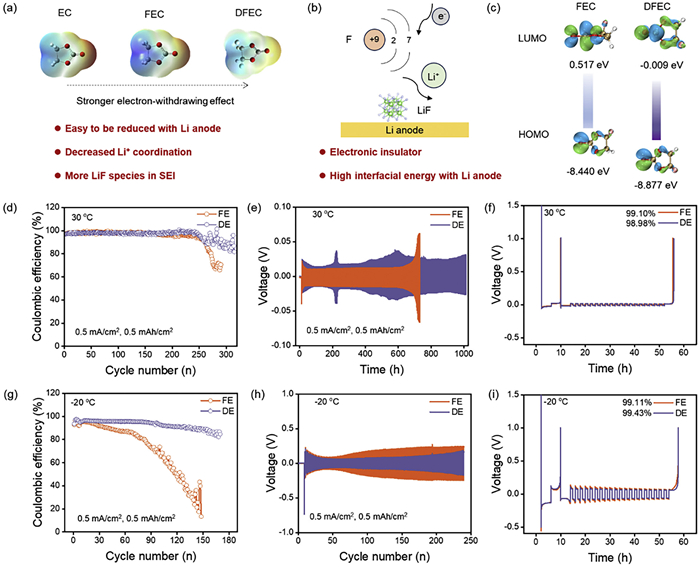
FEC and DFEC are fluorinated derivatives of ethylene carbonate (EC), and their fluorination effects are mainly reflected in two aspects. Firstly, due to the electron-withdrawing effect (I-) of F atoms, the electron cloud of the fluorinated solvent will change, endowing it with a stronger ability to gain electrons (e-) [17,18]. This characteristic enables the fluorinated solvent to undergo reduction reactions on the surface of the Li anode prior to other solvents, forming an interfacial protective film (Fig. 1a). Generally speaking, for solvents with the same molecular structure, the higher degree of fluorination, the faster the corresponding reduction reaction kinetics [8]. Secondly, the LiF produced by the reduction and decomposition of the fluorinated solvent on the surface of the Li anode is an electronic insulator, which has a high interfacial energy with the Li anode and can inhibit the growth of Li dendrites (Fig. 1b) [19,20]. To deeply explore the electrochemical performance of FEC and DFEC under different temperatures, we first summarized the physicochemical properties of FEC and DFEC. As shown in Fig. S1 (Supporting information), DFEC exhibits a lower melting point (Mp) and viscosity than FEC, which is conducive to ion transport under low-temperature conditions. The molecular orbital energy data (Fig. 1c) show that DFEC has a lower LUMO and highest occupied molecular orbital (HOMO) energy than FEC, which suggests that it has a higher reduction reaction activity with Li metal, and the film-formation kinetics is more rapid. In our experiment, the traditional ether-based electrolyte (LiTFSI and LiNO3 in DOL/DME) is used as the base electrolyte and is named as PE electrolyte. The FE and DE electrolytes are prepared by introducing 10 vol% FEC and 10 vol% DFEC, respectively, and the FDE electrolyte is prepared by introducing 5% FEC and 5% DFEC.
Figure 1
Figure 1.
(a) The influence of the electron-induced effect of F atoms. (b) The F atom gains electrons and forms LiF with Li+. (c) HOMO and LUMO energy levels of FEC and DFEC. (d) Galvanostatic cycling performance of Li/Cu half cells with FE and DE electrolytes at 30 ℃. (e) Galvanostatic cycling performance of Li/Li symmetrical cells of FE and DE electrolytes at 30 ℃. (f) Li plating/stripping CE test at 30 ℃ via the method proposed by Adams et al., cycling for 20 cycles, 0.5 mA/cm2. (g) Galvanostatic cycling performance of Li/Cu half cells with FE and DE electrolytes at −20 ℃. (h) Galvanostatic cycling performance of Li/Li symmetrical cells of FE and DE electrolytes at −20 ℃. (i) Li plating/stripping CE test at −20 ℃ via the method proposed by Adams et al., cycling for 20 cycles, 0.5 mA/cm2.
Firstly, through the test of Li/Cu half cells, we systematically investigated the influence of temperature on the performance of additives on the Li anode. At a high temperature of 60 ℃ (Fig. S2 in Supporting information), the Li plating/stripping CE and cycle lifespan of the modified electrolyte are both inferior to those of the PE electrolyte, and the performance of FE is superior to that of FDE and DE. At 30 ℃ (Fig. S3 in Supporting information), the phenomenon reversed. The cycling performance and CE of FE, FDE, and DE electrolytes are significantly improved compared with PE. And DE shows better cycling stability, while FE has higher efficiency in the early cycles. The low-temperature working conditions revealed more significant changes, at −20 and −40 ℃ (Figs. S4 and S5 in Supporting information), the PE electrolyte could not operate. The introduction of FEC and DFEC significantly improved the low-temperature performance of the PE electrolyte. Among them, DE outperformed FE in both cycle performance and Li plating/stripping CE, and its stability advantage is greatly enhanced compared to 30 ℃. The above results show that the effects of FEC and DFEC on the performance of Li anodes are significantly temperature-dependent. FEC and DFEC are effective at medium and low temperatures, and DFEC exhibits more excellent performance at low temperatures than FEC.
To systematically investigate the temperature adaptability of FEC and DFEC, we conducted comprehensive studies at 30 and −20 ℃, where the additives are effective but their performance changed significantly. The effects of FE and DE electrolytes on the performance of Li anodes at different temperatures are systematically evaluated through Li/Cu half cells cycling tests, Li/Li symmetrical cell cycling tests, and Li plating/stripping CE tests. At 30 ℃ (Fig. 1d), the FE electrolyte exhibits a higher Li plating/stripping CE in the initial cycles, while DE shows better cycling stability. This result is consistent with our previous research results [13]. Meanwhile, the same phenomenon was also detected in the modification experiments of traditional ester electrolytes (1 mol/L LiPF6 in EC/DEC (1:1, by vol%)) by FEC and DFEC [12]. Furthermore, the data of the Li/Li symmetrical cells at 30 ℃ (Fig. 1e) show that the FE electrolyte exhibits a lower polarization voltage and nucleation overpotential, while the DE electrolyte shows a longer cycle lifespan. The local time curve shows that a large Li nucleation overpotential occurs in the DE electrolyte at the beginning of the cycle, and then gradually decreases (Fig. S6 in Supporting information). It is worth noting that this phenomenon also exists in traditional ester electrolytes modified by FEC and DFEC [12]. Furthermore, Li plating/stripping CE was tested via the method proposed by Adams et al. [21]. As shown in Fig. 1f, at 30 ℃, the Li plating/stripping CE of the FE electrolyte is 99.10%, slightly higher than 98.98% of the DE electrolyte. Meanwhile, the larger nucleation overpotential and overpotential phenomena observed in the DE electrolyte (Fig. S7 in Supporting information) are mutually confirmed with the results of Li/Li symmetrical batteries. In traditional ester electrolytes, the Li plating/stripping CE of the electrolytes modified by FEC and DFEC are 98.0% and 97.4% respectively [12], showing the same trend as that of ether electrolytes.
At −20 ℃, the performance of the electrolyte changes significantly compared with that at 30 ℃. PE electrolyte cannot work at low temperatures. The cycle data of the Li/Cu half cells (Fig. 1g) indicate that the DE electrolyte exhibits outstanding cycle stability, maintaining a stable cycle of over 150 cycles, while the FE electrolyte shows a continuous attenuation trend from the initial cycle. The cycle data of the Li/Li symmetrical battery (Fig. 1h) further reveal that the large Li nucleation overpotential and polarization voltage existing in DE at 30 ℃ disappear at −20 ℃, and both its Li nucleation overpotential and polarization voltage are lower than those of the FE electrolyte (Fig. S8 in Supporting information). For the Li plating/stripping CE test, the Coulombic efficiency (CE) of DE at −20 ℃ is 99.43%, significantly higher than that of FE (99.11%) (Fig. 1i). It is worth noting that the CE of both FE and DE electrolytes has increased compared with that of 30 ℃, and DE shows a lower polarization voltage and nucleation overpotential, which is consistent with the results of Li/Li symmetrical batteries (Fig. S9 in Supporting information). The data at −40 ℃ (Fig. S10 in Supporting information) further verify this phenomenon. The performance of Li/Cu half cells, Li/Li symmetrical battery, and Li plating/stripping CE (98.85%) of DE are all superior to those of FE (98.43%), and DE exhibits lower Li nucleation overpotential and polarization voltage than FE at −40 ℃. The parallel experimental data of Li/Cu half cells (Fig. S11 in Supporting information) further confirmed the reliability of the results.
Furthermore, Li anode performance was evaluated at higher current density of 1 mA/cm2 with an areal capacity of 1 mAh/cm2 under both 30 ℃ and −20 ℃ conditions (Figs. S12 and S13 in Supporting information). Li/Li symmetric cells and Li/Cu half cells exhibited trends consistent with those observed at 0.5 mA/cm2 and 0.5 mAh/cm2. At 30 ℃, FEC showed a higher CE for Li plating/stripping (99.26% vs. 98.97%), along with lower polarization voltage and nucleation overpotential, while DFEC delivered a longer cycle lifespan (Fig. S12). At −20 ℃, DFEC demonstrated superior performance across all metrics, including Li plating/stripping CE (99.36% vs. 98.33%), polarization voltage, nucleation overpotential, and cycling stability (Fig. S13).
Based on the above electrochemical data, we summarized the performance of FE and DE electrolytes on Li anodes at different temperatures. At 60 ℃, neither FEC nor DFEC can improve the performance of either electrolyte on Li anodes, and FEC shows better performance than DFEC. At 30 ℃, FEC and DFEC exhibit different performance advantages. Under low-temperature conditions (−20 and −40 ℃), DFEC demonstrates comprehensive advantages, including longer cycle lifespan, higher Li plating/stripping CE, lower polarization voltage, and lower Li nucleation overpotential. Furthermore, the performance improvement of DFEC at −20 ℃ is greater than that at −40 ℃. That might be because the extremely low temperature (−40 ℃) further inhibits the reduction kinetics of DFEC and FEC, resulting in a significant decline in the performance of both FE and DE electrolytes.
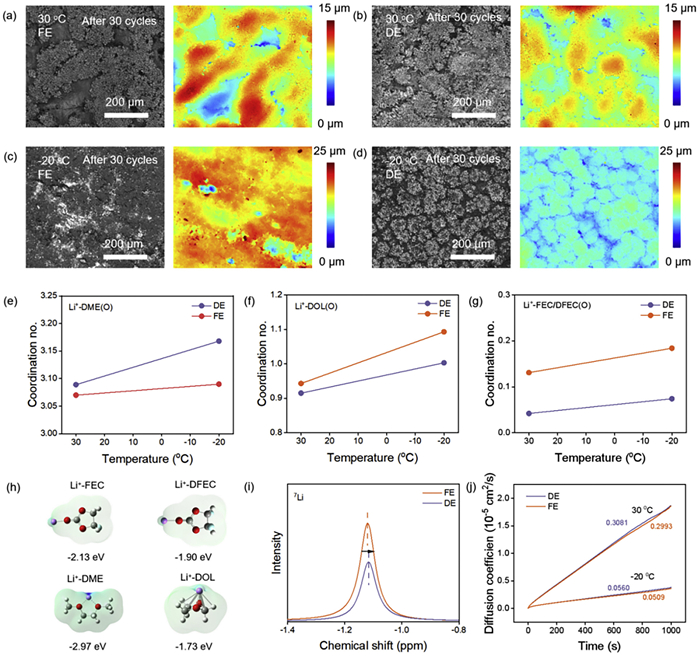
The Li plating/stripping behavior is closely related to the Li deposition morphology. To deeply explore the temperature adaptability of FEC and DFEC, we systematically characterized the Li deposition morphology of FE and DE electrolytes at 30 ℃ and −20 ℃ by using confocal laser microscopy (CLSM) and scanning electron microscopy (SEM). Firstly, a large-scale morphological analysis of Li deposition after 30 cycles is conducted through CLSM. As shown in Figs. 2a and b, at 30 ℃, the Li deposition formed in the DE electrolyte exhibits better density, with more uniform morphology distribution and thickness, but the difference from the FE electrolyte is relatively small, the corresponding 3D-mapping images are shown in Fig. S14 (Supporting information). This phenomenon corresponds to the cycle lifespan of Li/Cu half cells, where FE and DE differ little at 30 ℃. Higher-resolution SEM characterization (Fig. S15 in Supporting information) further confirms that the Li deposition morphology in the DE electrolyte is still slightly better than that in the FE electrolyte at the microscopic scale. At −20 ℃ (Figs. 2c and d), both FE and DE electrolytes exhibit a more uniform Li deposition distribution and better overall density than at 30 ℃. However, it is worth noting that under low-temperature conditions, the particle size of Li deposition significantly decreases, resulting in a decline in local compactness. In particular, the FE electrolyte shows a more severe powdering phenomenon at low temperatures, while the DE electrolyte maintains a relatively uniform and dense morphology, the corresponding 3D-mapping images are shown in Fig. S16 (Supporting information). The SEM images (Fig. S17 in Supporting information) clearly shows that compared with FE, the Li deposition formed in the DE electrolyte has better uniformity and density at the microscopic scale, and the deposition particle size is larger. That fully demonstrates the superiority of the DFEC over FEC in low-temperature environments.
Figure 2
Figure 2.
Two-dimensional (2D) laser and height maps of the cycled Li under 30 ℃ and −20 ℃ in different electrolytes performed by CLSM: (a) FE electrolyte at 30 ℃, color bars (0–15 µm), (b) DE electrolyte at 30 ℃, color bars (0 µm–15 µm), (c) FE electrolyte at −20 ℃, color bars (0–25 µm), and (d) DE electrolyte at −20 ℃, color bars (0–25 µm). The coordination numbers of Li+ with different solvents in the FE and DE electrolytes are obtained through MD simulations at 30 and −20 ℃: (e) Li+-DME(O), (f) Li+-DOL(O), (g) Li+-FEC/DFEC(O). (h) Binding energy between Li+ and solvents obtained by density functional theory (DFT), Li+-FEC, Li+-DFEC, Li+-DME, and Li+-DOL. (i) The 7Li NMR spectra of FE and DE electrolytes at 30 ℃. (j) Comparison of diffusion coefficients of the two electrolytes at 30 and −20 ℃ obtained by MD simulation.
The above morphological data indicate that under normal temperature conditions (30 ℃), the Li deposition morphology in the DE electrolyte is slightly better than that in the FE electrolyte. However, under low-temperature conditions (−20 ℃), the improvement effect of DE electrolyte on the Li deposition morphology is more significant than FE. This phenomenon is highly consistent with the test results of the cycle performance of Li/Cu half cells. From the perspective of the action mechanism, the influence of film-forming additives on the performance of Li anodes is mainly reflected in two key aspects: Firstly, there is the kinetic process of Li+ plating/stripping, including the diffusion coefficient (D) and Li+ desolvation, which is related to the solvation behavior of the electrolyte. The second is the reduction reaction of the additive on the surface of the Li anode, involving reaction kinetics, thermodynamics, and reduction products. In addition, it is worth noting that the thermal stability of the solvent will also significantly affect the film-forming process of the additive on the surface of the Li anode at different temperatures, especially at high temperatures. However, both the boiling points of DFEC and FEC are higher than 60 ℃. Moreover, due to the "synergistic stabilizing effect" of the double-fluorine substitution, the symmetrical structure of DFEC makes the electronic distribution of the entire molecule more balanced and more resistant to thermal decomposition. Therefore, DFEC has better thermal stability than FEC. However, at 60 ℃, the performance of DFEC is significantly inferior to that of FEC. Therefore, the temperature adaptability of DFEC and FEC is independent of the thermal stability of the additives.
Through molecular dynamics (MD) simulation, DFT calculation, liquid nuclear magnetic resonance (NMR), and Raman spectroscopy (Raman). We systematically investigated the effects of FEC and DFEC on the solvation structure of the electrolyte and the Li+ transport kinetics at different temperatures. The MD simulation results show (Figs. S18-S20 and Table S2 in Supporting information) that at 30 and −20 ℃, the coordination environments of the first solvation layer (≤2.95 Å) of Li+ in the FE and DE electrolytes exhibit similar temperature response trends. As the temperature decreases, the coordination number of Li+-solvent increases, and FE and DE show the same coordination trend of Li+-solvent at different temperatures, with small differences (Figs. 2e-g), which is consistent with the previous research [22]. At low temperatures, the thermal motion of solvent molecules weakened, and the entropy increase in the free energy of ion pairing is weak, resulting in a decrease in ion pairing and the interaction with Li+ strengthened, resulting in more solvent molecules entering the first solvation shell of Li+, and the coordination number increased accordingly. Compared with FE, at both 30 and −20 ℃, DE shows more Li+-DME (O) coordination, less Li+-DOL (O) coordination, and less Li+-FEC/DFEC (O) coordination. This might stem from the fact that the binding energy of DFEC with Li+ is weaker than that of FEC with Li+. Furthermore, we calculate the binding energy between Li+ and solvents through density functional theory (DFT). As shown in Fig. 2h, the binding energies between Li+ and FEC, DFEC, DME, and DOL are −2.13, −1.90, −2.97, and −1.73 eV, respectively. Combining the primary solvation coordination of Li+ and the binding energy between Li+ and solvents, we calculate the Li+ desolvation energy barrier of representative Li+ solvation structures (Fig. S21 in Supporting information). At 30 ℃, the Li+ desolvation energy barrier of DE electrolyte is slightly lower than that of FE, while at −20 ℃, it is slightly higher. However, the difference between FE and DE is not significant (< 0.05 eV) at both 30 and −20 ℃. This result is mutually confirmed with the 7Li NMR test data (Fig. 2i). Compared with FE, the chemical shift of the DE electrolyte only shows a slight upfield shift, confirming that the change in the electronic environment of Li+ is limited [23–25]. Raman spectroscopy measurements of FE and DE electrolytes at different temperatures further confirmed these findings (Fig. S22 in Supporting information). At low temperatures (−20 and −40 ℃), FE and DE exhibit more Li+-solvent(O) coordination than at 30 ℃, with relatively smaller variations, and the trends of their changes are the same. By comparison with FE and DE, the peak positions of Li+-solvent (O) at different temperatures are relatively similar, indicating that there are only subtle differences in the Li+ solvation structure between FE and DE electrolytes. The above data indicate that temperature has not led to essential differences in the Li+ desolvation kinetics between FE and DE electrolytes. Diffusion kinetics further revealed the effects of the additive (Fig. 2j). Although the DE electrolyte shows a slightly higher Li+ diffusion coefficient at both 30 and −20 ℃, the difference between DE and FE electrolyte (< 3%) is much smaller than the temperature-dependent difference in the performance of Li anodes between FE and DE electrolytes. Based on the multi-dimensional analysis of solvation structure, desolvation process, and Li+ transport kinetics. We think that the temperature adaptability differences between FEC and DFEC additives are independent of the influence of the introduction of FEC and DFEC on the solvation structure or Li+ transport kinetics.
Based on the Arrannius equation (K = Ae(-Ea/RT)) [26,27], temperature (T) is a key factor affecting the rate of physicochemical reactions, and temperature changes will influence the kinetic and thermodynamic behaviors inside the battery. Specifically, temperature generally affects the performance of LMBs in the following two aspects. (1) Temperature will change the migration behavior of Li+ [28]; (2) Temperature can alter the kinetic and thermodynamic processes of the interfacial reaction between electrolyte and Li anode [29]. This section focuses on interfacial reaction mechanisms. Temperature critically affects interfacial reactions by altering the reduction kinetics and pathways of both anions and solvents on the surface of the Li anode, resulting in substantial variations in the chemical composition and physical properties of the solid electrolyte interphase (SEI) under different thermal conditions. Under low-temperature conditions, the decomposition reactions of solvents and Li salt anions in the electrolyte are inhibited, which will lead to the accumulation of a large amount of intermediate decomposition products [29]. This change in reaction selectivity leads to an increase in the proportion of organic components in the SEI, while the inorganic components (such as LiF) relatively decrease. The changes of organic/inorganic components will hurt the transport of Li+ in the SEI, thereby inducing the uneven Li deposition and leading to the growth of Li dendrites.
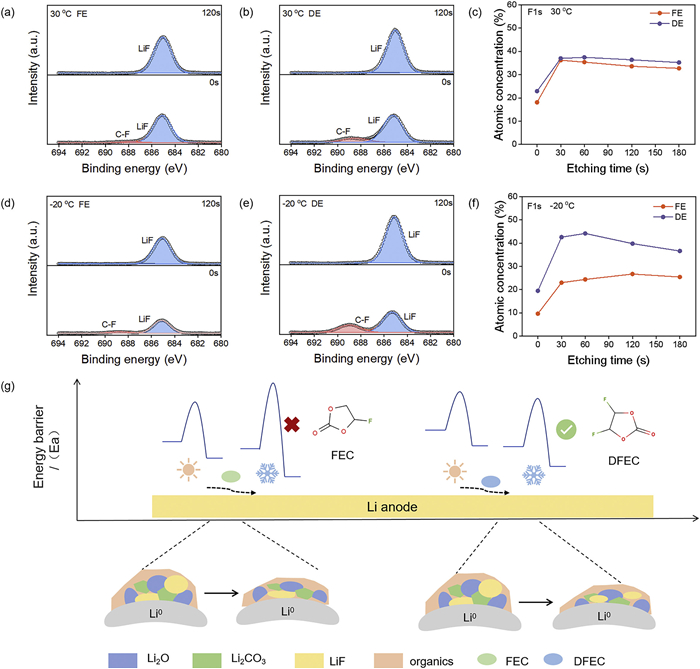
To deeply explore this phenomenon, X-ray photoelectron spectroscopy (XPS) was used to characterize the SEI formed in FE and DE electrolytes at 30 and −20 ℃. Since FEC and DFEC have the same molecular skeleton but different degrees of fluorination, we focus on analyzing the spectra and content of the two characteristic elements, F and C atoms. The XPS F 1s spectra of SEI formed at 30 ℃ (Figs. 3a and b) reveal that the content of LiF in the SEI formed in DE electrolyte is marginally higher than that in FE electrolyte, but the difference is not significant. This phenomenon is further verified by the graph of the variation of F element content with etching time (Fig. 3c). Combining the C 1s spectrum (Fig. S23 in Supporting information) and the graph of C element content varying with etching time (Fig. S24a in Supporting information), we find that the content of organic components in the SEI formed in the DE electrolyte is higher than that of FE. That might be due to the rapid decomposition of DFEC, generating more organic by-products while forming LiF. It is worth noting that although the F atom in DFEC is twice that of FEC, the LiF content in the SEI formed in FE and DE electrolytes is similar. This phenomenon might be due to the thermodynamically driven reduction decomposition reaction of DFEC on the Li anode at 30 ℃. Therefore, only part of DFEC is involved in the construction of SEI, resulting in the actual formed LiF content being comparable to that of FEC. The large amount of organic products generated by this fast reduction decomposition reaction will deteriorate the ionic conductivity of the SEI and the nucleation ability of Li deposition, which well explains the low Li plating/stripping CE and high Li nucleation overpotential exhibited by the DE electrolyte at 30 ℃. However, at −20 ℃, the SEI components formed in the FE and DE electrolytes undergo significant changes. The F 1s spectrum and the variation graph of F element with etching time (Figs. 3d-f) show that the content of F element or LiF in the SEI formed in the DE electrolyte is twice that of the FE electrolyte. And compared with 30 ℃, the contents of LiF and F in the SEI are almost the same, while that of FE is halved. This result indicates that DFEC has a better film-forming ability at low temperatures and more LiF is formed in SEI. This result indicates that DFEC forms more inorganic LiF substances than FEC at low temperatures and shows a more excellent film-forming ability. Furthermore, the C 1s spectrum and content variation graph in Figs. S25 and 24b (Supporting information) indicate that the organic components in the SEI formed in the FE electrolyte at low temperatures are more than those in DE. This might be because the film-formation process of FEC is inhibited by low temperatures, leading to the accumulation of more C-containing intermediate products. Due to the limited thermal decomposition reaction and the lower LUMO energy level, DFEC can selectively form a high-quality SEI rich in LiF and with a lower organic content at low temperatures. Thereby demonstrating superior cycle lifespan, Li plating/stripping CE, lower Li nucleation overpotential, and polarization voltage. Further, the composition of SEI was further observed by transmission electron microscopy (TEM). The results are shown in Fig. S26 (Supporting information). At 30 ℃, LiF, Li2CO3 and Li2O, and other inorganic components are detected in DE and FE, dispersed in amorphous organic components. While at −20 ℃, only LiF inorganic substances and a large amount of organic components are detected, and the LiF distribution shows unevenness.
Figure 3
Figure 3.
F 1s regions in XPS spectra of SEI on Li anode in (a) FE electrolyte and (b) DE electrolyte after 20 cycles at 0.5 mA/cm2 under 30 ℃. (c) The content of element F changes with the duration of etching of SEI formed in FE and DE under 30 ℃. F 1s regions in XPS spectra of SEI on Li anode in (d) FE electrolyte and (e) DE electrolyte after 20 cycles at 0.5 mA/cm2 under −20 ℃. (f) The content of element F changes with the duration of etching of SEI formed in FE and DE under −20 ℃. (g) A schematic diagram showing the content of LiF in the SEI formed by FE and DE electrolytes at 30 and −20 ℃.
Moreover, we characterized the SEI formed in DE and FE electrolytes at −40 ℃, and the results are shown in Fig. S27 (Supporting information). Results show that, compared with −20 ℃, the contents of LiF and F elements in the SEI formed in DE and FE decrease significantly, and the content of C elements increases. Although DE electrolyte till demonstrated more LiF products and less organic content than FE, its performance dropped sharply compared to −20 ℃. That indicates that the lower temperature (−40 ℃) further limits the film-forming ability of DFEC, and the low LUMO energy level of DFEC fails to compensate for its constrained reduction kinetics.
Based on the previous results of the Li/Cu half cells and the Li/Li symmetric cells, DE demonstrates superior cycling stability, attributed to its more stable LiF-rich SEI. The enhanced stability is likely related to the mechanical properties, uniformity, and ion transport performance of the SEI. Therefore, we further examined the mechanical characteristics, homogeneity, and ion transport performance of SEI formed in different electrolytes at varying temperatures. As shown in Fig. S28 (Supporting information), DE exhibits higher mechanical strength than FE, consistent with its higher LiF content, an inorganic component known to enhance mechanical robustness. At −20 ℃, the Young’s modulus of the SEI was lower than at 30 ℃. This reduction is due to inhibited electrolyte reduction at low temperatures, leading to a higher proportion of organic components and a decrease in inorganic content (as supported by XPS data), thereby lowering the overall modulus of the SEI. Furthermore, energy dispersive X-ray spectroscopy (EDS) mapping via SEM and TEM was used to analyze the elemental distribution of the SEI [30]. The results indicate that DE and FE exhibit similar uniformity at 30 ℃. In contrast, at −20 ℃, DE shows significantly better uniformity than FE (Figs. S29 and S30 in Supporting information).
To further probe SEI properties, linear sweep voltammetry (LSV) is performed on Li/Li symmetric cells after 20 cycles at various temperatures, with corresponding Tafel plots derived as shown in Fig. S31 (Supporting information). The results demonstrate that the exchange current density (I0) of FE-derived SEI exceeds that of DE at 30 ℃, while this trend reverses at −20 ℃, consistent with the aforementioned SEI compositional variations. Subsequent EIS test also confirmed the differences in the ion transport properties of the electrode/electrolyte interface in DE and FE (Fig. S32 in Supporting information). Results indicate that: (1) The impedance of the SEI formed at −20 ℃ is lower; (2) Compared with the FE and DE electrolytes, the impedance of the SEI formed by FE at 30 ℃ is lower than that of the DE electrolyte, while the impedance of the SEI (Rsei) formed in FE at −20 ℃ was higher than that of the DE electrolyte; (3) The difference in the charge transfer impedance (Rct) between FE and DE is not significant. This confirmed that the differences between FE and DE at 30 and −20 ℃ were more related to the performance of the SEI.
Furthermore, we fitted the EIS data obtained at different temperatures to obtain the activation energies (Ea) corresponding to the formation of the SEI and ion transport (Fig. S33 in Supporting information). Fig. S33a indicates that there is a small difference in the Ea of Rct. The values of FE and DE are −43.853 and −39.657 kJ/mol, respectively, suggesting that DE has better transport performance, which may be attributed to a lower Li+ desolvation energy barrier. Fig. S33b shows that the Ea of the SEI formed by these two electrolytes at 30 ℃ does not show a significant difference. The values of FE and DE are −34.004 and −34.436 kJ/mol, respectively. FE exhibits better interface transport performance. Fig. S33c shows that the Ea of the SEI formed by these two electrolytes at −20 ℃ also does not show a significant difference. The values of FE and DE are −20.785 and −19.369 kJ/mol, respectively. DE exhibits better interface transport performance, which is consistent with the results of the Tafel plot. The above analyses of SEI effectively explain the differences in electrochemical performance of these two electrolytes under temperature variations.
By systematically studying the composition and property changes of SEI at 30 and −20 ℃, we find that temperature significantly regulates the content of LiF and the proportion of organic components in SEI (Fig. 3g). And these changes are highly correlated with the temperature dependence of the electrochemical performance of the Li anode. In conclusion, we conclude that the temperature adaptability differences of FEC and DFEC additives mainly result from the alterations in their interfacial chemical properties (such as the SEI formation mechanism), rather than changes in the solvation structure or Li+ transport characteristics.
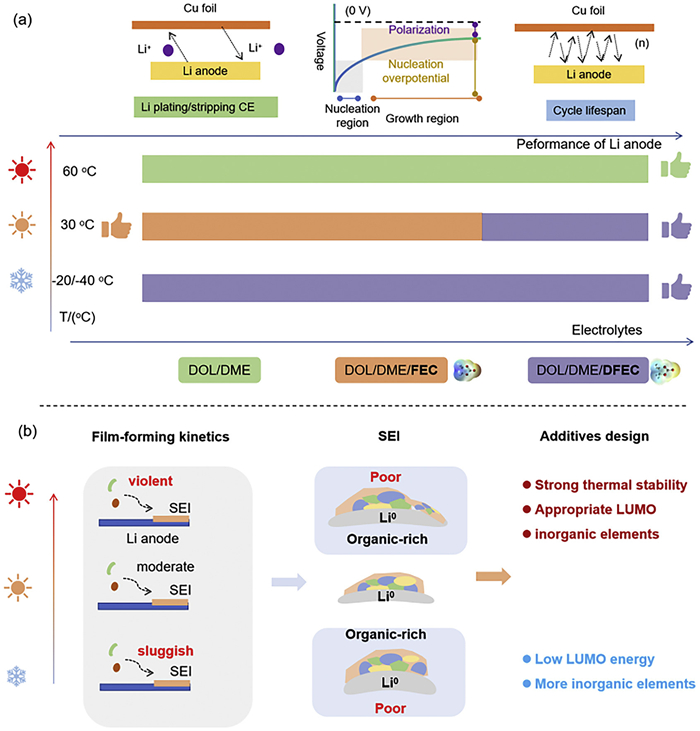
As shown in Fig. 4a, the performance of DFEC is better at low temperatures, while that of FEC is better at normal temperatures. However, both will experience performance degradation at high temperatures. Furthermore, our research has confirmed that this phenomenon mainly results from alterations in their interfacial chemical properties (such as the mechanism of SEI formation), rather than changes in the solvation structure, Li+ transport characteristics, and the thermal stability of the additives. Therefore, through the research on the temperature-adaptability of FEC and DFEC to the performance of Li anodes. We can draw the following important conclusion that the F-substituted EC as film-forming additives exhibit different properties at different temperatures, mainly attributed to their reaction kinetics, thermodynamics, and the composition of the reduction products. The performance of film-forming additives is jointly influenced by their structure and external factors. For the anode, the appropriate film-forming additive should contain some inorganic elements and have a relatively low LUMO energy level. That not only enables priority reduction on the surface of anode but also allows the reduction of inorganic elements to increase the content of inorganic components in the SEI, thereby facilitating uniform Li deposition. This determines the thermal stability of the additive, the film-forming kinetics, and the chemical composition of the SEI. However, an excessively low LUMO energy may also have negative impacts: It will increase its reaction kinetics with the Li anode, which may lead to premature deactivation of the additive and the formation of an uneven SEI.
Figure 4
Figure 4.
(a) Summary of temperature adaptability performance of FEC and DFEC. (b) The changes of electrolyte and its related physical and chemical properties at different temperatures, as well as the selection indicators of film-forming additives at each temperature.
Secondly, according to the Arrhenius equation, K = Ae(-Ea/RT), temperature has a decisive influence on the reaction kinetics of film-forming additives. Under low-temperature conditions, the weakening of reaction kinetics will lead to incomplete decomposition of film-forming additives, resulting in an increase in organic components and a decrease in inorganic components in the SEI. However, it is worth noting that a low-temperature environment can effectively suppress the side reactions between the Li anode and electrolyte, thereby enhancing the compatibility between the electrolyte and Li anode. High temperatures can significantly accelerate the reaction rate, causing the film-forming additives to decompose too quickly, and even some additives may undergo thermal decomposition. This rapid decomposition or thermal decomposition will generate a large amount of organic products, reducing the film-forming effect and the uniformity of the SEI. That further triggers the continuous decomposition of the electrolyte and leads to adverse changes in the composition and structure of the SEI, ultimately affecting the electrochemical performance of the batteries. Based on the literatures and our research, we propose the selection strategy for film-forming additives for low or high temperatures (Fig. 4b). At low temperatures, film-forming additives with low LUMO energy and multiple inorganic elements should be chosen, which can balance the kinetic limitations brought by low temperatures and form an inorganic-rich SEI. For additives for high temperatures, in order to prevent the rapid decomposition of additives, additives with an appropriate degree of fluorination should be selected to balance the content of organic/inorganic products in the thermodynamic-driven SEI. Furthermore, it is more necessary to choose those with strong thermal stability to prevent thermal decomposition and damage to battery performance.
In conclusion, we select FEC and DFEC, which have similar structures but different degrees of fluorination to systematically investigate their temperature adaptability characteristics as the electrolyte additives for Li metal batteries. Results show that FEC and DFEC exhibit significant performance differences for Li metal anode under different temperature conditions. At a high-temperature environment (60 ℃), the introduction of additives instead reduces the cycling performance of Li anodes, and DFEC with more F atom shows worse performance than FEC. When the temperature drops to 30 ℃, the additives begin to show positive effects. DFEC exhibits superior cycling stability, while FEC has a lower Li nucleation overpotential, polarization voltage, and higher Li plating/stripping CE. At lower temperature conditions (−20 and −40 ℃), the improvement of additives on the cycling performance of Li anode is more significant. DFEC shows comprehensive advantages over FEC in multiple key performance indicators, including Li plating/stripping CE, Li nucleation overpotential, polarization voltage, and cycle lifespan. Based on the above experimental results, we reveal that there are significant differences in temperature adaptability among film-forming additives, and each additive has its optimal working temperature range. Further mechanism studies have shown that the temperature dependence of the performance differences between FEC and DFEC mainly stems from the sensitivity of their interfacial chemical behaviors (especially the SEI formation mechanism) to temperature, rather than changes in the solvation structure or the Li+ transport characteristics. This significant discovery provides new theoretical guidance for the design of wide-temperature-range electrolytes: On the basis of optimizing the solvation structure, the temperature response characteristics of additives at the electrode/electrolyte interface should be given particular attention. Precisely regulating the composition and structural features of the SEI is the key to achieving stable operation of wide temperature range LMBs.
The authors declare that they have no known competing financial interests or personal relationships that could have appeared to influence the work reported in this paper.
Acknowledgments
This work was supported by the National Natural Science Foundation of China (No. 92372128), Taishan Young Scholar Program (No. tsqn202312312), and Excellent Young Scholars of the Shandong Provincial Natural Science Foundation (Overseas) (No. 2023HWYQ-112).
Supplementary materials
Supplementary material associated with this article can be found, in the online version, at doi:10.1016/j.cclet.2026.112535.
C. Ma, D. Hou, J. Jiang, et al., Adv. Sci. 9 (2022) 2204837. doi: 10.1002/advs.202204837
Figure 1
(a) The influence of the electron-induced effect of F atoms. (b) The F atom gains electrons and forms LiF with Li+. (c) HOMO and LUMO energy levels of FEC and DFEC. (d) Galvanostatic cycling performance of Li/Cu half cells with FE and DE electrolytes at 30 ℃. (e) Galvanostatic cycling performance of Li/Li symmetrical cells of FE and DE electrolytes at 30 ℃. (f) Li plating/stripping CE test at 30 ℃ via the method proposed by Adams et al., cycling for 20 cycles, 0.5 mA/cm2. (g) Galvanostatic cycling performance of Li/Cu half cells with FE and DE electrolytes at −20 ℃. (h) Galvanostatic cycling performance of Li/Li symmetrical cells of FE and DE electrolytes at −20 ℃. (i) Li plating/stripping CE test at −20 ℃ via the method proposed by Adams et al., cycling for 20 cycles, 0.5 mA/cm2.
Figure 2
Two-dimensional (2D) laser and height maps of the cycled Li under 30 ℃ and −20 ℃ in different electrolytes performed by CLSM: (a) FE electrolyte at 30 ℃, color bars (0–15 µm), (b) DE electrolyte at 30 ℃, color bars (0 µm–15 µm), (c) FE electrolyte at −20 ℃, color bars (0–25 µm), and (d) DE electrolyte at −20 ℃, color bars (0–25 µm). The coordination numbers of Li+ with different solvents in the FE and DE electrolytes are obtained through MD simulations at 30 and −20 ℃: (e) Li+-DME(O), (f) Li+-DOL(O), (g) Li+-FEC/DFEC(O). (h) Binding energy between Li+ and solvents obtained by density functional theory (DFT), Li+-FEC, Li+-DFEC, Li+-DME, and Li+-DOL. (i) The 7Li NMR spectra of FE and DE electrolytes at 30 ℃. (j) Comparison of diffusion coefficients of the two electrolytes at 30 and −20 ℃ obtained by MD simulation.
Figure 3
F 1s regions in XPS spectra of SEI on Li anode in (a) FE electrolyte and (b) DE electrolyte after 20 cycles at 0.5 mA/cm2 under 30 ℃. (c) The content of element F changes with the duration of etching of SEI formed in FE and DE under 30 ℃. F 1s regions in XPS spectra of SEI on Li anode in (d) FE electrolyte and (e) DE electrolyte after 20 cycles at 0.5 mA/cm2 under −20 ℃. (f) The content of element F changes with the duration of etching of SEI formed in FE and DE under −20 ℃. (g) A schematic diagram showing the content of LiF in the SEI formed by FE and DE electrolytes at 30 and −20 ℃.
Figure 4
(a) Summary of temperature adaptability performance of FEC and DFEC. (b) The changes of electrolyte and its related physical and chemical properties at different temperatures, as well as the selection indicators of film-forming additives at each temperature.


 DownLoad:

 下载:


 下载:

