Citation:
Jianing Liu, Qian Zhang, Cong Su, Songyang Sui, Changkang Li, Ridao Chen, Dawei Chen, Jimei Liu, Jungui Dai, Kebo Xie. Identification of a BBE-like enzyme involved in the biosynthesis of pyranocoumarins and its catalytic mechanism in the pyran ring formation[J]. Chinese Chemical Letters,
2026, 37(10): 112531.
doi:
10.1016/j.cclet.2026.112531
Identification of a BBE-like enzyme involved in the biosynthesis of pyranocoumarins and its catalytic mechanism in the pyran ring formation
English
Identification of a BBE-like enzyme involved in the biosynthesis of pyranocoumarins and its catalytic mechanism in the pyran ring formation
State Key Laboratory of Bioactive Substance and Function of Natural Medicines, NHC Key Laboratory of Biosynthesis of Natural Products, CAMS Key Laboratory of Enzyme and Biocatalysis of Natural Drugs, Institute of Materia Medica, Chinese Academy of Medical Sciences & Peking Union Medical College, Beijing 100050, China
* Corresponding author. E-mail address: keboxie@imm.ac.cn (K. Xie). 1 These authors contributed equally to this work.
Received Date:
06 November 2025 Accepted Date:
13 February 2026 Revised Date:
12 February 2026 Available Online:
15 October 2026
Abstract:
Pyranocoumarins are a characteristic class of pyranophenolic compounds predominantly found in plants of the Moraceae, Umbelliferae, and Rutaceae families. These pyranophenolics not only exhibit diverse physiological activities, but also have a wide range of pharmacological activities such as anti-cancer, anti-spasmatic, and anticoagulant. However, the biosynthetic mechanism of pyranocoumarins, especially the formation mechanism of the pyran core in the final step, remains unclear. It was hypothesized the pyran core is formed by dehydration of decursinol after oxidation and cyclization of demethylsuberosin. Here we characterized a berberine bridge enzyme (BBE)-like enzyme namely FcBBElike4 from Ficus carica. FcBBElike4 could catalyze direct cyclization of 6- and 8-isoprenyl coumarins into corresponding pyranocoumarins, which functionally characterized as an oxidocyclase (OC). This finding elucidated the final step in the biosynthetic pathway for pyranocoumarins. The catalytic mechanism of FcBBElike4 was investigated and a general key active site of aspartic acid residue determining the cyclization activity of BBE-like enzymes was identified. Diverse BBE-like enzymes with diene synthesis activities were mined and further engineered into rare OCs with high catalytic activity and broad substrate spectra. What is more, an enzymatic approach to synthesize pyranophenolics was constructed based on engineered OCs and applied in the synthesis of drug molecules. This study not only elucidates the key biosynthetic steps of pyranocoumarins but also offers insights into engineering common BBE-like enzymes into rare and useful OCs.
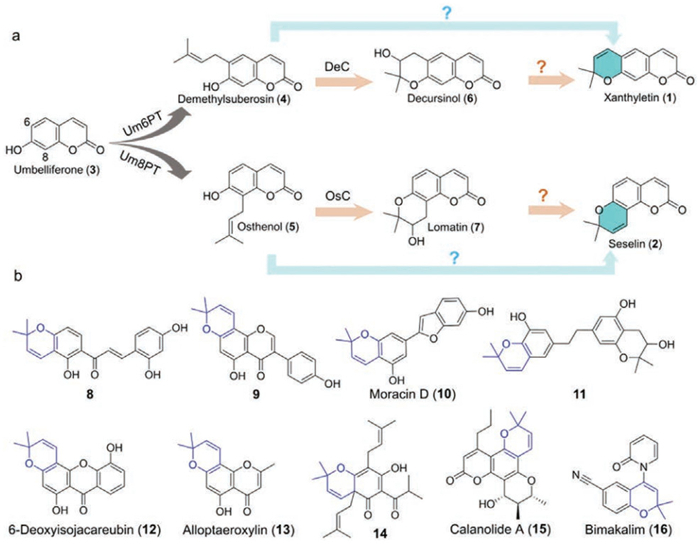
Pyranocoumarins, represented by xanthyletin (1) and seselin (2), constitute a prominent class of pyranophenolics predominantly isolated from plants of the Moraceae, Umbelliferae, and Rutaceae families [1–4]. These compounds are characterized by a fused benzopyran core structure (Fig. 1a). Notably, their unique bioactivity profiles, including cytotoxic effects against leukemia cells and antimicrobial properties, demonstrate great application value in the pharmaceuticals, agrochemicals, food, and cosmetic industries [4–6]. In addition to pyranocoumarins, structurally diverse pyranophenolics exist in nature, such as pyrano-flavonoids (8, 9), pyrano-stilbenes (10), pyrano-bibenzyls (11), pyrano-xanthones (12), pyrano-chromones (13) and pyrano-acylphloroglucinols (14) (Fig. 1b) [7–17]. The benzopyran scaffold is also a key structural motif in many clinical drugs, exemplified by calanolide A (15) (an anti-human immunodeficiency virus (anti-HIV) agent) and bimakalim (16) (a potassium channel opener) [18–21]. The increasing demand for bioactive pyranophenolics promotes research on establishing sustainable supply approaches for pyranophenolics.
Figure 1
Figure 1.
Proposed biosynthetic pathways of pyranocoumarins and structural types of representative pyranophenolics. (a) Proposed biosynthetic pathways of xanthyletin (1) and seselin (2) from umbelliferone (3). (b) Representative structural types of bioactive natural (8–15) and unnatural (16) pyranophenolics.
Biosynthesis is considered to be a promising alternative route to obtain pyranophenolic compounds. To elucidate the biosynthetic pathway of pyranocoumarins, extensive research has been conducted, and the biosynthetic pathway has been partially elucidated [22–25]. Umbelliferone (3) is firstly prenylated by an umbelliferone 6-prenyltransferase (Um6PT) and an umbelliferone 8-prenyltransferase (Um8PT) to generate demethylsuberosin (4) and osthenol (5), respectively (Fig. 1a). Then demethylsuberosin (4) and osthenol (5) are further catalyzed by two CYP450s namely demethylsuberosin cyclase (DeC) and osthenol cyclase (OsC) to form decursinol (6) and lomatin (7), respectively. The key biosynthetic enzymes including Um6PT, Um8PT, DeC and OsC have been identified from different medical plants [22–25]. However, the last step of the proposed biosynthetic pathway of xanthyletin (1) and seselin (2) is unclear. It was hypothesized the pyran core is formed by dehydration of 6 and 7 after oxidative cyclization of 4 and 5 [1]. Taking inspiration from the reports that plant berberine bridge enzyme (BBE)-like enzymes mediate the formation of pyran cores in cannabichromene (CBC), daurochromenic acid (DCA), and moracin D by direct cyclization of corresponding prenylated phenolics [26–28]. Therefore, it involves two potential formation mechanisms that the pyran rings are formed via dehydration of decursinol (6) and lomatin (7) (the light brown pathway, Fig. 1a) or direct cyclization of demethylsuberosin (4) and osthenol (5) (the light blue pathway, Fig. 1a).
In the present work, we characterized a BBE-like enzyme namely FcBBElike4 from Ficus carica, which could catalyze the direct cyclization of 6- and 8-isoprenyl coumarins (4, 5) into pyranocoumarins (1, 2). The catalytic mechanism of FcBBElike4 was elucidated and a general key aspartic acid (Asp) residue controlling the cyclization activity of BBE-like enzymes was identified. By a single-point mutation strategy, diverse BBE-like enzymes with the function for diene synthesis were engineered into rare oxidocyclases (OCs) with high catalytic activity and broad substrate spectra. What is more, an enzymatic approach to synthesize structurally diverse pyranophenolics was constructed by combining substate promiscuous PTs and OCs.
Xanthyletin (1) and seselin (2) are characteristic pyranocoumarins compounds found in Ficus genus, Moraceae family. Interestingly, various types of pyranophenolics have also been widely found in other genera of Moraceae, such as Morus, Artocarpus, Maclura, Broussonetia and Fatoua. The structural types of pyranophenolics not only encompass pyranocoumarins but also include pyranostilbenes, pyranchalcones and pyranoflavones. Recently, a BBE-like enzyme (MaOC1) from Morus alba (white mulberry) was reported to catalyze the cyclization of prenylated stilbenes [28]. MaOC1, as an OC, forms an independent evolutionary clade in the phylogenetic analysis of BBE-like enzymes including Diels-Alderases (DAases) and diene synthases (DSs) from M. alba [28]. This MaOC1 evolutionary branch may help us search for new OCs from other genera within the Moraceae family. Therefore, we speculated that BBE-like enzymes that belong to the same evolutionary branch as MaOC1 may be the coumarin OCs catalyzing the cyclization of prenylated coumarins.
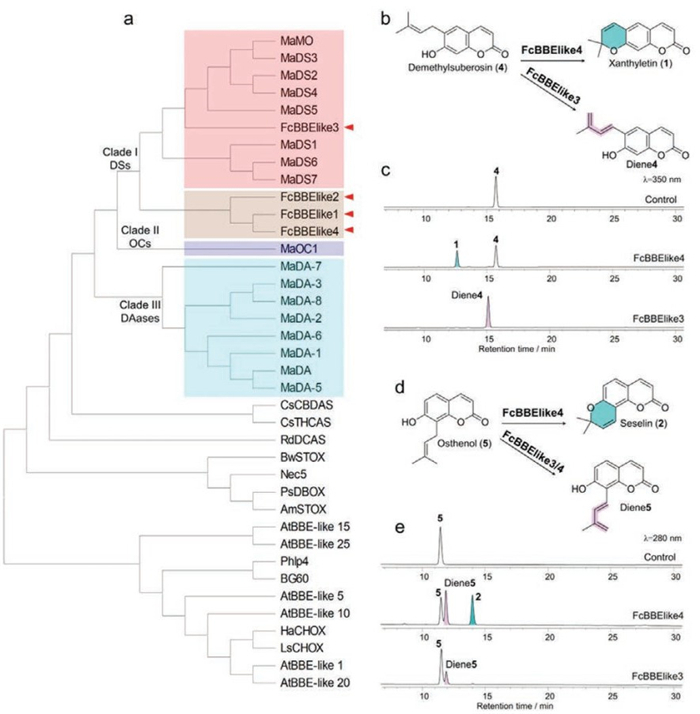
F. carica, as a typical medicinal Ficus plant with available genomic information on NCBI database (https://www.ncbi.nlm.nih.gov/datasets/genome/?taxon=3494), was selected to identify new coumarin OCs. Based on the genomic information (Table S2 in Supporting information), candidate genes annotated as BBE-like enzymes were screened and phylogenetically analyzed. In the phylogenetical tree, four candidate BBE-like enzymes (FcBBElike1–4) shared close evolutionary relationships with DAases, DSs, and OCs from M. alba (Fig. 2a). However, none of the four BBE-like enzymes was located within the evolutionary clade of MaOC1. FcBBElike1, FcBBElike2 and FcBBElike4 form an independent evolutionary clade. FcBBElike3 is positioned within the DSs clade. Although there is no candidate OC from F. carica located in the MaOC1 clade, FcBBElike1–4 and MaOC1 are from the same ancestor. So, the coding genes of FcBBElike1–4 were cloned from the cDNA of F. carica leaves. Their encoded proteins were heterogeneously expressed in baculovirus-mediated insect cell expression system and purified by affinity chromatography. Then, demethylsuberosin (4) and osthenol (5) were used as substrates to test the catalytic activities of FcBBElike1–4. High-performance liquid chromatography and mass spectrometry (HPLC-MS) analysis demonstrated that FcBBElike4 could catalyze the oxidative cyclization of demethylsuberosin (4) to generate xanthyletin (1) (Figs. 2b and c). For osthenol (5), FcBBElike4 exhibited both oxidative cyclization and diene synthesis activities generating seselin (2) and diene5 (Figs. 2d and e). Therefore, FcBBElike4 was a bifunctional enzyme involved in the last biosynthetic step of pyranocoumarins. FcBBElike1 and FcBBElike2 showed no catalytic activity to both demethylsuberosin (4) and osthenol (5). However, FcBBElike3 exhibited specific diene synthesis activity to 4 and 5, which is characterized as a DS. The enzymatic products xanthyletin (1), seselin (2), diene4 and diene5 were prepared by scale-up reactions and their structures were confirmed by MS and nuclear magnetic resonance (NMR) (Figs. S1–S18, S35 and S36 in Supporting information).
Figure 2
Figure 2.
Functional characterization of FcBBElike3 and FcBBElike4. (a) Phylogenetic analysis of BBE-like enzymes from F. carica and DSs (light red), FAD-dependent OCs (light purple), DAases (light blue) in Morus alba as well as other representative identified BBE-like enzymes from different species. (b, c) Reactions catalyzed by FcBBElike3 and FcBBElike4 with demethylsuberosin (4) as the substrate. (d, e) Reactions catalyzed by FcBBElike3 and FcBBElike4 with osthenol (5) as the substrate. FcBBElike4 not only could synthesize xanthyletin (1) and seselin (2) but also showed DS activity. The evolutionary history was inferred using the neighbor-joining method. All the NCBI accession numbers of the representative plant BBE-like enzymes can be found in Supporting information. Evolutionary analyses were performed in MEGA7.
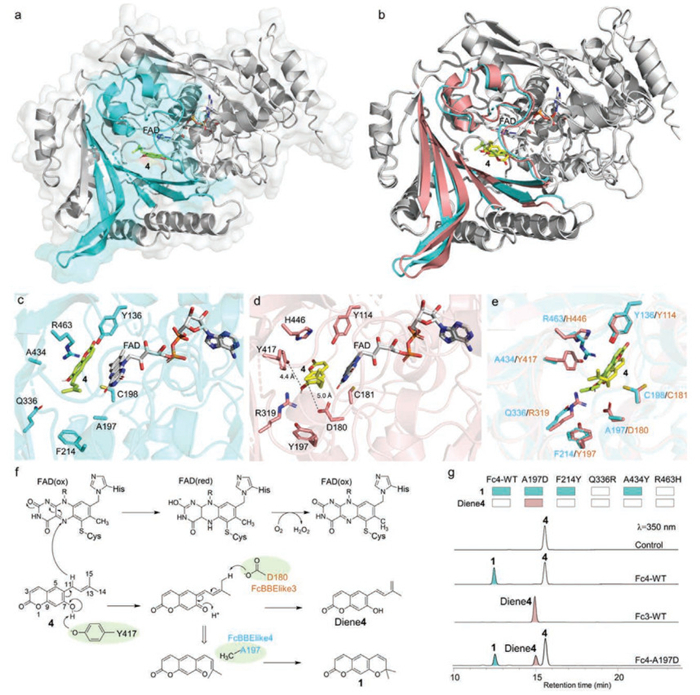
Generally, pyranophenolic OCs are sparsely characterized in plants and often exhibit insufficient substrate promiscuity. Elucidating the mechanistic basis of their functional divergence is helpful to discover and construct new OCs. FcBBElike3 and FcBBElike4 showed a high degree of homology (identity 66%) while their catalytic functions are different. To elucidate the mechanism underlying the functional divergence, a comprehensive structural analysis including primary sequence alignment, secondary structure profiling, and tertiary structural modeling was conducted on FcBBElike3 and FcBBElike4. Firstly, AlphaFold2 was employed to predict the structures of FcBBElike3 and FcBBElike4 (Figs. 3a and b). Then, molecular docking was performed with demethylsuberosin (4) using AutoDock Vina and further validated by molecular dynamics simulations (Figs. S53 and S54 in Supporting information). Comparative analysis of the protein structures revealed FcBBElike3 and FcBBElike4 shared a characteristic overall fold with BBE-like enzymes. Specifically, their substrate-binding pockets possess six β-sheets, one α-helix and two loops (Figs. 3a and b). A cofactor flavin adenine dinucleotide (FAD) is adjacent to the substrate-binding pocket.
Figure 3
Figure 3.
Identification of the key active sites of FcBBElike3 and FcBBElike4. (a) The structure of FcBBElike4. (b) The superposition of the protein structures of FcBBElike3 (salmon) and FcBBElike4 (cyans), and their binding pockets were indicated. (c) The amino acid residues in the substrate binding pocket of FcBBElike4. (d) The amino acid residues in the substrate binding pocket of FcBBElike3. (e) The superposition of the residues in the binding pockets of FcBBElike3 and FcBBElike4. (f) The proposed catalytic mechanism of FcBBElike3 and FcBBElike4 in catalyzing demethylsuberosin (4). (g) Catalytic activities of the FcBBElike4 mutants and HPLC analysis of the reactions catalyzed by Fc4-WT, Fc3-WT and Fc4-A197D.
According to the docking results, in the substrate-binding pocket of FcBBElike4, seven key amino acid residues including Y136, A197, C198, F214, Q336, A434 and R463 are located within 5 Å of the substrate (Fig. 3c). Similarly, seven amino acid residues including Y114, D180, C181, Y197, R319, Y417 and H446 are in close proximity to the substrate in the substrate-binding pocket of FcBBElike3 (Fig. 3d). The structure superposition of FcBBElike3 and FcBBElike4 revealed a high degree of complementarity between the binding cavities and the seven residues aligned perfectly in each enzyme (Fig. 3e). Two (Y136/Y114 and C198/C181) of the seven residues are identical, while the remaining five (A197/D180, F214/Y197, Q336/R319, A434/Y417 and R463/H446) differ. So, these five amino acid residues are postulated to constitute critical determinants underlying functional divergence of FcBBElike3 and FcBBElike4. In FcBBElike3, the substrate binding is likely facilitated by Y417 and R319, which can form hydrogen-bonding interactions with the phenol group of the substrate (Fig. 3d). In addition, hydrophobic interactions between the residues (Y116, H446, and Y197) and the substrate can contribute to the substrate binding (Fig. 3d). C181 was one of the conversed residues covalently bound to FAD. Generally, in BBE-like enzyme catalyzing reactions, FAD is acted as the catalytic center to assist hydride transfer to the N5 position of the isoalloxazine ring [29,30]. The N5 atom of FAD accepts the hydride transferred from the C11 position of demethylsuberosin (4). In the active cavity of FcBBElike3, Y417 interacts with the 7–hydroxy group of demethylsuberosin (4) to withdraw the active proton. D180 interacts with the hydrogen on the methyl group of 4, which is also one of the five different residues with FcBBElike4. Therefore, it is hypothesized that D180 act as a catalytic base to withdraw a proton from the hydrogen on the methyl group of 4 to produce diene4 (Fig. 3f).
Based on the above hypothesis, we mutated the five candidate residues (A197, F214, Q336, A434 and R463) in FcBBElike4 to corresponding residues (D180, Y197, R319, Y417 and H446) of FcBBElike3. These five mutants namely Fc4-A197D, F214Y, Q336R, A434Y and R463H were constructed and purified. Their enzymatic activities were assayed by monitoring the conversion of 4 to diene4 and 1. The HPLC-MS analysis revealed that only A197D brought the DS activity into FcBBElike4 (Fig. 3g). The conserved Asp residue acts as a catalytic base to abstract a hydrogen from the substrate. After FAD abstracts a hydride ion from demethylsuberosin (4) to form an allylic carbocation, Asp abstracts a proton from the methyl group driving the reaction towards the formation of dienes. Therefore, a single key Asp residue that controls the activities of FcBBElike3 and FcBBElike4 was identified.
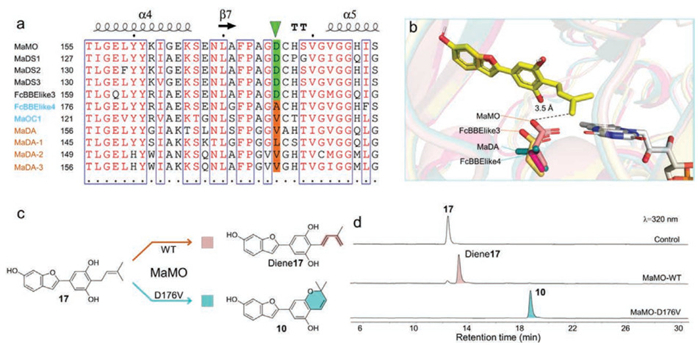
DSs from Moraceae plants form a distinct independent evolutionary branch leading to the discovery of various DSs. However, due to the poor correlation between evolutionary branches and functions, very few OCs have been discovered. The identification of this key Asp residue is of significance for protein engineering in obtaining OCs in construction of pyran rings. At first, we tried to mutate the residue Asp180 in FcBBElike3 to the corresponding residue Ala197 of FcBBElike4. However, the mutant Fc3-D180A was not functionally expressed. Given Asp180 in FcBBElike3 is crucial for the formation of diene, there should be a highly conserved Asp residue adjacent to the isoprenyl group in the binding pocket of other DSs. Therefore, we conducted a multiple sequence alignment analysis of the DSs, OCs, and DAases that have been identified from M. alba. The analysis results are consistent with our hypothesis that all DSs possess a highly conserved Asp residue, which is the same as Asp180 in FcBBElike3. Differently, the corresponding sites in DAases are occupied by non-polar amino acid residues such as Ala, Val and Leu (Fig. 4a).
Figure 4
Figure 4.
Switch the diene synthesis activity of DSs to oxidocyclization activity. (a) Alignment of amino acid sequences around the conserved Asp residue in DSs, OCs and DAases. (b) The conversed Asp residue of MaMO (D176) and FcBBElike3 (D180) are closely adjacent (3.5 Å) to C5 of the isoprenyl group of moracin C (17). (c) The reactions catalyzed by MaMO and MaMO-D176V with moracin C (17). (d) The corresponding HPLC detection spectra of the reactions.
The structures of BBE-like enzymes including MaDA (6JQH) [31] and MaMO (predicted by AlphaFold2) were also employed to the structural alignment. The conserved Asp residue in the primary sequence is also highly conserved in terms of its spatial position within the active cavity of the protein structures, closely adjacent (3.5 Å) to C5 of the isoprenyl group (Fig. 4b). Asp acts as a catalytic base, abstracting a proton from the methyl group, driving the reaction towards the formation of dienes. Substitution of the negatively charged Asp residue in the active cavity of DSs with non-polar amino acid residues would abolish its catalytic base function. The carbocation intermediate cannot undergo dehydrogenation and instead form benzopyran-type products. To further confirm this supposition, we selected a typical DS MaMO whose original function is catalyzing the conversion of 17 to diene17. And mutated its conserved residue Asp176 to a non-polar amino acid residue Val, resulting in the mutant MaMO-D176V (Figs. 4a and b). The diene synthesis activity of MaMO-D176V was completely abolished, and instead, it exhibited oxidative cyclization activity with the conversion rate of 100% (Figs. 4c and d). The enzymatic products diene17 and 10 were prepared by scale-up reactions and their structures were confirmed by MS and NMR (Figs. S19–S24 in Supporting information). These findings identified a conserved residue Asp that controls the DS and OC activities in BBE-like enzymes.
Most of reported OCs exhibited strict substrate specificity and limited their application in the synthesis of diverse types of pyranophenolic drug molecules. Construction of promiscuous OCs by engineering DSs is a promising approach. BBE-like-type DSs can form a distinct evolutionary branch, thereby enabling efficient and rapid identification of high-efficiency DSs. In addition, since the functional modification only involves a single-site mutation, the engineered DSs will retain its high activity and broad substrate spectrum characteristics. Consequently, to explore the universality of the Asp residue in engineering various BBE-like enzymes and further develop tool enzymes, new DSs with both highly efficient and broad substrate spectra from different plants need to be discovered.
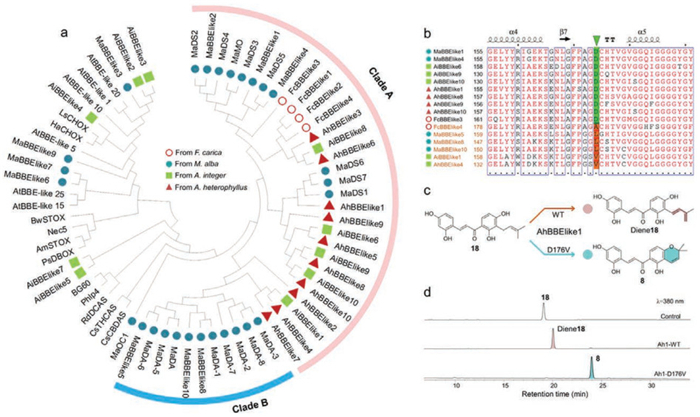
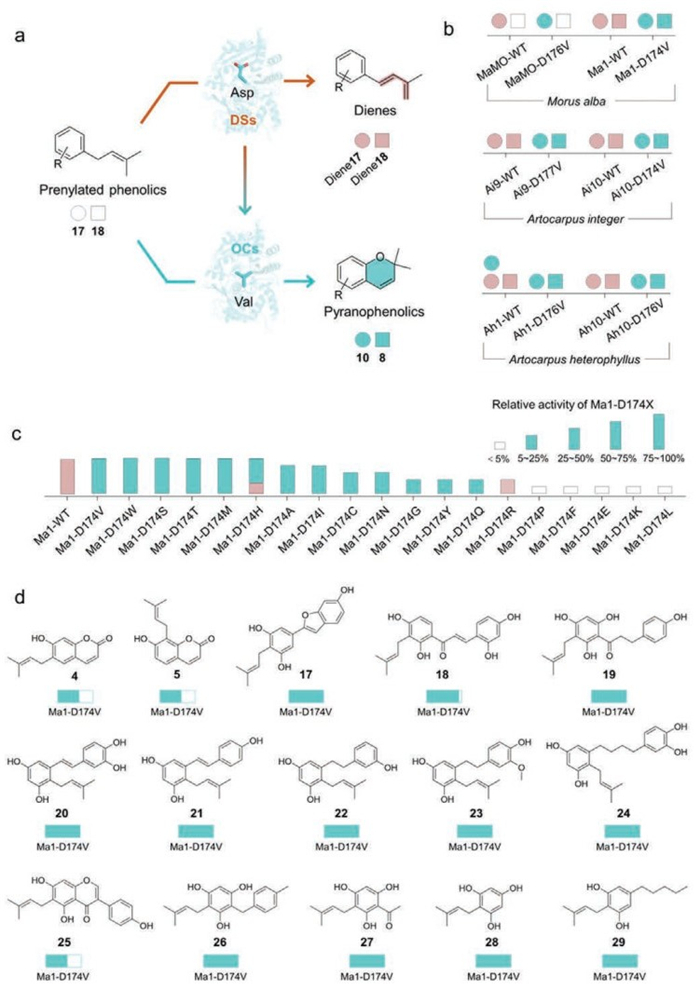
DSs are often present in plants containing Diels-Alder (DA) adducts, as it catalyzes the formation of diene, a precursor for DA adducts synthesis. DA adducts are widely distributed in Moraceae plants such as M. alba, A. heterophyllus, and A. integer. Therefore, transcriptome sequencing and analyzing were conducted on these species to identify novel DSs. We systematically investigated BBE-like enzyme-encoding genes from the transcriptome of M. alba and A. integer, and the genome of A. heterophyllus (Tables S3–S5 in Supporting information). A total of 30 full-length BBE-like enzyme-encoding genes (MaBBElike1–10, AhBBElike1–10 and AiBBElike1–10) were cloned, and their open reading frames (ORFs) were predicted. Then, phylogenetical analysis was performed. Interestingly, 14 BBE-like enzymes (MaBBElike1, 2, 4; AhBBElike1, 3, 5, 6, 8–10; AiBBElike6, 8–10) and the reported DSs from M. alba formed a distinct clade (clade A) (Fig. 5a). All these 14 BBE-like enzymes were cloned, expressed and purified. The catalytic activities of these BBE-like enzymes were investigated with moracin C (17) and morachalcone A (18), which are the precursors of dienes that exist in M. alba, A. heterophyllus, and A. integer. According to the enzymatic reaction assay results, these 14 new BBE-like enzymes in clade A showed DS activity, which is oxidizing isoprenyl groups of 17 and 18 to generate dienes, respectively. Sequence alignment analysis of enzymes from evolutionary clades A and B revealed that DS clade members consistently exhibited the conserved Asp residue, whereas DAase clade members possess nonpolar amino acids at the corresponding sites (Fig. 5b). To validate the universality of the single-site mutagenesis strategy across species-specific variants, site mutation was conducted at the conserved Asp176 residue of AhBBElike1, a DS from non-Morus plants. The resulting mutant Ah1-D176V lost DS activity, while acquired OC activity with high catalytic efficiency (Figs. 5c and d). Then, DSs with broad spectra from M. alba (MaBBElike1), A. heterophyllus (AhBBElike10), and A. integer (AiBBElike9 and AiBBElike10) were engineered into the mutants Ma1-D174V, Ah10-D176V, Ai9-D177V and Ai10-D174V, respectively (Figs. 6a and b). Enzyme activity assays showed that all these mutants had shifted their catalytic activities from diene synthesis to oxidocyclization. Substrate specificity testing revealed that Ma1-D174V possessed a wide substrate spectrum, which could recognize all the tested substrates (4, 5, 17 and 18) generating pyranophenolics (Fig. 6d). Subsequently, saturation mutagenesis at the D174 site was conducted. Using substrate 17, we assayed the catalytic activity of all the mutants. Ma1-D174V exhibited the highest catalytic activity and the conversion yield was up to 100% (Fig. 6c). Then, we systematically explored the substrate spectrum of Ma1-D174V (Fig. 6d). Ma1-D174V was capable of recognizing various types of natural and unnatural products with an isoprenyl group including coumarins (4 and 5), stilbenes (17), chalcones (18 and 19), bibenzyls (20–23), diphenylbutanes (24), flavonoids (25), diphenylmethanes (26), phloroglucinols (27 and 28), and olivetols (29) (Figs. S37–S51 in Supporting information). The broad substrate spectrum and high catalytic efficiency of Ma1-D174V make it a potential tool enzyme for synthesis of pyran-containing pharmaceutical molecules.
Figure 5
Figure 5.
Discovering new DSs from non-Morus plants and exploring the universality of the conversed Asp residue. (a) Phylogenetic analysis of BBE-like enzymes from F. carica, M. alba, A. integer, A. heterophyllus and other representative plant BBE-like enzymes. (b) Alignment of amino acid sequences around the conserved Asp residue in DSs and DAases from F. carica, M. alba, A. integer and A. heterophyllus. (c) The reactions catalyzed by AhBBElike1 and Ah1-D176V with morachalcone A (18). (d) The corresponding HPLC detection spectra of the reactions.
Figure 6.
Engineering DSs into promiscuous OCs with promiscuous catalytic activity. (a, b) Mutations at the Asp conserved site of DSs from M. alba, A. heterophyllus and A. integer, and their catalytic activity. (c) Saturation mutation at the D174 site of MaBBElike1 and the catalytic activity of its mutants. (d) Exploring the substrate promiscuity of Ma1-D174V. The light green solid and hollow boxes below the compound structure represented the relative conversion rates of OCs for the corresponding substrates.
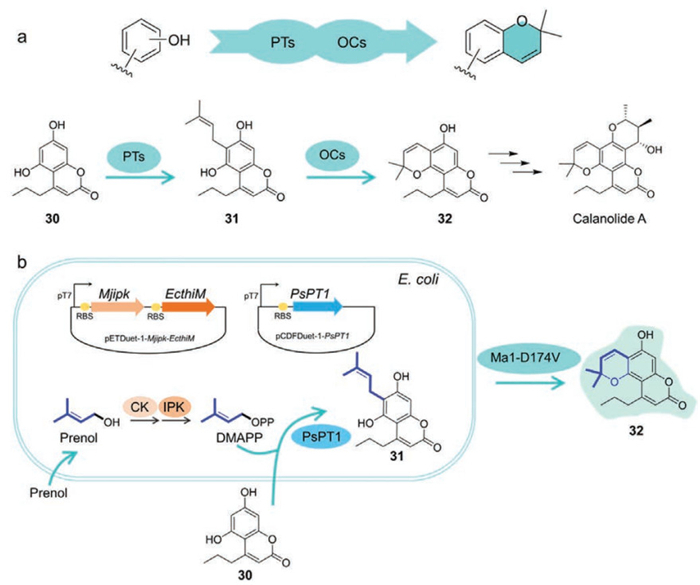
The installation of a benzopyran motif typically demands a multi-step process under stringent reaction conditions, often employing hazardous reagents [32–34]. The use of combinatorial biocatalysis to replace certain key steps in chemical synthesis holds great potential for green production [35–40]. With the assistance of enzymes, the pyran ring introduction can be achieved in two steps, which are the introduction of an isoprenyl group and the following oxidative cyclization. The introduction of an isoprenyl group can be accomplished by prenyltransferases (PTs). PsPT1 and AtaPT are promiscuous PTs identifying from fungi in our previous work and have been proved to be powerful tools in enzymatic prenylation [41,42]. These two PTs were selected to introduce the isoprenyl group into various substrates with dimethylallyl pyrophosphate (DMAPP) as the isoprenyl donor. According to in vitro assays, PsPT1 showed broader substrate spectrum and higher catalytic activity in synthesis of prenylated compounds 19–24 and 26. Subsequently, by employing Ma1-D174V, a combined enzymatic method for synthesizing benzopyran molecules was established. Representative isoprenylated phenolics including compounds 19–24 and 26 were successfully synthesized by PTs (Fig. 6d) and further cyclized by OCs (Fig. 7a). In this in vitro cascade enzymatic system, DMAPP served as a costly isoprenyl donor. To establish a system capable of self-supplying DMAPP, an artificial biosynthetic pathway composed of Mjipk and EcthiM, which are key genes in the biosynthesis of DMAPP, was constructed in Escherichia coli [43,44]. Then, gene PsPT1 was introduced into the above recombinant E. coli generating an engineered bacterium namely E-Mjip-EcthiM-PsPT1. This engineered E. coli was successfully applied to synthesize compound 32, a key intermediate in the synthesis of Calanolide A (15). Calanolide A is a natural product initially extracted from Calophyllum lanigerum that possesses anti-HIV activity [45]. By employing the engineered strain E-Mjip-EcthiM-PsPT1, 30 was prenylated to synthesize 31 with the yield of 164.2 mg/L. Then, by combining this process with OCs-catalyzed oxidative cyclization reactions, pyranocoumarin 32 was synthesized with the conversion yield of 99% (Figs. 7a and b, Fig. S52 in Supporting information). Therefore, this approach possesses potentials in green synthesis of pharmaceutical molecules and intermediates containing benzopyran groups with high values.
Figure 7
Figure 7.
Enzymatic combinatorial synthesis of pyranophenolic compounds. (a) PTs (PsPT1) and OCs (Ma1-D174V) were combined to introduce the pyran ring onto the aromatic ring of 30 to produce 32. (b) An engineered E. coli E-DMAPP-PsPT1 containing PsPT1 and the biosynthetic pathway for DMAPP was constructed.
In summary, we elucidated the final step of the biosynthetic pathway of pyranocoumarins, which was catalyzed by a new OC (FcBBElike4) belonging to BBE-like enzymes. CYP450s were reported to be involved in the biosynthesis of pyranocoumarins with a hydroxyl group on the pyran ring in Apiaceae plants [23,24]. BBE-like enzymes that catalyze the formation of dihydropyran ring may also exist in Apiaceae plants. These different pyranocoumarins are biosynthesized through different biosynthetic pathways. We also found a new DS (FcBBElike3), which exhibited high homology with FcBBElike4. Through investigating the catalytic mechanism of FcBBElike3 and FcBBElike4, a key Asp site that controls their functions was identified. This Asp site exhibits high conservation in BBE-like enzymes from various species. The function switch from DSs to OCs was conveniently achieved by a single site mutation and the artificial OCs inherited the broad substrate spectra of the original DSs. In particular, we obtained one mutant Ma1-D174V exhibiting high catalytic activity to small molecules such as isoprenylated phloroglucinols, which can serve as molecular building blocks. These engineered enzymes can be used to synthesize many pharmaceutical intermediates, such as calanolide A. Furthermore, by combining with an enzymatic isoprenylation method, we have achieved efficient introduction of the pyran ring onto the benzene ring. Therefore, this study not only reveals the functional switch sites of a class of OCs, simplifying their functional modification methods, but also establishes a new combined enzymatic synthesis method for benzopyranyl groups. Our work provides a new strategy for the efficient synthesis of bioactive molecules containing pyran rings.
CRediT authorship contribution statement
Jianing Liu: Writing – original draft, Methodology, Investigation, Data curation, Conceptualization. Qian Zhang: Methodology, Data curation, Conceptualization. Cong Su: Methodology. Songyang Sui: Methodology, Data curation. Changkang Li: Data curation. Ridao Chen: Data curation. Dawei Chen: Data curation. Jimei Liu: Data curation. Jungui Dai: Writing – review & editing, Supervision, Conceptualization. Kebo Xie: Writing – review & editing, Writing – original draft, Supervision, Project administration, Funding acquisition, Data curation, Conceptualization.
Declaration of competing interest
The authors declare that they have no known competing financial interests or personal relationships that could have appeared to influence the work reported in this paper.
Acknowledgments
This study is supported by Fundamental Research Funds for the Central Universities (No. 2024-RC350-01), National Natural Science Foundation of China (Nos. 82422075 and 82550003), National Key Research and Development Program of China (No. 2024YFA0919900), and CAMS Innovation Fund for Medical Sciences (No. 2024-I2M-TS-013, China).
Supplementary materials
Supplementary material associated with this article can be found, in the online version, at doi:10.1016/j.cclet.2026.112531.
[1]
M.T. Khandy, A.K. Sofronova, T.Y. Gorpenchenko, et al., Plants 11 (2022) 3135. doi: 10.3390/plants11223135
[2]
J.C. Amaral, M.M. da Silva, M.F.G.F. da Silva, et al., J. Nat. Prod. 83 (2020) 1409–1415. doi: 10.1021/acs.jnatprod.9b00607
X. Liu, L. Sheng, M.M. Zhao, et al., Drug Metab. Pharmacokinet. 30 (2015) 89–96. doi: 10.2495/CUEE140111
Figure 1
Proposed biosynthetic pathways of pyranocoumarins and structural types of representative pyranophenolics. (a) Proposed biosynthetic pathways of xanthyletin (1) and seselin (2) from umbelliferone (3). (b) Representative structural types of bioactive natural (8–15) and unnatural (16) pyranophenolics.
Figure 2
Functional characterization of FcBBElike3 and FcBBElike4. (a) Phylogenetic analysis of BBE-like enzymes from F. carica and DSs (light red), FAD-dependent OCs (light purple), DAases (light blue) in Morus alba as well as other representative identified BBE-like enzymes from different species. (b, c) Reactions catalyzed by FcBBElike3 and FcBBElike4 with demethylsuberosin (4) as the substrate. (d, e) Reactions catalyzed by FcBBElike3 and FcBBElike4 with osthenol (5) as the substrate. FcBBElike4 not only could synthesize xanthyletin (1) and seselin (2) but also showed DS activity. The evolutionary history was inferred using the neighbor-joining method. All the NCBI accession numbers of the representative plant BBE-like enzymes can be found in Supporting information. Evolutionary analyses were performed in MEGA7.
Figure 3
Identification of the key active sites of FcBBElike3 and FcBBElike4. (a) The structure of FcBBElike4. (b) The superposition of the protein structures of FcBBElike3 (salmon) and FcBBElike4 (cyans), and their binding pockets were indicated. (c) The amino acid residues in the substrate binding pocket of FcBBElike4. (d) The amino acid residues in the substrate binding pocket of FcBBElike3. (e) The superposition of the residues in the binding pockets of FcBBElike3 and FcBBElike4. (f) The proposed catalytic mechanism of FcBBElike3 and FcBBElike4 in catalyzing demethylsuberosin (4). (g) Catalytic activities of the FcBBElike4 mutants and HPLC analysis of the reactions catalyzed by Fc4-WT, Fc3-WT and Fc4-A197D.
Figure 4
Switch the diene synthesis activity of DSs to oxidocyclization activity. (a) Alignment of amino acid sequences around the conserved Asp residue in DSs, OCs and DAases. (b) The conversed Asp residue of MaMO (D176) and FcBBElike3 (D180) are closely adjacent (3.5 Å) to C5 of the isoprenyl group of moracin C (17). (c) The reactions catalyzed by MaMO and MaMO-D176V with moracin C (17). (d) The corresponding HPLC detection spectra of the reactions.
Figure 5
Discovering new DSs from non-Morus plants and exploring the universality of the conversed Asp residue. (a) Phylogenetic analysis of BBE-like enzymes from F. carica, M. alba, A. integer, A. heterophyllus and other representative plant BBE-like enzymes. (b) Alignment of amino acid sequences around the conserved Asp residue in DSs and DAases from F. carica, M. alba, A. integer and A. heterophyllus. (c) The reactions catalyzed by AhBBElike1 and Ah1-D176V with morachalcone A (18). (d) The corresponding HPLC detection spectra of the reactions.
Figure 6
Engineering DSs into promiscuous OCs with promiscuous catalytic activity. (a, b) Mutations at the Asp conserved site of DSs from M. alba, A. heterophyllus and A. integer, and their catalytic activity. (c) Saturation mutation at the D174 site of MaBBElike1 and the catalytic activity of its mutants. (d) Exploring the substrate promiscuity of Ma1-D174V. The light green solid and hollow boxes below the compound structure represented the relative conversion rates of OCs for the corresponding substrates.
Figure 7
Enzymatic combinatorial synthesis of pyranophenolic compounds. (a) PTs (PsPT1) and OCs (Ma1-D174V) were combined to introduce the pyran ring onto the aromatic ring of 30 to produce 32. (b) An engineered E. coli E-DMAPP-PsPT1 containing PsPT1 and the biosynthetic pathway for DMAPP was constructed.


 DownLoad:

 下载:
下载:


 下载:
下载:

