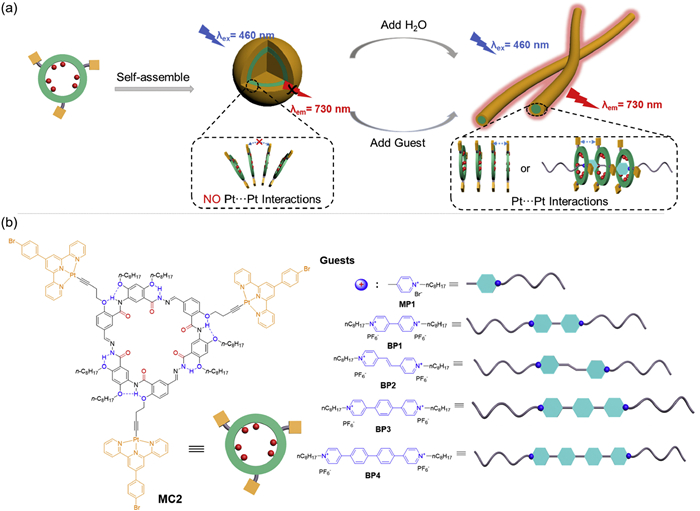
Scheme 1.
(a) Schematic illustration of guest-modulated self-assembly behaviors. (b) Molecular structures of complexes MC2 and pyridinium salt guests.

Guest-regulable Pt(Ⅱ)···Pt(Ⅱ) interactions in hydrogen-bonded aromatic macrocycle based rotaxanes enables tunable NIR emission
Wei Zeng , Qian Li , He Deng , Kang-Da Zhang , Meimei Zhang , Yongfei Yin , Shigui Chen , Lu Wang


In the past few decades, square-planar d8 platinum(Ⅱ) polypyridyl complexes have garnered significant attention due to their exceptional photophysical [1,2], conductive [3], and self-assembly [4] properties. These complexes exhibit a strong trend to aggregate, leading to intermolecular Pt···Pt interactions accompanied by distinctive spectral and luminescent properties [5-8]. Researchers have leveraged this behavior to synthesize diverse functionalized platinum(Ⅱ) polypyridine complexes, including amphiphiles [9], dendrimers [10], folded structures [11], copolymers [12,13] and molecular tweezers [14]. Such complexes show wide applications in gels [15], fluorescent probes [9,16], and anticancer [17,18]. Beyond the synthesis of novel complexes and the investigation of their luminescent properties, the precise modulation of the distance and strength of Pt(Ⅱ)···Pt(Ⅱ) interactions has gradually emerged as a research focus. Controlling these interactions is crucial not only for elucidating the underlying photophysical mechanisms but also for constructing functional supramolecular systems. Among various approaches, solution-based self-assembly strategies have gained particular prominence due to their efficiency and tunability. External stimuli such as temperature [19,20], solvent [21], pressure [22] and pH [23] can effectively trigger the self-assembly process, thereby enabling dynamic regulation of Pt(Ⅱ)···Pt(Ⅱ) interactions. The Pt(Ⅱ)···Pt(Ⅱ) interaction, being quite weak, is typically investigated only when complexes are forced into close proximity, such as in the solid state, at high concentrations, or within poor solvents that induce aggregation. Therefore, it's urgent to explore new strategy to investigate Pt(Ⅱ)···Pt(Ⅱ) interactions in dilute solution.
Host–guest interactions represent a pivotal area of supramolecular chemistry and have been extensively explored over the past decades [24,25], showing wide applications in molecular machines, smart materials, and responsive systems [26-32]. In particular, when a host molecule functions as a nanoreactor [33,34], its confined cavity can effectively restrict and bring reaction substrates into close spatial proximity, thereby significantly enhancing reaction efficiency [35]. This principle has been elegantly realized in mechanically interlocked architectures such as rotaxanes, where macrocyclic hosts are threaded onto molecular axles containing specific recognition sites. By rationally designing the position and spacing of these binding sites along the axle, the distance between adjacent macrocycles can be precisely modulated. Therefore, rotaxanes offer an ideal supramolecular platform to investigate and precisely regulate Pt(Ⅱ)···Pt(Ⅱ) interactions, allowing these weak metallophilic forces to be controlled by the design of the axle molecule.
Hydrogen-bonded aromatic amide/hydrazide macrocycles represent an emerging class of cyclic compounds that have garnered significant attention in recent years [36-41]. Their macrocyclic skeletons are pre-organized through intramolecular three-center hydrogen bonds, which impart exceptional structural rigidity, conformational stability, ease of functionalization, electron-rich cavities, and versatile host–guest recognition capabilities [38]. Leveraging these features, such macrocycles have been widely employed as building blocks for constructing higher-order supramolecular architectures, including vesicles [38], transmembrane ion channels [42], supramolecular gels [43], and mechanically interlocked rotaxanes [44,45], primarily driven by π–π stacking, hydrophobic effects, and other noncovalent interactions. Notably, when used as hosts in rotaxane formation, these hydrogen-bonded aromatic macrocycles can effectively thread onto cationic axles through multiple cation-dipole interactions. When platinum(Ⅱ) moieties are introduced as side chains onto the macrocyclic framework, metallophilic functionality is endowed to the rotaxanes. The rotaxanes will be an ideal supramolecular platform for investigating and precisely modulating Pt(Ⅱ)···Pt(Ⅱ) interactions—weak yet highly tunable metallophilic forces that are exquisitely sensitive to intermolecular distance and geometry. Critically, the spatial arrangement and proximity of the Pt(Ⅱ) centers can be rationally controlled by engineering the structure, length, and binding-site distribution of the axle component, thereby enabling external regulation of photophysical properties, self-assembly behavior, and stimuli-responsive functions in these metal-containing interlocked systems.
Herein, we report the design, synthesis, and supramolecular behavior of a novel trinuclear platinum(Ⅱ) complex, MC2, featuring a hydrogen-bonded aromatic amide macrocycle as its core structural motif (Scheme 1). The macrocyclic framework is inherently electron-rich and conformationally preorganized through intramolecular hydrogen bonding, endowing it with a well-defined cavity that is highly amenable to host–guest chemistry. Upon exposure to electron-deficient pyridinium-based guests, MC2 readily engages in complementary cation-dipole interactions, leading to the formation of well-defined supramolecular architectures, ranging from discrete "sandwich" complexes to extended pseudo-rotaxane-type assemblies. Critically, the inclusion of Pt(Ⅱ) centers at strategic positions on the macrocyclic periphery allows these host–guest interactions to serve as a molecular ruler: By dictating the relative orientation and interplanar distance between adjacent macrocycles, the binding event directly modulates the extent of intermacrocyclic Pt(Ⅱ)···Pt(Ⅱ) metallophilic interactions. This spatial control translates into a pronounced and reversible tuning of the photophysical properties of the system, most notably the emergence and intensity of near-infrared (NIR) emission, a signature of metal–metal–to–ligand charge transfer (MMLCT) transitions. Furthermore, the supramolecular reorganization triggered by guest binding induces a dramatic morphological transition in the self-assembled nanostructures: In the absence of guest, MC2 forms spherical nanoparticles in solution, whereas upon complexation, it reorganizes into elongated, one-dimensional nanofibers (Scheme 1a). This hierarchical structural evolution, orchestrated purely through noncovalent host–guest recognition, highlights the power of supramolecular design in achieving simultaneous control over electronic communication, optical output, and nanoscale morphology in metallo-supramolecular systems.
The acylhydrazone macrocycle (MC1) with alkyne groups was first synthesized from a preorganized aromatic precursor following a modified procedure (Scheme S1 in Supporting information) [46,47]. Subsequently, the platinum(Ⅱ) -containing macrocycle (MC2) was obtained via a copper(Ⅰ)-catalyzed dehydrohalogenation reaction between a chloroplatinum(Ⅱ) terpyridine complex and macrocycle MC1 (Fig. 1a and Scheme S2 in Supporting information).
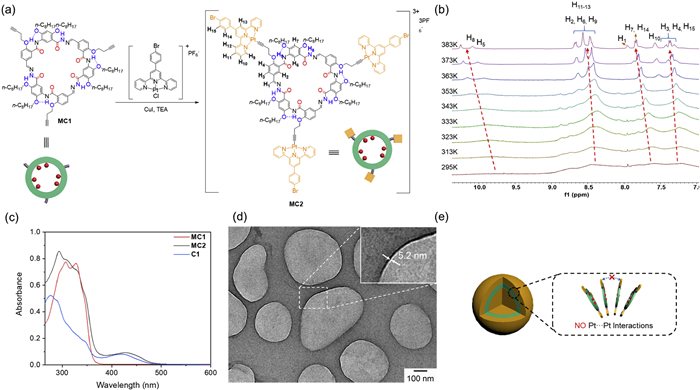
The 1H NMR spectrum of complex MC2 in DMSO–d6 (10-3 mol/L) at 298 K exhibited broadened aromatic proton signals (Fig. S1 in Supporting information), indicating significant π–π stacking interactions between the rigid macrocyclic aromatic backbones in solution. To further investigate the aggregation behavior and obtain better spectral resolution, temperature-dependent 1H NMR studies of MC2 were conducted in DMSO–d6. Upon heating, MC2 underwent a transition from an aggregated to a more dissociated state (Fig. 1b). The aromatic proton resonances became progressively sharper and shifted downfield with increasing temperature. Notably, the signals remained partially unresolved even at 383 K (Fig. S2 in Supporting information), suggesting persistent π–π stacking or other intermolecular interactions at elevated temperatures. Although the 13C NMR spectrum at this temperature was indistinguishable due to severe signal overlap (Fig. S3 in Supporting information), ESI-MS analysis of MC2 revealed a strong peak at m/z = 1172.0129, corresponding to the [MC2–3PF6]3+ species. The isotopically resolved peaks were in excellent agreement with the calculated theoretical distribution (Fig. S4 in Supporting information). unambiguously confirming the successful synthesis of MC2.
The photophysical properties of complex MC2 were investigated by UV–vis absorption spectroscopy. As shown in Fig. 1c, MC2 exhibits intense absorption bands in the range of 260–370 nm and moderately intense bands between 370 and 500 nm. By analogy with related alkynylplatinum(Ⅱ) terpyridine complexes [11,48-51], the intense bands are attributed to intraligand (IL) [π → π*] transitions of the terpyridine and alkynyl ligands. The moderate bands are assigned to metal-to-ligand charge transfer (MLCT) [dπ(Pt) → π*(terpy)] transitions mixed with ligand-to-ligand charge transfer (LLCT) [π(alkynyl) → π*(terpy)] character. The absence of bands in the 370 nm–500 nm region for MC1 supports this assignment. For comparison, a non-macrocyclic platinum(Ⅱ) complex (C1) was synthesized as a control compound (Fig. 1a and Scheme S3 in Supporting information). Notably, the MLCT/LLCT band of MC2 is redshifted compared to C1, attributed to the stronger electron-donating ability of the aromatic acylhydrazone macrocycle in MC2 relative to the salicylic acid moiety in C1. This enhanced electron density on both the alkynyl ligand and the metal center induces the observed redshift [51].
The concentration-dependent self-assembly behavior of MC2 was investigated in DMSO. UV–vis absorption spectra (Fig. S5 in Supporting information) showed a nonlinear increase in the low-energy tail around 510 nm as the concentration increased from ~10-6 mol/L to 10–4 mol/L, deviating from Beer's law, indicating the occurrence of ground-state aggregation. The absorption tail at 510 nm can be assigned to a metal–metal–to–ligand charge transfer (MMLCT) transition, arising from intermolecular Pt···Pt interactions and π–π stacking between macrocyclic backbones [52,53].
Concentration-dependent emission spectra (Fig. S6 in Supporting information) further support this result. Upon excitation at 460 nm, a new broad emission band centered at approximately 730 nm gradually emerged and intensified with increasing concentration. To further elucidate the nature of the emissive excited state associated with the aggregation-induced emission of MC2, emission lifetime and quantum yield measurements were performed. In acetone at 298 K, MC2 exhibits an emission lifetime of 2.41 ns (Fig. S7 in Supporting information) and a quantum yield of 0.598%, indicating that the emission originates from a short-lived excited state [54]. Taken together with the concentration-dependent emission behavior and the structural evidence discussed below, these photophysical characteristics support the assignment of the observed near-infrared emission to an excited state with metal–metal-to-ligand charge-transfer (MMLCT) character, which is closely associated with Pt···Pt and π–π interactions within the aggregated species. In parallel, a distinct color change of the DMSO solution from colorless to orange was observed as the concentration increased from ~10–6 mol/L to 10–3 mol/L (Fig. S8 in Supporting information), providing direct visual evidence for the formation of aggregates [51,55]. TEM imaging revealed vesicular assemblies of MC2 in pure DMSO, exhibiting a membrane thickness of approximately 5.2 nm (Fig. 1d). Considering the theoretical width of the MC2 backbone (Fig. S9 in Supporting information), the observed vesicles are most likely composed of a monolayer structure. Combined with the previously reported self-assembly behavior of acylhydrazone macrocycles [38], it can be deduced that MC2 molecules stack in a face-to-face manner to form a curved unilamellar membrane, driven by π–π stacking interactions (Fig. 1e).
The self-assembly behavior of macrocycle MC2 was further investigated in DMSO/H2O mixtures. Increasing the H2O fraction enhanced the MMLCT absorption at ~510 nm with a distinct isosbestic point (Fig. 2a) and intensified the MMLCT emission at ~730 nm (Fig. 2b), signifying Pt···Pt and π–π stacking interactions driven by hydrophobic effects. Plotting the normalized aggregation degree (absorbance at 510 nm) versus H2O volume fraction yielded a sigmoidal curve (Fig. S10 in Supporting information), indicative of an isodesmic growth mechanism [56,57]. Furthermore, the absorption the corresponding plot also indicated that a critical water content of around 30% was required to trigger the formation of aggregates. Monitoring the emission intensity at 730 nm (Fig. 2c) yielded a similar inflection point near 30%, confirming that aggregation occurs beyond this threshold, in full agreement with the UV–vis results. In contrast, macrocycle MC1 and control compound C1 showed no MMLCT emission under identical conditions (70% H2O, Fig. S11 in Supporting information), confirming that both the macrocyclic scaffold and the platinum(Ⅱ) center are essential for Pt···Pt and π–π stacking.
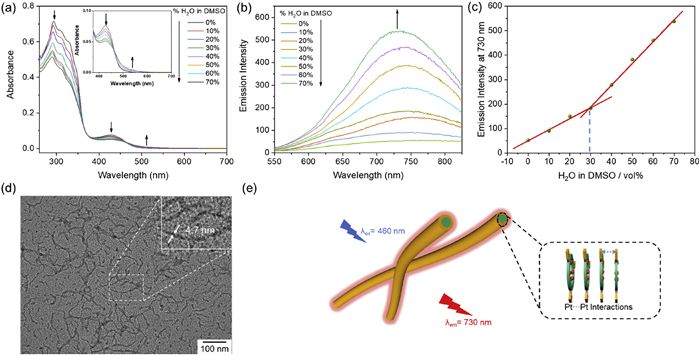
Interestingly, upon adding 70% water, the morphology transformed from vesicles into nanofibers with a diameter of ~4.7 nm (Fig. 2d). Given the calculated extended molecular diameter of MC2 (~4.7 nm), these fibers likely arise from face-to-face stacking of MC2 molecules. The morphological shift is likely caused by a reduction in the dihedral angle between MC2 molecules due to enhanced Pt···Pt and π–π stacking at higher water content, promoting near-parallel stacking and nanofiber formation (Fig. 2e). Furthermore, solvent-dependent studies (Fig. S12 in Supporting information) revealed that both the MMLCT absorption and the MMLCT emission bands are prominent in nonpolar solvents but nearly absent in polar solvents, likely due to differences in solubility and aggregation tendency of MC2.
The electron-rich cavity of the acylhydrazone macrocycle, with inwardly oriented carbonyl groups stabilized by intramolecular hydrogen bonds, confers strong affinity for pyridinium salt guests. Previous studies have demonstrated that the hydrazone-based macrocycle (MC), which shares the same backbone as MC2, can form sandwich-type complexes with mono-pyridinium salts (MP1 and MP2), and pseudo[3]rotaxane structures with bis-pyridinium salts (BP1 and BP2) (Scheme 1) [38]. To further elucidate how host–guest interactions affect the self-assembly behavior and photophysical properties of platinum- containing macrocycles, two longer bis-pyridinium guest containing macrocycles, two longer bis-pyridinium guest molecules, BP3 and BP4 (Scheme 1), were designed and synthesized. Given the strong aggregation propensity of MC2 in solution, the structurally simpler macrocycle MC was employed as a model host compound to assist in elucidating the host–guest binding behavior of MC2 with BP3 and BP4.
1H NMR titration experiments were first conducted to explore the host–guest interactions (Fig. S13 in Supporting information). Upon the addition of 0.33 equiv. of BP3, the proton signals of free MC completely disappeared (red dashed line), indicating a 3:1 host–guest binding stoichiometry and the formation of the pseudo[4]rotaxane MC3⊃BP3. Further addition of BP3 did not alter the intensity or pattern of the host–guest signals (green dashed line), suggesting that MC3⊃BP3 forms a highly stable assembly whose structure remains unchanged beyond the binding ratio. 1H NMR diffusion ordered spectroscopy (DOSY) measurements (Fig. S14 in Supporting information) corroborated these findings: at 0.22 equiv. of BP3, two species with diffusion coefficients of 3.1 × 10⁻¹⁰ and 3.7 × 10⁻¹⁰ m2/s were observed, corresponding to MC3⊃BP3 and free MC, respectively. At 0.33 equiv., a single diffusion coefficient (3.3 × 10⁻¹⁰ m2/s) was detected, In the presence of excess BP3, signals for both the pseudo[4]rotaxane and free guest appeared. 2D 1H–1H nuclear Overhauser effect spectroscopy (NOESY) spectrum displayed intermolecular NOE correlations between protons Ha, Hb, and Hd of BP3 and the cavity protons H2 and H6 of MC (Fig. S15 in Supporting information), further supporting the pseudorotaxane topology.
In the case of BP4, upon gradual addition of BP4 to the MC solution, the proton Hd exhibited an upfield shift of up to −0.30 ppm, indicating shielding and positioning outside the macrocyclic cavity. In contrast, protons Ha, Hb, Hc, and He showed downfield shifts due to deshielding effects (Figs. S16 and S17a in Supporting information), consistent with strong ion-dipole interactions between the electron-rich cavity of the acylhydrazone macrocycle and the electron-deficient cationic guest. Analysis of the molar ratio–dependent chemical shift of cavity proton H6 revealed an inflection point at a 0.33 molar ratio, indicating a 3:1 host–guest binding stoichiometry (Fig. S17b in Supporting information). DOSY NMR experiments (Fig. S18 in Supporting information) showed that the diffusion coefficients of free BP4 (5.2 × 10⁻¹⁰ m2/s) and MC (4.0 × 10⁻¹⁰ m2/s) decreased to 4.4 × 10⁻¹⁰ and 3.6 × 10⁻¹⁰ m2/s, respectively, upon complexation, confirming the formation of a large supramolecular assembly, MC3⊃BP4. Multiple NOE correlations were observed between protons Ha, Hb, and Hc of BP4 and protons H2 and H6 of MC, while no NOE signals were detected between Hd and H2/H6 (Fig. S19 in Supporting information). These data suggest that the MC cavity is in close proximity to Ha, Hb, and Hc, but distant from Hd, consistent with the 1H NMR titration results. This geometry places BP4 threaded through the macrocyclic cavity, with two macrocycles flanking the pyridinium N+ termini and the third positioned near proton Hc, giving rise to the pseudo[4]rotaxane MC3⊃BP4.The stoichiometry of both MC3⊃BP4 and MC3⊃BP4 was further confirmed by ESI-MS, which displayed peaks at m/z 2102.7961 and 2128.1359, corresponding to [MC3 + BP3 + H − 2PF6]3+ and [MC3 + BP4 + H − 2PF6]3+, respectively (Figs. S20 and S21 in Supporting information). Since MC2 possesses the same macrocyclic backbone as MC, it is anticipated that MC2, like MC, can form sandwich-type complexes with mono-pyridinium salts (MP1 and MP2) and pseudo[3]rotaxane structures with bis-pyridinium salts (BP1, BP2, BP3, and BP4).
To demonstrate the feasibility of guest-mediated regulation of the self-assembly of the platinum(Ⅱ)-containing macrocycle MC2 and the modulation of the Pt···Pt interactions, monopyridinium salt MP1 and bipyridinium salt BP2 were selected for the following studies firstly due to the significant difference in binding modes. Photophysical studies in methanol revealed a MMLCT emission band at ~730 nm for MC2 upon addition of either MP1 or BP2 (Figs. 3a and b), similar with the behavior induced by hydrophobic effect. This indicates that host–guest binding connects MC2 molecules, promoting the aggregation and further resulting in the strong Pt···Pt interactions at the side chains of MC2. Similar results were observed in acetone (Fig. S22 in Supporting information).
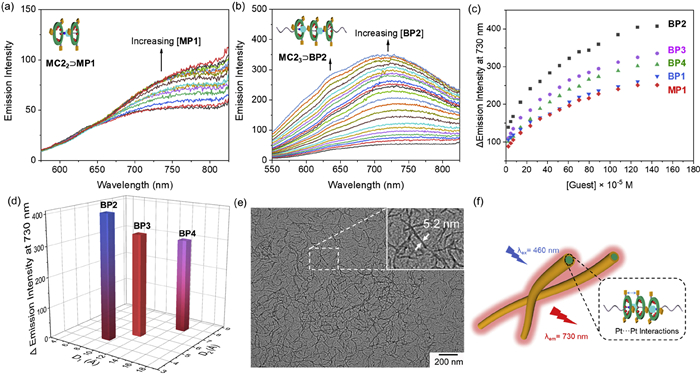
Beyond monopyridinium salt MP1 and bipyridinium salt BP2, pyridinium salts MP2, BP1, BP3 and BP4 could also promote the aggregation of complex MC2 through host–guest interactions in acetone, which produced the Pt···Pt interactions between MC2, and the MMLCT emission band at ca. 730 nm could be observed upon addition of these guests (Figs. S23-S26 in Supporting information). Comparing MP1 and MP2 revealed negligible steric effects on emission intensity (Fig. S27 in Supporting information), implying minimal impact of steric hindrance on Pt···Pt interaction modulation within the same binding mode. However, significant differences in emission intensity at ~730 nm were observed for different bipyridinium salts (BPs), with the strongest emission of BP2 (Fig. 3c). This suggests that the stacking models and the Pt···Pt interactions between MC2 molecules depend on the specific BP guest.
Analysis of emission intensity at identical guest concentrations (Fig. S28 in Supporting information) showed that monopyridinium salt MP1 gave a luminescence enhancement factor of ~3.1, lower than those observed for BPs. This indicates that pseudorotaxane formation is more effective than sandwich structures in Pt···Pt interactions. We propose that pyridinium salts act as conformational regulators. Pseudorotaxane formation imposes greater conformational restriction on MC2 molecules compared to sandwich structures, promoting a near-parallel alignment more conducive to Pt···Pt interactions. The enhancement factor for BP1 (~3.4) was lower than those for BP2, BP3 and BP4 (~4.6), highlighting the crucial role of host–guest stoichiometry. The pseudo[4]rotaxanes (MC23⊃BP2/BP3/BP4) incorporate more macrocycles than the pseudo[3]rotaxane (MC22⊃BP1), enabling multiple Pt···Pt interactions and stronger NIR fluorescence.
The effect of the distance between recognition sites in the BP guests on Pt···Pt interactions was investigated by comparing emission intensities induced by different BP guests (BP2, BP3, and BP4) in a pseudo[4]rotaxane assembly mode (Fig. 3d). The optimized geometries of the BP guests were obtained by theoretical calculations (Fig. 29 in Supporting information). The distance between the two recognition sites (the two N+ atoms) in each BP guest was defined as D1, while the distance between adjacent macrocycles in the corresponding pseudo-rotaxane assemblies was defined as D2 (Table S1 in Supporting information), which is approximately half of D1. The maximum emission intensity was observed when D1 was 9.1 Å (corresponding to D2 ≈ 4.6 Å). Increasing both D1 and D2 resulted in decreased emission at ~730 nm. This demonstrates that guest size influences Pt···Pt interactions. Larger guests increase the theoretical distance between adjacent MC2 molecules in the assembly, thereby weakening the Pt···Pt interaction. Notably, while typical Pt···Pt interactions range from 3.0 Å to 3.5 Å [58], and D2 values exceeded 3.5 Å, Pt···Pt interaction could be generated considering that the platinum(Ⅱ) terpyridine complex around the macrocyclic skeleton was connected by a flexible chain. Consequently, the Pt···Pt interactions in MC2 can be precisely modulated by controlling the assembly mode and adjusting the distance between the two N+ atoms of the guest molecules. TEM imaging revealed that MC2 predominantly exists as nanoparticles in pure methanol (Fig. S30 in Supporting information). Upon addition of BP2, a pronounced morphological transformation occurs, yielding nanofibers with a diameter of ~5.2 nm (Fig. 3e), consistent with the dimensions of individual MC2 molecules (Fig. S9). This transition is likely driven by face-to-face stacking of MC2 molecules guided by host–guest interactions (Fig. 3f). Enhanced Pt···Pt and π–π stacking interactions reduce the dihedral angle between MC2 molecules, promoting near-parallel alignment and the formation of nanofiber structures.
In summary, we have successfully demonstrated a strategy for controlling the supramolecular self-assembly and photophysical properties of the novel platinum(Ⅱ)-containing macrocycle, MC2, through both solvent polarity and external host–guest interactions. MC2 exhibits strong concentration-dependent ground-state aggregation in DMSO via π–π stacking and Pt···Pt interactions, leading to characteristic MMLCT absorption (510 nm) and MMLCT emission (730 nm). This aggregation is driven by hydrophobic effects in DMSO/H2O mixtures, with a critical water content of 30% triggering the formation of aggregates and subsequent morphological transition from vesicles to nanofibers. The electron-rich acylhydrazone macrocyclic backbone of MC2 was confirmed to form pseudo[4]rotaxane assemblies (MCnBP) with the longer bis-pyridinium guests (BP3 and BP4), featuring a 3:1 host–guest stoichiometry. The host–guest binding mode was shown to be a powerful switch for regulating MC2 self-assembly in solution. Pseudorotaxane formation (bipyridinium guests) was significantly more effective than sandwich complex formation (monopyridinium guests) in promoting Pt···Pt interactions. The strength of the Pt···Pt interaction and the resulting MMLCT emission intensity could be precisely tuned by adjusting the guest properties. The 3:1 pseudo[4]rotaxanes (MC23BPs) provided greater luminescence enhancement than 2:1 [3]pseudorotaxanes (MC22BP1) due to the incorporation of more MC2 units. An optimal distance between the two positive N+ recognition sites in the bipyridinium guests (corresponding to an optimal MC2-MC2 distance) maximized the Pt···Pt interactions. This work not only establishes acylhydrazone macrocycles as a robust, dual-responsive supramolecular system but also demonstrates a novel approach for confining and modulating Pt···Pt interactions within highly controlled pseudo[4]rotaxane structures, offering a versatile platform for constructing tunable functional materials.
Wei Zeng: Software, Investigation, Data curation. Qian Li: Data curation. He Deng: Software. Kang-Da Zhang: Writing – review & editing. Meimei Zhang: Software. Yongfei Yin: Writing – original draft, Funding acquisition. Shigui Chen: Funding acquisition, Conceptualization. Lu Wang: Funding acquisition, Conceptualization.
The authors declare that they have no known competing financial interests or personal relationships that could have appeared to influence the work reported in this paper.
This work was supported by National Natural Science Foundation of China (Nos. 22371218, 21702153, 52270070 and 21801194) and the Youth Program of Educational Commission of Anhui Province of China (No. 2025AHGXZK40705). We thank the support of the Core Facility of Wuhan University and the Large-scale Instrument and Equipment Sharing Foundation of Wuhan University.
Supplementary material associated with this article can be found, in the online version, at doi:
V.W.W. Yam, A.S.Y. Law, Coord. Chem. Rev. 414 (2020) 213298. doi: 10.1016/j.ccr.2020.213298
J. Sun, J. Abbenseth, H. Verplancke, et al., Nat. Chem. 12 (2020) 1054–1059. doi: 10.1038/s41557-020-0522-4
H. Li, M. Ajmal, X. Wu, et al., Small Methods 10 (2025) 2500232.
X. Zheng, M.H.Y. Chan, A.K.W. Chan, et al., Proc. Natl. Acad. Sci. U. S. A. 119 (2022) e2116543119. doi: 10.1073/pnas.2116543119
P. Rajakannu, W. Lee, S. Park, et al., Adv. Funct. Mater. 33 (2023) 2211853. doi: 10.1002/adfm.202211853
R. McGuire, M.C. McGuire, D.R. McMillin, Coord. Chem. Rev. 254 (2010) 2574–2583. doi: 10.1016/j.ccr.2010.04.013
J.A. Bailey, M.G. Hill, R.E. Marsh, et al., Inorg. Chem. 34 (1995) 4591–4599. doi: 10.1021/ic00122a015
C.Y. Sun, W.P. To, F.F. Hung, et al., Chem. Sci. 9 (2018) 2357–2364. doi: 10.1039/C7SC04528J
W. Meng, Q. He, M. Yu, et al., Polym. Chem. 10 (2019) 4477–4484. doi: 10.1039/C9PY00652D
P. Shi, B.J. Coe, S. Sánchez, et al., Inorg. Chem. 54 (2015) 11450–11456. doi: 10.1021/acs.inorgchem.5b02089
M.H.Y. Chan, S.Y.L. Leung, V.W.W. Yam, J. Am. Chem. Soc. 141 (2019) 12312–12321. doi: 10.1021/jacs.9b04447
L. Hu, F. Qu, Y. Wang, et al., J. Mater. Chem. C 5 (2017) 12500–12506. doi: 10.1039/C7TC04686C
H. Dong, J. Zhao, Y. Lu, et al., J. Energy Chem. 108 (2025) 527–535. doi: 10.1016/j.jechem.2025.04.056
F.K.W. Kong, A.K.W. Chan, M. Ng, et al., Angew. Chem. Int. Ed. 56 (2017) 15103–15107. doi: 10.1002/anie.201708504
Q. Zhang, F. Chen, X. Shen, et al., ACS Macro Lett. 10 (2021) 873–879. doi: 10.1021/acsmacrolett.1c00228
X. Yan, T.R. Cook, P. Wang, et al., Nat. Chem. 7 (2015) 342–348. doi: 10.1038/nchem.2201
S. Jin, Y. Guo, Z. Guo, et al., Pharmaceuticals 14 (2021) 133. doi: 10.3390/ph14020133
P. Štarha, R. Křikavová, Coord. Chem. Rev. 501 (2024) 215578. doi: 10.1016/j.ccr.2023.215578
Y. Ma, K. Chen, J. Lu, et al., Inorg. Chem. 60 (2021) 7510–7518. doi: 10.1021/acs.inorgchem.1c00826
W.B. Connick, L.M. Henling, R.E. Marsh, et al., Inorg. Chem. 35 (1996) 6261–6265. doi: 10.1021/ic960511f
Z. Zhang, Z. Zhao, L. Wu, et al., J. Am. Chem. Soc. 142 (2020) 2592–2600. doi: 10.1021/jacs.9b12689
L. Liu, X. Wang, N. Wang, et al., Angew. Chem. Int. Ed. 56 (2017) 9160–9164. doi: 10.1002/anie.201705785
S. Fujii, H. Yagi, T. Kawaguchi, et al., Dalton Trans. 52 (2023) 10206–10212. doi: 10.1039/D3DT00956D
N. Xia, J. Zhao, G. Gong, et al., Sci. China Chem. 66 (2023) 3169–3177. doi: 10.1007/s11426-023-1829-8
X. Li, S. Zhou, Q. Zhao, et al., Angew. Chem. Int. Ed. 62 (2023) e202216987. doi: 10.1002/anie.202216987
M. Numata, K. Tanaka, A. Asai, et al., J. Am. Chem. Soc. 147 (2025) 20612–20630. doi: 10.1021/jacs.5c03550
Z. Zhang, H.T. Chiang, Y. Xia, et al., Chem. 11 (2025) 102407. doi: 10.1016/j.chempr.2024.102407
P. Liu, F. Fang, N.M. Khashab, Matter 8 (2025) 102130. doi: 10.1016/j.matt.2025.102130
Y. Yin, P. Sun, H. Dong, et al., Chin. Chem. Lett. 34 (2023) 108594. doi: 10.1016/j.cclet.2023.108594
Y. Yin, L. Gao, P. Sun, et al., Acta Biomater. 172 (2023) 395–406. doi: 10.1016/j.actbio.2023.10.019
Q. Zhao, J. Zhu, Y. Chen, et al., J. Hazard. Mater. 469 (2024) 133875. doi: 10.1016/j.jhazmat.2024.133875
Y. Yin, P. Zeng, Y. Duan, et al., J. Mater. Chem. B 12 (2024) 8099–8106. doi: 10.1039/D4TB00668B
X. Hu, J. Yang, F. Gao, et al., Chin. Chem. Lett. 36 (2025) 109967. doi: 10.1016/j.cclet.2024.109967
R. Ning, Q.Q. Wang, Chem. Soc. Rev. 54 (2025) 11105–11140. doi: 10.1039/D5CS00835B
H. Li, X. Hu, F. Liu, et al., Chin. Chem. Lett. 33 (2022) 5124–5127. doi: 10.1016/j.cclet.2022.04.030
C. Li, Y.Y. Zhu, H.P. Yi, et al., Chem. Eur. J. 13 (2007) 9990–9998. doi: 10.1002/chem.200701047
D. Mazzier, S. De, B. Wicher, et al., Angew. Chem. Int. Ed. 59 (2020) 1606–1610. doi: 10.1002/anie.201912805
H. Deng, G. Gong, S. Lv, et al., Org. Chem. Front. 10 (2023) 317–326. doi: 10.1039/D2QO01691E
M. Zhou, H. Deng, J. Zhao, et al., Sci. Sin. Chim. 55 (2025) 514–520.
Q. Li, S. Lv, F. Xu, et al., ACS Macro Lett. 14 (2025) 1622–1630. doi: 10.1021/acsmacrolett.5c00458
Q. Li, H. Deng, W. Zeng, et al., Chem. Asian J. 20 (2025) e202500289. doi: 10.1002/asia.202500289
P. Xin, P. Zhu, P. Su, et al., J. Am. Chem. Soc. 136 (2014) 13078–13081. doi: 10.1021/ja503376s
D. Yang, S. Xia, M. Bao, et al., J. Mater. Chem. A 11 (2023) 6181–6190. doi: 10.1039/D2TA10000B
J. Zhu, X.Z. Wang, Y.Q. Chen, et al., J. Org. Chem. 69 (2004) 6221–6227. doi: 10.1021/jo0490705
Z. Yang, K. Fu, W. Yu, et al., Chin. Chem. Lett. 36 (2025) 110842. doi: 10.1016/j.cclet.2025.110842
X.N. Xu, L. Wang, G.T. Wang, et al., Chem. Eur. J. 15 (2009) 5763–5774. doi: 10.1002/chem.200900309
L. Wang, G.T. Wang, X. Zhao, et al., J. Org. Chem. 76 (2011) 3531–3535. doi: 10.1021/jo102577a
K.M.C. Wong, V.W.W. Yam, Acc. Chem. Res. 44 (2011) 424–434. doi: 10.1021/ar100130j
C. Yu, K.M.C. Wong, K.H.Y. Chan, et al., Angew. Chem. Int. Ed. 44 (2005) 791–794. doi: 10.1002/anie.200461261
S.Y.L. Leung, A.Y.Y. Tam, C.H. Tao, et al., J. Am. Chem. Soc. 134 (2012) 1047–1056. doi: 10.1021/ja208444c
Y.S. Wong, M. Ng, M.C.L. Yeung, et al., J. Am. Chem. Soc. 143 (2021) 973–982. doi: 10.1021/jacs.0c11162
Y.S. Wong, F.C.M. Leung, M. Ng, et al., Angew. Chem. Int. Ed. 57 (2018) 15797–15801. doi: 10.1002/anie.201810302
H.L.K. Fu, C. Po, S.Y.L. Leung, et al., ACS Appl. Mater. Interfaces 9 (2017) 2786–2795. doi: 10.1021/acsami.6b12584
S. Cho, M.W. Mara, X. Wang, et al., J. Phys. Chem. A 115 (2011) 3990–3996. doi: 10.1021/jp109174f
A.K.W. Chan, K.M.C. Wong, V.W.W. Yam, J. Am. Chem. Soc. 137 (2015) 6920–6931. doi: 10.1021/jacs.5b03396
P.A. Korevaar, C. Schaefer, T.F.A. De Greef, et al., J. Am. Chem. Soc. 134 (2012) 13482–13491. doi: 10.1021/ja305512g
V.C.H. Wong, C. Po, S.Y.L. Leung, et al., J. Am. Chem. Soc. 140 (2018) 657–666. doi: 10.1021/jacs.7b09770
A. Aliprandi, M. Mauro, L. De Cola, Nat. Chem. 8 (2016) 10–15. doi: 10.1038/nchem.2383

Scheme 1 (a) Schematic illustration of guest-modulated self-assembly behaviors. (b) Molecular structures of complexes MC2 and pyridinium salt guests.

Figure 1 (a) Synthetic route to MC2 and the chemical structures of the non-macrocyclic platinum(Ⅱ) complex C1. (b) Partial 1H NMR spectra of MC2 (400 MHz, DMSO–d6) at 295, 313, 323, 333, 343, 353 363, 373, and 383 K, respectively. (c) Absorption spectra of macrocycles MC1 (4.5 × 10⁻⁶ mol/L), complex MC2 (4.5 × 10⁻⁶ mol/L) and control compound C1 (1.35 × 10⁻⁵ mol/L) in DMSO at 298 K. (d) TEM image of complex MC2 in DMSO. (e) The assembly model of complex MC2 shown in (d).

Figure 2 (a) UV–vis absorption spectra of complex MC2 (4.5 × 10⁻⁶ mol/L) upon increasing the H2O content in DMSO. (b) Emission spectra of complex MC2 (4.5 × 10⁻⁵ mol/L) upon increasing the H2O content in DMSO. (c) Plot of emission intensity at 730 nm as a function of the H2O volume fraction. (d) TEM image of complex MC2 in DMSO containing 70% H2O. (e) The assembly model of complex MC2 shown in (d).

Figure 3 (a) Emission spectral changes based on complex MC2 (4.5 × 10⁻⁵ mol/L) upon addition of monopyridinium salt MP1 and (b) bipyridinium salt BP2. (c) Fluorescence intensity changes of the complex MC2 at 730 nm under different guest concentrations. (d) Guest-modulated emission intensity of complex MC2 (D1: the distance between N+ in BP, D2: theoretical distance of adjacent macrocycles in assemblies, Å). (e) TEM images of complex MC2 after adding BP2. (f) The assembly model of complex MC2 shown in (e).

 扫一扫看文章


扫一扫关注我们
 DownLoad:
 下载:
 下载: