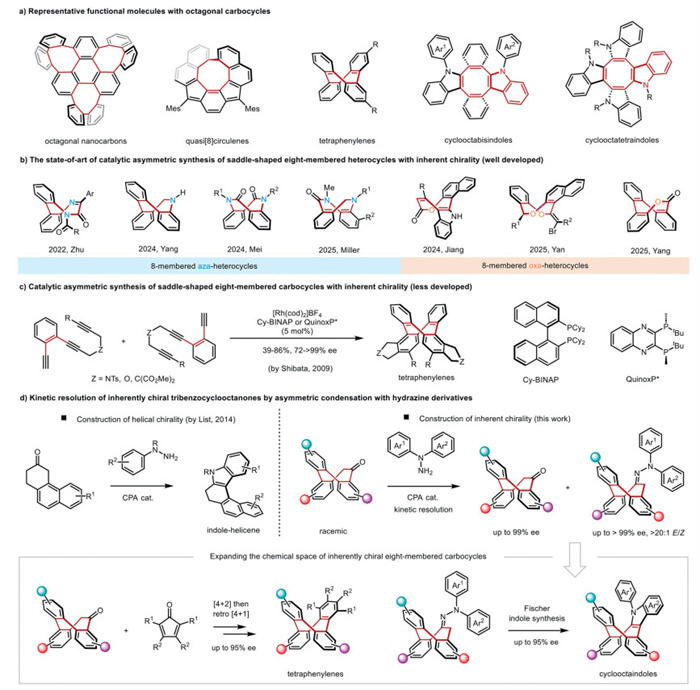
Scheme 1.
Catalytic enantioselective synthesis of eight-membered carbocycles with inherent chirality.

Kinetic resolution of inherently chiral tribenzocyclooctanones via enantioselective condensation with phenylhydrazines
Yi Ma , Yu-Zhen Zhang , Qi-Tao Lu , Ming-Shu Li , Quan Cai


Octagon-embedded polycyclic aromatic hydrocarbons (PAHs) exhibit remarkable optical, electrochemical, and magnetic properties [1-3]. As illustrated in Scheme 1a, curved polycyclic nanocarbons incorporating all-carbon-based eight-membered rings served as building blocks for constructing larger nanographenes with negative Gaussian curvature [4-10]. Quasi[8]circulenes represent a class of saddle-shaped molecules formed by fusing with seven aromatic rings around a central eight-membered carbocycle, displaying notable optoelectronic, redox, and supramolecular characteristics [11,12]. Tetraphenylenes, consisting of four benzene rings linked by four single bonds, are historically significant scaffolds that have enabled diverse applications in molecular sensing, host-guest chemistry, and material science [13-15]. Intriguingly, cyclooctatetraene derivatives bearing two indole moieties have emerged as a new class of organic light-emitting materials, showing promising performance in OLED devices with low operating voltages and high luminous efficiencies [16,17]. Very recently, saddle-shaped asymmetric cyclooctatetraindoles have been identified as effective electroactive materials in dye-sensitized solar cells, inverted perovskite solar cells, and multielectron all-organic flow batteries [18-20].
Inherent chirality, a concept first introduced by Böhmer et al. in 1994, was originally employed to describe the chirality presented in calix[4]arenes [21-30]. It was subsequently extended to compounds with positive or negative curvature that lack perpendicular planes of symmetry [31-46]. According to this definition, unsymmetrical saddle-shaped tetraphenylenes, and their octagonal analogues, charactered with high inversion energy barriers, are inherently chiral [47-51]. Giving the growing significance of such medium-sized ring systems in asymmetric catalysis, chiral recognition, and chiroptical materials [52-57], developing efficient catalytic enantioselective methods to access these chiral molecules is of considerable importance. In 2022, the Zhu group reported the enantioselective synthesis of aza-analogues of tetraphenylenes via a palladium-catalyzed isocyanide insertion strategy (Scheme 1b) [58]. Subsequently, significant advancements in the asymmetric synthesis of eight-membered azaheterocycles have been made by the same group [59], as well as Yang [60,61], Mei [62], and Miller [63]. More recently, the introduction of oxygen atoms into the central eight-membered scaffolds have gained attention. Efficient enantioselective approaches to inherently chiral eight-membered O-heterocycles have been established by Jiang [64], Yan [65], and Yang [66]. Despite these advances, the catalytic asymmetric synthesis of inherently chiral molecules based on all-carbon-based eight-membered rings remains elusive. To the best of our knowledge, only one example has been reported to date. In 2009, the Shibata group achieved a pioneering catalytic enantioselective synthesis of tetraphenylenes through a Rh-catalyzed [2+2+2] cycloaddition of two triyne units (Scheme 1c) [67].
Chiral phosphoric acids (CPAs) have been established as efficient catalysts for a variety of enantioselective transformations [68-77]. Among them, the CPA-catalyzed enantioselective carbonyl condensation with hydrazine or oxime ether derivatives has emerged as a powerful tool for the construction of structurally novel chiral systems [78-81]. Of particular note, the List group developed the catalytic asymmetric Fischer indolization via CPA catalysis, offering an efficient approach to access indoles and indolines bearing central chirality [82,83]. This strategy was further extended to the synthesis of enantioenriched azahelicenes with helical chirality from readily available phenylhydrazine derivatives and polyaromatic ketones [84]. Inspired by these advances, we envisaged whether this approach could be applied to the enantioselective synthesis of eight-membered carbocycles with inherent chirality. Herein, we report the kinetic resolution of racemic tribenzocyclooctanones with inherent chirality via the CPA-catalyzed enantioselective condensation with phenylhydrazine derivatives (Scheme 1d). By this method, the corresponding hydrazone products were obtained with high enantioselectivities, which subsequently underwent Brønsted acid-promoted Fischer indolization smoothly, yielding tribenzocyclooctaindoles with excellent retention of enantioselectivities. Moreover, the recovered enantiomerically enriched tribenzocyclooctanones could be employed as inherently chiral synthons for the synthesis of tribenzocyclooctatetraenes and tetraphenylenes, thereby highlighting the synthetic utility of this method.
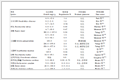
Our investigation began with the racemic tribenzocyclooctanone 1a, synthesized according to the protocol developed by Zhang et al. [85], and phenylhydrazine 2a as model substrates to evaluate the CPA-catalyzed indolization. Using CPA-1 (5 mol%) as the catalyst in DCM at room temperature, the reaction between 1a (1.0 equiv.) and 2a (0.5 equiv.) proceeded smoothly, affording the (E)-hydrazone product 3a as the major isomer (E/Z = 12:1) with 45% yield and 58% ee, along with recovered 1a in 45% yield and 44% ee. Although the desired indolization did not take place, likely due to the strain of the eight-membered ring, we hypothesized that further indolization of 3a might be promoted by a stronger acid catalyst under elevated temperature. Subsequently, a series of additives were screened (Table 1, entries 2‒4). The addition of 4 Å molecular sieves significantly enhanced enantioselectivity, providing 1a with 84% ee and 3a with 77% ee (Table 1, entry 3). Further optimization of solvents (Table 1, entries 5‒9) revealed that toluene gave the best results, yielding 1a in 46% yield with 83% ee and 3a in 48% yield with 82% ee (Table 1, entry 9). Encouraged by these findings, we evaluated a variety of chiral phosphoric acids (Table 1, entries 10‒15). Notably, when the SPINOL-derived CPA-7 was employed as the catalyst, both 1a and 3a were obtained in 90% ee, although the E/Z selectivity of 3a dropped to 6:1 (Table 1, entry 15). Intriguingly, through further experimentation, we found that increasing the reaction concentration (c = 0.3 mol/L in toluene) dramatically improved the E/Z selectivity of 3a to 20:1, affording 1a in 49% yield with 90% ee and 3a in 48% yield with 90% ee (Table 1, entries 17). In contrast, both higher and lower concentrations led to decreased E/Z selectivity of 3a, thus demonstrating the concentration effect in this reaction (Table 1, entries 16‒18).
 DownLoad:
CSV
 |
|||||||||||||||||||||||||||||||||||||||||||||||||||||||||||||||||||||||||||||||||||||||||||||||||||||||||||||||||||||||||||||||||||||||||||||||||||||||||||||||||
| Entry | CPA | Additive | Solvent | 1a | 3a | ||||||||||||||||||||||||||||||||||||||||||||||||||||||||||||||||||||||||||||||||||||||||||||||||||||||||||||||||||||||||||||||||||||||||||||||||||||||||||||
| Yield (%)b | ee (%)c | Yield (%)b | ee (%)c | E/Z d | |||||||||||||||||||||||||||||||||||||||||||||||||||||||||||||||||||||||||||||||||||||||||||||||||||||||||||||||||||||||||||||||||||||||||||||||||||||||||||||
| 1 | CPA-1 | – | DCM | 45 | 44 | 45 | 58 | 12/1 | |||||||||||||||||||||||||||||||||||||||||||||||||||||||||||||||||||||||||||||||||||||||||||||||||||||||||||||||||||||||||||||||||||||||||||||||||||||||||
| 2 | CPA-1 | 3 Å MS | DCM | 43 | 73 | 32 | 78 | 16/1 | |||||||||||||||||||||||||||||||||||||||||||||||||||||||||||||||||||||||||||||||||||||||||||||||||||||||||||||||||||||||||||||||||||||||||||||||||||||||||
| 3 | CPA-1 | 4 Å MS | DCM | 40 | 84 | 42 | 77 | 20/1 | |||||||||||||||||||||||||||||||||||||||||||||||||||||||||||||||||||||||||||||||||||||||||||||||||||||||||||||||||||||||||||||||||||||||||||||||||||||||||
| 4 | CPA-1 | 5 Å MS | DCM | 44 | 78 | 42 | 78 | 20/1 | |||||||||||||||||||||||||||||||||||||||||||||||||||||||||||||||||||||||||||||||||||||||||||||||||||||||||||||||||||||||||||||||||||||||||||||||||||||||||
| 5 | CPA-1 | 4 Å MS | DCE | 48 | 70 | 44 | 77 | 20/1 | |||||||||||||||||||||||||||||||||||||||||||||||||||||||||||||||||||||||||||||||||||||||||||||||||||||||||||||||||||||||||||||||||||||||||||||||||||||||||
| 6 | CPA-1 | 4 Å MS | THF | 57 | 23 | 32 | 75 | 16/1 | |||||||||||||||||||||||||||||||||||||||||||||||||||||||||||||||||||||||||||||||||||||||||||||||||||||||||||||||||||||||||||||||||||||||||||||||||||||||||
| 7 | CPA-1 | 4 Å MS | c-Hexane | 45 | 78 | 48 | 78 | 20/1 | |||||||||||||||||||||||||||||||||||||||||||||||||||||||||||||||||||||||||||||||||||||||||||||||||||||||||||||||||||||||||||||||||||||||||||||||||||||||||
| 8 | CPA-1 | 4 Å MS | EtOAc | 53 | 56 | 36 | 82 | 18/1 | |||||||||||||||||||||||||||||||||||||||||||||||||||||||||||||||||||||||||||||||||||||||||||||||||||||||||||||||||||||||||||||||||||||||||||||||||||||||||
| 9 | CPA-1 | 4 Å MS | Toluene | 46 | 83 | 48 | 82 | 20/1 | |||||||||||||||||||||||||||||||||||||||||||||||||||||||||||||||||||||||||||||||||||||||||||||||||||||||||||||||||||||||||||||||||||||||||||||||||||||||||
| 10 | CPA-2 | 4 Å MS | Toluene | 43 | 82 | 38 | 73 | 20/1 | |||||||||||||||||||||||||||||||||||||||||||||||||||||||||||||||||||||||||||||||||||||||||||||||||||||||||||||||||||||||||||||||||||||||||||||||||||||||||
| 11 | CPA-3 | 4 Å MS | Toluene | 50 | 38 | 36 | 45 | 20/1 | |||||||||||||||||||||||||||||||||||||||||||||||||||||||||||||||||||||||||||||||||||||||||||||||||||||||||||||||||||||||||||||||||||||||||||||||||||||||||
| 12 | CPA-4 | 4 Å MS | Toluene | 44 | 76 | 50 | 68 | 20/1 | |||||||||||||||||||||||||||||||||||||||||||||||||||||||||||||||||||||||||||||||||||||||||||||||||||||||||||||||||||||||||||||||||||||||||||||||||||||||||
| 13 | CPA-5 | 4 Å MS | Toluene | 48 | 80 | 40 | 82 | 4/1 | |||||||||||||||||||||||||||||||||||||||||||||||||||||||||||||||||||||||||||||||||||||||||||||||||||||||||||||||||||||||||||||||||||||||||||||||||||||||||
| 14 | CPA-6 | 4 Å MS | Toluene | 75 | 21 | 10 | 93 | - | |||||||||||||||||||||||||||||||||||||||||||||||||||||||||||||||||||||||||||||||||||||||||||||||||||||||||||||||||||||||||||||||||||||||||||||||||||||||||
| 15 | CPA-7 | 4 Å MS | Toluene | 45 | 90 | 44 | 90 | 6/1 | |||||||||||||||||||||||||||||||||||||||||||||||||||||||||||||||||||||||||||||||||||||||||||||||||||||||||||||||||||||||||||||||||||||||||||||||||||||||||
| 16e | CPA-7 | 4 Å MS | Toluene | 45 | 85 | 44 | 92 | 6/1 | |||||||||||||||||||||||||||||||||||||||||||||||||||||||||||||||||||||||||||||||||||||||||||||||||||||||||||||||||||||||||||||||||||||||||||||||||||||||||
| 17f | CPA-7 | 4 Å MS | Toluene | 49 | 90 | 48 | 90 | 20/1 | |||||||||||||||||||||||||||||||||||||||||||||||||||||||||||||||||||||||||||||||||||||||||||||||||||||||||||||||||||||||||||||||||||||||||||||||||||||||||
| 18g | CPA-7 | 4 Å MS | Toluene | 46 | 84 | 46 | 90 | 10/1 | |||||||||||||||||||||||||||||||||||||||||||||||||||||||||||||||||||||||||||||||||||||||||||||||||||||||||||||||||||||||||||||||||||||||||||||||||||||||||
| a (rac)-1a (0.1 mmol), 2a (0.05 mmol), CPA (5 mol%) and additives (50.0 mg) in solvent (1.0 ml) at 25 ℃ for 48 h. b Determined by 1H NMR analysis of the crude reaction mixture using 2,4,6-trichloropyridine as the internal standard; the yield of 3aa referred to the inseparable mixture of E/Z-isomers. iPr, isopropyl; Cy, cyclohexyl; Ad, adamantyl; DCM, dichloromethane; DCE, 1,2-dichloroethane; THF, tetrahydrofuran; MS, molecular sieves. c Determined by HPLC analysis with a chiral stationary phase. d Determined by the crude 1H NMR analysis of the reaction mixture. e c = 0.2 mol/L. f c = 0.3 mol/L. g c = 0.4 mol/L. |
|||||||||||||||||||||||||||||||||||||||||||||||||||||||||||||||||||||||||||||||||||||||||||||||||||||||||||||||||||||||||||||||||||||||||||||||||||||||||||||||||
With the optimal reaction conditions established, we first investigated the scope of diphenylhydrazine derivatives 2. As summarized in Scheme 2, a variety of electron-withdrawing substituents, including F, Cl, Br, CF3, and OCF3, were tolerated on both phenyl rings of symmetrical hydrazines, delivering the corresponding inherently chiral hydrazones (3b‒3g) in 46%‒50% yields, with 90%‒98% ee and E/Z ratios ranging from 6:1 to 17:1. Meanwhile, the recovered starting material 1a with 46%‒49% yields and 90%‒95% ee. The absolute configuration of 1a was unambiguously assigned by the X-ray crystallography analysis (CCDC: 2493546). Substrates bearing electron-donating groups, such as Me, tBu, and OMe, at the para or ortho positions of phenyl rings were also compatible, affording recovered 1a in 44%‒49% yields with 70%‒90% ee, and the corresponding 3h‒3k in 47%‒50% yields with 67%‒90% ee. Pleasingly, carbazole-derived hydrazines proved to be suitable substrates, showing excellent resolution efficiency with high yields and ee values for both recovered 1a and the desired products 3l and 3m. Furthermore, this reaction was successfully extended to unsymmetrical diphenylhydrazine derivatives bearing a single substituent, such as 4-Cl, 4-Br, 4-Me, 4-CO2Me, or 4-CN on one phenyl ring, furnishing products 3n‒3r in good performance.
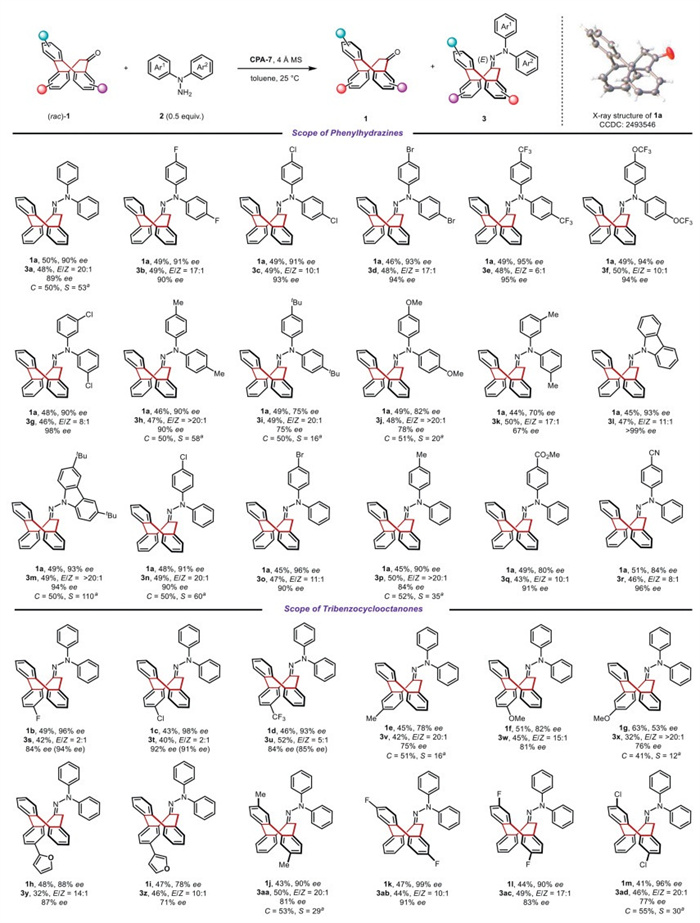
Next, the reaction scope with respect of racemic tribenzocyclooctanones was investigated (Scheme 2). Tribenzocyclooctanones bearing electron-withdrawing groups (F, Cl, CF3) on the phenyl ring adjacent to the carbonyl moiety proved to be compatible, affording recovered tribenzocyclooctanones 1b‒1d in 43%−49% yields with 93%−98% ee, along with hydrazone products 3s‒3u in 40%−52% yields with 84%−92% ee, albeit with moderate E/Z selectivity ranging from 2:1 to 5:1. In contrast, substrate bearing electron-donating groups (Me, OMe, 2-furyl, 3-furyl) afforded hydrazone products 3v‒3z in 32%−46% yields and 71%−87% ee, accompanied by a marked increase in E/Z selectivity (from 10:1 to > 20:1). Furthermore, a series of disubstituted tribenzocyclooctanones were evaluated, yielding recovered 1j‒1m in 41%−47% yields with 90%−99% ee, and hydrazones 3aa‒3ad in 44%−50% yields, 77%−91% ee, and 10:1 to 20:1 E/Z.
With the enantioenriched hydrazones in hand, we next explored the Fischer indolization to achieve our initial goal. After systematically optimizing reaction conditions (see Supporting information for details), we found that treating hydrazone 3a (90% ee) with HCl in MeOH at 80 ℃ smoothly afforded the inherently chiral tribenzocyclooctaindole 4a in 80% yield and 88 % ee (Scheme 3a). This protocol proved to be applicable to a range of substituted hydrazone intermediates, delivering the corresponding indole products 4b‒4j in moderate to excellent yields (35%−95%) with high retention of enantiopurities (84%−95% ee). Notably, the moderate yields observed for 4h and 4i suggested that both (E)- and (Z)-hydrazone isomers could participate in the indolization step. To illustrate the practicability of this method, a large-scale reaction was conducted using (rac)-1a (2.0 mmol) and 2d (1.0 mmol) (Scheme 3b). In this reaction, starting material 1a was recovered in 44% yield with 93% ee, while hydrazone 3d was obtained in 45% yield, 92% ee, with a 10:1 E/Z ratio. Subsequent Fischer indolization of 3d on a larger scale proceeded smoothly, furnishing the target inherently chiral indole product in 58% yield and 92% ee.
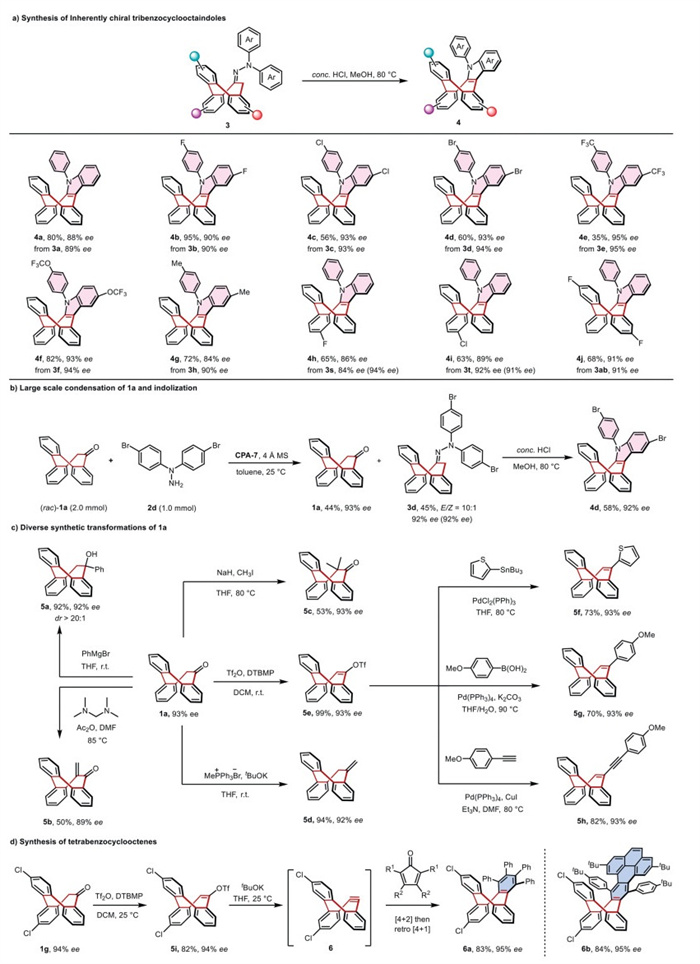
To demonstrate the synthetic utility of this kinetic resolution process, the recovered enantiomerically enriched compound 1a was employed as a chiral synthon for further transformations. As illustrated in Scheme 3c, 1,2-addition of 1a with PhMgBr afforded tertiary alcohol 5a bearing both inherent and central chirality in 92% yield, 92% ee, and with excellent diasterioselectivity (> 20:1 dr). α-Methylenation of 1a using CH2(NMe)2 furnished enone 5b in 50% yield and 89% ee. Additionally, dimethylation and Wittig reaction of 1a proceeded smoothly to give 5c in 53% yield with 93% ee, and 5d in 94% yield with 92% ee, respectively. Notably, 1a was efficiently converted to vinyl triflate 5e in 99% yield and 93% ee. This intermediate underwent a range of cross-coupling reactions, including Stille, Suzuki‒Miyaura, and Sonogashira couplings, affording 5f‒5h in 70%‒82% yields while maintaining high enantiopurity (93%‒93% ee). Furthermore, the enantioenriched tribenzocyclooctenone 1g could serve as a π-extension reagent for constructing inherently chiral tetraphenylenes (Scheme 3d). For instance, 1g was readily transformed into vinyl triflate 5i in 99% yield and 93% ee. Then, treatment of 5i with tBuOK generated a strained tribenzocyclooctatrienyne intermediate [85], which reacted in situ with electron-deficient cyclopentadienones via the Diels‒Alder reaction followed by the spontaneous retro-[4+1] extrusion of CO, leading to tetraphenylenes 6a and 6b with high yields and excellent ee, respectively.
To showcase the application potential of inherently chiral tribenzocyclooctanone derivatives in asymmetric catalysis, a thiourea catalyst was prepared (Scheme 4a). From 5e with 93% ee, Suzuki coupling with 2-aminophenylboronic acid, followed by the condensation with thiophosgene and enantiopure (S,S)-N,N-dimethylcyclohexane-1,2-diamine, led to thiourea 7b in 76% yield with > 20:1 dr. In the presence of 7b (10 mol%), the α-hydrazination of β-ketoester 7d with di-tert-butyl azodicarboxylate 7e went on smoothly, affording 7f in 98% yield with 96% ee. In comparison, 7f was obtained in only 66% ee by the catalysis of commercially available thiourea catalyst 7c. These observations unambiguously demonstrated the practical utility of eight-membered carbocycles with inherent chirality.
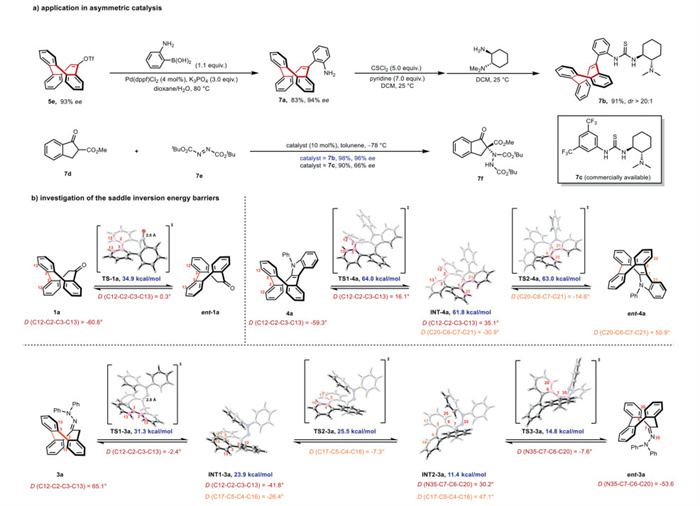
To better understand the conformational stability of eight-membered carbocycles, DFT calculations were performed to investigate the saddle inversion energy barriers of tribenzocyclooctanone 1a, hydrazone 3a, and tribenzocyclooctaindole 4a (Scheme 4b). The computational results suggested that all these inherently chiral molecules exhibited sufficiently rigid conformer (ΔG‡rac > 30 kcal/mol). As shown in Scheme 4, the saddle-shaped 1a was converted to its enantiomer ent-1a through an almost flat transition state TS-1a with an energy barrier of 34.9 kcal/mol, in which the dihedral angel of C12-C2-C3-C13 was calculated to be 0.3°. In contrary, the racemization process of hydrazone 3a was more complicated. The flipping of three phenyl rings of 3a initially proceeded via TS1-3a (dihedral angle of C12-C2-C3-C13 = ‒2.4°) with an energy barrier of 31.3 kcal/mol, leading to thermodynamically unstable intermediate Int1-3a. Twisted Int1-3a was then converted to saddle-shaped Int2-3a facilely through TS2-3a (dihedral angle of C17-C5-C4-C16 = ‒7.3°) with an energy barrier of 1.6 kcal/mol. From Int2-3a, the saddle inversion was completed to afford ent-3a by flipping the hydrazone group via TS3-3a (dihedral angle of N35-C7-C6-C20 = ‒7.6°). Notably, the relatively lower racemization energy barrier of 3a compared with 1a might be attributed to the longer distance of the C=N bond (2.8 Å) than the C=O bond (2.0 Å). For tribenzocyclooctaindole 4a, the saddle inversion commenced with ring flipping via TS1-4a (dihedral angle of C12-C2-C3-C13 = 16.1°), leading to twisted intermediate Int-4a, which then underwent further ring flipping to afford ent-4a via TS2-4a (dihedral angle of C20-C6-C21-C47 = ‒14.6°). The high energy barrier of 64.0 kcal/mol for TS1-4a suggested the remarkable thermodynamic stability of the inherent chirality in cyclooctatetraene derivatives fused with four aromatic rings.
In conclusion, we have developed an efficient kinetic resolution of inherently chiral tribenzocyclooctanones via chiral phosphoric acid-catalyzed condensation with phenylhydrazine derivatives. Using this method, a series of tribenzocyclooctanones bearing diverse substituents were successfully resolved, affording the recovered starting material and the corresponding hydrazone products in good yields and enantioselectivities. Subsequent Brønsted acid-promoted indolization of hydrazone products proceeded smoothly to give a diverse range of inherently chiral tribenzocyclooctaindoles without loss of enantiopurities. Moreover, the recovered tribenzocyclooctanones with high ee were shown to serve as versatile chiral synthons for the synthesis of saddle-shaped tribenzocyclooctatetraene and tetraphenylene derivatives possessing inherent chirality. Further studies on the application of this approach for constructing inherently chiral medium-ring-embedded scaffolds and exploring their chiroptical properties are underway in our laboratory.
Yi Ma: Writing – review & editing, Writing – original draft, Methodology, Investigation, Data curation. Yu-Zhen Zhang: Methodology, Investigation. Qi-Tao Lu: Investigation, Data curation. Ming-Shu Li: Investigation, Data curation. Quan Cai: Writing – review & editing, Writing – original draft, Supervision, Project administration, Conceptualization.
The authors declare that they have no known competing financial interests or personal relationships that could have appeared to influence the work reported in this paper.
Financial support for this work was provided by the National Natural Science Foundation of China (Nos. 22222104, 22471043), Shanghai Science and Technology Committee (No. 22JC1401102), and Shanghai Pilot Program for Basic Research.
Supplementary material associated with this article can be found, in the online version, at doi:
A. Narita, X.Y. Wang, X. Feng, K. Müllen, Chem. Soc. Rev. 44 (2015) 6616–6643. doi: 10.1039/C5CS00183H
G.G. Miera, S. Matsubara, H. Kono, K. Murakami, K. Itami, Chem. Sci. 13 (2022) 1848–1868. doi: 10.1039/D1SC05586K
V. Kumar, J.L. Páez, S. Míguez-Lago, et al., Chem. Soc. Rev. 54 (2025) 4922–4947. doi: 10.1039/d4cs00745j
F. Chen, Y.S. Hong, S. Shimizu, et al., Angew. Chem. Int. Ed. 54 (2015) 10639–10642. doi: 10.1002/anie.201505124
K.Y. Cheung, C.K. Chan, Z. Liu, Q. Miao, Angew. Chem. Int. Ed. 56 (2017) 9003–9007. doi: 10.1002/anie.201703754
S.H. Pun, Q. Miao, Acc. Chem. Res. 51 (2018) 1630–1642. doi: 10.1021/acs.accounts.8b00140
S. Matsubara, Y. Koga, Y. Segawa, K. Murakami, K. Itami, Nat. Catal. 3 (2020) 710–718. doi: 10.1038/s41929-020-0487-0
S.H. Pun, Q. Miao, Chin. J. Org. Chem. 40 (2020) 3347–3353. doi: 10.6023/cjoc202005033
Y. Zhang, Y. Zhu, D. Lan, et al., J. Am. Chem. Soc. 143 (2021) 5231–5238. doi: 10.1021/jacs.1c01642
J. Bello-Garcia, J.A. Varela, C. Saa, Angew. Chem. Int. Ed. 63 (2024) e202414017. doi: 10.1002/anie.202414017
E. Sidler, R. Hein, C.N. Stindt, B.L. Feringa, Angew. Chem. Int. Ed. 64 (2025) e202510583. doi: 10.1002/anie.202510583
M.I. Khalid, M.S.H. Salem, M. Sako, et al., Commun. Chem. 5 (2022) 166. doi: 10.1038/s42004-022-00780-7
N.Z. Huang, F. Sondheimer, Acc. Chem. Res. 15 (1982) 96–102. doi: 10.1021/ar00076a001
J.W. Han, X. Li, H.N. Wong, Chem. Rec. 15 (2015) 107–131. doi: 10.1002/tcr.201402047
J.W. Han, X.S. Peng, H.N.C. Wong, Nat. Sci. Rev. 4 (2017) 892–916. doi: 10.1093/nsr/nwx122
H.T. Fan, X.G. Zhang, Z.Q. Zhu, et al., Beijing Eternal Material Technology Co., Ltd., Patent, CN106433614A, 2017.
P. Xie, H.W. Zhang, X.F. Xu, et al., Beijing Bayi Space LCD Technology Co., Ltd., Patent, CN114773353A, 2022.
X. Qian, H.H. Gao, Y.Z. Zhu, B. Pan, J.Y. Zheng, Dyes Pigm. 121 (2015) 152–158. doi: 10.1016/j.dyepig.2015.05.015
M.A. Truong, L. Ueberricke, T. Funasaki, et al., Angew. Chem. Int. Ed. 63 (2024) e202412939. doi: 10.1002/anie.202412939
H.T.K. Chung, T.K. Schramm, M. Head-Gordon, J. Shee, F.D. Toste, J. Am. Chem. Soc. 147 (2025) 2115–2128. doi: 10.1021/jacs.4c16027
V. Böhmer, D. Kraft, M. Tabatabai, J. Incl. Phenom. Macrocycl. Chem. 19 (1994) 17–39. doi: 10.1007/978-94-011-0267-4_2
J. Feng, L.L. Xi, R.R. Liu, Chem. Eur. J. 31 (2025) e02247. doi: 10.1002/chem.202502247
S. Tong, J.T. Li, D.D. Liang, et al., J. Am. Chem. Soc. 142 (2020) 14432–14436. doi: 10.1021/jacs.0c05369
Y.Z. Zhang, M.M. Xu, X.G. Si, J.L. Hou, Q. Cai, J. Am. Chem. Soc. 144 (2022) 22858–22864. doi: 10.1021/jacs.2c10606
X. Zhang, S. Tong, J. Zhu, M.X. Wang, Chem. Sci. 14 (2023) 827–832. doi: 10.1039/d2sc06234h
P.F. Qian, G. Zhou, J.H. Hu, et al., Angew. Chem. Int. Ed. 63 (2024) e202412459. doi: 10.1002/anie.202412459
Y.K. Jiang, Y.L. Tian, J. Feng, et al., Angew. Chem. Int. Ed. 63 (2024) e202407752. doi: 10.1002/anie.202407752
S. Yu, M. Yuan, W. Xie, et al., Angew. Chem. Int. Ed. 63 (2024) e202410628. doi: 10.1002/anie.202410628
X.Y. Zhang, D. Zhu, R.F. Cao, et al., Nat. Commun. 15 (2024) 9929. doi: 10.1038/s41467-024-54380-1
M. Yuan, W. Xie, S. Yu, T. Liu, X. Yang, Nat. Commun. 16 (2025) 3943. doi: 10.1038/s41467-025-59221-3
A. Szumna, Chem. Soc. Rev. 39 (2010) 4274–4285. doi: 10.1039/b919527k
M. Rickhaus, M. Mayor, M. Juríček, Chem. Soc. Rev. 46 (2017) 1643–1660. doi: 10.1039/C6CS00623J
M.A. Majewski, M. Stępień, Angew. Chem. Int. Ed. 58 (2019) 86–116. doi: 10.1002/anie.201807004
M. Tang, X. Yang, Eur. J. Org. Chem. 26 (2023) e202300738. doi: 10.1002/ejoc.202300738
M. Li, X.L. Chia, C. Tian, Y. Zhu, Chem 8 (2022) 2843–2855. doi: 10.1016/j.chempr.2022.08.009
M. Li, C.K.S. Ho, I.K.W. On, V. Gandon, Y. Zhu, Chem 10 (2024) 3323–3341. doi: 10.1016/j.chempr.2024.06.012
D. Wang, P. Penert, L. Schneider, et al., Angew. Chem. Int. Ed. 65 (2026) e8159257. doi: 10.1002/anie.8159257
X. Wang, C. Wang, Y. Luo, et al., Chem Catal. 4 (2024) 100904.
H. Zhang, C.J. Lu, G.H. Cai, et al., Nat. Commun. 15 (2024) 3353. doi: 10.1038/s41467-024-47731-5
Z. Wu, D. Yi, J. Tang, et al., Chem 12 (2026) 102730. doi: 10.1016/j.chempr.2025.102730
W.G. Zhou, L.L. Xi, M.R. Zhang, et al., Angew. Chem. Int. Ed. 64 (2025) e202502381. doi: 10.1002/anie.202502381
T.R. Luan, C. Sun, Y.L. Tian, et al., Nat. Commun. 16 (2025) 2370. doi: 10.1038/s41467-025-57461-x
X.H. Zhou, X. Zhang, Y.R. Song, et al., Angew. Chem. Int. Ed. 64 (2025) e202415190. doi: 10.1002/anie.202415190
M.R. Zhang, H.R. Wang, H.M. Shan, et al., Nat. Commun. 16 (2025) 2505. doi: 10.52152/801615
Y.E. Zhang, Y. Jiang, Y. Zhang, et al., Chin. Chem. Lett. 36 (2025) 111201. doi: 10.1016/j.cclet.2025.111201
H. Zhou, X.D. Wang, Y.F. Ao, D.X. Wang, Q.Q. Wang, Chin. Chem. Lett. 37 (2026) 111443. doi: 10.1016/j.cclet.2025.111443
C. Cheng, Z. Cai, X.S. Peng, H.N. Wong, J. Org. Chem. 78 (2013) 8562–8573. doi: 10.1021/jo401240k
L. Cai, J. Chen, Y. Zhu, G. Yang, S. Gu, Adv. Synth. Catal. 367 (2025) e70020. doi: 10.1002/adsc.70020
Y. Luo, S. Luo, Q. Zhu, J. Org. Chem. 90 (2025) 5307–5322. doi: 10.1021/acs.joc.5c00479
S. Jia, Y. Hao, Y. Li, Y. Lan, Nat. Rev. Chem. 9 (2025) 617–633. doi: 10.1038/s41570-025-00735-1
S.M. Bachrach, J. Org. Chem. 74 (2009) 3609–3611. doi: 10.1021/jo900413d
C.K. Hau, S.S.Y. Chui, W. Lu, et al., Chem. Sci. 2 (2011) 1068–1075. doi: 10.1039/c1sc00053e
J. Wang, X. Xie, Y. Cai, et al., J. Mater. Chem. A 9 (2021) 9927–9936. doi: 10.1039/d0ta12591a
J. Guo, W.B. Xiong, H.R. Ma, et al., Chem. Sci. 13 (2022) 4608–4615. doi: 10.1039/d2sc00388k
E.Z. Yao, G.L. Chai, P. Zhang, B. Zhu, J. Chang, Org. Chem. Front. 9 (2022) 2375–2381. doi: 10.1039/d1qo01845k
H.R. Ma, X.S. Peng, J.F. Cui, H.N.C. Wong, Tetrahedron Lett. 119 (2023) 154429. doi: 10.1016/j.tetlet.2023.154429
K. Matsumura, M. Hasegawa, Y. Tsuchido, H. Kawai, Asian J. Org. Chem. 14 (2025) e202500409. doi: 10.1002/ajoc.202500409
Y. Luo, S. Cheng, Y. Peng, et al., CCS Chem. 4 (2022) 2897–2905. doi: 10.31635/ccschem.021.202101486
Y. Luo, X. Wang, W. Hu, et al., CCS Chem. 5 (2023) 982–993. doi: 10.31635/ccschem.022.202201901
D. Zhang, J. Zhou, T. Qin, X. Yang, Chem Catal. 4 (2024) 100827.
J. Zhou, M. Tang, X. Yang, Chin. J. Chem. 42 (2024) 1953–1959. doi: 10.1002/cjoc.202400243
C.Y. Guan, S. Zou, C. Luo, et al., Nat. Commun. 15 (2024) 4580. doi: 10.1038/s41467-024-48947-1
N. Tampellini, B.Q. Mercado, S.J. Miller, J. Am. Chem. Soc. 147 (2025) 4624–4630. doi: 10.1021/jacs.4c17080
S.Q. Shi, C.C. Cui, L.L. Xu, et al., Nat. Commun. 15 (2024) 8474. doi: 10.1038/s41467-024-52823-3
D. Xu, G. Zhou, B. Liu, et al., Angew. Chem. Int. Ed. 64 (2025) e202416873. doi: 10.1002/anie.202416873
L. Wei, Y. Chen, Q. Zhou, et al., J. Am. Chem. Soc. 147 (2025) 30747–30756. doi: 10.1021/jacs.5c05380
T. Shibata, T. Chiba, H. Hirashima, Y. Ueno, K. Endo, Angew. Chem. Int. Ed. 48 (2009) 8066–8069. doi: 10.1002/anie.200903715
T. Akiyama, J. Itoh, K. Yokota, K. Fuchibe, Angew. Chem. Int. Ed. 43 (2004) 1566–1568. doi: 10.1002/anie.200353240
D. Uraguchi, M. Terada, J. Am. Chem. Soc. 126 (2004) 5356–5357. doi: 10.1021/ja0491533
M. Terada, Synthesis 12 (2010) 1929–1982. doi: 10.1055/s-0029-1218801
X. Wu, M. Li, L. Gong, Acta Chim. Sinica 71 (2013) 1091–1100. doi: 10.6023/A13030279
D. Parmar, E. Sugiono, S. Raja, M. Rueping, Chem. Rev. 114 (2014) 9047–9153. doi: 10.1021/cr5001496
X. Li, Q. Song, Chin. Chem. Lett. 29 (2018) 1181–1192. doi: 10.1016/j.cclet.2018.01.045
X. Tian, X. Xu, T. Jing, Z. Kang, W. Hu, Green Synth. Catal. 2 (2021) 337–344.
C. Zhao, J. Liao, Y. Zhu, et al., Chin. Chem. Lett. 36 (2025) 110337. doi: 10.1016/j.cclet.2024.110337
D.Q. Cui, Q.X. Li, J.B. Huang, et al., Chin. Chem. Lett. 37 (2026) 111738. doi: 10.1016/j.cclet.2025.111738
S.K. Nimmagadda, S.C. Mallojjala, L. Woźtas, S.E. Wheeler, J.C. Antilla, Angew. Chem. Int. Ed. 56 (2017) 2454–2458. doi: 10.1002/anie.201611602
B. Ghosh, R. Balhara, G. Jindal, S. Mukherjee, Angew. Chem. Int. Ed. 60 (2021) 9086–9092. doi: 10.1002/anie.202017268
B. Yang, J. Dai, Y. Luo, et al., J. Am. Chem. Soc. 143 (2021) 4179–4186. doi: 10.1021/jacs.1c01366
J.H. Li, X.K. Li, J. Feng, et al., Angew. Chem. Int. Ed. 63 (2024) e202319289. doi: 10.1002/anie.202319289
S. Muller, M.J. Webber, B. List, J. Am. Chem. Soc. 133 (2011) 18534–18537. doi: 10.1021/ja2092163
A. Martinez, M.J. Webber, S. Muller, B. List, Angew. Chem. Int. Ed. 52 (2013) 9486–9490. doi: 10.1002/anie.201301618
L. Kotzner, M.J. Webber, A. Martinez, C. De Fusco, B. List, Angew. Chem. Int. Ed. 53 (2014) 5202–5205. doi: 10.1002/anie.201400474
X. Zuo, C. Cheng, Y. Zhang, Org. Chem. Front. 9 (2022) 4937–4942. doi: 10.1039/d2qo00647b
S.H. Pun, C.K. Chan, J. Luo, Z. Liu, Q. Miao, Angew. Chem. Int. Ed. 57 (2018) 1581–1586. doi: 10.1002/anie.201711437

Scheme 1 Catalytic enantioselective synthesis of eight-membered carbocycles with inherent chirality.

Scheme 2 Substrate scope of phenylhydrazines and tribenzocyclooctanones. Reaction conditions: (rac)-1 (0.2 mmol), 2 (0.1 mmol), CPA-7 (5 mol%), 4 Å MS (50 mg) in toluene (0.3 mol/L) at 25 ℃ for 36 h. Isolated yields of 1 and 3. The yield of 3 referred to the inseparable mixture of E/Z-isomers. E/Z ratios were determined by 1H NMR analysis of 3. The ee values were determined by HPLC analysis with a chiral stationary phase. a Conversion and S factor when E/Z ratio of 3 ≥ 20:1 were determined, conversion (C) = ees/(ees + eep), S = ln[(1−C)(1−ees)]/ln[(1−C)(1−ees)].

Scheme 3 Diverse synthesis of saddle-shaped carbocycle derivatives with inherent chirality. DMF, N,N-dimethylformamide; DTBMP, 2,6-di-tert-butyl-4-methylpyridine.

Scheme 4 Application of inherently chiral eight-membered carbocycles in asymmetric synthesis and investigation of the saddle inversion energy barriers by DFT calculations.
Table 1. Reaction optimization for the CPA-catalysed condensation of tribenzocyclooctanone 1a with diphenylhydrazine 2a.a
|
|||||||||||||||||||||||||||||||||||||||||||||||||||||||||||||||||||||||||||||||||||||||||||||||||||||||||||||||||||||||||||||||||||||||||||||||||||||||||||||||||
| Entry | CPA | Additive | Solvent | 1a | 3a | ||||||||||||||||||||||||||||||||||||||||||||||||||||||||||||||||||||||||||||||||||||||||||||||||||||||||||||||||||||||||||||||||||||||||||||||||||||||||||||
| Yield (%)b | ee (%)c | Yield (%)b | ee (%)c | E/Z d | |||||||||||||||||||||||||||||||||||||||||||||||||||||||||||||||||||||||||||||||||||||||||||||||||||||||||||||||||||||||||||||||||||||||||||||||||||||||||||||
| 1 | CPA-1 | – | DCM | 45 | 44 | 45 | 58 | 12/1 | |||||||||||||||||||||||||||||||||||||||||||||||||||||||||||||||||||||||||||||||||||||||||||||||||||||||||||||||||||||||||||||||||||||||||||||||||||||||||
| 2 | CPA-1 | 3 Å MS | DCM | 43 | 73 | 32 | 78 | 16/1 | |||||||||||||||||||||||||||||||||||||||||||||||||||||||||||||||||||||||||||||||||||||||||||||||||||||||||||||||||||||||||||||||||||||||||||||||||||||||||
| 3 | CPA-1 | 4 Å MS | DCM | 40 | 84 | 42 | 77 | 20/1 | |||||||||||||||||||||||||||||||||||||||||||||||||||||||||||||||||||||||||||||||||||||||||||||||||||||||||||||||||||||||||||||||||||||||||||||||||||||||||
| 4 | CPA-1 | 5 Å MS | DCM | 44 | 78 | 42 | 78 | 20/1 | |||||||||||||||||||||||||||||||||||||||||||||||||||||||||||||||||||||||||||||||||||||||||||||||||||||||||||||||||||||||||||||||||||||||||||||||||||||||||
| 5 | CPA-1 | 4 Å MS | DCE | 48 | 70 | 44 | 77 | 20/1 | |||||||||||||||||||||||||||||||||||||||||||||||||||||||||||||||||||||||||||||||||||||||||||||||||||||||||||||||||||||||||||||||||||||||||||||||||||||||||
| 6 | CPA-1 | 4 Å MS | THF | 57 | 23 | 32 | 75 | 16/1 | |||||||||||||||||||||||||||||||||||||||||||||||||||||||||||||||||||||||||||||||||||||||||||||||||||||||||||||||||||||||||||||||||||||||||||||||||||||||||
| 7 | CPA-1 | 4 Å MS | c-Hexane | 45 | 78 | 48 | 78 | 20/1 | |||||||||||||||||||||||||||||||||||||||||||||||||||||||||||||||||||||||||||||||||||||||||||||||||||||||||||||||||||||||||||||||||||||||||||||||||||||||||
| 8 | CPA-1 | 4 Å MS | EtOAc | 53 | 56 | 36 | 82 | 18/1 | |||||||||||||||||||||||||||||||||||||||||||||||||||||||||||||||||||||||||||||||||||||||||||||||||||||||||||||||||||||||||||||||||||||||||||||||||||||||||
| 9 | CPA-1 | 4 Å MS | Toluene | 46 | 83 | 48 | 82 | 20/1 | |||||||||||||||||||||||||||||||||||||||||||||||||||||||||||||||||||||||||||||||||||||||||||||||||||||||||||||||||||||||||||||||||||||||||||||||||||||||||
| 10 | CPA-2 | 4 Å MS | Toluene | 43 | 82 | 38 | 73 | 20/1 | |||||||||||||||||||||||||||||||||||||||||||||||||||||||||||||||||||||||||||||||||||||||||||||||||||||||||||||||||||||||||||||||||||||||||||||||||||||||||
| 11 | CPA-3 | 4 Å MS | Toluene | 50 | 38 | 36 | 45 | 20/1 | |||||||||||||||||||||||||||||||||||||||||||||||||||||||||||||||||||||||||||||||||||||||||||||||||||||||||||||||||||||||||||||||||||||||||||||||||||||||||
| 12 | CPA-4 | 4 Å MS | Toluene | 44 | 76 | 50 | 68 | 20/1 | |||||||||||||||||||||||||||||||||||||||||||||||||||||||||||||||||||||||||||||||||||||||||||||||||||||||||||||||||||||||||||||||||||||||||||||||||||||||||
| 13 | CPA-5 | 4 Å MS | Toluene | 48 | 80 | 40 | 82 | 4/1 | |||||||||||||||||||||||||||||||||||||||||||||||||||||||||||||||||||||||||||||||||||||||||||||||||||||||||||||||||||||||||||||||||||||||||||||||||||||||||
| 14 | CPA-6 | 4 Å MS | Toluene | 75 | 21 | 10 | 93 | - | |||||||||||||||||||||||||||||||||||||||||||||||||||||||||||||||||||||||||||||||||||||||||||||||||||||||||||||||||||||||||||||||||||||||||||||||||||||||||
| 15 | CPA-7 | 4 Å MS | Toluene | 45 | 90 | 44 | 90 | 6/1 | |||||||||||||||||||||||||||||||||||||||||||||||||||||||||||||||||||||||||||||||||||||||||||||||||||||||||||||||||||||||||||||||||||||||||||||||||||||||||
| 16e | CPA-7 | 4 Å MS | Toluene | 45 | 85 | 44 | 92 | 6/1 | |||||||||||||||||||||||||||||||||||||||||||||||||||||||||||||||||||||||||||||||||||||||||||||||||||||||||||||||||||||||||||||||||||||||||||||||||||||||||
| 17f | CPA-7 | 4 Å MS | Toluene | 49 | 90 | 48 | 90 | 20/1 | |||||||||||||||||||||||||||||||||||||||||||||||||||||||||||||||||||||||||||||||||||||||||||||||||||||||||||||||||||||||||||||||||||||||||||||||||||||||||
| 18g | CPA-7 | 4 Å MS | Toluene | 46 | 84 | 46 | 90 | 10/1 | |||||||||||||||||||||||||||||||||||||||||||||||||||||||||||||||||||||||||||||||||||||||||||||||||||||||||||||||||||||||||||||||||||||||||||||||||||||||||
| a (rac)-1a (0.1 mmol), 2a (0.05 mmol), CPA (5 mol%) and additives (50.0 mg) in solvent (1.0 ml) at 25 ℃ for 48 h. b Determined by 1H NMR analysis of the crude reaction mixture using 2,4,6-trichloropyridine as the internal standard; the yield of 3aa referred to the inseparable mixture of E/Z-isomers. iPr, isopropyl; Cy, cyclohexyl; Ad, adamantyl; DCM, dichloromethane; DCE, 1,2-dichloroethane; THF, tetrahydrofuran; MS, molecular sieves. c Determined by HPLC analysis with a chiral stationary phase. d Determined by the crude 1H NMR analysis of the reaction mixture. e c = 0.2 mol/L. f c = 0.3 mol/L. g c = 0.4 mol/L. |
|||||||||||||||||||||||||||||||||||||||||||||||||||||||||||||||||||||||||||||||||||||||||||||||||||||||||||||||||||||||||||||||||||||||||||||||||||||||||||||||||
 下载: 导出CSV

 扫一扫看文章


扫一扫关注我们
 下载: