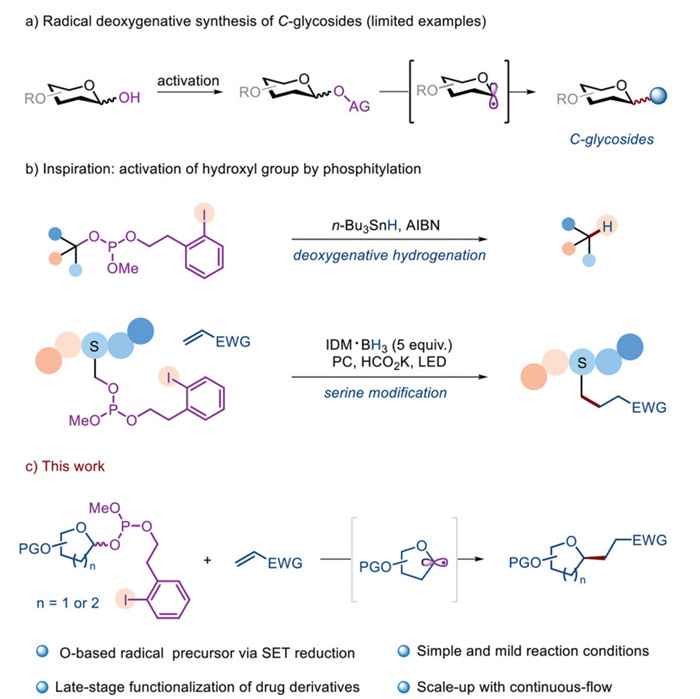
Scheme 1.
Radical deoxygenative C-glycosylation, activation of hydroxyl group by phophitylation and this work.

Generation of glycosyl radicals from phosphitylated 1-hydroxycarbohydrates for the deoxygenative synthesis of C-alkyl glycosides
Shuai Liu , Le Liu , De-Yong Liu , Nai-Li Fan , Xiang-Guo Hu


C-Alkyl glycosides demonstrate remarkable metabolic stability owing to the inherent inertness of the carbon–carbon bond, which confers high resistance to hydrolysis under acidic, basic, and enzymatic conditions [1,2]. This robustness endows C-glycosides with prolonged in vivo half-lives. For example, replacement of the C—O bond in galactosylceramide (KRN7000) with a C—C linkage resulted in a 1000-fold enhancement in antimalarial activity and a 100-fold increase in antitumor potency [3]. Furthermore, several physiologically active C-alkyl glycoside natural products have been identified, including Tunicamycin [4], Aureonuclemycin [4], and Amphidinol 3 [5].
Reactions involving glycosyl radicals have emerged as a robust strategy for the synthesis of C-glycosides [6-8]. In recent years, a variety of glycosyl radical precursors have been developed for C-glycoside synthesis, including C-based [9-13], O-based [14-19], S-based [20-31], halide-based [32-39] glycosyl donors, and others [40-51] (e.g., glycals [40–41,47-50], 1-deoxyglycoside [45,51], glycosyl trifluoroborate [46]). Among these, the ready availability and remarkable stability of 1-hydroxycarbohydrates make them particularly attractive precursors for O-glycosyl donors (Scheme 1a). As a result, strategies for generating glycosyl radicals have been developed via the use of glycosyl 1,4-dihydropyridine esters [14,19], N-heterocyclic carbene (NHC)-activated 1-hydroxycarbohydrates [15], glycosyl acetates [16], glycosyl benzoates [17], and 1-hydroxycarbohydrates activated by a titanium catalyst [18]. Notably, Chi and Wang have developed a method for synthesizing unprotected C-alkyl glycosides from glycosyl 1,4-dihydropyridine esters [19]. Nevertheless, the variety of such donors is still relatively constrained, with a notable scarcity of donors that can be activated via single-electron transfer (SET) reduction [16-18].
As a continuation of our interest in glycosyl radical-based glycosylation [15,49,52-55], we previously disclosed NHC-activated 1-hydroxycarbohydrates as a radical precursor for N- and C-glycoside synthesis via single-electron oxidation [15,52]. Complementing this approach, we now present a reductive deoxygenation strategy employing phosphite-activated 1-hydroxycarbohydrates to generate glycosyl radicals, enabling efficient and stereoselective synthesis of C-alkyl glycosides (Scheme 1c). Notably, our strategy utilizes silane as the reductant, thereby avoiding the use of toxic n-Bu3SnH employed previously (Scheme 1b) [56].
We draw inspiration from Koreeda's work, who reported that 2-iodophenethyl methyl phosphite serves as an activation group for generating alkyl radicals from corresponding alcohols (Scheme 1b). This reaction, however, is a radical-mediated deoxygenative hydrogenation that employs toxic Bu3SnH [56,57]. Notably, during the preparation of this manuscript, the Diao group demonstrated that 2-iodophenethyl methyl phosphite could activate serine residues for the late-stage functionalization of noncanonical peptides, offering a modern application of this strategy [58].
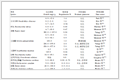
The phosphitylated 1-hydroxycarbohydrates were conveniently prepared by subjecting the parent 1-hydroxycarbohydrates to a sequential reaction with CH3OPCl2 and 2-(2′-iodophenyl)ethanol, and were used directly after purification by flash column chromatography (see Supporting information for details). After extensive screening, the optimal conditions were established as follows: Phosphitylated d-ribofuranose 1a (0.2 mmol) and N-(4-fluorophenyl)acrylamide 2a (0.1 mmol) were reacted in the presence of fac-Ir(ppy)3 (3 mol%) and TMS3SiH (2.5 equiv.) in anhydrous DMAc at room temperature under an argon atmosphere. The reaction was irradiated with 45 W blue LEDs (445 nm) for 24 h, affording the desired product 3a as the β-isomer in 72% yield (entry 1, Table 1). Replacing fac-Ir(ppy)3 (Ered = −1.71 V vs. SCE) with photocatalysts possessing lower reduction potentials, such as Ir(ppy)2(dtbbpy)PF6 (Ered = −0.96 V vs. SCE), 4CzIPN (Ered = −1.21 V vs. SCE), and Ru(bpy)3 (Ered = −0.81 V vs. SCE), led to 52%–61% yields (entries 2–4). Alternative hydrogen atom donors, including Hantzsch ester (HE), MePh2SiH, Et3SiH, and methanol, were ineffective, providing ≤28% yield (entries 5–8). The use of DMF, MeCN, or MTBE as solvent also resulted in significantly lower yields (16%–30%) (entries 9–11). Control experiments showed that irradiating the glycosyl donor without a photocatalyst still afforded product 3a in 28% yield (entries 12 and 13). This result indicates that the glycosyl radical can be generated through direct photochemical cleavage of the C–I bond, albeit inefficiently. For comparison, the Et3B/O2 system, which was effectively employed by Niu and co-workers in a related desulfonative C-glycosylation, afforded the C-glycoside 3a in 25% yield (Table 1, entry 14) [25].
 DownLoad:
CSV
 |
|||||||||||||||||||||||||||||||||||||||||
| Entry | Variations from standard conditions | Yield (%)b | |||||||||||||||||||||||||||||||||||||||
| 1 | None | 72 | |||||||||||||||||||||||||||||||||||||||
| 2 | Ir(ppy)2(dtbbpy)PF6 instead of fac-Ir(ppy)3 | 59 | |||||||||||||||||||||||||||||||||||||||
| 3 | 4CzIPN instead of fac-Ir(ppy)3 | 61 | |||||||||||||||||||||||||||||||||||||||
| 4 | [Ru(bpy)3](BF4)2 instead of fac-Ir(ppy)3 | 52 | |||||||||||||||||||||||||||||||||||||||
| 5 | HE instead of TMS3SiH | 28 | |||||||||||||||||||||||||||||||||||||||
| 6 | MePh2SiH instead of TMS3SiH | 15 | |||||||||||||||||||||||||||||||||||||||
| 7 | Et3SiH instead of TMS3SiH | 10 | |||||||||||||||||||||||||||||||||||||||
| 8 | MeOH instead of TMS3SiH | 5 | |||||||||||||||||||||||||||||||||||||||
| 9 | DMF instead of DMAc | 30 | |||||||||||||||||||||||||||||||||||||||
| 10 | MeCN instead of DMAc | 22 | |||||||||||||||||||||||||||||||||||||||
| 11 | MTBE instead of DMAc | 16 | |||||||||||||||||||||||||||||||||||||||
| 12 | No PC | 28 | |||||||||||||||||||||||||||||||||||||||
| 13 | No (MeSi)3SiH, or in dark | N.D. | |||||||||||||||||||||||||||||||||||||||
| 14 | Et3B (1.5 equiv.), NHC borane (1.5 equiv.), O2 | 25c | |||||||||||||||||||||||||||||||||||||||
| a Conditions: 1a (0.2 mmol, 2.0 equiv.), 2a (0.1 mmol, 1.0 equiv.), fac-Ir(ppy)3 (0.004 mmol, 2 mol%), TMS3SiH (2.0 equiv.), DMAc (1.0 mL, dried and degassed), blue LED, N2, r.t., 4 h. b Isolated yield. c Detailed experimental conditions are provided in Table S5 (Supporting information). |
|||||||||||||||||||||||||||||||||||||||||
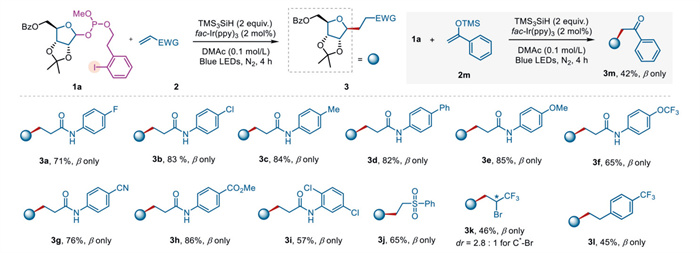
With optimized conditions in hand, we next evaluated the substrate scope of this C-glycosylation reaction, beginning with a series of Giese acceptors (Scheme 2). N-Phenyl acrylamides with various substituents on the phenyl ring all showed good reactivity, producing exclusive C-glycosides (3a–3j) in moderate to high yields (57%–85%). Representative para-substituted substrates included fluorine (3a), chlorine (3b), methyl (3c), and phenyl (3d) groups. Both electron-donating groups (e.g., methoxy 3e) and electron-withdrawing groups such as trifluoromethoxy (3f), cyano (3g), and ester (3h) at the para position of the N-phenyl acrylamide scaffold were well tolerated, delivering the desired Giese adducts in good yields. A 2,4-dichloro-substituted N-phenyl acrylamide also reacted smoothly, producing the product (3i) as a single stereoisomer in 57% yield. Furthermore, phenyl vinyl sulfone (3j), 2–bromo-2-trifluoromethyl ethylene (3k), and 4-(trifluoromethyl)styrene (3l) underwent hydroglycosylation with phosphitylated 1–hydroxy carbohydrates effectively, delivering the corresponding C-glycosides in yields of 65% and 46%, respectively. Notably, a silyl enol ether derivative (2m) also participated in the reaction with phosphitylated 1–hydroxy ribose, furnishing a benzoyl-substituted C-glycoside with a 42% yield [22,23]. Importantly, all cases demonstrated outstanding β-only diastereoselectivity.
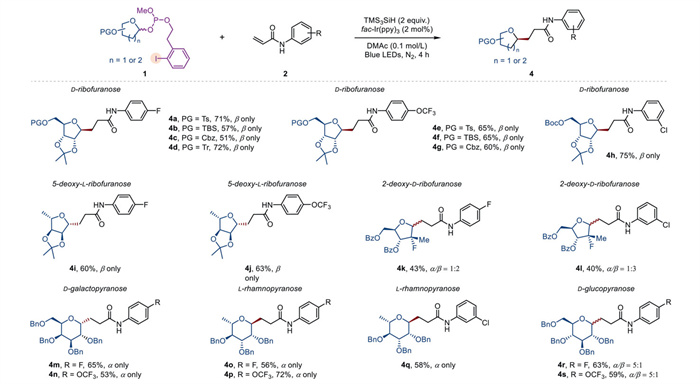
We next examined the scope of phosphitylated 1–hydroxy carbohydrate substrates (Scheme 3). d-Ribofuranose derivatives bearing diverse C5-O-protecting groups, including p-toluenesulfonyl (Ts), tert–butyldimethylsilyl (TBS), benzyloxycarbonyl (Cbz), and tert–butoxycarbonyl (Boc) (4a–4h), underwent smooth coupling with N-phenylacrylamides containing F, OCF3, or Cl substituents, affording corresponding C-glycosides in 51%–75% yield in only one diastereomer. The method also proved effective for 5-deoxy-L-ribofuranosides (4i, 4j), affording products in moderate to good yields. Lower stereoselectivity was observed for 4k and 4l (α/β = 1:2 and 1:3, respectively), possibly because of the competing influence of the C-F bond stereoelectronics and methyl group steric hindrance [8,52]. Pyranose substrates equipped with benzyl (Bn) groups, including d-galactopyranose (4m, 4n), l-rhamnopyranose (4o–4q), and d-glucopyranose (4r, 4s), were also suitable, delivering the desired adducts in moderate to good yields. The observed α-stereoselectivity for pyranoses in this glycosyl radical-based C-glycosylation arises from the greater stability of the axial σ-radical. This selectivity is reduced in glucose-derived substrates because the glucosyl radical adopts a B2,5 conformation, where steric hindrance from the C2-OR group disfavors the α-approach [8,60].
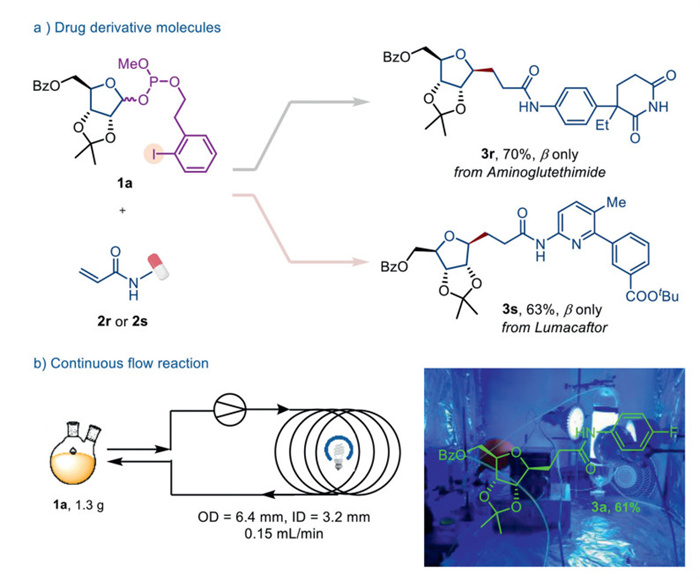
To showcase the synthetic utility of this protocol, we applied it to the late-stage functionalization of aminoglutethimide (3r) and lumacaftor (3s) derivatives, successfully obtaining the corresponding C-glycosylated products in 70% and 63% yield, respectively (Scheme 4a). Moreover, the scalability of the process was evaluated using compound 3a under continuous-flow conditions, delivering a 61% yield on a gram scale (Scheme 4b).
Mechanistic investigations were conducted to elucidate the pathway of this deoxygenative C-glycosylation reaction (Scheme 5). The reaction was completely suppressed by TEMPO, with HRMS analysis concurrently detecting two radical adducts: One derived from the deiodinated aryl radical and another from the glycosyl radical (Scheme 5a). Deuterium-labelling experiments suggest that TMS3SiH, rather than water, serves as the hydrogen atom source, and that the reaction proceeds via a radical pathway rather than a polar one (Scheme 5a). Furthermore, Stern–Volmer quenching studies indicated that the glycosyl donor quenches the excited-state photocatalyst (PC*) more efficiently than TMS3SiH (Scheme 5b). Collectively, these results strongly support a mechanism involving photoinduced generation of the glycosyl radical.
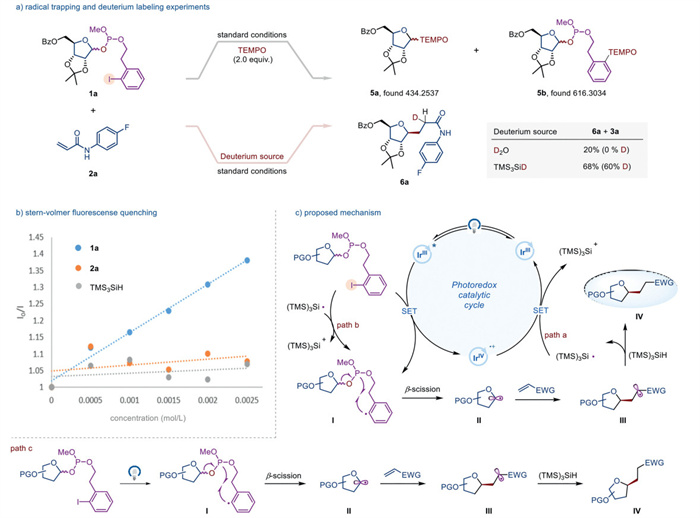
Based on the above results and literature precedents [57,59], a plausible mechanism was proposed (Scheme 5). Photoexcitation of fac-IrⅢ(ppy)3 generates fac-IrⅢ(ppy)3*, which undergoes single-electron transfer (SET) with 2-iodophenethyl methyl phosphite to yield an aryl radical Ⅰ and fac-IrⅣ(ppy)3. Aryl radical Ⅰ then undergoes rapid β-scission to generate the glycosyl radical Ⅱ. This radical adds across styrene to form adduct Ⅲ, which is reduced via hydrogen atom transfer (HAT) from TMS3SiH, yielding the product Ⅳ and a TMS3Si• radical [59]. Finally, oxidation of TMS3Si• by fac–IrⅣ(ppy)3 regenerates the ground-state photocatalyst fac–IrⅢ(ppy)3 and furnishes the silyl cation intermediate, thus closing the catalytic cycle (path a). Two minor competing pathways are conceivable: (ⅰ) The TMS3Si• radical produced in the HAT step may directly initiate a radical XAT with the substrate, furnishing aryl radical Ⅰ and entering the productive cycle. (ⅱ) Alternatively, blue light-induced homolytic cleavage of the aryl iodide C–I bond can generate aryl radical Ⅰ, which then undergoes the same β-scission/addition/HAT sequence to yield the product, though this route is inefficient (Table 1, entry 12).
In conclusion, we report the first use of phosphitylated 1-hydroxycarbohydrates as glycosyl radical precursors for the deoxygenative hydroglycosylation of alkenes, enabling the synthesis of C-alkyl glycosides. This method establishes a novel strategy for generating glycosyl radicals via SET reduction. Mechanistic studies confirmed the formation of glycosyl radicals and identified TMS3SiH as the hydrogen atom source. This methodology offers several advantages: (ⅰ) Readily available precursors; (ⅱ) simple and mild reaction conditions; (ⅲ) convenient application in the late-stage functionalization of drug derivatives; and (ⅳ) easy scalability using continuous-flow technology. We anticipate that these features will make this protocol valuable for the preparation of biologically important C-glycosides.
Shuai Liu: Writing – review & editing, Writing – original draft, Supervision, Project administration, Methodology, Funding acquisition, Data curation, Conceptualization. Le Liu: Methodology, Investigation, Data curation. De-Yong Liu: Data curation. Nai-Li Fan: Data curation. Xiang-Guo Hu: Writing – review & editing, Supervision, Project administration, Funding acquisition, Formal analysis.
There are no conflicts to declare.
We thank the National Natural Science Foundation of China (Nos. 22377044, 22577043) and Natural Science Foundation of Jiangxi Province (No. 20252BAC200207).
Supplementary material associated with this article can be found, in the online version, at doi:
Y. Yang, B. Yu, Chem. Rev. 117 (2017) 12281–12356. doi: 10.1021/acs.chemrev.7b00234
P.G. Hultin, Curr. Top. Med. Chem. 5 (2005) 1299–1331. doi: 10.2174/156802605774643015
G. Yang, J. Schmieg, M. Tsuji, R.W. Franck, Angew. Chem. Int. Ed. 43 (2004) 3818–3822. doi: 10.1002/anie.200454215
A. Takatsuki, K. Arima, G. Tamura, J. Antibiot. 24 (1971) 215–223. doi: 10.7164/antibiotics.24.215
A. Bouloc, E. Roo, A. Moga, B. Chadoutaud, C.C. Zouboulis, Acta Derm. Venereol. 97 (2016) 541–542.
Z. Azeem, P. Kumar Mandal, Adv. Synth. Catal. 365 (2023) 2818–2849. doi: 10.1002/adsc.202300425
Y. Jiang, Y. Zhang, B.C. Lee, M.J. Koh, Angew. Chem. Int. Ed. 62 (2023) e202305138. doi: 10.1002/anie.202305138
L.Y. Xu, N.L. Fan, X.G. Hu, Org. Biomol. Chem. 18 (2020) 5095–5109. doi: 10.1039/d0ob00711k
M. Zhu, S. Messaoudi, ACS Catal. 11 (2021) 6334–6342. doi: 10.1021/acscatal.1c01600
Y. Ma, S. Liu, Y. Xi, et al., Chem. Commun. 55 (2019) 14657–14660. doi: 10.1039/c9cc07184a
X. Zhou, P. Wang, L. Zhang, et al., J. Org. Chem. 83 (2018) 588–603. doi: 10.1021/acs.joc.7b02346
P. Ji, Y. Zhang, Y. Wei, et al., Org. Lett. 21 (2019) 3086–3092. doi: 10.1021/acs.orglett.9b00724
W. Zhao, J. Hai, H. Chen, et al., ACS Catal. 15 (2025) 19127–19134. doi: 10.1021/acscatal.5c06029
Y. Wei, B. Ben-zvi, T. Diao, Angew. Chem. Int. Ed. 60 (2021) 9433–9438. doi: 10.1002/anie.202014991
J.Y. Pang, L.M. Feng, W.F. Zhang, et al., Org. Lett. 27 (2025) 504–509. doi: 10.1021/acs.orglett.4c04510
Y. Li, Z. Wang, L. Li, et al., Angew. Chem. Int. Ed. 61 (2022) e202110391. doi: 10.1002/anie.202110391
Y. Han, X. Wang, Q. Tao, B. Yang, F. Zhu, Angew. Chem. Int. Ed. 64 (2025) e202504504. doi: 10.1002/anie.202504504
H. Xie, S. Wang, X.Z. Shu, J. Am. Chem. Soc. 146 (2024) 32269–32275. doi: 10.1021/jacs.4c11857
C.C. Ho, H. Wang, G. Wang, Y.R. Chi, Org. Lett. 27 (2025) 635–639. doi: 10.1021/acs.orglett.4c04475
Y. Jiang, Y. Wei, Q.Y. Zhou, et al., Nature 631 (2024) 319–327. doi: 10.1038/s41586-024-07548-0
D. Xie, W. Zeng, J. Yang, X. Ma, Nat. Commun. 15 (2024) 9187. doi: 10.1038/s41467-024-53563-0
L. Hu, R. Li, Y. Liu, J. Zhou, Z. Sun, Org. Lett. 26 (2024) 8188–8193. doi: 10.1021/acs.orglett.4c03124
S. Li, H. Ding, R. Cao, et al., ACS Catal. 14 (2024) 17727–17738. doi: 10.1021/acscatal.4c05257
D. Xie, Y. Wang, X. Zhang, Z. Fu, D. Niu, Angew. Chem. Int. Ed. 61 (2022) e202204922. doi: 10.1002/anie.202204922
W. Shang, S.N. Su, R. Shi, et al., Angew. Chem. Int. Ed. 60 (2020) 385–390.
L.Q. Wan, X. Zhang, Y. Zou, et al., J. Am. Chem. Soc. 143 (2021) 11919–11926. doi: 10.1021/jacs.1c05156
C. Zhang, S.Y. Xu, H. Zuo, et al., Nat. Synth. 2 (2023) 251–260. doi: 10.1038/s44160-022-00214-1
T. Miura, M. Yoritate, G. Hirai, Chem. Commun. 59 (2023) 8564–8567. doi: 10.1039/d3cc02361c
Q. Wang, B.C. Lee, T.J. Tan, et al., Nat. Synth. 1 (2022) 967–974. doi: 10.1038/s44160-022-00162-w
Q. Sun, Q. Wang, W. Qin, et al., Nat. Synth. 3 (2024) 623–632. doi: 10.1038/s44160-024-00496-7
W. Ding, X. Chen, Z. Sun, et al., Angew. Chem. Int. Ed. 63 (2024) e202409004. doi: 10.1002/anie.202409004
H. Gong, M.R. Gagné, J. Am. Chem. Soc. 130 (2008) 12177–12183. doi: 10.1021/ja8041564
L. Nicolas, P. Angibaud, I. Stansfield, et al., Angew. Chem. Int. Ed. 51 (2012) 11101–11104. doi: 10.1002/anie.201204786
L. Xia, W. Fan, X.A. Yuan, S. Yu, ACS Catal. 11 (2021) 9397–9406. doi: 10.1021/acscatal.1c02088
T. Moriyama, M. Yoritate, N. Kato, et al., J. Am. Chem. Soc. 146 (2024) 2237–2247. doi: 10.1021/jacs.3c12581
Y. Fang, W. Ma, Z. Zhou, et al., Chem. Eur. J. 31 (2025) e202500044. doi: 10.1002/chem.202500044
J. Wu, N. Kaplaneris, J. Pöhlmann, et al., Angew. Chem. Int. Ed. 61 (2022) e202208620. doi: 10.1002/anie.202208620
Y. Jiang, Q. Wang, X. Zhang, M.J. Koh, Chem 7 (2021) 3377–3392. doi: 10.1016/j.chempr.2021.09.008
Y. Wei, Q. Wang, M.J. Koh, Angew. Chem. Int. Ed. 61 (2022) e202214247.
F. Zhu, M.J. Rourke, T. Yang, J. Rodriguez, M.A. Walczak, J. Am. Chem. Soc. 138 (2016) 12049–12052. doi: 10.1021/jacs.6b07891
Q. Wang, B.C. Lee, N. Song, M.J. Koh, Angew. Chem. Int. Ed. 62 (2023) e202301081. doi: 10.1002/anie.202301081
J. Zhang, Q. Liu, A. Chiang, M. Nitz, Org. Lett. 26 (2024) 8498–8502. doi: 10.1021/acs.orglett.4c03035
Y. Liu, Q. Zhang, Z. Yu, et al., Org. Lett. 27 (2025) 3994–3999. doi: 10.1021/acs.orglett.5c00957
J.M. Chen, J.D. Zhang, J.C. Wu, et al., Org. Lett. 27 (2025) 7389–7394. doi: 10.1021/acs.orglett.5c02133
S. Xu, Y. Ping, M. Xu, et al., Nat. Chem. 16 (2024) 2054–2065. doi: 10.1038/s41557-024-01629-3
E.M. Miller, M.A. Walczak, Org. Lett. 23 (2021) 4289–4293. doi: 10.1021/acs.orglett.1c01035
J.C. Lo, J. Gui, Y. Yabe, C.M. Pan, P.S. Baran, Nature 516 (2014) 343–348. doi: 10.1038/nature14006
D. Tardieu, M. Desnoyers, C. Laye, et al., Org. Lett. 21 (2019) 7262–7267. doi: 10.1021/acs.orglett.9b02496
W.Z. Shi, H. Li, G.C. Mu, et al., Org. Lett. 23 (2021) 2659–2663. doi: 10.1021/acs.orglett.1c00551
H. Li, D. Zhang, C. Li, et al., J. Am. Chem. Soc. 146 (2024) 33316–33323. doi: 10.1021/jacs.4c15084
Z. Zhou, Y. Ai, S. Xu, et al., Angew. Chem. Int. Ed. 64 (2025) e202510594. doi: 10.1002/anie.202510594
D.P. Liu, X.S. Zhang, S. Liu, X.G. Hu, Nat. Commun. 15 (2024) 3401. doi: 10.1038/s41467-024-47711-9
C.Y. Li, Y. Ma, Z.W. Lei, X.G. Hu, Org. Lett. 23 (2021) 8899–8904. doi: 10.1021/acs.orglett.1c03390
H. Li, K.C. Yu, J.K. Su, et al., Green Chem. 24 (2022) 8280–8291. doi: 10.1039/d2gc01513g
H. Zeng, W. Ouyang, S. Liu, et al., Chem. Eur. J. 31 (2025) e02233. doi: 10.1002/chem.202502233
L. Zhang, M. Koreeda, J. Am. Chem. Soc. 126 (2004) 13190–13191. doi: 10.1021/ja0462777
P.A. Jordan, S.J. Miller, Angew. Chem. Int. Ed. 51 (2012) 2907–2911. doi: 10.1002/anie.201109033
Z. Guo, T. Diao, J. Am. Chem. Soc. 147 (2025) 33127–33135. doi: 10.1021/jacs.5c11065
S.M. Hell, C.F. Meyer, A. Misale, et al., Angew. Chem. Int. Ed. 59 (2020) 11620–11626. doi: 10.1002/anie.202004070
J. Dupuis, B. Giese, D. Rüegge, et al., Angew. Chem. Int. Ed. 23 (1984) 896–898. doi: 10.1002/anie.198408961

Scheme 1 Radical deoxygenative C-glycosylation, activation of hydroxyl group by phophitylation and this work.

Scheme 2 The scope of electron-deficient alkenes. Conditions: 1a (0.4 mmol, 2.0 equiv.), 2 (0.2 mmol, 1.0 equiv.), TMS3SiH (2.0 equiv.), fac-Ir(ppy)3 (2 mol%), DMAc (2.0 mL, dried and degassed), blue LED, N2, r.t., 4 h.
Table 1. Reaction optimization.a
|
|||||||||||||||||||||||||||||||||||||||||
| Entry | Variations from standard conditions | Yield (%)b | |||||||||||||||||||||||||||||||||||||||
| 1 | None | 72 | |||||||||||||||||||||||||||||||||||||||
| 2 | Ir(ppy)2(dtbbpy)PF6 instead of fac-Ir(ppy)3 | 59 | |||||||||||||||||||||||||||||||||||||||
| 3 | 4CzIPN instead of fac-Ir(ppy)3 | 61 | |||||||||||||||||||||||||||||||||||||||
| 4 | [Ru(bpy)3](BF4)2 instead of fac-Ir(ppy)3 | 52 | |||||||||||||||||||||||||||||||||||||||
| 5 | HE instead of TMS3SiH | 28 | |||||||||||||||||||||||||||||||||||||||
| 6 | MePh2SiH instead of TMS3SiH | 15 | |||||||||||||||||||||||||||||||||||||||
| 7 | Et3SiH instead of TMS3SiH | 10 | |||||||||||||||||||||||||||||||||||||||
| 8 | MeOH instead of TMS3SiH | 5 | |||||||||||||||||||||||||||||||||||||||
| 9 | DMF instead of DMAc | 30 | |||||||||||||||||||||||||||||||||||||||
| 10 | MeCN instead of DMAc | 22 | |||||||||||||||||||||||||||||||||||||||
| 11 | MTBE instead of DMAc | 16 | |||||||||||||||||||||||||||||||||||||||
| 12 | No PC | 28 | |||||||||||||||||||||||||||||||||||||||
| 13 | No (MeSi)3SiH, or in dark | N.D. | |||||||||||||||||||||||||||||||||||||||
| 14 | Et3B (1.5 equiv.), NHC borane (1.5 equiv.), O2 | 25c | |||||||||||||||||||||||||||||||||||||||
| a Conditions: 1a (0.2 mmol, 2.0 equiv.), 2a (0.1 mmol, 1.0 equiv.), fac-Ir(ppy)3 (0.004 mmol, 2 mol%), TMS3SiH (2.0 equiv.), DMAc (1.0 mL, dried and degassed), blue LED, N2, r.t., 4 h. b Isolated yield. c Detailed experimental conditions are provided in Table S5 (Supporting information). |
|||||||||||||||||||||||||||||||||||||||||
 下载: 导出CSV

 扫一扫看文章


扫一扫关注我们


 下载: