
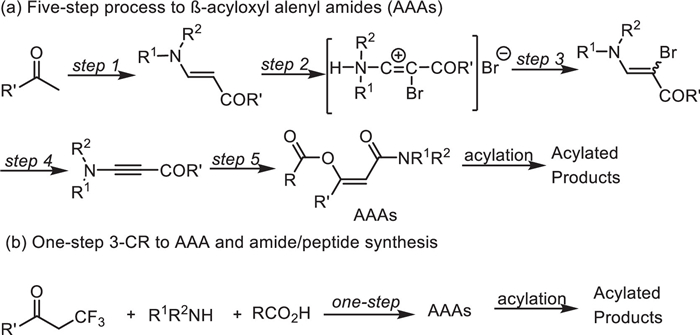
Scheme 1.
Different accesses to AAAs.


The formation of peptide bonds is a crucial step in peptide synthesis and their long-term application across diverse fields. Therefore, identifying effective coupling reagents to activate carboxylic and amino acids remains a central objective in peptide chemistry [1]. Significant efforts have led to the discovery of numerous coupling agents, including both single-component and combined reagent systems. However, challenges such as high cost, limited commercial availability, un-desired racemization/epimerization, and potential safety hazards continue to hinder ideal peptide synthesis [2]. Consequently, the development of novel coupling reagents with distinct advantages remains an enduring goal to facilitate more efficient, sustainable, and practical peptide synthesis.
The β-acyloxyl alkenyl amides (AAAs) are a class of alkenyl esters in which the electron–withdrawing effect of the conjugated alkenyl amide moiety significantly activates the acyl C—O bond. This property makes AAAs promising intermediates for acylation reactions, including peptide synthesis and the conversion to other carboxylic acid derivatives. The transformation of carboxylic/amino acids into AAAs was first reported by Neuenschwander in 1968, using commercially available methyl ketones as starting materials in a five–step linear sequence (Scheme 1a) [3]. Despite the demonstrated utility of AAAs in the synthesis of peptides [4], the tedious linear procedure and the need to isolate highly sensitive amino alkynone intermediates hindered further development of AAA–based synthetic methodologies. More recently, Wan and co–workers achieved a direct three–component synthesis of AAAs using simple, commercially available α–trifluoromethyl ketones and secondary amines as coupling partners for carboxylic/amino acids, promoted by Cs2CO3 under mild heating at 40 ℃ (Scheme 1b) [5].
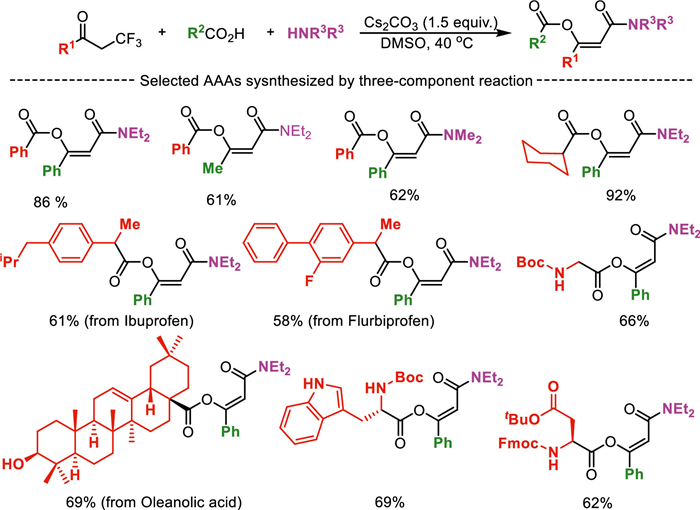
This three–component approach exhibits broad substrate tolerance. In particular, a wide range of carboxylic acids, including aromatic and aliphatic carboxylic acids, natural products, pharmaceuticals, and amino acids, have been successfully converted into the corresponding AAAs in satisfactory yields (Scheme 2).
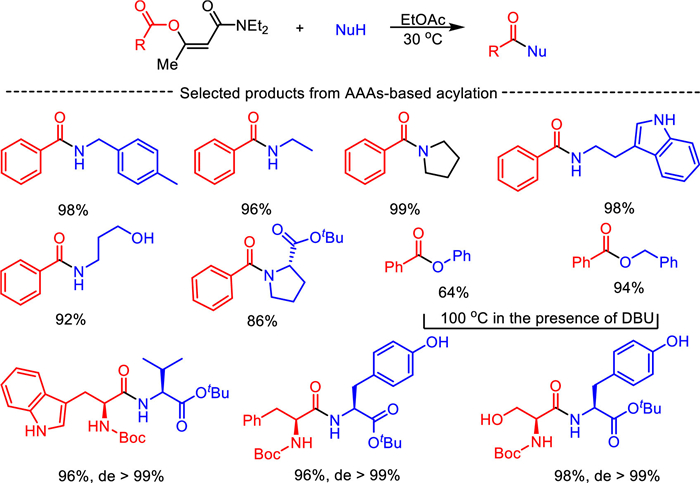
With an efficient route to AAAs established, the authors explored their application in various acylation reactions. The results demonstrate that AAAs are highly effective in reactions with amines, alcohols, and amino acids, enabling efficient synthesis of amides, esters, and dipeptides. These transformations can be conducted in neat ethyl acetate, generally affording amides and dipeptides in excellent yields. Notably, no racemization or epimerization was detected in dipeptide formation, indicating that the combination of α–trifluoromethyl ketone and secondary amine serves as a promising new coupling system for peptide synthesis via amino acid activation (Scheme 3).
Further extending this methodology, dipeptides were synthesized via a one–pot, two–step procedure starting directly from α–trifluoromethyl ketone, diethylamine, and amino acids, without isolating the AAA intermediates. More significantly, by employing the AAA–based activation strategy, a tetrapeptide was successfully assembled through sequential amino acid coupling, highlighting the considerable potential of this new reagent system in peptide synthesis. More notably, the comparison of the AAAs with classical coupling reagents such as DCC and HBTU has been conducted, and the current method displayed clear superiority in surpress the epimerization and friendliness to the operator.
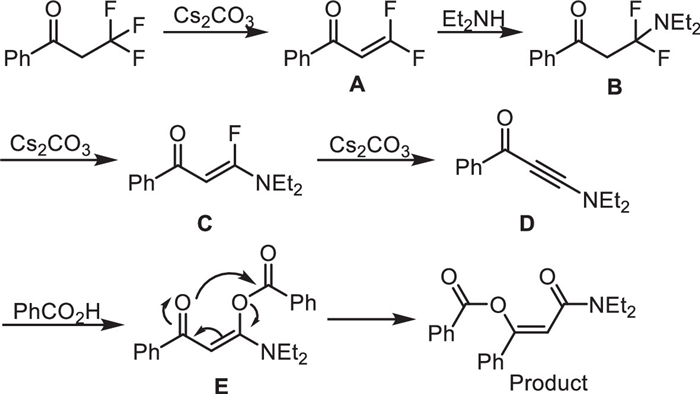
The authors conducted a series of mechanistic studies and proposed a plausible reaction mechanism (Scheme 4). The trifluoromethyl ketone first unde take HF elimination to give difluoroalkenone A which can tranfered to B via the addition of diethyl amine. Furthe double HF elimination then lead to aminoalkynone D via fluorinated enaminone C. The quick addition of carboxylic acid to D affords E which proceed to the target product via acyl migration.
Conclusively, Wan and co-workers have developed a remarkably straightforward three-component method for the synthesis of amino acid activators from carboxylic and amino acids. These AAAs have demonstrated excellent performance in the synthesis of amides, esters, and peptides. This one-step protocol effectively overcomes the significant limitations associated with previous multi-step linear approaches, and is therefore poised to greatly advance AAA-based synthesis and facilitate applications in peptide chemistry and other acylation reactions.
The authors declare that they have no known competing financial interests or personal relationships that could have appeared to influence the work reported in this paper.
Dong-Fang Jiang: Writing – original draft. Fei Zeng: Writing – original draft. Rong-Nan Yi: Writing – review & editing. Wei-Min He: Writing – review & editing.
A. Sharma, A. Kumar, B.G. de la Torre, et al., Chem. Rev. 122 (2022) 13516–13546. doi: 10.1021/acs.chemrev.2c00132
A. El-Faham, F. Albericio, Chem. Rev. 111 (2011) 6557–6602. doi: 10.1021/cr100048w
K. Hafner, M. Neuenschwander, Angew. Chem. Int. Ed. 7 (1968) 459–460. doi: 10.1002/anie.196804591
H.J. Gais, Angew. Chem. Int. Ed. 17 (1978) 597–598. doi: 10.1002/anie.197805971
S. Cao, H. Guo, Z. Zhong, et al., Sci. Adv. 11 (2025) eaea4120. doi: 10.1126/sciadv.aea4120

 扫一扫看文章


扫一扫关注我们
 DownLoad:

 下载:
下载:


 下载:
下载: