Citation:
Xin Zhang, Shuo Li, Chenghao Zhu, Xu-Lang Chen, Lijun Mao, Da Ma. Synergistic regulation of rate of the dissipative molecular switches via host-guest design and fuel engineering[J]. Chinese Chemical Letters,
2026, 37(12): 112483.
doi:
10.1016/j.cclet.2026.112483
Synergistic regulation of rate of the dissipative molecular switches via host-guest design and fuel engineering
English
Synergistic regulation of rate of the dissipative molecular switches via host-guest design and fuel engineering
Zhejiang Key Laboratory of New Drug Development for Central Nervous System Diseases & Institute for Advanced Studies, Taizhou University, Taizhou 318000, China
b.
Hubei Key Laboratory of Pollutant Analysis and Reuse Technology, College of Chemistry and Chemical Engineering, Hubei Normal University, Huangshi 435002, China
Received Date:
22 October 2025 Accepted Date:
30 January 2026 Revised Date:
22 January 2026 Available Online:
15 December 2026
Abstract:
Guest substituent electronic effects and chemical fuel selection govern the kinetics of anion-responsive dissipative molecular switches. Using Texas-sized macrocycles (Na-TxSB/An-TxSB) and 17 para-phthalic acid dianion guests, time-resolved UV–vis spectroscopy reveals substituent-dependent the half reaction time (t1/2) and fuel-driven rate modulation ((2-cyano-2-(p-tolyl)propanoic acid (ACA2) accelerated switching up to 6-fold vs. trichloroacetic acid (ACA1)). DFT calculations established a proportional relationship between guest Mulliken charge and t1/2, rationalizing kinetic trends confirmed with both hosts. This provides design principles for tailoring dissipative switches via host-guest and fuel engineering.
Most biomolecular machines in nature derive energy from biochemical reactions to power their motion through energy release [1-3]. Inspired by natural systems, chemists have developed chemically fuelled dissipative systems [4-7]. The synthesis of artificial dissipative molecular machines not only provides deeper insights into biological systems but also demonstrates broad applications in diverse fields [8-11]. For instance, such dissipative systems have been successfully implemented in self-assembly gel materials [12-17], molecular switches and motors [18,19], and switchable catalysts [20,21]. However, the remarkable complexity of biological molecular machines necessitates more sophisticated control strategies for their artificial counterparts [22,23].
To date, temporal control of host-guest interactions in artificial dissipative systems has been predominantly achieved through structural modifications of chemical fuels and adjustments in their concentrations [24,25]. In 2016, S. Di Stefano and co-workers reported the first example of a small-molecule chemical fuel that could trigger the oscillatory motion of a molecular machine, demonstrating further control over switching rates through fuel structure optimization [26]. While substituent effects play crucial roles in regulating supramolecular functions [27-35], the influence of guest substituents on the switching kinetics of dissipative molecular systems remains unexplored to the best of our knowledge. This study not only expands the toolkit of chemically fuelled systems but, more importantly, establishes a dual synergistic regulatory strategy, through molecular-level rational design of the functional components (guest and fuel), for constructing chemically fueled dissipative systems with programmable temporal control.
“Texas-sized” molecular boxes (TxSBs), a class of conformationally flexible cationic hosts and self-assembly building blocks, have shown particular promise in this context [36-39]. Building upon our previous work that established an anion-recognition-based chemically fueled dissipative system with temporally programmable characteristics [40], we herein present a comprehensive study employing two distinct Texas-sized molecular boxes in combination with dual chemical fuels. This investigation systematically evaluates 17 different substituted p-terephthalic acid dianions (PTAs). The nature of guest substituents, which includes hydrogen-bond donors, electron-donating, or electron-withdrawing groups, exerts critical control over the operational rates of dissipative molecular switches. Our findings substantiate the hypothesis that strategic selection of anionic components can provide novel perspectives for designing and regulating the functional dynamics of dissipative molecular machines.
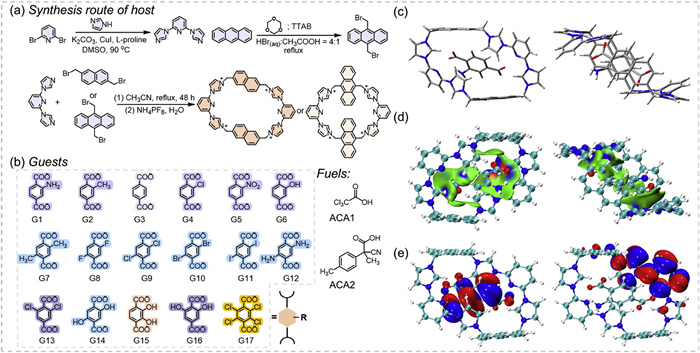
The two tetra-cationic macrocycles (Fig. 1a), Na-TxSB (naphthalene-bridged) and An-TxSB (anthracene-bridged), were synthesized using naphthalene and anthracene as bridging units, respectively. A pyridyl-based trimeric precursor was synthesized via Ullmann-type coupling, followed by cyclization with 2,6-bis(bromomethyl)naphthalene or 9,10-bis(bromomethyl)anthracene. The resulting products were converted to their hexafluorophosphate salts by treatment with aqueous ammonium hexafluorophosphate. Both macrocycles feature multiple aromatic π-surfaces (naphthalene, anthracene, and pyridine moieties) that facilitate π-π donor-acceptor and anion-π interactions with specific guests. Their cationic nature and hydrogen-bond-donating capabilities further enhance anion recognition. Single-crystal X-ray analysis confirmed that Na-TxSB and An-TxSB adopt a chair-like and box-like conformation [36,41], respectively, with the naphthalene and anthracene bridges oriented perpendicularly to the 2,6-bis(1H-imidazol-1-yl)pyridine subunits due to steric constraints (Figs. S1–S4 in Supporting information).
Figure 1
Figure 1.
(a) The synthetic route of the target macrocycles Na-TxSB and An-TxSB. (b) Structures of the chemical fuels (ACA1 and ACA2) and dianionic PTA-derived guests G1-G17 considered in the present study. (c) Top view (left) and side view (right) of the optimized geometry of [Na-TxSB·G1]. (d) Geometries of [Na-TxSB·G1] was optimized at the B3LYP/6–31+G(d) level with Grimme's dispersion correction. (e) The frontier molecular orbitals of [Na-TxSB·G1] in excited states were performed at the PBE0/6–31G(d) level of theory.
Prior to investigating dissipative switching behavior, the interactions between Na-TxSB or An-TxSB and 17 guest molecules were analyzed via1H NMR in DMSO‑d6 at 298 K. For example, mixing 0.5 mmol/L of the diprotonated guest G1 with 1 equiv. of Na-TxSB or An-TxSB induced no significant chemical shift changes. However, upon deprotonation of G1, distinct shifts in 1H NMR spectra indicated strong host-guest complexation (Figs. S5–S72 in Supporting information).
Due to the unsuccessful acquisition of suitable single crystals of the host-guest complex for XRD analysis, the binding geometry of the [Na-TxSB·G1] complex was optimized using density functional theory (DFT) calculations at the B3LYP/6–31G(d) level (Fig. 1c). DFT analysis revealed the presence of non-covalent weak interactions between Na-TxSB and G1. Multiple hydrogen bonds and C–H···π interactions were visualized using the Independent Gradient Model (IGM) based on Hirshfeld partitioning of the electron density, represented by thin, narrow green isosurfaces (sign(λ2)ρ) in Fig. 1d. Frontier molecular orbital analysis of the [Na-TxSB·G1] complex indicates that the HOMOs are primarily localized on the guest molecule G1, whereas the LUMOs are distributed across the pyridyl-based trimeric precursor of the host (Fig. 1e). This orbital distribution suggests a host-guest charge-transfer character for the complex.
Fluorescence titration or nuclear magnetic titration experiments further quantified the binding affinities between the macrocycles and G1, yielding association constants (Ka1 and Ka2) of (4.9 ± 0.1) × 103 and (3.4 ± 0.6) × 102 L/mol for Na-TxSB and similar values for An-TxSB (Figs. S74 and S108 in Supporting information). Similar analyses for guests G2-G17 revealed Ka values summarized in Table S1 (Figs. S73–S140 in Supporting information).
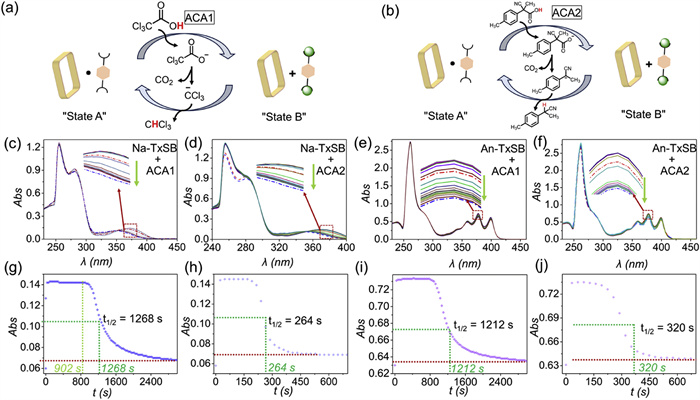
The operational dynamics of the dissipative molecular switch were interrogated through time-resolved UV–vis spectroscopy. As illustrated in Fig. 2c, the system was initially prepared in a DMSO/H2O (9:1, v/v) solvent mixture containing equimolar concentrations (3 × 10⁻⁵ mol/L) of the macrocyclic hosts and protonated guest G1, corresponding to the non-complexed "State B". The UV–vis spectrum (red dashed line) exhibited an absorbance of 0.13 at 370 nm. Subsequent addition of 5 equiv. triethylamine induced complete deprotonation of G1, triggering host-guest complexation ("State A"), which reduced the absorbance at 370 nm to 0.06 (blue dashed line).
Figure 2
Figure 2.
(a, b) Cartoon schematic representation of the cyclic dissipative operation of the molecular switches when using chemical fuels ACA1 (a) and ACA2 (b) respectively. Time-dependent UV–vis spectra recorded for the mixtures of dissipative molecular switches systems [Na-TxSB·ACA1·G1] (c), [Na-TxSB·ACA2·G1] (d), [An-TxSB·ACA1·G1] (e), and [An-TxSB·ACA2·G1] (f); host (0.03 mmol/L), G1 (0.03 mmol/L), Et3N (0.15 mmol/L) and chemical fuel (0.75 mmol/L). According to Figs. 3c-f, the time-dependent absorbance changes at 374 nm (g), 374 nm (h), 378 nm (i), and 378 nm (j) were obtained, respectively. The corresponding half-reaction times are 1268 s, 264 s, 1212 s, and 320 s.
Introduction of 10 equiv. ACA1 as the chemical fuel provoked immediate protonation of the dianionic guest, reverting the system to State B, as evidenced by the rapid increase of absorbance. An appropriate chemical fuel concentration (10 equiv.) was selected to ensure that the kinetic processes fell within a clearly monitorable experimental window, allowing for reliable comparison of switching dynamics across different dissipative molecular switch systems. This study defines the half reaction time (t1/2) as the time required for the absorbance to decrease to half of its maximum value. Time-dependent monitoring revealed a transient plateau phase (~902 s) attributable to fuel excess, followed by gradual absorbance decay (t1/2 = 1268 s) as ACA1 underwent consumption via decarboxylation. This decay phase reflects slow guest re-deprotonation and subsequent reformation of the host-guest complex, ultimately restoring State A after a full cycle duration of ~2900 s (Fig. 2g). The decomposition of chemical fuel ACA1 drives the dissipative cycle by modulating the protonation state of the guest. Initially, triethylamine deprotonates the guest, enabling host–guest complex formation. Addition of ACA1 reprotonates the guest, dissociating the complex. ACA1 then undergoes decarboxylation, releasing CO2 and generating a carbanion intermediate that is rapidly protonated, thereby restoring the basic triethylamine. This process gradually shifts the proton balance, allowing the guest to re‑deprotonate and reform the host–guest complex until the fuel is depleted, completing one operational cycle.
Theoretically, such dissipative processes are described as analogous to catalytic cycles that return to the initial state after fuel consumption. In these dissipative systems, the chemical reaction can generate waste products chloroform or 2-(p-tolyl)propanenitrile that accumulate in the system, and the concentration of the chemical fuel used undergoes a dynamic depletion process that gradually decreases over time.
Notably, replacing ACA1 with ACA2 markedly accelerated the switching kinetics. For the Na-TxSB system, ACA2 reduced the t1/2 to 264 s, representing a 5-fold rate enhancement compared to ACA1 (Figs. 2d and h). Similarly, An-TxSB exhibited a t1/2 of 1212 s with ACA1, corresponding to a 3.8-fold acceleration relative to ACA2 (Figs. 2e, i, f and j). These results unambiguously demonstrate that strategic selection of chemical fuels enables precise modulation of dissipative switching rates.
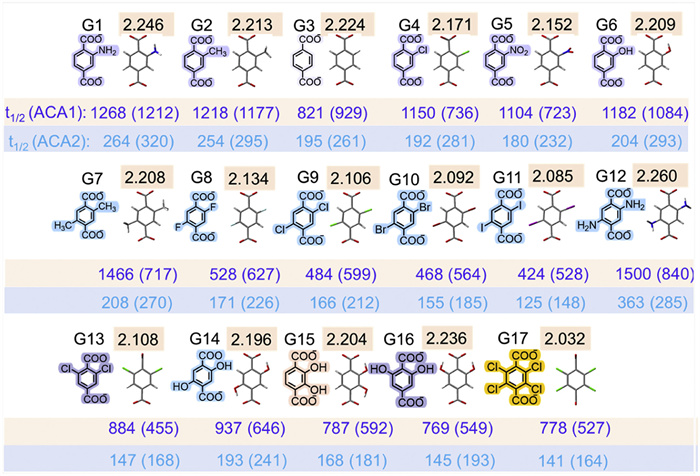
To generalize our findings, we systematically investigated dissipative molecular switches incorporating PTAs bearing diverse substituents (G2-G17) (Figs. S141-S286 in Supporting information). Statistical analysis of the half reaction time (t1/2) revealed pronounced variations in switching rates across the guest series (Fig. 3). To elucidate these differences, Mulliken charges of all guest molecules were computed using density functional theory (DFT) at the B3LYP/6–311G(d) level (Supporting information). The calculated charge distributions suggested a correlation between guest electronic properties and switching kinetics.
Figure 3
Figure 3.
Geometries of guest molecules were optimized at the B3LYP/6–31+G(d) level with the Mulliken charge analysis (the number on top of optimized guest electron structure). The blue numbers indicate the t1/2 for different guests when the dissipative molecular switch system is [Na-TxSB·ACA1·G], while the numbers in parentheses represent the t1/2 for different guests when the dissipative molecular switch system is [Na-TxSB·ACA2·G]. The light blue numbers indicate the t1/2 for different guests when the dissipative molecular switch system is [An-TxSB·ACA1·G], while the numbers in parentheses represent the t1/2 for different guests when the dissipative molecular switch system is [An-TxSB·ACA2·G].
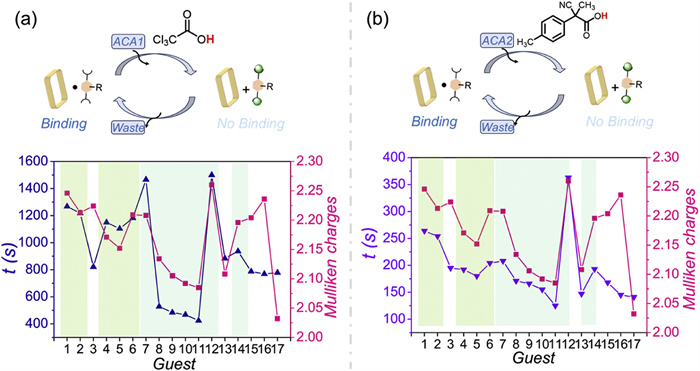
For mono-substituted guests at the 2-position (G1, G2, G4–G6) and di-substituted guests at the 2,5-(G7–G12, G14) or 2,6-positions (G13, G16), a proportional relationship emerged: Higher Mulliken charges corresponded to longer t1/2 values. For instance, for [Na-TxSB·ACA1·G] system, 2-mono-substituted G1 (Mulliken charge = 2.246) exhibited the longest t1/2 of 1268 s. Replacing ACA1 with ACA2 yielded analogous trends, with G1 displaying a t1/2 of 264 s. Similar proportionality was observed for 2,5-di-substituted guests: G12 (charge = 2.26) showed maximal t1/2 values of 1500 s (ACA1) and 363 s (ACA2) (Figs. 4a and b).
Figure 4
Figure 4.
Dual-y-axis line charts illustrate the correlation trends between half-reaction times and Mulliken charges for the dissipative molecular switch systems [Na-TxSB·ACA1·G] (a) and [Na-TxSB·ACA2·G] (b).
The observed correlation between a higher Mulliken charge on the dianionic guest and a longer t1/2 can be mechanistically rationalized. A higher Mulliken charge density on the guest molecule (specifically, the greater negative charge on the carboxylate oxygen atoms) signifies a higher proton affinity. Consequently, the subsequent re-deprotonation of the guest, which is necessary for regenerating the complex, becomes the rate-limiting step. This deprotonation process is slowed down because it is less favorable for a guest with a higher proton affinity, leading to a prolonged t1/2. Furthermore, specific electronic substituent effects also influence the half-reaction time; for example, electron-withdrawing groups can lower the Mulliken charge density of the guest carboxylate, thereby accelerate the deprotonation step and shortening the t1/2.
Although the association constant (Ka) is essential for establishing reversible host–guest binding, its correlation with t1/2 across the series of dissipative molecular switch systems is not straightforward. Specifically, for systems composed of the same host and the same chemical fuel paired with different guest molecules, we observed no simple monotonic correlation between Ka and t1/2. This suggests that, in the present dissipative cycle, the rate-limiting process is not the physical re-association of the deprotonated guest with the preorganized host cavity, but is instead more closely tied to the kinetics of the guest's protonation-state interconversion, which is modulated by electronic effects. Thus, in the current dissipative molecular switch systems, the influence of the guest’s intrinsic acid–base character, reflected in its Mulliken charge, on the switching rate outweighs differences in Ka.
Notably, the unsubstituted guest G3 (charge = 2.224) deviated from this trend, exhibiting shorter t1/2 values (821 s with ACA1; 195 s with ACA2) compared to substituted analogs. This anomaly likely arises from the synergistic interplay of electronic and steric effects in substituted derivatives. Supporting this hypothesis, di-substituted hydroxyl derivatives (G14, G15, G16) with elevated Mulliken charges displayed extended t1/2 values (e.g., 937 s for G14 with ACA1; 168 s with ACA2), further underscoring the critical roles of substituent electronic character and steric hindrance.
To validate the universality of these observations, parallel experiments were conducted using An-TxSB as the host. The resulting t1/2 trends for both ACA1 and ACA2-driven systems corroborated the above conclusions (Figs. S209-S286 in Supporting information), confirming that substituent electronic modulation combined with steric factors governs the operational dynamics of dissipative molecular switches. The different decarboxylation rates of the two chemical fuels (ACA1 and ACA2) used in this study indicate that the proton-transfer kinetics are significantly influenced by the substituents of the chemical fuel. This is due to the strong structural dependence of carbanion stability and reactivity [24,42].
In conclusion, we have developed a versatile platform for controlling dissipative molecular switch kinetics through integrated host-guest design and fuel engineering. The combination of π-rich Texas-sized macrocycles (Na-TxSB and An-TxSB) and varied PTA derivatives enabled precise correlation of guest substituent effects with switching dynamics. Key findings include: (1) Chemical fuel structure affects temporal control, with ACA2 outperforming ACA1 by 3–6-fold in switching rates; (2) Substituent electronic character (quantified via Mulliken charges) and positional isomerism synergistically govern t1/2 values, establishing design rules for rate modulation; (3) Host flexibility (naphthalene and anthracene bridges) preserving substituent-dependent trends. These insights bridge supramolecular design with non-equilibrium thermodynamics, enabling a strategy for rational modulation for constructing chemically fueled dissipative systems. This methodology expands the toolkit for temporally programmed molecular switch systems.
The authors declare that they have no known competing financial interests or personal relationships that could have appeared to influence the work reported in this paper.
Acknowledgments
The authors want to thank Zhejiang Provincial Natural Science Foundation of China (No. LQN26B020017 to X. Zhang, No LR24B020003 to D. Ma and No LQ24B020003 to L. Mao), Key Research and Development Program of Sichuan Province of China (No. 2024YFFK0057, D. Ma), the Technology Project of Taizhou City (No. 24gyb17, X. Zhang), open Research Fund of Hubei Key Laboratory of Pollutant Analysis & Reuse Technology (No. PA210102, X.-L. Chen).
Supplementary materials
Supplementary material associated with this article can be found, in the online version, at doi:10.1016/j.cclet.2026.112483.
D. Del Giudice, E. Spatola, R. Cacciapaglia, et al., Chem. Eur. J. 26 (2020) 14954–14962. doi: 10.1002/chem.202002574
Figure 1
(a) The synthetic route of the target macrocycles Na-TxSB and An-TxSB. (b) Structures of the chemical fuels (ACA1 and ACA2) and dianionic PTA-derived guests G1-G17 considered in the present study. (c) Top view (left) and side view (right) of the optimized geometry of [Na-TxSB·G1]. (d) Geometries of [Na-TxSB·G1] was optimized at the B3LYP/6–31+G(d) level with Grimme's dispersion correction. (e) The frontier molecular orbitals of [Na-TxSB·G1] in excited states were performed at the PBE0/6–31G(d) level of theory.
Figure 2
(a, b) Cartoon schematic representation of the cyclic dissipative operation of the molecular switches when using chemical fuels ACA1 (a) and ACA2 (b) respectively. Time-dependent UV–vis spectra recorded for the mixtures of dissipative molecular switches systems [Na-TxSB·ACA1·G1] (c), [Na-TxSB·ACA2·G1] (d), [An-TxSB·ACA1·G1] (e), and [An-TxSB·ACA2·G1] (f); host (0.03 mmol/L), G1 (0.03 mmol/L), Et3N (0.15 mmol/L) and chemical fuel (0.75 mmol/L). According to Figs. 3c-f, the time-dependent absorbance changes at 374 nm (g), 374 nm (h), 378 nm (i), and 378 nm (j) were obtained, respectively. The corresponding half-reaction times are 1268 s, 264 s, 1212 s, and 320 s.
Figure 3
Geometries of guest molecules were optimized at the B3LYP/6–31+G(d) level with the Mulliken charge analysis (the number on top of optimized guest electron structure). The blue numbers indicate the t1/2 for different guests when the dissipative molecular switch system is [Na-TxSB·ACA1·G], while the numbers in parentheses represent the t1/2 for different guests when the dissipative molecular switch system is [Na-TxSB·ACA2·G]. The light blue numbers indicate the t1/2 for different guests when the dissipative molecular switch system is [An-TxSB·ACA1·G], while the numbers in parentheses represent the t1/2 for different guests when the dissipative molecular switch system is [An-TxSB·ACA2·G].
Figure 4
Dual-y-axis line charts illustrate the correlation trends between half-reaction times and Mulliken charges for the dissipative molecular switch systems [Na-TxSB·ACA1·G] (a) and [Na-TxSB·ACA2·G] (b).


 DownLoad:

 下载:


 下载:

