
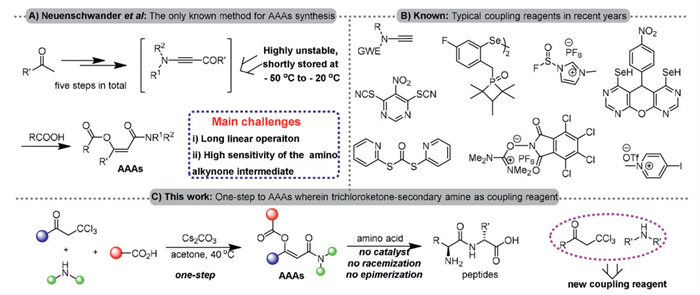
Scheme 1.
Amino acid synthesis and free radical reactions on diazo compounds.


As irreplaceable molecules in living processes, pharmaceutical and numerous other functional molecules or molecular fragments, peptides occupy central role in the research of organic chemistry and many related disciplines/industries [1-7]. Among the available tactics for peptides synthesis, the application of a coupling reagent to activate the amino acid by forming active acid ester constitutes the most important tool. In this regard, the discovery of coupling reagents is critical for the advances of peptide science [8-13]. The milestone work on the DCC mediated peptide synthesis has revealed the adventure for coupling reagent research in the synthesis of peptides [14]. Until now, the extensive efforts from scientists have led to the discovery of > 100 different coupling reagents in the form of either single molecule or molecules' combination [15-18]. However, the currently available coupling reagents suffer yet from a variety of challenges, including but not limited in the tedious long synthetic process, heavy metal reagent, occupational toxicity, environmental pressure, and racemization/epimerization [19-21]. Accordingly, the discovery and development of new coupling reagents featuring high coupling efficiency, chirality maintenance, low cost, and environmental friendliness is yet rather desirable.
In 1968, Neuenschwander and Hafner reported the synthesis of AAAs via the addition of carboxylic acids to aminoalkynones [22]. Later, the primary investigation on the application of AAAs proved their distinctive activity toward different acylation reactions, including peptide synthesis [23,24], and thiol/selenoester synthesis [25]. Unfortunately, in despite of the promising reactivity of AAAs, the expanded application of these scaffolds failed to demonstrate their real power in organic synthesis, mainly because of the critical restriction in the access to AAAs themselves. Based on the procedure reported by Neuenschwander and Hafner [26,27], four independent steps were required to access the key amino alkynone intermediate, and a further step to AAAs via the addition of acid to the amino alkynone was involved. In addition to the long linear process, the other obstructive challenge was the high sensitivity of amino alkynones, the key intermediates with short stability at low temperature from –50 ℃ to −20 ℃ (Scheme 1A). The difficult preparation and harsh conditions required for such coupling reagent predetermined the inapplicability of the amino alkynone-based synthesis of AAAs and their further application.
On the other hand, the recent years have witnessed dramatic advances in the development of new coupling reagents for the peptide bond construction (Scheme 1B). For example, by making use of the stable ynamides as coupling reagents, Zhao et al. [28-30] have realized efficient peptides synthesis and different other acylation reactions. Likewise, a plethora of different other coupling reagents, such as the allonates [31], dipyridyldithiocarbonate (DPDTC) [32], methylimidazolium sulfinyl fluoride salt [33], as well as more other coupling reagents [34-40] have been developed or discovered for peptide synthesis. More noteworthy, the recent breakthrough has proved that it is applicable to employ small organic molecules as organocatalysts for such bond formation [41,42]. However, due to the diversity of peptide architectures and substructures, as well as the aforementioned restrictions associated with known coupling reagents, designing or discovering new coupling reagents to complement the known candidates are yet urgent.
Considering the promise of AAAs in acylation reaction, solving the problems in the synthetic procedure toward AAAs would thus revive their valuable. In this context, the tactic of the multicomponent reactions (MCRs) provides an ideal option because MCRs allow the access to products in one-step, one-pot operation without isolating any intermediate [43-48]. To data, MCRs have shown amazingly broad and notable application in diversity-oriented synthesis [49-56], the equivalent works on target-oriented synthesis, however, remain much less developed [57-59]. Therefore, achieving the target of AAAs with MCRs is of high significance for providing valuable tool for peptide synthesis. A rather recent breakthrough of direct three-component, one-step synthesis of AAAs with α-trifluoromethyl ketones, amines and acids as starting materials has addressed the major challenges in the five-step procedure [60]. Yet, the relatively high cost of α-trifluoromethyl ketones and the release of fluorine-containing by-product in the synthesis suggested the space of improvement. Herein, as an update approach for AAAs synthesis, we report a three-component protocol with α-trichloromethyl ketone, secondary amines and carboxylic/amino acids by the promotion of only Cs2CO3 at mild heating. In addition, the application of the AAAs synthesized herein have been verified by the efficient synthesis of dipeptides and the linear synthesis of tetrapeptide (Scheme 1C), providing a much more atom economical option for peptide bond construction and related acylation reactions.
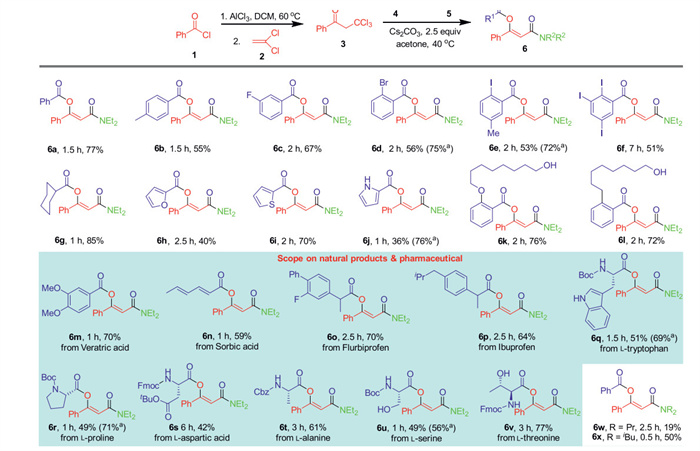
To start the investigation, the reaction of α-trichloromethyl ketone 3a, benzoic acid 4a and diethyl amine 5a were performed under different conditions for achieving an optimal result. It should be noted the 3a was prepared following literature procedure [61] using benzoyl chloride 1a and geminal dichloroethene 2a and subjected to the subsequent reaction directly without purification. By systematical screening on the reaction medium, temperature, promoter species and loading, as well as the reaction time, the fine result of 77% product 6a by running the three-component reaction in the presence of Cs2CO3 in acetone by stirring at 40 ℃ for 1.5 h was established (see Supporting information for detail).
Under the optimized conditions, the scope of the AAAs synthesis with the three-component assembly was investigated. The results obtained from this section demonstrated satisfactory results (Scheme 2). For carboxylic acids, the aromatic acids were generally tolerable to the synthesis (6a-6f and 6h-6k). As the typical feature of nucleophilic reactions, the benzoic acids with ortho-substitution gave evidently lower yield of products than those one without such steric hindrance substituent (6d, 6e and 6f). In addition, the electron rich hereroarenes led to products with also lower yields probably because of the side reaction resulting from their higher reactivity (6h-6j). Besides aromatic acids, the aliphatic (6 g) as well as long alkyl alcoholic acids (6k and 6l) could be practically incorporated. More notably, a broad array of natural products such as Veratric acid and Sorbic acid (6m and 6n), pharmaceuticals such as Ibuprofen and Flurbiprofen could also be efficiently derived to corresponding AAAs (6o and 6p). The more valuable results were the reactions using amino acids, including those with most typical N-protecting groups such as Boc, Cbz, and Fmoc could be practically transformed into corresponding AAAs (6q-6v), enabling the later application of these scaffolds for peptide synthesis. Finally, the reactions using different secondary amines also led to the corresponding AAAs via this one-pot procedure (6w-6x). Notably, for the products with lower yields from one-pot operation, using purified 3a to react with 4 and 5a could give evidently improved yield under the standard conditions of the Cs2CO3 promotion (6d, 6e, 6j, 6q, 6r and 6u, Scheme 2).
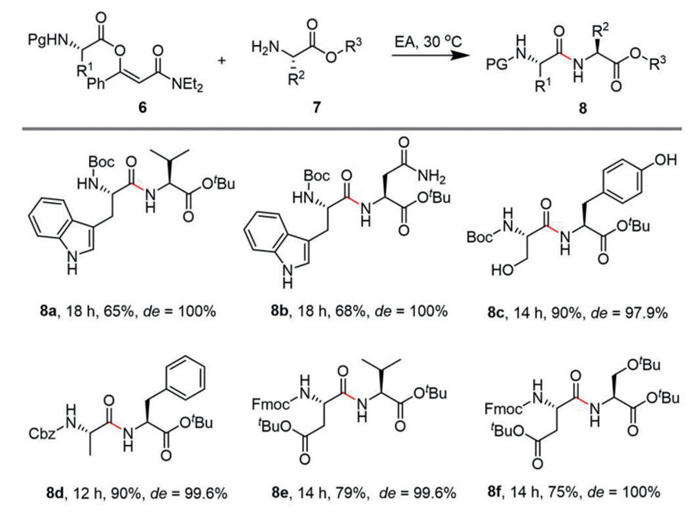
Following the generally tolerable synthesis of the AAAs with carboxylic and amino acids, we were then inspired to investigate the application of the AAAs in the synthesis of dipeptides. Based on the results (Scheme 3), the AAAs prepared from the one-step method reacted with a variety of different amino acids, including l-valine (8a and 8e), l-asparagine (8b), l-tyrosine (8c), l-phenylalanine (8d), and l–serine (8f) to provide corresponding dipeptides with 65%−90% yields by simple heating the substrates in EtOH at 30 ℃. Alongside the satisfactory yield, the more noteworthy point was that the dipeptide synthesized by the current method gave product generally free of racemization or epimerization with generally > 99% de value of the products. Tiny epimerization was observed in the reaction with l-tyrosine as the amino donor, the corresponding product 8c was provided with 97.9% de, probably because of the sensitive hydroxyl group in the amino acid substrate. The efficient synthesis of the dipeptides 8 demonstrated that the combination of the α-trichloromethyl ketone and secondary amine served as coupling reagent for peptide synthesis by the easy formation of AAAs to activate amino acids. However, the direct one-pot operation by subjecting 3, diethyl amine 5a with the N-Boc-L-tryptophan and O-(tBu)-L-valine did not give dipeptide 8a in neat EA.
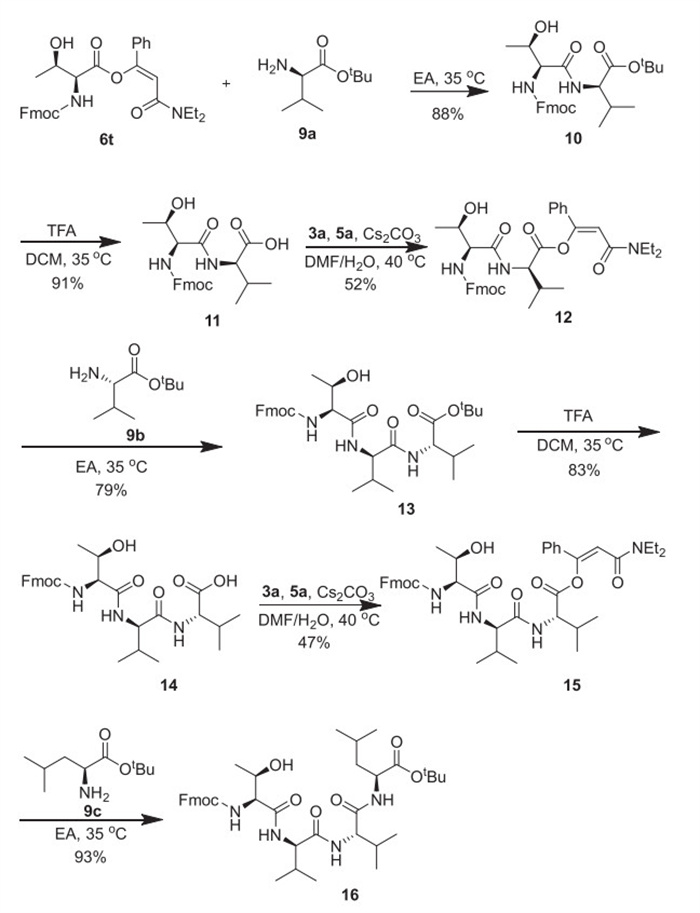
Afterwards, to further demonstrate the application of the current method for peptide synthesis, we then attempted to synthesize longer peptide. As outlined in Scheme 4, starting from AAA 6t, the aminolysis with another amino acid 9a at 35 ℃ gave the dipeptide 10 efficiently which could be deprotected to give peptide 11 by treating with TFA. The carboxyl was group then further transformed into AAA 12, and repeating the aminolysis, deprotection, AAA preparation for further two rounds afforded the tetrapeptide 16, confirming the promising application potential of the current carboxylic acid activation tactic.
To explore the possible mechanism for the reactions providing AAAs, we monitored the process of the model reaction toward 6a synthesis with HRMS. Fortunately, two key intermediates, including the sensitive amino alkynone D and the β-acyloxyl enaminone E, were observed, providing valuable guides for understanding the reaction mechanism (Figs. 1a and b).
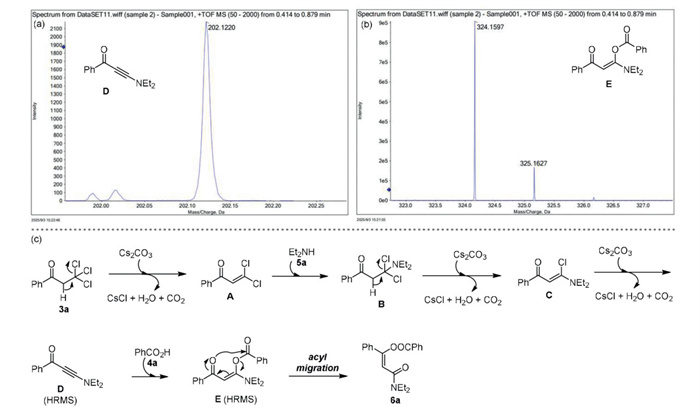
Accordingly, the mechanism of this three-component AAAs synthetic reaction has been proposed (Fig. 1c). Originally, the trichloromethyl ketone 3a reacts with diethyl amine to provide geminal dichloroenone A by eliminating HCl via the promotion of base. Subsequently, the nucleophilic addition of amine 5a to A affords intermediate B which quickly undergoes a further HCl elimination and gives rise to the chlorinated enaminone C. In the presence of base, the third round HCl elimination takes place in C to afford alkynone D. Afterwards, the in situ generated D is quickly captured by carboxylic acid via nucleophilic addition to donated acyloxylated enaminone E. Finally, the 1, 3-acyl migration in E enables the formation of product 6a. The Cs2CO3 displays much better effect than K2CO3 in the reaction because of its stronger basicity and higher solubility in the medium.
In conclusion, by making use of the consecutive trifold HCl elimination from the α-trichloromethyl ketones, the one-step, three-component synthesis of AAAs has been accomplished by the promotion of a base, offering a formally simplest and most step-efficient route to alternate the five-step protocol reported dozens of years ago and complementing the recent method with α-trifluoromethyl ketones as a key substrate. The performance of the AAAs synthesized herein have been verified by the synthesis of an array of divergent dipeptides under mild condition without encountering evident racemization or epimerization. Moreover, the synthesis of tetrapeptide has also been practically executed. The results indicate that the α-trichloromethyl ketone-secondary amine combination is new coupling reagent for peptide synthesis. The low cost, easy availability of the reagents, broad tolerance to carboxylic/amino acids, as well as satisfactory results in peptide synthesis assure the promising application of this protocol. More notably, the confirmation of the in situ generated active amino alkynone in the present work would bring expectable new advances on more novel synthetic methods based on this valuable molecular platform.
Xiangwei Chen: Methodology, Investigation, Data curation. Yunyun Liu: Writing – original draft, Methodology, Investigation. Jie-Ping Wan: Writing – review & editing, Supervision, Funding acquisition, Conceptualization.
The authors declare that they have no known competing financial interests or personal relationships that could have appeared to influence the work reported in this paper.
This work is financially supported by the National Natural Science Foundation of China (No. 22561026).
Supplementary material associated with this article can be found, in the online version, at doi:
S. Lautru, R.J. Deeth, L.M. Bailey, et al., Nat. Chem. Biol. 1 (2005) 265–269. doi: 10.1038/nchembio731
E. Petsalaki, R.B. Russell, Curr. Opin. Biotechnol. 19 (2008) 344–350. doi: 10.1016/j.copbio.2008.06.004
A. Henninot, J.C. Collis, J.M. Nuss, J. Med. Chem. 61 (2018) 1382–1414. doi: 10.1021/acs.jmedchem.7b00318
M. Muttenthaler, G.F. King, D.J. Adams, P.F. Alewood, Nat. Rev. Drug Discov. 20 (2021) 309–325. doi: 10.1038/s41573-020-00135-8
S. Dong, J.S. Zheng, Y. Li, et al., Sci. China Chem. 67 (2024) 1060–1096. doi: 10.1007/s11426-024-1950-1
J. Wang, J. Feng, Y. Kang, et al., Sci. Adv. 11 (2025) eads8932. doi: 10.1126/sciadv.ads8932
J. Li, J. Chen, Q.L. Hu, et al., Chin. Chem. Lett. 36 (2025) 110126. doi: 10.1016/j.cclet.2024.110126
A. El-Faham, F. Albericio, Chem. Rev. 111 (2011) 6557–6602. doi: 10.1021/cr100048w
R.M. de Figueiredo, J.S. Suppo, J.M. Campagne, Chem. Rev. 116 (2016) 12029–12122. doi: 10.1021/acs.chemrev.6b00237
M. Paradís-Bas, J. Tulla-Puche, F. Albericio, Chem. Soc. Rev. 45 (2016) 631–654. doi: 10.1039/C5CS00680E
Y. Guo, M. Wang, Y. Gao, et al., Org. Biomol. Chem. 22 (2024) 4420–4435. doi: 10.1039/d4ob00563e
Y. Tan, H. Wu, T. Wei, et al., J. Am. Chem. Soc. 142 (2020) 20288–20298. doi: 10.1021/jacs.0c09664
J. Magano, Org. Process Res. Dev. 26 (2022) 1562–1689. doi: 10.1021/acs.oprd.2c00005
J.C. Sheehan, G.P. Hess, J. Am. Chem. Soc. 77 (1955) 1067–1068. doi: 10.1021/ja01609a099
F. Albericio, A. El-Faham, Org. Process Res. Dev. 22 (2018) 760–772. doi: 10.1021/acs.oprd.8b00159
S.Y. Han, Y.A. Kim, Tetrahedron 60 (2004) 2447–2476. doi: 10.1016/j.tet.2004.01.020
L. Hu, J. Zhao, Acc. Chem. Res. 57 (2024) 855–869. doi: 10.1021/acs.accounts.3c00743
J. Yang, H. Huang, J. Zhao, Org. Chem. Front. 10 (2023) 1817–1846. doi: 10.1039/d2qo01686a
A.L. Isidro-Llobet, M.N. Kenworthy, S. Mukherjee, et al., J. Org. Chem. 84 (2019) 4615–4628. doi: 10.1021/acs.joc.8b03001
V. Borghesani, J. Pept. Sci. 31 (2025) e3649. doi: 10.1002/psc.3649
J.C. Graham, A. Trejo-Martin, M.L. Chilton, et al., Chem. Res. Toxicol. 35 (2022) 1011–1022. doi: 10.1021/acs.chemrestox.2c00031
M. Neuenschwander, K. Hafner, Angew. Chem. Int. Ed. 7 (1968) 460.
H.J. Gais, Angew. Chem. Int. Ed. 17 (1978) 597–598. doi: 10.1002/anie.197805971
U. Lienhard, H.P. Fahrni, M. Neuenschwander, Helv. Chim. Acta 61 (1978) 1609–1621. doi: 10.1002/hlca.19780610511
H.J. Gais, T. Lied, Angew. Chem. Int. Ed. 17 (1978) 267–268. doi: 10.1002/anie.197802671
K. Hafner, M. Neuenschwander, Angew. Chem. Int. Ed. 7 (1968) 459–460. doi: 10.1002/anie.196804591
M. Neuenschwander, Helv. Chim. Acta 98 (2015) 881–898. doi: 10.1002/hlca.201400212
L. Hu, S. Xu, Z. Zhao, et al., J. Am. Chem. Soc. 138 (2016) 13135–13138. doi: 10.1021/jacs.6b07230
C. Wang, Z. Zhao, R. Ghadir, et al., ACS Cent. Sci. 10 (2024) 1742–1754. doi: 10.1021/acscentsci.4c01148
C. Wang, C. Han, J. Yang, et al., J. Org. Chem. 87 (2022) 5617–5629. doi: 10.1021/acs.joc.1c03076
Z. Wang, X. Wang, P. Wang, et al., J. Am. Chem. Soc. 143 (2021) 10374–10381. doi: 10.1021/jacs.1c04614
K.F. Freiberg, R.D. Kavthe, R.M. Thomas, et al., Chem. Sci. 14 (2023) 3462–3469. doi: 10.1039/d3sc00198a
J. Lai, C. Bahri, M.P. Truong, et al., Commun. Chem. 8 (2025) 53. doi: 10.1038/s42004-025-01456-8
Y. Li, J. Li, G. Bao, et al., Org. Lett. 24 (2022) 1169–1174. doi: 10.1021/acs.orglett.1c04258
J.N. deGruyter, L.R. Malins, L. Wimmer, et al., Org. Lett. 19 (2017) 6196–6199. doi: 10.1021/acs.orglett.7b03121
A. Mattellone, D. Corbisiero, L. Ferrazzano, et al., Green Chem. 25 (2023) 2563–2571. doi: 10.1039/d3gc00431g
J. Yang, D. Zhang, Y. Chang, et al., Org. Chem. Front. 11 (2024) 5422–5428. doi: 10.1039/d4qo01009d
W. Zhong, C. Wan, Z. Zhou, et al., Org. Lett. 25 (2023) 8661–8665. doi: 10.1021/acs.orglett.3c03539
T. Hottori, T. Ishiguro, H. Yamamoto, Org. Lett. 27 (2025) 3742–3746. doi: 10.1021/acs.orglett.5c00904
S. Bharamawadeyar, E. Chetankumar, C. Srinivasulu, et al., Synthesis 56 (2024) 1476–1484. doi: 10.1055/s-0043-1763675
N.R. Panigrahi, S.M. Khan, Handoko, et al., J. Am. Chem. Soc. 147 (2025) 25682–25691. doi: 10.1021/jacs.5c07242
Y. Li, J. Li, Z. Shen, et al., ACS Cent. Sci. 11 (2025) 1240–1249. doi: 10.1021/acscentsci.5c00487
A. Dömling, I. Ugi, Angew. Chem. Int. Ed. 39 (2000) 3168–3210. doi: 10.1002/1521-3773(20000915)39:18<3168::AID-ANIE3168>3.0.CO;2-U
A. Dömling, W. Wang, K. Wang, Chem. Rev. 112 (2012) 3083–3135. doi: 10.1021/cr100233r
E. Ruijter, R. Scheffelaar, R.V.A. Orru, Angew. Chem. Int. Ed. 50 (2011) 6234–6246. doi: 10.1002/anie.201006515
J.D. Sunderhaus, S.F. Martin, Chem. Eur. J. 15 (2009) 1300–1308. doi: 10.1002/chem.200802140
L. Song, L. Cai, E.V. van der Eycken, et al., Coord. Chem. Rev. 528 (2025) 216428. doi: 10.1016/j.ccr.2024.216428
R.N. Yi, W.M. He, Chin. Chem. Lett. 35 (2024) 110115. doi: 10.1016/j.cclet.2024.110115
C. Zhang, J. Zhou, P.P. Xie, et al., Science 389 (2025) eadx2935. doi: 10.1126/science.adx2935
J. Wei, J. Zhang, J.K. Cheng, et al., Nat. Chem. 15 (2023) 647–657. doi: 10.1038/s41557-023-01179-0
C. Che, Y.N. Lu, T. Fang, et al., ACS Cent. Sci. 11 (2025) 36–45. doi: 10.1021/acscentsci.4c00970
J. Luo, Y. Li, H. Wang, et al., J. Am. Chem. Soc. 147 (2025) 19458–19464. doi: 10.1021/jacs.5c04924
X.M. Chen, L. Song, J. Pan, et al., Chin. Chem. Lett. 35 (2024) 110112. doi: 10.1016/j.cclet.2024.110112
J. Li, Z. Lai, W. Zhang, et al., Nat. Commun. 14 (2023) 4806. doi: 10.1038/s41467-023-40598-y
P. Ni, J. Tan, Y. Tan, et al., Org. Lett. 27 (2025) 10809–10814. doi: 10.1021/acs.orglett.5c03433
J. Ye, Y. Liu, J. Luo, et al., Org. Lett. 25 (2023) 8451–8456. doi: 10.1021/acs.orglett.3c03353
B.B. Touré, D.G. Hall, Chem. Rev. 109 (2009) 4439–4486. doi: 10.1021/cr800296p
L.F. Tietze, A. Modi, Med. Chem. Rev. 20 (2000) 304–322.
D.G. Hall, T. Rybak, T. Verdelet, Acc. Chem. Res. 49 (2016) 2489–2500. doi: 10.1021/acs.accounts.6b00403
S. Cao, H. Guo, Z. Zhong, et al., Sci. Adv. 11 (2025) eaea4120. doi: 10.1126/sciadv.aea4120
J.P. Gütlein, M. Lubbe, H. Feist, et al., Z. Naturforsch. B 76 (2021) 1–26. doi: 10.1515/znb-2020-0114

Scheme 2 Scope on the three-component protocol to AAAs. a Yield from the reaction using purified 3a.

Figure 1 Key intermediates observed by HRMS monitoring. (a) Amino alkynone intermediate D (Calcd. for C13H16NO [M + H]+ m/z 202.1226; Found 202.1220). (b) β-Acyloxyl enaminone intermediate E (calcd. for C20H22NO3 [M + H]+ m/z 324.1594; Found 324.1597). (c) The plausible reaction mechanism involving amino alkynone intermediate and acyl migration.

 扫一扫看文章


扫一扫关注我们
 DownLoad:

 下载:

