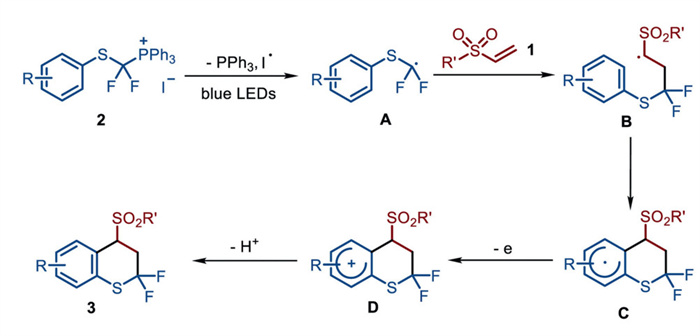
Scheme 1.
A proposed route for the synthesis of 2,2-difluoro-4-sulfonylthiochromanes.

Generation of 2,2-difluoro-4-sulfonylthiochromanes under visible light irradiation and their biological evaluations
Tonghao Zhu , Chuxun Wu , Xiaoying Zhang , Zaixing Yang , Ning Mu , Wei Zhou , Jie Wu


The influenza virus is a major human and animal pathogen with the potential to cause catastrophic mortality. The virus reproduces rapidly, mutates frequently, and occasionally crosses species barriers. Potent anti-influenza agents are urgently required in our ongoing fights against seasonal outbreaks and to address the risk of future pandemics, given the low probability of developing a universally effective influenza virus vaccine in the near future [1,2]. The first antiviral drugs which target M2 ion channels including adamantane derivatives, amantadine and rimantadine were used to treat influenza [3,4]. Later, orally administered oseltamivir and inhaled zanamivir, which target neuraminidase, were approved for use in treatments [3,4]. However, alternative therapeutics are needed because the appearance of influenza strains resistant to drugs targeting neuraminidase, particularly oseltamivir, is an increasing clinical problem [5-7]. Thus, development of new anti-influenza agents is of high demand.
Since the presence of fluorine can increase the stability of organic drugs, improve the lipid solubility and permeability of compounds, and also reduce the generation of drug resistance, the introduction of fluorine or fluorine-containing groups in specific positions of active or drug molecules has become a focus in the field of synthetic chemistry [8-11]. Recently, we are interested in the synthesis and biological evaluations of fluorine-containing compounds [12-15]. For example, trifluoromethyl-substituted vinyl sulfones were designed, synthesized, and evaluated for several assays against different tumor cells and the antitumor mechanism in cytotoxic autophagy induced by PI3K/Akt/mTOR signal was investigated [15]. Among these fluorinated groups, the difluoromethyl group has attracted ongoing attention due to its special characteristics [16,17].
The importance of sulfur-containing heterocycles is known due to their remarkable biological activities in natural products and pharmaceuticals. For instance, thiochromanes are thio analogues of the naturally occurring chromanes and flavonoid compounds, displaying a variety of bioactivities such as anti-HIV activity, fiity to 5HTA1 receptors in human and rat brains, antagonistic and antibacterial activity [18]. As part of a program for the generation of fluorine-containing heterocycles [12-15], we conceived that difluoromethyl-containing thiochromanes would be beneficial for our specific biological assay. On the other hand, the importance and biological activities of sulfones have been identified. As our continuous interest for the synthesis of sulfonyl compounds [19-21], we envisioned that it would be ideal if sulfonyl group could be incorporated into the scaffold of difluoromethyl-containing thiochromanes. On the basis of these considerations, we therefore initiated a program for the methodology development and library construction of sulfonyl-substituted difluoromethyl-containing thiochromanes, with an expectation to find a hit in the anti-influenza assay.
Recently, photoredox-catalyzed difluoro(phenylthio)methylation from {difluoro(phenylthio)methyl}triphenylphosphonium salts were developed [22-29]. For example, the photoredox catalyzed difuloro(phenylthio)methylation of 2,3-allenoic acids with {difluoro(phenylthio)methyl}triphenylphosphonium triflte was reported, leading to 4-difluoro(phenylthio)methylated butenolides through radical difluoro(phenylthio)methylation/intramolecular cyclization [26]. During the reaction process, difluoro(phenylthio)methyl radical was generated under mild conditions. Inspired by these results, we conceived that sulfonyl-substituted 2,2-difluorothiochromanes could be synthesized through radical difluoro(phenylthio)methylation/cyclization. Herein, we report a facile route for the generation of 2,2-difluoro-4-sulfonylthiochromanes through a reaction of {difluoro(phenylthio)methyl}triphenylphosphonium iodides with vinyl sulfones under visible light irradiation. This transformation is highly efficient in the absence of catalyst and additives under mild conditions. Further biological evaluations reveal that 4-((2,2-difluorothiochroman-4-yl)sulfonyl)benzonitrile is a potential anti-influenza hit compound.
The proposed synthetic route is shown in Scheme 1. We hypothesized that under visible light irradiation, {difluoro(phenylthio)methyl}triphenylphosphonium iodide 2 would give rise to difluoro(phenylthio)methyl radical A with the release of triphenylphosphine and iodo radical. Difluoro(phenylthio)methyl radical A would then react with vinyl sulfone 1, leading to radical intermediate B. Subsequently, intramolecular radical cyclization would occur to provide radical intermediate C, which then underwent a single electron transfer to afford cation intermediate D. Further deprotonation would take place to generate 2,2-difluoro-4-sulfonylthiochromane 3.
With the above consideration in mind, initial investigations were performed by evaluating the reaction of (vinylsulfonyl)benzene 1a and {difluoro(phenylthio)methyl}triphenylphosphonium iodide 2a under visible light irradiation. At the beginning, this reaction was carried out in MeCN under the irradiation of 427 nm LEDs at 45 ℃. To our delight, high efficiency of this transformation was observed, and the corresponding 2,2-difluoro-4-(phenylsulfonyl)thiochromane 3aa was afforded in 62% yield (Table 1, entry 1). A higher yield was obtained when the reaction was performed in DCE (Table 1, entry 2). Other solvents including THF, DMF, DMA, acetone, EtOAc and DMSO gave inferior results (Table 1, entries 3–8). Further examination of different wavelength showed that the reaction worked efficiently under the irradiation of 427 nm LEDs (Table 1, entries 9–11). When the reaction time was extended or shortened, the yield of 3aa could not be improved (Table 1, entries 12 and 13). Inferior results were obtained when reaction temperature was changed (Table 1, entries 14 and 15). Further investigations into the effects of reaction concentration and light intensity were studied, however, no higher yield was observed (Table 1, entries 16–19). No reaction occurred without the light irradiation (Table 1, entry 20). Additionally, the reaction could not take place under air atmosphere (Table 1, entry 21).
 DownLoad:
CSV
 |
||
| Entry | Deviation from standard conditions | Yield (%)b |
| 1 | None | 62 |
| 2 | DCE instead of MeCN | 75 |
| 3 | THF instead of MeCN | 20 |
| 4 | DMF instead of MeCN | 28 |
| 5 | DMA instead of MeCN | 22 |
| 6 | Acetone instead of MeCN | 59 |
| 7 | EtOAc instead of MeCN | Trace |
| 8 | DMSO instead of MeCN | Trace |
| 9c | 390 nm instead of 427 nm | 46 |
| 10c | 440 nm instead of 427 nm | 72 |
| 11c | 456 nm instead of 427 nm | 51 |
| 12c | 6 h instead of 12 h | 41 |
| 13c | 18 h instead of 12 h | 31 |
| 14c | 35 ℃ instead of 45 ℃ | 13 |
| 15c | 55 ℃ instead of 45 ℃ | 70 |
| 16c | 0.1 mol/L instead of 0.2 mol/L | 73 |
| 17c | 0.4 mol/L instead of 0.2 mol/L | 31 |
| 18c | 20 W instead of 40 W | 11 |
| 19c | 30 W instead of 40 W | 69 |
| 20c | In dark | n.d. |
| 21c | Under air atmosphere | n.d. |
| a Reaction conditions: (vinylsulfonyl)benzene 1a (0.2 mmol), (difluoro(phenylthio)methyl)triphenylphosphonium iodide 2a (0.3 mmol), MeCN (1.0 mL), 45 ℃, 12 h, 427 nm blue LEDs (40 W), under N2 atmosphere. b Isolated yield based on (vinylsulfonyl)benzene 1a. c DCE was used as solvent. |
||
Having identified the optimized conditions, the generality of this radical difluoro(phenylthio)methylation/cyclization reaction of {difluoro(phenylthio)methyl}triphenylphosphonium iodides with vinyl sulfones under visible light irradiation was then investigated. The results are summarized in Scheme 2. All reactions of vinylsulfonyl compounds worked efficiently to afford the desired products in moderate to good yields. Moreover, {difluoro(phenylthio)methyl}triphenylphosphonium iodide 2a reacted with diethyl vinylphosphonate 1a' giving rise to the diethyl (2,2-difluorothiochroman-4-yl)phosphonate 3a'a in 40% yield. Unfortunately, reactions of other Michael acceptors (compounds 1b'−1d') could not provide the corresponding six-ring products.
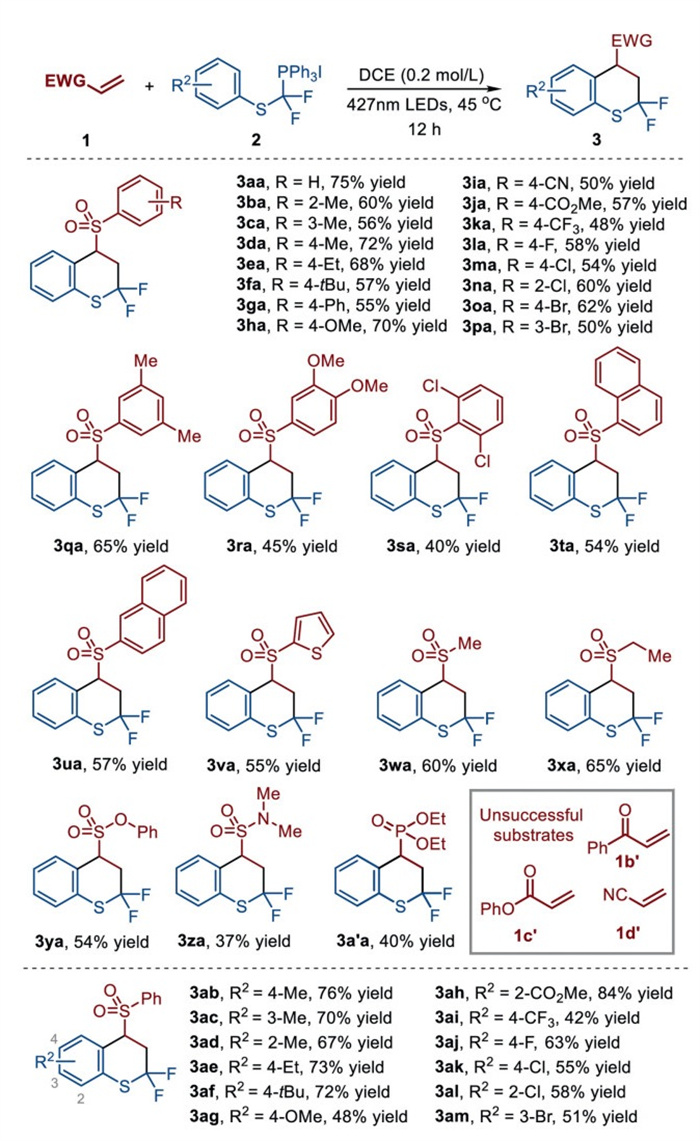
With respect to vinyl sulfones, the electron-donating groups and electron-withdrawing groups (such as methoxyl, tert–butyl, fluoro, bromo, chloro, cyano, and ester) attached on the aromatic ring of (vinylsulfonyl)benzenes were compatible in this transformation, leading to the target 2,2-difluoro-4-(arylsulfonyl)thiochromanes as expected. Additionally, other vinylsulfones with heteroaryl or naphthyl group were workable as well. Interestingly, (methylsulfonyl)ethane, (ethylsulfonyl)ethane, phenyl ethenesulfonate, and N,N-dimethylethenesulfonamide were all suitable partners in the reaction of {difluoro(phenylthio)methyl}triphenylphosphonium iodide. Subsequently, various {difluoro(phenylthio)methyl}triphenylphosphonium iodides were evaluated in the reaction of (vinylsulfonyl)benzene 1a under the standard conditions. Again, {difluoro(phenylthio)methyl}triphenylphosphonium iodides with electron-donating groups and electron-withdrawing groups attached on the aromatic ring underwent this transformation smoothly, affording the corresponding products in moderate to good yields.
These compounds were then evaluated for their anti-influenza activities in vitro by the cytopathic effect (CPE) inhibition assay. The result of the single-concentration (50 µmol/L) screening on influenza virus A strain (H1N1 PR8, ATCC VR-1469) is shown in Table 2. Compared with 3aa, compounds 3wa-3za exhibited significantly lower activity, indicating that an aromatic group at R1 was more suitable for better anti-influenza activity. When R1 was a substituted phenyl group (3ba-3sa), the substituent effect indicated that introducing a moderate electron-withdrawing substituent at the para-position of the phenyl ring (3ia, 3la, 3ma, 3oa) benefited the compounds more. However, the overly strong electron-withdrawing effect of trifluoromethyl (3ka) made it inactive.
DownLoad:
CSV
| Compd. | CPE Inhibition (%)a | Compd. | CPE inhibition (%)a |
| 3aa | 62.5 | 3ta | 75.0 |
| 3ba | 62.5 | 3ua | 75.0 |
| 3ca | 50.0 | 3va | 62.5 |
| 3da | 25.0 | 3wa | 37.5 |
| 3ea | 25.0 | 3xa | 12.5 |
| 3fa | 62.5 | 3ya | 37.5 |
| 3ga | 75.0 | 3za | 25.0 |
| 3ha | 62.5 | 3ab | 50.0 |
| 3ia | 100.0 | 3ac | 62.5 |
| 3ja | 62.5 | 3ad | 75.0 |
| 3ka | 0.00 | 3ae | 50.0 |
| 3la | 90.0 | 3af | 12.5 |
| 3ma | 87.5 | 3ag | 62.5 |
| 3na | 62.5 | 3ah | 75.0 |
| 3oa | 95.0 | 3ai | 50.0 |
| 3pa | 37.5 | 3aj | 75.0 |
| 3qa | 100.0 | 3ak | 75.0 |
| 3ra | 50.0 | 3al | 75.0 |
| 3sa | 75.0 | 3am | 90.0 |
| Vehicle | 0.0 | ||
| a The average of two repetitions. | |||
To further identify the effects of anti-influenza A, EC50 values of compounds 3ia, 3la, 3ma, 3oa, 3qa, and 3am were detected as 11.8, 17.3, 15.0, 23.7, 29.5, and 14.4 µmol/L, respectively, which were all better than that of Ribavirin (32.6 µmol/L). Thus, 4-((2,2-difluorothiochroman-4-yl)sulfonyl)benzonitrile (3ia) was selected to be a potential anti-influenza pharmacophore.
To gain more insight into the structure-activity relationship of this structure, a small library of 4-((2,2-difluorothiochroman-4-yl)sulfonyl)benzonitriles with modifications on R2 was constructed. The results are displayed in Scheme 3.
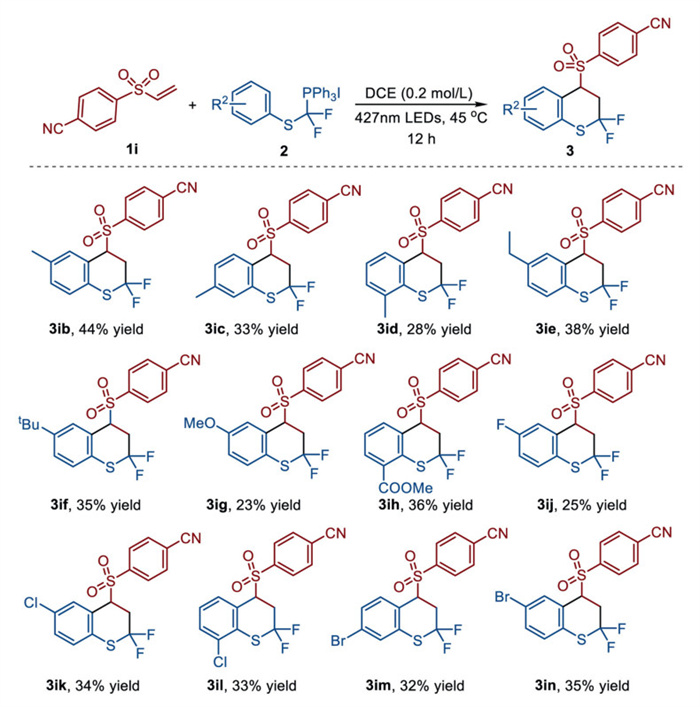
All the compounds in Scheme 3 were evaluated on both influenza A and B (Victoria lineage, Florida/78/2015, ATCC VR-1931) strains. The results are shown in Table 3. Compared with the lead compound 3ia (Fig. 1), 3if and 3ih exhibited markedly reduced activity against influenza A, which might be attributed to the steric effects of the tert–butyl and COOMe groups. For influenza B, except compounds 3ie, 3ig, and 3ij, the activities of the derivatives with other modifications on R2 all significantly decreased. Overall, 3ij showed the most comprehensive activity.
DownLoad:
CSV
| Compd | EC50 (µmol/L) | |
| Influenza A | Influenza B | |
| 3ib | 4.6 | / |
| 3ic | 9.8 | / |
| 3id | 39.1 | / |
| 3ie | 8.8 | 25.6 |
| 3if | / | / |
| 3ig | 9.9 | 30.9 |
| 3ih | / | / |
| 3ij | 3.5 | 26.4 |
| 3ik | 22.4 | / |
| 3il | 10.1 | / |
| 3im | 7.9 | / |
| 3in | 48.3 | / |
| 3ia | 11.8 | 38.0 |
| Ribavirin | 32.6 | 38.9 |
| /: EC50 > 50 µmol/L. | ||
Anti-influenza virus activity involves multiple targets, including neuraminidase (NA), hemagglutinin (HA), viral polymerase, M2 ion channel, and viral nucleoprotein [30]. The crystal structure of the A/Hong Kong/1/1968 (H3N2) influenza virus hemagglutinin in complex with the antiviral drug arbidol (PDB code: 5T6N) showed that the π-π stacking with ARG54 was an essential force for HA inhibition (Fig. 2A). In this study, molecular docking experiments revealed that the antiviral activity of such a 4-((2,2-difluorothiochroman-4-yl)sulfonyl)benzonitrile structure may also arise from their interaction with HA.
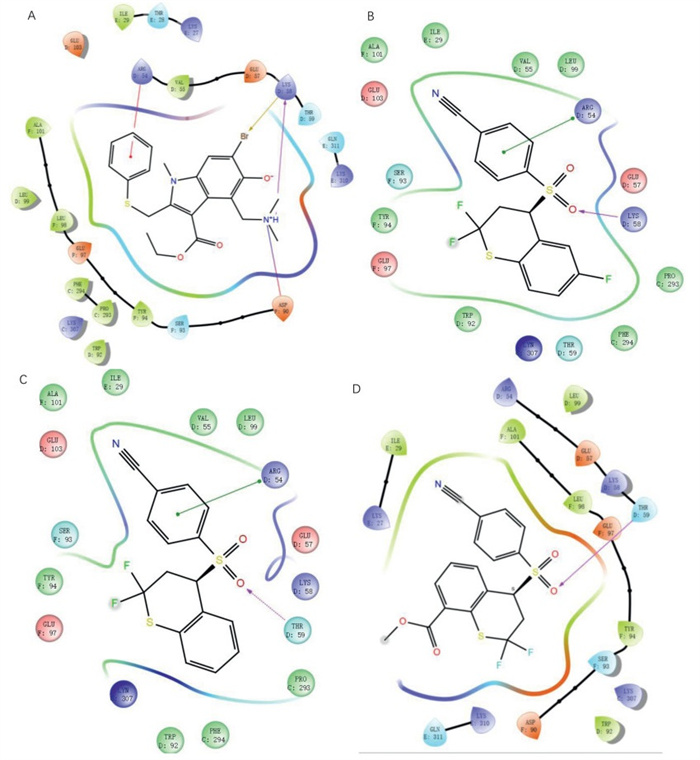
The predicted binding modes indicated that 3ia and 3ij occupied the active pocket of hemagglutinin with docking scores of −7.688 and −8.266, respectively. As shown in Fig. 2, a π-π stacking between ARG54 and the phenyl group was well formed, which was consistent with the screening result that an aromatic ring was optimal for the R1 group. Besides this, the sulfonyl group additionally formed a hydrogen-bonding interaction with LYS58 for 3ij (Fig. 2B) and THR59 for 3ia (Fig. 2C). And the introduction of a fluorine atom on R2 of 3ij led to a more proper size, which make it have a stronger hydrogen bond (2.12 Å) than 3ia (2.72 Å) and show better activities consequently. These SAR results indicate that the activity data are consistent with the proposed mechanism, and HA is likely to be the target of this novel structure. However, the precise mechanism requires further investigation in vitro and in vivo.
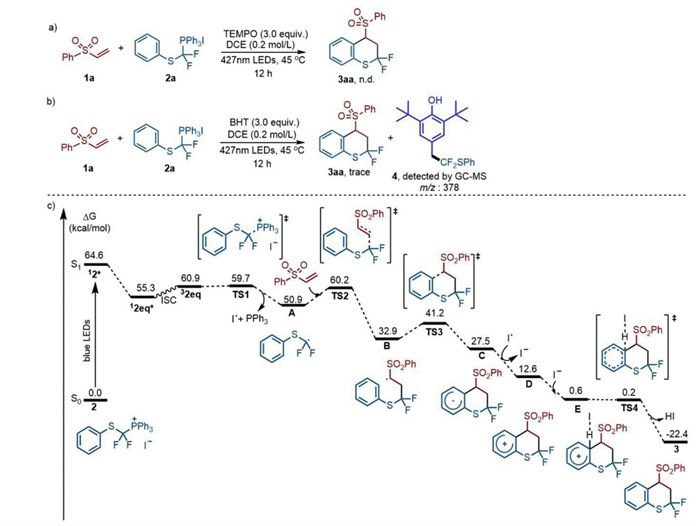
To in-depth explored the reaction mechanism, some control experiments were carried out and shown in Schemes 4a and b. The reaction was suppressed completely when 2,2,6,6-tetramethylpiperidin-1-oxyl (TEMPO) was added into the model reaction under the standard conditions. Additionally, only a trace amount of product 3aa was observed when 2,6-di–tert–butyl–4-methylphenol (BHT) was employed as the radical scavenger, and adduct 4 was detected by GC–MS. Furthermore, density functional theory (DFT) and time-dependent DFT (TDDFT) were conducted (Scheme 4c), as detailed in Supporting information. Upon blue light irradiation, 2 undergoes vertical excitation to its first excited state (12*) (ΔG = 64.6 kcal/mol). Subsequently, 12* relaxes to its equilibrium geometry (12*) on the S1 potential energy surface. The reaction then proceeds via intersystem crossing (ISC) of 12*eq (ΔG = 55.3 kcal/mol), ultimately yielding the triplet specie 32eq (ΔG = 60.9 kcal/mol). C-P bond cleavage occurs from 32eq through the TS1, with a low energy barrier of 59.7 kcal/mol, resulting the difluoro(phenylthio)methyl radical A (ΔG = 50.9 kcal/mol). Then, difluoro(phenylthio)methyl radical A attacks terminal alkene carbon of vinyl sulfone 1 via TS2 (ΔG = 60.2 kcal/mol) to afford the radical intermediate B (ΔG = 32.9 kcal/mol). Subsequently, intramolecular radical cyclization would occur from B to provide radical intermediate C (ΔG = 27.5 kcal/mol) via TS3 (ΔG = 41.2 kcal/mol), which through a single electron transfer to form intermediate D. Finally, deprotonation would take place to generate 2,2-difluoro-4-sulfonylthiochromane 3 via TS4 (ΔG = 0.2 kcal/mol).
In summary, we have developed a facile route to 2,2-difluoro-4-sulfonylthiochromanes through a reaction of {difluoro(phenylthio)methyl}triphenylphosphonium iodides with vinyl sulfones under visible light irradiation. This transformation is highly efficient through radical difluoro(phenylthio)methylation/cyclization in the absence of catalyst and additives under mild conditions. 4-((2,2-Difluorothiochroman-4-yl)sulfonyl)benzonitrile, as a novel potential anti-influenza pharmacophore, is identified, and the structure-activity relationship is also studied. The supposed mechanism of hemagglutinin inhibition is investigated by the method of molecular docking.
Tonghao Zhu: Investigation. Chuxun Wu: Investigation. Xiaoying Zhang: Data curation. Zaixing Yang: Validation. Ning Mu: Writing – review & editing, Supervision. Wei Zhou: Writing – review & editing, Supervision. Jie Wu: Writing – original draft, Supervision, Project administration.
The authors declare that they have no known competing financial interests or personal relationships that could have appeared to influence the work reported in this paper.
Financial support from National Natural Science Foundation of China (Nos. 22101200, 22201202 and 22371201), National Key R & D Program of China (No. 2023FC3503400), Natural Science Foundation of Zhejiang Province (No. LZ23B020001) and Zhejiang Provincial Ten Thousand Talent Program (No. 2023R5244) is gratefully acknowledged.
Supplementary material associated with this article can be found, in the online version, at doi:
F. Carrat, A. Flahault, Vaccine 25 (2007) 6852–6862. doi: 10.1016/j.vaccine.2007.07.027
J. Treanor, N. Engl. J. Med. 350 (2004) 218–220. doi: 10.1056/NEJMp038238
M. von Itzstein, Nat. Rev. Drug Discovery 6 (2007) 967–974. doi: 10.1038/nrd2400
E. De Clercq, Nat. Rev. Drug Discovery 5 (2006) 1015–1025. doi: 10.1038/nrd2175
Q.M. Le, M. Kiso, K. Someya, et al., Nature 437 (2005) 1108. doi: 10.1038/4371108a
M.D. de Jong, T.T. Tran, H.K. Truong, et al., N. Engl. J. Med. 353 (2005) 2667–2672. doi: 10.1056/NEJMoa054512
A. Moscona, N. Engl. J. Med. 360 (2009) 953–956. doi: 10.1056/NEJMp0900648
Y. Zhou, J. Wang, Z. Gu, et al., Chem. Rev. 116 (2016) 422–518. doi: 10.1021/acs.chemrev.5b00392
M. Cametti, B. Crousse, P. Metrangolo, et al., Chem. Soc. Rev. 41 (2012) 31–42. doi: 10.1039/C1CS15084G
E.P. Gillis, K.J. Eastman, M.D. Hill, J. Med. Chem. 58 (2015) 8315–8359. doi: 10.1021/acs.jmedchem.5b00258
N.A. Meanwell, J. Med. Chem. 61 (2018) 5822–5880. doi: 10.1021/acs.jmedchem.7b01788
Y. Li, Y. Xiang, Z. Li, J. Wu, Org. Chem. Front. 3 (2016) 1493–1497. doi: 10.1039/C6QO00434B
Y. Xiang, Y. Li, Y. Kuang, J. Wu, Chem. Eur. J. 23 (2017) 1032–1035. doi: 10.1002/chem.201605336
X. Wang, W. Zhou, W. Xie, et al., Chin. Chem. Lett. 34 (2023) 107984. doi: 10.1016/j.cclet.2022.107984
J. Zhang, X. Wang, Q. Chen, et al., Eur. J. Med. Chem. 232 (2022) 114197. doi: 10.1016/j.ejmech.2022.114197
R. Szpera, D.F.J. Moseley, L.B. Smithet, et al., Angew. Chem. Int. Ed. 58 (2019) 14824–14848. doi: 10.1002/anie.201814457
J.B.L. Sap, C.F. Meyer, N.J.W. Straathof, Chem. Soc. Rev. 50 (2021) 8214–8247. doi: 10.1039/d1cs00360g
M.L. Bolognesi, M. Bartolini, A. Cavalli, et al., J. Med. Chem. 47 (2004) 5945–5952. doi: 10.1021/jm049782n
J. Huang, C. Wang, X. Wang, et al., Sci. China Chem. 68 (2025) 257–263. doi: 10.1007/s11426-024-2151-x
X. Wang, Y. Mao, S. Ye, et al., ACS Catal. 15 (2025) 17494–17503. doi: 10.1021/acscatal.5c06163
J. Zhang, X. Wang, P. Wang, et al., Sci. China Chem. 67 (2024) 908–913. doi: 10.1007/s11426-023-1814-2
Q.Y. Lin, X.H. Xu, K. Zhang, F.L. Qing, Angew. Chem. Int. Ed. 55 (2016) 1479–1483. doi: 10.1002/anie.201509282
N.B. Heine, A. Studer, Org. Lett. 19 (2017) 4150–4153. doi: 10.1021/acs.orglett.7b02109
J. Yu, J.H. Lin, Y.C. Cao, J.C. Xiao, Org. Chem. Front. 6 (2019) 3580–3583. doi: 10.1039/c9qo00919a
B. Zhu, Z. Wang, H. Xi, et al., Org. Chem. Front. 8 (2021) 6300–6308. doi: 10.1039/d1qo01187a
Y.Y. Zhu, S. Liu, Y.E. Huang, J. Fluorine Chem. 257-258 (2022) 109969. doi: 10.1016/j.jfluchem.2022.109969
Y. Ran, Q.Y. Lin, X.H. Xu, F.L. Qing, J. Org. Chem. 82 (2017) 7373–7378. doi: 10.1021/acs.joc.7b01041
L.I. Panferova, V.V. Levin, M.I. Struchkova, A.D. Dilman, Chem. Commun. 55 (2019) 1314–1317. doi: 10.1039/c8cc09115c
Y. Wang, S. Liu, Y. Huang, Org. Biomol. Chem. 22 (2024) 4895–4900. doi: 10.1039/d4ob00602j
A. Loregian, B. Mercorelli, G. Nannetti, et al., Cell. Mol. Life Sci. 19 (2014) 3659–3683. doi: 10.1007/s00018-014-1615-2

Scheme 2 Substrate scope for the reaction of {difluoro(phenylthio)methyl}triphenylphosphonium iodides with vinyl sulfones and other Michael acceptors.

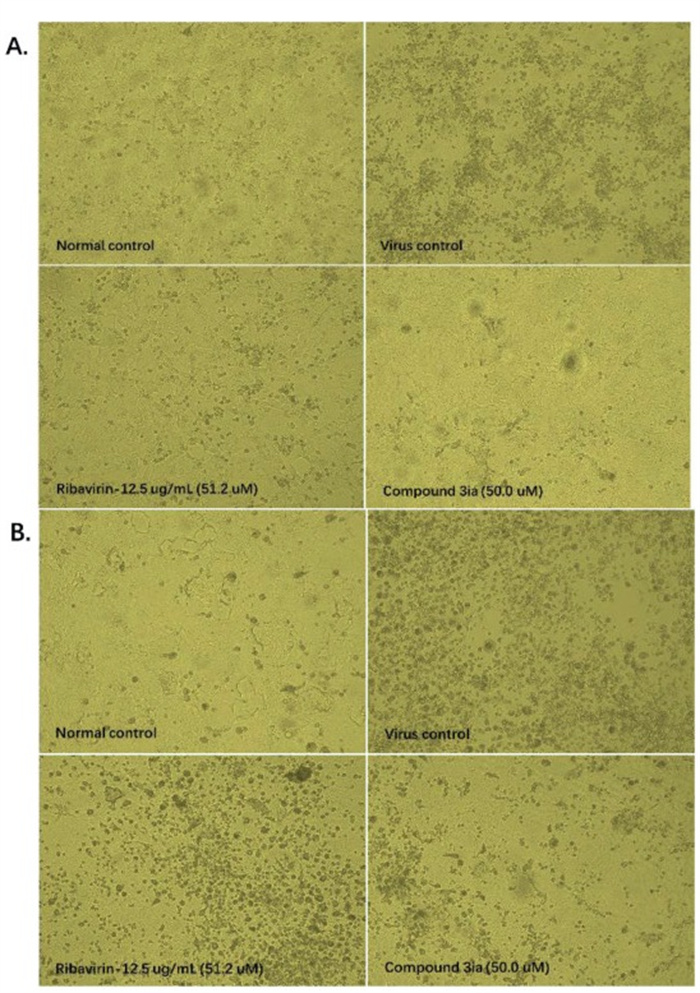
Figure 1 Cytopathic effect (CPE) images of MDCK cells. Ribavirin was used as a positive control. (A) CPE images of compound 3ia against the influenza virus A H1N1 PR8 strain. (B) CPE images of compound 3ia against the influenza virus B Victoria lineage strain.

Figure 2 Binding modes of compounds arbidol (A), 3ij (B), 3ia (C), and 3ih (D) in the Arbidol binding site of H1 hemagglutinin (PDB code: 5T6N). The π-π stackings are shown by the green lines and the hydrogen bonds are shown by the purple lines. The modeling study was carried out using Schrödinger Maestro 13.1, the docking study was performed using Glide.
Table 1. Optimization of the reaction conditions.a
|
||
| Entry | Deviation from standard conditions | Yield (%)b |
| 1 | None | 62 |
| 2 | DCE instead of MeCN | 75 |
| 3 | THF instead of MeCN | 20 |
| 4 | DMF instead of MeCN | 28 |
| 5 | DMA instead of MeCN | 22 |
| 6 | Acetone instead of MeCN | 59 |
| 7 | EtOAc instead of MeCN | Trace |
| 8 | DMSO instead of MeCN | Trace |
| 9c | 390 nm instead of 427 nm | 46 |
| 10c | 440 nm instead of 427 nm | 72 |
| 11c | 456 nm instead of 427 nm | 51 |
| 12c | 6 h instead of 12 h | 41 |
| 13c | 18 h instead of 12 h | 31 |
| 14c | 35 ℃ instead of 45 ℃ | 13 |
| 15c | 55 ℃ instead of 45 ℃ | 70 |
| 16c | 0.1 mol/L instead of 0.2 mol/L | 73 |
| 17c | 0.4 mol/L instead of 0.2 mol/L | 31 |
| 18c | 20 W instead of 40 W | 11 |
| 19c | 30 W instead of 40 W | 69 |
| 20c | In dark | n.d. |
| 21c | Under air atmosphere | n.d. |
| a Reaction conditions: (vinylsulfonyl)benzene 1a (0.2 mmol), (difluoro(phenylthio)methyl)triphenylphosphonium iodide 2a (0.3 mmol), MeCN (1.0 mL), 45 ℃, 12 h, 427 nm blue LEDs (40 W), under N2 atmosphere. b Isolated yield based on (vinylsulfonyl)benzene 1a. c DCE was used as solvent. |
||
 下载: 导出CSV
Table 2. Anti-influenza A activities of the compounds (50 µmol/L) in Scheme 2.
| Compd. | CPE Inhibition (%)a | Compd. | CPE inhibition (%)a |
| 3aa | 62.5 | 3ta | 75.0 |
| 3ba | 62.5 | 3ua | 75.0 |
| 3ca | 50.0 | 3va | 62.5 |
| 3da | 25.0 | 3wa | 37.5 |
| 3ea | 25.0 | 3xa | 12.5 |
| 3fa | 62.5 | 3ya | 37.5 |
| 3ga | 75.0 | 3za | 25.0 |
| 3ha | 62.5 | 3ab | 50.0 |
| 3ia | 100.0 | 3ac | 62.5 |
| 3ja | 62.5 | 3ad | 75.0 |
| 3ka | 0.00 | 3ae | 50.0 |
| 3la | 90.0 | 3af | 12.5 |
| 3ma | 87.5 | 3ag | 62.5 |
| 3na | 62.5 | 3ah | 75.0 |
| 3oa | 95.0 | 3ai | 50.0 |
| 3pa | 37.5 | 3aj | 75.0 |
| 3qa | 100.0 | 3ak | 75.0 |
| 3ra | 50.0 | 3al | 75.0 |
| 3sa | 75.0 | 3am | 90.0 |
| Vehicle | 0.0 | ||
| a The average of two repetitions. | |||
下载: 导出CSV
Table 3. Anti-influenza A and B activities of the compounds in Scheme 3.
| Compd | EC50 (µmol/L) | |
| Influenza A | Influenza B | |
| 3ib | 4.6 | / |
| 3ic | 9.8 | / |
| 3id | 39.1 | / |
| 3ie | 8.8 | 25.6 |
| 3if | / | / |
| 3ig | 9.9 | 30.9 |
| 3ih | / | / |
| 3ij | 3.5 | 26.4 |
| 3ik | 22.4 | / |
| 3il | 10.1 | / |
| 3im | 7.9 | / |
| 3in | 48.3 | / |
| 3ia | 11.8 | 38.0 |
| Ribavirin | 32.6 | 38.9 |
| /: EC50 > 50 µmol/L. | ||
下载: 导出CSV

 扫一扫看文章


扫一扫关注我们


 下载: