Citation:
Hailing Huo, Zikun Liang, Yuanyong Huang, Zhongkai Xie, Cai Ning, Erjun Kan, Ang Li, Weidong Shi. Fermi-level-gradient-driven unidirectional electron transfer in TiO2/Au-Pt for broad-spectrum photocatalytic hydrogen production[J]. Chinese Chemical Letters,
2026, 37(12): 112447.
doi:
10.1016/j.cclet.2026.112447
Fermi-level-gradient-driven unidirectional electron transfer in TiO2/Au-Pt for broad-spectrum photocatalytic hydrogen production
English
Fermi-level-gradient-driven unidirectional electron transfer in TiO2/Au-Pt for broad-spectrum photocatalytic hydrogen production
Received Date:
14 November 2025 Accepted Date:
22 January 2026 Revised Date:
19 January 2026 Available Online:
15 December 2026
Abstract:
Photocatalytic hydrogen evolution from water is considered a promising route for solar energy utilization. However, the efficiency of plasmonic photocatalysts under broad-spectrum sunlight remains hampered by inefficient charge management. Systems such as TiO2/Au suffer from electron counterflow under simultaneous UV and visible excitation: UV-excited electrons in TiO2 migrate toward Au, while visible-light-induced hot electrons from Au inject into TiO2, resulting in severe recombination losses. Here, we construct a ternary TiO2/Au-Pt heterostructure with a deliberately aligned Fermi-level gradient (TiO2 → Au → Pt), establishing a unidirectional, downhill electron-transfer pathway. This stepwise energy alignment channels both UV- and visible-light-excited electrons sequentially to Pt catalytic sites, effectively suppressing charge counterflow and maximizing electron utilization. Consequently, TiO2/Au-Pt achieves a remarkable H2 evolution rate of 16.67 mmol g-1 h-1 under broad-spectrum irradiation, surpassing those of TiO2/Au and TiO2/Pt by factors of 3.18 and 2.32, respectively, while maintaining excellent stability over 20 h. This Fermi-level-guided strategy provides a general paradigm for engineering multicomponent photocatalysts with optimized interfacial energetics toward efficient broad-spectrum solar-to-hydrogen conversion.
The pursuit of sustainable energy has positioned hydrogen (H2) as an indispensable clean energy carrier, owing to its high gravimetric energy density (143 MJ/kg, based on higher heating value) and zero carbon emissions upon utilization [1]. Photocatalytic H2 evolution from water, which directly converts solar energy into chemical energy, offers a green pathway for H2 production [2,3]. The efficiency of this process heavily relies on the dynamics of photogenerated charge carriers [4]. Broad light absorption is essential to maximize their generation [5], while their efficient separation and utilization are crucial for driving the hydrogen evolution reaction (HER) [6-8].
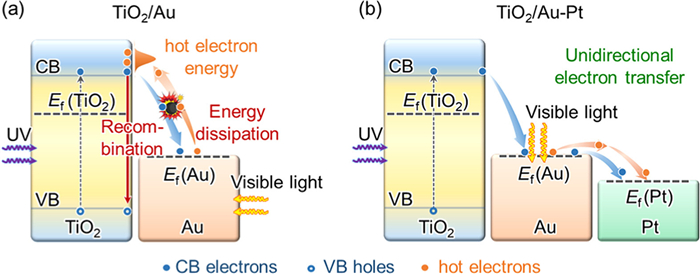
Wide-bandgap semiconductors such as titanium dioxide (TiO2) are valued for their strong redox potentials [9,10]. Nevertheless, their light absorption is inherently confined to the ultraviolet (UV) region (∼4% of sunlight) [9,11]. To utilize visible light (∼43% of sunlight) [9], a common strategy involves coupling with plasmonic metals such as gold (Au) to form plasmonic photocatalysts [12]. Au nanoparticles (NPs) exhibit strong localized surface plasmon resonance (LSPR), enabling efficient visible-light harvesting and generation of hot electrons with sufficient energy to inject into the conduction band (CB) of TiO2 [13]. This integration effectively extends the optical response of TiO2/Au composites across both UV and visible regions. However, the TiO2/Au system suffers from an intrinsic limitation in charge management under broad-spectrum irradiation (encompassing both UV and visible light). Photogenerated electrons from the TiO2 CB and plasmon-induced hot electrons from Au often migrate in opposing directions [14,15]. Specifically, UV-excited CB electrons in TiO2 flow toward the lower-Fermi-level Au, while visible-light-excited hot electrons from Au inject back into the TiO2 CB by overcoming the Schottky barrier (Fig. 1a) [16]. This electron counterflow causes charge accumulation at the metal-semiconductor interface [17], substantially increasing the probability of interfacial electron-hole recombination, and thereby severely compromising the overall charge utilization efficiency [14].
Figure 1
Figure 1.
Schematics of electron flow directions driven by the Fermi-level differences in (a) TiO2/Au and (b) TiO2/Au-Pt. To clearly highlight the relative Fermi levels and the resulting electron transfer, TiO2, Au, and Pt are depicted separately rather than in direct contact.
To address this challenge, we constructed a ternary TiO2/Au-Pt heterostructure designed to establish a unidirectional downhill electron-transfer pathway through precise interfacial Fermi-level alignment. In this configuration, Au NPs were first loaded onto TiO2 (denoted as TiO2/Au), followed by the selective deposition of Pt onto Au, yielding the final TiO2/Au-Pt architecture. The stepwise decrease in Fermi levels from TiO2 (∼−4.2 eV) to Au (∼−5.3 eV) to Pt (∼−5.6 eV) creates an electronic potential gradient in TiO2/Au-Pt [18,19]. Consequently, the CB electrons of TiO2 are driven to transfer sequentially to Au and then to Pt. Simultaneously, the hot electrons of Au flow directly toward Pt (Fig. 1b). This innovative design effectively suppresses electron counterflow, minimizes recombination losses, and facilitates rapid electron transfer to the active sites for the HER, thereby maximizing broad-spectrum solar energy utilization. As a result, the TiO2/Au-Pt catalyst achieves a superior H2 evolution rate of 16.67 mmol g-1 h-1 under broad-spectrum irradiation, exceeding those of TiO2/Au and TiO2/Pt by factors of 3.18 and 2.32, respectively. This work provides new insights into the development of highly efficient, broad-spectrum-responsive photocatalytic systems.
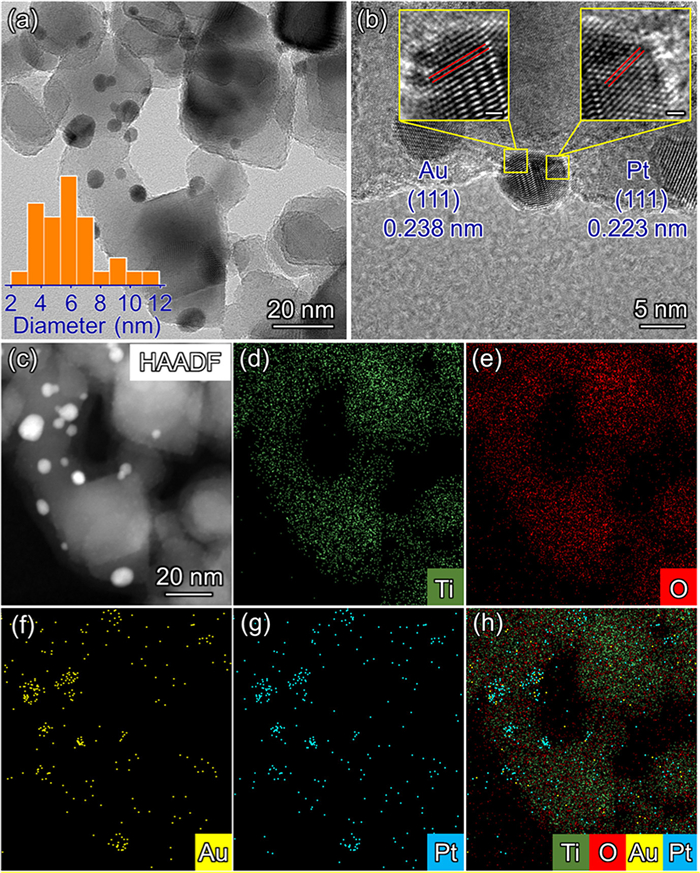
The TiO2/Au-Pt catalyst was synthesized via a sequential procedure, in which Au NPs were first loaded onto the P25 substrate to form TiO2/Au, followed by the selective deposition of Pt onto Au within TiO2/Au (Fig. S1 in Supporting information). Transmission electron microscopy (TEM) images confirm the successful formation of TiO2/Au, showing that Au NPs are randomly distributed on TiO2 with an average diameter of ∼6 nm (Fig. S2 in Supporting information). To ensure that Pt predominantly deposits on Au rather than directly on TiO2, a prerequisite for establishing unidirectional charge-carrier flow, we employed a photodeposition method that promotes the in situ growth of Pt on the Au NPs (Fig. S3 in Supporting information). During the photodeposition process, PtCl62- are preferentially reduced on the surface of Au, as Au possesses a lower Fermi level than TiO2 and thus serves as an efficient electron sink [20]. The resulting TiO2/Au-Pt structure is presented in Fig. 2. Particle size analysis (Fig. 2a) indicates a slight increase in the average metal particle diameter to 7.1 nm. Furthermore, the high-resolution TEM (HRTEM) images (Fig. 2b and Fig. S4 in Supporting information) clearly resolve lattice fringes corresponding to the Au (111) plane (0.238 nm) and Pt (111) plane (0.223 nm) within individual particles [21,22], confirming the Au-Pt component of the particle and thus the successful deposition of Pt on Au. This is further corroborated by energy-dispersive X-ray spectroscopy (EDS) elemental mapping based on high-angle annular dark-field scanning TEM (HAADF-STEM), which shows near-coincident spatial distributions of Au and Pt (Figs. 2c–h). Additionally, the loading amounts of Au and Pt, determined by inductively coupled plasma optical emission spectroscopy (ICP-OES), are 2.05 wt% and 0.85 wt%, respectively (Table S1 in Supporting information).
Figure 2
Figure 2.
Morphology of TiO2/Au-Pt. (a) TEM image. The inset shows the size distribution of metal NPs. (b) HRTEM image. The scale bar for the magnified Au and Pt lattice images is 1 nm. (c) HAADF-STEM image and corresponding EDS mapping profiles of Ti (d), O (e), Au (f), and Pt (g). (h) Overlapped EDS mapping signals of Ti, O, Au, and Pt.
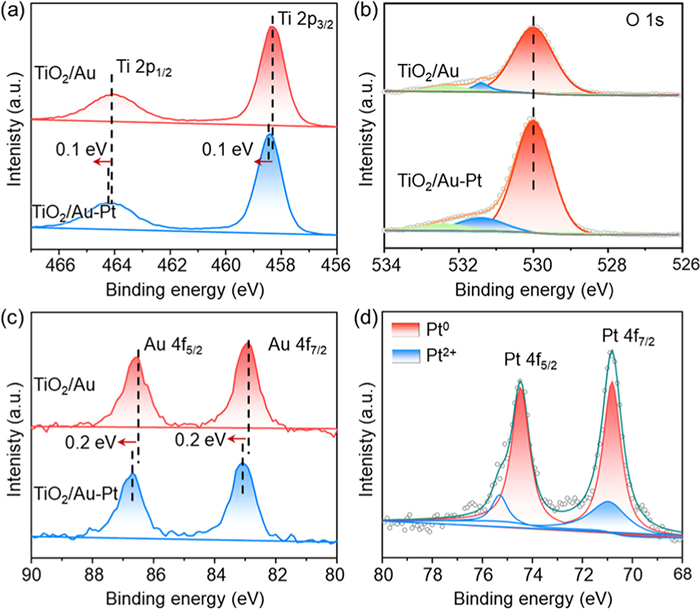
The chemical compositions of TiO2/Au and TiO2/Au-Pt were first examined by X-ray diffraction (XRD), and both samples display the characteristic diffraction peaks of P25, corresponding to a mixed phase of anatase and rutile (Fig. S5 in Supporting information). No diffraction peaks assignable to Au or Pt are detected, which can be attributed to their low loading amounts and high dispersion on the TiO2 surface [23]. To further elucidate the electronic structure, X-ray photoelectron spectroscopy (XPS) was conducted. The Ti 2p spectra (Fig. 3a) exhibit characteristic peaks corresponding to Ti4+ species [24]. The O 1s spectra (Fig. 3b) are dominated by a lattice oxygen peak at 530.0 eV, characteristic of TiO2 [25], further confirming the Ti(Ⅳ) oxidation state in both TiO2/Au and TiO2/Au-Pt. Notably, the Ti 2p3/2 peak of TiO2/Au-Pt (458.4 eV) shows a slight positive shift (∼0.1 eV) compared with that of TiO2/Au (458.3 eV), suggesting a decreased electron density on TiO2 induced by the introduction of Pt. This behavior indicates enhanced interfacial electronic interaction, likely associated with electron transfer from TiO2 toward the metal components (Au and Pt). Furthermore, analysis of the Au 4f region (Fig. 3c) reveals that the characteristic peaks for metallic Au in TiO2/Au (83.0 eV for 4f7/2 and 86.6 eV for 4f5/2) shift positively by 0.2 eV in the TiO2/Au-Pt sample [26]. This shift implies electron transfer from Au to Pt, which can be ascribed to the higher work function of Pt (∼5.6 eV) than that of Au (∼5.3 eV) [18,27]. Moreover, the Pt 4f spectra of TiO2/Au-Pt (Fig. 3d) exhibit main peaks at 70.6 eV (4f7/2) and 74.2 eV (4f5/2), confirming the presence of metallic Pt [28]. Additional minor peaks at 71.8 eV and 75.8 eV can be assigned to partially oxidized Pt species arising from air exposure [29]. Nevertheless, Pt predominantly exists in the metallic state in the TiO2/Au-Pt composite. Collectively, these results confirm the successful deposition of metallic Pt and demonstrate that the introduction of Pt induces interfacial electron redistribution, with electrons preferentially migrating toward Pt from both TiO2 and Au.
Figure 3
Figure 3.
Structural characterizations. (a) High-resolution Ti 2p XPS spectra of TiO2/Au and TiO2/Au-Pt. (b) High-resolution O 1s XPS spectra of TiO2/Au and TiO2/Au-Pt. (c) High-resolution Au 4f XPS spectra of TiO2/Au and TiO2/Au-Pt. (d) High-resolution Pt 4f XPS spectra of TiO2/Au-Pt.
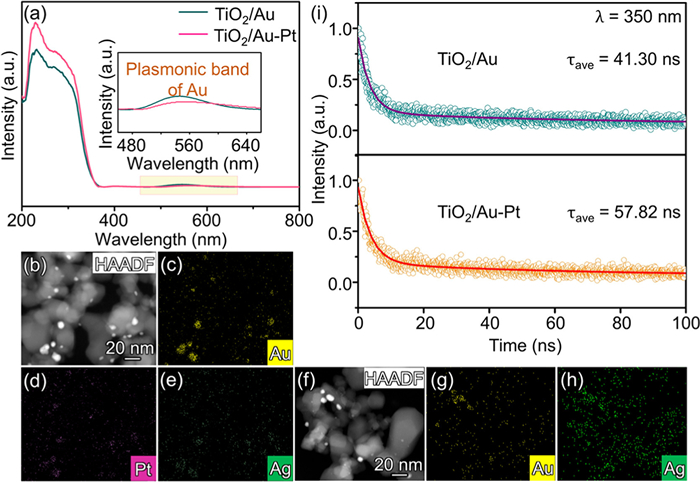
Furthermore, the light absorption characteristics of different samples were evaluated using UV-vis diffuse reflectance spectra. Both TiO2/Au and TiO2/Au-Pt exhibit an absorption edge near 380 nm, consistent with the intrinsic bandgap absorption of TiO2 (Fig. 4a) [30]. A magnified view in Fig. 4a reveals a distinct absorption band centered at ∼550 nm for both composites, which is absent in both pure TiO2 and TiO2/Pt (Fig. S6 in Supporting information). This absorption band can be attributed to the LSPR of Au NPs [31], confirming their role in conferring visible-light responsiveness. Under visible-light irradiation, these Au NPs generate energetic hot electrons that can participate in photocatalytic reactions [32].
Figure 4
Figure 4.
Light absorption properties and evidence of electron-transfer direction. (a) UV-vis diffuse reflectance spectra of TiO2/Au and TiO2/Au-Pt. Inset is the enlarged view of the light absorption in the wavelength range of 460-660 nm. (b-e) Ag+ probe results for TiO2/Au-Pt, including the HAADF image of TiO2/Au-Pt/Ag (b) and corresponding EDS mapping profiles of Au (c), Pt (d), and Ag (e). Ag+ probe results for TiO2/Au, including the HAADF image of TiO2/Au/Ag (f) and corresponding EDS mapping profiles of Au (g) and Ag (h). (i) TRPL spectra of TiO2/Au and TiO2/Au-Pt under 350 nm excitation.
To elucidate the migration pathways of visible-light-induced hot electrons and UV-excited CB electrons in TiO2/Au and TiO2/Au-Pt under different illumination conditions, silver ion (Ag+) probe experiments [33] and time-resolved photoluminescence (TRPL) measurements were performed. First, Ag+ probe tests were conducted under visible-light irradiation (λ > 400 nm), which exclusively excites the LSPR of Au NPs, to track the flow of plasmon-generated hot electrons. Since TiO2 is not photoexcited under visible-light irradiation, the reduction of adsorbed Ag+ species can be exclusively attributed to hot electrons generated from Au (Fig. S7 in Supporting information). Consequently, the spatial distribution of deposited Ag0 directly reveals the direction of hot-electron transfer. As shown in Figs. 4b-e, for TiO2/Au-Pt, Ag0 is predominantly located at the Au-Pt sites, forming a TiO2/Au-Pt/Ag structure, indicating that hot electrons from Au preferentially transfer to Pt. In contrast, for TiO2/Au, Ag0 is randomly distributed across the surface of TiO2 (Figs. 4f-h), forming a TiO2/Au/Ag structure and implying that a considerable fraction of the hot electrons from Au is transferred to TiO2, consistent with previous reports [34,35]. These observations demonstrate that selective Pt deposition redirects the hot-electron transfer from Au toward Pt rather than TiO2. Consequently, under visible-light irradiation, a significant proportion of hot electrons flows in the direction of Au → TiO2 in the TiO2/Au system, whereas it switches to Au → Pt in the TiO2/Au-Pt system.
TRPL spectra were collected using a 350 nm excitation source to probe the electron-transfer situation in TiO2/Au and TiO2/Au-Pt under UV illumination. As shown in Fig. 4i, the average carrier lifetime (τave) increases from 41.30 ns for TiO2/Au to 57.82 ns for TiO2/Au-Pt (detailed fitting parameters are provided in Table S2 in Supporting information). The extended lifetime indicates slower PL decay, indicative of reduced charge recombination, which is corroborated by steady-state PL spectra (Fig. S8 in Supporting information) [36]. These results collectively demonstrate more efficient charge separation in TiO2/Au-Pt compared to TiO2/Au, aligning with a sequential electron-transfer pathway under UV light. In this pathway, CB electrons from TiO2 migrate to Au and subsequently to Pt, significantly suppressing recombination with valence band (VB) holes. Consequently, it can be reasonably deduced that upon UV-light irradiation, CB electrons in TiO2/Au transfer from TiO2 to Au, whereas in TiO2/Au-Pt, they transfer sequentially from TiO2 to Au and then to Pt. The unidirectional electron-transfer pathway in TiO2/Au-Pt significantly enhances charge-separation efficiency [37].
The Ag+ probe and TRPL results collectively demonstrate distinct electron-transfer regimes under broad-spectrum irradiation. In TiO2/Au, CB electrons migrate from TiO2 to Au, whereas plasmon-induced hot electrons generated in Au are injected into TiO2, resulting in opposing electron-transfer directions. In contrast, for TiO2/Au-Pt under the same irradiation, TiO2 CB electrons transfer sequentially from TiO2 → Au → Pt, while hot electrons generated in Au flow directly to Pt. Consequently, a unidirectional charge-transfer pathway is effectively established in TiO2/Au-Pt.
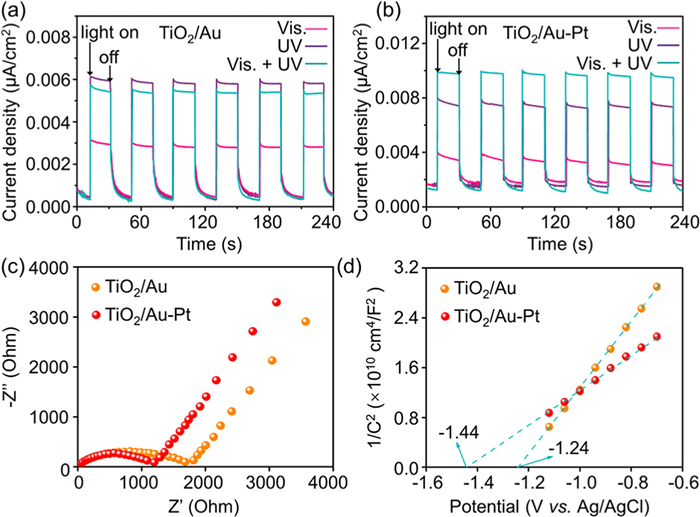
To gain further insight into charge carrier behavior in TiO2/Au and TiO2/Au-Pt, photoelectrochemical measurements were performed [33]. Photocurrent responses under different illumination conditions, including visible (400-780 nm), UV (320-400 nm), and broad-spectrum (320-780 nm), are presented in Figs. 5a and b. Both samples exhibit the lowest photocurrent under visible light, consistent with the limited light absorption contribution due to the low Au loading. Under UV and broad-spectrum irradiation, however, TiO2/Au and TiO2/Au-Pt display markedly different photocurrent behaviors. Specifically, the photocurrent of TiO2/Au decreases under broad-spectrum light compared to UV light, whereas that of TiO2/Au-Pt increases significantly. These observations indicate that the number of effective electrons in TiO2/Au decreases under broad-spectrum light, while TiO2/Au-Pt yields more effective electrons under the same conditions. Therefore, the designed TiO2/Au-Pt effectively enhances electron supply for the HER under broad-spectrum irradiation. Additionally, electrochemical impedance spectroscopy (EIS) was performed to probe charge-transfer resistance (Fig. 5c). The smaller semicircle radius observed for TiO2/Au-Pt compared to TiO2/Au corresponds to a lower charge transfer resistance, indicating enhanced electron mobility and more efficient charge transport [38], which is conducive to the HER. Moreover, Mott-Schottky analysis was conducted to estimate the flat-band potential of the samples (Fig. 5d). TiO2/Au-Pt exhibits a more negative flat-band potential (−1.44 V vs. Ag/AgCl) than TiO2/Au (−1.24 V vs. Ag/AgCl), indicating an upward shift of the CB and thus a stronger reducing ability [39], which is favorable for the HER. Collectively, these results demonstrate that the electron-transfer characteristics of TiO2/Au-Pt render it more effective for the HER under broad-spectrum light irradiation.
Figure 5
Figure 5.
Photoelectrochemical characterizations. Transient photocurrent responses of (a) TiO2/Au and (b) TiO2/Au-Pt under periodic light on/off cycles with different irradiation conditions. Vis. denotes visible light. (c) EIS and (d) Mott-Schottky curves of TiO2/Au and TiO2/Au-Pt.
The photocatalytic HER performance of TiO2/Au-Pt was evaluated under visible (400-780 nm), UV (320-400 nm), and broad-spectrum (320-780 nm) light irradiation, using methanol (CH3OH) as a hole scavenger. For comparison, TiO2/Au was used as a reference sample. To further verify the role of the Fermi-level-gradient-driven unidirectional electron transfer in TiO2/Au-Pt, an additional control sample was prepared by selectively depositing Ag onto the Au NPs of TiO2/Au, denoted as TiO2/Au-Ag. In this structure, the Fermi level of Ag (∼−4.3 eV) lies between those of TiO2 (∼−4.2 eV) and Au (∼−5.3 eV) [18,19,40], which disrupts the formation of a Fermi-level gradient and thus impedes the establishment of a unidirectional electron-transfer pathway. The successful synthesis of TiO2/Au-Ag was confirmed by the HAADF-STEM image and corresponding EDS elemental mapping (Fig. S9 in Supporting information). Moreover, TiO2/Au-Ag has a light absorption range similar to that of TiO2/Au-Pt, and both exhibit UV and visible light response (Fig. S10 in Supporting information).
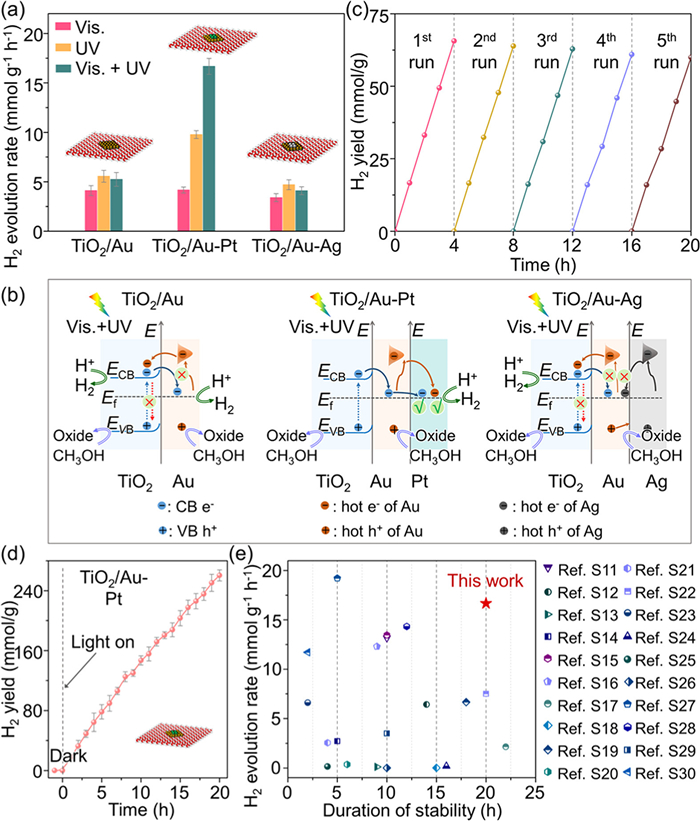
As shown in Fig. 6a, the H2 evolution rates of TiO2/Au under visible, UV, and broad-spectrum light irradiation are 4.11, 5.56, and 5.24 mmol g-1 h-1, respectively. Since TiO2 is inactive under visible light (Fig. S11 in Supporting information), the photocatalytic H2 evolution observed for TiO2/Au in this regime originates predominantly from hot electrons generated in Au NPs (Fig. S12a in Supporting information) [41,42]. Conversely, under UV light, the activity arises mainly from the CB electrons of TiO2 (Fig. S12b in Supporting information). Notably, the H2 evolution rate under broad-spectrum irradiation is lower than that under UV light, despite the simultaneous excitation of both TiO2 and Au. This result suggests that the hot electrons generated in Au are not effectively utilized under broad-spectrum illumination. Such inefficient utilization is likely due to opposing electron-transfer directions between TiO2 and Au, leading to ineffective electron consumption (Fig. 6b). In contrast, TiO2/Au-Pt exhibits a substantially enhanced photocatalytic H2 evolution rate under broad-spectrum light irradiation (16.67 mmol g-1 h-1) compared to that under UV light (11.88 mmol g-1 h-1), indicating efficient utilization of hot electrons generated from Au NPs. Given that the Fermi levels of TiO2, Au, and Pt follow the order Ef (TiO2) > Ef (Au) > Ef (Pt), electrons preferentially flow from TiO2 to Au and subsequently to Pt until their Fermi levels equilibrate. The deposition of Pt onto the Au sites of TiO2/Au thereby establishes a unidirectional electron-transfer pathway. Consequently, when Au absorbs visible light to generate hot electrons, these electrons can be efficiently transferred to Pt to drive the HER, rather than being dissipated through transition into the TiO2 CB (Fig. S13 in Supporting information). This configuration effectively suppresses back-transfer processes between hot electrons and CB electrons, minimizing energy losses and enhancing the overall utilization efficiency of photogenerated carriers. Therefore, under broad-spectrum irradiation, both hot electrons and CB electrons are efficiently harnessed through the Fermi-level-gradient-driven unidirectional electron transfer within the TiO2/Au-Pt system (Fig. 6b). This optimized charge-flow pathway results in the markedly enhanced photocatalytic HER activity of 16.67 mmol g-1 h-1, which is 211 times higher than that of pristine TiO2 (Fig. S11). Simultaneously, holes generated in the VB of TiO2 or within Au were primarily consumed in the oxidation of CH3OH to formic acid (HCOOH) and formaldehyde (HCHO) (Fig. S14 in Supporting information).
Figure 6
Figure 6.
Photocatalytic HER performance. (a) H2 evolution rates of TiO2/Au, TiO2/Au-Pt, and TiO2/Au-Ag under different light irradiation conditions. Insets show schematic models of each catalyst, where red, white, brown, green, and gray spheres represent Ti, O, Au, Pt, and Ag atoms, respectively. The error bar in (a) represents the standard deviation of three measurements. (b) Proposed reaction mechanisms for TiO2/Au, TiO2/Au-Pt, and TiO2/Au-Ag under broad-spectrum light irradiation. (c) Recycling tests of TiO2/Au-Pt over five consecutive runs under broad-spectrum light irradiation. (d) H2 yields as a function of time for TiO2/Au-Pt under broad-spectrum light irradiation. The error bar in (d) represents the standard deviation of three measurements. (e) Comparison of H2 evolution rates and stability of Au- or Pt-modified TiO2 photocatalysts reported in the literature between 2020 and 2025.
To further verify the effectiveness of the Fermi-level-gradient-driven unidirectional electron-transfer pathway in regulating charge flow within TiO2/Au-Pt, TiO2/Au-Ag, which lacks such directional electron guidance, was employed as a control sample. By comparing the trends in H2 evolution rates of TiO2/Au-Ag under different illumination conditions with those of TiO2/Au-Pt, the crucial role of unidirectional electron transfer in enabling efficient electron utilization in TiO2/Au-Pt can be indirectly demonstrated. Notably, the H2 evolution rate of TiO2/Au-Ag under broad-spectrum irradiation (4.1 mmol g-1 h-1) is even lower than that observed under UV-light irradiation (4.7 mmol g-1 h-1), indicating inefficient utilization of hot electrons generated from Au and Ag. This behavior is in sharp contrast to that of TiO2/Au-Pt, whose performance under broad-spectrum irradiation is markedly higher than under UV-light irradiation. This observation aligns with the conclusion that, in the absence of a unidirectional electron-transfer pathway, opposing electron flow directions among TiO2, Au, and Ag lead to inefficient electron consumption. As illustrated in Fig. 6b, the higher Fermi level of Ag relative to Au drives the transfer of electrons from Ag toward Au, as supported by the in situ XPS measurements (Fig. S15 in Supporting information). However, since Au lies between Ag and TiO2 and offers limited active sites for the HER, the TiO2 surface remains the dominant reaction site. Furthermore, the reverse electron-transfer direction between Au and TiO2 not only leads to energy dissipation but also increases the probability of charge recombination, thereby reducing the number of electrons available for the HER. In contrast, in the TiO2/Au-Pt system, both CB electrons from TiO2 and hot electrons from Au can unidirectionally migrate to Pt owing to its lowest Fermi level, enabling highly effective charge utilization. Such an efficient electron-transfer process is unattainable in the TiO2/Au-Ag structure (Fig. S13), ultimately resulting in its inferior photocatalytic performance.
Moreover, recycling experiments were conducted to evaluate the stability of TiO2/Au-Pt. As depicted in Fig. 6c, the H2 evolution rate exhibits a negligible decline after five consecutive cycles under broad-spectrum irradiation [43]. Furthermore, a 20-h continuous test shows a steady increase in H2 production over time, reaffirming the excellent stability of the TiO2/Au-Pt catalyst (Fig. 6d). To gain a more in-depth understanding of the catalyst’s stability, post-reaction TEM and XPS analyses were conducted (Fig. S16 in Supporting information). The well-preserved morphology, uniform distribution of metals, and almost unchanged chemical states of Ti, Au, and Pt once again underscore the outstanding stability of TiO2/Au-Pt. Additionally, TiO2/Pt, synthesized via the same photodeposition method employed for TiO2/Au-Pt, exhibits similar H2 evolution rates under both UV (7.25 mmol g-1 h-1) and broad-spectrum (7.18 mmol g-1 h-1) light irradiation, which can be attributed to its inability to respond to visible light (Fig. S17 in Supporting information). This observation further corroborates that the significantly enhanced H2 evolution activity of TiO2/Au-Pt under broad-spectrum irradiation stems from the efficient utilization of hot electrons. Overall, TiO2/Au-Pt exhibits clear advantages in both H2 evolution rate and stability, achieving a well-balanced performance between activity and stability for hydrogen production (Fig. 6e and Table S3 in Supporting information). Furthermore, the STH value used to evaluate the solar-energy conversion efficiency of the optimized TiO2/Au-Pt catalyst is calculated to be ∼0.11%, underscoring the appreciable intrinsic performance of the system (Fig. S18 in Supporting information). Moreover, control experiments conducted in the absence of light irradiation or catalysts exhibited no detectable H2 evolution activity, confirming the photocatalytic nature of the reaction system (Fig. S19 in Supporting information).
In summary, we have demonstrated a Fermi-level-gradient-driven strategy to overcome the intrinsic challenge of charge management in plasmonic photocatalysts under broad-spectrum illumination. By constructing a ternary TiO2/Au-Pt heterostructure with a precisely aligned stepwise potential gradient, a unidirectional electron-transfer pathway is established, efficiently channeling both UV-excited CB electrons from TiO2 and visible-light-induced hot electrons from Au toward Pt. This configuration effectively suppresses electron counterflow and recombination, enhancing the utilization efficiency of photogenerated carriers. The resultant catalyst exhibits a substantially enhanced broad-spectrum H2 evolution rate of 16.67 mmol g-1 h-1, surpassing those of TiO2/Au and TiO2/Pt by factors of 3.18 and 2.32, respectively, highlighting the critical importance of charge-carrier management across the solar spectrum. Furthermore, it maintains excellent stability over a 20-h continuous operation, achieving remarkable overall performance relative to comparable systems. Beyond this system, this work establishes a generalizable design principle for engineering multicomponent plasmonic-semiconductor heterostructures with tailored interfacial energetics, offering a promising blueprint for the development of high-efficiency, broad-spectrum solar-to-hydrogen conversion systems.
The authors declare that they have no known competing financial interests or personal relationships that could have appeared to influence the work reported in this paper.
Acknowledgments
This work is financially supported by the National Natural Science Foundation of China (Nos. 22225808, U24A20551, 22378204, T2125004, 22508148), Natural Science Foundation of Jiangsu Province (Nos. BK20250182, BK20251008, BK20251012), National Key R&D Program of China (Nos. 2023YFB4004800, 2024YFF0506002), Funding of NJUST (No. TSXK2022D002), and High-level Talent Cultivation Project of Jiangsu University of Science and Technology (No. 1112932503).
Supplementary materials
Supplementary material associated with this article can be found, in the online version, at doi:10.1016/j.cclet.2026.112447.
Y. Wang, Y. Liu, L. Wang, et al., Nat. Commun. 15 (2024) 6047. doi: 10.3390/s24186047
[41]
A. Tanaka, S. Sakaguchi, K. Hashimoto, et al., ACS Catal. 3 (2013) 79–85. doi: 10.1021/cs3006499
[42]
J.B. Priebe, M. Karnahl, H. Junge, et al., Angew. Chem. Int. Ed. 52 (2013) 11420–11424. doi: 10.1002/anie.201306504
[43]
L. Wu, F. Su, T. Liu, et al., J. Am. Chem. Soc. 144 (2022) 20620–20629. doi: 10.1021/jacs.2c07313
Figure 1
Schematics of electron flow directions driven by the Fermi-level differences in (a) TiO2/Au and (b) TiO2/Au-Pt. To clearly highlight the relative Fermi levels and the resulting electron transfer, TiO2, Au, and Pt are depicted separately rather than in direct contact.
Figure 2
Morphology of TiO2/Au-Pt. (a) TEM image. The inset shows the size distribution of metal NPs. (b) HRTEM image. The scale bar for the magnified Au and Pt lattice images is 1 nm. (c) HAADF-STEM image and corresponding EDS mapping profiles of Ti (d), O (e), Au (f), and Pt (g). (h) Overlapped EDS mapping signals of Ti, O, Au, and Pt.
Figure 3
Structural characterizations. (a) High-resolution Ti 2p XPS spectra of TiO2/Au and TiO2/Au-Pt. (b) High-resolution O 1s XPS spectra of TiO2/Au and TiO2/Au-Pt. (c) High-resolution Au 4f XPS spectra of TiO2/Au and TiO2/Au-Pt. (d) High-resolution Pt 4f XPS spectra of TiO2/Au-Pt.
Figure 4
Light absorption properties and evidence of electron-transfer direction. (a) UV-vis diffuse reflectance spectra of TiO2/Au and TiO2/Au-Pt. Inset is the enlarged view of the light absorption in the wavelength range of 460-660 nm. (b-e) Ag+ probe results for TiO2/Au-Pt, including the HAADF image of TiO2/Au-Pt/Ag (b) and corresponding EDS mapping profiles of Au (c), Pt (d), and Ag (e). Ag+ probe results for TiO2/Au, including the HAADF image of TiO2/Au/Ag (f) and corresponding EDS mapping profiles of Au (g) and Ag (h). (i) TRPL spectra of TiO2/Au and TiO2/Au-Pt under 350 nm excitation.
Figure 5
Photoelectrochemical characterizations. Transient photocurrent responses of (a) TiO2/Au and (b) TiO2/Au-Pt under periodic light on/off cycles with different irradiation conditions. Vis. denotes visible light. (c) EIS and (d) Mott-Schottky curves of TiO2/Au and TiO2/Au-Pt.
Figure 6
Photocatalytic HER performance. (a) H2 evolution rates of TiO2/Au, TiO2/Au-Pt, and TiO2/Au-Ag under different light irradiation conditions. Insets show schematic models of each catalyst, where red, white, brown, green, and gray spheres represent Ti, O, Au, Pt, and Ag atoms, respectively. The error bar in (a) represents the standard deviation of three measurements. (b) Proposed reaction mechanisms for TiO2/Au, TiO2/Au-Pt, and TiO2/Au-Ag under broad-spectrum light irradiation. (c) Recycling tests of TiO2/Au-Pt over five consecutive runs under broad-spectrum light irradiation. (d) H2 yields as a function of time for TiO2/Au-Pt under broad-spectrum light irradiation. The error bar in (d) represents the standard deviation of three measurements. (e) Comparison of H2 evolution rates and stability of Au- or Pt-modified TiO2 photocatalysts reported in the literature between 2020 and 2025.


 DownLoad:

 下载:


 下载:

