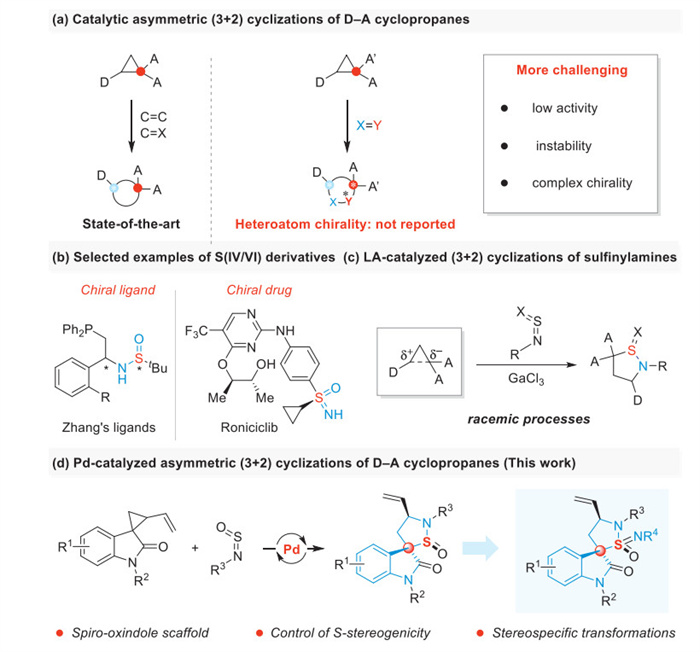
Scheme 1.
Background and reaction design.

Control of adjacent S(Ⅳ) and spiro stereocenters via Pd-catalyzed asymmetric (3+2) cyclization
Fen-Ya Xiong , Su-Rui Pan , Bao-Cheng Wang , Yu-Jie Li , Konstantin Nikolaevich Gavrilov , Wen-Jing Xiao , Liang-Qiu Lu


The construction of complex ring systems containing multiple stereocenters is of great interest in the area of synthetic chemistry because of its profound relevance to drug discovery and development [1,2]. In recent decades, cyclopropanes have emerged as versatile building blocks for assembling complex molecule architectures [3-7]. Among these, donor-acceptor (D-A) cyclopropanes [8,9] have attracted considerable attention because of their unique reactivities that enable the formation of diverse functionalized ring systems via ring-opening transformations. Notably, (3+2) cyclizations involving D-A cyclopropanes have been extensively explored using various 2π-components, such as aldehydes [10,11], imines [12,13], and olefins [14,15]. Significant progress has also been made in the catalytic asymmetric variants [16-19], providing efficient access to chiral cyclic molecules. However, despite such advances, the use of 2π-components featuring two distinct heteroatoms remains a formidable challenge in this field. More specifically, the low reactivities of these substrates, the inherent instabilities of certain heterocyclic products, and difficulties in controlling the stereochemistry hinder the application of this protocol, particularly when chiral spiro stereocenters (A and A' are two different acceptors) and heteroatom stereocenters are involved (Scheme 1a).
In recent years, the pharmaceutical and agrochemical industries have increasingly sought novel molecular scaffolds featuring rigid structures and chiral heteroatoms to enhance the specificity of binding to biological targets [20,21]. Among them, compounds containing S(Ⅳ)/S(Ⅵ) stereocenters have garnered significant attention because of their broad applications in chiral ligand, pharmaceuticals and agrochemicals (Scheme 1b) [22-35]. In addition, sulfinylamines, which are distinguished by their unique orthogonal cumulative π-systems, are pivotal in the synthesis of sulfinamides, and have been extensively studied [36-48]. In 2022, Werz et al. [38] reported the Lewis acid-catalyzed (3+2) cyclization of D-A cyclopropanes with sulfinylamines, yielding cyclic sulfinamides (Scheme 1c). Despite these advancements, controlling the heteroatom chirality in such transformations remains a challenge [49,50]. Continuing our interest in heterocycle synthesis [51-71], we herein report a Pd-catalyzed asymmetric (3+2) cyclization between oxindole-derived VCPs and sulfinylamines to yield oxindole scaffolds bearing a chiral S(Ⅳ) stereocenters and a spiro stereocenter, a special quaternary carbon stereocenter, under mild conditions. Furthermore, the obtain products are subsequently employed as versatile precursors for the enantioselective preparation of various S(Ⅵ)-stereogenic derivatives (Scheme 1d).
Building on our precedent work addressing the stereoselectivity in Pd-catalyzed cyclization through hydrogen bonding interactions [51,53,55], we initially investigated the Pd-catalyzed asymmetric (3+2) cyclization of oxindole-derived VCPs 1a and sulfinylamine 2a in DCM (Table 1). The use of Trost's ligand L1 [72] and Ma's variant L2 [73], both with amide-based hydrogen bond donors, failed to yield the desired product with retention of both starting materials (Note: Conversion of part of cis-configured substrate 1a to its isomer was detected). Encouragingly, Zhang's chiral ligand L3 [74], bearing a stronger hydrogen bond donor due to the two electron-deficient CF3 groups, afforded the product 3aa with moderate enantioselectivity, albeit in low yield. Further evaluation of ligands with different hydrogen bonding capabilities revealed that Zi's chiral ligand L4 [75] afforded 3aa with improved yield. To further improve the result, modifications were made to the chiral amino alcohol moiety. Substitution of the tert-butyl group with a phenyl moiety (L5) enhanced both the yield and enantioselectivity. Conversely, replacement of the phenyl group with the sterically hindered 3,5-(tBu)2C3H6 (L6) significantly diminished enantioselectivity. In contrast, introduction of electron-withdrawing groups on the phenyl ring improved enantioselectivity, albeit at the expense of reaction yield (L7 and L8). These results suggest that the reaction efficiency and stereoinduction are significantly influenced by the electronic properties and hydrogen bonding interactions of the ligand. With L8 identified as the optimal ligand, further reaction parameters were optimized. Increasing the catalyst loading and using a lower-polarity solvent improved the yield and enantioselectivity but efficiency (Table 1, entry 10). Finally, using a DCM/toluene ratio of 1:2 at 20 ℃ afforded 3aa in 89% isolated yield with 10:1 dr and 90% ee (Table 1, entry 11). The structure of 3aa was unambiguously confirmed by single crystal X-ray diffraction analysis (see Section 7 in Supporting information).
 DownLoad:
CSV
 |
|||||||||||||||||||||||||||||||||||||||||||||||||||||||||||||||||
| Entry | Ligand | T (℃) | Yield (%)b | drc | ee (%)d | ||||||||||||||||||||||||||||||||||||||||||||||||||||||||||||
| 1 | L1 | 40 | N.D. | – | – | ||||||||||||||||||||||||||||||||||||||||||||||||||||||||||||
| 2 | L2 | 40 | N.D. | – | – | ||||||||||||||||||||||||||||||||||||||||||||||||||||||||||||
| 3 | L3 | 40 | 8 | > 19:1 | 51 | ||||||||||||||||||||||||||||||||||||||||||||||||||||||||||||
| 4 | L4 | 40 | 68 | > 19:1 | 42 | ||||||||||||||||||||||||||||||||||||||||||||||||||||||||||||
| 5 | L5 | 40 | 78 | > 19:1 | 73 | ||||||||||||||||||||||||||||||||||||||||||||||||||||||||||||
| 6 | L6 | 40 | 16 | > 19:1 | 10 | ||||||||||||||||||||||||||||||||||||||||||||||||||||||||||||
| 7 | L7 | 40 | 56 | > 19:1 | 82 | ||||||||||||||||||||||||||||||||||||||||||||||||||||||||||||
| 8 | L8 | 40 | 52 | > 19:1 | 87 | ||||||||||||||||||||||||||||||||||||||||||||||||||||||||||||
| 9e | L8 | 40 | 92 | 3:1 | 94 | ||||||||||||||||||||||||||||||||||||||||||||||||||||||||||||
| 10e | L8 | 20 | 52 | 15:1 | 95 | ||||||||||||||||||||||||||||||||||||||||||||||||||||||||||||
| 11e,f | L8 | 20 | 93(89)g | 10:1 | 90 | ||||||||||||||||||||||||||||||||||||||||||||||||||||||||||||
| a Reaction conditions: 1a (0.075 mmol, 1.5 equiv.), 2a (0.05 mmol, 1.0 equiv.), Pd2(dba)3·CHCl3 (5 mol%), and chiral ligand (12 mol%) in DCM (1.0 mL) at 40 ℃. PMP, 4-methoxyphenyl; dba, dibenzylideneacetone; DCM, dichloromethane; dr, diastereomer ratio; ee, enantiomer excess; N.D., not detected. b Determined by 1H NMR analysis of the reaction mixture with 1,3,5-trimethoxybenzene as the internal standard. c Determined by 1H NMR analysis of the reaction mixture. d Determined by chiral HPLC. e Pd2(dba)3·CHCl3 (10 mol%), L8 (24 mol%), toluene (2.0 mL). f DCM (0.5 mL), toluene (1.0 mL), 53 h. g Isolated yield is shown in parentheses. |
|||||||||||||||||||||||||||||||||||||||||||||||||||||||||||||||||
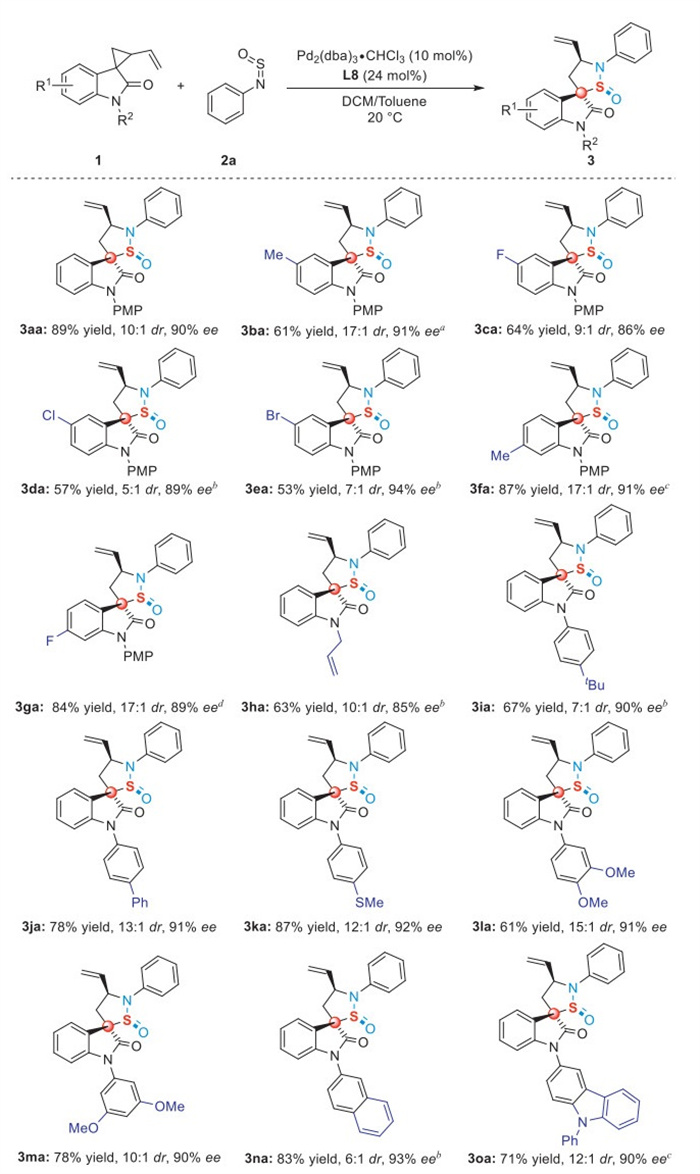
With the optimized reaction conditions in hand, the substrate scope of the Pd-catalyzed asymmetric (3+2) cyclization was investigated. As summarized in Scheme 2, the scope of the oxindole-derived VCPs was initially evaluated in this transformation. The introduction of substituents (e.g., Me, F, Cl, and Br) at the C5 position of the oxindole scaffold afforded cyclization products 3ba-3ea in moderate-to-good yields, with diastereoselectivities ranging from 5:1 to 17:1 dr, and in high enantioselectivities (86%-94% ee). Additionally, the efficiency and enantioselectivity of the cyclization reaction remained unaffected by variations in the electronic properties at the C6 position of the oxindole, affording the corresponding cyclic sulfinamides in satisfactory yields (3fa-3ga, 84%-87% yields, 17:1 dr, and 89%-91% ee). However, the presence of an allyl group on the nitrogen atom of the oxindole led to a slight decrease in enantioselectivity (3ha, 63% yield, 10:1 dr, and 85% ee). Notably, variations in the substituents on the phenyl ring, including tBu, Ph, and MeS groups, were well tolerated, delivering highly functionalized cyclization products 3ia-3ka in 67%-87% yields with 7:1-13:1 dr and 90%-92% ee. Substrates with multiple substituents on the phenyl ring also performed well, yielding products 3la-3ma in 61%-78% yields with 10:1-15:1 dr and 90%-91% ee. Furthermore, the introduction of naphthalene and heteroaryl rings on the indole nitrogen atoms proved to be compatible, providing the corresponding chiral products in excellent enantioselectivities (3na-3oa, 90%-93% ee).
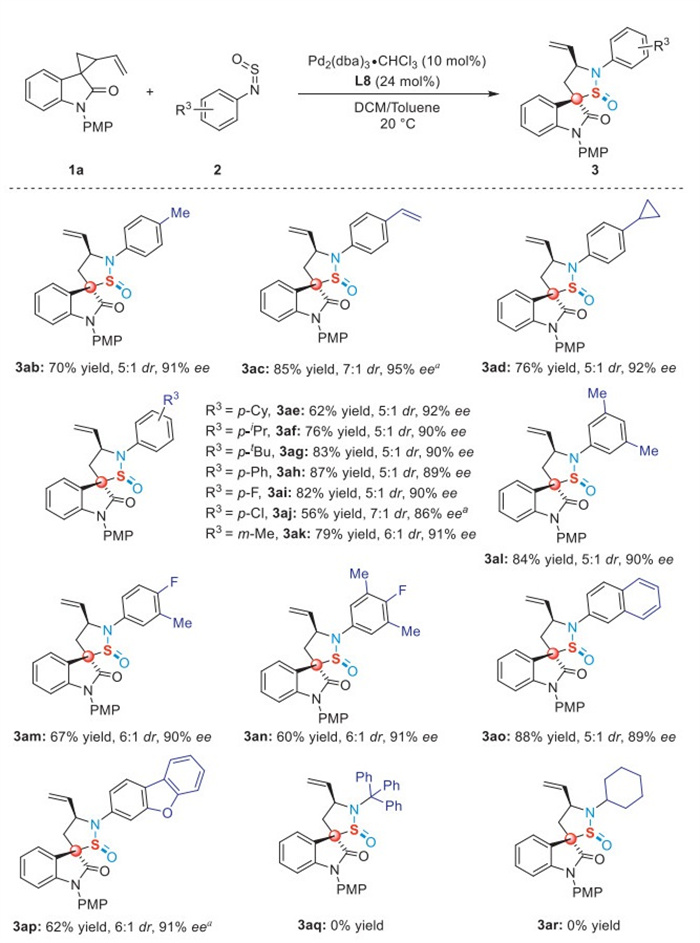
In parallel, a range of N-aryl-substituted sulfinylamines effectively participated in this transformation, delivering chiral five-membered cyclic sulfinamides in moderate to good yields with high enantioselectivities (Scheme 3). Variations in the electronic properties of the phenyl ring had a minimal impact on the enantioselectivity, affording cyclization products 3ab-3aj in 56%-87% yields, 5:1-7:1 dr, and 86%-95% ee. Substituents at the meta-position of the phenyl ring were well tolerated, with particularly favorable results being obtained for product 3ak. Furthermore, multi-substituted sulfinylamines proved compatible with the reaction, yielding highly functionalized cyclization products 3al-3an in 60%-84% yields, 5:1-6:1 dr, and 90%-91% ee. Notably, naphthyl- and heteroaryl-containing sulfinylamines also participated effectively in this reaction, affording products 3ao-3ap in 62%-88% yields, 5:1-6:1 dr, and 89%-91% ee. Regrettably, the cyclization did not proceed with sulfinylamines bearing alkyl substituents (e.g., triphenylmethyl and cyclohexyl), as evidenced by the recovery of most of the VCP substrate 1a.
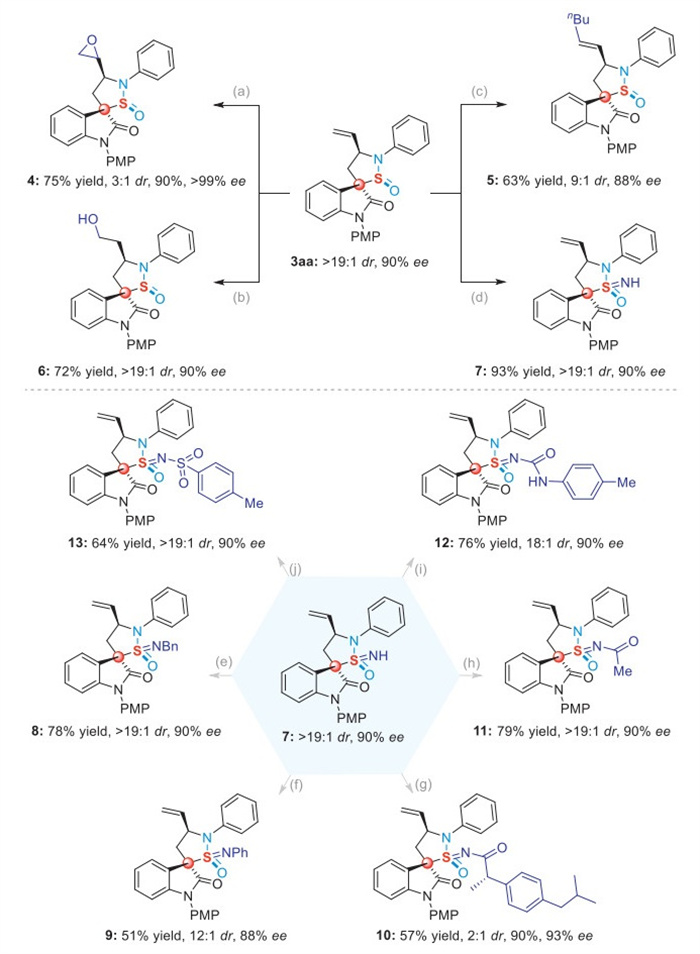
To demonstrate the synthetic utility of this methodology, further transformations were performed using the chiral cyclic sulfinamide 3aa (Scheme 4). Initially, the alkene epoxidation of 3aa (after purification: > 19:1 dr) using m-CPBA selectively was performed to afford epoxide 4 in a high yield. Subsequently, a Ru-catalyzed cross-metathesis reaction successfully introduced an alkyl group into 3aa, whereas Ir-catalyzed hydroboration followed by oxidation with hydrogen peroxide yielded chiral primary alcohol 6 in a 72% yield without erosion of optical purity [76]. Additionally, the oxidative amidation of 3aa with hypervalent iodine reagents delivered cyclic sulfoximine 7 [77], a versatile structural motif that is prevalent in bioactive molecules and drugs [78-84]. Notably, the S(Ⅵ)-stereogenic center remained unchanged during this transformation. Based on this success and the utilization of the sulfoximine group in medicinal chemistry, further derivatization of cyclic sulfoximine 7 was explored. Through routine functionalization, a diverse array of sulfonimidamides (8-13) was accessed by incorporating alkyl, aryl, carbonyl, amide, and sulfonyl groups [85,86]. Importantly, the enantioselectivity of the S(Ⅵ)-stereogenic center was maintained throughout these transformations.
To elucidate the reaction mechanism and the origin of the stereoselectivity in the Pd-catalyzed asymmetric (3+2) cyclization, control experiments and nuclear magnetic resonance (NMR) studies were performed. First, control experiments were conducted with both cis- and trans-1a under the standard Pd catalysis conditions (Scheme 5a). Using cis-1a in the absence of 2a resulted in the formation of trans-1a with a 38% NMR yield and 20% of the cyclization byproduct 3aq with dba (Eq. 1). When trans-1a underwent the same reaction conditions in the absence (Eq. 2) or presence (Eq. 3) of substrate 2a, trace amounts of product 3aa and byproduct 3aq were detected, accompanied by the conversion of some trans-1a to cis-1a. These results indicate reversible interconversion between both isomers under the standard conditions. However, only cis-1a effectively participates in Pd-catalyzed asymmetric (3+2) cyclization to produce 3aa. In contrast, trans-1a has a negligible effect on the productive reaction pathway. Second, control experiments with methylated chiral ligands L8a, L8b and L8c highlighted the critical role of hydrogen bonding, as no desired products were formed and only the mixture of cis-1a and trans-1a was detected, with substrate 2a remaining unreacted (Scheme 5b). Further NMR titration studies revealed that upon adding 1 equiv. of substrate 2a to a deuterated dichloromethane solution containing palladium catalyst and chiral ligand L8, significant chemical shift changes were observed for two hydrogen atoms in the ligand. Notably, identical chemical shift variations were still detected when substrate 1a was added first followed by substrate 2a (Figs. S4-S6 in Supporting information for details). These results provide direct evidence that the hydrogen bonds in the ligand participate in the catalytic activation process through specific interactions with the substrate 2a.
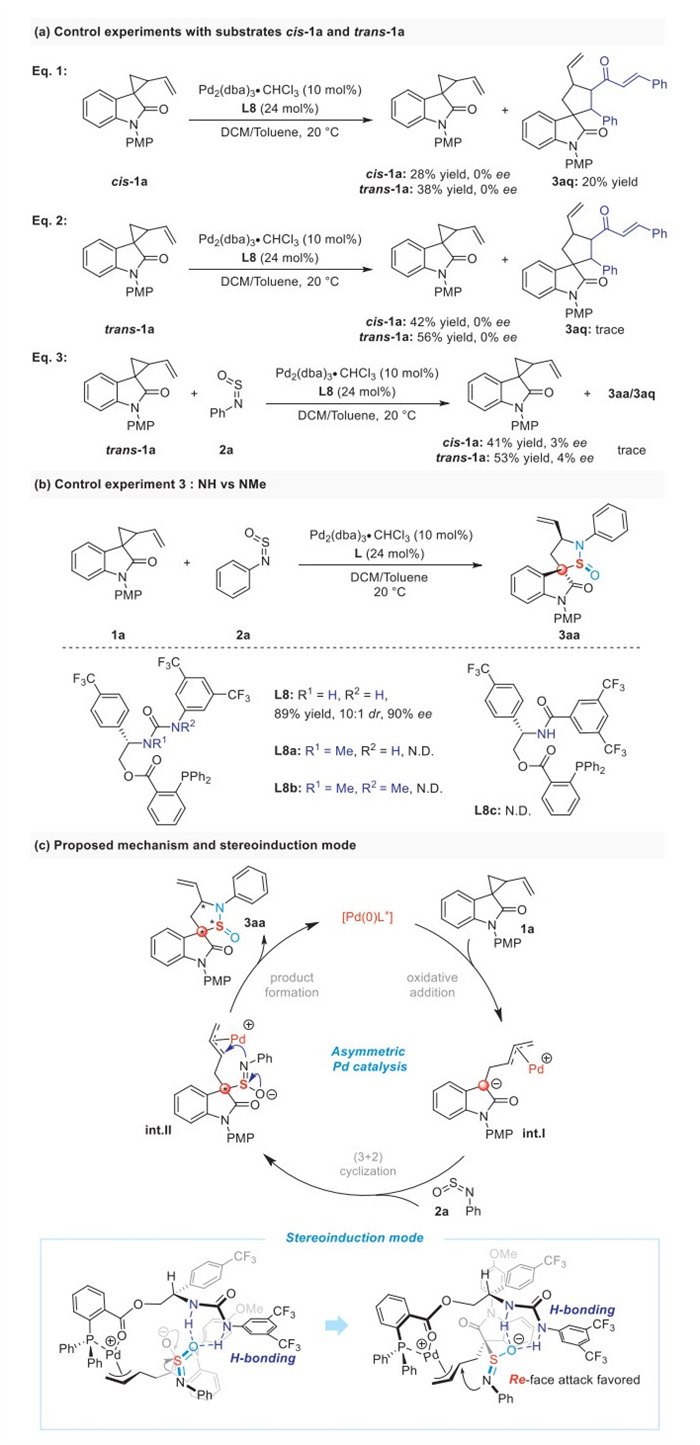
Based on these observations, a plausible mechanism is proposed in Scheme 5c. First, the Pd(0) catalyst reacts with VCP 1a to form the chiral π-allyl-Pd intermediate (int.Ⅰ) via oxidative addition. Following, this species was captured by sulfinylamine 2a via hydrogen bonding to yield intermediate (int.Ⅱ). Finally, an intramolecular allylic substitution yields the desired product 3aa, completing the catalytic cycle. A stereocontrol model was proposed: The chiral urea ligand's bifunctional hydrogen-bonding network rigidly positions the substrate 2a within the catalytic pocket, directing nucleophilic attack exclusively from the inner side to achieve enantioselective C–S bond formation. Concurrently, the steric shielding effect of ligand L8 selectively blocks the Si-face of the π-allylpalladium int.Ⅱ, thereby enforcing exclusive Re-face attack to achieve highly enantioselective allylation.
In conclusion, a Pd-catalyzed asymmetric (3+2) cyclization of oxindole-derived VCPs with sulfinylamines was developed, facilitating the efficient and selective synthesis of structurally diverse spiro-oxindoles bearing adjacent S(Ⅳ) and spiro stereocenters. The success of this transformation was attributed to the remote enantioinduction through H-bonding direction by the chiral amide unit of the ligand, as preliminarily evidenced by experimental studies. This study not only offers a promising approach for the construction of S(Ⅳ/Ⅵ)-chiral cyclic sulfinamides and sulfoximines, but also significantly advances the field of Pd-catalyzed asymmetric cyclization. Moreover, the spiro-oxindoles synthesized in this study have the potential to serve as valuable scaffolds for the future drug discovery and related fields.
Fen-Ya Xiong: Writing – original draft, Methodology, Investigation, Formal analysis, Data curation. Su-Rui Pan: Formal analysis, Data curation. Bao-Cheng Wang: Methodology, Formal analysis, Data curation. Yu-Jie Li: Investigation, Formal analysis, Data curation. Konstantin Nikolaevich Gavrilov: Writing – review & editing, Project administration. Wen-Jing Xiao: Supervision, Funding acquisition. Liang-Qiu Lu: Writing – review & editing, Supervision, Project administration, Funding acquisition, Conceptualization.
The authors declare that they have no known competing financial interests or personal relationships that could have appeared to influence the work reported in this paper.
We are grateful to the National Key R&D Program of China (Nos. 2023YFA1507203 and 2024YFA1509700), the National Natural Science Foundation of China (Nos. 22471089, 22271113, and 92256301), Wuhan Institute of Photochemistry and Technology, and Central China Normal University for support of this research. We thank Prof. Jia-Rong Chen, Prof. Zhihan Zhang, and many other group members for helpful discussions.
Supplementary material associated with this article can be found, in the online version, at doi:
T.T. Talele, J. Med. Chem. 63 (2020) 13291–13315. doi: 10.1021/acs.jmedchem.0c00829
C.M. Marshall, J.G. Federice, C.N. Bell, et al., J. Med. Chem. 67 (2024) 11622–11655. doi: 10.1021/acs.jmedchem.4c01122
D. Zhang, H. Song, Y. Qin, Acc. Chem. Res. 44 (2011) 447–457. doi: 10.1021/ar200004w
C. Ebner, E.M. Carreira, Chem. Rev. 117 (2017) 11651–11679. doi: 10.1021/acs.chemrev.6b00798
T.R. McDonald, L.R. Mills, M.S. West, et al., Chem. Rev. 121 (2021) 3–79. doi: 10.1021/acs.chemrev.0c00346
O.O. Sokolova, J.F. Bower, Chem. Rev. 121 (2021) 80–109. doi: 10.1021/acs.chemrev.0c00166
Y. Cohen, A. Cohen, I. Marek, Chem. Rev. 121 (2021) 140–161. doi: 10.1021/acs.chemrev.0c00167
T.F. Schneider, J. Kaschel, D.B. Werz, Angew. Chem. Int. Ed. 53 (2014) 5504–5523. doi: 10.1002/anie.201309886
M.A. Cavitt, L.H. Phun, S. France, Chem. Soc. Rev. 43 (2014) 804–818. doi: 10.1039/C3CS60238A
A.T. Parsons, J.S. Johnson, J. Am. Chem. Soc. 131 (2009) 3122–3123. doi: 10.1021/ja809873u
F. Nanteuil, E. Serrano, D. Perrotta, et al., J. Am. Chem. Soc. 136 (2014) 6239–6242. doi: 10.1021/ja5024578
J. Waser, F. De Simone, Synthesis 20 (2009) 3353–3374. doi: 10.1055/s-0029-1216998
A.T. Parsons, A.G. Smith, A.J. Neel, et al., J. Am. Chem. Soc. 132 (2010) 9688–9692. doi: 10.1021/ja1032277
H. Xu, J.P. Qu, S. Liao, et al., Angew. Chem. Int. Ed. 52 (2013) 4004–4007. doi: 10.1002/anie.201300032
H. Xu, J.L. Hu, L. Wang, et al., J. Am. Chem. Soc. 137 (2015) 8006–8009. doi: 10.1021/jacs.5b04429
L. Wang, Y. Tang, Isr. J. Chem. 56 (2016) 463–475. doi: 10.1002/ijch.201500094
V. Pirenne, B. Muriel, J. Waser, Chem. Rev. 121 (2021) 227–263. doi: 10.1021/acs.chemrev.0c00109
Y. Xia, X. Liu, X. Feng, Angew. Chem. Int. Ed. 60 (2021) 9192–9204. doi: 10.1002/anie.202006736
M. Bao, M.P. Doyle, ChemCatChem 15 (2023) e202301090. doi: 10.1002/cctc.202301090
M. Feng, B. Tang, S.H. Liang, et al., Curr. Top. Med. Chem. 16 (2016) 1200–1216. doi: 10.2174/1568026615666150915111741
M.J. Tilby, M.C. Willis, Expert Opin. Drug Discovery 16 (2021) 1227–1231. doi: 10.1080/17460441.2021.1948008
W. Li, J. Zhang, Acc. Chem. Res. 57 (2024) 489–513.
B.M. Trost, M. Rao, Angew. Chem. Int. Ed. 54 (2015) 5026–5043. doi: 10.1002/anie.201411073
S. Otocka, M. Kwiatkowska, L. Madalinska, et al., Chem. Rev. 117 (2017) 4147–4181. doi: 10.1021/acs.chemrev.6b00517
Q. Wen, L. Zhang, J. Xiong, et al., Eur. J. Org. Chem. (32) (2016) 5360–5364. doi: 10.1002/ejoc.201601206
U. Lücking, R. Jautelat, M. Krüger, et al., ChemMedChem 8 (2013) 1067–1085. doi: 10.1002/cmdc.201300096
E. Wojaczyńska, J. Wojaczyński, Chem. Rev. 120 (2020) 4578–4611. doi: 10.1021/acs.chemrev.0c00002
W. Liu, J. Ke, C. He, Chem. Sci. 12 (2021) 10972–10984. doi: 10.1039/d1sc02614c
X. Zhang, F. Wang, C.H. Tan, JACS Au 3 (2023) 700–714. doi: 10.1021/jacsau.2c00626
X. Zhang, E.C.X. Ang, Z. Yang, et al., Nature 604 (2022) 298–303. doi: 10.1038/s41586-022-04524-4
S. Huang, Z. Zeng, N. Zhang, et al., Nat. Chem. 15 (2023) 185–193. doi: 10.1038/s41557-022-01120-x
G.F. Yang, Y. Yuan, Y. Tian, et al., J. Am. Chem. Soc. 145 (2023) 5439–5446. doi: 10.1021/jacs.2c13758
Y. Sun, N. Cramer, Angew. Chem. Int. Ed. 57 (2018) 15539–15543. doi: 10.1002/anie.201810887
B. Shen, B. Wan, X. Li, Angew. Chem. Int. Ed. 57 (2018) 15534–15538. doi: 10.1002/anie.201810472
T. Zhou, P.F. Qian, J.Y. Li, et al., J. Am. Chem. Soc. 143 (2021) 6810–6816. doi: 10.1021/jacs.1c03111
T.Q. Davies, M.C. Willis, Eur. J. Org. Chem. 27 (2021) 8918–8927. doi: 10.1002/chem.202100321
L. Bayeh, P.Q. Le, U.K. Tambar, Nature 547 (2017) 196–200. doi: 10.1038/nature22805
G.A. Oliver, M.N. Loch, A.U. Augustin, et al., Angew. Chem. Int. Ed. 60 (2021) 25825–25831. doi: 10.1002/anie.202106596
L. Li, S.Q. Zhang, Y. Chen, et al., ACS Catal. 12 (2022) 15334–15340. doi: 10.1021/acscatal.2c05169
J.A. Andrews, J. Kalepu, C.F. Palmer, et al., J. Am. Chem. Soc. 145 (2023) 21623–21629. doi: 10.1021/jacs.3c07974
L. Xi, X. Fang, M. Wang, et al., J. Am. Chem. Soc. 146 (2024) 17587–17594. doi: 10.1021/jacs.4c04050
Y. Shi, Y. Yuan, J. Li, et al., J. Am. Chem. Soc. 146 (2024) 17580–17586. doi: 10.1021/jacs.4c03473
X. Fang, L. Xi, M. Wang, et al., Nat. Commun. 16 (2025) 2547. doi: 10.1038/s41467-025-57471-9
Y. Yuan, X. Tian, H. Zheng, et al., Angew. Chem. Int. Ed. 64 (2025) e202506243. doi: 10.1002/anie.202506243
N. Liu, H. Xia, Y. Shi, et al., J. Am. Chem. Soc. 147 (2025) 26786–26796. doi: 10.1021/jacs.5c07911
X. Fang, F. Xiang, Y. Zhao, et al., ACS Cent. Sci. 11 (2025) 1762–1772. doi: 10.1021/acscentsci.5c00909
Y. Wang, Z. Zhang, Q. Chong, et al., ACS Catal. 15 (2025) 15857–15866. doi: 10.1021/acscatal.5c04608
Y. Yuan, L. Pan, Y. Han, et al., CCS Chem. 8 (2026) 2206–2214. doi: 10.31635/ccschem.025.202505937
T. Andreassen, M. Lorentzen, L.K. Hansen, et al., Tetrahedron 65 (2009) 2806–2817. doi: 10.1016/j.tet.2009.01.090
T.Y. Jian, L. He, C. Tang, et al., Angew. Chem. Int. Ed. 50 (2011) 9104–9107. doi: 10.1002/anie.201102488
B.C. Wang, F. Hu, J. Bai, et al., Angew. Chem. Int. Ed. 63 (2024) e202319728. doi: 10.1002/anie.202319728
B.C. Wang, T. Fan, F.Y. Xiong, et al., J. Am. Chem. Soc. 144 (2022) 19932–19941. doi: 10.1021/jacs.2c08090
Y.Q. Xiao, M.M. Li, Z.X. Zhou, et al., Angew. Chem. Int. Ed. 62 (2023) e202212444. doi: 10.1002/anie.202212444
B. Shi, M. Xiao, J.P. Zhao, et al., J. Am. Chem. Soc. 146 (2024) 26622–26629. doi: 10.1021/jacs.4c10328
Z.X. Zhou, Y.L.T. Fu, C. Zhang, et al., J. Am. Chem. Soc. 147 (2025) 3223–3232. doi: 10.1021/jacs.4c12892
M.M. Zhang, B.L. Qu, B. Shi, et al., Chem. Soc. Rev. 51 (2022) 4146–4174. doi: 10.1039/d1cs00897h
J. Zhang, Y. Chen, Q. Wang, et al., Chin. J. Org. Chem. 42 (2022) 3051–3101. doi: 10.6023/cjoc202206028
H. Uno, N. Punna, E. Tokunaga, et al., Angew. Chem. Int. Ed. 59 (2020) 8187–8194. doi: 10.1002/anie.201915021
L.C. Yang, Y.N. Wang, R. Liu, et al., Nat. Chem. 12 (2020) 860–868. doi: 10.1038/s41557-020-0503-7
B.M. Trost, Z. Jiao, Y. Liu, et al., J. Am. Chem. Soc. 142 (2020) 18628–18636. doi: 10.1021/jacs.0c08348
B.M. Trost, Z. Jiao, J. Am. Chem. Soc. 142 (2020) 21645–21650. doi: 10.1021/jacs.0c11535
W. Chai, Q. Zhou, W. Ai, et al., J. Am. Chem. Soc. 143 (2021) 3595–3603. doi: 10.1021/jacs.0c13412
G. Yang, Y.M. Ke, Y. Zhao, Angew. Chem. Int. Ed. 60 (2021) 12775–12780. doi: 10.1002/anie.202102061
M. Faltracco, K.N.A. van de Vrande, M. Dijkstra, et al., Angew. Chem. Int. Ed. 60 (2021) 14410–14414. doi: 10.1002/anie.202102862
J. Liu, L. Yu, C. Zheng, et al., Angew. Chem. Int. Ed. 60 (2021) 23641–23645. doi: 10.1002/anie.202111376
T. Morita, H. Murakami, Y. Asawa, et al., Angew. Chem. Int. Ed. 61 (2022) e202113558. doi: 10.1002/anie.202113558
W. Zhang, P.C. Zhang, Y.L. Li, et al., J. Am. Chem. Soc. 144 (2022) 19627–19634. doi: 10.1021/jacs.2c09799
J. Bitai, A.J. Nimmo, A.M.Z. Slawin, et al., Angew. Chem. Int. Ed. 61 (2022) e202202621. doi: 10.1002/anie.202202621
A. Li, Y. Gao, J.B. Lu, et al., Chem. Sci. 13 (2022) 9265–9270. doi: 10.1039/d2sc02985e
K. Li, S. Zhen, W. Wang, et al., Chem. Sci. 14 (2023) 3024–3029. doi: 10.1039/d3sc00112a
J.L. Zhou, Y. Xiao, L. He, et al., J. Am. Chem. Soc. 146 (2024) 19621–19628. doi: 10.1021/jacs.4c01851
B.M. Trost, M.R. Machacek, A. Aponick, Acc. Chem. Res. 39 (2006) 747–760. doi: 10.1021/ar040063c
Y. Zhang, X. Zhang, S. Ma, Nat. Commun. 12 (2021) 2416. doi: 10.1038/s41467-021-22498-1
T. Cong, H. Wang, X. Li, et al., Chem. Commun. 55 (2019) 9176–9179. doi: 10.1039/c9cc04357h
Y. Zheng, T. Qin, W. Zi, J. Am. Chem. Soc. 143 (2021) 1038–1045. doi: 10.1021/jacs.0c11504
F. Tian, W.L. Yang, T. Ni, et al., Sci. China Chem. 64 (2021) 34–40. doi: 10.1007/s11426-020-9854-3
Y.Q. Zhang, L. Hu, L. Yuwen, et al., Nat. Catal. 6 (2023) 487–494. doi: 10.1038/s41929-023-00966-9
U. Lücking, Angew. Chem. Int. Ed. 52 (2013) 9399–9408. doi: 10.1002/anie.201302209
M. Zenzola, R. Doran, L. Degennaro, et al., Angew. Chem. Int. Ed. 55 (2016) 7203–7207. doi: 10.1002/anie.201602320
P. Mäder, L. Kattner, J. Med. Chem. 63 (2020) 14243–14275. doi: 10.1021/acs.jmedchem.0c00960
W. Zheng, X. Chen, F. Chen, et al., Chem. Rec. 21 (2021) 396–416. doi: 10.1002/tcr.202000134
U. Lücking, Chem. Eur. J. 28 (2022) e202201993. doi: 10.1002/chem.202201993
L. Gao, Y.Q. Wang, Y.Q. Zhang, et al., Angew. Chem. Int. Ed. 63 (2024) e202317626. doi: 10.1002/anie.202317626
Z. Peng, S. Sun, M.M. Zheng, et al., Nat. Chem. 16 (2024) 353–362. doi: 10.1038/s41557-024-01452-w
F. Izzo, M. Schäfer, P. Lienau, et al., Chem. Eur. J. 24 (2018) 9295–9304. doi: 10.1002/chem.201801557
S. Gupta, S. Baranwal, N. Muniyappan, et al., Synthesis 51 (2019) 2171–2182. doi: 10.1055/s-0037-1612216

Scheme 2 Substrate scope of VCPs 1. The majority of VCPs 1 used are cis-configured, except for 1e (cis/trans = 6:1) and 1l (cis/trans = 5:1). Reaction conditions: see entry 11 in Table 1. Isolated yield. ee and dr values were determined by chiral HPLC and 1H NMR analysis. a 1,4-Dioxane (1.5 mL) was used as the solvent. b Toluene (2.0 mL) was used as the solvent. c DCM/1,4-dioxane (1:1, 2.0 mL) was used as the solvent. d DCM (2.0 mL) was used as the solvent.

Scheme 3 Substrate scope of sulfinylamines 2. Reaction conditions: see entry 11 in Table 1. Isolated yield. ee and dr values were determined by chiral HPLC and 1H NMR analysis. a Toluene (2.0 mL) was used as the solvent.

Scheme 4 Transformations of product 3aa. Reaction conditions: (a) m-CPBA, DCM, r.t., 24 h. (b) HBpin, [Ir(COD)Cl]2, DPPM, DCM, r.t., 15 h; H2O2, NaOH, THF, 0 ℃ to r.t., 0.5 h. (c) Ru 627, Ti(OiPr)4, 55 ℃, DCE, 5 h. (d) HTIB, NH2CO2NH4, CF3CH2OH. (e) BnBr, KOH, DMSO, r.t., 2 h. (f) PhB(OH)2, CuI, DMAP, MeOH, r.t., air, 24 h. (g) Ibuprofen, EDCI, DMAP, NEt3, DCM, r.t., 12 h. (h) Ac2O, DMAP, NEt3, DCM, 0 ℃ to r.t., 12 h. (i) p-Tolyl isocyanate, DBU, CH3CN, 0 ℃ to r.t., 2 h. (j) p-Toluenesulfonic anhydride, DMAP, NEt3, DCM, 0 ℃ to r.t., 12 h. HTIB, [hydroxy(tosyloxy)iodo]benzene; TFE, 2,2,2-trifluoroethanol; DPPM, bis(diphenylphosphino)methane; COD, 1,5-cyclooctadiene; DMAP, 4-dimethylaminopyridine; EDCI, n-(3-dimethylaminopropyl)-n'-ethylcarbodiimide hydrochloride; DBU, 1,8-diazabicyclo[5.4.0]undec-7-enediazabicyclo[5.4.0]undec-7-ene; HBpin, pinacolborane.
Table 1. Optimization of the reaction conditions.a
|
|||||||||||||||||||||||||||||||||||||||||||||||||||||||||||||||||
| Entry | Ligand | T (℃) | Yield (%)b | drc | ee (%)d | ||||||||||||||||||||||||||||||||||||||||||||||||||||||||||||
| 1 | L1 | 40 | N.D. | – | – | ||||||||||||||||||||||||||||||||||||||||||||||||||||||||||||
| 2 | L2 | 40 | N.D. | – | – | ||||||||||||||||||||||||||||||||||||||||||||||||||||||||||||
| 3 | L3 | 40 | 8 | > 19:1 | 51 | ||||||||||||||||||||||||||||||||||||||||||||||||||||||||||||
| 4 | L4 | 40 | 68 | > 19:1 | 42 | ||||||||||||||||||||||||||||||||||||||||||||||||||||||||||||
| 5 | L5 | 40 | 78 | > 19:1 | 73 | ||||||||||||||||||||||||||||||||||||||||||||||||||||||||||||
| 6 | L6 | 40 | 16 | > 19:1 | 10 | ||||||||||||||||||||||||||||||||||||||||||||||||||||||||||||
| 7 | L7 | 40 | 56 | > 19:1 | 82 | ||||||||||||||||||||||||||||||||||||||||||||||||||||||||||||
| 8 | L8 | 40 | 52 | > 19:1 | 87 | ||||||||||||||||||||||||||||||||||||||||||||||||||||||||||||
| 9e | L8 | 40 | 92 | 3:1 | 94 | ||||||||||||||||||||||||||||||||||||||||||||||||||||||||||||
| 10e | L8 | 20 | 52 | 15:1 | 95 | ||||||||||||||||||||||||||||||||||||||||||||||||||||||||||||
| 11e,f | L8 | 20 | 93(89)g | 10:1 | 90 | ||||||||||||||||||||||||||||||||||||||||||||||||||||||||||||
| a Reaction conditions: 1a (0.075 mmol, 1.5 equiv.), 2a (0.05 mmol, 1.0 equiv.), Pd2(dba)3·CHCl3 (5 mol%), and chiral ligand (12 mol%) in DCM (1.0 mL) at 40 ℃. PMP, 4-methoxyphenyl; dba, dibenzylideneacetone; DCM, dichloromethane; dr, diastereomer ratio; ee, enantiomer excess; N.D., not detected. b Determined by 1H NMR analysis of the reaction mixture with 1,3,5-trimethoxybenzene as the internal standard. c Determined by 1H NMR analysis of the reaction mixture. d Determined by chiral HPLC. e Pd2(dba)3·CHCl3 (10 mol%), L8 (24 mol%), toluene (2.0 mL). f DCM (0.5 mL), toluene (1.0 mL), 53 h. g Isolated yield is shown in parentheses. |
|||||||||||||||||||||||||||||||||||||||||||||||||||||||||||||||||
 下载: 导出CSV

 扫一扫看文章


扫一扫关注我们


 下载: