Citation:
Song Xi, La Yin, Changhong Xie, Quanying Long, Yulian Zhang, Ling He, Chenyang Wang, Min Zhang. Copper-catalyzed aerobic oxyalkylation of alkenes with cyclopropanols: A straightforward access to 1,5-diketones[J]. Chinese Chemical Letters,
2026, 37(10): 112433.
doi:
10.1016/j.cclet.2026.112433
Copper-catalyzed aerobic oxyalkylation of alkenes with cyclopropanols: A straightforward access to 1,5-diketones
English
Copper-catalyzed aerobic oxyalkylation of alkenes with cyclopropanols: A straightforward access to 1,5-diketones
Chongqing Key Laboratory of Natural Product Synthesis and Drug Research, Innovative Drug Research Center, School of Pharmaceutical Sciences, Chongqing University, Chongqing 401331, China
b.
Department of Pharmacy, Chongqing General Hospital, Chongqing University, Chongqing 401147, China
Received Date:
14 November 2025 Accepted Date:
18 January 2026 Revised Date:
08 January 2026 Available Online:
15 October 2026
Abstract:
We report here an aerobic oxyalkylation reaction of alkenes with cyclopropanols that enables the facile synthesis of 1,5-diketones. Key to success of this reaction is utilization of a CuCl2·Phen catalyst, with the ambient air serving as both the oxidant and oxygen source. The reaction proceeds via a domino process involving a free-radical ring-opening addition of cyclopropanols to alkenes and radical capture by O2. Both intra- and intermolecular variants are feasible, providing stream-lined access to a broad range of 1,5-diketones possessing fused, spiro, bridged, and linear frameworks. The synthetic utility of this method is showcased by late-stage functionalization of bioactive molecules and synthesis of natural products (analogues).
The oxidation and coupling of readily accessible feedstock chemicals constitute a powerful strategy for synthesis of structurally intricate molecules in modern organic chemistry. Within this paradigm, the catalytic oxyalkylation of alkenes has become a cornerstone methodology, enabling simultaneous elevation of oxidation states and molecular complexity from simple precursors [1–6]. While significant progress has been achieved in this area, the pursuit of practical and sustainable protocols characterized by the use of earth-abundant metals, cost-effective ligands, and green oxidants remains a pivotal frontier.
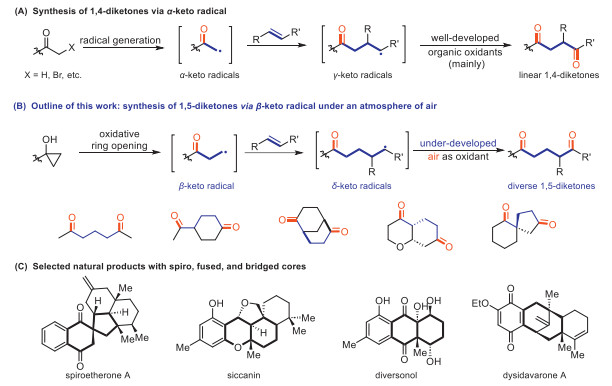
One noteworthy application of alkene oxyalkylation is the synthesis of 1,4-diketones via a sequence involving the generation of α-keto radicals from ketones, addition to alkenes, and oxidation of the resulting γ-keto radicals (Fig. 1A) [7–13]. In 2014, Klussmann’s group developed a para-toluenesulfonic acid-catalyzed alkylation-peroxidation reaction of styrene with ketones to afford γ-peroxyketones, which was then converted to the 1,4-diketones [7]. The groups of Huang [8], Wan [9], Xing [10], and Thakur [11] independently developed direct oxidative couplings of terminal vinylarenes with ketones to furnish 1,4-diketones directly, employing Cu/Mn co-catalysis or cobalt salts in conjunction with TBHP. Maity [12] and Senadi [13] reported an alternative strategy involving photoredox-catalyzed 1,2-oxoalkylation of vinyl arenes with 1,3-diketones, employing air as the terminal oxidant, sequentially. Inspired by these advances on 1,4-diketone synthesis through α-keto radicals, we envisioned that β-keto radicals generated by oxidation of cyclopropanols, the most prominent type of the homo-enol equivalents [14–21], might undergo an addition reaction with olefins to form δ-keto radicals, which could then be oxidized by molecular oxygen to afford 1,5-diketones straightforwardly [22–24].
Figure 1
Figure 1.
Background and study synopsis. (A) Synthesis of 1,4-diketones via α-keto radical. (B) Outline of this work: Synthesis of 1,5-diketones via β-keto radical under an atmosphere of air. (C) Selected natural products with spiro, fused, and bridged cores.
The challenge of achieving this aerobic radical transformation lies in the intrinsic instability of β-keto radicals, which are less stable than α-keto counterparts and readily quenched by molecular oxygen [25–27]. Overcoming this limitation requires a catalytic system capable of efficiently generating β-keto radicals and directing their regioselective addition to alkenes. Recently, our group developed an intramolecular homo-Mannich reaction of cyclopropanols to construct azabicyclo[3.3.1]nonane skeletons [28–31]. In this reaction, β-keto radicals were generated via oxidative ring-opening of cyclopropanols and then efficiently trapped by the C=N double bonds of imines with CuCl2 as the catalyst. Inspired by the advances in cyclopropanols chemistry made by our group [28–31] and others [32–47], we surmised that a copper-based catalytic system could be adapted to oxyalkylation of the C=C double bonds of alkenes with cyclopropanols, to furnish diverse 1,5-diketones (Fig. 1B). Herein, we report a copper-catalyzed oxyalkylation of alkenes with cyclopropanols under an atmosphere of air. This operationally simple protocol accommodates both inter- and intramolecular variants [48–55], providing rapid access to 1,5-diketones bearing linear, fused, spirocyclic, or bridged scaffolds-motifs commonly found in natural products such as spiroetherone A, siccanin, and dysidavarone A (Fig. 1C) [56–63].
As shown in Table 1, we first commenced our study by screening various metal salts using cyclopropanol 1a as the model substrate (entries 1–4), and CuCl2 was identified as the optimal copper salt, yielding product 2a in 32% yield (entry 3). Investigation of ligands (entries 5–9) indicated that 1,10-phenanthroline (Phen, L5) was the ligand of choice, increasing the yield to 69% (entry 9). Examination of solvents indicated that substitution of THF with 1,4-dioxane or MeCN was detrimental to the product yield (entries 10 and 11). When the reaction time was shortened to 2 h, the yield remained at 69%, underscoring the efficiency of this reaction protocol (entry 12). Further improvement was achieved using the preformed CuCl2·Phen complex as the catalyst, which delivered 2a in 79% yield at a 10 mol% catalyst loading (entries 13 and 14).
Table 1
Table 1.
Optimization of the oxyalkylation of alkenes with cyclopropanols.a
a Typical reaction conditions unless otherwise noted: 1a (0.1 mmol), CuCl 2 (0.02 mmol), THF (4.0 mL), 12 h, 60 ℃, to air. b isolated yield. c 2 h of reaction time. d 0.02 mmol CuCl 2· L5 as the catalyst. e 0.01 mmol CuCl 2· L5 as the catalyst. f CuCl 2· L5 is pre-prepared.
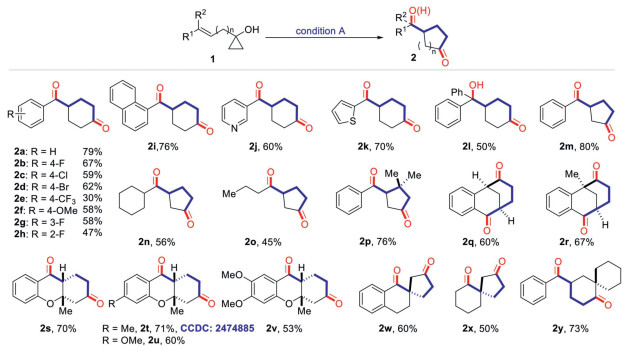
With the optimized reaction conditions established, we first explored the intramolecular oxyalkylation of alkenes with cyclopropanols (Scheme 1). Styryl-substituted substrates, bearing electron-donating or -withdrawing groups on the aryl ring, underwent a smooth transformation to afford the corresponding 4-benzoylcyclohexanone derivatives 2a–2h in moderate to good yields. Other olefins with aryl groups including 1-naphthyl, 3-pyridyl and 2-thienyl were well tolerated, delivering products 2i–2k in good yields. Importantly, the 1,1-diphenylethene-derived substrate 1l also furnished the hydroxylated cyclohexanone 2l. Aliphatic olefins proved to be compatible as well, affording 2n and 2o in good yields. Significantly, the methodology enabled the synthesis of a diverse array of bridged, spiro, and fused polycyclic products 2q–2y. For instance, cyclopropanols 1q and 1r produced functionalized bicyclo[3.3.1]nonanes 2q and 2r, structural analogues of Dysidavarone A [53]. Likewise, fused products 2s–2v were successfully generated, which are the core scaffold of the succinate dehydrogenase inhibitor Siccanin [54]. Importantly, the product 2u could be obtained in 48% yield when the reaction was carried out on a 5 mmol scale, and the structure of 2t was confirmed by X-ray crystallography (see details in Supporting information). Furthermore, cyclopropanols with dihydronaphthalene and cyclohexene substituents yielded spirocyclic products 2w–2y. Among them, 2w represents the spirocyclic core structure found in the natural product Spiroetherane [55].
Scheme 1
Scheme 1.
The intramolecular oxyalkylation of olefins with cyclopropanols. Reaction condition A: substrate 1a–1y (0.20 mmol), CuCl2·Phen (CuCl2·L5, 10 mol%), THF (4.0 mL), 60 ℃, to air, isolated yield.
Next, this method was adapted to the intermolecular oxyalkylation under slightly modified reaction conditions (Scheme 2). A broad range of cyclopropanols were compatible, affording the corresponding linear 1,5-dicarbonyl compounds 5a–5m in moderate to good yields. Notably, cyclopropanol 4k with a free hydroxyl group delivered product 5k in 62% yield. Substrates bearing two cyclopropanol units (4l and 4m) also participated in the transformation, providing products 5l and 5m with two 1,5-dicarbonyl fragments. Furthermore, the utility of this protocol for drug derivatization was demonstrated. Cyclopropanols derived from ibuprofen, naproxen, and lithocholic acid reacted well with styrene to furnish products 5n–5q in 45%–64% yields. Remarkably, coupling of an ibuprofen-derived cyclopropanol with a styrene derived from fenofibrate generated a conjugate of two drugs (5q), which may be of pharmacological interest in drug discovery.
Scheme 2
Scheme 2.
The intermolecular oxyalkylation of styrenes with cyclopropanols. Reaction condition B: substrate 3a–3c (0.40-0.80 mmol), 4a–4m (0.20 mmol), CuCl2·Phen (10 mol%), CH3CN (4.0 mL), 80 ℃, to air, isolated yield. * The yield of product was achieved via a two-step procedure after deprotection.
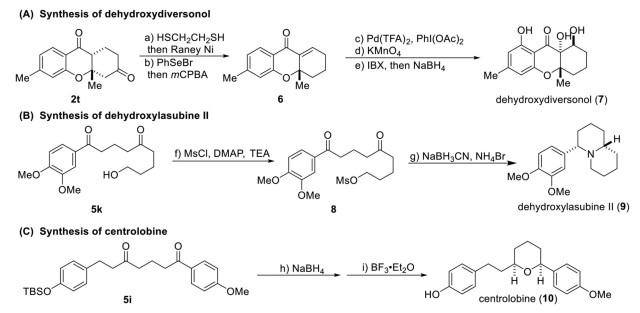
Additionally, this versatile synthetic strategy was further applied to the synthesis of natural products or their analogues (Fig. 2) [56–63]. First, the natural product analogue 4-dehydroxydiversonol (7) [56,57] with multiple oxygen functionalities was synthesized from 2t by taking advantage of the two ketone groups generated by our new method. The linear 1,5-dicarbonyl compounds can be employed in generating diverse range of heterocycles (9 and 10). For instance, a lasubine Ⅱ analogue 9 was successfully prepared from oxyalkylation product 5k through a sequence of reductive amination and intramolecular alkylation [60,61]. (±)-Centrolobine (10), which was isolated from the heartwood of Centrolobium robustum and exhibits biological activity against Leishmania amazonensis promastigotes, was synthesized in two steps from 5i [62,63].
Figure 2
Figure 2.
The synthesis of natural products or their analogues. (A) Synthesis of dehydroxydiversonol. (B) Synthesis of dehydroxylasubine Ⅱ. (C) Synthesis of centrolobine. Reagents and conditions: (a) 1,2-ethanedithiol (1.2 equiv.), BF3·Et2O (1.3 equiv.), CHCl3, 0 ℃; then Raney Ni (1.0 g), EtOH (10.0 mL), 50 ℃, 68% for 2 steps; (b) KHMDS (1.2 equiv.), PhSeBr (1.2 equiv.), THF, –78 ℃; then mCPBA (1.0 equiv.), CH2Cl2, 64% for 2 steps; (c) Pd(TFA)2 (0.1 equiv.), PhI(OAc)2 (2.0 equiv.), DCE, 100 ℃, 86%; (d) KMnO4 (1.0 equiv.), EtOH, H2O, 0 ℃, 38%; (e) IBX (1.0 equiv.), DMSO, 70 ℃; then NaBH4 (0.5 equiv.), MeOH/CH2Cl2, –78 ℃, 48% for 2 steps; (f) MsCl (1.0 equiv.), Et3N (2.0 equiv.), DMAP (0.1 equiv.), CH2Cl2, 88%; (g) NaBH3CN (1.0 equiv.), NH4Br (2.0 equiv.), MeOH, then 2 mol/L HCl, 66%; (h) NaBH4 (2.0 equiv.), MeOH, –60 ℃, 85%; (i) BF3·Et2O (2.0 equiv.), CH3CN, –40 ℃, 93%.
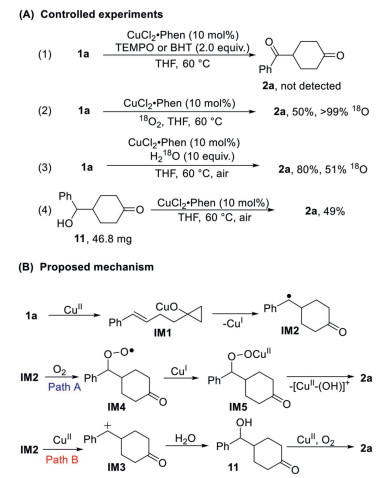
Control experiments were conducted to study the reaction mechanism (Fig. 3A). No product formation was observed in the presence of radical scavengers TEMPO or BHT, the corresponding adducts of the β-carbonyl radical with TEMPO or BHT were detected by HRMS, indicating the involvement of a radical process. To probe the source of the incorporated oxygen atom, isotopic labeling studies were performed. When 18O2 was employed as the oxidant in place of air, the resulting 2a was obtained in 50% yield with complete 18O incorporation; while 10 equivalents of H218O were added to the standard reaction conditions, the product 2a displayed 51% 18O incorporation as determined by high-resolution mass spectrometry. To further examine the possibility of water as the oxygen source, compound 11 was prepared and subjected to the standard conditions, furnishing product 2a in 49% yield. These findings suggest that both molecular oxygen and water may contribute as sources of the incorporated oxygen atom.
Based on the results of control experiments and previous reports [28–31],[64–70], a plausible reaction mechanism is proposed (Fig. 3B). Initially, association of CuⅡ-L5 with cyclopropanol 1a yields intermediate IM1, which undergoes ring opening and radical-type 6-exo-trig cyclization onto the alkene to afford δ-ketone radical IM2 [68]. Subsequently, two possible pathways may account for the formation of the final product 2a. The dominant route is Path A, in which radical IM2 is intercepted by molecular oxygen to generate peroxyl radical IM4, which undergoes reduction by [CuⅠ] to afford IM5. Then, IM5 go through a elimination reaction to ultimately afford product 2a and release [CuⅡ-(OH)]+ species [66,67]. In this pathway, molecular oxygen serves a dual role as both the oxidant and oxygen source. A plausible alternative mechanism (Path B) involves the further oxidation of radical IM2 to form carbocation IM3, which is subsequently attacked by water to yield hydroxylated intermediate 11, which is then followed by oxidation to deliver the final diketone 2a [69,70].
In summary, we have developed an efficient method for the synthesis of 1,5-diketones via Cu-catalyzed oxyalkylation of alkenes with cyclopropanols under ambient air. The use of CuCl2·Phen complex as the catalyst proved critical to the success of this transformation. This protocol offers notable synthetic advantages, including operational simplicity, mild conditions, and broad substrate scope, enabling the conversion of unactivated alkenes into structurally diverse 1,5-diketones. Importantly, the intramolecular variant of this reaction grants access to valuable fused, spiro, bridged polycyclic scaffolds.
The authors declare that they have no known competing financial interests or personal relationships that could have appeared to influence the work reported in this paper.
Acknowledgments
This work was supported by the National Natural Science Foundation of China (No. 22271033), Chongqing Science and Technology Commission (Nos. CSTB2024YCJH-KYXM0045, CSTB2022NSCQ-LZX0036 and CSTB2025TIAD-STX0046), and Fundamental Research Funds for the Central Universities (Nos. 2024CDJYXTD-006, 2022CDJQY-001 and 2024CDJXY002), and Science and Technology Innovation Key R&D Program of Chongqing (No. CSTB2022TIAD-STX0015), Open Project of State Key Laboratory of Phytochemistry and Natural Medicines (No. P2025-KF0X), Open Project of Central Nervous System Drug Key Laboratory of Sichuan Province (No. 230049-01SZ).
Supplementary materials
Supplementary material associated with this article can be found, in the online version, at doi:10.1016/j.cclet.2026.112433.
[1]
Y. Wang, L. Zhang, Y. Yang, et al., J. Am. Chem. Soc. 135 (2013) 18048–18051. doi: 10.1021/ja410195j
[2]
A. Tlahuext-Aca, R. A. Garza-Sanchez, F. Glorius, Angew. Chem. Int. Ed. 56 (2017) 3708–3711. doi: 10.1002/anie.201700049
Y. Su, X. Sun, G. Wu, N. Jiao, Angew. Chem. Int. Ed. 52 (2013) 9808–9812. doi: 10.1002/anie.201303917
[67]
H. R. Lucas, L. Li, A. A. Narducci Sarjeant, et al., J. Am. Chem. Soc. 131 (2009) 3230–3245. doi: 10.1021/ja807081d
[68]
J. Shen, D. Yang, Y. Liu, et al., Org. Lett. 16 (2014) 350–353. doi: 10.1021/ol403555n
[69]
G. Zhang, C. Yang, E. Liu, et al., RSC Adv. 4 (2014) 61907–61911.
[70]
O. Das, T. K. Paine, Dalton Trans. 41 (2012) 11476–11481. doi: 10.1039/c2dt31134h
Figure 1
Background and study synopsis. (A) Synthesis of 1,4-diketones via α-keto radical. (B) Outline of this work: Synthesis of 1,5-diketones via β-keto radical under an atmosphere of air. (C) Selected natural products with spiro, fused, and bridged cores.
Scheme 2
The intermolecular oxyalkylation of styrenes with cyclopropanols. Reaction condition B: substrate 3a–3c (0.40-0.80 mmol), 4a–4m (0.20 mmol), CuCl2·Phen (10 mol%), CH3CN (4.0 mL), 80 ℃, to air, isolated yield. * The yield of product was achieved via a two-step procedure after deprotection.
Table 1.
Optimization of the oxyalkylation of alkenes with cyclopropanols.a
Entry
Catalyst
Ligand
Solvent
Yield (%)b
1
CuCl2
—
THF
26
2
CuCl
—
THF
<5
3
CuCl2
—
THF
32
4
Cu(OTf)2
—
THF
0
5
CuCl2
L1
THF
37
6
CuCl2
L2
THF
0
7
CuCl2
L3
THF
30
8
CuCl2
L4
THF
21
9
CuCl2
L5
THF
69
10
CuCl2
L5
1,4-Dioxane
63
11
CuCl2
L5
MeCN
61
12c)
CuCl2
L5
THF
69
13d)
CuCl2·L5f
—
THF
75
14e)
CuCl2·L5f
—
THF
79
a Typical reaction conditions unless otherwise noted: 1a (0.1 mmol), CuCl 2 (0.02 mmol), THF (4.0 mL), 12 h, 60 ℃, to air. b isolated yield. c 2 h of reaction time. d 0.02 mmol CuCl 2· L5 as the catalyst. e 0.01 mmol CuCl 2· L5 as the catalyst. f CuCl 2· L5 is pre-prepared.


 DownLoad:




 下载:
下载:


 下载:
下载:

