Scheme 1.
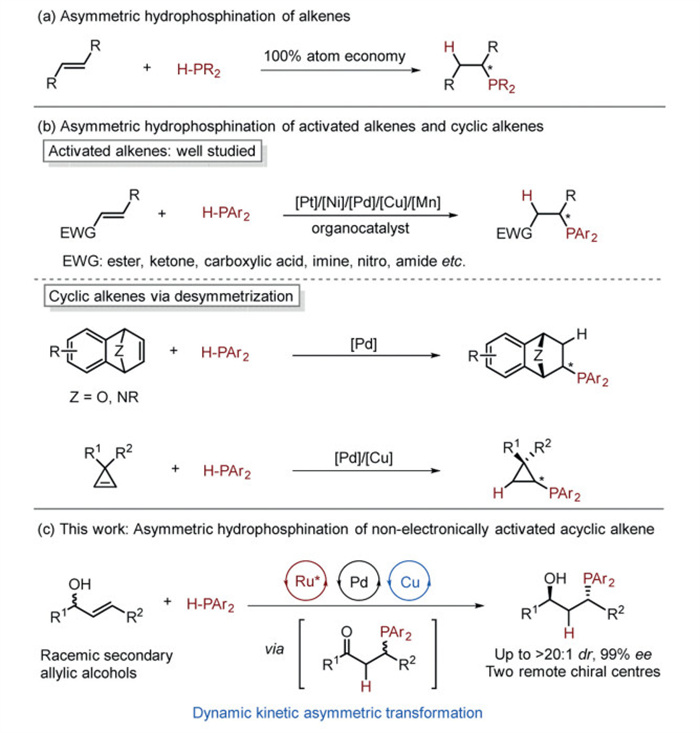
Asymmetric hydrophosphination of alkenes.

Enantioconvergent hydrophosphination of allylic alcohols to access chiral γ-hydroxyphosphines via multicatalysis
Huailan Yang , Haohe Tang , Wang Miao , Weijun Tang , Jianliang Xiao , Huaming Sun , Chao Wang


The asymmetric catalytic hydrophosphination of alkenes with phosphine derivatives offers a direct and atom-economical route to access enantioenriched chiral organophosphorus compounds (Scheme 1a) [1-7]. These products serve not only as valuable chiral ligands and organocatalysts in asymmetric synthesis [8-18] but also as key structural motifs in pharmaceuticals and biologically active molecules [19-28]. Since Glueck and co-workers' pioneering work in 2000 on the platinum-catalyzed hydrophosphination of acrylonitriles [29-31], significant progress has been made in this transformation. Various metal- and organocatalytic systems have been developed for the hydrophosphination of electron-deficient alkenes, typically with high enantioselectivity (Scheme 1b, top) [32-47]. However, electronically unactivated or nonpolar alkenes remain challenging substrates. Leung, Wang, Yin, and co-workers elegantly demonstrated that cyclic alkenes, such as aza/oxabenzonorbornadienes and cyclopropenes, can undergo hydrophosphination via desymmetrization, yielding products with multiple chiral centers [48-51]. This reactivity is attributed to the angle strain of cyclic alkenes, facilitating their activation (Scheme 1b, bottom). Despite these advances, the asymmetric catalytic addition of secondary phosphines to electronically unactivated acyclic alkenes remains elusive.
Allylic alcohols are versatile building blocks in organic synthesis [52,53] and asymmetric catalysis [54-57]. Their asymmetric hydrophosphination would provide access to γ-hydroxy phosphines, which could be further elaborated to chiral ligands or organocatalysts. However, existing catalytic systems for hydrophosphination are unable to affect the reaction, as the C=C double bond in allylic alcohols is not electronically activated. Borrowing hydrogen catalysis [57-73] has emerged as a viable strategy for allylic alcohol functionalization. In this approach, allylic alcohols are dehydrogenated to α,β-unsaturated ketones, electron-deficient alkenes that are ideal substrates for hydrophosphination. Merging borrowing hydrogen catalysis with hydrophosphination could enable the formal hydrophosphination of allylic alcohols. However, several challenges must be addressed: (1) Compatibility between the borrowing hydrogen and hydrophosphination catalysts, (2) control of stereoselectivity for multiple chiral centers, (3) catalyst deactivation due to strong phosphine coordination [74,75], and (4) interference of the hydroxy group for hydrophosphination [76-79].
Herein, we report a trimetallic catalytic system, a multicatalysis system [80-86], for the enantioconvergent hydrophosphination of racemic secondary allylic alcohols, delivering γ-hydroxyphosphine derivatives with 1,3-stereocenters. This work represents the first example of asymmetric hydrophosphination involving unactivated acyclic alkenes. The transformation synergistically combines borrowing hydrogen catalysis with metal-catalyzed hydrophosphination, and notably the stereoselectivity of two remote chiral centers is controlled by a single chiral Ru catalyst via a dynamic asymmetric kinetic transformation.
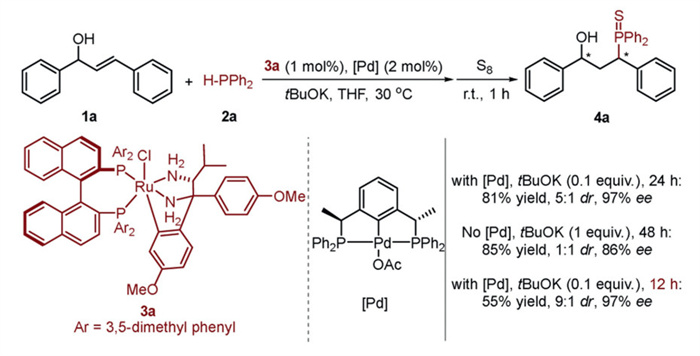
Building upon the known feasibility of hydrophosphination with α,β-unsaturated ketones [87,88] and our group's expertise in borrowing-hydrogen (BH) reactions [59,67,72,73], we proposed that allylic alcohols would undergo Ru-catalyzed dehydrogenation to form α,β-unsaturated ketone intermediates, which could then participate in conjugate addition with a phosphine reagent to afford γ-hydroxyphosphine products upon reduction. Initially, we devised a bimetallic cooperative catalytic system to enable both the coupling and borrowing-hydrogen steps and control the selectivities of two remote chiral centers. We envisioned that the robust hydrogen transfer catalyst 3a could catalyze the borrowing hydrogen process [59,67,72,73], while a chiral pincer Pd catalyst, developed by Duan and co-workers for asymmetric hydrophosphination, would enable the enantioselective conjugate addition of the phosphine reagent to the in situ generated α,β-unsaturated ketone intermediate [36]. In light of this hypothesis, we studied the reaction of racemic allylic alcohol 1a with diphenylphosphine 2a, catalyzed by the Ru catalyst 3a and the chiral pincer Pd catalyst [Pd]. With 10 mol% tBuOK as base and THF as solvent at 30 ℃, the coupling indeed took place, affording the sulfur-protected product 4a with 81% yield, 5:1 dr and 97% ee (Scheme 2). Control experiment showed that in the absence of the [Pd] catalyst the reaction could still proceed to afford 4a, with 1:1 dr and 86% ee, suggesting the existence of non-enantioselective background conjugate addition reaction, possibly promoted by the base [89,90]. A base is indispensable for the Ru catalyzed borrowing hydrogen process as shown in our previous studies [67,73,91]; thus this background reaction is unavoidable. Despite extensive optimization, we were not able to get a satisfactory result (best results obtained 55% yield, 9:1 dr, 97% ee, Scheme 2). Details can be found in Table S1 (Supporting information).
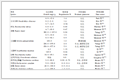
A new strategy was thus required. Previously, we have achieved the control of two remote stereocenters via dynamic kinetic asymmetric transformation (DYKAT) in a Ru-catalyzed asymmetric hydroalkylation of allylic alcohols [72]. We were wondering if a DYKAT process could facilitate the control of stereoselectivities of the two chiral centers. Initially, different bases including strong bases were examined (Table S2 in Supporting information), aiming to achieve DYKAT via deprotonation/protonation of the acidic hydrogen atom on the carbon adjacent to the phosphine unit of the ketone intermediate without using a palladium co-catalyst. However, none of the bases afforded a higher diastereoselectivity. Nevertheless, K3PO4 delivered the best enantioselectivity among those tested (Table 1, entry 1). Because DYKAT could also be enabled by retro-conjugate addition [92] and Lewis acids are known to promote such reactions [93], we then evaluated various Lewis acids (Table S2). Delightfully, the addition of [Cu(MeCN)4]PF6 enhanced both the enantioselectivity and diastereoselectivity (97% ee, 2:1 dr; Table 1, entry 2), albeit with a lower yield (70%). Given that Pd catalysts promote conjugate addition of HPAr2 to α,β-unsaturated ketones [36,50], we thus added both [Cu(MeCN)4]PF6 and a Pd catalyst to the reaction in order to accelerate both the conjugate addition and retro-conjugate addition processes, thus creating a fast racemization equilibrium for DYKAT. It was found that amongst the palladium catalysts tested, Pd2(dba)3 in combination with Xantphos increased the diastereoselectivity and enantioselectivity (6:1 dr, 99% ee, Table 1, entry 3). The ligand Xantphos is crucial for the diastereoselectivity (Table 1, entry 4). The cyclometallation feature of 3a is also important for the rate and selectivity of the reaction (Table 1, entries 5-7). Replacing [Cu(MeCN)4]PF6 with Cu(OAc)2 increased both the yield and diastereoselectivity (Table 1, entry 8). Further optimization of Cu(OAc)2 loading (Table 1, entry 9), substrate ratio (Table 1, entry 10) and solvent (Table 1, entry 11) led to an optimal condition, with 92% NMR yield (91% isolated), 13:1 dr and 99% ee (more optimization data can be found in Supporting information).
 DownLoad:
CSV
 |
||||||||||||||||||||||||||||||||||||||||||||||||||||||||||||||||||||||||||||
| Entry | [Ru] | [Pd] | [Cu] | Yield (%)b | drc | ee (%)c | ||||||||||||||||||||||||||||||||||||||||||||||||||||||||||||||||||||||
| 1d | 3a | - | - | 89 | 1:1 | 90 | ||||||||||||||||||||||||||||||||||||||||||||||||||||||||||||||||||||||
| 2e | 3a | - | [Cu(MeCN)4]PF6 | 70 | 2:1 | 97 | ||||||||||||||||||||||||||||||||||||||||||||||||||||||||||||||||||||||
| 3 | 3a | Pd2(dba)3 | [Cu(MeCN)4]PF6 | 75 | 6:1 | 99 | ||||||||||||||||||||||||||||||||||||||||||||||||||||||||||||||||||||||
| 4f | 3a | Pd2(dba)3 | [Cu(MeCN)4]PF6 | 65 | 2:1 | 99 | ||||||||||||||||||||||||||||||||||||||||||||||||||||||||||||||||||||||
| 5 | 3b | Pd2(dba)3 | [Cu(MeCN)4]PF6 | Trace | - | - | ||||||||||||||||||||||||||||||||||||||||||||||||||||||||||||||||||||||
| 6 | 3c | Pd2(dba)3 | [Cu(MeCN)4]PF6 | 56 | 1:1 | 99 | ||||||||||||||||||||||||||||||||||||||||||||||||||||||||||||||||||||||
| 7 | 3d | Pd2(dba)3 | [Cu(MeCN)4]PF6 | Trace | - | - | ||||||||||||||||||||||||||||||||||||||||||||||||||||||||||||||||||||||
| 8 | 3a | Pd2(dba)3 | Cu(OAc)2 | 92 | 7:1 | 99 | ||||||||||||||||||||||||||||||||||||||||||||||||||||||||||||||||||||||
| 9g | 3a | Pd2(dba)3 | Cu(OAc)2 | 93 | 7:1 | 99 | ||||||||||||||||||||||||||||||||||||||||||||||||||||||||||||||||||||||
| 10h | 3a | Pd2(dba)3 | Cu(OAc)2 | 93 | 8:1 | 99 | ||||||||||||||||||||||||||||||||||||||||||||||||||||||||||||||||||||||
| 11i | 3a | Pd2(dba)3 | Cu(OAc)2 | 92 (91)j | 13:1 | 99 | ||||||||||||||||||||||||||||||||||||||||||||||||||||||||||||||||||||||
| a Reaction conditions unless otherwise noted: 1a (0.4 mmol), 2a (0.2 mmol), [Ru] (1.0 mol%), [Cu] (5.0 mol%), [Pd] (0.5 mol%), Xantphos (7.2 mol%), K3PO4 (0.2 mmol), THF (2 mL), 30 ℃, under N2 for 48 h. b Determined by 31P{1H} NMR analysis of the crude mixture. c The dr and ee was determined by chiral HPLC. d No [Cu], [Pd] and Xantphos. e No [Pd]. f No Xantphos. g Cu(OAc)2 (4.0 mol%). h 1a: 2a = 3:1. i Toluene (2 mL). j Yield of the isolated product. |
||||||||||||||||||||||||||||||||||||||||||||||||||||||||||||||||||||||||||||
With the optimized reaction conditions in hand (Table 1, entry 11), the substrate scope of this transformation was then investigated (Scheme 3). Initially, allylic alcohols bearing various aryl substituents at the terminal alkene carbon were examined (Scheme 3, 4a-4y). The reaction demonstrated good tolerance toward both electron donating (e.g., methoxy) and electron-withdrawing (e.g., cyano, halides) groups across all substitution patterns (ortho-, meta-, para-), delivering products 4a-4u in high yields (67%-96%) with excellent stereocontrol (> 20:1 dr, > 98% ee in most cases). Notably, ortho-substituted substrates (4l, 4n, 4q and 4r) exhibited good yields and excellent stereoselectivities (> 20:1 dr, 99% ee). A 2-thienyl group was also tolerated (4v). However, nitrogen containing heterocyclic substrate were not suitable, as exemplified by 4w, possibly due to the strong coordinating ability of the pyridine nitrogen atom interfering with the catalytic process. Furthermore, for alkyl‑substituted substrates, such as the cyclohexyl (4x) and ethyl (4y) derivatives, the reaction proceeded but with reduced activity and diastereoselectivity.
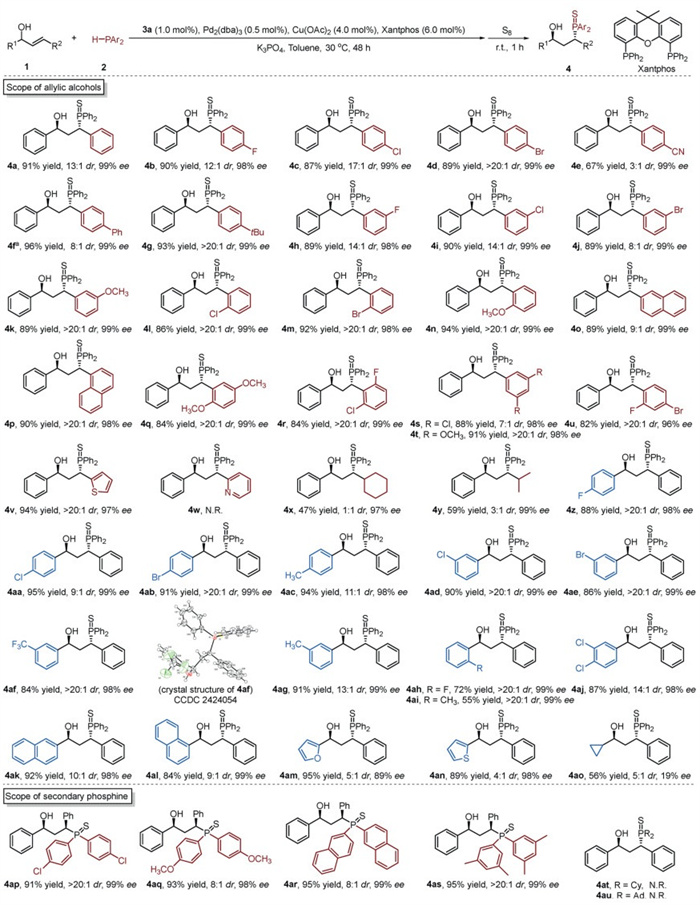
The scope of the reaction was extended to allylic alcohols bearing a range of aryl substituents adjacent to the hydroxy group (Scheme 3, 4z and 4aa-4ao). These substrates generally gave excellent stereoselectivities (> 20:1 dr, 99% ee for 4ab, 4ad, 4ae, 4ah and 4ai) and tolerated diverse aromatic systems, including disubstituted phenyl, naphthyl, and heterocyclic groups (4aj-4an). Despite this broad tolerance, ortho-substituted aryl groups (4ah, 4ai) afforded reduced yields, possibly due to the difficulty of alcohol dehydrogenation caused by the steric hindrance near the hydroxy-attached carbon. A notable limitation was observed with aliphatic substituents adjacent to the hydroxy group, which resulted in low enantioselectivity (4ao, 19% ee). The absolute configuration of 4af was determined to be (1S, 3S) by X-ray crystallography analysis.
The generality of different phosphines were then examined. Aryl phosphines generally afforded excellent yields (91%-95%) with high stereoselectivities (> 8:1 dr, 98%-99% ee). However, aliphatic phosphines such as dicyclohexylphosphine and diadamantylphosphine (4at-4au) were entirely unreactive under the standard reaction conditions. Being stronger σ donors, the latter may poison the metal catalysts via coordination.
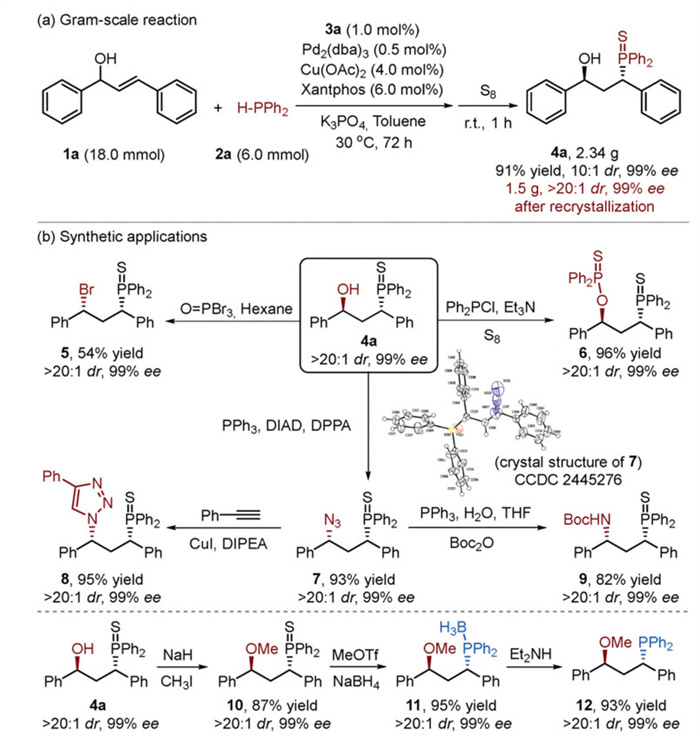
Gram-scale synthesis and subsequent derivatization of products were conducted to demonstrate the practical utility of this methodology (Scheme 4). The reaction between 1a and 2a on a 6 mmol scale, with an extended reaction time of 72 h, afforded 4a in 91% yield with slight erosion of stereoselectivities (10:1 dr, 99% ee). The diastereomeric ratio could be enhanced to > 20:1 via recrystallization (Scheme 4a). The chiral γ-hydroxyphosphine 4a was then used as a synthon for the synthesis of functionalized phosphine compounds. As shown in Scheme 4b, γ-functionalized phosphines including brominated 5, azide-bearing 7, and bisphosphine compound 6 were prepared from 4a. The absolute configuration of 7 was confirmed as (1R, 3S) through single-crystal X-ray diffraction analysis. In addition, the azide group of compound 7 could undergo copper-catalyzed cycloaddition to furnish triazole-phosphine compound 8 (95% yield). And 7 could be reduced to give the chiral aminophosphine compound 9 (82% yield), which can be used for the synthesis of chiral ligand for asymmetric catalysis. The sulfur protecting group could be removed as exemplified by 4a (Scheme 4b, bottom). After protecting the hydroxy group of 4a with a methyl group, the free phosphine product 12 could be obtained with high yield and excellent stereoselectivities.
Mechanistic studies were undertaken to elucidate the reaction pathway, the role of each catalyst, and the origin of stereoselectivity. Previous studies on the functionalization of allylic alcohols via borrowing hydrogen catalysis suggest that the reaction could proceed via a sequential dehydrogenation/conjugate addition/reduction process (Scheme 5) [59,67]. Catalyst 3a is known to be able to dehydrogenate allylic alcohols [59,67,72,73]; thus 1a could be dehydrogenated to form an α,β-unsaturated ketone compound 13 under standard reaction conditions (Section S6.1 in Supporting information). It was shown that 13 reacted with 2a in the presence of K3PO4 in toluene to give 14, without any enantioinduction as expected (Scheme 5a). Control experiments showed that the Ru catalyst 3a did not affect this reaction, while Pd and Cu catalysts could accelerate the conjugate addition (Scheme 5a). Thus, in the presence of both Pd and Cu catalysts, the yield of 14 increased from 64% to 94%.
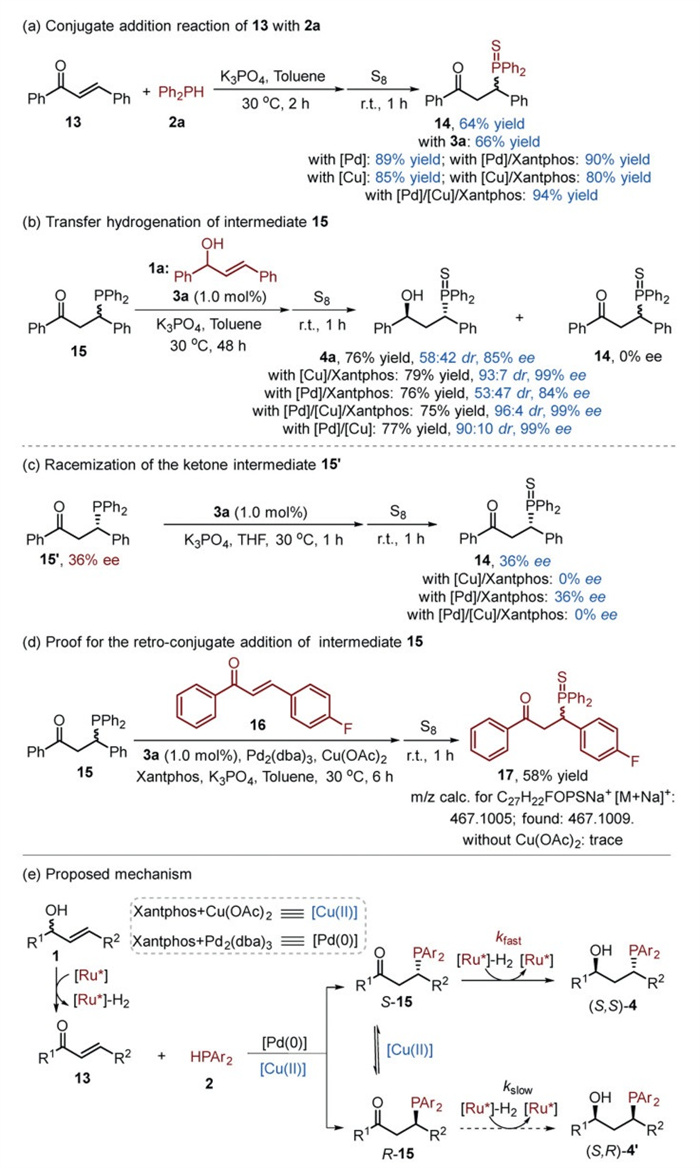
The racemic intermediate 15 was then synthesized and subjected to 3a-catalyzed reduction with allylic alcohol 1a as hydrogen source (Scheme 5b). In the absence of Pd and Cu catalysts, the reduction afforded 4a with 76% yield, 58:42 dr and 85% ee. Notably, the addition of Cu catalyst enhanced both the diastereo- and enantioselectivity of 4a (93:7 dr, 99% ee), while Pd catalyst had almost no effect (Scheme 5b). Similar results to the addition of Cu catalyst were obtained with the addition of both Cu and Pd catalysts. Note that the ligand Xantphos affects the diastereo-, not enantio-selectivity, of 4a (Scheme 5b). For all the control experiments in Scheme 5b, the sulfur protected, unreacted substrate (14) remained racemic. These results suggest that 15 is reduced to 4a in a dynamic kinetic resolution (DKR) [94-101] fashion and the Cu/Xantphos catalyst promotes the DKR process. The DKR process requires the rapid racemization of 15 during its reduction. Control experiments using enantioenriched 15' (36% ee) showed that the racemization only occurred in the presence of the Cu catalyst and K3PO4 (Scheme 5c). Both 3a and the Pd catalyst had no effect on the racemization in the presence of K3PO4.
Racemization of compound 15 may occur through a reversible pathway involving retro-conjugate addition/conjugate addition [92]. Experiment was then designed to elucidate the mechanism for racemization (Scheme 5d). Definitive evidence for the retro-conjugate addition pathway was provided by a crossover experiment (Scheme 5d). Under standard conditions, stirring 15 with an exogenous α,β-unsaturated ketone 16 generated the crossover-product 17 (Scheme 5d, confirmed by HRMS, 58% yield via 19F{1H} NMR, Section S6.6 in Supporting information). Notably, the formation of 17 was detected only in the presence of Cu(OAc)2, confirming the reversibility of the conjugate addition and the role of Cu(Ⅱ) as a Lewis acid in facilitating the retro-conjugate addition step by coordinating with the substrate.
The above mechanistic studies support a dehydrogenation/conjugate addition/reduction pathway for the reaction. Both Pd and Cu catalysts are capable of accelerating the conjugate addition step. The Cu/Xantphos system enables a DKR process by promoting the racemization of the carbonyl phosphine intermediate via a retro-conjugate addition/conjugate addition process, thereby enhancing the diastereoselectivity of the product.
Based on the mechanistic investigations, a proposed mechanism for the coupling of 1 with 2 is outlined in Scheme 5e. The transformation is initiated when the Ru catalyst dehydrogenates allylic alcohol 1, generating the α,β-unsaturated ketone 13 and a chiral Ru-hydride intermediate. Ketone 13 then undergoes conjugate addition with phosphine 2 to form the racemic phosphine adduct 15 (a 1:1 mixture of S-15 and R-15). Owing to their distinct stereochemical differences within the chiral catalyst pocket, the S-15 is reduced at a faster rate by the chiral Ru-hydride intermediate, yielding the major observed product, (S,S)-4. Meanwhile, R-15 is converted to S-15 via a Cu-mediated retro-conjugate addition reaction. If the equilibration is much faster than the subsequent reduction and kfast > kslow, (S,S)-4 will be enriched. The overall process thus allows for the enantioconvergent transformation of racemic allylic alcohols into enantioenriched γ-hydroxyphosphine derivatives in a DYKAT manner. The three metal catalysts act cooperatively to achieve the transformation: Pd and Cu catalysts accelerate conjugate addition, while a single Ru catalyst, facilitated by the Cu catalyst, controls the stereoselectivities of the two remote chiral centers.
In conclusion, we have developed a trimetallic cooperative catalytic system for the enantioconvergent hydrophosphination of allylic alcohols with phosphines via a DYKAT process. This methodology operates via a synergistic merger of borrowing hydrogen catalysis and phosphine conjugate addition, affording enantioenriched chiral γ-hydroxyphosphines bearing two remote stereocenters with high diastereo- and enantio-selectivity. Mechanistic studies elucidate the role of each catalyst: The Ru catalysts mediates the asymmetric borrowing hydrogen process, the Pd and Cu catalysts accelerate the conjugate addition step, while the Cu catalyst acts as a Lewis acid, enhancing diastereoselectivities in the DYKAT process. The stereoselectivities of two remote chiral centers are controlled by a single Ru catalyst. The products could be used as intermediates for the synthesis of various functionalized chiral phosphine compounds including otherwise challenging targets, and could serve as key intermediates for the synthesis of chiral ligands. This work provides an rare example of catalytic hydrophosphination of unactivated alkenes and a new strategy for the synthesis of organophosphorus compounds.
Huailan Yang: Writing – original draft, Methodology, Investigation. Haohe Tang: Methodology. Wang Miao: Methodology. Weijun Tang: Supervision. Jianliang Xiao: Writing – review & editing. Huaming Sun: Methodology. Chao Wang: Writing – review & editing, Supervision, Resources, Funding acquisition, Conceptualization.
The authors declare that they have no known competing financial interests or personal relationships that could have appeared to influence the work reported in this paper.
This research was supported by the National Natural Science Foundation of China (Nos. 22472089 and 22172096), the Fundamental Research Funds for the Central Universities (Nos. GK202307002 and GK202002003), and the 111 project (No. B14041).
Supplementary material associated with this article can be found, in the online version, at doi:
C.S. Demmer, L.N. Krogsgaard, L. Bunch, Chem. Rev. 111 (2011) 7981–8006. doi: 10.1021/cr2002646
L. Rosenberg, ACS Catal. 3 (2013) 2845–2855. doi: 10.1021/cs400685c
V. Koshti, S. Gaikwad, S.H. Chikkali, Coord. Chem. Rev. 265 (2014) 52–73. doi: 10.1016/j.ccr.2014.01.006
C.A. Bange, R. Waterman, Chem. Eur. J. 22 (2016) 12598–12605. doi: 10.1002/chem.201602749
K. Zheng, X. Liu, X. Feng, Chem. Rev. 118 (2018) 7586–7656. doi: 10.1021/acs.chemrev.7b00692
S. Lau, T.M. Hood, R.L. Webster, ACS Catal. 12 (2022) 10939–10949. doi: 10.1021/acscatal.2c03144
B.T. Novas, R. Waterman, ChemCatChem 14 (2022) e202200988. doi: 10.1002/cctc.202200988
Y.Y. Sun, B. Zhang, L. Yu, et al., Chin. Chem. Lett. 33 (2022) 5084–5087. doi: 10.1016/j.cclet.2022.04.054
P.W.N.M. van Leeuwen, P.C.J. Kamer, C. Claver, et al., Chem. Rev. 111 (2011) 2077–2118. doi: 10.1021/cr1002497
H. Ni, W.L. Chan, Y. Lu, Chem. Rev. 118 (2018) 9344–9411. doi: 10.1021/acs.chemrev.8b00261
P.B. Bai, M.Y. Wu, X.X. Yang, et al., Chin. Chem. Lett. 34 (2023) 107894. doi: 10.1016/j.cclet.2022.107894
Y. Jiang, K. Cheng, Z. Yang, et al., Chin. Chem. Lett. 36 (2025) 110231. doi: 10.1016/j.cclet.2024.110231
F. Yang, M. Gong, Y. Zhang, et al., Chin. Chem. Lett. 37 (2026) 111219. doi: 10.1016/j.cclet.2025.111219
J. Zhang, X. Chang, X. Xu, et al., Nat. Commun. 13 (2022) 7049. doi: 10.1038/s41467-022-34764-x
W. Tang, X. Zhang, Chem. Rev. 103 (2003) 3029–3070. doi: 10.1021/cr020049i
Y. Yuan, C. Darcel, ChemCatChem 16 (2024) e202400703. doi: 10.1002/cctc.202400703
M. Zhang, N. Zhang, Q. Zhao, et al., Chin. Chem. Lett. 36 (2025) 110081. doi: 10.1016/j.cclet.2024.110081
M. Benaglia, S. Rossi, Org. Biomol. Chem. 8 (2010) 3824–3830. doi: 10.1039/c004681g
Y. Zhao, D. Cao, J.P. Wan, et al., Chin. Chem. Lett. 37 (2026) 111740. doi: 10.1016/j.cclet.2025.111740
A. Mucha, P. Kafarski, Ł. Berlicki, J. Med. Chem. 54 (2011) 5955–5980. doi: 10.1021/jm200587f
G.P. Horsman, D.L. Zechel, Chem. Rev. 117 (2017) 5704–5783. doi: 10.1021/acs.chemrev.6b00536
B. Yang, S. Yan, S. Ban, et al., Chin. Chem. Lett. 36 (2025) 110837. doi: 10.1016/j.cclet.2025.110837
T. Yue, J.B. Wang, X.Y. Wang, et al., Chin. Chem. Lett. 37 (2026) 112050. doi: 10.1016/j.cclet.2025.112050
S. Gong, Y.L. Chang, K. Wu, et al., Chem. Mater. 26 (2014) 1463–1470. doi: 10.1021/cm4037555
R.M. Govea, S. Zhou, S.M. Carlton, Neuroscience 217 (2012) 130–139. doi: 10.1016/j.neuroscience.2012.05.014
R. Liu, J. Chen, N. Zhou, et al., Chin. Chem. Lett. 37 (2026) 112156. doi: 10.1016/j.cclet.2025.112156
D.Y. Hu, M.S. Li, W.W. Zhong, et al., Chin. Chem. Lett. 27 (2016) 1691–1695. doi: 10.1016/j.cclet.2016.05.029
B. Dong, J. Zhang, X.Y. Ye, et al., Chin. Chem. Lett. 36 (2025) 111052. doi: 10.1016/j.cclet.2025.111052
I. Kovacik, D.K. Wicht, N.S. Grewal, et al., Organometallics 19 (2000) 950–953. doi: 10.1021/om990882e
C. Scriban, I. Kovacik, D.S. Glueck, Organometallics 24 (2005) 4871–4874. doi: 10.1021/om050433g
C. Scriban, D.S. Glueck, L.N. Zakharov, et al., Organometallics 25 (2006) 5757–5767. doi: 10.1021/om060631n
A.D. Sadow, I. Haller, L. Fadini, et al., J. Am. Chem. Soc. 126 (2004) 14704–14705. doi: 10.1021/ja0449574
A.D. Sadow, A. Togni, J. Am. Chem. Soc. 127 (2005) 17012–17024. doi: 10.1021/ja0555163
A. Carlone, G. Bartoli, M. Bosco, et al., Angew. Chem. Int. Ed. 46 (2007) 4504–4506. doi: 10.1002/anie.200700754
I. Ibrahem, R. Rios, J. Vesely, et al., Angew. Chem. Int. Ed. 46 (2007) 4507–4510. doi: 10.1002/anie.200700916
J.J. Feng, X.F. Chen, M. Shi, et al., J. Am. Chem. Soc. 132 (2010) 5562–5563. doi: 10.1021/ja100606v
Y. Huang, S.A. Pullarkat, Y. Li, et al., Chem. Commun. 46 (2010) 6950–6952. doi: 10.1039/c0cc00925c
B. Ding, Z. Zhang, Y. Xu, et al., Org. Lett. 15 (2013) 5476–5479. doi: 10.1021/ol402627f
Y.R. Chen, J.J. Feng, W.L. Duan, Tetrahedron Lett. 55 (2014) 595–597. doi: 10.1080/17153379.2014.12557149
R.J. Chew, P.H. Leung, Chem. Rec. 16 (2016) 141–158. doi: 10.1002/tcr.201500220
Y.B. Li, H. Tian, L. Yin, J. Am. Chem. Soc. 142 (2020) 20098–20106. doi: 10.1021/jacs.0c09654
W.J. Yue, J.Z. Xiao, S. Zhang, et al., Angew. Chem. Int. Ed. 59 (2020) 7057–7062. doi: 10.1002/anie.201916076
R. Maiti, J.L. Yan, X. Yang, et al., Angew. Chem. Int. Ed. 60 (2021) 26616–26621. doi: 10.1002/anie.202112860
J.M. Pérez, R. Postolache, R.M. Castiñeira, et al., J. Am. Chem. Soc. 143 (2021) 20071–20076. doi: 10.1021/jacs.1c10756
J.W.K. Seah, R.H.X. Teo, P.H. Leung, Dalton Trans. 50 (2021) 16909–16915. doi: 10.1039/d1dt03134a
C. Wang, K. Huang, J. Ye, et al., J. Am. Chem. Soc. 143 (2021) 5685–5690. doi: 10.1021/jacs.1c02772
L. Ge, S.R. Harutyunyan, Chem. Sci. 13 (2022) 1307–1312. doi: 10.1039/d1sc06694c
A. Sadeer, Y.J. Ong, T. Kojima, et al., Chem. Asian J. 13 (2018) 2829–2833. doi: 10.1002/asia.201801061
Z. Lu, H. Zhang, Z. Yang, et al., ACS Catal. 9 (2019) 1457–1463. doi: 10.1021/acscatal.8b04787
Y. Zhang, Y. Jiang, M. Li, et al., Chem Catal. 2 (2022) 3163–3173.
S. Zhang, N. Jiang, J.Z. Xiao, et al., Angew. Chem. Int. Ed. 62 (2023) e202218798. doi: 10.1002/anie.202218798
A. Lumbroso, M.L. Cooke, B. Breit, Angew. Chem. Int. Ed. 52 (2013) 1890–1932. doi: 10.1002/anie.201204579
D.A. Alonso, B. Maciá, I.M. Pastor, et al., ACS Org. Inorg. Au 4 (2024) 269–286. doi: 10.1021/acsorginorgau.3c00065
Z. Zhang, J. Li, C. Xi, Org. Lett. 25 (2023) 8178–8182. doi: 10.1021/acs.orglett.3c03528
M. Jiang, L. He, Z. Wang, et al., Chin. J. Chem. 44 (2026) 1971–1976. doi: 10.1002/cjoc.70553
W.Q. Zhang, Z. Lin, D. Wu, et al., Angew. Chem. Int. Ed. 63 (2024) e202410743. doi: 10.1002/anie.202410743
X. Cheng, C. Fu, B.B. Chen, et al., J. Am. Chem. Soc. 147 (2025) 5014–5024. doi: 10.1021/jacs.4c14761
M. Roudier, T. Constantieux, A. Quintard, et al., ACS Catal. 6 (2016) 5236–5244. doi: 10.1021/acscatal.6b01102
J. Zhang, M. Song, W. Tang, et al., ACS Catal. 13 (2023) 15603–15610. doi: 10.1021/acscatal.3c04599
A. Casnati, D. Lichosyt, B. Lainer, et al., Org. Lett. 23 (2021) 3502–3506. doi: 10.1021/acs.orglett.1c00939
F. Li, L. Long, Y.M. He, et al., Angew. Chem. Int. Ed. 61 (2022) e202202972. doi: 10.1002/anie.202202972
K. Das, K. Sarkar, B. Maji, ACS Catal. 11 (2021) 7060–7069. doi: 10.1021/acscatal.1c01199
A. Quintard, T. Constantieux, J. Rodriguez, Angew. Chem. Int. Ed. 52 (2013) 12883–12887. doi: 10.1002/anie.201307295
W.M. Akhtar, C.B. Cheong, J.R. Frost, et al., J. Am. Chem. Soc. 139 (2017) 2577–2580. doi: 10.1021/jacs.6b12840
Y. Nakamura, T. Ohta, Y. Oe, Chem. Commun. 51 (2015) 7459–7462. doi: 10.1039/C5CC01584G
M. Roudier, T. Constantieux, A. Quintard, et al., Org. Lett. 16 (2014) 2802–2805. doi: 10.1021/ol500821c
J. Zhang, K.K. Cheung, M. Song, et al., J. Am. Chem. Soc. 147 (2025) 27790–27801. doi: 10.1021/jacs.5c06622
D.M.J. Cheang, J.L. Crompton, M.M. Amer, et al., Angew. Chem. Int. Ed. 64 (2025) e202424959. doi: 10.1002/anie.202424959
C. Fu, L. He, X. Chang, et al., Angew. Chem. Int. Ed. 63 (2024) e202315325. doi: 10.1002/anie.202315325
L. Duarte de Almeida, F. Bourriquen, K. Junge, et al., Adv. Synth. Catal. 363 (2021) 4177–4181. doi: 10.1002/adsc.202100081
F. Sun, X. Chen, S. Wang, et al., J. Am. Chem. Soc. 145 (2023) 25545–25552. doi: 10.1021/jacs.3c10484
X. Zhang, W. Ma, J. Zhang, et al., Angew. Chem. Int. Ed. 61 (2022) e202203244. doi: 10.1002/anie.202203244
R. Xu, K. Wang, H. Liu, et al., Angew. Chem. Int. Ed. 59 (2020) 21959–21964. doi: 10.1002/anie.202009754
J. Francos, D. Elorriaga, P. Crochet, et al., Coord. Chem. Rev. 387 (2019) 199–234. doi: 10.1016/j.ccr.2019.02.014
P.W.N.M. van Leeuwen, I. Cano, Z. Freixa, ChemCatChem 12 (2020) 3982–3994. doi: 10.1002/cctc.202000493
X. Wo, P. Xie, W. Fu, et al., Chem. Commun. 54 (2018) 11132–11135. doi: 10.1039/c8cc06530f
Y. Yin, W.Z. Weng, J.G. Sun, et al., Org. Biomol. Chem. 16 (2018) 2356–2361. doi: 10.1039/c8ob00231b
S. Feng, J. Li, F. He, et al., Org. Chem. Front. 6 (2019) 946–951. doi: 10.1039/c9qo00006b
X. Ma, X. Yan, J. Yu, et al., Green Chem. 27 (2025) 102–108. doi: 10.1039/d4gc04409f
D.B. Ramachary, S. Jain, Org. Biomol. Chem. 9 (2011) 1277–1300. doi: 10.1039/C0OB00611D
X.P. Yin, X.P. Zeng, Y.L. Liu, et al., Angew. Chem. Int. Ed. 53 (2014) 13740–13745. doi: 10.1002/anie.201407677
S. Dhiman, U.K. Mishra, S.S.V. Ramasastry, Angew. Chem. Int. Ed. 55 (2016) 7737–7741. doi: 10.1002/anie.201600840
S. Martínez, L. Veth, B. Lainer, et al., ACS Catal. 11 (2021) 3891–3915. doi: 10.1021/acscatal.0c05725
A. Quintard, Chem. Eur. J. 27 (2021) 89–105. doi: 10.1002/chem.202002092
A. Quintard, Isr. J. Chem. 61 (2021) 278–288. doi: 10.1002/ijch.202000018
T. Shi, Y. Li, J. Yang, et al., ACS Cent. Sci. 11 (2025) 938–949. doi: 10.1021/acscentsci.5c00041
Z. Li, W.L. Duan, Chin. J. Org. Chem. 36 (2016) 1805–1813. doi: 10.6023/cjoc201602018
H. Li, L. Yin, Chin. J. Org. Chem. 44 (2024) 3575–3586. doi: 10.6023/cjoc202405002
T. Imamoto, T. Oshiki, T. Onozawa, et al., J. Am. Chem. Soc. 112 (1990) 5244–5252. doi: 10.1021/ja00169a036
E.H. Yen Wong, Y.X. Jia, Y. Li, et al., J. Organomet. Chem. 862 (2018) 22–27. doi: 10.1016/j.jorganchem.2018.03.010
K. Wang, S. Niu, X. Guo, et al., J. Org. Chem. 87 (2022) 3804–3809. doi: 10.1021/acs.joc.1c02916
Y. Liu, P. Ji, G. Zou, et al., Angew. Chem. Int. Ed. 63 (2024) e202410351. doi: 10.1002/anie.202410351
T. Selvi, S. Velmathi, J. Org. Chem. 83 (2018) 4087–4091. doi: 10.1021/acs.joc.7b03151
R.S. Ward, Tetrahedron: Asymmetry 6 (1995) 1475–1490. doi: 10.1016/0957-4166(95)00179-S
E.J. Ebbers, G.J.A. Ariaans, J.P.M. Houbiers, et al., Tetrahedron 53 (1997) 9417–9476. doi: 10.1016/S0040-4020(97)00324-4
F.F. Huerta, A.B.E. Minidis, J.E. Bäckvall, Chem. Soc. Rev. 30 (2001) 321–331. doi: 10.1039/b105464n
Y. Ahn, S.B. Ko, M.J. Kim, et al., Coord. Chem. Rev. 252 (2008) 647–658. doi: 10.1016/j.ccr.2007.09.009
H. Pellissier, Adv. Synth. Catal. 353 (2011) 659–676. doi: 10.1002/adsc.201000751
O. Verho, J.E. Bäckvall, J. Am. Chem. Soc. 137 (2015) 3996–4009. doi: 10.1021/jacs.5b01031
P. Li, X. Hu, X.Q. Dong, et al., Molecules 21 (2016) 1327. doi: 10.3390/molecules21101327
V. Bhat, E.R. Welin, X. Guo, et al., Chem. Rev. 117 (2017) 4528–4561. doi: 10.1021/acs.chemrev.6b00731

Scheme 3 Substrate scope of allylic alcohols and secondary phosphines. Reaction conditions: 1 (0.60 mmol), 2 (0.20 mmol), 3a (1.0 mol%), Pd2(dba)3 (0.5 mol%), Cu(OAc)2 (4.0 mol%), Xantphos (6.0 mol%), K3PO4 (0.20 mmol), toluene (2 mL), 30 ℃, under N2, 48 h. Yield of the isolated product. The dr and ee were determined by chiral HPLC analysis of the isolated product. a THF (2 mL).
Table 1. Optimization of reaction conditions.a
|
||||||||||||||||||||||||||||||||||||||||||||||||||||||||||||||||||||||||||||
| Entry | [Ru] | [Pd] | [Cu] | Yield (%)b | drc | ee (%)c | ||||||||||||||||||||||||||||||||||||||||||||||||||||||||||||||||||||||
| 1d | 3a | - | - | 89 | 1:1 | 90 | ||||||||||||||||||||||||||||||||||||||||||||||||||||||||||||||||||||||
| 2e | 3a | - | [Cu(MeCN)4]PF6 | 70 | 2:1 | 97 | ||||||||||||||||||||||||||||||||||||||||||||||||||||||||||||||||||||||
| 3 | 3a | Pd2(dba)3 | [Cu(MeCN)4]PF6 | 75 | 6:1 | 99 | ||||||||||||||||||||||||||||||||||||||||||||||||||||||||||||||||||||||
| 4f | 3a | Pd2(dba)3 | [Cu(MeCN)4]PF6 | 65 | 2:1 | 99 | ||||||||||||||||||||||||||||||||||||||||||||||||||||||||||||||||||||||
| 5 | 3b | Pd2(dba)3 | [Cu(MeCN)4]PF6 | Trace | - | - | ||||||||||||||||||||||||||||||||||||||||||||||||||||||||||||||||||||||
| 6 | 3c | Pd2(dba)3 | [Cu(MeCN)4]PF6 | 56 | 1:1 | 99 | ||||||||||||||||||||||||||||||||||||||||||||||||||||||||||||||||||||||
| 7 | 3d | Pd2(dba)3 | [Cu(MeCN)4]PF6 | Trace | - | - | ||||||||||||||||||||||||||||||||||||||||||||||||||||||||||||||||||||||
| 8 | 3a | Pd2(dba)3 | Cu(OAc)2 | 92 | 7:1 | 99 | ||||||||||||||||||||||||||||||||||||||||||||||||||||||||||||||||||||||
| 9g | 3a | Pd2(dba)3 | Cu(OAc)2 | 93 | 7:1 | 99 | ||||||||||||||||||||||||||||||||||||||||||||||||||||||||||||||||||||||
| 10h | 3a | Pd2(dba)3 | Cu(OAc)2 | 93 | 8:1 | 99 | ||||||||||||||||||||||||||||||||||||||||||||||||||||||||||||||||||||||
| 11i | 3a | Pd2(dba)3 | Cu(OAc)2 | 92 (91)j | 13:1 | 99 | ||||||||||||||||||||||||||||||||||||||||||||||||||||||||||||||||||||||
| a Reaction conditions unless otherwise noted: 1a (0.4 mmol), 2a (0.2 mmol), [Ru] (1.0 mol%), [Cu] (5.0 mol%), [Pd] (0.5 mol%), Xantphos (7.2 mol%), K3PO4 (0.2 mmol), THF (2 mL), 30 ℃, under N2 for 48 h. b Determined by 31P{1H} NMR analysis of the crude mixture. c The dr and ee was determined by chiral HPLC. d No [Cu], [Pd] and Xantphos. e No [Pd]. f No Xantphos. g Cu(OAc)2 (4.0 mol%). h 1a: 2a = 3:1. i Toluene (2 mL). j Yield of the isolated product. |
||||||||||||||||||||||||||||||||||||||||||||||||||||||||||||||||||||||||||||
 下载: 导出CSV

 扫一扫看文章


扫一扫关注我们


 下载: